

Page 1
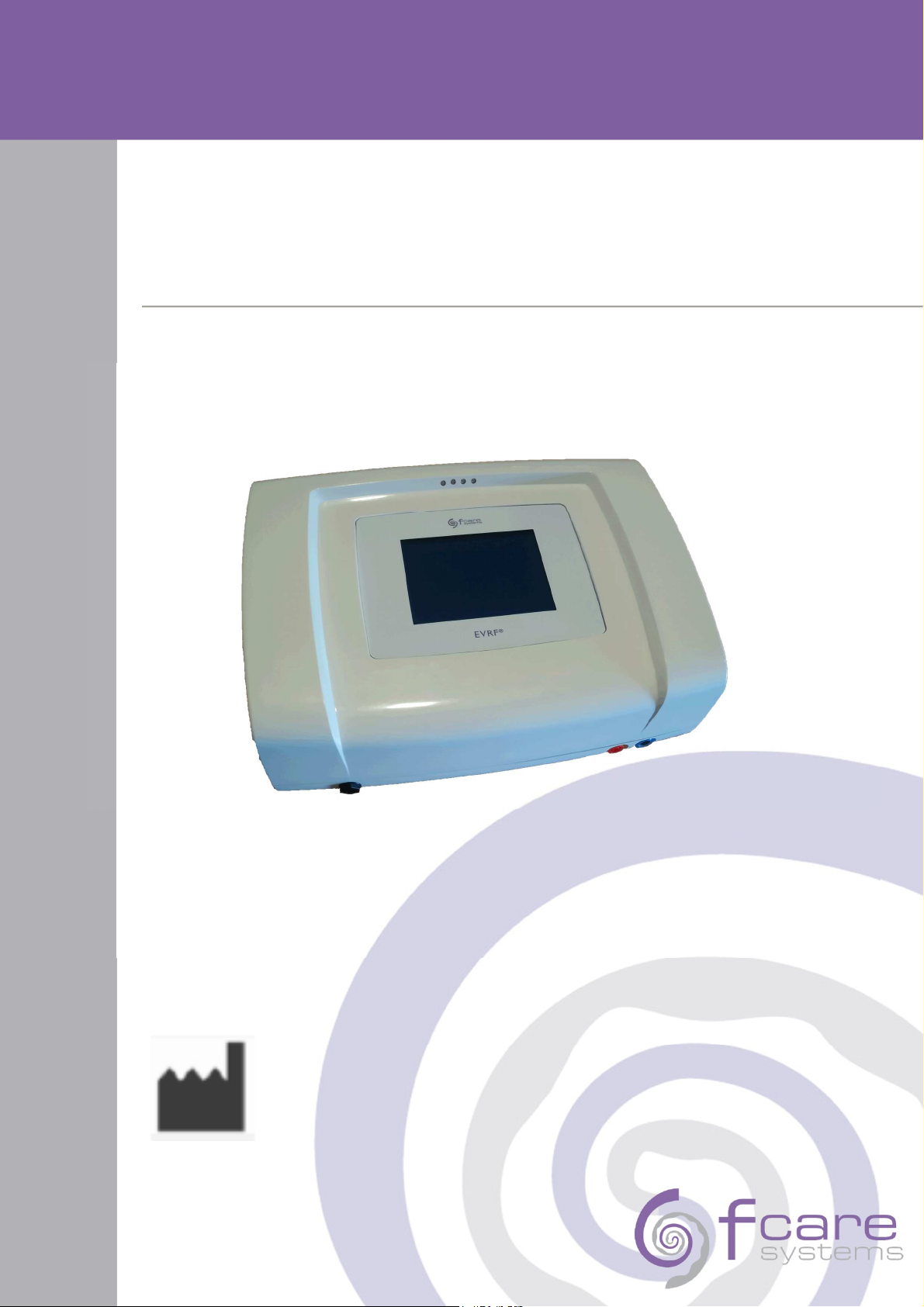
MANUAL THERMOCOAGULATION - EVRF
26/06
/2018
MANUAL
EVRF
D
.Mue.EVRF.18
F CARE SYSTEMS NV
Date
Oosterveldlaan 99
B-2610 - Antwerp - Belgium
TEL: +32 3 451 51 45
FAX: +32 3 451 51 39
WWW.FCARESYSTEMS.COM
Page 1 of 34 Revision N° : 18
Page 2

MANUAL THERMOCOAGULATION - EVRF
26/06
/2018
We thank you for your confidence
The PRODUCT includes a plan of two years guarantee
covering:
- All the spare parts
- Working-hours
This guarantee is only applicable on the condition that the guarantee card is returned
to F Care Systems and that all the clauses of safety measures were applied strictly.
For this we ask you to read the chapter: SECURITY INSTRUCTIONS of this manual.
For any further information or any technical problem concerning the product, we will
stay fully at your disposal.
READ THE INSTRUCTIONS BEFORE CONNECTING THE INSTRUMENT IN SERVICE.
THE USE OF THIS DEVICE IS RESERVED ONLY TO
PEOPLE WHO ARE QUALIFIED AND TRAINED ON THE
SUBJECT
ALL THE INSTRUCTIONS OF THIS MANUAL MUST BE FOLLOWED STRICTLY.
Date
Page 2 of 34 Revision N° : 18
Page 3

MANUAL THERMOCOAGULATION - EVRF
26/06
/2018
GUARANTEE CARD
This card must be returned to F Care Systems within 15 days after reception of the
EVRF.
F Care Systems NV
Oosterveldlaan 99
B-2610 - Antwerp - Belgium
NAME:
*************************************
ADDRESS:
**************************……*********.
*************************************.
POSTAL CODE: ………………………………………………………………………………………
TOWN: *………………………………………………………………………………………….
COUNTRY: *******************************..
EVRF N°: ***********.
received on: ***********.
I, undersigned (name and function) ............................................................ state to
have taken knowledge of the chapter of security instructions of this user’s manual
and I engage, in the name of my establishment, to apply it and to make it apply.
NAME and SIGNATURE STAMP
Date
Page 3 of 34 Revision N° : 18
Page 4

MANUAL THERMOCOAGULATION - EVRF
26/06
/2018
Summary
1 SECURITY INSTRUCTIONS ........................................................................................................................ 6
1.1 ELECTRICAL SECURITY................................................................................................................................ 6
1.2 ELECTROMAGNETIC DISRUPTION .................................................................................................................. 6
1.3 PROTECTION AGAINST EXPLOSION ................................................................................................................ 6
1.4 SECURITY BY INSTALLATION ......................................................................................................................... 6
1.5 SECURITY DURING USE .............................................................................................................................. 7
1.6 TECHNICAL CONTROL ................................................................................................................................ 7
1.7 GUARANTEE AND LIABILITIES ....................................................................................................................... 7
1.8 CLEANING AND SERVICING .......................................................................................................................... 8
1.9 IN CASE OF PROBLEMS ............................................................................................................................. 10
1.10 PRACTICAL ADVICE ................................................................................................................................. 10
1.11 RESTRICTION STERILE CATHETERS ............................................................................................................... 10
2 TECHNICAL CHARACTERISTICS ............................................................................................................... 11
2.1 GENERAL CHARACTERISTICS ...................................................................................................................... 11
2.2 EXPLANATION OF THE SYMBOLS ................................................................................................................. 11
2.3 OUTPUT CHARACTERISTICS ....................................................................................................................... 12
2.4 LABEL EXPLANATION ............................................................................................................................... 12
2.5 FUNCTIONING ....................................................................................................................................... 12
2.6 DECLARATION OF CONFORMITY ................................................................................................................. 13
3 INDICATION FOR USE ............................................................................................................................ 14
3.1 SPIDER VEINS AND TELANGIECTASIA ............................................................................................................ 14
3.2 VARICOSE VEINS .................................................................................................................................... 14
3.3 PERFORATING VEINS ............................................................................................................................... 14
3.4 SAPHENA PARVA AND SAPHENA MAGNA....................................................................................................... 14
3.5 HEMORRHOIDS ..................................................................................................................................... 14
3.6 CONTRA INDICATIONS ............................................................................................................................. 15
3.7 CAUTION ............................................................................................................................................. 15
3.8 POSSIBLE SIDE EFFECTS AND COMPLICATIONS ................................................................................................ 16
3.9 IMPORTANT .......................................................................................................................................... 16
4 DESCRIPTION OF THE EVRF AND THE ACCESSORIES ............................................................................... 17
4.1 FRONT FACE OF THE EVRF ....................................................................................................................... 17
4.2 BOTTOM SIDE OF THE EVRF ..................................................................................................................... 17
4.3 ACCESSORIES ..................................................................................................................................... 17
4.3.1 Foot pedal .............................................................................................................................. 18
4.3.2 Output cable........................................................................................................................... 18
4.3.3 3M cable ................................................................................................................................. 18
4.3.4 Needle-holder pen
4.3.5 Needles .................................................................................................................................. 19
4.3.6 CR30KAB catheter ................................................................................................................ 19
4.3.7 Insertion needles ................................................................................................................... 19
4.3.8 CR40i catheter ....................................................................................................................... 20
4.3.9 CR45i catheter and 6 French Introducer ............................................................................. 20
4.3.10 The 3M Pad ........................................................................................................................... 20
4.3.11 HPR45i probe ........................................................................................................................ 20
(with connection cable) ......................................................................... 18
5 USE OF THE EVRF SYSTEM ..................................................................................................................... 21
5.1 CONFIGURATION OF THE EVRF ................................................................................................................. 22
5.1.1 Language settings ................................................................................................................. 22
5.1.2 Screen contrast ..................................................................................................................... 22
5.2 USE OF THE EVRF .................................................................................................................................. 23
5.2.1 Needle holder ........................................................................................................................ 23
Date
Page 4 of 34 Revision N° : 18
Page 5

MANUAL THERMOCOAGULATION - EVRF
26/06
/2018
5.2.2 CR30KAB catheter ................................................................................................................ 24
5.2.3 CR45i catheter: ...................................................................................................................... 24
5.2.4 Hemorrhoids .......................................................................................................................... 25
5.3 ERROR AT START-UP ............................................................................................................................... 26
5.4 SET-UP AND USE OF EVRF PADS ................................................................................................................ 27
6 ANNUAL CONTROL FORMS.................................................................................................................... 28
7 DEFECT REPORT FORM .......................................................................................................................... 34
Date
Page 5 of 34 Revision N° : 18
Page 6
MANUAL THERMOCOAGULATION - EVRF
26/06
/2018
1 SECURITY INSTRUCTIONS
1.1 Electrical Security
Check that the electrical safety provisions of the place where the equipment will be
installed comply with current regulations, before the apparatus is taken in service.
Risk of damaging the apparatus in case of excessive voltages or mains cut.
Check if the voltage and the frequency indicated at the back of the apparatus, are
conform to the electricity mains of the region.
The apparatus must only be used with the cable provided together with the device. It
must always be connected to a ground plug, conform to the local regulations for medical
premises.
In case of usage of a power extension cable, the leakage currents may increase. The
apparatus, in this case, might not be conform to security standards anymore.
1.2 Electromagnetic disruption
The apparatus is equipped with a filter for mains suppression. To avoid any eventual
disruption, don’t use the apparatus near to another sensitive high frequency device.
(Doppler, Pacemaker, etc.).
1.3 Protection against explosion
The apparatus must be disconnected from the power when the room, where the
apparatus is located, is disinfected.
Don’t use the apparatus in places where flammable gas or steam is present.
1.4 Security by installation
The apparatus cannot be installed at a location with high atmospheric dampness.
Avoid penetration of any liquids inside the apparatus because it is not watertight.
Don’t let the apparatus get wet.
If liquid has penetrated into the apparatus, stop the treatment immediately and
disconnect the apparatus from the mains. Have the apparatus checked by a competent
person.
Don’t expose the apparatus to high temperatures (>40°C).
Don’t install the apparatus near a heat source (e.g. central heating) and never under
the direct light of the sun.
Never cover the ventilation grate at the back of the apparatus. These vents must be
free to provide good air circulation.
Don’t expose the apparatus to rain.
The apparatus may never undergo vibrations.
Don’t keep the apparatus in places where the temperature is lower than 10°C.
Date
Page 6 of 34 Revision N° : 18
Page 7

MANUAL THERMOCOAGULATION - EVRF
26/06
/2018
1.5 Security during use
At the end of the treatment, make sure that you “switch off” the apparatus.
Immediately replace any defective cable.
It is recommended that the patient is not connected with the applied parts before the
apparatus has been switched ON.
The apparatus must only be used with accessories, maintenance parts, and
consumption products, of which the technical security on use has been controlled and
approved by a control organism, entrusted with the mission of control of the apparatus
and its accessories.
It is important to inform the patient about the sensation he or she will feel during
treatment with the device. The treatment is not for:
People who are prone to diseases.
People who do not understand (mentally) what will happen or who are not rational
enough to distinguish between “normal” and “abnormal” (comatose patients, nonintellectual people).
People who can’t express themselves or reveal abnormal sensations (infants,
elderly).
People with epilepsy, heart failure, pregnancy.
People who refuse the treatment.
See also chapter contra-indications.
1.6 Technical control
The user must submit the apparatus to technical control, conform the medical instructions
93/42/CEE, at least once a year or after each repair.
This technical control consists of:
a) Visual monitoring and cleaning of EVRF.
b) Securities control.
c) A control of all functions.
d) Measurement of output signals.
e) Control of the foot pedal.
f) Control of the needle holder.
g) Measurement of leakage currents.
The results of this control must be collated on the control form (at the end of this manual) and
must be realised by competent people who are recommended by the company F CARE
SYSTEMS.
1.7 Guarantee and liabilities
1.7.1.1 Conditions of guarantee:
The device comes with a 2 year guarantee and 7 years on spare parts, from the day of
the purchase (mentioned on the invoice which you have to store).
Are in guarantee: manufacturing defects and the repairing of hidden defaults once they
have been proved.
Date
Page 7 of 34 Revision N° : 18
Page 8
MANUAL THERMOCOAGULATION - EVRF
26/06
/2018
Also falls under warranty: the repairing of defective components. The purchaser must
inform F CARE SYSTEMS about the expiry date of the guarantee, by registered letter
with acknowledgement of receipt.
No compensation can be asked as a prejudice due to the immobilization of the
apparatus. The pick-up and return charges are for the purchaser.
The yearly guarantee mentioned doesn’t apply for: the repair of a breakdown or
mistakes due to a bad use of the apparatus or of its accessories, an erroneous
interpretation of the manual, negligence or an accident, bad maintenance of the device
or a repairing of the apparatus realised by an incompetent person - not recommended
by F care systems.
1.7.1.2 Not covered by warranty:
Incorrect operation of the device.
The regulations, repairs or modifications effectuated by the purchaser or by a third party
not recommended by F care systems.
Damage of the delivery device (box, housing, display) caused by the transport or by
dropping it.
Any external interventions, (fire, lightning, flood, natural disaster, explosion, war,
excessive voltage, etc.).
If proved that the apparatus has been opened.
If the identification of the apparatus has been changed or modified.
If the guarantee form has not been returned within 15 days after the delivery date,
incorrectly or incompletely filled in.
1.7.1.3 Liabilities:
After a period of 10 years since purchasing the device, F CARE SYSTEMS will not be
held responsible for any errors and their consequences
F Care Systems cannot be blamed for any eventual consequences for the device, the
user or the patient; for example, as wrong use of the device or the accessories, wrong
interpretation or no use of the manual, bad maintenance or repair of the device by an
incompetent person - not recommended by F CARE SYSTEMS.
F CARE SYSTEMS cannot be blamed in case of electrical discharge, cardiac sickness
or allergy on a patient due to a bad manipulation, bad connections due to excessive
regulations or to a wrong use of the accessories. Neither the manufacturer, nor F CARE
SYSTEMS will be blamed in case of transmission of infections by the needles.
1.8 Cleaning and servicing
AS SECURITY PRECAUTION, DISCONNECT THE APPARATUS FROM THE NETWORK
BEFORE ANY SERVICING OR REPAIRING!
In order to give a permanent guarantee of safety and quality of the device, it is
prohibited for any incompetent person to open the device or accessories.
Opening the device or its accessories is only reserved for competent people
approved by F CARE SYSTEMS.
Date
Page 8 of 34 Revision N° : 18
Page 9
MANUAL THERMOCOAGULATION - EVRF
26/06
/2018
1.8.1.1 Apparatus
You can clean the external face of the apparatus with a soft, dry rag or a damp rag.
Don't use aggressive products because they can damage the parts inside the device.
In case of streaks or smears, use non aggressive soapy water.
No liquid may penetrate into the apparatus - dry the device carefully after cleaning.
1.8.1.2 Hygiene
The needles, catheters and probes are sterile and for single use. Never use the same
needle, catheter or probe for more than one patient and wear gloves during the
treatment.
Reusing or re-sterilizing the needles, catheters or probes can result in
transmission of blood borne pathogens (including HIV and Hepatitis) and
endanger patients and operators.
1.8.1.3 Waste handling
Please, throw the single use products in the appropriate bio-medical waste bins,
according to national regulations.
1.8.1.4 End of life considerations:
At the end of its life, the product is taken out of service. European legislation and
sometimes national laws arrange the basic principles on how to treat the product.
Different rules apply depending on possible contamination risks. For electrical and
electronic equipment, the EU Directive on WEEE deals with recovery and treatment
of waste at European level.
Recommendations:
The user must contact the MANUFACTURER if he is unsure what to do with the
product when it is taken out of service.
1.8.1.5 Fuses
The replacement of the fuses, accessible through the fuse holder of the mains power
supply, must be realised with a flat screwdriver. The two fuses are type F2A/250V in
glass 5 mm per 20 mm.
Maintenance
The EVRF device must be controlled annually by F care systems or a company
authorised by F care systems after the warranty has expired.
Transport and storage
The apparatus can be transported and stored in the following environment conditions:
Room temperature between – 40°C and + 70°C.
Relative dampness between 10% and 100%.
Atmospheric pressure comprised between 500 hPa and 1060 hPa.
After 15 weeks the device must pass the procedure test again.
Date
Page 9 of 34 Revision N° : 18
Page 10
MANUAL THERMOCOAGULATION - EVRF
26/06
/2018
1.9 In case of problems
- The apparatus doesn’t switch on:
Check if the power cable is well connected to the device and put the switch on "I".
- There is no output signal:
Check first if the pen is well connected to the apparatus. If this is the case there is a problem
with the pen itself, so you have to take another one.
1.10 Practical advice
Never place the unit in direct sunlight during treatment.
Place the machine on a solid and flat surface.
Use the EVRF only at temperatures between 10 °C – 40 °C.
Do not expose to rain and moisture.
When applied, the entire area of neutral electrode/pad should be reliably attached to a
suitably prepared and appropriate area of the patients’ body. We recommend the lower
back, shoulder or buttocks area.
Patient should not come in contact with earthed metal parts or parts with appreciable
capacitance to earth (for example table supports).
Monitoring electrodes should be placed away as far as possible from the treatment
zone.
It is recommended not to use needle monitoring electrodes.
It is recommended to use monitoring systems incorporating high frequency current
limiting devices.
Apparent low output or failure of the EVRF to function correctly may indicate faulty
application of the electrode/pad or poor contact in its connections (only if working in
CR45i mode).
It is recommended to use non-flammable agents for cleaning and disinfecting wherever
possible.
It is possible that the EVRF causes interference, which may adversely influence
operation of other electronic equipment.
1.11 Restriction sterile catheters
The following restrictions are applicable for the sterile accessories:
- Do not use in case of damaged packing or if in doubt about sterility.
- Do not use after expiration date, expiration date is shown on label.
- Do not sterilise the accessories after use, the accessories should be disposed after end of
treatment.
- Do not use the accessories on multiple patients, the accessories should be disposed after
end of treatment.
- Only use for approved applications (see chapter 3 Indication for use).
Date
Page 10 of 34 Revision N° : 18
Page 11
MANUAL THERMOCOAGULATION - EVRF
26/06
/2018
!
2 TECHNICAL CHARACTERISTICS
2.1 General characteristics
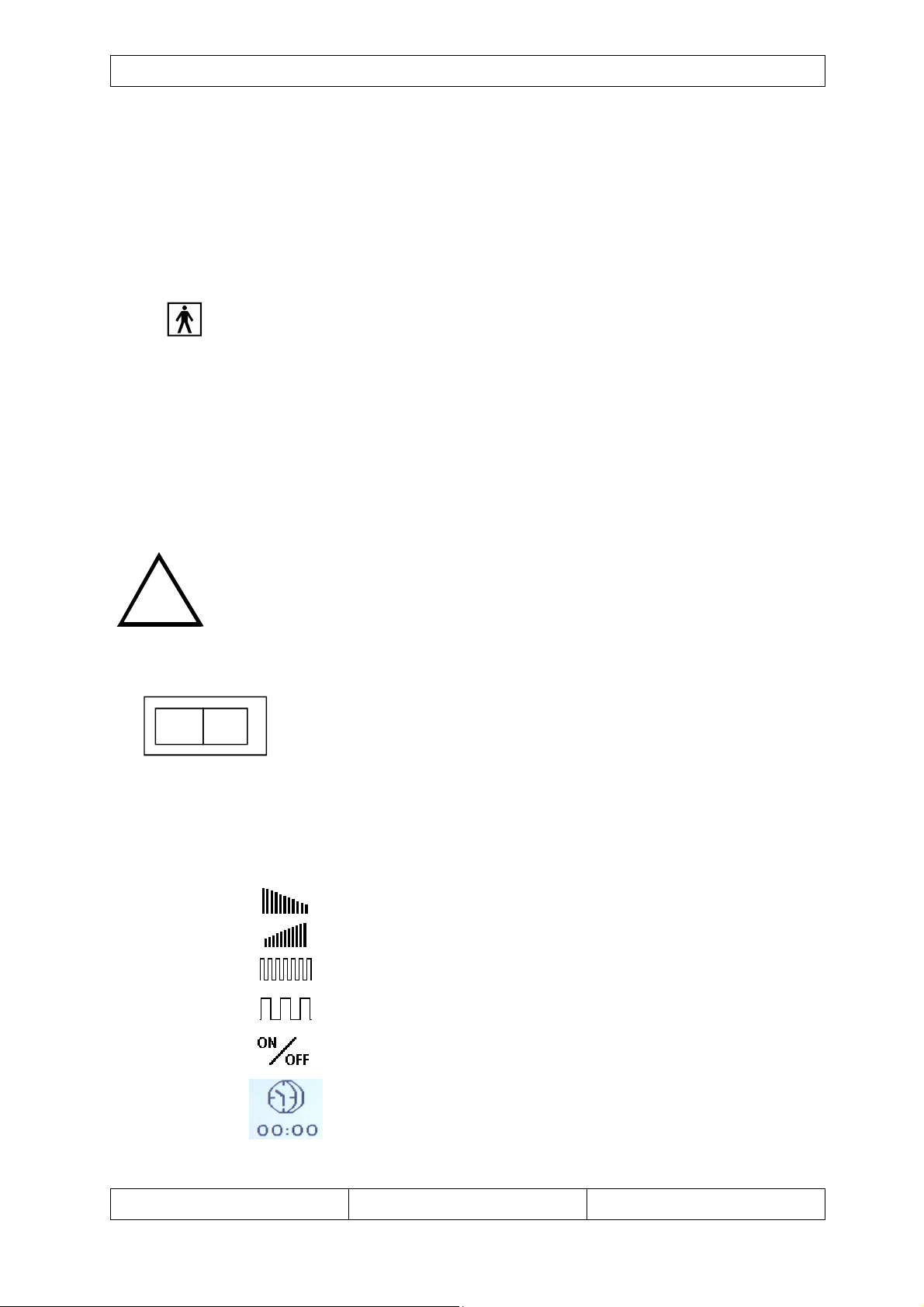
Supply Voltage: 110-230V / 50-60Hz ~.
Power : 125VA.
BF type apparatus .
Protection degree against liquid penetration: IPX0.
Temporized fuse in glass.
Work in continuous.
Dimensions : W = 360 mm, D = 280 mm, H = 120 mm.
Weight: +/- 5 Kg.
Class IIb apparatus.
Insulation: class I.
Output of the thermo-coagulation (HF) signal.
Fuse reference: 2x F2A / 250V.
1 0
2.2 Explanation of the Symbols
Switch on/ Switch off button.
Confirm.
Cancel.
Navigate.
Reduce power.
Increase power.
Reduce impuls.
Date
Page 11 of 34 Revision N° : 18
Increase impuls.
Switch between ON/OFF state.
Session timer.
Page 12
MANUAL THERMOCOAGULATION - EVRF
26/06
/2018
U
FREQ
P
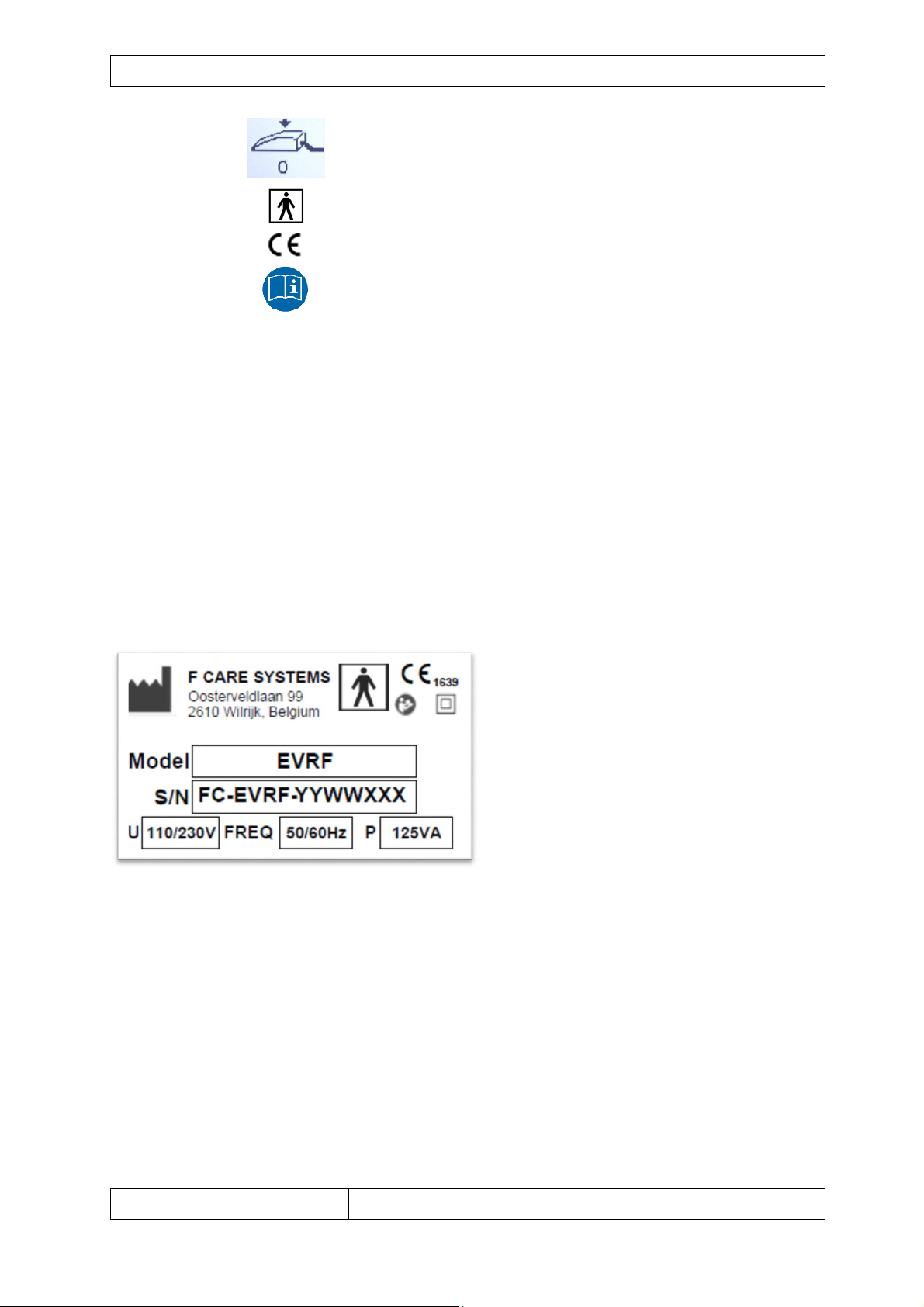
The number of impulse per session.
Type BF device.
CE marking.
Read manual before use.
Allowed voltage.
Frequency.
Maximum power.
2.3 Output characteristics
This apparatus generates some high frequencies impulses whose characteristics are:
Frequency of the wave : 4 MHz.
Max voltage in output : 660V.
Max time of impulse : 0,8s.
Continuous mode.
2.4 Label explanation
1: Type BF apparatus.
2: Name + address of fabricant.
3: CE number.
4: Read operating manual before usage.
5: Model/apparatus name.
6: Serial number.
7: Technical specifications.
2.5 Functioning
The apparatus works in the following environment:
Room temperature between +10°C and + 40°C.
Relative dampness comprised between 30% and 80%, condensation comprised.
Atmospheric pressure comprised between 700 hPa and 1060 hPa.
The power supply cannot exceed a voltage of 230V~+-10% of the rated voltage.
Date
Page 12 of 34 Revision N° : 18
Page 13
MANUAL THERMOCOAGULATION - EVRF
26/06
/2018
2.6 Declaration of conformity
DECLARATION OF CONFORMITY
We,
F Care Systems NV
Oosterveldlaan 99, B-2610 Wilrijk, Belgium
Hereby declare that under our sole responsibility that the CE marked product to which this
declaration relates.
Product type:
treatment of varicose veins, spider veins and hemorrhoids,
including treatment of the great saphenous vein (vena saphena
magna) and small saphenous vein (vena saphena parva).
Product name:
Thermo-coagulator using radiofrequency ablation intended for
EVRF
Has been classified as Class IIb, according to annex IX, rule 9, of the Medical Device
Directive93/42/EECand is in conformity with the essential requirements and provisions of the
Council Directive 93/42/EEC concerning medical devices. and is in conformity with the
relevant harmonized standards:
EN 1041:2008+A1:2013 EN 60601-1:2006/AC:2010
EN ISO 14971 :2012 EN 60601-1-2 : 2007
EN ISO 15223-1:2016 EN 60601-2-2:2009 + A11 (2012)
EN 62304:2006/AC:2008 EN 62366:2015
and is subject to the procedure set out in Annex II of the Council Directive 93/42/EC.
This declaration is made on base of quality assurance certificate.
N° BE 10/23574093
Delivered by SGS Belgium, N° 1639
Signed :
Name: Rudi Devers.
Function: Managing Director.
Date
Page 13 of 34 Revision N° : 18
Page 14

MANUAL THERMOCOAGULATION - EVRF
26/06
/2018
3 Indication for Use
3.1 Spider veins and Telangiectasia
The EVRF has a connection cable to the needle holder which accepts small insulated needles
to treat spider veins and telangiectasia. The EVRF software allows the user to pre-set an
energy level and an impulse time so that the exact energy can be administered to coagulate a
small spider vein.
Spider veins are small veins on the legs or the face with a diameter between 0,3 and 0,9 mm
which are treatable with the EVRF radio frequency.
3.2 Varicose veins
The EVRF has a special connection to the CR30KAB catheter. This catheter can be inserted
into a varicose vein through a 20 gauge access needle.
The catheter is flexible and can be routed through veins that are not too tortuous.
The EVRF software allows the user to set the energy level so that the varicose vein can be
coagulated. The tip of the flexible PTFE coated catheter is from steel and the RF energy
allows the tip to heat so that the vein coagulates.
The CR30KAB allows the coagulation of varicose veins with a diameter of about 2 to 5mm.
3.3 Perforating veins
When the valves of perforator veins become incompetent they can cause venous reflux when
the muscles contract. The resulting reflux can cause a rapid deterioration in an existing
varicose disease and be responsible for the development of venous ulcers.
3.4 Saphena parva and saphena magna.
The EVRF has a connection to a CR45i catheter which because of its larger diameter can
coagulate the large saphenous vein and the small saphenous vein.
The energy to be supplied is indicated by the lights on the EVRF device or by the sound that
each light accompanies.
The catheter is also covered with a PTFE coating. The tip of the catheter is in metal and
conducts the radio frequency signal in the vein wall. The 4 MHz vibrations of the tip make the
cells in the vein wall increase in temperature and coagulate.
Saphena magna with diameters between 5 and 18mm can be treated with the EVRF and the
CR45i catheter.
3.5 Hemorrhoids
The EVRF has a connection to the HPR45i probe, which is a small stiff probe with a noninsulated tip. The EVRF delivers energy the same way as with the CR45i catheter to the tip of
the HPR45i probe so that the tip makes the hemorrhoidal tissue heat up and coagulate.
Hemorrhoids are also vein based so that the coagulation of the hemorrhoid will make it shrink
and fall off or disappear. Hemorrhoids of grade 2, 3 and 4 can be treated with the EVRF and
the HPR45i probe.
The fact that the outer part of the hemorrhoid is hardened because of the coagulation will
make the hemorrhoid stop growing and will make it shrink.
Date
Page 14 of 34 Revision N° : 18
Page 15

MANUAL THERMOCOAGULATION - EVRF
26/06
/2018
3.6 Contra Indications
For all types of treatment
- People with heart disease including pace maker.
- Pregnant patients, including breastfeeding.
- Patients younger than 18 years.
- Contraindication to local anesthetic.
For spider vein treatment
- Allergy to nickel.
For varicose vein treatment
- Deep venous insufficiency.
- Obstructed deep venous system.
- Deep vein thrombosis.
- Allergic to substances in tumescence.
For hemorrhoid treatment
- Cutaneous infection.
- Anal fissures.
- Infective anal pathologies like cryptitis & proctitis.
- Allergic to substances in tumescence.
- Presence of stitches from previous Longo treatment and patients with bleeding disorders.
3.7 Caution
The following precautions need to be taken for each type of treatment:
- Patient may not be grounded or connected to any other radio frequency device.
- Care and vigilance must be exercised when treating patients who are on aspirin or
anticoagulant therapy, due to the possibility of increased bleeding.
- Care and vigilance must be exercised when treating patients who suffer from hyper
coagulopathy.
For treatment of varicose veins precautions need to be taken when treating patients with
following conditions:
- Congenital vasculopathies.
- Thrombophilia.
- Sciatic vein reflux.
- Occlusive peripheral arterial disease.
For treatment of hemorrhoids the following precautions are additional:
- Always work above the dentate line.
- Patients who have had Longo treatment require a radioscopy to detect remaining stitches.
Date
Page 15 of 34 Revision N° : 18
Page 16

MANUAL THERMOCOAGULATION - EVRF
26/06
/2018
3.8 Possible side effects and complications
Following side effects and complications can be experienced during or after the treatment.
Spider vein treatment
- Pain
- Skin pigmentation
- Skin burn
Varicose vein treatment
- Skin hyperpigmentation.
- Skin burns.
- Saphenous nerve damage.
- Ecchymosis.
- Paresthesia.
- Puncture site infection.
- Scar.
- Periphlebitis.
- Induration.
- Edema.
- Bruising.
- Hypersensitivity to metal (stainless steel type AISI316L)
Hemorrhoid treatment
- Bleeding (including mild serosanguinous discharge).
- Edema.
- Slime forming.
- Thrombose.
- Anal fissure.
- Fever.
- Strong pain.
- Incontinence to flatus
- Hypersensitivity to metal (stainless steel type AISI316L)
- Chronic/delayed wound healing
Following hemorrhoid treatment complications are unlikely but cannot be ruled out
- Urinary retention.
- Skin tag formation.
- Increased tension of the anus.
- Marginal hematoma.
- Marginal clot – single or multiple.
- Late Complications: Too much energy in the same area, energy could be distributed to the
anal canal and might result in damaging the internal sphincter.
3.9 Important
Before treatment of varicose veins can be performed it should be checked if the deep vein
system functions correctly.
Patients should avoid exposure to sunlight until all bruising and redness has disappeared to
avoid hyperpigmentation.
Date
Page 16 of 34 Revision N° : 18
Page 17
MANUAL THERMOCOAGULATION - EVRF
26/06
/2018
2
1
Before the treatment of hemorrhoids, it is advised to perform a rectoscopy analysis to look for
serious diseases: rectal cancer(carcinoma) or polyps. If the patient recently had a rectoscopy
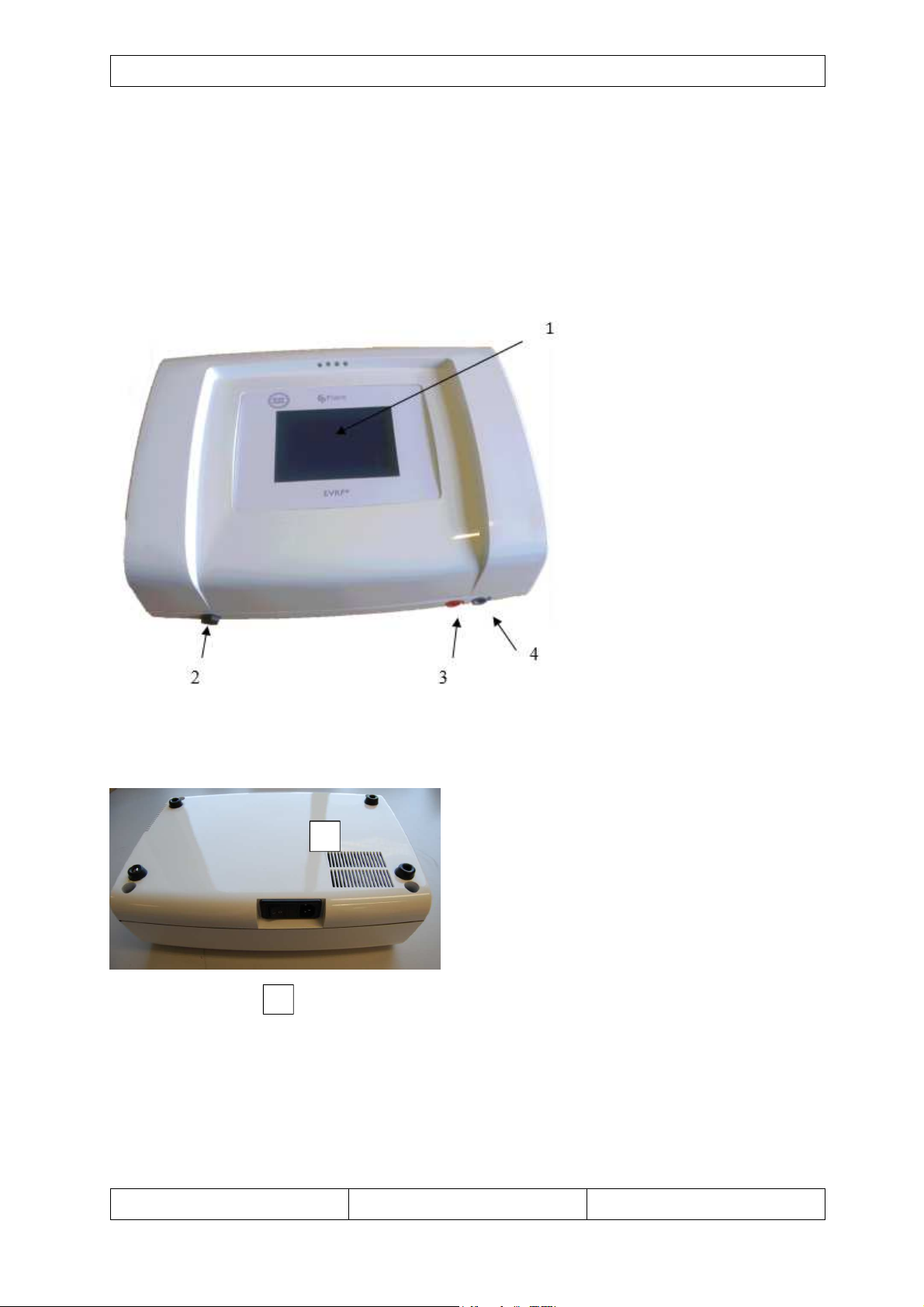
or colonoscopy, then another rectoscopy analysis is not required.
4 DESCRIPTION OF THE EVRF AND THE ACCESSORIES
4.1 Front face of the EVRF
1. Display with touchscreen.
2. Connection for the 3M
cable (black).
3. Connection for the output
cable (red).
4. Connection for the foot
pedal (blue).
4.2 Bottom side of the EVRF
1. Main power supply + fuse holder +
ON/OFF Switch.
2. Cooling fan.
4.3 Accessories
For the correct functioning of the EVRF accessories are required.
Attention: use of accessories and cables other than those provided by F Care Systems could
result in malfunctioning of the EVRF.
The accessories of the EVRF are the following:
Date
Page 17 of 34 Revision N° : 18
Page 18
MANUAL THERMOCOAGULATION - EVRF
26/06
/2018
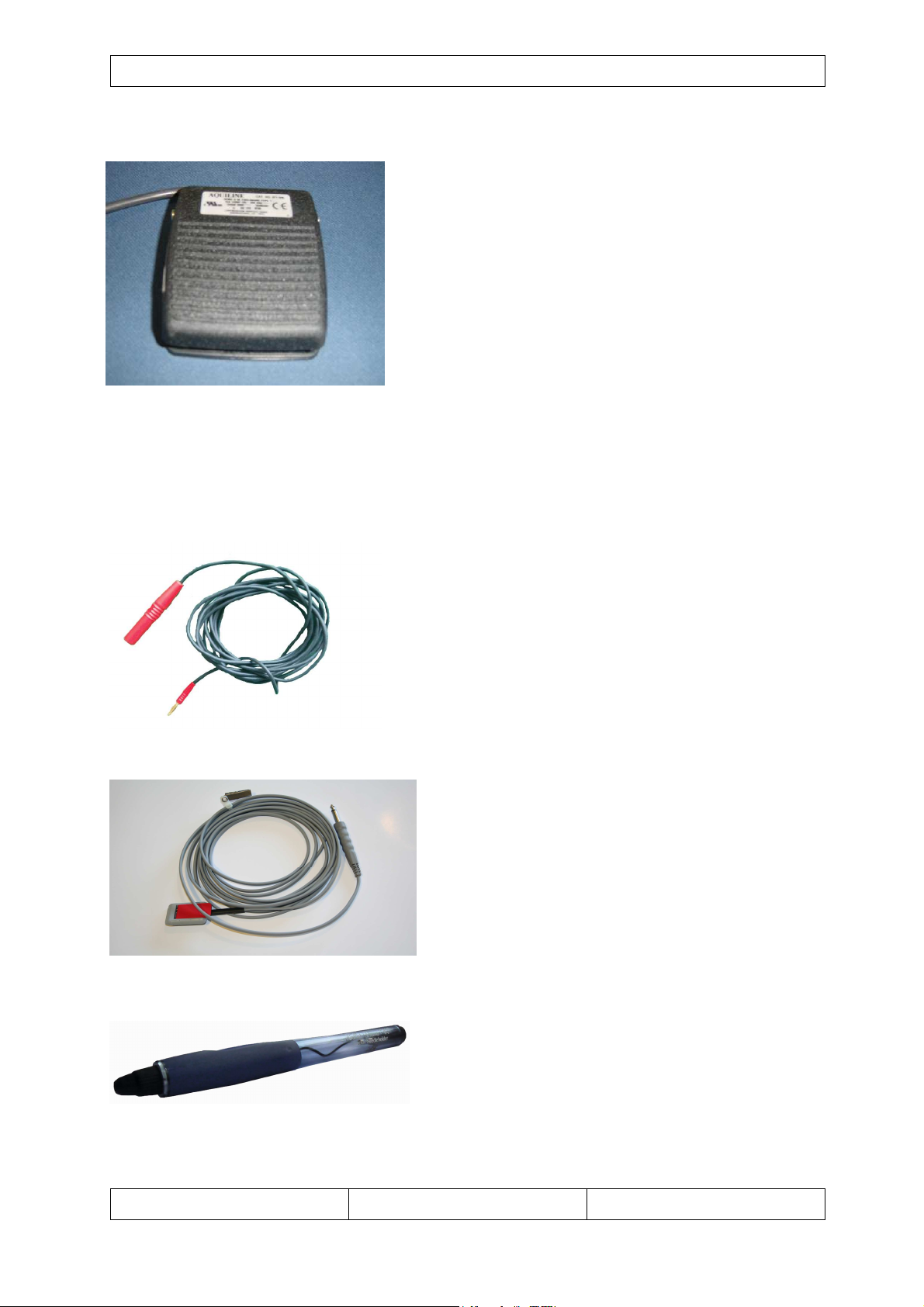
4.3.1 Foot pedal
The foot pedal permits to activate the high frequency impulses.
It connects the blue connector with the EVRF.
4.3.2 Output cable
4.3.3 3M cable
Cable used to connect the apparatus to the needle
holder or catheter CR30KAB.
Cable used to connect the neutral electrode (3M
pad) to the apparatus.
4.3.4 Needle-holder pen
Date
(with connection cable)
To be used in combination with the sterile K3i or K6i
needles.
When linked to the apparatus, it permits to transmit
the high frequency impulses through the needle for
treatment of telangiectasia.
Page 18 of 34 Revision N° : 18
Page 19
MANUAL THERMOCOAGULATION - EVRF
26/06
/2018
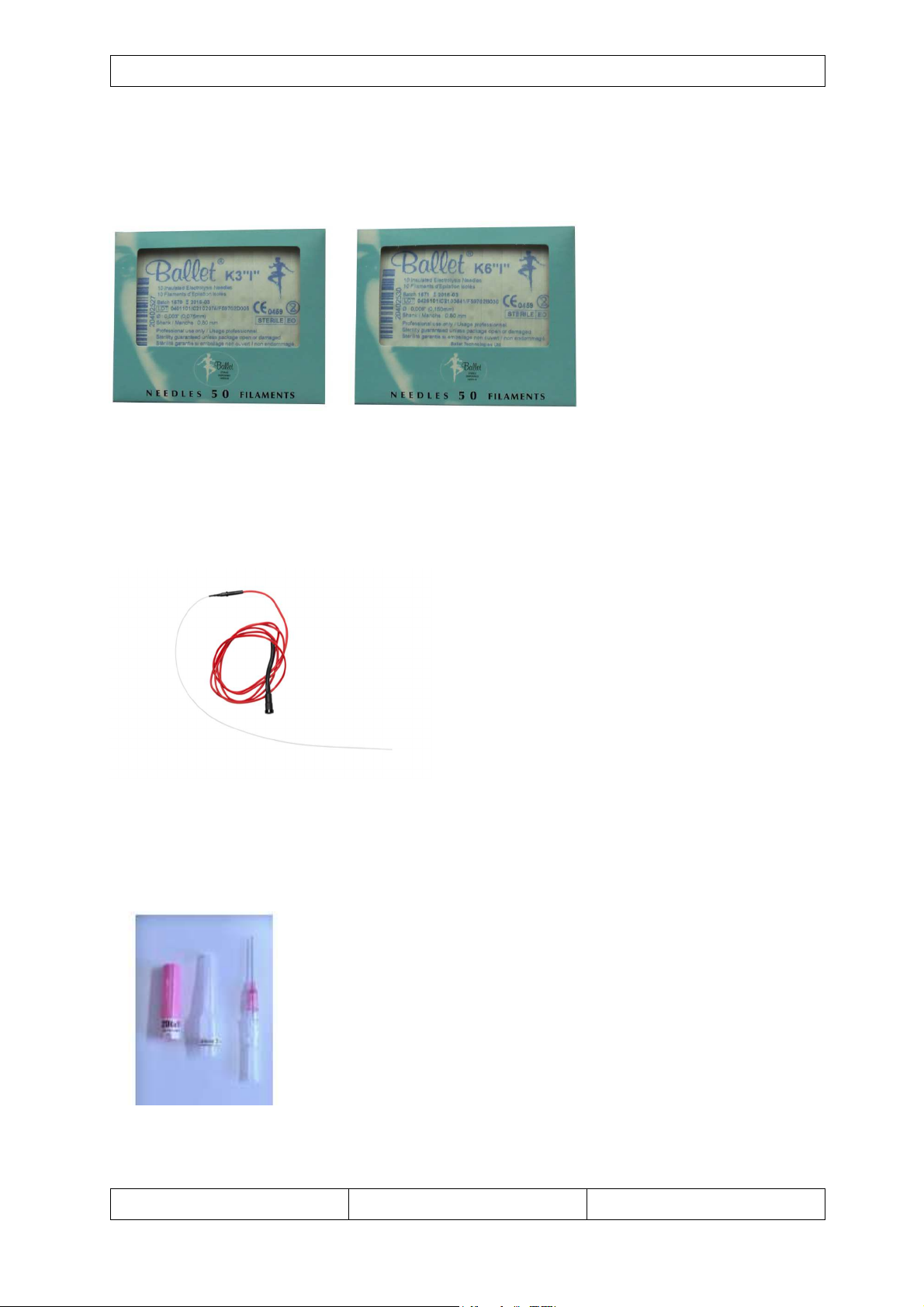
4.3.5 Needles
The apparatus is delivered
with a set of Ballet needles.
The needles are
available in 2sizes,
“Ballet K3i” (0,075 mm)
and “Ballet K6i” (0,150
mm), and are made out of
chromium and nickel
material.
In case the patient has a
Nickel or Chromium allergy do not use these needles, see chapter contra indications.
The needles are marked CE0459 conform to the Directive 93/42/CEE.
The needles are single use and must be used before their expiry date.
4.3.6 CR30KABi catheter
Reticular, collateral and perforating veins can be
treated with F Care Systems’ CR30KAB catheter.
The catheter is extremely flexible, so that they
follow the direction of the vein easily. Smooth
insertion is ensured with the advanced coating
material around the catheter.
The non-insulated tip transmits the high
frequency signal to the vein wall. This causes the
vein to coagulate and eventually disappear.
4.3.7 Insertion needles
The insertion needles are used to make the initial insertion in the
vein. After the insertion has been done you pull the needle out and
leave the flexible part in the vein. This flexible part will guide the
catheter of the handset into the vein.
Insertion needles for CR30KAB
Date
Page 19 of 34 Revision N° : 18
Page 20
MANUAL THERMOCOAGULATION - EVRF
26/06
/2018
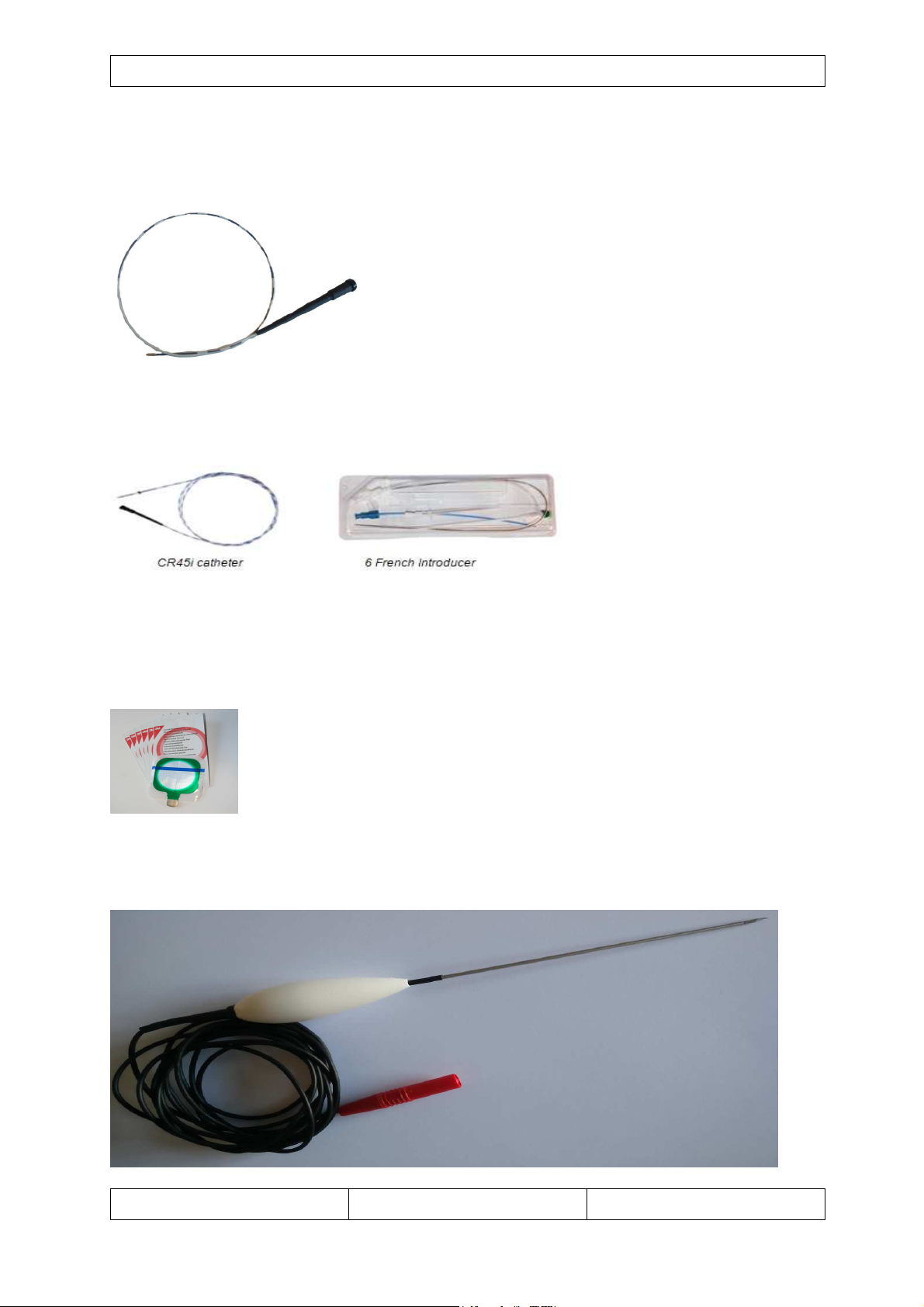
4.3.8 CR40i catheter
For the treatment of perforating veins, the CR40i catheter
can be used. The catheter can be inserted in the vein for
up to 25cm.
Thermocoagulation of the perforating veins is performed
with a 0,5 cm long tip, which is pulled back slowly so the
entire vein closes. Smooth and fast insertion is ensured by
the advanced coating material around the flexible core.
The markings allow for easy positioning during pull-back.
4.3.9 CR45i catheter and 6 French Introducer
For the treatment of the Saphena Magna a 6 French Introducer and CR45i catheter are used.
The CR45i catheter is a special designed catheter for efficient removal of the Saphena Magna.
Thermocoagulation of the Saphena Magna is performed with a 0,5 cm long tip, which is pulled
back slowly so the entire vein closes. Smooth and fast insertion is ensured by the advanced
coating material around the flexible core.
4.3.10 The 3M Pad
The neutral electrode is to be used when working with a catheter type
CR45i. The neutral electrode is attached to the patient.
The entire area of neutral electrode/pad should be reliably attached to a
suitably prepared and appropriate area of the patients’ body. We
recommend the lower back, shoulder or buttocks area.
3M Pad
4.3.11 HPR45i probe
With the HPR45i probe hemorrhoids degree 2-4 can be treated easily and effectively.
Date
Page 20 of 34 Revision N° : 18
Page 21
MANUAL THERMOCOAGULATION - EVRF
26/06
/2018
5 USE OF THE EVRF SYSTEM
The use of the EVRF is very easy.
Connect the foot pedal to the apparatus (blue plug).
If needed connect the non-sterile output cable to the device (only required for needle
holder CR30KAB treatment).
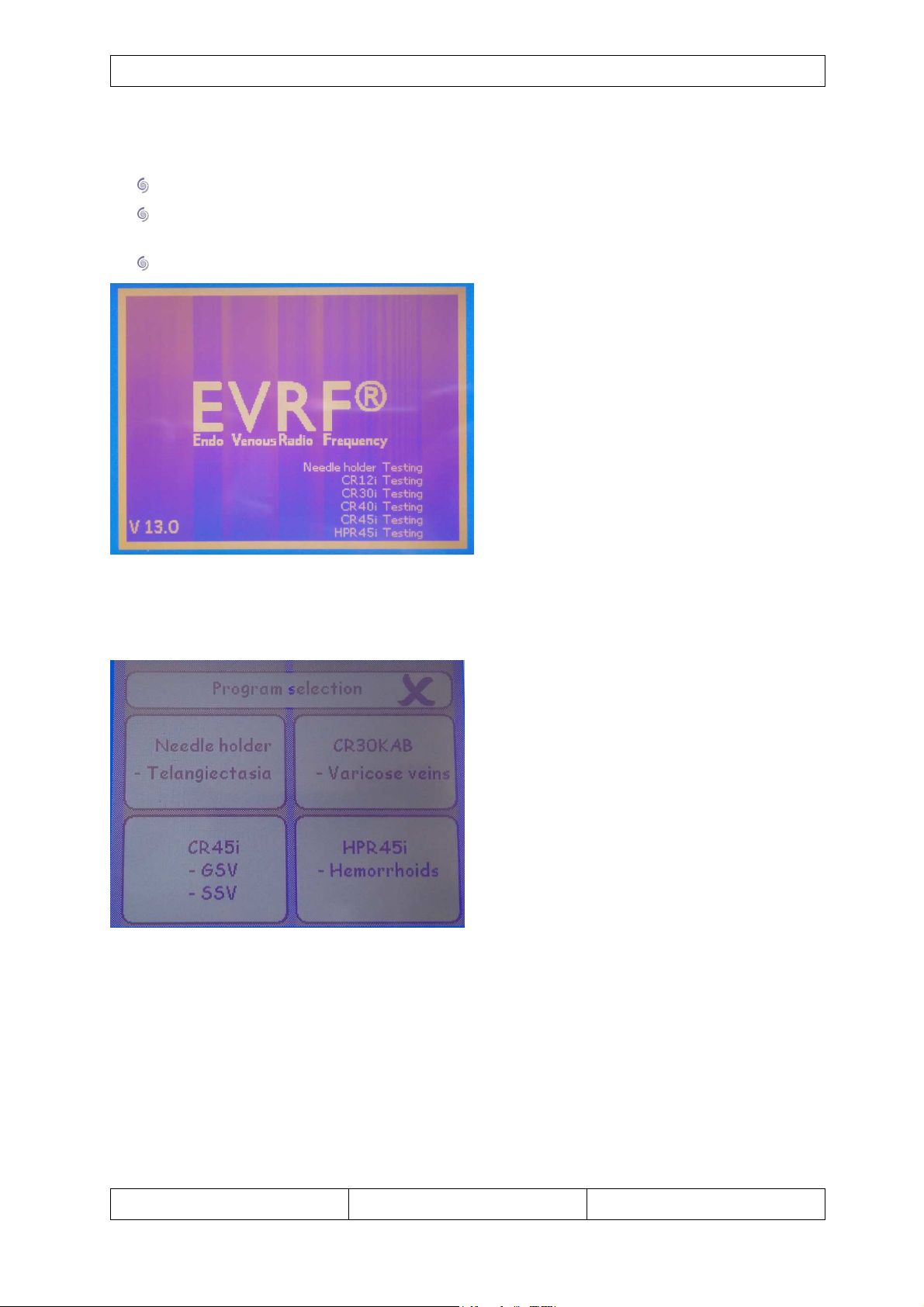
Switch on the apparatus, the welcome screen appears.
The welcome screen is shown while the
EVRF is testing the different programs.
In case a problem is found with one of the
possible programs a warning screen is
shown (see chapter 5.3).
If all programs are functioning correctly, then the program selection screen is shown.
In this menu you have the option to choose
between 4 modes:
-Telangiectasia with needle holder < 1mm.
-Varicose veins with CR30KAB catheter < 15 mm.
-GSV/SSV with CR45i catheter.
-Haemorrhoids with HPR45i probe.
Changing the selection can be done by
touching the button.
By touching you go to the settings screen.
Date
Page 21 of 34 Revision N° : 18
Page 22
MANUAL THERMOCOAGULATION - EVRF
26/06
/2018
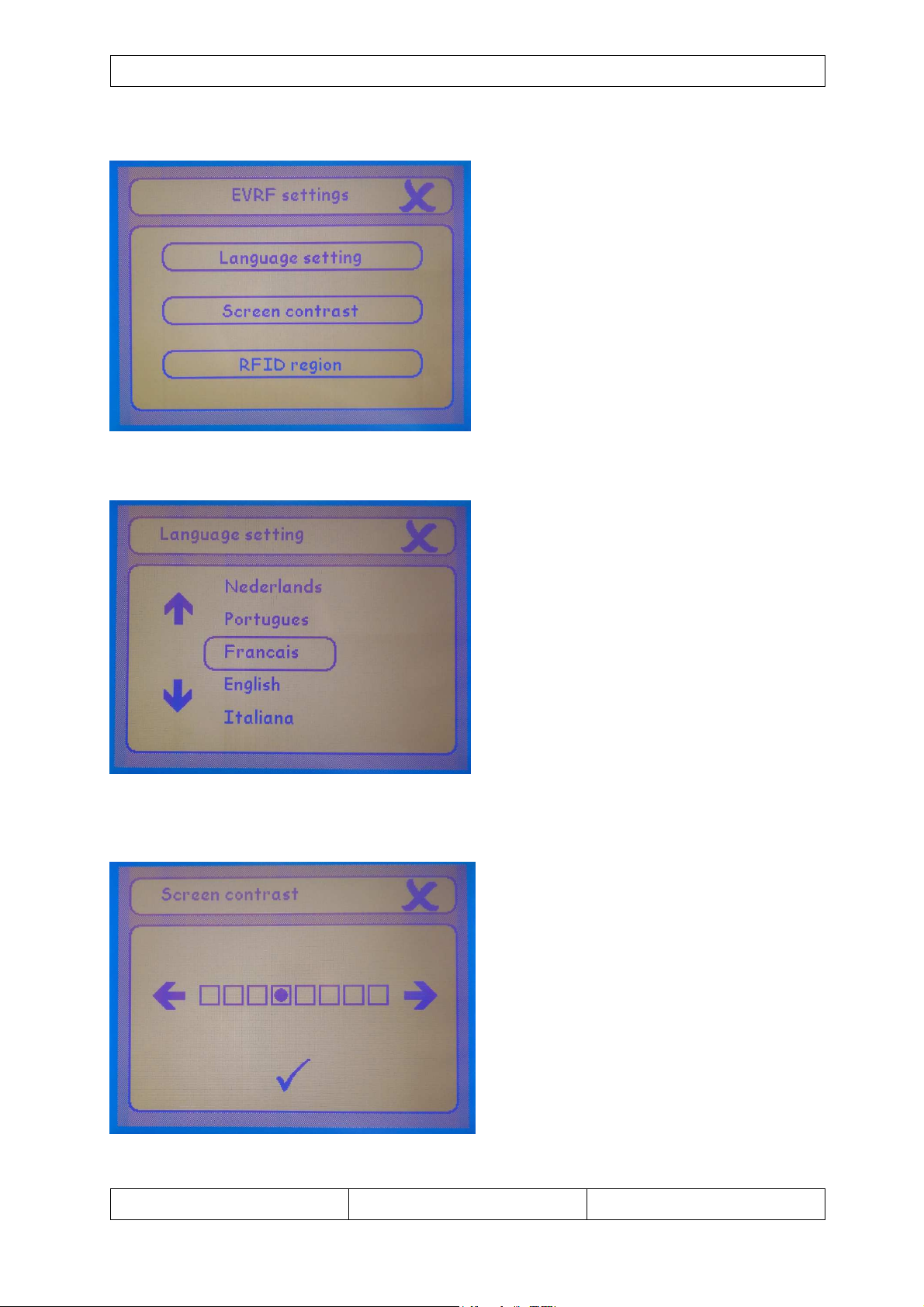
5.1 Configuration of the EVRF
After touching the button in the program
selection screen you end up in the settings
screen.
In this screen you have the option to alter 2
settings: language and screen contrast.
By touching one of the buttons you will be
able to change the selected option.
By touching you go back to the mode
selection screen.
5.1.1 Language settings
If the "language setting" option was
chosen, we end up in the following screen.
5.1.2 Screen contrast
Several languages can be selected: French
– English - Italian – Spanish - German Dutch.
Choose the desired language with the
up/down arrows and touch the language you
wish. Touch to cancel and return to the
settings selection.
If "screen contrast" was chosen, we enter
the screen to change the contrast.
Choose the desired contrast settings with
the left/right arrows and touch to accept.
Touch to cancel and return to the mode
selection.
Date
Page 22 of 34 Revision N° : 18
Page 23
MANUAL THERMOCOAGULATION - EVRF
26/06
/2018
5.2 Use of the EVRF
When we are in the program selection screen we have the option to enter the Needle holder
treatment screen or to enter the Scan screen.
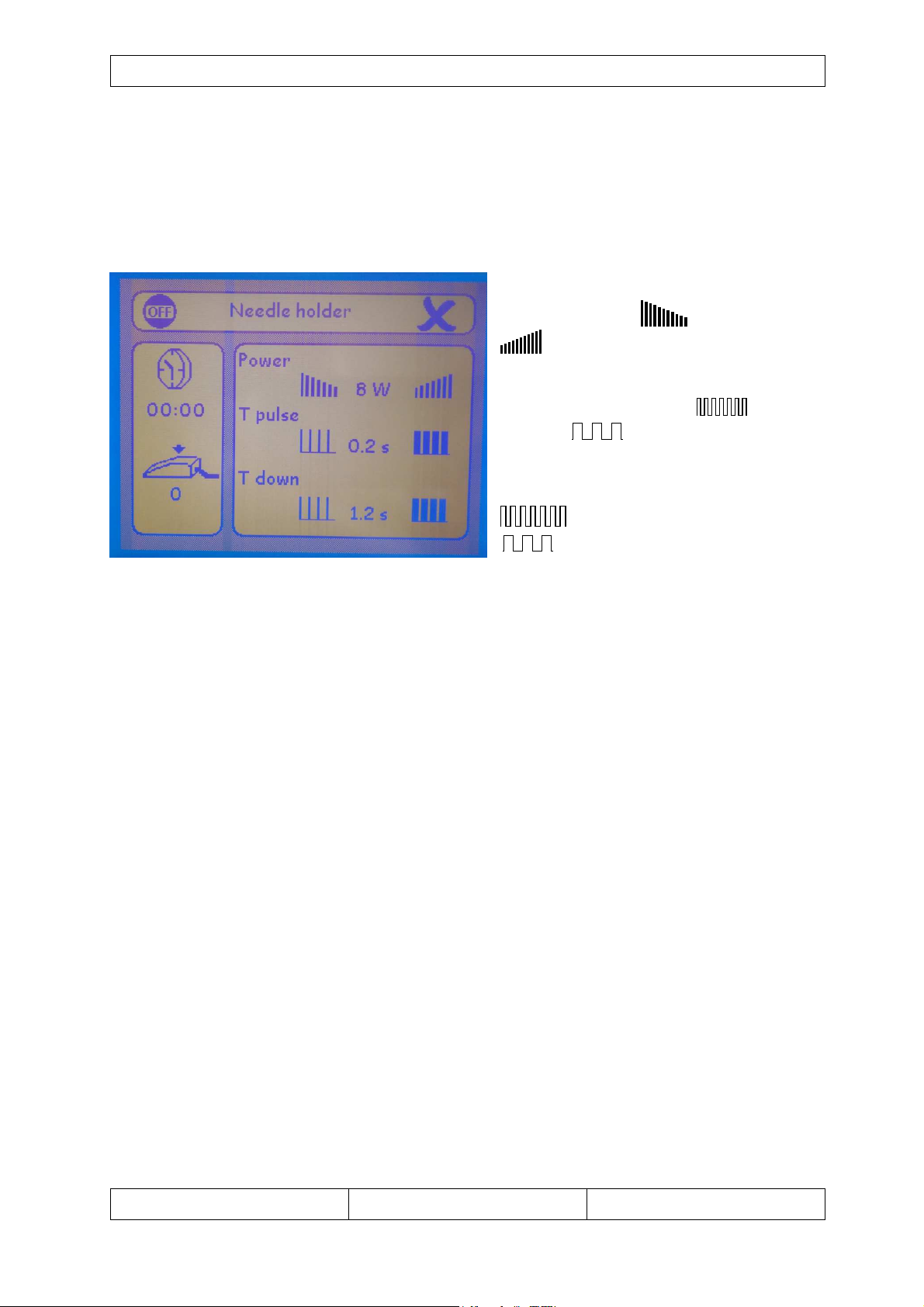
5.2.1 Needle holder
The Power setting, standard on 8Watt,
can be decreased or increased
between 5W and 15W.
The duration of the impulse width (T
pulse). We can decrease or
increase the duration.
The time between 2 pulses (T down).
This time can be decreased by touching
or increased by touching
.
On the left we have a clock which indicates the duration of the treatment.
On the left below we have a drawing of a foot pedal with a counter which will indicate the
number of pulses given.
The OFF icon in the top left corner indicates that the EVRF is in “OFF” mode. By touching on
“OFF” the EVRF is changed to “ON” and is ready to be used.
A beep indicates that the impulse is transmitted.
The beep stops as soon as the duration of the impulse is finished (ex: an impulse of 0.2 S will
generate 2 sound beeps; an impulse of 0.4 S will generate 4 sound beeps).
If, after the first pulse is finished, the foot pedal is still activated then the “T Down” time starts.
After T Down is finished and the foot pedal is still activated a new pulse will be transmitted. If
you don’t want to use the “T Down” feature then you need to deactivate the pedal first before
a new pulse is transmitted.
The EVRF will give a sound beep every two seconds, so you know that every beep, you have
generated 2 times the watt that was set on the EVRF. This is the amount of joule that the EVRF
generated.
Date
Page 23 of 34 Revision N° : 18
Page 24
MANUAL THERMOCOAGULATION - EVRF
26/06
/2018
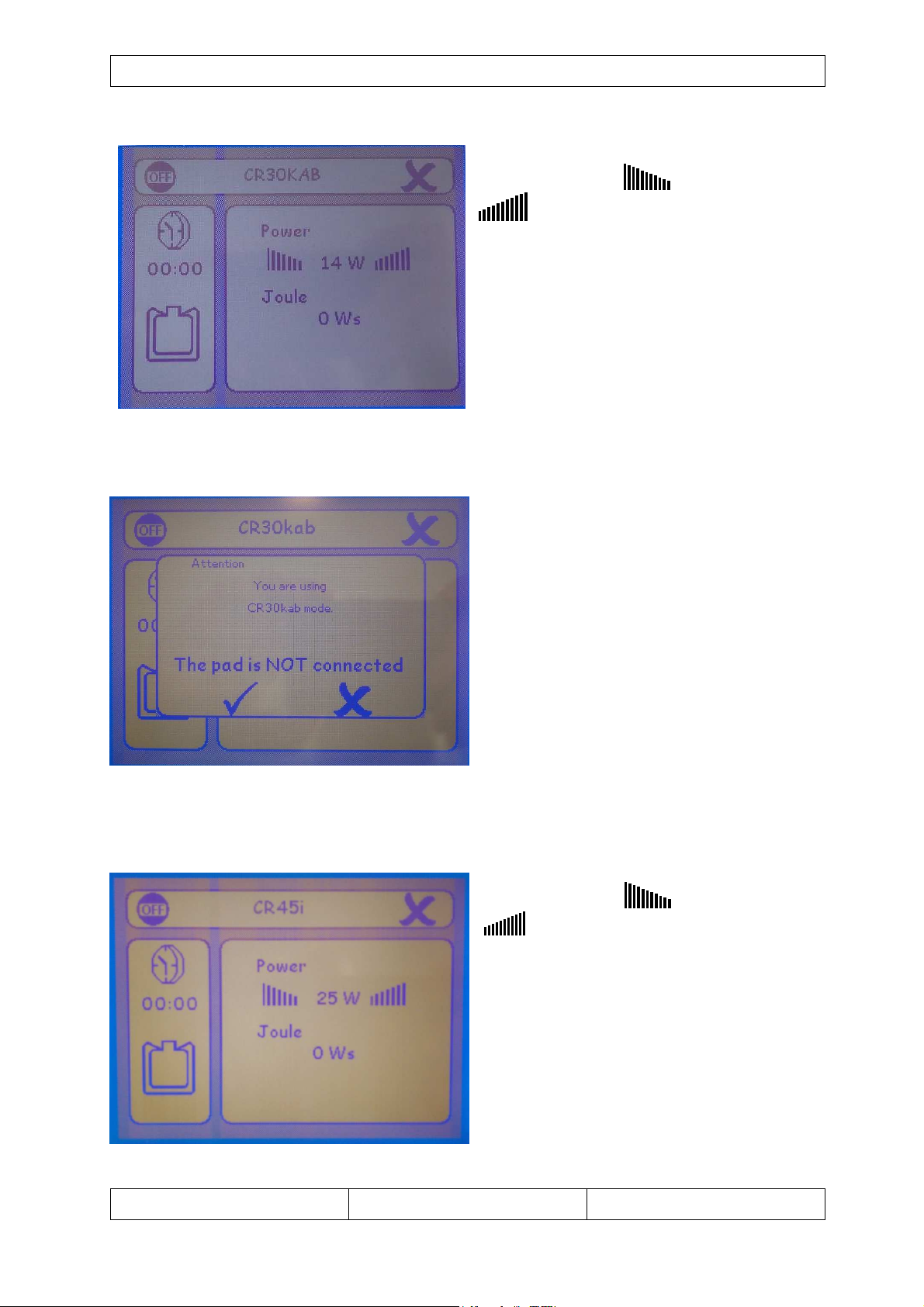
5.2.2 CR30KAB catheter
- The Power setting, standard on 16Watt,
can be decreased or increased
between 8W and 25W.
- Continuous mode. When the pedal is
pressed the output is active until the pedal
is released.
- “logo” Indication of whether or not the pad
is connected.
Joule:
-This is the sum of the amount of energy
generated over a period of time.
The EVRF will give a sound beep every two seconds, so you know that every beep, you
have generated 2 times the watt that was set on the EVRF. This is the amount of joule that
the EVRF generated.
When pressing the “OFF” button the device
will check if the output cable is connected.
If the cable is not connected a beep is
given and the device remains in “OFF”
mode.
5.2.3 CR45i catheter:
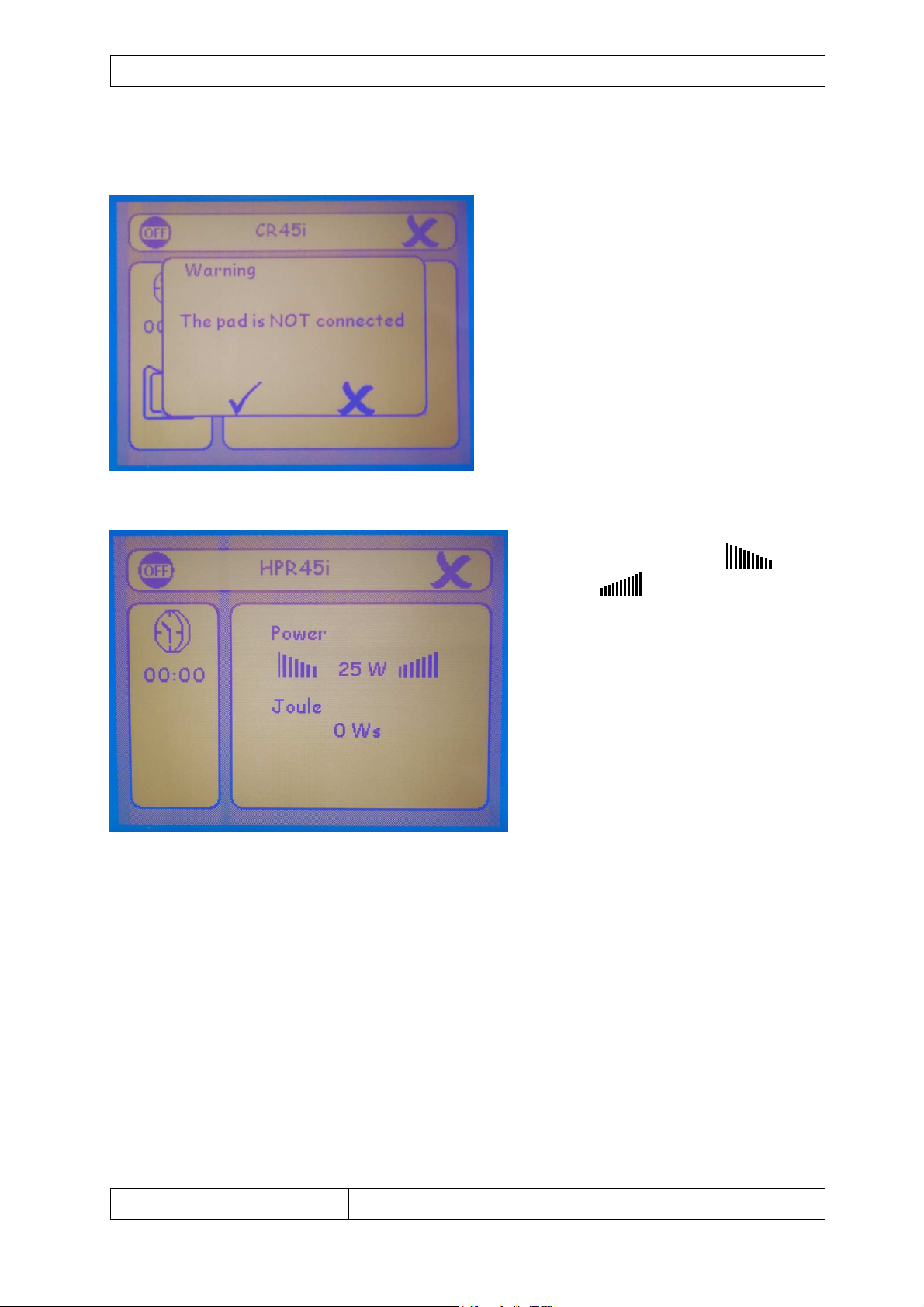
If the output cable is connected, then a
pop-up screen is shown with the status of
the pad. When you accept the pop-up then
the device will be place in “ON” mode.
If the pop-up is declined, then the device
remains in “OFF” mode.
You can also leave the program and return
to the program selection by pressing .
- The Power setting, standard on 25Watt,
can be decreased or increased
between 20W and 25W.
Continuous mode. When the pedal is
pressed the output is active until the pedal
is released.
LOGO Indication of whether or not the pad
is connected.
Date
Joule:
This is the sum of the amount of energy
generated over a period of time.
Page 24 of 34 Revision N° : 18
Page 25
MANUAL THERMOCOAGULATION - EVRF
26/06
/2018
The EVRF will give a sound beep every two seconds, so you know that every beep, you
have generated 2 times the watt that was set on the EVRF. This is the amount of joule that
the EVRF generated.
When pressing the “OFF” button the
device will check if the output cable is
connected. If the cable is not connected a
beep is given and the device remains in
“OFF” mode.
If the output cable is connected, then a
pop-up screen is shown with the status of
the pad. When you accept the pop-up then
the device will be place in “ON” mode.
If the pop-up is declined, then the device
remains in “OFF” mode.
You can also leave the program and return
to the program selection by pressing .
5.2.4 Hemorrhoids
- The Power setting, standard on
25Watt, can be decreased or
increased between 20W and
25W.
Continuous mode. When the pedal is
pressed the output is active until the
pedal is released.
Joule:
-This is the sum of the amount of
energy generated over a period of
time.
The EVRF will give a sound beep
every two seconds, so you know that
every beep, you have generated 2 times the watt that was set on the EVRF. This is the
amount of joule that the EVRF generated.
When pressing the “OFF” button the device will check if the output cable is connected. If the
cable is not connected a beep is given and the device remains in “OFF” mode.
The device will also check if the pad is connected. If the pad is connected, then a warning
will be shown advising to disconnect the pad. If the pad is not connected, then no message is
shown and the device is placed in “ON” mode.
You can also leave the program and return to the program selection by pressing . End of
the care.
To stop the care definitively, one touches the button. We return to the basic screen.
Date
Page 25 of 34 Revision N° : 18
Page 26

MANUAL THERMOCOAGULATION - EVRF
26/06
/2018
5.3 Error at start-up
When a problem is detected during start-up a warning screen is shown and the defective
program is locked to prevent usage. When trying to enter the program the machine will show
a warning screen explaining that the program is locked and that the device needs to be
revised.
Only the programs in which a problem was found are locked, other programs can still be
used safely.
Date
Page 26 of 34 Revision N° : 18
Page 27
MANUAL THERMOCOAGULATION - EVRF
26/06
/2018
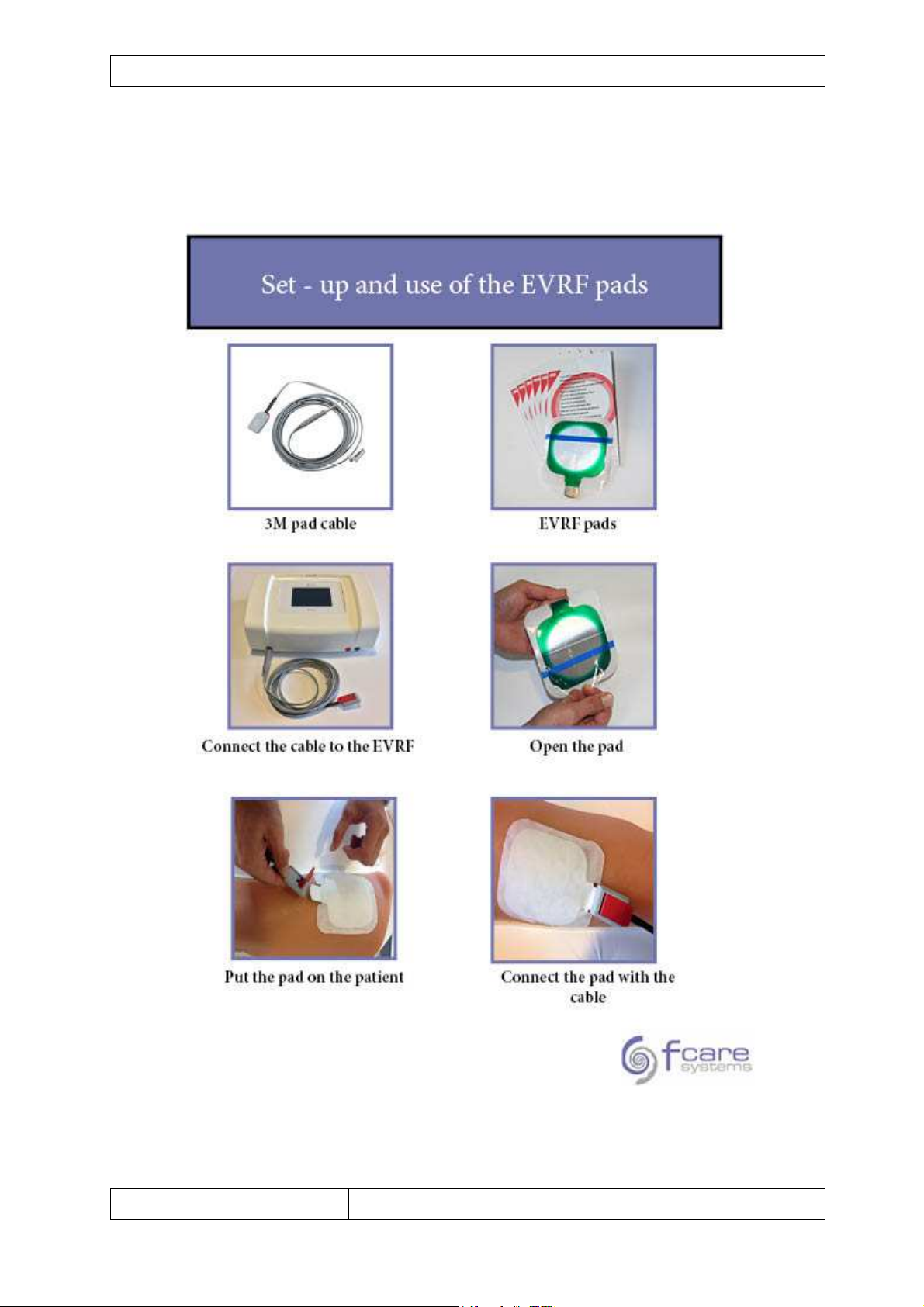
5.4 Set-up and use of EVRF pads
Date
Page 27 of 34 Revision N° : 18
Page 28

MANUAL THERMOCOAGULATION - EVRF
26/06
/2018
Control
at end of guarantee
Date of control
to carry out:
Date of
control:
Checks carried out:
Changed components:
Name and visa of the controller
Name and visa of the customer:
6 ANNUAL CONTROL FORMS
The EVRF must be submitted to an annual control for it to be in conformance with its CE
marking. During this control all the functions of the apparatus and, particularly, the safety of
the device is tested.
This chapter relates to the notebook of maintenance of the EVRF.
Visual check of EVRF.
Security control.
Control functions of orders.
Measuring of the output signals.
Control of the foot pedal.
Control of needle holder.
Control of output cables.
Needle holder.
Output cable.
Other components: @@@@@@@@@@@@@@@@@@@@@@@@
@@@@@@@@@@@@@@@@@@@@@@@@@@@@@@@@@@..
Date
Page 28 of 34 Revision N° : 18
Page 29

MANUAL THERMOCOAGULATION - EVRF
26/06
/2018
Control of year 2
Date of control to
carry out:
Date of
control:
Checks carried out:
Changed
components:
Name and visa of the controller
Name and visa of the customer:
Visual check of EVRF.
Security control.
Control functions of orders.
Measuring of the output signals.
Control of the foot pedal.
Control of needle holder.
Control of output cables.
Needle holder.
Output cable.
Other components: @@@@@@@@@@@@@@@@@@@@@@@@
@@@@@@@@@@@@@@@@@@@@@@@@@@@@@@@@@@..
Date
Page 29 of 34 Revision N° : 18
Page 30

MANUAL THERMOCOAGULATION - EVRF
26/06
/2018
Control of year
3
Date of control to carry
out: Date of
control:
Checks carried out:
Changed
components:
Name and visa of the controller
Name and visa of the customer:
Visual check of EVRF.
Security control.
Control functions of orders.
Measuring of the output signals.
Control of the foot pedal.
Control of needle holder.
Control of output cables.
Needle holder.
Output cable.
Other components: @@@@@@@@@@@@@@@@@@@@@@@@
@@@@@@@@@@@@@@@@@@@@@@@@@@@@@@@@@@..
Date
Page 30 of 34 Revision N° : 18
Page 31

MANUAL THERMOCOAGULATION - EVRF
26/06
/2018
Control of year
4
Date of control to carry
out: Date of
control:
Checks carried out:
Changed
components:
Name and visa of the controller
Name and visa of the customer:
Visual check of EVRF.
Security control.
Control functions of orders.
Measuring of the output signals.
Control of the foot pedal.
Control of needle holder.
Control of output cables.
Needle holder.
Output cable.
Other components: @@@@@@@@@@@@@@@@@@@@@@@@
@@@@@@@@@@@@@@@@@@@@@@@@@@@@@@@@@@..
Date
Page 31 of 34 Revision N° : 18
Page 32

MANUAL THERMOCOAGULATION - EVRF
26/06
/2018
Control of year
5
Date of control to carry
out: Date of
control:
Checks carried out:
Changed
components:
Name and visa of the controller
Name and visa of the customer:
Visual check of EVRF.
Security control.
Control functions of orders.
Measuring of the output signals.
Control of the foot pedal.
Control of needle holder.
Control of output cables.
Needle holder.
Output cable.
Other components: @@@@@@@@@@@@@@@@@@@@@@@@
@@@@@@@@@@@@@@@@@@@@@@@@@@@@@@@@@@..
Date
Page 32 of 34 Revision N° : 18
Page 33

MANUAL THERMOCOAGULATION - EVRF
26/06
/2018
Control of year
6
Date of control to carry
out: Date of
control:
Checks carried out:
Changed
components:
Name and visa of the controller
Name and visa of the customer:
Visual check of EVRF.
Security control.
Control functions of orders.
Measuring of the output signals.
Control of the foot pedal.
Control of needle holder.
Control of output cables.
Needle holder.
Output cable.
Other components: @@@@@@@@@@@@@@@@@@@@@@@@
@@@@@@@@@@@@@@@@@@@@@@@@@@@@@@@@@@..
Date
Page 33 of 34 Revision N° : 18
Page 34

MANUAL THERMOCOAGULATION - EVRF
26/06
/2018
7 Defect report form
This card must be returned to F CARE SYSTEMS within 15 days after occurrence of a
problem with the EVRF
F Care Systems NV
Oosterveldlaan 99
B-2610 –WILRIJK-ANTWERP - Belgium
Fax: +32 3 451 51 39
Email:
I, undersigned (name and function) ............................................................ state that,
when using EVRF N°: ***********., on date ******. to have
experienced the following problem with the EVRF:
........................................................................................................................................
........................................................................................................................................
........................................................................................................................................
........................................................................................................................................
........................................................................................................................................
........................................................................................................................................
........................................................................................................................................
........................................................................................................................................
........................................................................................................................................
........................................................................................................................................
........................................................................................................................................
........................................................................................................................................
NAME and SIGNATURE STAMP
Telephone number: ......................................................................................................
Email: ......................................................................................................
Date
Page 34 of 34 Revision N° : 18
 Loading...