

Page 1

E1808X, E1838X & E1848X
CHIEFTAIN Deep Fat Fryers
USER INSTRUCTIONS
CAUTION: Read the instructions before using the
appliance
SECTION 1 - GENERAL DESCRIPTION
WEEE Directive Registration No. WEE/DC0059TT/PRO
At end of unit life, dispose of appliance and any replacement parts in a safe
manner, via a licenced waste handler. Units are designed to be dismantled easily
and recycling of all material is encouraged whenever practicable.
Falcon Foodservice Equipment
HEAD OFFICE AND WORKS
Wallace View, Hillfoots Road, Stirling.
FK9 5PY. Scotland.
Phone: 01786 455200
SECTION 2 – CONTROLS and OPERATION
SECTION 3 – CLEANING and MAINTENANCE
SECTION 4 - SPARE PARTS
This appliance has been UKCA/CE marked based on compliance with the relevant Electrical and
Electromagnetic Compatibility (EMC) Regulations/Directives for the voltages stated on the data plate.
The appliance MUST BE installed by a competent person in compliance with the
INSTALLATION AND SERVICING INSTRUCTIONS and National Regulations in force at the
time.
UK regulations are listed on the front of the Installation and Servicing Instructions.
PREVENTATIVE MAINTENANCE CONTRACT
To obtain maximum performance from this unit regular servicing of the appliance should be undertaken to
ensure correct operation, it is functioning as intended, and safe to use. We recommend servicing in
accordance with SFG20 Maintenance Schedules and as a minimum, after 2,500 hours of use, or annually,
whichever comes first and that a maintenance contract be arranged with an appointed service contact.
Visits may then be made at agreed intervals to carry out adjustments and repairs.
WARNING - THE APPLIANCE MUST BE EARTHED.
Upon receipt of the User's Instruction manual, the installer should instruct the responsible
person(s) of the correct operation and maintenance of the unit.
This equipment is ONLY FOR PROFESSIONAL USE and shall be operated by QUALIFIED
persons. It is the responsibility of the Supervisor or equivalent to ensure that users
wear SUITABLE PROTECTIVE CLOTHING and to draw attention to the fact that, some parts
will, by necessity, become VERY HOT and will cause burns if touched accidentally.
T101009 Ref. 6
Page 2

Training and competence
To help ensure the safe use of this appliance there is a requirement for you to provide whatever
information, instruction, training and supervision as is necessary to ensure, so far as is reasonably
practicable, the health and safety of all users.
For further help and information on training and competence we would refer you the Health and Safety
Executive website; www.hse.gov.uk document ref: health and safety training INDG345. International
customers should default to the health and safety guidelines provided by your government body.
Risk assessment
As part of managing the health and safety of your business you must control any risks identified in your
commercial kitchen. To do this you need to think about what might cause harm to people and decide
whether you are taking reasonable steps to prevent that harm. This is known as risk assessment. It is
important to consider the environment around the product as well as the product itself. For example oil or
food spills will present a significant risk so users so the need to immediately clean up such spills must be
reflected in staff training.
For further help and information on risk assessments we would refer you to you the Health and Safety
Executive website; www.hse.gov.uk document ref: risk assessment INDG163. International customers
should default to the health and safety guidelines provided by your government body.
Cleaning and maintenance
When removing heavy items to aid cleaning or maintenance particular care should be taken. A manual
handling risk assessment is the best way to determine the level of risk to anyone using or maintaining this
equipment. To help with such an evaluation we have included the weights of individual components that
may present significant risk.
For further help and information on manual handling and associated risk assessment we would refer you
to you the Health and Safety Executive website; www.hse.gov.uk document ref: manual handling at work
INDG143. International customers should default to the health and safety guidelines provided by your
government body.
The cleaning of fryers or other products that use hot oil present significant risks to end users and particular
care should be taken. Cold water and hot oil for example are an explosive mix and should be avoided at
all costs.
Other useful references for health and safety issues www.hse.gov.uk
Essentials of health and safety at work ISBN978 Noise at work INDG362
Safe systems of work
Other notes added to the body of the instructions.
Page 3
S.0 SAFETY GUIDANCE
S.1 GENERAL SAFETY
S.1.1 These instructions are only valid if the country code appears on the appliance. If
the code does not appear on the appliance, refer to the technical instructions for
adapting the appliance to the conditions for use in that country.
S.1.2 These appliances have been UKCA/CE-marked based on compliance with
the Gas Appliance Regulations/Product Safety and Metrology Regulations,
Electrical and Electromagnetic Compatibility (EMC) Regulations/Directives for the
Countries, Gas Types and Pressures as stated on the data plate.
S.1.3 This equipment is for professional use only and must be used by qualied
persons.
S.1.4 Never leave this appliance unsupervised when in use and always turn products
o at the end of service.
S.1.5 The installer must instruct the responsible person(s) of the correct operation and
maintenance of the appliance.
S.1.6 Check that no damage has occurred to the appliance or supply cord during
transit. If damage has occurred, do not use this appliance.
S.1.7 If tted to the appliance, ensure the supply cord is routed free from the appliance
to avoid damage.
S.1.8 Min-Level Mark: Medium should never be allowed to drop below the mark.
Should this occur, top up immediately or switch o the fryer.
S.1.9 Suitable Protective clothing must be worn when topping up whilst the fryer is hot.
S.1.10 To prevent surge boiling. DO NOT EXCEED recommended loads or charge pan
with over-wet food items. NEVER leave a working appliance unattended.
S.1.11 If the appliance is tted with an oil bucket, take care when removing as oil bucket
is heavy when full.
S.1.12 Training and Competence: To help ensure the safe use of this appliance there is
a requirement for you to provide whatever information, instruction, training and
supervision as is necessary to ensure, so far as is reasonably practicable, the
health and safety of all users.
S.1.13
S.1.14 Risk Assessment: As part of managing the health and safety of your business
S.1.15 Record the training that you provide and support it by providing safe system of
For further help and information on training and competence we refer you to the
Health & Safety Executive website; www.hse.gov.uk document ref: health and
safety training INDG345. International customers should default to the health and
safety guidelines provided by your government body.
you must control any risks identied in your commercial kitchen. T
you need to think about what might cause harm to people and decide whether
you are taking reasonable steps to prevent that harm. This is known as risk
assessment. It is important to consider the environment around the product as
well as the product itself. For example, oil or food spills will present a signicant
risk so users so the need to immediately clean up such spills must be reected in
sta training.
work (SSOW) documents that set out procedures to be followed for potentially
hazardous tasks.
o do this
Page 4

S.1.16 For further help and information on risk assessments we would refer you to you
the Health and Safety Executive website; www.hse.gov.uk document ref: risk
assessment INDG163. International customers should default to the health and
safety guidelines provided by your government body.
S.2 INSTALLATION SAFETY
S.2.1 Installation must meet national or local regulations. Attention must be paid to:
safety (installation & use) regulations, health and safety at work act, local and
national building regulations, re precautions act.
S.2.2 The installer must instruct the responsible person(s) of the correct operation and
maintenance of the appliance.
S.2.3 On gas appliances, only competent persons are allowed to service or convert the
appliance to another gas type.
S.2.4 Put a documented system in place for periodic inspections, testing and
maintenance of our gas/ electrical appliances. Check that the xed electrical
installation has been inspected and tested by a competent electrical contractor
(e.g. NICEIC-approved or ECA member) as prescribed in BS7671, within the last
5 years.
S.3 ELECTRICAL SAFETY
S.3.1 To prevent shocks, this appliance must be earthed.
S.3.2 This unit is tted with an equipotential connection at the rear on the base.
S.3.3 Before attempting any maintenance, isolate the appliance at the mains switch
and take steps to ensure that it is not inadvertently switched on.
S.3.4 We recommend, Supplementary electrical protection with the use of a type A
residual current device (RCD).
S.3.5 Fixed wiring appliances incorporate a locally situated switch disconnector
to connect to, which is easily accessible for switching o and safe isolation
purposes. The switch disconnector must meet the specication requirements of
IEC 60947.
S.4 GAS SAFETY
S.4.1 Gas appliances must have a stop cock tted in the supply pipe work. The user
must be familiar with the location and operation of this device in order to turn o
the supply of gas in the event of an emergency.
S.4.2 Before Inspection, Servicing or Conversion, Turn O Gas at isolator.
Page 5

S.5 FIRE SAFETY
Fryers can present various hazards in the catering environment if not correctly
used, operated, and maintained. Hazards including re, burns from hot oil, contact
with hot surfaces, fumes from boiling cleaning chemicals, eye injuries from
splashes and slips from oil spillages.
Operator Competency and Training
S.5.1 Ensure you are trained in the safe and proper use of the fryer and know how to
turn it o and switch the power or gas o at the mains.
S.5.2 Ensure you are familiar with the kitchen re safety procedures and the location
and proper use of correct re safety equipment.
Fryer Safety Equipment
S.5.3 1.5.3 Provide an appropriate BS compliant re blanket, and an adequate number
of re extinguishers that comply with BS EN 3 (parts 1-6) and carry a BAFE or
LPCB approval mark. At least one must be appropriate for use on electrical res,
and one for deep-fat fryers (Class F).
Fryer Suppression System
S.5.4 We recommend kitchen equipment and extraction systems are protected with a
re suppression system. Check your insurance as this may also be a condition of
your policy.
S.5.5 1.5.5 Protect cooking and extraction equipment (including any associated
extraction ductwork and hoods inside the building) by having an extinguishing
system installed, in line with (or the equivalent of) LPS 1223. The system should
include a local alarm, automatic activation by a detection system and manual
activation – located a safe distance away from the cooking equipment, preferably
by a re escape route door.
Operational Fryer Safety
S.5.6 Do not leave the fryer unattended when powered on or when it is in use.
S.5.7 Always switch the fryer o and replace the pan cover/ lid when not in use.
Cleaning
S.5.8 Ensure fryers are regularly cleaned serviced and maintained by a qualied and
competent service provider, and there is enough room around the appliance to do so.
S.5.9 Ensure that the appliance, surrounding work area and extraction system are
regularly cleaned, (at least weekly) to avoid the build-up of fats oils and greases
that could present a re risk. A deep clean should be undertaken at least every 6
months by a specialist contractor.
Oil Safety
S.5.10 Do not operate the fryer with no or low oil levels.
S.5.11 Solid Fat (e.g. Beef Tallow) must be melted using the fat melt mode in order to
avoid re caused by burning of the fat and/or overheating. We do not recommend
using Solid Fat if the fryer control does not have a Fat Melt Cycle.
S.5.12 Regularly change your cooking oil. Use colour charts to check on oil quality.
Page 6
S.5.13 If you see the cooking oil or fat smoking, switch the fryer o, allow to cool, drain
oil, clean and dry fryer pan thoroughly and replace with fresh oil. If the clean fryer
oil smokes when heated, switch o immediately and contact service engineer. Do
not switch fryer back on.
S.5.14 Never add water to the fryer medium at any time.
Gas and Electrical Isolation Points
S.5.15 Ensure any separate gas shut o switches and electric switches provided for
cooking equipment and/or extractor fans are accessible and clearly labelled.
Care and Maintenance of Thermal and Operational Safety Devices
S.5.16 Your fryer is tted with a thermal safety device. This will stop heating of medium if
it becomes overheated. This appliance will always fail safe so long as there is no
damage to the thermal safety device.
S.5.17 Failure to clean and check the safety and operational thermostats can impact the
performance of the appliance and increase the risk of an appliance re.
S.5.18 Damage to the thermostat sensors or their capillaries can increase the risk of
overheating or re.
S.5.19 Do not operate the fryer if the safety devices located within the fryer pan appear
to be dislodged or damaged.
S.6 MAINTENANCE SAFETY
S.6.1 Unless otherwise stated, parts which have been protected by the manufacturer
must not be adjusted by the installer or end user.
S.6.2 Before any cleaning is undertaken, isolate appliance from mains power supply at
isolator switch.
S.6.3 Suitable protective clothing must be worn when cleaning this appliance.
S.6.4 If ltration is tted, never pump water through the ltration pump at any time!
Water and hot oil are an explosive mixture.
S.6.5 Oil must be allowed to cool to a safe temperature before draining. Do not overll oil
bucket. All spills onto the product and on the oor should be cleaned up immediately.
S.6.6 The appliance must not be cleaned with a jet of water or be steam cleaned.
Do not use acid or halogen-based (e.g. chlorine) descaling liquids, ammable
liquids, cleaning aids or cleaning powders.
S.6.7 Failure due to lack of proper cleaning is not covered by warranty.
S.6.8 Particular attention must be paid to cleaning the Thermostat bulb and Capillaries.
S.6.9 Take care when cleaning not to dislodge or damage thermostat sensors mounted
on the base and side of the pan.
S.6.10 If the thermostats or capillaries are damaged then do not turn the appliance on and
contact Falcon or you approved service provider to undertake the necessary repairs.
S.6.11 To obtain maximum performance from this unit regular servicing of the
appliance should be undertaken to ensure correct operation, it is functioning as
intended, and safe to use. We recommend servicing in accordance with SFG20
Maintenance Schedules and as a minimum, after 2,500 hours of use, or annually,
whichever comes rst and that a maintenance contract be arranged with an
appointed service contact. Visits may then be made at agreed intervals to carry
out adjustments and repairs.
S.6.12 During Servicing of the appliance, where applicable, please ensure seals are
checked. If the integrity of the seal is compromised, it must be replaced.
Page 7
SECTION 1 GENERAL DESCRIPTION
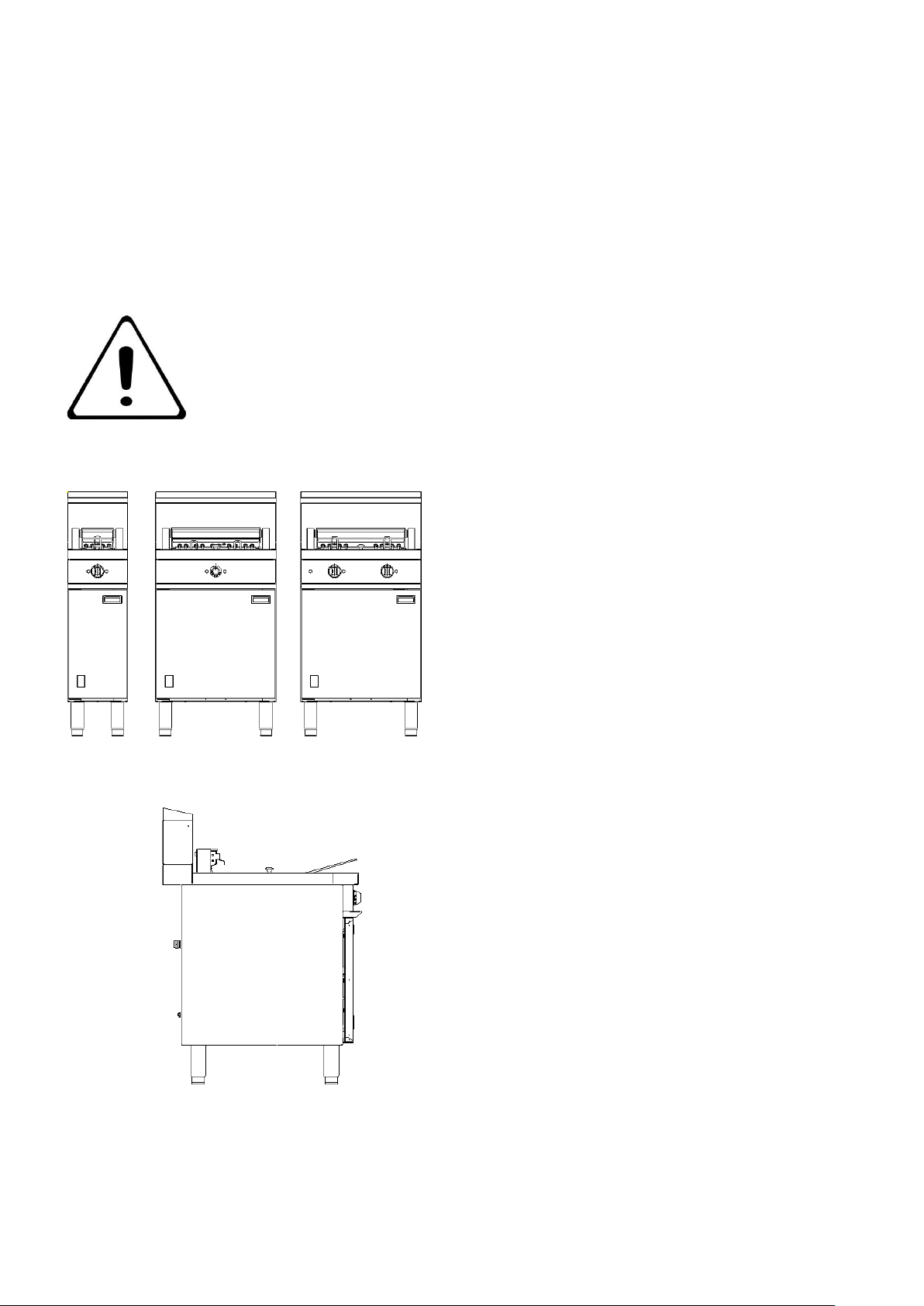
The E1808X, E1838X & E1848X are heavy duty, free-standing, fryers.
The E1808X is 300mm wide with 1 pan which accommodates 1 basket. The unit is thermostatically
controlled.
The E1838X is 600mm wide with 1 pan which accommodates 2 baskets. The unit is thermostatically
controlled.
The E1848X is 600mm wide with 2 pans, each pan accommodates 1 basket. The unit is
thermostatically controlled.
All models have standard hob heights and may be suited with other Falcon Chieftain Series models.
Warning
THIS APPLIANCE MUST BE EARTHED.
End Elevation – All Models
E1838X
E1848X
E1808X
Page 8
SECTION 2 CONTROLS and OPERATION
PARTICULAR ATTENTION MUST BE PAID TO CLEANING THE
THERMOSTAT PROBE AND CAPILLARIES.
ENSURE FOOD DEBRIS DOES NOT BUILD UP, WHICH COULD
DETRIMENTALLY AFFECT THE PERFORMANCE AND SAFETY OF
THE APPLIANCE.
PARTS WHICH HAVE BEEN PROTECTED BY THE MANUFACTURER
ARE NOT TO BE ADJUSTED BY THE USER.
Controls
The thermostat control knob(s) and indicator lamps are mounted on the fascia panel. The mains
indicator lamp (red) will become lit when power is supplied to unit. The thermostat indicator
lamp(s) (amber) lights only when heating elements are being supplied with current. It will go out
when oil has reached selected temperature.
Frying Medium
The appliance will give optimum performance when a good quality vegetable oil is used to fry.
Nevertheless, favorable results can be obtained from cooking fats provided the following
procedures are adhered to.
Warning
NEVER operate thermostat above smoke point of chosen medium.
DO NOT USE SOLID FAT.
Attention is drawn to following: -
Operation - Initial Charging of The Pan Important
Ensure that appliance has been turned OFF at mains isolating switch.
Prior to operation, clean pan using hot water and detergent.
Rinse and DRY the pan THOROUGHLY before use. Ensure that drain valve is CLOSED.
Fill with oil to “C” level mark on element guard.
“C” denotes COLD, “H” denotes HOT.
Switching The Appliance On
Ensure pan is filled with oil to correct level. Close isolating switch, open door and press on/off
switch to ‘on’ position. Set thermostat knob to desired frying temperature. Leave unit to heat up.
When oil has reached selected temperature, the amber neon will go out. This indicates that fryer
is ready for use. When oil temperature falls, e.g. when food is immersed in oil, thermostat
automatically restores supply of current to elements. The amber neon will become lit.
Oil Capacity
E1808X - 20 litres
E1838X - 40 litres
E1848X – (x2) 20 litres
Page 9

SECTION 3 -
CLEANING and MAINTENANCE
BEFORE ANY CLEANING IS UNDERTAKEN, ISOLATE APPLIANCE FROM MAINS
POWER SUPPLY AT ISOLATOR SWITCH.
SUITABLE PROTECTIVE CLOTHING MUST BE WORN WHEN CLEANING THIS
APPLIANCE.
NEVER PUMP WATER THROUGH THE FILTRATION PUMP AT ANY TIME! WATER AND
HOT OIL ARE AN EXPLOSIVE MIXTURE.
OIL MUST BE ALLOWED TO COOL TO A SAFE TEMPERATURE BEFORE DRAINING. DO
NOT OVERFILL OIL BUCKET. ALL SPILLS ONTO THE PRODUCT AND ON THE FLOOR
SHOULD BE CLEANED UP IMMEDIATELY.
THE APPLIANCE MUST NOT BE CLEANED WITH A JET OF WATER OR BE STEAM
CLEANED. DO NOT USE ACID OR HALOGEN-BASED (E.G. CHLORINE) DESCALING
LIQUIDS, FLAMMABLE LIQUIDS, CLEANING AIDS OR CLEANING POWDERS.
FAILURE TO CLEAN AND CHECK THE SAFETY AND OPERATIONAL THERMOSTATS
CAN IMPACT THE PERFORMANCE OF THE APPLIANCE AND INCREASE THE RISK OF
AN APPLIANCE FIRE.
FAILURE DUE TO LACK OF PROPER CLEANING IS NOT COVERED BY WARRANTY.
Attention is drawn to following safety related points:-
NEVER, under any circumstances, switch unit on unless it is filled with oil or water.
Before draining pan or raising elements for cleaning, the appliance MUST be isolated at the mains
switch.
Surge boiling may occur if over-wet food or a larger than recommended load is being prepared.
There is a possibility that the appliance could catch fire if oil level is below specified, indicated level.
Old oil has a reduced flash point compared to that of a fresh medium, therefore it is more prone to
surge boiling.
To Shut the Fryer Off
Turn thermostat knob to off position, Press on/off switch behind door to ‘off’ position and turn
mains isolating switch off.
High Temperature Limit Device
The fryers are fitted with a high temperature limit device. This ensures that oil cannot become
overheated to reach a dangerous temperature level.
If limit device trips, it will be necessary for a service engineer to investigate and rectify cause.
This requires to be addressed prior to unit being brought back into service.
Page 10
Stainless Steel Surfaces
Important Note
Elements MUST be allowed to cool before handling.
Stainless steel can be easily marked by certain scouring pads including nylon types and care
should be exercised. When rubbing stainless steel with a cloth, always rub along grain direction.
Cleaning Procedure
In the interests of hygiene and to maintain maximum performance, daily cleaning is
recommended.
1.
Turn unit off at mains isolating switch.
2.
Place a receptacle directly below drain pipe, slowly open drain valve and let oil flow gently
and take care not to overfill receptacle.
3.
Having drained pan, close drain valve.
4.
Remove basket and fish plate and wash in a sink filled with hot, soapy water.
5.
Pour hot water and detergent into pan. Detergent to water ratio is dependent upon strength
of cleaning medium.
6.
Turn unit ON.
7.
Allow water to heat and simmer slowly. Duration of process is dependent upon pan soiling.
8.
Turn unit OFF.
9.
Drain water from pan as item 2.
10.
Rinse pan with clean water and dry thoroughly. Elements can be hinged upward to gain access
to wipe pan. When elements are fully raised, a support latch will secure them in position. Also
ensure drain valve is dried thoroughly before use.
11.
Clean the elements, the safety and operating thermostats, removing any food debris from around the
thermostats which could detrimentally affect the performance and safety of the appliance.
TAKE CARE WHEN CLEANING NOT TO DISLODGE OR DAMAGE
THERMOSTAT PROBES MOUNTED ON THE BASE AND SIDE OF THE
PAN AND ON ELEMENTS.
DISLODGING OR DAMAGING THE THERMOSTAT PROBES OR THEIR
CAPILLARIES CAN INCREASE THE RISK OF OVERHEATING OR FIRE.
IF THE THERMOSTATS OR CAPILLARIES ARE DAMAGED THEN DO
NOT TURN THE APPLIANCE ON. CONTACT FALCON OR YOUR
APPROVED SERVICE PROVIDER TO UNDERTAKE THE NECESSARY
REPAIRS.
Page 11
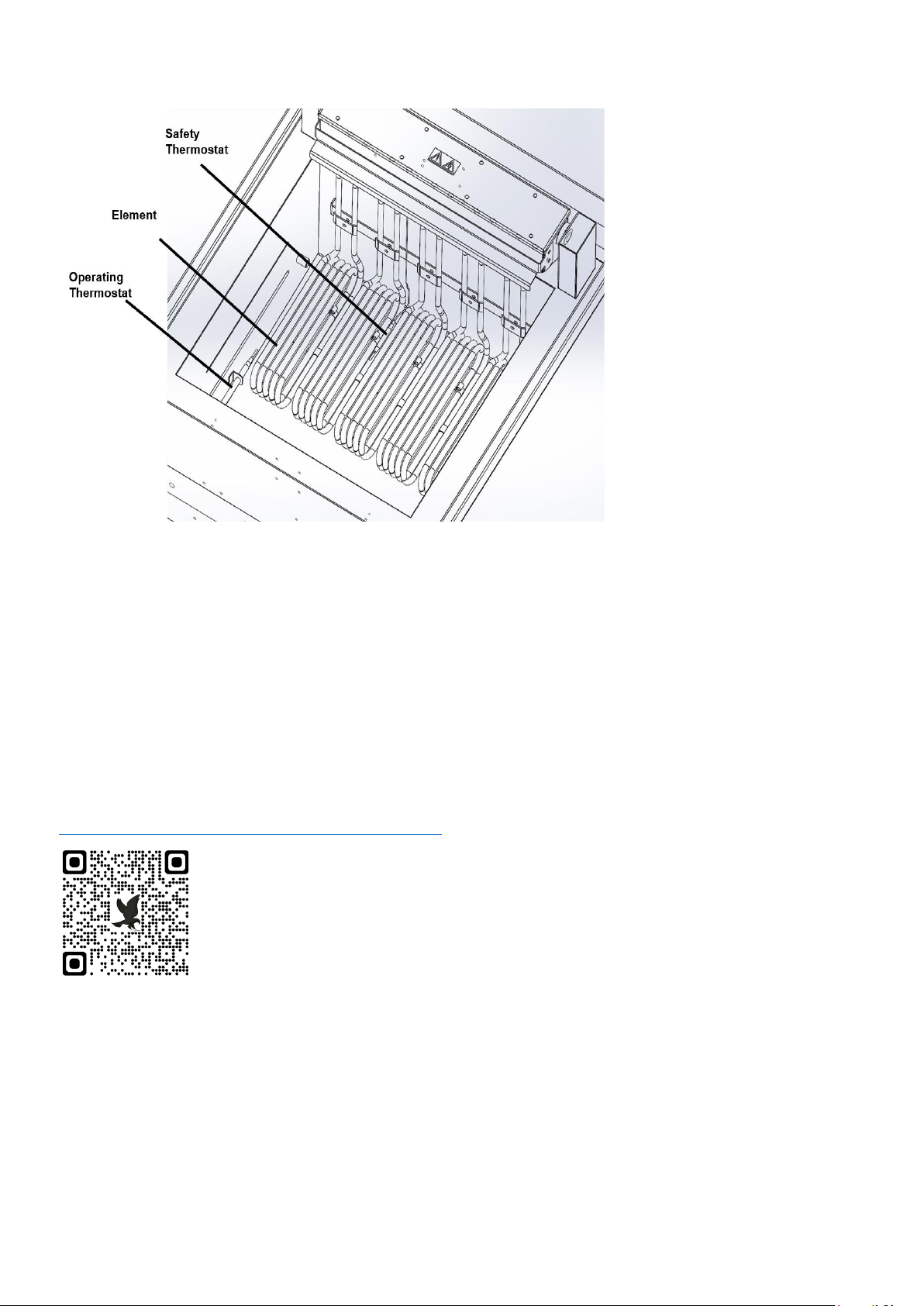
Location of Safety
and Operating
Thermostat probes
12.
Wash and rinse basket and fish plate. Dry thoroughly before replacing within pan.
13.
Ensure drain valve is closed. Remove pipe.
14.
Strain/filter oil back into pan. If necessary top up with clean oil to maximum level mark.
DO NOT OVERFILL.
SERVICE INFORMATION
This unit carries an extensive mainland UK warranty. The warranty is in addition to and does not
change your statutory or legal rights.
The warranty policy can be found on our website which details the conditions of the warranty and
the exclusions.
https://www.falconfoodservice.com/info-centre/policy
Service calls to equipment under warranty will be carried out in accordance with the conditions of
sale.
Warranty calls can be made between 8:30 am and 5:00 pm weekdays only.
To ensure your warranty enquiry is handled as efficiently as possible, ensure you have the
following appliance information prior to calling us:
1. Model number – found on data plate
2. Serial number – found on data plate
3. Brief description of the issue
To contact Falcon for a warranty issue dial (UK only) 01786 455 200 and select Warranty Issues
from the menu.
Page 12

SECTION 4 - SPARE PARTS
The following parts may require replacing during the
life of this appliance:
Safety thermostat
Operating thermostat
Contactor
Tilt Switch
Red neon
Amber neon
Element
Fuse
On/Off Switch
 Loading...