

Page 1
Integrated amplifi ers £500-£1,000
£599 콯 01273 423877 q www.exposurehifi .com
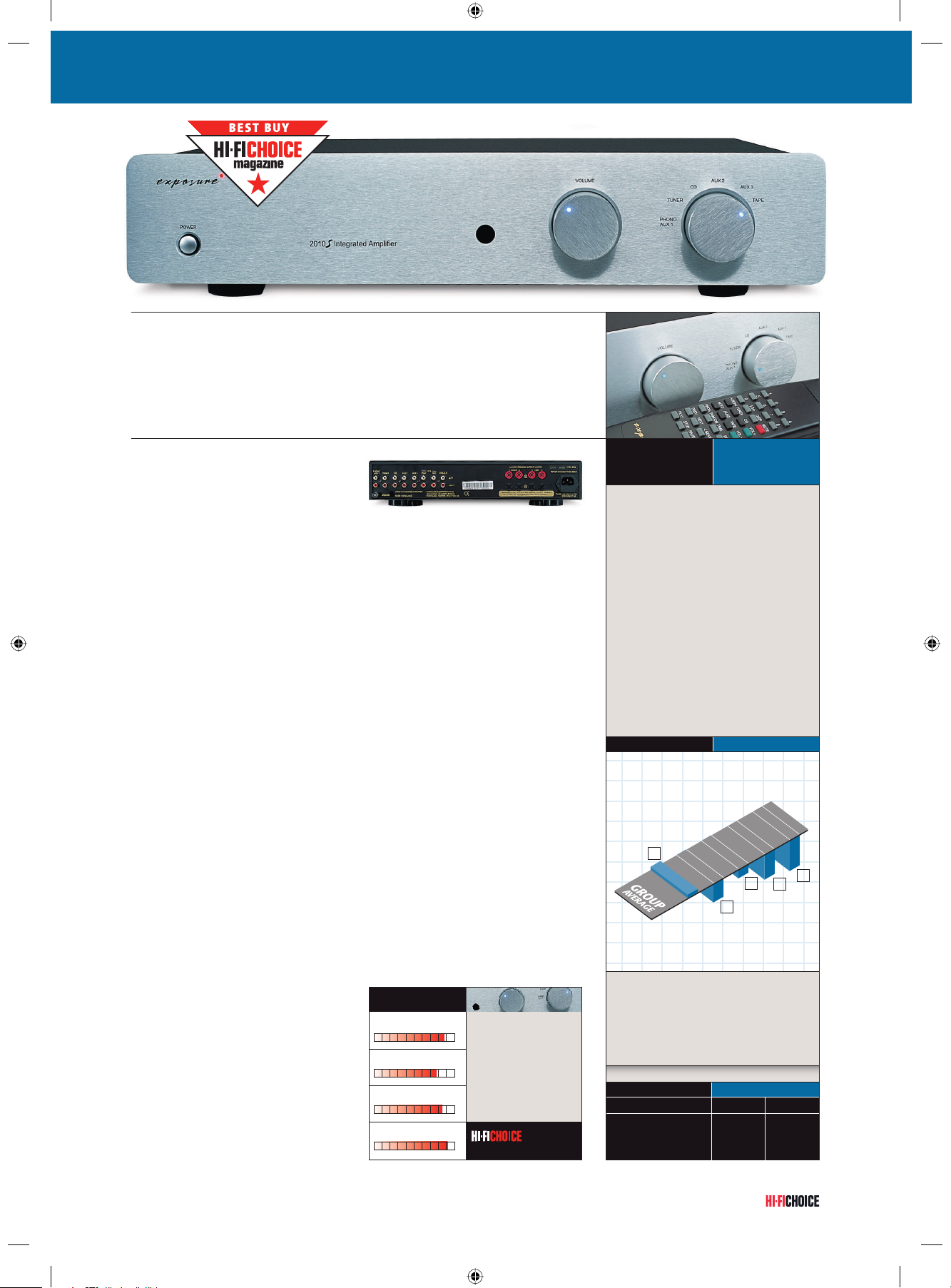
EXPOSURE 2010 S
Beauty is a lot more than skin deep with this revamped classic
[
Ultimate Group Test
]
xposure has never been much of a brand
for visually remarkable hi-fi. But ‘slightly
unadventurous’ is not the same as ‘ugly’
E
and, in fact, this silver-fronted box is highly
presentable. On closer inspection, the 2010 S
has some deceptively attractive touches, such
as the small chamfer surrounding the knobs.
Indeed, the general standard of fit and finish is
high, this having evidently been a priority in
Exposure’s overhaul of the original 2010 range.
A new 2010 system remote control is also now
available. The most obvious internal change to
the amp is an increase of nominal output
power from 50 to 75 watts.
The box’s contents bear witness to thoughtful,
cost-conscious design. A relatively meaty power
supply bodes well, as does the near-exclusive
use of discrete transistors and uniformly good
quality passive components. Both the volume
control and the selector switch are good
old-fashioned mechanical parts, but motorised
to allow remote operation. There’s no attempt
at a heatsink, merely a thick metal bar to
distribute heat evenly over the base; this should
allow plenty of margin even for party use,
although unrealistic sinewave testing could
cause some awful hot running.
Facilities are basic, with six line inputs (one
can optionally be turned into a phono input)
plus tape and preamp out, and twin sets of
terminals for bi-wiring. Set against the more
fully-featured Marantz and Cyrus, this clearly sets
out its stall in terms of sound first and foremost.
SOUND QUALITY
It had better sound good, then! And rest
assured, it does. Even from cold (our sample
arrived just before the test began), it managed
to put in a performance which was generally
considered equal best, tied with the (dearer)
Electrocompaniet. Listeners enjoyed its bass
weight, which added depth not just in terms of
frequencies but in musical interpretation. And
it’s not just weighty, but punchy and agile too,
with no trace of flab or waffle.
Allied to that is a high standard of imaging
depth and precision, with the various groups
within an ensemble clearly and stably
positioned. Rhythmic drive also impressed at
least one listener considerably, and in the end
the feeling was that there was an essential,
highly enjoyable ‘rightness’ to the sound.
Again, this was borne out in extended
listening. One of the greatest and most
subversive hi-fi evils is the effect of making real
acoustic instruments sound like synthesised
versions, and while none of the amps in this
group suffered badly from that, the 2010 S
was notably far from it. It has a high credibility
factor, if you like – there is a real woody weight
and resonance to piano, for instance, and
properly reedy saxophones.
Compared with the Electrocompaniet, the
2010 S is more forward in its presentation
and some listeners may find its balance less
comfortable in the long run. That’s largely a
matter of taste, however – after all, to many
people ‘comfortable’ is a term of hi-fi abuse.
We’d rather not be pedantic on the subject.
Rather, suffice it to say that this amp gives an
admirable degree of musical insight and
communication, and altogether fulfils the
criteria of high-fidelity sound. All-in-all, a
clear Best Buy.
HFC
VERDICT
SOUND >> 88%
FEATURES
BUILD
VALU E >> 92%
>> 78%
>> 85%
A fine example of how a
hi-fi amp should be – it
doesn’t draw attention to
itself, it just gets on with its
job and does it very well
indeed. Unless you seek
vast power or flashy looks,
this is a prime contender.
OVERALL SCORE
90%
LAB REPORT
This amplifier’s nominal power rating seems right
on the money, our measured figure of 2x74W
before clipping agreeing closely with the
manufacturer’s figure. Peak power is nearer 100W,
a very healthy figure, and the specified peak
current output of 12A is fairly conservative – our
testing indicates that the protection circuitry limits
out at exactly 15A.
The frequency response is flat in the bass but
slightly rolled off in the treble, 0.8dB down by
20kHz (-3dB at 45kHz). Many manufacturers prefer
to limit frequency response a little for various
reasons, and this amount of roll-off is often just
about audible in side-by-side comparisons, slightly
sweetening the sound. It’s short of SACD’s
enormous bandwidth but not worryingly so.
Likewise, the distortion and output impedance
figures, unimpressive by this group’s standards, are
still fine in the general scheme of things.
HOW IT COMPARES
>>>
1
Better
3
2
1] Dynamic power >> +5%
>>
-40%
>>
-15%
-50%
>>
-30%
2] Frequency response
3] Dynamic range
4] Distortion
5] Output impedance
SPECIFICATIONS
Measurement Rated Actual
Power output (8 ohms) 75W 74W
Distortion (1kHz/8 ohms) 0.3% 0.016%
Frequency response (20Hz-20kHz) +/- 0.5dB +/- 0.8dB
>>
5
4
Worse
>>>
REPRINTED FROM
HFC270.repex Sec3:79HFC270.repex Sec3:79 2/6/05 7:44:30 pm2/6/05 7:44:30 pm
 Loading...