

Page 1
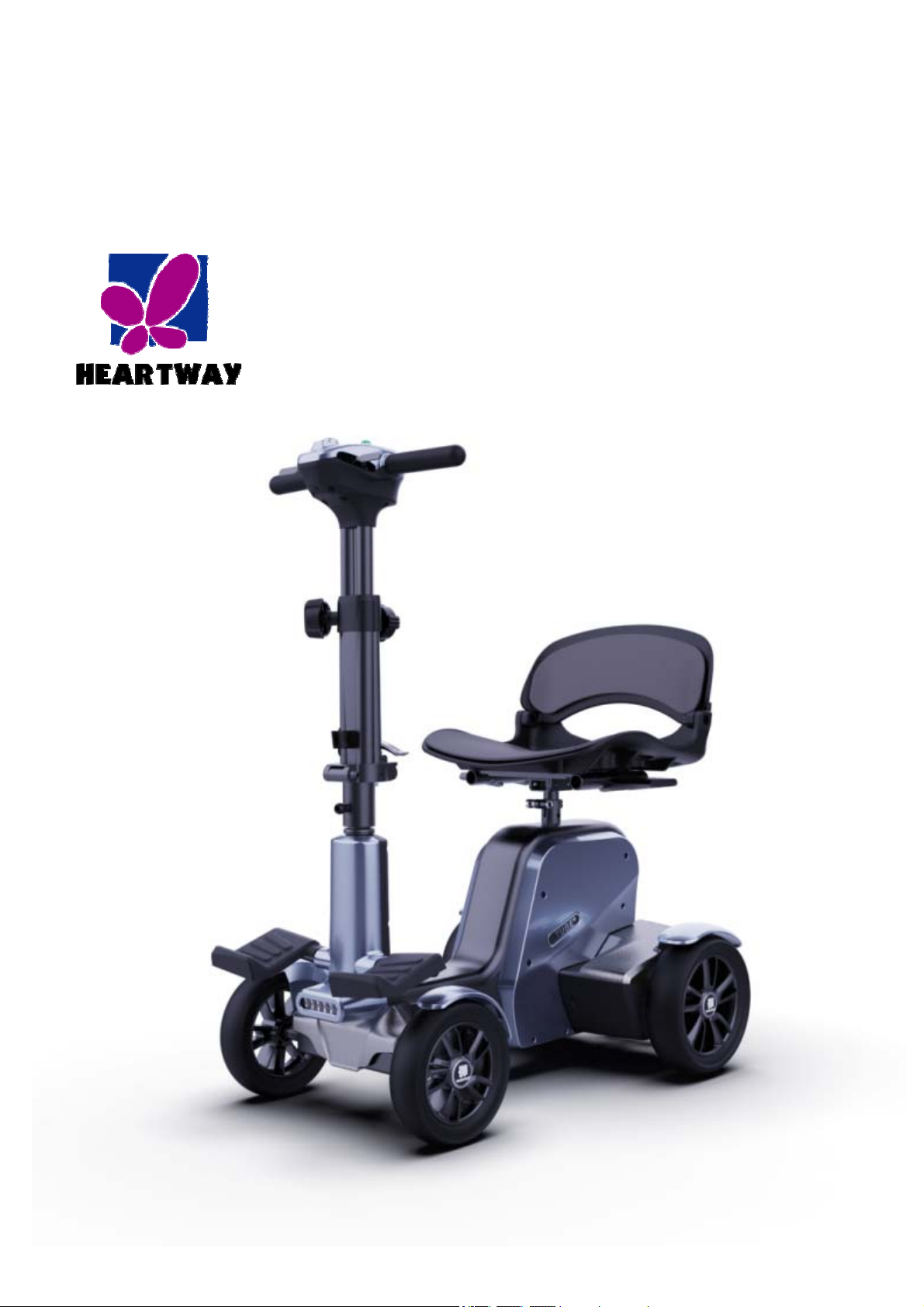
S11E
User Manual
Version: 2022-01
Page 2

Contents
Information
Safety Instruction
Product Specification
Adjustment
Operation of Control
Brake & Battery Connection
…………….………………...………………...
.…………………………………………...
………………………………………...
……………………………………....….………
...………………………………………
….…………………………….
P1
P3
P6
P7
P10
P12
Charging Instruction
Electromagnetic Interference
Maintenance & Repair
BOM List
Warranty Declaration
…………………………………………………..
….………………………..…………….
………………..………………...…...
..……………………………………...
.…………...…………………..
P14
P23
P25
P29
P30
Page 3
INFORMATION
01
Electrically powered scooter Class B (EN 12184)
Heartway Medical Products. Co. Ltd. No 18
Dist. Taichung City 408, Taiwan ROC.
The users need to consult the instructions of the device for information on how
to .use it properly
Moving of adult disabled persons by self-driving. Maximum user weight: 115 kg;
Classified in Class B (EN12184)
Rated slope: 6°(Suitable for indoor and outdoor).
The product is not intended for visually impaired people. The rivers need to
mentally and physically suitable to drive the scooters. The fingers need to work
functionally. The device can’t be used by children until age of 12. The driving
distance will be reduced if the power scooter is used frequently on slopes, rough
ground or to climb kerbs. The scooter is not for use as a seat in motor vehicle.
th
Jingke Central 1stRoad Nantun
All adjustments can be adjusted by both occupant and assistant.
This vehicle is suitable for land and/or air transport.
WARNING
Don’t operate your power scooter without completely reading and understanding this user
manual!
Don’t operate the scooter with depleted batteries, since the occupant could be stranded.
The end user is NOT allowed to change the parameter.
The occupant can switch off the key to stop the scooter for any emergency stop
Please Disconnectbattery package from the scooter unit before long term storage
**Notice to the user and/or patient that any serious incident that has occurred in
relation to the device should be reported to the manufacturer and the competent
authority of the Member State in which the user and/or patient is established**
Please refer to our official website for general product information
at www.heartway.com.tw
S11E should be turned off prior to entering or existing the seat. Before driving, please
make sure that the quick release handle of the scooter is fully locked
Page 4

02
• For detailed product safety notice and product recalls, please contact your local authorized
distributer direct. The recall notice should include the following information: Product
description, including the name, make, model and any distinguishing features, batch, or
serial numbers. The power scooter has provision for an anterior pelvis support to be fitted
such as belt
Please refer to our official website for general product information at www.heartway.com.tw
Environmental conditions may affect the safety and performance of your power
scooter. Water and extreme temperatures are the main elements that can cause
damage and affect performance.
A) Rain, Sleet and Snow:
If exposed to water, your power scooter is susceptible to damage to electronic or
mechanical components.
Water can cause electronic malfunction or promote premature corrosion of electrical
components and frame.
B) Temperature:
Some of the parts of the power scooter are susceptible to change in temperature.
The controller can only operate in temperature that range between -20°C and +45°C
At extreme low temperatures, the batteries may freeze, and your power scooter may not
be able to operate.
In extreme high temperatures, it may operate at slower speeds due to a safety feature of
the controller that prevents damage to the motors and other electrical components.
Page 5
SAFETY INSTUCTION
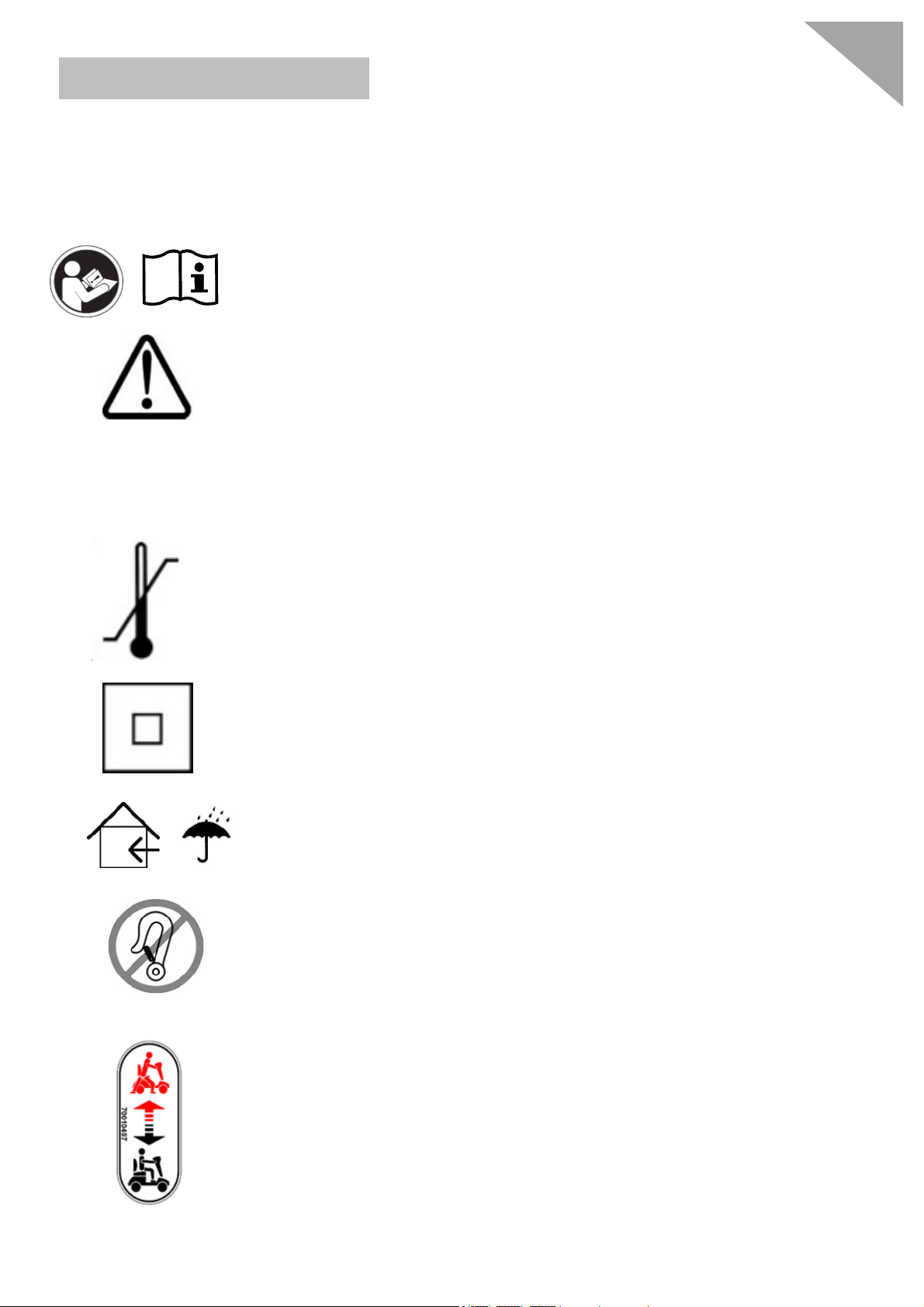
The following symbols are used in the scooter to identify warnings, mandatory actions
and prohibited actions. It is very important that you read and understand them
completely.
Read and follow the information in the instruction manual.
Caution. Observing notes and accompanying documents
It is classified in category B according to EN 12184.
Scooter
Class B
It is compact, manoeuvrable and not necessarily able to overcome
obstacles outdoors
03
For ambient conditions
Protection class II
Charger IPX0 "Protect from moisture" / Scooter IPX4 "Splashproof"
Does not meet the ISO 7176-19 standard and cannot be used as
a seat in a motor vehicle.
Labeling on the product.
Devices for decommissioning the drive system
Warning: Switch on the drive system again before leaving a
user unattended.
Page 6
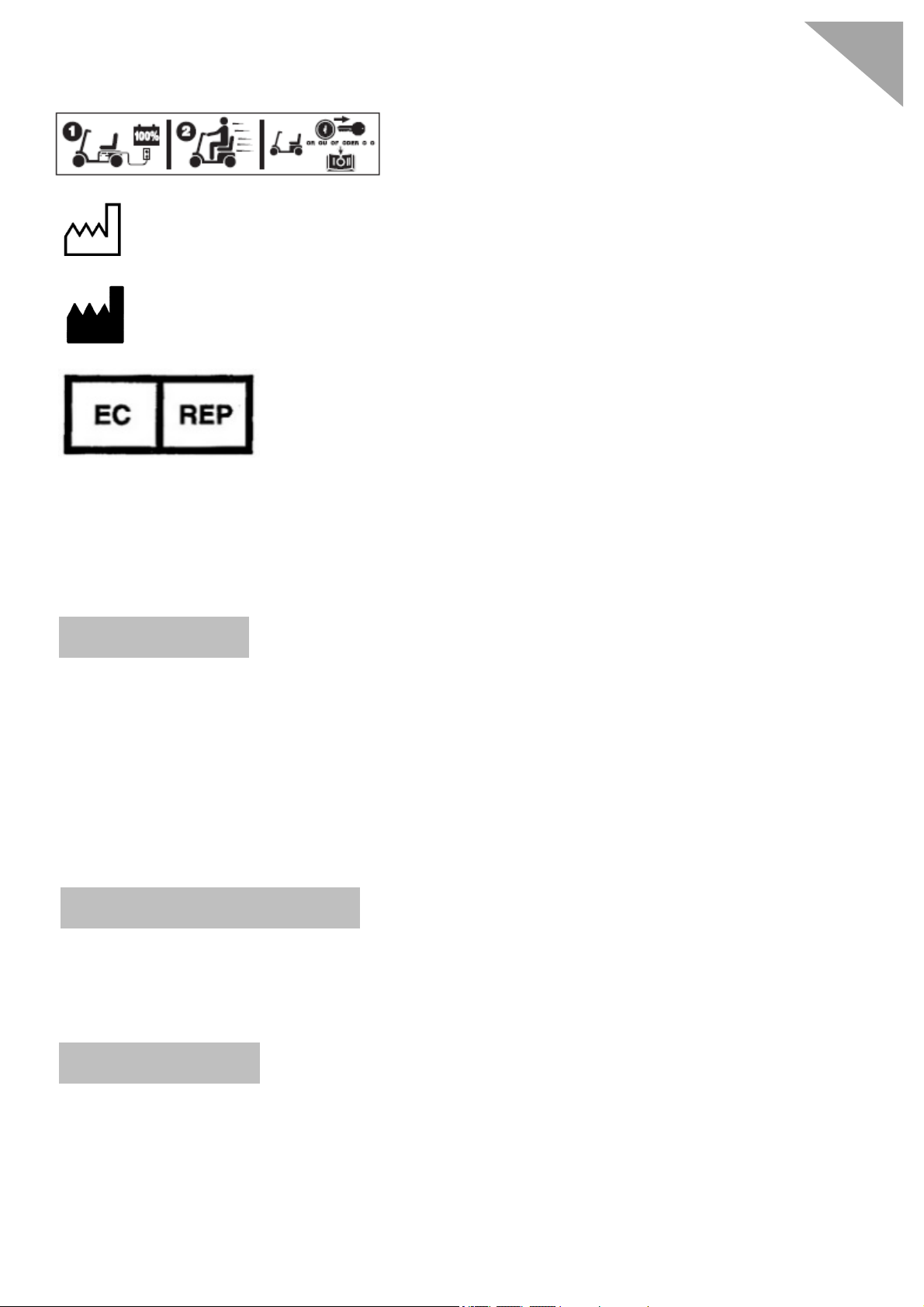
Charge the batteries fully before use.
Disconnect battery the key from an
unattended scooter.
Year of manufacture see label on the product.
Heartway Medical Products Co., Ltd.
No.18, Jingke Central 1st Rd., Nantun Dist.Taichung City
40852,Taiwan (R.O.C.)
Europäischer Bevollmächtigter / Authorized Representative
Emergo Europe Prinsessegracht 20 2514 AP The Hague
The Netherlands
04
The scooter S11E is designed for indoor and outdoor use by adults with limited
mobility. According to EN 12184, it belongs to category B. It is compact,
maneuverable, and able to overcome outdoor obstacles. The maximum load is 115 kg.
INDICATIONS
Inability to walk or severe walking disability due to
• paralysis • Loss of limbs • extremity defect / deformity • joint
• joint damage (not on both arms) other diseases
A supply with a scooter (or also electric wheelchairs) is indicated when the use of
hand-driven wheelchairs is no longer possible due to the disability, but the correct
operation of an electric motor drive is still possible.
CONTRAINDICATIONS
The supply of scooters is unsuitable for people:
• with severe balance problems • with reduced and insufficient eyesight
• with severe cognitive impairments
CONFORMITY
This mobility meets the requirements of EN 12184: 2014 and the requirements for
class I medical devices in accordance with Class I of Regulation MDR (EU)2017/745
annex VIII.
Page 7
05
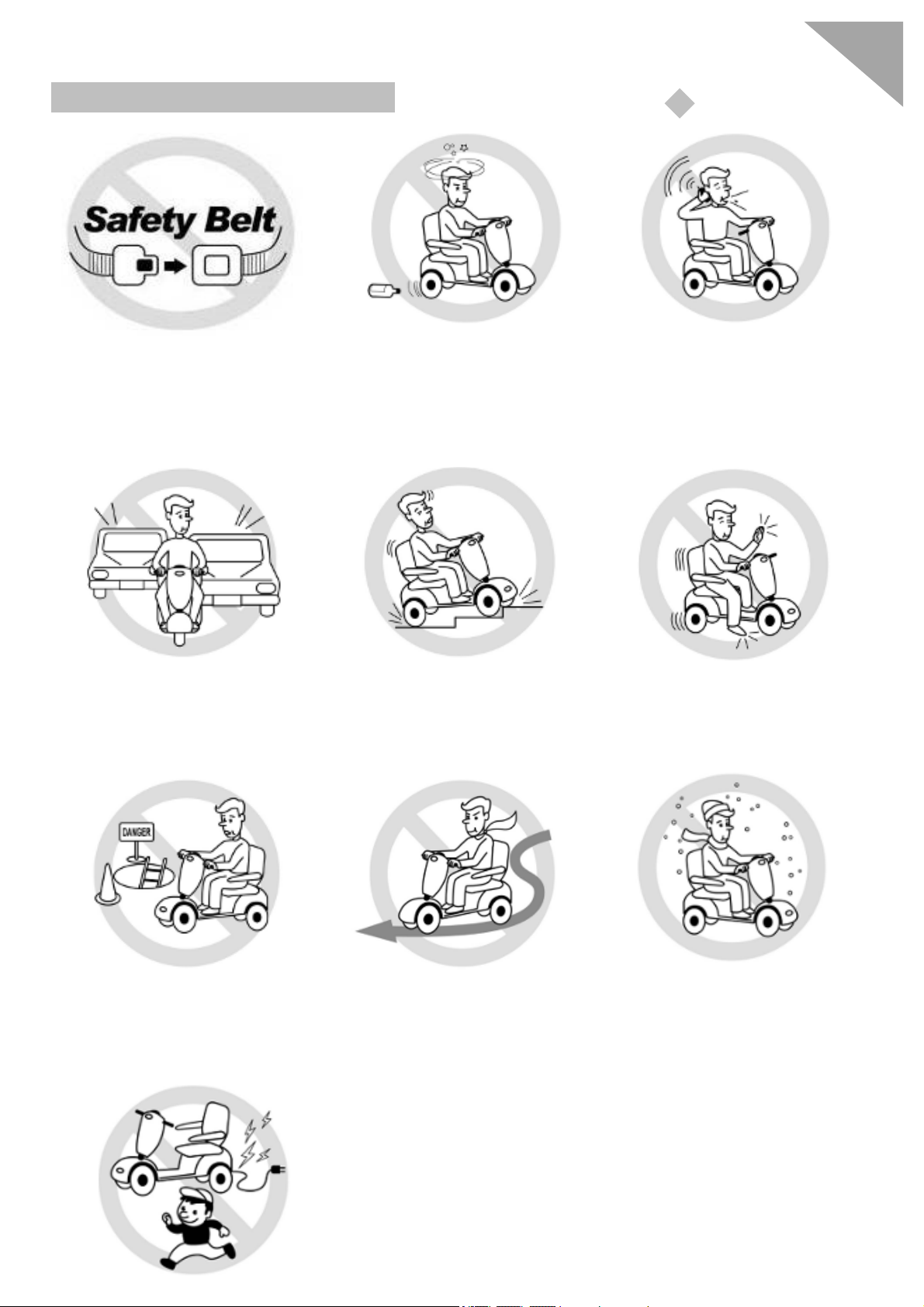
SAFETY INSTRUCTION
Always use a seat belt
and keep your feet on
the scooter all the time.
Never operate the scooter
while you are under the
influence of alcohol.
General
Never use electronic radio
transmitters such as
walkie-talkies, or cellular
phones.
Do not rider your scooter
in traffic.
Make sure that there are
no obstacles behind you
while reserving your scooter.
Do not attempt to climb curbs
greater than limitation show
on Technical Specification.
Do not make a sharp turn or
a sudden stop while riding
your scooter.
Do not leave your hands
and legs off the scooter
when driving.
Do not rider your scooter
during snow in order to avoid
accident on slippery road.
Do not allow unsupervised children to play near this
equipment while the batteries are charging.
Page 8

PRODUCT SPECIFICATION
MODEL S11E
WEIGHT CAPACITY 115kg
SEAT: TYPE/SIZE 16"
06
DRIVE WHEEL
FRONT CASTER (WHEEL)
REAR CASTER (ANTI-TIPPER) 62mmx18mm
MAX SPEED 6 KM/H
BATTERY SPECIFICATIONS 12V 12Ah x2pcs
BATTERY RANGE 10KM
CHARGER TYPE 2Amp, 100/240VAC Charger
CONTROLLER TYPE S-Drive 45Amp
MOTOR TYPE 270W
WEIGHT: W/ BATTERY 30.8KG
228mmx65mm(PU)
228mmx70mm Pneumatic Tire (optional)
200mmx50mm(PU)
200mmx60mm Pneumatic Tire (optional)
WEIGHT: W/O BATTERY 22.4KG
Battery (removable, the heaviest part) 8.4KG
TURNING RADIUS 950 mm
SUSPENSION None
LENGTH 825mm
WIDTH 520mm
HEIGHT 870~970mm
SEAT WIDTH 400mm
SEAT HEIGHT 540mm
SEAT DEPTH 330mm
BACK HEIGHT 220mm
WHEEL BASE 535mm
Obstacle Climbing 50mm
Rated slope 3 Degree
Page 9
ADJUSTMENT
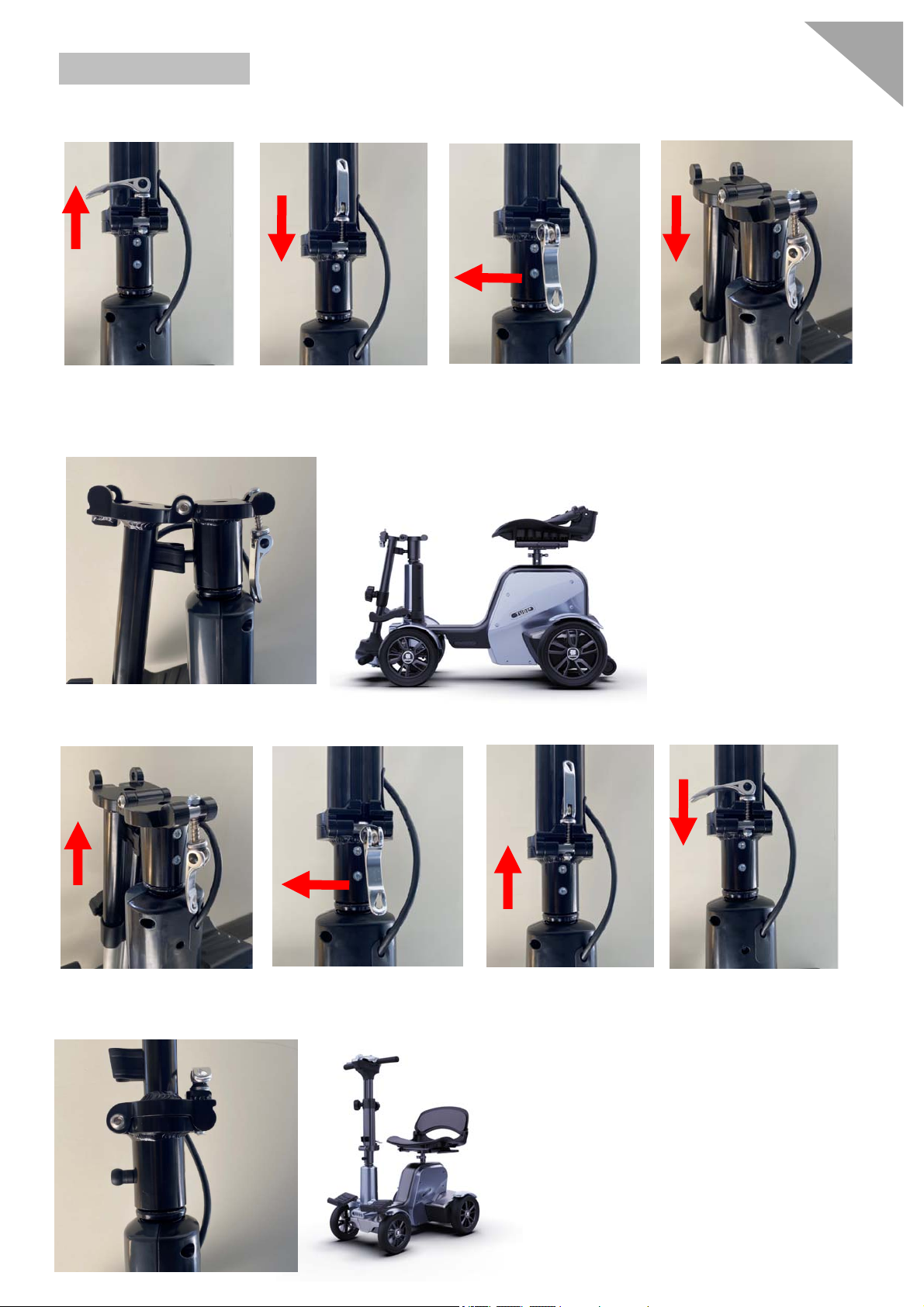
Folding the scooter
07
1.Pulluprelease
handle
2.Pressdown
releasehandle
Unfolding the scooter
3.Pushleftrelease
handle
4.Toforwardtofold
thesteering
1.Liftup
thesteering
2.Pushleftrelease
handle
3.Pulluprelease
handle
4.Pressdownthe
releasehandleto
makelock.
Page 10

WARNING
If you need to release the handle, please turn off the power of the electric
scooter first
For any mechanical adjustment on the tiller or on the seat, be aware of
trapping and squeezing of your fingers
One person can lift this scooter – S11E
Never open the battery box. If you have any question, please contact your local
authorized dealer or technical supports for further support and assistance.
The power scooter needs to be folded properly before any transporting.
Storage
Your power scooter should be stored in a dry place, free from temperature extremes.
When storing, disconnect the batteries from the power scooter.
If you fail to store the unit properly, the frame can rust and the electronics can be
damaged.
Please Disconnectbatterypackage from the scooter unit before long term storage.
08
Batteries that are regularly and deeply discharged, infrequently charged, stored
in extreme temperatures, or stored without a full charge may be permanently
damaged, causing unreliable performance and limited service life.
It is recommended that you charge the batteries periodically throughout periods
of prolonged storage to ensure proper performance.
If you plan on not using your power scooter for an extended period of
time, it is best to:Fully charge its batteries prior to storage.
Disconnect the batteries from the scooter.
Store your power scooter in a warm, dry environment.
Avoid storing your power scooter where it will be exposed to temperature extremes.
Operating conditions and Storage conditions (‐10ºC ~ +45ºC)
Make sure the batteries are fully charged before use after long‐term storage
Batteries that are regularly and deeply discharged, infrequently charged,
stored in extreme temperatures, or stored without a full charge may be permanently
damaged, causing unreliable performance and limited service
life.
It is recommended that you charge the power scooter batteries periodically
throughout periods of prolonged storage to ensure proper performance.
Page 11
OPTIONAL ACCESSORIES
09
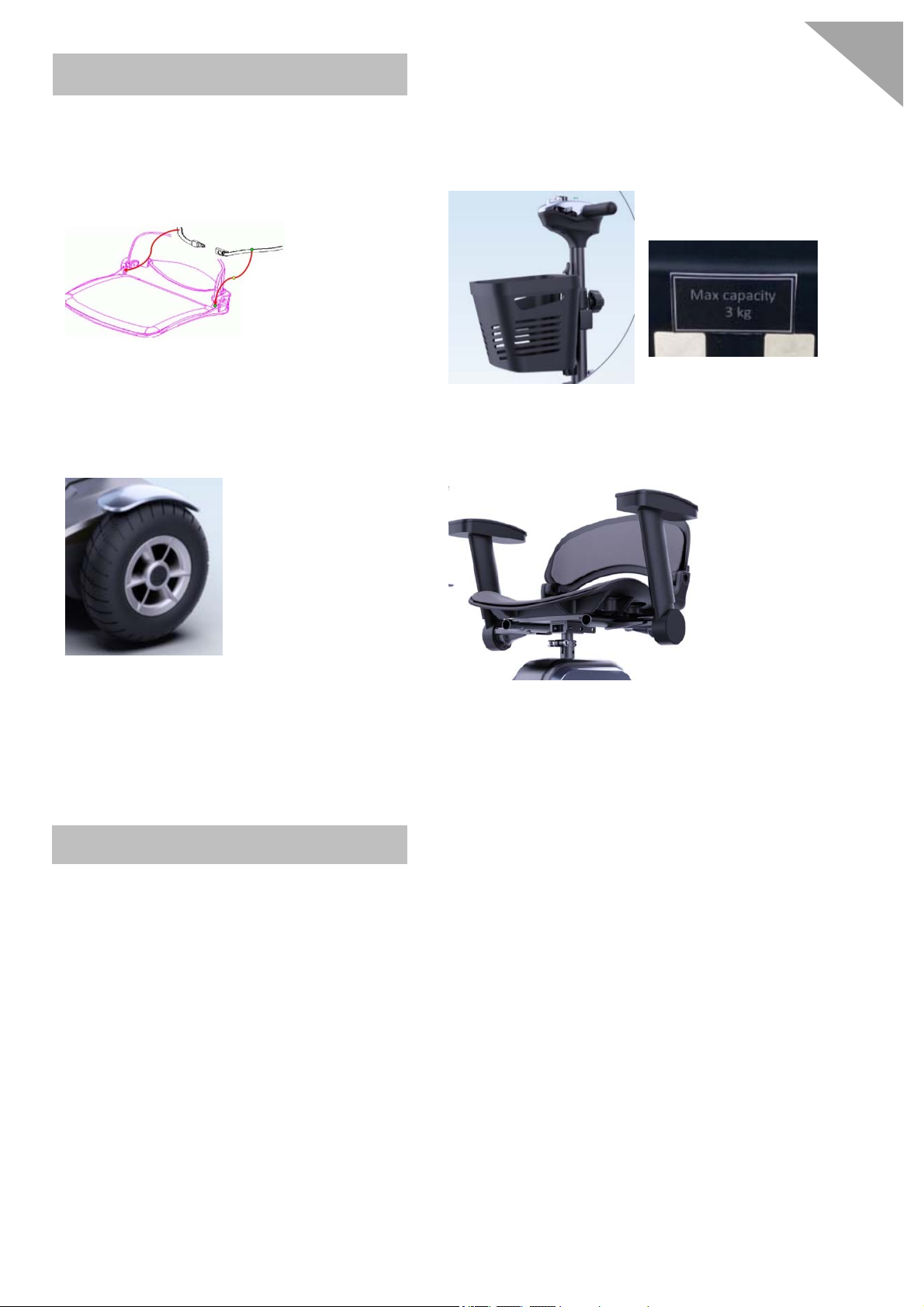
Seat Belt
Seat belt can be installed onto
the seat (see photo below)
PneumaticTire
S11E scooter can be installed
pneumatic tires (see photo below)
Basket :0.5KG
Max capacity:3KG
Armrest
S11E can be installed armrest
(see photo below)
OPERATION OF CONTROL
The power scooter is simple to operate. However, we recommend that you read
carefully the following instructions to become familiarized with your new vehicle.
Please do not operate this power scooter if it is behaving abnormally or erratically.
The following operation can be carried out either by assistant or occupant .
A Word of Caution:
Before you turn the power on, always be aware of the environment that surrounds you
to select your desired speed. For indoor environments we recommend that you select
the slowest speed setting. For outdoor operation of this vehicle we recommend that
you select a speed that is comfortable for you to control it safely.
The following steps are required to operate your vehicle safely with the controller.
Button functions
Page 12
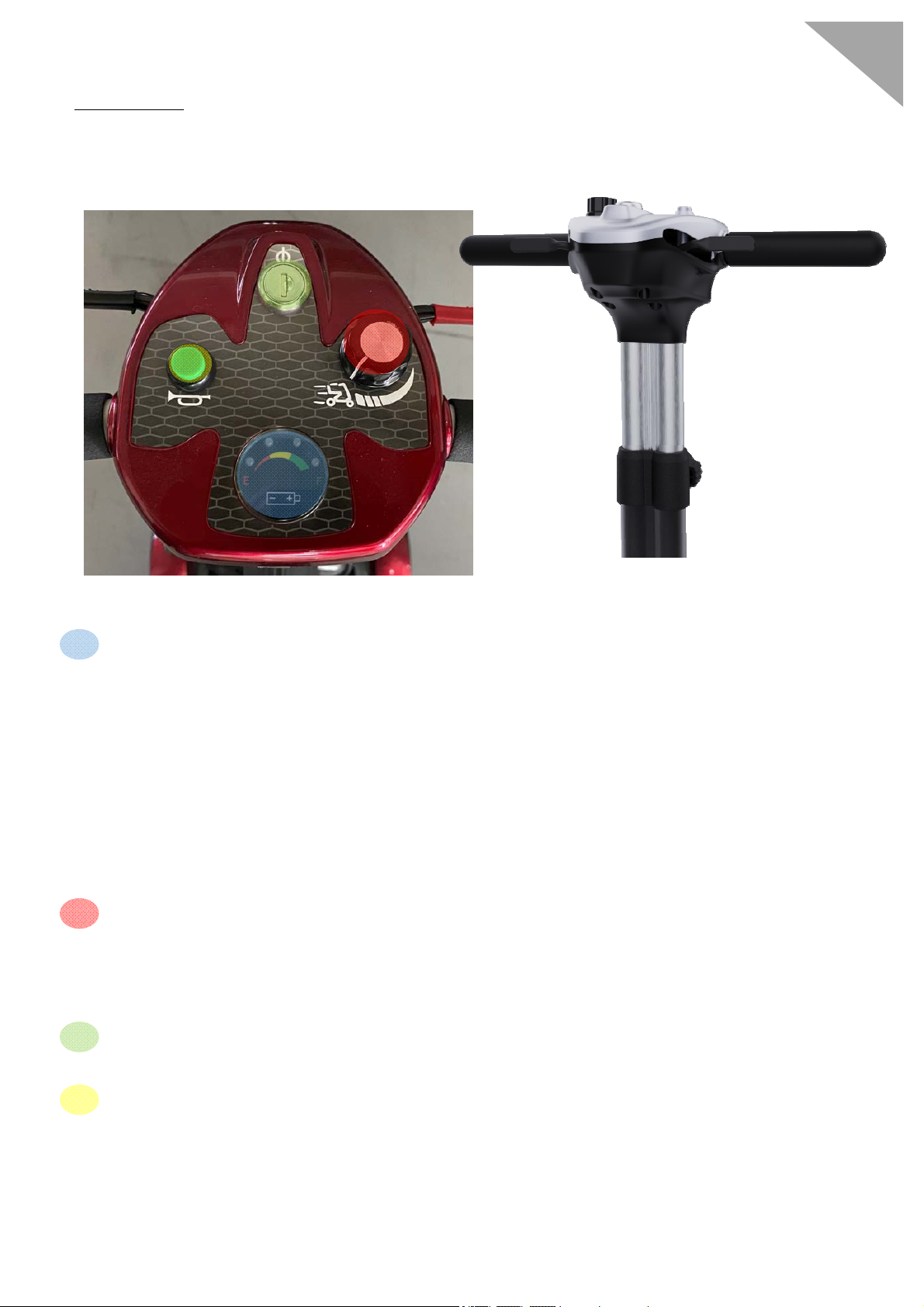
B. KEY ON
Insert the key and rotate it clockwise to power on the scooter.
To turn off the scooter rotate the key anti clockwise.
3
5
2
4
1
10
1. Battery Indicator: Whenthescooteristurnedon,theLEDlightsonthe
meterwilllightupinsequencefromlefttoright.Whenthebatteryis
slowlyexhausted,theLEDlightswillturnoffinsequencefromrighttoleft,
andthechargingwillbeindicatedattheprecisetimeStatus,whenallfour
LEDlightsareon,thebatteryisfullycharged.WhentheLEDlightsturnoff
insequence,yourbatterywilllosepower,butyoustillhavepowerto
spare.Whenthebatterysymbolonthemeterflashesblue,yourbatteryis
lowandneedstoberecharged(see"BatteryandBatterycharging"
section).
2. High/Low Speed Adjustment: This allows you to pre‐select your desired
speed. The adjuster is proportional to speed and can be set anywhere
between minimum and maximum. Turn the adjuster knob ounter‐clockwise
to minimum for a very gentle operation, and clockwise towards maximum
to increase your speed.
3. Power ON/OFF Light: The light will turn on if you insert the key. The
light will turn off if you take out the key.
4. Horn button: Press this button to sound the horn.
( Easy operation for left hand or right hand)
Page 13

DRIVING
A Controller ON/OFF Switch
Insert the key to power on the scooter (Disconnectbattery the key to power off). Swing
the finger lever control forward or backward to control the driving direction of the scooter
(The finger lever control is located at both sides of the controller and the returning of the
finger lever control to its neutral position,(center), will reduce the speed and stop the
vehicle by automatically applying the electro‐magnetic brakes
B Speed Control
Turn the adjuster knob clockwise towards maximum to increase your speed, and
counter‐clockwise toward minimum to slow down your speed.
C Finger Lever Control
The finger lever control can also control the speed of your vehicle. The deeper you
press on the finger lever
(forward / backward), the faster the vehicle will go.
11
Notes:
ð After inserting the key into controller ON/OFF port, the light of power
ON/OFF will turn on for a few seconds during self‐checking process.
When the vehicle is in operation, the surface of the charger
will become slightly warm.
In case of emergency, let go of the finger lever control and
the vehicle will come to a stop.
DO NOT touch the rear shroud while driving. It may be hot.
CONTROL PANEL DISPLAY
1. The control panel display is a multifunction visual display. It
can provide a lot of information of the vehicle.
When the needle falls into the red sector, your batteries are low on power and
need to be recharged. It is wise to recharge your batteries when the needle enters
the red zone. The remaining battery needle only goes lower when using the battery,
regardless the battery voltage. The remaining battery meter needle goes higher
only when recharging battery in progress.
2. System will power off when the battery voltage is lower than
21.0V.
3. System will be automatically power‐off when the vehicle is not in use over 30
minutes. You need to Disconnectbattery the key and insert the key to restart the
scooter.
Page 14
BRAKE & BATTERY CONNECTION
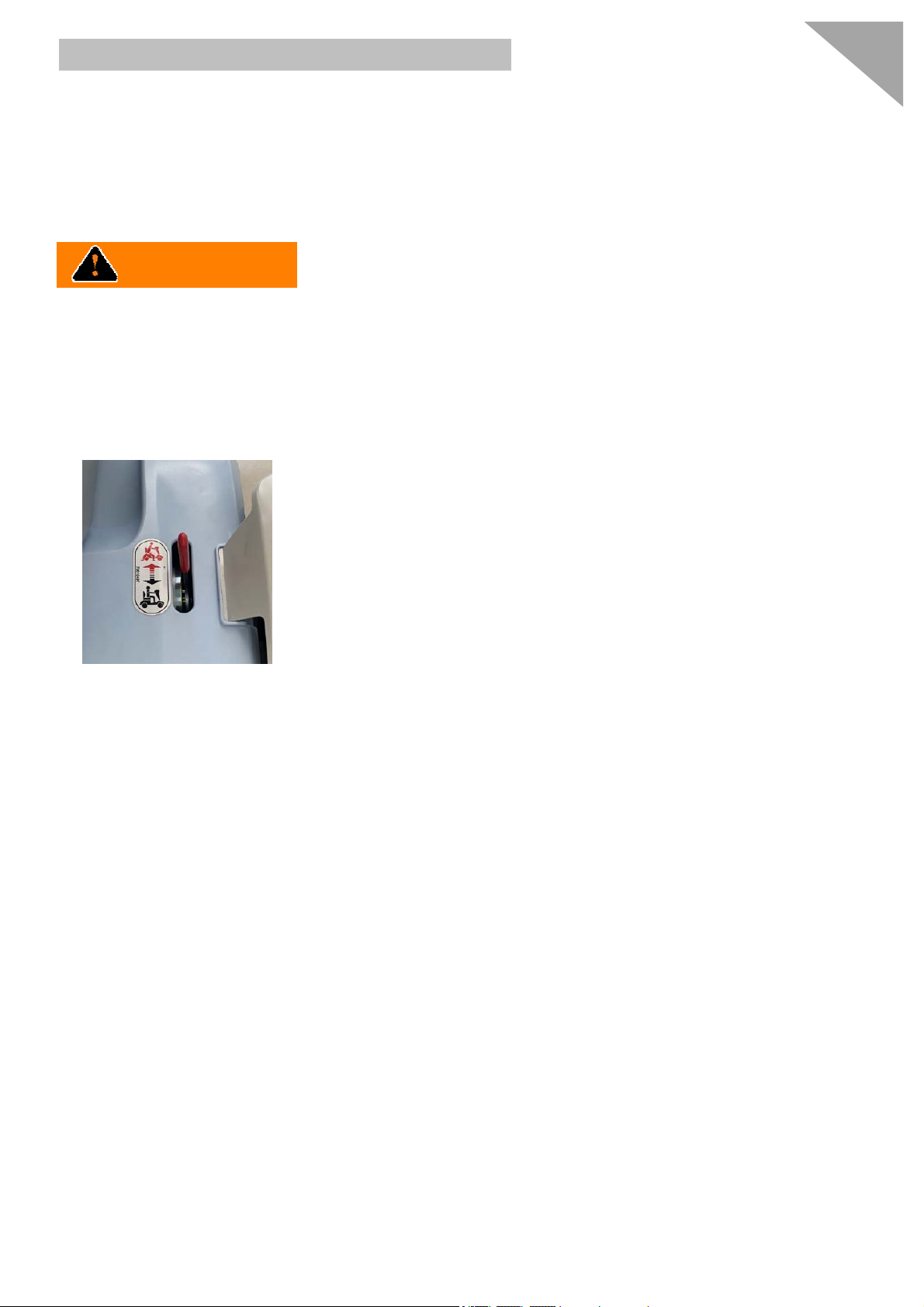
1. The motors are designed to engage the electromagnetic brakes when the vehicle is not
in use or when the power is OFF. They also have a manual feature that allows them to
“free‐wheel” so the scooter can be moved without turning it on. Free‐wheeling is
accomplished by adjusting the free‐wheeling switch to the free‐wheeling position.
2. Engaging in freewheel mode will have the function as parking brake.
WARNING
Free‐wheel your power scooter on a slope.
Never Never free‐wheel the motors while operating your vehicle.
Always remember to engage the motors before turning the power ON.
PLEASE TURN OFF THE POWER BEFORE FOLDING/UNFOLDING
POWER SCOOTER
In Case the switch (see the attached photo) is turned to
FREE-WHEEL mode (accidently) while driving, the error
code will be activated to remind the user to stop driving.
However, the scooter will not stop operation automatically
while the user switch the DRIVE mode to FREE-WHEEL
mode accidently.
12
Electromagnetic Brakes:
Your power scooter comes with Electromagnetic Brakes., i.e. an automatic magnetic disc
safety brake which is also known as Fail‐Safe brake. The electro‐magnetic Brakes are
automatic and work when the power scooter is ON but in a steady state (i.e. Wigwag is
released to the neutral position), even when the scooter is on a slope. The
Electromagnetic Brakes will also be set whenever the power scooter is OFF, but the
motor levers are in the engaged (vertical) position.
Parking brake:
There is an automatic parking brake function included in the electromagnetic brake. The
scooter will stop when the motor is engaged and the power switch is off or when the
power switch is on and the wigwag is in the neutral position. If the scooter is in the free
wheel mode (motor is disengaged), you can use the manual parking brake function by
moving the engaging/disengaging lever back into the engaged position by an attendant.
Thermal Protection:
Your power scooter controller is equipped with a safety system called thermal rollback.
A built‐in circuit monitors the temperature of the controller and motor.
In case of excessive heat of the controller and motor, the controller will cut‐off the
power to allow the electrical components to cool down. Although your power scooter
will resume its normal speed when the temperature returns to a safe level, we
recommend to wait for 5 minutes before restarting to allow the components to cool
down.
Page 15
13
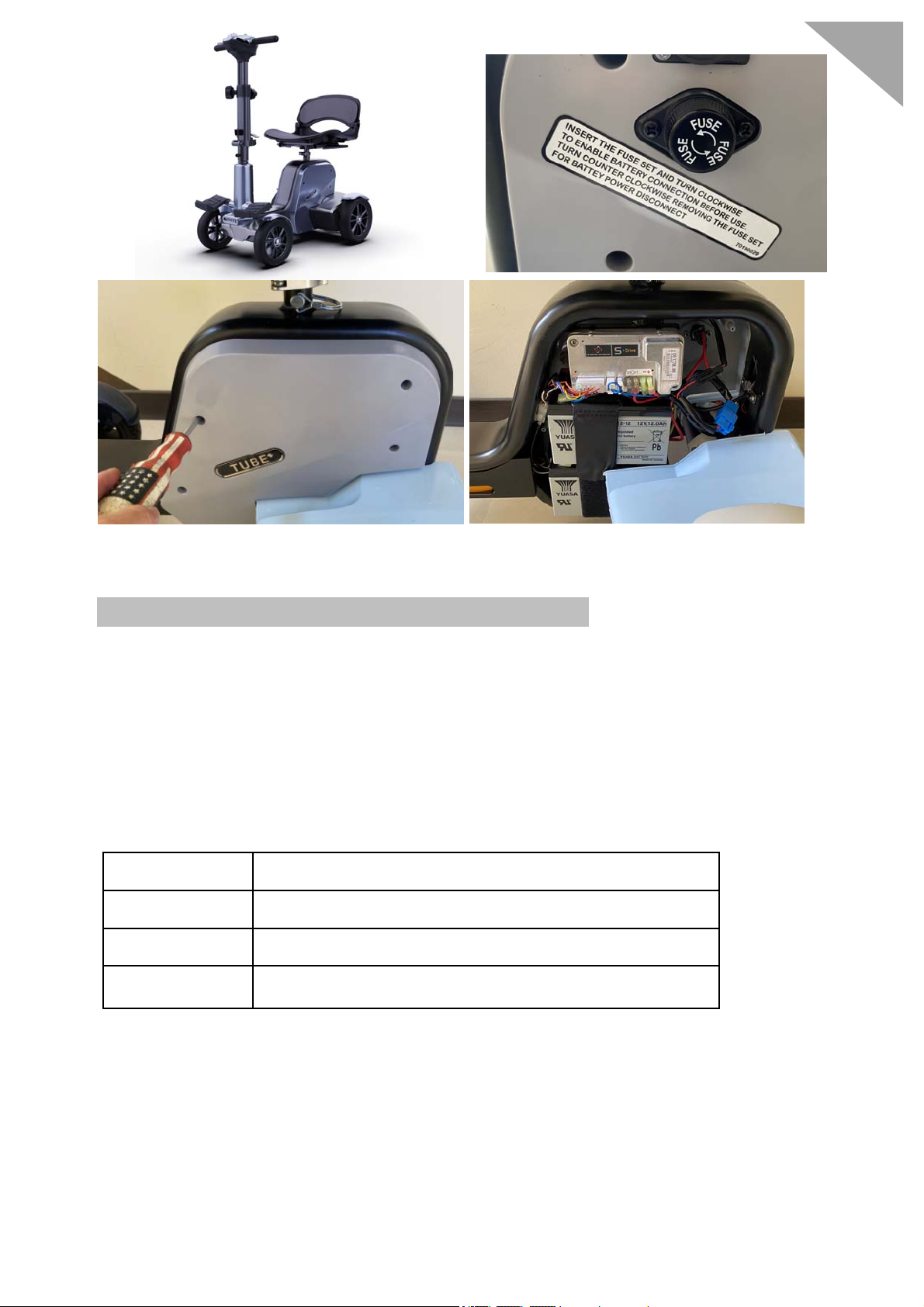
Make sure the battery connectors are connected properly after you install
the batteries into the power scooter.
BATTERY & CHARGING INSTRUCTION
Lead-Acid Battery
We recommend that you use deep-cycle batteries that are sealed and maintenance free
for your power scooter.
Both sealed lead-acid (SLA) and gel cell are deep-cycle batteries and are similar in
performance. Deep-cycle
batteries are specifically designed to provide power, drain down, and then accept a
relatively quick recharge.
Specification of the battery that we recommend for S11E is
Type: Deep –cycle sealed lead-acid (12V12AH SLA)
Size: 12AH
Voltage: 12V each
Amp Hours: 12 amp hours
Depending on the use, terrain and driving conditions, the batteries will provide a range
of 13 km of travel.
However, even if the power scooter is not in use, we recommend that the batteries are
charged periodically.
Note: Do not use any automotive batteries. They are not designed to handle a long,
deep discharge and also are
unsafe for use in power scooter. The useful life of a battery is quite often a reflection of
the care it receives.
IMPORTANT NOTICE: Do not dispose of batteries in fire. Batteries should be
recycled or disposed of
as per state and local guidelines.
Page 16
WARNING
DO NOT operate this scooter with depleted batteries since the occupant could be stranded.
Please Disconnect battery the battery package from the scooter unit before long term
storage.
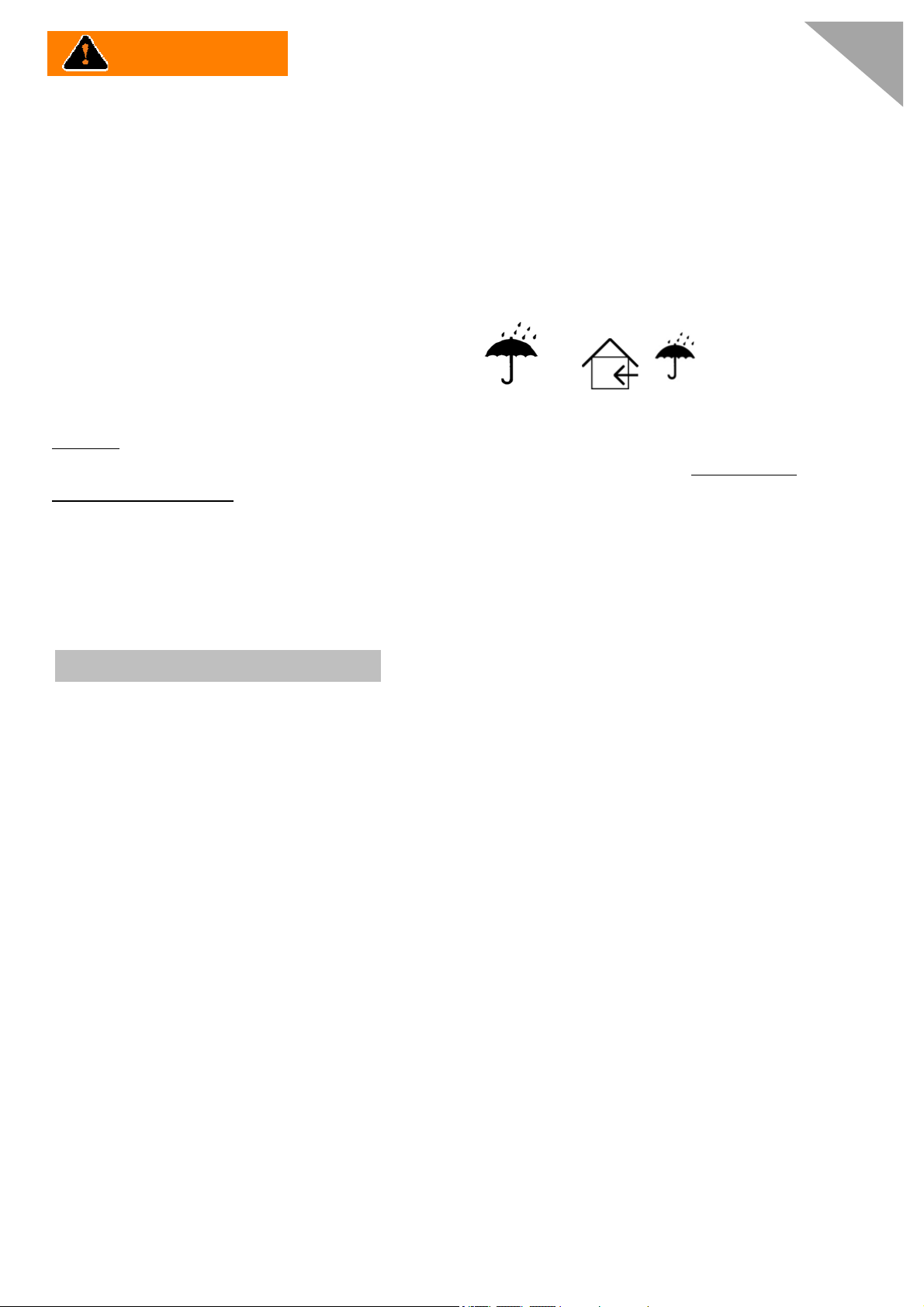
Forbidden! Although the travel scooter has passed the required IPX4 water spray test
requirements, keep electrical connections away from sources of moisture, including direct
exposure to water or body fluids, and incontinence. Check the electrical components
frequently for signs of corrosion and replace if necessary.
Warning! The charger should only be used in a
dry interior.
Protect from moisture and wetness.
Depending on the use, terrain and driving conditions, the batteries will provide a range of
25 KM of travel.
However, even if the power scooter is not in use, we recommend that the batteries are
charged periodically.
Note: Do not use any automotive batteries.
They are not designed to handle a long, deep discharge and also are unsafe for use in
power scooter.
The useful life of a battery is quite often a reflection of the care it receives.
14
CHARGING INSTRUCTION
BATTERY CHARGER
The battery charger takes the standard wall outlet voltage (alternating current) and
converts it into DC voltage (direct current).The batteries use direct current to run your
power scooter. When the batteries are fully charged, the amperage from the charger is
almost at zero. This is how the charger maintains a charge but does not overcharge the
battery.
Note 1: The batteries cannot be charged if they were discharged to
nearly zero voltage.
Note 2: The power scooter meet the requirement of ISO 7176‐14:2008 and
ISO 7176‐21:2009.
Note 3: Only use the battery charger type which was provided by the supplier.
The use of any different type of charger can be hazardous and need the approval of the
manufacturer.
Page 17
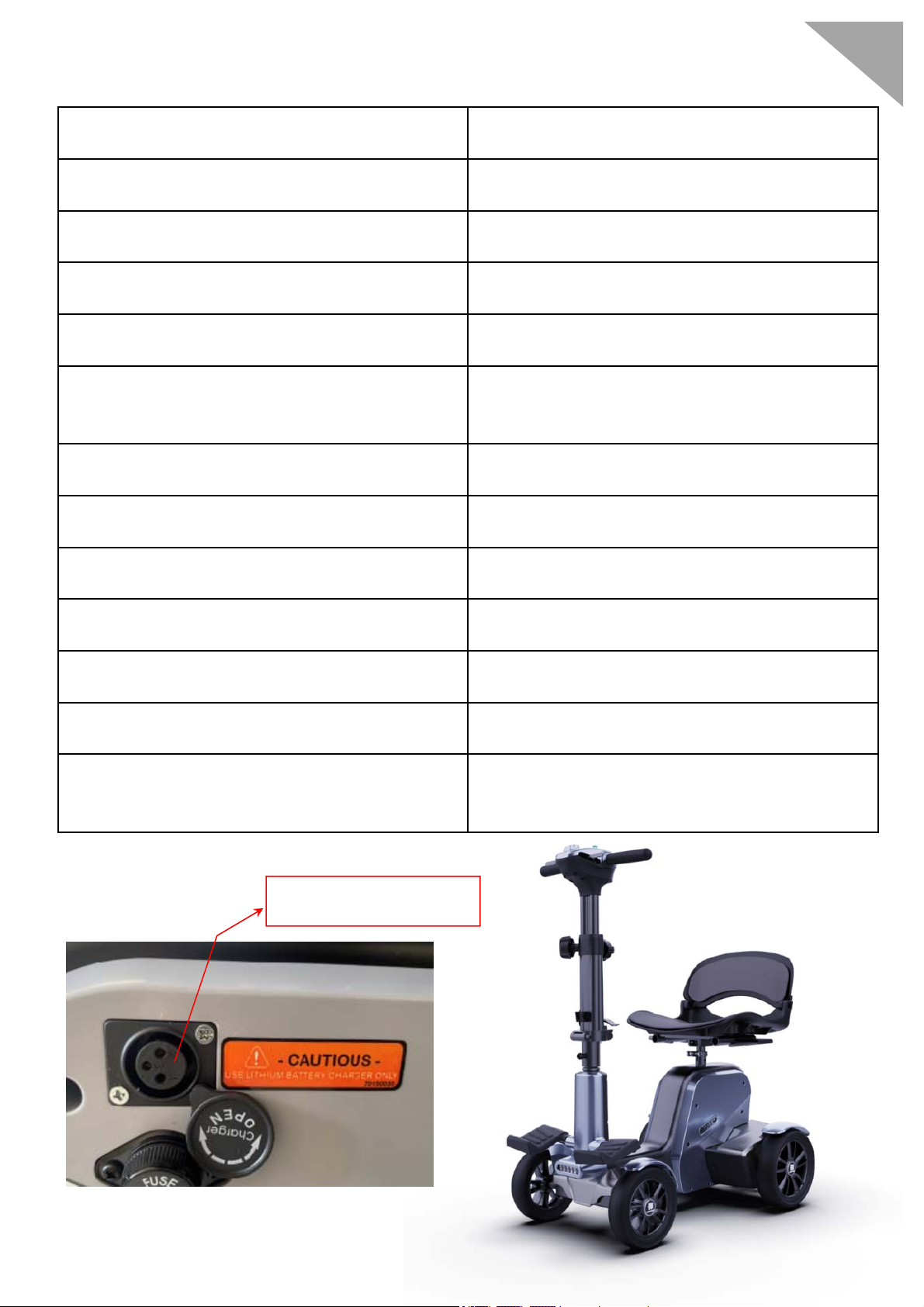
1. MODEL:HP0060W(B)-M
15
HP0060W(B)-M 24V/2A
Output current
No-load Voltage
Input AC voltage range 100~240VAC
Efficiency
Charge mode Constant Voltage
Operating temperature 0℃~40℃
Operating humidity 20%~85%
Operating altitude 0M~2000M
Dimensions
2A±0.2A
27.6±0.3VDC
AC~DC >82%
Constant Current
L128mm×W67mm×H40mm.
Weight 0.355KG
Color Black
Certificates cUL/TUV-GS/ FCC /CE-EN60601/SAA/
PSE/KC/CB/RoHS 2
This is charger port
Page 18
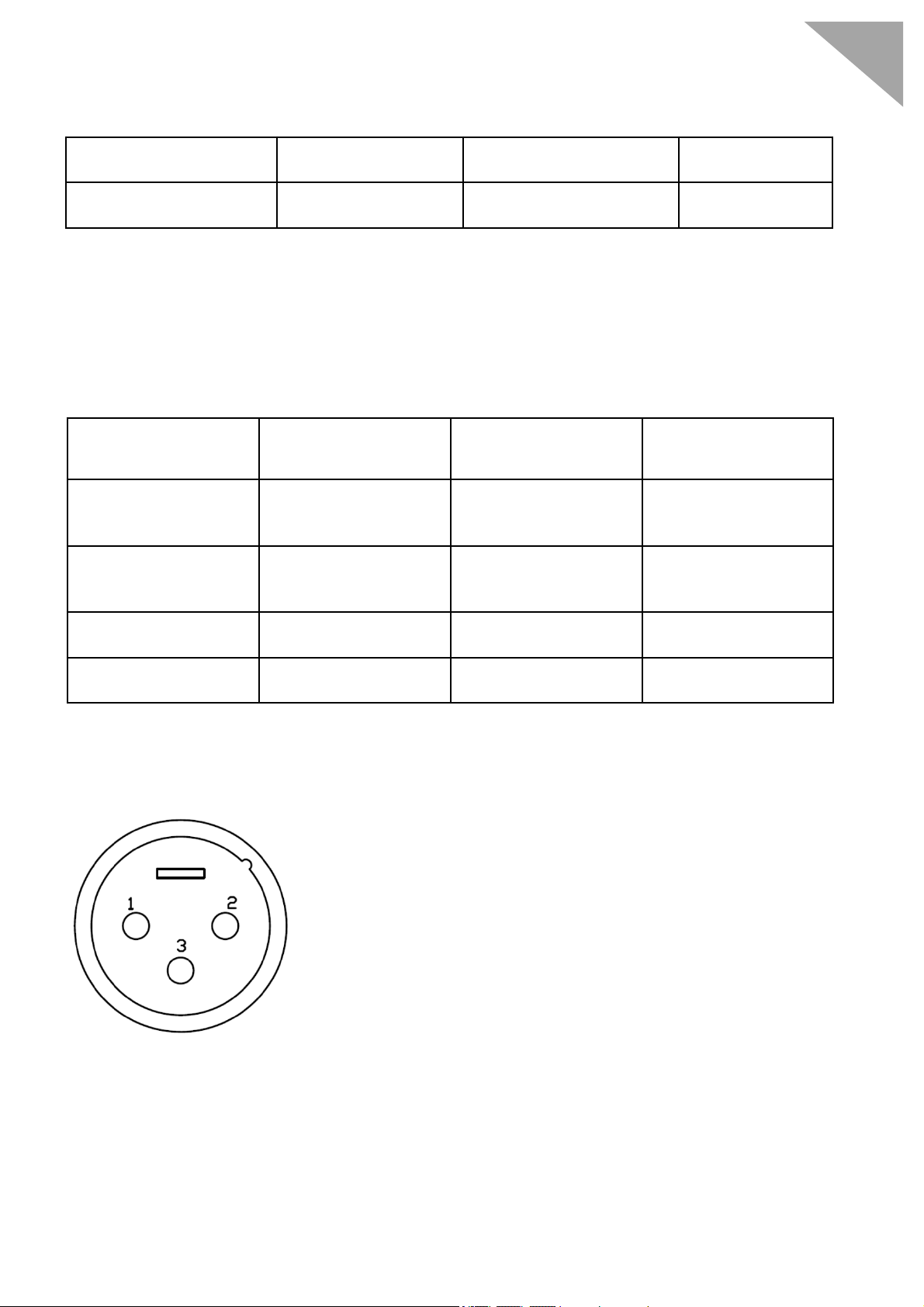
1. Electrical Characteristics
1.1 Input voltage & Frequency
Input voltage range Frequency range Min Voltage Max Voltage
100Vac~240Vac 47~63HZ 90Vac 264Vac
1.2 Efficiency:≥82%.
1.3 Input current:≤1.5A
1.4 Input leakage current:≤0.25mA
1.5 Output voltage & current
Charge mode Output voltage Output current Led display
16
Constant Current
2A±0.2A Orange light on
±1V
28.5V~29.2V±0.5
14.5V~28.5V
Constant Voltage
Decrease from2A Orange light on
V
Fully Charged 29.2V±0.4V 0.5A±0.3A Green light on
Unload 27.6V±0.3V 0A Red light on
2. Input power cord and Output connector
AC:IEC 60320 C8 connector DC:3PIN XLR connector(Pin1+、Pin 2-、Pin 3-)
3. Production introduction and operating instructions :
3.1 This is a lead-acid battery charger with AC-DC switching circuit,
suitable for 24V 6AH-20AH.
sealed lead-acid battery with constant current and constant voltage mode.
Page 19

3.2 Operating instructions
(1) Make sure the power cord, charger and battery connector are in good connected
(2) Make sure the output voltage of the charger is the same as the connecting battery.
(3) Connect the plug of the charger with the battery.
(4)Make sure the input voltage is correct and plug into the electrical outlet, normally the
LED (Red) light will turn on when it is charging.
3.3 LED indications
1.Red light on: Power on
2.Orange light on: Charging
3.Green light on: Full-charged
3.4 Troubles shooting
17
(1)RED light is off when power on. Check if the input power cord of the charger has been
plug into the socket, and if there have electricity passes from the outlet, if yes; please send
the charger for repair.
(2)ORANGE light is off during charging.
Check if the charger and battery connectors are correctly connected, if they are in good
connection, and the battery is not fully charged, the battery maybe defective.
(3)ORANGE light does not turn Green
The battery can not be charged, please remove the battery and check to see if the battery is
still useable.
(4) ORANGE light turns Green immediately. Check to see if the battery is fully charged, if
not, the charger maybe defective, please send the charger back to the manufacturer for
repair.
4. Caution
(1) For Indoor use only, do not expose to rain.
(2) Please switch off the power supply before removing the charger from the battery.
(3) Do not get closed to explosive gases or sparks and put the charger in a well ventilated
area during charging.
(4) Use the charger only with 24V lead acid battery.
5. Stickers
5.1 LED sticker
Page 20
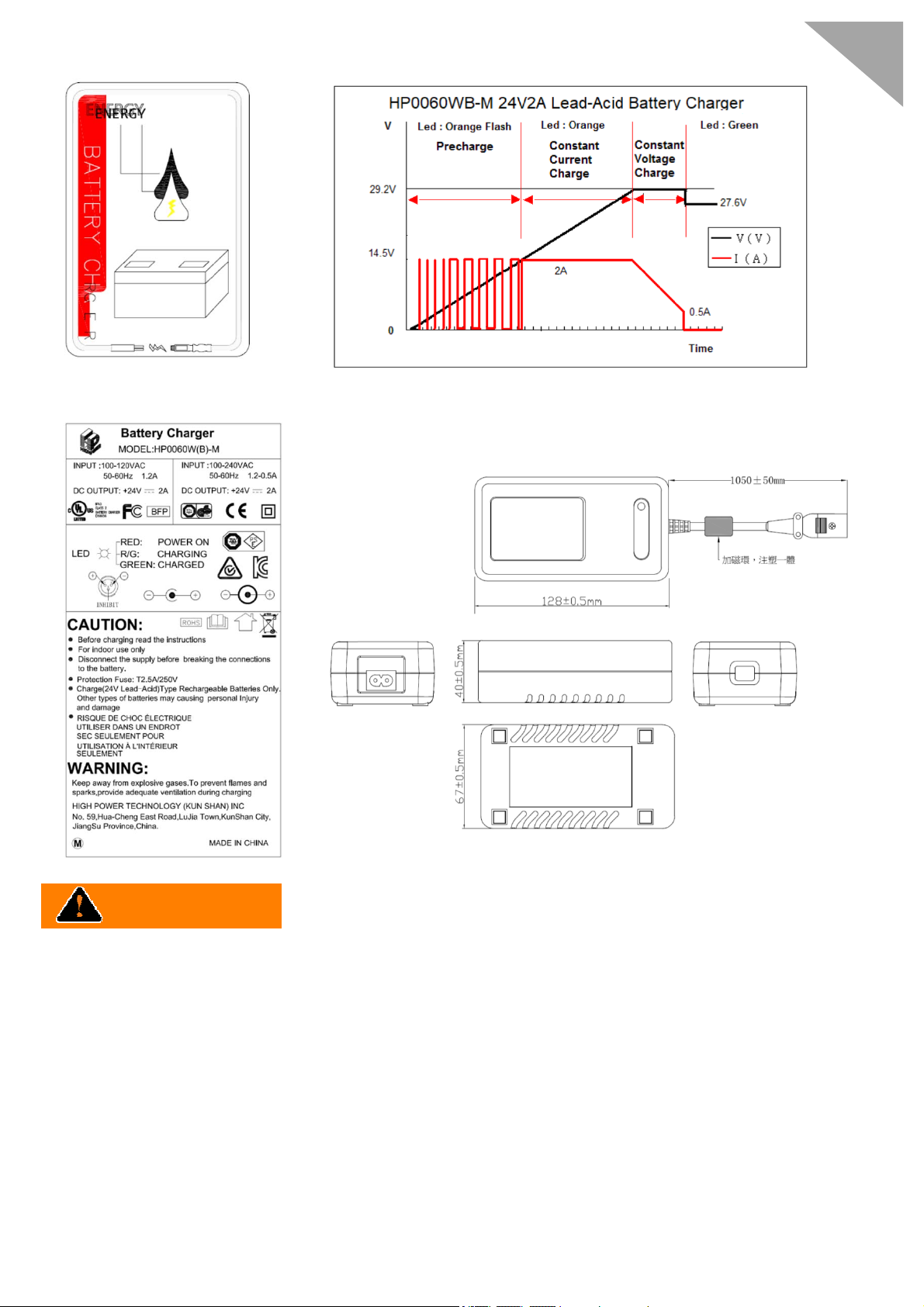
5.2 Front sticker
6. Charger curve
18
5.3 Back sticker
7.Outside view drawing
WARNING
Always charge your batteries in well ventilated areas.
The charger is intended for indoor use only. Please protect it from the moisture.
For maximum performanceIf the battery is low, it is recommended that you charge the
battery.
If the power scooter will not be used for a long period of time, arrange to have the
batteries recharge at least once every month to avoid deterioration of the batteries.
Can we use a different charger? Please understand that chargers are selected specifically for
particular applications and matched to the type and size of specificbatteries. In order to
charge your power scooter safely and efficiently, we recommend use of the charger supplied
as original equipment with your Heartway .
product only. Any charging method resulting in batteries being charged individually is
prohibited.
Page 21

According to the battery type and condition of the batteries, batteries usually can be
fully charged in 4‐10 hours.
This will be indicated when the status light in the battery charger side panel turns green.
Charging the battery longer than necessary will not harm the battery.
We recommended that you charge the batteries for 8 to 10 hours after daily use. Do not
charge the batteries for more than 24 hours.
Note: There is a battery circuit diagram labeled on the frame. Please refer this diagram
before you assemble the battery.
BATTERY MAINTENANCE INSTRUCTION
Read through the charger operating instruction before using it.
Make sure you charge the battery every time after you use the power scooter or
scooter.
If the charger indicates red light, please kindly check if the charger is defected or
if the cable wiring connection is poor.
19
Please keep the battery terminals clean otherwise the charging condition will be poor.
Caution
Caution on usage of Lithium Ion pack. (or soft pack)
Handing at assembly
1) In case of adding strong shock to battery or dropping battery, do not use the battery.
2) In case of distorting battery, do not use the battery.
3) To prevent from ESD under appropriate work environment and by workers.
Storage
1) It shall be kept in shipping condition (within 40%~60% SOC or 25V~26V voltage
range) for long period.
2) It is recommended to inspect the battery pack every 6 month to ensure battery pack is
at the best status for long term storage. If battery pack is out of the storage condition,
specified in 1), it shall be charged or discharged to the recommended storage condition.
3) It shall be kept in dry condition of low humidity, especially be free from high
temperature.
4) Do not storage the battery near heat sources, nor in a place subject to direct sunlight to
storage in warehouse.
Prohibition Clause
1) Do not throw the battery into fire, nor heat the battery.
2) Do not disassemble nor modify the battery Pack.
3) Do not leave the battery in a place of high temperature.( 45ºC or more)
4) Do not immerse battery in water, nor leaving in high moisture.
5) Do not add strong shock, nor drop the battery.
6) Do not solder lead directly to the battery body.
7) Do not heat nor solder the terminals of the battery.
Page 22

WARNING
Don’t operate your scooter for the first time without completely reading and understanding
this user manual.
1. Don’t operate scooter on public streets and roadways. Be aware that it may be difficult
for traffic to see you when you are seated on the scooter. Obey all local pedestrian
traffic rules. Wait until your path is clear of traffic, and then proceed with extreme
cautions.
2. To prevent injury to yourself or others, always ensure that the power is switched off
when getting on or off of the scooter.
3. Always check that the drive wheels are engaged (drive mode) before driving. Do not
switch off the power when the scooter is still moving forward. This will bring the chair
to an extremely abrupt stop.
4. Do not use this product or any available optional equipment without first completely
reading and understanding these instructions. If you are unable to understand the
warnings, cautions or instructions, contact a healthcare professional, the dealers or
technical supports before attempting to use this equipment, otherwise, injury or
damage may occur.
5. There are certain situations, including some medical conditions, where the scooter user
will need to practice operating the scooter in the presence of a trained attendant. A
trained attendant can be defined as a family member or care professional especially
trained in assisting a scooter user in various daily living activities. Consult with your
physician if you are taking any medication that may affect your ability to operate your
scooter safely.
6. Do not attempt to lift or move a power scooter by any of its removable parts including
the armrests, seats or shrouds. Personal injury and damage to the power chair may
result.
7. Never try to use your scooter beyond its limitations as described in this manual.
8. Please do not sit on your scooter while it is in a moving vehicle.
9. Keep your hands away from the wheels (tires) while driving scooters. Be aware that
loose fitting clothing can become caught in the drive tires.
10. Consult your physician if you are taking prescribed medication or if you have any
certain physical limitations. Some medications and limitations may impair your ability
to operate scooters in a safe manner.
11. Be aware when the drive mode is unlocked or locked.
12. Don’t Disconnectbattery anti-tipper if there is any-tipper equipped with the scooter.
20
13. Contact with tools can cause electrical shock and do not connect an extension cord to
the AC/DC converter or the battery charger.
14. Do not attempt to lift or move your scooter by any of its removal parts, such as the
armrests, seats, or shroud.
15. When climbing an incline, don’t drive at an angle up the face of the incline. Drive your
scooter straight up the incline. This greatly reduces the possibility of a tip or a fall.
16. Don’t climb a slope steeper than the scooter’s limitation.
17. Don’t attempt to have your scooter proceed backward down any step, curb or other
obstacle. This may cause the scooter to fall or tip.
18. Always reduce your speed and maintain a stable center of gravity when cornering
sharply. Don’t corner sharply when driving scooters at higher speeds.
Page 23

19. Operating in rain, snow, salt, mist conditions and on icy or slippery surfaces may
have an adverse affect on the electrical system.
20. Never sit on your scooter when it is being used in connection with any type of lift or
elevation product. Your scooter is not designed with such use in mind and any damage
or injury incurred from such use is not the responsibility of Heartway.
21. Surfaces of the power scooter that can come into direct contact with the occupant’s
skin and/or assistant’s skin during normal use and that are within occupant reach shall
not exceed 41˚C. The motor surface can reach temperatures greater than 41˚C after
driving. Do not touch these parts when disassembling the scooter or wait until the
motor is cooled down.
22. The programming of the controller shall only be carried out by personnel, which is
authorized by his manufacturer. A wrong programming can result in safety hazards for
the occupant!
23. Drive-wheel needs to be switched to engaged-mode while transporting the power
scooter with a car or airplane.
24. Surface temperatures can increase when exposed to external sources of heat.
25. Can only go up obstacles in the direction of progress. Forward & Backward obstacle
with run up.
21
IMPORTANT NOTICE
Heartway Medical Product has designed and engineered power scooter to provide maximum
utility. However, under no circumstances should you modify, add, Disconnectbattery, or
disable any part or function of your power scooter. Personal injury and damage to the power
scooter may result.
1. Do not modify your power scooter in any way not authorized by Heartway. Do not use
accessories if they have not been tested or approved for Heartway products. Changing
of controller parameter shall be only performed by authorized technicians due to the
safety concern.
2. Get to know the feel of your power scooter and its capabilities. Heartway recommends
that you perform a safety check before each use to make sure your power scooter
operates safely.
Inspections prior to using your power scooter:
1. If equipped with pneumatic tires, please check for proper tire inflations.
2. Please check all electrical connections and make sure they are tight and not corroded.
3. Please check all harness connections and make sure they are secured properly.
4. Please check the brakes.
Page 24
Weight limitation.
1. Please refer to the specifications table for weight capacity information. Power scooter
is rated for a maximum weight capacity.
2. Stay within the specified weight capacity for your scooter. Exceeding the weight
capacity voids your warranty.
3. Heartway will not be held responsible for injuries or property damage resulting from
failure to observe weight limitations.
4. Don’t carry passengers on scooters.
5. Carrying passengers on scooter may affect the center of gravity, resulting in a tip or a
fall.
Tire inflation
22
1. If your scooter is equipped with pneumatic tires, it is necessary to check the air
pressure at least one time a week.
2. Proper inflation pressures will prolong the life your tires and ensure the smooth
operation while riding.
3. Inflating your tires from an unregulated air source could over‐inflate them,
resulting in a burs tire.
Temperature
1. Some of the parts of the power scooter are susceptible to change in temperature. The
controller can only operate in temperature that ranges between -20˚C ~ 45˚C.
2. At extreme low temperatures, the batteries may freeze, and your power scooter may not
be able to operate. In extreme high temperatures, it may operate at slower speeds due to
a safety feature of the controller that prevents damage to the motors and other electrical
components.
3. The scooter can generally be operated at outside temperatures from -10˚ to +45˚C.
4. Some parts of the scooter tend to be temperature dependent. The controller works best
at temperatures between 25˚C and 45˚C.
5. Below -15˚C the batteries can freeze and the scooter may not work.
6. At extremely high temperatures > 45˚C, the safety function of the control, which
prevents damage to the motors and other electrical components, can lead to slower
maximum speeds.
Page 25

ELECTROMAGNETIC INTERFERENCE (EMI)
The rapid development of electronics, especially in the area of communications, has saturated
our environment with electromagnetic (EMI) radio waves that are emitted by television, radio
and communication signals. These EMI wave are invisible and their strength increases as one
approach the source. All electrical conductors act as antennas to the EMI signals and, to
varying degrees, all power scooters and scooters are susceptible to electromagnetic interference
(EMI). The interference could result in abnormal, unintentional movement and/or erratic
control of the vehicle. The United States Food and drug Administration (FDA) suggests that the
following statement be incorporated to the user’s manual for all power scooter like the S11E.
Power scooters may as susceptible to electromagnetic interference (EMI), which is interfering
electromagnetic energy emitted from sources such as radio stations, TV stations, amateur radio
(HAN) transmitter, two‐way radios, cellular phones and alarm systems of shops. The
interference (from radio wave sources) can cause the power scooter to release its brakes, move
by itself or move in unintended directions. It can also permanently damage the powered
scooter’s control system. The intensity of the EM energy can be measured in volts per meter
(V/m).Each powered scooter can resist EMI up to a certain intensity. This is called “ immunity
level”. The higher the immunity level the greater the protection. At this time, current
technology is capable of providing at least 20 V/m of immunity level, which would provide
useful protection against common sources of radiated EMI.
23
Following the warnings listed below should reduce the chance of unintended brake release or
powered scooter movement that could result in serious injury:
1. Do not turn on hand‐held personal communication devices such as citizens band (CB)
radios and cellular phones while the powered scooter is turned on.
2. Be aware of nearby transmitters such as radio or TV stations and try to avoid coming close
to them.
3. If unintended movement or brake release occurs, turn the powered scooter off as soon as it
is safe.
4. Be aware that adding accessories or components, or modifying the powered scooter, may
make it more susceptible to interference from radio wave sources .(Note: It is difficult to
evaluate the effect on the overall immunity of the powered scooter)
5. Report all incidents of unintended movement or brake release to the powered scooter
manufacturer, and note whether there is a radio wave source nearby.
TURN OFF YOUR POWERED SCOOTER AS SOON AS POSSIBLE WHEN
EXPERIENCING THE FOLLOWING:
• Unintentional scooter movements.
• Unintended or uncontrollable direction.
• Unexpected brake release.
Page 26

The FDA has written to the manufacturers of power scooters asking them to test new
products to be sure they provide a reasonable degree of immunity against EMI. The FDA
requires that a powered scooter should have an immunity level at least 20 V/m, which
provides a reasonable degree of protection against more common sources of EMI. The
higher the immunity level the greater the protection. Your powered scooter has an immunity
level of 20 V/m which should protect
against common sources of EMI.
24
WARNING
• The scooter itself can disturb the performance of the electromagnetic fields such as emitted
by alarm systems of shops.
• The driving performance of the scooter can be influenced by electro magnetic fields.
S11E seat is tested according to EN 1021 regarding resistance to ignition, but it is
recommended to avoid the use of flame near the power scooter and of smoking during
sitting on the power scooter.
Remarks:
The stability tests were performed in the least stable positions of the seat (height and
front/rear position).
The distance will be reduced if the wheelchair is used frequently on slopes, rough round or
to climb the kerbs.
WARNING
The stopping distance on the slope can be significantly greater than on the level
ground.
Indication/ Intended Purpose:
Considerable to pronounced limitation of mobility/walking abilities/structural and/or
functional damages the lower extremities (including amputation, consequences of
injuries, musculoskeletal.
Severe impairment of strength and grasping capabilities
Sufficient orientation and coordination capabilities
Ensuring mobility indoors as well as outdoors (access to neighborhood and
handling of routine errands)
Page 27

MAINTENANCE & REPAIR
Your power scooter is designed for minimal maintenance. However, like any
motorized vehicle it requires routine maintenance. To keep your S11E for years
of trouble-free operation, we recommend you follow the following maintenance
checks as scheduled.
DAILY CHECKS
1. Visual check on the conditions of tires.
2. Inspect the battery condition meter on the controller to determine if batteries need
to be charged.
MONTHLY CHECKS
1. Visually inspect the controller harnesses. Make sure that they are not frayed,
cut or have any exposed wires.
SEMI-ANNUAL CHECKS
1. Check the motor brushes. We recommended that your authorized dealer
inspect the brushes every six months or sooner if your power scooter is not
operating smoothly. If inspection determines excessive wear on the brushes,
they must be replaced or motor damage will result.
Disposal of Your Power Scooter/ Batteries
Your power scooter/batteries must be disposed of according to applicable local
and national statutory regulations. Contact your local waste disposal agency or
authorized dealer for information on proper disposal of power scooter packaging,
metal frame components, plastic components, electronics, batteries, neoprene,
silicone, and polyurethane materials.
25
CHECKS:
Make sure to keep the controller clean while protecting it from rain or water. Never
hose off your power scooter or place it in direct contact with water.
Keep wheels free from lint, hair, sand and carpet fibers.
Visually inspect the tire tread. If less than 1mm (1/32”), please have your tires
replaced by your local dealer.
All Upholstery can be washed with warm water and mild soap. Occasionally check
the seat and back for sagging, cuts and tears. Replace if necessary. Do not store
your scooter in damp or humid conditions as this will lead to mildew and rapid
deterioration of the upholstery parts.
All moving mechanism will benefit from simple lubrication and inspection. Lubricate
using petroleum jelly or light oil. Do not use too much oil, otherwise small drips
could stain and damage carpets and furnishings etc.
Always perform a general inspection of the tightness of all nuts and bolts.
Cleaning and Disinfection
Use a damp cloth and mild, non‐abrasive cleanser to clean the plastic and metal
parts of your power scooter. Avoid using products that may scratch the surface of
Your power scooter.
If necessary, clean your product with an approved disinfectant. Make sure the
disinfectant is safe for use on your product before application. Follow all safety
instructions for the proper use of the disinfectant and/or cleaning agent before
applying it to your product. Failure to comply may result in skin irritation or premature
deterioration of upholstery and/or power scooter finishes.
Page 28

SCOOTER MAINTENANCE & REPAIR
Your power scooter is designed for minimal maintenance. However, like any motorized
vehicle it requires routine maintenance. To keep your scooter for years of trouble-free
operation, we recommend you follow the following maintenance checks as scheduled.
DAILY CHECKS
1. Visual check on the conditions of tires.
2. Inspect the battery condition meter on the controller to determine if batteries need to
be charged.
WEEKLY CHECKS
1. Your power scooter comes with standard pneumatic tires. If your power scooter comes
with optional air tires, make sure to maintain the pressure of the tires between 30-35 psi.
MONTHLY CHECKS
26
1. Visually inspect the controller harnesses. Make sure that they are not frayed, cut or
have any exposed wires.
CHECKS:
Make sure to keep the controller clean while protecting it from rain or water. Never
hose off your power scooter or place it in direct contact with water.
Keep wheels free from lint, hair, sand and carpet fibers.
Visually inspect the tire tread. If less than 1mm (1/32"), please have your tires
replaced by your local dealer.
All upholstery can be washed with warm water and mild soap. Occasionally check
the seat and back for sagging, cuts and tears. Replace if necessary. Do not store your
scooter in damp or humid conditions as this will lead to mildew and rapid
deterioration of the upholstery parts.
All moving mechanism will benefit from simple lubrication and inspection.
Lubricate using petroleum jelly or light oil. Do not use too much oil, otherwise
small drips could stain and damage carpets and furnishings etc. Always perform a
general inspection of the tightness of all nuts and bolts.
Page 29

TROUBLE SHOTTING & ERROR CODE
P&G S-Drive 45 Amp controller: Your scooter is fitted with S-Drive controller, which
continuously monitors the operating conditions of your scooter. If it detects a problem it
will indicate with error message by flashing light on the power ON/ OFF light. You must
count the number of the flash, and see the list to check what kind of error has happened
according to the number)
Flash Description
27
1
2
3
4.
5 Not used
6
7
8. A controller fault is indicated. Make sure that all connections are secured.
The battery needs charging or there is a bad connection to the battery. Checkthe
connections to the battery. If the connections are good, try changing the battery
There is a bad connection to the motor. Check all the connections between the
motor and the controller
The motor has a short circuit to a battery connection. Contact your service
agent.
The freewheel switch is activated or the manual brake disengagement
mechanism is operated. Check the position of the switch of lever.
The S-Drive is being inhibited from driving. Inhibit 2 is active. This may be
because the battery charger is connected or the seat is no in the driving position.
A throttle fault is indicated. Make sure that the throttle is in the rest position
before switching on the scooter.
9.
10.
Note:
If you experience any technical problems, it is
recommended that you check with your local dealer
before attempting to troubleshoot on your own.
The following symptoms could indicate a serious problem
with your power wheelchair. Contact your local dealer if
any of the following arises:
1. Motor noise
2. Frayed harnesses
3. Cracked or broken connectors
4. Uneven wear on any of tires
5. Jerky motion
6. Pulling to one side
7. Bent or broken wheel assemblies
8. Does not power up
9. Powers up, but does not move
The parking brakes have a bad connection. Check the parking brake and motor
connections. Make sure the controller connections are secured.
An excessive voltage has been applied to the controller. This is usually caused
by a poor battery connection. Check the battery connections.
Page 30
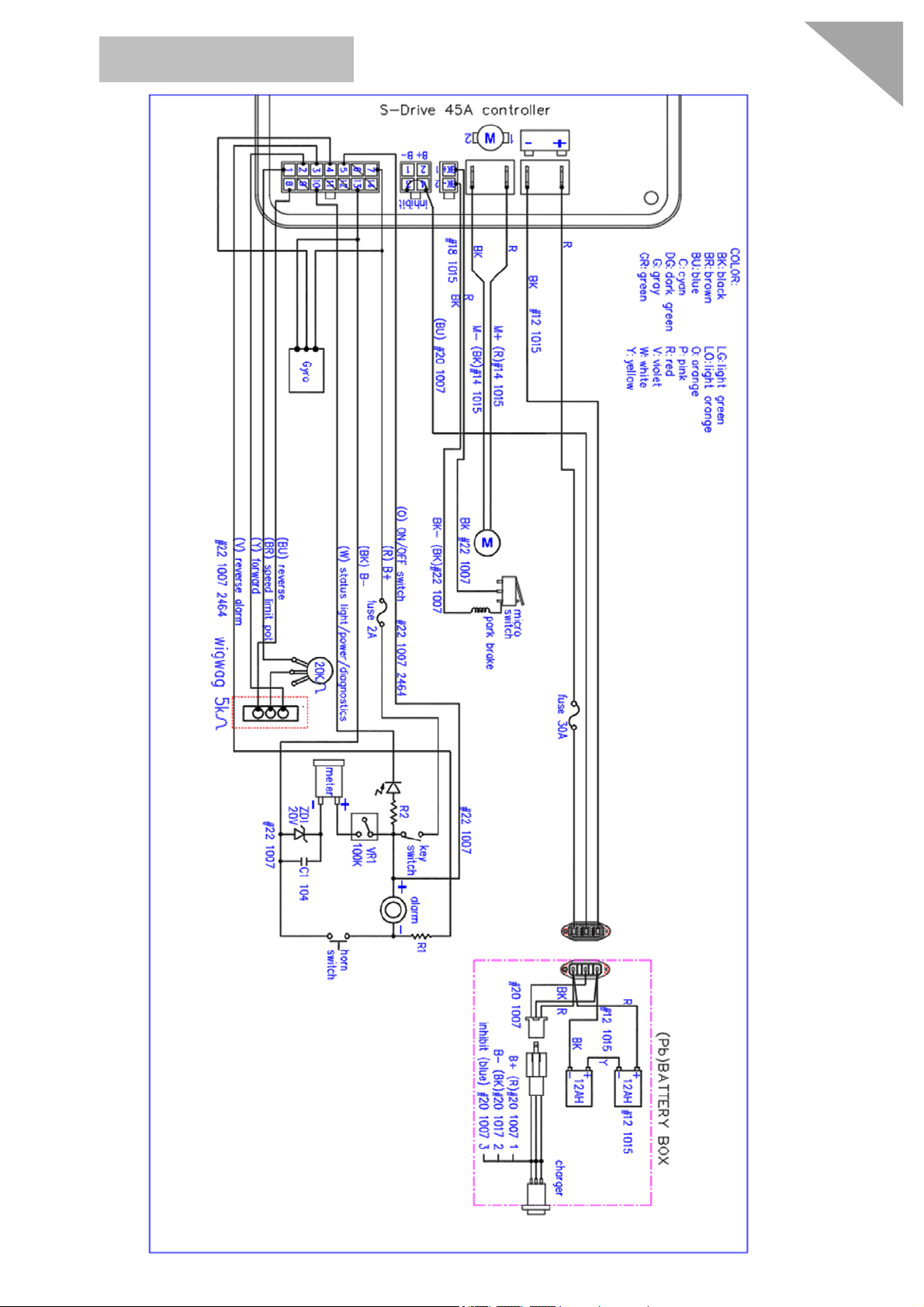
CIRCUIT DIAGRAM
28
Page 31
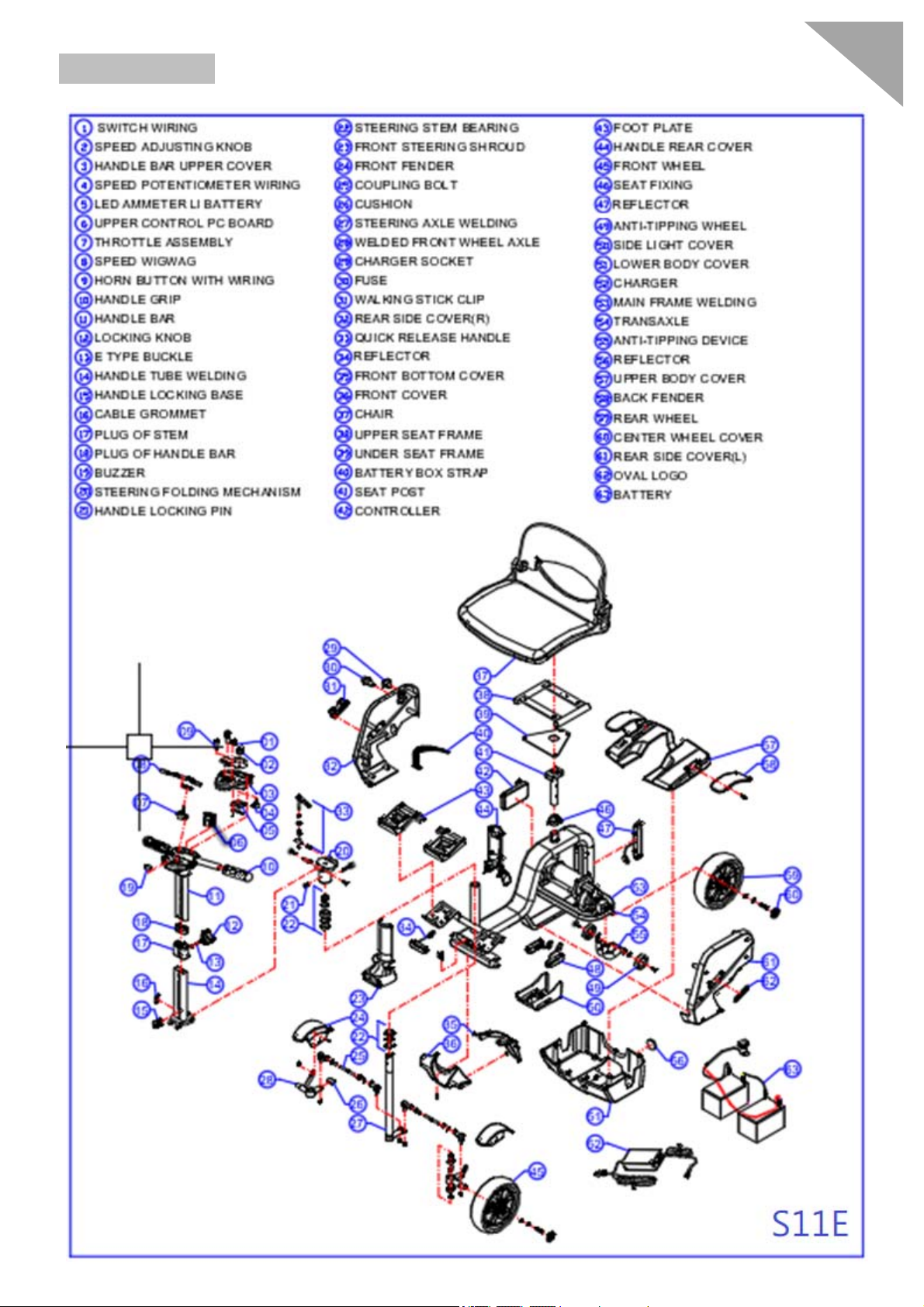
BOM LIST
29
Page 32

WARRANTY DECLARATION
Quality/ Warranty Declaration
Products are fit for purpose and of excellent quality and performance.
For valid warranty claims Heartway will, at their discretion, replace/
repair/ refund items mutually agreed to be defective.
Heartway’s Warranty as Following:
Frame: Two‐year limited warranty
Controllers: One‐and‐a‐half‐year limited warranty
Electronic Components and Charger: One‐year limited warranty
Warranty Exclusion. The following items are not covered by warranty.
Motor brushes Wheel Tires Arm Pads
Seat Cushion Fuses / Bulbs Tiller Cover
30
Rear Shroud Front Shroud Batteries and Consumable parts
Any damage or defect of any nature occurring from the misuse, abuse of the product,
improper operation or improper storage is not to be covered. The warranty is to start
from the date of arrival of our products. Normally, the average lifespan of a scooter will
last 5-year long. Heartway will be able to provide the spare-part support for five-year
long after scooters purchased.
Note: If you encounter a damaged or cracked battery; please enclose it in a plastic bag
and call the local authorized dealers immediately for instructions on disposal and
recycling.
Product Safety Notice and Product Recalls
For detailed product safety notice and product recalls, please contact your local
authorized distributer direct. The recall notice should include the following information:
Product description, including the name, make, model and any distinguishing features,
batch, or serial numbers.
Page 33
Heartway Medical Products Co.,LTD
No.18, Jingke Central 1st Rd., Nantun Dist., Taichung City 408, Taiwan (R.O.C.)
TEL:+886-4-2358-0537 FAX:+886-4-23590786
E-mail: sales@heartway.com.tw
http://www.Heartway.com.tw
 Loading...