

Page 1

Cross-folding wheelchairs / English
User manual
Page 2
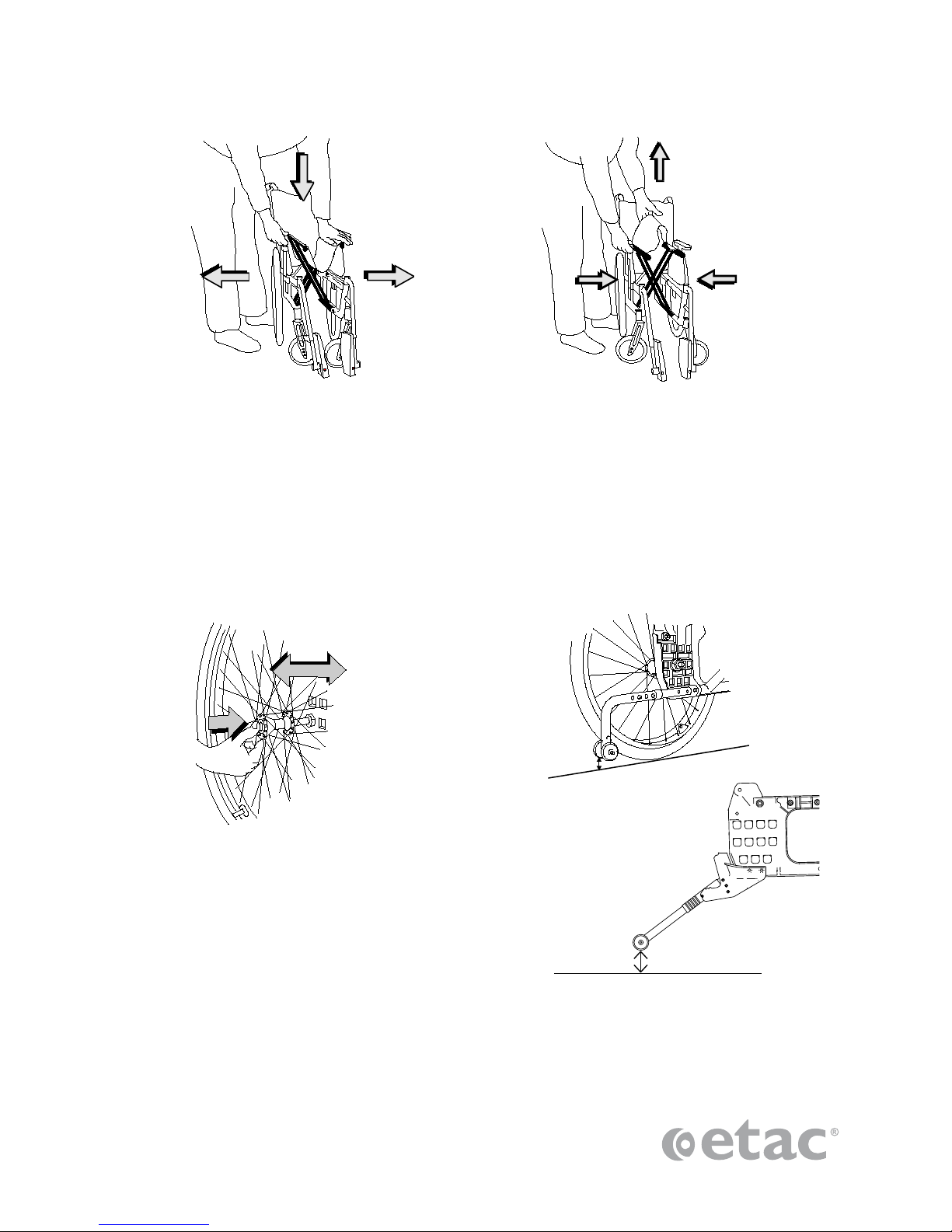
Unfolding
• Push one of the seat bars downwards,
with your entire hand on top of the seat.
• Do not keep hold of the seat bar during
unfolding, as there is a risk of trapping
your fingers.
• Lower the footrests.
Anti-tip feature
• Test how far back you would like the
wheelchair to be able to tip.
• You must be able to move easily, yet
still feel secure.
Rear wheel with quick release
• When assembling, always check that
the rear wheel is correctly positioned.
• The button in the hub must spring out
properly.
Folding
• Remove/unsnap any bow handle
and/or cross-brace, if applicable.
• Flip up the footrests.
• Lift the seat upwards.
2
3-4c m
A
3-7 cm
Page 3
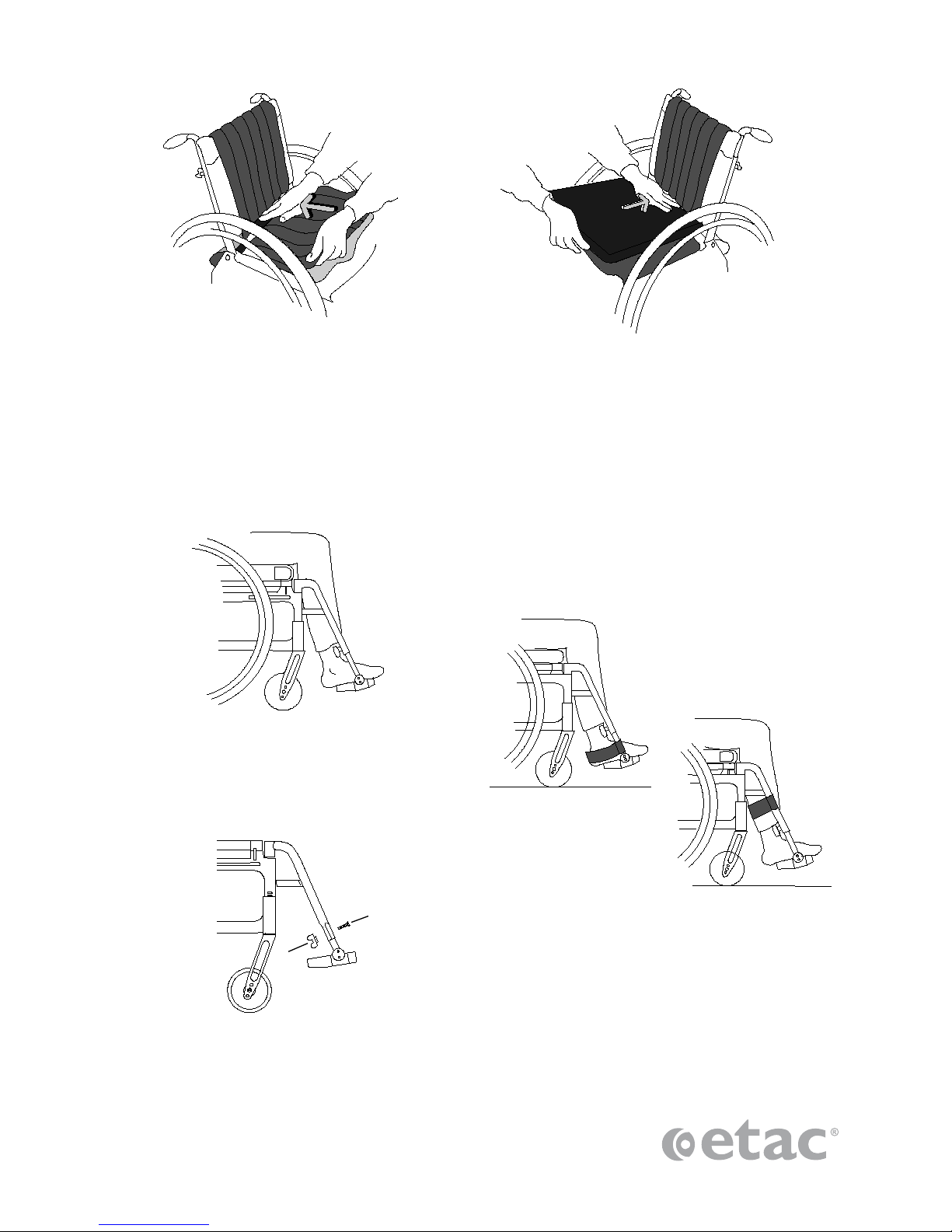
Back cover
• Place the back cover far enough back
on the seat for a fold to be formed
between the backrest and seat.
• It is important to always place the
back cover on the seat in this way, as it
affects user comfort when seated.
Footrests
• Adjust the height until you are sure
that your feet are supported and your
thighs are resting on the cushion.
• Adjust the footrest angle, so the ankles
are at 90°.
• Loosen the lock nut (A) on the legrest
fully. Remove the screw (B).
Adjust the height. Replace the screw
and nut and tighten securely.
Seat cushion
• Place the cushion far enough back on
the seat that the rounded corners are
between the back tubes.
• Trim the cushion to suit seat depth.
• Place any comfort wedge in the pocket
of the cover under the cushion.
Calf/Heel strap
• Adjust the length so that your
insteps rest on the footrests.
3
A
B
Page 4
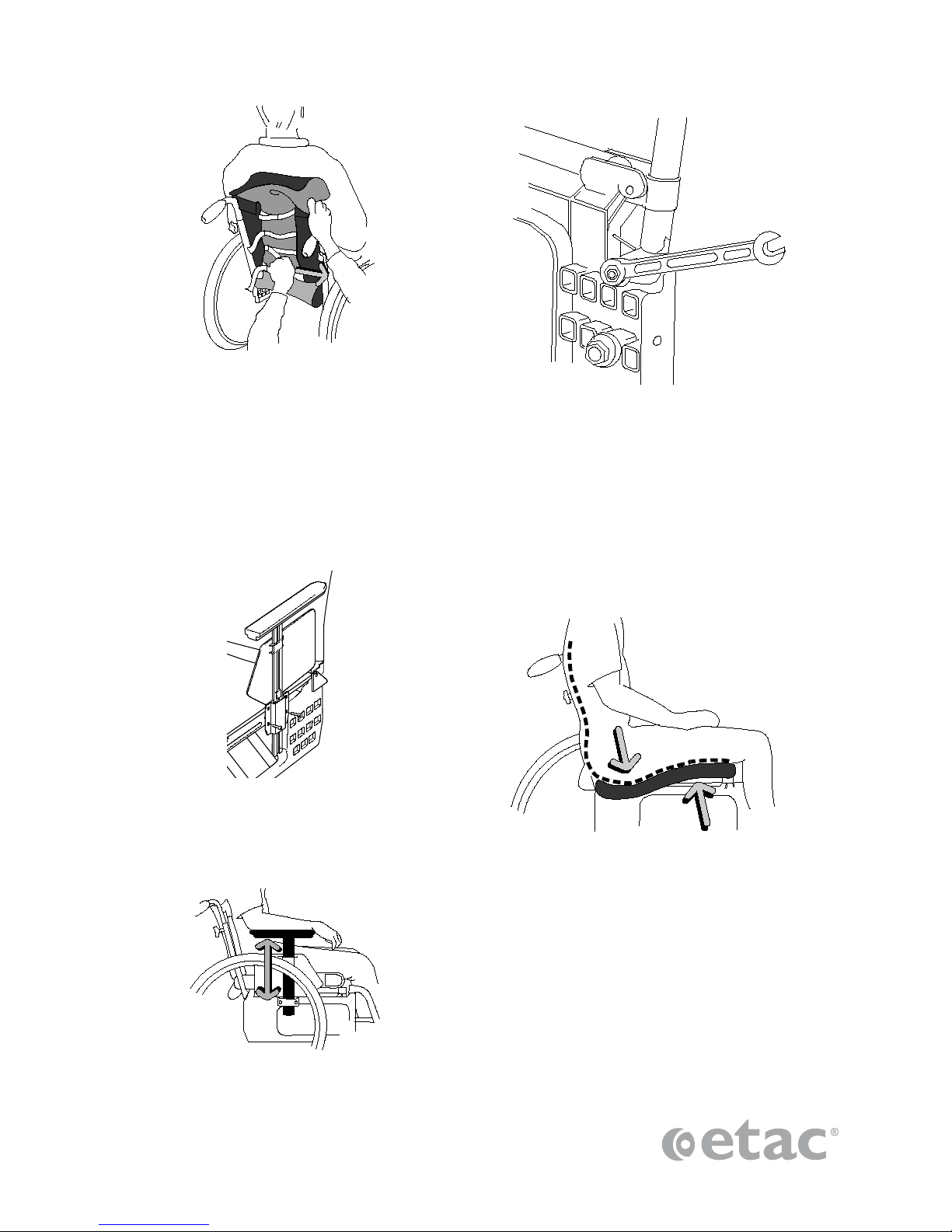
Back upholstery
• Loosen all back straps.
• Tighten the strap just below the curve
of the back.
• Adjust the other straps to allow space
for the bottom and follow the natural
curve of the back.
Armrest
• The high position of the armrests
supports and relieves pressure on the
back better than a lower position.
Backrest angle
• The backrest angle may need to be
adjusted when adjusting the shape
of the back upholstery.
Comfort
• Good comfort when seated requires
a well-shaped seat that provides:
- Pressure distribution.
- Stability.
- Freedom of movement.
4
• Slide the side plate up or down to the
required height.
• Reattach the screw to the side plate.
Page 5
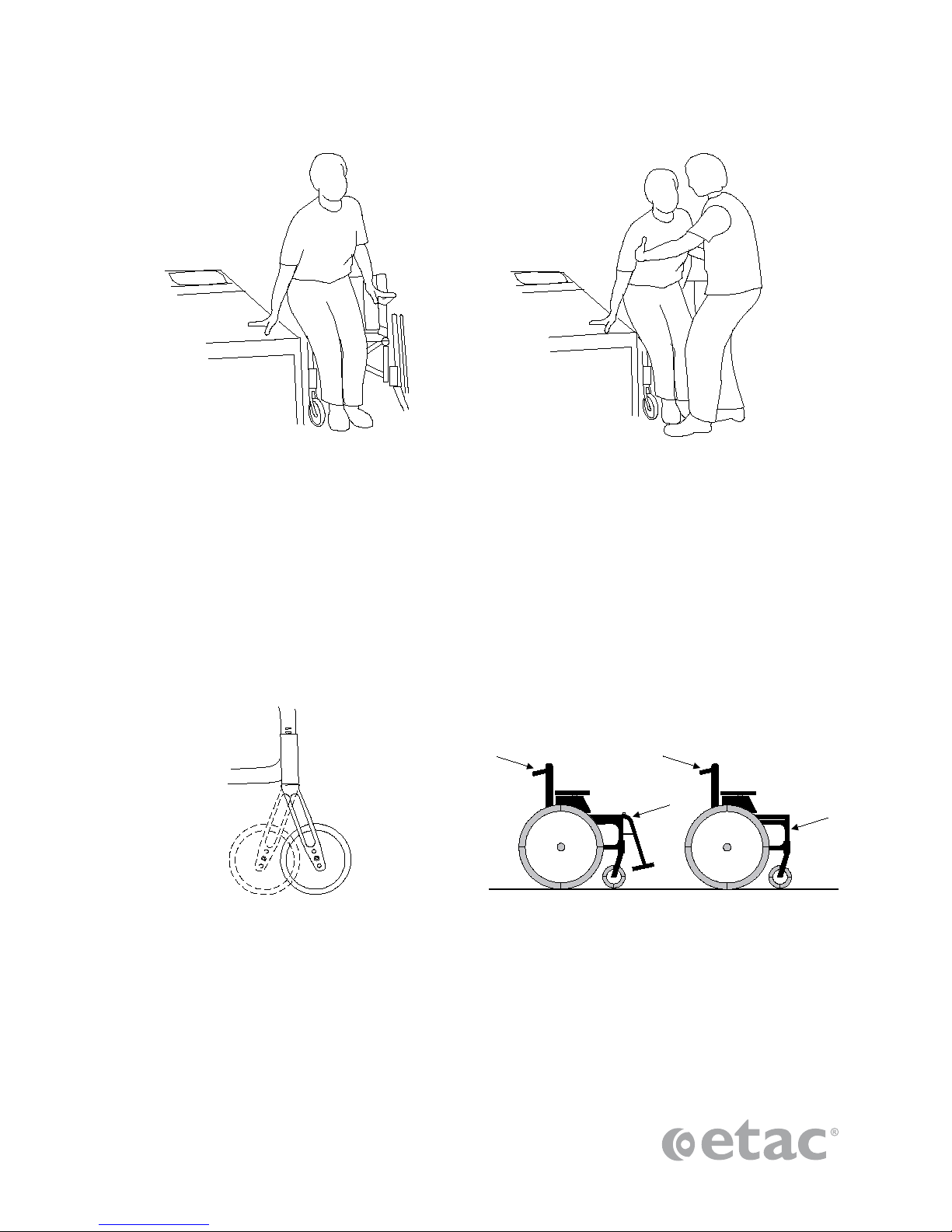
Transfer to/from a wheelchair
Sideways
• Back the wheelchair up 5-10 cm
before stopping so that the castors are
facing forwards.
• The wheelchair should be close to
the transfer point.
• Lock the brakes.
• Remove/raise the armrest/siderest
and legrest on the transfer side.
Parking
• Increase the support area of the
wheelchair by backing up 10 cm so
that the castors are facing forwards.
• Helper: Lock the brakes and ensure
that the anti-tip stabilisers are
lowered.
From the front
• Back the wheelchair up 5-10 cm so
that the castors are facing forwards.
• The wheelchair should be close to
the transfer point.
• Lock the brakes and swivel the
legrests in or out under the seat.
• Do not stand on the footrests, risk
of tipping!
Lifting the wheelchair
• Check that the height-adjustable push
handles are properly tightened.
• Non-lockable legrests should be swung
under the seat, and the wheelchair
lifted by the upper front section of
the frame.
5
Page 6
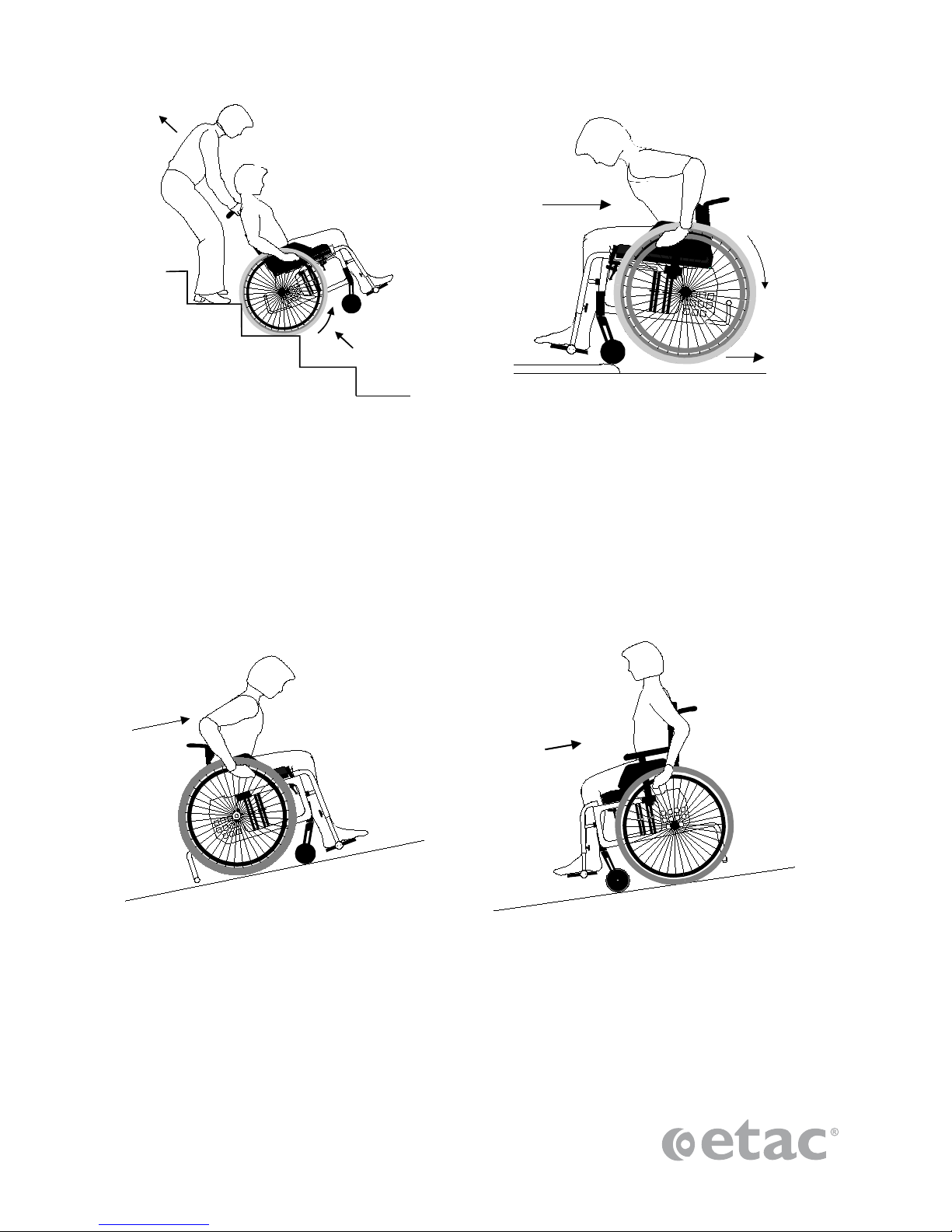
Travelling downhill
• Lean your body back to correct
the centre of gravity.
Kerbs
• Flip up the anti-tip stabilisers.
• If you are unsure, ask for help.
• Up/Low kerb: Back up, take a
strong grip and lean your upper
body over your thighs.
• Down/Low kerb: Back up carefully
and lean your upper body over
your thighs.
Travelling uphill
• Lean your body forwards to correct
the centre of gravity.
Stairs
• Always ask for help.
• Flip up the anti-tip stabilisers.
• Ascending: With the wheelchair facing
backwards.
• Descending: With the wheelchair
facing forwards.
• Never use an escalator, even with a
helper present.
- Check your speed using the handrims, not the brakes!
- Always travel up/down as directly as possible.
- If you are unsure, ask for help.
6
Page 7
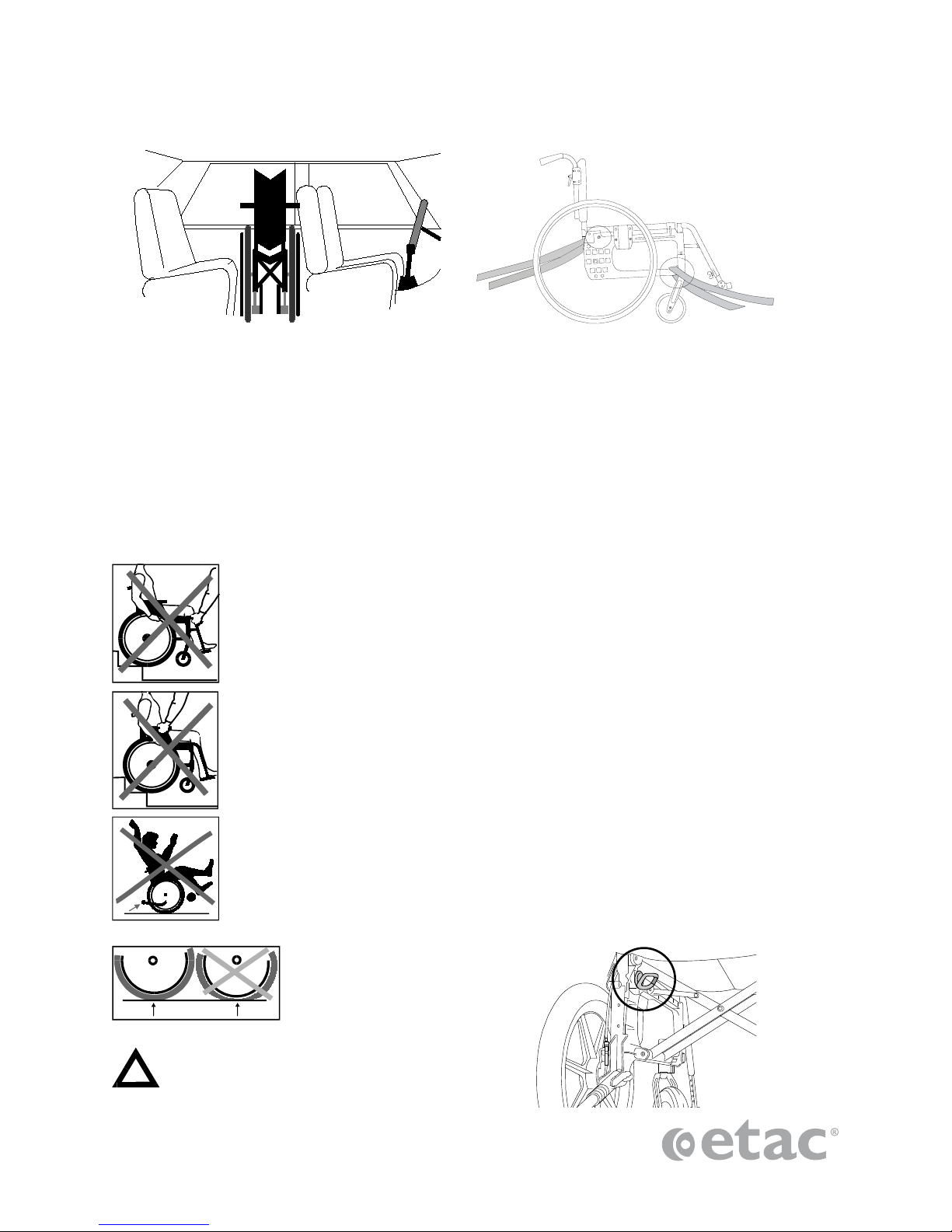
Car/taxi
• Ideally, the wheelchair should be
placed in the boot.
• If the wheelchair is placed in the back
seat, ensure that it cannot tip over or
roll. Secure it, if possible using the
vehicle’s seat belts.
Explanation of symbols
Do not lift the chair
using the legrests.
Do not lift the chair
using the armrests.
Risk of tipping:
Always have the
anti-tip stabilisers
down when moving.
Always ensure
the tyre pressure
is correct.
Always check the anti-tip
stabiliser function when adjusting
the seat height, balance position
or backrest angle.
Mobility service bus
Etac’s wheelchairs are crash-tested and
approved in accordance with
ISO-7176-19 and ISO 10542, with
attachment features and three-point
belts from Unwin.
• The user should transfer to a vehicle
seat, if possible, and use the vehicle’s
three-point belt during transport.
The wheelchair must then be secured
so that it cannot tip over or roll.
• If the wheelchair is used as a seat when
travelling, the chair must be facing in
the direction of travel and be fastened
to the vehicle at four points, round the
end/the front castor mountings and
through the transport attachment
(item no. 26158) at the back, as shown
in the picture. The wheelchair must not
be secured through the wheels or round
the back tube.
• Accessories that can be removed without
tools, e.g. trays, must be removed.
The wheelchair’s belts are not sufficient
to prevent injury in the event of sudden
braking.
Vehicle transport
7
1" = 6 kg /cm²/85 psi
13/8 " =3,5 k g/cm²/50 psi
Page 8

Maintenance
Rear wheels: Clean quick release axles as required.
Tyre pressure: Check the tyre pressure, see tyre section (once/month).
Castors: Clean castor wheel axles as required.
Chassis: Wash with a damp cloth and detergent, e.g. car shampoo.
Upholstery: Wash, see labels on each item.
In the event of problems, contact your Assistive Equipment Centre.
(!) If necessary, lubricate moving parts/joints with cycle oil or similar.
Troubleshooting table
The wheelchair is pulling
diagonally
The wheelchair is “heavy” to
manoeuvre
The wheelchair is awkward
to turn
The brakes are poor
The rear wheels are “loose”
The rear wheels are difficult
to get on/off
The castors “wobble”
The wheelchair is difficult to
fold up/unfold
The wheelchair feels “unsteady”
- Pump up the tyres
- Adjust the angle of the front fork mountings
- Check that the front fork mountings are fitted at the same height
- The rear wheel mountings are incorrectly fitted
- The user’s weight is not evenly distributed in the wheelchair
- The front handrim is stronger on one side
- Pump up the tyres
- The rear wheel mountings are incorrectly fitted
- Clean any hair and dirt from the castor axles
- Too much weight over the castors; adjust the chair’s balance position
- Pump up the tyres
- Check that the front forks are not tightened too much
- Clean any hair and dirt from the castor axles
- Too much weight over the castors; adjust the chair’s balance position
- Pump up the tyres
- Adjust the distance between tyre and brake
- Check that the washer round the hub axle is still in place
- Adjust the hub axle length
- Lubricate and clean the quick release with cycle oil or similar
- Adjust the hub axle length
- The front forks have not been tightened sufficiently
- Check that the front fork mountings are fitted at the same height
- Adjust the angle of the front fork mountings
- Too much weight over the castors; adjust the chair’s balance position
- The upholstery is too taut
- Lubricate and clean the cross elements under the seat
- Pump up the tyres
- Check that screws and controls are properly tightened
8
74590A
06-06-12
Etac, box 203, se-334 24 Anderstorp
TEL +46-371-58 73 00 FAX +46-371-58 73 90
www.etac.com
Maximum user weight: Cross/Twin 125 kg, Cross XL 150 kg, Transit 145 kg
 Loading...