

Page 1
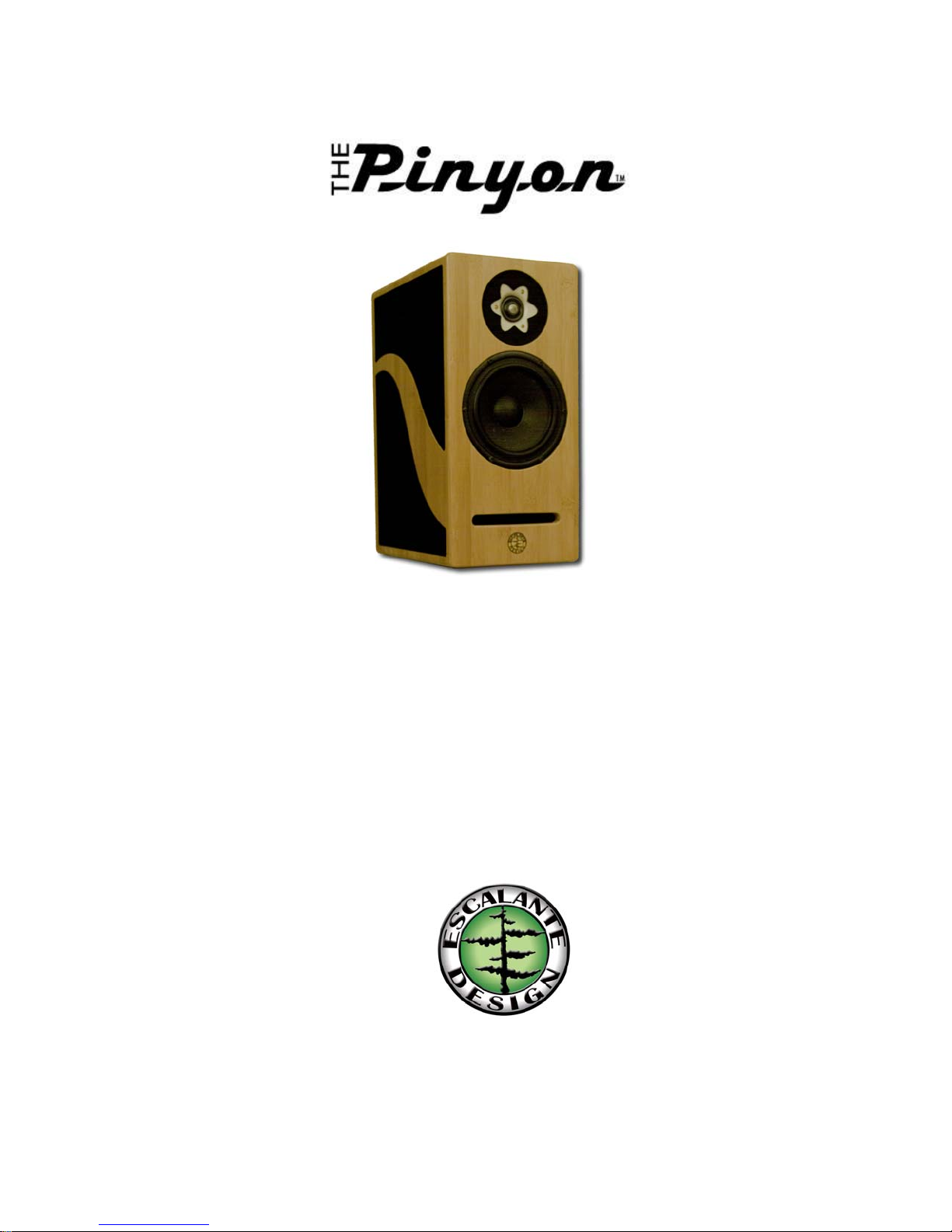
Reference Manual & Guidebook
A collection of system descriptions and recommendations
designed to provide the owner with an expanded
understanding of the use, care, and enjoyment of The Pinyon™
loudspeaker system.
Page 2

Contents
Authentication ..........................................3
Foreword ..................................................4
- Welcome
Warnings ..................................................5
Initial Placement & Electrical Hook-up
- Location ............................................. 6
- Stands ............................................... 6
- Spikes ...............................................6
- Cabling .............................................. 6
Initial Impressions.................................... 7
- Introduction
- Break In
- Program Material
Set-up.......................................................8
Sound & Your Room-an Overview
- Architecture
- Room Shape / Placement
Room & Loudspeaker Integration
- Bass...................................................9
- Midrange ...........................................9
- Treble ...............................................10
Spiking & Leveling ................................... 10
Grill Removal .......................................... 11
Amplification ..........................................11
Loudspeaker Cable ..................................11
Listening Concerns ..................................11
Care & Maintenance ..................................12
Technical ..................................................13
- General Measurements
Warranty...................................................14
2
Page 3

© 2004 Escalante Design L.C.
Reproduction in whole or in part without prior written permission is
prohibited. All rights reserved. This manual, in whole or in part, may
not be reproduced, translated or reduced to any machine-readable
form without prior written approval.
The information contained herein is designed relative to The Pinyon™
loudspeaker system; designed and manufactured by Escalante Design.
Escalante Design is not responsible for any use of this information as
applied to other loudspeakers.
Neither Escalante Design nor its affiliates shall be liable to the
purchaser of this product or third parties for damages, losses or
expenses incurred by purchaser or third parties as a result of:
accident, misuse or abuse of this product or unauthorized
modifications, repairs or alterations.
Trademark Notice: Escalante Design L.C., The Pinyon™, and Escalante
Design, are trademarks of Escalante Design and Escalante Design L.C
Patents: BUWA Tech L. L.C. has granted rights to Escalante Design
L.C. for the use of its patents.
General Notice: Other product names used herein are for identification
purposes only and may be trademarks of their respective owners.
Escalante Design disclaims any and all rights in those marks.
Quality Control: Before each speaker leaves the factory, it is subject to
15 different quality control evaluations…including a listening test. This
is above and beyond the visual inspection of each individual part when
it enters the Escalante factory.
Trade Name: Escalante Design
Responsible Party: Escalante Design L.C.
Address: 3585 North University Ave. Suite 200
Provo, Utah 84604
Telephone: 801.373.4712
Fax: 801.805.6918
Web site: www.escalantedesigns.com
Email [email protected]
For more specific information on the Escalante Design
philosophy/technology, visit our web site, listed above.
3
Page 4

Foreword
For several generations inventors and audio enthusiasts have been
experimenting with ways to reproduce sound, or more specifically,
music. The audio industry has progressed from a mesmerizing
discovery, to an accepted form of communication, and now to a
necessity in many homes. Whether we are watching movies or reliving an exceptional performance, sound and music reproduction has
taken an integral place in our lives.
Unfortunately, in the years since its genesis, loudspeaker design has
often pursued a meandering path. The individuality of a loudspeaker
frequently establishes itself in the form of gimmicks, flavors, and/or
cookbook-style patterns: thus, straying from the goal of “total fidelity
to the source. The heart and soul of the original music has taken a
back seat to intellectual and philosophical interpretation...How much
musical excitement is there in a discussion of “air vs. harmonic
extension”?
Music is intended to be disarmingly joyous…Come Listen.
…..Welcome to Escalante Design
We set out to create a technology which would adeptly accommodate
all the styles, moods, and listening levels of today’s audio/video
demands. Additionally, we have made it part of our philosophical
mission to implement earth friendly materials into the manufacturing
of our loudspeakers.
The technology embodied in your Escalante speaker system represents
both an increase in speed and a reduction in intermodulation
distortion. (U.S. Patent: 6,816,598)
This increased speed and lower distortion introduces a whole new level
of texture and dimensionality, not etched sterility.
Accordingly, our hope is to bring out the essence of the music:
harmonics, timbres, and dynamics that bloom in complete individual
and ensemble character; and resolution, which brings both musical
presence and warmth, not analytical detachment. It is our desire to
help you discover the qualities that will urge you to listen again and
again…this is what sets Escalante Design apart…
...Believability is what we do.
4
Page 5

WARNINGS
Hearing Damage: The Pinyon™ loudspeaker system is capable of
producing surprisingly high sound levels and hearing damage may
result if misused. Please read the LISTENING CONCERNS section of
this manual for a more complete understanding of hearing damage
avoidance and responsible playback.
Lifting Advisory: Each Pinyon™ loudspeaker weighs approximately
16 Kg (35 lb). It is highly recommended that you employ proper lifting
techniques and have adequate help...especially if the loudspeakers
need to be moved up or down stairs.
Shock Hazard: Children should not be left unattended around
electronic devices with accessible power and loudspeaker level cables.
To reduce the risk of fire or electric shock, disconnect your amplifier
from the power source prior to disconnecting or connecting
loudspeaker cable. Do not expose loudspeaker to rain or moisture. Do
not operate loudspeaker near a pool, bathtub or other standing water.
Do not attempt to open up (or service) this unit beyond instructions
contained in this manual.
Note: The Pinyon™ is fully shielded and should not present any
magnetically-related problems to local CRT’s, or other magnetically
sensitive devices.
5
Page 6

Initial Placement & Electrical Hook-up
If The Pinyon™ will be replacing other loudspeakers in an existing
system, be sure to power everything down prior to disconnection and
displacement. Do not install stand-spikes at this time.
Location: It is not always possible to place speakers in what might be
considered an “acoustically ideal” position. However, we have made a
concerted effort to design your speakers around real living spaces.
Please feel free to place your speakers in your best chosen location to
compliment the room’s living space. While the selected position may
not be the best sonically, the presentation of The Fremont™ is such
that satisfactory room integration is attainable from almost any
position within the room. Additional information regarding room and
loudspeaker integration can be found in the Set-up section.
Stands: In order to obtain the highest degree of performance, we
recommend the use of well-designed stands. Such stands do more
than provide a stable foundation; they help keep the bass solid and
dynamic while lowering upper frequency distortion. Your Escalante
dealer can give you help and recommendations to suit your needs.
Spikes: If you decide to make use of stands, we recommend that you
wait to install any spiked feet until speaker placement is determined.
Caution should be used if the loudspeakers are to be positioned on
delicate area rugs. To avoid damaging such rugs, lift (a two person
task) or carefully pivot, rather than slide the loudspeaker into position.
Cabling: Connect the loudspeaker cables after initial positioning. To
reduce the risk of electrical shock and possible system damage, make
sure that the amplifier is off.
6
Page 7

Initial Impressions
Introduction: The tweeter that we selected for this particular design
represents a true breakthrough! It is the subject of years of research,
and the development of some innovative and truly exciting patents
(Vifa of Denmark). This tweeter single-handedly provides extension
(35 KHz!) and dynamics; smoothness and detail; timbres and
transparency.
In the presentation of many musical virtues—vibrance, timbres,
lucidity, and low coloration, to name a few--we’ve found this tweeter
to be a in a class by itself. To this end, we feel that it is the perfect
match to the companion woofer, and its low-distortion-loading.
In the application of this woofer/tweeter combination, we’ve
discovered new heights of musical control, predictability, and
articulation. The levels of “coloration” and distortion are lower than we
ever thought possible, only a few years ago. Rather than imposing
an “Escalante flavor,” each piece of music displays a character
and flavor unique to the style and quality of the original. You
should notice an almost unprecedented variance from recording-torecording…this is how it should be!
Break-in: As befits a new technology, the burn-in process
demonstrates several distinct characteristics: The crossover itself
takes approximately 50-75 hours to form. Once this occurs, the upperbass to lower-midrange transition will flesh out, increasing
cohesiveness and dimensionality in that range. After 200-250 hours
the bottom-end will flesh out and gain greater solidity.
After burn-in, the sound will become progressively more open and
detailed. The components and technologies developed for The Pinyon™
loudspeaker yield expanding performance with use. Additionally,
cabinets, passive parts, cables and connections have all been designed
to last a lifetime.
Program Material: Escalante Design does not recommend recordings
specifically designed for loudspeaker, system or cable burn-in. The
quickest and most enjoyable way to facilitate break-in is to play music
that is fun, dynamic and harmonically dense. Instruments combining
transients and rich harmonics seem to be most useful--for example,
piano, guitar, and harpsichord—for breaking in crossovers. Material
containing dynamic and powerful bass works best for breaking in
woofers.
7
Page 8

Set-up
Sound & Your Room—an Overview
Note: Under normal conditions, we do not recommend the use of
acoustic materials designed to absorb specific frequency ranges.
(“tube traps,” diffusers, etc.) These should be considered only as a last
resort. In either case, please follow the set-up instructions
first…introducing tuning measures, as needed, afterwards.
Architecture: Custom, acoustically-engineered rooms are generally
unnecessary and, more often than not, result in a marginallyperforming, aesthetically-challenged space. Additionally, your speakers
have been designed around normal living rooms. We always
recommend trying to make the most of your existing room before
attempting any major remodeling.
Room Shape/Placement: The “every day” rectangular room offers a
number of definable and manageable virtues. They are simple to build,
pleasing to the eye, and easy to decorate and furnish.
In the cases where décor is second to sonic fidelity; loudspeakers
should be placed in the “closed-in” end of a room. For example, if one
side of a rectangular room opens into a dinning area via an archway—
or something similar--and the opposite end of the room is completely
walled-in; loudspeakers should be placed opposite the archway. If the
room is rectangular, but has vaulted ceilings, the speakers should be
placed at the side of the room where the ceiling is at its lowest. The
basic idea is to have the speaker firing from the restricted, to the
more-open end of the room. This technique alone will increase the
“energy,” impact, and sheer fun of playback.
Occasionally, the ideal sonic position is not acceptable with the décor
of a room. While this might present a few minor sonic sacrifices, The
Pinyon™ will still deliver remarkable performance regardless of
placement.
8
Page 9

Room & Loudspeaker Integration
Note: If your own set-up precludes any placement tailoring, you may
wish to skip this section.
Often times, a speaker’s interaction with nearby furnishings can create
slight imbalances. A “set-up” intended to pursue the “absolute” in
focus, imaging, and tonal balance might prove elusive, if these
“imbalances” are not dealt with individually. Therefore, we recommend
that the following “set-up” be performed one speaker at a time.
Fine-tuning involves three basic areas. In sequence, they are 1) bass,
2) midrange and 3) treble. Following this sequence, one speaker at a
time, requires a bit of commitment and time, but is well worth the
effort.
Bass: After having “placed” the speakers according to the guidelines in
the “Initial Placement” section, select a piece of music with an
abundant amount of low frequency information and energy. While the
selected music is playing, walk to the wall behind the loudspeakers.
Now face the backside of the loudspeaker and gradually walk away
from the wall. Near the back wall, the bass is woolly and muddy. As
you walk out into the room, muddiness, or “murkiness,” will fade while
the bass begins to open up. At this point, position the backside of the
loudspeaker to fall within the region where the greatest part of the
wooliness disappears. Once repositioned, you may wish to reconfirm
this placement by repeating the above procedure. Having decided on a
relative position, listen to the new placement, from the normal
listening seat. If the bass is still overly warm, or a bit murky, the
speakers may be too close to the wall behind them. If the bass seems
a bit thin, pinched, and lacking in power and “weight,” the speakers
may be too far out into the room.
When the room impedance is right and the speakers are at a correct
distance from the wall behind them, low-frequency “precision” and
overall dynamic bloom will open up tremendously.
Once the back wall distance is set, measure it for reference.
Rectangular rooms will often require that both speakers utilize this
same distance.
Midrange: Mid and high frequency tuning, while similar to that of
bass, is a task of centimeters rather than meters; right to left
movement rather than front to back. Although midrange changes can
be heard while repositioning the speaker, it is helpful to have an
additional individual move the speakers while you listen from the
seated position. Recommended recordings for midrange and treble
tuning include female voice, guitar, harp, Baroque music, and
9
Page 10

piano…anything that can easily display tendencies to a nasal or
pinched sound. The “nasality” is what you want to dial out.
Slide the loudspeaker slowly sideways away from the closest wall.
While sliding, the positioning individual and stationary listener should
notice the female voice transition from nasal-and-masked to openand-natural. The “good to bad to good…” transition cycles often
happen within a few centimeters. There may be several spots within
the good-sounding-bass area that have good mids and highs.
Occasionally, one spot may not be better than the other so choose one
and move on.
Treble: Once a midrange position is selected, angle the loudspeaker
face toward the seated listener; stopping when the listener can see
just a sliver of the inside edge. Now that the loudspeaker is “toed in”,
listen again for voice openness and intimacy, minor left / right changes
of a few millimeters will most likely be necessary. This creates more of
an “absolute” high-frequency balance; however, some listeners may
be accustomed to more of the laid-back balance that comes from a
“straight on” speaker placement.
Once individually positioned, slight changes may need to take place—
while listening in stereo—in order to obtain good focus and imaging.
Note: After significant run-in time, we recommend you perform the
room & loudspeaker integration again as outlined. Midrange and treble
fine-tuning is also recommended anytime a component in the system
is changed and/or burned-in.
Break-in, correct loudspeaker placement, and a good match with
associated equipment all help to contribute to an even, harmonically
correct balance.
Spiking & Leveling
Once in the desired location, install the stand’s spiked feet. Before
removing the speaker to install the spikes, you may want to mark your
new reference speaker position first. (Masking tape works quite well
for this.)
Because most floors are not exactly level or smooth, it is usually
necessary to adjust each spike so all four make good contact. When
properly done, the loudspeaker will be level and stable. (Fastidious
listeners may wish to use a bubble level to ensure best performance.)
Note: Spiking and leveling the loudspeakers will provide solid
mechanical grounding. Such “grounding” improves bass definition,
reduces high-frequency modulation, and increases dynamic resolution.
Spiking will improve the performance regardless of the flooring
10
Page 11

material or construction. However, spiking will likely damage hard
surface flooring (i.e. tile, or hardwood), so please choose carefully.
Grill Removal
Escalante grills are magnetic and can be removed simply by holding
the frame and lifting away from the speaker.
Amplification
The Pinyon™ loudspeaker system presents high efficiency (89dB), flat
impedance curves, and a low reactive load to the amplifier. This allows
any connected amplifier to operate much closer to its designed ideal.
The Pinyon™ has been successfully driven by the widest imaginable
range of amplifier types, and rated outputs.
Loudspeaker Cable
We find that the cable interface has a greater effect on general tonal
acceptance level than any other single component. Your authorized
Escalante dealer most likely carries a line of cable that will match well
with The Pinyon™. Follow recommendations, trust your listening
abilities, and/or visit our website for a list of our preferences in cable
selection.
Listening Concerns
The undistorted, low resonance-factor presentation of The Pinyon™
often leads us to listen at louder levels. Our ears are quite resilient,
but very sensitive. Since The Pinyon™ has the potential for loud,
undistorted playback, care should be taken while setting the overall
levels.
We believe that listening is about an emotional reaction. That is,
does it encourage you to broaden your horizons, or does it relegate
you to the few styles of music that entice you the most? Perhaps,
rather than asking, “How does it sound?” we should ask, “How does it
make me feel?”
11
Page 12

Care & Maintenance
The Pinyon™ loudspeaker system is maintenance free. It does not
offer or contain any adjustable or serviceable parts or devices.
The proprietary finish used on The Pinyon™ cabinets has been
developed in order to minimize environmental impact without
sacrificing beauty or durability. With color, depth, texture, and
contrast, we designed The Pinyon™ finish to accent your listening
space as a piece of fine aesthetic furniture carefully balanced with
exceptional functionality. Cabinet cleaning should be performed with
warm water on a soft cloth. Also, you may use a mild glass cleaner to
enhance the sheen of the veneered portion of The Pinyon™ cabinets
Do not place anything which may leak or condensate water on the top
of the loudspeakers…such as live potted plants or beverages. It could
result in damaging the paint finish. Also, avoid placing heavy or sharp
objects on your speakers for any extended period of time; they may
leave unattractive imprints on the painted surface.
Ideally, the loudspeaker should not be placed in direct sunlight. Long
exposure to direct sunlight may cause finish discoloration.
12
Page 13

Technical
General Measurements
Amplifier recommendation 1 ~ 1000 Watts / channel
Power rating .............. 1000 Watts RMS
Transient power rating 1000 Watts @ 10 mS
Sensitivity (1 Watt; 1 meter) ... 90 dB
SPL @ 10 Watts input; 100 dB cont. (103 dB peak, 1m)
SPL @ 100 Watts input; 110 dB cont. (113 dB peak, 1m)
Bandwidth (system) ........32 Hz ~ 50 kHz (+/- 3dB)
Nominal-impedance .........8
low freq. minimum .....6.5
Speaker Dimensions
Height: 18 inches (46cm)
Width: 8.75 inches (22cm)
Depth: 13.25 inches (34cm)
Weight: 35 lbs. each (16kg)
Shipping Weight: 108 lbs. (50kg)
13
Page 14

Warranty
Escalante Design provides limited warranty services for its loudspeaker
systems, amplifiers, outboard electronics, stands, and enclosures for
the following periods of time beginning on the purchase date any
particular product was originally purchased:
Speakers: 5 years
Amplifiers & Outboard Electronics: 3 years
Enclosures & Stands: 2 years
To register your warranty, please visit us online at:
http://www.escalantedesigns.com//viewer/home/warranty.asd
This limited warranty inures to the benefit of the original purchaser
only and is non-transferable. The limited warranty covers defects in
material or workmanship, but does not cover damages:
(a) caused by accident, misuse, abuse, product modification or
neglect;
(b) incurred during shipment or transport by purchaser or purchaser's
agent;
(c) resulting from failure to follow Escalante's product instructions; or,
(d) resulting from repairs or upgrades made or attempted by an
unauthorized third party.
The limited warranty will not be honored, is void and unenforceable, if
the product's serial number has been defaced, modified, or removed.
Claiming repairs under the Escalante Design Limited Warranty:
If your Escalante Design product ever needs service, write, telephone,
or visit our website at:
Escalante Design
3585 North University Ave. Suite 200
Provo, Utah 84604
P: 801.373.4712
F: 801.373.4713 (attention: warranties)
E: [email protected] (subject: warranty claim)
URL: www.escalantedesigns.com
We may direct you to an authorized Escalante Design service agency
or ask you to send your product to the factory for repair. In either
14
Page 15

case, you will need to present the original bill of sale to establish the
date of purchase, and product serial number for our reference. Your
product should be shipped in its original shipping carton, because a
charge will be made if replacement cartons are requested. Please do
not ship your products to the factory without prior authorization.
If transportation of your Escalante product presents any unusual
difficulties, please advise us and we may make special arrangements
with you. Otherwise, you are responsible for transporting your product
for repair or arranging for its transportation and for payment of any
initial shipping charges. We will pay the return shipping charges if the
repairs are covered by the warranty. However, if the repairs are not
covered by the limited warranty, then you will be responsible for the
return shipping charges as well.
Limitation of Implied Warranties:
ALL IMPLIED WARRANTIES, INCLUDING WARRANTIES OF
MERCHANTABILITY AND FITNESS FOR PARTICULAR PURPOSE, ARE
LIMITED IN DURATION TO THE LENGTH OF THIS WARRANTY.
EXCLUSION OF CERTAIN DAMAGES
ESCALANTE DESIGN’S LIABILITY IS LIMITED TO THE REPAIR OR
REPLACEMENT (AT OUR OPTION) OF ANY DEFECTIVE PRODUCT AND
SHALL NOT INCLUDE INCIDENTAL OR CONSEQUENTIAL DAMAGES OF
ANY KIND. SOME STATES DO NOT ALLOW LIMITATIONS ON HOW
LONG AN IMPLIED WARRANTY LASTS AND/OR DO NOT ALLOW THE
EXCLUSION OF INCIDENTAL OR CONSEQUENTIAL DAMAGES, SO THE
ABOVE LIMITATIONS AND EXCLUSIONS MAY NOT APPLY TO YOU. THIS
WARRANTY GIVES YOU SPECIFIC LEGAL RIGHTS, AND YOU MAY ALSO
HAVE OTHER RIGHTS WHICH VARY FROM STATE TO STATE.
Escalante Design
3585 North University Ave. Suite 200
Provo, Utah 84604
P: 801.373.4712
F: 801.373.4713
E: [email protected]
URL: www.escalantedesigns.com
15
 Loading...