

Page 1

We strive to ensure that our products are of the highest quality
and free of manufacturing defects or missing parts. However, if
you have any problems with your new product,
DO NOT RETURN IT TO THE STORE,
please contact us toll free @:
1-866-556-2759
FAX: 1-866-873-3531
Or write to:
Escalade Sports
Customer Service Department
P.O. Box 889
Evansville IN 47706
Please have your model number when inquiring about parts.
When contacting Escalade Sports please provide your model number , serial number (if
applicable), and part number if requesting a replacement part. These numbers are
located on the product, packaging, and in this owners manual.
Y our Model Number _______________________
© 2002 Escalade Sports
G07607
1
For Customer Service Call 1-866-556-2759
Page 2
I
MPORTANT! READ THIS MANUAL ALL THE
WAY THROUGH BEFORE BEGINNING TO
PUT YOUR GAME TABLE TOGETHER! THEN
READ EACH STEP BEFORE STARTING
THAT STEP.
TWO ADULTS ARE REQUIRED TO ASSEMBLE
THIS GAME TABLE
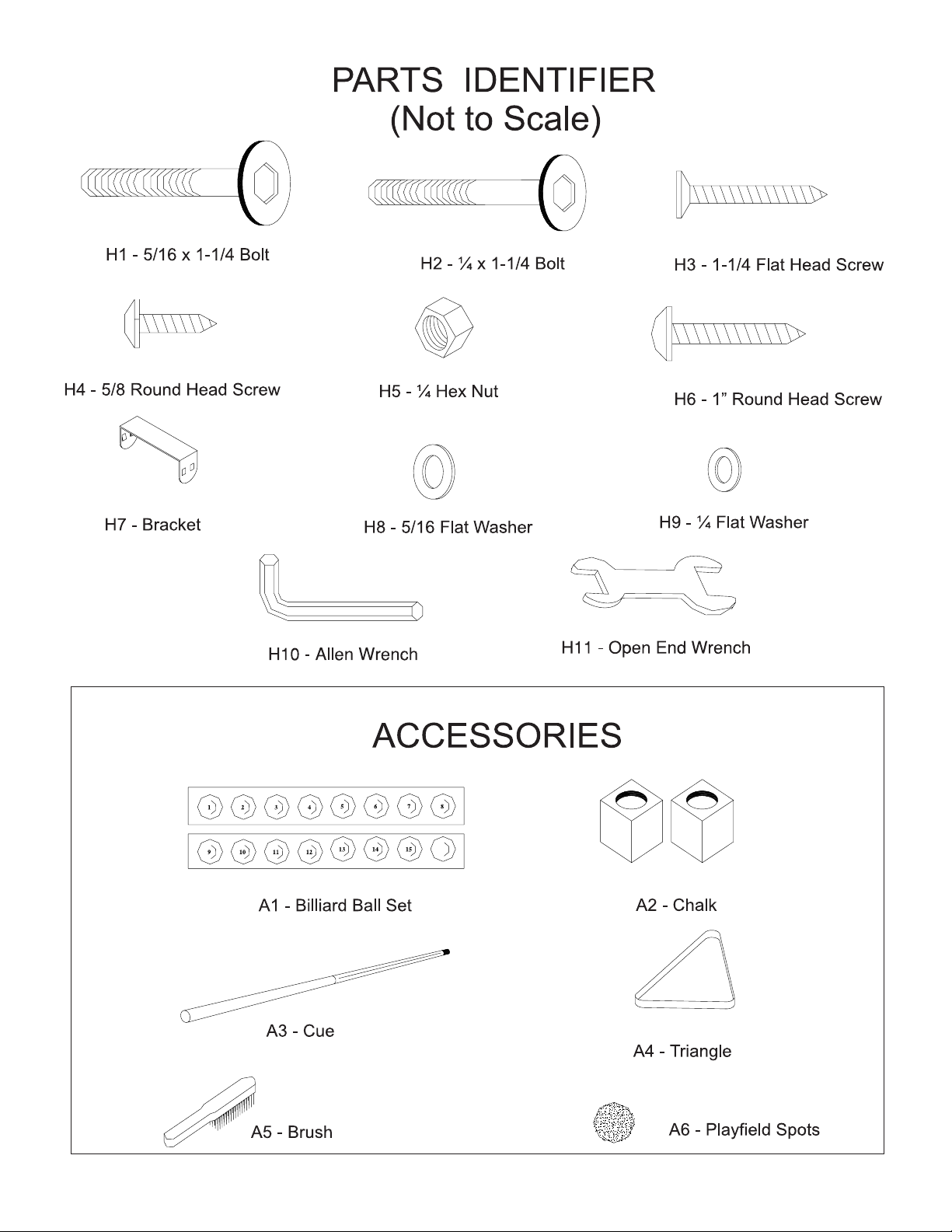
Tools Required:
Allen Wrench H10 and H11 Included with the Hardware Kit
Phillips Screwdriver
Furniture Polish and Cloth
An electric screwdriver is helpful in assembly. However, please set at low torque and use
extreme caution with an electric screwdriver because you could overtighten the hardware
and strip the screws.
Assembly Tips
Make sure you understand the following tips before you begin to assemble your soccer table.
1. When installing parts that have more than one bolt, start ALL the bolts in that part by
hand before tightening anything.
2. Some drawings or images in this manual may not look exactly like your product. Please
read and understand the text before starting each assembly step.
READ AND FOLLOW ALL ASSEMBLY, OPERA TION, AND
SAFETY INSTRUCTIONS CAREFULLY . AT LEAST TWO
ADULTS ARE NEEDED TO PUT THIS GAME TABLE
TOGETHER.
© 2002 Escalade Sports
2
For Customer Service Call 1-866-556-2759
Page 3
© 2002 Escalade Sports
3
For Customer Service Call 1-866-556-2759
Page 4
© 2002 Escalade Sports
4
For Customer Service Call 1-866-556-2759
Page 5
© 2002 Escalade Sports
5
For Customer Service Call 1-866-556-2759
Page 6
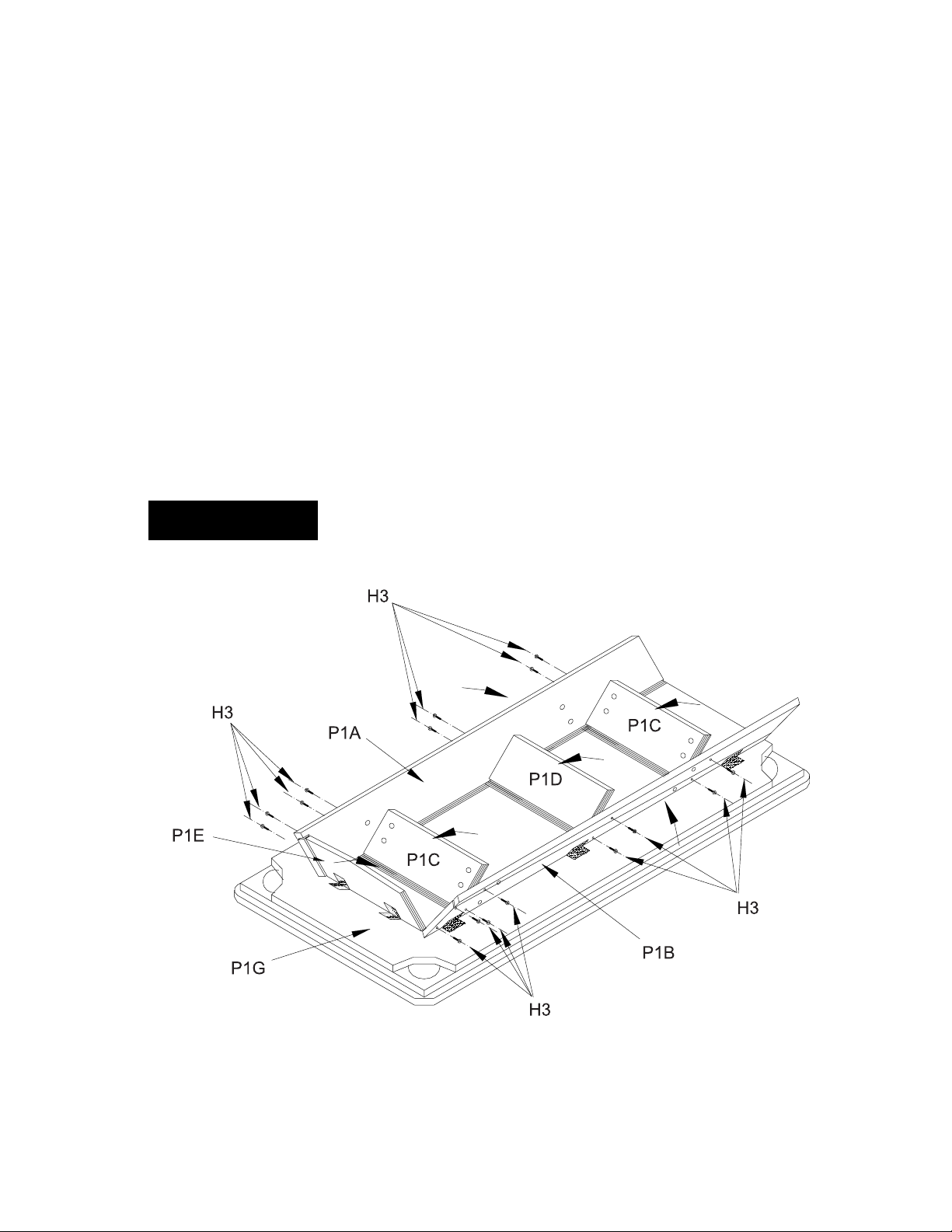
1. Find a clean, level place to begin the assembly of your pool table. We recommend
building the table on the box top to protect the parts during assembly.
2. Place the main cabinet P1 on the ground with the playing side down.
3. Apply glue P12 to ALL the edges and ends of the long rail sections P1A and P1B and the
short rail sections P1C, P1D, and P1E that will be attached to one another.
4. Attach long rail sections P1A and P1B to each short rail sections P1C, P1D, and P1E with
flat head screw H3 as shown in Figure 1.
DO NOT OVER TIGHTEN SCREWS.
Figure 1
© 2002 Escalade Sports
6
For Customer Service Call 1-866-556-2759
Page 7

5. Attach legs P2A and P2B to the return end of the table using bolts H1 and
washers H8 as shown in FIGURE 2. The leg bolts go from the inside of the leg
toward the frame pieces as shown. Make sure you start all bolts by hand before
you tighten anything.
Figure 2
6. Attach legs P2A and P2B to the other end of the table using bolts H1 and
washersH8 as shown in FIGURE 3. The leg bolts go from the inside of the leg
toward the frame pieces as shown. Make sure you start all bolts by hand before
you tighten anything.
Figure 3
© 2002 Escalade Sports
7
For Customer Service Call 1-866-556-2759
Page 8
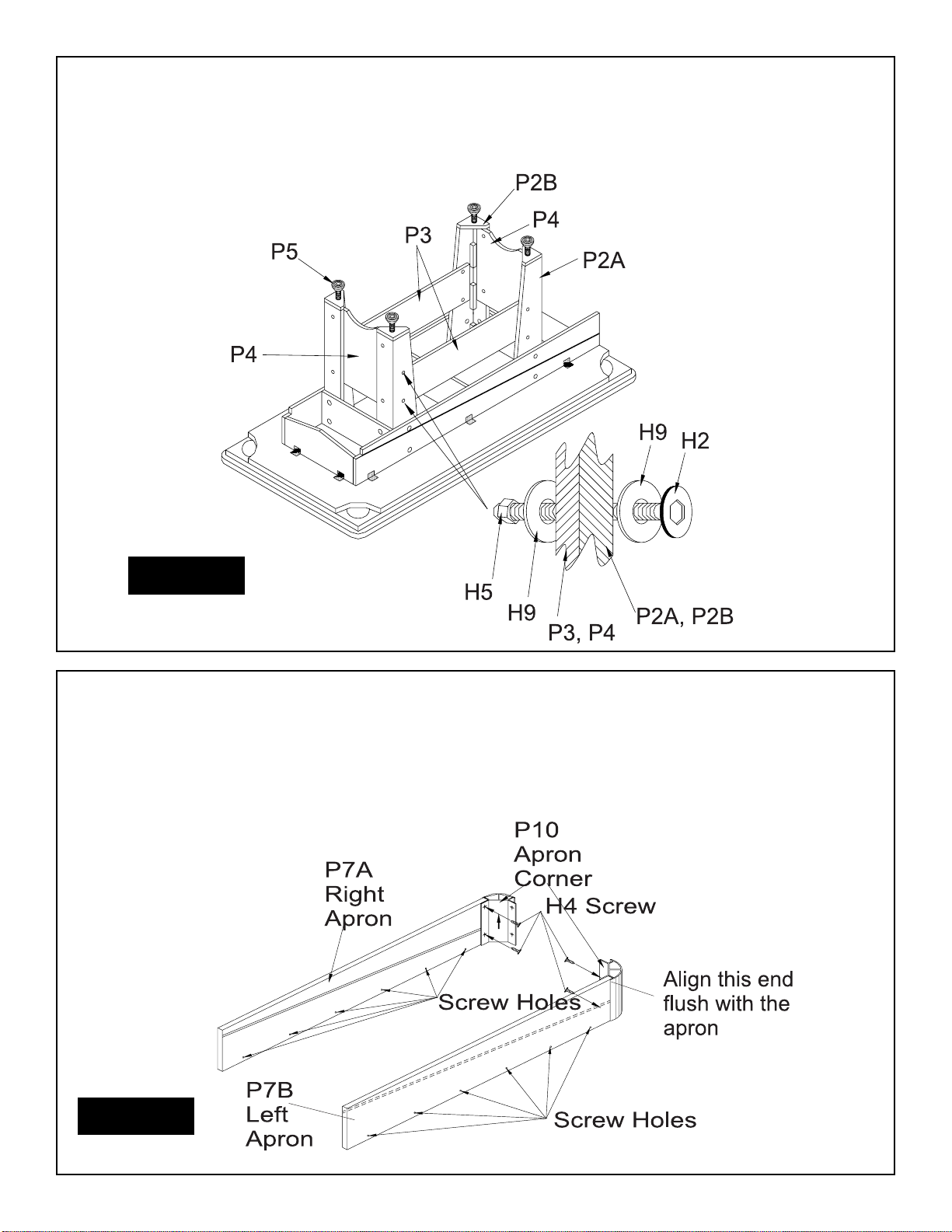
7. Attach the two spreaders P3 and the two end panels P4 as shown in FIGURE 4
using bolts H2washers H9 and nuts H5
.
8. Attach one leg leveler P5 to the bottom of each leg as shown in FIGURE 4.
Figure 4
9. Lay the apron side panels P7A and P7B on a flat surface with the woodgrain
side facing out and the screw holes at the bottom of the panels.
10. Attach the two apron corners P10 with the arrows facing up, to the side
panels P7A and P7B using screws H4 as shown in FIGURE 5.
Figure 5
© 2002 Escalade Sports
8
For Customer Service Call 1-866-556-2759
Page 9

11. Position the apron side panels P7A and P7B on the main cabinet P1 as
shown in FIGURE 6. The panels are positioned correctly when the apron
corners P10 rest inside the corner caps that are attached to the main cabinet.
Once you have the side panels placed correctly, attach them to the main
cabinet using screws H3 as shown in Figure 6.
12. Slide the apron end panel P8 into each apron corner P10 and attach to apron
corners using screws H4. Next attach the apron end panel to the main
cabinet P1 using screws H3 as shown in FIGURE 6.
13. With the rubberized sides of the long return boards P6A and P6B facing the
playfield, slide them in the groves of the apron side panels and the long rails.
Make sure you have the angled corners towards the apron corners P10.
Figure 6
© 2002 Escalade Sports
9
For Customer Service Call 1-866-556-2759
Page 10
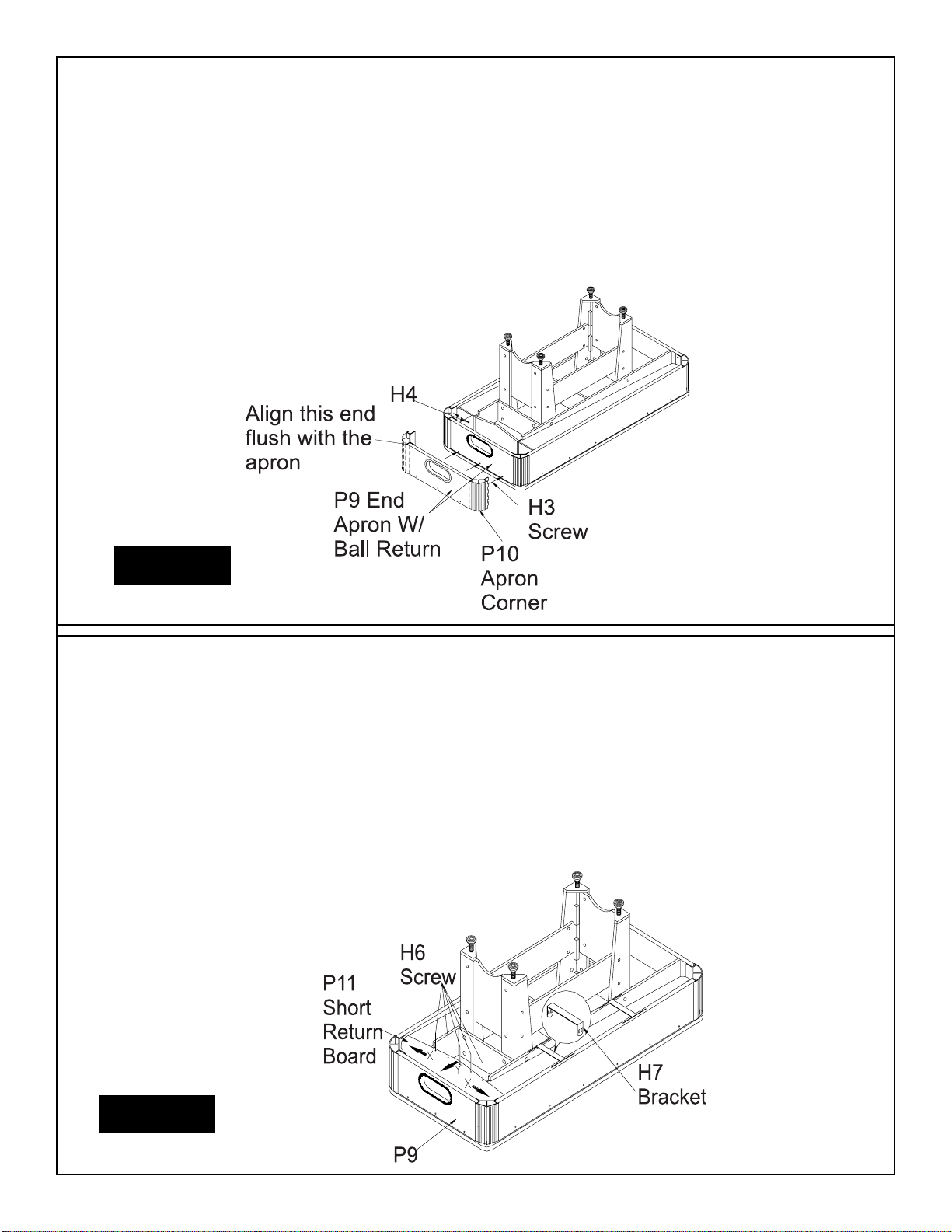
13. Attach two apron corners P10 to each end of apron ball return panel P9 with
the arrows facing up using screws H4 as shown in FIGURE 7.
14. Attach the assembled apron return panel P9 toboth apron side panels P7A
and P7B using screws H4. Attach the apron to the main cabinetP1 using
screws H3 as shown in FIGURE 7.
Figure 7
14. Bend the short return board P11 by hand and insert into the groves of both
apron side panels P7A and P7B by sliding first in the direction noted by an
“X” as shown in FIGURE 8. Next slide the board in the direction noted by
the letter “Y” into the grove on the apron ball return panel P9.
15. Attach the short return board P11 using screws H6 as shown in FIGURE 8.
16. Position the metal brackets H7 as shown and tap down into place with a
hammer as shown in FIGURE 8.
Figure 8
© 2002 Escalade Sports
10
For Customer Service Call 1-866-556-2759
Page 11
THIS STEP REQUIRES TWO OR MORE ADULTS.
VERY CAREFULLY TURN THE TABLE OVER AND SET IT ON
ITS LEGS. BE CAREFUL, THE TABLE IS VERY HEAVY.
14. After the glue has dried (Approximately 12 Hours) turn the table over. Put the
table in its final resting place in your room. Using a capenters level or rolling
a pool ball on the surface, level thetable by turning the leg levelers P5. Start
by adjusting the lowest corner first and then work your way around the table.
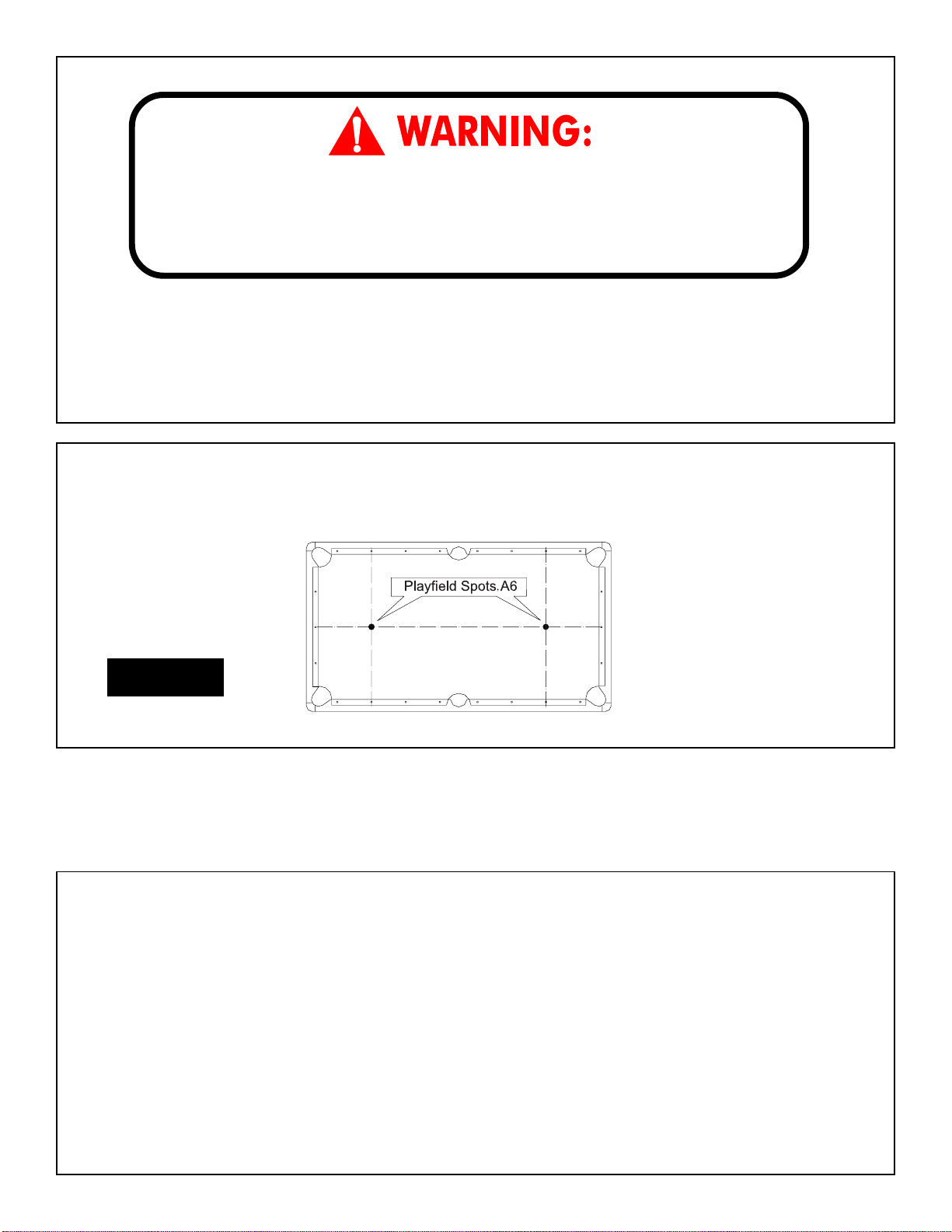
15. Using two pieces of string (Not Included) put the playfield spots A6 on the
table as shown. Align with the second sight on the side rail and the center
sight on the end rail.
Figure 9
Congratulations! You have now assembled your pool table. Please note the Care
and Use instructions below to insure many years of trouble free use of your game
table.
CARE AND USE OF YOUR TABLE
1. Use spray furniture polish to clean all exterior surfaces of your game table.
2. Use the table brush provided to clean the cloth on the table.
3. You may use a vaccume cleaner with the brush attachment to clean the cloth
should it become necessary .
4. This product is intended for INDOOR use only.
5. DO NOT sit, climb or lean on the table.
6. DO NOT drag the table when moving it. This will damage the legs
© 2002 Escalade Sports
11
For Customer Service Call 1-866-556-2759
Page 12

8 - BALL
Eight-Ball is a call shot game played with a cue ball and 15 object balls, numbered 1 through 15.
One player must pocket balls of the group numbered 1 through 7 (
player has 9 through 15 (
stripes
). The player pocketing either group first, and then legally
solid colors
pocketing the 8-ball wins the game.
CALL SHOT In Call Shot, obvious balls and pockets do not have to be indicated. It
is the opponent’s right to ask which ball and pocket if he is unsure of the shot. Bank shots and
combination shots are not considered obvious, and care should be taken in calling both the object
ball and the intended pocket. When calling the shot, it is never necessary to indicate details such
as the number of cushions, banks, kisses, caroms, etc. Any balls pocketed on a foul remain pocketed, regardless of whether they belong to the shooter or the opponent. The opening break is not
a” called shot.” Any player performing a break shot in 8-Ball may continue to shoot so long as any
object ball is legally pocketed on the break.
), while the other
RACKING THE BALLS
The balls are racked in a triangle at the foot of the table with the 8-ball in the center of the triangle,
the first ball of the rack on the foot spot, a stripe ball in one corner of the rack and a solid ball in
the other corner.
AL TERNATING BREAK
Winner of the lag has the option to break. During individual competition, players will alternate
breaking on each subsequent game.
JUMP AND MASSE SHOT FOUL
While “cue ball fouls only” is the rule of play when a match is not presided over by a referee, a
player should be aware that it will be considered a cue ball foul if during an attempt to jump, curve
or masse the cue ball over or around an impeding numbered ball that is not a legal object ball, the
impeding ball moves
bridge)
.
(regardless of whether it was moved by a hand, cue stick follow-through or
LEGAL BREAK SHOT
(Defined)
To execute a legal break, the breaker
(with the cue ball behind the head string)
must either
(1) pocket a ball, or (2) drive at least four numbered balls to the rail. When the breaker fails to make
a legal break, it is a foul, and the incoming player has the option of (1) accepting the table in position
and shooting, or (2) having the balls re-racked and having the option of shooting the opening break
or allowing the offending player to re-break.
© 2002 Escalade Sports
12
For Customer Service Call 1-866-556-2759
Page 13

SCRATCH ON A LEGAL BREAK
If a player scratches on a legal break shot, (1) all balls pocketed remain pocketed
ball: see rule “Object Balls Jumped Off Table On Break”)
, (2) it is a foul, (3) the table is open.
(exception, the 8-
Please Note: The incoming player has cue ball in hand behind the head string and may not shoot
an object ball that is behind the head string, unless he first shoots the cue ball past the head string
and causes the cue ball to come back behind the head string and hit the object ball.
OBJECT BALLS JUMPED OFF TABLE ON THE BREAK
If a player jumps an object ball off the table on the break shot, it is a foul and the incoming player
has the option of (1) accepting the table in position and shooting, or (2) taking cue ball in hand
behind the head string and shooting.
8-BALL POCKETED ON THE BREAK
If the 8-ball is pocketed on the break, breaker may ask for a re-rack or have the 8-ball spotted and
continue shooting. If the breaker scratches while pocketing the - ball on the break, the incoming
player has the option of a re-rack or having the 8-ball spotted and begin shooting with ball in hand
behind the head string.
OPEN TABLE
(Defined)
The table is “open” when the choice of groups
(stripes or solids)
has not yet been determined. When the table is open, it is legal to hit a solid first to make a stripe or vice-versa. Note:
The table is always open immediately after the break shot. When the table is open it is legal to hit
any solid or stripe or the 8-ball first in the process of pocketing the called stripe or solid. However,
when the table is open and the 8-ball is the first ball contacted, no stripe or solid may be scored in
favor of the shooter. The shooter loses his turn; any balls pocketed remain pocketed; and the incoming player addresses the balls with the table still open. On an open table, all illegally pocketed
balls remain pocketed.
CHOICE OF GROUP
The choice of stripes or solids is not determined on the break even if balls are made from only one
or both groups, because the table is always open immediately after the break shot. The choice of
group is determined only when a player legally pockets a called object ball after the break shot.
LEGAL SHOT
(Defined)
On all shots
(except on the break and when the table is open)
, the shooter must hit one of
his group of balls first and (1) pocket a numbered ball, or (2) cause the cue ball or any numbered
ball to contact a rail. Please Note: It is permissible for the shooter to bank the cue ball off a rail
before contacting the object ball; however, after contact with the object ball, an object ball must be
pocketed, or the cue ball or any numbered ball must contact a rail. Failure to meet these requirements is a foul.
“SAFETY” SHOT
For tactical reasons, a player may choose to pocket an obvious object ball and also discontinue a
turn at the table by declaring “safety” in advance. A safety shot is defined as a legal shot. If the
shooting player intends to play safe by pocketing an obvious object ball, then prior to the shot, the
shooter must declare a “safety” to the opponent. If this is not done, and one of the shooter’s object
balls is pocketed, the shooter will be required to shoot again. Any ball pocketed on a safety shot
remains pocketed.
© 2002 Escalade Sports
13
For Customer Service Call 1-866-556-2759
Page 14

SCORING
A player is entitled to continue shooting until failing to legally pocket a ball of his group. After a
player has legally pocketed all of his group of balls, he shoots to pocket the 8-ball.
FOUL PENALTY
Opposing player gets cue ball in hand. This means that the player can place the cue ball anywhere
on the table
(does not have to be behind the head string except on opening break)
. This rule prevents a player from making intentional fouls which would put an opponent at a disadvantage. With
“cue ball in hand,” the player may use a hand or any part of a cue
(including the tip)
to position the
cue ball. When placing the cue ball in position, any forward stroke motion contacting the cue ball will
be a foul, if not a legal shot.
COMBINA TION SHOTS
Combination shots are allowed; however, the 8-ball can’t be used as a first ball in the combination
except when the table is open.
ILLEGALLY POCKETED BALLS
An object ball is considered to be illegally pocketed when (1) that object ball is pocketed on the
same shot a foul is committed, or (2) the called ball did not go in the designated pocket, or (3) a
safety is called prior to the shot. Illegally pocketed balls remain pocketed.
OBJECT BALLS JUMPED OFF THE TABLE
If any object ball is jumped off the table, it is a foul and loss of turn, unless it is the 8-ball, which is a
loss of game. Any jumped object balls are spotted in numerical order according to General Rules for
spotting balls.
PLAYING THE 8-BALL
When shooting at the 8-ball, a scratch or foul is not loss of game if the 8-ball is not pocketed or
jumped from the table. Incoming player has cue ball in hand. Note: A combination shot can never
be used to legally pocket the 8-ball.
LOSS OF GAME
A player loses the game by committing any of the following infractions:
1. Fouls when pocketing the 8-ball
(exception: see 8-Ball Pocketed On The Break).
2. Pockets the 8-ball on the same stroke as the last of his group of balls.
3. Jumps the 8-ball off the table at any time.
4. Pockets the 8-ball in a pocket other than the one designated
5. Pockets the 8-ball when it is not the legal object ball.
Note: All infractions must be called before another shot is taken, or else it will be deemed
that no infraction occurred.
ST ALEMA TED GAME
If, after 3 consecutive turns at the table by each player
referee, both players agree)
that attempting to pocket or move an object ball will result in loss of
(6 turns total)
, the referee judges
(or if no
game, the balls will be reracked with the original breaker of the stalemated game breaking again.
The stalemate rule may only be used when there are only two object balls and the 8-ball remaining
on the table. Please Note: Three consecutive fouls by one player is not a loss of game
© 2002 Escalade Sports
14
For Customer Service Call 1-866-556-2759
Page 15

9 - BALL
OBJECT OF THE GAME
Nine-Ball is played with nine object balls numbered one through nine and a cue ball. On each shot,
the first ball the cue ball contacts must be the lowest numbered ball on the table, but the balls need
not be pocketed in order. If a player pockets any ball on a legal shot, he remains at the table for
another shot, and continues until missing, committing a foul, or wining the game by pocketing the 9ball. After a miss, the incoming player must shoot from the position left by the previous player, but
after any foul the incoming player may start with the cue ball anywhere on the table. Players are not
required to call any shot. A match ends when one of the players has won the required number of
games.
RACKING THE BALLS
The object balls are racked in a diamond shape, with the 1-ball at the top of the diamond and on the
foot spot, the 9-ball in the center of the diamond, and the other balls in random order, racked as
tightly possible. The game begins with cue ball in hand behind the head string.
LEGAL BREAK SHOT
The rules governing the break shot are the same as for other shots except:
1. The breaker must strike the I-ball first and either pocket a ball or drive at least four numbered
balls to the rail.
2. If the cue ball is pocketed or driven off the table, or the requirements of the opening break are
not met, it is a foul, and the incoming player has cue ball in hand anywhere on the table.
3. If on the break shot, the breaker causes an object ball to jump off the table, it is a foul and the
incoming player has cue ball in hand anywhere on Diagram 21 the table. The object ball is not
re-spotted
(exception; if the object ball is the 9-ball, it is re-spotted)
.
CONTINUING PLA Y
On the shot immediately following a legal break, the shooter may play a “push out.” (See “Push
Out”). If the breaker pockets one or more balls on a legal break, he continues to shoot until he
misses, fouls, or wins the game. If the player misses or fouls, the other player begins an inning and
shoots until missing, committing a foul, or winning. The game ends when the 9-ball is pocketed on a
legal shot, or the game is forfeited for a serious infraction of the rules.
© 2002 Escalade Sports
15
For Customer Service Call 1-866-556-2759
Page 16

PUSH OUT
The player who shoots the shot immediately after a legal break may play a push out in an attempt to
move the cue ball into a better position for the option that follows. On a push out, the cue ball is not
An illegal push out is penalized according to the type of foul committed. After a player scratches on
the break shot, the incoming player cannot play a push out.
FOULS
When a player commits a foul, he must relinquish his run at the table and no balls pocketed on the
foul shot are re-spotted
(exception; if a pocketed ball is the 9-ball, it is re-spotted)
. The incoming
player is awarded ball in hand; prior to his first shot he may place the cue ball anywhere on the
table. If a player commits several fouls on one shot, they are counted as only one foul.
BAD HIT
If the first object ball contacted by the cue ball is not the lowest numbered ball on the table, the shot
is foul.
NO RAIL
If no object ball is pocketed, failure to drive the cue ball or any numbered ball to a rail after the cue
ball contacts the object ball on is a foul.
IN HAND
When the cue ball is in hand, the player may place the cue ball anywhere on the bed of the table,
except in contact with an object ball. The player may continue to adjust the position of the cue ball
until shooting.
OBJECT BALLS JUMPED OFF THE TABLE
An un-pocketed ball is considered to be driven off the table if it comes to rest other than on the bed
of the table. It is a foul to drive an object ball off the table. The jumped object ball(s) is not re-spotted
( exception: if the object ball is the 9-ball it is re-spotted) and play continues.
JUMP AND MASSE SHOT FOUL
If a match is not refereed, it will be considered a cue ball foul if during an attempt to jump, curve or
masse the cue ball over or around an impeding numbered ball, the impeding ball moves (regardless
of whether it was moved by a hand; cue stick follow-through or bridge).
THREE CONSECUTIVE FOULS
If a player fouls three consecutive times on three successive shots without making an intervening
legal shot, the game is lost. The three fouls must occur in one game. The warning must be given
between the second and third fouls. A player’s inning begins when it is legal to take a shot and ends
at the end of a shot on which he misses, fouls or wins, or when he fouls between shots.
END OF GAME
A game starts as soon as the cue ball crosses over the head string on the opening break. The 1-ball
must be legally contacted on the break shot. The game ends at the end of a legal shot which pockets the 9-ball, or when a player forfeits the game as the result of a foul
© 2002 Escalade Sports
16
For Customer Service Call 1-866-556-2759
Page 17
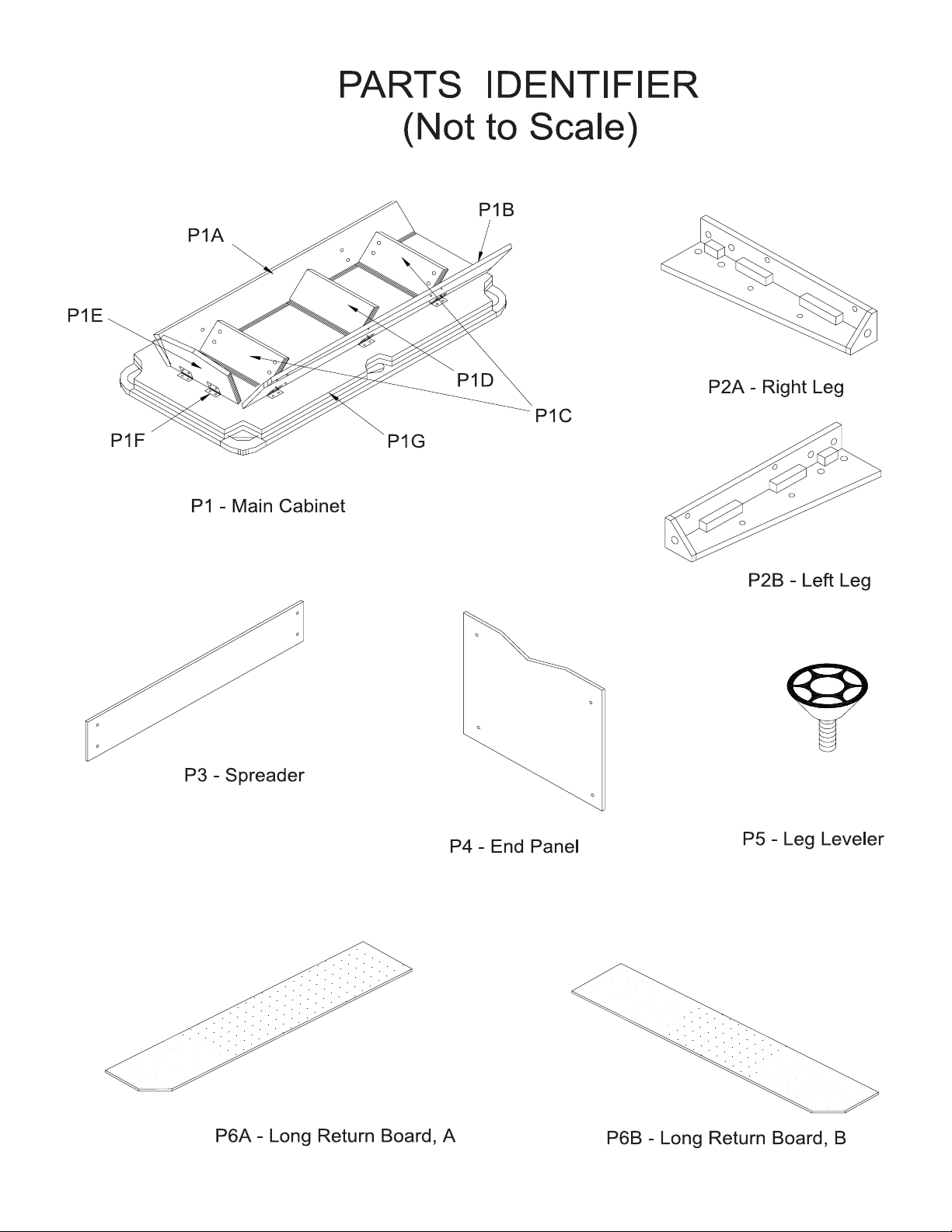
PRODUCT PARTS LIST
Part # Description Qty. Part# Description Qty.
Model # G07607
H1 5/16 x 1-1/4 Bolt 16
H2 1/4 x 1-1/4 Bolt 16
H3 1-1/4 Flat Head Screw 34
H4 5/8 Round Head Screw 16
H5 1/4 Hex Nut 16
H6 1” Round Head Screw 5
H7 Bracket 4
H8 5/16 Flat Washer 16
H9 1/4 Flat Washer 32
H10 Allen Wrench 1
H11 Open End Wrench 1
P1 Main Cabinet 1
P1A Long Rail (Right) 1
P1B Long Rail (Left) 1
P1C Short Rail Ends W/Hole 2
P1D Short Rail Center 1
P1E Short Rail Return End 1
P1F Hinge 14
P2A Right Leg 2
P2B Left Leg 2
P3 Spreader 2
P4 End Panel 2
P5 Leg Leveler 4
P6A Long Return Board, A 1
P6B Long Return Board, B 1
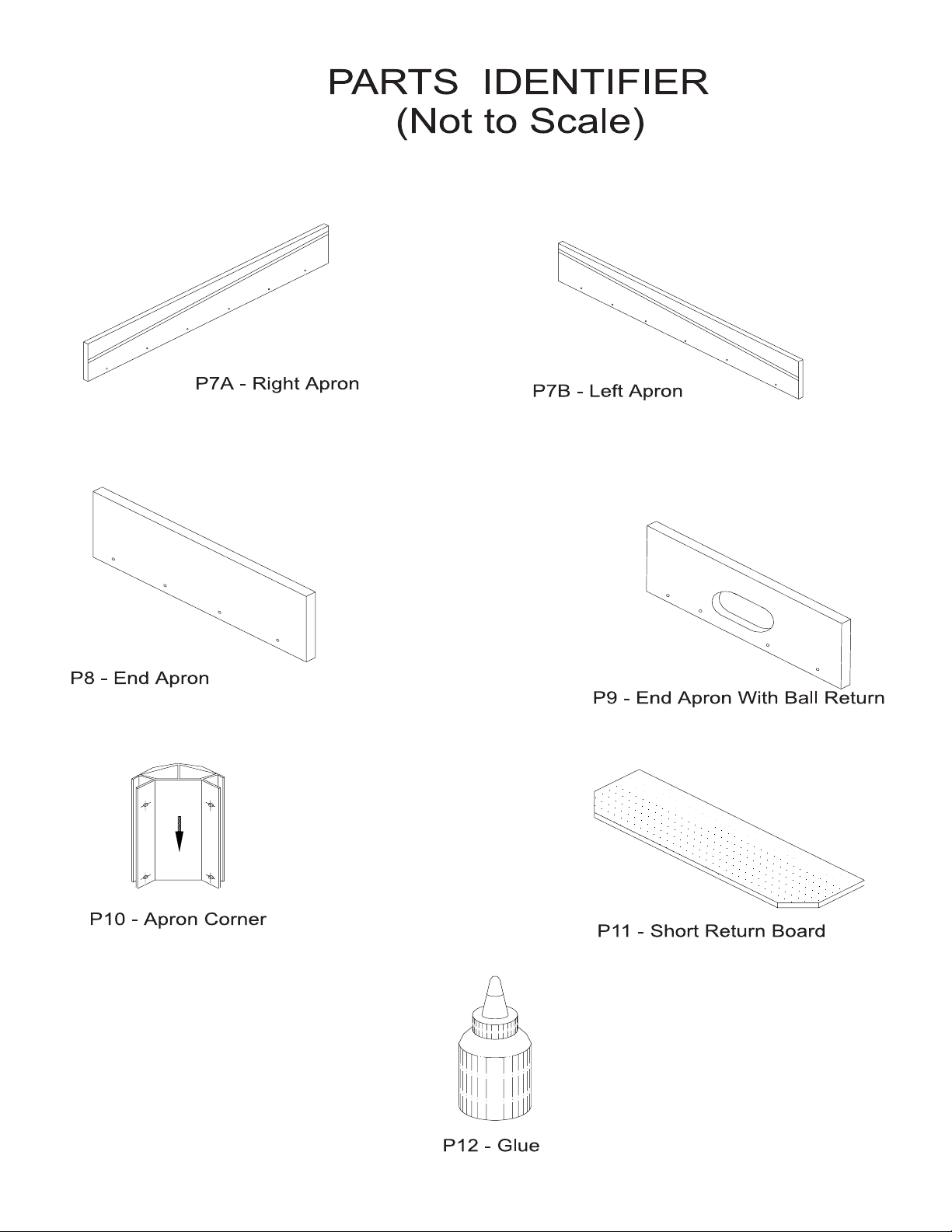
P7A Right Apron 1
P7B Left Arpon 1
P8 End Apron 1
P9 End Apron With Ball Return 1
P10 Apron Corner 4
P11 Short Return Board 1
P12 Glue 1
A1 Billiard Ball Set 1
A2 Cue Chalk 2
A3 Pool Cue 2
A4 Triangle 1
A5 Table Brush 1
A6 Playfield Spots 2
A8 Owners Manual 1
K1 Hardware Kit 1
© 2002 Escalade Sports
17
For Customer Service Call 1-866-556-2759
Page 18

90 DAY LIMITED WARRANTY
This consumer warranty extends to the original consumer purchase of any ESCALADESPORTS
Product (hereinafter referred as the "Product").
WARRANTY DURATION: This Product is warranted to the original consumer purchase of a period of 90 days from the original purchase.
WARRANTY COVERAGE: ESCALADE SPORTS warrants to the original Consumer Purchaser
that any Product of its manufacture is free from defects in material and workmanship when used
for the intended purpose under normal use and conditions. THIS WARRANTY IS VOID IF THE
PRODUCT HAS BEEN DAMAGED BY ACCIDENT, UNREASONABLE USE, NEGLIGENCE,
IMPROPER SERVICE, FAILURE TO FOLLOW INSTRUCTIONS PROVIDED WITH THE PRODUCT OR OTHER CAUSES NOT ARISING OUT OF DEFECTS IN MATERIAL AND WORKMANSHIP.
WARRANTY PERFORMANCE: During the above 90 day warranty period, ESCALADESPORTS
shall repair or replace with a comparable model, and Product, or component thereof, which may
prove defective under normal use and proper care, and which our examination shall disclose to
our satisfaction to be thus defective, please contact our Warranty Dept.
1-866-556-2759 / Warranty Dept.
Or Write us at:
Escalade® Sports, Inc. - P.O. Box 889, Evansville, IN 47706
Attn: Warranty Dept.
Or E-mail us at:
Other than shipping requirements no charge will be made for such repair or replacement of inwarranty Products. ESCALADE SPORTS strongly recommends that the Product is insured for
value prior to mailing.
W ARRANTY DISCLAIMERS: ANY IMPLIED WARRANTIES ARISING OUT OF
THIS SALE, INCLUDING BUT NOT LIMITED TO THE IMPLIED W ARRANTIES OF
MERCHANTABILITY AND FITNESS FOR A PARTICULAR PURPOSE, ARE LIMITED IN DURATION TO THE ABOVE 90 DAY PERIOD. ESCALADE SPORTS
SHALL NOT BE LIABLE FOR LOSS OF USE OF THE PRODUCT OR OTHER
CONSEQUENTIAL OR INCIDENTAL COSTS, EXPENSES OR DAMAGES INCURRED BY THE CONSUMER OF ANY OTHER USE.
Some states do not allow the exclusion or limitation of implied warranties or consequential or
incidental damages, so the above limitations or exclusions may not apply to you.
LEGAL REMEDIES: This warranty gives you specific legal rights and you may also have other
rights which may vary from state to state.
© 2002 Escalade Sports
18
For Customer Service Call 1-866-556-2759
 Loading...