

Page 1

Erace Incorporated
PYROCAP B-136™
TRAINING MANUAL
Version 2.1
Page 2

NOTICE
PYROCAP B-136™ is a surfactant chemical that is effective as a
fire retardant and suppressant wetting agent if applied in a manner
consistent with the instructions in this Manual. READ THIS
MANUAL CAREFULLY BEFORE USING THE PRODUCT AND
FOLLOW ALL INSTRUCTIONS EXACTLY. Erace makes no other
guarantees or representations, expressed or implied, regarding the use
of PYROCAP B-136™ and has no liability for any loss or damage
arising from actions not taken in accordance with this Manual and
warning label affixed to the actual PYROCAP B-136™ containers.
Page 3

PYROCAP B-136™ TRAINING MANUAL
PURPOSE OF THIS TRAINING MANUAL
This manual is to inform firefighters of the effective application of PYROCAP B136™ in all appropriate fire and hazardous spill emergencies.
It is designed to augment the training of firefighters. If this information is to be
discussed in a briefing or classroom setting, classes of 10 to 12 firefighters will be best
served by the training, although larger groups can use the material effectively.
Presentation and discussion of the material will take one hour.
DEFINING THE THREAT: Toxic Smoke, Heat, and Multiple Class Fires
Reports from the National Fire Protection Association cite smoke inhala tion as
the greatest threat of injury and death by fire. According to firefighters interviewed
throughout the world, this major threat is followed closely by heat exposure, a hazard
which is often encountered when water alone is used to extinguish extremely hot fires.
Superheated steam, which often is present when water alone is used to extinguish many
structure fires, is a hazard which may be as life threatening as the fire itself.
For decades, most of the extinguishing agents firefighters have been presented
with focus on one class of fire, typically, Cla ss A or Class B. However, over 90 percent
of fires which fire fighters confront each year involve a combination of Class A, B, and D
materials.
A typical structure fire not only involves the wood support beams and walls, but
also petrochemicals found in carpeting, fabrics, and paint, as well as, metals such as
aluminum siding, vents, and others found throughout many homes and buildings. Much
of the same may be said about automobiles and aircraft. In all of these situations,
firefighters are confronted with a combination of Class A, B, and D fires.
- 1 -
Page 4

ADVANTAGES OF PYROCAP
Highly Effective In Suppressing Smoke
PYROCAP B-136™ reduces the emissions of carbonaceous fumes, reducing
the hazard of smoke inhalation and the need for mechanical ventilation.
Hydrocarbon gases and fine particulate materials are liquified into the dilute
agent and “washed” out. For best results, It is recommended that the agent be applied in
a fog pattern using sweeping motion and varying the degree of fog from 30 degree to
the full open setting.
Heat Absorption
PYROCAP B-136™ has an extraordinary ability to absorb a large amount of
heat, thus significantly reducing the threat of heat exposure and the danger of inhaling
superheated steam. This characteristic has proven to be significant in extinguishing
structure fires, automo bile fires, tire fires, coal mine fires, and dynamic oil well fires.
Rapid Suppression of Multiple Class Fires
PYROCAP B-136™ can speedily extinguish Class A and combinations of
Classes A, B, and D fires. The product’s wetting, cooling, and emulsifying characteristics greatly enhances the quick extinguishment of fire. This ability provides the
following benefits:
• Maximize the safety of firefighters, occupants, and those in the vicinity of the
burning property;
• Minimize the quant ity of water used in fighting fire, thereby enhancing the ability
to extinguish a fire with water carried In tanks when hydrants are too distant,
and when only one engine is available (this feature will also lower the cost of
damage by water and greatly reduce the cost of fire to the community); and
• Simplify the planning, environmental analysis, logistics and control of tire, coal,
and wildland fires.
- 2 -
Page 5
Suppression of Metal Fires
PYROCAP B-136™ has the unique capability of extinguishing many types of
metal fires. When combined with water at a 6 percent concentration, the product is
effective in extinguishing magnesium, aluminum, titanium, sodium, white phosphorous,
and solid rocket propellant fires.
Flexibility to Extinguish Static and Dynamic Class B Fires
PYROCAP B-136™ is very effective in extinguishing non-polar hydrocarbon
fuels (such as JP-4, diesel, and crude oil) in the high boiling range without burnback.
The product is also effective in extinguishing dynamic Class B fires, such as oil well
heads, and ship board fires.
Versatility to Create Chemical Fire Break
When used at a 6 percent concentration PYROCAP B-136™ has been proven
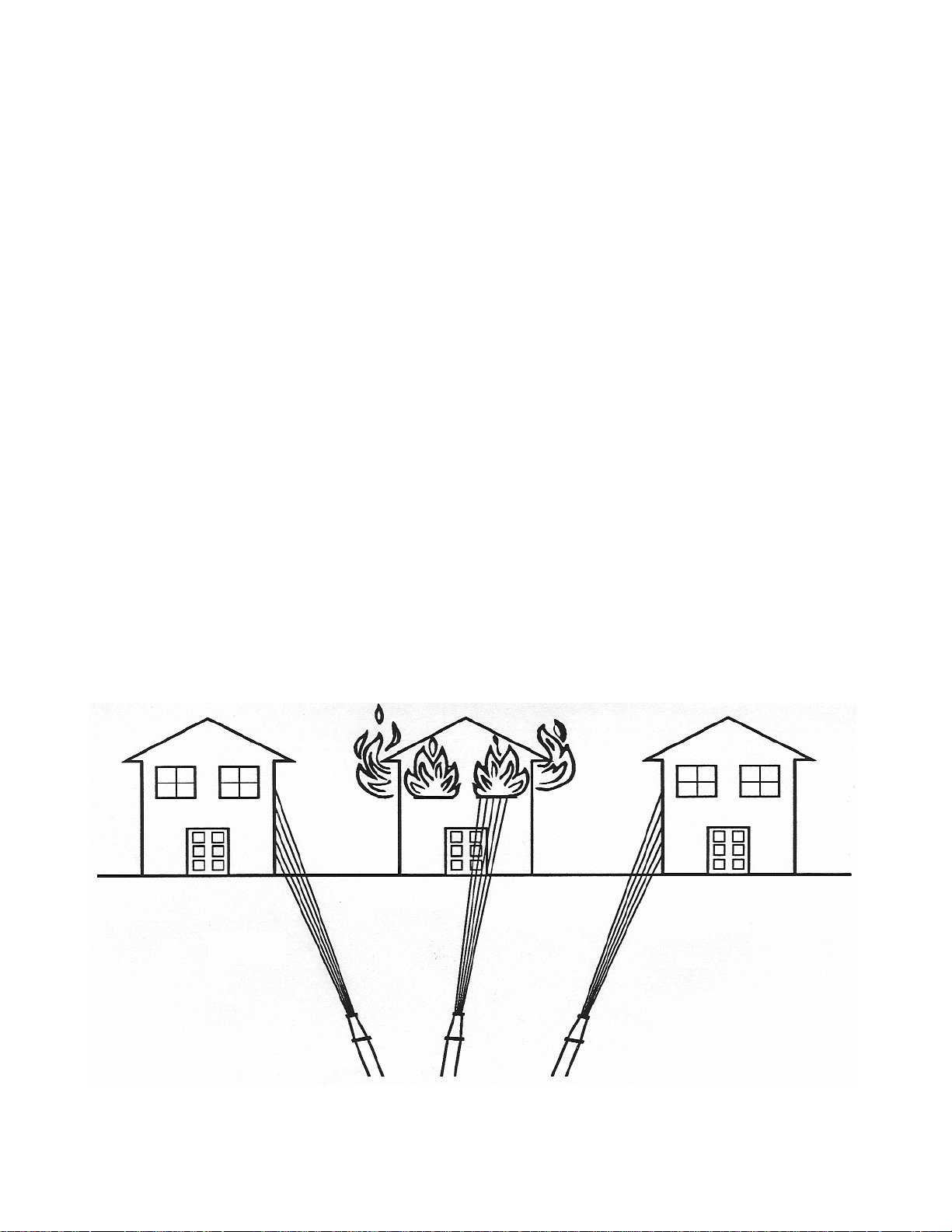
to provide an effective fire break in wildland applications. In urban and suburban
communities, the product has been ap plied to exposed houses to prevent ignition due to
radiant heat from fully involved adjacent dwellings (fig. 1).
STEP 3
STEP 1 STEP 2
Figure 1 – Structure Fire Application
- 3 -
Page 6

EQUIPMENT TO BE USED WITH PYROCAP B-136™
PYROCAP B-136™ turns water into a kind of “Super-water”. For that reason,
all equipment and application techniques used for delivering PYROCAP B-136™ are
similar to those used with water. The agent may be premixed in pumper engine holding
tanks, or proportioned with standard eduction equipment.
Nozzles
PYROCAP B-136™ is most effective with non-aspirated nozzles, such as the
Task Force nozzle, or equivalent, which is adjustable from straight stream to fog
settings.
Eductors
For PYROCAP B-136™ at 1, 3, or 6 percent concentration, eductors should be
set in the “water” position, and the pickup tube inserted in a 5-gallon container of the
product. Pressure at the pump should be sufficient to give 100 psi at the nozzle.
Generally, pressure of 200 psi at the pump will be sufficient, although a loss of press ure
to friction in the piping may require greater pressure. Nozzles and eductors must be
compatible to ensure effective use.
The flow of PYROCAP B-136™ should be metered at the eductor at 1, 3, or 6
percent, and the flow rate of delivery of agent-enhanced water will generally be 95 gpm
for Classes A, B, and D fires.
Concentration setting recommended:
Class A
Class B
- 1 to 3%
- 6%
Class D
- 6%
- 4 -
Page 7

Proportioners
Proportioners of any type may be used by following the same general guidance
provided for in using eductors. Again, proportioners and nozzles must have compatible
flow rates.
Hand Held Extinguishers
PYROCAP B-136™ at 6 percent concentration is used with stored-pressure
extinguishers for Classes A, B, and D fires. Straight stream nozzles perform
satisfactorily with all fire types. The firefighter may wish to “fan” the stream by placing
a finger into the stream at the nozzle.
Charging Hand Held Extinguishers
Refilling PYROCAP B-136™ for a 6 percent solution in a 2-1/2 gallon extinguisher should begin with the water portion approximately 300 oz. (15 parts), followed
by 20 oz. (1 part) of PYROCAP B-136™. The water should precede PYROCAP B136™ as the opposite procedure causes foaming, making proper measurement and handling inefficient.
NOTE: USE ONLY PRESSURIZED EXTINGUISHERS WITH AIR.
- 5 -
Page 8
APPLICATION TECHNIQUES FOR PYROCAP B-136™
Using Hose Line
CLASS A APPLICATION
In extinguishing Class A fires the fog setting should be adjusted to the situation.
Typically, a 30 degree setting is appropriate. For most applications, a 3 percent
concentration of PYROCAP B-136™ to water is recommended (3 parts B-136 to 97
parts water).
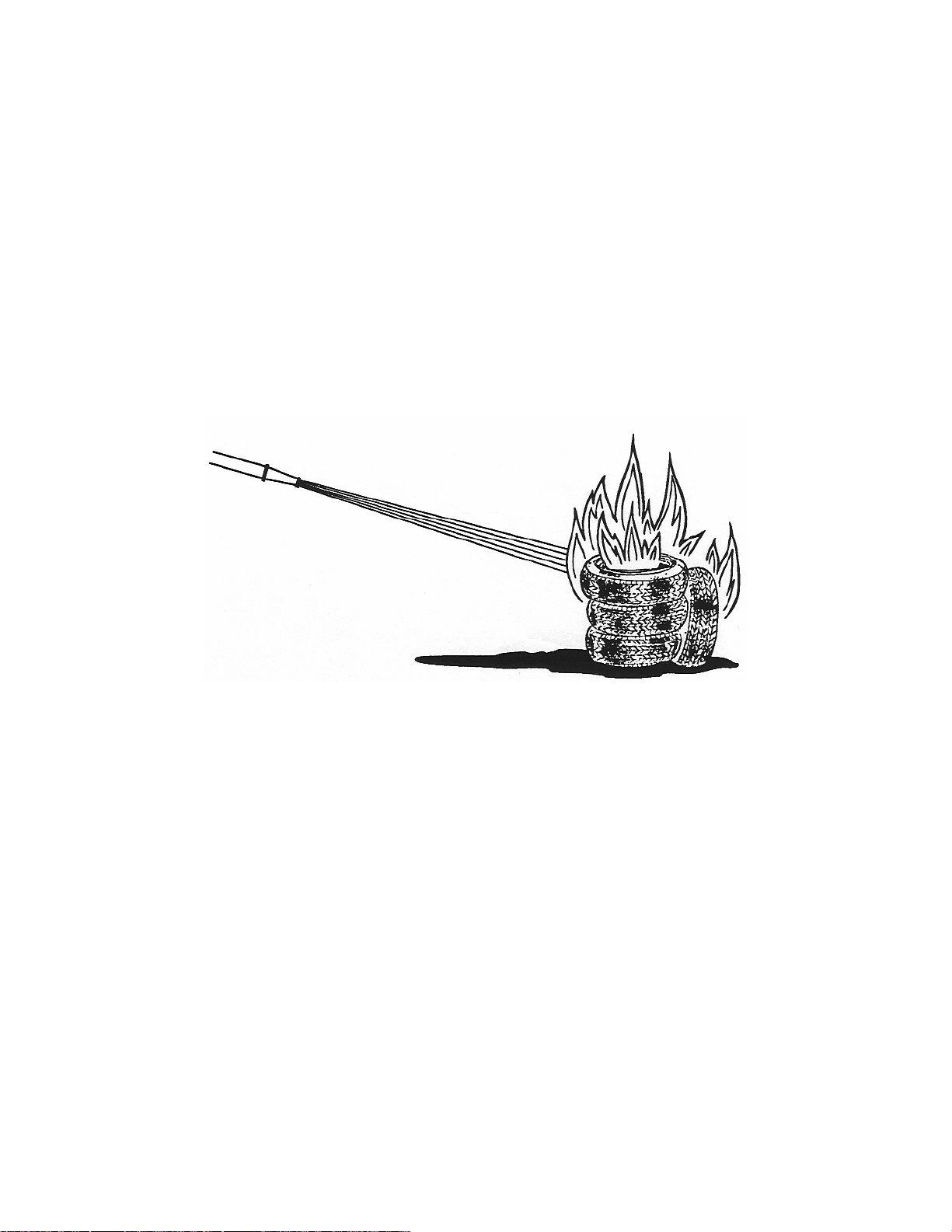
Firefighters should be aggressive in attacking these fires so that the material
may penetrate into deep seated fires such as tire fires and coal fires. (fig. 2)
Figure 2 – Class A (Tire Fire) Application
CLASS B APPLICATION
In extinguishing Class B fires, a 6 percent concentration of PYROCAP B-
136™ is recommended.
Plunge Method:
The stream should be plunged into the burning liquid at the base of the fire (see
fig 3). Since the turbulence in the burning fluid hastens the emulsifying action, a straight
stream to narrow fog is required . Care needs to be taken to assure that the stream not be
applied in such a manner to cause the agent-in-water to “dive” beneath the fuel. The
nozzle setting may vary depending on the throw distance, nozzle pressure, flow rate,
and angle of approach. Once the fire has been extinguished, the mixture of material and
water should once again be swept to ensure emulsification (fig4).
- 6 -
Page 9
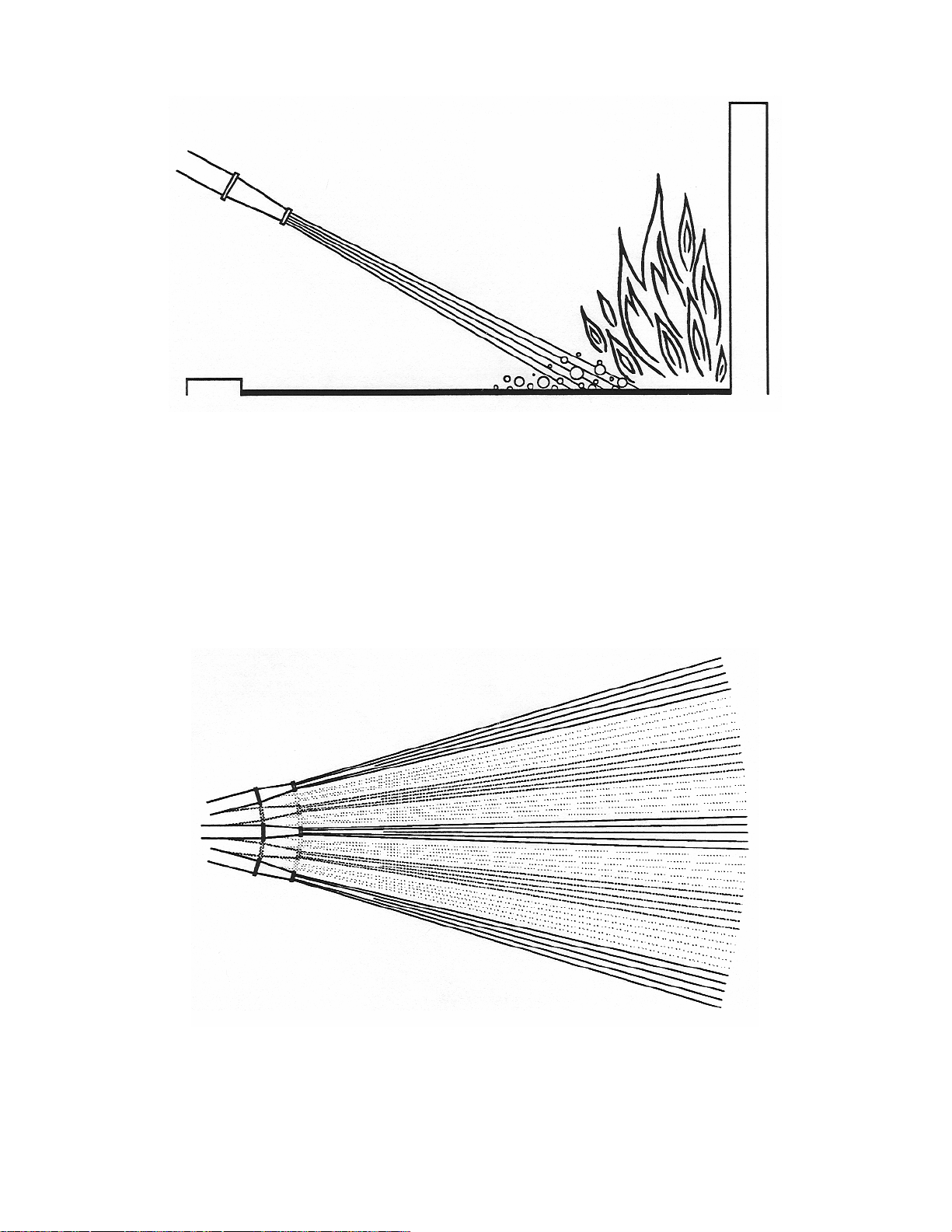
Figure 3 - The Plunge Technique
Figure 4 - Sweeping
- 7 -
Page 10
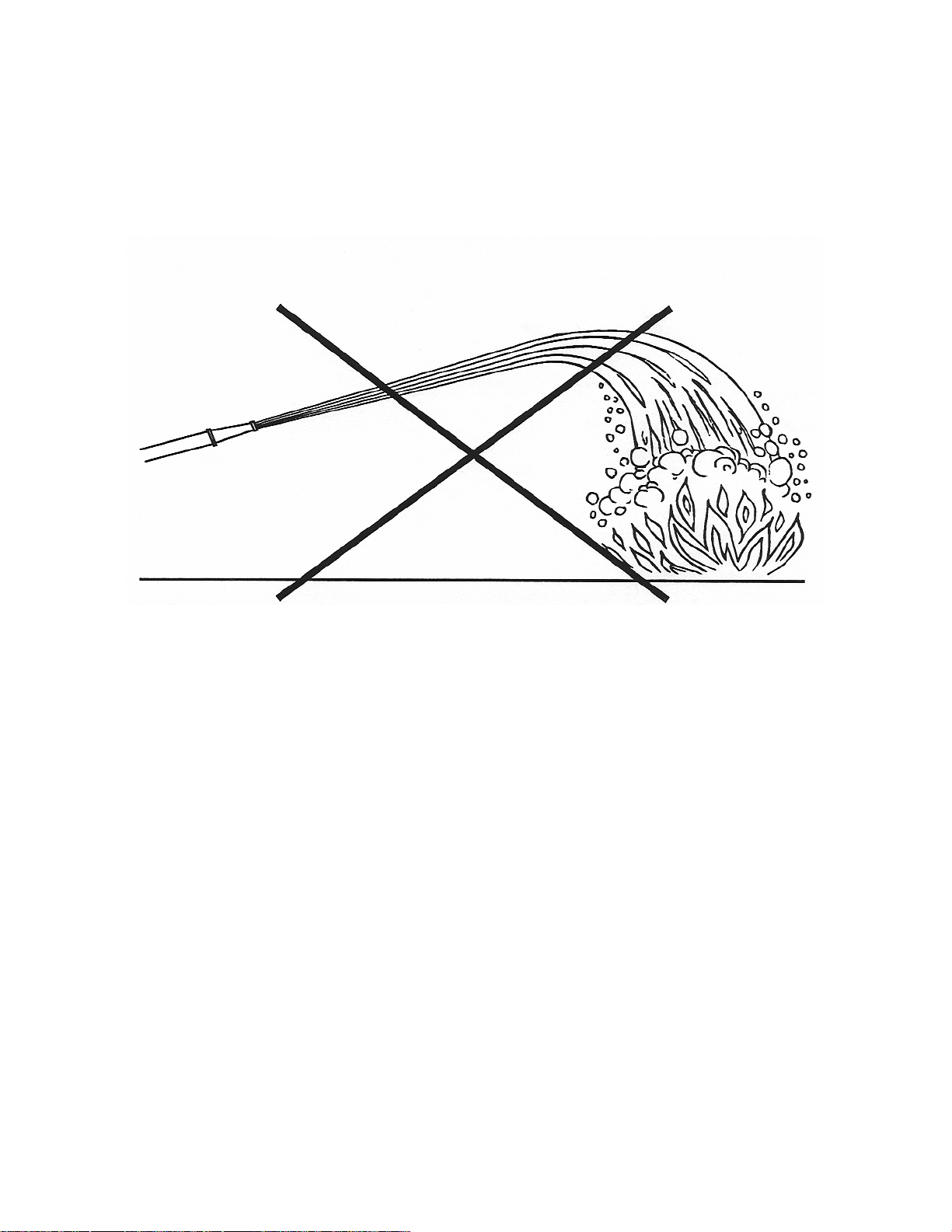
NOTE: This procedure is in direct contrast with that required in fire fighting operations
employing mechanical foam agents, such as the “Raindown” technique recommended
when using aqueous film forming foams (AFFF) (FIG 5).
Figure 5 - The AFFF “Raindown” technique
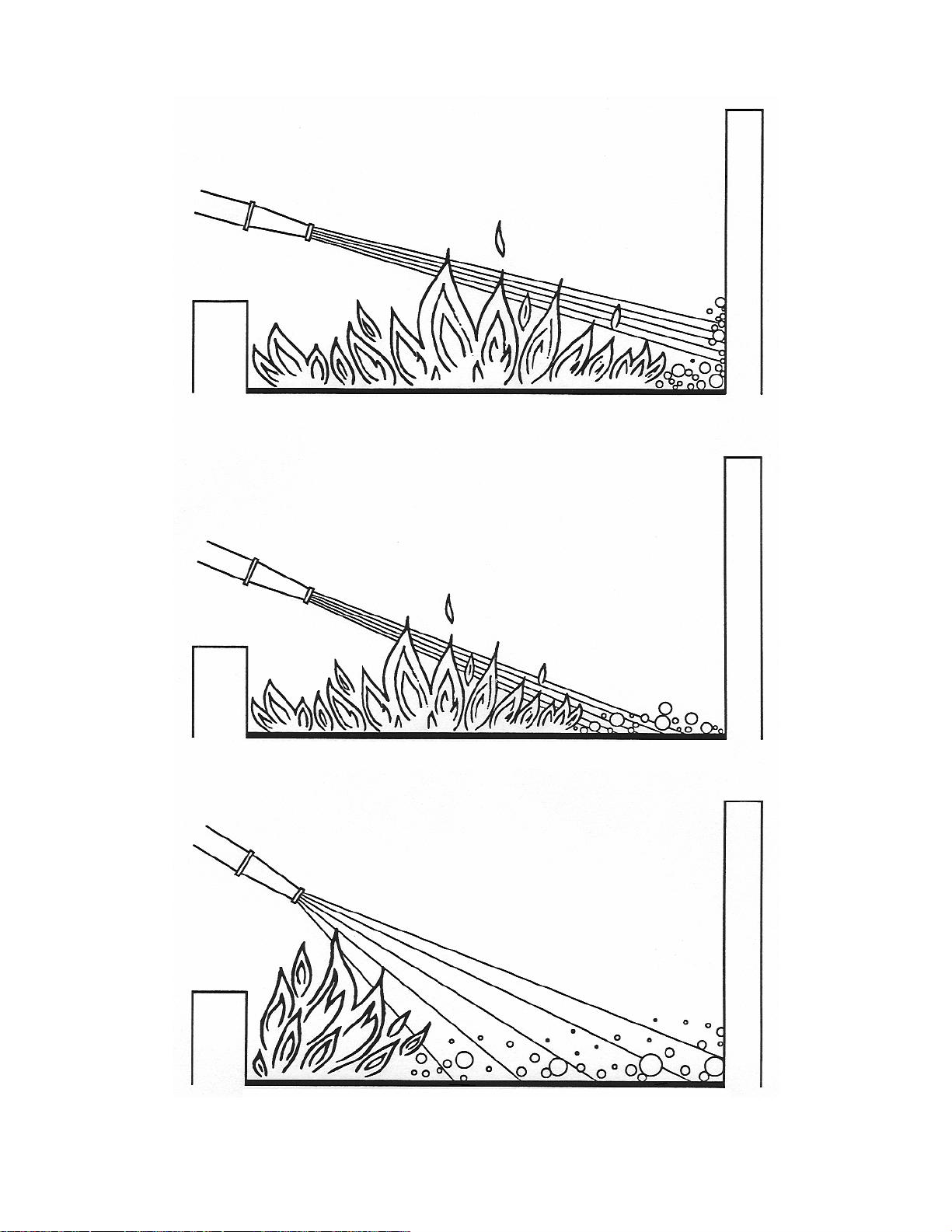
Bank-and-Roll Method:
If an obstruction prevents attacking the fuel from the front using the Plunge
Method and a wall or bank is located at the back of the burning pool of petrochemical, a
straight stream of PYROCAP B-136™ at a 6 percent concentration may be aimed
approximately 6 inches above the fuel level (fig. 6a). A foam will be developed which
will begin to roll back across the fuel surface (fig. 6b). Once control becomes apparent,
the nozzle should be adjusted to a 30 degree setting and the material should be aimed at
the base of the remaining fire as in the Plunge method (fig. 6c).
- 8 -
Page 11
c b a
- 9 -
Page 12
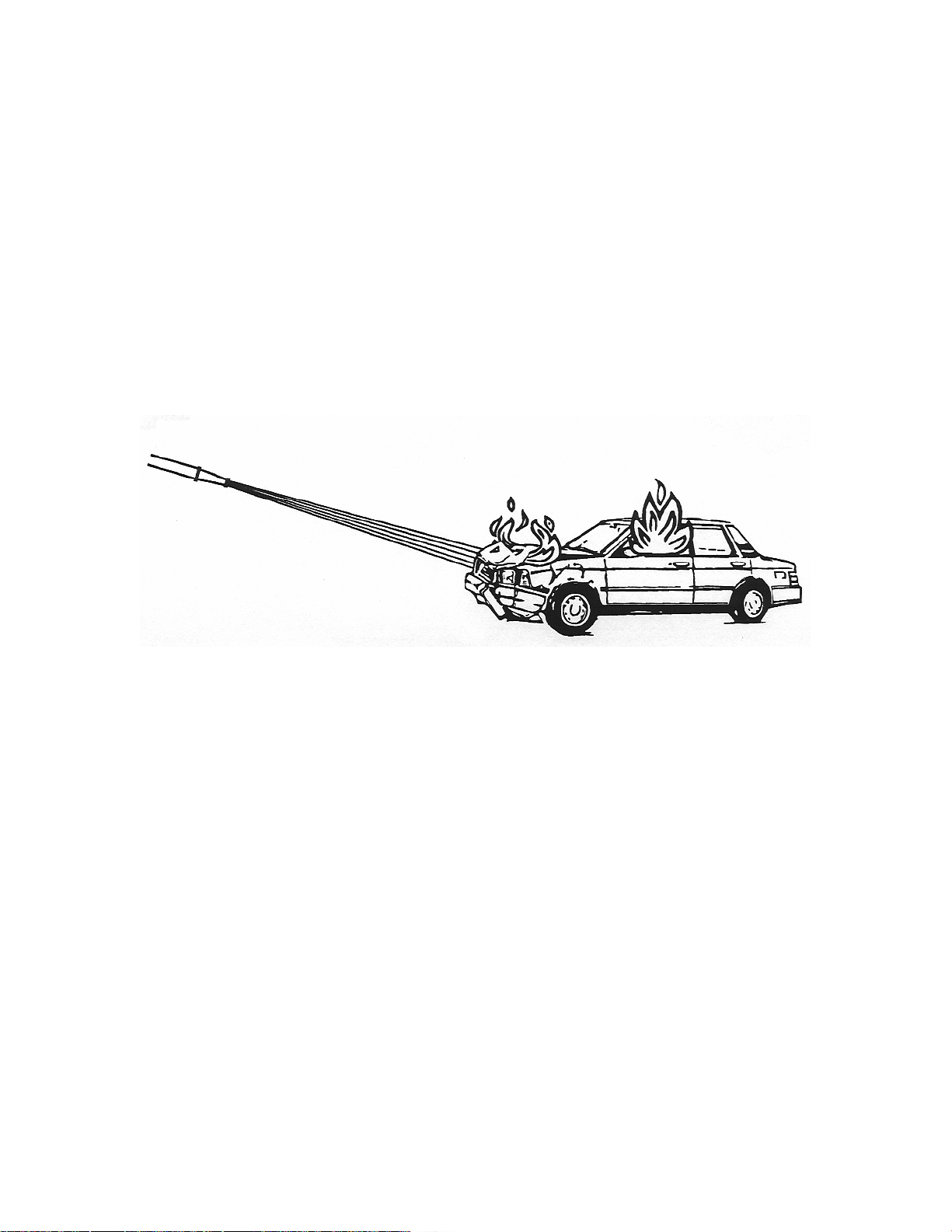
Figure 6 - Bank-and-Roll Technique
CLASS D APPLICATION
In Class D fires, as with Class A, the situation will dictate the appropriate
adjustment of the nozzle, but a non-aspirated nozzle is appropriate for most
applications. The product concentration for Class D fires is 6 percent (fig. 7).
NOTE: Powdered metals in densely packed containers which have a pre-burn
sufficient to allow deep seated combustion will crust over when the formula is applied.
The crust of metal oxide will prohibit the agent from reaching the core of the
combustion. Mechanical means are necessary to penetrate the crust to the core. Extreme
caution is required.
Figure 7 - Class A, B, and D Application
MULTIPLE CLASS APPLICATION
In multiple class fires a 6 percent concentration is recommended for maximum
flexibility to the fire fighter. For general application to structure fires (Class A) a 3
percent concentration is recommended. To provide protection to adjacent structures,
wooded areas, or grass -lands apply a 6 percent barrier coating.
Appendix A is the standard operating procedure used by the Fire Department of
the Fire District of Roosevelt, Long Island, New York. It provides an approach that will
generally apply to many structural fire situations.
- 10 -
Page 13
APPLICATION USING HAND HELD EXTINGUISHERS
In each class of fire, the fire fighter should direct the stream of PYROCAP B136™ enhanced with water, at the base of the fire.
In using PYROCAP B-136™ to extinguish Class B fires in non-polar hydrocarbons, firefighters must direct the stream directly onto the fuel to create a turbulence at
the base of the fire. This technique will expedite the emulsifying action of PYROCAP
B-136™ in such fuels.
REMOVING THE TH REAT OF HAZARDOUS MATERIAL SPILLS
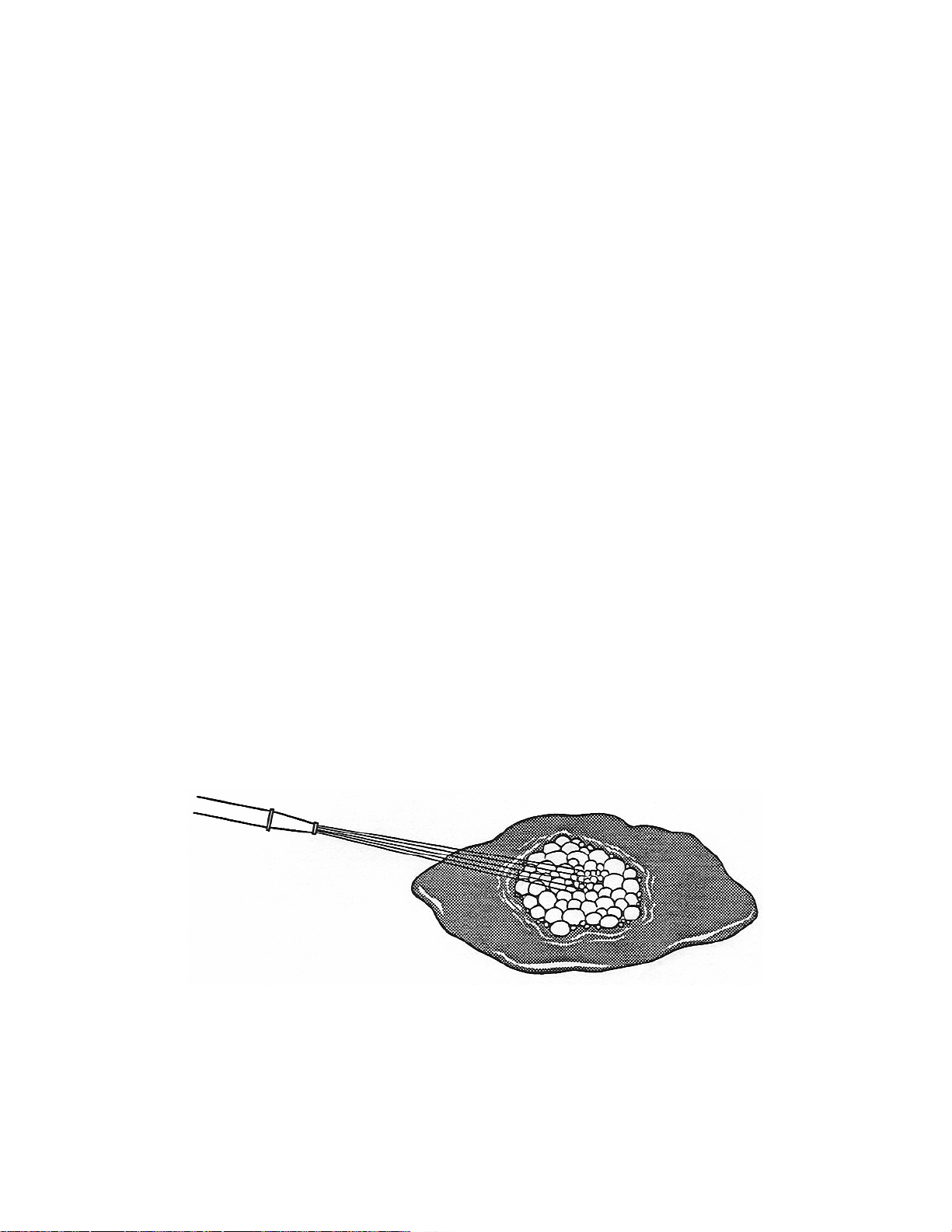
PYROCAP B-136™ can be used to reduce the threat caused by hazardous
material spills. Plunging the stream of PYROCAP B-136™ directly into a contained
spill of non-polar hydrocarbons will emulsify them and significantly reduce their
flammability (fig. 8).
PYROCAP B-136™ emulsifies non-polar hydrocarbons. The material can be
removed in the most expeditious way consistent with safety and environmental
considerations.
Figure 8 - Emulsifying Non-Polar Hydrocarbons
- 11 -
Page 14

APPENDIX A
ROOSEVELT FIRE DEPARTMENT STANDARD OPERATING PROCEDURE
TITLE: PYROCAP B-136™ INITIAL FIRE ATTACK
PURPOSE:
TO ESTABLISH A METHOD FOR EMPLOYING PYROCAP B136™ IN INITJAL FIRE ATFACK OPERATIONS
APPLICATION:
THIS PROCEDURE WILL BE USED FOR ANY STRUCTURAL FIRE, TIRE
FIRE, AND FOR ANY VEHICULAR FIRE WHICH EXPOSES ANY STRUCTURE
TO INVOLVEMENT IN A FIRE
PERSONNEL REQUIRED:
3 FIRE FIGHTERS AND 1 CHAUFFEUR/PUMP OPERATOR
EQUIPMENT REQUIRED:
1- PYROCAP B-136™ PRECONNECT LINE
1- 95 GPM IN-LINE EDUCTOR SET AT 3 PERCENT
3- 5 GAL. CANS PYROCAP B-136™ ADDITIVE
DEFINITION:
Pyrocap Line- A 10 FOOT, 1-3/4 INCH HOSE CONNECTED TO THE PUMP OUTLET
WITH A 200 FOOT LENGTH OF 1-3/4 INCH HOSE ATTACHED TO A
TASK FORCE NOZZLE STORED IN CROSS LAY #1.
A. EVOLUTION USING AN EDUCTOR:
1. Upon arrival, the fire engine will stop at the hydrant closest to the fire. Fire
fighter #1 will get off and rap the hydrant.
2. The engine will lay a supply line to the scene of the fire.
3. The chauffeur/pump operator will set up the engine to the pump.
- 12 -
Page 15

4. Fire fighter #2 takes the nozzle and advances the line toward the fire.
5. Fire fighter #3 pulls the remainder of the hose from the cross lay, breaks
the line at the end of the 10 foot length, and inserts the eductor set at 3
percent.
6. Fire fighter #3 then positions the cans of PYROCAP B -136™ at the
eductor, and joins fire fighter #2 to attack the fire.
7. The pump operator then connects the supply line to the pump and signals
fire fighter #1 to start water in the supply line.
8. The pump operator places the feed tube into a can of PYROCAP B-136™,
raises the engine pressure to 200 psi, the required inlet pressure for the
eductor, and charges the line.
9. Fire fighter #1 takes a hook and joins the team attacking the fire. The pump
operator monitors the pump and the supply of PYROCAP B-136™ .
NOTE: Use the same procedure for Class B fires, large tire fires, and Class D fires,
but SET THE EDUCTOR TO 6 PERCENT.
B. EVOLUTION USING A PREMIX:
To obtain a 3 percent premixture of PYROCAP B-136™ in a 500 gallon capacity tank
for Class A applications:
1. Charge the tank with approximately 400 gallons of water.
2. Add 3 ca ns (15 gallons) PYROCAP B-136™ to the 400 gallons of water in
the tank.
3. Put the pump in the recirculating mode, fill the tank to capacity, then allow
the pump to recirculate for 3 minutes.
4. Use normal SOP* for structural fires.
*(Standard Operating Procedure)
- 13 -
Page 16

Erace Inc.
Firefighters Are at Their Best,
When They Have the Best!
If you have any questions or concerns, please feel free to contact us at:
Erace Incorporated
P.O. Box 281
Parkesburg, PA 19365
Email: [email protected]
 Loading...