

Page 1
Wireless
Pool Thermometer
S300PT-US
Operating Manual
ELV Electronics Ltd. Hong Kong
1
Page 2

2
Please read these instructions carefully from start to finish
before initial start-up to avoid functional breakdown and
faulty operation. The manual contains much important
information about the installation and operation. Keep the
manual available for future reference.
If you sell or give away this unit to other persons, hand
over also this manual.
1st English edition March 2006
Documentation © 2006 ELV ltd. Hongkong
All rights reserved. This handbook must not be reproduced in any form, even in excerpts, or duplicated or processed using electronic, mechanical or chemical procedures without written permission of the publisher.
This handbook may contain mistakes and printing errors. The information in this
handbook is regularly checked and corrections made in the next issue. We accept no
liability for technical mistakes or printing errors, or their consequences.
All trademarks and patents are acknowledged.
Printed in Hong Kong
Modifications due to technical improvements may be made without warning.
66255 Y2006V1.0
Page 3

Content
1. General information and function ................................................ 4
2. Indended usage ........................................................................... 4
3. Safety instructions ....................................................................... 5
4. Battery and environment instructions .......................................... 5
5. Preparing for operation ................................................................ 6
5.1. Open the housing ........................................................................ 6
5.2. Inserting batteries ........................................................................ 6
5.3. Setting address and measuring unit ............................................ 7
6. Operation ..................................................................................... 8
7. Range ..........................................................................................8
8. Maintenance ................................................................................ 9
8.1. Changing the batteries ................................................................9
8.2. Cleaning ....................................................................................... 9
9. Disposal ....................................................................................... 9
9.1. General ........................................................................................9
9.2. Disposing of used batteries .........................................................9
10. Technical Data ........................................................................... 10
11. FCC Information ........................................................................11
3
Page 4

4
1. General information and function
This wireless, battery-operated pool thermometer is a high quality measuring system to define the temperatur of water in swimming pools, garden
pools, bowls etc. It is water-proof and can swim.
The thermometer indued with own temperature display. This can show the
temperature in centigrade (˚C) or degrees Fahrenheit (˚F).
The thermometer indued with a transmitter for send the temperatur data
to the wireless poolthermometer basic station PTD300-US. Also it is
possible to receive the data with many weather stations from ELV. The
following weather stations are compatible to this wireless thermometer:
⌦- BA 1010-US
⌦- WS 200-US
⌦- WS 300-US
⌦- WS 250 Edition-US
⌦
This weather stations can receive the data as a normal outdoor sensor.
For this using the pool thermometer is addressable accordingly to the ELV
adress system. Please refer to the manual of the weather station.
2. Indended usage
The product is intended for domestic use. It is not suitable for medical
purposes or public information.
This product is designed for show the water temperatur in pools, bowls
etc. It is only designed to using into water, not other liquids!
The product is battery-operated. It transmits his data per radio to a ELV
base station (see below, 433 MHz, range up to 300 ft. in open space).
Any other use than that described above may go to damage the product
or to other danger.
The product has been EMV-tested and meets the requirements of the
valid international guidelines. CE-conformity has been proven and the
corresponding declarations deposited with the manufacturer.
Page 5

3. Safety Instructions
We shall not assume any liability for damage to items or persons caused
by improper handling or non-observance of the safety instructions!
In such cases, any guarantee claims shall become null and void.
- Do not use this product in hospitals or medical institutions. Although
the outdoor sensor only emits relatively weak radio signals, these may
cause interference to life-support systems. The same can also apply
in other areas.
- Do not use the unit, if there are damages on the housing.
- Do not subject the device to temperatures below 32˚F (0°C) or above
158˚F (70°C).
- Caution by danger of freezing! Take the unit out of the water, if the
temperature goes to 32˚F (0˚C).
- For safety and licensing reasons (CE), it is not permitted to convert or
modify the product.
- Do not leave the packaging material laying around. Plastic foil and
bags, polystyrene parts etc. are dangerous toys in the hands of children.
- This product is not a toy. It contains glass and small parts, children
can swallow up them. Erect the unit out of the reach of children.
- This product is not a toy for pets. It contains peaked and dangerous
materials, they can harm pets, if they bite to the unit.
4. Battery and environment instructions
• Batteries do not belong in the hands of children.
• Observe the right polarity when inserting the batteries.
• Do not leave batteries laying around. Pets or small children may swallow
them. If they are swallowed, contact a doctor immediately.
• Leaking or damaged batteries may lead to injury to the skin. For this
reason, use suitable protective gloves when changing them.
• Make sure that batteries or accumulators are not thrown into the fire
or short-circuited. There is a likelihood of explosion!
• Never dismantle batteries!
• Do not recharge normal batteries. There is a risk of explosion!
• If the product is not used for longer periods of time (e.g. in case of sto
rage), please remove the inserted batteries in order to prevent damage
caused by leaking batteries.
-
5
Page 6
6
5. Preparing for operation
5.1. Open the housing
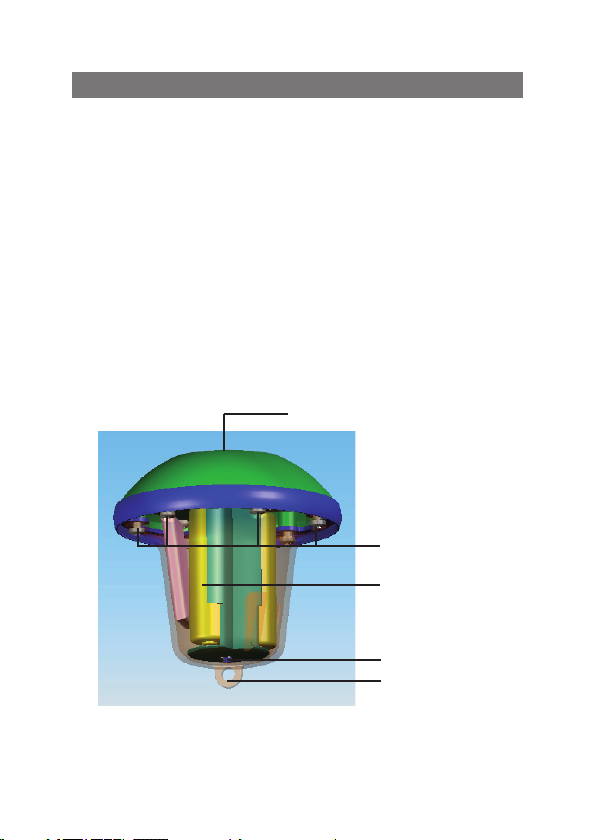
- Rotate the unit and unscrew the 6 screws (see below)
- Lift up the upper part carefully.
5.2. Inserting the batteries
- The unit is operated with 3 x 1,5 V AA batteries. You should take alkaline
batteries (LR6) for longer using and better safety against leaking.
- Insert the three batteries into the battery holder with right polarity as
shown in the battery holder.
- If you want to make settings (addresses or measuring unit), go to the
next chapters.
- Or else you can close the housing. Note, that the temperatur sensor
is laying in the spare on the ground of the bottom part, and that the
neoprene seal ring is laying exactly on the housing, before you close
the housing and tighten the screws. Tighten the screws carefully in a
diagonal sequence.
Display
Screws
Batteries
Sensor
Eye for fixing
on the ground
Page 7
5.3. Setting address and measuring unit
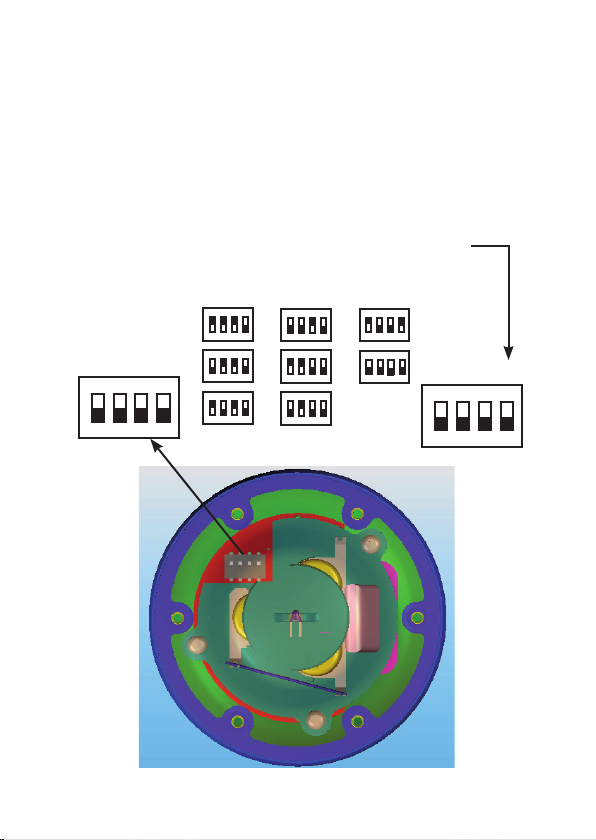
- If you have take the unit out of the lower part, you can see the DIPSwitch on the lower side of the electronic part (see below).
- The DIP-Switches 1-3 are used for addressing, the switch 4 ist used
for choosing the measuring unit. The default values are adress 8 and
the measuring unit Fahrenheit.
- If you will transmit the data to a ELV weather station, choose the address
accordingly the description of your weather station. The allocation
you see below. After some time the value is available on the weather
station.
- Choose the measuring unit accordingly the allocation below.
- Close the housing as per description in chapter 5.2.
Addressing
ON
1 2 3 4
1
2
3
4
5
6
7
8
ON
1 2 3 4
˚F
˚C
7
Page 8

8
6. Operation
- Set the accurately closed unit on the water surface.
- Wait some seconds, till the temperature display shows a stable value.
The housing and the inner of the thermometer needs some time till
they has the same temperatur as the water.
Caution!
- Do not pitch the unit into the water and use it not as a toy or sport
equipment.
- Look after your dog - the dogs can understand the unit as a toy!
- Do not submerge the unit - it ist designed for working on the water
surface.
- Do not dip the unit into hot water (max. 158˚F/70˚C) or in icy water.
- Take the unit out of the water, if it is no required.
7. Range
The free field range, i.e. the range of the line of sight contact between the
transmitter and the receiver is 300 ft. under optimum conditions. Walls
and even reinforced concrete can be penetrated, which does, however,
reduce the range. A reduced range can occur due to the following reasons:
- High-frequency interference of all kinds
- Built structures and vegetation of all types
- The distance of the transmitter or receiver from conductive surfaces or
objects (even to the human body or the ground) has an effect on the
transmission characteristics and therefore the range.
- Wide band interference in built up areas can reach levels that reduce
the signal-noise ratio throughout the frequency band which results in
a reduced range.
- Devices with adjacent working frequencies can also influence the receiver.
- Badly shielded PCs can irradiate the receiver and limit its range.
Page 9
8. Maintenance
8.1. Changing the batteries
- If the flat battery symbol appears in the display (Lo Bat)
all batteries must be changed for ones of the same type
as described in Section 5.2 (p. 6).
Always change all 3 batteries and use only high-quality alkaline cells.
8.2. Cleaning
- Clean the unit using only a soft cloth. Do not use cleaners containing
solvents. Make sure that no moisture enters the interior of the unit.
- Do not exert any pressure on the display.
Lo-Bat
9. Disposal
9.1. General
- Dispose of the unusable product according to valid legal
regulations
9.2. Disposing of used batteries
- You, as ultimate consumer, are required by law (battery
regulations) to return all used batteries. Disposing of
used batteries with domestic waste is prohibited!
-
Batteries / accumulators containing toxins are marked by appropriate
symbols which refer to the prohibition of disposal with domestic waste.
- The designations for the decisive heavy metals are:
Cd = cadmium, Hg = mercury, Pb = lead (The designation
can be found on the battery under the dustbin symbol
illustrated on the right).
- You may return used batteries/accumulators free of charge to collec
ting stations, our outlets or anywhere else where batteries/accumulators are sold.
By doing so, you fulfil the legal requirements and contribute to the
conservation of our environment.
-
9
Page 10

10
10. Technical Data
Measurement range: ......................................32˚F to 158˚F (0˚C to 70˚C)
Resolution: .................................................................................. 0,1˚F/˚C
Accuracy: ..............................................................................±1,8˚F/±1˚C
Display updating: .................................................................. every 5 sec.
Data transmission interval: ...................................................about 3 min.
Transmission frequency: ....................................................... 433,92 MHz
Free field range: .....................................................................max. 300 ft.
Voltage supply: ........................................................ 3 x 1.5 V/AA battery
Battery service life: ....................................................................2-3 years
Dim. (H x ø): ...........................................................................88 x 84 mm
Page 11

11. FCC Information
FCC ID: RNT-PT3
Changes or modifications not expressly approved in writing by ELV Electronics Limited may void the user’s authority to operate the equipment.
NOTE:
This equipment has been tested and found to comply with the limits for
a Class B digital device, pursuant to Part 15 of the FCC Rules. These
limits are designed to provide reasonable protection against harmful interference in a residential installation. This equipment generates, uses
and can radiate radio frequency energy and, if not installed and used
in accordance with the instructions, may cause harmful interference to
radio communications.
However, there is no guarantee that interference will not occur in a particular installation. If this equipment does cause harmful interference to
radio or television reception, which can be determined by turning the
equipment off and on, the user is encouraged to try to correct the interference by one or more of the following measures:
- Reorient or relocate the receiving antenna.
- Increase the separation between the equipment and receiver.
- Connect the equipment into an outlet on a circuit different from that to
which the receiver is connected.
- Consult the dealer or an experienced radio/TV technician for help.
The internal antenna used for this mobile transmitter must provide a separation distance of at least 20 cm from all persons and must not be
co-located or operating in conjunction with any other antenna or transmitter.
This device complies with Part 15 of the FCC Rules. Operation is subject
to the following two conditions:
(1) this device may not cause harmful interference,
and
(2) this device must accept any interference received, including in
terference that may cause undesired operation.
-
11
Page 12

ELV Electronics Ltd. Hong Kong
12
 Loading...