

Page 1
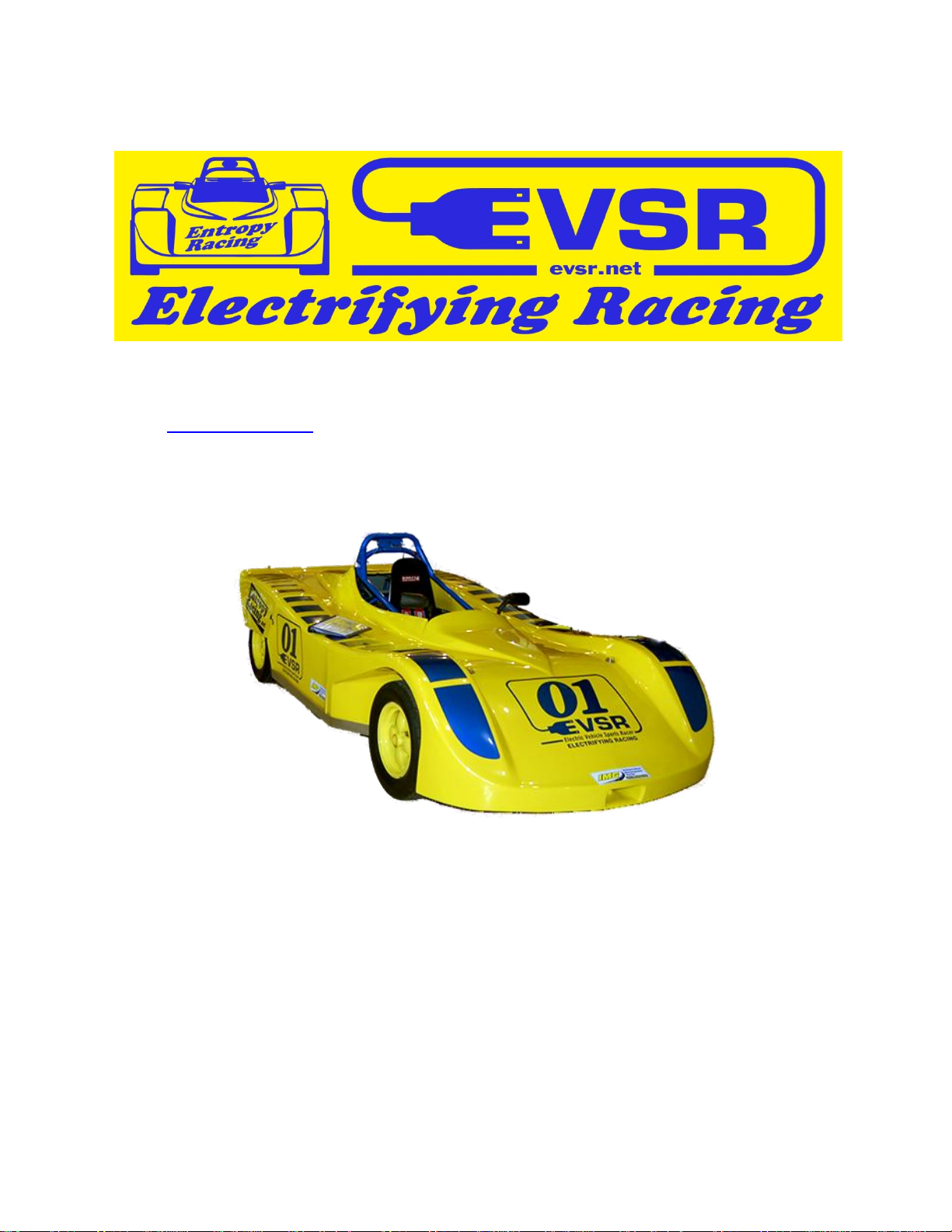
EVSR SAFETY AND FIRST RESPONDER INFORMATION GUIDE
EVSR High Voltage Safety and First Responder Information Guide is available at:
http://evsr.net/ and may also be requested by calling 570-682-9666
EVSR is a product of Entropy LLC.
EVSR SAFETY QUICK REFERENCE GUIDE INFO:
EVSR is a race car which carries no liquid fuel, but just like a Hybrid, has higher battery current
and voltage than a conventional gasoline-only powered car.
EVSR can be treated much in the same way as any other race car by corner workers. Just as
you would not touch a hot engine or exhaust- do not touch any of the large orange wires or
components they attach to on the EVSR. Avoid contact the orange box in the rear of the car as
this contains all the high voltage switching mechanisms.
The high voltage battery packs sit to the left and right of the driver at the outside center of the
car within reinforced boxes that should never require the attention of a worker. In the event
of a severe crash in which the boxes may be compromised, avoid contact with the cells within.
1
Page 2

EVSR does carry a small amount of conventional coolant for the computers which never
reaches boiling temperatures as well as cold distilled water for the motor cooling. The rear
mounted differential contains gear oil, and the brake system uses conventional brake fluid.
EVSR is equipped with a large external master kill switch to turn off the power, which will be
indicated by the green lights going out on both sides of the main hoop. There is also a HV
Battery Switch on Driver’s Right, on the front section just ahead of the cockpit, which shuts off
the High Voltage Supply. TURN THESE OFF BEFORE ASSISTING DRIVER, MOVING CAR, ETC.
If you cannot reach the Master Kill Switch, turning off the red capped power switch on the
instrument panel will also shut down the power in the EVSR. Also, the HV Battery Switch may
be operated from Driver’s Right outside the Instrument Panel, by pulling the orange handle
loop.
In the event of a serious collision that impacts and shorts the high voltage system, there is a
master fuse which will quickly blow and shut the high voltage power off. The 12v power is also
fused.
In the event of a fire, there is no increased hazard as compared to a gas powered car and the
priority is to turn off the master switch and battery switch, then extract the driver. Standard
fire extinguishers are safe to use on the car as well as water.
EVSR may be towed by the roll bar. Additionally, EVSR has tow/tie-down hooks on the front
suspension, just inboard of the wheels on the lower control arm, and at the center in the rear
of the chassis. Removal of bodywork presents no hazards and is similar to that of a SRF.
Please refer to the EVSR First Responder Safety Manual for a complete comprehensive guide
to safety with the EVSR. We advise all track workers to become familiar with this information
as Electric Race Cars are here to stay.
EVSR SAFETY AND FIRST RESPONDER INFORMATION GUIDE:
This guide is designed to assist emergency responders and corner workers to
effectively handle the fully electric EVSR in emergency situations. The information
in this guide will allow you to respond to an EVSR in a safe manner. While the
EVSR has a much lower risk of fire than a race vehicle equipped with an Internal
Combustion Engine (ICE), there are some different risks associated with the use of
high voltage, the Lithium Ferrous Phosphate Battery Pack, and the lack of noise
from an EVSR. This guide will familiarize responders with these specific risks and
required cautions. This guide only contains information specific to the EVSR
Electric Vehicle Sport Racer, and should only be used for that vehicle. This guide
may only be copied in its entirety with express written consent of Entropy LLC.
Covers:
•Safety Overview
2
Page 3

•Low Voltage Battery and High Voltage Battery Pack
•High-Voltage Electrical Disconnect Features
•Other High-Voltage Electrical Components
•Fire Fighting Measures
•First Aid Measures
•Accidental Release Measures
•Links to Specific Training Resources
Safety Overview:
The chassis, body, and mechanical systems of the EVSR are all conventional in
nature, and do not need any special attention not required of ICE powered cars.
There is no flammable fuel contained in the EVSR as it is a pure electric race
vehicle, not a hybrid. The only fluids present are the brake fluid, differential gear
oil, ethylene glycol coolant in a small quantity for computer cooling, and distilled
water/windshield washer solution for motor cooling.
The EVSR is very quiet in operation, and may not be heard by track workers if it is
approaching. Use extreme caution when entering a hot track when EVSR’s are
present!
Other distinguishing safety features of the EVSR include the use of Aircraft type
Lithium Ferrous Phosphate (LiFePO4) High Voltage Batteries, which have a very
small fire hazard when punctured, as opposed to the more commonly used
Lithium-Ion type. Battery MSDS is available by request, with pertinent info at the
end of this manual. Also, the EVSR Power System nominal voltage is under 200v,
not the 400v commonly in use on most road going Hybrid and Electric Vehicles.
The EVSR Power System is a “Floating” System which means the High Voltage (HV)
circuit grounds are separate from the Low Voltage (LV) circuit grounds. The
Computerized Controller System (CCS) measures the HV system’s “Isolation” from
HV Circuits to Chassis Ground. Faults will be displayed in the Driver Instrument
System (DIS) / Cluster. An electric shock may occur if the HV circuit ground is
shared with the LV circuit ground.
3
Page 4
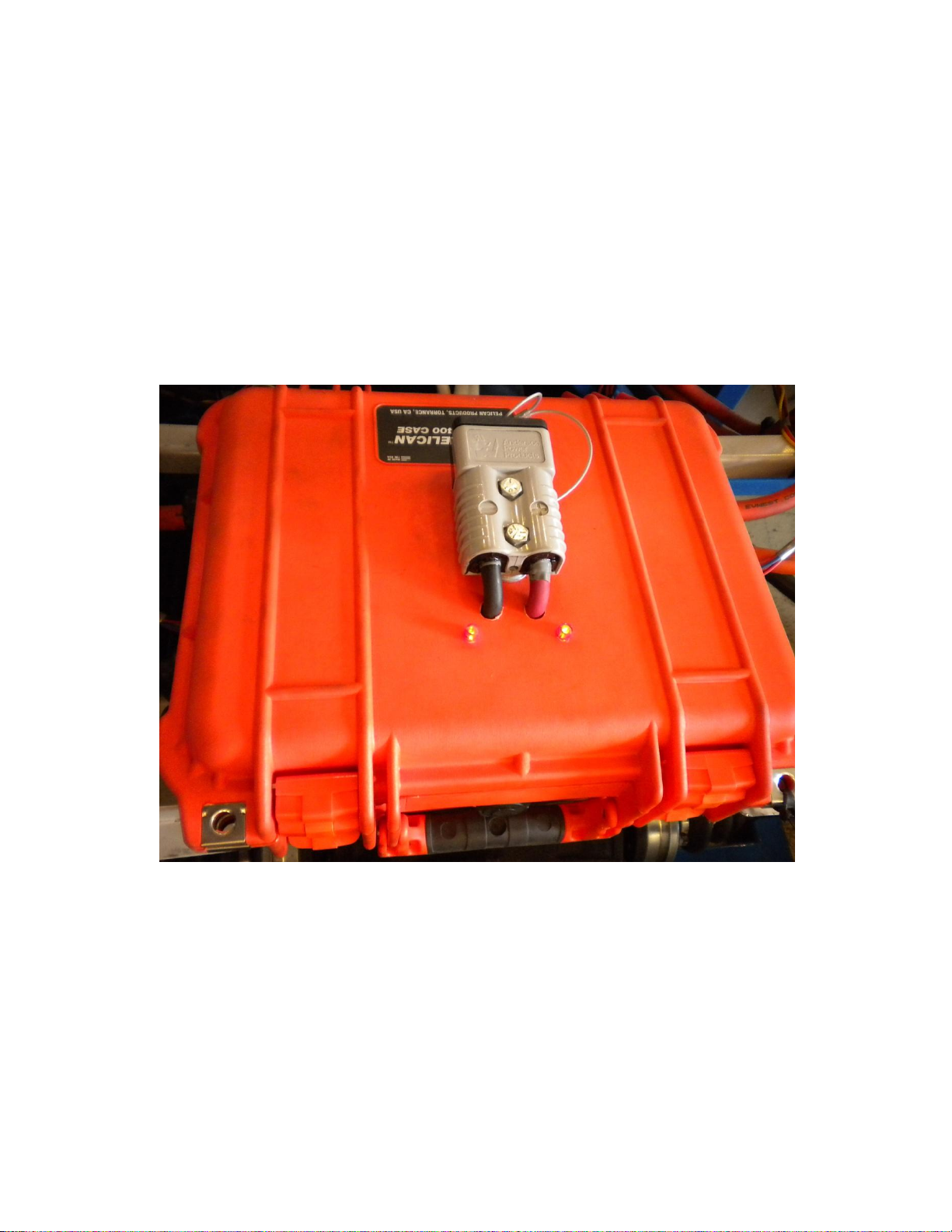
Do not touch or open the Pelican Case that contains the contactors, or the
charge leads that are mounted on top of the case, located under the tail section.
WARNING: Always assume the HV circuit is LIVE. Capacitors on HV DC circuit can
maintain HV for as long as 5 minutes after the Emergency Stop Button is
switched OFF or the 12v LV Fuse is removed. Most EVSR’s have two indicator
lights on the contactor Pelican Box which go out when capacitor voltage drops
below 50volts. Once these lights go out, allow 2 minutes longer for total
capacitor discharge. This picture shows the lights lit:
WARNING: DO NOT cut into the vehicle until the 12v and HV electrical
systems have been deactivated. Cutting into the vehicle prior to
disconnecting and isolating the 12v and High Voltage electrical energy
sources may cause electric shock resulting in serious injury.
There is a “Master Kill Switch” located on the drivers’ right side of the vehicle’s
roll bar structure, accompanied by a green LED power indicator light. Pushing this
4
Page 5
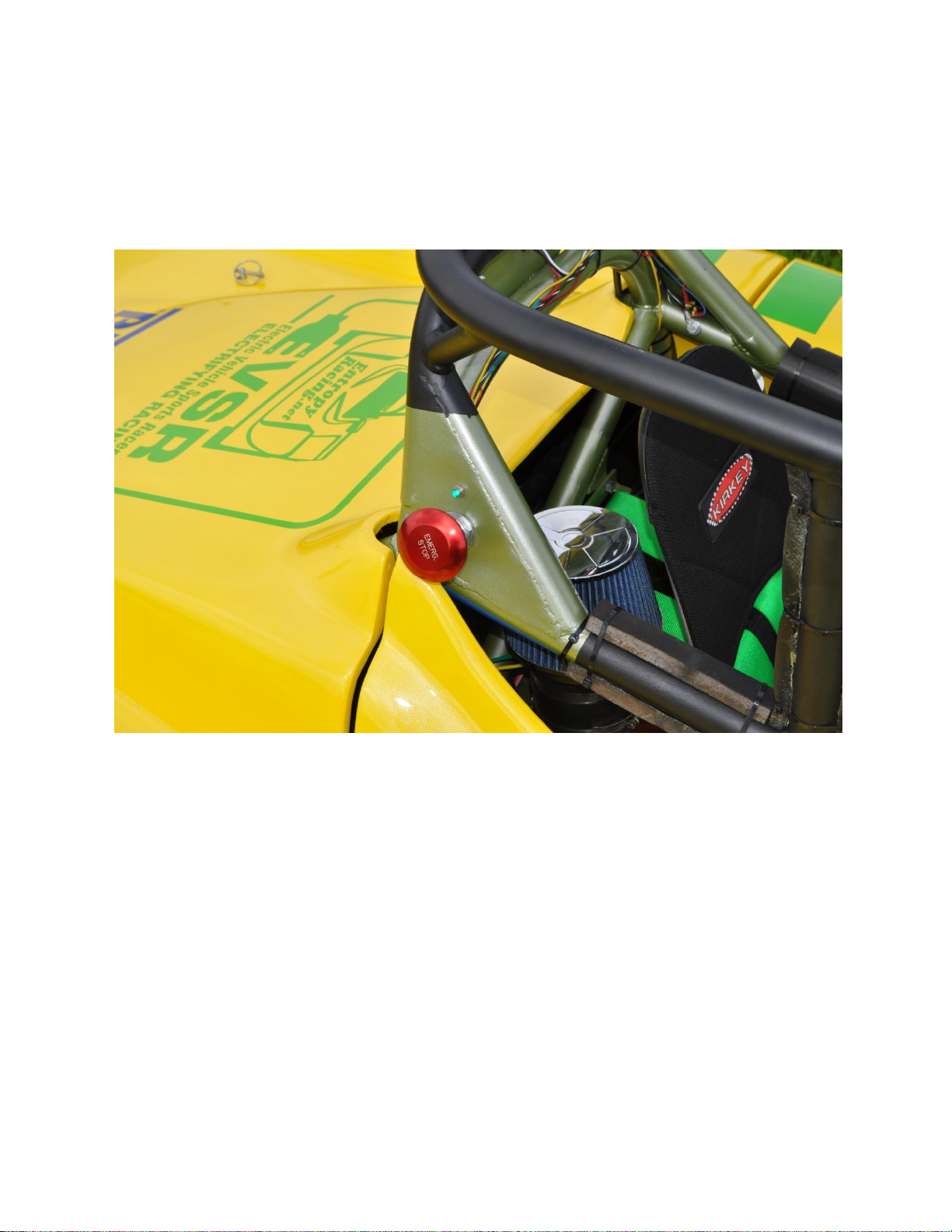
switch in will shut off the 12v power, which in turn prevents the HV system from
being powered under most conditions. Always push this switch off and be sure
that the green light has gone out before attempting to enter or move the
vehicle. If the light does not go out, see below for 12v battery fuse location.
Low Voltage Battery:
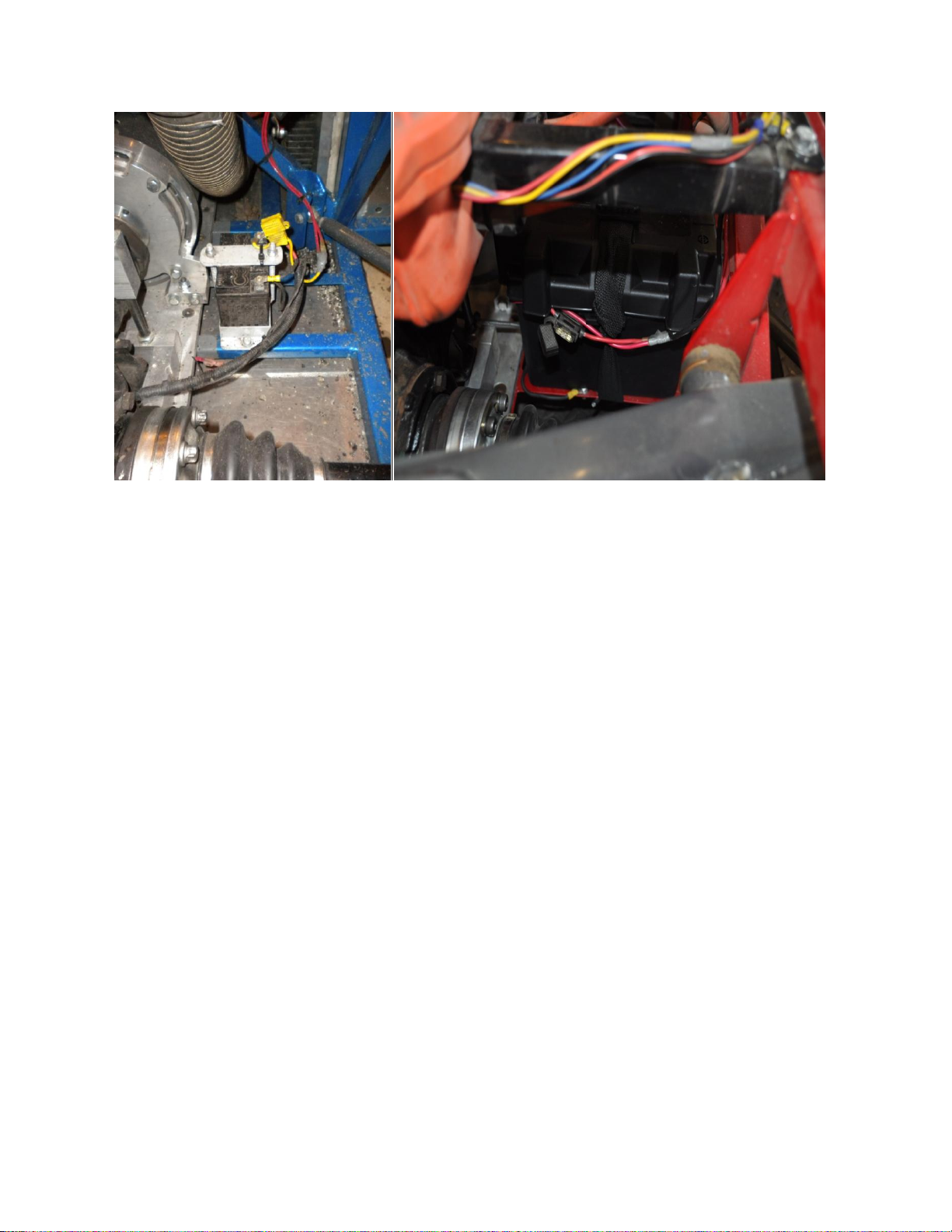
There is a small 12v battery located in the rear of the car on the drivers’ right,
under the tail section. This may be an Absorbent Glass-Mat (AGM) battery or a
conventional lead/acid battery. It may be contained within a spill-proof box.
The 12v battery may be disconnected in an emergency by removing the fuse in
the yellow/red/black fuse holder which is mounted just above the battery.
5
Page 6
High Voltage Battery Packs:
There are two High Voltage Lithium Ferrous Phosphate (LiFePO4) Battery packs
located within heavy gauge Aluminum boxes in both central side pods of the
EVSR, connected in series. These batteries are made up of individual sealed cells
connected by metal buss plates. Orange colored heavy gauge wires carry the high
voltage current throughout the EVSR. There is a single wire of this type that
connects the two High Voltage Battery packs across the car, under the nose
section, just forward of the instrument panel mount/rollover structure. This wire
connects the two battery packs through the High Voltage Battery Disconnect
Switch, located on the RF of the car, just ahead of the cockpit. There is a main HV
system fuse that is located on the outside rear corner of the HV Battery Pack
located on drivers’ left. This fuse will blow and disconnect the HV Battery Pack
from the EVSR if any short circuit occurs in the High Voltage EVSR System. This
fuse is not accessible without removing bolted on bodywork.
Whenever workers respond to an incident involving an EVSR, the first course of
action is to depower the vehicle by pushing in the Master Kill Switch located on
the driver’s right side of the main roll bar and labeled “Emergency Stop”,
followed by turning off the HV disconnect on the RF body, labeled “Battery
Switch.” This switch may also be turned off by pulling the red loop handle to
Drivers Right of the instrument panel. In the unlikely event that power indicator
lights are still lit after turning off the Master Kill and Battery Switch following a
6
Page 7
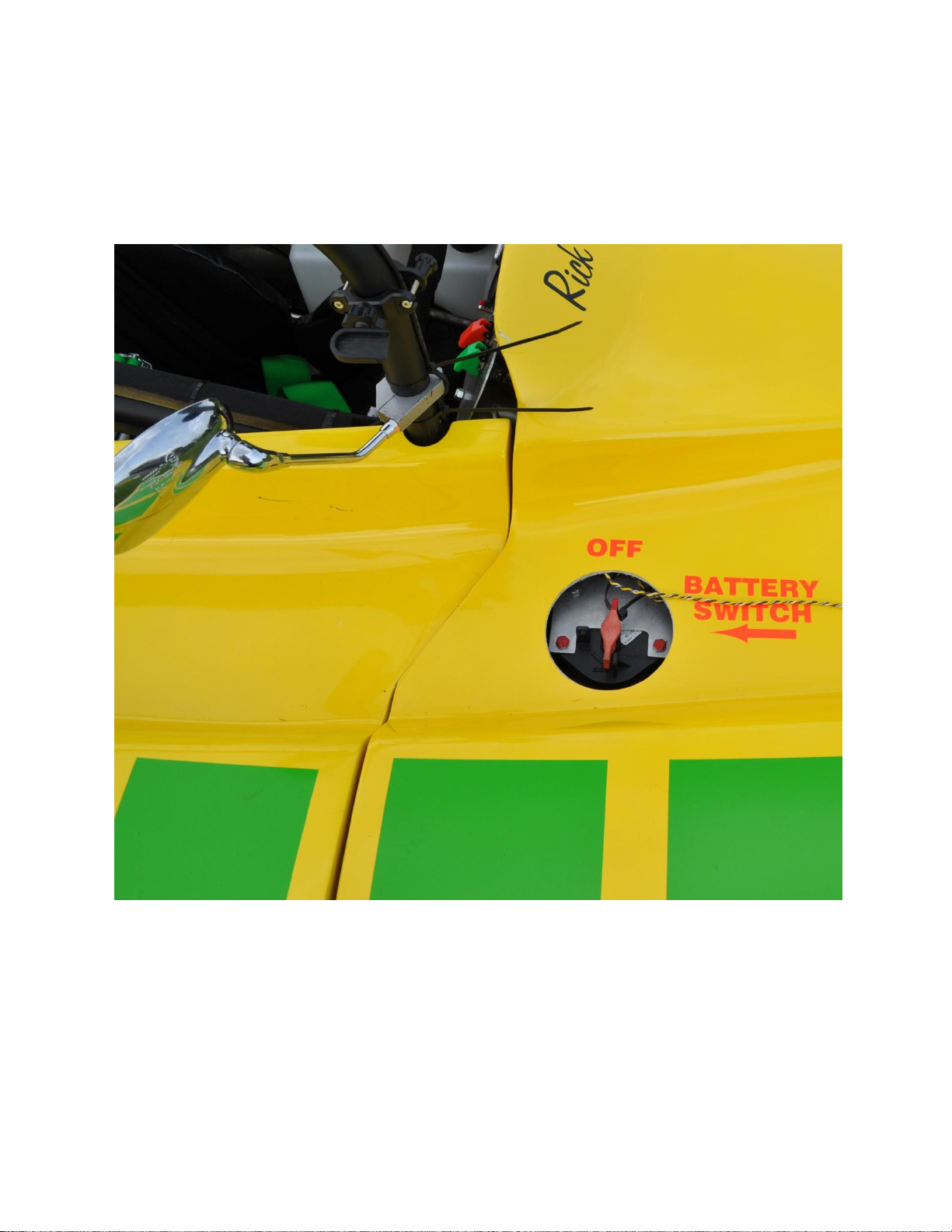
major crash incident, only properly equipped first responders should attempt to
cut any EVSR wires. Properly equipped first responders may cut the wires to the
12v battery where indicated by bright red tape stripes on either side of the area
to be cut. DO NOT attempt to cut any of the orange high voltage wires! The
picture below shows the HV Battery Switch in the OFF position.
7
Page 8
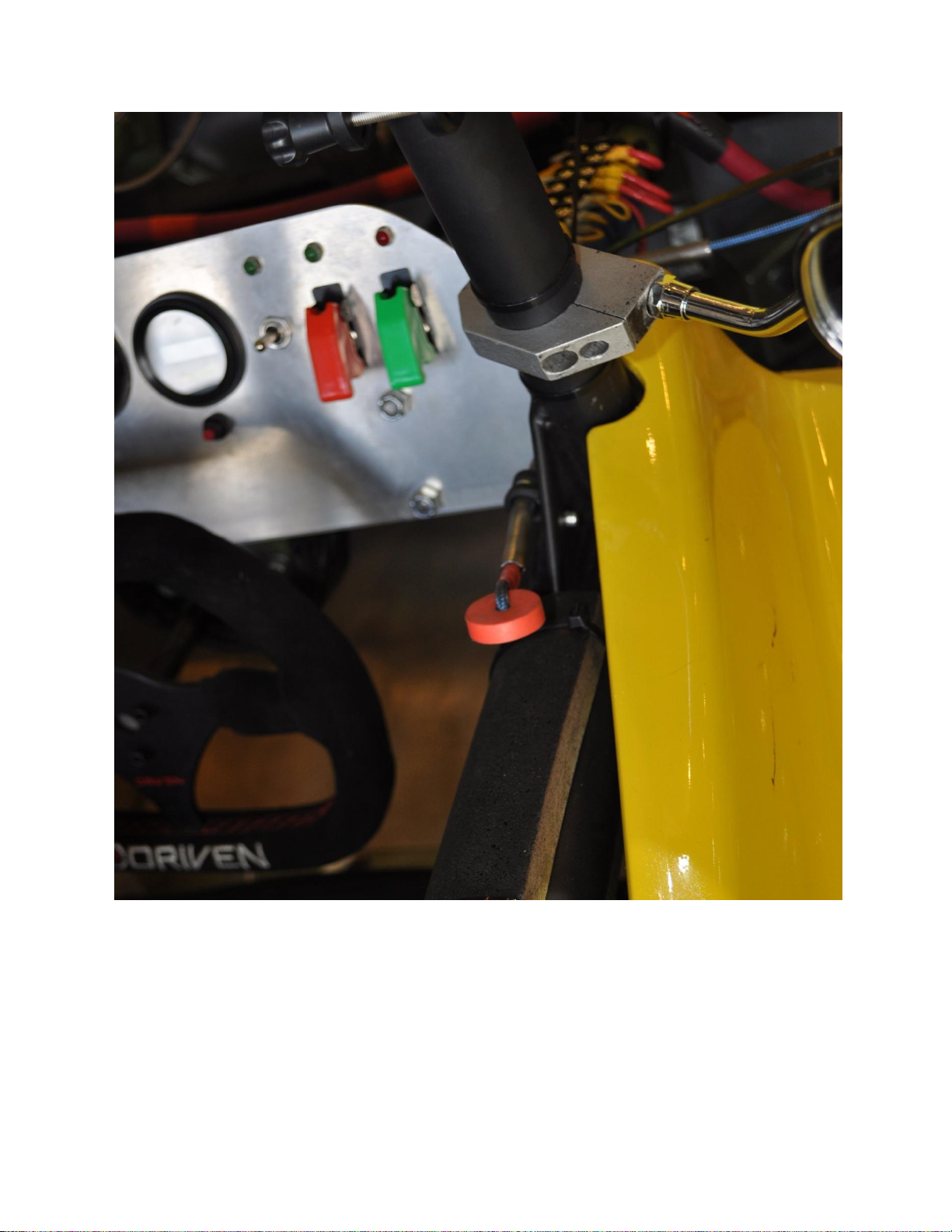
The High Voltage Battery Switch can also be operated from the drivers’
compartment by pulling the orange loop handle, located to the right of the
Instrument Panel.
Other High-Voltage Electrical Components:
There are many orange colored heavy gauge wires that carry high voltage current
throughout the EVSR System. Most of these are not live unless the car is switched
8
Page 9

on and the throttle is being applied. There are exceptions to this, so always treat
the HV System as if it were live!
The Accessory Power Module (APM) is a DC/DC Converter. The APM is a High
Voltage component located under the tail on the driver’s left and steps 200 volts
down to 13-14 volts of power to operate the EVSR and run the vehicle’s 12 volt
accessories.
Fire Fighting Measures:
Extinguishing Media
Copious amounts of cold water or water-based foam may be used to cool
burning cells or batteries. Do not use warm or hot water.
A carbon dioxide (CO2) extinguisher is also effective.
For fires involving exposed, raw lithium metal (characterized by deep red
flames), use only metal (Class D) fire extinguishers.
Special Fire Fighting Procedures
Use a positive pressure self-contained breathing apparatus (SCBA) if cells or
batteries are involved in a fire.
Full fire fighting protective clothing is necessary.
During water application, caution is advised as burning pieces of flammable
particles may be ejected from the fire.
Unusual Fire and Explosion Hazard
Cells or batteries that are damaged, opened or exposed to excessive heat/fire
may flame or leak potentially hazardous organic vapors.
First Aid Measures:
Inhalation:
Avoid inhaling any vented gases.
Remove to fresh air immediately.
If breathing is difficult, seek emergency medical attention.
Ingestion:
Consult a physician or local poison control center immediately
Skin Contact:
Exposure to materials from a ruptured or otherwise damaged cell or battery
may cause skin irritation.
Flush immediately with water and wash affected area with soap and water.
Eye Contact:
Exposure to materials from a ruptured or otherwise damaged cell or battery
may cause eye irritation.
Flush immediately with copious amounts of water for at least 15 minutes;
consult a physician immediately.
9
Page 10

Accidental Release Measures:
In the event a cell or battery is crushed; releasing its contents, rubber gloves
must be used to handle all battery components.
Avoid inhalation of any vapors that may be emitted.
Damaged batteries that are not hot or burning should be placed in a sealed
plastic bag or container.
Links to Specific Training Resources:
EV Safety and Training
Other helpful links for first responders and information about EV safety and training:
Electric Vehicle Safety Training →
Advanced Extrication →
University of Extrication →
Legal: ©2014 Entropy LLC. The Entropy LLC name, model names including EVSR, and
logos are registered trademarks. All rights reserved. Each copy of these materials must
retain all copyright and other proprietary notices contained therein. The text, images
and any other content are the property of Entropy LLC and subject to copyright and
other intellectual property protection. Furthermore, The Entropy LLC name, model names
and logo are registered trademarks. These trademarks and other Entropy LLC banners,
logos, service marks, design marks and any other intellectual property belonging to the
company, may not be modified, and they may not be used, copied, or distributed in any
way except as an integral part of an authorized copy or transmission of material in these
brochure pages. No license to any Entropy LLC intellectual property has been granted by
this brochure. No other use, copying or transmission, in whole or in part, of any material
may be made without the express prior written permission of Entropy LLC. Entropy LLC
may at any time change this information. While Entropy LLC makes all reasonable efforts
to provide accurate information in this material, there is no guarantee or warranty of
accuracy. Furthermore, we do not assume any liability for the accuracy or completeness
of information presented in this material. Any rights not expressly granted herein are
reserved.
10
 Loading...