

Page 1
www.elysator.com
®
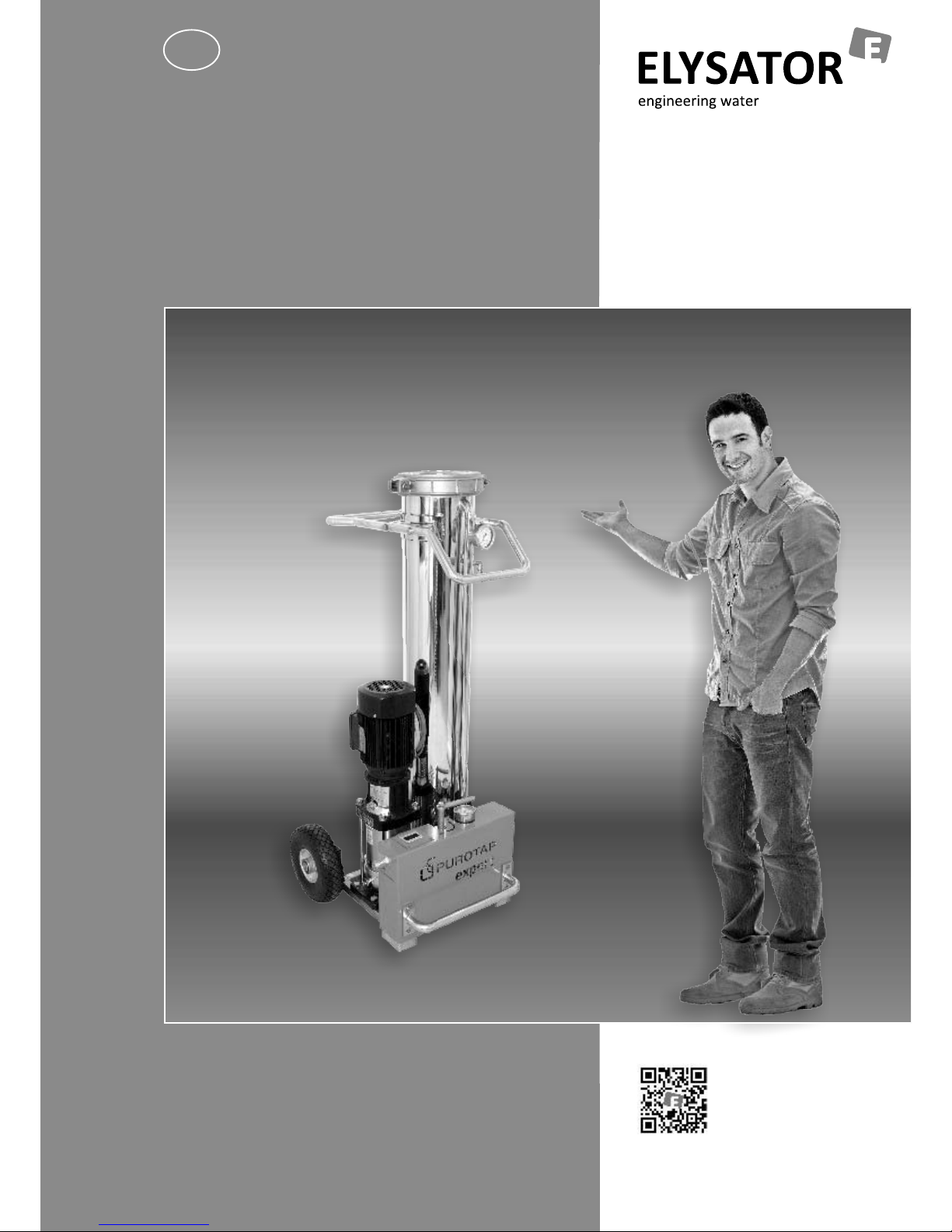
PUROTAP expert
EN
Installation
Function
Operation
Service
Minerals and salts in water circuits for technical purposes
cause corrosion and deposits. PUROTAP® expert filters the
aggressive substances out of the fill water, thereby enabling
trouble-free operation for the long term.
Demineralised heating water
Demineralised heating water
makes heating systems safe
in accordance with
VDI 2035 and
SWKI BT 102-01
Demineralisation
Page 2
www.elysator.com
3
3
4
4
5
6
7
8
Contents
Protection against limescale deposits
Protection against corrosion
Function
Specification
Components
Operating the combined meter
Operation and safety
Troubleshooting
Updates may be made without notice.
Web version supercedes print version.
EN 2
Page 3
0
3°
6°
11°
17°
20°
22°
25°
28°
14°
8°
100 g 200 g 300 g 400 g 500 g
5°
10°
20°
30°
35°
40°
45°
50°
25°
15°
°dH
°fH
Demineralised water water no longer contains any substances that can settle out
or be deposited in the boiler and heat exchanger.
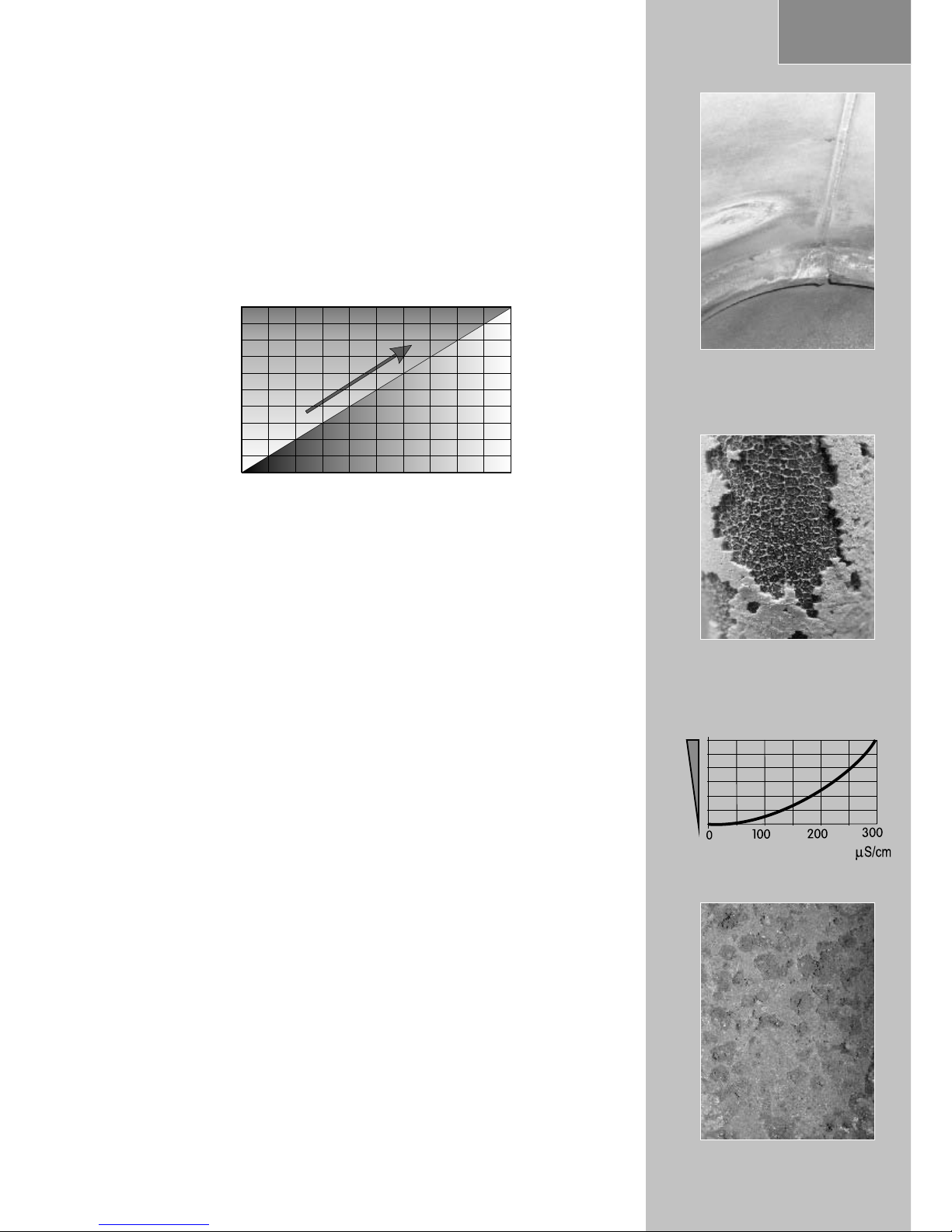
The following table shows the amount of lime accumulating in a heating system
that is filled once with untreated water.
VDI 2035, SWKI Directive BT102-01 and other European standards state that
water for filling heating systems should generally be demineralised for low salt
operation. Practical experience has shown that even at a low hardness level,
modern appliances such as wall mounted gas boilers, heat pumps and solar
thermal systems can suffer damage from limescale deposits.
Compared to water that has been softened, demineralised water no longer
contains any salts. Its electrical conductivity is extremely low, allowing it to act as a
corrosion inhibitor.
Amount of dissolved calcium carbonate (CaCO )
3
Limescale deposits in the
boiler
Overheating, stress crack
Total hardness °fH
Total hardness °dH
3
Amount of lime in 1 m of fill water
in the boiler and heat exchanger
Protection against limescale deposits
Pitting due to high salt content
Protection against corrosion
In line with applicable standards
Full desalination additionally removes all neutral salts such as chlorides,
sulphates and nitrates, which are known to cause corrosion above a certain
concentration and in certain combinations.
It has long been clear to experts in the field that fully desalinated water is ideal for
filling heating systems and that this will extend the service life of all components.
Today, this technology is so user friendly and affordable that it recommends itself
for practical application.
The process of full desalination (demineralisation) is therefore ideal for ensuring
that the water quality requirements of the following directives and standards are
met:
- VDI Guideline 2035
- SWKI BT 102-01
- ÖNORM 5195-1
- DIN 50930
Speed of corrosion
Salt content in the water
3 EN
V
corr
Page 4
EN 4
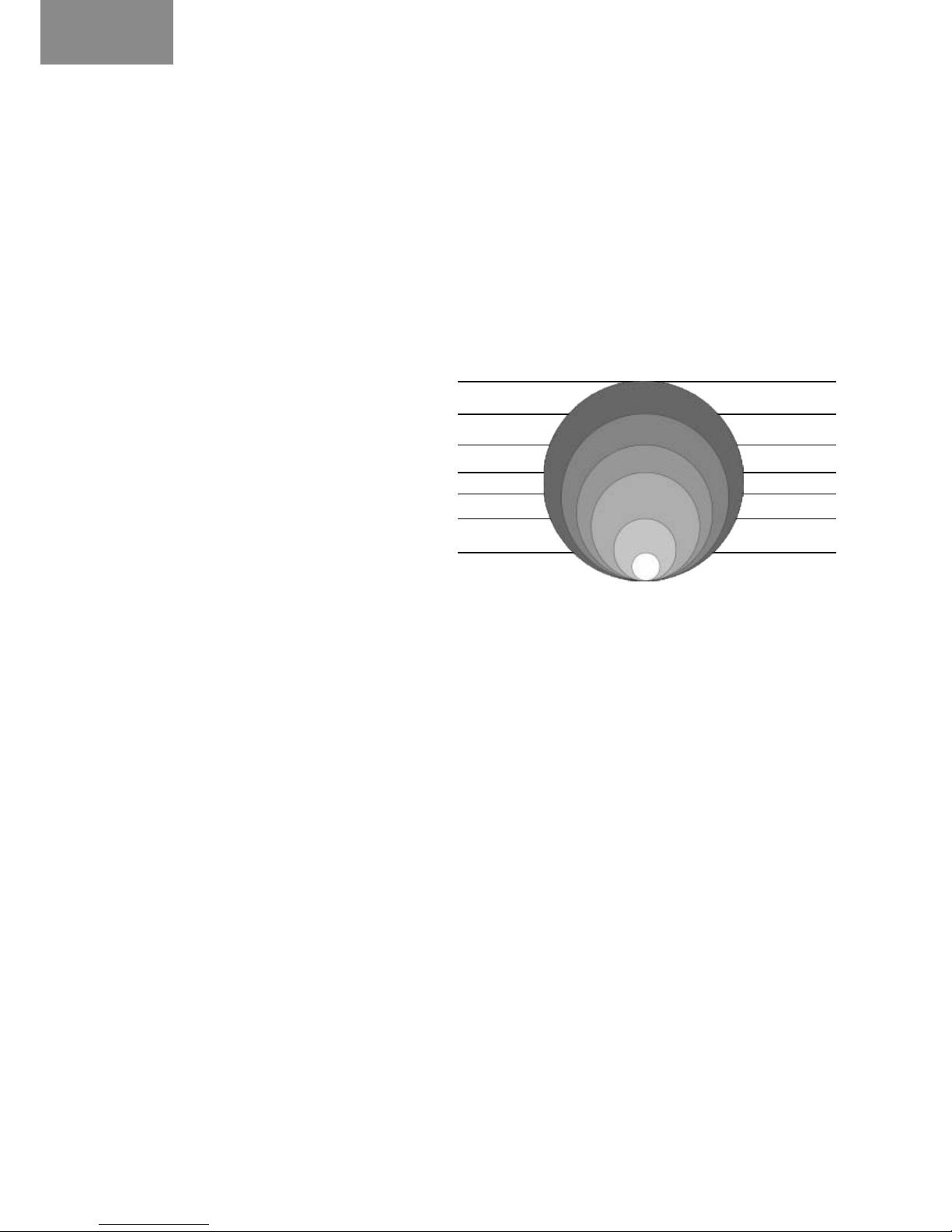
PUROTAP® expert operates with hyper filtration – a most advanced process. The flow pattern of the water inside
the intricately designed tank is controlled in a way that enables the system to achieve incomparably high
filtration velocities. The integral high pressure pump allows PUROTAP® expert to achieve a throughput of 20
l/min, or 1200 l/hr.
Raw water is pushed inside the PUROTAP® expert at pressures of up to 18 bar through a filter membrane with a
gauge width of less than one nanometre – this equates to one millionth of a millimetre. This holds back all
dissolved solids and only pure water molecules pass through the membrane.
The hyper-filtered water is particularly suitable for technical applications since dissolved minerals, heavy metals
and pesticides, as well as bacteria and organic matter, are removed from the water.
An optimised and fully automatic flushing process
keeps the filter membrane clean whilst in use. All
PUROTAP® expert components operate without
use of power. Technical design innovations mean
there is no need to use controllers and regulating
valves that are susceptible to failure.
On average, the filter diaphragm only needs to be
replaced once every 100.000 litres. Compared to
ion exchange, this keeps running costs substantially lower.
Mobile unit for fast, ecologically sound and affordable demineralisation of tap water.
Integrated metering and control devices; power supply optional.
Minimum inlet pipe flow rate: 30 l/min
Max. inlet pipe pressure 9 bar
Max. operating pressure with pump: 18 bar
Desalination capacity without pump: up to 10 l/min
Desalination capacity with pump: up to 20 l/min,
depending on hardness of raw water and pressure conditions
Max. water temperature: 60°C
Pump connection: 230V/16A
Filter Membrane service life: approx. 100.000 l
The throughput (l/min) depends on the salt content of the raw water. The higher the salt content, the lower the
throughput.
The service life of the filter cartridge depends on the contamination level of the raw water. Turbid materials, rust
particles, organic contaminants, etc. shorten the service life of the filter membrane.
Main applications:
- District heating systems
- Large plants and major heating or cooling systems with a top-up demand > 1000 l p.a.
- Water for cleaning purposes (windows, solar panels, cars, etc.)
Not suitable for desalinating any other water sources except tap water from the drinking water
supply.
Function
Specification
5
Hair
Fine filter
Coarse filter
Bacteria
Particle filter
Viruses
Micro filter
Nanofiltration
Pesticides
Ultrafiltration
Pure water
Hyperfiltration
Limescale, powdery
corrosion
Nitrate, sulphate
Page 5
5 EN
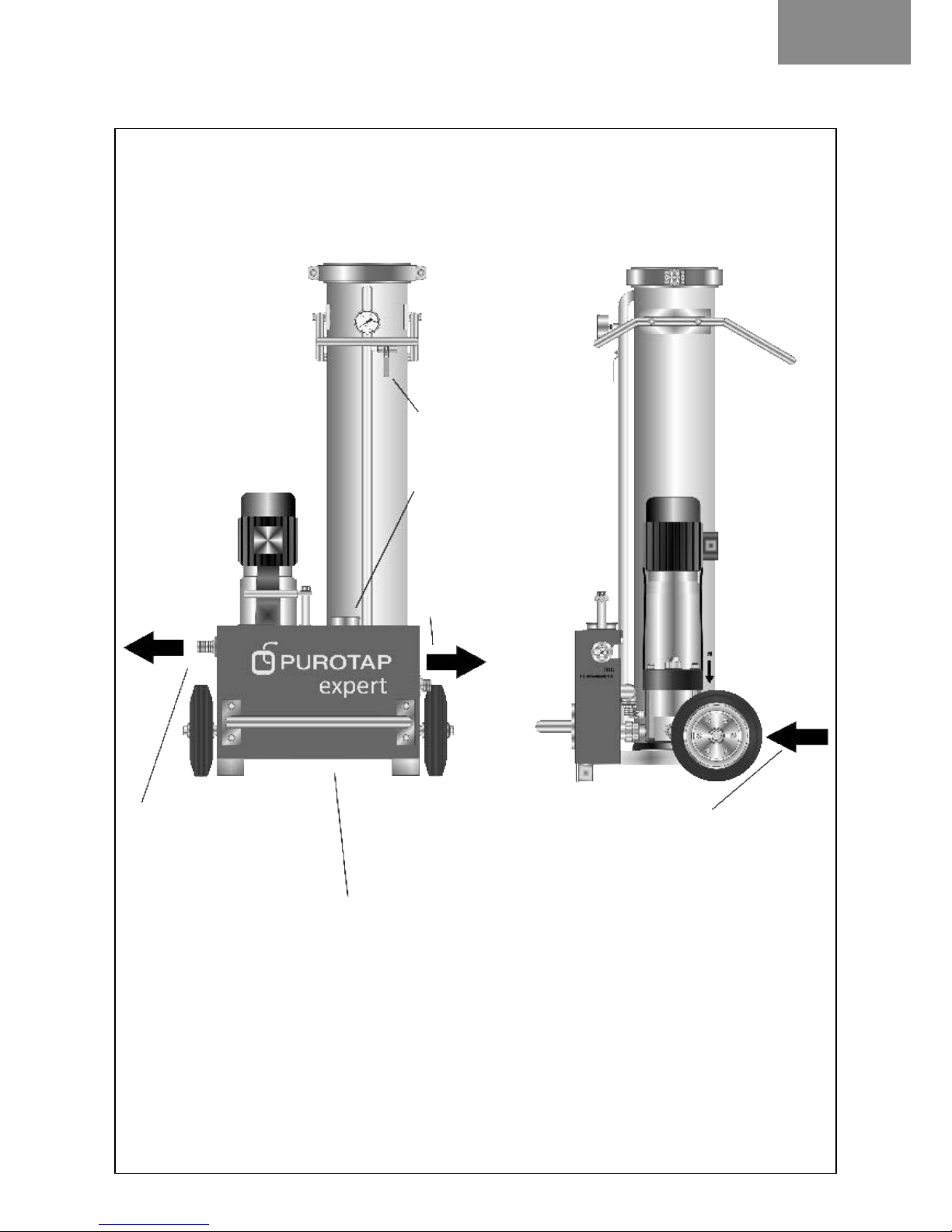
Components
Height: 133 cm
Width: 64 cm
Depth: 60 cm
Weight: 100 kg
Pressure booster pump
230 V/16 A/8 bar
Combined
meter
Tap water input,
connection 3/4" external
thread at back of pump
Waste water output,
connection 3/4" external
thread (concentrate)
Pure, fully desalinated
water output,
connection 3/4" external
thread (permeate)
Aeration tap for draining
and replacing the
membrane
Stainless steel filter
casing, maximum
operating pressure
18 bar
Filter casing cover
Handle
Handle
Mechanical single lever
fitting assembly for fully
automatic operation
Pressure gauge
dynamic pressure,
filter membrane
Manometer for pure
water output
Page 6
1
2
3
4
3 x AAA
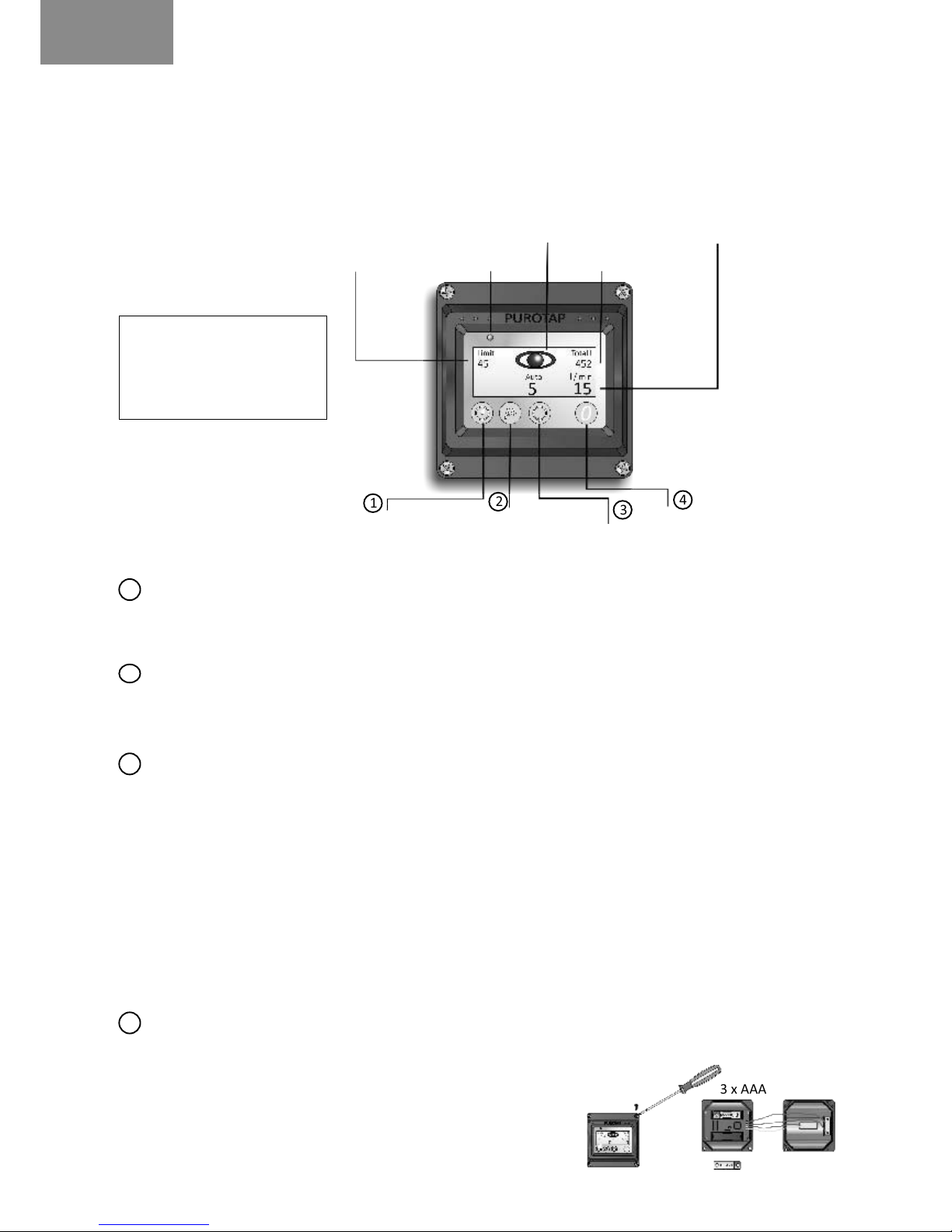
µS
Warning limit
setting
Limit
Combined
meter reset
Flow rate
ON/OFF
Total litres treated
TDS/µS toggle
Automatic quality monitor
Display:
Keys:
Limit warning signal
Operating the combined meter
The combined meter is battery-operated. It measures the flow rate in l/min, the total volume in litres and
the concentration of dissolved minerals (electrical conductivity), either in microsiemens or TDS. In addition,
a limit can be set for the maximum concentration of minerals tolerated in the demineralised water (expert
outlet). The limit and flow rate total can both be reset.
Every time this key is pressed, the limit is increased by 6/7 TDS or 10 µS/cm. Pressing the key for 3
seconds resets the limit to zero. Programming the limit ensures that a warning is issued when the ion
exchange resin is spent.
When the combined meter displays the
symbol indicating a battery change is
due: Carefully unscrew the front and
replace the batteries. 3 x AAA.
This key can be pressed at any time to switch between TDS (total dissolved solids) and electrical conductivity. Both are units of measurement for minerals dissolved in water. Most European component
manufacturers use the unit of measurement µS/cm (microsiemens).
1
2
If the ON key is pressed once, the water quality is measured for 10 seconds and compared to the set
limit. The measured value is shown. If it is above the limit, the LED glows red; if it is below, the LED
glows green while the measurement is being taken. If required, the measurement can be repeated
manually.
Auto mode: If the ON key is pressed for a second time, the combined meter begins automatic
monitoring. The eye symbol appears to indicate that monitoring has been enabled. In auto mode, the
meter only takes measurements when water is actually passing over it. If the water draw-off is
interrupted, the meter continues to show the last captured value. While water is being drawn off, the
combined meter measures the water quality every 40 litres. If the limit is exceeded in two successive
measurements, the display continuously flashes red. This indicates that the ion exchange resin is
spent and needs replacing. If the ON key is pressed for a third time, the meter exits auto mode.
3
Pressing the reset key for 3 seconds resets the overall total on the combined meter. This is
recommended every time the filter membrane is replaced since it gives a reference point for the
remaining capacity of the filter .membrane
4
Recommended limit:
33 TDS/50 µS; above this
the will need membrane
to be replaced
µS
EN 6
Page 7
11
7 EN
Operation and safety
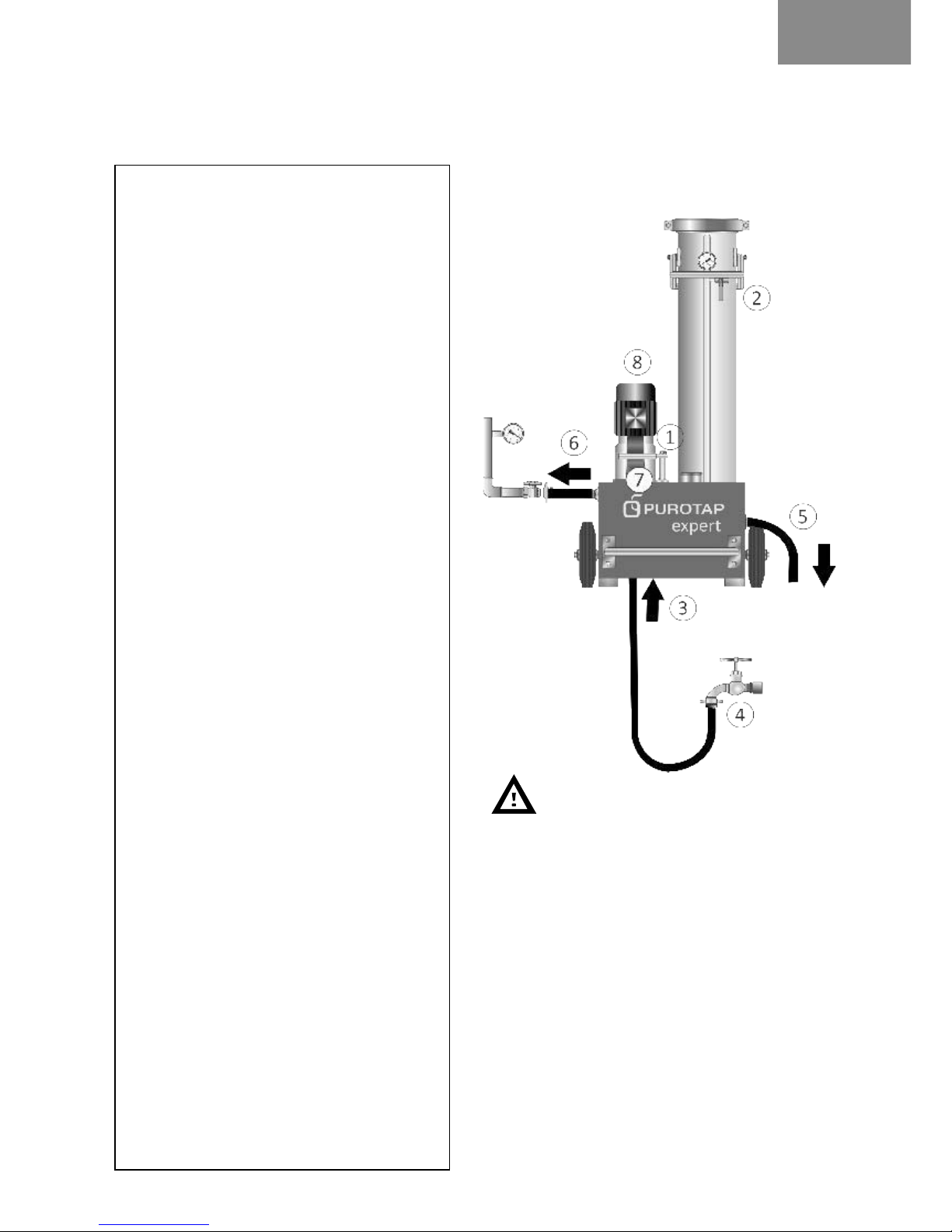
Operation
Turn the single lever fitting (1) in the
direction of flow = close; close the
aeration tap (2).
Attach the freshwater connection (3)
behind the pump, at an inflow rate of
at least 30 l/min; connection 3/4"
external thread.
Open the tap (4) to subject the inlet
hose to pressure.
Using the hose, route the concentrate
output (5) into the drain.
Open the single lever fitting (1), open
the aeration tap (2) and wait until the
casing has been ventilated. Close the
aeration valve.
Monitor the pure water output (6). If
the combined meter (7) indicates a
conductivity of below 30 µS
(microsiemens) per centimetre,
PUROTAP® expert is ready for
operation and can be connected.
If necessary, attach the plug on the
pump (8) to boost the rate.
Cable length: 2,8 m
Monitor the combined meter.
End of operation
Close single lever fitting (1),
disconnect all hoses,
open aeration tap (2) and single lever
fitting (1) and drain casing.
It is essential to use a pressure-reducing valve
when filling sealed unvented systems.
PUROTAP® expert can build up to 18 bar
pressure.
Monitor casing pressure: it should not exceed
18 bar.
Water not suitable for drinking.
Connect PUROTAP® expert to clean drinking
water supply only; contaminants in the water
destroy the filter membrane.
Only to be operated by qualified personnel and
under supervision.
Protective measures:
Page 8
EN 8
Troubleshooting
Little or no pure water
Possible causes:
- Single lever fitting not opened
- Water supply rate too low; minimum = 30 l/min
- Filter membrane spent
No/incorrect display on combined meter
Possible causes:
- Battery needs replacing
- Meter jammed
- Meter faulty
- Conductivity too high
Possible causes:
- Insufficient flushing
(can take a few minutes)
- Filter membrane faulty
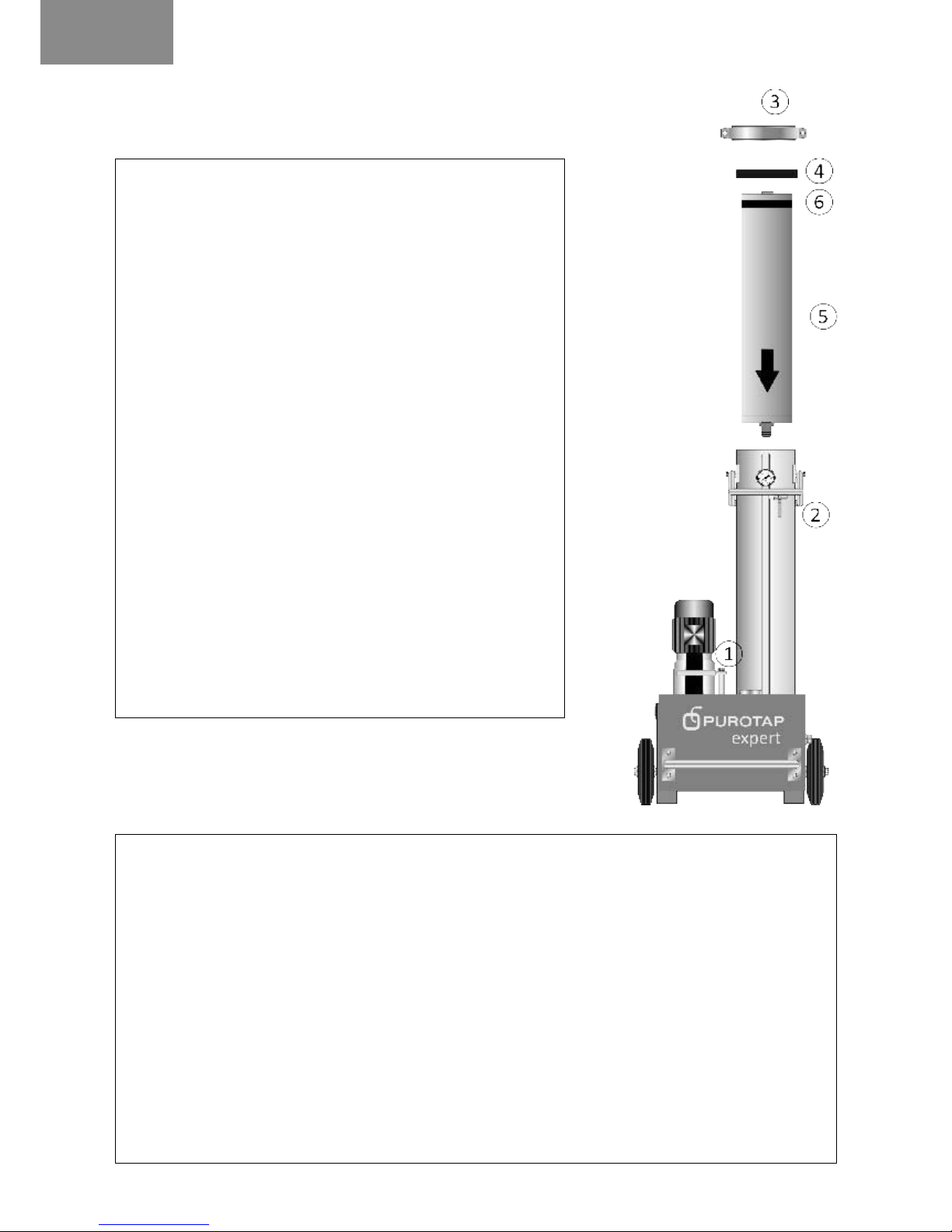
- Remove all water connections from PUROTAP® expert
- Pull out pump plug
- Open single lever fitting (1) (pointing forwards)
- Open aeration tap (2)
- Open cover (3)
- Remove fine filter (4)
- Take out filter membrane (5)
- Unpack new membrane; grease connector with silicone grease
- Insert new filter membrane with the connector pointing downwards
- Insert fine filter (4)
- Close cover
- Test run
- Lubricate the O-ring on the membrane with the silicone grease supplied (6)
Replacing the filter membrane
 Loading...