

Page 1
www.elysator.com
Installation
Function
Operation
Service
Minerals and salts in technical water circulations lead to
corrosion and mineral deposits.
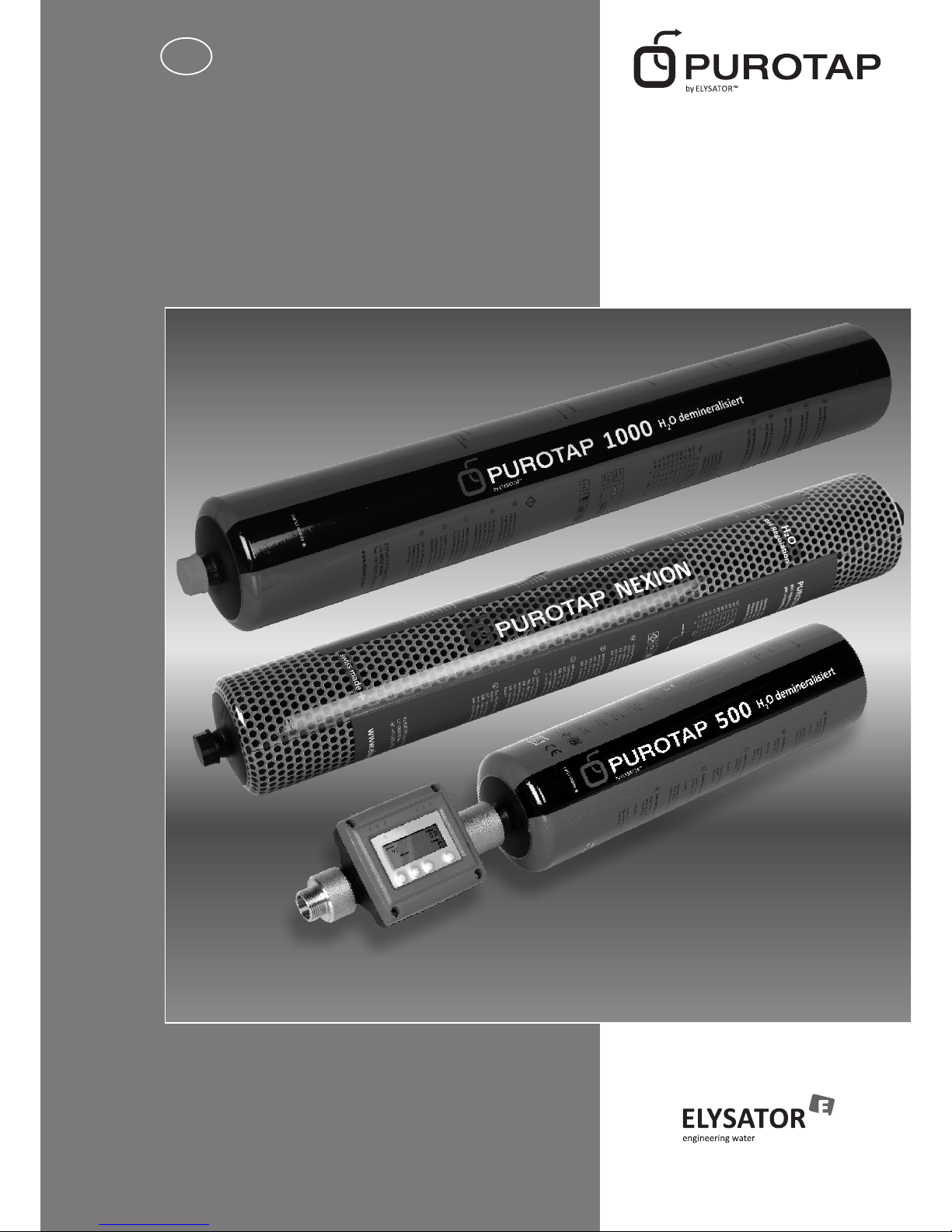
PUROTAP filters aggressive materials out of the water and
enables trouble-free operation.
Demineralised heating water
is perfect for every system
PUROTAP disposable cartridge
EN
NEW: now also
available in
premium quality
NEXION with pH
control
Page 2
6 bar
max
60 °C
max
0
200 l 400 l 600 l 800 l 1’000 l
5°
10°
20°
30°
35°
40°
45°
50°
25°
15°
3°
6°
11°
17°
20°
22°
25°
28°
14°
8°
4 bar
max
60 °C
max
PUROTAP 500
PUROTAP 1000
PUROTAP nexion
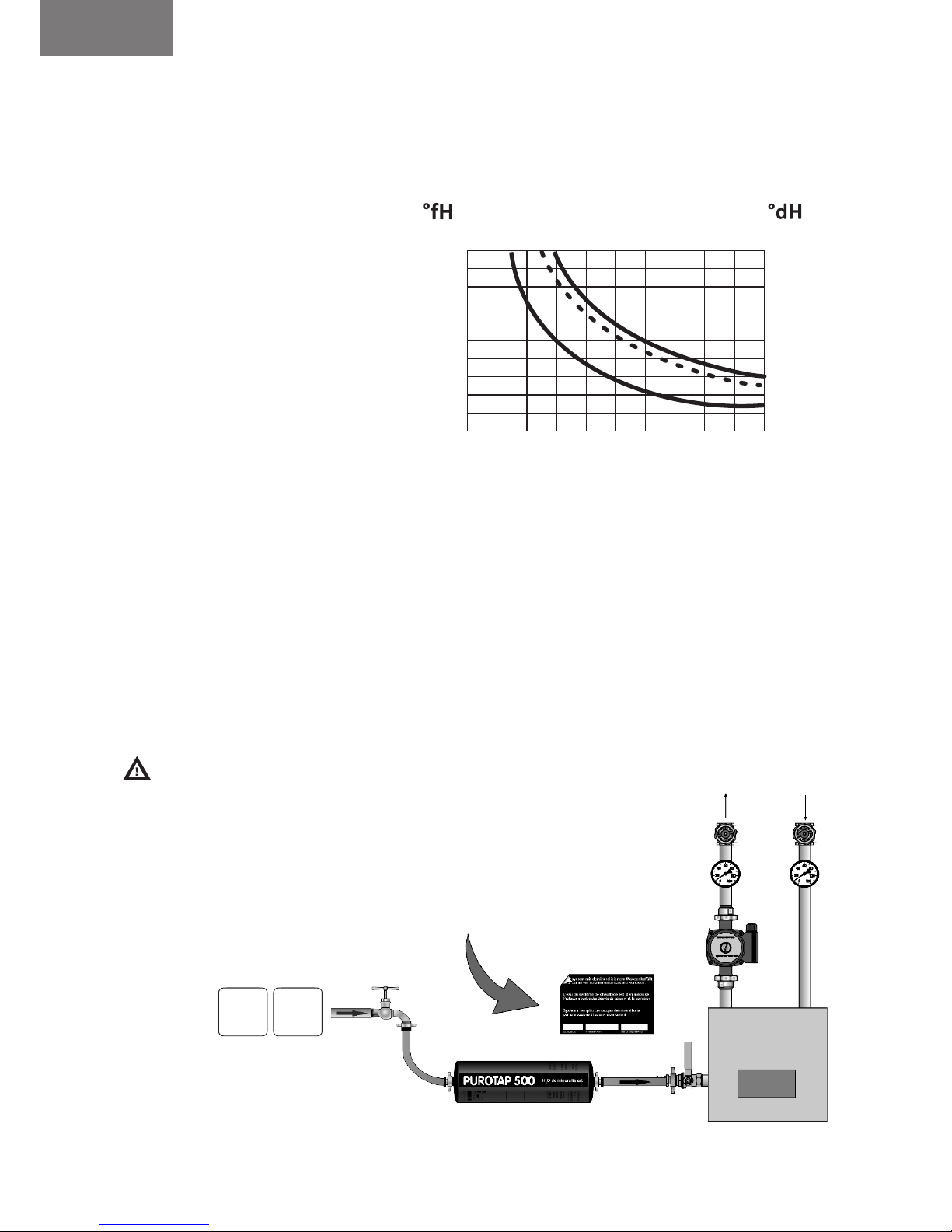
The PUROTAP cartridge filters lime and aggressive dissolved substances such as sulfate, nitrate and chloride
out of the fill-up water. The device operates on the basis of a mixed bed ion exchanger and provides
demineralised water that has been completely desalinated. This method does not release any chemical
additives into the water. The device operates without an external power supply.
The function
Capacity: Litres completely desalinated water
The accompanying table shows the
capacity of a full desalination cartridge as
a function of the total hardness of the fill
water. For example, at a hardness of 20
®
°fH/11 °dH, PUROTAP 500 delivers
approximately 375 litres of fully
®
desalinated water, while PUROTAP 1000
®
delivers 750 litres. PUROTAP NEXION is
suitable for systems with low operating
temperatures and large water capacity.
Removes carbon dioxide during
demineralisation and thus increases the
pH value without the use of additives.
In the pressure area between 3 - 4 bar, the volume flow through the cartridge is approx. 10 l/min. This results in
a maximum cartridge running time. If the cartridge is used without the use of measuring devices (water meter,
conductivity measuring device), then the specified running times should not be exceeded. In order to monitor
the effective performance more closely, use of a meter is optional.
Simple system filling, without measuring
This connection variant is not suitable for surface heating systems that can only be de-aerated through
purging. The delivery rate of the ion exchanger is insufficient for purging air from a horizontal line. In these
cases, we recommend filling with untreated water and subsequently demineralising using a cleaning
system (see following page).
If the fill-up is not measured for water
quality, only use the cartridge once. After
use, dispose of in household waste.
In the DIN EN 1717 (Germany) field of application, a pipe disconnector
must be installed for fill-up.
The cartridge does not contain mechanisms for automatic stop. The work
with the cartridge may only take place under constant monitoring. The
cartridge may only be under pressure during the duration of the fill-up.
Temp. max. 60 °C, pressure max. 4 bar.
The adhesive label stick visibly on the boiler.
Affix the correct fill-up.
Flow line
Return line
Boiler
Drain and
feed cock
EN 2
Page 3
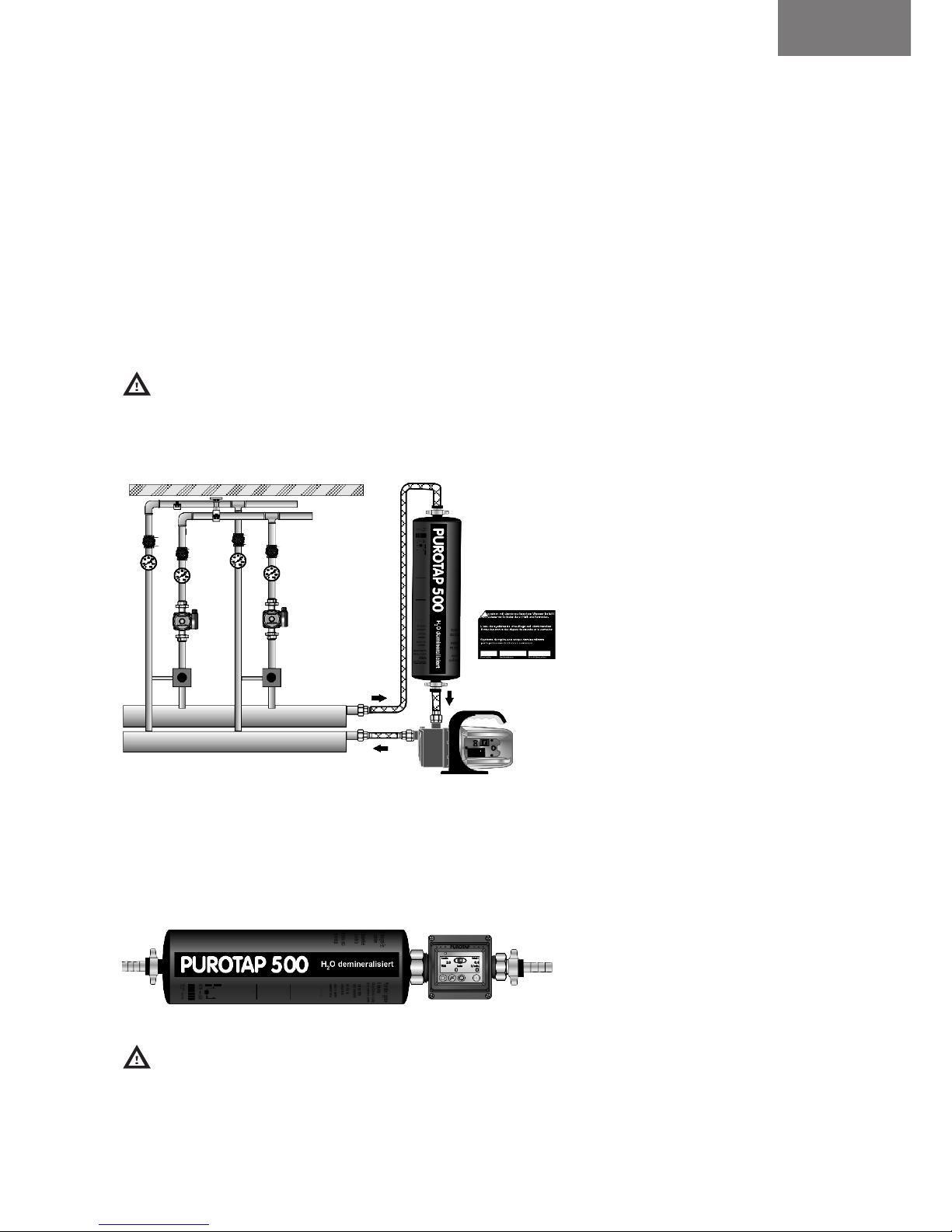
Cleaning system with auxiliary pump
Use of the LF-M Meter
Directly filling via the ion exchanger is not suitable for surface heating systems that can only be de-aerated
through purging. The delivery rate is insufficient enough for purging air from a horizontal line. In these
cases, we recommend filling up with untreated water and subsequently demineralising using a cleaning
system.
This procedure is also suitable for subsequently demineralising systems with too much salt content according to the boiler manufacturer's specifications or guidelines.
In doing so, the ion exchanger is integrated into the heating system circulation with the help of a separate
pump (e.g. jet pump, impeller pump, centrifugal pump) and two reinforced hoses. The type of adapter
used here is of less importance; instead, it is more important that the circulation pumps are operating and
all valves are open enabling the system water to be mixed thoroughly.
The temperature of the cartridge may be a maximum of 60 °C for a short period. It must be connected to a return line with the lowest possible temperature. Only hoses that are sufficiently pressure
and temperature resistant should be used (reinforced hoses). The work may only take place with
monitoring.
The pump must be connected behind the cartridge, no pump pressure on the cartridge!
General safety instructions
The resin from the cartridge must not enter the heating system. Before each use, the retention sieves
on both sides of the cartridge must be checked. The work with the cartridge may only take place with
monitoring.
It is recommended to do a test run of the system and purge the oxygen and carbon dioxide gases that
are normally present in tap water.
Run the cartridge until it is exhausted.
Determine the number or size of the
required cartridges based on the system content and the capacity diagram
on page 2.
The adhesive label stick visibly to the
boiler.
Affix the correct fill-up.
The use of measuring devices makes
reliable system cleaning easier.
The LF-M meter enables flow rate and
water quality monitoring. The cartridge can be completely used up and
then replaced at the appropriate
time.
The cartridge can easily be used several times with the LF-M meter for
smaller amounts of water until it is
exhausted.
Auxiliary pump
M a i n d is tr ib ut io n
3 EN
LF-M Meter
Page 4
www.elysator.com
°fH
5°
10°
20°
30°
35°
40°
45°
50°
25°
15°
3°
6°
11°
17°
20°
22°
25°
28°
14°
8°
°dH
0
100 g 200 g 300 g 400 g 500 g
E0518
Completely desalinated water no longer contains any substances that can
damage or settle in boilers and heat exchangers.
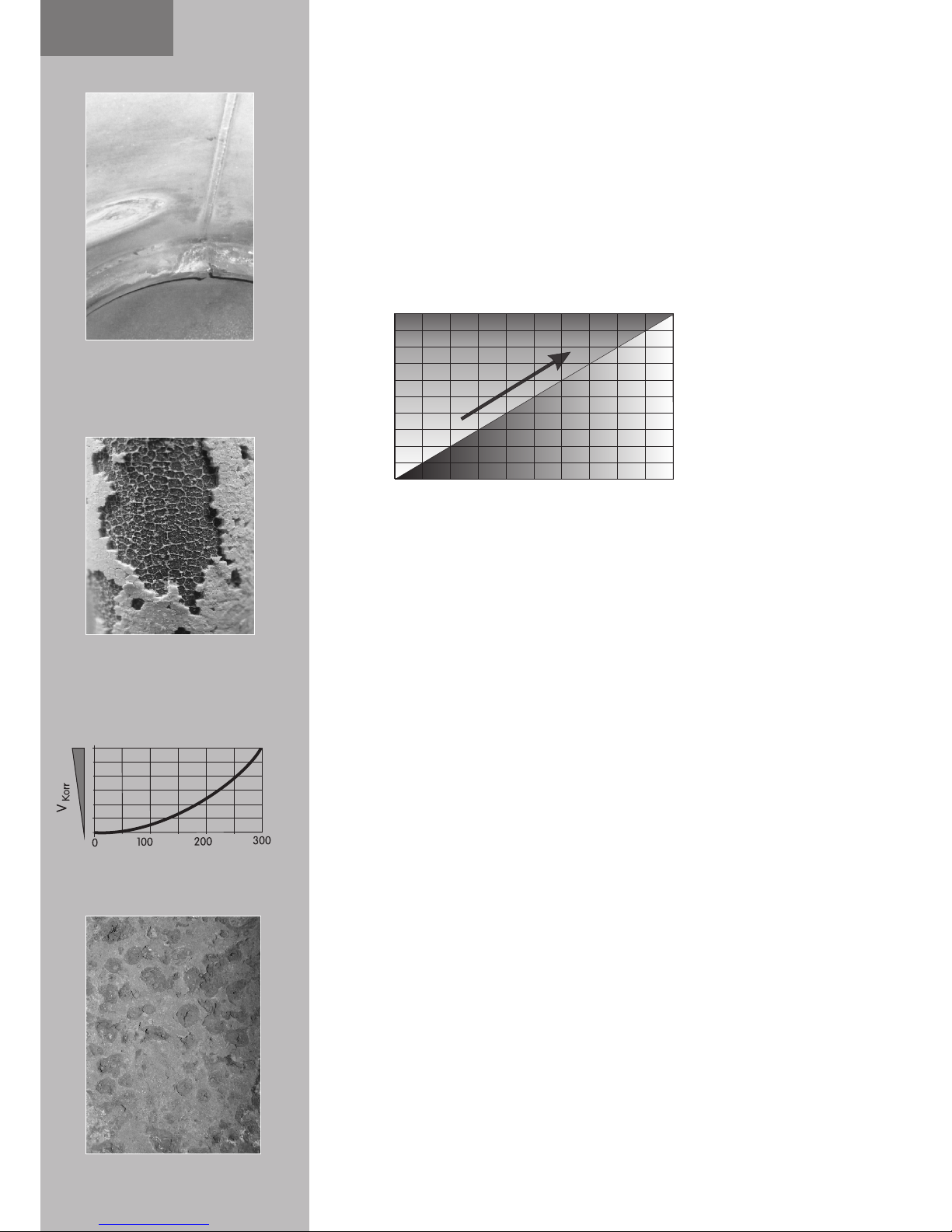
The following table shows the amount of lime that accumulates as a result of
filling the heating system once with untreated water.
According to many manufacturer specifications and technical guidelines, fill-up
water must normally be demineralised (completely desalinated) for heating systems.
Practice has shown that modern devices such as wall-mounted gas boilers, heat
pumps and solar systems are damaged by lime precipitation even at lower water
hardness levels.
In contrast to softened water, demineralised water no longer contains salt. It is
almost non-conductive and is thus corrosion-resistant.
Amount of dissolved calcium carbonate (CaCO )
3
Total hardness °fH
Total hardness °dH
3
Amount of lime in 1 m of fill-up water
in the boiler and heat exchanger
Combat lime precipitation
Combat corrosion
According to current standards
Complete desalination also removes all neutral salts such as chloride, sulfate and
nitrate that are known for causing corrosion above a certain concentration and in
a specific inter-action.
It has always been clear among experts that completely desalinated water is perfectly suitable for the fill-up water in heating systems and thus, the service life of
all components is extended. Today, this technology is very user-friendly and
affordable, making it ideal for practical application.
The complete desalination (demineralisation) procedure is best suited to fulfil
the water quality requirements from the following guidelines and standards:
VDI guideline 2035
SWKI BT 102-01
ÖNORM 5195-1
DIN 50930
Lime precipitation in the boiler
Over heating, stress crack
Localised corrosion for
high levels of salt
Corrosion rate
Salt content in water µS/cm
EN 4
Updates may be made without notice.
Web version supercedes print version.
 Loading...