

Page 1

CERAMIC / PORCELAIN
TILE SPECIFICATIONS
TILE is a ceramic surfacing unit, usually relatively thin in relation to facial area, having either a glazed or unglazed
face and fired above red heat in the course of manufacture to a temperature sufficiently high to produce specific
physical properties and characteristics.
There are three types of ceramic tiles: floor, wall and porcelain tiles. What differentiate them is the technology used
in the production process, which directly results in the characteristics that must be considered at the time of
choosing the best option to your project.
WATER ABSORPTION AND INDOOR/OUTDOOR USE – ASTM C373
- Non-Vitreous tile has water absorption of more than 7%. Indoor use.
- Semi-Vitreous tile has water absorption of more than 3% but less than 7%. Indoor use.
- Vitreous tile has water absorption of more than 0.5% but less than 3%. Indoor use.
- Impervious tile has water absorption of less than 0.5%. Indoor or outdoor use.
COEFFICIENT OF FRICTION
Coefficient of friction (COF) is the measurement of a tile’s frictional resistance, closely related to traction and
slipperiness. Both static and dynamic measurements can be taken. Static coefficient of friction (SCOF) is the
frictional resistance one pushes against when starting in motion. Dynamic coefficient of friction (DCOF) is the
frictional resistance one pushes against when already in motion. For SCOF and DCOF, a slip occurs when pushing
off with more force than the surface can resist. That can happen when the angle of the force changes (e.g., pushing
off harder while pressing down less) or when the floor surface becomes more slippery than anticipated.
SCOF – ASTM C1028
- C.O.F. greater than .50 is recommended for standard residential applications and is marginally skid resistant.
Indoor use.
- C.O.F. greater than .60 to .79 is required for commercial applications to meet or exceed ADA (Americans with
Disabilities Act) Guidelines. Skid Resistant. Indoor and outdoor use.
- C.O.F. .80 and above is recommended for commercial applications to meet or exceed ADA (Americans with
Disabilities Act) Guidelines. Highly Skid Resistant. Indoor and outdoor use
DCOF – AcutTest ASTM section 9.6
Unless otherwise specified, tiles suitable for level 1 interior spaces expected to be walked upon when wet shall
have a wet DCOF of 0.42 or greater. However, tiles with a DCOF of 0.42 or greater are not necessarily suitable for
all projects. The specifier shall determine tiles appropriate for specific project conditions, considering by way of
example, but not in limitation, type of use, traffic, expected contaminants, expected maintenance, expected wear,
and manufacturers’ guidelines and recommendations.
There are many factors that affect the possibility of a slip occurring on a tile surface including by way of example,
but not in limitation, the following: the material of the shoe sole and the degree of its wear; the presence and nature
of surface contaminants; the speed and length of stride at the time of a slip; the physical and mental condition of
the individual at the time of a slip; whether the floor is flat or inclined, and how the tile surface is used and
maintained; and the COF of the tile, how the tile is structured, and how drainage takes place if liquids are involved.
Because many variables affect the risk of a slip occurring, the COF shall not be the only factor in determining the
appropriateness of a tile for a particular application.
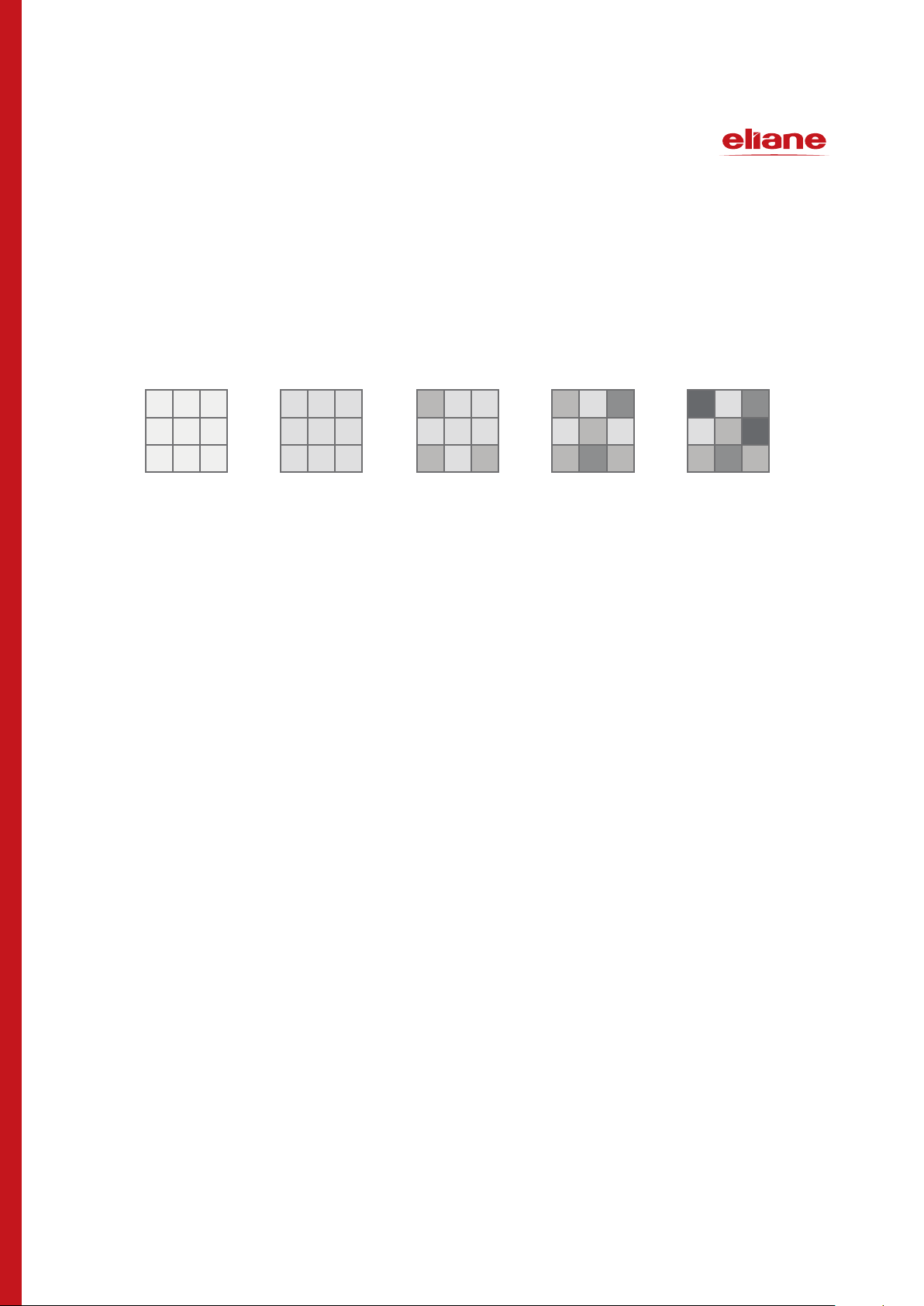
SHADE VARIATION
Tiles may vary in color, texture, or appearance according to the manufacturer’s design for that particular tile series
of product line. The following aesthetic class designations have been provided, so that the manufacturer may
communicate the aesthetic characteristics of a particular tile product.
V0 = VERY UNIFORM APPEARANCE. Pieces of the same shade value are very uniform and smooth in texture.
They can be measured for small color differences and are in compliance with the color uniformity requirements
ANSI A137.1 Tables 6-10 where a V0 shade has a 3 Judds maximum tolerance in color uniformity per ASTM
C609.
V1 = UNIFORM APPEARANCE.Differences among pieces from the same production run are minimal.
of
eliane.com
Page 2
CERAMIC / PORCELAIN TILE SPECIFICATIONS
V2 = SLIGHT VARIATION. Clearly distinguishable differences in texture and/or pattern with similar colors.
V3 = MODERATE VARIATION. While the colors and/or texture present on a single piece of tile will be indicative
of the colors and/or texture to be expected on the other tiles, the amount of colors and/or texture on each piece
may vary significantly. It is recommended that the range be viewed before selection.
V4 = SUBSTANTIAL VARIATION. Random color and/or texture differences from tile to tile, so that one tile may
have totally different color and/or texture from that on other tiles. Thus, the final installation will be unique. It is
recommended that the range be viewed before selection.
V0
For Aesthetic Classes V0, V1 and V2, there should be minimal visible box-to-box variation present between
boxes labeld with identical shade values.
Tiles with a V3 or V4 aesthetic class may exhibit box-to-box variations. However, these products should have a
continuous natural blend.
ABRASION RESISTANCE – ASTM C1027
The durability of glazed tile is measured, subjectively, by observing the visible surface abrasion of the tile when
subjected to the ASTM C1027 testing procedure. Below is the classification for this test:
- Class 0: is suitable for walls and residential use only (PEI 0)
- Class I: is suitable for light-duty residential floors, bathrooms and bedrooms without direct access from
outside; no scratching dirt can be present (PEI I)
- Class II: is suitable for light-duty residential floors, most areas of the home, except kitchens and entrances,
where occasional dirt may be present (soft-sole shoes or normal footwear only) (PEI II)
- Class III is suitable for medium-duty residential floors including kitchens, halls, corridors, balconies, terraces
and areas used more often with normal footwear and small amounts of dirt (PEI III)
- Class IV has high resistance to abrasion and is suitable for heavy-duty residential and commercial floor
installations such as entrances, commercial kitchens, hotels, exhibition and sales rooms with some dirt
conditions (PEI IV)
- Class V is suitable for both residential and high-traffic commercial use including extra heavy-duty floors and
areas subject to severe pedestrian traffic over sustained periods with some dirt such as shopping centers,
airport concourses, public walkways and industrial applications (PEI V)
V1 V2 V3
V4
CHEMICAL RESISTANCE – ASTM C650
In this test method, changes due to prolonged exposure of ceramic tiles to chemicals are determined.
Chemical substances in common household cleaning products, swimming pool chemicals, as well as other
severe chemicals are used to determine resistance to damage by a chemical.
BREAKING STRENGTH - ASTM C648
Force on an unsupported portion of tile until breakage occurs, expressed in lbs. This test covers the
determination of the breaking strength of glazed ceramic wall tile, ceramic mosaic tile, quarry tile, and paver
tile. Ceramic tiles used on floors and walls must be able to withstand the expected load bearing capacity of
various installations.
INDUSTRY STANDARDS
The American Society for Testing and Materials (ASTM) and the American National Standards Institute (ANSI)
are nationally recognized organizations, which identify and develop industry test methods and technical
standards.
eliane.com
 Loading...