

Page 1
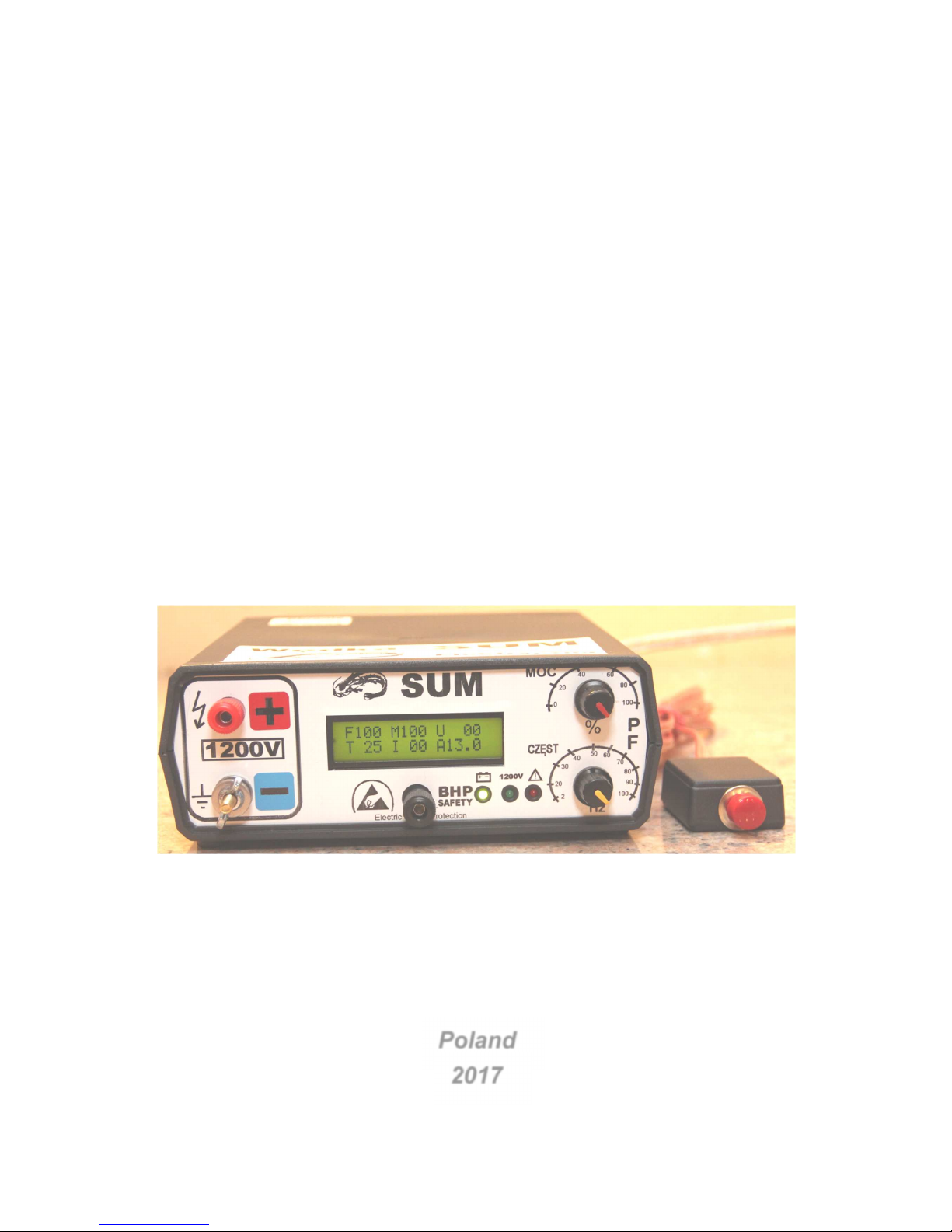
SUM
Electro-fisher
Manual
Poland
2017
Page 2

2
WHAT IS ELECTROFISHING ?
Scientists use electrofishing to survey fishes and monitor
the size of populations and determine the species in a
community. Whether using a boat or a backpack electroshocker,
the basic principle involves generating an electrical field in the
water to stun fish. When fish are stunned, they often times float
near the surface of the water and can be removed from the
electrical field.
How Do Fish Get Stunned?
When a fish swims into a weak electrical field, it may not be
affected at all. There is a threshold of electrical charge that must
be emitted into the water in order to affect the fish.
When the electrical charge in the water is sufficient to allow
transport of the charge across the nerve cells in the body, then
the fish's muscles will undergo involuntary contraction. The
contractions will lead to increased exercise of the muscle and a
build up of lactate in the blood stream. This process is very similar
to what happens to the muscles of a runner or a swimmer who
exerts a lot of exercise. The runner or swimmer may eventually
get a cramp in the muscle and cannot move it effectively. When
the fish cramps up, it floats to the surface and can be removed
from the electrical field. The process to stun a fish is usually 5 10 seconds.
Once the fish is removed from the electric field, the Tidal
Bass Survey team places the fish in a live well with good aeration.
The aeration and cool temperatures are essential in the live well
because the fish has an oxygen debt that needs to be paid. Like
a runner or swimmer, the lactate in the blood stream and
cramping must be treated with rest and good oxygen supply.
While this period of recovery may take a short time in humans,
Page 3

3
the recovery time for fish is generally a minimum of 4 hours and
can range up to 12 hours.
Are you Stunning All the Fish?
Electrofishing is a widespread tool used for surveying black
bass because black bass are generally easily stunned by the
electric field. When stunned, all black bass are removed from the
water. However, not all black bass are likely stunned by the
electrofish boat. The electric field quickly weakens with distance
from the boat and with depth, so many fish in the area are never
affected. Some fish that have been stunned may even build up a
tolerance for the electric field. Many species also have
evolutionary adaptations that help them avoid the boat, such as
a keen lateral sensory system and eyesight. The black bass may
be able to see the boat coming and swim out of the way of the
electrical field. Many other species of fish, such as common carp
or longnose gar, have especially thick scales that protect them
from the electrical fields. Small fish, such as many minnows and
killifishes, have such a small body area that the electrical field
doesn't affect them.
What is the Recovery Time?
Generally, fish recover almost immediately after they are
stunned by an electrofisher. They become oriented in the upright
position and begin swimming normally within 1 - 2 minutes. To
fully recover from the electrofishing, it can take 4 - 12 hours,
which depends on the amount of lactate in the blood (or the level
of stress the fish experiences) and habitat conditions. It may take
also longer for the fish to recover during late summer when
dissolved oxygen in the water is low.
Page 4
4
Connecting the electro-fisher
Sockets plus and minus (see photo) serve to install a
loading of electrofisher. The socket "+" is connected with cable
on the landing net. The socket "-" is connected with outer cable
with metal wire at the end (mass/minus) which is thrown into
water behind the boat or fisherman.
Cables of 12 Volt power supply are connected to the battery
"+" to "+" and "-". When user connects electrofisher in wrong
order - device will not work. User should correctly connect battery
to use electrofisher.
Socket "START" designed to connect a cable of steering by
the means of which the electrofisher is turned ON and OFF.
Green indicator shows the presence of high voltage on the outer
sockets of the electrofisher.
By the 2 knobs and display fisherman regulates and controls
parameters of the electrofisher.
Knob F serve to increase or decrease frequency of going out
impulses in accordance with clock direction.
Page 5

5
Knob P serve to increase or decrease output power of going out
impulses in accordance with clock direction.
The electrofishing is quite simple, however, it may seem to
be very complicated at the first sight.
The most important is to meet all cable connections and the
electrofishing device . To connect correctly device we should
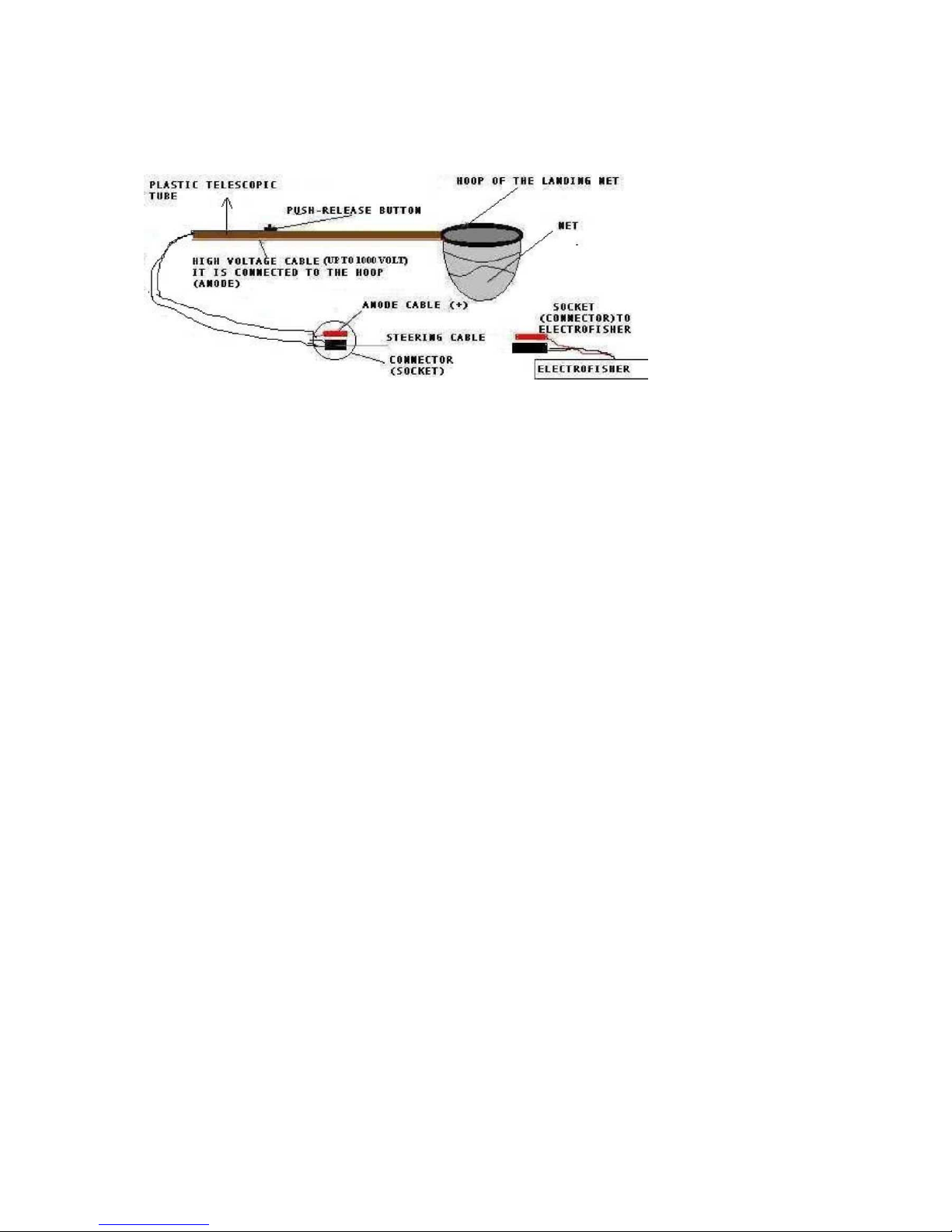
install first the button of steering on landing net and to connect
the high voltage cable into the landing net. The button is the
common PRESS-REALEASE button this means that in moment
of pressing device switches ON and makes possible fishing and
in moment of releasing the button the electrofisher switches OFF.
This button we install on landing net - we attach it with
isolation to landing net in distances 30-50 cm from end so that
we could easily operate the landing net and switch on the
electrofisher.
This button is connected with cables of steering output
power- if we press the button then the device switches ON- we
release the button then device switches OFF.
High-voltage cable - (up to 1200 Volt) we can install directly
to the hoop and to wind its rest on stick or what more comfortable
to place into the centre of plastic telescopic tube ( handle of
landing net).
To the socket OUT "+" of electrofisher we connect outer
cable which goes to the landing net. This must be installed on the
plastic landing net and the bare end of a cable must be fixed to
the metal (aluminium) ring of landing net. The other 2 cm bare
end we place in the socket OUT"+" .
To the outer socket OUT "-" we connect outer cable with
metal wire at the end ( mass/minus) and the metal copper end
Page 6

6
place into the water in the back part of the boat or we throw it
behind ourselves while electrofishing in brooks or streams. To
the socket START we insert the steering cable to the maximum
end.
When electrofisher is correctly connected we can start
fishing dipping the landing net in water and pressing pressrelease button. The (-) minus cable with metal wire at the end
must ALSO be dipped into the water. Fishing takes place by
periodic/short pressing the button START on landing net while it
is under water surface. The (-) minus cable with metal wire at the
end and the cable (+) plus must be in the distance of 3 meters
and in case of catfishing it can be greater even 20 meters. In this
moment flow of electric current follows between electrodes and
executes the fishing. You should hear silent noise and blinking
green lamp on the device as well as display showing operating
parameters.
In the course of electrofishing negative (-) electrode is
placed in water "freely" and positive electrode (anode)(+) serves
to active fishing. Intensity of current field is the greatest at
positive electrode and ąuickly diminishes with the distance from
it. In regard with this fishes become paralysed in the radius not
greater than 2-5 metres from anode. Inertly flowing fishes we
should pick up ąuickly because in the course of several seconds
they recover equilibrium and escape at random.
When we catch wading in a river cathode cable we pull near
behind so that space out between electrodes must be not greater
than 2-3 metres.
Switching the device by pressing START should be no
longer than for 10 seconds. If the consumed current is lower than
10 A you can hold on the START button longer and in case of 5
A you can keep it very long.
Page 7

7
It is not advised to turn the electrofisher very often as fishes
are shy, especially large, and will escape from big distance if they
are outside of the catching zone. You should turn the device
every 5-10 meters from last fishing place. Boating should be
silent and careful in order not to frighten fish.
In the previous paragraph you set the optimum parameters,
however, in most cases depending on special water conditions,
weather, season of the year, conductivity of water it is necessary
to correct these parameters to obtain higher efficiency and better
effects. Each species of fish has its own properties and each
species differently behave in the electric field.
Basic parameter which influences on smooth exit of fish
from water is F- frequency. Low frequency ( 45-50 Hz) makes
fish exit to the surface quick and from greater distance. . On the
contrary, higher frequency causes smoother exit of fish on the
surface. Taking into consideration this you should remember :
increasing of frequency -slows down move of the fish, while
decreasing of frequency speeds up. In the summer fish is very
quick and frequency should be increased. In cool seasons fish is
more lazy and frequency should be decreased. In the course of
electrofishing in thick water flora it is advised to lower the
frequency in order to enable the fish to overcome all barriers on
its way towards the landing net.
Usually, frequency is set once and in the course of gaining
experience and tries fisherman can adjust this value in desired
direction. Then parameters will be corrected according to
changes of water properties and other factors which influence
electrofishing.
You should also know a fact that changes in frequency
make change in level of output power of electrofisher. Therefore,
if you want keep the previous power level you should
Page 8

8
appropriately correct the duration of impulses increasing their
length. This is done by the Power knob.
Power of output impulses influences exit of fish in lesser
level than frequency. If the power is high the fish will start flowing
up from deeper water and sinking afterwards. Too little power
level will cause that fish will escape immediately if the electric
field is not enough to shock them and if you press the button
START for too short time. Between maximum and minimum there
is an optimum level of power which allows, from the point of view
of smooth exit of fish, to catch them as effectively as possible.
However, this level should be closer to minimum than maximum
to keep the battery work longer and cause less stress to fish.
During electrofishing it is possible to take two ways of fixing
output power: medium power level and periodic pressing the
button START ( no longer than 10 seconds); low power level and
longer pressing the button START. In the shallow waters the
power can easily be reduced to as low as 50.
Page 9

9
CATFISHING
The given model of electrofisher has an option for catching
catfish especially designed for that species. This makes
electrofishing catfish from large distance ( up to 30 meters) and
deep water - more than 10 meters. Catfish electrofishing is being
effected on very low frequency (F<20). The electrofisher
automatically goes in the state of catfish option if the frequency
is lower than 20 Hz. Due to that fact steering of electrofisher
changes and optimum frequency sets between 10 and 15 Hz.
Catfishing by the means may take place in large aquatic
environments and enables skillful fisherman to catch large
quantities of catfish for commercial aims. It is advised to boat in
the water where the big water holes are present and switching
electrofisher for up to 10 minutes observing flowing up catfish in
the distance of 15-20 meters.
After 3-4 fishing you will become experienced operators of
that device. Try to find the best parameters for your waters as
water properties differ in various regions.
High power level may only cause quick unloading even the
high capacity battery. In electrofisher high power is required for
ensuring high reliability only, in order to have greater reserve.
Great role in electrofishing plays knowledge of a given water
area, places of fish stocking and fish customs.
SAFETY ISSUES
SUM electrofisher is an absolutely safe and reliable
electrofishing device if appropriate electric safety issues are
known for a user. It is forbidden to switch the device and
Page 10

10
electrofish in the close exposure to bathing people or drinking
farm animals.
Watch integrity of isolation of wires of loading and a power
supply. In case of infringement of a wire it is necessary to replace
on similar on section with that that were complete with the device.
Periodically check reliability of contact of cable with anode (
landing net) as well as power supply cables with battery bolts.
Watch integrity of rubber band on micro-switcher of the
steering cable and in case of damage change by the home
means such as : finger of rubber glove or in the end condom.
We guarantee free reparation or replacement of the broken
device. Our guarantee certificates are not distributed to devices
with obvious or unauthorised mechanical damages.
Page 11
11
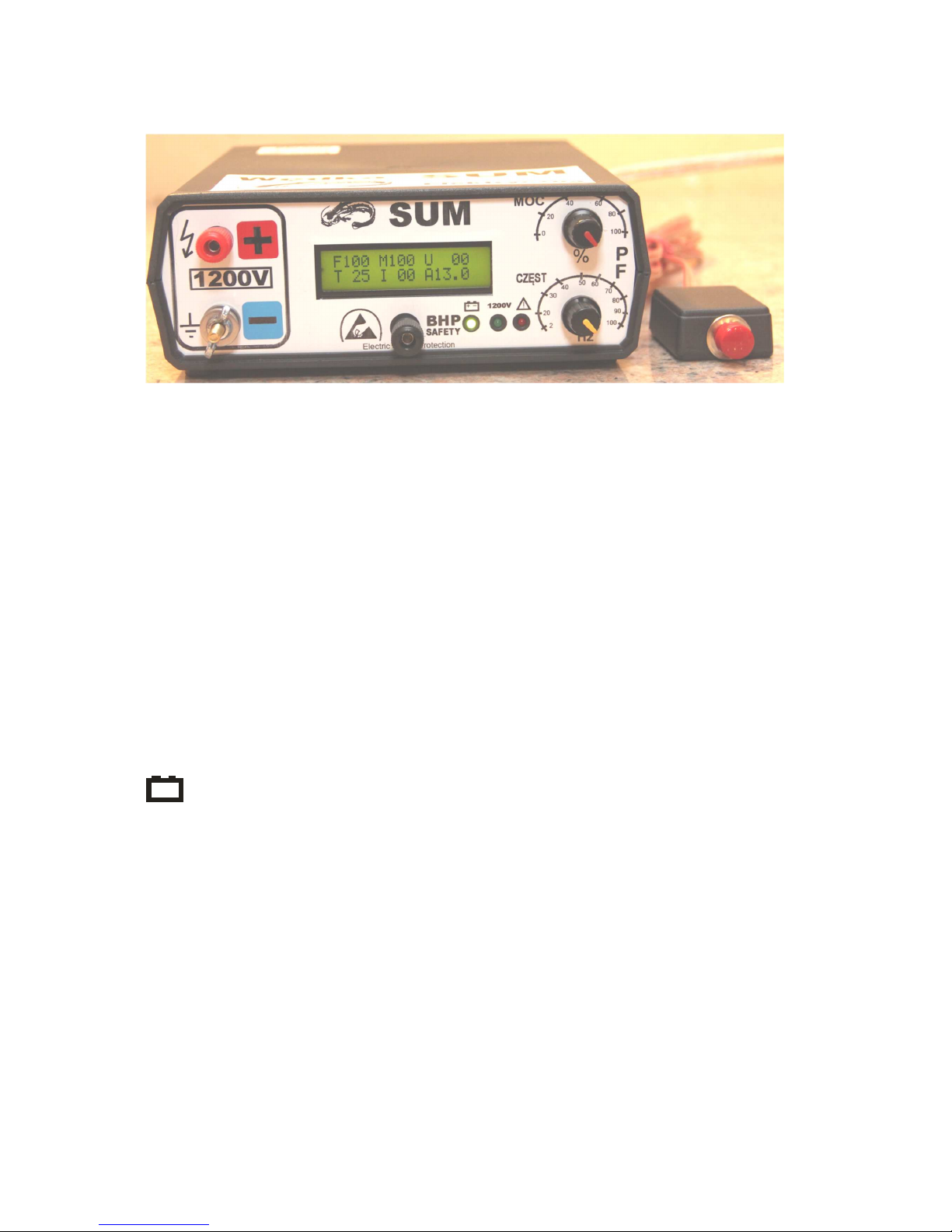
During normal work electro-fisher LCD shows
F - Frequency [Hz]
M - Output power [%]
U - Output voltage [V]
T - Temperature inside [°C]
I - Battery current [A]
A - Battery voltage [V]
Electro-fisher is equipped with three LEDs
+
-
Battery status
Green light - Connected battery is charged
Red light - Connected battery is discharged (voltage below 10,4
V)
1200V
Green LED indicates the presence of the high voltage on the
output
Page 12

12
!
Short circuit - red LED lights up when worked electro-fisher
protection. The number of flashes indicates the type of failure
(error that occurred). Detailed information about problem is
visible on LCD.
Error no. 1 Anode and cathode short circuit type 1
(metallic no. 1)
Error no. 2 Temperature inside is above 90°C
Error no. 3 Sparks appears at battery clamp
Error no. 4 No High Voltage on output (contact service)
Error no. 5 Anode and cathode short circuit type 2
(during switch on)
Error no. 6 Anode and cathode short circuit type 3
(anode and cathode too close)
Error no. 7 Anode and cathode short circuit type 4
(metallic no. 2)
Error no. 8 Safety problem (High Voltage present on
electro-fisher casing)
Error no. 9 Processor Hung-up
Error no. 10 Safety problem (Water inside electro-fisher)
Error no. 11 Input Voltage above 15V
Error no. 12 No impulses on MOSFET 1 (contact service)
Error no. 13 No impulses on MOSFET 2 (contact service)
Error no. 14 Weak battery or battery sulphated
Error no. 15 MOSFETs conduct (contact service)
Error no. 16 Thyristor Conduct (contact service)
Error no. 17 Comparator have got wrong voltage level
(possible water inside)
Error no. 18 MOSFET gate 1 problem (contact service)
Error no. 19 MOSFET gate 2 problem (contact service)
Page 13

13
Error no. 20 MOSFET gate 1 and 2 problem (contact
service)
Error no. 21 Safety resistor corrupted
Error no. 22 Battery voltage below 9V
Error no. 23 Sparks at High Voltage output (check anode
and cathode connectors)
Error no. 24 Inside relay 12V is off
Error no. 25 Battery voltage between 5V and 6V (probably
wrong type of battery)
Error no. 26 Thyristor conduct current
Error no. 27 Non symmetrical MOSFET 1 behaviour
Error no. 28 Non symmetrical MOSFET 2 behaviour
Error no. 29 Processor supply voltage above 5V
Error no. 30 Probably battery charger is connected. It can
corrupt electrofisher.
Error no. 31 Safety resistor corrupted.
Error no. 32 Weak battery. High start current.
Error no. 33 Safety resistor have short circuit – probably
water inside electrofisher
LCD Backlight switch OFF
Display in standard is illuminated. If you want to disable the
backlight, press and hold the START button during connection of
battery. By this you can fish in total darkness. If you want to return
the display backlight disconnect the battery and reconnect it.
LANGUAGE CHANGE
Message language can be easily change.
For ENGLISH
During connecting of battery - POWER REGULATION should
be set at 0% level.
Page 14
14
For POLISH
During connecting of battery - POWER REGULATION should
be set at 100% level.
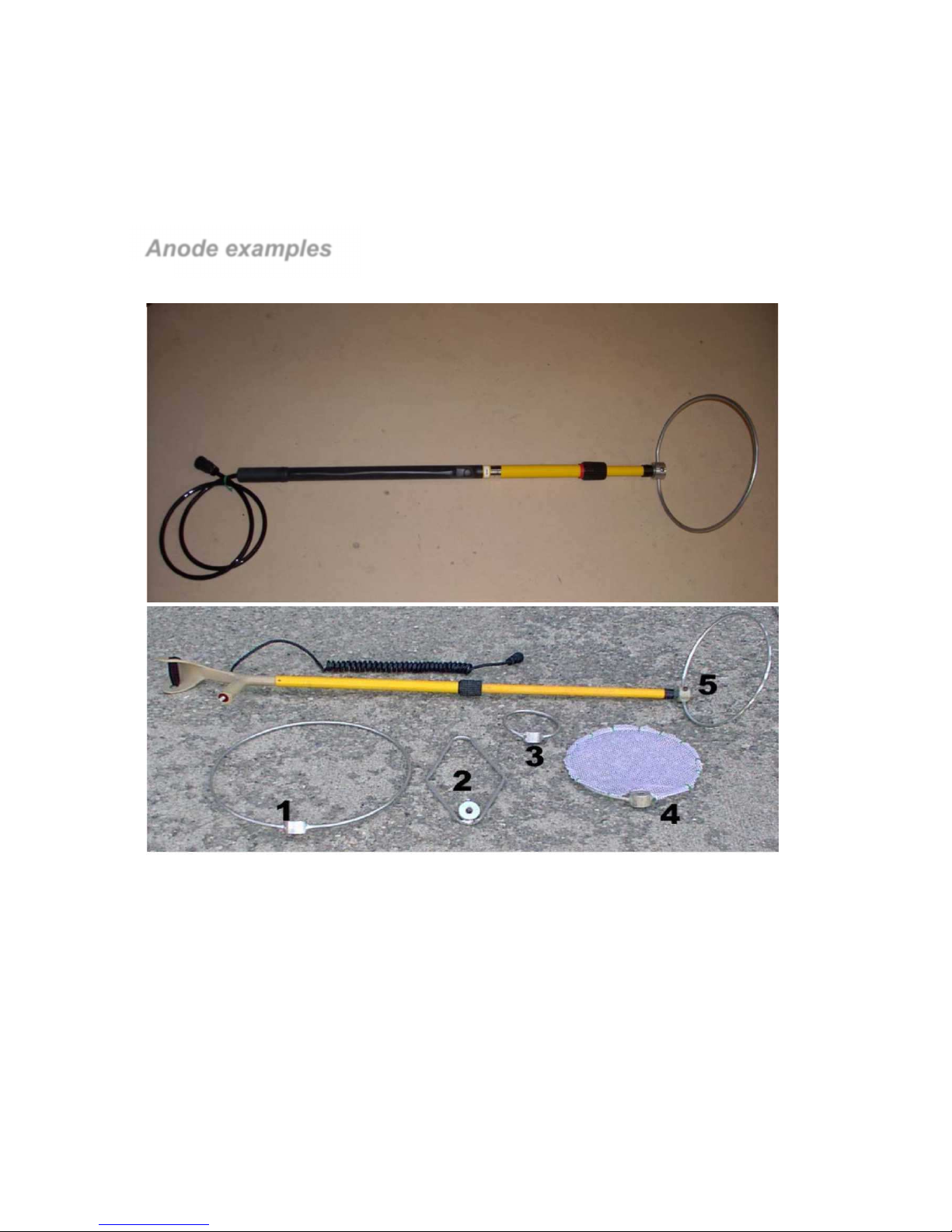
Anode examples
1 - Oversized Round Anode Ring
2 - Diamond Shaped Anode Ring
3 - Small Round Anode Ring
4 - Round Net Anode Ring
5 - Standard Round Anode Ring
Page 15

15
SUM electrofisher features
- Input voltage 12 VDC
- Output voltage 50V-1200V with stabilization
- Output power 15000W (peak)
- Output current 128 A (peak)
- Output frequency 2-100 Hz in 1 Hz step
- Overcurrent protection
- Overvoltage protection
- Electrofisher automatically is switched off when fall in to a
water
- Catfish option
- Soft start function
- No passwords
- Battery saver function
- Automatic battery tester
- Thermal protection
- Battery sulfation detector
- Spark testing protection
Page 16

16
ONE / TWO / THREE YEAR LIMITED WARRANTY
Electrofisher
Model
SUM
Name
Address
Date of Purchase
Website: www.electro-fisher.net
 Loading...