

Page 1
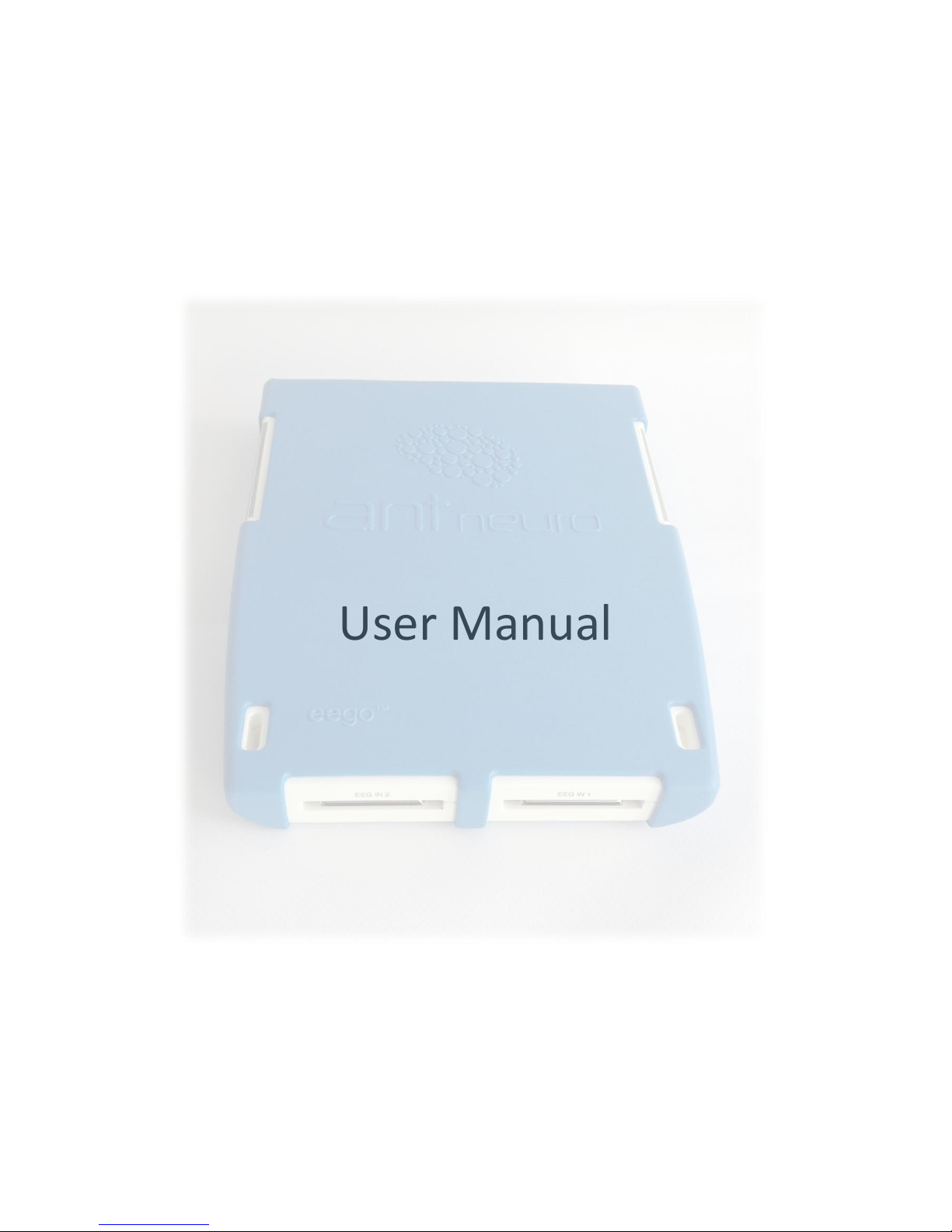
eego™ amplifier EE-21x EE-22x
User Manual
eego amplifier
EE-211, EE-212, EE-213, EE-214, EE-215 / version 1.2
EE-221, EE-222, EE-223, EE-224, EE-225 / version 1.2
User Manual Revision 5, July 2016
Copyright eemagine Medical Imaging Solutions GmbH.
All rights reserved.
Page 2

eego amplifier EE-21x EE-22x User Manual
Rev. 5, DRN-PDO-1664 2 of 26 2016-07-11
MANUFACTURER
eemagine Medical Imaging Solutions GmbH
Gubener Str. 47
D-10243 Berlin, Germany
Phone: +49 (0)30 2904 8404
E-Mail: support@eemagine.com
IMPORTANT NOTICES
Following the European Medical Device Directive 93/42/EEC Annex IX, eego amplifier is a CE class IIa
medical device.
This User Manual only covers the EE-21x and EE-22x variants of the eego amplifier. Refer to
dedicated User Manual for other variants.
For US customers only:
Rx only
Caution: Federal Law (USA) restricts this device to sale by or on the order of a physician.
DISCLAIMER
We have attempted to write this document as accurately as possible. However, mistakes are bound
to occur, and we reserve the right to make changes to the products, which may render parts of this
document invalid.
No part of this document may be copied or reproduced without the explicit permission of the
authors.
Page 3

eego amplifier EE-21x EE-22x User Manual
Rev. 5, DRN-PDO-1664 3 of 26 2016-07-11
TABLE OF CONTENTS
1 General Information ......................................................................................................................... 4
1.1 About this Document ................................................................................................................. 4
1.2 Intended Use .............................................................................................................................. 4
1.3 Technical Data and Features Overview ...................................................................................... 4
1.4 Safety Warnings ......................................................................................................................... 5
1.4.1 Important information ........................................................................................................ 5
1.4.2 Safety measures .................................................................................................................. 5
1.4.3 Precautionary measures ...................................................................................................... 6
1.4.4 Warnings .............................................................................................................................. 6
1.5 Maintenance and Cleaning ........................................................................................................ 7
1.6 Disposing of Waste Equipment .................................................................................................. 7
1.7 Product Variants ......................................................................................................................... 8
1.8 PC Requirements ........................................................................................................................ 8
1.9 Contact Information ................................................................................................................... 8
2 The eego amplifier, Hardware SETUP description ............................................................................ 9
2.1 The eego amplifier ..................................................................................................................... 9
2.2 Biosignal and Impedance Measurements ................................................................................ 13
2.3 Recording Trigger Input ............................................................................................................ 14
2.4 Mounting Options for the eego amplifier ................................................................................ 14
2.5 Battery and Charger for the eego amplifier ............................................................................. 15
2.6 LED and SOUND Status Indicators for the eego amplifier ....................................................... 16
APPENDIX A: CONNECTORS AND PINNING TABLES .............................................................................. 17
EEG Connectors (Referential) ............................................................................................................ 17
Bipolar Connector .............................................................................................................................. 18
Trigger Connector .............................................................................................................................. 19
Power and USB Connector ................................................................................................................. 20
APPENDIX B: AMPLIFIER TECHNICAL SPECIFICATIONS (EMC) ............................................................... 21
APPENDIX C: EXPLANATION OF SYMBOLS............................................................................................. 23
APPENDIX D: Datasheet......................................................................................................................... 24
Page 4

eego amplifier EE-21x EE-22x User Manual
Rev. 5, DRN-PDO-1664 4 of 26 2016-07-11
1 GENERAL INFORMATION
1.1 ABOUT THIS DOCUMENT
With this document, we provide you with all information required to set up and start working with
the eego amplifier.
If you encounter problems with the device that cannot be resolved using this document please
contact us directly via support@eemagine.com for further help (please make sure to state the
product ID and serial number of your amplifier in the Subject section of your email).
We will coordinate communication with your dealer in case you purchased the device locally.
1.2 INTENDED USE
The eego amplifier is intended to be used by or under the direction of a physician for acquisition of
EEG signals and to transmit them digitally to a computer.
The device is intended for use on humans.
The device is intended for use in a clinical environment (e.g., hospital, physician’s office, etc).
The device is not intended for use in life support systems.
1.3 TECHNICAL DATA AND FEATURES OVERVIEW
The eego amplifier has been designed as a mobile recording device for high-density EEG and other
electrophysiological signals. It provides access to recorded data over a USB connection to external
software over its signal driver interface. The eego amplifier comes with a built-in rechargeable
battery for mobile applications and recordings of several hours.
This ultimate solution for mobile EEG recording provides maximum 64 channels of referential EEG
and (optionally) synchronously recorded 24 bipolar input signals.
The eego amplifier is used in combination with the eego recording software, a 64-channel or 32-
channel EEG headcap and other optional accessories.
The eego amplifier has one 8-bit trigger input channel accessible through high-density connectors.
Impedance values can be measured for all referential electrodes as well as the reference and patient
ground electrode. An active shielding technique protects the EEG inputs from grid interference noise.
Sampling rate and gain can be set through the user interface of the control software.
Detailed technical specifications, environmental conditions, the available product variants and PC
requirements are given in the APPENDIX D: Datasheet for eego amplifier.
Page 5

eego amplifier EE-21x EE-22x User Manual
Rev. 5, DRN-PDO-1664 5 of 26 2016-07-11
1.4 SAFETY WARNINGS
The following warnings and cautions apply to the eego amplifier:
Proper use of the eego amplifier depends on careful reading of all instructions and labels that
come with or on the device inaccurate measurements may be caused by incorrect use of the
device.
Non-compliance with warnings and safety regulations may result in severe personal injury!
If you are uncertain or have any questions about operational safety or about any of the warnings and
cautions, then do not hesitate to call or email:
eemagine Medical Imaging Solutions GmbH
Gubener Str. 47
D-10243 Berlin, Germany
Phone: +49 30 29048404
E-Mail: support@eemagine.com
http://www.eemagine.com
For warnings and safety regulations concerning waveguard EEG caps, please refer to the
corresponding manual.
1.4 .1 IM P ORTANT INFORM ATION
There are no known side effects from the use of this equipment.
ONLY APPLICABLE TO THE USA: Under federal law this apparatus may only be sold by or on the
order of a physician or licensed practitioner. The apparatus may only be used under the constant
supervision of or on the instructions of a physician or other authorized medical professional.
1.4 .2 SA FETY MEAS URES
The only external power supply that may be used is the original device supplied
together with the amplifier. DO NOT replace it with anything else. If any third-party
type of power supply is used then patient safety is not guaranteed.
Make sure that the wall socket is well earthed.
Inspect the power cord on a regular basis for damages. Do not operate the device with a
damaged power cord.
The eego amplifier contains LITHIUM-ION BATTERIES. In case of damaged amplifier housing and
to the battery cells inside the housing, metallic Lithium tends to spontaneous formation of
flames when in air contact. Make sure to quarantine any amplifier with damaged battery cells
and inform eemagine support immediately.
Do not connect active sensors or electrodes to any of the inputs of the amplifier.
Do not use the device with adapters, EEG caps or other devices not explicitly listed to be
compatible with the device.
Take care when arranging sensor cables to avoid risks of entanglement or strangulation.
Page 6

eego amplifier EE-21x EE-22x User Manual
Rev. 5, DRN-PDO-1664 6 of 26 2016-07-11
Reusable electrodes present a potential risk of cross-contamination. Please refer to the
documentation that came with your electrodes for instructions on how to prevent this.
Do not connect the device to a patient undergoing MRI, electro-surgery or defibrillation.
Do not modify the equipment. Never attempt to unscrew any parts of the amplifier.
Do not attempt to open the battery compartment of the amplifier.
ELECTRICAL SHOCK HAZARD: Do not connect electrode inputs to earth ground.
Connecting an earth ground might result in electrocution.
ELECTRICAL SHOCK HAZARD: Servicing of the equipment is to be done by approved
technicians only.
1.4 .3 PRE CAUT IONA RY ME ASURES
When the amplifier is not in use, please make sure to switch it off. The device will switch of
automatically after the batteries are discharged below a given limit. With batteries completely
discharged, the device can only be switched on while the power supply is attached.
The amplifier needs special precautions regarding EMC and needs to be installed and put into
service according to the EMC information provided in APPENDIX B: AMPLIFIER TECHNICAL
SPECIFICATIONS (EMC); the use of accessories other than specified may result in increased
emissions or decreased immunity of the eego amplifier.
The eego amplifier should not be used adjacent to or stacked with other equipment; if this is still
necessary, verify normal operation in the configuration in which it will be used. Do also not stack
multiple eego amplifiers directly on top of each other. Allow for some spacing of several cm in
between.
The use of portable and mobile RF communications equipment can adversely affect the
recording; do not use an operating cellular phone within 30 cm of the amplifier, the cables and
the electrodes to avoid excessive noise on the signals. See also in APPENDIX B: AMPLIFIER
TECHNICAL SPECIFICATIONS (EMC).
Disposable electrodes which are used for electrophysiological measurements may pose a
biohazard. Handle, and when applicable, dispose of these materials in accordance with accepted
medical practice and any applicable local, state and federal laws and regulations.
1.4 .4 WARNING S
Safety and performance of the device are not guaranteed when it is used together
with accessories that were not explicitly listed as compatible.
The device is not defibrillator-proof.
The device is not suitable for use in an inflammable mixture of anesthetics and air, oxygen or
nitrous oxide.
No chemical agents are to be used with the device.
The device is not to be immersed in any liquid and should not be exposed to rain.
If any liquids or moisture penetrate the device or a part thereof, turn the device off, remove the
plug from the wall socket and have the device checked by the manufacturer.
Do not expose the device to direct sunlight, heat from a source of thermal radiation, excessive
amount of dust, moisture, vibration, or mechanical shock.
Do not wind the cables in a loop smaller than 5 cm or bend them sharply, as this may damage the
cables.
Page 7

eego amplifier EE-21x EE-22x User Manual
Rev. 5, DRN-PDO-1664 7 of 26 2016-07-11
During operation with an active connection via USB to a compatible computer, do not connect
other USB devices, and do not make changes to any connections.
If the eego amplifier is upgraded or replaced for any reason, make sure to have the control
software and interfacing computer checked for compliance by eemagine support before
continuing to work with the device. Similarly have the eego amplifier checked for compliance
when the control software or computer is upgraded or replaced.
During operation place the device in such a way that connectors and cables are easily accessible.
Do not use sharp objects such as pencil-points or pen-tips to manipulate the buttons on the
control panel, as this may cause damage.
Do not use the device whenever parts of it are damaged.
The eego amplifier’s soft-shell must be handled with care and must not be removed from the
device. It may tear otherwise.
1.5 MAINTENANCE AND CLEANING
We would like to give a few general recommendations that may help to keep your equipment in
good shape and ensure high quality of recordings.
The amplifier is mechanically robust – within limits. Try to protect the device as much as possible
from falling and heavy mechanical shocks. Please take special care that the USB cable and the
connectors on either side are not under mechanical stress. A broken USB connection may lead to
expensive and time-consuming repair of the amplifier.
The EEG head-cap and trigger connectors may be attached to the amplifier with the available screws
on the connector in case of expected movement of the patient/subject. The screws do not need to
be extremely tight but just hold the connectors in place, so please tighten the screws gently.
The expected lifetime is 5 years.
If the amplifier requires cleaning, please use a dry cloth to remove dirt (e.g. gel remainders). Do not
use alcohol or cleaning chemicals.
1.6 DISPOSING OF WASTE EQUIPMENT
Various parts of the eego amplifier device bear the symbol for special waste
disposal regulations (EU). The symbol means that the products must not be
disposed of with regular waste. Instead, it is the user’s responsibility to dispose of
waste equipment by handing it over to a designated collection point for the
recycling of waste electrical and electronic equipment. The separate collection and
recycling of your waste equipment at the time of disposal will help to conserve natural resources and
ensure that it is recycled in a manner that protects human health and the environment. For more
information about where you can drop off your waste equipment for recycling, please contact your
local city office, your household waste disposal service, or the manufacturer.
Page 8

eego amplifier EE-21x EE-22x User Manual
Rev. 5, DRN-PDO-1664 8 of 26 2016-07-11
1.7 PRODUCT VARIANTS
See the APPENDIX D: Datasheet.
1.8 PC REQUIREMENTS
See the APPENDIX D: Datasheet.
1.9 CONTACT INFORMATION
For more information and for reporting problems with eego amplifier, please contact eemagine at:
eemagine Medical Imaging Solutions GmbH
Gubener Str. 47
D-10243 Berlin, Germany
Phone: + 49 30 29048404
E-Mail: support@eemagine.com
http://www.eemagine.com/
Page 9

eego amplifier EE-21x EE-22x User Manual
Rev. 5, DRN-PDO-1664 9 of 26 2016-07-11
2 THE EEGO AMPLIFIER, HARDWARE SETUP DESCRIPTION
2.1 THE EEGO AMPLIFIER
The eego amplifier device has been designed for ultra-mobile applications of high-density EEG and
other electrophysiological signals. The compact electronic device is battery-powered and gives access
to 64 referential input channels as shown in Figure 2-1 or only 32 channels as shown in Figure 2-2.
Some variant restrict the number of channels to 16 but they still use the EEG IN 1 connector.
At the rear (Figure 2-3 and Figure 2-4) 24 additional bipolar input channels can be connected
(optional, not for all amplifier types). Further a USB connector (plug type B, straight) provides access
to data communication and hardware control.
Figure 2-1. The eego amplifier EE-211 amplifier shown from the front. The amplifier (white) is mechanically protected by
the eego amplifier soft-shell (blue). Two high density connectors (EEG IN 1 and EEG IN 2) provide access to 64 shielded
referential inputs, reference and ground. The openings allow securing the amplifier, e.g., on the table.
Figure 2-2. The eego amplifier EE-212 shown from the front. Only 32 shielded referential inputs are available.
Trigger input can be recorded from devices that deliver TTL output. The high-density connector at the
back side, next to the USB connector, provides 8 independent input lines and a ground connection.
The trigger ground and the trigger lines are electrically isolated from the other electrical parts of the
Page 10

eego amplifier EE-21x EE-22x User Manual
Rev. 5, DRN-PDO-1664 10 of 26 2016-07-11
amplifier. The trigger adapter XS-230 allows to connect eego amplifier with DSUB25 compatible
trigger sources.
Figure 2-3. The eego amplifier shown from the rear. The ON/OFF pushbutton to the left is the power button. The
TRIGGER high density connector gives access to 8 electrically decoupled TTL lines for recording of synchronized trigger
input. The USB 2.0 connector provides access to control the hardware and to stream data. The DC IN 12 V power input is
compatible with the charger delivered with the device.
Figure 2-4. The eego amplifier shown from the rear with the optional bipolar channel high density connector (24 bipolar
channels).
Page 11

eego amplifier EE-21x EE-22x User Manual
Rev. 5, DRN-PDO-1664 11 of 26 2016-07-11
Figure 2-5. Side view of the eego amplifier with soft-shell. The LED light bars at the left and right sides work
symmetrically and contain multicolor LEDs for DATA and POWER status.
eemagine Medical Imaging Solutions GmbH
Gubener Str. 47
10243 Berlin, Germany
Product Name: eego™ amplifier
Product Code: EE-211
Revision Nr: 1.2
000123 2015
Figure 2-6. The product label at the bottom of the amplifier device shows manufacturer information, product name, code
and revision, and serial number, year of production and CE marking. The symbols in the bottom row points are explained
in Appendix C. The product code as shown, EE-211, will read EE-21x and EE-22x for corresponding different amplifier
types. Amplifier revisions below 1.2 were delivered as type CF. For revision 1.2 and above type BF is the standard (man in
box symbol). Type CF is still available on request. The manufacturer label for CF amplifiers looks slightly different
(showing the hart symbol and a product code with a CF extension).
Rx only
Page 12

eego amplifier EE-21x EE-22x User Manual
Rev. 5, DRN-PDO-1664 12 of 26 2016-07-11
Figure 2-7. Compatible waveguard cap CA-200, 64 electrodes plus GND (medium size shown). The white labels on the
cable indicate product code, (and on other side of label) manufacturer information and serial number.
Page 13

eego amplifier EE-21x EE-22x User Manual
Rev. 5, DRN-PDO-1664 13 of 26 2016-07-11
2.2 BIOSIGNAL AND IMPEDANCE MEASUREMENTS
Measurements of physiological parameters such as EEG require highest quality and fidelity of the
electronic equipment and sensors used with it. The eego amplifier has been developed on the basis
of latest state of the art core electronic components (integrated circuits). The modern chip-set
allowed miniaturizing hardware without compromises in signal quality and keeping the power
consumption at a minimum. The device weighs less than 500 grams and has a small form factor, as it
should be for mobile use.
The input stage of the 64 referential input channels to the amplifier has been optimized for highdensity EEG recorded with waveguard head caps. The preamplifier component implements active
shielding, which greatly suppresses external noise effects that typically contaminate EEG signals.
Active shielding works such that the buffered input signal (no amplification of signal amplitude but
impedance transformation) is put on the coaxial shield of an electrode lead inside the waveguard
cap. This way, electrical transmission of external noise through the coaxial shield into the lead is
minimized due to the nearly perfect “shorting” (zero voltage difference) between the lead and its
shield.
The input stage of the amplifier registers incoming signals against a common dedicated passive
reference electrode. The measured voltages thus all depend upon the quality of the reference signal
and it is highly recommended to pay attention to good preparation of the reference.
In order to measure physiological signals with high sensitivity, the human body acting as a source of
voltage differences and the amplifier ground (the electrical zero-point from which the operating
range is determined) have to be connected. This can be - for convenience - an electrode lead in the
waveguard cap: the model CA-200 defines AFz to be the ground (GND) position. Nonetheless, any
other accessible body part can be used to make the GND connection – with no effect on the
measured signal amplitudes. For a good suppression of common-mode signals, it may actually be
more suitable to place the GND at some distance from the scalp electrode. The cap therefore
provides access to the GND with a microcoax socket in the cap cable near the neck (note that there is
a second socket for connection of an EOG lead). See the cap datasheet and its user guide for more
information.
The GND connection actually implements a driven ground, i.e. a small voltage of ca. 2.5 Volts relative
to the internal amplifier ground is put on the human body. Electrical currents are kept well below
limits defined for patient safety in medical devices and order of magnitude smaller than currents
flowing in impedance measurements. The driven ground allows measuring signal amplitudes of the
voltage of the driven ground without saturation effects, regardless of the polarity of the signal. The
actual signal range is determined by the amplification factor of the input stage, which is
programmable in steps.
With the eego amplifier you can record bipolar signals using a referential setup and by re-referencing
in the eego software application. Please refer to corresponding documentation for more details how
to prepare the configuration with the appropriate adapter (XS-260).
Further you can record true bipolar signals via the dedicated bipolar input ports at the rear of the
housing. Two terminals per channel are available and must be connected.
Page 14

eego amplifier EE-21x EE-22x User Manual
Rev. 5, DRN-PDO-1664 14 of 26 2016-07-11
Regardless of referential or bipolar recordings the amplified data stream of input signals is converted
from analog (continuous in amplitude and time) to digital (discrete in amplitude and time). Both
dimensions – voltage and time – are digitized in a way that the analog waveforms can be
approximated without loss of quality in further review and analysis steps. The minimum step width is
in the order of (less than) ms (milliseconds) and a few nV (nano Volts), depending on the selected
sampling rate, signal range and resolution (see eego amplifier datasheet). Each signal is treated by its
own converter, so that no multiplexing effects occur.
The digital data stream is then converted into a protocol suitable for computer communication
(USB). Communication between computer and amplifier works in two ways: control commands sent
by the application software make sure that the amplifier takes the requested actions, and the
amplifier sends EEG data, trigger and status information in the respective operation mode.
The application software sets up communication with USB 2.0 (USB 3.0 is fully compatible with USB
2.0 standard) and provides user interfaces to display and record the measurements.
2.3 RECORDING TRIGGER INPUT
In case you want to record event-related activity, we assume you have available a PC with
presentation software, which is able to deliver TTL pulses along a parallel port cable (DSUB 25 pin
connector, male) with pinning compatible with the description in Appendix A.
WARNING: Make sure that the computer generating the trigger signals is compliant with
IEC 60950.
To run an ERP experiment, please insert the trigger adapter XS-230 into the high-density trigger input
of the amplifier. The DSUB connector at the other end of the adapter is connected with a parallel
port cable that links with the DB25 port of the presentation PC (cable, presentation PC and software
not provided with the eego amplifier).
The 8-bit trigger information is encoded in a decimal trigger code (from 1 to 255) in the recording
software.
Please be aware that only rising flanks are detected as triggers and as high trigger bits! A trigger
pulse should have a length of at least 2-3 times the reciprocal of the sampling rate. In between
triggers the Low level must also be hold for 2-3 times the reciprocal of the sampling rate.
2.4 MOUNTING OPTIONS FOR THE EEGO AMPLIFIER
The eego amplifier can be used as a stationary device or as a mobile device.
When using eego amplifier as a stationary device, please make absolutely sure that the amplifier
cannot drop from the table, e.g. when the patient is connected with the cap and tries to walk away
or when the USB cable is dragged over the table sides. You can for example put a string through the
mounting holes to fixate the amplifier box.
In mobile EEG applications, we strongly recommend to mechanically protect the amplifier with the
eego amplifier soft-shell. Do not remove the soft-shell from the amplifier.
Page 15

eego amplifier EE-21x EE-22x User Manual
Rev. 5, DRN-PDO-1664 15 of 26 2016-07-11
2.5 BATTERY AND CHARGER FOR THE EEGO AMPLIFIER
The eego amplifier comes with a built-in rechargeable Li-Ion battery. The battery provides several
hours of operation time. The exact value may vary depending on the operation mode of the amplifier
(more current is drawn from the battery in impedance measurement mode), operating temperature
and aging effects of the battery similar to other battery-driven devices. The charging process takes
usually less than 2 hours to complete.
The LED light-pipes at the side edges of the eego amplifier communicate POWER and DATA status as
well as possible hardware problems. The two multi-color LED indicators at each side operate
symmetrically.
The following table gives a description of the battery status as shown with the POWER LED.
POWER
LED color*)
Battery
Status
Description
Red
Low
Battery is in the low charging state. You should stop the recording and
recharge the amplifier immediately.
Yellow
Medium
Battery is in medium state. At least 1 hour of operation time remains but
the device should be recharged now. Do not start a new recording.
Green
High
Battery charging state is high.
Table 2-1 Display of battery status as shown with the POWER LEDs.
The POWER indicator light is breathing, i.e. brightness of the LEDs is oscillating slowly, when the
battery is charged (supposing that the power supply is attached). Please remember that for best
signal quality the power supply should not be attached while recording with the amplifier.
In case you experience drastically reduced battery operation times of the amplifier, please contact
Support for options to check the device and possibly to exchange the battery.
WARNING: Do not attempt to open the amplifier or battery compartment yourself!
The battery charger for eego amplifier comes with a power cord and plug fit for a particular region. A
green LED indicator in the power supply shows whether the device is turned on.
*) The LED indicators are not active when the amplifier is turned off. Nevertheless, the device will
be charged when the power supply is connected. You can check the charging status by turning on
the device.
Page 16

eego amplifier EE-21x EE-22x User Manual
Rev. 5, DRN-PDO-1664 16 of 26 2016-07-11
2.6 LED AND SOUND STATUS INDICATORS FOR THE EEGO AMPLIFIER
The LED light-pipes at the side edges of the eego amplifier communicate POWER and DATA status as
well as possible hardware problems. The two multi-color LED indicators at each side operate
symmetrically.
The DATA LED indicator can have the following states:
DATA LED
color
Visual indication
Description
OFF - Amplifier is switched OFF
Green
Constant
Amplifier is ON, no data is acquired
Green
Breathing*
Data is acquired (streamed)
Yellow
Breathing*
Impedance data is acquired (streamed)
Red
Constant
Device error, restart device, contact support
Table 2-2 status as shown with the DATA LEDs. (* brightness of the LEDs is oscillating slowly)
A built-in beep indicates important changes of the status:
SOUND
signal
Description
2 beeps
first low, second high
Amplifier is switched ON
2 beeps
first high, second low
Amplifier is switched OFF
3 beeps
Amplifier is fully charged
Table 2-3 Sound signals as relevant for power status.
The LED and sound indicators are not active when the amplifier is turned off. Nevertheless, the
device will be charged when the power supply is connected. You can check the charging status by
turning on the device.
Page 17

eego amplifier EE-21x EE-22x User Manual
Rev. 5, DRN-PDO-1664 17 of 26 2016-07-11
APPENDIX A: CONNECTORS AND PINNING TABLES
EEG CONNECTORS (REFERENTIAL)
The eego amplifier has two EEG input connectors, EEG IN 1 and EEG IN 2. The 68-pin high-density,
high-quality connectors give access to the 64 shielded referential inputs, the reference electrode and
the patient ground, and are typically used according to the pinning tables below.
eego amplifier EEG IN 1 connector
eego amplifier EEG IN 2 connector
Channel
Number
Electrode
CA-200/201
Pin numbers, 68-pin
high-density connector
Channel
Number
Electrode
CA-200
Pin numbers, 68-pin
high-density connector
active
shield
active
shield
-
GND
34
68 -
not connected
34
68
Ref 1
Fp1
33
67
Ref 33
AF7
33
67
Ref 2
Fpz
32
66
Ref 34
AF3
32
66
Ref 3
Fp2
31
65
Ref 35
AF4
31
65
Ref 4
F7
30
64
Ref 36
AF8
30
64
Ref 5
F3
29
63
Ref 37
F5
29
63
Ref 6
Fz
28
62
Ref 38
F1
28
62
Ref 7
F4
27
61
Ref 39
F2
27
61
Ref 8
F8
26
60
Ref 40
F6
26
60
Ref 9
FC5
25
59
Ref 41
FC3
25
59
Ref 10
FC1
24
58
Ref 42
FCz
24
58
Ref 11
FC2
23
57
Ref 43
FC4
23
57
Ref 12
FC6
22
56
Ref 44
C5
22
56
Ref 13
M1
21
55
Ref 45
C1
21
55
Ref 14
T7
20
54
Ref 46
C2
20
54
Ref 15
C3
19
53
Ref 47
C6
19
53
Ref 16
Cz
18
52
Ref 48
CP3
18
52
Ref 17
C4
17
51
Ref 49
CP4
17
51
Ref 18
T8
16
50
Ref 50
P5
16
50
Ref 19
M2
15
49
Ref 51
P1
15
49
Ref 20
CP5
14
48
Ref 52
P2
14
48
Ref 21
CP1
13
47
Ref 53
P6
13
47
Ref 22
CP2
12
46
Ref 54
PO5
12
46
Ref 23
CP6
11
45
Ref 55
PO3
11
45
Ref 24
P7
10
44
Ref 56
PO4
10
44
Ref 25
P3 9 43
Ref 57
PO6 9 43
Ref 26
Pz 8 42
Ref 58
FT7 8 42
Ref 27
P4 7 41
Ref 59
FT8 7 41
Ref 28
P8 6 40
Ref 60
TP7 6 40
Ref 29
POz 5 39
Ref 61
TP8 5 39
Ref 30
O1 4 38
Ref 62
PO7 4 38
Ref 31
O2 3 37
Ref 63
PO8 3 37
Ref 32
EOG 2 36
Ref 64
Oz 2 36 - REF 1 35 -
not connected
1
35
One of the connectors can also be used with the XS-260 bipolar adapter; see its datasheet for details.
Page 18

eego amplifier EE-21x EE-22x User Manual
Rev. 5, DRN-PDO-1664 18 of 26 2016-07-11
BIPOLAR CONNECTOR
The eego amplifier has one bipolar input connectors, BIPOLAR IN. The 50-pin high-density, highquality connectors give access to the 24 bipolar inputs and the patient ground. The patient ground is
identical to the referential channel patient ground. Only one patient ground connection should be
established and used when preparing a subject. Pin 50 on the connector is unused and reserved for
internal use.
eego amplifier BIPOLAR IN connector
Channel
Number
Pin numbers, 50-pin
high-density connector
negative
positive
BIP 1 1 26 BIP 2 2 27
BIP 3 3 28 BIP 4 4 29 BIP5 5 30
BIP 6 6 31 BIP 7 7 32 BIP 8 8 33 BIP 9 9 34
BIP 10
10
35
BIP 11
11
36
BIP 12
12
37
BIP 13
13
38
BIP 14
14
39
BIP 15
15
40
BIP 16
16
41
BIP 17
17
42
BIP 18
18
43
BIP 19
19
44
BIP 20
20
45
BIP 21
21
46
BIP 22
22
47
BIP 23
23
48
BIP 24
24
49 GND
25
Page 19

eego amplifier EE-21x EE-22x User Manual
Rev. 5, DRN-PDO-1664 19 of 26 2016-07-11
TRIGGER CONNECTOR
The eego amplifier provides an 8-bit trigger input via the 36-pin high-density connector at the
amplifier backside. The trigger connector is compatible with the XS-230 trigger adapter, which should
be used whenever connecting the amplifier with a trigger source (TTL).
WARNING: The trigger source must be compliant with IEC 60950.
eego amplifier trigger connector (and pinning for XS-230)
Pin numbers, 36-pin highdensity connector
Pin numbers, 25-pin DSUB
connector (XS-230)
Description
1
-
(not connected)
2
-
(not connected)
3
-
(not connected)
4
-
(not connected)
5
-
(not connected)
6 2 TTL Bit 1
7 3 TTL Bit 2
8 4 TTL Bit 3
9 5 TTL Bit 4
10 6 TTL Bit 5
11 7 TTL Bit 6
12 8 TTL Bit 7
13 9 TTL Bit 8
14
-
(not connected)
15
-
(not connected)
16
-
(not connected)
17
-
(not connected)
18
-
(not connected)
19
-
(not connected)
20
-
(not connected)
21
-
(not connected)
22
-
(not connected)
23
-
(not connected)
24
25
Trigger Ground
25
25
Trigger Ground
26
25
Trigger Ground
27
25
Trigger Ground
28
25
Trigger Ground
29
25
Trigger Ground
30
25
Trigger Ground
31
25
Trigger Ground
32
-
(not connected)
33
-
(not connected)
34
-
(not connected)
35
-
(not connected)
36
-
(not connected)
Page 20

eego amplifier EE-21x EE-22x User Manual
Rev. 5, DRN-PDO-1664 20 of 26 2016-07-11
POWER AND USB CONNECTOR
The power connector of the eego amplifier is compatible with the DC output cable of the supplied
battery charger. Do not connect any other power source to the amplifier!
The USB connector of the eego amplifier is typically connected with the USB port of a computer (USB
plug type A). This cable is necessary for data transmission. It does not power the amplifier or battery
but supplies the electrically isolated USB communication module. Please inspect the settings for the
USB ports available at your computer, and make sure ‘power saving’ options are turned off for the
USB ports.
Figure A-0-1. The label of the compatible power supply.
Page 21

eego amplifier EE-21x EE-22x User Manual
Rev. 5, DRN-PDO-1664 21 of 26 2016-07-11
APPENDIX B: AMPLIFIER TECHNICAL SPECIFICATIONS (EMC)
The compliance in the tables below is valid for eego amplifier with following accessories:
Part
Cable length (m)
Power supply XP Power Model AFM45US12C2
1.9
USB cable
1.8
XS-230 trigger adapter DB25
0.3
CA-2xx waveguard caps (tests below performed with CA-200)
1.2
XS-260 adapter for 16 bipolar channels (connection equivalent
to a set of 32 unipolar EEG inputs)
0.8
Guidance and manufacturer’s declaration – electromagnetic emissions
The eego amplifier is intended for use in the electromagnetic environment specified below. The customer and/or user of the
eego amplifier should ensure that it is used in such an environment.
Emission Test Compliance
Compliance
Electromagnetic Environment - guidance
RF Emissions CISPR 11
Group 1
The eego amplifier uses RF energy only for its internal
function. Therefore, its RF emissions are very low and are
not likely to cause any interference in nearby electronic
equipment.
RF Emissions CISPR 11
Class B
The eego amplifier is suitable for use in all establishments,
including domestic and those directly connected to the
public low-voltage power supply network that supplies
buildings used for domestic purposes.
Harmonic Emissions
IEC 61000-3-2
Not applicable
Voltage Fluctuations/ Flicker
Emissions
IEC 61000-3-3
Not applicable
Guidance and manufacturer’s declaration – electromagnetic immunity
The eego amplifier is intended for use in the electromagnetic environment specified below. The customer and/or user of the
eego amplifier should ensure that it is used in such an environment.
Immunity Test
IEC 60601 test level
Compliance level
Electromagnetic Environment - guidance
Electrostatic discharge (ESD)
IEC 61000-4-2
± 6 kV contact
± 8 kV air
± 6 kV contact
± 8 kV air
Floors should be wood, concrete, or ceramic tile. If
floors are covered with synthetic material, the
relative humidity should be at least 30 %.
Electrical fast
transient/burst
IEC 61000-4-4
± 2 kV for power supply
lines
± 1 kV for input/output
lines
± 2 kV for power supply
lines
± 1 kV for input/output
lines
Mains power quality should be that of a typical
commercial or hospital environment.
Surge
IEC 61000-4-5
± 1 kV line(s) to line(s)
± 2 kV line(s) to earth
± 1 kV line(s) to line(s)
± 2 kV line(s) to earth
Mains power quality should be that of a typical
commercial or hospital environment.
Voltage dips, short
interruptions and voltage
variations on power supply
input lines
IEC 61000-4-11
<5 % UT
(>95 % dip in UT)
for 0,5 cycle
40 % UT
(60 % dip in UT)
for 5 cycles
70 % UT
(30 % dip in UT)
for 25 cycles
<5 % UT
(>95 % dip in UT)
for 5 s
<5 % UT
(>95 % dip in UT)
for 0,5 cycle
40 % UT
(60 % dip in UT)
for 5 cycles
70 % UT
(30 % dip in UT)
for 25 cycles
<5 % UT
(>95 % dip in UT)
for 5 s
Mains power quality should be that of a typical
commercial or hospital environment.
Power frequency
(50/60 Hz) magnetic field
IEC 61000-4-8
3 A/m
3 A/m
Power frequency magnetic fields should be at
levels characteristic of a typical location in a typical
commercial or hospital environment.
NOTE UT is the a.c. mains voltage prior to application of the test level.
Page 22

eego amplifier EE-21x EE-22x User Manual
Rev. 5, DRN-PDO-1664 22 of 26 2016-07-11
Guidance and manufacturer’s declaration – electromagnetic immunity
The eego amplifier is intended for use in the electromagnetic environment specified below. The customer or the user of the
eego amplifier should assure that it is used in such an environment.
Immunity test
IEC 60601 Test level
Compliance level
Electromagnetic environment – guidance
Conducted RF
IEC 61000-4-6
Radiated RF
IEC 61000-4-3
3 Vrms
150 kHz to 80 MHz
3 V/m
80 MHz to 2.5 GHz
3 Vrms
3 V/m
Portable and mobile RF communications equipment should be
used no closer to any part of the eego amplifier, including cables,
than the recommended separation distance calculated from the
equation applicable to the frequency of the transmitter.
Recommended separation distance
d = 1.2
d = 1.2 80 MHz to 800 MHz
d = 2.3 800 MHz to 2.5 GHz
where P is the maximum output power rating of the transmitter in
watts (W) according to the transmitter manufacturer and d is the
recommended separation distance in metres (m).
Field strengths from fixed RF transmitters, as determined by an
electromagnetic site survey,a) should be less than the compliance
level in each frequency range.b)
Interference may occur in the vicinity of equipment marked with
the following symbol:
NOTE 1 At 80 MHz and 800 MHz, the higher frequency range applies.
NOTE 2 These guidelines may not apply in all situations. Electromagnetic propagation is affected by absorption and reflection from
structures, objects and people.
a) Field strengths from fixed transmitters, such as base stations for radio (cellular/cordless) telephones and land mobile radios, amateur
radio, AM and FM radio broadcast and TV broadcast cannot be predicted theoretically with accuracy. To assess the electromagnetic
environment due to fixed RF transmitters, an electromagnetic site survey should be considered. If the measured field strength in the
location in which the eego amplifier is used exceeds the applicable RF compliance level above, the eego amplifier should be observed
to verify normal operation. If abnormal performance is observed, additional measures may be necessary, such as re-orienting or
relocating the eego amplifier.
b) Over the frequency range 150 kHz to 80 MHz, field strengths should be less than 3 V/m.
Recommended separation distances between portable and mobile RF communications equipment and the eego amplifier
The eego amplifier is intended for use in an electromagnetic environment in which radiated RF disturbances are controlled.
The customer or the user of the eego amplifier can help prevent electromagnetic interference by maintaining a minimum
distance between portable and mobile RF communications equipment (transmitters) and the eego amplifier as
recommended below, according to the maximum output power of the communications equipment.
Rated maximum output power
of transmitter
(W)
Separation distance according to frequency of transmitter (m)
150 kHz to 80 MHz
d = 1.2
80 MHz to 800 MHz
d = 1.2
800 MHz to 2.5 GHz
d = 2.3
0.01
0.2
0.2
0.23
0.1
0.38
0.38
0.73 1 1.2
1.2
2.3
10
3.8
3.8
7.3
100
12
12
23
For transmitters rated at a maximum output power not listed above, the recommended separation distance d in metres (m) can be
estimated using the equation applicable to the frequency of the transmitter, where P is the maximum output power rating of the
transmitter in watts (W) according to the transmitter manufacturer.
NOTE 1 At 80 MHz and 800 MHz, the separation distance for the higher frequency range applies.
NOTE 2 These guidelines may not apply in all situations. Electromagnetic propagation is affected by absorption and reflection from
structures, objects and people.
Page 23

eego amplifier EE-21x EE-22x User Manual
Rev. 5, DRN-PDO-1664 23 of 26 2016-07-11
APPENDIX C: EXPLANATION OF SYMBOLS
Manufacturer symbol: indicated with name, address
Serial number
Year of manufacture
Conformité Europeenne, CE mark, with number of Notified Body
involved in the conformity assessment
Follow the instructions for use (i.e., this user manual)
Warning sign: warnings apply
Special waste disposal regulations apply (EU)
Safety according to class II electrical equipment (IEC 60601-1)
Applied parts: type BF (IEC 60601-1)
Applied parts: type CF (IEC 60601-1) (only applicable if on device label)
Rx only
Caution: Federal Law (USA) restricts this device to sale by or on the
order of a physician.
Page 24

eego amplifier EE-21x EE-22x User Manual
Rev. 5, DRN-PDO-1664 24 of 26 2016-07-11
APPENDIX D: DATASHEET
Manufacturer:
eemagine Medical Imaging Solutions GmbH
Gubener Straße 47
10243 Berlin
Germany
Product Name: eego amplifier
Product Code: EE-211, EE-212, EE-213, EE-214, EE-215 / version 1.2
EE-221, EE-222, EE-223, EE-224, EE-225 / version 1.2
Classification: CE class IIa according to the MDD 93/42/EEC Annex IX
Description: The eego amplifier has been designed as a mobile recording device for high-density
EEG and other electrophysiological signals. It provides access to recorded data over a
USB connection to external software over its signal driver interface. The eego
amplifier comes with a built-in rechargeable battery for recordings of several hours.
The device provides maximum 64 channels of referential EEG and (optionally)
synchronously recorded 24 bipolar input signals.
The eego amplifier is used in combination with the eego recording software.
An SDK is available for direct amplifier communication.
The implemented active shielding technology protects the EEG inputs from grid
interference noise.
Sampling rate and gain can be set through the user interface of the control software.
Page 25

eego amplifier EE-21x EE-22x User Manual
Rev. 5, DRN-PDO-1664 25 of 26 2016-07-11
Product variants:
Product code
Description
EE-211
eego amplifier, 64ch referential, 2kHz
EE-212
eego amplifier, 32ch referential, 2kHz
EE-213
eego amplifier, 16ch referential, 2kHz
EE-214
eego amplifier, 32ch referential, 24ch bipolar, 2kHz
EE-215
eego amplifier, 64ch referential, 24ch bipolar, 2kHz
EE-221
eego amplifier, 16ch referential, 16kHz
EE-222
eego amplifier, 32ch referential, 16kHz
EE-223
eego amplifier, 32ch referential, 24ch bipolar, 16kHz
EE-224
eego amplifier, 64ch referential, 16kHz
EE-225
eego amplifier, 64ch referential, 24ch bipolar, 16kHz
Specifications:
Dimensions (width * depth * height)
160 * 205 * 22 mm
Weight
<500 g
Resolution and input stage
24 bit, true DC input for all channels, one A/D converter per
channel
Number of referential channels
64 actively shielded inputs. Separate reference and patient ground
Number of bipolar channels (optional)
24
Input noise (referential)
< 1.0 μV
RMS
(lowest sampling rate and signal range)
Input impedance (referential)
>1 GΩ
Input signal range (referential)
150 – 1000 mVPP (programmable gain)
Common-mode rejection ratio
(referential)
>100 dB
Maximum sampling rate
(depends on amplifier type)
16384 Hz (16384/8192/4096/2048/1024/512 and
16000/8000/4000/2000/1000/500 Hz)
Trigger input
8 bit TTL, electrically separated from amplifier
USB output interface
USB, electrically separated from amplifier
Operation time (integrated battery)
up to 5h
Operating temperature
10°C to 40°C
Storage temperature
10°C to 40°C
Transport temperature
-10°C to 50°C
Humidity
30% to 75%
IP class
The enclosure protection class is IP20 according EN60529
Atmospheric pressure
70 kPa to 106 kPa
Page 26

eego amplifier EE-21x EE-22x User Manual
Rev. 5, DRN-PDO-1664 26 of 26 2016-07-11
OS requirements
MS Windows 7 or 8.1 (32bit, 64bit), 32 bit applications only
Debian 8.x with g++ 4.9 compiler (32bit, 64bit OS and applications)
2GB RAM working memory
USB 2.0 connection for amplifier
Control software must be compatible and designed for eego
amplifier
PC Compliance
IEC 60950
Compliant EMC Directive 2014/30/EU, the Low Voltage Directive
2014/35/EU, the RoHS Directive 2011/65/EU, the Ecodesign
Directive 2009/125/EC, and the Radio Equipment Directive
2014/53/EU where applicable.
Warning:
Proper use of the eego amplifier depends on careful reading of all instructions and labels
that come with or are present on the device. Incorrect use of the device may cause inaccurate
measurements. Non-compliance with warnings and safety regulations may result in severe personal
injury and total loss of equipment.
Disclaimer: We have attempted to write this document as accurately as possible. However, mistakes are bound to occur, and we reserve
the right to make changes to the products, which may render parts of this document invalid. No part of this document may be copied or
reproduced without the explicit permission of the authors.
 Loading...