

Page 1

Page 2

Table of Contents
Chapter I Product Introduction .................................................................................. 4
1-1 Package Contents ........................................................................................ 4
1-2 Safety Instructions ........................................................................................ 5
1-3 System Requirements ................................................................................. 7
1-4 Highlights of this Wireless Projector Server ............................................. 8
1-5 Familiar with Wireless Projector Server / Remote Control .................... 9
1-6 Install Wireless Projector Server .............................................................. 14
Chapter II Using Projector Server ........................................................................... 17
2-1 Switch the Projector Server On and Check IP address ....................... 17
2-2 Connect to Projector Server by Wireless Ethernet ............................... 19
2-3 Set the IP address of the Computer ........................................................ 20
2-3-1 Windows 95/98/Me IP address setup: ............................................... 20
2-3-2 Windows 2000 IP address setup: ....................................................... 22
2-3-3 Windows XP IP address setup: .......................................................... 24
2-3-4 Windows Vista IP address setup: ...................................................... 26
2-4 Download and Install Client Software ..................................................... 29
2-5 Connect to Projector Server ..................................................................... 34
2-6 Using Client Software ................................................................................ 40
On-Screen Keyboard ................................................................................... 42
About............................................................................................................ 42
2-6-2 Start / Stop Projection .................................................................... 44
2-6-3 Quad-split Display ........................................................................... 45
2-6-4 Change Display Setting ................................................................. 46
2-7 Broadcast ..................................................................................................... 47
2-9 USB Direct Show ........................................................................................ 49
2-10 Using Remote Control ............................................................................. 50
2-11 Select User ................................................................................................ 51
2-11-1 ‘User Switch’ Button ....................................................................... 51
2-11-2 Use Remote Control ......................................................................... 53
Chapter III Configure Projector Server .................................................................. 54
3-1 Connect to Web Configuration Menu ...................................................... 54
3-2 Utility Download .......................................................................................... 57
3-3 Basic Setting ............................................................................................... 58
3-4 Network Setting .......................................................................................... 60
3-5 Wireless Setting .......................................................................................... 62
Page 3

3-5-1 ‘Basic’ Settings .................................................................................. 63
3-5-2 ‘Advanced’ Settings ........................................................................... 66
3-5-3 ‘Security’ Settings .............................................................................. 69
3-5-3-1 Encryption: Disabled ............................................................. 71
3-5-3-2 Encryption: WEP ................................................................... 73
3-5-3-3 Encryption: WPA pre-shared key .......................................... 75
3-5-3-4 ‘WPS’ Settings ........................................................................ 77
3-6 Configuration Tools .................................................................................... 84
3-6-1 Configuration Tools........................................................................... 84
3-6-2 Firmware Upgrade ............................................................................ 86
3-6-3 Reset ................................................................................................... 88
4-1 Hardware Specification ............................................................................. 89
Presentation Mode ............................................................................ 89
Allow maximum 16 users login ....................................................... 89
Allow 4 user presentation into 1 screen display ........................... 89
4-2 Troubleshooting .......................................................................................... 91
Page 4

Chapter I Product Introduction
1-1 Package Contents
Thank you for purchasing this wireless projector server! Before you start to use
this product, please check every item in the package. If any of them is missing,
please ask your dealer of purchase for a new package.
Packaging List
Item
No.
Name
Quantity
1
Wireless Projector Server
1
2
12V1A Power Adapter
1
3
Network Cable
1
4
Remote Control
1
5
Rubber Foot Pad
4
6
Wireless Antenna
2
7
CR-2302 Lithium Battery
(Installed in Remote Control)
1
8
CD(Manual)
1
Page 5

1-2 Safety Instructions
Please follow the following safety instructions when you‟re using this wireless
projector server, or you may damage this projector server and / or yourself!
1. THIS PROJECTOR SERVER IS NOT A TOY! Keep out of reach of children!
2. Do not place this wireless projector server in humid and / or hot environment,
like bathroom or kitchen. Please refer to the specification of this wireless
projector server to understand the environmental requirements of this wireless
projector server.
3. This wireless projector server is designed to be used indoor. Do not use this
wireless projector server at places like garden or any other outdoor
environment.
4. Do not put any part or any component, accessories of this projector server
into your body.
5. If any part or any component is dropped into water, return it to your dealer of
purchase and ask for an examination; never use it again before it has been
properly processed by certified technician.
6. If the projector server is dropped into water when it‟s powered on, DO NOT
ATTEMPT TO GET IT BACK BY YOURSELF! Switch the electrical power
switch off, and call a qualified electrical technician or us immediately for help.
7. If you want to hang this wireless projector server at high places, please
make sure that the wireless projector server is properly secured. Falling down
from high places will damage this wireless projector server, and may cause
serious injury to people!
8. Do not drag any connected cord with force; the terminal and cord will be
damaged.
9. Only use dry cloth with water to clean this wireless projector server; do not
use alcohol or other chemical solution to clean this wireless projector server.
Page 6

10. There‟s no user-serviceable part inside this wireless projector server; if the
wireless projector server is not working properly, please contact the dealer of
purchase to ask for help.
11. Do not put the wireless projector server and / or A/C adapter on paper,
cloth, or other flammable materials. After hours of use, this projector server will
become hot, and may cause flammable materials placed under it to burn.
12. Do not cover the wireless projector server with cloth or any material; the
projector server will become overheat and cause malfunction, even cause fire.
13. When the projector server is powered on, do not connect or disconnect any
connection cable.
14. Do not display the same video content on projector, CRT / LCD display,
and plasma TV for too long time. The image may remain PERMENTALY. Use
screen saver to prevent to display the same video content for too long time.
15. If you smell something strange or even see smoke coming out from the
wireless projector server or A/C adapter, disconnect the power cord
immediately, and call your dealer of purchase for help.
Page 7

1-3 System Requirements
Video Display:
A Projector, CRT display, LCD display, or plasma TV that support VGA
video input.
The display should support at least one resolution listed below:
800 x 600
1024 x 768
1280 x 800
Audio amplifier or speaker that accepts 3.5 audio connector.
Computers support wired or wireless Ethernet connectivity.
Windows 95 / 98 / Me / 2000 / XP / Vista / Windows 7 operating system or
MAC OSX 10.5 / 10.6 (Power PC exclusive) with Internet Explorer 5.5,
Netscape, Safari, Firefox web browser.
At least 100MB of available hard disk space.
NOTE: Please check the user manual or specification of the display
you’re going to use with this projector server for supported resolution.
Using an unsupported resolution may damage your projector, CRT /
LCD display, or plasma TV.
Page 8

1-4 Highlights of this Wireless Projector Server
Thanks again for choosing this wireless projector server. This projector server
eases the procedure of sharing a single projector among many presenters;
they don‟t have to switch VGA video cables, just use wired or wireless network
connection to connect the projector server, and the video on their computer
display will be projected on big-screen.
Other functions of this wireless projector server include:
Supports both wired (10/100/1000Mbps Ethernet connection) and
wireless (802.11b / g / n connection).
Wireless interface supports encryption - protects the content of
presentation from theft.
Presenter needs to input a random 4-digit projector server access code as
2nd level security check.
WPS (Wi-Fi Protected Setup) function provides fast, easy, and secure
wireless encryption setup.
No pre-installed software required – new users can download application
from projector server directly, and get it installed within 30 seconds.
Works with any projector, LCD / CRT display, plasma display with VGA
video input.
Supports all major LCD display / projector resolutions – 800 x 600 / 1024 x
768 / 1280 x 800 or 1400 x 1050.
Also supports audio output!
Presenter can use supplied IR remote Control to control the process or
presentation.
USB port - You can connect external peripherals to assist your
presentation, like wireless mouse.
Broadcast to more than 2 projector servers for computer desktop or
images.
USB port type B - You can connect to PC for direct display.(Only works in
Windows)
Page 9

1-5 Familiar with Wireless Projector Server / Remote Control
Front
Name
Description
Power
Press this button to switch this projector server on / off.
WPS
WPS (Wi-Fi Protected Setup) activation button
Remote Control
Receiver
IR signal receiver (for remote Control), DO NOT block
the receiver, or remote Control will not function.
Power LED
When this LED lights, indicates this wireless projector
server is correctly powered.
LAN
When this LED lights, indicates wired LAN is connected.
WLAN
When this LED flashes, indicates wireless LAN activity.
USB Connector
Connects to USB peripherals, supports USB mouse.
USB Type B
Connects to PC or NB for direct projection without login.
(only works in Windows)
Page 10
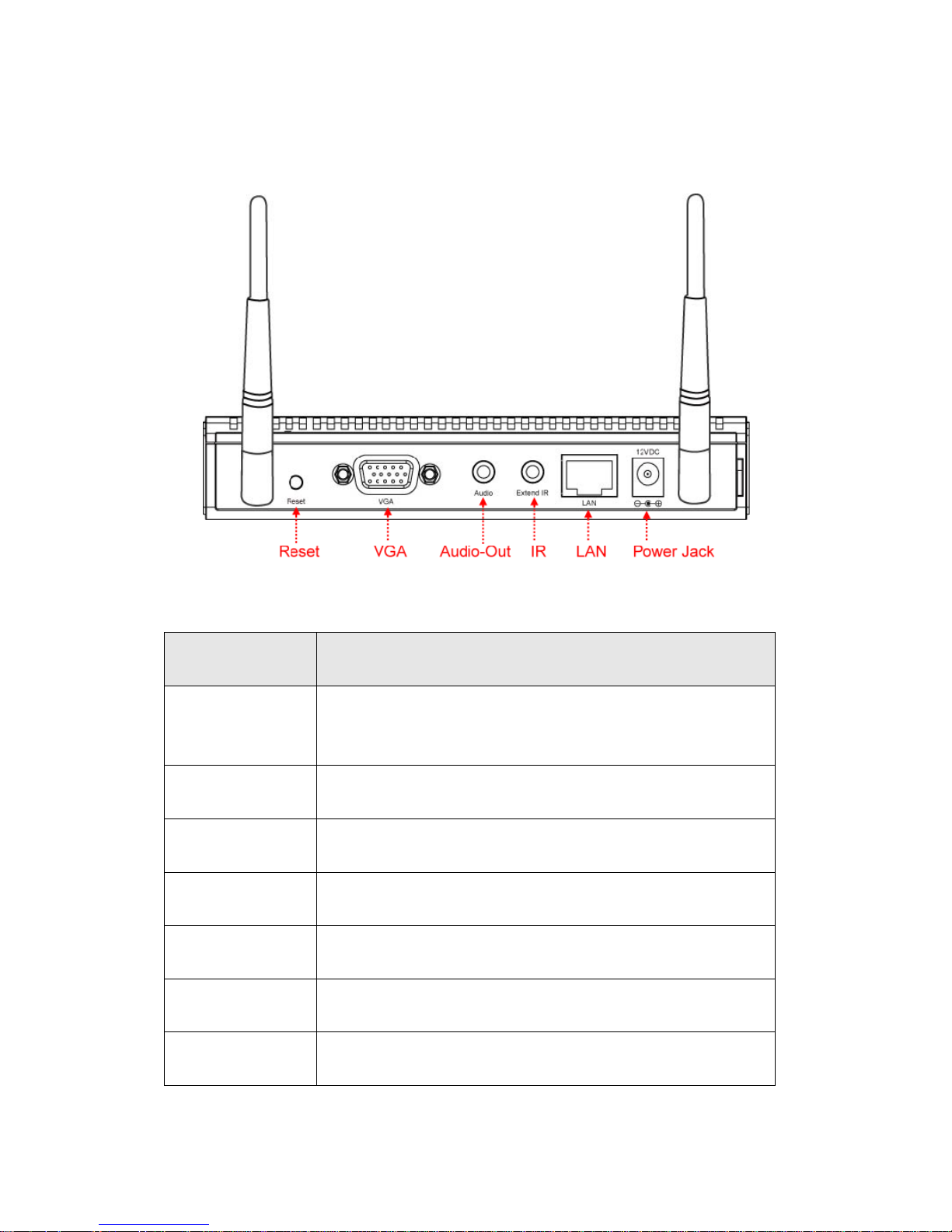
Back
Name
Description
Reset
When this projector server is not working properly, you
can use a pen or pin to press and hold this button for 5
seconds to reset the projector server.
VGA
VGA D-sub 15 pin video output (Connects to any
VGA-compatible display).
Audio
Stereo audio output (Connects to external speaker or
audio amplifier).
External IR
Connects to supplied IR extender cable to receive IR
signals
LAN
10/100/1000Mbps fast Ethernet port (Connects to your
local area network)
12VDC
Connect to DC 12V power adapter (Use supplied power
adapter only!).
Antenna
(Left and Right)
Transmits wireless signal. Please keep both antennas
perpendicular to the ground for best signal reception.
Page 11

Remote Control - Front
Name
Description
„Black out‟ Button
Press this button to activate „Black Out‟ function, which
will remove any display contents displayed on external
display; Press this button again to resume.
„Menu‟ Button
Press this button to switch the display output of projector
server between presenter‟s computer display content
and projector server‟s configuration menu.
„Page down‟
button
Equivalent to „Left‟ key on your computer‟s keyboard.
„Page up‟ button
Equivalent to „Right‟ key on your computer‟s keyboard.
„Prev.‟ button
Select previous user (presenter) in projector server‟s
configuration menu; Equivalent to „Up‟ key on your
computer‟s keyboard when presentation is in progress.
„Next‟ button
Select next user (presenter) in projector server‟s
configuration menu; Equivalent to „Down‟ key on your
computer‟s keyboard when presentation is in progress.
button
Select user in projector server‟s configuration menu.
Page 12

Remote Control - Top
Name
Description
IR Transmitter
Infrared signal transmitter. When using the remote
Control, point the IR transmitter to the front of the
projector server. DO NOT use your finger or other object
to block the IR transmitter, or your command will not be
received by projector server.
IR Transmitter
Page 13
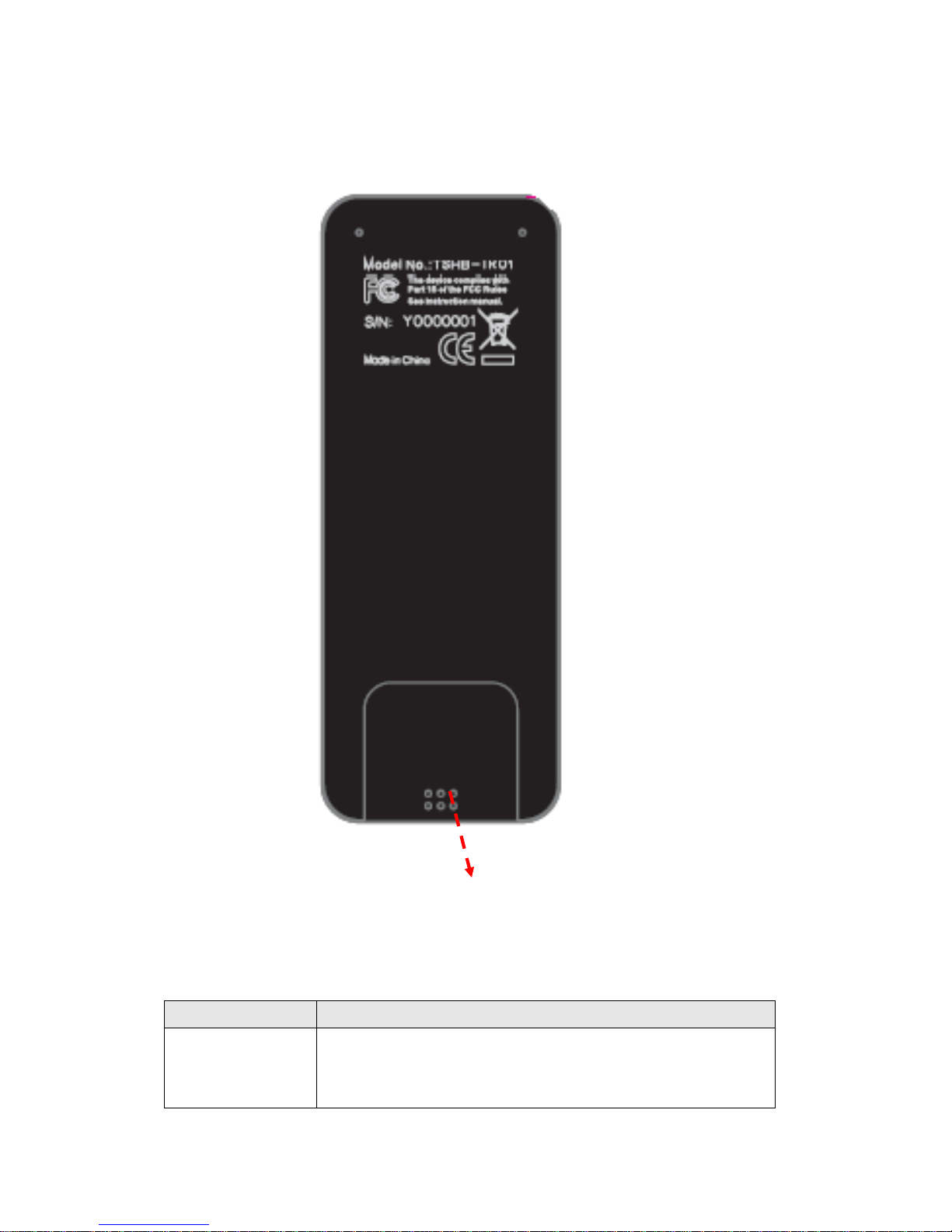
Remote Control - Back
Name
Description
Battery Lid
Press battery lid and push it out to open battery
compartment (to install or remove CR-2032 lithium
battery).
Battery Lid
Page 14
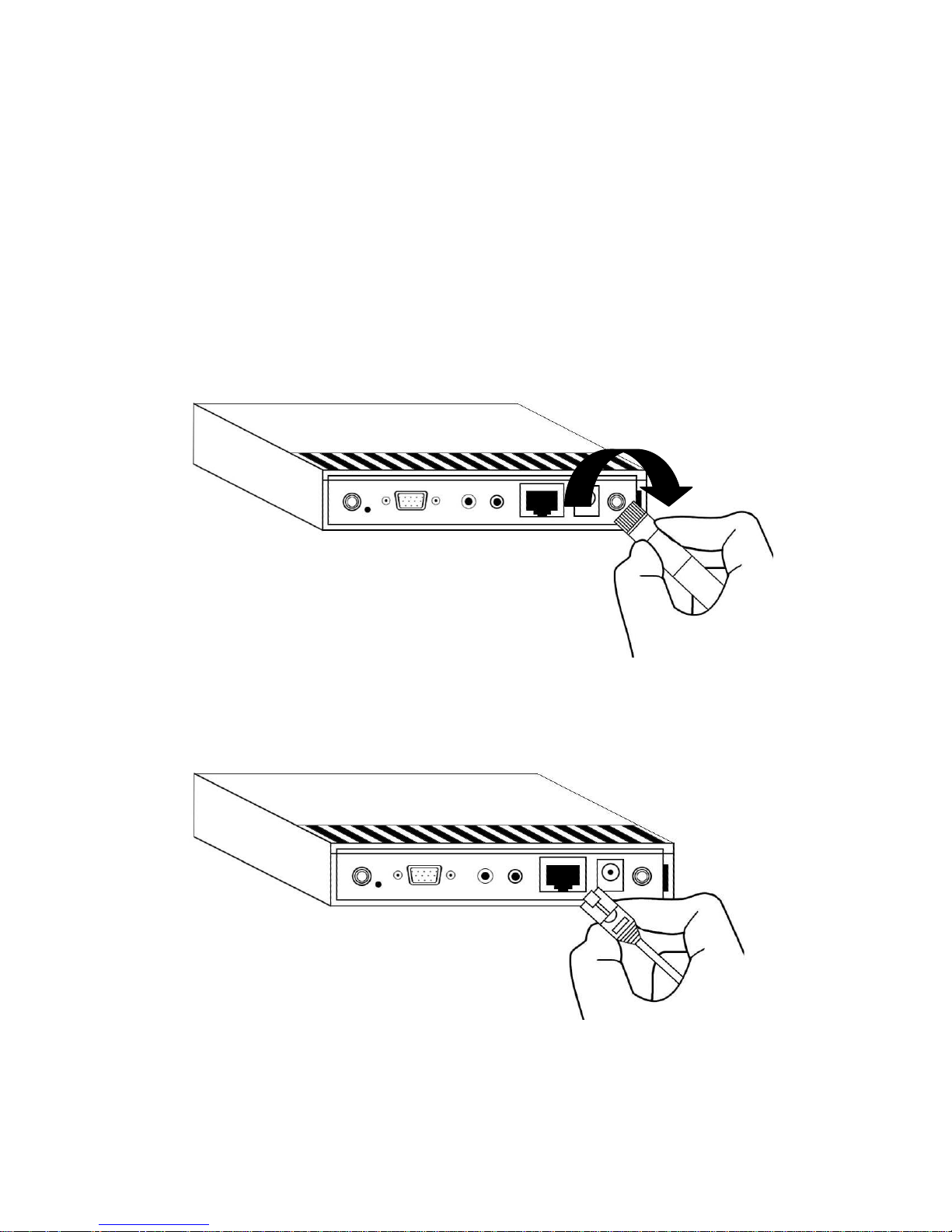
1-6 Install Wireless Projector Server
Please follow the following instructions to get the projector server installed:
1. Unpack the wireless projector server‟s package, and make sure no item in
the package is missing.
2. Connect antennas to both antenna connectors located at the back or
projector server - hold antenna base by your finger and turn in clockwise
direction to fasten it.
3. Connect the Ethernet cable to the LAN port (this port is labeled as „LAN‟ and
located at the back of this projector server)
4. Insert the audio cable which connects with external amplifier / speaker to
„Audio Out‟ port located at the back of this projector server.
Page 15

You can skip this step if you don’t have external audio amplifier / speaker.
5. Insert VGA cable which connects with external video display to VGA
connector located at the back of this projector server.
6. Adjust the antennas located at the back of the projector server, so they‟re
perpendicular to the ground.
7. Connect the A/C power adapter to the electrical outlet on the wall, and insert
the power connector of A/C power adapter to the power slot labeled as „12VDC‟
Page 16

at the back of projector server.
9. Press „Power‟ button located at the front of projector server.
10. Open battery lid located at the back of remote Control by press and push it
downward, and place the CR 2032 battery into remote Control‟s battery
compartment. Please note that „+‟ sign on the battery should be facing up. To
close battery lid, push it back.
11. Please check the status of the „Power‟ LED located at the front of the
projector server. If it does not light, please check all connections and the status
of electrical power outlet, or refer to chapter 4-1 „Troubleshooting‟ for possible
solutions.
Page 17

Chapter II Using Projector Server
2-1 Switch the Projector Server On and Check IP address
When the connection between projector server and external display is
established, you can switch the display‟s power on, then press the „Power‟
button of projector server, which is located at the front of projector server.
You should be able to see the following image displayed on external display; if
not, please make sure the external display you used with projector server
accepts input video resolution „1024 x 768‟, and horizontal refresh rate „60Hz‟.
*
If you see above image shown on display for more than two minutes, please
press „Power‟ button to switch the projector server off, and then switch the
projector server on again. If this still happens, refer to chapter 4-2
„Troubleshooting‟ for possible solutions.
Page 18

When the projector server is powered on and connected to a LAN with DHCP
server, it will get an IP address from DHCP server automatically; when there‟s
no DHCP server available, it will use default IP address „192.168.2.10‟. Please
refer to chapter 2-3 „How to set IP address for your computer‟ to set the IP
address for computers wish to connect to projector server when there‟s no
DHCP server available.
The IP address of projector server can be found on the connected external
display, like following picture:
The IP address of the WLAN (wireless Ethernet) and LAN (wired Ethernet)
interface of projector server can be found at the lower-left corner of video
display. You can use one of these IP addresses to connect to the projector
server.
The IP Address (Wireless / Wired Ethernet)
of projector server can be found here.
Page 19

2-2 Connect to Projector Server by Wireless Ethernet
The wireless Ethernet interface of this projector server is switched on and
accepts any computer to establish connection by default. You can use your
computer‟s wireless utility to establish connection with this projector server.
The SSID (Service Set Identifier) of this projector server is „projector‟ by
default:
Please select the wireless network named „projector‟, and click „Connect‟ to
establish connection. In some cases, Windows will connect to projector server
automatically, or sometime it will connect to other wireless network. Please
make sure you‟re connecting to correct wireless network.
After you connected to projector server, please use web browser to connect to
projector server‟s wireless (WLAN) IP address. In the following example,
projector server‟s IP address is ‟192.168.100.10‟, which is default setting.
Page 20

2-3 Set the IP address of the Computer
If there‟s no DHCP server available on your LAN, please follow the following
instructions to set the IP address of the computer, so the computers wish to
use the projector server can connect to project server.
If the operating system of your computer is….
Windows 95/98/Me - please go to section 2-3-1
Windows 2000 - please go to section 2-3-2
Windows XP - please go to section 2-3-3
Windows Vista - please go to section 2-3-4
Windows 7 - please go to section 2-3-5
2-3-1 Windows 95/98/Me IP address setup:
1. Click „Start‟ button (it should be located at lower-left corner of your
computer), then click control panel. Double-click Network icon, and
Network window will appear. Select „TCP/IP‟, then click „Properties‟.
Page 21

2. Select „Specify an IP address‟, then input the following settings in respective
field:
IP address: 192.168.2.x (where x is an integer greater or less than 200, if
there‟s more than one computer need to use this projector server on the same
network, every computer should use an unique number)
Subnet Mask: 255.255.255.0
click „OK‟ when finish.
Page 22

2-3-2 Windows 2000 IP address setup:
1. Click „Start‟ button (it should be located at lower-left corner of your
computer), then click control panel. Double-click Network and Dial-up
Connections icon, double click Local Area Connection, and Local Area
Connection Properties window will appear. Select „Internet Protocol
(TCP/IP)‟, then click „Properties‟
Page 23

2. Select „Use the following IP address‟, then input the following settings in
respective field:
IP address: 192.168.2.x (where x is an integer greater or less than 200, if
there‟s more than one computer need to use this projector server on the same
network, every computer should use an unique number)
Subnet Mask: 255.255.255.0
click „OK‟ when finish.
Page 24

2-3-3 Windows XP IP address setup:
1. Click „Start‟ button (it should be located at lower-left corner of your
computer), then click control panel. Double-click Network and Internet
Connections icon, click Network Connections, and then double-click Local
Area Connection, Local Area Connection Status window will appear, and
then click „Properties‟
Page 25

2. Select „Use the following IP address‟, then input the following settings in
respective field:
IP address: 192.168.2.x (where x is an integer greater or less than 200, if
there‟s more than one computer need to use this projector server on the same
network, every computer should use an unique number)
Subnet Mask: 255.255.255.0
click „OK‟ when finish.
Page 26

2-3-4 Windows Vista IP address setup:
1. Click „Start‟ button (it should be located at lower-left corner of your
computer), then click control panel. Click View Network Status and Tasks,
then click Manage Network Connections..Right-click Local Area Netwrok,
then select ‘Properties’. Local Area Connection Properties window will
appear, select „Internet Protocol Version 4 (TCP / IPv4), and then click
„Properties‟
Page 27

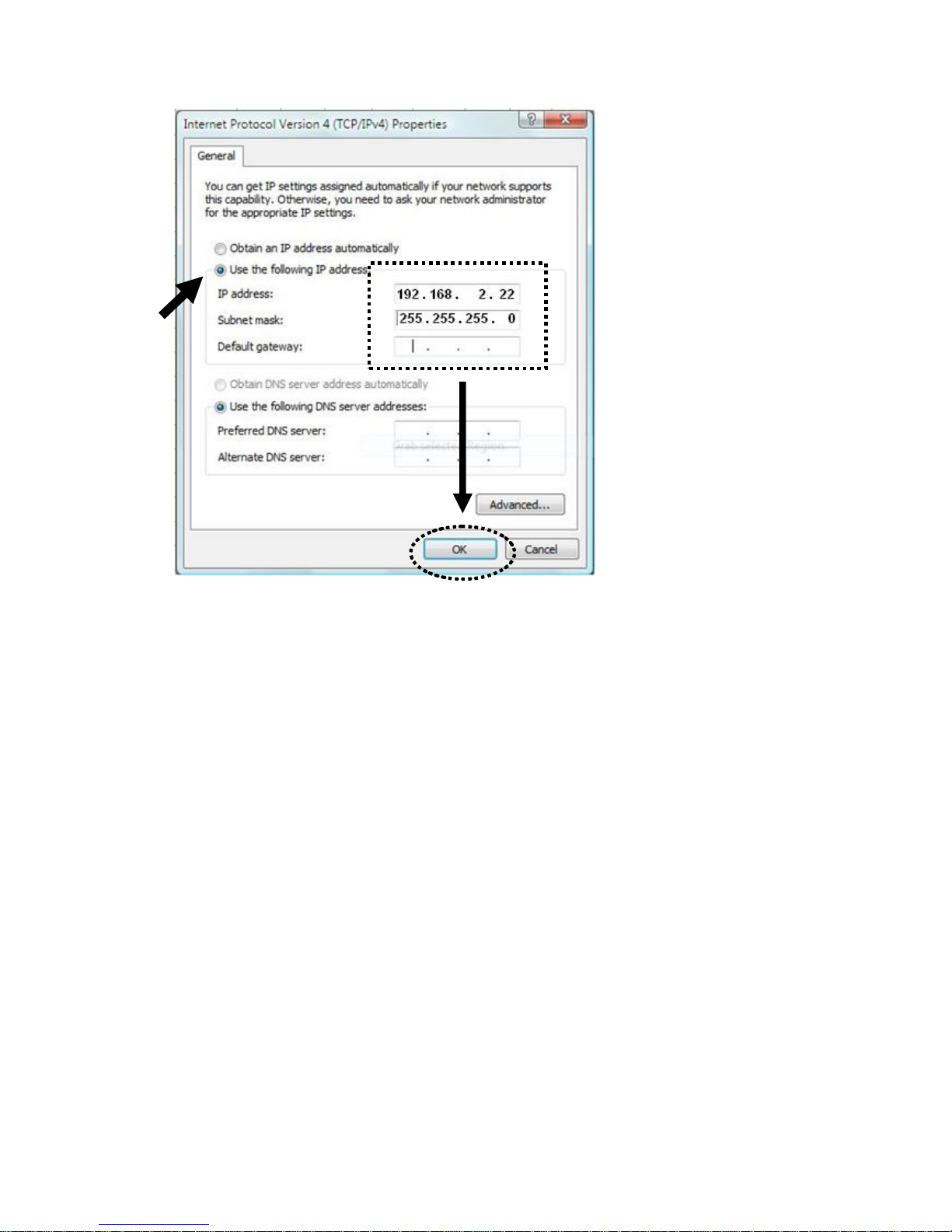
2. Select „Use the following IP address‟, then input the following settings in
respective field:
IP address: 192.168.2.x (where x is an integer greater or less than 200, if
there‟s more than one computer need to use this projector server on the same
network, every computer should use an unique number)
Subnet Mask: 255.255.255.0
click „OK‟ when finish.
Page 28
Page 29

2-4 Download and Install Client Software
Before any computer can use the projector server, client software must be
installed first. Please follow the following instructions to download and install
projector server client software:
1. Use the web browser to connect to the IP address of projector server
(WLAN / LAN IP address). Projector server‟s IP address can be found at the
lower-left corner of projector server‟s display (refer to chapter 2-1).
Please note that the IP address of projector server will vary depends on the
setting of the DHCP server of your LAN, do not use the IP address listed in
above sample picture to connect to projector server.
Page 30

2. If you just want to display image on projector and don‟t want to install
software on your computer (especially when you‟re a guest and only need to
use projector server once), click „Start‟ and jump to next chapter for
instructions for green-version client software. Otherwise please click „Video
Driver‟ to install audio / video driver for complete functionality for Windows
2000 and XP.
If you don‟t need audio support, skip to next chapter for instructions of
installation-free projector server client software.
3. When you‟re prompted to download the software, click „Run‟:
Page 31

Page 32

4. Click „Run‟ to start software installation:
5. Please click „Next‟ when you‟re prompted, until installation procedure is
complete.
Page 33

If you see this warning message, please click „Continue Anyway‟ to
continue, or installation cannot be completed (You may see this
message appear for more than once).
Page 34

2-5 Connect to Projector Server
To connect to projector server, click „Start‟ in projector server‟s web page:
You‟ll be prompted to save or run projector server client software:
You can click „Run‟ to run client software directly, or you can click „Save‟ to
save client software to your computer‟s hard drive for future usage.
Page 35

If you have personal firewall software installed, or you‟re using Windows XP /
Vista operating system, you may see similar message windows appear:
Click „Unblock‟ (or the button with similar meaning) so firewall software will not
block the network access of projector server‟s client software.
Client software will appear:
Click button and client software will search for projector server on
local network.
If there are more than one projector servers found on LAN, please select the
projector server you wish to connect from ‘Projector’
Every projector server‟s SSID can be found at the lower-left corner of projector
Page 36

server‟s display, and login code can be found at lower-right corner:
Please input a unique user name (used to identify each projector server user
and should not be the same with other user, client software will use your
computer‟s name as default user name) in „User Name‟ field, and input the
login code as shown on projector server‟s display.
When you’re ready, click icon to continue.
SSID
Login
Code
Page 37

If the login code you provided is not the same with projector server‟s displayed
login code, the following message will appear:
If you see this message, click „OK‟ to input login code again.
Page 38

If you entered correct login code, you‟ll be connected to projector server as
one of users, and the client software will be look like this:
Before any user start presentation, all connected user‟s name and their IP
address will be listed on projector server‟s display:
Page 39

You can click „Start / Stop‟ button (as indicated above) to start presentation (the
content of your computer‟s display will be transmitted to projector server, and
being displayed on projector server‟s display).
To stop presentation, press „Start / Stop‟ button again.
Your computer‟s display content will no longer be
transmitted to projector server.
If you see this message, it means there‟s already a progressing presentation,
please wait for existing presenter logout, or use remote Control to switch user:
If your computer display‟s resolution setting is different from projector server‟s
display resolution setting, you computer‟s resolution will be changed to fit
projector server‟s display resolution:
Start presentation
Page 40

2-6 Using Client Software
If you download and execute client software, the client software will appear
instantly, you don‟t have to install the software on your computer.
There are two modes of client software: before login and logged in.
Before login:
Close
Application
Minimize
Client
Connect to
Projector Server
Page 41

After Login:
Close
Application
Minimize
Client Software
Play /
Stop
1/2/3/4 Quad-Split
Image Quality Setup
Page 42

2-6-1 Client software icon
After you connected to projector server and start transmitting display content,
an icon will appear beside the clock of system tray, you can right-click on it and
its menu will appear. You can also double click client software‟s icon to recall
projector server client software (maximize its window):
The descriptions of every function of client software will be given below.
On-Screen Keyboard
Select this function and an on-screen keyboard will appear, you can use this
keyboard to type characters by mouse click, just like using your keyboard.
About
You can get the version number and other information about the client software
you‟re using; this is very helpful when you need help from dealer of purchase.
Click „OK‟ to close „About‟ window.
Page 43

Sound
Sound of your computer will be transmitted to projector server by default. If you
don‟t want to transmit the sound of your computer to projector server, click
„Sound‟ in pop-up menu to uncheck it.
To resume, repeat above procedure again.
Setting
Call the setup menu of projector server‟s client software (see chapter x-x for
detailed descriptions).
Exit
Terminates projector server client software, and you‟ll be disconnected from
projector server. To start another presentation, you have to launch client
software again.
Page 44

2-6-2 Start / Stop Projection
To start / stop projection (display the display content of your computer to
projector), simply click „Start / Stop‟ button.
When projection has been started, client software will minimize automatically.
To stop projection, recall client software and click „Start / Stop‟ button again.
Please note that if someone‟s already using this function, other user will not be
able to start projection, unless the other stop projection.
Page 45

2-6-3 Quad-split Display
This projector server supports quad-split projector display which allows
maximum 4 users to display their computer‟s display content at the same time,
and each of them will occupy 1/4 size of projector‟s display.
To start quad-split display function, click one of 1/2/3/4 button:
Each number corresponds to a corner of projector‟s display:
1 = upper-left corner
2 = upper-right corner
3 = lower-left corner
4 = lower-right corner
Page 46

2-6-4 Change Display Setting
The image displaying speed of different computer may vary depends on the
network connection speed and other factors. If you find that the image
displayed on projector is too slow, you can adjust image quality to improve
displaying speed.
Quality High: Set display quality as high, displaying speed will be slow on a
slow network link.
Quality Standard: Set display quality as standard, this setting will lose some
graphic details but will improve displaying speed.
Device name: Displays connected projector server‟s name (SSID).
Output Resolution: Set projector server‟s video output resolution (800 x 600 /
1024 x 768 / 1280 x 800 ).
Follow Desktop: If your computer‟s desktop resolution is not one of those 4 ,
check this option to force projector server to use your computer‟s desktop
resolution. Please note this will not affect projector server‟s output resolution,
and projector server will try to simulate the resolution of your computer‟s
desktop, therefore displayed image will be slightly deformed.
Page 47

2-7 Broadcast
With this function, You can broadcast some specific content to more than one
Projector Servers on your network.
To activate broadcast function, click broadcast button or select Menu ->
Advanced -> Broadcast, then broadcast control panel will appear:
Descriptions of every function will be given below:
Item
Description
Select Device
Only selected projector servers will be displayed
when toggled.
Release selected
device
When you‟re broadcasting image, you can un-tick
the selected projector servers to release control.
Audio On/Off
Click audio button the color becomes green to
present with audio output to every selected
projector servers, click again to turn off.
Page 48

NOTE:
‧Broadcast will not work when doing the presentation. Please stop the
presentation before use
2-8 Capture Display
To display a specific area from your computer desktop to the projector.
To use this function, click „Capture Display‟ button , or select Menu ->
Advanced -> Capture Display.
Descriptions of every function will be given below:
Item
Description
Select Object
For Windows:
Select an object (a window, explorer bar,
notification area etc.) on your computer‟s player for
projection.
For MAC:
It requires “Get” and “Set” two steps to make your
computer‟s player for projection.
Get: Select “Get” to get a frame on your computer‟s
Page 49

player.
Set: Select “Set” to confirm the frame of the player
for projection.
Close: To unlock the frame of your player for
projection.
Select Area
Select a desired area on your computer‟s desktop
for projection.
When you selected an object or area for projection, click „Play‟ button to start
projection. In this mode, only the object or area you selected will be displayed
on projector.
2-9 USB Direct Show
The function allows to project your computer‟s desktop on screen via the
connection of USB Type B to USB Type A cable.
Once the connection and detection are succeeded, an inquiry window will
automatically pop up to ask you to execute “dPresenter” to make the desktop
of your PC output to the screen. If the inquiry window is not pop up, please
access to the disk “dPresenter” from “COMPUTER” and execute
“dPresenter.exe”.
NOTE:
‧Only “Play”, “Stop”, “Pause”, “Minimize”, and “Close” keys are available
during the USB display operation.
‧If the image can not be projected, please disable firewall on your system.
‧USB display will not work when someone is doing the presentation. Please
stop the presentation before use.
‧The function is not available in MAC.
Page 50

2-10 Using Remote Control
When the presentation is in progress, you can use supplied remote Control to
control the presentation. When using remote Control, point the remote
Control‟s IR signal transmitter toward the front of projector server.
Name
Description
„Black out‟ Button
Press this button to activate „Black Out‟ function, which
will remove any display contents displayed on external
display; Press this button again to resume.
„Menu‟ Button
Press this button to switch the display output of projector
server between presenter‟s computer display content
and projector server‟s configuration menu.
„Page down‟
button
Equivalent to „Left‟ key on your computer‟s keyboard.
„Page up‟ button
Equivalent to „Right‟ key on your computer‟s keyboard.
„Prev.‟ button
Select previous user (presenter) in projector server‟s
configuration menu; Equivalent to „Up‟ key on your
computer‟s keyboard when presentation is in progress.
„Next‟ button
Select next user (presenter) in projector server‟s
configuration menu; Equivalent to „Down‟ key on your
computer‟s keyboard when presentation is in progress.
button
Select user in projector server‟s configuration menu.
Notice:
1) Remote Control only works when the
distance between remote Control and
projector server is shorter than 7 meters.
This distance will be shortened in some
environments, or when the battery state of
remote Control is low.
2) If there’s strong light source near
projector server and / or remote Control,
remote Control may not be able to function
properly.
Page 51

2-11 Select User
When there‟re more than one connected client software, project server can
select one of them to display its display content. In the example below, there
are two connected client software and none of them is in presentation mode:
You can use the „User Switch‟ button or remote Control to select the user, and
display its display content by projector server‟s display.
2-11-1 ‘User Switch’ Button
A button named „User Switch‟ is located at the top of projector server:
If you wish to select which user should projector server display its display
content, you can press this button. The configuration menu of projector server
will be shown on projector server‟s display; if there is a progressing
presentation and you pressed „User Switch‟ button, presentation will be
aborted and the configuration menu of projector server will be shown.
Page 52

In this example, total 2 users are connected. You can press „User Switch‟
button to select which user should projector server display its display content
( The selected user will become yellow, the color of the progressing
presentation one is Orange). You can press this button again and again to
select other users in the list.
When a user is selected, stop pressing „User Switch‟ button and let „>‟ mark
stop at the user you wish projector server to display its display content.
Selected user will begin presentation after 5 seconds.
Page 53

2-11-2 Use Remote Control
You can also use remote Control to select which user should projector server
display its display content:
1. If there‟s a progressing presentation, press „Menu‟ button on remote Control
(Skip this step if there‟s no progressing presentation).
2. Press „Prev.‟ or „Next‟ button to select the user you wish projector server to
display its display content, selected user will have a > mark in front of it.
3. When a user is selected, press button on remote Control, and the display
content of the user you selected will be displayed on projector server‟s display.
Page 54

Chapter III Configure Projector Server
3-1 Connect to Web Configuration Menu
This projector server provides several administrative functions which can be
accessed via the web configuration menu. In this chapter, you‟ll be instructed
to user web configuration menu to setup the projector server.
Please follow the following steps to connect to the web configuration menu of
projector server:
1. Use the web browser to connect to the IP address of projector server
(WLAN / LAN IP address)
Projector server‟s IP address can be found at the lower-left corner of projector
server‟s display (refer to chapter 2-1).
Page 55

2. Click „Admin Login‟ link on the left.
3. You‟ll be prompted to input administrator‟s username and password. Default
„User Name‟ is „admin‟ and „Password‟ is „1234‟. Click „OK‟ button when you‟re
ready.
Page 56

4. After you logged in, the status of projector server will be shown on web
browser.
Page 57

3-2 Utility Download
You can use this function to download projector server‟s client software.
(Same as described in chapter 2-4)
Click ‘Start’ link on the top, and you’ll be prompted to run or save projector
server’s client software.
For system MAC OS X10.4 above, please download the presentation utility
from CD.
Page 58

3-3 Basic Setting
In this menu, you can change web configuration menu password.
You can use this function to change the password required for logging onto
web configuration menu (user name is always „admin‟ and cannot be
changed).
The description of every setting item will be described below:
Item
Description
Current Password
Input current password (default: 1234) here.
New Password
Input new password you wish to use here.
Confirmed
Password
Input new password you wish to use here again, for
confirmation.
When you finish, please click „Apply‟ button to save changes you made; to
discard changes, click „Cancel‟ button. If you click „Apply‟, you‟ll see the
following message:
Page 59

Click „Continue‟ to continue on projector server setting, or click „Apply‟ to
reboot projector server, and changes you made will take effect after projector
server rebooted.
Page 60

3-4 Network Setting
You can use this menu to change the setting of wired Ethernet connection and
DNS (Domain Name Service) server.
The description of every setting item will be described below:
Item
Description
Obtain an IP
address
automatically
Select this option and projector server will obtain an IP
address from the DHCP server on your local area
network automatically. If you selected this option but
there‟s no DHCP server on your LAN, projector server
will use IP address „192.168.2.10‟ automatically.
Use the following
IP address
Select this option and projector server will use the IP
address you defined below.
IP address
Input the IP address you wish to assign to projector
server.
Subnet Mask
Input the subnet mask of the IP address of projector
server.
Gateway address
Input the IP address of the gateway of your local area
network. You can leave this field blank and clients on
local area network will still be able to connect to
projector server, but some network functionalities will
not function. For example, if the time server you defined
Page 61

is not located within local area network, projector server
will not be able to access Internet and synchronize with
time server.
DNS address
Input the IP address of DNS server here (DO NOT input
the host name of DNS server here!).
Secondary DNS
Address
You can input another DNS server‟s IP address here,
so if projector server fails to connect to the DNS server
listed above, it will use the DNS server‟s IP address
listed in this field instead.
You can leave both fields of DNS server blank, and
most functionalities of this projector server will still
function. However, you have to input IP address, not
host name, for all servers required by this projector
server (like NTP server).
When you finish, please click „Apply‟ button to save changes you made; to
discard changes, click „Cancel‟ button. If you click „Apply‟, you‟ll see the
following message:
Click „Continue‟ to continue on projector server setting, or click „Apply‟ to
reboot projector server, and changes you made will take effect after projector
server rebooted.
Page 62

3-5 Wireless Setting
You can configure the settings of the wireless network interface of this
projector server from this menu.
Page 63

3-5-1 ‘Basic’ Settings
You can configure basic wireless network settings from this menu.
The description of every setting item will be described below:
Item
Description
Enable Wireless
pass through
without login.
Tick the box to enable the function allows other users
not in the presentation to access the Projector Server
as an AP.
Wireless Function
Select „Enable‟ from dropdown menu to enable wireless
network function; select „Disable‟ to disable wireless
network function (wireless radio off).
Mode
Select wireless mode. Only AP (Access Point) mode is
supported currently.
Band
Select the wireless band. Available options are:
2.4GHz (B) - supports 802.11b wireless clients only.
2.4GHz (N) - supports 802.11 Draft-n wireless clients
only.
2.4GHz (B+G) - supports 802.11b and 802.11 Draft-n
Page 64

wireless clients.
2.4GHz (G) - supports 802.11g wireless clients only.
2.4GHz (B+G+N) - supports 802.11b, 802.11g, and
802.11 Draft-n wireless clients.
ESSID
Input the ESSID (Extended Service Set IDentifier, i.e.
the name used to identify this projector server among
other wireless access points) here.
Please note that client software also uses this name to
identify the projector server, even client software is
using wired Ethernet connection to connect to projector
server.
Default ESSID is „projector‟.
Channel Number
Select the wireless channel number used by the
wireless interface of projector server from dropdown
menu.
Associated Client
Click „Show Active Clients‟ button to show all connected
wireless clients (wired clients will not be displayed
here).
Click „Refresh‟ button to reload latest wireless client list.
When you finish, please click „Apply‟ button to save changes you made; to
Page 65

discard changes, click „Cancel‟ button. If you click „Apply‟, you‟ll see the
following message:
Click „Continue‟ to continue on projector server setting, or click „Apply‟ to
reboot projector server, and changes you made will take effect after projector
server rebooted.
Page 66

3-5-2 ‘Advanced’ Settings
In this menu, you can configure advanced wireless settings of this projector
server. Please note that only experienced user should modify these settings,
and wrong settings may affect the performance of this projector server. This
projector server is able to run properly without any modification in this page.
The description of every setting item will be described below:
Item
Description
Fragment
Threshold
Set the Fragment threshold of wireless radio.
Do not modify default value if you don’t know what
it is, default value is 2346.
RTS Threshold
Set the RTS threshold of wireless radio. Do not modify
Page 67

default value if you don’t know what it is, default
value is 2347.
Beacon Interval
Set the beacon interval of wireless radio. Do not
modify default value if you don’t know what it is,
default value is 100.
DTIM Period
Set the DTIM period of wireless radio. Do not modify
default value if you don’t know what it is, default
value is 3.
Data Rate
Set the wireless data transfer rate to a certain value.
Since most of wireless devices will negotiate with each
other and pick a proper data transfer rate automatically,
it’s not necessary to change this value unless you
know what will happen after modification.
N Data Rate
Same as above, but only for 802.11n clients.
Channel Width
Set channel width of wireless radio. Do not modify
default value if you don’t know what it is, default
setting is ‘Auto 20/40 MHz’.
Preamble Type
Set the type of preamble of wireless radio, Do not
modify default value if you don’t know what it is,
default setting is ‘Short Preamble’.
Broadcast ESSID
Decide if the wireless router will broadcast its own
ESSID or not. You can hide the ESSID of your wireless
router (set the option to „Disable‟), so only people those
who know the ESSID of your wireless router can get
connected.
CTS Protect
Enabling this setting will reduce the chance of radio
signal collisions between 802.11b and 802.11g wireless
access points. It‟s recommended to set this option to
„Auto‟ or „Always‟. However, if you set to „None‟, your
wireless router should be able to work fine, too.
Tx Power
You can set the output power of wireless radio. Unless
you‟re using this wireless router in a really big space,
you may not have to set output power to 100%. This
will enhance security (malicious / unknown users in
distance will not be able to reach your wireless
router).
Turbo Mode
Enhance the data transfer rate of LAN, default value is
‘Enable’, it’s recommended to set this option to
Page 68

‘Enable’.
WMM
The short of Wi-Fi MultiMedia, it will enhance the data
transfer performance of multimedia contents when
they‟re being transferred over wireless network. If you
don’t know what it is / not sure if you need it, it’s
safe to set this option to ‘Enable’, however, default
value is ‘Disable’.
When you finish, please click „Apply‟ button to save changes you made; to
discard changes, click „Cancel‟ button. If you click „Apply‟, you‟ll see the
following message:
Click „Continue‟ to continue on projector server setting, or click „Apply‟ to
reboot projector server, and changes you made will take effect after projector
server rebooted.
Page 69

3-5-3 ‘Security’ Settings
In this menu, you can setup wireless security for wireless connections.
By default, projector server does not enable wireless security so
wireless clients don’t have to know the password for wireless network
before they can get connected to projector server. You can improve the
security level of projector server by setup security settings in this menu.
The description of every setting item will be described below:
Item
Description
Encryption:
Disable
Disable wireless encryption. This will allow anyone who
found the projector server by wireless network able to
connect to projector server and download client
software. Refer to chapter 3-5-3-1 for detailed
instructions when encryption is disabled.
Encryption: WEP
Enables WEP (Wired Equivalent Privacy) encryption.
Although some people may use certain utility software
to discover the password used by WEP encryption, it
still be able to provide certain level of security, and
Page 70

almost every wireless client support WEP (especially
some old IEEE 802.11b wireless clients), therefore
WEP provides better compatibility. Refer to chapter
3-5-3-2 for detailed instructions of WEP encryption.
Encryption: WPA
pre-shared key
Enables WPA (Wi-Fi Protected Access) encryption.
WPA provides better protection strength against
malicious attackers, and most of modern wireless
clients support WPA. Refer to chapter 3-5-3-3 for
detailed instructions of WPA encryption.
When you finish, please click „Apply‟ button to save changes you made; to
discard changes, click „Cancel‟ button. If you click „Apply‟, you‟ll see the
following message:
Click „Continue‟ to continue on projector server setting, or click „Apply‟ to
reboot projector server, and changes you made will take effect after projector
server rebooted.
Page 71

3-5-3-1 Encryption: Disabled
When encryption setting is disabled, projector server‟s wireless interface uses
no protection against wireless users who attempted to connect to it. It is
convenient for meeting room‟s visitors; however, every one will be able to
connect to projector server unless you enabled 802.1x authentication.
The description of every setting item will be described below:
Item
Description
RADIUS Server IP
address
Please input the IP address of RADIUS authentication
server here.
RADIUS Server
Port
Please input the port number of radius server here.
RADIUS Server
Password
Please input the password of radius server here.
When you finish, please click „Apply‟ button to save changes you made; to
discard changes, click „Cancel‟ button. If you click „Apply‟, you‟ll see the
following message:
Page 72

Click „Continue‟ to continue on projector server setting, or click „Apply‟ to
reboot projector server, and changes you made will take effect after projector
server rebooted.
Page 73

3-5-3-2 Encryption: WEP
Enable WEP encryption.
The description of every setting item will be described below:
Item
Description
Key Length
There are two types of WEP key length: 64-bit and
128-bit. Using „128-bit‟ is safer than ‟64-bit‟, but will
reduce some data transfer performance.
Key Format
There are two types of key format: ASCII and Hex.
When you select a key format, the number of
characters of key will be displayed. For example, if you
select ‟64-bit‟ as key length, and „Hex‟ as key format,
you‟ll see the message at the right of „Key Format‟ is
„Hex (10 characters), which means the length of WEP
key is 10 characters.
Default Tx Key
You can set up to four sets of WEP key, and you can
decide which key is being used by default here. If you
don’t know which one you should use, select ‘Key
1’.
Page 74

Encryption Key 1
to 4
Input WEP key characters here, the number of
characters must be the same as the number displayed
at „Key Format‟ field. You can use any alphanumerical
characters (0-9, a-z, and A-Z) if you select „ASCII‟ key
format, and if you select „Hex‟ as key format, you can
use characters 0-9, a-f, and A-F. You must enter at least
one encryption key here, and if you entered multiple
WEP keys, they should not be same with each other.
RADIUS Server IP
address
Please input the IP address of RADIUS authentication
server here.
RADIUS Server
Port
Please input the port number of radius server here.
RADIUS Server
Password
Please input the password of radius server here.
When you finish, please click „Apply‟ button to save changes you made; to
discard changes, click „Cancel‟ button. If you click „Apply‟, you‟ll see the
following message:
Click „Continue‟ to continue on projector server setting, or click „Apply‟ to
reboot projector server, and changes you made will take effect after projector
server rebooted.
Page 75

3-5-3-3 Encryption: WPA pre-shared key
Enable WPA pre-shared key encryption.
The description of every setting item will be described below:
Item
Description
WPA Unicast
Cipher Suite
Please select a type of WPA cipher suite.
Available options are: WPA (TKIP), WPA2 (AES), and
WPA2 Mixed. You can select one of them, but you have
to make sure your wireless client support the cipher you
selected.
Pre-shared Key
Format
Select the type of pre-shared key, you
can select Passphrase (8 or more alphanumerical
characters, up to 63), or Hex (64 characters of 0-9, and
a-f).
Pre-shared Key
Please input the WPA passphrase here.
It’s not recommended to use a word that can be
found in a dictionary due to security reason.
When you finish, please click „Apply‟ button to save changes you made; to
discard changes, click „Cancel‟ button. If you click „Apply‟, you‟ll see the
following message:
Page 76

Click „Continue‟ to continue on projector server setting, or click „Apply‟ to
reboot projector server, and changes you made will take effect after projector
server rebooted.
Page 77

3-5-3-4 ‘WPS’ Settings
In this menu, you can use WPS (Wi-Fi Protected Setup) to setup secure
wireless connections quickly and easily with WPS-compatible wireless clients.
In this menu, current WPS settings will be displayed, like above example. The
descriptions of every field are:
Item
Description
WPS Status
Displays WPS configuration status: Configured (WPS
ready), or Unconfigured.
Self PinCode
Displays WPS self pin code. This code will be used
when pin-style WPS pairing mode is being used, and
WPS wireless clients will need to know this code.
SSID
Displays the SSID of this projector server.
Authentication
Mode
Displays current wireless authentication mode.
Passphrase Key
Here uses asterisk mark ( * ) to show WPA passphrase
key.
And here‟s WPS configuration menu:
Page 78

The description of every setting item will be described below:
Item
Description
Config Mode
Select WPS configuration mode: „Registrar‟ (This
projector will accept WPS-compatible wireless client to
send WPS pairing request),
Configure via Push
Button
Click „Start PBC‟ and projector server will enter „WPS
Push-Button‟ mode. When using this mode, another
WPS-compatible wireless device must also enter WPS
push-button mode with different WPS configuration
mode (i.e. if projector server enters WPS push button
mode in „Registrar‟ configuration mode, another
WPS-compatible wireless device must use „Enrollee‟
configuration mode; if projector server enters WPS
push button mode in „Enrollee‟ configuration mode,
another WPS-compatible wireless device must use
„Registrar‟ configuration mode.
When you click this button, the button will be grayed-out
and start 2-minute count down. If no WPS-compatible
wireless device enters WPS push button mode within 2
minutes, WPS pairing will be cancelled.
Hint: You can also press ‘WPS’ button located on the
front of projector server to enter WPS mode, too.
Configure via
Client PinCode
If you got another WPS-compatible wireless device‟s
Self PinCode, you can enter it here, and press „Start
PIN‟ button to start PIN-style WPS pairing.
Page 79

3-6 Presentation Control
You can use this menu to control every connected user, and device who
should be active presenter here.
The description of every setting item will be described below:
Item
Description
Administrator
mode
Check this box to enter „Administrator mode‟ (i.e. you
can control users).
Please note that when you change the status of
Administrator mode, projector server needs to reboot
and all connected users must reconnect to projector
server. You‟ll be prompted before projector server is
rebooting, and you can cancel rebooting.
Once enable Administrator mode, all presentation
procedure will be controlled in this UI, users can not
use any presentation function on their PC utility.
All connected users will be displayed in „User List‟:
Page 80

You can arrange a specific user to display in quad-split display (1, 2, 3, or 4), or
display in full-screen mode:
Quad-Split Display
(Position 1 / 2 / 3 /4)
Full-Screen Mode
To assign a user to display in specific quad-split display position or full-screen
mode, select a user first, then click the white circle of specific position, and
click button of quad-split display or full-screen mode.
Page 81

3-7 Display Setting
You can configure the characteristics of external display here.
The description of every setting item will be described below:
Item
Description
Resolution
Select output video resolution, select a resolution from
this dropdown menu.
When you finish, please click „Apply‟ button to save changes you made; to
discard changes, click „Cancel‟ button. If you click „Apply‟, you‟ll see the
following message:
Click „Continue‟ to continue on projector server setting, or click „Apply‟ to
reboot projector server, and changes you made will take effect after projector
Page 82

server rebooted.
Page 83

3-7 Black Out
When you don‟t want audience see the content of your computer display
temporarily when you‟re active presenter, you can suspend video output by
this function.
Click „Screen Off‟ button and video will stop displaying on external display.
Click it again to resume.
Please note that this function will not stop video signal, therefore external
display will NOT enter power-save mode when you use this function to stop
displaying video contents (if it supports).
Page 84

3-6 Configuration Tools
This menu provides several useful functions, you can save projector server‟s
configuration (backup), upgrade firmware (to improve projector server‟s
functionality), or reset projector server from this menu.
3-6-1 Configuration Tools
You can backup and restore configuration of this projector server here, or
restore all settings of this projector server back to factory default value.
The description of every setting item will be described below:
Page 85

Item
Description
Backup Settings
Click „Save…‟ button to save projector server‟s current
setting as a file and store it on your computer. You‟ll be
prompted when you click „Save…‟ button, click „Save‟ to
select a folder on your computer to save projector
server‟s configuration file.
You can give each configuration file a different name,
so you can remember the purpose of configuration file.
Restore Settings
Click „Browse…‟ button to select a configuration file
stored in your computer‟s folder (you‟ll be prompted to
select a file), then you can click „Upload‟ button to
upload the configuration file to projector server.
Reset
Click this button to reset all settings of projector server
back to factory default settings. You‟ll be prompted to
confirm configuration reset.
Page 86

3-6-2 Firmware Upgrade
In this menu, you can upgrade the firmware of this projector server. New
firmware will provide more functionality, and fix some existing problem. Please
download latest firmware from our website.
Please click „Next‟ button to start firmware upgrade procedure:
Click „Browse…‟ button to select a firmware file from your computer, and then
click „Apply‟ to start firmware upgrade. Firmware upgrade procedure may
require some time, please be patient and do not switch your computer and / or
Page 87

projector server off during firmware upgrade procedure. Also, please do not
remove the network connection during firmware upgrade, if firmware upgrade
fail, the projector server may not be able to function properly, and you will need
to ask your dealer of purchase for help.
Page 88

3-6-3 Reset
If you found that projector server is not function properly, or respond to your
command slowly, reboot the projector server may solve the problem.
Click „Apply‟ to reboot the projector server. You‟ll be prompted before the
projector server reboots itself:
Click „OK‟ to reboot the projector server, or click „Cancel‟ to abort. Projector
server needs about 60 seconds to reboot, please reconnect to projector server
after you clicked „OK‟ button for 60 seconds.
Page 89

Chapter IV Appendix
4-1 Hardware Specification
Supports DHCP Server & Client
Supports wireless AP Mode
Download utility from the device directly, no need installation CD
Presentation control via remote Control
OSD menu configuration
Supports login code to protect other users from login into this device
without any authentication.
VGA Output Resolution: 1024x768
Wired & Wireless Presentation
Presentation Mode
Allow maximum 16 users login
Allow 4 user presentation into 1 screen display
Video Mode
Various video format support by PC side
Firmware Upgradeable
USB type A for wired HID mouse and 2.4G RF remote Control
2.4G RF remote control: Logitech MX Air
USB type B for direct projection
Flash/ RAM
16MB Flash/ 128MB DDR2
Connector
USB type A x1 for 2.4G RF presenter
USB type B x 1 for direct show
VGA output x 1
3.5mm Audio output jack x 1
IR extent x 1
Wireless
1T1R 802.11n, supports WPS
LAN Port
10/100/1000M UTP Port x 1
Power
12V DC,1A Switching Power Adaptor
Page 90

Dimension
30(H) x 157(W) x 127(D) mm
Temperature
Operating: 10~40oC, Storage: -20~60
o
C
Humidity
Operating: 10~90% (Non-Condensing)
Storage: Max.95% (Non-Condensing)
Certification
CE, FCC
Page 91

4-2 Troubleshooting
Don‟t panic if projector server is not function properly! In most cases, you can
solve the problem by yourself and you don‟t have to send the projector server
back to dealer of purchase to ask of help. Please refer to this troubleshooting
table to find out possible solution.
Scenario
Solution
Can‟t connect to
projector server
1. Check the LED lights located at the front of projector
server. If „Power‟ LED does not light, do the following
check:
Check the connection of A/C adapter, and if the
electrical outlet you used with A/C adapter is
functioning properly.
Press „Power‟ button to see if „Power‟ LED lights
now.
2. If „Ready‟ LED does not light after you switch the
projector server on after more than 2 minutes, ask the
dealer of purchase for help.
3. Check the network connection.
4. Make sure you connected to correct IP address.
5. If you‟re using wireless network, make sure you
connected to correct SSID.
6. If you‟re using wireless network, check the WEP /
WPA password.
Remote Control
does not work
1. Replace the battery of remote Control with a new one
(CR-2032 lithium battery).
2. Please point the IR transmitter (located at the top of
remote Control) to the front panel of projector server.
3. Make sure the IR receiver of projector server (labeled
Page 92

as „Remote‟) is not blocked by any object, especially
when you inserted USB peripheral in front USB slot.
4. If there‟s strong / fluorescent light source near IR
transmitter / receiver, remote Control may not be able to
function properly.
5. If the distance between IR transmitter / receiver is
longer than 7 meters, remote Control may not working
properly.
Noting displayed
on projector
server‟s display
1. If you‟re using „Black out‟ function, resume it
(„Blackout‟ LED located at the front of projector server
will light).
2. Check the connection between video display and
projector server.
3. If video display you‟re using supports more than one
video mode / source, make sure you selected correct
video mode / source.
4. Make sure you selected correct video output type
(HDMI or VGA).
5. Make sure the video display you‟re using supports
the video output mode you selected (in VGA mode).
6. Make sure the video display is switched on.
I hear some sound
when projector
server is switched
on
1. There‟s a fan inside the projector server and it will
start working when projector server is switched on. This
is normal and is not malfunction.
2. If you smell something strange or even see smoke
come out from projector server, unplug the A/C adapter
(if possible), and return the projector server back to
dealer of purchase immediately.
No image output
via USB display in
1. Make sure the cable is well-connected between
Projector Server and your PC.
Page 93

Windows system
2. Make sure no one is doing the presentation.
3. Please access to the disk “dPresenter” from
“COMPUTER” and execute “dPresenter.exe”.
No audio output in
MAC
1. Please make sure “Enable Audio” is selected.
2. An inquiry window will pop up to ask you to install
extra program to you‟re your MAC PC to output audio to
projector server
 Loading...