

Page 1
E-SEC,2EC,2GC-P,4GC-I-0512
READ AND UNDERSTAND THE OPERATORS INSTRUCTION MANUAL THOROUGHLY
BEFORE ATTEMPTING TO OPERATE THIS EQUIPMENT.
Death or serious injury could occur if this machine is used improperly.
SAFETY
MESSAGES
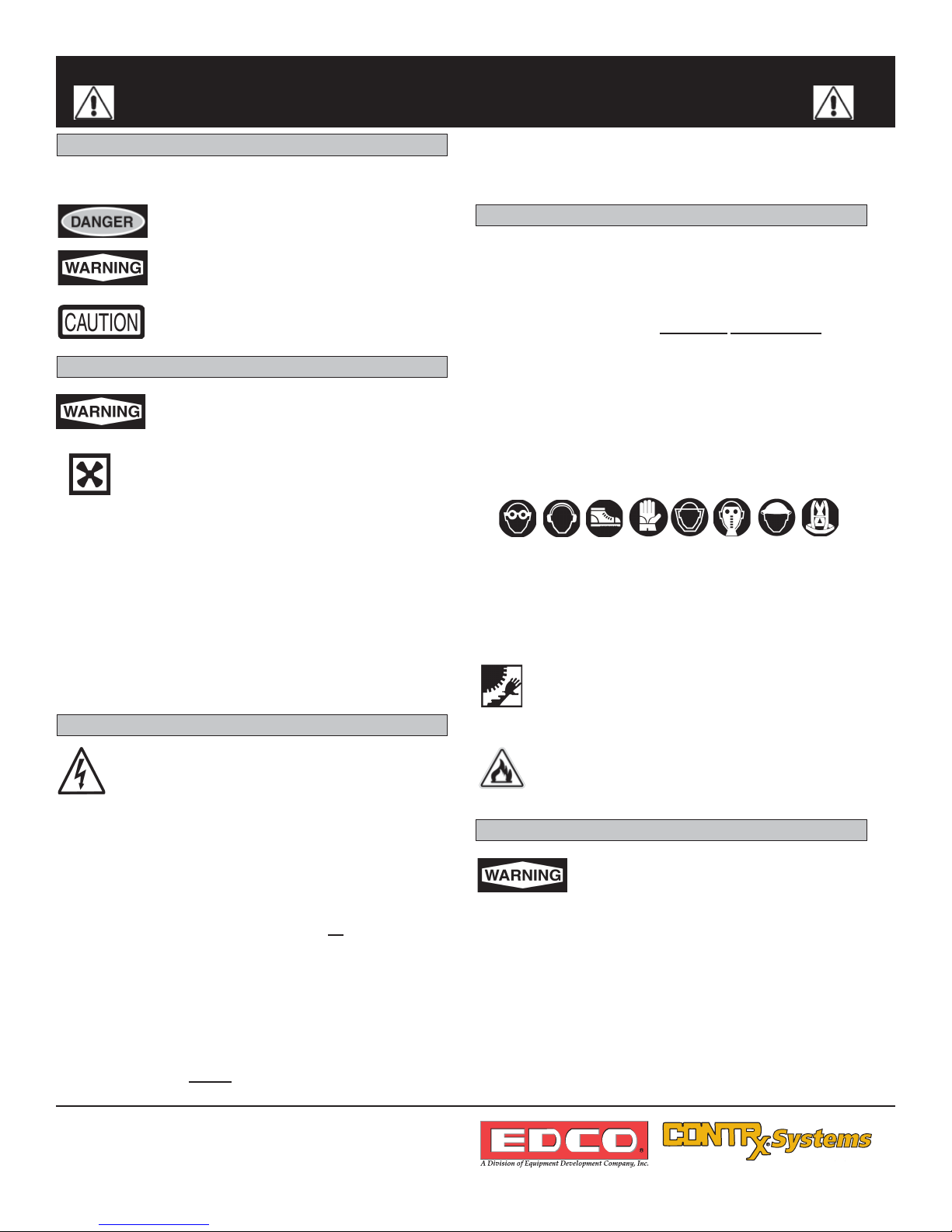
• Safety Instructions are proceeded by a graphic alert symbol
of DANGER, WARNING, or CAUTION.
SAFETY MESSAGES
Indicates an imminent hazard which, if not
avoided, will result in death or serious injury.
Indicates an imminent hazard which, if not
avoided, can result in death or serious injury.
Indicates hazards which, if not avoided, could
result in serious injury and or damage to the
equipment.
GASOLINE/PROPANE POWERED EQUIPMENT
• Engine exhaust from this product contains
chemicals known to the State of California to
cause cancer, birth defects or other reproductive harm.
• Gasoline is extremely fl ammable and poisonous.
It should only be dispensed in well ventilated areas,
and with a cool engine.
• Small gasoline engines produce high concentra-
tions of carbon monoxide (CO) example: a 5 HP 4 cycle
engine operation in an enclosed 100,000 cu. ft. area with
only one change of air per hour is capable of providing
deadly concentrations of CO in less than fi fteen minutes.
Five changes of air in the same area will produce noxious
fumes in less than 30 minutes. Gasoline or propane pow ered equipment should not be used in enclosed or partially
enclosed areas. Symptoms of CO poisoning include, head ache, nausea, weakness, dizziness, visual problems and
loss of consciousness. If symptoms occur - get into fresh
air and seek medical attention immediately.
ELECTRICAL POWERED EQUIPMENT
Extreme care must be taken when operating electric
models with water present: Ensure power cord is properly grounded, is attached to a Ground-Fault-Interrupter
(GFI) outlet, and is undamaged.
• Check all electrical cables - be sure connections are tight and
cable is continuous and in good condition. Be sure cable is
correctly rated for both the operating current and voltage of
this equipment.
• Improper connection of the equipment-grounding conductor can
result in a risk of electric shock. Check with qualifi ed electri-
cian or service person if there is any doubt as to whether the
outlet is properly grounded. Adhere to all local codes and
ordinances.
• NOTE: In the event of a malfunction or breakdown, grounding
provides a path of least resistance for the electric current to
dissipate. The motor is equipped with a grounded plug and
must be connected to an outlet that is properly installed and
properly grounded. DO NOT modify the plug provided on the
motor. If the plug does not fi t the outlet have a qualifi ed electri-
cian install the proper receptacle.
• Switch motor OFF before disconnecting power.
• Do not disconnect power by pulling cord. T o disconnect, grasp
the plug, not the cord.
• Unplug power cord at the machine when not in use and before
servicing.
GENERAL INSTRUCTIONS
• Equipment should only be operated by trained personnel in
good physical condition and mental health (not fatigued). The
operator and maintenance personnel must be physically able
to handle the bulk weight and power of this equipment.
• This is a one person tool. Maintain a safe operating distance
to other personnel. It is the operators’ responsibility to keep
other people (workers, pedestrians, bystanders, etc.) away
during operation. Block off the work area in all directions with
roping, safety netting, etc. for a safe distance. Failure to do so
may result in others being injured by fl ying debris or exposing
them to harmful dust and noise.
• This equipment is intended for commercial use only.
• For the operator’s safety and the safety of others, always keep
all guards in place during operation.
• Never let equipment run unattended.
• Personal Protection Equipment and proper safety attire must
be worn when operating this machinery. The operator must
wear approved safety equipment appropriate for the job such
as hard hat and safety shoes when conditions require. Hearing protection MUST be used (operational noise levels of this
equipment may exceed 90db). Eye protection MUST be worn
at all times.
Keep body parts and loose clothing away from moving
parts. Failure to do so could result in dismemberment
or death.
• Do not modify the machine.
• Stop motor/engine when adjusting or servicing this equipment.
Maintain a safe operating distance from fl ammable
materials. Sparks from the cutting-action of this machine
can ignite fl ammable materials or vapors.
DUST WARNING
Some dust created by power sanding, sawing,
grinding, drilling, and other construction activities contains chemicals known to cause cancer,
birth defects, or other reproductive harm. Some
examples of these chemicals are:
• Lead from lead-based paints, and
• Crystalline silica from bricks and concrete and other
masonry products.
Your risk of exposure to these chemicals varies depending
on how often you do this type of work. To reduce your risk:
work in a well ventilated area, use a dust control system, such
as an industrial-style vacuum, and wear approved personal
safety equipment, such as a dust/particle respirator designed
to fi lter out microscopic particles.
100 Thomas Johnson Drive, Frederick, MD 21702-4600 USA
Printed in USA
TVW
©2012
Page 2
Phone (301) 663-1600 • 1-800-638-3326
Fax (301) 663-1607 • 1-800-447-3326
Website: www.contrxsystems.com
Email: [email protected]
Page 2
E-SEC,2EC,2GC-P,4GC-I-0512
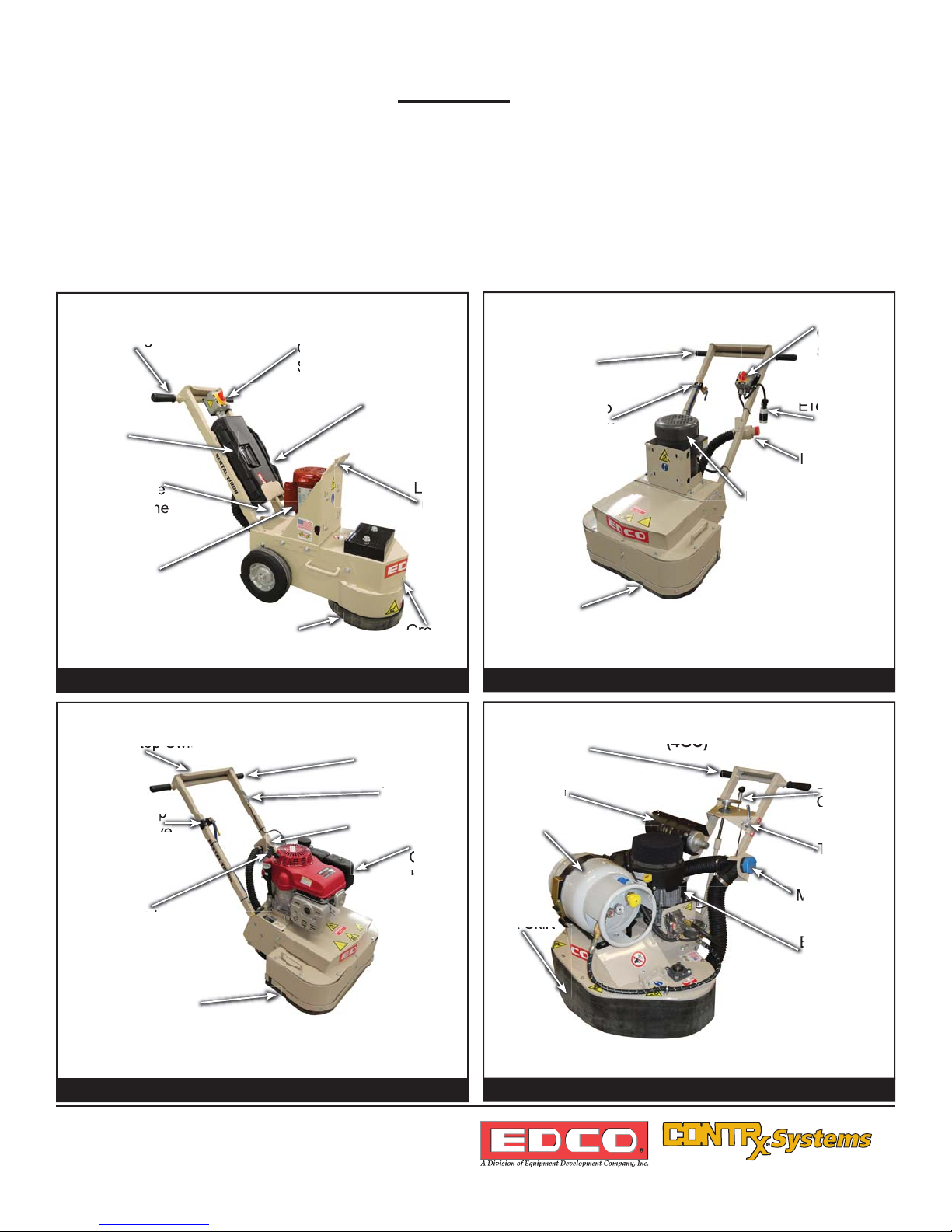
Operating Controls
Please Note:
Controls shown are for the model indicated.
The location of these controls may vary on the
different models.
Due to improvements and changes in the
equipment, the illustration shown may vary
from the actual machine.
Vibration
Dampening
Handles
Accessory
Box
Water Hook-up
and on/off valve
back of machine
Electric Motor
Engine Stop Switch
Water Hook-up
and on/off valve
Recoil
Starter Grip
Electric Powered
(SEC)
Dust Skirt
Figure 2
Power
On/Off
Switch
Gasoline Powered
(2GC)
Multi-Vac
Multi-Vac
Port
Grease
Cushioned
hand grips
Throttle
Port
Control
Lifting
Bail
point
Choke
hidden
Vibration
Dampening
Handles
Water Hook-up
and on/off valve
Dust Skirt
Vibration
Dampening
Handles
Muffl er
Propane
Tank
Dust Skirt
Electric Powered
(2EC)
Electric Motor
Figure 3
Propane Powered
(4GC)
Power
On/Off
Switch
Electrical
Plug
Multi-Vac
Port
Depth
Control
Throttle
Multi-Vac
Port
Electric
Starter
Dust Skirt
NOTE: Operating controls are the same for the gasoline
and propane models.
Figure 4
100 Thomas Johnson Drive, Frederick, MD 21702-4600 USA
Printed in USA
TVW
©2012
Page 4
Phone (301) 663-1600 • 1-800-638-3326
Fax (301) 663-1607 • 1-800-447-3326
Website: www.contrxsystems.com
Email: [email protected]
NOTE: Operating controls are the same for the gasoline
and propane models.
Figure 5
Page 3
E-SEC,2EC,2GC-P,4GC-I-0512
Operating Instructions
• Read and understand all operating instructions before operating this equipment. Death
or serious injury can result if this machine is used improperly.
• Concrete grinders are designed to be used to grind fl at horizontal concrete slabs using EDCO
approved accessories.
• The machines are equipped with gasoline/propane engines and electric motors.
• They are designed to be controlled by a single operator from a position at the rear of the machine.
• When operating equipment maintain a safe distance from other personnel in the area.
Be sure to read the complete instructions supplied with your machine.
IMPORTANT: Perform Pre-Start Check.
• Visually inspect the equipment for wear or damage.
• Be sure all guards are in place and functioning properly. Do not operate unless all guards are in place and secure.
• Perform all daily maintenance.
• Check to be sure water tubes are functioning properly if performing wet-grinding operations.
• Inspect accessories - Be sure the correct accessory is installed properly on the machine, mounting arrangement and
its intended use.
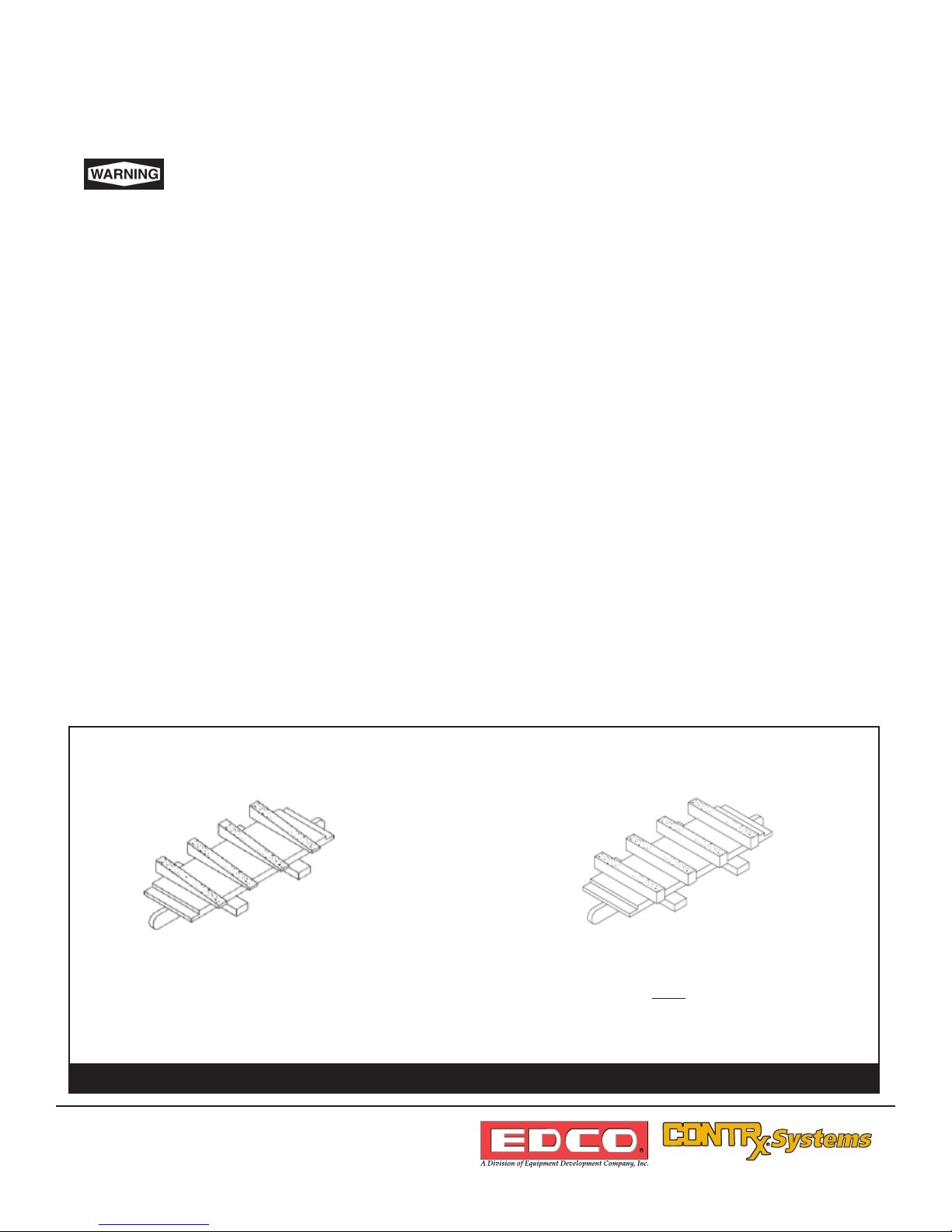
• Check accessories for damage (see fi gure 6, below), the type of wear or damage will vary with the type if acces-
sory.
• Inspect work area to determine the presence and location of deck inserts, pipes, columns and objects protruding from
the slab surface so that they may be avoided during the grinding operation.
• FOR WET GRINDING: Attach the water supply. A fl ow rate of approximately 1/2 gallon per minute is recommend-
ed.
EXAMPLE OF SEVERELY WORN
DYMA-SERT
The above in an example of a DYMA-SERT that has
not been rotated after every four hours of use. To get
maximum life out of a DYMA-SERT they should be
rotated 180º every four hours of use.
100 Thomas Johnson Drive, Frederick, MD 21702-4600 USA
Printed in USA
TVW
©2012
Page 6
Phone (301) 663-1600 • 1-800-638-3326
Fax (301) 663-1607 • 1-800-447-3326
Website: www.contrxsystems.com
Email: [email protected]
EXAMPLE OF AN EVENLY WORN
DYMA-SERT
The above in an example of a DYMA-SERT that has
been rotated after every four hours of use, as you
can see the wear is even across all segments.
Figure 6
Page 4

E-SEC,2EC,2GC-P,4GC-I-0512
Operating Instructions
• BEFORE STARTING THE ENGINE: Raise the front of the machine clear of the working surface.
• START ENGINE AND ALLOW IT TO REACH OPERATING SPEED. Position the grinder at the starting point.
Bring the engine to full speed. Lower the machine onto the slab surface. Use a slow sweeping motion from left right
and back continously, and do not force the machine into the work, the engine or motor should not strain
when grinding.
• WHEN WET GRINDING: Water is required. Attach the water hose to the water hook-up valve. Use the valve to
control the fl ow of water.
• FOR DRY GRINDING: Provide a respirator and dust control system.
• FOR GASOLINE MODELS: Put the engine stop switch in the “RUN” position. Consult the engine manufac-
turers operating instructions and follow the directions for starting and breaking in the engine.
• TO STOP THE MACHINE: Stop forward motion. On gasoline models push the throttle to idle. Turn ignition
or power switch off and let the engine come to a complete stop. Turn off the water supply.
• WHEN MANEUVERING THE GRINDER: Tilt grinder back enough so it does not strike the slab surface. Damage to
accessories may occur with inadvertent contact with the slab.
• DO NOT FORCE GRINDER WHILE GRINDING.
• IF THE POWER SOURCE FAILS: Raise the grinder off of the fl oor. Disconnect the power source (i.e. the
spark plug wire on a gasoline engine). Inspect the accessories for damage. Replace damaged (or questionable)
accessories immediately.
• WHEN TRANSPORTING THE GRINDER: Disconnect the power source before lifting or removing any guard.
See the directions for changing accessories on page 9.
• WHEN HOISTING OR LIFTING A GRINDER : Always inspect frame and attaching hardware for damage
before lifting. Use proper safe hoisting and lifting techniques and hardware.
SMI Dust and Silica Warning
Grinding/cutting/drilling of masonry , concrete, metal and other materials can generate dust, mists and fumes containing
chemicals known to cause serious or fatal injury or illness, such as respiratory disease, cancer, birth defects or other
reproductive harm. If you are unfamiliar with the risks associated with the particular process and/or material being
cut or the composition of the tool being used, review the material safety data sheets and/or consult your employer,
the manufacturers/suppliers, governmental agencies such as OSHA and NIOSH and other sources on hazardous
materials. California and some other authorities, for instance, have published lists of substances known to cause
cancer, reproductive toxicity, or other harmful effects.
Control dust, mist and fumes at the source where possible. In this regard use good work practices and follow the recom-
mendations of the manufacturers/suppliers, OSHA/NIOSH, and occupational and trade associations. Water should
be used for dust suppression when wet grinding/cutting/drilling is feasible. When the hazards from inhalation of dust,
mists and fumes cannot be eliminated, the operator and any bystanders should always wear a respirator approved
by NIOSH/MSHA for the material being used.
Grinding/cutting/drilling of masonry, concrete and other materials with silica in their composition may give off dust or
mists containing crystalline silica. Silica is a basic component of sand, quartz, brick clay, granite and numerous
other minerals and rocks. Repeated and/or substantial inhalation of airborne crystalline silica can cause serious or
fatal respiratory diseases, including silicosis. In addition, California and some other authorities have listed respirable
crystalline silica as a substance known to cause cancer. When grinding/cutting/drilling such materials, always follow
the respiratory precautions mentioned above.
100 Thomas Johnson Drive, Frederick, MD 21702-4600 USA
Phone (301) 663-1600 • 1-800-638-3326
Fax (301) 663-1607 • 1-800-447-3326
Website: www.contrxsystems.com
Email: [email protected]
Printed in USA
TVW ©2012
Page 7
Page 5
E-SEC,2EC,2GC-P,4GC-I-0512
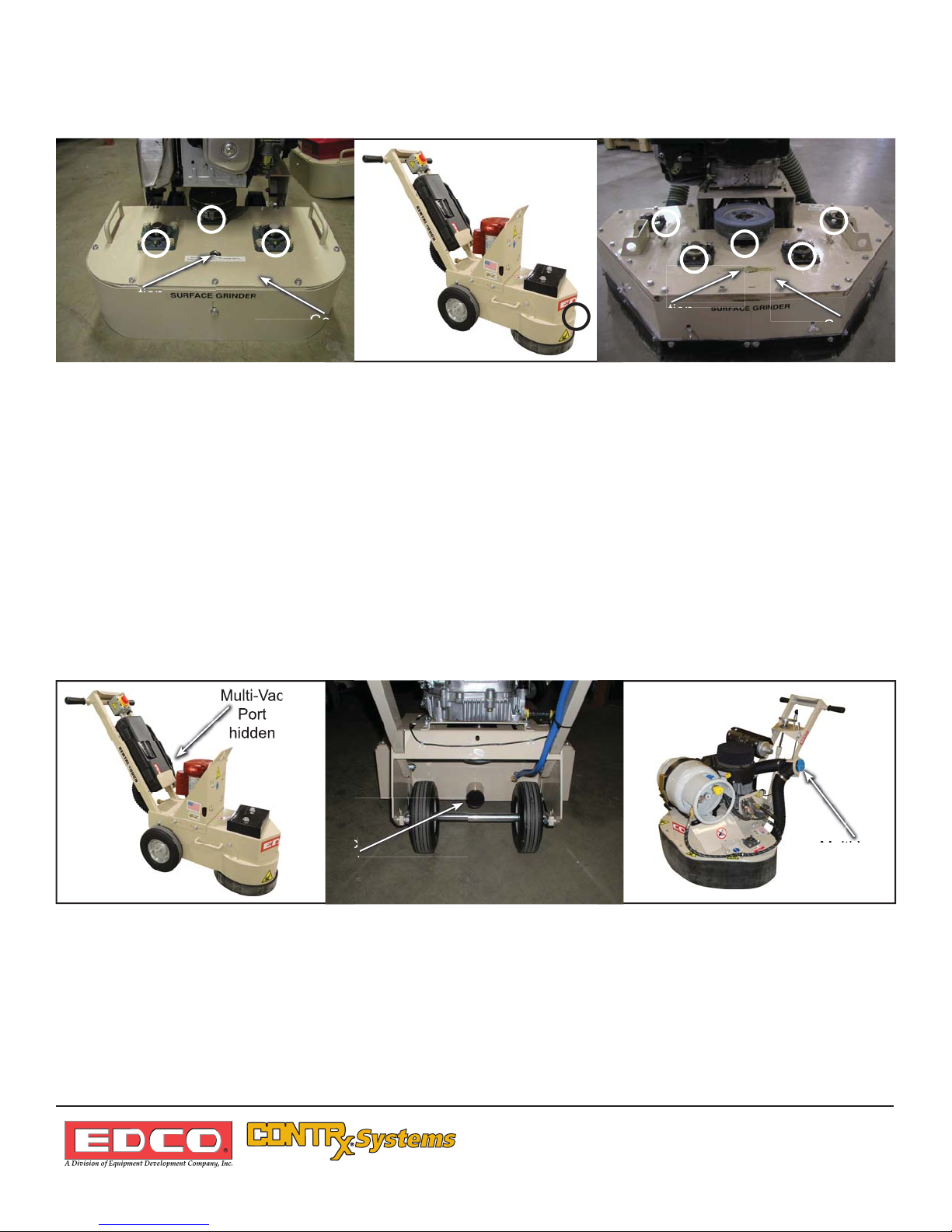
PROCEDURE FOR LUBRICATING FLANGE BEARINGS
Inspection
hole
Gear
case
The procedure is the same for two or four disc machines. The hood has to be removed to access the grease points on the
fl ange bearings. The single disc grinder is lubricated through the access hole on the front of the machine and under the belt
cover. The grease points are circled in the photos above. There are duplicate grease fi ttings on the underside of the 2EC,
2GC and the 4GC models. The skirts will have to be removed to access the grease points.
To grease the fl ange bearings attach the grease gun to the grease fi ttings and give only two (2) pumps on the grease gun
every 50 hours of use. If excessive over lubrication is done grease will leak onto the work surface causing possible damage and wasted cleanup time.
Inspection
hole
Gear
case
PROCEDURE FOR ATTACHING A V ACUUM
Multi-Vac
Port
hidden
Vac
Port
SEC
2GC
4GC
If using a vacuum for dust control attach it to the vacuum port at the rear of the machine except for the SEC and 4GC
which is on the handle as pictured above, securing it with clamps. The ports are shown in the photos above.
Multi-Vac
Port
100 Thomas Johnson Drive, Frederick, MD 21702-4600 USA
Phone (301) 663-1600 • 1-800-638-3326
Fax (301) 663-1607 • 1-800-447-3326
Website: www.contrxsystems.com
Email: [email protected]
Printed in USA
TVW ©2012
Page 13
 Loading...