

Page 1
Instruction Manual 742
5/1/2009
Eclipse
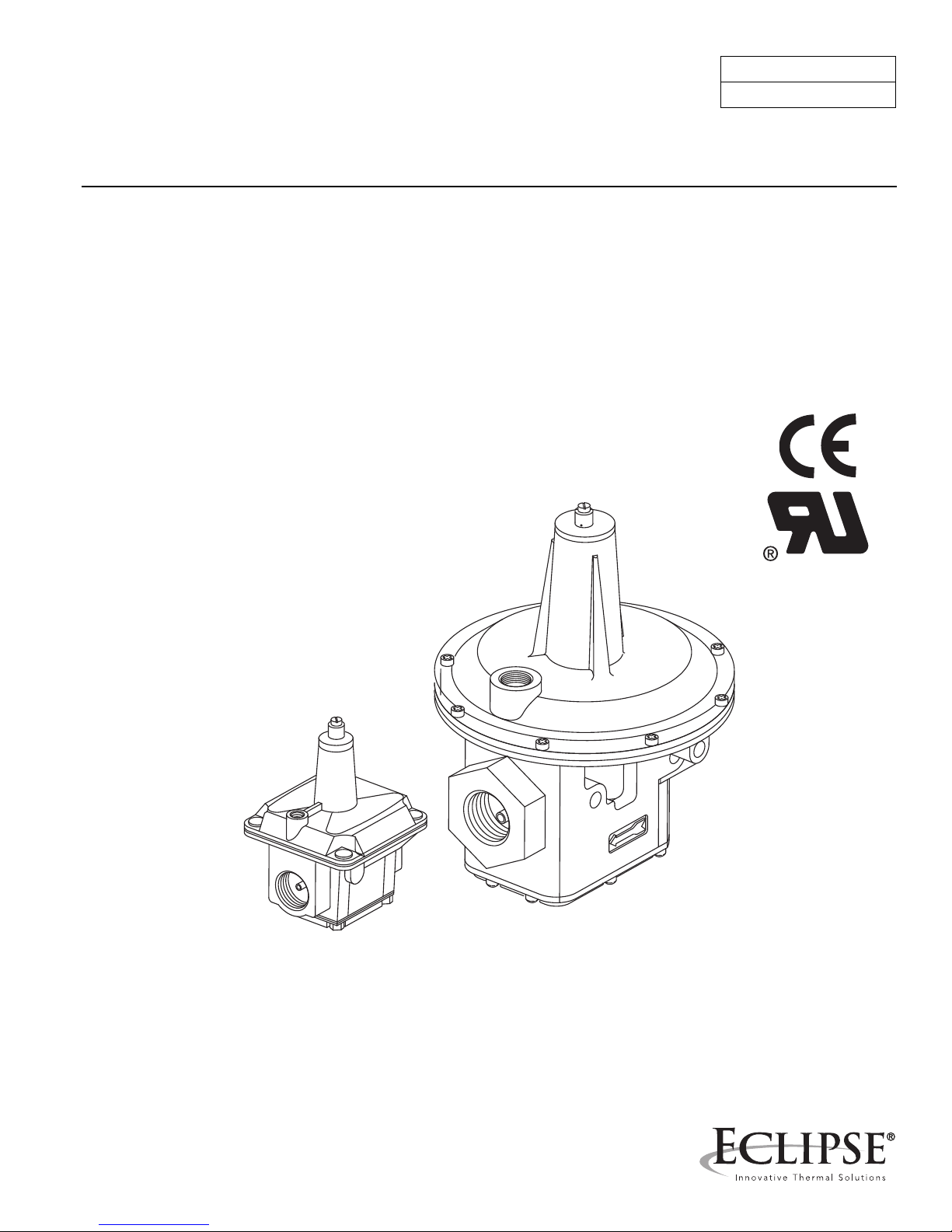
Ratio Regulators
ES Series
Version 1
Page 2

Copyright
This is the safety alert symbol. It is used to alert you to potential personal
injury hazards. Obey all safety messages that follow this symbol to avoid
possible injury or death.
Indicates a hazardous situation which, if not avoided, will result in death
or serious injury.
Indicates a hazardous situation which, if not avoided, could result in
death or serious injury.
Indicates a hazardous situation which, if not avoided, could result in
minor or moderate injury.
Is used to address practices not related to personal injury.
Indicates an important part of text. Read thoroughly.
NOTE
NOTICE
WARNING
CAUTION
Copyright 1997 by Eclipse, Inc. All rights reserved
worldwide. This publication is protected by federal
regulation and shall not be copied, distributed,
transmitted, transcribed or translated into any human or
computer language, in any form or by any means, to any
third parties, without the express written consent of
Eclipse, Inc.
It must be understood that Eclipse’s liability for its product,
whether due to breach of warranty, negligence, strict
liability, or otherwise is limited to the furnishing of
replacement parts and Eclipse will not be liable for any
other injury, loss, damage or expenses, whether direct or
consequential, including but not limited to loss of use,
income, or damage to material arising in connection with
the sale, installation, use of, inability to use, or the repair
or replacement of Eclipse’s products.
Disclaimer Notice
In accordance with the manufacture’s policy of continual
product improvement, the product presented in this
brochure is subject to change without notice or obligation.
The material in this manual is believed adequate for the
intended use of the product. If the product is used for
purposes other than those specified herein, confirmation
of validity and suitability must be obtained. Eclipse
warrants that the product itself does not infringe upon any
United States patents. No further warranty is expressed or
implied.
Liability and Warranty
We have made every effort to make this manual as
accurate and complete as possible. Should you find errors
or omissions, please bring them to our attention so that we
may correct them. In this way we hope to improve our
product documentation for the benefit of our customers.
Please send your corrections and comments to our
Marketing Communications Manager.
Any operation expressly prohibited in this manual, any
adjustment, or assembly procedures not recommended or
authorized in these instructions shall void the warranty.
Document Conventions
There are several special symbols in this document. You
must know their meaning and importance.
The explanation of these symbols follows below. Please
read it thoroughly.
How To Get Help
If you need help, contact your local Eclipse representative.
You can also contact Eclipse at:
1665 Elmwood Rd.
Rockford, Illinois 61103 U.S.A.
Phone: 815-877-3031
Fax: 815-877-3336
http://www.eclipsenet.com
2
Eclipse Ratio Regulator, V1, Instruction Manual 742, 5/1/2009
Page 3

Table of Contents
Introduction............................................................................................................................... 4
Product Description.............................................................................................................. 4
Safety......................................................................................................................................... 5
Safety Warnings................................................................................................................... 5
Capabilities .......................................................................................................................... 5
Operator Training................................................................................................................. 5
Replacement Parts .............................................................................................................. 5
Specifications ........................................................................................................................... 6
Compatability/Temperature Specifications .......................................................................... 6
Model Specifications ............................................................................................................6
Flow vs Pressure Drop......................................................................................................... 6
Dimensions .......................................................................................................................... 7
Design & Installation ................................................................................................................ 9
General Information .............................................................................................................9
Ratio Regulator/Pipe Connections....................................................................................... 9
Gas Bias Adjustment ........................................................................................................... 10
Eclipse Ratio Regulator, V1, Instruction Manual 742, 5/1/2009
3
Page 4
Introduction
WARNING
1
Product Description
The ES-Series Ratio Regulators are used in applications
where gas to air proportional flow is required. The gas flow
is controlled as a function of the air pressure through a
loading line which connects into the top of the regulator.
As the system air pressure increases, it forces the ratio
regulator valve to open causing the outlet pressure to
increase until the two pressures balance. As the load line
pressure increases, the ratio of the outlet pressure to the
load line pressure will be slightly less than 1:1.
The ratio regulators have a bias adjustment for varying the
gas flow when setting the burner at low fire. It can be used
to increase or decrease the gas flow resulting in gas rich
or lean combustion. The adjustment is restricted in the
gas rich direction therefore limiting the gas flow at zero air
pressure.
■ The ratio regulators are control valves only and
cannot be used as gas shut-off valves.
Product Features
The ratio regulators are designed to optimize performance
as ambient temperature and inlet pressure vary. Features
include:
• UL recognized and CE approved for natural gas,
propane, and butane.
• Valve seat design for consistent low fire
repeatability.
• Balanced double diaphragm design allows regulator
to operate over a wide range of inlet pressures while
minimally affecting outlet pressure.
• Rugged die cast aluminum housing.
• Corrosion resistant internal components.
• Synthetic rubber diaphragms for excellent low
temperature performance.
• Inlet pressure tap with connector (1-1/2", 2" & 3"
NPT (Rp) models only).
Audience
This manual has been written for people who are already
familiar with all aspects of a combustion system and its
add-on components, also referred to as “the burner
system”.
The audience is expected to have had experience with the
ratio regulator component of a burner system.
Purpose
The purpose of this manual is to make sure that the ratio
regulator component of a burner system is used in a safe,
effective and trouble free manner.
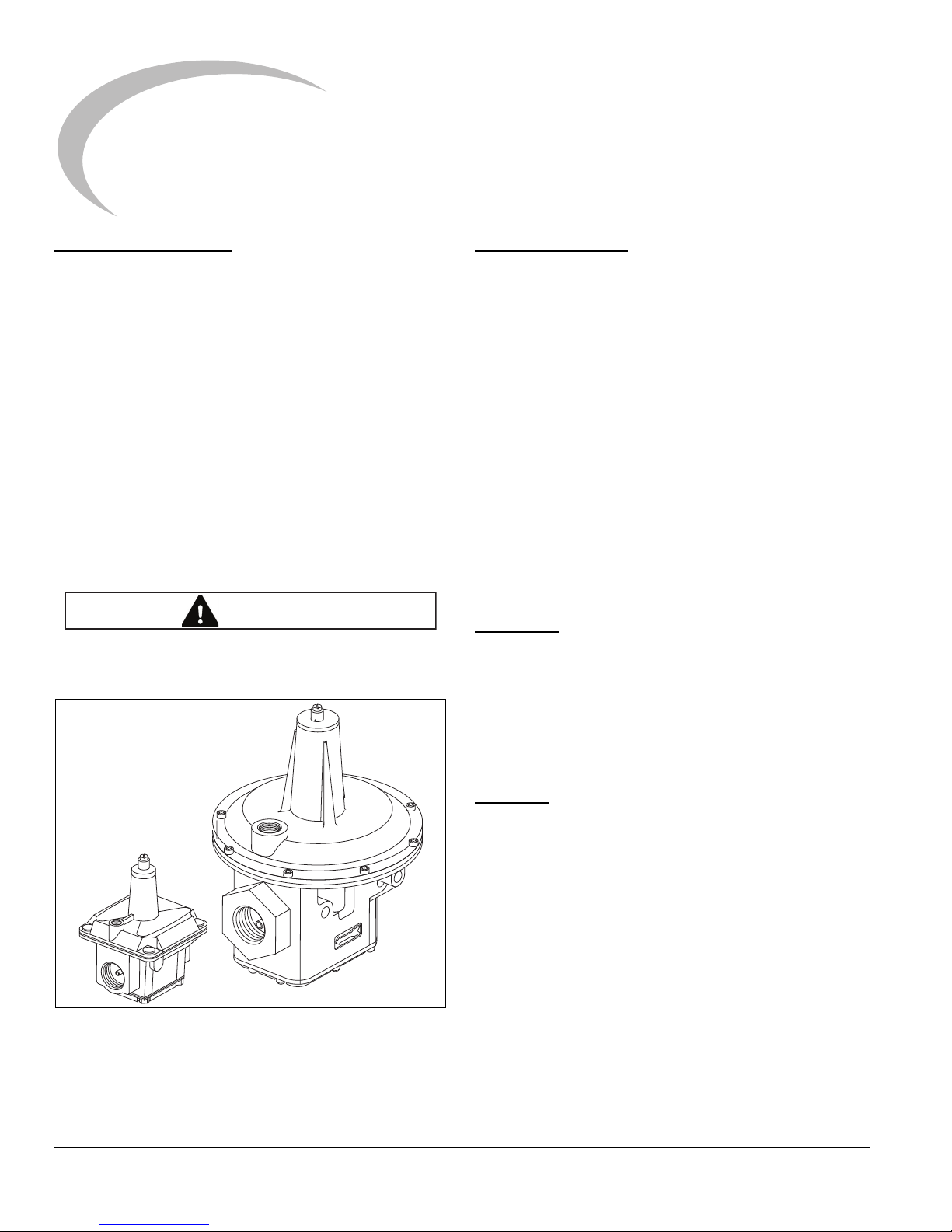
Figure 1.1. Ratio Regulators
4
Eclipse Ratio Regulator, V1, Instruction Manual 742, 5/1/2009
Page 5

Safety
DANGER
NOTICE
2
Important notices about safe ratio regulator operation will
be found in this section. Read this entire manual before
attempting to start the system. If any part of the
information in this manual is not understood, contact
Eclipse before continuing
Safety Warnings
■ Do not bypass any safety feature. Fires and
explosions can be caused.
■ Never try to use a ratio regulator that shows signs
of damage or appears to be malfunctioning.
■ This manual gives information for the use of these
ratio regulators within their specific design
purpose. Do not deviate from any instructions or
application limits in this manual without written
advice from Eclipse.
Capabilities
Adjustment, maintenance and troubleshooting of the
mechanical parts of this system should be done by
qualified personnel with good mechanical aptitude and
experience with combustion equipment.
Operator Training
The best safety precaution is an alert and competent
operator. Thoroughly instruct operators so they
demonstrate an understanding of the equipment and its
operation.
Replacement Parts
Order replacement ratio regulators from Eclipse only.
Eclipse Ratio Regulator, V1, Instruction Manual 742, 5/1/2009
5
Page 6

CAUTION
Specifications
3
Compatibility/Temperature Specifications
Tab le 3.1
Ambient Temperature
Compatible Gases
Natural
Manufactured
Mixed
Vaporized Liquified Petroleum
LP Gas-Air Mixture
■ Below 32°F (0°C), the gas must be free of water
vapor which could condense and freeze within the
valve.
Range
-40°F to 205°F
(-40°C to 96.1°C)
Model Specifications
Table 3.2
Model Part No. Pipe Thread
ES365 19997 3/4" NPT 1.0 psi 1,245 scfh
ES365M 19998 Rp 3/4 69.2 mbar 35.27 Nm3/hr
ES366 15939 1" NPT
ES366M 19999 Rp 1 69.2 mbar 39.09 Nm3/hr
ES363 20312 1-1/2" NPT
ES363M 20311 Rp 1-1/2 346.2 mbar 179.9 Nm3/hr
ES368 10315 2" NPT
ES368M 19990 Rp 2 346.2 mbar 328.6 Nm3/hr
ES369 10316 3" NPT
ES369M 19989 Rp 3 346.2 mbar 736.5 Nm3/hr
1
Gas inlet pressure must be greater than the total of the outlet pressure plus the pressure drop across the regulator at the required
flow.
2
Capacity for natural gas (0.60 sg). When using propane or butane, divide capacity by conversion factors listed in Table 3.3.
Maximum Inlet
Pressure
1.0 psi 1,380 scfh
5.0 psi 6,350 scfh
5.0 psi 11,600 scfh
5.0 psi 26,000 scfh
1
Capacity
2
6
Eclipse Ratio Regulator, V1, Instruction Manual 742, 5/1/2009
Page 7

10.0
8.75
7.5
6.25
5.0
3.75
2.5
1.25
0.0
0200
5.66
400
11.33
600
16.99
800
22.66
1000
28.32
1200
33.99
1400
39.66
1600
45.32
Model ES365 & ES365M
Model ES366 & ES366M
Capacity, scfh
∆P "wc
4.0
3.5
3.0
2.5
2.0
1.5
1.0
0.5
∆P mbar
0.0
Capacity, Nm³/hr
0
87.5
75
Figure 3.1. Flow vs Pressure Drop, 3/4" & 1" NPT (Rp) Models
35
30
62.5
37.5
∆P mbar
12.5
50
25
0
25
20
15
∆P "w.c.
10
5
0
05,000
0
141.6
10,000
Capacity, scfh
283.3
Capacity, Nm3/hr
Figure 3.2. Flow vs Pressure Drop, 1-1/2", 2" & 3" NPT (Rp) Models
NOTE:
Above graphs are for natural gas (0.60 s.q.). For
propane or butane, multiply the gas flow by the factors
listed below, to calculate the equivalent natural gas flow,
then find the pressure drop from the previous graphs.
Propane (1.5 s.g.) 1.58
Butane (2.0 s.q.) 1.82
Table 3.3 Conversion Factors
Gas Conversion Factor
15,000
424.9
Model ES363, ES363M
Model ES368, ES368M
Model ES369, ES369M
20,000
566.5
25,000
708.2
30,000
849.8
Example: Find the pressure drop created by 15,000 scfh
of propane through an ES369 ratio regulator.
1. Convert propane to the equivalent natural gas flow:
15,000 x 1.58 = 23,700 scfh
2. Plot the point where 23,700 scfh crosses the ES369
curve on the above graph.
3. Translate the intersection point back to the pressure
drop axis.
4. The pressure drop at 23,700 scfh natural gas,
equivalent to 15,000 scfh propane, is approximately
23.5" w.c.
Eclipse Ratio Regulator, V1, Instruction Manual 742, 5/1/2009
7
Page 8

Figure 3.3. Dimensions in inches (mm), Models ES365 (M) & ES366 (M)
3-7/8
(98.4)
1-1/2
(38.1)
5-11/16
(144.5)
1/8" NPT
Load Line
2-3/8
(60.3)
Inlet
ES365(M) 3/4" NPT (Rp 3/4)
ES366(M) 1" NPT (Rp 1)
4
(101.6)
Outlet
ES365(M) 3/4" NPT (Rp 3/4)
ES366(M) 1" NPT (Rp 1)
4-7/8
(123.8)
Outlet End View
Swing
Radius
E
A
C
Inlet
B Dia.
D
F
Load Line
Outlet End View
Swing
Radius
Inlet Pressure Tap
1
Inlet Test
Tap Connector
2
1
1/4" taper pipe plug on ES363(M) and ES368(M). No tap this side on ES369(M).
2
1/8" taper test tap connector, 0.34" OD (8.6 mm) for slip-on hose.
Outlet
Figure 3.4. Dimensions in inches (mm), Models ES363 (M), ES368 (M) & ES369 (M)
Table 3.4
Model Swing Radius Inlet/Outlet A B C D E F
ES363 6-3/16" 1-1/2" NPT 9" 7" 5-1/2" 2-3/8" 3-3/4" 1/2" NPT
ES363M 157.1 mm Rp 1-1/2 228.6 mm 177.8 mm 139.7 mm 60.3 mm 92.2 mm Rp 1/2
ES368 9-3/16" 2" NPT 11-1/4" 9-1/8" 7-5/8" 3-1/8" 4-5/16" 3/4" NPT
ES368M 233.4 mm Rp 2 285.7 mm 231.7 mm 193.6 mm 79.3 mm 109.5 mm Rp 3/4
ES369 13-1/4" 3" NPT 16-1/16" 13-7/16" 10-3/8" 4-7/8" 6-1/8" 3/4" NPT
ES369M 336.6 mm Rp 3 407.9 mm 341.3 mm 263.5 mm 123.8 mm 155.5 mm Rp 3/4
8
Eclipse Ratio Regulator, V1, Instruction Manual 742, 5/1/2009
Page 9

WARNING
CAUTION
Design & Installation
4
Design
To select the ratio regulator best suited for a combustion
system, several parameters need to be considered. The
following steps identify those items that need to be
considered when selecting a ratio regulator.
Ratio Regulator selection based on flow:
• Define the maximum gas flow required for the
system.
• Identify the ratio regulator for that flow based on the
capacities listed in Table 3.2 of the “Specifications”
section.
Minimum inlet pressure calculation:
• Define the pressure drop through the ratio regulator
based on the Flow vs. Pressure Drop curves
(Figures 3.1 and 3.2) and conversion factors listed
in the “Specifications” section.
• Calculate the pressure losses through components
mounted between the ratio regulator and the burner.
• Define the gas pressure required at the burner.
• Calculate the minimum inlet pressure to ratio
regulator by taking 125% of the sum between the
ratio regulator drop, component drops and burner
pressure.
• Verify that the inlet pressure is within the ratio
regulator limit. If not, make the necessary changes
to the ratio regulator or the upstream pressure
control.
■ Shut off gas supply before installing or removing
the ratio regulator
General Installation Information
• Gas flow through the ratio regulator must be in the
direction of the arrow on the body.
• Make sure the gas is compatible per Table 3.1.
• Ambient temperature at the valve location must
remain between 40°F and 205°F (-40°C and
96.1°C).
• The ratio regulator must be mounted with the spring
tower in the vertical upright position.
• Allow clearance above the ratio regulator to allow
access to the bias adjustment.
• Pipe ends are to be free of foreign material
(excluding pipe dope) before connecting into the
ratio regulator body.
• Do not use the ratio regulator to support adjacent
piping.
Regulator/Pipe Connections
1. Remove the protective caps from the ends of the ratio
regulator.
2. Apply a moderate amount of pipe dope to the male
pipe threads only.
NOTE:
set thus affecting pressure regulation.
■ Regulator must be installed with spring tower
3. Install the ratio regulator with the flow in the direction
Excessive pipe dope could contaminate the valve
pointing upward, with flow in the direction of the
cast arrow on regulator body.
of the flow arrow on the body.
Eclipse Ratio Regulator, V1, Instruction Manual 742, 5/1/2009
4. When tightening the pipe into the valve body, hold the
end of the regulator adjacent to that pipe.
9
Page 10

5. Connect the air pressure loading line into the vent on
the top of the ratio regulator. The ratio regulators can
be adjusted to bias the gas outlet pressure relative to
the combustion air pressure when setting low fire
flows. Adjust the regulator as described below.
Gas Bias Adjustment
NOTE: Gas-rich adjustment is limited. If the spring
adjustment will not produce the desired outlet pressure,
make sure that the supply pressure is at least equal to the
desired outlet pressure plus the pressure drop across the
regulator at the required flow.
1. Set the burner air flow to low fire according to the
instructions furnished with the burner.
2. Open the gas shut-off valves to allow gas flow to the
burner. Ignite the burner.
3. Measure the fuel/air ratio using a flue gas analyzer,
metering orifices or estimate the ratio from flame
appearance. Use a screw driver to turn the adjusting
screw clockwise to increase the outlet pressure or
counterclockwise to decrease to outlet pressure.
Figure 5.1. Adjustment of Outlet Pressure
4. Turn the combustion air to high fire and make sure the
burners stay lit.
NOTE:
Some models are equipped with a pressure tap on
the upstream side. It is open when the screw inside the tap
is unscrewed approximately 1/2 a turn.
10
Eclipse Ratio Regulator, V1, Instruction Manual 742, 5/1/2009
Page 11

NOTES
Eclipse Ratio Regulator, V1, Instruction Manual 742, 5/1/2009
11
Page 12

Instruction Manual 742, 5/1/2009
 Loading...