

Page 1
®
DT 23 DT 24 DT 32 DT 33 DT 34 DT 44
Operating Manual
www.duratruss.com
DURATRUSS B.V.
Junostraat 2
6468 EW Kerkrade
The Netherlands
DURATRUSS - www.duratruss.com – Operating Manual Page 1
Page 2

DURATRUSS Table of Contents
Introduction………………………..………………………………………………..…… 2
Transport and storage………...…………………………………………………..…… 3
DT 23 Specifications..…………………………………………………………….…… 3
DT 24 Specifications..…………………………………………………………….…… 4
DT 32 Specifications..…………………………………………………………….…… 4
DT 33 Specifications..…………………………………………………………….…… 5
DT 34 Specifications..…………………………………………………………….…… 5
DT 44 Specifications..…………………………………………………………….…… 6
Periodic safety inspection……………………………………………………………... 7
Inspection criteria………………………………………………………………………. 7
Visual inspection……………………………………………………………………….. 8
Assembly…………………………………………………………..……………………. 9
General use…………………………………………………………………………….. 9
Installation over an audience…………………………………………………………. 10
Maintenance ......................................................................................................... 11
DURATRUSS Introduction
General instructions: For your safety, it is recommended that you thoroughly read and
understand this operating manual before you use the truss systems. The instructions in this
operating manual contain important information on safety and maintenance during use.
All persons who have anything to do with this product in whatsoever manner should take note of
all the information in this operating manual and be knowledgeable regarding the construction of
truss systems.
Introduction: Thank you for choosing to purchase a DURATRUSS product. The DT 23, DT 24,
DT 32, DT 33, DT 34 and DT 44 DURATRUSS series is a high quality TÜV-tested truss with
conical clutches, which is produced according to the strictest standards.
Due to their compactness, strength and flexibility, the DT 23, DT 24, DT 32, DT 33, DT 34 and DT
44 series is multifunctional and is ideally suited for all fixed installations, hiring and exhibition
stands and booths due to its unlimited fields of application.
Products from the DT 23, DT 24, DT 32, DT 33, DT 34 and DT 44 series can be connected
together for longer spans. In combination with corners, tee or cross pieces and/or Box Corners,
complex designs can be assembled.
The DT 23, DT 24, DT 32, DT 33, DT 34 and DT 44 series was not designed to carry people. If a
structure for carrying people is needed, the local resistance and safety standards must be
observed.
DURATRUSS - www.duratruss.com – Operating Manual Page 2
Page 3
DURATRUSS Transport and storage
Warning!
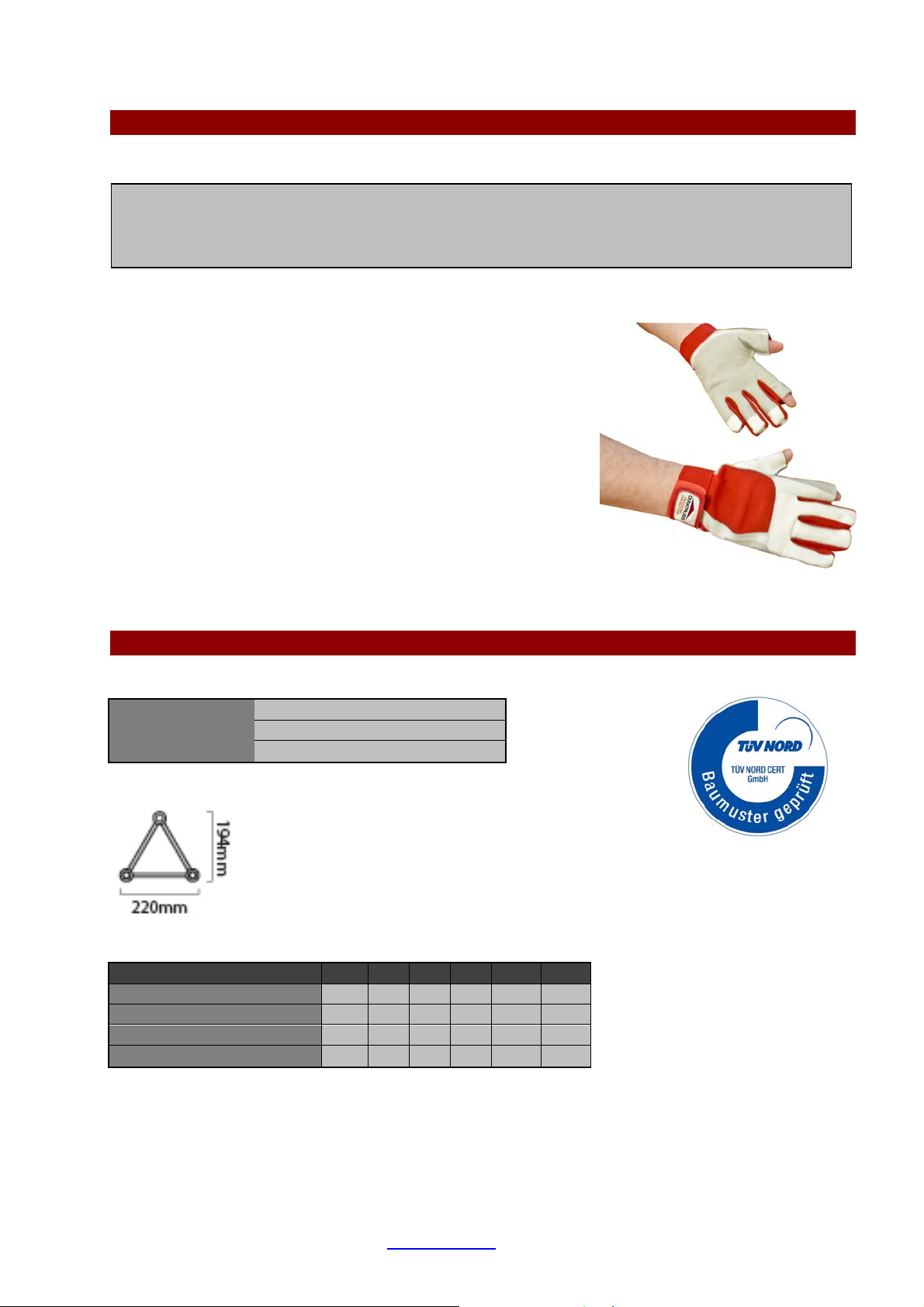
Always wear safety shoes and protective gloves for transporting as well as installation and
dismantling of the truss structure.
Treat the trusses with caution. Do not drop them or drag
them on the ground, and do not throw truss parts on top of
one another.
Protect the trusses from sharp objects.
Vertical transport or storage should be avoided. The risk of
the trusses falling is too great.
The transport and storage in truss-dollies in combination
with truss-carriers is the best solution. It simplifies transport
and storage, and protects the trusses during transport.
DURATRUSS - DT 23 Specifications
Main pipe
Connecting pipes
Aluminium
35 x 2 mm
8 mm
EN-AW 6060 T66 (AIMgSi0,5 T66)
Load table DT 23 2m 4m 6m 8m 10m 12m
Point load (kg)
Deflection (mm)
Distributed load (kg / m)
Deflection (mm)
89 79 63 41 33 24
0.8 3.9 8.95 17.2 28.5 43.2
215 62 23 14 8 5
2.1 7 10.9 21.8 37.5 55.4
DURATRUSS - www.duratruss.com – Operating Manual Page 3
Page 4
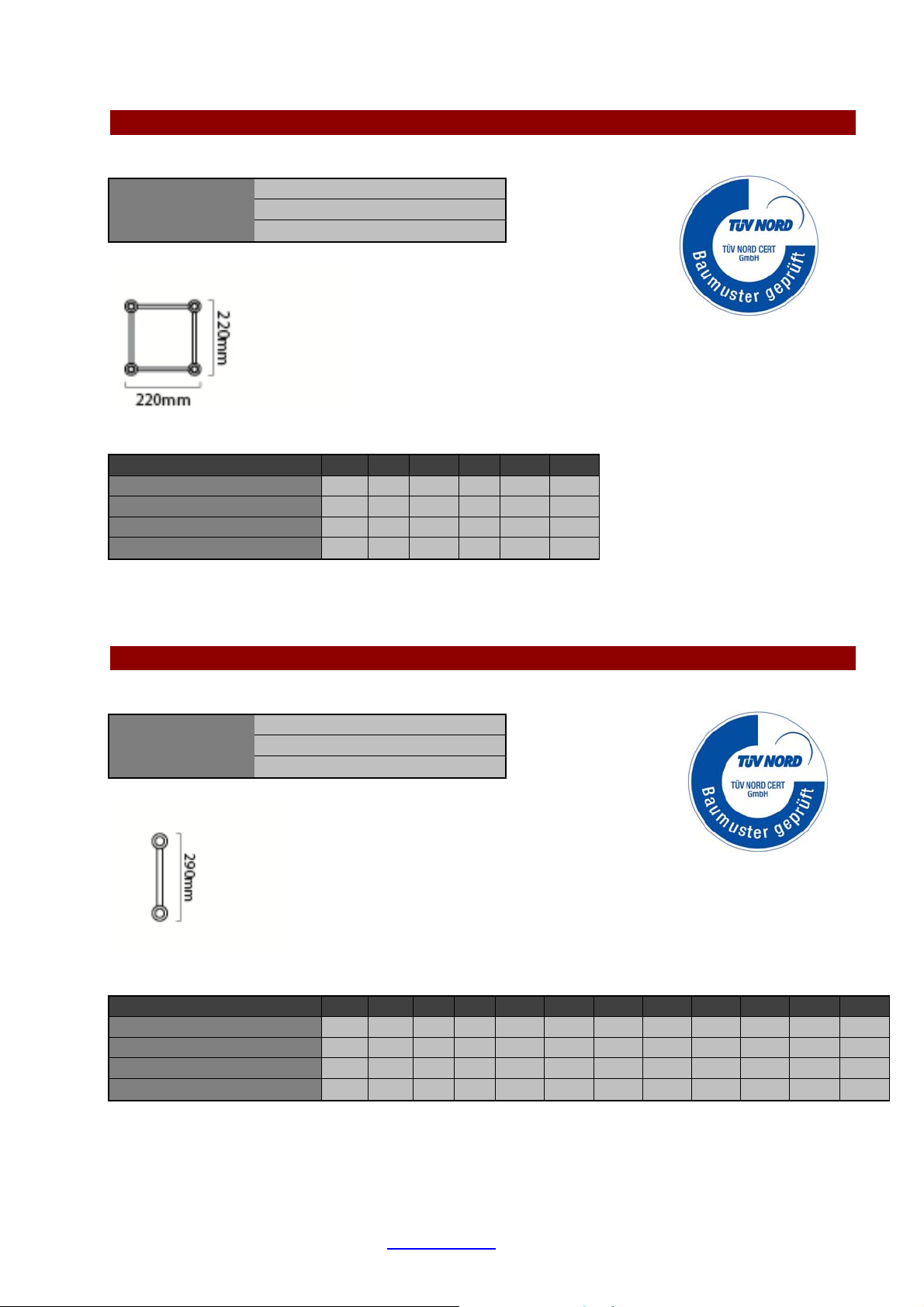
DURATRUSS - DT 24 Specifications
Main pipe
Connecting pipes
Aluminium
35 x 2 mm
8 mm
EN-AW 6060 T66 (AIMgSi0,5 T66)
Load table DT 24 2m 4m 6m 8m 10m 12m
Point load (kg)
Deflection (mm)
Distributed load (kg / m)
Deflection (mm)
178 122 104 86 71 59
1.2 3.8 12 22.1 38.16 64.15
375 105 40 23 11 8
2.5 7.7 16.76 32.6 44.12 60.6
DURATRUSS - DT 32 Specifications
Main pipe
Connecting pipes
Aluminium
50 x 2 mm
20 x 2 mm
EN-AW 6082 T66 (AIMgSi0,5 T66)
Load table DT 32 1m 2m 3m 4m 5m 6m 7m 8m 9m 10m 11m 12m
Point load (kg)
Deflection (mm)
Distributed load (kg / m)
Deflection (mm)
1200 1040 670 500 420 340 300 250 230 200 180 160
2.3 5.3 11 13.3 20.5 28 38.7 47.7 62.5 74.4 89.9 104.5
1200 652 400 219 144 97 74.3 58.1 45 35.1 29.2 25.1
2.3 5.4 8.7 16.2 23.9 33.9 46.5 58.2 72.3 88 105.5 126.1
DURATRUSS - www.duratruss.com – Operating Manual Page 4
Page 5
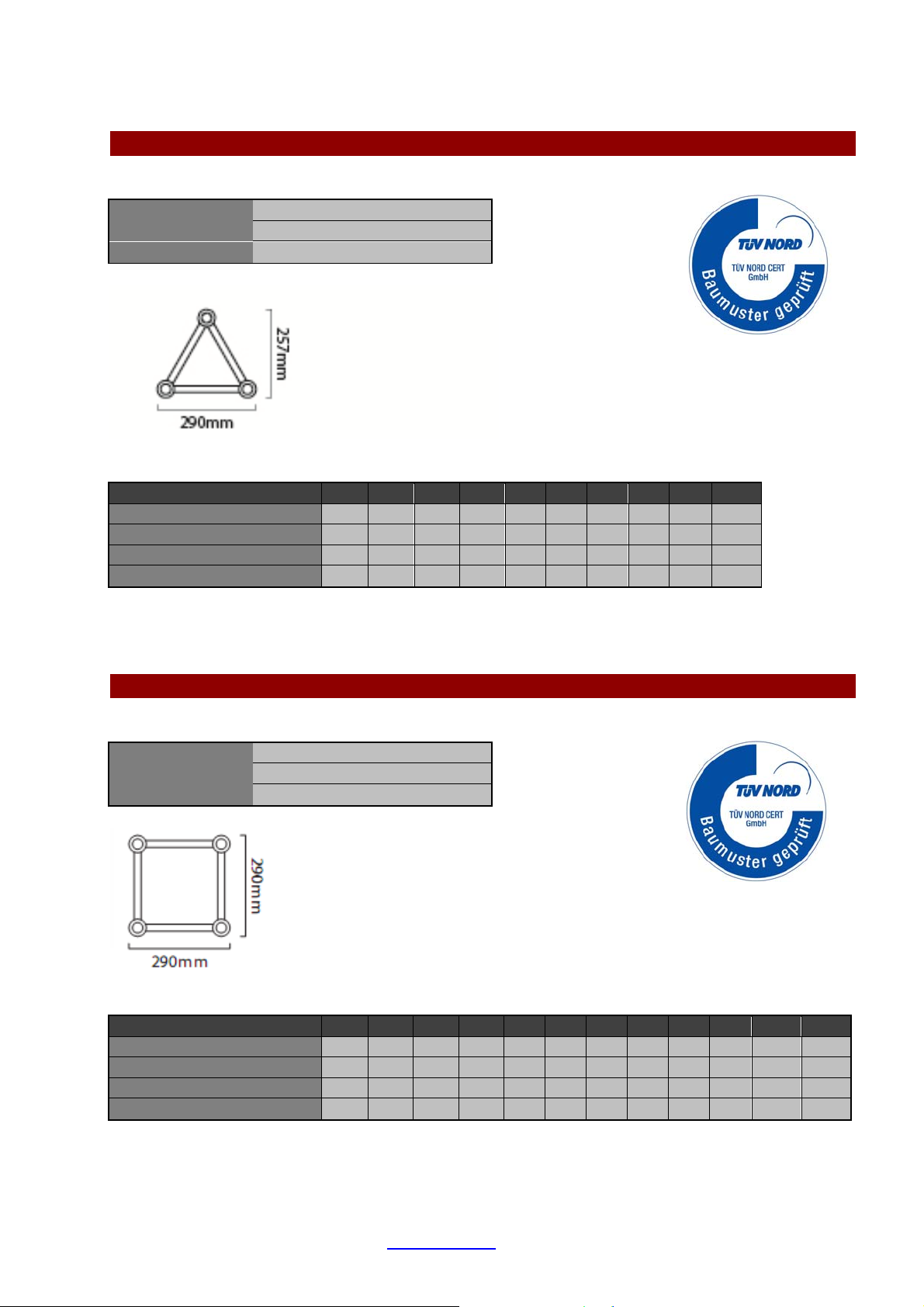
DURATRUSS - DT 33 Specifications
Main pipe
Connecting pipes
Aluminium
50 x 2 mm
20 x 2 mm
EN-AW 6082 T6 (AIMgSiI)
Load table DT 33 1m 1.5m 2m 3m 4m 5m 6m 8m 10m 12m
Point load (kg)
Deflection (mm)
Distributed load (kg / m)
Deflection (mm)
725 660 600 490 415 350 270 205 160 135
1.6 2.2 2.9 5.8 10.5 16.5 16.8 33.4 50.8 81.3
1300 1010 750 396 195 133 98 56 35 23
2.1 3.1 4.8 7.4 12.6 24 29 52.5 82.2 115.2
DURATRUSS - DT 34 Specifications
Main pipe
Connecting pipes
Aluminium
50 x 2 mm
20 x 2 mm
EN-AW 6082 T6 (AIMgSiI)
Load table DT 34 1m 2m 3m 4m 5m 6m 7m 8m 9m 10m 11m 12m
Point load (kg)
Deflection (mm)
Distributed load (kg / m)
Deflection (mm)
2400 2080 1340 1000 840 680 600 500 460 400 360 320
2.3 5.3 11 13.3 20.5 28 38.7 47.7 62.5 74.4 89.8 104.5
2400 1304 800 438 288 194 149 116 90 70 58 50
2.3 5.4 8.7 16.2 23.9 33.9 46.5 58.2 72.3 88 105.5 126.1
DURATRUSS - www.duratruss.com – Operating Manual Page 5
Page 6
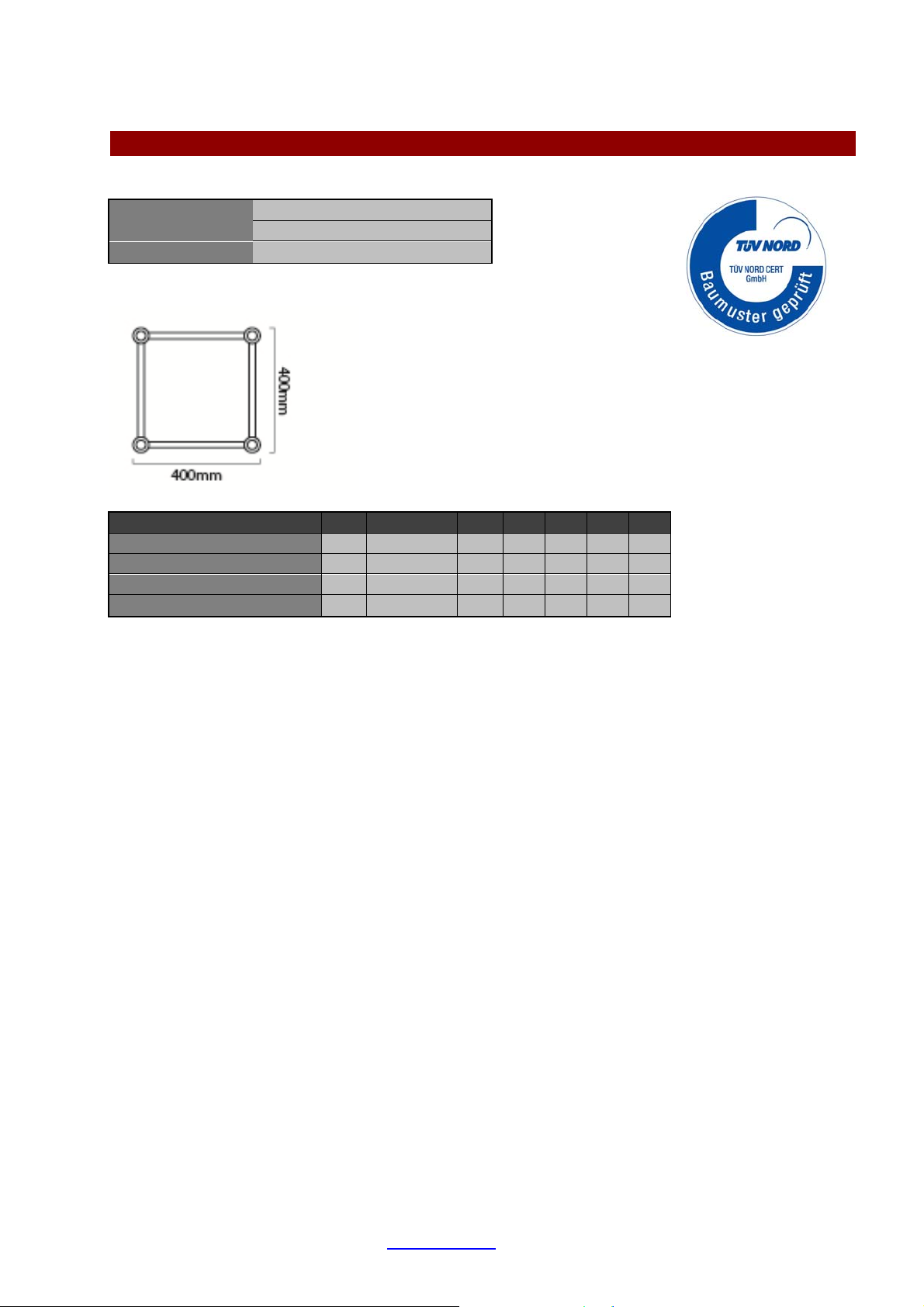
DURATRUSS - DT 44 Specifications
Main pipe
Connecting pipes
Aluminium
50 x 2 mm
20 x 2 mm
EN-AW 6082 T6 (AIMgSiI)
Load table DT 44 2m 4m 6m 8m 10m 12m 14m 16m
Point load (kg)
Deflection (mm)
Distributed load (kg / m)
Deflection (mm)
568 458 425 387 362 329 303 286
1.2 2.4 6.2 14.1 25.2 39.6 58.3 79.8
839 461 308 178 119 81 56 45
2.9 6 17.9 37 55 78 105 134
DURATRUSS - www.duratruss.com – Operating Manual Page 6
Page 7

DURATRUSS Periodic safety inspection
DURATRUSS products must be thoroughly checked at least once a year by a qualified
person. Depending on the standards required and the adaptation, it may be necessary to
perform these checks more often.
Should the trusses be used as a lifting tool the guidelines for the use of machinery, as well as
local legislation, are crucial for the control intervals.
DURATRUSS Inspection criteria
The responsibility and liability for the safe use of the tresses lies primarily with the user.
If one of the points mentioned below apply, the truss must no longer be used or installed
under any circumstances.
WARNING!
DURATRUSS products must be checked and inspected visually for damage or other matters
that might have a negative effect on the product properties.
A. General information
Never use trusses whose manufacturer, model code or date of
production is unknown.
Permanent deformation of a truss section by twisting, bending, or any
other alteration to the original shape.
Welding seams that seize or are damaged. The opening at the welding
seam of the connecting pipes is normal and was included in the TÜV
calculations.
Any incomplete welding seam, except the openings in the connecting
pipes (steel bolts & safety clip recording).
Welding seams that are more than 10% worn.
Strong corrosion reduces the permissible load by at least 10%.
B. Main pipes
A broken or partially torn/broken main pipe.
A bent main pipe.
Deflection of the end pieces so that they can not be pr operly connected
to a different truss.
Each scratch or cut that is deeper than 1 mm and is longer than 10mm,
and this irrespective of the direction of rotation.
Permanent deformation of the main pipe by dents or oval deformation.
C. Connecting pipes
A broken or partially torn/broken connecting pipe.
DURATRUSS - www.duratruss.com – Operating Manual Page 7
Page 8

A bent connecting pipe.
Each scratch or cut that is deeper than 0.5mm and is longer than
10mm, and this irrespective of the direction of rotation.
Every hole in the connecting pipe.
Permanent deformation of the main pipe by dents or oval deformation.
D. Conical couplings
Cracked or broken parts of the female connector.
Cracked or partially broken welding seams of the connecting pieces of
the main pipe.
Each oval worn hole in the connection couplings of the main pipe or the
conical clutches.
E. Steel pins
The steel bolts are disposable products. These should be replaced upon
noticing of visible damage or deformation. The condition of these bolts
gives an idea of the scope of the load or over-loading on the structure.
Alteration of the original diameter.
Notches, dents or scratches in the smooth surface.
Deformation due to the use of a hammer, to the extent that the safety
clip can no longer be utilised.
Completely or partially corroded bolts.
Self locking nuts, of which the plastic seal is broken.
DURATRUSS Visual inspection
Inspect the trusses and their accessories for any wear or damage before each use.
Warning!
Never use worn or damaged truss products or accessories!
DURATRUSS - www.duratruss.com – Operating Manual Page 8
Page 9

DURATRUSS Assembly
1. Make sure that all parts meet inspection criteria.
2. Place the conical connector into the conical end pieces of the truss pipes. Please
make sure that the larger opening for the accommodation of the steel bolts always
faces outwards.
3. Secure the conical connector with the steel bolts and safety clips (for mobile use)
or with the steel bolts with M8 threads and M8 nuts for fixed installations. Use a
500g hard rubber hammer or copper hammer to drive in the bolts.
4. Insert the next truss into the connector and secure it again with the steel bolt and
Safety-Clips/M8 nuts as described in point 3.
DURATRUSS General use
This multi-functional adjustable truss system was developed to create designs for hanging
professional entertainment lighting, sound systems, etc.
Make sure that the place where the truss system will be assembled or dismantled, or where
the maintenance work is to take place, is not accessible to outside people who have nothing
to do with the work.
Suspended, "flown" trusses must always be secured with the appropriate Safety's and load
slings by trained personnel.
Any changes or modifications of the product are prohibited for technical safety reasons.
Warning!
The spans and loads must never exceed the values given in this operating manual.
DURATRUSS was not designed to carry people. If the truss structure should be used to carry
people, the local safety regulations and standards apply.
When using 3-way corners in a 3D design, the maximum permissible load must be reduced
by half.
DURATRUSS - www.duratruss.com – Operating Manual Page 9
Page 10

DURATRUSS Installation over an audience
Danger to life!
Installation is to above all fulfil the safety regulations BGV C1 (DE) and DIN 15560. The
installation may only be carried out by qualified personnel.
The suspension system of "flown" trusses must withstand 10 times the approved load for at
least one hour, without permanent detrimental deformation occurring.
A "flown" truss must always be hung outside of the public area.
The installation must always be secured by a second, independent suspension system, so
that no parts can fall down if the primary suspension system fails.
In this case, the maximum bagging height should not exceed 20cm. A safety cable that is
damaged or affected by falling may no longer be used and must be replaced.
Each truss structure must be grounded!
Screening guidelines!
Important! To "fly" trusses over an audience requires a great deal of experience, with
knowledge of load calculations, the correct use of construction materials, regular safety
inspections and the local safety regulations. If you do not have the necessary qualifications,
the construction work is to be carried out by a professional fitter.
Unprofessional structures can lead to damage and accidents!
Warning!
Regarding "flown" truss structures at public events, numerous safety requirements are to be
followed, which are not described in detail in this operating manual. The user should inform
themselves of any applicable safety requirements on site.
DURATRUSS is not responsible for damage caused by improper installation or insufficient
safety precautions.
DURATRUSS - www.duratruss.com – Operating Manual Page 10
Page 11

DURATRUSS Maintenance
Truss products are often exposed to heavy loads and therefore must also be maintained. Special
attention should be paid to the conical clutches. These are disposable products, which must be
replaced upon the appearance of visible signs of wear.
Regularly smooth out the surface of the steel bolts with fine sandpaper.
Regularly lubricate the steel bolts with silicone-oil/spray or equivalent lubricant.
Watch out! Do not use sticky lubricants, these attract dust and dirt.
Warning!
Failure to perform regular inspections and maintenance leads to unsafe trusses. This can lead
to accidents and even death as a result.
Any damage with negative impact on the safety of the product renders this product unusable.
Immediately label the damaged product so that it can no longer be used unintentionally.
DURATRUSS - www.duratruss.com – Operating Manual Page 11
 Loading...