

Page 1

Bariatric Transport Chair
REF: BTR22BLK
Page 2

Bariatric Transport Chair (Issued 03/16) Page 2 of 8
Contents
1. Contents
2. Introduction
3. Parts Description
4. Brake Operation
5. Leg Rest Adjustment
6. Leg Rest Removal
7. Arm Rest Removal
8. Quick Release Wheels
9. Using the Stepper Tube
10. Disassembly and Folding
11. Maintenance
12. Warranty
Introduction
The Bariatric Transport chair is designed for a single occupant up to 32
stone (200kg) and is suitable for in indoor and most outdoor environments.
The wheelchair has a 22” seat width, and is propelled by an attendant using
the wheelchair push handles.
Parts Description
Page 3

Bariatric Transport Chair (Issued 03/16) Page 3 of 8
Brake Operation
Parking Brakes
To apply the parking brakes, push
the handle on the brake unit until
locked in place (see diagram). To
release the brake, push the handle in
the opposite direction.
Note: the model of brake on the wheelchair may be visually different
from that shown.
Leg Rest Adjustment
The height of the footplates on the
leg rests can be adjusted to suit the
user without tools.
To adjust the height, press the brass
push buttons on the leg rest (as
shown left). Adjust the footplate to
the correct height. Release the push
buttons and carry on adjusting the
footplate until they locks in position
with an audible click.
Page 4
Bariatric Transport Chair (Issued 03/16) Page 4 of 8
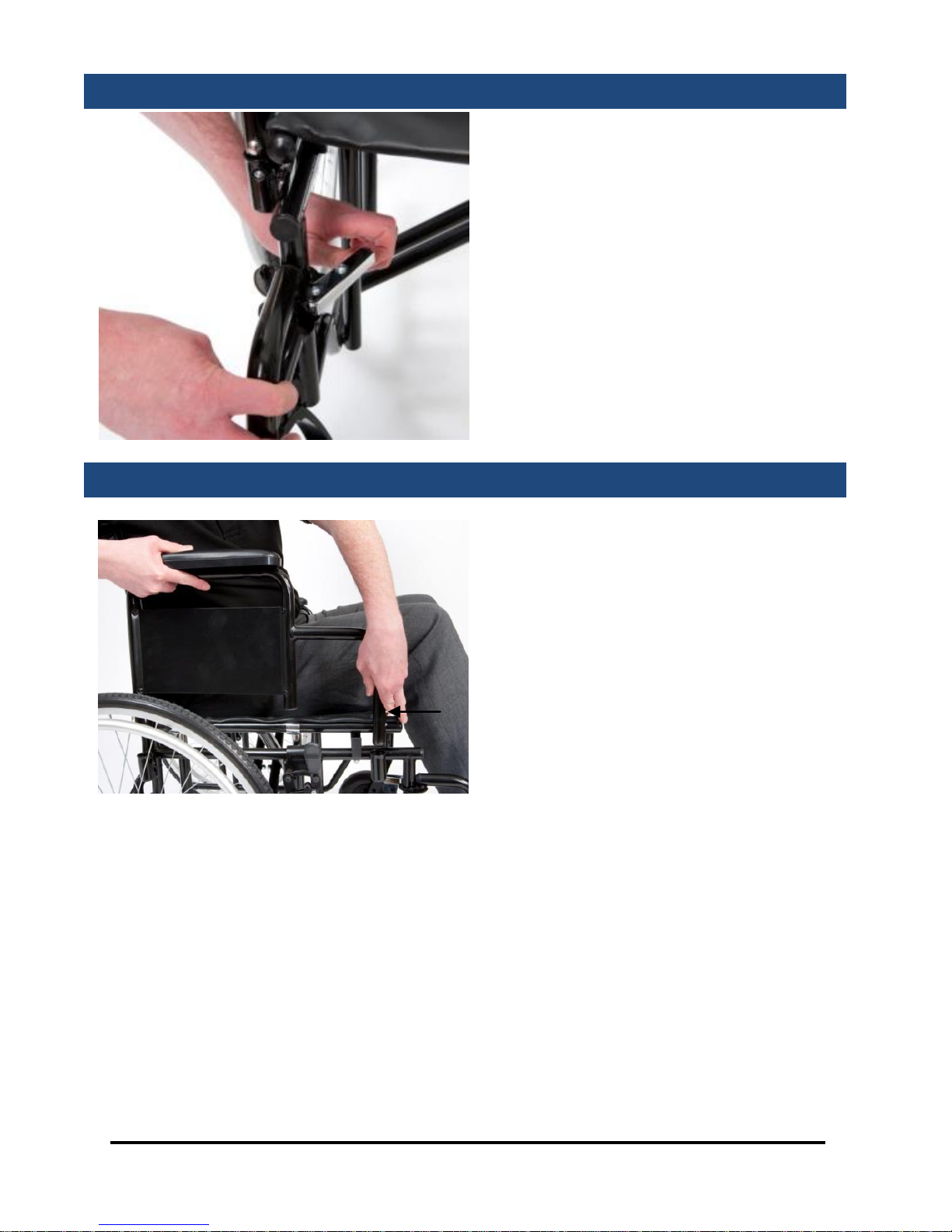
Leg Rest Removal
To remove the leg rest, press the
chrome lever on the leg rest whilst
swinging the leg rest out (as shown
left). This will now allow the leg rest
to be lifted up and removed. To
attach the leg rest, place the leg
rest on the two receiver posts on
the wheelchair frame. Then swing
the leg rest inwards until it locks in
position.
Arm Rest Removal
To remove the arm rest, press the
chrome button at the front of the
armrest (arrowed) and pull up on
the armrest.
To replace the armrest, push the
armrest back in to the receivers
and it will automatically lock.
Page 5

Bariatric Transport Chair (Issued 03/16) Page 5 of 8
Operation and Propulsion
The Bariatric Transport Chair has transit wheels which can only be
propelled by an attendant using the push handles.
Apply the parking brakes when stationary. Refer to the section on
parking brakes for operation instructions.
Use slow speeds on gradients. Do not use on
gradients more than 10º
The wheelchair is only suitable for single occupancy.
The wheelchair user should keep their feet on
the footplates when
moving. Do not stand on the footplates.
Do not use escalators.
Do not reverse down a gradient.
Maintain proper balance at all times. Users should not move their
centre of gravity out of the seating area.
Do not reach for items further than your arm
will extend.
Be aware of hazards in your environment, such as narrow doorways,
steps, household appliances, children's toys, etc.
We recommend you consult your healthcare professional for advice
about transferring to and from the wheelchair. The parking brakes
should always be applied when transferring.
Page 6

Bariatric Transport Chair (Issued 03/16) Page 6 of 8
Using the Stepper Tube
Use the stepper tube to raise the front castors (when mounting a kerb for
example). To use, push down on the stepper tube with a foot. Do not raise the
front castors by pushing down on the push handles as this could result in
damage to the wheelchair.
To mount a kerb. Approach the kerb head on. Then the attendant uses the
stepper tube to raise the front castors, and lowers the front castors on the
raised kerb. Finally the attendant should push the wheelchair forward, lifting it
up slightly to mount the kerb if required.
To go down a kerb. Line up the front castors with the edge of the kerb. The
attendant uses the stepper tube to raise the front castors and tip the user
slightly back. Keeping the castors raised, slowly lower the wheelchair down
the kerb.
Warning: When going down a kerb, the front castors must be raised to
prevent the user from falling out. The above are only recommendations and
may not be suitable for all events.
Disassembly and Folding
Before folding, remove any quick release components if required. The
Bariatric Transport Chair has been designed with an easy fold mechanism. To
fold the wheelchair, ensure that the leg rests are removed, or in the forward
position with the footplates flipped up. Holding the front and rear edge of the
seat sling, pull the seat in an upward motion. The wheelchair will naturally fold
up.
Please note though that the wheelchair may be too heavy for some users to
lift. Also be sure to adopt the latest health and safety recommendations
when lifting the wheelchair.
Page 7

Bariatric Transport Chair (Issued 03/16) Page 7 of 8
Maintenance and Tyre Pressure
The Bariatric Transport Chair is installed with puncture proof solid tyres that
will not require inflation.
Proper care and maintenance is important in order to keep your wheelchair in
good working order. Be sure that your chair is in proper working order at all
times. A qualified dealer or repair centre should be consulted for periodic
inspections and repairs:
1. At least once a week, wipe down the frame using a
clean soft cloth. If the
chair is exposed to moisture, dry the chair immediately. The metal parts of
the chair should be polished once a month with an auto wax.
2. Clean the upholstery with a mild soap solution,
rinse and wipe dry. Worn or
torn upholstery should be replaced promptly as it may not support your
body weight.
3. Inspect the wheels at least once a month.
Correct any side play by
loosening the lock nut on the axle then tighten the axle just enough to
remove any play.
4. Solid tyres require limited upkeep, but need to be cleaned periodically
with a damp cloth. Solid tyres need to be replaced if they become cracked
or severely worn.
Page 8

Bariatric Transport Chair (Issued 03/16) Page 8 of 8
Warranty
Your Drive branded product is warranted to be free of defects in
materials and workmanship for one year from date of purchase. This
device was built to exacting standards and carefully inspected prior to
shipment. This warranty is an expression of our confidence in the
materials and workmanship of our products and our assurance to the
customer.
In the event of a defect covered by this warranty, we will at our option
supply parts or replace the device. This warranty does not cover device
failure due to owner misuse or negligence, or normal wear and tear. The
warranty does not extend to non-durable components, such as rubber
accessories, castors and grips, which are subject to normal wear and need
periodic replacement.
If you have any queries or require full warranty conditions, please contact
your Drive stockist.
This does not affect your statutory rights.
Ainley’s Industrial Estate, Elland, GB HX5 9JP
www.drivemedical.co.uk
 Loading...