

Page 1
Engineering Ltd
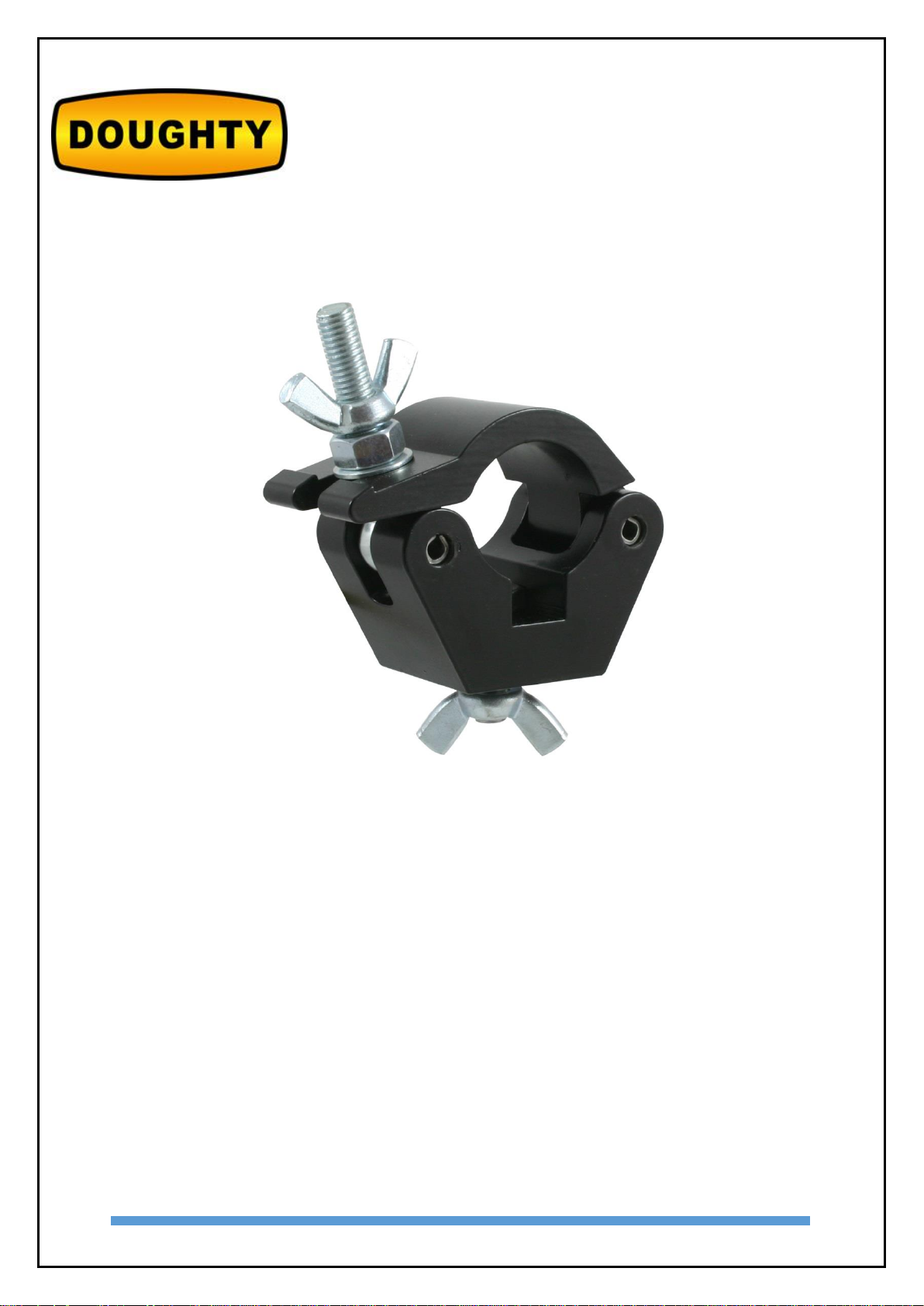
Doughty Clamps
User Manual
IMPORTANT – READ CAREFULLY BEFORE USE – KEEP FOR FUTURE REFERENCE
User Manual Revision 1 Issued November 2017
Doughty Engineering Ltd
Crow Arch Lane, Ringwood, Hampshire BH24 1NZ
Tel: +44 (0) 1425 478961
www.doughty-engineering.co.uk
Doughty Clamp User Manual Revision 1 Original User Manual Page 1 of 20
Page 2

Contents
1. SAFETY NOTES .............................................................................................................. 3
2. GENERAL ......................................................................................................................... 3
3. SCOPE ............................................................................................................................... 4
4. LIMITATIONS OF USE ................................................................................................... 4
5. IDENTIFICATION OF THE PRODUCT ........................................................................ 7
6. MODIFICATION ............................................................................................................... 8
7. SAFETY INFORMATION ................................................................................................ 8
8. COMPLIANCE ................................................................................................................ 11
9. TRANSPORT AND STORAGE .................................................................................... 11
10. INSTALLATION .......................................................................................................... 12
11. COMMISSIONING ...................................................................................................... 15
12. DISSASSEMBLY INSTRUCTION ............................................................................ 15
13. INDICATIONS OF FAULTS ...................................................................................... 15
14. INSPECTION, DISCARD AND REJECTION CRITERIA ..................................... 15
15. MAINTENANCE .......................................................................................................... 17
16. REPAIRS and REPLACEMENT OF PARTS ......................................................... 17
17. IF THE PRODUCT IS NO LONGER NEEDED ...................................................... 17
18. WARRANTY ................................................................................................................ 18
19. INSPECTION LIST ..................................................................................................... 19
20. EC DECLARATIONS ................................................................................................. 20
Doughty Clamp User Manual Revision 1 Original User Manual Page 2 of 20
Page 3
1. SAFETY NOTES
BEFORE installing and operating clamps, please read this manual carefully and pay
attention to the information provided. Use this manual to familiarise yourself with the clamp,
its proper use and safety regulations.
DANGER: Indicates a hazardous situation which, if not avoided, will result in death or
serious injury. This signal word is to be limited to the most extreme situations.
WARNING: Indicates a hazardous situation which, if not avoided, could result in death or
serious injury.
CAUTION: Indicates a hazardous situation which, if not avoided, could result in minor or
moderate injury.
NOTICE: address practices not related to personal injury.
SAFETY INSTRUCTIONS: is used for lists of steps, procedures or instructions that might
otherwise substitute a DANGER, WARNING or CAUTION notification.
2. GENERAL
The Doughty Clamp range consists of various clamps used to lift loads or make structural
connections. Clamps are used in the entertainment market. They can be used for permanent
support structures in places of entertainment such as museums, event venues, theatres etc.
Lifting loads is inherently dangerous so Doughty clamps are strictly for professional use only.
Only competent persons are permitted to install and use Doughty clamps. A competent
person in this respect is an individual with relevant technical education, training and/or
experience enabling him or her to perceive risks and to avoid hazards occurring during use
of a product.
The load capacity differs depending on the model and the safety factor required. Clamps are
suitable to fit steel and aluminium tubes of diameters ranging from 48mm to 51mm
depending on the model. Clamps are marked with the working load limit corresponding to the
8:1 safety factor in order to meet the German standard for overhead lifting.
Most clamps are available in Silver (polished aluminium) or black powder coating.
Special attention has been taken to safety. Therefore the TUV test certificates indicate
multiple Working loads. Depending on the application or local applicable legislation max
working load can be chosen.
Clamps can be judged as a lifting accessories under the EU machine Directive 2006/42/EC
as well as German DGUV-BGV-C1 for lifting and holding loads above persons. They can
also be used as a joining part in constructions. For this application no harmonised standard
is available no CE Declaration of Performance can be provided.
Doughty Clamp User Manual Revision 1 Original User Manual Page 3 of 20
Page 4

Doughty has endeavoured to deliver the highest degree of accuracy possible. However,
continuous improvement of our products is a Doughty Policy. Therefore, product
specifications are subject to change without notice.
Readers and users are encouraged to notify Doughty of errors and send in suggestions for
improvement. All communications will be carefully considered for future printings of this
manual and changes to our products.
Some models of clamps are composed of different elements each with an individual Working
Load. The lowest of the working loads determines the overall strength and thus shall be
used as max working Load for the application.
When Doughty Clamps form part of a lifting machine or lifting system, the lifting machine or
system shall be tested and marked with its SWL and appropriate certification issued.
The resulting forces in the structure attached shall be verified before applying a load.
For the ease of reading this document the word “Clamps” or “Clamp” is used to cover all
Doughty Clamp series and models.
3. SCOPE
The intended use of clamps is to be used as a lifting accessory to hang loads or create a
connection between structural elements. Loads can be, but not limited to, lighting fixtures,
video projectors, sound systems and stage sets.
Structural elements can be pipes, trusses, tubular frame works or lifting brackets.
Any use other than that mentioned is considered to be a case of misuse. The user/operator
and not the manufacturer shall be liable for any damage or injury resulting from such cases
of misuse.
The use of clamps for scaffolding purposes under EN74 is explicitly excluded from the
intended use.
Check local legislation for the application of use and adapt the use where ever necessary.
4. LIMITATIONS OF USE
The Clamps can be operated in -20° Celsius up to +60° Celsius.
When used permanently outdoors it is advised to use the versions with stainless steel
hardware in order to avoid galvanic corrosion.
Salt water environments require cleaning with fresh water at least once per week
Doughty clamps shall only be used on steel or aluminium tubes or bars.
When Doughty Clamps are used as part of an outdoor lifting system special factors
such as ground condition and profile, wind loading, water accumulation on temporary
structures and other criteria shall also be taken into account.
When clamps are used to secure equipment which is moved or suspended over
areas where persons are present an M12 self-locking nut shall replace the standard
nut and wingnut.
The use of Clamps is the sole responsibility of the user.
Doughty Clamp User Manual Revision 1 Original User Manual Page 4 of 20
Page 5

To use the Clamps the user must also observe the safety regulation, the assembly
and dis-assembly instructions to be found in this manual.
All persons who use and service this device have to be acquainted with this manual
and must be informed about its potential hazards.
It is also imperative to observe the local accident prevention regulations and/or
occupational health and safety regulations.
The manufacturer is not liable for indirect consequential damage and financial loss.
The manufacturer shall not be liable for any changes made to the device nor for any
damage resulting from such changes.
Loading Table
Rated Load with a Safety Factor of 8:1 WLL1 DGUV/BGV C1 for Lifting Load
Rated Load with a Safety Factor of 4:1 WLL2 2006/42/ES for Static Load
Doughty Clamp User Manual Revision 1 Original User Manual Page 5 of 20
Page 6

PART NO
TUBE DIA
(mm)
DESCRIPTION FINISH ACCESSORY
WLL1 (KG)
LIFTING
WLL2 (KG)
STATIC
T57000 48-51 Doughty Clamp Polished None 375 750
T57010 48-51 Doughty Clamp Black None 375 750
T57200 48-51 Doughty Hook Clamp Polished Bolt and Wing Nut 375 750
T57201 48-51 Doughty Hook Clamp Black Bolt and Wing Nut 375 750
T57120 48-51 Easy Grip Doughty Clamp Polished Easy Grip Handle 375 750
T57121 48-51 Easy Grip Doughty Clamp Black Easy Grip Handle 375 750
T57215 48-51 Doughty Little Tom Clamp Polished M12 Aluminium Spigot N/A N/A
T57216 48-51 Doughty Little Tom Clamp Black M12 Aluminium Spigot N/A N/A
T57225 48-51 Doughty Big Ben Clamp Polished 28mm Spigot 100 200
T5722501 48-51 Doughty Big Ben Clamp Black 28mm Spigot 100 200
T57227 48-51 Doughty Articulated Big Ben Polished 28mm Articulating Spigot 100 200
T57223 48-51 TV Doughty Clamp Polished 29mm Receiver 125 250
T57224 48-51 TV Doughty Clamp Black 29mm Receiver 125 250
T57235 48-51 Doughty TV Quick Clamp Polished 29mm Receiver 100 200
T57236 48-51 Doughty TV Quick Clamp Black 29mm Receiver 100 200
T57203 48-51 Doughty Hanging Clamp Polished 340Kg Eye Nut 170 340
T57204 48-51 Doughty Hanging Clamp Black 340Kg Eye Nut 170 340
T57205 48-51 Doughty Hanging Clamp Red Eye Polished 500Kg Red Eye Nut 250 500
T57206 48-51 Doughty Hanging Clamp Red Eye Black 500Kg Red Eye Nut 250 500
T57207 48-51 Doughty Hanging Clamp Pink Eye Polished 750Kg Pink Eye Nut 375 750
T57208 48-51 Doughty Hanging Clamp Pink Eye Black 750Kg Pink Eye Nut 375 750
T57100 48-51 Doughty Swivel Coupler Polished Two Clamps Joined N/A 750
T57110 48-51 Doughty Swivel Coupler Black Two Clamps Joined N/A 750
T57102 48-51 Doughty 90° Coupler Polished Two Clamps Joined N/A 750
T57112 48-51 Doughty 90° Coupler Black Two Clamps Joined N/A 750
T57104 48-51 Doughty Parallel Coupler Polished Two Clamps Joined N/A 750
T57114 48-51 Doughty Parallel Coupler Black Two Clamps Joined N/A 750
The following couplers are not CE marked
Doughty Clamp User Manual Revision 1 Original User Manual Page 6 of 20
Page 7
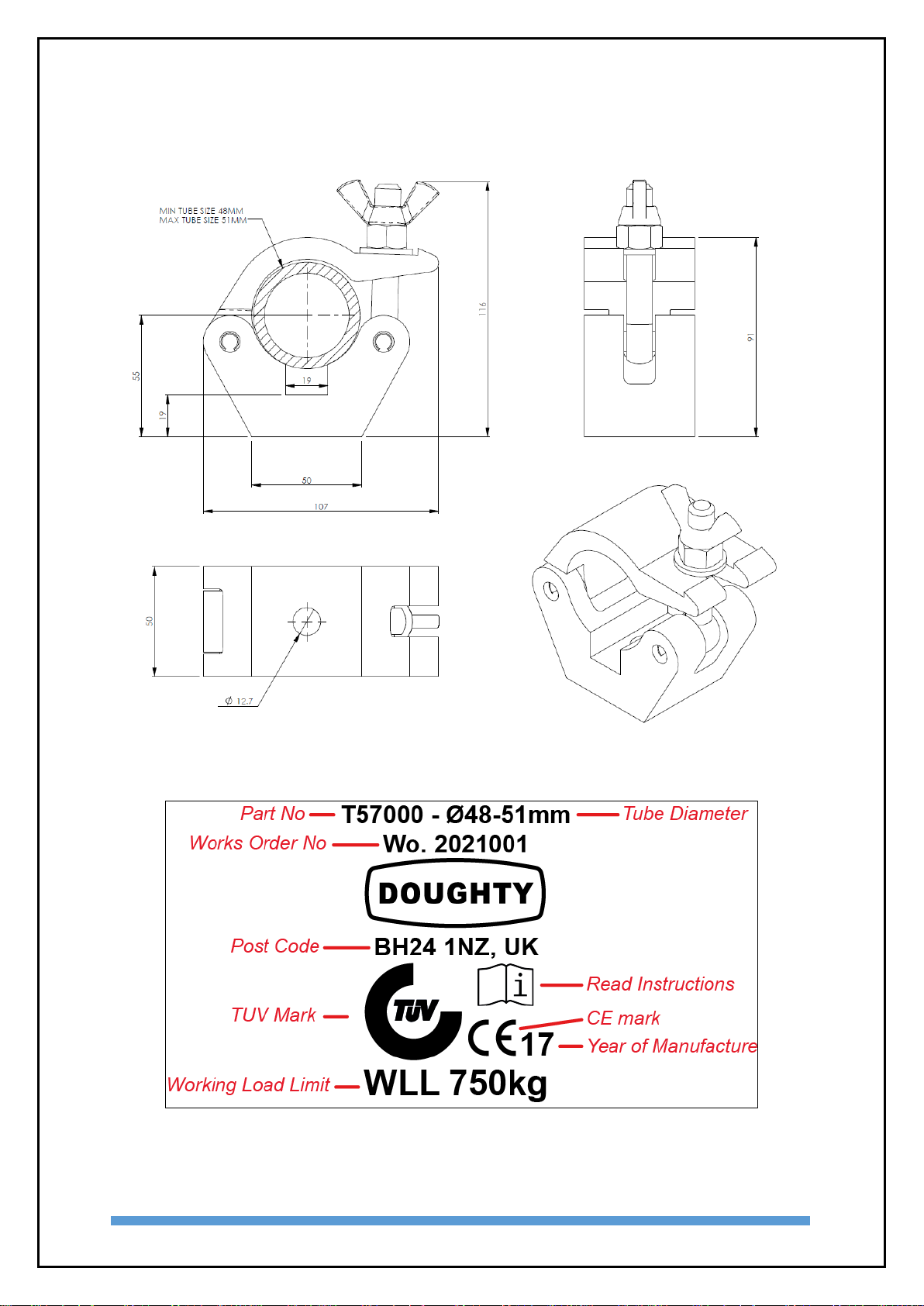
5. IDENTIFICATION OF THE PRODUCT
TYPICAL DOUGHTY CLAMP
TYPICAL DOUGHTY CLAMP LABEL
Doughty Clamp User Manual Revision 1 Original User Manual Page 7 of 20
Page 8
6. MODIFICATION
The following modifications are allowed to be executed by third parties.
Nut replacement: The standard nut and wing-nut shall be replaced by a self-locking nut
when
Loads are predominantly dynamic.
Loads are moving and change position.
Painting:
To paint a clamp, cover all bolts and nut with tape.
Use blasting to roughen the surface and to degrease the clamp.
Use a wet-paint or powder coating paint system to colour the part.
7. SAFETY INFORMATION
For health and safety reasons people assembling, disassembling, transporting, maintaining
and cleaning Clamps should wear adequate Personal Protection Equipment such as, but not
limited to; gloves, hard hats and safety shoes.
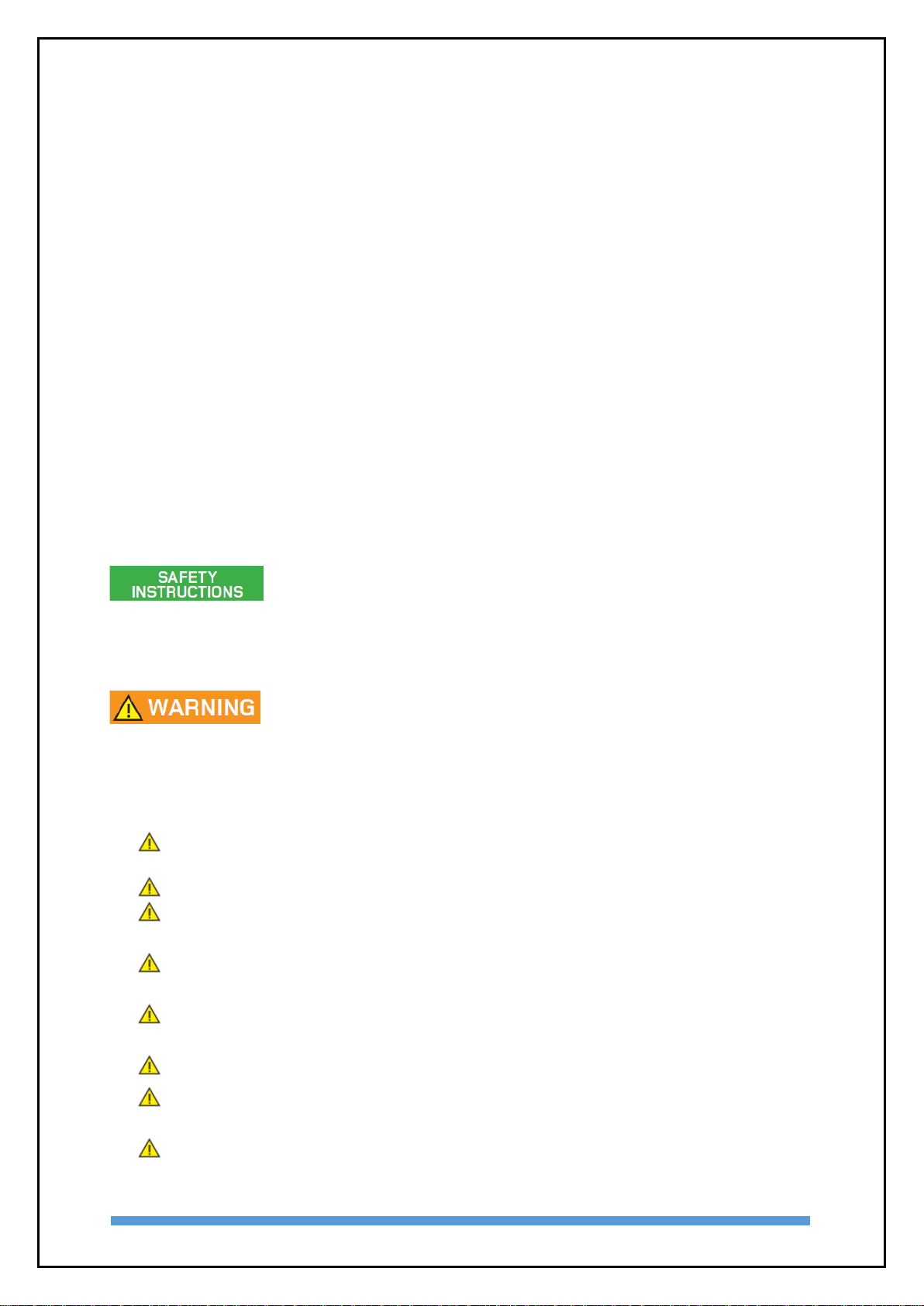
DO NOT lift loads above people without the following precautions
Use a Self-locking nut instead of the wingnuts on the eye bolts when loads are predominantly
dynamic and loads are moving and change position.
Clamps shall be solely used for the range of pipe diameters as stated on the clamp.
The use of a clamp on other diameter pipes will lower the working load limit.
Do not exceed the working load limit engraved on the clamp.
Make sure the resulting forces on the supporting structure are approved by a
competent person.
All loads imposed shall be considered. E.g. dynamic forces caused by the lifting
machinery.
Bolts and nuts shall be tightened by means of a spanner in such a manner they
cannot be released by man power.
When loads are using electrical power, equip-potential bonding shall be put in place.
Clamps shall be inspected by a competent person as often as required but with a
minimum of once a year.
Inspect equipment before every use. Damaged clamps shall be taken out of service.
Doughty Clamp User Manual Revision 1 Original User Manual Page 8 of 20
Page 9
SUSPENSION
SUSPENSION
LOAD
LOAD
A clamp must be taken out of service immediately if, during use, repair or
maintenance any serious damage is discovered.
Maintenance and repairs can be undertaken only by authorised personnel. If in any
doubt contact the manufacturer.
Do not throw clamps.
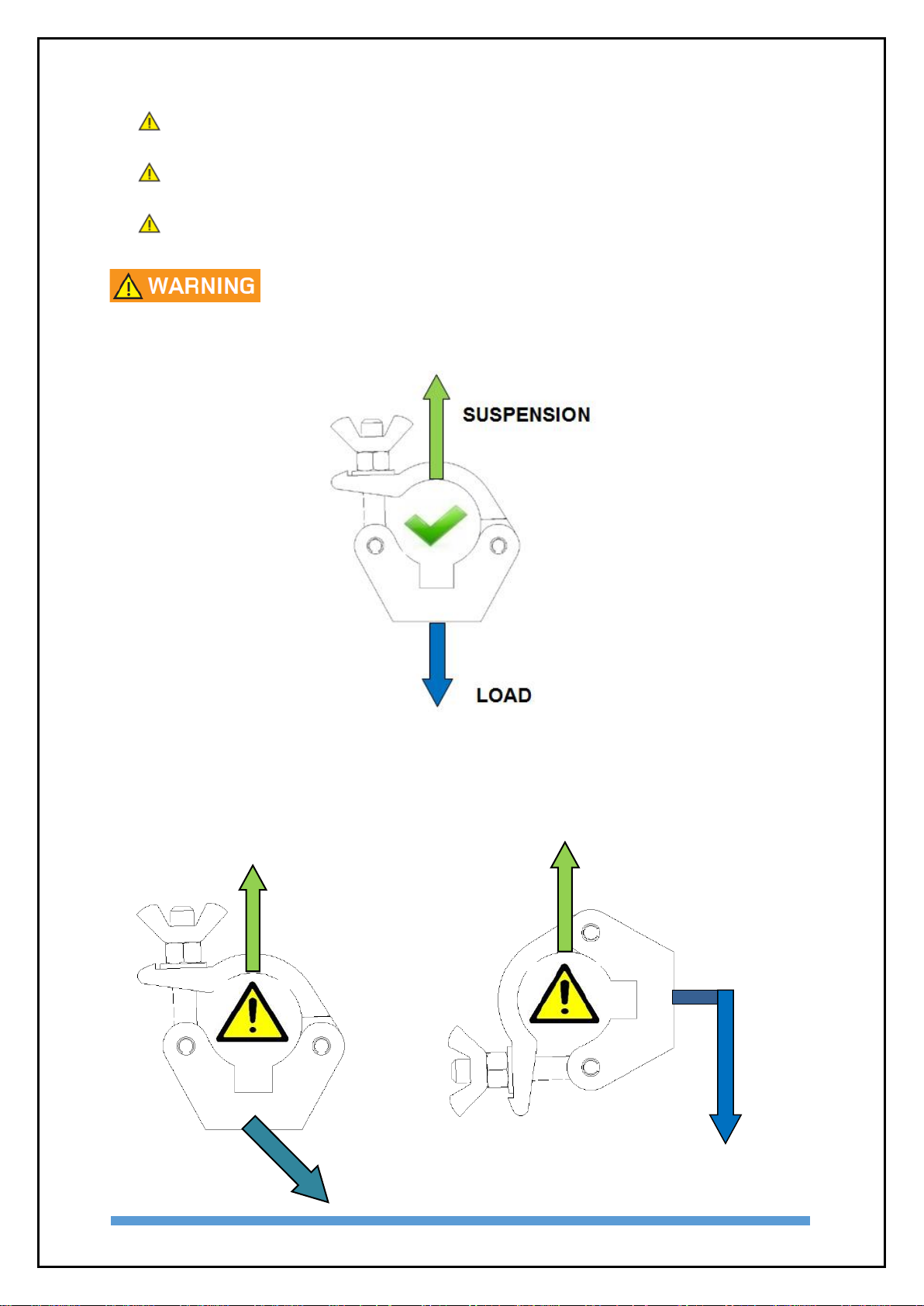
THE WORKING LOAD ENGRAVED ON THE CLAMP IS SOLELY FOR A STRAIGHT PULL
BETWEEN THE SUPPORTING PIPE AND CONNECTION POINT ON THE CLAMP
THE METHODS OF SUSPENSION SHOWN BELOW CREATES TORSIONAL FORCES,
INFLUENCE THE STABILITY OF THE SUPPORTING STRUCTURE AND LOWERS THE
WORKING LOAD OF THE CLAMP. THIS NEEDS TO BE CHECKED BY A COMPETENT
PERSON.
Doughty Clamp User Manual Revision 1 Original User Manual Page 9 of 20
Page 10
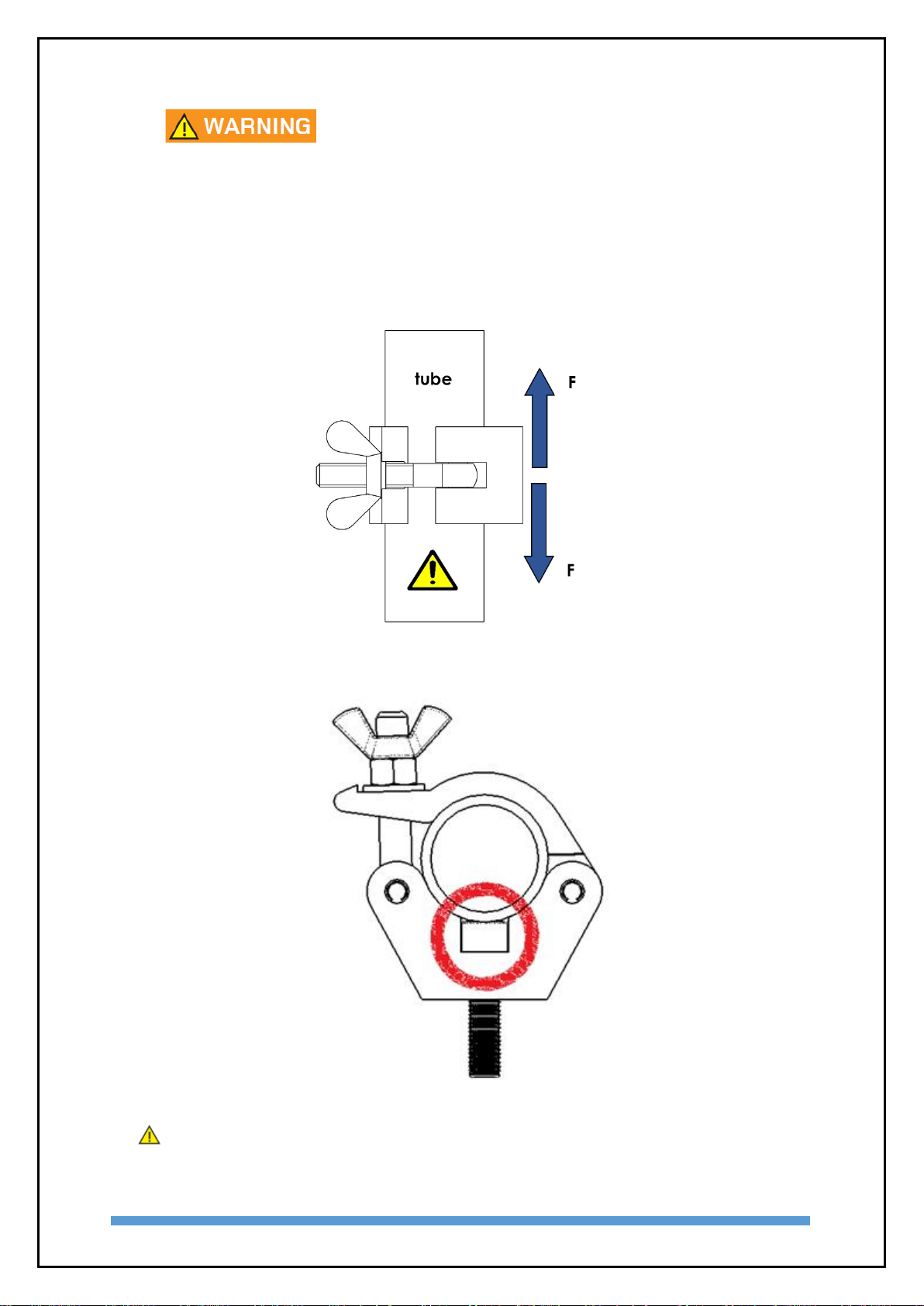
USING CLAMPS WHERE THE DIRECTION OF LOAD IS PARALLEL TO THE TUBE
DEPENDS ON, BUT NOT LIMITED TO, CONTACT SURFACE, MATERIAL,
FRICTION RESISTANCE AND THE APPLIED TORQUE TO THE CLAMP’S
WINGNUT / NUT. THIS TYPE OF APPLICATION SIGNIFICANTLY REDUCES THE
STATED WLL AND SHOULD BE USED WITH EXTREME CAUTION.
Do not use fixings that, when tightened, will contact the tube or barrel on which the
clamp is fixed as highlighted above.
Doughty Clamp User Manual Revision 1 Original User Manual Page 10 of 20
Page 11

8. COMPLIANCE
CLAMPS USED AS LIFTING ASSESSORY:
2006/42/EC Machinery directive
DGUV Rules 115-002 Regulations for stages and studios (Formerly known as BGVc1)
DGUV Information 215-313 Safety at productions and events for television, radio, film,
theatre, exhibitions: Loads above persons (Formerly known as
BGI 810-3)
BS 7905-1:2001 Lifting equipment for performance broadcast and similar
applications. Part 1 specifications for the design and
manufacture of above stage equipment
9. TRANSPORT AND STORAGE
Due to the relatively high self-weight it is advised to keep storage bins as small as
possible in such a manner they can be lifted by one person. Local legislation for
maximum load to be lifted by persons shall be adhered to.
Before clamps are put into storage they shall be checked for defects. Defective
clamps shall be clearly marked and put aside is such a way they cannot be re-used.
Put the lid and eye bolt together and hand tighten. This way bolts will not get lost
during transport.
Ensure the product is stored and kept in a dry, ventilated environment to avoid
corrosion.
Do not store aluminium clamps in steel bins.
Doughty Clamp User Manual Revision 1 Original User Manual Page 11 of 20
Page 12
10. INSTALLATION
Inspect the clamp before every use. If damaged do not use.
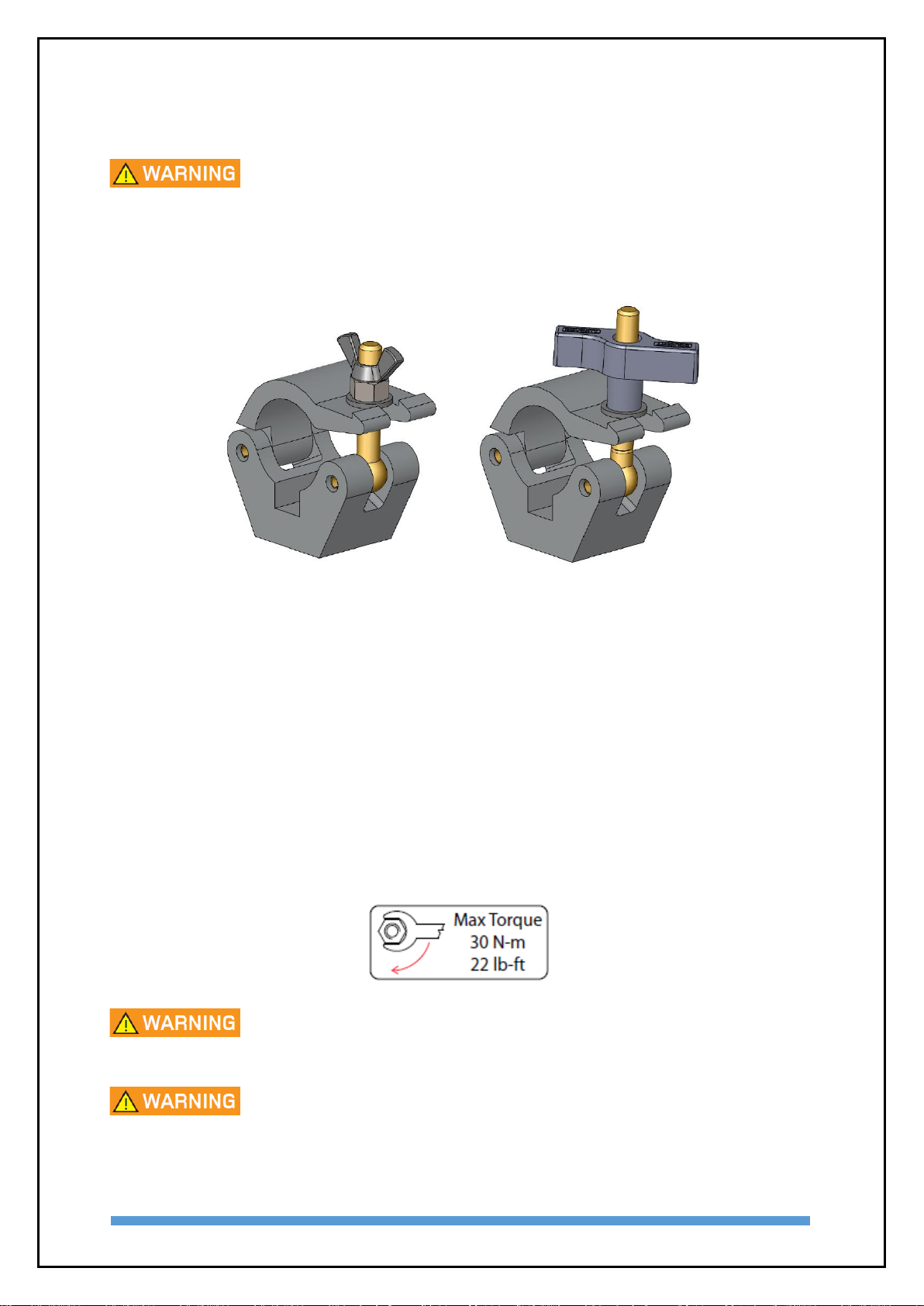
Doughty Clamps including Doughty Hook Clamps and Doughty Clamps with
Easy Grip.
Doughty clamps are used to suspend or make structural connections between truss or barrel
and a variety of objects using an M12 fixing.
a. Determine the bolt type and length needed to connect the Doughty clamp to the object
to be suspended.
b. Use low head hexagon socket bolts or standard hexagon bolts. Minimum 8.8 grade.
c. Tighten the bolt connection using the appropriate tool.
d. Open the lid of the clamp.
e. Fold the eye bolt and lid aside.
f. Hang the clamp in the desired position. Tighten the bolt before the load is fully
supported.
g. Tighten the wingnut / nut / bolt by hand or using a 19mm spanner. Firmly hand tight
should be enough. When using a spanner, do not apply a toque greater 30Nm /22lbft.
h. Use a secondary safety if legislation requires.
Use an M12 self-locking nut instead of wing nut in case of overhead lifting.
Over tightening the nut or bolt might lead to permanent deformation of the tubes to which
they are attached.
Doughty Clamp User Manual Revision 1 Original User Manual Page 12 of 20
Page 13
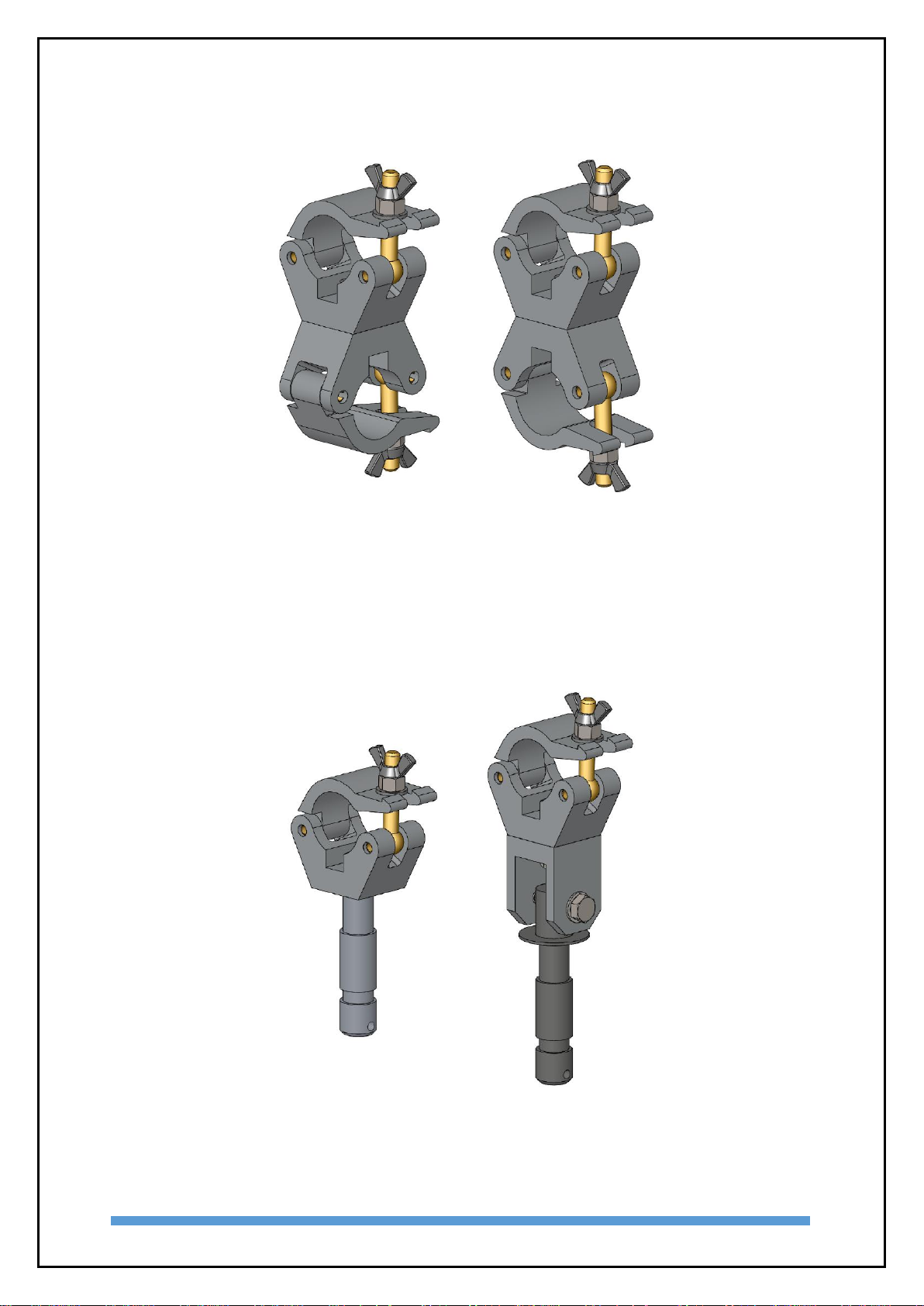
Doughty Couplers including Swivel, 90° Fixed and Parallel.
These couplers are used for rigging two sections of truss or barrel together. The couplers
consist of two Doughty clamps bolted together. In the case of the swivel coupler the two
clamps are free to rotate relative to each other. With the 90° and parallel couplers the clamps
are pinned together so that they cannot rotate.
To install, attach each of the clamps that comprise the coupler to their respective barrel or
truss following the instructions set out in Sections 10d to 10h.
Big Ben and Articulated Big Ben Clamps
Big Ben and Articulated Big Ben Clamps consist of a 28mm spigot fixed to a Doughty clamp.
The articulated version allows the spigot to rotate through 2 axes.
Big Ben clamps are commonly fitted into a receiver mounted on a stand.
Once the clamp has been inserted into the receiver and locked in to place the barrel or truss
can fitted into the clamp following the instructions set out in Sections 10d to 10h.
Doughty Clamp User Manual Revision 1 Original User Manual Page 13 of 20
Page 14
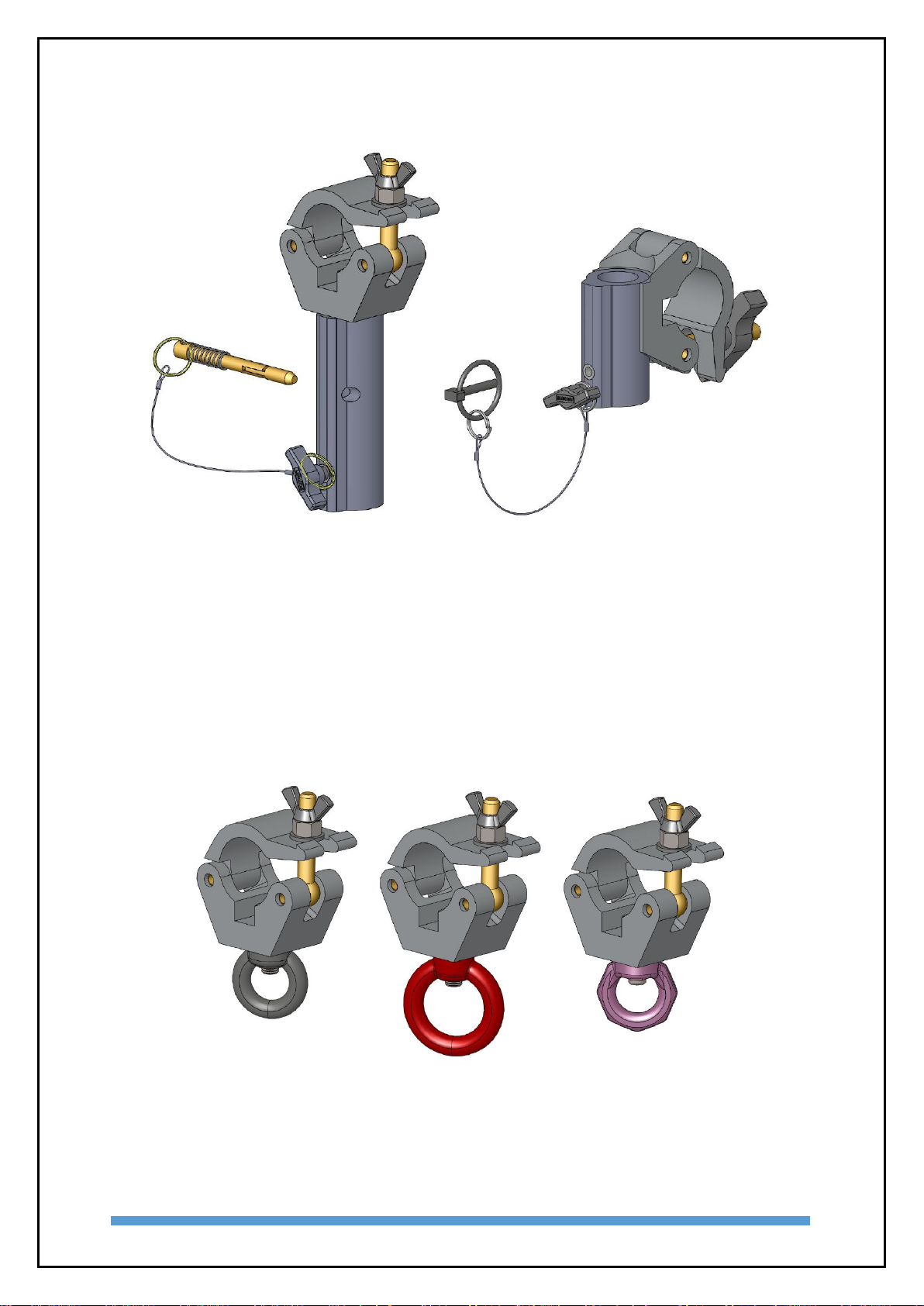
TV Doughty Clamp and TV Quick Clamp
TV Doughty Clamps and TV Quick Clamps consist of 29mm receiver fitted to a Doughty
clamp.
Commonly TV clamps will be mounted to a section of barrel or truss following the instructions
set out in Sections 10d to 10h. The objects to be suspended will typically be fitted with a
28mm TV spigot which should be inserted into the receiver and secured with the Doughty
knob. In the case of the TV Doughty clamp the sword pin should also be inserted into the
receiver. The TV Quick clamp has a lynch pin which should be inserted into the hole
provided in the spigot.
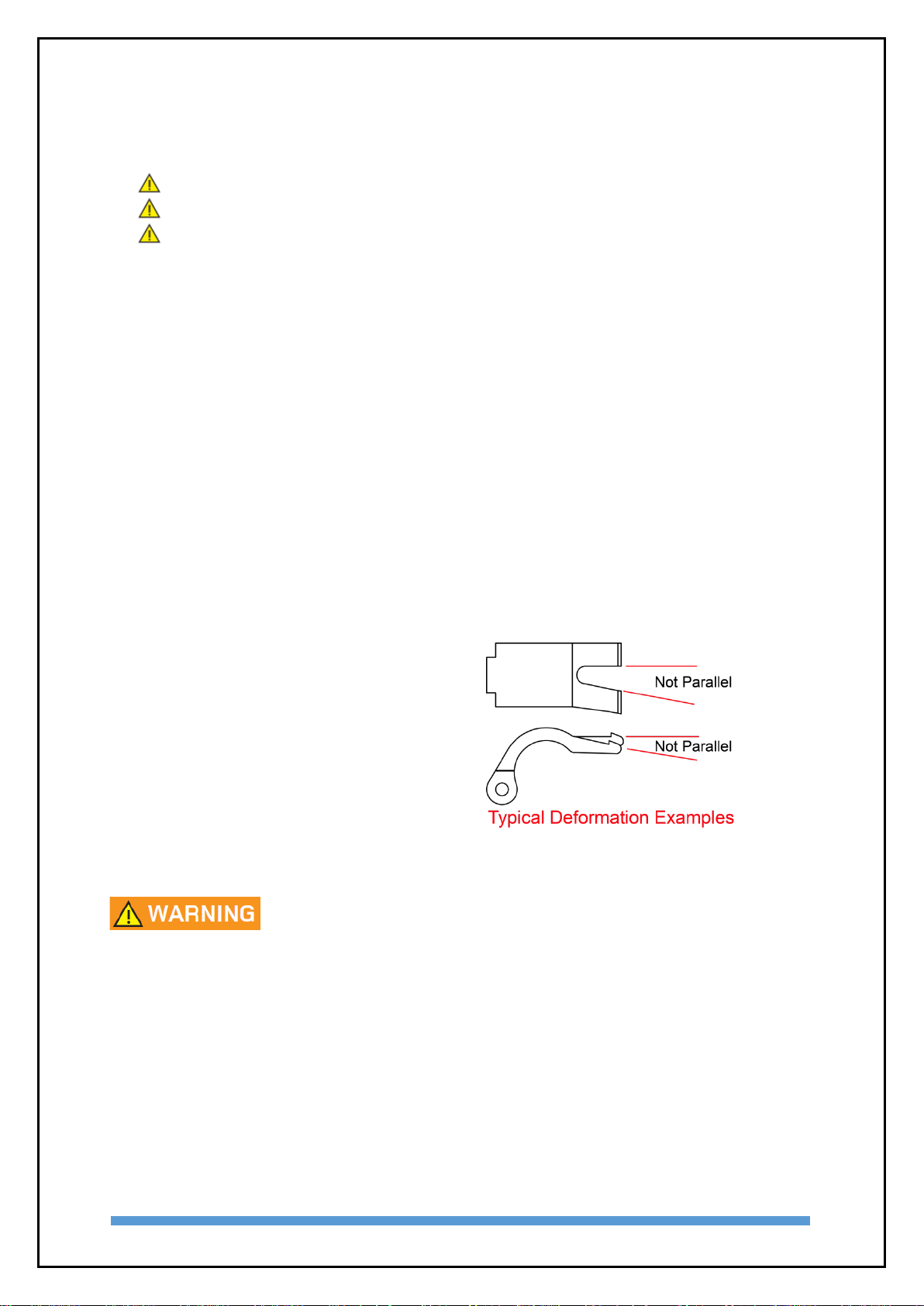
Hanging Clamps
Hanging clamps are available in three versions: 340kg Standard Eye, 500kg Red Eye and
750kg Pink Eye.
These clamps are commonly used to secure rope directly or via shackles, karabiners, hooks
etc.
Hanging clamps will be mounted to a section of barrel or truss following the instructions set
out in Sections 10d to 10h. The rope is then secured to the eye as required.
Doughty Clamp User Manual Revision 1 Original User Manual Page 14 of 20
Page 15
11. COMMISSIONING
Before applying a load check that all connections are properly made.
Before lifting check that all connections are still correct.
Check if all parts are in good order.
12. DISSASSEMBLY INSTRUCTION
1. Take the weight of the clamp.
2. Release the nut and fold the eye bolt aside.
3. Open the lid and fold aside.
4. Remove the load.
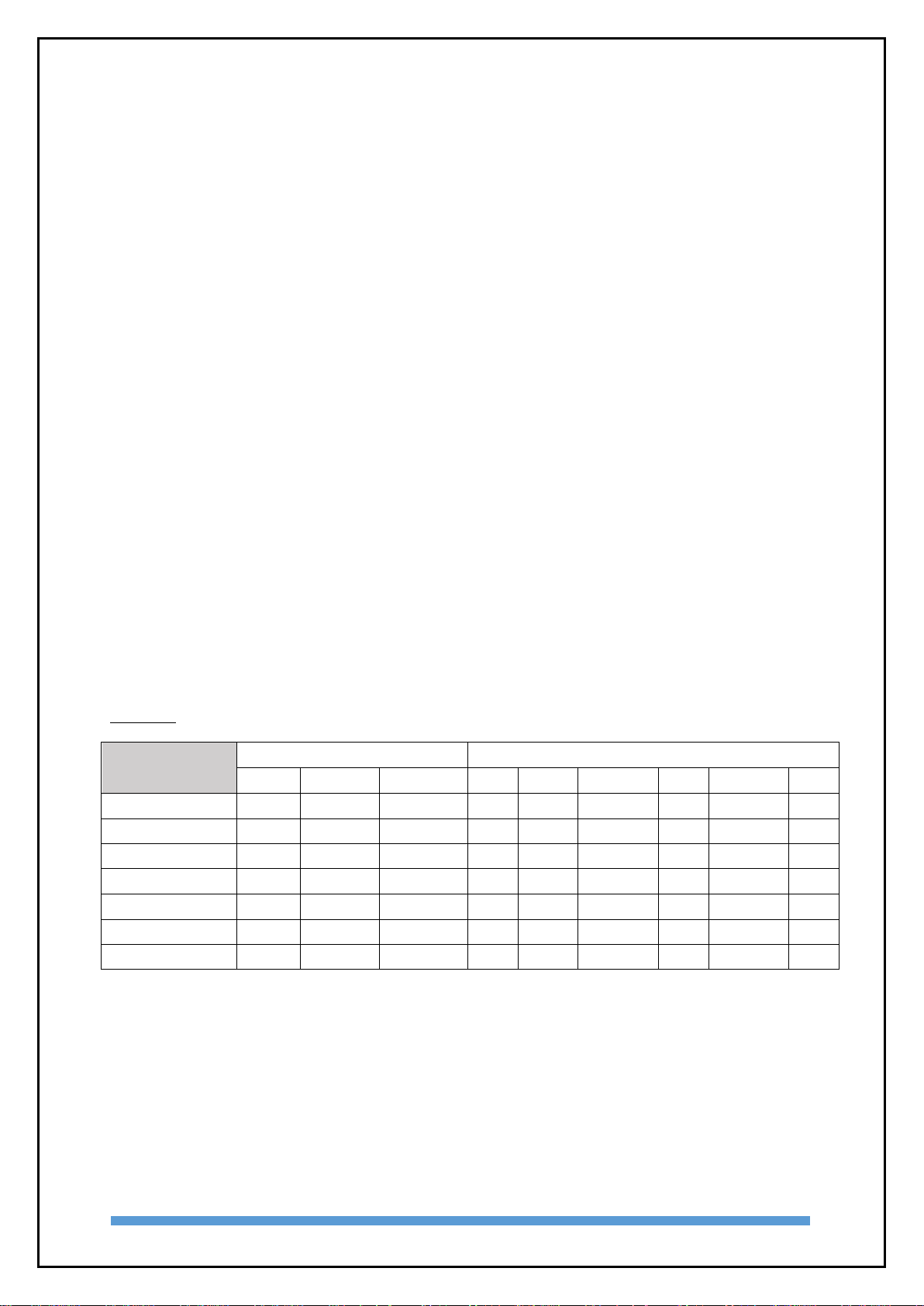
5. Check if the clamps are in good order. If not, mark them clearly and put aside.
13. INDICATIONS OF FAULTS
The following faults could be an indication of overload or misuse. Remove those clamps from
service.
Deformation of the lid. (see diagram)
Nuts which cannot be turned by hand.
Eyebolt which do not swivel properly.
Lid which do not swivel properly.
Clamp does not fit around the pipe.
14. INSPECTION, DISCARD AND REJECTION CRITERIA
If any fault is found, mark the product clearly and remove from service.
14.1 INITIAL INSPECTIONS
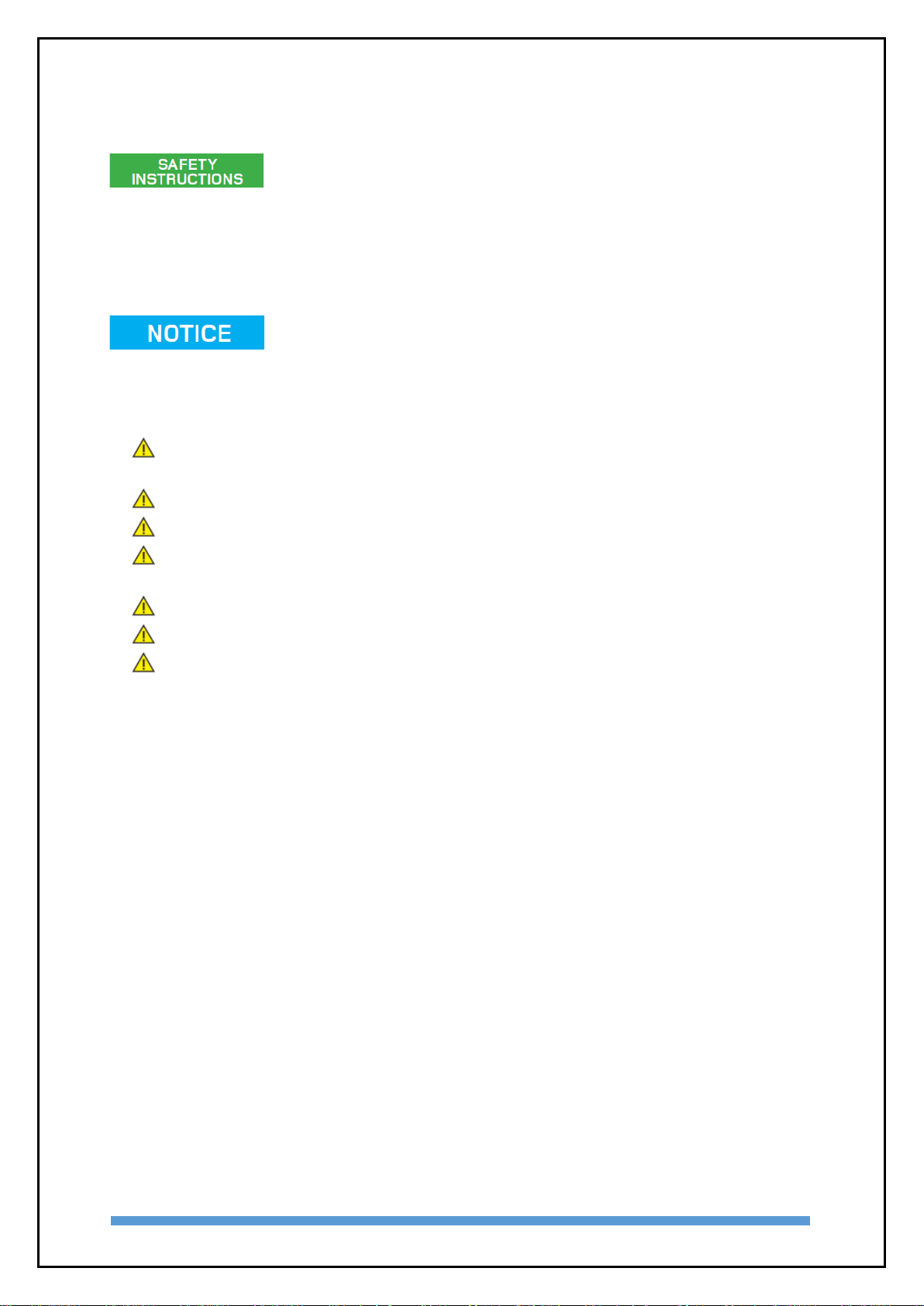
When first acquired, whether they are new or used, clamps should be inspected in accordance
with Table 14 and a record of the inspection maintained.
REGULAR INSPECTIONS
Regular visual inspections should be carried out in accordance with Table 14. Regular
inspections should be performed by a competent person and should be carried out prior to
each incident of use.
Doughty Clamp User Manual Revision 1 Original User Manual Page 15 of 20
Page 16
INSPECTION LEVEL
ITEMS TO BE INSPECTED
INITIAL
REGULAR
PERIODIC
LID
BODY
EYEBOLT
NUT
ROLL PIN
ID
MISSING PARTS
Y Y Y Y
HOLES
Y Y Y Y Y
ABRASION
Y Y Y Y Y Y
CORROSION
Y Y Y Y Y Y
DEFORMATION
Y Y Y Y Y Y Y Y
EXCESSIVE WEAR
Y Y Y Y Y Y
CRACKS
Y Y Y Y Y Y Y Y
PERIODIC INSPECTIONS
Periodic visual inspections should be carried out in accordance with Table 14 and a record of
the inspections maintained. Periodic inspections should be performed by a competent person
and should be conducted at least once each year or in accordance with an inspection routine
established by a qualified person.
Clamps which are subject to any accident must be inspected according to the requirements per
periodic inspection and in accordance with table below.
14.2 INSPECTION FREQUENCY
CLAMPS IN REGULAR SERVICE
Clamps in regular service should be subjected to regular and periodic inspections.
PERMANENT INSTALLATIONS, STATIONARY
Periodic inspections should be carried out on all Clamps that are permanently installed in a
stationary (not moving) configuration. The frequency of inspections should be determined on
the basis of the prevalent conditions.
PERMANENT INSTALLATIONS, MOVING
Periodic inspections should be carried out every three months, or in accordance with an
inspection routine established by a qualified person, on all clamps that are installed in a
permanent configuration where movement of the truss system is an integral part of use.
RECORDS
Records of initial inspections and periodic inspections should be kept by the owner for each
clamp and should be signed and dated by the person carrying out the inspections.
Table 14
Doughty Clamp User Manual Revision 1 Original User Manual Page 16 of 20
Page 17
15. MAINTENANCE
Although under normal use and environmental circumstances, clamps need little
maintenance, for safety reasons, all parts must be checked regularly for damage, cracks and
corrosion.
The Clamp shall be checked in compliance with the local law by a competent person.
Checking shall take place as often as required but at a minimum of once a year. If in doubt
contact the manufacturer.
Check all components for damage and corrosion. Damaged and corroded parts shall
be removed and disposed of.
Check roll pins for cracks. If cracked, replace the pins.
Burrs and sharp edges shall be removed using fine sandpaper or a file.
Maintenance and repairs must only be carried out by a competent person. If in doubt,
contact the manufacturer.
Do not use any mechanical abrasive machine to remove sharp edges from clamps.
Use hot water and soap to remove any dirt from clamps.
Do not use abrasive fluids to remove dirt or paint from clamps.
16. REPAIRS and REPLACEMENT OF PARTS
Damaged clamps should be returned to an authorised Doughty service agent for
repair.
17. IF THE PRODUCT IS NO LONGER NEEDED
Products that are no longer needed can be scrapped. Preferably remove all steel parts,
store part separately before offering them to a scrapping company.
The following alloys are used:
Aluminium ENAW 6060 or 6082
Steel 8.8
Stainless 304
Doughty Clamp User Manual Revision 1 Original User Manual Page 17 of 20
Page 18

18. WARRANTY
For a period of 12 months we undertake to repair, free of charge any damage
attributable to faulty materials or workmanship, provided that the appliance is
forwarded, freight paid, to our works or one of the Doughty appointed service agents.
The guarantee-period begins on the day of the delivery, proven by a purchase receipt
like an invoice or delivery note or their copies.
The guarantee only is applicable for new equipment.
The guarantee does not cover damage due to transport damage, negligent handling,
overload or parts subject to normal wear and tear. Nor damages that originate from a
case of misuse because of non-observance the instructions in this manual.
The fitting of non-original replacement parts or modifications of design by third parties
invalidates the guarantee.
Guarantee repairs do not renew nor extend the guarantee-period.
In case of a claim under the guarantee or spare part requirements please contact
your Doughty service agent.
The manufacturer is not liable for indirect consequential damage or financial loss.
The manufacturer is not liable for any changes made to the clamp or for any damage
resulting from such changes.
Doughty Clamp User Manual Revision 1 Original User Manual Page 18 of 20
Page 19

ITEM
FAULT
REPAIR
DATE
SIGNATURE
19. INSPECTION LIST
Doughty Clamp User Manual Revision 1 Original User Manual Page 19 of 20
Page 20

20. EC DECLARATION
Doughty Clamp User Manual Revision 1 Original User Manual Page 20 of 20
 Loading...