

Page 1
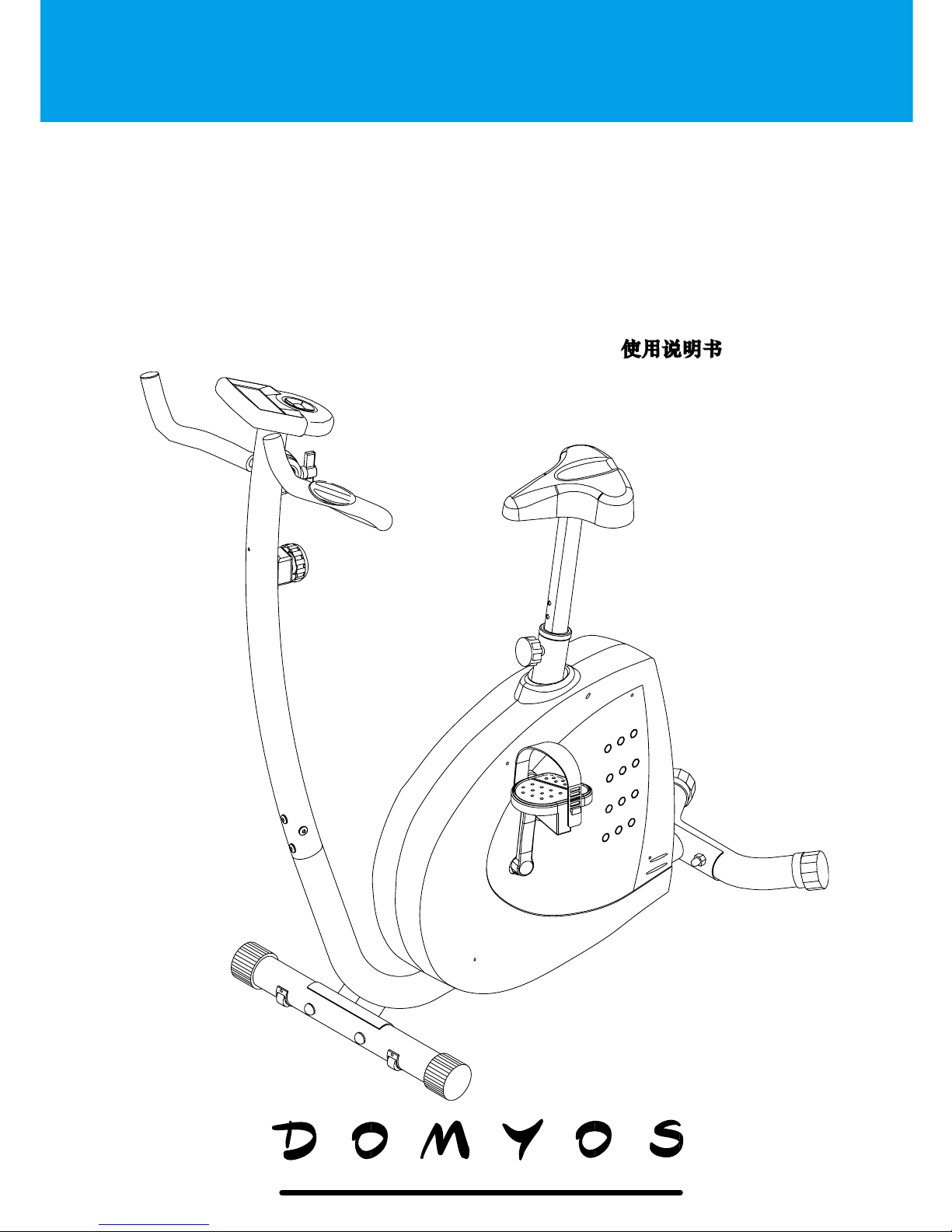
NOTICE D’UTILISATION
OPERATING INSTRUCTIONS
MODO DE EMPLEO
GEBRAUCHSANWEISUNG
ISTRUZIONI PER L’USO
GEBRUIKSHANDLEIDING
MANUAL DE UTILIZAÇÃO
INSTRUKCJA UŻYTKOWANIA
VM 430
Page 2

VM 430
Réalisation :
EVOLUTION
+ 32 / 69 88 87 89
DECATHLON
4, Boulevard de Mons - 59665 Villeneuve d'Ascq - France
Made in China
Notice à conserver
Keep these instructions
Bitte bewahren Sie diese Hinweise auf
Istruzioni da conservare
Conservar instrucciones
Bewaar deze handleiding
Instruções a conservar
Bevar vejledningen
Zachowaj instrukcję
Page 3
3
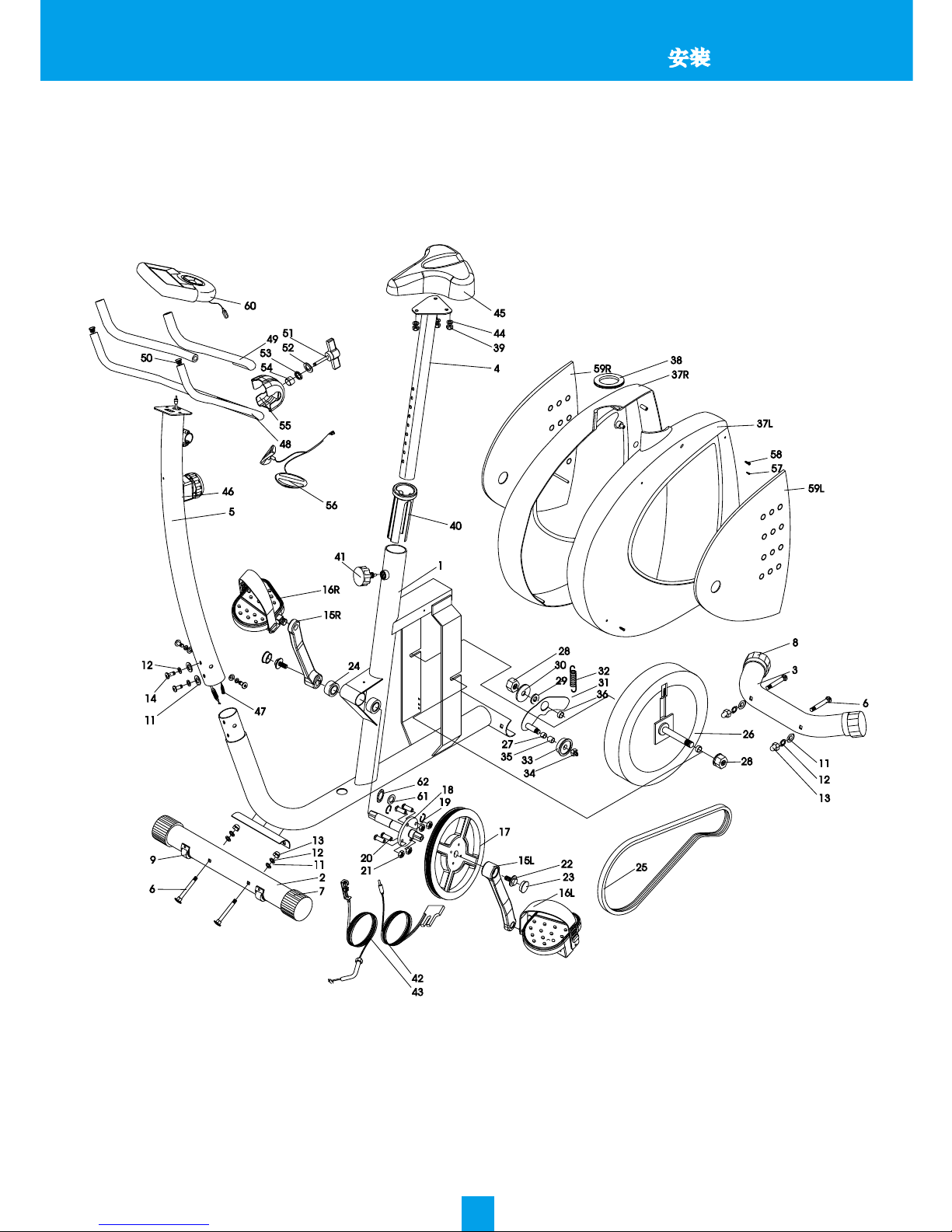
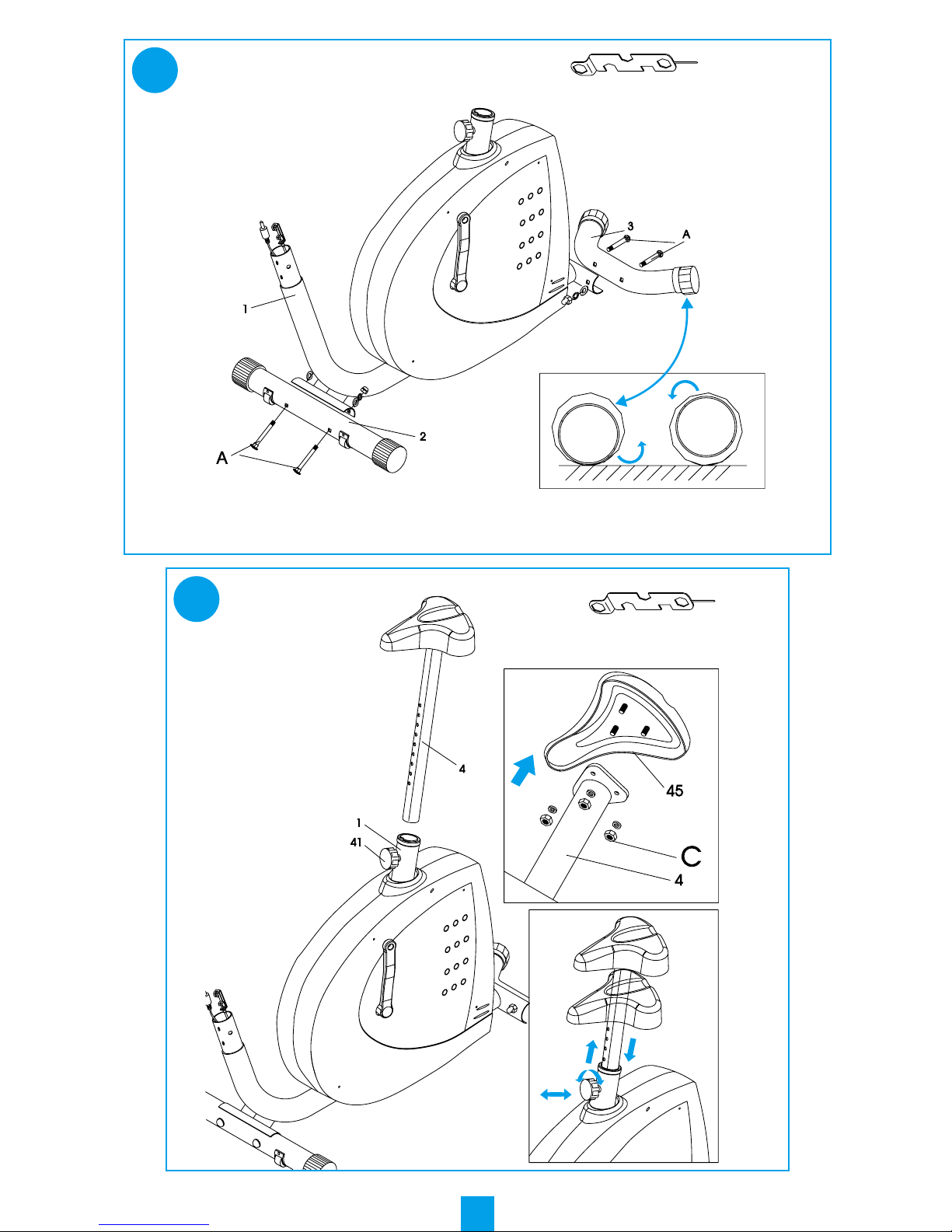
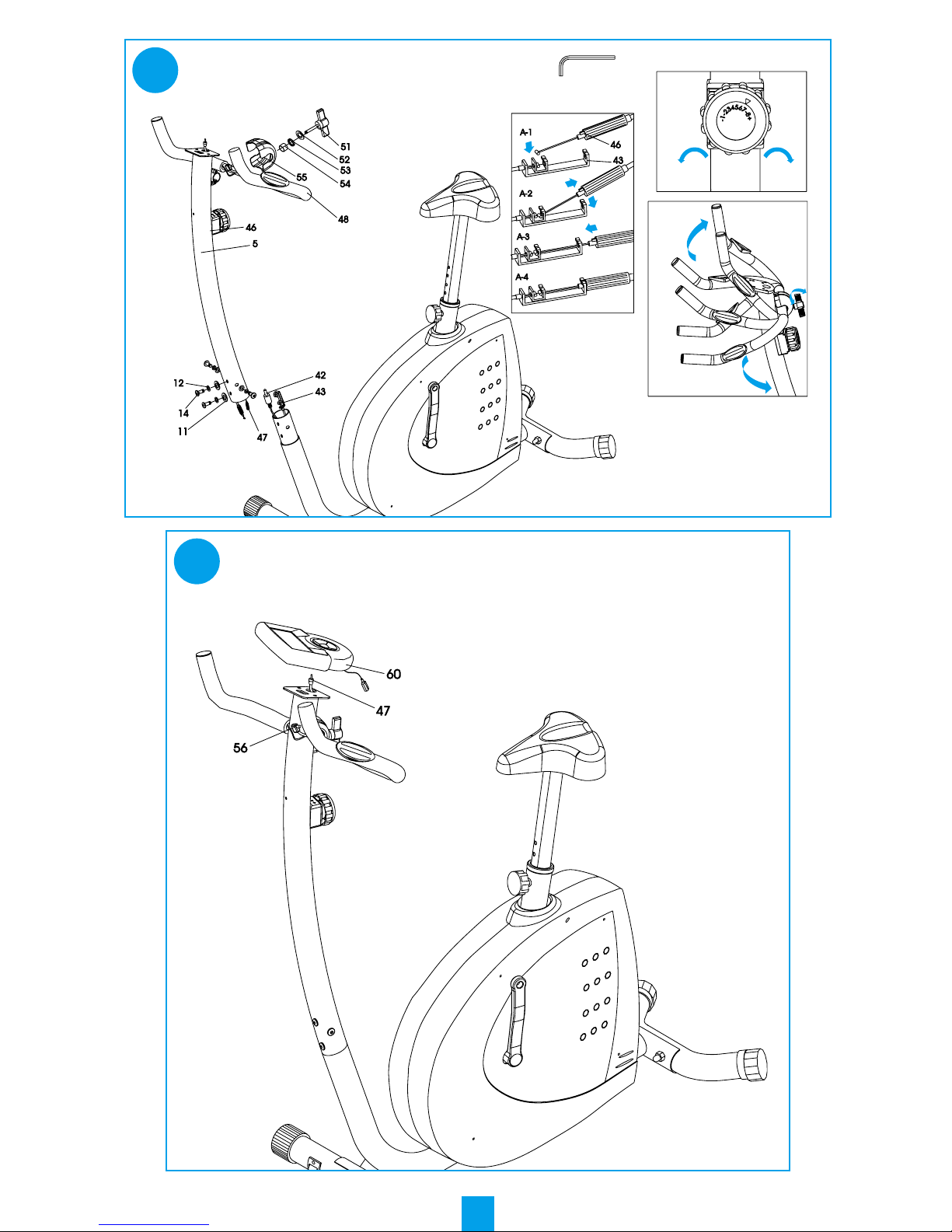
MONTAGE• ASSEMBLY•MONTAJE• ZUSAMMENBAU• MONTAGGIO
•
AFWERKING• MONTAGEM• MONTAŻ
•
Page 4
4
1
2
Page 5
5
+
-
3
4
Page 6
6
Page 7
14
ENGLISH
You have chosen a DOMYOS fitness machine and we wish to thank you for the trust you place with us.
We created the DOMYOS brand to enable all sports aficionadoes to remain at peak fitness. This item was designed
by sportsmen for sportsmen and women. We would very much appreciate receiving any of your comments and suggestions
about DOMYOS products. To this aim, the staff at your local store and the DOMYOS design department are at your disposal.
If you wish to write to us, you can send us email at the following address: [email protected].
We wish you enjoyable training sessions and hope that this DOMYOS item be a source of pleasure for you.
Model N° : _ _ _ _ _ _ _ _ _ _ _ _ _ _ _ _ _ _
Serial N° : _ _ _ _ _ _ _ _ _ _ _ _ _ _ _ _ _ _
Write the serial number in the space
above for future reference.
CAUTION
Read all warnings affixed to the product.
Read precautions and instructions in this manual
before using this equipment.
Keep this manual for future reference.
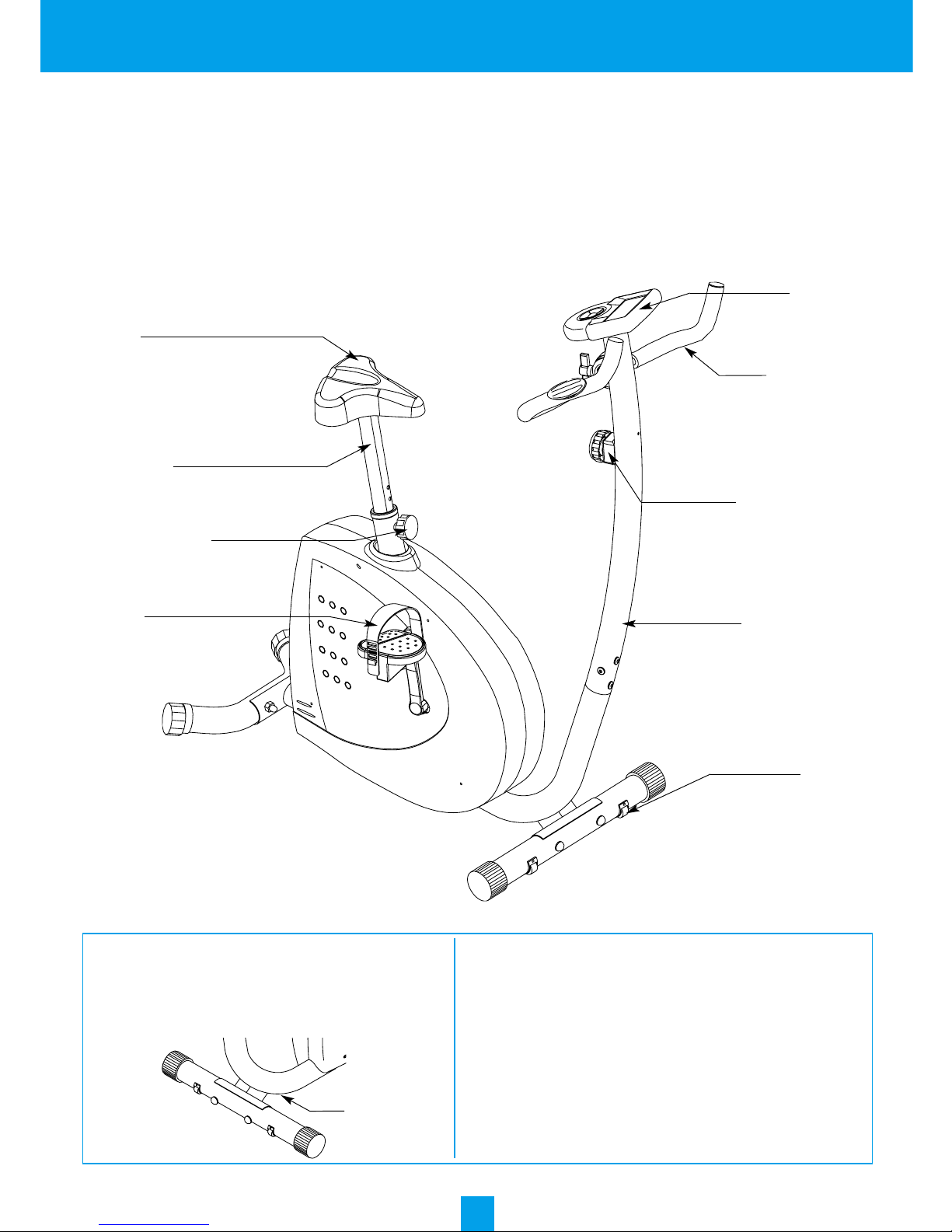
Seat
Handlebars
Console
Resistance knob
Handlebar post
Wheel
Seat post
Seat post knob
Pedal
BACK
RIGHT SIDE
LEFT SIDE
FRONT
Serial number
Decal
Page 8

15
ENGLISH
1. Read all the instructions in this manual before using the product. Use
this product only in the way described in this manual. Keep this manual
during the product’s service life.
2. This appliance is in compliance with European, American and
Chinese standards related to fitness products for domestic and non-therapeutic use. (EN-957-1 and 5 classes HC / ASTM F1250 / GB17498)
3. An adult should do the assembly of the appliance.
4. It is up to the owner to make sure that all of the product’s users are
properly informed on all the user precautions.
5. DOMYOS disclaims all responsibility concerning claims for injury or
for damages suffered by any persons or property arising from the normal or abnormal use of this product by the purchaser or by any other
person (valid only in the United States).
6. The product is intended for domestic use only. Do not use the product
in a commercial, rental or institutional context.
7. Use the product indoors, away from moisture and dust, on a level
and solid surface and in a clear area. Be sure there is enough space for
safe access to and passage around the product. Cover the floor beneath
the product for protection.
8. It is the user’s responsibility to ensure efficient maintenance of the
appliance. After assembling the product and before each use, check
that the attachment elements are well tightened without extending.
Check the state of wear and tear parts.
9. In the event of damage to your product, have all worn out or defective parts replaced immediately by the After-Sales Service of your nearest DECATHLON store and do not use the product before it is completely repaired.
10. Do not store the product in a humid place (edge of swimming pool,
bathroom…)
11. Always wear sports shoes to protect the feet while exercising. Wear
appropriate clothing when exercising. DO NOT wear loose clothing
that could get caught in moving parts. Remove jewellery.
12. Tie long hair so that it does not get in the way when exercising.
13. If you feel pain or dizziness while exercising, stop immediately, rest
a while and consult your doctor.
14. Keep children and pets away from the product at all times.
15. Keep hands and feet away from moving parts.
16. Before starting an exercise program, you should consult a doctor to
make sure that there are no counter-indications especially if you have
not practiced any sport for several years.
17. Do not let setting devices extend outward.
18. Do not tinker with your VM430.
19. Keep your back straight when using the product. Do not arch your
back.
20. The pulse sensor is not a medical device. Various factors may affect
the accuracy of rate readings. The pulse sensor is intended only as an
exercise aid in determining heart-rate trends in general.
21. Notice to persons with pacemakers, defibrillators or other implanted electronic devices. Persons who have a pacemaker use the pulse
sensor at their own risk. Before starting use, an exercise test under a
doctor’s supervision is advised.
22. Pregnant women are not advised to use the VM430. Please consult
your doctor before using it.
23. Always hold the handlebar when getting on, getting down, or using
the product.
24. Care should be taken mounting/dismounting the exercise bicycle.
25. When you stop exercising, allow the pedals to slowly come to a
stop.
26. Maximum user weight: 110 kg – 242 pounds.
PRESENTATION
WARNING
Consult your doctor before starting an exercise program. This is particularly important for people over 35 or having had health problems before.
Read all the instructions before use. DECATHLON disclaims any responsibility for any bodily injury or damage inflicted to property resulting from
the use of this product.
WARNING
The VM430 is a new generation exercise bike.
This bike places you in an anatomic position, the back straight and the arms in a resting position.
This product is equipped with magnetic transmission for greater pedaling comfort without jolts.
Warning: to reduce the risk of serious injury, please read the important precautions below before using the product.
Page 9
16
ENGLISH
SETTINGS
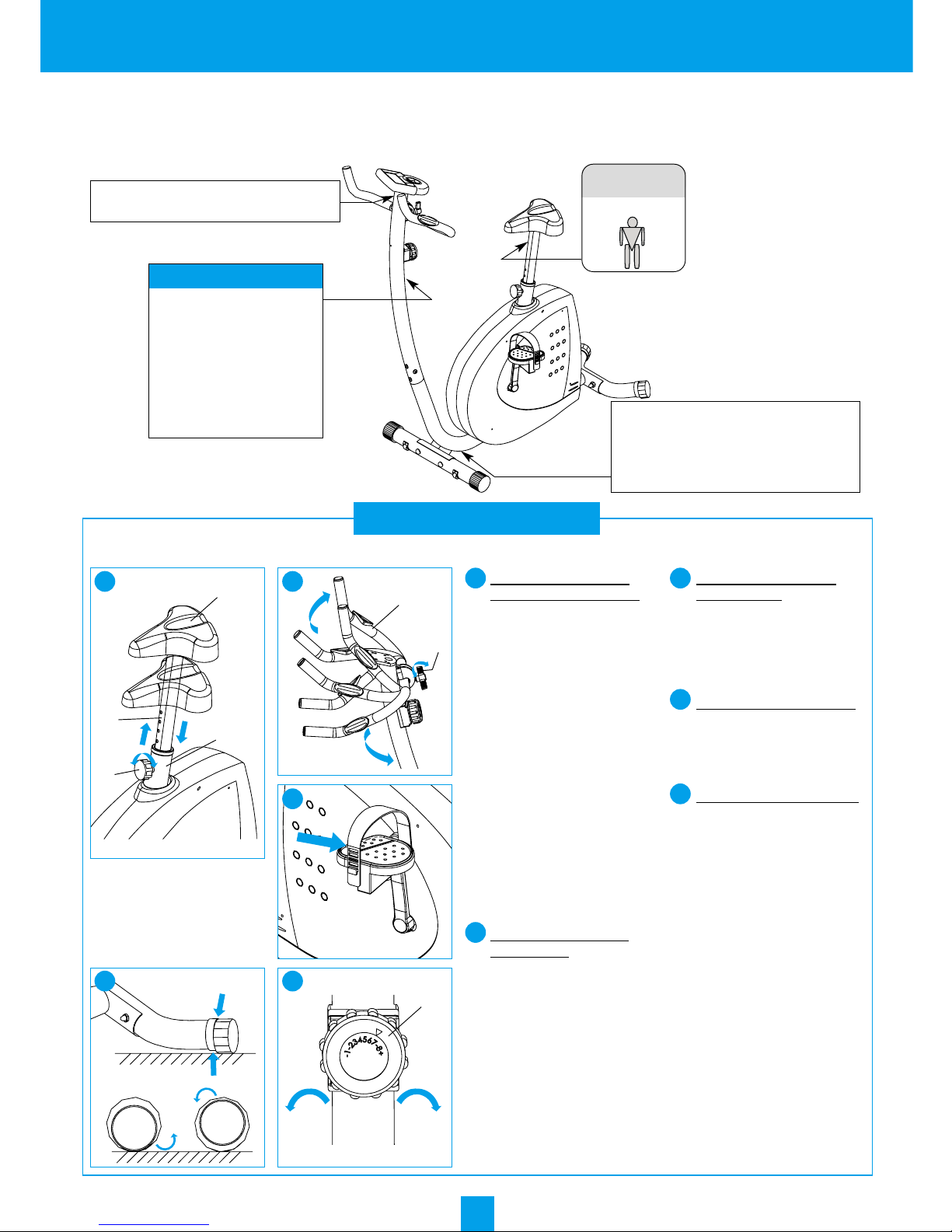
Warning: It is necessary to get off the bike to proceed to the settings (saddle, handlebar)
The warning decals shown on this page have been placed on the product in the locations shown below. If a decal is missing or
illegible, please contact your nearest DECATHLON store and order a free replacement decal. Place the decal on the product in
the location shown.
HOW TO ADJUST THE
POSITION OF THE SEAT
For effective exercising, the seat
should be at the proper height.
As you pedal, there should be a
slight bend of the knees when the
pedals are at the lowest position.
To adjust the seat, first hold the
seat (45) and loosen the seat post
knob (41). Align one of the holes
in the seat post (4) with the hole in
the frame tube (4). Insert the seat
knob into the frame and the seat
post, and tighten the seat knob
into the frame.
CAUTION :
• Be sure to insert the seat post
knob through one of the holes
in the seat post, and firmly tighten the seat post knob.
• Never exceed the maximum
saddle height.
HOW TO ADJUST THE
HANDLEBAR
To adjust the handlebar (48), loosen the handlebar knob (51).
When the handlebar is in the suitable position, tighten the knob
(51).
HOW TO ADJUST THE
PEDAL STRAP
To adjust the pedal strap, first
release the brake system under the
pedal. Adjust the strap to the desired position and then press the
brake to block the strap.
HOW TO LEVEL THE BIKE
If the bike rocks during use, turn
one or both plastic caps (8) at the
end of the back foot (3) until the
rocking stops.
SETTING THE RESIST
ANCE
The brakes system and the resistance are coupled with the pedaling speed.
The resistance setting is done with
the knob indexed (46) from 1 to
8.
Position 1 corresponds to the least
resistance and position 8 to the
highest resistance.
You can adjust the resistance
while pedaling.
Product in accordance with
EN 957 class HC, ASTM F 1250 class B, GB17498,
not suitable for therapeutic purposes.
DECATHLON - 4, bvd. de Mons – BP299
59665 Villeneuve d’Ascq Cedex – France
F : (+).33.3.20.33.50.00
-----------------------------------------------------------
EN957 Class HC, ASTM F1250 class B, GB17498
Item n°: x/xxx.xxx Order n°: xxxxxxxxxx
Supplier code: xxxxxx Made in China
WARNING
• Misuse of this product may result in
serious injury.
• Read user’s manual and follow all
warnings and operating instructions prior to use.
• Do not allow children on or around
machine.
• Replace label if damaged, illegible,
or removed.
• Keep hands, feet and hairs away
from moving parts.
MAXI
100 kg / 220 lbs
1 3
4
5
2
+
-
48
45
4
41
1
51
46
1 2
3
54
Page 10
17
ENGLISH
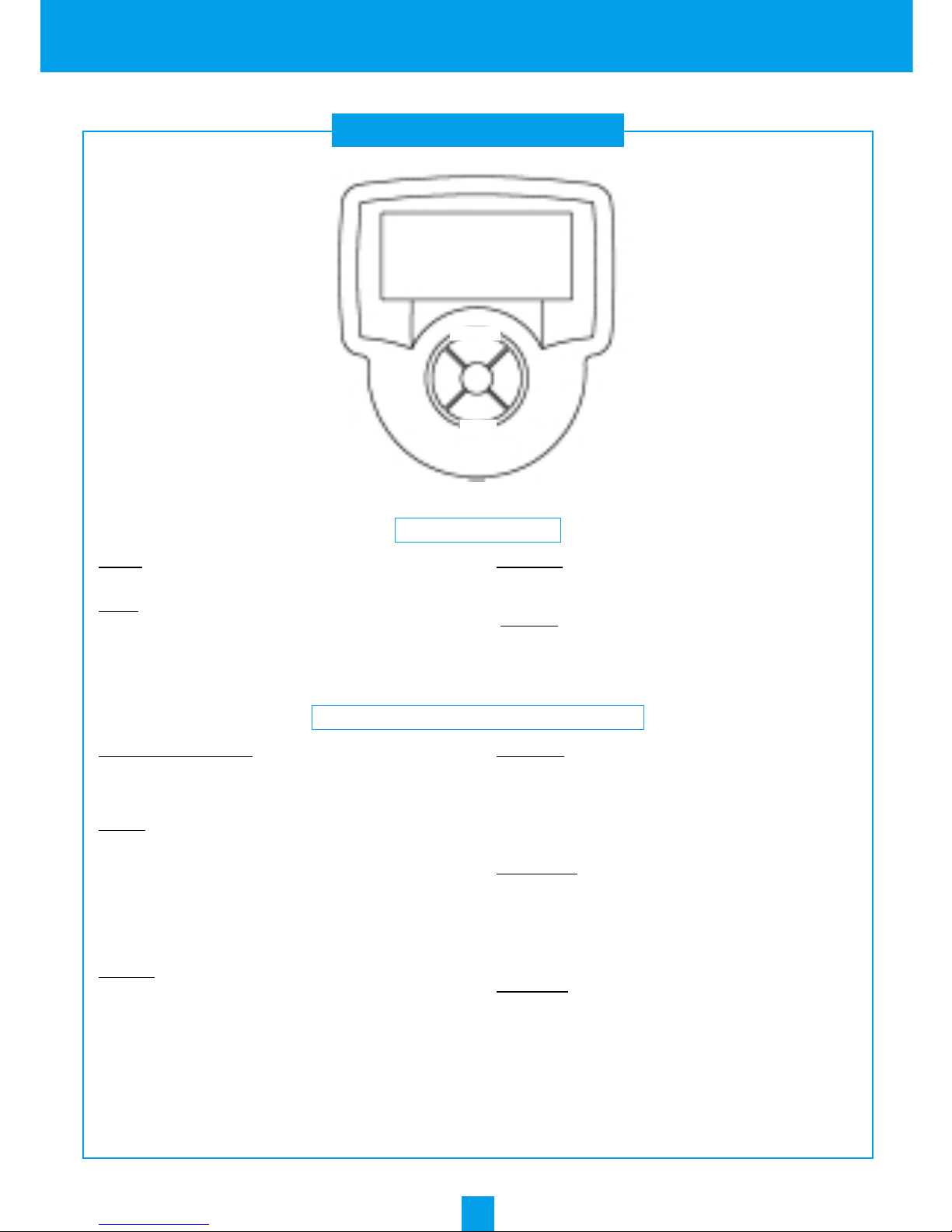
VM 430 METER
AUTO POWER ON/OFF:
The monitor will be turned on automatically by pressing any key or
start to exercise. It will turn off automatically if the monitor cannot
detect any signal for 256 seconds.
"TIME":
If the time is not preset, it will count in one-second intervals for the
exercising. The distance you have traveled will be displayed on the
meter.
• Counting: Without setting the time value, the monitor will count the
time from 00:00~99:59.
• Count down: Setting the exercise time from 1:00~99:00 minutes,
the monitor will count down from your setting values. Once the setting value is reached, the monitor will set off an alarm.
"SPEED":
The meter displays the current speed when exercising
The monitor will display the current speed from 0.00 ~ 99.9 Km/h or
Mile/h.
DIST
ANCE:
The monitor will add the distances traveled.
• Counting: Without setting the distance value, the monitor will count
up the distance from 0.1~999.9Km or Miles.
• Count down: Setting the exercise distance from 1.0~999.0 Km or
Mile, the monitor will count down from your setting values. Once the
setting value reached, the monitor will set off an alarm.
HEAR
T-RATE:
Before measuring your heart rate, place the palms of your hands on
the two contact pads, then the current heart rate on the meter will
appear on the window. If no Pulse Signal input is found within 16
seconds, the display will indicate “P_”.
Warning: it is an estimation and should in no case be interpreted
as a medical fact.
CALORIES :
The calories burned will be displayed on the window.
• Counting: Without setting the distance value, the monitor will count
up the distance from 0.1~999.0.
• Count down: Setting the exercise calorie from 1.0~999.0, the monitor will count down from your setting values. Once the setting value
reached the monitor will set off an alarm.
Warning: it is an estimation and should in no case be interpreted
as a medical fact.
KEY GUIDE
FUNCTIONS AND OPERATIONS
MODE:
Select the function to be preset.
"UP":
Press the UP key to increase the setting values of TIME, DISTANCE,
CALORIES or PULSE.
"DOWN":
Press the DOWN key to decrease the setting values of TIME, DISTANCE, CALORIES or PULSE.
"RESET":
Resets all displays to zero.
MODE
RESET
DOWN
UP
Page 11
18
ENGLISH
HOW TO PRESET TIME, DISTANCE, CALORIES and PULSE:
1. Press the MODE key until the preset item flashes.
2. Press the UP or DOWN key until the desired number is shown in
the LCD display.
3. Once the exercise has started, the preset function will begin to
count down.
4. It will beep for 12 seconds to indicate the completion of the preset
workout, press any key to stop the beeping.
REMARKS:
1. You are advised to preset only one item. If more than one item is
set, when the first preset item has reached the preset value, the
monitor will set off the alarm.
2. For PULSE window, the display will flash continuously when the
actual heart rate detected is above the preset value.
3. To exit the setting, please do not press MODE again but wait for
about 4 seconds until the display stops flashing.
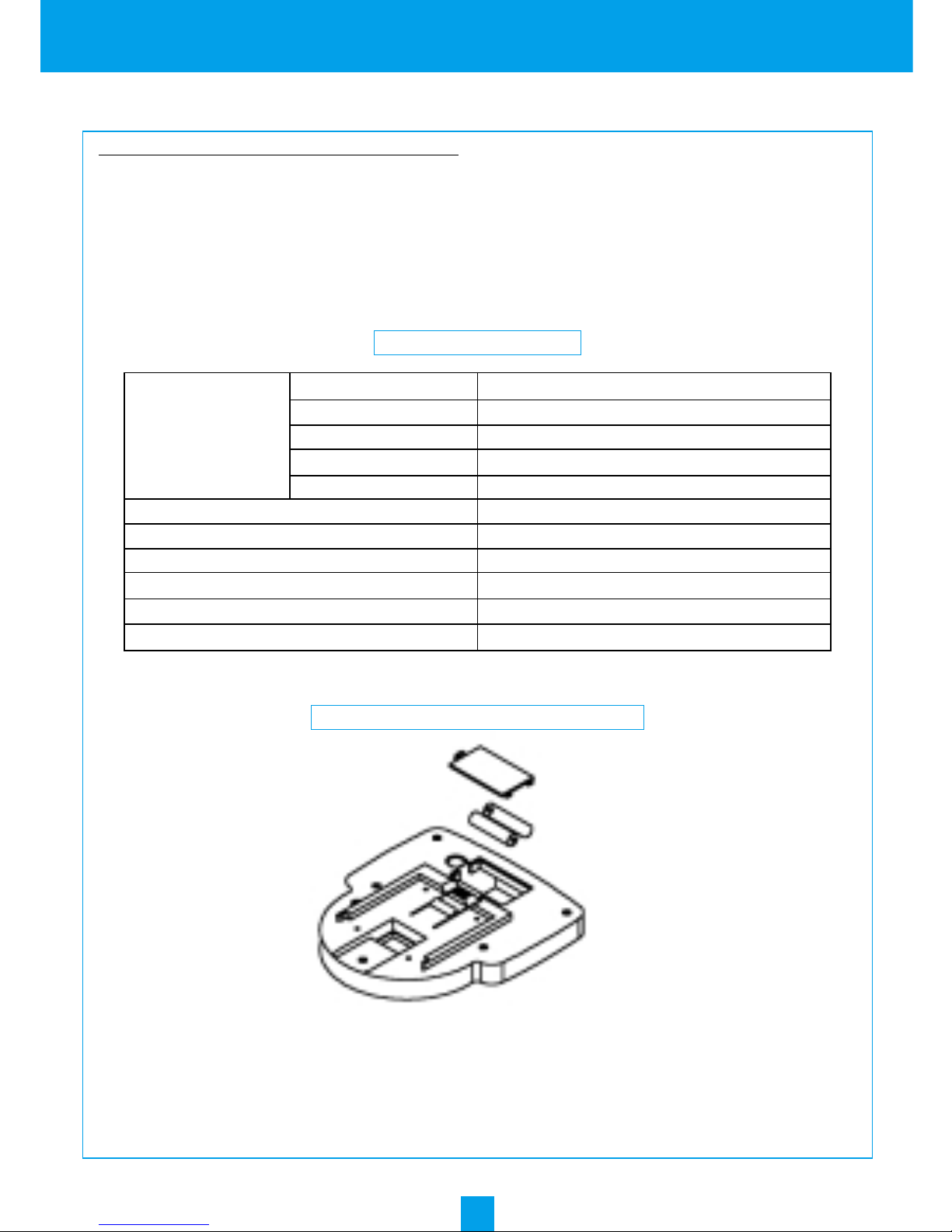
HOW TO REMOVE BATTERY
1. Pull off the battery cover and place two SIZE-AA or UM-3 batteries
into the battery housing on the back of the monitor, please refer to
the illustrations below.
2. Make sure the batteries are correctly positioned and battery springs
are in proper contact with the batteries.
3. Install the battery cover and ensure it is tightly closed.
4. If the display is illegible or only partial segments appear, please
remove the battery; wait for 15 seconds, then reinstall it.
5. The batteries life is approx. two months under normal use.
6. Removing the batteries will erase the computer’s memory.
7. Take old batteries to the recycling centers intended for that
purpose.
SPECIFICATIONS
Time 0:00-99:59
Distance 0.01-99.99 KMS or Miles
FUNCTION Current SPEED 0.0-99.9 KPH or MPH
Pulse Rate 30-240 beats per minute
Calorie 0.1-99.9K.Cal
DISPLAY Liquid crystal type
CONTROLLER 4 bit Single chip microprocessor
SENSOR No-contact magnetic type
POWER SOURCE Requires 2 type AA or UM-3 batteries
OPERATING TEMPERATURE 0°C ~ +40°C (32°F~ 104°F)
STORAGE TEMPERATURE -10°C ~ +60°C (14°F~ 140°F)
Page 12

19
The exercise bike provides an excellent kind of cardio-training activity. Training on this equipment is designed to increase your cardio-vascular
capacity. On this principle, you improve your physical condition, your endurance and you burn calories (an indispensable activity for weight
loss in association with dieting).
Finally, the exercise bike allows you to tone the muscles in the legs and buttocks.
The muscles in the calves and the lower abdominals are also worked.
PARTS OF THE BODY WORKED
Weight Maintenance/Warm-up:
progressive effort starting at 10
minutes.
For a workout designed either to keep you in
shape or for re-education purposes, you may
train every day for around ten minutes. This
type of exercise is designed to stimulate your
muscles and joints or may be used as a
warm-up to additional physical activity.
To increase the muscle tone of the legs, select
a higher resistance and lengthen the exercise
period.
Of course, you may vary the pedalling resistance throughout your exercise session.
Aerobic fitness workout: moderate
effort for a fairly long period (35
min to 1 hour).
If you wish to lose weight, this type of exercise, combined with a diet, is the only way to
increase the quantity of energy consumed by
the organism. Nevertheless, it is pointless to
push yourself beyond your limits. It is the
regularity of training that will allow you to
obtain the best results.
Select a fairly weak pedalling resistance and
exercise at your own rhythm, but at least for
a period of 30 minutes. This exercise should
raise a slight sweat but should under no circumstances leave you breathless. It’s the
duration of the exercise, at a slow rhythm,
that will require your organism to draw its
energy from your fat reserves provided that
you pedal for more than thirty minutes, a
minimum of three times a week.
Aerobic training for endurance: sustained effort for 20 to 40 minutes.
This type of training targets significant reinforcement of the cardiac muscle and improved respiratory activity.
The resistance and/or speed of pedalling is
increased so as to increase respiration during
the exercise. The effort here is more sustained
than for the maintenance workout.
As your training progresses, you will be able
to sustain the effort for longer periods, at a
faster rate or with a higher degree of resistance. You may train a minimum of three
times a week for this type of training.
Training at a faster rate (anaerobic workout
and workout in the red zone) is reserved for
athletes and requires adequate preparation.
After each training session, take several
minutes to pedal with diminishing speed and
resistance in order to cool down and progressively bring the body to a state of rest.
When just starting out, begin by training over several days with a slight resistance and pedalling speed, without forcing, and taking rest breaks as
needed. Then progressively increase the frequency or duration of your exercise sessions.
USAGE
DECATHLON guarantees this product for parts and labor, under normal conditions of use, for 5 years for the structure and 2 years for wear parts
and labor starting on the date of purchase, confirmed by the date on the sales ticket. This guarantee applies only to the original purchaser.
DECATHLON’S obligation in compliance with this warranty is limited to the product’s replacement or repair, at DECATHLON’S convenience.
To have the product repaired, bring it to a DECATHLON store.
All the products covered by this warranty, shall be accepted by DECATHLON in one of its authorized service centers, sent postage paid together
with the proof of purchase.
This warranty cannot be applied in the following cases:
• Damage caused during transport
• Misuse or abnormal use
• Repairs done by people not authorized by DECATHLON
• The commercial use of the product concerned
This trade warranty does not exclude the legal guarantee(s) applicable according to countries and / or provinces.
This guarantee gives you specific rights recognized by the law. You may also have rights that vary from one province to another as specified by the
salesperson of your equipment.
DECATHLON
- 4 BOULEVARD DE MONS – BP299 –
- 59665 VILLENEUVE D’ASCQ – France -
TRADE WARRANTY
ENGLISH
Page 13
2020
Warm-up phase : progressive effort.
Warming up is a preparatory phase before any activity. It puts the person INTO
OPTIMUM CONDITIONS for carrying out his or her favorite sport. It is a METHOD
OF PREVENTING ACCIDENTS TO TENDONS AND MUSCLES. There are two
aspects : WAKING UP THE MUSCULAR SYSTEM, GENERAL WARMING UP.
1) The muscular system is prepared in a SPECIAL STRETCHING SESSION which
PREPARES FOR EACH ACTIVITY : each group of muscles is used, joints are used.
2) Global warming up gradually brings the cardiovascular and respiratory system into action, improves irrigation of the muscles and prepares for making
efforts. It must be sufficiently long : 10 min for a leisure sport activity, 20 min
for a competition sport activity. Note that warming up must be longer : after
55 years old, in the morning.
Training
TRAINING is the main phase of your physical activity. You can improve your physical condition by REGULAR training.
• Anaerobie exercice to develop endurance.
• Aerobic exercice to develop cardio-pulmonary resistance.
Slowing down
This is the continuation of an activity at low intensity, the gradual “return to rest”
phase. SLOWING DOWN brings the cardiovascular and respiratory system, the
blood flow and muscles back to “normal” (eliminating the counter effects of an
exercice, such as lactic acids, the accumulation of which is one of the major causes of muscular pains such as cramps and stiff muscles).
Stretching
STRETCHING must follow the slowing down phase while joints are still warm in
order to reduce risks of injury. Stretching after an activity : minimizes MUSCULAR
STIFFNESS due to an accumulation of LACTIC ACIDS, “stimulates” BLOOD
CIRCULATION.
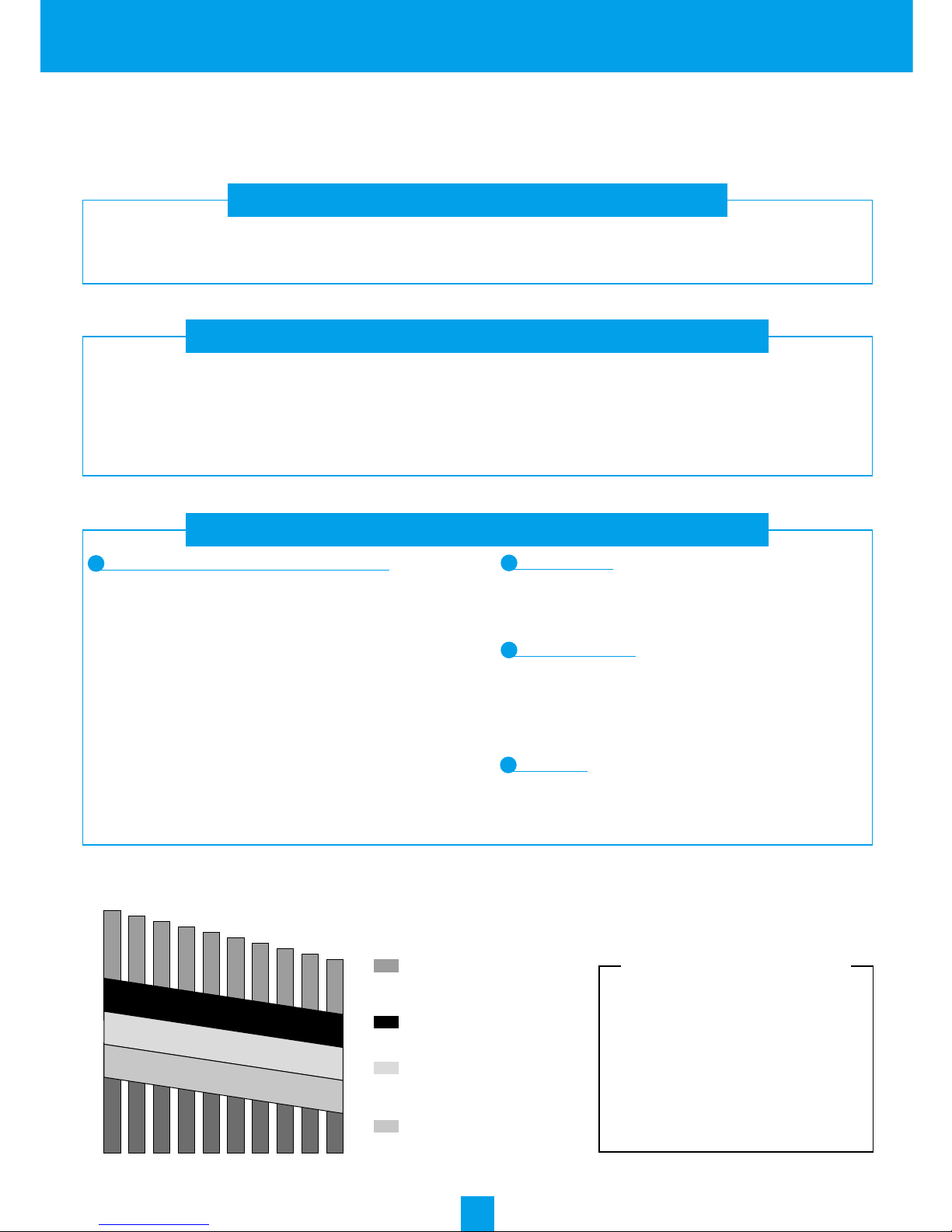
CARDIO - TRAINING
• Exercise from 80 to 90% and
beyond : Anaerobic zone and red
zone reserved for high performance and specialised athletes.
• Exercise of 70% to 80% of the
maximum cardiac rate :
Endurance exercise.
• Exercise from 60 to 70% of the
maximum cardiac rate : Getting
fit / favourable consumption of
fat.
• Exercise from 50 to 60% of the
maximum cardiac rate :
Maintenance /Warm up.
200
195
185
190
180
175
170
165
160
155
20
60%
70%
80%
100%
60%
50%
70%
80%
100%
25 30 35 40 45 50 55 60 65
160
156
148
152
144
140
136
132
128
124
140
136
129
133
126
122
119
115
112
108
120
117
111
114
108
105
102
99
96
93
100
97
92
95
90
87
85
82
80
77
50%
WARNING, TECHNICAL INSET
WARNING TO USERS
You must work towards getting fit in a controlled
manner.
Do no hesitate to consult a doctor before any
physical activity, especially if : you have not
practiced any sports activities in recent years,
you are more than 35 years old, you are not sure
about your health, you are following medical
treatment.
CONSULT A DOCTOR
BEFORE PRACTISING ANY SPORT.
Exercice range
A
B
C
D
Beats per minute
CARDIO-TRAINING EXERCICE
Cardio-training exercice is a form of aerobics (conditioning the body in the presence of oxygen) and allows you to improve your cardio-vascular
capacity. To be more precise, you will improve the tonicity of the heart and your blood vessels. Cardio-training exercice carries the oxygen breathed
in from the air to your muscles. It is the heart that pumps this oxygen through the body and, in particular, to the muscles being exercised.
CONTROLLING YOUR HEARTBEAT
PHASES OF A PHYSICAL ACTIVITY
It is vital to measure your pulse periodically in order to control your
degree of exercising. If you do not have an electronic measuring
device, follow this procedure :
To take your pulse, position two fingers : on the neck, or below the
ear, or at the inside wrist beside the thumb.
Do not press too hard : excessive pressure reduces the blood flow
and can slow down the heartbeat. After counting the pulsations for
30 seconds, multiply by 2 to obtain the number of pulsations per
minute.
Example : 75 pulsations counted in 30 seconds corresponds to a
heart beat of 150 pulsations per minute.
ENGLISH
 Loading...