

Page 1
CAST IRON STOVE AND DIRECT-VENT
(FREESTANDING FIREPLACE HEATER)
BURNER SYSTEM
OWNER’S OPERATION AND INSTALLATION MANUAL
NATURAL GAS BURNER SYSTEM MODEL MSTDVN
PROPANE/LP GAS BURNER SYSTEM MODEL MSTDVP
REMOTE READY
IMPORTANT: This direct-vent burner system must be installed into approved Sun Valley cast iron
stove bodies, models MC(*) series ONLY. See page 3 of this manual.
QUALIFIED INSTALLER: If you encounter problems during installation of this product, please
contact DESA International’s Technical Service Department at 1-800-337-2564.
* Indicates Color Suffix Designation
WARNING: If the information in this manual is
not followed exactly, a fire or explosion may
result causing property damage, personal injury, or loss of life.
FOR YOUR SAFETY
Do not store or use gasoline or other flammable
vapors and liquids in the vicinity of this or any
other appliance.
FOR YOUR SAFETY
WHAT TO DO IF YOU SMELL GAS
• Do not try to light any appliance.
• Do not touch any electrical switch
• Do not use any phone in your building.
• Immediately call your gas supplier from a
neighbor’s phone. Follow the gas supplier’s
instructions.
• If you cannot reach your gas supplier, call the
fire department.
This appliance may be installed in an aftermarket*, permanently located manufactured
(mobile) home, where not prohibited by state or local codes.
WARNING: Improper installation,
adjustment, alteration, service, or
maintenance can cause injury or
property damage. Refer to this
manual for correct installation and
operational procedures. For assistance or additional information
consult a qualified installer, service agency, or the gas supplier.
— Installation and service must
be performed by a qualified installer, service agency, or the gas
supplier.
— This appliance is only for use
with the type of gas indicated on
the rating plate. This appliance is
not convertible for use with other
gases, unless a certified kit is used.
*Aftermarket: Completion of sale, not for purpose of resale, from the manufacturer.
Save this manual for future reference.
Page 2
SUN VALLEY STOVE COMPANY
CAST IRON STOVE AND BURNER SYSTEM
SAFETY
INFORMATION
WARNINGS
IMPORTANT: Read this owner’s
manual carefully and completely
before trying to assemble, operate, or service this stove and burner
system. Improper use of this stove
and burner system can cause serious injury or death from burns,
fire, explosions, electrical shock,
and carbon monoxide poisoning.
DANGER: Carbon monoxide
poisoning may lead to death!
This stove with burner system is a vented
product. This stove with burner system will
not produce any gas leakage into your home
if properly installed. This stove with burner
system must be properly installed by a qualified service person. The glass door must be
properly seated and sealed. If this unit is not
properly installed by a qualified service
person with glass door properly seated and
sealed, gas leakage can occur.
Carbon Monoxide Poisoning: Early signs of
carbon monoxide poisoning resemble the flu,
with headaches, dizziness, or nausea. If you
have these signs, the stove with burner system
may not have been installed properly. Get
fresh air at once! Have stove with burner
system inspected and serviced by a qualified
service person. Some people are more affected by carbon monoxide than others. These
include pregnant women, people with heart or
lung disease or anemia, those under the influence of alcohol, and those at high altitudes.
Propane/LP gas and natural gas are both
odorless. An odor-making agent is added to
each of these gases. The odor helps you
detect a gas leak. However, the odor added
to these gases can fade. Gas may be present
even though no odor exists.
Make certain you read and understand all
warnings. Keep this manual for reference. It
is your guide to safe and proper operation of
this stove and burner system.
WARNING: Any change to
this stove or burner system or its
controls can be dangerous.
1. This appliance is only for use with the
type of gas indicated on the rating plate.
This appliance is not convertible for use
with other gases unless a certified kit
is used.
2. For propane/LP burner system, do not
place propane/LP supply tank(s) inside
any structure. Locate propane/LP supply tank(s) outdoors. T o prevent performance problems, do not use propane/LP
fuel tank of less than 100 lbs. capacity.
3. If you smell gas
• shut off gas supply
• do not try to light any appliance
• do not touch any electrical switch; do
not use any phone in your building
• immediately call your gas supplier
from a neighbor’s phone. Follow the
gas supplier’s instructions
• if you cannot reach you gas supplier ,
call the fire department.
4. Never install the stove
• in a recreational vehicle
• where curtains, furniture, clothing, or
other flammable objects are less than
42" from the front, top, or sides of
the stove
• in high traffic areas
• in windy or drafty areas
5. This stove reaches high temperatures.
Keep children and adults away from hot
surfaces to avoid burns or clothing ignition. Stove will remain hot for a time
after shutdown. Allow surfaces to cool
before touching.
6. Carefully supervise young children
when they are in the room with stove.
7. Do not modify the burner or stove under
any circumstances. Any parts removed
for servicing must be replaced prior to
operating stove or burner system.
8. Turn burner system off and let cool
before servicing, installing, or repairing. Only a qualified service person
should install, service, or repair the
stove or burner system. Have burner
system inspected annually by a qualified service person.
9. You must keep control compartments,
burners, and circulating air passages
clean. More frequent cleaning may be
needed due to excessive lint and dust from
carpeting, bedding material, pet hair, etc.
Turn off the gas valve and pilot light before cleaning stove or burner system.
10. Have venting system inspected annually by a qualified service person. If
needed, have venting system cleaned
or repaired. See Cleaning and Mainte-
nance, page 28.
11. Keep the area around your stove clear
of combustible materials, gasoline,
and other flammable vapor and liquids. Do not run burner system where
these are used or stored. Do not place
items such as clothing or decorations
on or around stove.
12. Do not use this stove to cook food or
burn paper or other objects.
13. Never place anything on top of stove.
14. Do not use any solid fuels (wood, coal,
paper, cardboard, etc.) in this stove. Use
only the gas type indicated on burner
system nameplate.
15. This appliance, when installed, must be
electrically grounded in accordance
with local codes or, in the absence of
local codes, with the National Electri-
cal Code, ANS/NFPA 70, or the Canadian Electrical Code, CSA C22.1.
16. Do not obstruct the flow of combustion and ventilation air in any way . Provide adequate clearances around air
openings into the combustion chamber
along with adequate accessibility clearance for servicing and proper operation.
17. Do not install stove directly on carpeting, vinyl tile, or any combustible material other than wood. The stove must
set on a metal or wood panel extending the full width and depth of the stove.
18. Do not use stove or burner if any part has
been exposed to or under water. Immediately call a qualified service person to
arrange for replacement of the unit.
19. Do not operate burner system if any log
is broken.
20. Do not use a blower insert, heat exchanger insert, or other accessory not
approved for use with this stove.
21. Do not operate burner system with glass
door removed, cracked, or broken.
For more information, visit www.desatech.com
2
107280
Page 3
OWNER’S MANUAL
PRODUCT
IDENTIFICATION
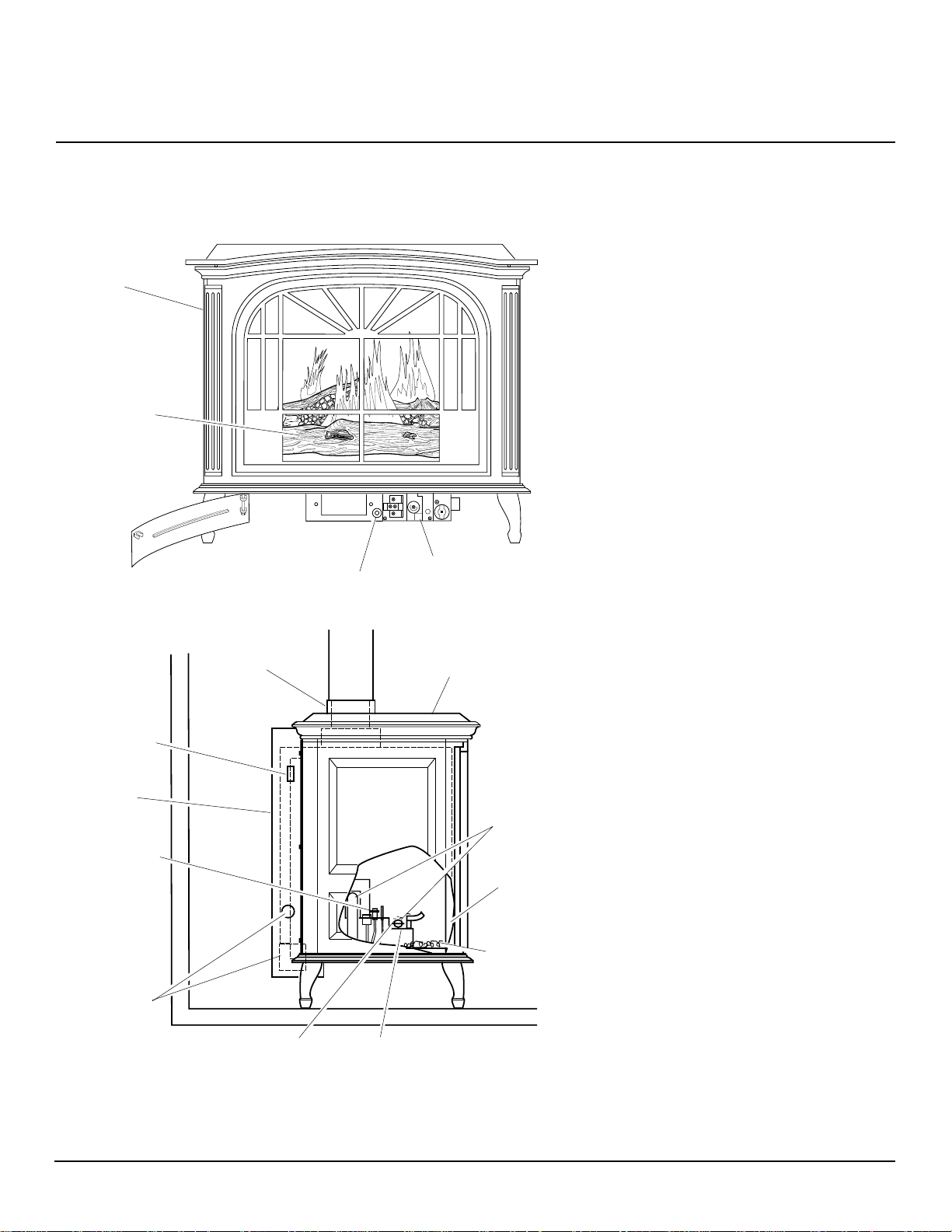
Cast Iron
Stove Body
Log Set
Vent
Opening
Piezo Ignitor
O
H
L
I
OFF
ON
Control Valve
Cast Iron
Stove Body
LOCAL CODES
Install and use stove and burner system with
care. Follow all local codes. In the absence to
local codes, use the current National Fuel
Gas Code, ANS Z223.1, also known as NFPA
54* (USA) or the current CAN/CGA-B149[.1
or .2] Installation Codes (Canada).
*Available from:
American National Standards Institute, Inc.
1430 Broadway
New York, NY 10018
National Fire Protection Association, Inc.
Batterymarch Park
Quincy, MA 02269
PRODUCT
FEATURES
OPERATION
This cast iron stove with burner system is
clean burning and vents easily through outside walls or vertically using outside air for
combustion. Heat is generated by both realistic flames and glowing embers. When
used without the blower accessory, the stove
with burner system requires no electricity
making it ideal for emergency backup heat.
ON/OFF Switch
(Opposite Side)
Rear Cover
Burner
Pilot Assy
Glass Door
Assy
Lava Rock
Blower with
Adjustment
Knob (Optional
Installation)
Figure 1 - Sun Valley Direct-Vent Burner System Shown Installed in Approved Sun
Valley Cast Iron Stove Body Models MC Series Only
Glowing Embers
Grate Assembly
PIEZO IGNITOR
This burner system has a piezo ignitor. This
system requires no matches, batteries, or
other sources to light burner system.
GLOSSARY OF
TERMS
Chase - A boxlike enclosure to protect
venting from the elements when the venting
run is on the outside of a structure.
Mastic - A pliable sealant for use around the
vent terminal.
Snorkel Termination - A box that raises the
horizontal termination above ground level
clearances.
Vent Terminal - Mounted on an outside
wall or roof to separate the inlet and outlet of
the vent system and protect it from weather.
Vinyl Siding Standoff - A metal box that
separates the vent cap from vinyl siding.
Wall Thimble/Firestop - A metal plate used
to secure the vent pipe when it passes through
a wall or ceiling.
107280
3
For more information, visit www.desatech.com
Page 4
SUN VALLEY STOVE COMPANY
6
"
4
"
Front
CAST IRON STOVE AND BURNER SYSTEM
PRE-INSTALLATION
PREPARATION
WARNING: A qualified installer or service person must
install stove and burner system.
Follow all local codes.
CAUTION: This stove creates
warm air currents. These currents
move heat to wall surfaces next
to stove. Installing stove next to
vinyl or cloth wall coverings or
operating stove where impurities
(such as tobacco smoke, aromatic candles, cleaning fluids,
oil or kerosene lamps, etc.) in the
air exist, may discolor walls.
LOCATION AND SPACE
REQUIREMENTS
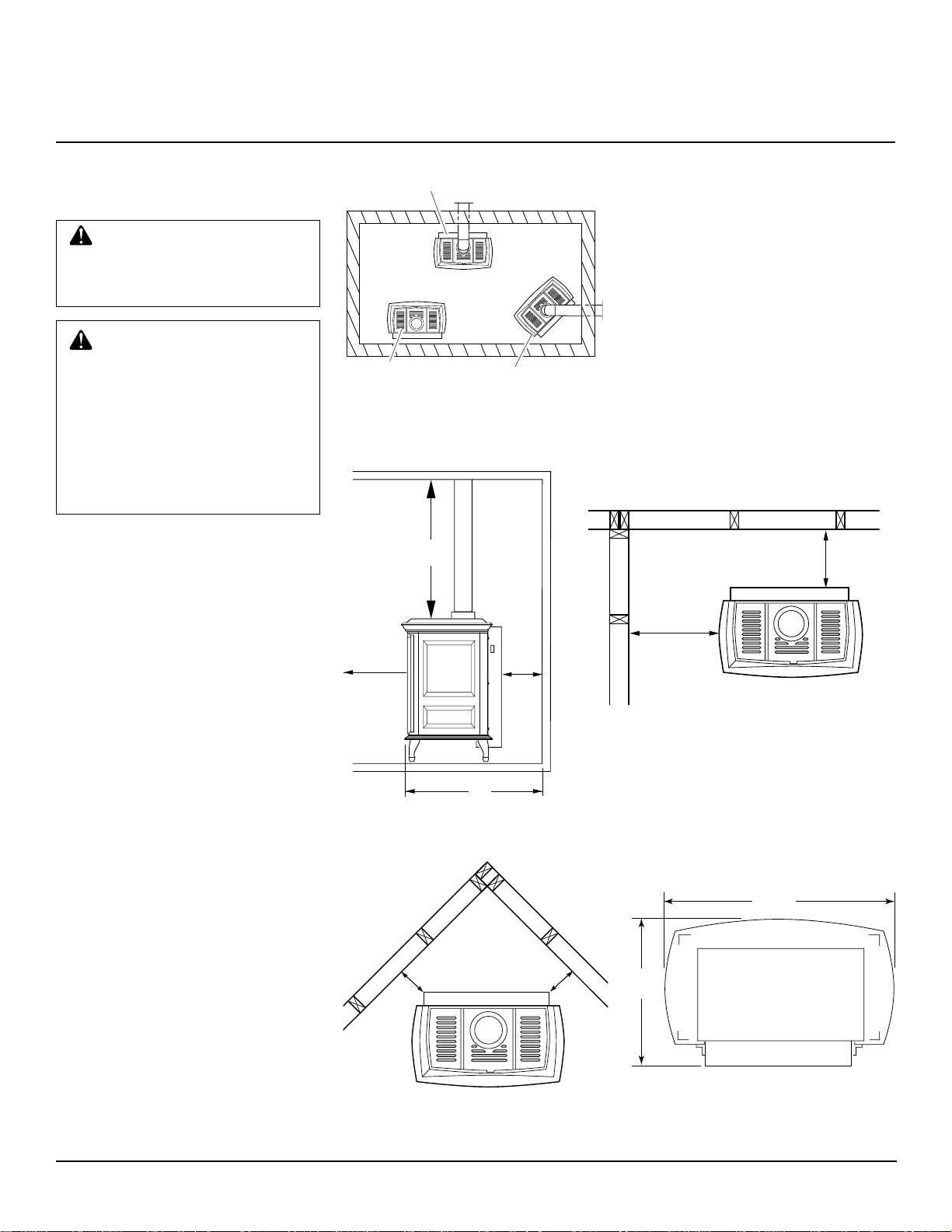
Determine the safest and most efficient location for your Sun Valley cast iron stove.
Make sure that rafters and wall studs are not
in the way of the venting system. Choose a
location where the heat output is not affected by drafts, air conditioning ducts, windows, or doors. Figure 2 shows some common locations. Read all venting information
in this manual. Be aware of all restrictions
and precautions before deciding the exact
location for your stove.
When deciding the location of your stove,
follow these rules:
1. Do not connect this stove and burner
system to a chimney flue serving a
separate solid-fuel burning fireplace or
appliance.
2. Due to high temperatures, do not locate this stove in high traffic areas or
near furniture or draperies.
3. Proper clearances must be maintained,
see Figures 3 and 4.
4. This stove is a freestanding unit designed to set directly on the floor. If
your stove is to be installed directly on
carpeting, vinyl tile, or any combustible
material other than wood, it must be
installed on a metal or wood panel extending the full width and depth of the
stove. See Figure 5.
For more information, visit www.desatech.com
On Wall with Vertical
Termination Through
Ceiling
Figure 2 - Common Stove Locations
Figure 3 - Minimum Clearances for Standard Installation
Figure 4 - Minimum Clearance for Corner
Installation
On Wall with
Horizontal Termination
Ceiling
42"
36"
from
Front
Floor
4"
Corner Installation
4"
from
Back
Wall
29"
4
27 1/2"
Front
4"
X"
Figure 5 - Stove with Burner System
Bottom Dimensions
107280
Page 5
CAST IRON STOVE
OWNER’S MANUAL
AND DIRECT-VENT
BURNER SYSTEM
ASSEMBLY
STOVE BODY ASSEMBLY
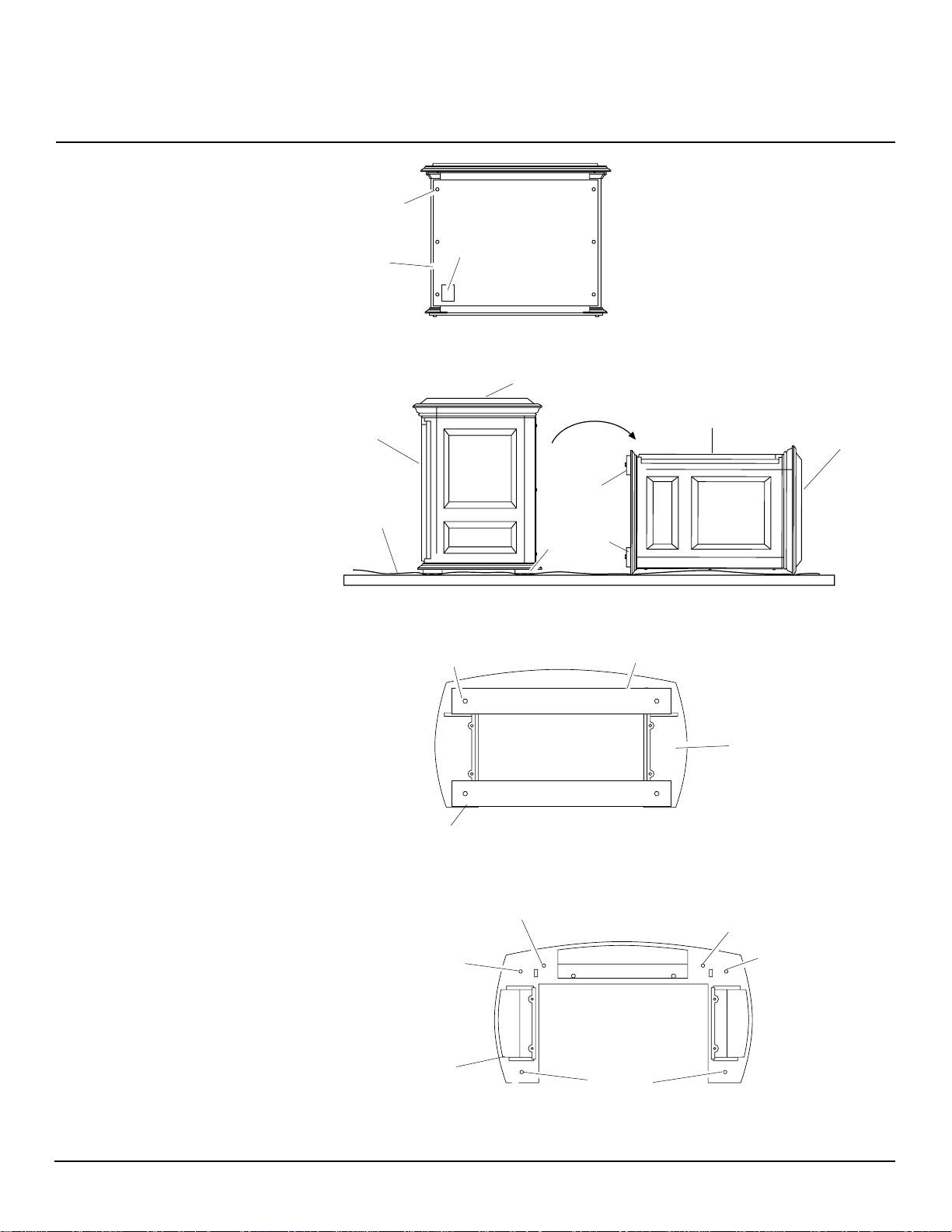
1. Lift off corrugated box enclosing stove
body crating.
2. Remove all screws fastening the wood
frame enclosure. Spread wood frame open
and lift away from plastic-bagged stove
body. The bottom pieces of pallet wood
will remain bolted to the stove body.
3. Remove plastic bag from stove body.
4. Remove back panel from stove (see
Figure 6). Use an adjustable wrench or
a 10 mm socket. Remove six (6) bolts
and washers. Keep bolts and washers
to attach rear cover.
5. Remove all contents from inside stove
cavity. Contents include:
(1) - Stove bottom (Discard - Not used
with this application)
(4) - Legs with leg leveler bolts
(1) - Bottom door
(3) - Top grates
(2) - Brackets
(1) - Hardware kit bag with fasteners
6. Carefully lay stove body on back to attach bottom components to stove body
(see Figure 7). Rest stove on drop cloth
or blanket to avoid scratching stove edges.
7. Remove remaining pallet wood attached to bottom of stove body (see
Figure 8). Use an adjustable wrench to
remove bolts.
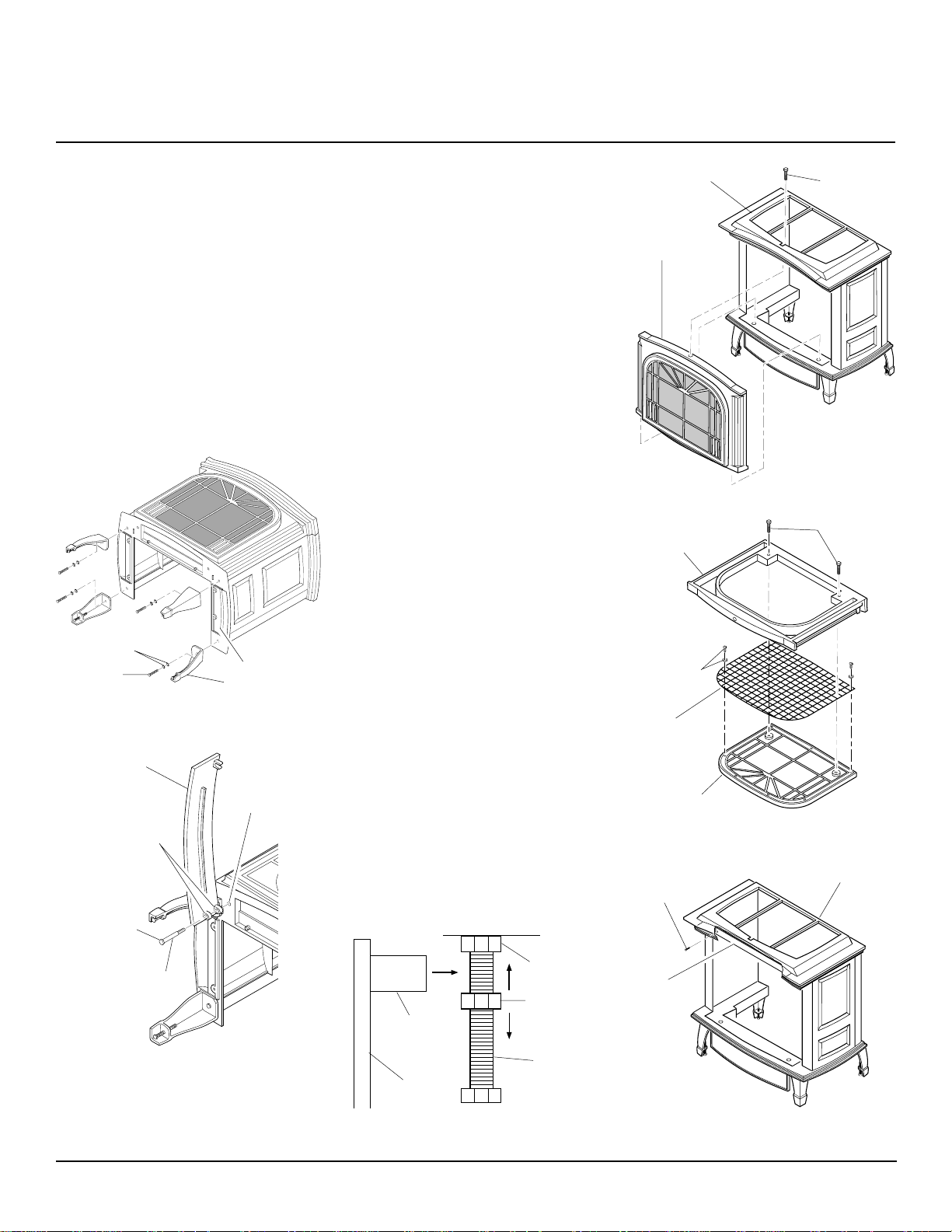
8. Fasten each leg to stove with four (4)
M8 x 1.25 - 20mm bolts. Use a flat
washer and lock washer with each bolt.
Tighten bolts into threaded holes on
stove body (see Figure 9 and Figure 10
on page 6). Use an adjustable wrench
or a 12mm socket.
Bolt
Back
Stove
Panel
Figure 6 - Removing Back Panel
Front of
Stove
Unit
Drop
Cloth/
Blanket
Figure 7 - Laying Down Stove On Side
Pallet Wood
Figure 8 - Removing Pallet Wood From The Bottom of The Stove
Product
Identification
Label
Bolt
Door Hinge Step
Bolt Hole
Leg
Hole
Top of Stove Unit
Pallet
Wood
Bolted to
Bottom of
Stove
Body
Front
Front
Front of
Stove Unit
Pallet Wood
Bottom Of
Stove Unit
Door Catch Bolt
With Adjustable
Hex Nuts Hole
Top of
Stove Unit
Leg
Hole
107280
Bottom Of
Stove Unit
Figure 9 - Locating Threaded Holes for Legs, and Door Attachment
5
Leg Hole
For more information, visit www.desatech.com
Continued
Page 6
SUN VALLEY STOVE COMPANY
CAST IRON STOVE AND BURNER SYSTEM
CAST IRON STOVE
AND DIRECT-VENT
BURNER SYSTEM
ASSEMBLY
Continued
9. Attach stove door by inserting step bolt
through door hinge pivot hole and into
threaded hole in stove body (see Figure
11 and Figure 9, page 5). Use an adjustable wrench or a 12mm socket to fasten step bolt. Tighten step bolt until snug.
Make sure door moves freely.
Washers
Bolt
Figure 10 - Attaching Stove Legs
Stove Door
Panel
Door Hinge
Step
Bolt
Bolt
Shoulder
Figure 11 - Attaching Lower Stove Door
Panel
Bottom Of
Stove Unit
Leg
Threaded
Hole
10. Install door catch bolt (M8 x 1.25-55mm
with two M8 hex nuts) into threaded
hole on stove body (see Figure 9, page
5). Use an adjustable wrench or a 12mm
socket. The catch bolt has two hex nuts
attached to it (see Figure 12). The top
nut is a bolt stop and the bottom nut is
for door leveling adjustment.
11. Check general catch bolt alignment
with door claw. Make final adjustment
and door leveling after stove is in normal standing position.
12. Carefully lift stove back up on its four
attached legs.
13. Remove 2 bolts from bottom of stove
and discard. Remove bolt from the top
of the stove to remove the front panel
assembly (see Figure 13). If not removing screen, proceed to step 17.
14. Optional Screen Removal: Lay the
front panel assembly face down on a
protected surface. Remove the two
screws that hold the front plate onto the
front surround plate (see Figure 14).
Save these screws.
15. Remove the seven screws and washers
that hold the screen onto the front surround plate. Discard these screws,
washers, and screen. They are required
for vent-free use only (see Figure 14).
16. Replace the two screws from step 15
to reassemble the front plate and the
front surround plate. Set this assembly
aside until burner system has been installed, logs have been placed inside of
burner system, and glass door to burner
system insert has been replaced.
17. Remove the four screws that secure the
metal plate located across the front section at the top of the stove body (see Figure 15). Discard these screws and metal
plate. They are for vent-free use only.
Bolt
Stop
Adjusting
Door
Claw
Door
Nut
Catch
Bolt
Stove
Body
Front
Assembly
Figure 13 - Removing Front Assembly
Front Surround
Plate
Screw with
Washer
Screen
Front Plate
Figure 14 - Removing Screen from Front
Assembly
Screw
Metal
Plate
Bolt
Screws
Stove Body
Figure 12 - Catch Bolt and Door Claw
Orientation
For more information, visit www.desatech.com
Figure 15 - Removing Metal Plate from
Stove Body
6
107280
Page 7
OWNER’S MANUAL
CAST IRON STOVE
AND DIRECT-VENT
BURNER SYSTEM
ASSEMBLY
Continued
INSTALLING DIRECT-VENT
BURNER SYSTEM INTO
STOVE BODY
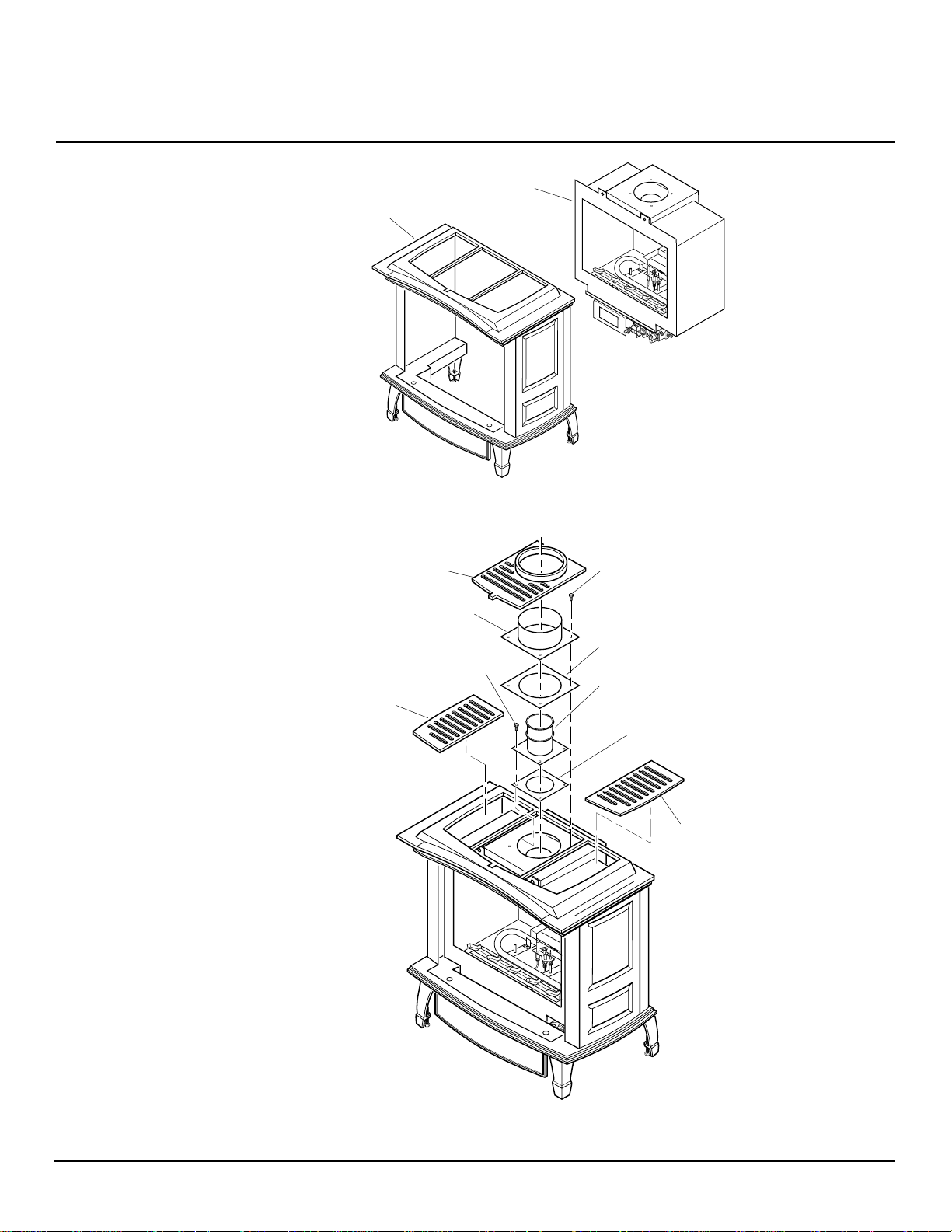
1. Carefully lift burner system and place
into stove body from the rear of stove
(see Figure 16).
2. Carefully insert small gasket into top
vent hole of burner system box and
align holes (see Figure 17).
3. Place 4" vent collar inside hole and
align with gasket. Secure with hex
screws provided (see Figure 17).
4. Place large gasket on outside of burner
system box over vent hole and align
(see Figure 17).
5. Place 7" vent collar over gasket and
align holes. Secure with hex screws
provided (see Figure 17).
IMPORTANT:
must not be installed until after burner system has been inserted into stove body.
6. Place the left and right grate top into
top of stove body. Discard center grate
top and replace with center cast top
provided with burner system.
These gaskets and collars
Cast Iron
Stove Body
Burner
System
O
L
H
I
F
P
F
I
O
L
O
O
T
N
Figure 16 - Installing Burner System into Cast Iron Stove Body
Center Top Grate
(Included with
Burner System)
Hex
Screw
7" Collar
Hex
Large Gasket
Screw
Left Top
4" Collar
Grate
Small
Gasket
107280
Right
Top
Grate
Figure 17 - Installing Gaskets, Vent Collars, and Top Grates
7
For more information, visit www.desatech.com
Continued
Page 8
SUN VALLEY STOVE COMPANY
CAST IRON STOVE AND BURNER SYSTEM
CAST IRON STOVE
AND DIRECT-VENT
BURNER SYSTEM
ASSEMBLY
Continued
INSTALLING OPTIONAL
BLOWER ACCESSORY
NOTICE: If installing blower in an
existing stove burner system with
gas connections, shut off gas
supply and disconnect heater
from gas supply. Contact a qualified service person to do this.
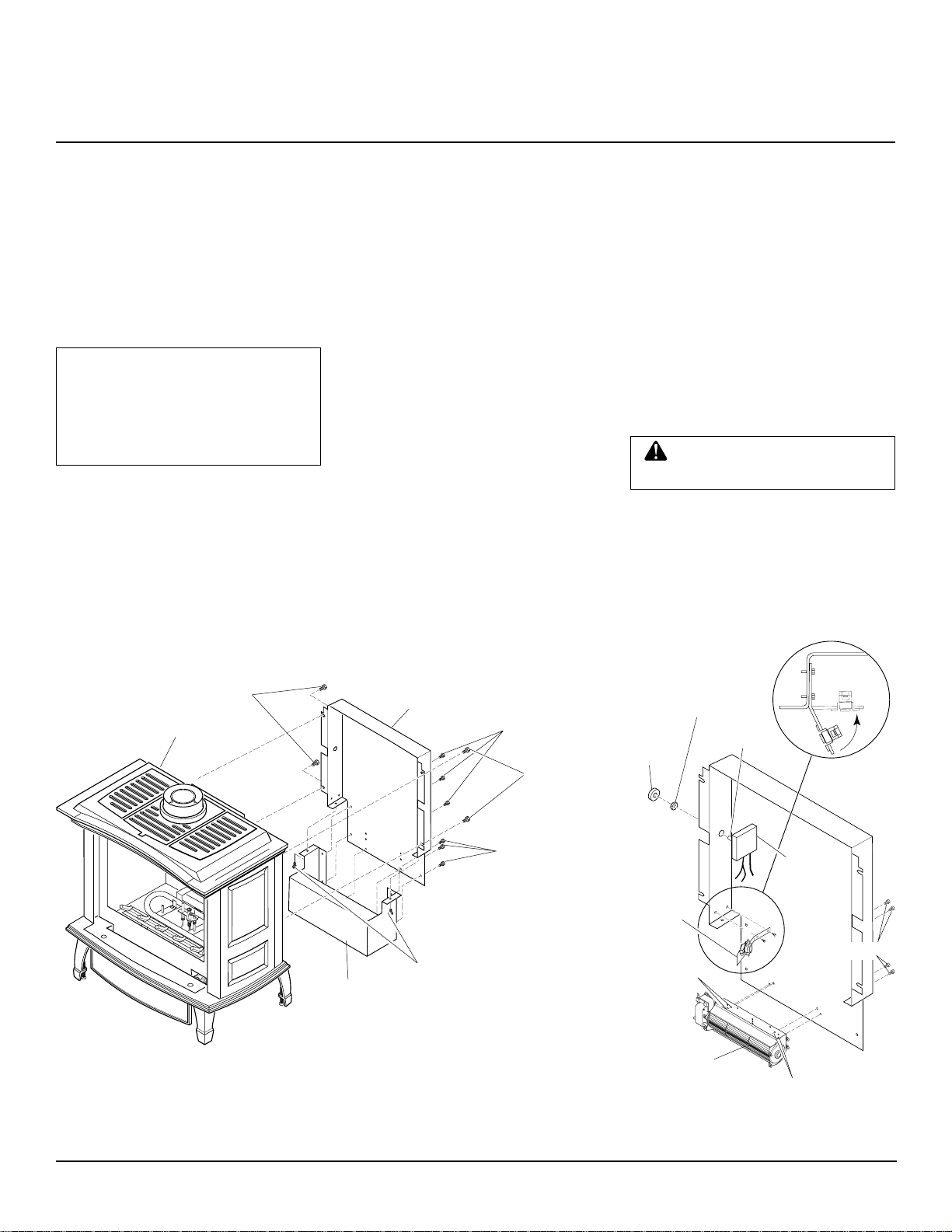
1. Remove 4 hex screws securing rear
cover to back of stove body (see Figure 18).
2. Separate bottom cover from rear cover
by loosening the 8 mounting screws
(see Figure 18).
3. Align the holes in the top mounting tabs
of blower with the holes in wall of rear
cover. Using the 4 screws provided,
mount blower and tighten screws securely (see Figure 19).
4. Attach thermal switch and bracket to
inside rear cover wall with two hex head
screws provided as shown. After secur ing bracket to rear cover, carefully bend
along existing bend line on bracket to
almost a 90° angle (see Figure 19). This
will allow thermal switch to be positioned against stove rear wall and sense
temperature when in operating mode.
5. Place speed control on left inside of rear
cover and push the plastic control shaft
through opening (see Figure 19).
6. While supporting speed control, secure
control shaft with lock nut by pushing and
turning lock nut with pliers clockwise
until tight against the side of rear cover.
Place control knob provided onto shaft.
7. Place the green wire between the bottom hole on the blower assembly and the
hex screw and tighten (see Figure 20,
page 9).
8. Connect the blue wire to the blower assembly and to one side of the thermal
switch (see Figure 20, page 9).
9. Connect the black wire to the other side
of the thermal switch (see Figure 20,
page 9).
10. Connect the white wire to the other terminal on the blower motor assembly
(see Figure 20, page 9). Make sure the
thermal switch has been properly installed to fit against back of fireplace
insert after the rear cover assembly has
been reinstalled.
11. Make sure all wire connections to terminals on blower motor and thermal switch
are securely attached and that the screw
retaining the green ground wire is tight.
12. Check to make sure that the power cord
is completely clear of the blower wheel
and that there are no foreign objects in
blower wheel.
WARNING: Never touch the
blower wheel while in operation.
13. Peel off the backing paper and stick the
supplied wiring diagram decal on the
inside of rear cover as shown (see Figure 20, page 9).
14. Connect or reconnect gas supply following instructions in Connecting
Stove/Burner System to Gas Supply,
page 20.
Hex Screws
Stove Body
Bottom Cover
Figure 18 - Removing Rear Cover and Bottom Cover from Stove Body
Rear Cover
Mounting
Screws
Mounting
Screws
Mounting
Screws
Hex
Screw
Locknut
Blower
Control
Knob
Thermal
Switch
and
Bracket
Mounting
Holes
Blower
Assembly
Figure 19 - Blower Assembly, Speed
Control, and Thermal Switch Locations
Control
Shaft
TOP VIEW
Speed
Control
Screws
Mounting
Holes
For more information, visit www.desatech.com
8
107280
Page 9
OWNER’S MANUAL
CAST IRON STOVE
AND DIRECT-VENT
BURNER SYSTEM
ASSEMBLY
Continued
WARNING: A qualified installer or service person must
connect fireplace to gas supply.
Follow all local codes.
15. Reattach bottom cover to rear cover
with 8 screws (see Figure 18, page 8).
Make sure that you don’t pinch any
wires during reassembly.
WARNING: Failure to position
the parts in accordance with supplied diagrams or failure to use
only parts specifically approved
with this heater may result in damage or personal injury.
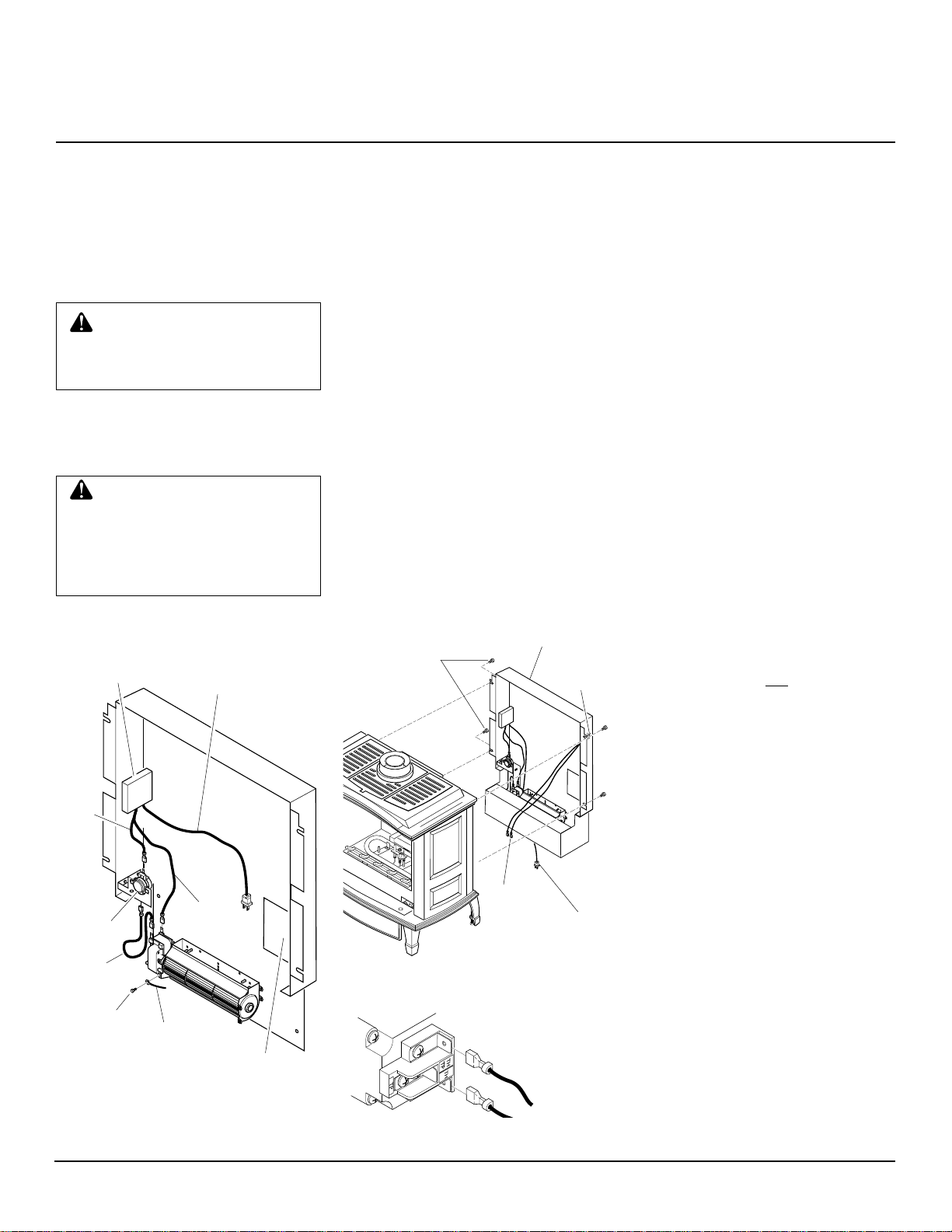
Power Cord
Speed
Control
Box
Black
Wire
Thermal
Switch
Blue Wire
Screw
Green Ground Wire
Figure 20 - Blower Wiring Layout
(Route Through
Plastic Bushing in
Bottom Cover When
Assembled)
White
Wire
Wiring Diagram Decal
INSTALLING REAR COVER
1. Place rear cover behind stove body.
Rear cover will rest on the bottom ledge
of the stove body.
2. Place wire harness from ON/OFF
switch under the cast of stove body.
3. Using hex screws provided, attach
rear cover to back of stove body . See
Figure 21.
IMPORTANT:
securely in place before venting pipes
are installed.
4. Open lower door panel. The valve is
attached to the underside of the burner
system assembly.
5. Connect one terminal of the wire from
ON/OFF switch to the THTP terminal
on the valve. Connect remaining wire
terminal to the TH terminal on the
valve. Make sure that the wire terminals are in the positions on the unit as
pictured in Figure 22. If wires are not
connected as shown, the ON/OFF
switch will not work.
Hex
Screws
Figure 21 - Installing Rear Cover (Shown
with Optional Blower Accessory)
Figure 22 - Control Valve Terminals
This rear cover must be
Rear Cover (Shown
with Optional Blower)
ON/OFF
Switch
ON/OFF
Switch
Wire
Harness
Blower
Power
Cord
To Control
Switch
GENERAL VENTING
These models are approved for use with
Simpson Dura-Vent 6 5/8" direct-vent pipe
components and terminations as well as rigid
Sun Valley vent components.
Your stove with burner system is approved
to be vented either through the side wall, or
vertically using the following guidelines:
• Only use Sun Valley or Simpson DuraV ent GS venting components or kits specifically approved for this stove and
burner system.
• Minimum clearance between vent pipes
and combustible materials is 1" (25 mm),
except where stated otherwise.
• Do not recess venting termination into a
wall or siding.
• If your house is covered with vinyl siding, you will need to use a vinyl siding
standoff (see Figure 29, page 13).
• Install horizontal venting with a 1/4"
rise for every 12" of run toward the
termination.
• You may paint the vent termination with
450ºF (232ºC) heat-resistant paint to coordinate with the exterior finish.
• There must not be any obstruction such
as bushes, garden sheds, fences, decks,
or utility buildings within 24" from the
front of the termination cap.
• Do not locate termination cap where excessive snow or ice build up may occur.
Be sure to clear vent termination area after snow falls to prevent accidental blockage of venting system. When using snow
blowers, do not direct snow towards vent
termination area.
• You must maintain minimum wall and
ceiling clearances shown in Figures 3 and
4, page 4.
LOCATION OF VENT
TERMINATION
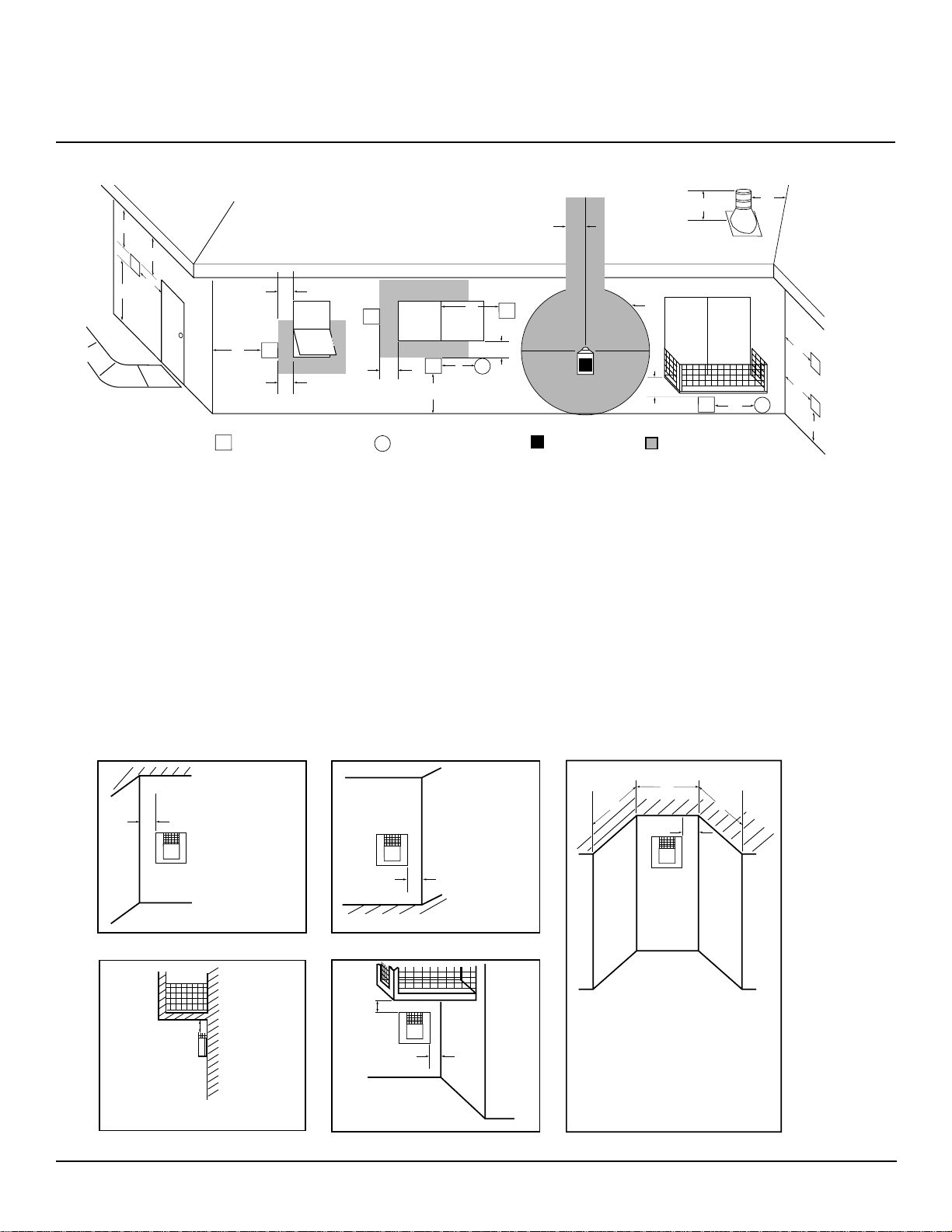
When locating vent termination, it is important to observe the minimum clearances
shown in Figure 23, page 10.
*Check with local codes or with the current
CAN/CGA B149[.1 or .2] Installation Codes
for Canada or the USA Installations follow
the current National Fuel Gas Code, ANS
Z223.1, also known as NFPA 54.
Continued
107280
9
For more information, visit www.desatech.com
Page 10
SUN VALLEY STOVE COMPANY
CAST IRON STOVE AND BURNER SYSTEM
GENERAL VENTING
D
E
V
B
L
V
A = clearance above grade, veranda, porch, deck, or balcony
[*12 inches (305mm) minimum]
B = clearance to window or door that may be opened
[12 inches (305mm) minimum]
C = clearance to permanently closed window [minimum 12 inches
(305mm) recommended to prevent condensation on window]
D = vertical clearance to ventilated soffit located above the terminal
within a horizontal distance of 24 inches (610mm) from the
center-line of the terminal [18 inches (457mm) minimum]
E = clearance to unventilated soffit [12 inches (305mm) minimum]
F = clearance to outside corner (see below)
G = clearance to inside corner (see below)
H = *not to be installed above a meter/regulator assembly within
36 inches (914mm) horizontally from the center-line of the regulator
† vent shall not terminate directly above a side-walk or paved driveway which is located between two
single family dwellings and serves both dwellings*
‡ only permitted if veranda, porch, deck or balconey is fully open on a minimum of 2 sides beneath the floor*
* as specified in CAN/SGA B149 (.1 or .2) Installation Codes (1991) for Canada or for U.S.A. installation follow
the current
Note: Local codes or regulations may require different clearances
C
F
V
B
TERMINATION CAP
National Fuel Gas Code, ANS Z223.1
Continued
Fixed
Closed
Openable
V
Openable
B
AIR SUPPLY INLET
X
B
Fixed
Closed
B
J
V
A
X
I = clearance to service regulator vent outlet [*72 inches (1829mm)
minimum]
J = clearance to non-mechanical air supply inlet to building or the
combustion air inlet to any other fireplace [*12 inches (305mm)
minimum]
K = clearance to a mechanical air supply inlet [*72 inches (1829mm)
minimum]
L = † clearance above paved side-walk or a paved driveway located on
public property [*84 inches (2133mm) minimum]
M = clearance under veranda, porch, deck [*12 inches (305mm) minimum ‡]
N = clearance above a roof shall extend a minimum of 24 inches (610mm)
above the highest point when it passes through the roof surface and
any other obstruction within a horizontal distance of 18 inches (457mm)
Termination Clearances for Buildings with Combustible and Noncombustible Exteriors
Inside Corner
Outside Corner Recessed Location
N
H
V
G
G
GAS METER RESTRICTED AREA
I
M
V
(TERMINATION PROHIBITED)
N
G
V
G
X
K
V
A
A
Balcony with No Side Wall
G = Combustible 24" (610mm)
Noncombustible 18" (457mm)
V
G
V
A = 6" (152mm)
V
Balcony with Perpendicular Side Wall
H
Combustible &
Noncombustible
H = 24" (610mm)
J = 20" (508mm)
Figure 23 - Minimum Clearances for Vent Terminations
For more information, visit www.desatech.com
B
V
J
B = 6" (152mm)
10
D
C
V
C = Maximum depth of 48" (1219mm) for
recessed location
D = Minimum width for back wall of
recessed location Combustible - 38" (965mm)
Noncombustible - 24" (610mm)
E = Clearance from corner in
recessed locationCombustible - 6" (152mm)
Noncombustible - 2" (51mm)
C
E
107280
Page 11
OWNER’S MANUAL
VENTING
INSTALLATION
WARNING: Read all instructions completely and thoroughly
before attempting installation.
Failure to do so could result in
serious injury, property damage
or loss of life. Operation of improperly installed and maintained
venting system could result in
serious injury, property damage
or loss of life.
WARNING: Seal all vent connections. Seal only the outer pipe
connections with high temperature
silicone (600°F/316° C). Before joining elbows and pipes, apply a bead
of high temperature silicone sealant (GE RTV 106/Loctite RTV 81585)
to the male end of the elbow or
pipe. High temperature silicone
must also be used to re-seal any
connections after maintenance to
venting system.
NOTICE: Failure to follow these
instructions will void the warranty.
INSTALLATION
PRECAUTIONS
Consult local building codes before beginning
the installation. The installer must make sure
to select the proper vent system for installation. Before installing vent kit, the installer
must read this stove and burner system
manual and vent kit instructions.
Only a qualified installer/service person
should install venting system. The installer
must follow these safety rules:
• Wear gloves and safety glasses for
protection
• Use extreme caution when using ladders
or when on roof tops
• Be aware of electrical wiring locations
in walls and ceilings
The following actions will void the warranty on your venting system:
• Installation of any damaged venting
component
• Unauthorized modification of the venting system
• Installation of any component part not
manufactured or approved by DESA
International
• Installation other than as instructed by
these instructions
WARNING: This stove with
burner system and vent assembly
must be vented directly to the outside. The venting system must
NEVER be attached to a chimney
serving a separate solid fuel burning appliance. Each gas appliance
must use a separate vent system.
Do not use common vent systems.
WARNING: Horizontal sections of this vent system require
a minimum clearance of 2" from
the top of the pipe and 1" minimum to the sides and bottom.
Vertical sections of this system
require a minimum of 1" clearance to combustible materials on
all sides of the pipe.
INSTALLATION PLANNING
There are two basic types of direct-vent
installation:
• Horizontal Termination
• Vertical Termination
It is important to select the proper length of
vent pipe for the type of termination you
choose. It is also important to note the wall
thickness.
For Horizontal Termination: Select the
amount of vertical rise desired. The horizontal run of venting must have 1/4" rise for
every 12" of run towards the termination.
WARNING: Never run the vent
pipe downward as this may cause
excessive temperatures which
could cause a fire.
You may use one or two 90° elbows in this
vent configuration. See Horizontal Termina-
tion Configurations on page 14.
For Vertical Termination: Measure the dis-
tance from the burner system flue outlet to
the ceiling. Add the ceiling thickness, the
vertical rise in an attic or second story, and
allow for sufficient vent height above the
roofline. You may use one or two 90° elbows
in this vent configuration. See Vertical Ter-
mination Configurations on pages 16 and 17.
Note:
When using Simpson Duravent pipe,
you must order the vertical restrictor (shown
in Figures 38 through 41 on pages 16 and
17) separately.
Note:
You may use two 45° elbows in place
of a 90° elbow. You must follow rise to run
ratios when using 45° elbows.
For two-story applications, firestops are required at each floor level. If an offset is
needed in the attic, additional pipe and elbows will be required.
You may use a chase with a vent termination
with exposed pipe on the exterior of the
house. See Installing Vent System in a Chase,
below.
It is very important that the venting system
maintain its balance between the combustion air intake and the flue gas exhaust.
Certain limitations apply to vent configurations and must be strictly followed.
Installing Vent System in a Chase
A chase is a vertical boxlike structure built
to enclose venting that runs along the outside of a building. A chase is required for
such venting.
NOTICE: Treatment of firestops
and construction of the chase may
vary from building type to building type. These instructions are
not substitutes for the requirements of local building codes. You
must follow all local building
codes.
Note:
When installing in a chase, you should
insulate the chase as you would the outside
walls of your home. This is especially important in cold climates. Minimum clearance between vent pipes and combustible
materials such as insulation is 1".
Continued
107280
11
For more information, visit www.desatech.com
Page 12
SUN VALLEY STOVE COMPANY
CAST IRON STOVE AND BURNER SYSTEM
VENTING
INSTALLATION
Continued
INSTALLATION FOR
HORIZONTAL TERMINATION
1. Determine the route your horizontal
venting will take.
of the horizontal vent termination on
the exterior wall must meet all local and
national building codes and must not
be easily blocked or obstructed.
WARNING: Do not recess vent
terminal into a wall or siding.
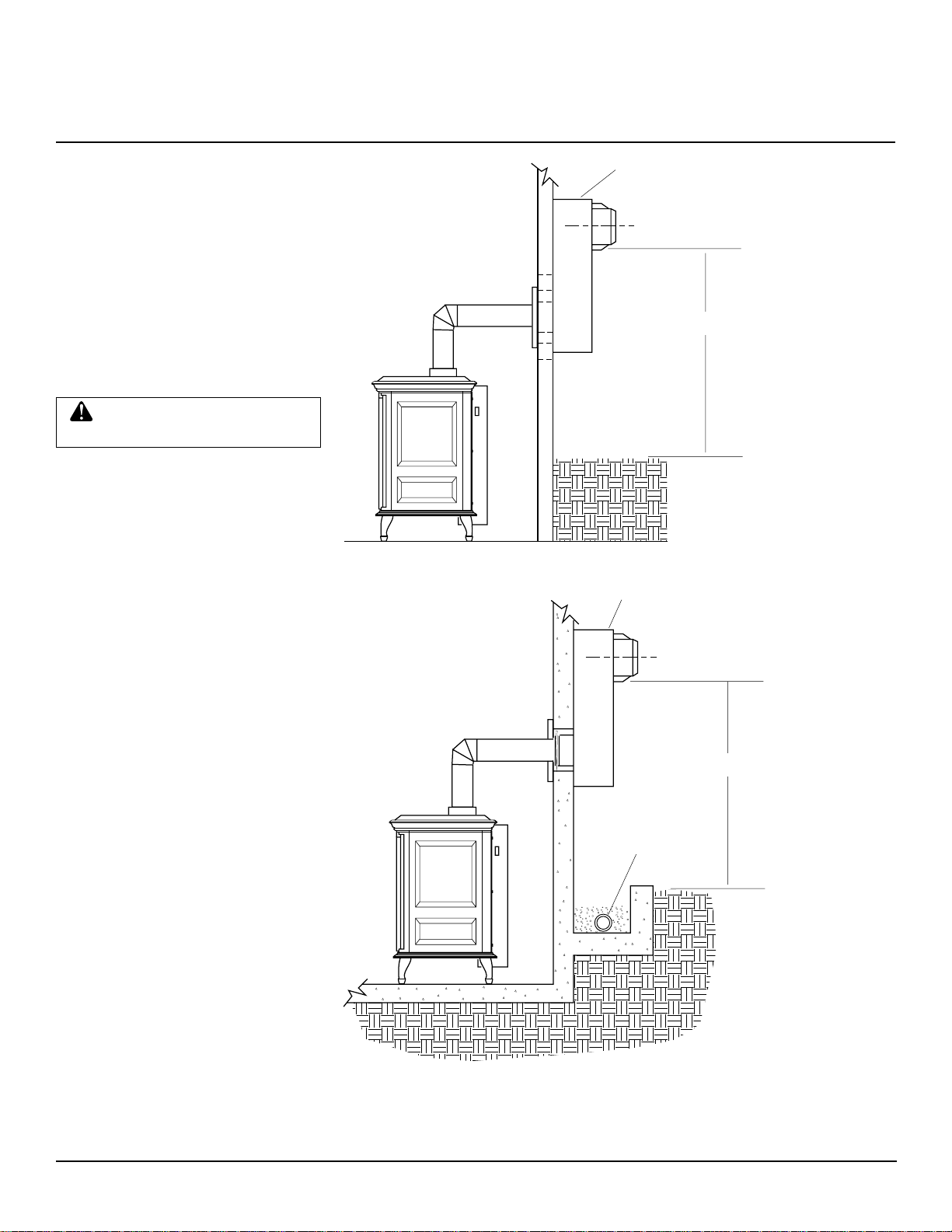
Snorkel terminations are available for
terminations requiring a vertical rise on
the exterior of the building (see Figures
24 and 25). Snorkel kit NSVKBK is
also available (see page 18). Follow the
same installation procedures used for
standard horizontal terminations. If installing the snorkel termination below
grade (basement applications), you must
provide proper drainage to prevent water from entering the snorkel termination (see Figure 25). Do not back fill
around the snorkel termination.
2. Rigid vent pipes and fittings have special twist-lock connections. Assemble
the desired combination of pipe and elbows to the appliance adaptor with pipe
seams oriented towards the wall or floor.
Twist-lock Procedure:
the pipes and fittings have locking lugs
(indentations). These lugs will slide
straight into matching slots on the male
ends of adjacent pipes and fittings. (All
connections must be sealed with high
temperature silicone sealant as specified
in the second warning statement on page
11.) Push the pipe sections together and
twist one section clockwise approximately one-quarter turn until the sections are fully locked. See Figure 26,
page 13.
must be supported every three feet. Use
wall straps for this purpose.
Note:
Note:
The location
The female ends of
Horizontal runs of vent
Snorkel
12" Minimum
Figure 24 - Snorkel Termination
Snorkel
12" Minimum
Adequate
drainage
Figure 25 - Snorkel Termination with Drainage Pipe
For more information, visit www.desatech.com
12
107280
Page 13

OWNER’S MANUAL
VENTING
INSTALLATION
Continued
3. Attach vent pipe assembly to the
burner system. Set stove in front of it’s
permanent location to insure minimum
clearances. Mark the wall for a 10"
square hole (for noncombustible material such as masonry block or concrete, a 7 1/2" diameter hole is acceptable). See Figure 27. The center of the
hole should line up with the centerline of the horizontal rigid vent pipe.
Cut a 10"x10" (254mm x 254mm)
square hole through combustible exterior wall (7 1/2" [190mm] diameter
hole if noncombustible). Frame as
necessary (see Figure 27).
Female
Locking
Lugs
Male
Slots
4. Apply a bead of non-hardening mastic
around the outside edge of the vent cap.
Position the vent cap in the center of
1
/2" or 10" hole on the exterior
the 7
wall with the word “up” on the vent cap
facing up. Insure proper clearance of
1" to combustibles is maintained. Attach the vent cap with four wood screws
supplied (see Figure 28).
Note
: Replace the wood screws with appropriate fasteners for stucco, brick, concrete,
or other types of siding.
WARNING: Do not recess vent
termination into any wall. This
will cause a fire hazard.
For vinyl siding, stucco, or wood exterior use vinyl siding standoffs between vent cap and exterior wall. The
vinyl siding standoff prevents excessive heat from melting the vinyl siding material. Bolt the vent cap to the
standoff. Apply non-hardening mastic
around outside edge of the standoff instead of the vent cap assembly. Use
wood screws provided to attach the
standoff. See Figure 29.
5. Slide the wall thimble over the vent
pipe before connecting the horizontal
run to the vent cap (see Figure 30).
6. Carefully move the stove with vent assembly attached toward the wall and
insert the vent pipe into the horizontal
termination. The pipe overlap should
be a minimum of 1 1/4". Fasten all vent
connections with screws provided.
Note
: It is not necessary to apply silicone to the outer pipe of the termination connection.
7. Slide the wall thimble against the interior wall surface and attach with screws
provided (see Figure 30).
Cut Vinyl Siding
Away to Fit
Standoff
Standoff
Wood
Screw
P
U
Nut
Figure 29 - Installing Vinyl Siding Standoff
Apply Mastic
to All Four
Sides
Bolt
Vent
Cap
Figure 26 - Rigid Vent Pipe Connections
Vent Opening
Combustible Wall
10"
(254mm)
10"
(254mm)
(Framing
Vent Opening
Noncombustible Wall
7 1/2"
(190mm)
Figure 27 - Vent Opening Requirements
107280
Detail)
Apply Mastic
to All Four
Sides
UP
Wood
Vent Cap
Figure 28 - Installing Horizontal Vent Cap
13
Screw
For more information, visit www.desatech.com
Interior Wall
Surface
Decorative Wall
Thimble
Wall
Thimble
Vent Cap
(Horizontal
Termination)
Figure 30 - Connecting Vent Cap with
Horizontal Vent Pipe
Screw
Horizontal
Vent Pipe
Continued
Page 14

SUN VALLEY STOVE COMPANY
CAST IRON STOVE AND BURNER SYSTEM
VENTING
INSTALLATION
Continued
Horizontal Termination
Configurations
Figures 31 through 33 show different configurations for venting with horizontal termination. Each figure includes a chart with
vertical minimum/maximum and horizontal maximum dimensions which must be
met. Seal all connections with high temperature silicone sealant (outer pipe only) as
specified in the second warning statement
on page 11. All horizontal terminations require 1/4" rise per 12" of horizontal run.
U
P
*
Venting with Two 90° Elbows
Vertical (V) Horizontal (H
) Horizontal (H1) +
1
Horizontal (H2)
6' min. 4' max. 8' max.
7' min. 6' max. 12' max.
8' min. 8' min. 20' max.
20' max. 8' max. 20' max.
*
Note:
Add 1/4" rise per 12"
horizontal length of pipe.
Figure 32 - Horizontal Termination Configuration for Rigid Venting Using Two
°
Elbows
90
*
*
Note:
Add 1/4" rise per 12"
horizontal length of pipe.
Horizontal Venting
Vertical (V) Horizontal (H)
55" min. 24" max.
66" min. 46" max.
88" min. 20' max.
Note:
This configuration for use with
corner installation.
Figure 31 - Horizontal Termination
Configuration for Rigid Venting Using
°
One 90
For more information, visit www.desatech.com
Elbow
Figure 33 - Horizontal Termination Configuration for Rigid Venting Using Two 90
Elbows with Termination at 90° with Stove
U
P
Venting with Two 90° Elbows
Vertical (V) Horizontal (H1) +
Horizontal (H2)
6' min. 4' max.
7' min. 6' max.
8' min. 10' max.
20' max. 12' max.
14
Note:
Add 1/4" rise per 12"
*
horizontal length of pipe.
107280
*
°
Page 15

OWNER’S MANUAL
VENTING
INSTALLATION
Continued
INSTALLATION FOR
VERTICAL TERMINATION
NOTICE: Use rigid pipe only. Flex
venting is not to be used with a
vertical termination.
1. Determine the route your vertical venting will take. If ceiling joists, roof rafters,
or other framing will obstruct the venting system, consider an offset (see Figure 34) to avoid cutting loadbearing
members.
these installation instructions for required clearances (air space) to combustibles when passing through ceilings,
walls, roofs, enclosures, attic rafters, etc.
Do not pack air spaces with insulation.
Also note maximum vertical rise of the
venting system and any maximum horizontal offset limitations. Offsets must
fall within the parameters shown in Figure 23 on page 10.
2. Set the stove in desired location. Drop
a plumb line down from the ceiling to
the position of the burner system exit
flue. Mark the center point where the
vent will penetrate the ceiling. Drill a
small locating hole at this point.
Drop a plumb line from the inside of
the roof to the locating hole in the ceiling. Mark the center point where the
vent will penetrate the roof. Drill a
small locating hole at this point.
Wall Strap
Note:
Pay special attention to
45° Elbow
Roof
Flashing
Flat Ceiling Installation
1. Cut a 10" square hole in the ceiling using the locating hole as a center point.
The opening should be framed to
10"x10" (254mm x 254mm) inside dimensions, as shown in Figure 27 on
page 13 using framing lumber the same
size as the ceiling joists. If the area
above the ceiling is an insulated ceiling or a room, nail firestop from the
top side. This prevents loose insulation
from falling into the required clearance
space. Otherwise, install firestop below
the framed hole. The firestop should be
installed with no less than three nails
per side (see Figure 35).
2. Assemble the desired lengths of pipe
and elbows necessary to reach from the
burner system flue up through the
firestop. All connections must be
sealed with high temperature silicone
sealant as specified in the second warning statement on page 11. Be sure all
pipe and elbow connections are fully
twist-locked (see Figure 26, page 13).
If area above is a room, install firestop
above framed hole.
If area above is not a room, install
firestop below framed hole.
Figure 35 - Installing Firestop
3. Cut a hole in the roof using the locating
hole as a center point. (Cover any exposed open vent pipes before cutting
hole in roof.) The 10"x10" hole must
be measured on the horizontal; actual
length may be larger depending on the
pitch of the roof. There must be a 1"
clearance from the vent pipe to combustible materials. Frame the opening as
shown in Figure 27 on page 13.
4. Connect a section of pipe and extend
up through the hole.
Note:
If an offset is needed to avoid
obstructions, you must support the vent
pipe every 3 feet. Use wall straps for
this purpose (see Figure 34). Whenever
possible, use 45° elbows instead of 90°
elbows. The 45° elbow offers less restriction to the flow of the flue gases
and intake air.
5. Place the flashing over the pipe
section(s) extending through the roof.
Secure the base of the flashing to the
roof and framing with roofing nails. Be
sure roofing material overlaps the top
edge of the flashing as shown in Figure
34. There must be a 1" clearance from
the vent pipe to combustible materials.
6. Continue to add pipe sections until the
height of the vent cap meets the minimum building code requirements described in Figure 23 on page 10 .
You must increase vent height for steep
roof pitches. Nearby trees, adjoining
rooflines, steep pitched roofs, and other
similar factors may cause poor draft or
down-drafting in high winds. Increasing
the vent height may solve this problem.
7. Twist-lock the vent cap onto the last
section of vent pipe and seal outer pipe
connection with high temperature silicone sealant as specified in the second
warning statement on page 11.
Note:
If the vent pipe passes through any
occupied areas above the first floor, including
storage spaces and closets, you must enclose
pipe. You may frame and sheetrock the enclosure with standard construction material. Make
sure and meet the minimum allowable clearances to combustibles. Do not fill any of the
required air spaces with insulation.
Note
:
Ceiling Firestop
Figure 34 - Offset with Wall Strap and 45
Elbows
107280
°
15
For more information, visit www.desatech.com
Continued
Page 16

SUN VALLEY STOVE COMPANY
CAST IRON STOVE AND BURNER SYSTEM
VENTING
INSTALLATION
Continued
Cathedral Ceiling Installation
1. Remove shingles or other roof covering as necessary to cut the rectangular
hole for the support box. Mark the outline of the cathedral ceiling support box
on the roof sheathing using the locating hole as a center point.
2. Cut the hole 1/8" larger than the support box outline (see Figure 36).
3. Lower the support box through the hole
in the roof until the bottom of the box
extends at least 2" below the ceiling
(see Figure 36). Align the support box
vertically and horizontally using a
level. T emporarily tack the support box
in place through the inside walls and
into the roof sheathing.
4. Using tin snips, cut the support box from
the top corners down to the roofline and
fold the resulting flaps over the roof
sheathing (see Figure 37). Apply a bead
of non-hardening mastic around the top
edges of the support box to make a seal
between the box and the roof. Nail in
place with roofing nails. Remove any
combustible material that might be inside of the support box.
5. Complete the cathedral ceiling installation by following the same procedures
outlined in steps 2 through 7 for Flat
Ceiling Installation, page 15
.
Level
Cathedral ceiling
support box
2" minimum below
finished ceiling
Cut hole 1/8" larger than support
box when projected onto roofline
Figure 36 - Cathedral Ceiling Support
Box Installation
Non-hardening Mastic under all
edges of support box before nailing
Figure 37 - Installed Cathedral Ceiling
Support Box
Vertical Termination
Configurations
Figure 38 and Figures 39 through 41 on
page 17 show four different configurations
for vertical termination. All connections
must be sealed with high temperature silicone sealant as specified in the second warning statement on page 11.
Note:
Install
restrictor into 4"
collar of burner
system as shown.
Venting with One 90° Elbow
Vertical (V) Horizontal (H)
5' min. 2' max.
6' min. 4' max.
7' min. 6' max.
8' min. 8' max.
For more information, visit www.desatech.com
16
20' max. 8' max.
Figure 38 - Vertical Rigid Venting
Configuration Using One 90° Elbow
107280
Page 17

VENTING
INSTALLATION
Continued
Note:
Install
restrictor into 4"
collar of burner
system as shown.
OWNER’S MANUAL
Note:
Install
restrictor into
4" collar of
burner system
as shown.
Note:
Install
restrictor into 4"
collar of burner
system as shown.
Venting with Two 90° Elbows
Vertical (V) Horizontal (H1) +
Horizontal (H2)
5' min. 2' max.
6' min. 4' max.
7' min. 6' max.
8' min. 8' max.
20' max. 8' max.
Figure 39 - Vertical Rigid Venting
Configuration Using Two 90
Two Horizontal Runs
°
Elbows with
Note:
Vertical (V1) +
Vertical (V2) = 20' max.
Venting with Two 90° Elbows
Vertical (V1) Horizontal (H)
5' min. 6' max.
6' min. 12' max.
7' min. 18' max.
8' min. 20' max.
Figure 40 - Vertical Rigid Venting
Configuration Using Two 90
°
Elbows
Vertical V enting
V = 40' max.
Figure 41 - Vertical Rigid Venting
Configuration With No Horizontal Run
Continued
107280
17
For more information, visit www.desatech.com
Page 18

SUN VALLEY STOVE COMPANY
CAST IRON STOVE AND BURNER SYSTEM
VENTING
INSTALLATION
Continued
HIGH ALTITUDE
INSTALLATION
Your Sun Valley cast iron stove and directvent burner system has been CSA/AGA
tested and approved for elevations from 02000 feet and CGA certified for elevations
from 0-4500 feet.
When installing this stove at an elevation
above 2000 feet (in the USA), you may need
to decrease the input rating by changing the
existing burner orifice to a smaller size. Reduce input 4% for each 1000 feet above sea
level. Check with your local gas company for
proper orifice size identification.
When installing this stove at an elevation
above 4500 feet (in Canada), check with
local authorities.
Consult your local gas company to help determine the proper orifice for your location.
For assistance with any high altitude installation contact DESA International’s Technical Service Department at 1-800-DESALOG (1-800-337-2564).
PARTS LISTS FOR VENTING
KITS AND COMPONENTS
Sun Valley Rigid Venting
Number Description
NGFVKBK Ground Floor Rigid Vent Kit, Black
Includes: Rigid Horizontal Termination, 7"-12" Adjustable Coaxial Pipe, 7" x 90° Coaxial Elbow, 7" x 12" Coaxial Pipe, Wall
Thimble, Trim Plate, High Temperature Silicone, 12" Starter Pipe,
and 16 Screws
NBVKBK Basement Rigid Vent Kit, Black
Includes: Rigid Horizontal Termination, 7" x 90° Coaxial Elbow, 7" x 24" Coaxial Vent Pipe,
Wall Thimble, 7"-12" Adjustable
Coaxial Pipe, 7" x 12" Coaxial
Vent Pipe, Trim Plate, High Temperature Silicone, 12" Starter Pipe,
and 20 Screws
NSVKBK Snorkel Rigid Vent Kit, Black
Includes: Snorkel Termination, 7"
x 12" Coaxial Pipe, 7" x 24" Coaxial Pipe, 7" x 90° Coaxial Elbow, Wall Thimble, 7"-12" Adjustable Coaxial Pipe, Trim Plate,
High Temperature Silicone, 12"
Starter Pipe, and 28 Screws
NRVKBK Roof Rigid Vent Kit, Black
Includes: Rigid Vertical Termination, 7" x 48" Coaxial Pipe, 7"12" Adjustable Coaxial Pipe, 7"
x 24" Coaxial Pipe, Firestop
Spacer, Vertical Restrictor/Rigid
Vent, 0/6 Galvanized Flashing,
7" Storm Collar, Trim Plate, High
Temperature Silicone, 12" Starter
Pipe, and 26 screws
D1000BK 7" x 12" Black Coaxial Pipe
(1 pk)
D1010BK 7" x 24" Black Coaxial Pipe
(1 pk)
D1020BK 7" x 48" Black Coaxial Pipe
(1 pk)
D1030BK 7" Adjustable (7-12") Black
Coaxial Pipe (1 pk)
D1050BK 7" x 6" Black Coaxial Pipe (1 pk)
D2000BK 7" X 90° Elbow (1 pk)
D2010BK 7" x 45° Elbow (1 pk)
D2040BK 7" x 12" Black Coaxial Starter
Pipe (1 pk)
Sun Valley Rigid Venting
(Cont.)
Number Description
D3000 Wall Strap/Offset Support
(6 pcs.)
D3010 Storm Collar (6 pcs.)
D3040 Vertical Termination Cap (1 pk)
D3020 Wall Thimble (6 pcs.)
D3050 Vertical Restrictor (6 pcs.)
D3060 Ceiling Firestop/Support
(6 pcs.)
D3070 Rectangular Horizontal Rigid
Vent Termination Cap
D3090 Cathedral Ceiling Support
Box
D4000 Roof Flashing 6/12-9/12
D4010 Roof Flashing 9/12-12/12
D5000 Wood/Vinyl Siding Standoff
(6 pcs.)
SIMPSON DURA-VENT
GS 4" x 6 5/8 " (Black Pipe)
Number Description
902B 7" x 48" Pipe
903B 7" x 36" Pipe
904B 7" x 24" Pipe
906B 7" x 12" Pipe
907B 7" x 9" Pipe
908B 7" x 6" Pipe
911B 7" Adjustable (11"-14
940 Wall Thimble
941 Cathedral Ceiling Support Box
943 Roof Flashing 0/12-6/12
943S Roof Flashing 7/12-12/12
945B 7" x 45° Elbow
950 Vinyl Siding Standoff
953 Storm Collar
963 Ceiling Firestop
981 36" Snorkel Termination
984 Horizontal Termination Vent Cap
988 Wall Strap
990B 7" x 90° Elbow
991 Vertical High Wind Termination
5
/8") Pipe
For more information, visit www.desatech.com
18
107280
Page 19

OWNER’S MANUAL
STOVE AND
DIRECT-VENT
BURNER SYSTEM
INSTALLATION
CHECK GAS TYPE
Use proper gas type for the burner system
you are installing. If you have conflicting
gas types, do not install burner system. See
dealer where you purchased the stove and
burner system for proper burner system
according to your gas type.
INSTALLING GAS PIPING TO
STOVE/BURNER SYSTEM
LOCATION
WARNING: A qualified installer or service person must
connect burner system to gas
supply. Follow all local codes.
CAUTION: For propane/LP
units, never connect burner system directly to the propane/LP
supply. This burner system requires an external regulator (not
supplied). Install the external regulator between the burner system
and propane/LP supply.
Installation Items Needed
Before installing stove and burner system,
make sure you have the items listed below.
• external regulator (supplied by installer)
• piping (check local codes)
• sealant (resistant to propane/LP gas)
• equipment shutoff valve *
• test gauge connection *
• sediment trap
• tee joint
• pipe wrench
• approved flexible gas line with gas connector (if allowed by local codes) (not
provided)
* An CSA/AGA design-certified equipment
shutoff valve with 1/8" NPT tap is an acceptable alternative to test gauge connection.
Purchase the CSA/AGA design-certified
equipment shutoff valve from your dealer.
For propane/LP connections only, the installer must supply an external regulator.
The external regulator will reduce incoming
gas pressure. You must reduce incoming
gas pressure to between 11 and 14 inches of
water. If you do not reduce incoming gas
pressure, burner system regulator damage
could occur. Install external regulator with
the vent pointing down as shown in Figure
42. Pointing the vent down protects it from
freezing rain or sleet.
CAUTION: Use only new,
black iron or steel pipe. Internally-tinned copper tubing may
be used in certain areas. Check
your local codes. Use pipe of 1/2"
diameter or greater to allow
proper gas volume to burner system. If pipe is too small, undue
loss of pressure will occur.
Installation must include a equipment shutoff
valve, union, and plugged 1/8" NPT tap.
Locate NPT tap within reach for test gauge
hook up. NPT tap must be upstream from
burner system (see Figure 43).
IMPORTANT:
(equipment shutoff valve) in an accessible
location. The main gas valve is for turning
on or shutting off the gas to the appliance.
Vent Pointing Down
Figure 42 - External Regulator with Vent
Pointing Down (Propane/LP Only)
Install main gas valve
Propane/
LP Supply
Tank
External
Regulator
Check your building codes for any special
requirements for locating equipment shutoff
valve to stoves.
Apply pipe joint sealant lightly to male
threads. This will prevent excess sealant
from going into pipe. Excess sealant in pipe
could result in clogged burner system valves.
CAUTION: Use pipe joint sealant that is resistant to liquid petroleum (LP) gas.
We recommend that you install a sediment
trap/drip leg in supply line as shown in
Figure 43. Locate sediment trap/drip leg
where it is within reach for cleaning. Install
in piping system between fuel supply and
burner system. Locate sediment trap/drip
leg where trapped matter is not likely to
freeze. A sediment trap traps moisture and
contaminants. This keeps them from going
into burner system gas controls. If sediment
trap/drip leg is not installed or is installed
wrong, burner system may not run properly.
CSA/AGA Design-Certified
Equipment Shutoff Valve with
1/8" NPT Tap*
Approved Flexible
Gas Line
3" Minimum
Pipe Nipple Cap Tee Joint
Sediment Trap/Drip Leg
Natural - From
Gas Meter (5"
W.C. to 10.5"
W.C. Pressure )
* The CSA/AGA design-certified equipment shutoff valve may be supplied with the
appliance or you can purchase it from your
dealer.
Figure 43 - Gas Connection
Propane/LP - From
External Regulator
(11" W.C. to 14"
W.C. Pressure)
Continued
107280
19
For more information, visit www.desatech.com
Page 20

SUN VALLEY STOVE COMPANY
CAST IRON STOVE AND BURNER SYSTEM
STOVE AND
DIRECT-VENT
BURNER SYSTEM
INSTALLATION
Continued
CONNECTING STOVE/
BURNER SYSTEM TO GAS
SUPPLY
Installation Items Needed
• 5/16" hex socket wrench or nut-driver
• sealant (resistant to propane/LP gas, not
provided)
1. Open lower door panel.
2. Route flexible gas line (provided by
installer) from equipment shutoff valve
to burner system. Route flexible gas
supply line through slot in stove bottom and attach to valve.
3. Check all gas connections for leaks. See
Checking Gas Connections.
To Flare Fitting on
Control Valve
Flexible Gas Line
Figure 44 - Flexible Gas Line
CHECKING GAS
CONNECTIONS
WARNING: Test all gas piping and connections for leaks
after installing or servicing. Correct all leaks at once.
WARNING: Never use an open
flame to check for a leak. Apply
commercial leak test solution to
all gas joints. Bubbles forming
show a leak. Correct all leaks at
once.
Equipment Shutoff Valve
To Gas Supply
(Natural)
To External
Regulator
(Propane/LP)
Pressure Testing Gas Supply
Piping System
Test Pressures In Excess Of 1/2 PSIG
(3.5 kPa)
1.
Disconnect appliance with its appliance
main gas valve (control valve) and
equipment shutoff valve from gas
supply piping systems. Pressures in
excess of 1/2 psig (3.5 kPa) will damage
burner system gas regulator .
2. Cap off open end of gas pipe where
equipment shutoff valve was connected.
3. Pressurize supply piping system by either opening propane/LP supply tank
valve for propane/LP gas
tem
or
opening main gas valve located
on or near gas meter for natural gas
burner system,
4. Check all joints of gas supply piping
system. Apply commercial leak test
solution to all gas joints. Bubbles forming show a leak. Correct all leaks at
once.
5. Reconnect
ment shutoff valve to gas supply . Check
reconnected fittings for leaks.
Test Pressures Equal To or Less Than
1/2 PSIG (3.5 kPa)
1. Close equipment shutoff valve (see
Figure 45).
2. Pressurize supply piping system by either opening propane/LP supply tank
valve for propane/LP gas
tem
or
on or near gas meter for natural gas
burner system,
3. Check all joints from propane/LP supply tank or gas meter to equipment
shutoff valve (see Figure 46, page 21
for propane/LP or Figure 47, page 21
for natural). Apply commercial leak test
solution to all gas joints. Bubbles forming show a leak. Correct all leaks at
once.
Equipment
Shutoff
Valve
or using compressed air.
burner system
opening main gas valve located
or using compressed air.
burner sys-
and equip-
burner sys-
ON
Open
POSITION
For more information, visit www.desatech.com
20
OFF
POSITION
Closed
Figure 45 - Equipment Shutoff Valve
107280
Page 21

OWNER’S MANUAL
STOVE AND
DIRECT-VENT
BURNER SYSTEM
INSTALLATION
Continued
Pressure Testing Burner
System Gas Connections
1. Open equipment shutoff valve (see Figure 45, page 20).
2. Open propane/LP supply tank valve for
propane/LP
valve located on or near gas meter for
natural gas
3. Make sure control knob of
tem
is in the OFF position.
4. Check all joints from equipment shutoff
valve to thermostat gas valve (see Figure 46 for propane/LP or Figure 47 for
natural). Apply commercial leak test solution to all gas joints. Bubbles forming
show a leak. Correct all leaks at once.
5. Light
Stove with Burner System, pages 25
through 27). Check all other internal
joints for leaks.
6. Turn off
Gas to Appliance, page 25).
burner system
burner system
burner system
burner system
or main gas
.
burner sys-
(see Operating
(see T o T urn Off
Equipment Shutoff Valve
Propane/
LP Supply
Tank
Gas Valve
Figure 46 - Checking Gas Joints for Propane/LP Gas Burner System
Equipment Shutoff Valve
Gas Meter
107280
Gas Valve
Figure 47 - Checking Gas Joints for Natural Gas Burner System
21
For more information, visit www.desatech.com
Continued
Page 22

SUN VALLEY STOVE COMPANY
CAST IRON STOVE AND BURNER SYSTEM
STOVE AND
DIRECT-VENT
BURNER SYSTEM
INSTALLATION
Continued
INSTALLING OPTIONAL
WALL MOUNTED SWITCH
GWMS2
1. Connect one terminal of 25 ft. wire for
the wall switch to the TPTH terminal
on the valve. Connect remaining wire
terminal to the TH terminal on the valve.
Make sure that the wire terminals are in
the positions on the unit as pictured in
Figure 48. If wires are not connected as
shown, the switch will not work.
2. Route the 25 ft. wire through openings
provided on the sides of the burner system to a convenient location to mount
your switch.
3. Connect one bare wire end to each of the
terminals of the GWMS2 wall switch.
4. Install the wall switch and cover in the
wall.
To Control
Switch or
Optional
Accessory
Figure 48 - Control Valve Terminals
INSTALLING OPTIONAL
WALL MOUNTED
THERMOSTAT - GWMT1
WARNING: Installation must
be done by a qualified installer
familiar with low voltage wiring
procedures.
WARNING: Do not connect
this thermostat to any electrical
source! Electrical shock and/or
fire hazard will occur.
1. Open lower door panel. The valve is
attached to the underside of the burner
system assembly.
2. Disconnect from the valve the wires
running from the ON/OFF switch.
3. Connect one terminal of the wire for
the wall thermostat to the THTP terminal on the valve. Connect remaining
wire terminal to the TH terminal on the
valve. Make sure that the wire terminals are in the positions on the unit as
pictured in Figure 48. If wires are not
connected as shown the thermostat will
not work.
4. Route the wire to a convenient location to mount your thermostat (no outside wall).
must not exceed 25 feet in length.
The thermostat should be mounted 54"
above the floor in a location where
there is good air circulation. Avoid
heat sources such as lamps, direct sunlight, fireplace, or heat and air conditioning ducts.
5. Gently remove the cover of the thermostat from the base. Grasp the sides
of the cover firmly and pull to separate
from the base.
6. Feed the electrical wires through the
rectangular slots (from the back) on
each side of the base (see Figure 49).
IMPORTANT:
The wire
7. Connect one bare wire end to each terminal (“W” and “R”) of the thermostat
base (see Figure 50).
8. Install the base to the wall with screws
provided with thermostat.
9. Move the temperature adjustment back
and forth to insure the bimetal is free
from restrictions.
10. Replace the cover onto the base. (Upon
installation, the thermostat must be allowed to stabilize at room temperature
for a minimum of 30 minutes for proper
operation.)
11. Set the temperature adjustment to the
desired setting. This thermostat has
been electronically calibrated at the factory. No adjustment or leveling is necessary.
Feed wires through
rectangular slots
Figure 49 - Back View of Thermostat Base
Terminal “W”
W
Terminal “R”
R
For more information, visit www.desatech.com
WARNING: Do not connect
this thermostat to a power
source. Electrical shock and/or
fire hazard will occur.
22
Figure 50 - Thermostat Base Terminal
“W” and “R”
107280
Page 23

OWNER’S MANUAL
STOVE AND
DIRECT-VENT
BURNER SYSTEM
INSTALLATION
Continued
INSTALLING OPTIONAL
WIRELESS HAND-HELD
REMOTE CONTROL
ACCESSORIES - GHRC AND
GHRCTA SERIES
Notice: Only use alkaline batteries (not included).
Installing Remote Receiver and
9-Volt Alkaline Battery
1. Open bottom door on stove body.
2. Disconnect wires from THTP and TH
on control valve that lead to the switch
(see Figure 48, page 22). Discard
switch plate, screws, and nuts.
3. Install 9-volt battery (not included) into
receiver battery clip and connect to terminals (see Figure 51).
4. Place receiver into valve bracket and
align holes (see Figure 52).
5. Use push-in fasteners included with
receiver to secure to bracket.
6. Connect the wires from the receiver to
the valve at TH and THTP (see Figure
48, page 22).
Receiver
Installing 9-Volt Alkaline Battery
in Hand-Held Remote Control
Unit
1. Remove battery cover on back of remote control unit
2. Attach terminal wires to a 9-volt battery (not included). Place battery into
the battery housing.
3. Replace battery cover onto remote control unit.
Battery
Terminal
Wires
9-Volt
Battery
Figure 53 - Installing Battery in HandHeld Remote Control Unit (GHRC Series)
9-Volt
Battery
Battery Housing
Figure 54 - Installing Battery in Hand-Held
Remote Control Unit (GHRCTA Series)
Cover
Terminal
Wires
Remote
Control Unit
Battery
Housing
Remote
Control Unit
Battery
Cover
1. Remove 2 bolts from bottom of stove
(if still in place) and one from the top
of stove to remove front panel (see Figure 55).
2. Remove the screws from the 2 tabs at
the top of the glass door while holding
door securely keeping it from falling
forward (see Figure 56).
3. Grasp door by both sides and ease it
upward off of the lower bracket (see
Figure 56).
4. T o replace glass door, follow the above
instructions in reverse.
Bolt
Bolt
Stove Front Panel
Assembly
Figure 55 - Removing Front Panel from
Stove
Screw
Terminal
Wires
Battery
Clip
9-Volt Battery
Figure 51 - Installing Battery in Receiver
O
L
H
I
P
I
OFF
L
O
ON
T
Figure 52 - Installing Remote Receiver
107280
REMOVING/REPLACING
GLASS DOOR
You must remove glass door to install logs,
lava rock, and ember material. To remove
glass door, you must first remove the front
panel assembly on stove body if it has been
previously installed. If the front panel assembly is not in place, proceed to step 2.
CAUTION: Do not operate this
burner system with a broken
glass door panel or without the
glass door panel securely in
place. For replacement part information see
Parts
, page 32.
Replacement
23
For more information, visit www.desatech.com
Glass Door
Figure 56 - Removing Glass Door from
Burner System
Continued
Page 24

SUN VALLEY STOVE COMPANY
CAST IRON STOVE AND BURNER SYSTEM
STOVE AND
DIRECT-VENT
BURNER SYSTEM
INSTALLATION
Continued
INSTALLING LOGS, LAVA
ROCK, AND GLOWING
EMBERS
WARNING: Failure to position the parts in accordance with
these diagrams or failure to use
only parts specifically approved
with this burner system may result in property damage or personal injury.
Each log is marked with a number. These
numbers will help you identify the log when
installing. It is very important to install
these logs exactly as instructed. Do not
modify logs. Only use logs supplied with
burner system. Do not use if any log(s) are
broken (see Replacement Parts, page 32).
1. Remove glass door. See Removing/Re-
placing Glass Door, page 23.
2. Place log #1 (back log) on top of grate.
Make sure the notches in the bottom of
the log fit over the grate (see Figure 57).
2. Rest log #2 (large front log) on the pins on
the front part of the grate (see Figure 58).
3. Place log #3 (crossover log) onto the
rear and front logs. Make sure it is seated
properly into the notch on the front log
and over the raised triangular portion of
the rear log as shown in Figure 59.
4. Place log #4 (small log) onto the front
left part of the grate making sure the
notches fits over the prong of the grate.
See Figure 60.
2
Figure 58 - Installing Log No. 2
3
5. Lava rock may be placed along sides
and front inside burner system bottom.
This may not be visible when you have
replaced the front of the stove. It is
not necessary to use all of the lava rock
provided.
NOTICE: Do not put lava rock on
burner or under burner. Placing
lava rock on burner could cause
performance problems.
6. Pull ember material apart into pieces
no larger than a dime. Place these
pieces loosely and sparingly directly
onto the exposed section of the front
burner and along the space between the
burner and grate prongs (see Figure 61).
This will create the glowing ember appearance as the flame touches the ember material. Do not block air slots by
using too much ember material in one
area. It is not necessary to use all of the
ember material provided.
7. Replace the glass door and stove front.
See Removing/Replacing Glass Door,
page 23.
WARNING: The glass door
must be securely in place before
running this burner system. Do
not run this burner system if glass
is missing or broken.
1
Figure 59 - Installing Log No. 3
Figure 57 - Installing Log No. 1
Figure 60 - Installing Log No. 4
For more information, visit www.desatech.com
4
24
Figure 61 - Placing Ember Material on
Burner
107280
Page 25

OWNER’S MANUAL
L
O
H
I
OFF
ON
P
I
L
O
T
OPERATING STOVE
WITH BURNER
SYSTEM
FOR YOUR SAFETY
READ BEFORE
LIGHTING
WARNING: If you do not follow these instructions exactly, a
fire or explosion may result causing property damage, personal
injury or loss of life.
A. This appliance has a pilot which must
be lighted by hand. When lighting the
pilot, follow these instructions exactly .
B. BEFORE LIGHTING smell all
around the appliance area for gas. Be
sure to smell next to the floor because
some gas is heavier than air and will
settle on the floor.
WHA T TO DO IF YOU SMELL GAS
• Do not try to light any appliance.
• Do not touch any electric switch; do
not use any phone in your building.
• Immediately call your gas supplier
from a neighbor’s phone. Follow
the gas supplier’s instructions.
C. Use only your hand to push in or turn
the gas control knob. Ne ver use tools.
If the knob will not push in or turn
by hand, don't try to repair it, call a
qualified service technician. For ce or
attempted repair may result in a f ire
or explosion.
D. Do not use this appliance if any part
has been under water. Immediately
call a qualified service technician to
inspect the appliance and to replace
any part of the control system and
any gas control which has been under water.
LIGHTING
INSTRUCTIONS
1. STOP! Read the safety information
in column one.
2. T urn ON/OFF switch, located on the
side of rear cover, to “OFF”.
3. Open lower door panel.
4. Turn off all electric power to the
burner system.
5. Push in gas control knob slightly and
turn clockwise to “OFF”.
6. Wait f ive (5) minutes to clear out any
gas. Then smell for gas, including
near the floor. If you smell gas,
STOP! Follow “B” in the safety information in column one. If you don't
smell gas, go to the next step.
7. The pilot is located by the main
burner and should not require accessing for lighting.
8. T urn gas control knob counter clockwise to “PILOT”.
9. Push in gas control knob all the way
and hold. Immediately light the pilot by repeatedly depressing the piezo
spark ignitor until a flame appears.
Continue to hold for about one (1)
minute after the pilot is lit. Release
gas control knob and it will pop back.
Pilot should remain lit. If it goes out,
repeat steps 5 through 8.
•
If gas control knob does not pop up
when released, stop and immediately call your service technician or
gas supplier.
• If the pilot will not stay lit after sev-
eral tries, turn the gas control knob
to “OFF” and call your service
technician or gas supplier.
10. Turn gas control counterclockwise
to “ON”.
11. Turn on all electric power to the
burner system.
12. Turn the ON/OFF switch to ON
position.
13. This valve is equipped with a HI/LO
feature. Set burner system input as
desired.
14. Close lower panel.
TO TURN OFF GAS
TO APPLIANCE
1. T urn ON/OFF switch, located on the
side of rear cover, to “OFF”.
2a. Open lower door panel.
2b. If Using Optional Hand-Held Remote:
Set selector switch in the OFF position to prevent draining battery.
3. Turn off all electrical power to the
appliance if service is to be performed.
4. Push in gas control knob slightly and
turn clockwise
to “OFF”.
5. Close lower panel.
Shutting Off Burners Only (pilot
stays lit)
You may shut off the burners and keep
the pilot lit by doing one of the following:
1. Turn gas control knob clockwise
to the PILOT position.
2. Set selector switch in the OFF position.
Variable
Control Knob
Piezo Ignitor
Figure 62 - Control Valve
Gas Control
Knob
MANUAL LIGHTING
PROCEDURE
1. Remove glass door (see Removing/
Replacing Glass Door, page 23).
2. Follow steps 1 through 8 under Lighting Instructions.
3. Depress gas control knob and light
pilot with match.
4. Keep gas control knob pressed in for
30 seconds after lighting pilot. After
30 seconds, release gas control knob.
Now follow steps 10 through 14, column 2.
5. Replace glass door (see Removing/
Replacing Glass Door, page 23).
107280
Continued
25
For more information, visit www.desatech.com
Page 26

SUN VALLEY STOVE COMPANY
CAST IRON STOVE AND BURNER SYSTEM
OPERATING STOVE
WITH BURNER
SYSTEM
Continued
OPTIONAL REMOTE
OPERATION
Note:
All remote control accessories must
be purchased separately (See Accessories
on page 33). Follow instructions included
with the remote control.
Thermostat Control Operation
(Optional GHRCTA Only) The thermostat control setting on the remote control
unit can be set to any comfort level between WARMER and COOLER. The
burners will turn on and off automatically
to maintain the comfort level you select.
The ideal comfort setting will vary by
household depending upon the amount of
space to be heated, the output of the central heating system, etc.
NOTICE: You must light the pilot
before using the hand-held remote control unit. See
Instructions,
page 25 .
1. After lighting, let pilot flame burn for
about one minute. Turn gas control
knob on the control valve to ON position. T urn variable control knob anywhere between HI and LO. Slide the
selector switch to the REMOTE position.
Note:
The burners may light if
hand-held remote ON button was on
when selector switch was last turned
off. You can now turn the burners on
and off with either optional hand-held
remote control unit.
IMPORTANT:
Do not leave the selector switch in the REMOTE position when the pilot is not lit. This will
drain the battery.
IMPORTANT:
Be sure to press the
ON/OFF buttons on the hand-held
remote control unit for up to 3 seconds to assure proper operation.
Lighting
Selector Switch in
Remote Position
(Optional Remote
Control)
ON
OFF
REMOTE
Gas Control
Knob in On
Position
O
H
L
I
T
O
OFF
L
I
P
ON
• In the AUTO mode, the thermostat
in the hand-held remote unit controls the room temperature. To increase the room temperature, pr ess
the top arrow of the TEMP b utton.
To lower the room temperature,
press the bottom arrow of the
TEMP button. At higher settings
Variable Control Knob
Figure 63 - Setting the Selector Switch,
Gas Control Knob, and Variable Control
Knob for Remote Operation
the heater will run longer.
IMPORTANT:
This remote contr ol
has been specially engineered to
take an air temperature sample every 5.5 minutes in the auto mode.
GHRC Series Operation:
2a. Press the ON/OFF button to turn the
burners on and off. When turning
burners off, the pilot will remain lit.
GHRCTA Series Operation:
2b. Press the AUTO/ON/OFF b utton on
the hand-held remote control (see
Figure 64). The lights to the left of
the button will show AUTO, ON, or
OFF.
• In the ON mode, the burners will
ignite. The heater is in manual
mode when ON is lit.
It will not respond immediately to
the temperature setting being
turned up or down.
IMPORTANT:
The hand-held remote control unit must be near the
heater. Do not keep the hand-held
remote control unit too close to the
heater. The thermostat on the
hand-held remote control unit will
heat up too quickly and turn the
heater off.
3. To turn the burner off, press the
AUTO/ON /OFF button until OFF
lights. The pilot will remain lit.
IMPORTANT:
To turn the pilot off,
manually turn the control knob on the
heater to the OFF position.
Increases Room
Shows Temperature Setting
The Log Heater will
Automatically Cycle between
Pilot and the Heat Setting
that has been Selected
Figure 64 - Hand-Held Thermostat Remote Control Unit Selections
(GHRCTA Only)
Temperature in
AUTO Mode
Decreases Room
Temperature in
AUTO Mode
Turns Burner On
or Off and Allows
You to Choose
the Auto Setting
For more information, visit www.desatech.com
26
107280
Page 27

OWNER’S MANUAL
OPERATING STOVE
WITH BURNER
SYSTEM
Continued
OPERATING
OPTIONAL BLOWER
ACCESSORY
Locate the blower controls on right side of
rear cover (standing in front of stove).
The DA3610T thermostatically-controlled
blower has an ON setting and an OFF
setting. The blower will only run when the
switch is in the ON position. In the OFF
position, the blower will not operate.
If you are using DA3610TA blower with
optional thermostat (wall mount or remote control) for the burner system, your
burner system and blower will not turn on
and off at the same time. The burner
system may run for several minutes before
the blower turns on. After the burner
system modulates to the pilot position, the
blower will continue to run. The blower
will shut off after the burner system temperature decreases.
The blower helps distribute heated air
from the burner system. Periodically check
the air passageways of the burner system
and remove any dust, dirt, or other obstructions that will hinder the flow of air.
OPERATING
OPTIONAL GWMT1
WALL MOUNTED
THERMOSTAT
WARNING: Do not connect
the thermostat to a power source.
Electrical shock and/or a fire hazard will occur.
Upon installation, the thermostat must
be allowed to stabilize at room temperature for a minimum of 30 minutes for
proper operation.
To turn the burner system off, adjust
thermostat to the lowest setting and turn
the gas control knob back to PILOT. The
pilot will remain lit.
IMPORTANT:
the gas control knob on the burner system to the OFF position.
To turn the pilot off, turn
INSPECTING
BURNERS
Check pilot flame pattern and burner flame
patterns often.
PILOT ASSEMBLY
The pilot assembly is factory preset for the
proper flame height. Alterations may have
occurred during shipping and handling. Call
a qualified service person to readjust the
pilot if necessary.
The height of the thermopile must be 3/8" to
1/2" above the pilot flame as shown in Figure
65. The thermocouple must be at a height of
about 1/8" above the pilot flame. The flame
from the pilot burner must extend beyond
both the thermocouple and thermopile.
If your pilot assembly does not meet these
requirements:
• turn burner system off (see To Turn Off
Gas to Appliance, page 25)
• see Troubleshooting, pages 29 through 31
Thermopile
3/8" to 1/2"
Pilot Burner
1/8"
BURNER FLAME PATTERN
Burner flames will be steady; not lifting or
floating. Flame patterns will be different
from unit to unit and will vary depending on
installation type and weather conditions.
If the vent configuration is installed incorrectly, the flames will lift or “ghost”. This
can be dangerous. Inspect the flames after
installation to ensure proper installation and
performance.
Figure 66 shows a typical flame pattern. If
burner flame pattern differs from that
described:
• turn burner system off (see To Turn Off
Gas to Appliance, page 25)
• see Troubleshooting, pages 29 through 31
Figure 66 - Typical Flame Pattern
Light the
Lighting Instructions on page 25. Set wall
thermostat to desired temperature.
This thermostat has been electronically
calibrated at the factory and requires no
adjustment or leveling.
107280
burner system
as instructed in
Piezo Ignitor
Figure 65 - Pilot Assembly
27
Thermocouple
For more information, visit www.desatech.com
Page 28

SUN VALLEY STOVE COMPANY
CAST IRON STOVE AND BURNER SYSTEM
CLEANING AND
MAINTENANCE
WARNING: Turn off burner
system and let cool before
cleaning.
CAUTION: You must keep control areas, burners, and circulating air passageways of burner
system and stove clean. Inspect
these areas of burner system and
stove before each use. Have
burner system and stove inspected yearly by a qualified service person. Burner system and
stove may need more frequent
cleaning due to excessive lint from
carpeting, bedding material, pet
hair, etc.
GLASS DOOR
WARNING: Handle glass door
panel with care. Do not strike,
slam, or otherwise abuse glass.
Do not operate burner system
with the glass door removed,
cracked, or broken.
WARNING: Do not use abrasive cleaners as this may damage
glass. Use a nonabrasive household glass cleaner to clean glass.
Do not clean glass when hot.
Glass must be cleaned periodically. During
start-up it is normal for condensation to
form on the inside of the glass causing lint,
dust, and other airborne particles to cling to
the glass surface. During initial start-up a
slight film may form on the glass due to
paint curing. The glass should be cleaned
several times with a non-ammonia, nonabrasive household cleaner and warm water
after the first two weeks of operation. Thereafter, clean the glass two or three times
during each heating season, depending on
the usage and circumstances present. Refer
to Removing/Replacing Glass Door on page
23 of this manual when removing glass door
for cleaning.
WARNING: Only parts supplied by the manufacturer should
be used when replacing broken
or damaged glass door panel (see
Replacement Parts
glass door panel is a complete
unit. No substitute materials may
be used.
CAUTION: Wear gloves and
safety glasses while handling or
removing broken glass. Do not
remove if glass is hot. Keep children and pets away from glass.
If glass has been broken, carefully remove
glass door (see Removing/Replacing Glass
Door, page 23). Vacuum all glass pieces
with a shop vac.
CAUTION: Do not vacuum if
pieces are hot.
Use only the ceramic glass door replacement intended for this burner system (see
Replacement Parts, page 32 for detail on
ordering). No substitutions may be made.
See Removing/Replacing Glass Door, page
23 for instructions for replacing glass door.
WARNING: Do not operate
burner system with the glass door
removed, cracked, or broken.
, page 32). This
PILOT AND BURNERS
• Remove ember material before cleaning
burners and replace when cleaning is
complete.
• Burner and controls should be cleaned
with compressed air to remove dust, dirt,
or lint.
• Use a vacuum cleaner or small, soft
bristled brush to remove excess dust, dirt,
or lint.
LOGS
• If you remove logs for cleaning, refer to
Installing Logs, Lava Rock, and Glowing
Embers, page 24, to properly replace logs.
• Use a vacuum cleaner to remove any carbon buildup on logs.
• Replace log(s) if broken. See Replace-
ment Parts on page 32.
• Replace ember material periodically as
needed. See Replacement P arts on page 32.
VENTING SYSTEM
Conduct annual inspection of the venting
system following these guidelines:
1. Check areas of venting system that are
exposed to the weather for corrosion (rust
spots or streaks and, in extreme cases,
holes). Have these items replaced immediately by a qualified service person.
2. Remove the vent cap and shine a flash-
light into the vent. Remove any foreign
material.
3. Check for evidence of excessive con-
densation. Continuous condensation
can cause corrosion of caps, pipes, and
fittings and can be caused by having
excessive lateral runs, too many elbows, or exterior portions of the system being exposed to cold weather.
4. Inspect joints to verify that no pipe sec-
tion or fitting has been disturbed and
loosened. Check mechanical supports
such as wall straps for rigidity.
For more information, visit www.desatech.com
28
107280
Page 29

OWNER’S MANUAL
TROUBLESHOOTING
Note:
For additional help, visit DESA
International’s technical service web
site at www.desatech.com.
Note:
All troubleshooting items are listed in
order of operation.
OBSERVED PROBLEM
When ignitor button is pressed, there is no
spark at pilot
When ignitor button is pressed, there is
spark at pilot but no ignition
WARNING: Turn off burner
system and let cool before servicing. Only a qualified service
person should service and repair
burner system or stove.
POSSIBLE CAUSE
1. Ignitor electrode not connected to ignitor cable
2. Ignitor cable pinched or wet
3. Piezo ignitor nut is loose
4. Broken ignitor cable
5. Bad piezo ignitor
6. Ignitor electrode broken
7. Ignitor electrode positioned wrong
1. Gas supply turned off or equipment
shutoff valve closed
2. Gas control knob not in PILOT position
3. Gas control knob not pressed in while
in PILOT position
4. Air in gas lines when installed
5. Depleted gas supply (propane/LP models
only)
6. Pilot is clogged
7. Gas regulator setting is not correct
CAUTION: Never use a wire,
needle, or similar object to clean
pilot. This can damage pilot unit.
REMEDY
1. Reconnect ignitor cable
2. Free ignitor cable if pinched by any
metal or tubing. Keep ignitor cable dry
3. Tighten nut holding piezo ignitor. Nut
is located behind the mounting bracket
4. Replace ignitor cable
5. Replace piezo ignitor
6. Replace pilot assembly
7. Replace pilot assembly
1. Turn on gas supply or open equipment
shutoff valve
2. Turn gas control knob to PILOT position
3. Press in gas control knob while in PILOT
position
4. Continue holding down gas control
knob. Repeat igniting operation until air
is removed
5. Contact local propane/LP gas company
6. Clean pilot (see Cleaning and Mainte-
nance, page 28) or replace pilot assembly
7. Replace gas control
Pilot lights but flame goes out when control
knob is released
107280
1. Gas control knob not fully pressed in
2. Gas control knob not pressed in long
enough
3. Equipment shutoff valve not fully open
4. Pilot flame not touching thermocouple,
which allows thermocouple to cool,
causing pilot flame to go out. This problem could be caused by one or both of
the following:
A) Low gas pressure
B) Dirty or partially clogged pilot
5. Thermocouple connection loose at control valve
6. Thermocouple damaged
7. Control valve damaged
www.desatech.com
29
For more information, visit www.desatech.com
1. Press in gas control knob fully
2. After pilot lights, keep gas control knob
pressed in 30 seconds
3. Fully open equipment shutoff valve
4. A) Contact local gas company
B) Clean pilot (see Cleaning and
Maintenance, page 28) or replace pilot
assembly
5. Hand tighten until snug, then tighten
1/4 turn more
6. Replace thermocouple
7. Replace control valve
Continued
Page 30

SUN VALLEY STOVE COMPANY
CAST IRON STOVE AND BURNER SYSTEM
TROUBLESHOOTING
Continued
OBSERVED PROBLEM
Burner does not light after pilot is lit
Delayed ignition burner
Burner backfiring during combustion
Slight smoke or odor during initial operation
Burner system produces a whistling noise
when burner is lit
POSSIBLE CAUSE
1. Burner orifice clogged
2. Inlet gas pressure is too low
3. Thermopile leads disconnected or improperly connected
4. Thermopile is defective
1. Manifold pressure is too low
2. Burner porting or orifice clogged
1. Burner orifice is clogged or damaged
2. Damaged burner
3. Gas regulator defective
1. Residues from manufacturing processes
and logs curing
1. Turning gas control knob to HI position
when burner is cold
2. Air in gas line
3. Dirty or partially clogged burner orifice
REMEDY
1. Clean burner (see Cleaning and
Maintenance, page 28) or replace burner
orifice
2. Contact local propane/LP or natural gas
company
3. Reconnect leads (see Wiring Diagram,
page 32)
4. Replace thermopile
1. Contact local propane/LP or natural gas
company
2. Clean burner (see Cleaning and Main-
tenance, page 28) or replace burner orifice
1. Clean burner (see Cleaning and
Maintenance, page 28) or replace burner
orifice
2. Replace damaged burner
3. Replace gas control
1. Problem will stop after a few hours of
operation
1. Turn gas control knob to LO position and
let warm up for a minute
2. Operate burner until air is removed from
line. Have gas line checked by local propane/LP or natural gas company
3. Clean burner (see Cleaning and
Maintenance, page 28) or replace burner
orifice
Glass soots
Burner system produces a clicking/ticking
noise just after burners are lit or shut off
Remote does not function
For more information, visit www.desatech.com
1. Flame impingement on logs
2. Debris around burner air mixer
1. Metal expanding while heating or con-
1. Battery is not installed or battery power
tracting while cooling
is low
www.desatech.com
30
1. Adjust the log set so that the flame does
not excessively impinge on it
2. Inspect the opening at the base of the
burner to see that it is NOT packed with
any type of material
1. This is common. If noise is excessive,
contact qualified service person
1. Replace 9-volt batteries in receiver and
remote control
107280
Page 31

TROUBLESHOOTING
Continued
WARNING: If you smell gas
• Shut off gas supply.
• Do not try to light any appliance.
• Do not touch any electrical switch; do not use any phone in your building.
• Immediately call your gas supplier from a neighbor’s phone. Follow the gas
supplier’s instructions.
• If you cannot reach your gas supplier, call the fire department.
OWNER’S MANUAL
IMPORTANT:
supplies, paint, paint remover, cigarette smoke, cements and glues, new carpet or textiles, etc., create
fumes. These fumes may mix with combustion air and create odors. These odors will disappear over time.
Operating burner system where impurities in air exist may create odors. Cleaning
OBSERVED PROBLEM
Burner system produces unwanted odors
Burner system shuts off in use
Gas odor even when control knob is in OFF
position
POSSIBLE CAUSE
1. Gas leak. See Warning statement
above
1. High or gusting winds
2. Low line pressure
3. Pilot is partially clogged
4. Inner vent pipe leaking exhaust gasses
into system
5. Glass too loose and air tight gasket leaks
in corners after usage
6. Bad thermopile or thermocouple
7. Improper vent cap installation
1. Gas leak. See Warning statement
above
2. Control valve defective
REMEDY
1. Locate and correct all leaks (see Checking Gas Connections, pages 20 and 21)
1. Burner system has been tested for up to
40mph winds. However, extreme conditions may occur. See Lighting Instruc-
tions on page 25
2. Contact local propane/LP or natural gas
company
3. Clean pilot (see Cleaning and Mainte-
nance, page 28)
4. Locate and correct all leaks (see Check-
ing Gas Connections, pages 20 and 21)
5. Tighten glass
6. Replace faulty component
7. Check for proper installation and freedom from debris or blockage
1. Locate and correct all leaks (see Check-
ing Gas Connections, pages 20 and 21)
2. Replace control valve
Gas odor during combustion
Dark residue on logs or inside of burner
system
107280
1. Gas leak. See Warning statement
above
1. Improper log placement
2. Air holes at burner inlet blocked
3. Burner flame holes blocked
www.desatech.com
31
For more information, visit www.desatech.com
1. Locate and correct all leaks (see Checking Gas Connections, pages 20 and 21)
1. Properly locate logs (see Installing Logs,
Lava Rock, and Glowing Embers, page 24)
2. Clean out air holes at burner inlets. Periodically repeat as needed
3. Remove blockage or replace burner
Page 32

SUN VALLEY STOVE COMPANY
CAST IRON STOVE AND BURNER SYSTEM
REPLACEMENT
PARTS
Note:
Use only original replacement parts.
This will protect your warranty coverage for
parts replaced under warranty.
PARTS UNDER WARRANTY
Contact authorized dealers of this product.
If they can not supply original replacement
part(s), call DESA International’s Technical Service Department at 1-800-DESA
LOG (1-800-337-2564).
When calling DESA International, have ready
• your name
• your address
• model and serial numbers of your burner
system and stove
• how burner system or stove was malfunctioning
• type of gas used (propane/LP or natural
gas)
• purchase date
Usually, we will ask you to return the defective part to the factory.
PARTS NOT UNDER
WARRANTY
Contact authorized dealers of this product.
If they can not supply original replacement
part(s), call DESA International’s Parts Department at 1-800-972-7879 for referral information.
When calling DESA International, have ready
• model number of your burner system and
stove
• the replacement part number
TECHNICAL
SERVICE
You may have further questions about installation, operation, or troubleshooting. If
so, contact DESA International’s Technical
Service Department at 1-800-DESA LOG
(1-800-337-2564).
You can also visit DESA International’s
technical service web site at
www.desatech.com.
WIRING DIAGRAM
CAUTION: Label all wires prior
to disconnection when servicing
controls. Wiring errors can cause
improper and dangerous operation. Verify proper operation after servicing.
Variable
Fan Switch
1
Off
110/115
V.A.C.
Figure 67 - Blower Wiring Diagram for Thermostat-Controlled Models
Black
White
Green
2
Black
On
Fan Switch
(N.O.)
Blue
Blower
Motor
SERVICE HINTS
When Gas Pressure Is Too Low
• pilot will not stay lit
• burners will have delayed ignition
• burner system will not produce specified
heat
• propane/LP gas supply might be low
(propane/LP units only)
When Gas Quality Is Bad
• pilot will not stay lit
• burners will produce flames and soot
• burner system will backfire when lit
If you feel your gas pressure is too low or gas
quality is bad, contact your local natural or
propane/LP gas supplier.
For more information, visit www.desatech.com
32
107280
Page 33

OWNER’S MANUAL
SPECIFICATIONS
MSTDVN MSTDVP
21,000-30,000 Btu/h 20,000-28,000 Btu/h
Gas Type Natural Propane/LP
Ignition Piezo Piezo
Manifold Pressure 3.5" w.c. 10.0" w.c.
Minimum Inlet Supply Pressure 4.5" w.c. 11.0" w.c.
Thermal Efficiency 70% 70%
Dimension, Inches/mm (HxWxD)
Burner System* 27
Carton (Insert Only) 23
Weight, lbs/kg
Stove and Burner System 70 lbs/31.8 kg 70 lbs/31.8 kg
Shipping 75 lbs/34 kg 75 lbs/34 kg
* When installed in Sun Valley cast iron stove body (MC Series).
3
/4" x 28" x 18" 27 3/4" x 28" x 18"
704.8 x 698.5 x 635mm 704.8 x 698.5 x 635mm
1
/4" x 33 1/4" x 23 1/2" 23 1/4" x 33 1/4" x 23 1/2"
590.5 x 844.5 x 596.9mm 590.5 x 844.5 x 596.9mm
ACCESSORIES
Purchase these stove and burner system
accessories from your local dealer. If they
can not supply these accessories, call Sun
Valley Stove Company’s Sales Department
at 1-877-SUNVAL1 for information. You
can also write to the address listed on the
back page of this manual.
THERMOSTATICALLYCONTROLLED BLOWER KIT
DA3610TA
Provides better heat distribution. Blower
turns off and on automatically, as needed.
Complete installation and operation instructions included in this manual.
RECEIVER AND HAND-HELD
REMOTE CONTROL KIT
GHRC SERIES
For all models. Allows the burner system to
be turned on and off conveniently.
W
A
R
M
E
R
C
O
T
O
E
L
M
E
P
R
A
U
T
O
O
N
O
F
F
RECEIVER AND HAND-HELD
THERMOSTAT REMOTE
CONTROL KIT
GHRCTA SERIES
Allows the burner system to be operated in
a manually or thermostatically-controlled
mode. You can adjust your heat settings and
turn the burner system on or off without
leaving the comfort of your easy chair. (Requires part no. 103284-04 wire harness included with burner system.)
WALL MOUNTED
THERMOSTAT CONTROL KIT
GWMT1 (Not Shown)
Allows easy wall access to the operation of
your burner system. This will allow you
thermostatic control with the convenience
of a wall switch.
WALL MOUNTED ON/OFF
SWITCH - GWMS2
(Not Shown)
Allows burner system to be turned on and
off with a wall switch.
107280
33
For more information, visit www.desatech.com
Page 34

SUN VALLEY STOVE COMPANY
CAST IRON STOVE AND BURNER SYSTEM
ILLUSTRATED
PARTS
BREAKDOWN
MSTDVN
MSTDVP
29
2
26-3
26-4
26-1
19
23
18
4
31
24
3
4
32
6
25
12
4
30
4
20
21
4
9
1
26-2
4
16
27
5
For more information, visit www.desatech.com
17
8
14
13
10
11
28
15
22
O
L
H
I
F
P
F
I
L
O
O
T
O
N
22
23
7
34
107280
Page 35

OWNER’S MANUAL
PARTS LIST
MSTDVN
MSTDVP
This list contains replaceable parts used in your burner system. When ordering parts, follow the
instructions listed under Replacement Parts on page 32 of this manual.
KEY
NO. PART NUMBER DESCRIPTION QTY.
1 106840-01 Firebox Assembly 1
2 106854-01 Glass Door Assembly 1
3 106859-01 Rear Cover 1
4 M11084-46 Screw, Hex 19
5 106794-01 Grate Assembly 1
6 099998-01 On/Off Switch 1
7 103284-07 Wire Harness 1
8 104491-01 Relief Cover 1
9 104518-01 Relief Cover Gasket 1
10 104527-01 Relief Spring 2
11 104528-01 Relief Washer 2
12 H5C4-20B Hex Head Cap Screw 2
13 NTC-4C Locknut 2
14 105468-01 Valve Bracket 1
15 105487-01 Valve, Natural 1
105487-02 Valve, Propane/LP 1
16 105486-01 Pilot Assembly, Natural 1
105486-02 Pilot Assembly, Propane/LP 1
17 102445-01 Ignitor, Piezo 1
18 107012-01 Center Cast Top Grate 1
19 106036-01 Burner, Natural 1
106036-02 Burner, Propane/LP 1
20 104506-16 Orifice, Natural 1
104506-17 Orifice, Propane/LP 1
21 104507-01 Brass Elbow 1
22 901063-01 Brass Elbow 2
23 101628-04 Flex Tubing 2
24 106865-01 6" Connector Gasket 1
25 106827-01 4" Connector Gasket 1
26 105491-01 Log Set 1
26-1 105774-01 Rear Log 1
26-2 105774-02 Front Log 1
26-3 105774-03 Crossover Log 1
26-4 105774-04 Log Piece 1
27 098304-03 Screw 2
28 M12461-50 Screw 3
29 M12461-65 Screw 2
30 105325-01 Air Deflector 1
31 107008-01 7" Outer Connector 1
32 107496-01 4" Inner Connector 1
107280
PARTS AVAILABLE - NOT SHOWN
GA6060 Lava Rock 1
104529-01 Ember Material 1
M11084-26 Hex Screw for Blower Bracket 4
35
For more information, visit www.desatech.com
Page 36

SUN VALLEY STOVE COMPANY
CAST IRON STOVE AND BURNER SYSTEM
ILLUSTRATED
PARTS
BREAKDOWN
SUN VALLEY STOVE
MC(*) SERIES
(* Indicates Color Suffix
Designation)
1R
1L
8
2
(Discarded
During Assembly)
1C
8
5
7-4
5
6
7-1
3
For more information, visit www.desatech.com
7-2
5
5
4
7-3
36
107280
Page 37

OWNER’S MANUAL
PARTS LIST
SUN VALLEY STOVE
MC(*) SERIES
(* Indicates Color Suffix
Designation)
KEY PART
NO. NO. DESCRIPTION QTY.
1C 104171-02 Top Grate with Screen (Center) (Black Only) 1
1L 104171-03 Top Grate with Screen (Left) (Black Only) 1
1R 104171-04 Top Grate with Screen (Right) (Black Only) 1
2 104172-02 Stove Back Panel (Black Only) 1
3 104173-10 Bottom Door (Metallic Black) 1
4 104174-04 Stove Dropped Bottom 1
5 104175-10 One Leg (Metallic Black) (4 Total Per Stove) 1
6 104176-01 Leg Leveler bolt M8 x 1.25 - 55mm Long (4 Total Per Stove) 1
7 104177-02 Hardware Kit 1
7-1 * Door Hinge Step Bolt With Shoulder (1 Per Unit) 1
7-2 * Door Catch Bolt M8 x 1.25 - 55mm Long With Two M8
7-3 * Bottom Floor Bolts M6 x 1 - 25mm Long With Flat Washer
7-4 * Leg Bolts M6 x 1.25 - 20mm Long With Flat Washer And
8 104178-01 Back Panel Bolts M6 x 1 - 20mm Long With Flat Washer
This list contains replaceable parts used in your stove. When ordering parts, follow the
instructions listed under Replacement Parts on page 32 of this manual.
104173-11 Bottom Door (Porcelain Enamel Black) 1
104173-12 Bottom Door (Porcelain Enamel Navy) 1
104173-13 Bottom Door (Porcelain Enamel Almond) 1
104173-14 Bottom Door (Porcelain Enamel Green) 1
104173-15 Bottom Door (Porcelain Enamel Red) 1
104175-11 One Leg (Porcelain Enamel Black) (4 Total Per Stove) 1
104175-12 One Leg (Porcelain Enamel Navy) (4 Total Per Stove) 1
104175-13 One Leg (Porcelain Enamel Almond) (4 Total Per Stove) 1
104175-14 One Leg (Porcelain Enamel Green) (4 Total Per Stove) 1
104175-15 One Leg (Porcelain Enamel Red) (4 Total Per Stove) 1
Hex Nuts (1 Per Unit) 1
And Lock Washer (4 Per Unit) 1
Lock Washer (4 Per Unit) 1
And Lock Washer (6 Installed Per Unit) 1
107280
104108-06 Touch-up Spray Paint 12 oz Can (Metallic Black) 1
104807-04 Touch-up Paint Bottle with Brush (Porcelain Enamel Black) 1
104807-05 Touch-up Paint Bottle with Brush (Porcelain Enamel Navy) 1
104807-06 Touch-up Paint Bottle with Brush (Porcelain Enamel Almond) 1
104807-07 Touch-up Paint Bottle with Brush (Porcelain Enamel Green) 1
104807-08 Touch-up Paint Bottle with Brush (Porcelain Enamel Red) 1
106057-01 Back Panel Extension, Left (Included) 1
106057-02 Back Panel Extension, Right (Included) 1
104178-01 Back Panel Bolts M6 x 1 - 20mm Long With Flat Washer
* Included In Hardware Kit
PARTS AVAILABLE — NOT SHOWN
And Lock Washer (6 Installed Per Unit) 1
37
For more information, visit www.desatech.com
Page 38

WARRANTY INFORMATION
KEEP THIS WARRANTY
Model
Serial No.
Date Purchased
Always specify model and serial numbers when communicating with the factory.
We reserve the right to amend these specifications at any time without notice. The only warranty applicable is our standard written
warranty. We make no other warranty, expressed or implied.
LIMITED WARRANTY
DIRECT-VENT BURNER SYSTEM
DESA International warrants this product to be free from defects in materials and components for four (4) years from the date of first
purchase, provided that the product has been properly installed, operated and maintained in accordance with all applicable instructions.
To make a claim under this warranty the Bill of Sale or cancelled check must be presented.
This warranty is extended only to the original retail purchaser. This warranty covers the cost of part(s) required to restore this stove and
burner system to proper operating condition and an allowance for labor when provided by a DESA Authorized Service Center. Warranty
part(s) MUST be obtained through authorized dealers of this product and/or DESA International who will provide original factory
replacement parts. Failure to use original factory replacement parts voids this warranty. The stove and burner system MUST be installed
by a qualified installer in accordance with all local codes and instructions furnished with the unit.
This warranty does not apply to parts that are not in original condition because of normal wear and tear, or parts that fail or become damaged
as a result of misuse, accidents, lack of proper maintenance or defects caused by improper installation. Travel, diagnostic cost, labor,
transportation and any and all such other costs related to repairing a defective stove and burner system will be the responsibility of the owner.
TO THE FULL EXTENT ALLOWED BY THE LAW OF THE JURISDICTION THAT GOVERNS THE SALE OF THE PRODUCT;
THIS EXPRESS WARRANTY EXCLUDES ANY AND ALL OTHER EXPRESSED WARRANTIES AND LIMITS THE DURATION OF ANY AND ALL IMPLIED WARRANTIES, INCLUDING WARRANTIES OF MERCHANTABILITY AND FITNESS
FOR A PARTICULAR PURPOSE TO FOUR (4) YEARS ON ALL COMPONENTS FROM THE DATE OF FIRST PURCHASE;
AND DESA INTERNATIONAL’S LIABILITY IS HEREBY LIMITED TO THE PURCHASE PRICE OF THE PRODUCT AND
DESA INTERNATIONAL SHALL NOT BE LIABLE FOR ANY OTHER DAMAGES WHATSOEVER INCLUDING INDIRECT,
INCIDENTAL OR CONSEQUENTIAL DAMAGES.
Some states do not allow a limitation on how long an implied warranty lasts or an exclusion or limitation of incidental or consequential
damages, so the above limitation on implied warranties, or exclusion or limitation on damages may not apply to you.
This warranty gives you specific legal rights, and you may also have other rights that vary from state to state.
For information about this warranty write:
INTERNATIONAL
2701 Industrial Drive
P.O. Box 90004
Bowling Green, KY 42102-9004
www.desatech.com
NOT A UPC
or
107280 01
Sun V alley
Stove Company
Div. MASDA Corporation
Box D
Whippany, NJ 07981
www.sunvalleystove.com
107280-01
Rev. B
09/00
 Loading...