

Page 1

Dell Vostro15–3565
Owner's Manual
Reg ula tor y M ode l: P47 F
Reg ula tor y T ype : P 47F 006
Aug ust 20 20
Rev . A 02
Page 2

Notes, cautions, and warnings
NOTE: A NOTE indicates important information that helps you make better use of your computer.
CAUTION: A CAUTION indicates either potential damage to hardware or loss of data and tells you how to avoid
the problem.
WARNING: A WARNING indicates a potential for property damage, personal injury, or death.
© 2016 2020 Dell Inc. or its subsidiaries. All rights reserved. Del l, EMC , and other trademarks are trademarks of Dell Inc. or its subsidiar ies .
Other trademarks may be trademarks of their respective owners.
Page 3

Contents
Chapter 1: Working on your computer........................................................................................... 6
Safety instructions.............................................................................................................................................................. 6
Before working inside your computer.............................................................................................................................6
Turning off your computer................................................................................................................................................ 7
Turning off your computer — Windows 10............................................................................................................. 7
Turning off your computer — Windows 7............................................................................................................... 7
After working inside your computer................................................................................................................................7
Chapter 2: Chassis view................................................................................................................ 9
Front open view................................................................................................................................................................... 9
Front closed view................................................................................................................................................................ 9
Rear view............................................................................................................................................................................. 10
Right view............................................................................................................................................................................ 10
Left view.............................................................................................................................................................................. 10
Chapter 3: Removing and installing components.......................................................................... 12
Recommended tools.......................................................................................................................................................... 13
Removing the battery....................................................................................................................................................... 13
Installing the battery......................................................................................................................................................... 13
Removing the optical drive ............................................................................................................................................. 13
Removing the optical drive bracket...............................................................................................................................14
Installing the optical drive bracket.................................................................................................................................14
Installing the optical drive................................................................................................................................................ 15
Removing the keyboard....................................................................................................................................................15
Installing the keyboard...................................................................................................................................................... 16
Removing the base cover................................................................................................................................................ 16
Installing the base cover...................................................................................................................................................17
Removing the hard drive assembly................................................................................................................................ 18
Removing the hard drive from the hard drive bracket............................................................................................. 18
Installing the hard drive into the hard drive bracket................................................................................................. 19
Installing the hard drive assembly.................................................................................................................................. 19
Removing the memory module....................................................................................................................................... 19
Installing the memory module.........................................................................................................................................20
Removing the coin cell battery...................................................................................................................................... 20
Installing the coin cell battery......................................................................................................................................... 21
Removing the WLAN card............................................................................................................................................... 21
Installing the WLAN card................................................................................................................................................. 22
Removing the Input Output board ............................................................................................................................... 22
Installing the Input Output board ................................................................................................................................. 23
Removing the speakers....................................................................................................................................................23
Installing the speakers...................................................................................................................................................... 24
Removing the heat sink assembly................................................................................................................................. 24
Installing the heat sink assembly................................................................................................................................... 25
Removing the system board...........................................................................................................................................25
Contents 3
Page 4

Installing the system board............................................................................................................................................. 27
Removing the power connector.................................................................................................................................... 28
Installing the power connector...................................................................................................................................... 28
Removing the display assembly..................................................................................................................................... 29
Installing the display assembly....................................................................................................................................... 30
Removing the display bezel............................................................................................................................................ 30
Installing the display bezel............................................................................................................................................... 31
Removing the camera....................................................................................................................................................... 31
Installing the camera.........................................................................................................................................................32
Removing the display panel............................................................................................................................................ 32
Installing the display panel...............................................................................................................................................34
Removing the palmrest....................................................................................................................................................34
Installing the palmrest...................................................................................................................................................... 35
Removing the display hinges.......................................................................................................................................... 36
Installing the display hinges............................................................................................................................................ 36
Chapter 4: Technology and components...................................................................................... 38
Power adapter....................................................................................................................................................................38
Processors.......................................................................................................................................................................... 38
Identifying processors in Windows 10.................................................................................................................... 38
Identifying processors in Windows 7...................................................................................................................... 38
Verifying the processor usage in Task Manager.................................................................................................. 39
Verifying the processor usage in Resource Monitor...........................................................................................39
Chipsets............................................................................................................................................................................... 40
Downloading the chipset driver............................................................................................................................... 40
Identifying the chipset in Device Manager on Windows 10...............................................................................40
Identifying chipset in Device Manager on Windows 7........................................................................................40
Graphic chipset.............................................................................................................................................................41
AMD chipset drivers.................................................................................................................................................... 41
AMD Radeon Graphics drivers..................................................................................................................................41
Display options................................................................................................................................................................... 42
Identifying the display adapter................................................................................................................................. 42
Changing the screen resolution............................................................................................................................... 42
Rotating the display.................................................................................................................................................... 42
Adjusting brightness in Windows 10........................................................................................................................43
Adjusting brightness in Windows 7..........................................................................................................................43
Cleaning the display.................................................................................................................................................... 43
Connecting to external display devices..................................................................................................................43
Audio options......................................................................................................................................................................44
Downloading the audio driver................................................................................................................................... 44
Realtek ALC3234–CG Waves MaxxAudio Pro controller.................................................................................. 44
Downloading the audio driver................................................................................................................................... 44
Identifying the audio controller in Windows 10.....................................................................................................44
Identifying the audio controller in Windows 7...................................................................................................... 45
Realtek HD audio drivers........................................................................................................................................... 45
WLAN card..........................................................................................................................................................................45
Hard drive options.............................................................................................................................................................45
Identifying the hard drive in Windows 10...............................................................................................................45
Identifying the hard drive in Windows 7................................................................................................................ 45
Entering BIOS setup......................................................................................................................................................... 46
4
Contents
Page 5

Camera features................................................................................................................................................................46
Identifying the camera in Device Manager on Windows 10...............................................................................46
Identifying the camera in Device Manager on Windows 7................................................................................ 46
Starting the camera.................................................................................................................................................... 46
Starting the Camera App...........................................................................................................................................46
Memory features............................................................................................................................................................... 47
Verifying system memory in Windows 10.............................................................................................................. 48
Verifying system memory in Windows 7................................................................................................................ 48
Verifying system memory in setup.......................................................................................................................... 48
Testing memory using ePSA..................................................................................................................................... 48
Chapter 5: System Setup............................................................................................................ 49
Boot Sequence...................................................................................................................................................................49
Navigation keys..................................................................................................................................................................49
Setup Utility options.........................................................................................................................................................50
Advanced screen option...................................................................................................................................................51
Security screen option......................................................................................................................................................51
Boot...................................................................................................................................................................................... 52
Exit........................................................................................................................................................................................52
Updating the BIOS ...........................................................................................................................................................53
System and setup password...........................................................................................................................................53
Assigning a system password and setup password............................................................................................ 53
Deleting or changing an existing system and or setup password....................................................................54
Chapter 6: Enhanced Pre-Boot System Assessment — ePSA diagnostics....................................55
Running the ePSA diagnostics.......................................................................................................................................55
Chapter 7: Technical specifications............................................................................................. 56
System specifications...................................................................................................................................................... 56
Processor specifications..................................................................................................................................................56
Memory specifications.....................................................................................................................................................56
Audio specifications.......................................................................................................................................................... 57
Video specifications.......................................................................................................................................................... 57
Camera specifications...................................................................................................................................................... 57
Communication specifications........................................................................................................................................57
Port and connector specifications................................................................................................................................58
Display specifications....................................................................................................................................................... 58
Keyboard specifications...................................................................................................................................................58
Touchpad specifications.................................................................................................................................................. 58
Battery specifications...................................................................................................................................................... 59
AC Adapter specifications...............................................................................................................................................59
Physical specifications..................................................................................................................................................... 59
Environmental specifications..........................................................................................................................................60
Chapter 8: Contacting Dell...........................................................................................................61
Contents
5
Page 6

Working on your computer
Topics:
• Safety instructions
• Before working inside your computer
• Turning off your computer
• After working inside your computer
Safety instructions
Use the following safety guidelines to help protect your computer from potential damage and to help to ensure your personal
safety. Unless otherwise noted, each procedure included in this document assumes that the following conditions exist:
● You have read the safety information that shipped with your computer.
● A component can be replaced or--if purchased separately--installed by performing the removal procedure in reverse order.
NOTE: Disconnect all power sources before opening the computer cover or panels. After you finish working inside the
computer, replace all covers, panels, and screws before connecting to the power source.
1
NOTE: Before working inside your computer, read the safety information that shipped with your computer. For additional
safety best practices information, see the Regulatory Compliance Homepage at www.dell.com/regulatory_compliance
CAUTION: Many repairs may only be done by a certified service technician. You should only perform
troubleshooting and simple repairs as authorized in your product documentation, or as directed by the online or
telephone service and support team. Damage due to servicing that is not authorized by Dell is not covered by
your warranty. Read and follow the safety instructions that came with the product.
CAUTION: To avoid electrostatic discharge, ground yourself by using a wrist grounding strap or by periodically
touching an unpainted metal surface, such as a connector on the back of the computer.
CAUTION: Handle components and cards with care. Do not touch the components or contacts on a card. Hold a
card by its edges or by its metal mounting bracket. Hold a component such as a processor by its edges, not by
its pins.
CAUTION: When you disconnect a cable, pull on its connector or on its pull-tab, not on the cable itself. Some
cables have connectors with locking tabs; if you are disconnecting this type of cable, press in on the locking
tabs before you disconnect the cable. As you pull connectors apart, keep them evenly aligned to avoid bending
any connector pins. Also, before you connect a cable, ensure that both connectors are correctly oriented and
aligned.
NOTE: The color of your computer and certain components may appear differently than shown in this document.
Before working inside your computer
To avoid damaging your computer, perform the following steps before you begin working inside the computer.
1. Ensure that you follow the Safety instructions.
2. Ensure that your work surface is flat and clean to prevent the computer cover from being scratched.
3. Turn off your computer (see Turning off your computer).
4. If the computer is connected to a docking device (docked), undock it.
6 Working on your computer
Page 7

CAUTION: To disconnect a network cable, first unplug the cable from your computer and then unplug the
cable from the network device.
5. Disconnect all network cables from the computer.
6. Disconnect your computer and all attached devices from their electrical outlets.
7. Close the display and turn the computer upside-down on a flat work surface.
NOTE: To avoid damaging the system board, you must remove the main battery before you service the computer.
8. Remove the main battery.
9. Turn the computer top-side up.
10. Open the display.
11. Press the power button to ground the system board.
CAUTION: To guard against electrical shock, always unplug your computer from the electrical outlet before
opening the display.
CAUTION: Before touching anything inside your computer, ground yourself by touching an unpainted metal
surface, such as the metal at the back of the computer. While you work, periodically touch an unpainted
metal surface to dissipate static electricity, which could harm internal components.
12. Remove any installed ExpressCards or Smart Cards from the appropriate slots.
Turning off your computer
Turning off your computer — Windows 10
CAUTION:
computer.
1. Click or tap .
2. Click or tap and then click or touch Shut down.
NOTE:
automatically turn off when you shut down your operating system, press and hold the power button for about 6 seconds
to turn them off.
To avoid losing data, save and close all open files and exit all open programs before you turn off your
Ensure that the computer and all attached devices are turned off. If your computer and attached devices did not
Turning off your computer — Windows 7
CAUTION:
computer.
1. Click Start.
2. Click Shut Down.
NOTE:
automatically turn off when you shut down your operating system, press and hold the power button for about 6 seconds
to turn them off.
To avoid losing data, save and close all open files and exit all open programs before you turn off your
Ensure that the computer and all attached devices are turned off. If your computer and attached devices did not
After working inside your computer
After you complete any replacement procedure, ensure that you connect external devices, cards, and cables before turning on
your computer.
Working on your computer
7
Page 8

CAUTION: To avoid damage to the computer, use only the battery designed for this particular Dell computer. Do
not use batteries designed for other Dell computers.
1. Connect any external devices, such as a port replicator or media base, and replace any cards, such as an ExpressCard.
2. Connect any telephone or network cables to your computer.
CAUTION: To connect a network cable, first plug the cable into the network device and then plug it into the
computer.
3. Replace the battery.
4. Connect your computer and all attached devices to their electrical outlets.
5. Turn on your computer.
8 Working on your computer
Page 9
Topics:
• Front open view
• Front closed view
• Rear view
• Right view
• Left view
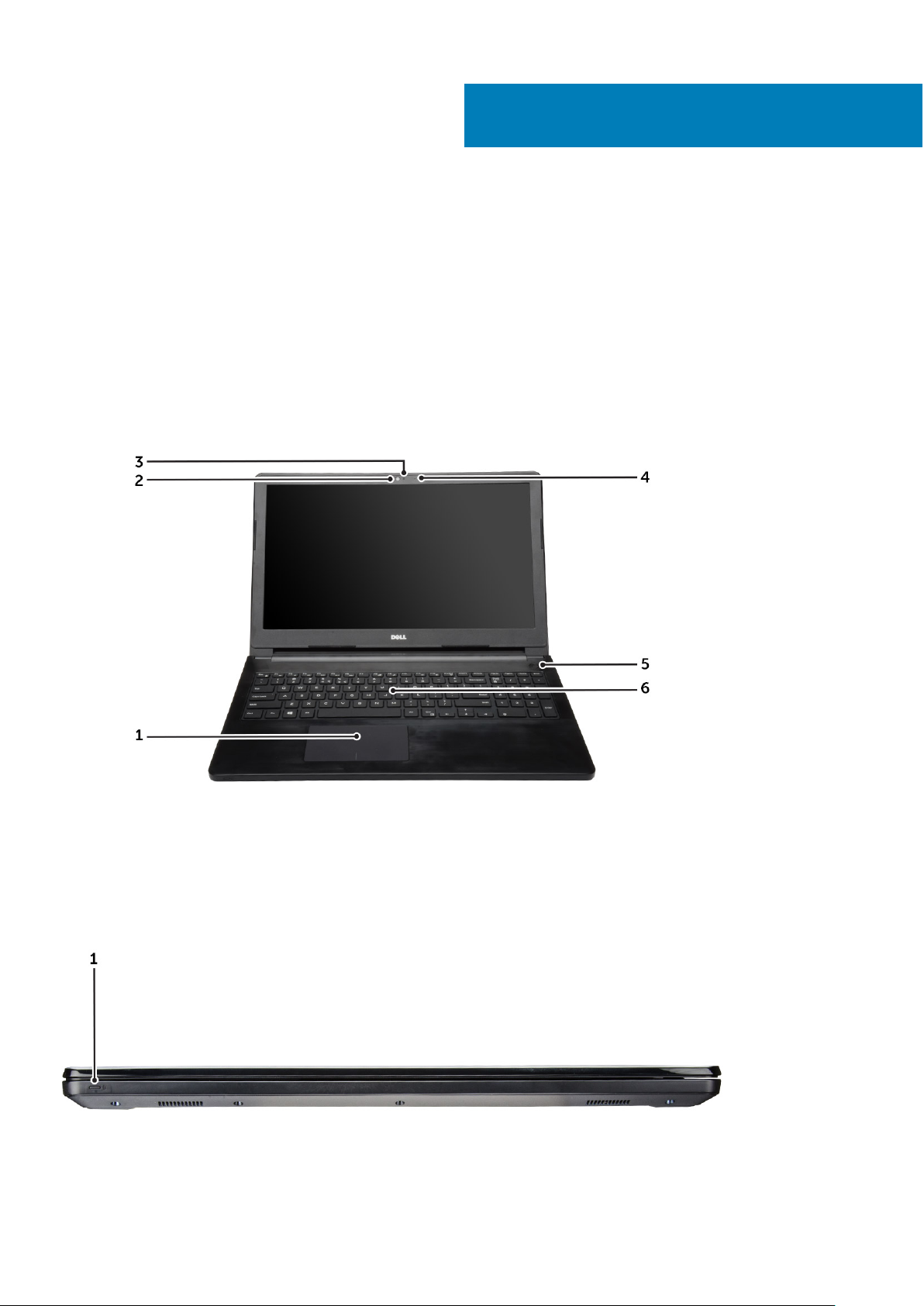
Front open view
2
Chassis view
1. Touchpad 2. Camera
3. Camera status light 4. Microphone
5. Power button 6. Keyboard
Front closed view
1. Power and battery status light
Chassis view 9
Page 10
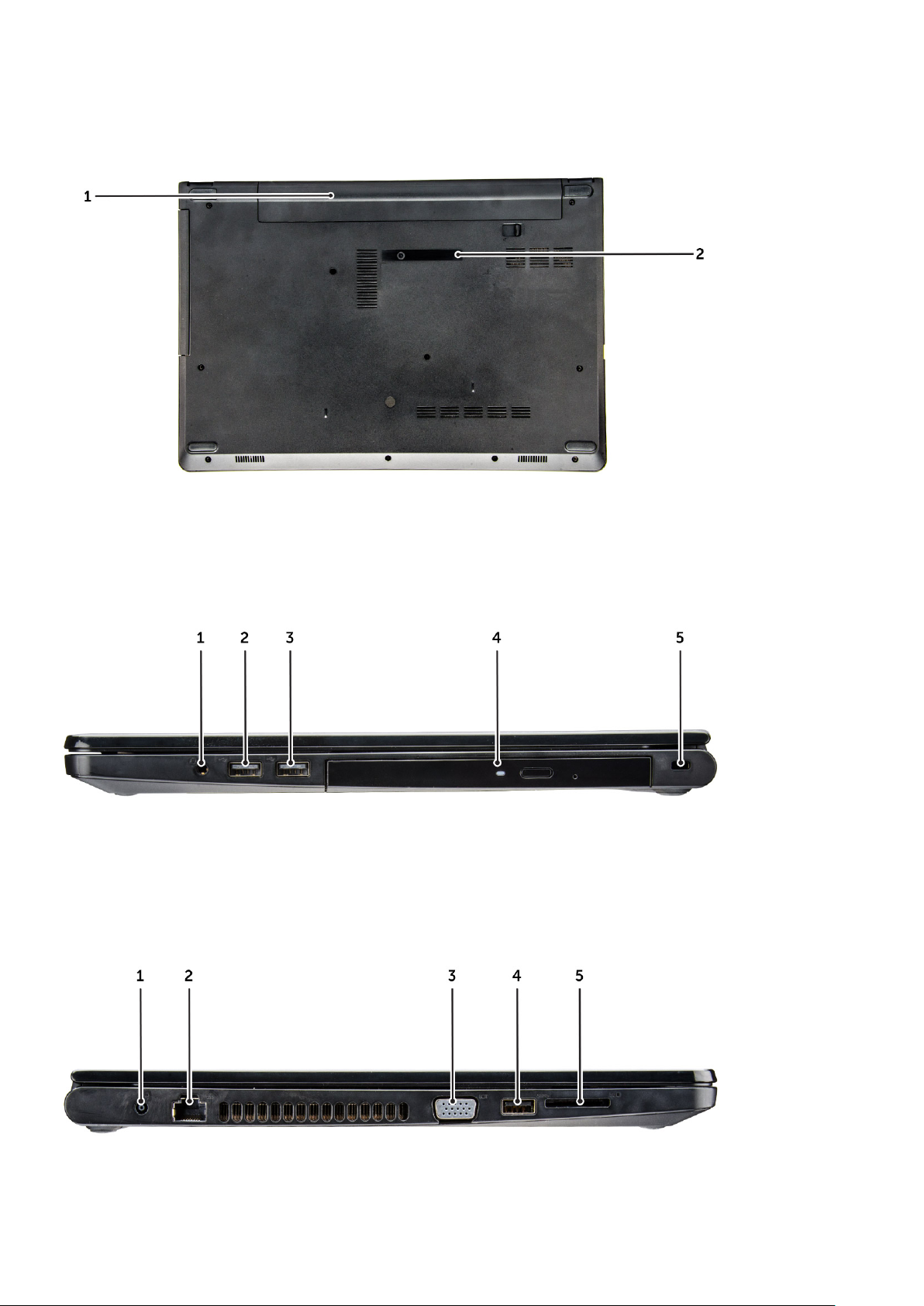
Rear view
1. Battery
2. Service Tag label
Right view
Headset connector 2. USB 2.0 connector
1.
3. USB 2.0 connector 4. Optical drive
5. Security cable slot
Left view
1.
Power connector 2. Network connector
10 Chassis view
Page 11

3. VGA connector 4. USB 3.0 connector
5. Memory card reader
Chassis view 11
Page 12

Removing and installing components
This section provides detailed information on how to remove or install the components from your computer.
Topics:
• Recommended tools
• Removing the battery
• Installing the battery
• Removing the optical drive
• Removing the optical drive bracket
• Installing the optical drive bracket
• Installing the optical drive
• Removing the keyboard
• Installing the keyboard
• Removing the base cover
• Installing the base cover
• Removing the hard drive assembly
• Removing the hard drive from the hard drive bracket
• Installing the hard drive into the hard drive bracket
• Installing the hard drive assembly
• Removing the memory module
• Installing the memory module
• Removing the coin cell battery
• Installing the coin cell battery
• Removing the WLAN card
• Installing the WLAN card
• Removing the Input Output board
• Installing the Input Output board
• Removing the speakers
• Installing the speakers
• Removing the heat sink assembly
• Installing the heat sink assembly
• Removing the system board
• Installing the system board
• Removing the power connector
• Installing the power connector
• Removing the display assembly
• Installing the display assembly
• Removing the display bezel
• Installing the display bezel
• Removing the camera
• Installing the camera
• Removing the display panel
• Installing the display panel
• Removing the palmrest
• Installing the palmrest
• Removing the display hinges
• Installing the display hinges
3
12 Removing and installing components
Page 13

Recommended tools
The procedures in this document require the following tools:
● Small flat blade screwdriver
● Phillips #0 screwdriver
● Phillips #1 screwdriver
● Small plastic scribe
Removing the battery
1. Follow the procedure in Before working inside your computer.
2. To remove the battery:
a. Slide the release latch to unlock the battery [1].
b. Remove the battery from the computer [2].
Installing the battery
1. Insert the battery into the slot and press it until it clicks into place.
2. Follow the procedures in After working inside your computer.
Removing the optical drive
1. Follow the procedure in Before working inside your computer.
2. Remove the battery.
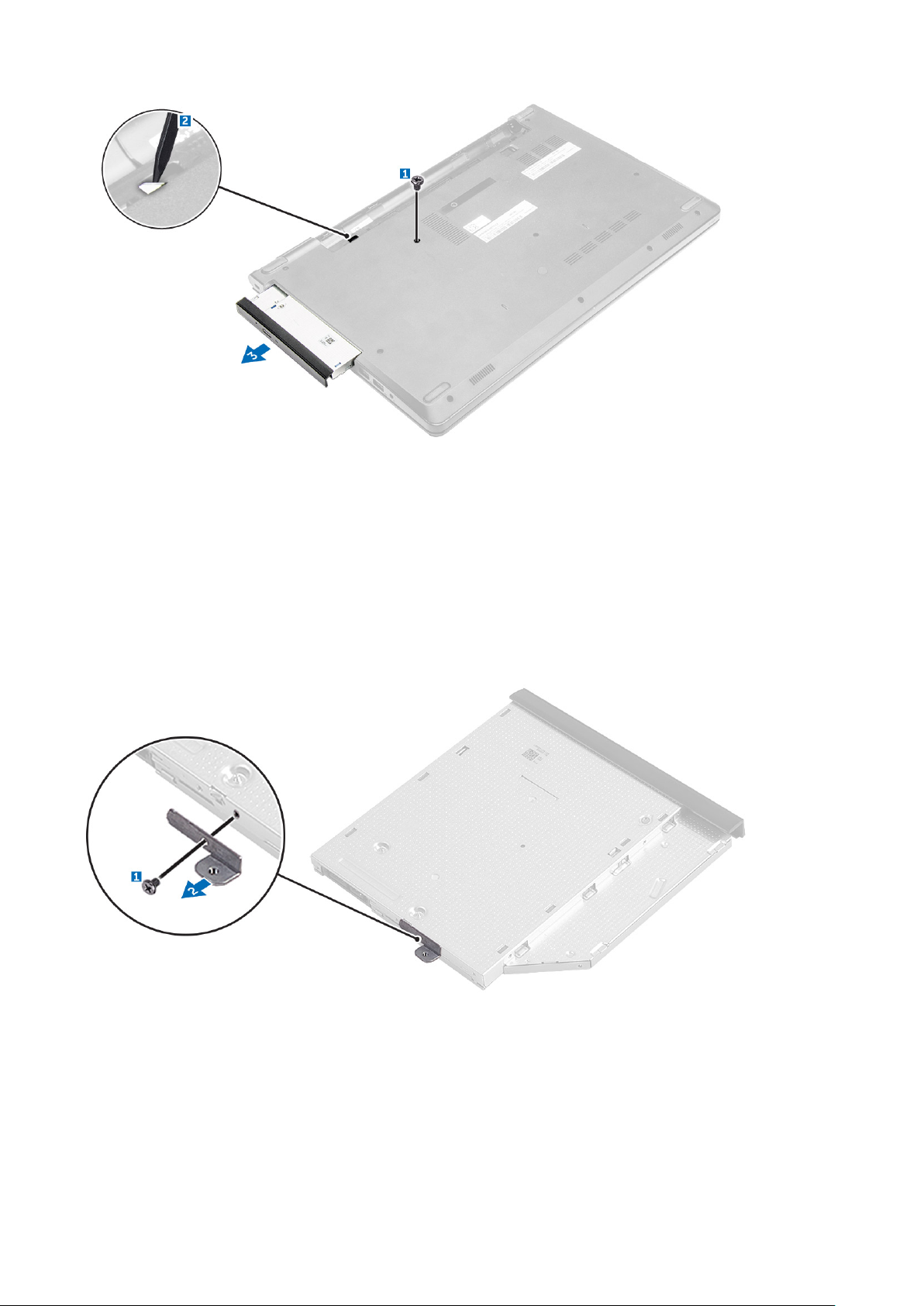
3. To remove the optical drive:
a. Remove the screw that secures the optical drive to the computer [1].
b. Using a plastic scribe push the tab to release the optical drive [2].
c. Slide the optical drive out of the computer [3].
Removing and installing components
13
Page 14
Removing the optical drive bracket
1. Follow the procedure in Before working inside your computer.
2. Remove the:
a. battery
b. optical drive
3. To remove the optical drive from bracket:
a. Remove the screw that secures the optical drive bracket [1].
b. Remove the optical drive bracket from the optical drive [2].
Installing the optical drive bracket
1. Install the optical drive bracket.
2. Tighten the screw to secure the optical drive bracket.
3. Install the:
a. optical drive
14
Removing and installing components
Page 15
b. battery
4. Follow the procedure in After working inside your computer.
Installing the optical drive
1. Insert the optical drive into the slot until it clicks into place.
2. Tighten the screw to secure the optical drive to the computer.
3. Install the battery.
4. Follow the procedure in After working inside your computer.
Removing the keyboard
1. Follow the procedure in Before working inside your computer.
2. Remove the battery.
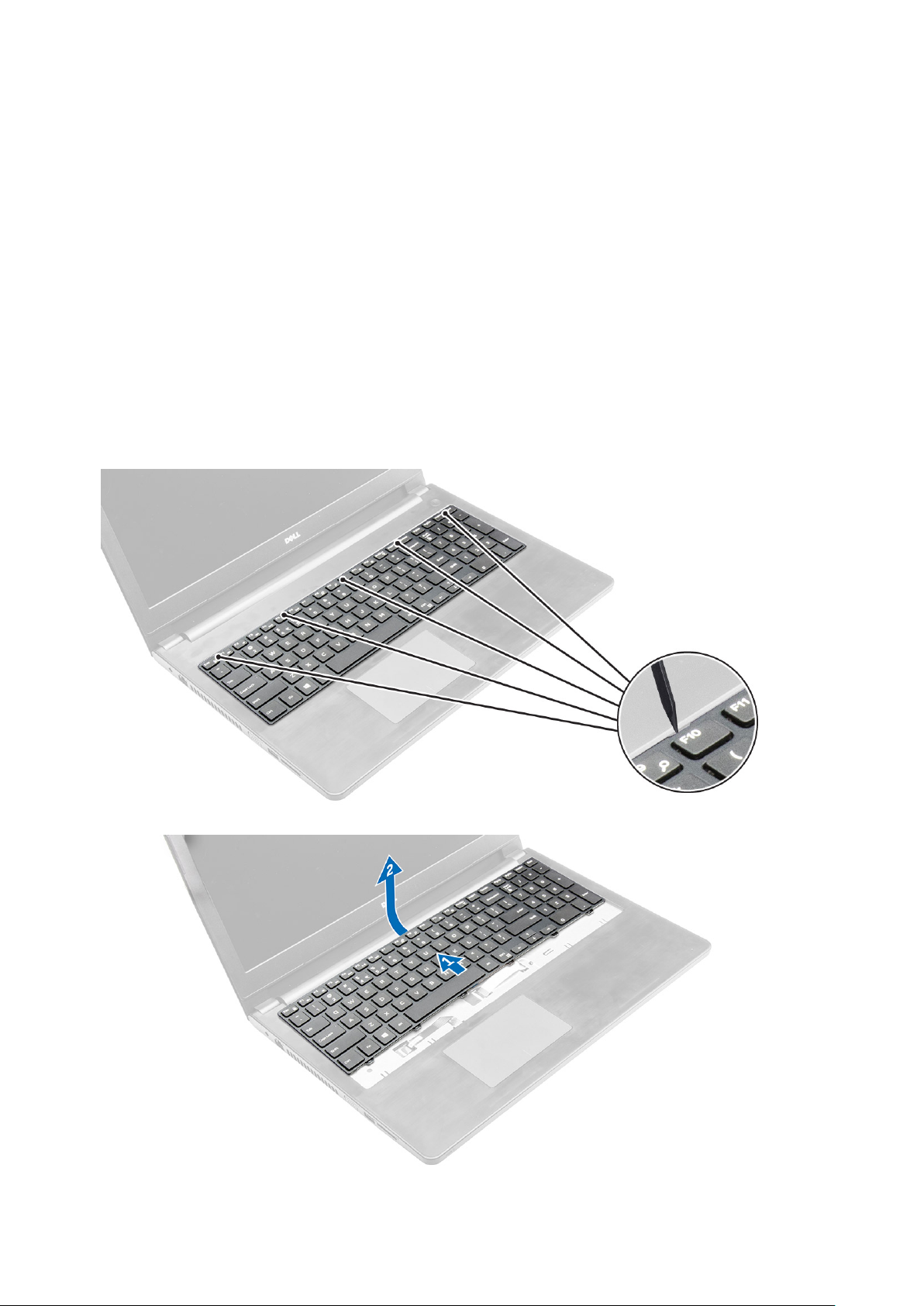
3. To remove the keyboard:
a. Release the keyboard by prying on the keyboard release tabs by using a scribe.
b. Slide and lift the keyboard to access the keyboard connector cable under the keyboard [1,2].
Removing and installing components
15
Page 16
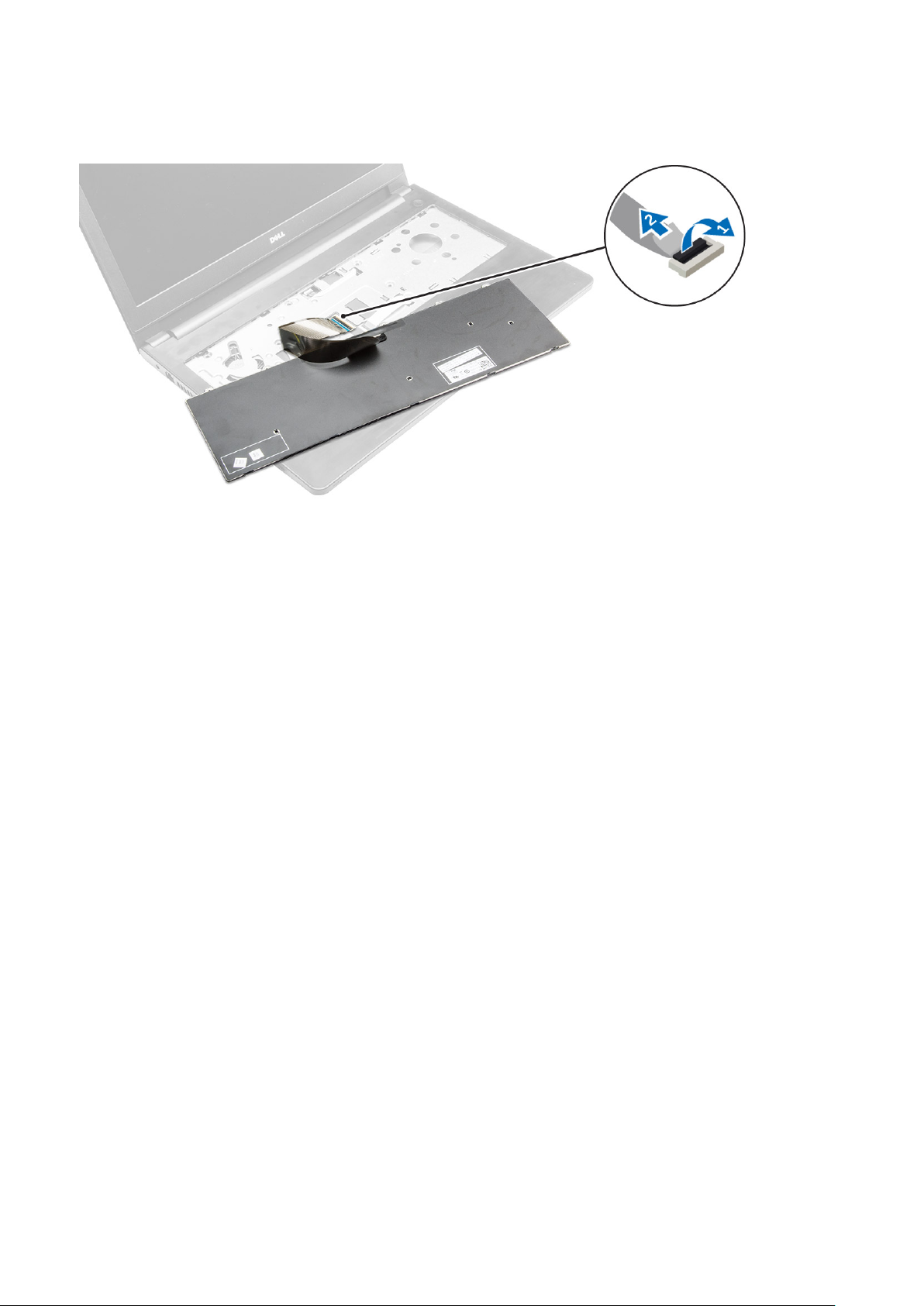
4. To remove the keyboard cable:
a. Disconnect the keyboard cable from the system board [1].
b. Lift the keyboard cable to remove it from the computer [2].
Installing the keyboard
1. Connect the keyboard cable to the connector on the system board.
2. Slide the keyboard into the retention slots.
3. Press along the top edges to lock the keyboard in place.
4. Install the battery.
5. Follow the procedure in After working inside your computer.
Removing the base cover
1. Follow the procedure in Before working inside your computer.
2. Remove the:
a. battery
b. optical drive
c. keyboard
3. To remove the base cover:
a. Disconnect the optical drive connector and lift it to remove it from the system board [1,2].
b. Remove the screws inside the palmrest [3].
16
Removing and installing components
Page 17
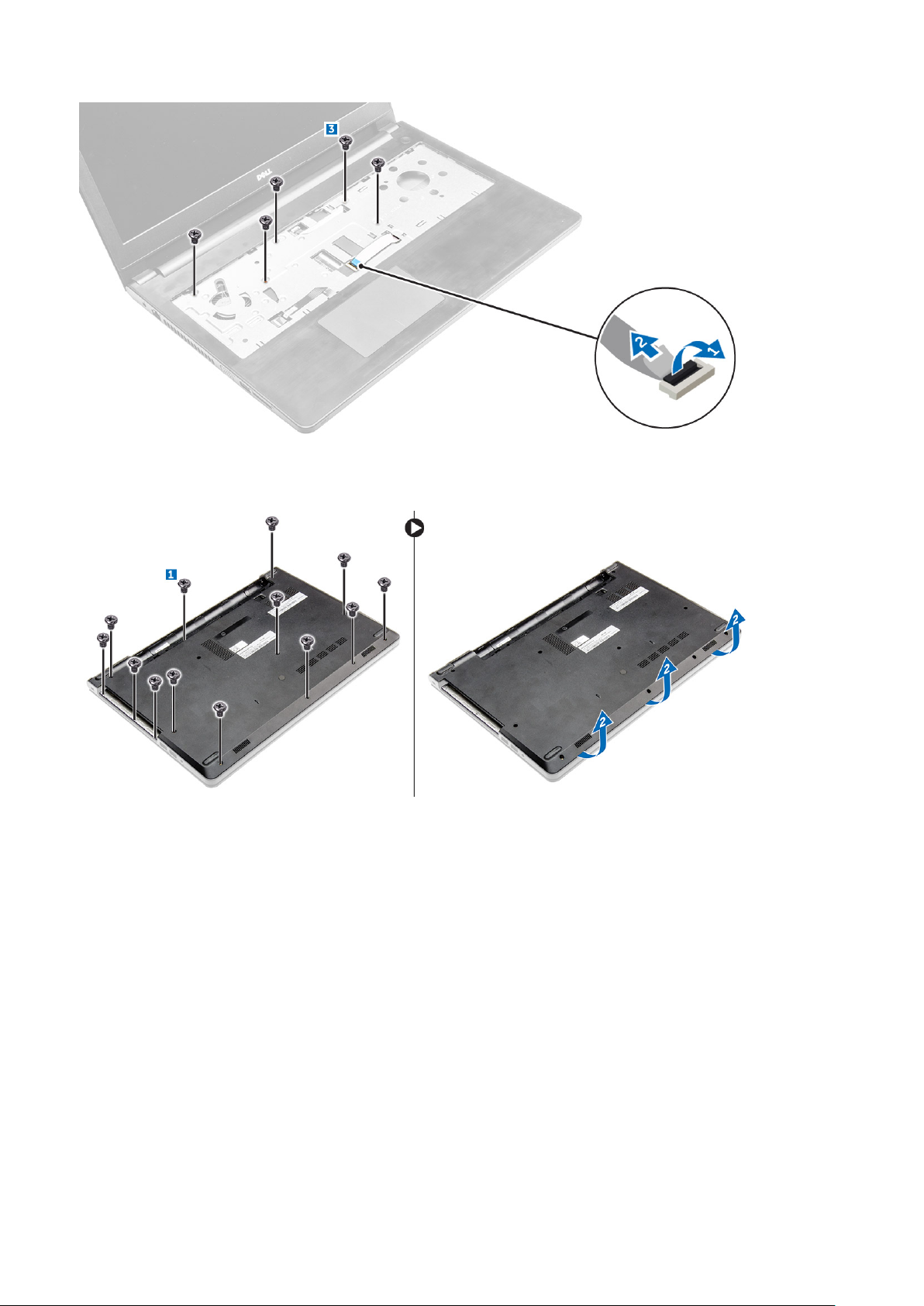
4. To remove the base cover:
a. Remove the screws that secure the base cover to the computer [1].
b. Pry the edges of base cover and lift it to remove it from computer [2].
Installing the base cover
1. Align the base cover with the screw holders on the computer.
2. Press the edges of the cover until it clicks into place.
3. Tighten the screws to secure the base cover to the computer.
4. Turn the computer over.
5. Open the computer and connect the optical drive connector to the system board.
6. Tighten the screws to secure the base cover to the palmrest.
7. Install the:
a. keyboard
b. optical drive
c. battery
8. Follow the procedure in After working inside your computer.
Removing and installing components
17
Page 18
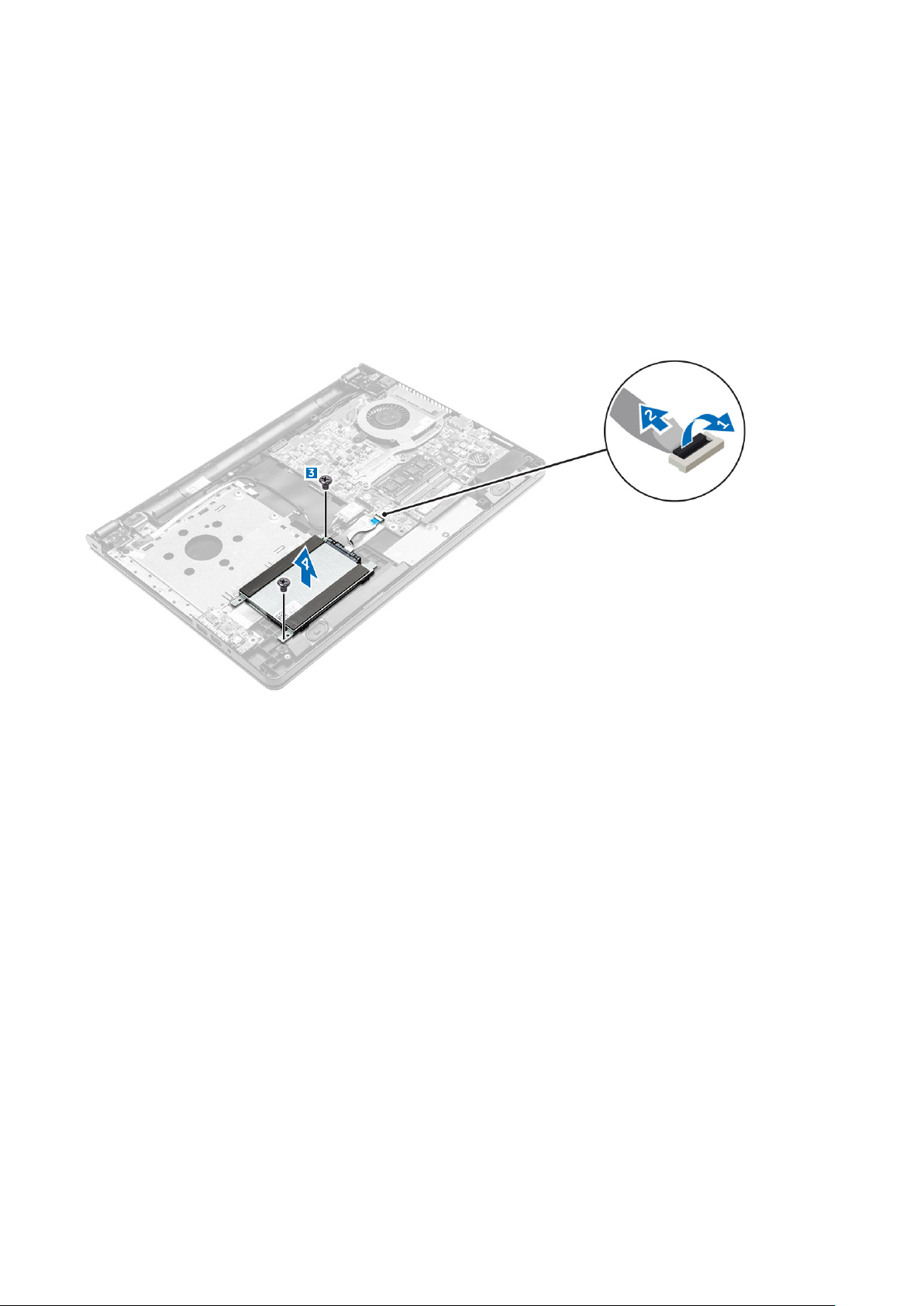
Removing the hard drive assembly
1. Follow the procedure in Before working inside your computer.
2. Remove the:
a. battery
b. optical drive
c. keyboard
d. base cover
3. To remove the hard drive assembly:
a. Disconnect the hard drive cable from the connector on the system board [1, 2].
b. Remove the screws that secure the hard drive assembly to the computer [3].
c. Lift the hard drive assembly away from the computer [4].
Removing the hard drive from the hard drive bracket
1. Follow the procedure in Before working inside your computer.
2. Remove the:
a. battery
b. optical drive
c. keyboard
d. base cover
e. hard drive assembly
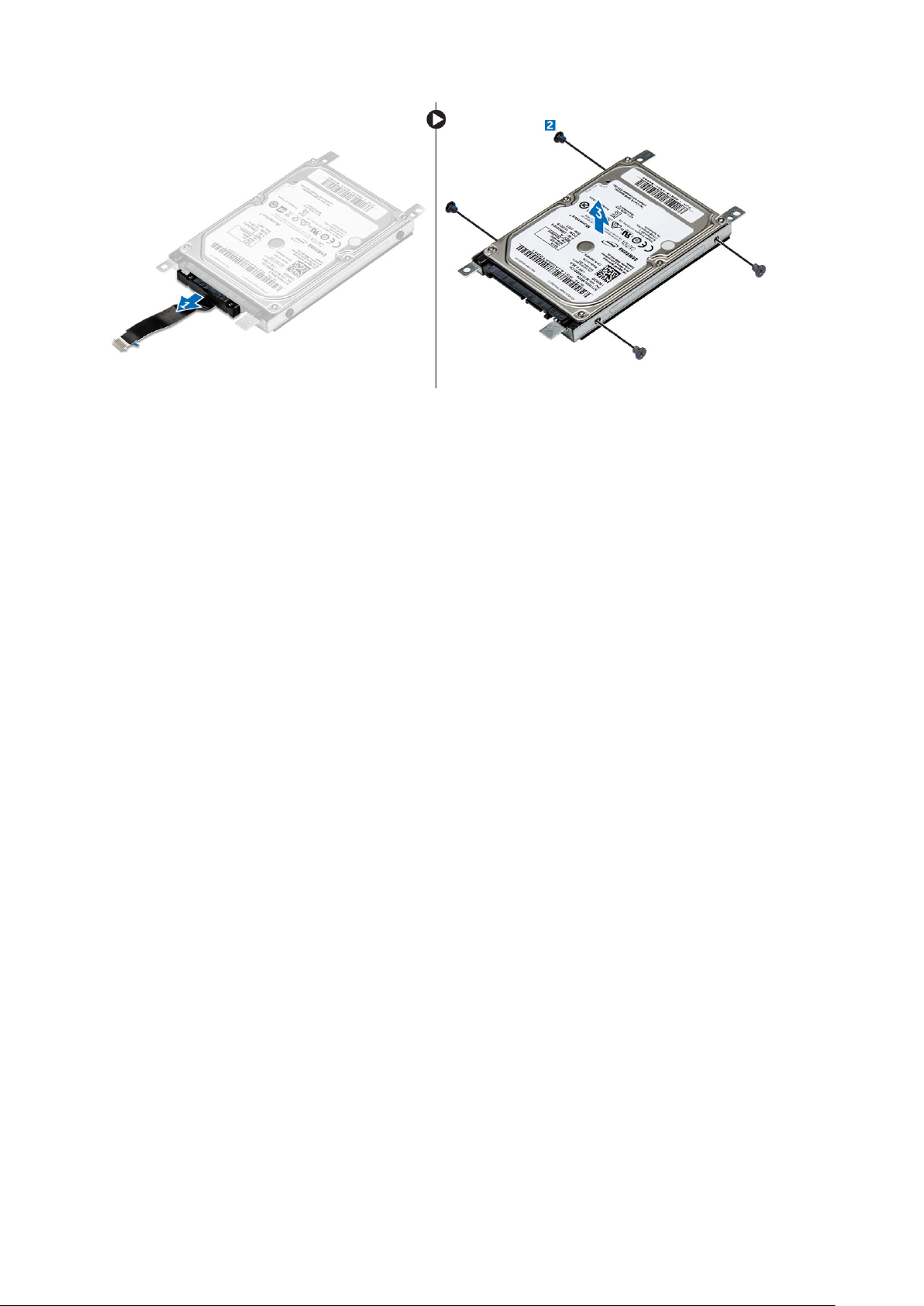
3. To remove the hard drive from hard drive assembly:
a. Pull the hard drive cable connector to remove it from the hard drive [1].
b. Remove the screws that secure the hard drive bracket to the hard drive [2].
c. Lift the hard drive from the hard drive bracket [3].
18
Removing and installing components
Page 19
Installing the hard drive into the hard drive bracket
1. Align the screw holders and insert the hard drive into the hard drive bracket.
2. Tighten the screws to secure the hard drive to the hard drive bracket.
3. Connect the hard drive cable connector to the hard drive.
4. Install the:
a. hard drive assembly
b. base cover
c. keyboard
d. optical drive
e. battery
5. Follow the procedure in After working inside your computer
Installing the hard drive assembly
1. Insert the hard drive assembly into the slot on the computer.
2. Tighten the screws to secure the hard drive assembly to the computer.
3. Connect the hard drive cable to the connector on the system board.
4. Install the:
a. base cover
b. optical drive
c. keyboard
d. battery
5. Follow the procedures in After working inside your computer.
Removing the memory module
1. Follow the procedure in Before working inside your computer.
2. Remove the:
a. battery
b. optical drive
c. keyboard
d. base cover
3. To remove memory module:
a. Pull the clips securing the memory module until the memory module pops up [1].
Removing and installing components
19
Page 20

b. Remove the memory module from the system board [2].
Installing the memory module
1. Insert the memory module into the memory socket.
2. Press the memory module until the clips secure the memory module.
3. Install the:
a. base cover
b. keyboard
c. optical drive
d. battery
4. Follow the procedures in After working inside your computer.
Removing the coin cell battery
1. Follow the procedure in Before working inside your computer.
2. Remove the:
a. battery
b. optical drive
c. keyboard
d. base cover
3. By using a plastic scribe, lift the battery out of the battery slot.
20
Removing and installing components
Page 21

Installing the coin cell battery
1. Insert the coin cell battery into the battery slot.
2. Press the battery until it clicks into place.
3. Install the:
a. base cover
b. keyboard
c. optical drive
d. battery
4. Follow the procedures in After working inside your computer.
Removing the WLAN card
1. Follow the procedure in Before working inside your computer.
2. Remove the:
a. battery
b. optical drive
c. keyboard
d. base cover
3. To remove the WLAN card:
a. Disconnect the WLAN cables from the connectors on the WLAN card [1].
b. Remove the secure that secures the WLAN card to the system board [2].
c. Remove the WLAN card from the computer [3].
Removing and installing components
21
Page 22

Installing the WLAN card
1. Insert the WLAN card into the slot on the computer.
2. Tighten the screw to secure the WLAN card to the computer.
3. Connect the WLAN cables to the connectors on the WLAN card.
4. Install the:
a. base cover
b. keyboard
c. optical drive
d. battery
5. Follow the procedure in After working inside your computer.
Removing the Input Output board
1. Follow the procedure in Before working inside your computer.
2. Remove the:
a. battery
b. optical drive
c. keyboard
d. base cover
3. To remove the Input/Output board (I/O board):
a. Remove the screw that secures the I/O board to the computer [1].
b. Lift the I/O board [2].
c. Turn the I/O board over to remove the black adhesive tape that secures the I/O board cable [3].
d. Disconnect the I/O board cable [4, 5].
22
Removing and installing components
Page 23

Installing the Input Output board
1. Connect the input/output (I/O board) cable to the I/O board.
2. Replace the black adhesive tape to secure the i/o board cable.
3. Turn the I/O board over and align it with the screw holder on the computer.
4. Insert the I/O board into the computer.
5. Tighten the screw to secure the I/O board to the computer.
6. Install the:
a. base cover
b. keyboard
c. optical drive
d. battery
7. Follow the procedure in After working inside your computer.
Removing the speakers
1. Follow the procedure in Before working inside your computer.
2. Remove the:
a. battery
b. optical drive
c. keyboard
d. base cover
3. To remove the speakers:
a. Disconnect the speaker cable [1].
b. Unroute the cables and remove the speakers from the computer [2].
Removing and installing components
23
Page 24

Installing the speakers
1. Insert the tabs on the speakers into the slots on the computer.
2. Route the speaker cable through the routing channel on the computer.
3. Connect the speaker cable to the system board.
4. Install the:
a. base cover
b. keyboard
c. optical drive
d. battery
5. Follow the procedure in After working inside your computer
Removing the heat sink assembly
1. Follow the procedure in Before working inside your computer.
2. Remove the:
a. battery
b. optical drive
c. keyboard
d. base cover
3. To remove the heat sink assembly:
a. Disconnect the system fan cable from the system board [1].
b. Loosen the captive screws that secure the heat sink assembly to the system board [2].
c. Remove the heat sink assembly from the system board [3].
24
Removing and installing components
Page 25

Installing the heat sink assembly
1. Align the screws on the heat sink with the screw holders on the system board.
2. Install the heat sink assembly and tighten the captive screws to secure it to the system board.
3. Connect the system fan cable to the system board.
4. Install the:
a. base cover
b. keyboard
c. optical drive
d. battery
5. Follow the procedures in After working inside your computer.
Removing the system board
1. Follow the procedure in Before working inside your computer.
2. Remove the:
a. battery
b. optical drive
c. keyboard
d. base cover
e. hard drive assembly
f. WLAN card
g. I/O board
h. memory module
i. coin cell battery
j. heat sink
3. Lift the locking tab to disconnect the optical drive and power button cable [1, 2].
Removing and installing components
25
Page 26

4. Turn the computer over and unroute the WLAN cable [1].
5. Remove the screw and lift the hinge that secures the system board to the computer [2,3].
6. Remove the screw that secures the system board to the computer [1] and lift the system board [2].
26
Removing and installing components
Page 27

7. Turn the system board over.
8. To remove the system board:
a. Remove the white adhesive tape [1].
b. Unlock the tab and disconnect the eDP cable [2, 3].
c. Disconnect the power cable [4].
d. Remove the system board from the computer.
Installing the system board
1. Connect power cable and eDP cable.
2. Replace the white adhesive tape.
3. Turn the system board over.
4. Align the system board with the screw holders on the computer.
5. Tighten the screws to secure the system board to the computer.
6. Close the hinge and tighten the screws to secure the system board to the computer.
7. Turn the computer over and open the computer and connect the optical drive cable and the touch pad cable to the system
board.
8. Install the:
Removing and installing components
27
Page 28

a. WLAN card
b. I/O board connector
c. memory module
d. heat sink
e. coin cell battery
f. base cover
g. optical drive
h. keyboard
i. battery
9. Follow the procedure in After working inside your computer.
Removing the power connector
1. Follow the procedure in Before working inside your computer.
2. Remove the:
a. battery
b. optical drive
c. keyboard
d. base cover
e. hard drive assembly
f. optical drive
g. WLAN card
h. i/o board
i. memory module
j. coin cell battery
k. heat sink
l. system board
3. To remove the power connector:
a. Remove the black adhesive tape and unroute the power cable [1].
b. Remove the screw that secures the power connector to the computer [2].
c. Lift the power connector.
Installing the power connector
1. Insert the power connector into the slot on the computer.
2. Route the power connector cable through the routing channel.
28
Removing and installing components
Page 29

3. Secure the power connector to the computer by using the screw.
4. Install the:
a. system board
b. WLAN card
c. I/O board
d. memory module
e. heat sink
f. coin cell battery
g. base cover
h. optical drive
i. battery
j. keyboard
5. Follow the procedure in After working inside your computer.
Removing the display assembly
1. Follow the procedure in Before working inside your computer.
2. Remove the:
a. battery
b. optical drive
c. keyboard
d. base cover
e. hard drive assembly
f. optical drive
g. WLAN card
h. i/o board
i. memory module
j. coin cell battery
k. heat sink
l. system board
m. power connector
3. Unroute the WLAN and eDP cable [1, 2, 3].
4. To remove the display assembly:
a. Remove and lift the screws that secure the display hinge to the computer [1, 2].
b. Lift and remove the display assembly [3,4].
Removing and installing components
29
Page 30

Installing the display assembly
1. Align the display assembly with the chassis.
2. Route the WLAN and display assembly cables through the cable securing tabs.
3. Tighten the display hinges screws to secure the display assembly.
4. Install the:
a. coin cell battery
b. system board
c. power connector
d. keyboard
e. WLAN card
f. I/O board
g. memory module
h. heat sink
i. base cover
j. optical drive
k. battery
5. Follow the procedure in After working inside your computer.
Removing the display bezel
1. Follow the procedure in Before working inside your computer.
2. Remove the:
a. battery
b. optical drive
c. keyboard
d. base cover
e. hard drive assembly
f. optical drive
g. WLAN card
h. I/O board
i. memory module
j. coin cell battery
k. heat sink
l. system board
30
Removing and installing components
Page 31

m. power connector
n. display assembly
3. To disconnect the display bezel:
a. By using a plastic scribe, release the tabs on the edges to release the display bezel from the display assembly [1].
b. Remove the display bezel display assembly [2].
Installing the display bezel
1. Place the display bezel on the display assembly.
2. Press the display bezel until it clicks onto the display assembly.
3. Install the:
a. display assembly
b. keyboard
c. WLAN card
d. I/O board
e. memory module
f. heat sink
g. base cover
h. coin cell battery
i. system board
j. power connector
k. battery
l. optical drive
4. Follow the procedure in After working inside your computer.
Removing the camera
1. Follow the procedure in Before working inside your computer.
2. Remove the:
a. battery
b. optical drive
c. keyboard
d. base cover
e. hard drive assembly
f. optical drive
g. WLAN card
h. I/O board
i. memory module
Removing and installing components
31
Page 32

j. coin cell battery
k. heat sink
l. system board
m. power connector
n. display assembly
o. display bezel
3. To remove the camera:
a. Remove the tape that secures the camera cable [1].
b. Disconnect the camera cable from the camera [2].
c. Remove the camera from the display assembly [3].
Installing the camera
1. Install the camera into the slot on the display assembly.
2. Connect the camera cable.
3. Install the:
a. display assembly
b. display bezel
c. keyboard
d. WLAN card
e. I/O board
f. memory module
g. heat sink
h. base cover
i. coin cell battery
j. system board
k. power connector
l. battery
m. optical drive
4. Follow the procedure in After working inside your computer.
Removing the display panel
1. Follow the procedure in Before working inside your computer.
2. Remove the:
32
Removing and installing components
Page 33

a. battery
b. optical drive
c. keyboard
d. base cover
e. hard drive assembly
f. optical drive
g. WLAN card
h. I/O board
i. memory module
j. coin cell battery
k. heat sink
l. system board
m. power connector
n. display assembly
o. display bezel
p. camera
3. To remove the display panel:
a. Remove the screws that secure the display panel to the display assembly [1].
b. Lift the display panel to access the cables underneath [2].
4. To disconnect the cable:
a. Remove the tape that secures the eDP cable to the display panel [1].
b. Lift the locking tab and remove the eDP cable [2, 3].
c. Remove the display panel from the computer [4].
Removing and installing components
33
Page 34

Installing the display panel
1. Connect the eDP cable to the display panel.
2. Affix the tape to secure the display cable.
3. Place the display panel on the display assembly.
4. Tighten the screws to secure the display panel to the display assembly.
5. Install the:
a. display assembly
b. display bezel
c. camera
d. keyboard
e. WLAN card
f. i/o board
g. memory module
h. heat sink
i. base cover
j. coin cell battery
k. system board
l. power connector
m. battery
n. optical drive
6. Follow the procedure in After working inside your computer.
Removing the palmrest
1. Follow the procedure in Before working inside your computer.
2. Remove the:
a. battery
b. optical drive
c. keyboard
d. base cover
e. hard drive assembly
f. WLAN card
g. I/O board
34
Removing and installing components
Page 35

h. speakers
i. memory module
j. coin cell battery
k. heat sink
l. system board
m. power connector
n. display assembly
o. display bezel
p. camera
q. display panel
3. Remove the Palmrest away from the computer:
Installing the palmrest
1. Align the palmrest on the computer.
2. Install the:
a. display panel
b. display assembly
c. display bezel
d. camera
e. keyboard
f. WLAN card
g. speaker
h. i/o board
i. memory module
j. heat sink
k. base cover
l. coin cell battery
m. system board
n. power connector
o. battery
p. optical drive
3. Follow the procedure in After working inside your computer.
Removing and installing components
35
Page 36

Removing the display hinges
1. Follow the procedure in Before working inside your computer.
2. Remove the:
a. battery
b. optical drive
c. keyboard
d. base cover
e. hard drive assembly
f. optical drive
g. WLAN card
h. I/O board
i. memory module
j. coin cell battery
k. heat sink
l. system board
m. power connector
n. display assembly
o. display bezel
p. camera
q. display panel
3. To remove the hinges:
a. Remove the screws that secure the display hinges to the display assembly [1].
b. Remove the display hinges [2].
Installing the display hinges
1. Tighten the screws to secure the display hinges to the display assembly.
2. Install the:
a. display assembly
b. display bezel
c. display panel
d. camera
e. system board
f. power connector
g. WLAN card
36
Removing and installing components
Page 37

h. I/O board
i. memory module
j. heat sink
k. coin cell battery
l. optical drive
m. base cover
n. keyboard
o. battery
3. Follow the procedure in After working inside your computer.
Removing and installing components 37
Page 38

Technology and components
Topics:
• Power adapter
• Processors
• Chipsets
• Display options
• Audio options
• WLAN card
• Hard drive options
• Entering BIOS setup
• Camera features
• Memory features
Power adapter
This laptop is shipped with the 45 W power adapter. This adapter uses a USB Type C connector.
4
WARNING:
itself, and then pull firmly but gently to avoid damaging the cable.
WARNING: The power adapter works with electrical outlets worldwide. However, power connectors and power
strips vary among countries. Using an incompatible cable or improperly connecting the cable to the power strip
or electrical outlet may cause fire or damage the equipment.
When you disconnect the power adapter cable from the laptop, grasp the connector, not the cable
Processors
This laptop is shipped with the AMD A6–7310 processor.
NOTE: The clock speed and performance varies depending on the workload and other variables.
Identifying processors in Windows 10
1. Click Search the Web and Windows.
2. Type Device Manager.
3. Select Processor.
The basic information of the processor is displayed
Identifying processors in Windows 7
1. Click Start.
2. Type Device Manager.
3. Select Processor.
38 Technology and components
Page 39

The basic information of the processor is displayed.
Verifying the processor usage in Task Manager
1. Right click on the taskbar.
2. Select Start Task Manager.
The Windows Task Manager window is displayed.
3. Click the Performance tab in the Windows Task Manager window.
The processor performance details are displayed.
Verifying the processor usage in Resource Monitor
1. Right click on the taskbar.
2. Select Start Task Manager.
The Windows Task Manager window is displayed.
3. Click the Performance tab in the Windows Task Manager window.
The processor performance details are displayed.
4. Click Open Resource Monitor.
Technology and components
39
Page 40

Chipsets
All laptop communicate with the CPU through the chipset.
Downloading the chipset driver
1. Turn on the laptop.
2. Go to www.Dell.com/support.
3. Click Product Support, enter the Service Tag of your laptop, and then click Submit.
NOTE: If you do not have the Service Tag, use the autodetect feature or manually browse for your laptop model.
4. Click Drivers and Downloads.
5. Select the operating system installed on your laptop.
6. Scroll down the page, expand Chipset, and select your chipset driver.
7. Click Download File to download the latest version of the chipset driver for your laptop.
8. After the download is complete, navigate to the folder where you saved the driver file.
9. Double-click the chipset driver file icon and follow the instructions on the screen.
Identifying the chipset in Device Manager on Windows 10
1. Click All Settings
2. From the Control Panel, select Device Manager.
3. Expand System Devices and search for the chipset.
on the Windows 10 Charms Bar.
Identifying chipset in Device Manager on Windows 7
1. Click Start → Control Panel → Device Manager.
2. Expand System Devices and search for the chipset.
40
Technology and components
Page 41

Graphic chipset
This laptop is shipped with the AMD Radeon R4 graphics chipset.
AMD chipset drivers
Verify if the AMD chipset drivers are already installed in the laptop.
Table 1. AMD chipset drivers
Before installation After installation
AMD Radeon Graphics drivers
Verify if the AMD Radeon Graphics drivers are already installed in the laptop.
Technology and components
41
Page 42

Table 2. AMD Radeon Graphics drivers
Before installation After installation
Display options
This laptop supports a 15 inch HD with 1366 x 768 resolution (maximum).
Identifying the display adapter
1. Click or tap Start and select Settings.
2. Type Device Manager in the search box and tap Device Manager from the left pane.
3. Expand Display adapters.
The display adapters are displayed.
Changing the screen resolution
1. Right-click or tap and select Display Settings.
2. Tap or click Advanced display settings.
3. Select the required resolution from the drop-down list and tap or click Apply.
Rotating the display
1. Right click on the desktop screen.
A sub menu is displayed.
2. Select Graphic Options > Rotation and choose one of the following:
● Rotate to Normal
● Rotate to 90 Degrees
● Rotate to 180 Degrees
● Rotate to 270 Degrees
The display can also be rotated using the following key combinations:
NOTE:
42 Technology and components
Page 43

● Ctrl + Alt + Up arrow key (Rotate to normal)
● Right arrow key (Rotate 90 degrees)
● Down arrow key (Rotate 180 degrees)
● Left arrow key (Rotate 270 degrees)
Adjusting brightness in Windows 10
To enable or disable automatic screen brightness adjustment:
1. Click or tap All Settings
2. Use the Adjust my screen brightness automatically slider to enable or disable automatic-brightness adjustment.
NOTE: You can also use the Brightness level slider to adjust the brightness manually.
→ System → Display.
Adjusting brightness in Windows 7
To enable or disable automatic screen brightness adjustment:
1. Click Start → Control Panel → Display.
2. Use the Adjust brightness slider to enable or disable automatic-brightness adjustment.
NOTE: You can also use the Brightness level slider to adjust the brightness manually.
Cleaning the display
1. Check for any smudges or areas that have to be cleaned.
2. Use a microfiber cloth to remove any obvious dust and gently brush off any dirt particles.
3. Proper cleaning kits should be used to clean and keep your display in a crisp clear pristine condition.
NOTE: Never spray any cleaning solutions directly on the screen; spray it to the cleaning cloth.
4. Gently wipe the screen in a circular motion. Do not press hard on the cloth.
NOTE: Do not press hard or touch the screen with your fingers or you may leave oily prints and smears.
NOTE: Do not leave any liquid on the screen.
5. Remove all excess moisture as it may damage your screen.
6. Let the display dry thoroughly before you turn it on.
7. For stains that are hard to remove, repeat this procedure till the display is clean.
Connecting to external display devices
1. Ensure that the projector is turned on and plug the projector cable into a video port on your laptop.
2. Press the Windows logo + P key.
3. Select one of the following modes:
● PC screen only
● Duplicate
● Extend
● Second Screen only
NOTE: For more information, see the document that shipped with your display device.
Technology and components 43
Page 44

Audio options
Downloading the audio driver
1. Turn on the laptop.
2. Go to www.Dell.com/support.
3. Click Product Support, enter the Service Tag of your laptop and click Submit.
NOTE: If you do not have the Service Tag, use the autodetect feature or manually browse for your laptop model.
4. Click Drivers and Downloads.
5. Select the operating system installed on your laptop.
6. Scroll down the page and expand Audio.
7. Select the audio driver.
8. Click Download File to download the latest version of the audio driver for your laptop.
9. After the download is complete, navigate to the folder where you saved the audio driver file.
10. Double-click the audio driver file icon and follow the instructions on the screen.
Realtek ALC3234–CG Waves MaxxAudio Pro controller
This laptop ships with integrated Realtek ALC3234–CG Waves MaxxAudio Pro controller. It is a High Definition audio codec
designed for Windows desktop and laptops.
Downloading the audio driver
1. Turn on the laptop.
2. Go to www.Dell.com/support.
3. Click Product Support, enter the Service Tag of your laptop and click Submit.
NOTE: If you do not have the Service Tag, use the autodetect feature or manually browse for your laptop model.
4. Click Drivers and Downloads.
5. Select the operating system installed on your laptop.
6. Scroll down the page and expand Audio.
7. Select the audio driver.
8. Click Download File to download the latest version of the audio driver for your laptop.
9. After the download is complete, navigate to the folder where you saved the audio driver file.
10. Double-click the audio driver file icon and follow the instructions on the screen.
Identifying the audio controller in Windows 10
1. Click All Settings
2. Type Device Manager in the search box and select Device Manager from the left pane.
3. Expand Sound, video and game controllers.
The audio controller is displayed.
on the Windows 10 Charms bar.
Table 3. Identifying the audio controller in Windows 10
Before installation After installation
44 Technology and components
Page 45

Identifying the audio controller in Windows 7
1. Type Device Manager in the search box and select Device Manager from the left pane.
2. Expand Sound, video and game controllers.
The audio controller is displayed.
Table 4. Identifying the audio controller in Windows 7
Before installation After installation
Realtek HD audio drivers
Verify if the Realtek audio drivers are already installed in the laptop.
Table 5. Realtek HD audio drivers
Before installation After installation
WLAN card
This laptop supports a WLAN card.
Hard drive options
This laptop supports 1 TB hard drive.
Identifying the hard drive in Windows 10
1. Click All Settings on the Windows 10 Charms bar.
2. Click Control Panel, select Device Manager , and expand Disk drives.
The hard drive is listed under Disk drives.
Identifying the hard drive in Windows 7
1. Click Start > Control Panel > Device Manager.
The hard drive is listed under Disk drives.
2. Expand Disk drives.
Technology and components
45
Page 46

Entering BIOS setup
1. Turn on or restart your laptop.
2. After the Dell logo is displayed, tap F2 until the Entering BIOS setup message appears. To enter the Boot selection menu,
tap F12
Hard drive is listed under the Setup Utility Options under the Main group.
Camera features
This laptop is shipped with front-facing camera with the image resolution of 1280 x 720 (maximum).
Identifying the camera in Device Manager on Windows 10
1. In the Search box, type device manager, and click imaging devices to start it.
2. Under Device Manager, expand Imaging devices.
Identifying the camera in Device Manager on Windows 7
1. Select Control Panel.
2. Select Device Manager and expand Imaging devices.
Starting the camera
To start the camera, open an application that uses the camera. For instance, if you tap the Dell webcam central software or the
Skype software that is shipped with the laptop, the camera turns on. Similarly, if you are chatting on the internet and the
application requests to access the webcam, the webcam turns on.
Starting the Camera App
1. Click the Windows button and select All apps.
46
Technology and components
Page 47

2. Select Camera from the apps list.
If the Camera App is not available in the apps list, search for it.
3.
Memory features
In this laptop, the memory (RAM) is a part of the system board. This laptop supports DDR3L SO-DIMM with 2 slots, up to 1600
MHz.
Technology and components
47
Page 48

Verifying system memory in Windows 10
1. Click or tap Windows > All Settings
2. Under System, select About.
> System.
Verifying system memory in Windows 7
1. From your desktop, start the Charms bar.
2. Select Control Panel and then select System.
Verifying system memory in setup
1. Turn on or restart your laptop.
2. After the Dell logo is displayed, tap F2 until the Entering BIOS setup message appears. To enter the Boot selection menu,
tap F12
3. On the left pane, select Settings > General > System Information,
The memory information is displayed on the right pane.
Testing memory using ePSA
1. Turn on or restart your laptop.
2. Perform one of the following actions after the Dell logo is displayed:
● With keyboard — Press F2.
● Without keyboard — Press and hold the Volume Up button when the Dell logo is displayed on the screen. When the F12
boot selection menu is displayed, select Diagnostics from the boot menu, and press Enter.
The PreBoot System Assessment (PSA) starts on your laptop.
NOTE:
If you wait too long and the operating system logo appears, wait until you see the desktop. Turn off the laptop
and try again.
48 Technology and components
Page 49

5
System Setup
System Setup enables you to manage your computer hardware and specify BIOS level options. From the System Setup, you can:
● Change the NVRAM settings after you add or remove hardware
● View the system hardware configuration
● Enable or disable integrated devices
● Set performance and power management thresholds
● Manage your computer security
Topics:
• Boot Sequence
• Navigation keys
• Setup Utility options
• Advanced screen option
• Security screen option
• Boot
• Exit
• Updating the BIOS
• System and setup password
Boot Sequence
Boot Sequence allows you to bypass the System Setup‐defined boot device order and boot directly to a specific device (for
example: optical drive or hard drive). During the Power-on Self Test (POST), when the Dell logo appears, you can:
● Access System Setup by pressing F2 key
● Bring up the one-time boot menu by pressing F12 key
The one-time boot menu displays the devices that you can boot from including the diagnostic option. The boot menu options
are:
● Removable Drive (if available)
● STXXXX Drive
NOTE: XXX denotes the SATA drive number.
● Optical Drive
● Diagnostics
NOTE: Choosing Diagnostics, will display the ePSA diagnostics screen.
The boot sequence screen also displays the option to access the System Setup screen.
Navigation keys
The following table displays the system setup navigation keys.
For most of the System Setup options, changes that you make are recorded but do not take effect until you restart
NOTE:
the system.
Navigation keys
The following tables describes the function of Navigation keys
System Setup 49
Page 50

Keys Navigation
Up arrow Moves to the previous field.
Down arrow Moves to the next field.
Enter Allows you to select a value in the selected field (if applicable) or follow the link in the field.
Spacebar Expands or collapses a drop‐down list, if applicable.
Tab Moves to the next focus area.
NOTE: For the standard graphics browser only.
Esc Moves to the previous page till you view the main screen. Pressing Esc in the main screen displays a
message that prompts you to save any unsaved changes and restarts the system.
F1 Displays the System Setup help file.
Setup Utility options
Main screen option
The Main tab lists out the primary hardware features of the computer.
Option
System Time Resets the time on the computer's internal clock.
System Date Resets the date on the computer's internal calendar.
BIOS Version Displays the BIOS revision.
Product Name Displays the computer model number.
Service Tag Displays the Service Tag of your computer.
Asset Tag Displays the asset tag of your computer.
CPU Type Displays the processor model number.
CPU Speed Displays the processor speed.
CPU ID Displays the processor ID.
CPU Cache
Fixed HDD Displays the hard drive ID and capacity.
SATA ODD Displays the type of ODD.
AC Adapter Type Displays the power adapter type.
System Memory Displays the memory capacity and type.
Extended
Memory
Memory Speed Displays the memory speed.
Description
L1 Cache Displays the processor L1 cache size.
L2 Cache Displays the processor L2 cache size.
Displays the extended memory capacity.
50 System Setup
Page 51

Advanced screen option
The Advanced tab allows you to set various functions that affect the performance of the computer. The table below defines
the function of each option and its default value.
Option Description
Power Now You can enable or disable the Power Now-Enable. Default:Enabled
Virtualization You can enable or disable the Virtualization. Default: Enabled
Integrated NIC You can enable or disable the Integrated NIC. Default: Enabled
USB Emulation You can enable or disable the USB Emulation. Default: Enabled
USB Wake
Support
SATA Operation You can choose the SATA operation mode. Default: AHCI
Adapter
Warnings
Function Key
Behavior
Battery Health You can battery performance.
Miscellaneous
Devices
You can enable or disable the USB Wake Support. Default: Disabled
You can enable or disable the Adapter Warnings. Default: Enabled
You can enable or disable the Function Key Behavior. Default: Multimedia Keys
External USB
Ports
Microphone You can enable or disable the Microphone. Default: Enabled
Camera You can enable or disable the Camera mode. Default: Enabled
Internal
Bluetooth
Internal WLAN You can enable or disable the Internal WLAN. Default: Enabled
Media Card
Reader
Optical Device You can enable or disable the Optical Device. Default: Enabled
Boot Disable You can enable or disable the Boot Disable. Default: Disabled
USB debug You can enable or disable the USB debug. Default: Disabled
You can enable or disable the External USB Ports. Default: Enabled
You can enable or disable the Internal Bluetooth. Default: Enabled
You can enable or disable the Media Card Reader. Default: Enabled
Battery Charge
Configuration
Advanced
Battery Charge
Mode
You can enable or disable the Battery Charge Configuration. Default: Adaptive
You can enable or disable the Advanced Battery Charge Mode. Default: Disabled
Security screen option
The Security tab displays the security status and allows you to manage the security features of the computer.
Option
Unlock Setup
Status
Admin Password
Status
System
Password Status
Description
You can enable an Unlock Setup Status (Default: Unlocked).
You can set, change or delete the administrator (admin) password status.
You can set, change or delete the system password status.
System Setup 51
Page 52

Option Description
HDD Passwords
Status
Set Admin
Password
Set System
Password
Set HDD
Passwords
Password
Change
Firmware TPM You can set, change or delete the password on the Firmware TPM.
Password Bypass You can enable or disable the permission to bypass the System when they are set.
Computrace You can activate or disable the optional Computrace software (Default: Deactivated).
You can set, change or delete the password on the system hard-disk drive.
You can set, change or delete the administrator (admin) password.
You can set, change or delete the system password.
You can set, change or delete the password on the system hard-disk drive.
You can enable the disable permission to the System and Hard Drive passwords when the admin password
is set.
Boot
The Boot tab allows you to change the boot sequence.
Option
Boot List Option Allows you to change the order in which the computer attempts to find an operating system. Default:
File Browser Add
Boot Option
File Browser
Delete Boot
Option
Secure Boot Enable or disable the Secure Boot Control. Default: Enabled
Load Legacy
Option ROM
Boot Option
Priorities
Description
UEFI
Allows you to Add file browser boot option.
Allows you to Delete file browser boot option.
This option control whether CSM should be loaded during POST. Default: Disabled
Boot Option 1 Allows you to select the 1st boot device preference.
Boot Option 2 Allows you to select the 2nd boot device preference.
Boot Option 3 Allows you to select the 3rd boot device preference.
Exit
This section allows you to save, discard and load default settings before exiting from Setup Utility.
Option
Save Changes
and Reset
Discard Changes
and Reset
Restore Defaults Allows you to Restore Default setting before exiting from Setup Utility.
Discard Changes Allows you to Discard Changes setting before exiting from Setup Utility.
Save Changes Allows you to Save Changes setting before exiting from Setup Utility.
52 System Setup
Description
Allows you to Save Changes and Reset default setting before exiting from Setup Utility.
Allows you to Discard Changes and Reset default setting before exiting from Setup Utility.
Page 53

Updating the BIOS
It is recommended to update your BIOS (System Setup), on replacing the system board or if an update is available. For laptops,
ensure that your computer battery is fully charged and connected to a power outlet
1. Restart the computer.
2. Go to Dell.com/support.
3. Enter the Service Tag or Express Service Code and click Submit.
NOTE: To locate the Service Tag, click Where is my Service Tag?
NOTE: If you cannot find your Service Tag, click Detect My Product. Proceed with the instructions on screen.
4. If you are unable to locate or find the Service Tag, click the Product Category of your computer.
5. Choose the Product Type from the list.
6. Select your computer model and the Product Support page of your computer appears.
7. Click Get drivers and click View All Drivers.
The Drivers and Downloads page opens.
8. On the Drivers and Downloads screen, under the Operating System drop-down list, select BIOS.
9. Identify the latest BIOS file and click Download File.
You can also analyze which drivers need an update. To do this for your product, click Analyze System for Updates and
follow the instructions on the screen.
10. Select your preferred download method in the Please select your download method below window, click Download File.
The File Download window appears.
11. Click Save to save the file on your computer.
12. Click Run to install the updated BIOS settings on your computer.
Follow the instructions on the screen.
NOTE:
It is recommended not to update the BIOS version for more than 3 revisions. For example: If you want to update the
BIOS from 1.0 to 7.0, then install version 4.0 first and then install version 7.0.
System and setup password
You can create a system password and a setup password to secure your computer.
Password
type
System password Password that you must enter to log on to your system.
Setup password Password that you must enter to access and make changes to the BIOS settings of your computer.
CAUTION: The password features provide a basic level of security for the data on your computer.
CAUTION: Anyone can access the data stored on your computer if it is not locked and left unattended.
NOTE: Your computer is shipped with the system and setup password feature disabled.
Assigning a system password and setup password
You can assign a new System Password and/or Setup Password or change an existing System Password and/or Setup
Password only when Password Status is Unlocked. If the Password Status is Locked, you cannot change the System
Password.
Description
If the password jumper is disabled, the existing System Password and Setup Password are deleted and you need not
NOTE:
provide the system password to log on to the computer.
System Setup 53
Page 54

To enter the system setup, press F2 immediately after a power-on or re-boot.
1. In the System BIOS or System Setup screen, select System Security and press Enter.
The System Security screen appears.
2. In the System Security screen, verify that Password Status is Unlocked.
3. Select System Password , enter your system password, and press Enter or Tab.
Use the following guidelines to assign the system password:
● A password can have up to 32 characters.
● The password can contain the numbers 0 through 9.
● Only lower case letters are valid, upper case letters are not allowed.
● Only the following special characters are allowed: space, (”), (+), (,), (-), (.), (/), (;), ([), (\), (]), (`).
Re-enter the system password when prompted.
4. Type the system password that you entered earlier and click OK.
5. Select Setup Password, type your system password and press Enter or Tab.
A message prompts you to re-type the setup password.
6. Type the setup password that you entered earlier and click OK.
7. Press Esc and a message prompts you to save the changes.
8. Press Y to save the changes.
The computer reboots.
Deleting or changing an existing system and or setup password
Ensure that the Password Status is Unlocked (in the System Setup) before attempting to delete or change the existing
System and/or Setup password. You cannot delete or change an existing System or Setup password, if the Password Status is
Locked.
To enter the System Setup, press F2 immediately after a power-on or reboot.
1. In the System BIOS or System Setup screen, select System Security and press Enter.
The System Security screen is displayed.
2. In the System Security screen, verify that Password Status is Unlocked.
3. Select System Password, alter or delete the existing system password and press Enter or Tab.
4. Select Setup Password, alter or delete the existing setup password and press Enter or Tab.
NOTE:
If you change the System and/or Setup password, re-enter the new password when promoted. If you delete the
System and/or Setup password, confirm the deletion when promoted.
5. Press Esc and a message prompts you to save the changes.
6. Press Y to save the changes and exit from System Setup.
The computer reboots.
54
System Setup
Page 55

6
Enhanced Pre-Boot System Assessment —
ePSA diagnostics
The ePSA diagnostics (also known as system diagnostics) performs a complete check of your hardware. The ePSA is embedded
with the BIOS and is launched by the BIOS internally. The embedded system diagnostics provides a set of options for particular
devices or device groups allowing you to:
● Run tests automatically or in an interactive mode
● Repeat tests
● Display or save test results
● Run thorough tests to introduce additional test options to provide extra information about the failed device(s)
● View status messages that inform you if tests are completed successfully
● View error messages that inform you of problems encountered during testing
CAUTION: Use the system diagnostics to test only your computer. Using this program with other computers
may cause invalid results or error messages.
NOTE: Some tests for specific devices require user interaction. Always ensure that you are present at the computer
terminal when the diagnostic tests are performed.
Topics:
• Running the ePSA diagnostics
Running the ePSA diagnostics
1. Power-on the computer.
2. As the computer boots, press the F12 key as the Dell logo appears.
3. On the boot menu screen, select the Diagnostics option.
The Enhanced Pre-boot System Assessment window is displayed, listing all devices detected in the computer. The
diagnostics starts running the tests on all the detected devices.
4. To run a diagnostic test on a specific device, press Esc and click Yes to stop the diagnostic test.
5. Select the device from the left pane and click Run Tests.
6. If there are any issues, error codes are displayed.
Note the error code and contact Dell.
Enhanced Pre-Boot System Assessment — ePSA diagnostics 55
Page 56

Technical specifications
NOTE: Offerings may vary by region. For more information regarding the configuration of your computer in:
● Windows 10, click or tap Start > Settings > System > About.
● Windows 7, click Start , right-click My Computer, and then select Properties.
Topics:
• System specifications
• Processor specifications
• Memory specifications
• Audio specifications
• Video specifications
• Camera specifications
• Communication specifications
• Port and connector specifications
• Display specifications
• Keyboard specifications
• Touchpad specifications
• Battery specifications
• AC Adapter specifications
• Physical specifications
• Environmental specifications
7
System specifications
Feature
Chipset AMD Beema/Carrizo-L
DRAM bus width 64-bit
Flash EPROM W25Q64FVSSIQ
Specification
Processor specifications
Feature
L2 smart cache 1 MB or 2 MB
Specification
Memory specifications
Feature
Memory capacity 2 GB
Memory type SO-DIMM DDR3L
Specification
56 Technical specifications
Page 57

Feature Specification
Minimum
memory
Maximum
memory
2 GB
8 GB
Audio specifications
Feature Specification
Types High-definition audio codec
Controller Realtek ACL3234
Internal
microphone
supports
Speakers Two 2 watts speaker
External
interface
Volume controls Program menus and keyboard shortcut keys
Digital microphone x 1
Stereo headset/mic combo
Video specifications
Feature
Video type UMA
Video Controller AMD Radeon Graphics
Data bus 64 bit
External display
support
Specification
VGA
Camera specifications
Feature
Camera
Resolution
Video Resolution
(maximum)
Diagonal viewing
angle
Specification
1 Megapixel
1280 x 720 pixels
74 degree
Communication specifications
Features
Network adapter Ethernet 10/100/1000 Base-T
Wireless Wi-fi 802.11 a/b/g/n
Specification
Technical specifications 57
Page 58

Port and connector specifications
Feature Specification
Audio combo jack
Video VGA
Network adapter One RJ-45 connector
USB One USB3.0, Two USB2.0
Memory card
reader
SD card
Display specifications
Feature
Type HD
Height 359.60 mm (14.15 inches)
Width 224.40 mm (8.83 inches)
Diagonal 15.0 mm (0.59 inch)
Active area (X/Y) 344.23 mm (13.55 inches) x 193.54 mm (7.61 inches)
Maximum
resolution
Maximum
brightness
Operating angle 135 degree
Refresh rate 60 Hz/40 Hz
Maximum
viewing angles
(horizontal)
Maximum
viewing angles
(vertical)
Pixel pitch 0.2265 mm x 0.2265 mm
Specification
1366 x 768 pixels
200 nits
40 (L)/40 (R)
10 (up)/30 (down)
Keyboard specifications
Feature
Number of keys 80
Specification
Touchpad specifications
Feature
Active Area:
X-axis 105.00 mm (4.13 inches)
Y-axis 65.00 mm (2.55 inches)
58 Technical specifications
Specification
Page 59

Battery specifications
Feature Specification
Type ICP666480
Depth 7.5 mm (0.30 inch)
Height 99.5 mm (3.91 inches)
Width 198.5 mm (7.81 inches)
Weight 269 grams (0.60 lb)
Charge time 3 hour
Life span 300 discharge/charge cycles
Voltage 11.4 V
Temperature
range
Operating 0℃ to 50℃
Non-operating 0℃ to 65℃
Coin cell battery LI 3V 83 MAH
AC Adapter specifications
Feature
Type 45 W
Input voltage 100 ~ 240 V AC
Input current
(maximum)
Input frequency 50 Hz to 60 Hz
Output current 2.31 A
Rated output
voltage
Temperature
range
(Operating)
Temperature
range (NonOperating)
Specification
1.3 A
19.5 V DC
0 ℃ to 40 ℃
95 ℃
Physical specifications
Feature
Height 23.65 mm (0.93 inches)
Width 380.0 mm (14.96 inches)
Depth 260.3 mm (10.24 inches)
Weight 2.45 kg (5.29 lb)
Specification
Technical specifications 59
Page 60

Environmental specifications
Temperature Specifications
Operating 0°C to 35°C
Storage -20 ℃ to 60 ℃
Relative
Specifications
humidity
(maximum)
Operating 20% to 90% (non condensing)
Storage 20% to 95%(non condensing)
Altitude
Specifications
(maximum)
Operating
Non-operating –15.2 m to 10,668 m (–50 ft to 35,000 ft)
Airborne
contaminant level
–15.2 m to 30482000 m (–50 to 10,0006560 ft)
0° to 35°C
G1 as defined by ISA-71.04–1985
60 Technical specifications
Page 61

Contacting Dell
NOTE: If you do not have an active Internet connection, you can find contact information on your purchase invoice, packing
slip, bill, or Dell product catalog.
Dell provides several online and telephone-based support and service options. Availability varies by country and product, and
some services may not be available in your area. To contact Dell for sales, technical support, or customer service issues:
1. Go to dell.com/support.
2. Select your support category.
3. Verify your country or region in the Choose a Country/Region drop-down list at the bottom of the page.
4. Select the appropriate service or support link based on your need.
8
Contacting Dell 61
 Loading...