

Page 1
Page 2
Dell, the DELL logo, PowerEdge, EqualLogic, PowerVault, PowerConnect, OpenManage, KACE, and ReadyRails
are trademarks of Dell, Inc. Intel and Xeon are registered trademarks of Intel Corporation in the U.S. and other
countries. Microsoft, Windows, Windows Server, SQL Server, BitLocker, ActiveX, Internet Explorer, and Hyper-V
are either registered trademarks or trademarks of Microsoft Corporation in the United States and/or other
countries. Novell and SUSE are registered trademarks of Novell, Inc. in the United States and other countries.
IBM, Tivoli, and Netcool are registered trademarks of IBM in the United States. AMD and combinations thereof,
are trademarks of Advanced Micro Devices, Inc. Other trademarks and trade names may be used in this
document to refer to either the entities claiming the marks and names or their products. Dell disclaims
proprietary interest in the marks and names of others.
©Copyright 2013 Dell Inc. All rights reserved. Reproduction or translation of any part of this work beyond that
permitted by U.S. copyright laws without the written permission of Dell Inc. is unlawful and strictly forbidden.
March 2013 | Version 4.0
ii PowerEdge R720 and R720xd Technical Guide
Page 3

Table of contents
1 System overview ................................................................................................................................................................. 6
Introduction ........................................................................................................................................................................ 6
New technologies .............................................................................................................................................................. 7
2 System features .................................................................................................................................................................. 9
Comparison of PowerEdge systems .............................................................................................................................. 9
Specifications ................................................................................................................................................................... 10
3 Chassis views and features .............................................................................................................................................. 13
Chassis views ..................................................................................................................................................................... 13
Chassis features ................................................................................................................................................................ 16
4 Processors ......................................................................................................................................................................... 20
Processor features ........................................................................................................................................................... 20
Supported processors ...................................................................................................................................................... 21
GPU support ...................................................................................................................................................................... 21
Chipset ............................................................................................................................................................................... 22
5 Memory .............................................................................................................................................................................. 23
Supported memory ......................................................................................................................................................... 23
Memory configurations .................................................................................................................................................. 24
Memory speed ................................................................................................................................................................. 25
Memory RAS features...................................................................................................................................................... 26
6 Storage ............................................................................................................................................................................... 27
Internal storage ................................................................................................................................................................ 27
External storage ............................................................................................................................................................... 29
Storage controllers .......................................................................................................................................................... 29
Optical drives ..................................................................................................................................................................... 31
Tape drives ......................................................................................................................................................................... 31
7 Networking and PCIe ...................................................................................................................................................... 32
Select Network Adapters ................................................................................................................................................ 32
PCIe expansion ................................................................................................................................................................ 34
8 Power, thermal, and acoustics ...................................................................................................................................... 36
Power consumption and energy efficiency ................................................................................................................ 36
Power supply units .......................................................................................................................................................... 37
Thermal and acoustics.................................................................................................................................................... 38
9 Rack rails and cable management .................................................................................................................................41
Sliding and static rail systems .........................................................................................................................................41
Cable management arm................................................................................................................................................. 43
10 Operating systems and virtualization ........................................................................................................................... 44
Supported operating systems ........................................................................................................................................ 44
Supported virtualization ................................................................................................................................................. 45
11 Dell OpenManage systems management .................................................................................................................... 46
Systems management solutions ................................................................................................................................... 46
OpenManage systems management ........................................................................................................................... 47
Dell server management operations ............................................................................................................................. 51
Appendix A. Additional specifications .......................................................................................................................... 54
Chassis dimensions ......................................................................................................................................................... 54
Chassis weight.................................................................................................................................................................. 54
Environmental specifications ........................................................................................................................................ 55
Power supply specifications .......................................................................................................................................... 56
Video specifications ........................................................................................................................................................ 56
Rack rail specifications ................................................................................................................................................... 57
USB peripherals ................................................................................................................................................................ 57
iii PowerEdge R720 and R720xd Technical Guide
Page 4
Appendix B. Standards compliance ............................................................................................................................. 58
Appendix C. Additional resources ................................................................................................................................. 59
Appendix D. System board block diagram ................................................................................................................... 61
Table 1. New technologies ................................................................................................................................................. 7
Table 2. Comparison of PowerEdge R710, R720, and R720xd ................................................................................... 9
Table 3. Technical specifications .................................................................................................................................... 10
Table 4. Chassis features ................................................................................................................................................... 16
Table 5. Security features .................................................................................................................................................. 19
Table 6. Supported processors ........................................................................................................................................ 21
Table 7. Memory technologies supported .................................................................................................................... 23
Table 8. DIMMs supported ............................................................................................................................................... 24
Table 9. Memory speed capabilities ............................................................................................................................... 25
Table 10. Memory RAS features ........................................................................................................................................ 26
Table 11. Chassis options ................................................................................................................................................... 27
Table 12. Supported hard drives ....................................................................................................................................... 28
Table 13. Supported external storage device types....................................................................................................... 29
Table 14. RAID controllers ................................................................................................................................................. 30
Table 15. Supported Select Network Adapter options and features .......................................................................... 33
Table 16. PCIe expansion slots .......................................................................................................................................... 34
Table 17. Supported NICs and HBAs ................................................................................................................................ 34
Table 18. Additional supported PCIe expansion cards ................................................................................................. 35
Table 19. Power tools and technologies ......................................................................................................................... 36
Table 20. Power supply efficiency .................................................................................................................................... 38
Table 21. R720 acoustical performance (2.5-inch chassis) ......................................................................................... 40
Table 22. R720xd acoustical performance (2.5-inch chassis) ..................................................................................... 40
Table 23. Supported rack rail system ............................................................................................................................... 42
Table 24. Primary operating system support .................................................................................................................. 44
Table 25. Virtual guest operating system support ......................................................................................................... 45
Table 26. Virtualization support ........................................................................................................................................ 45
Table 27. iDRAC7 with Lifecycle Controller functions and benefits ........................................................................... 47
Table 28. Feature comparison for iDRAC7 Express and Enterprise ............................................................................ 48
Table 29. One-to-one and one-to-many operations .................................................................................................. 52
Table 30. Chassis weight .................................................................................................................................................... 54
Table 31. Environmental specifications ........................................................................................................................... 55
Table 32. Power supply specifications ............................................................................................................................. 56
Table 33. Supported video modes .................................................................................................................................... 56
Table 34. Rail adjustability ranges ..................................................................................................................................... 57
Table 35. Industry standard documents .......................................................................................................................... 58
Table 36. Additional resources .......................................................................................................................................... 59
Figure 1. R720 front view (2.5” chassis with bezel) ........................................................................................................ 13
Figure 2. R720 front view (2.5” chassis without bezel) .................................................................................................. 13
Figure 3. R720xd front view (with bezel) .........................................................................................................................14
Figure 4. R720xd front view (2.5-inch chassis without bezel) .....................................................................................14
Figure 5. R720 back view ....................................................................................................................................................14
Figure 6. R720xd back view ................................................................................................................................................ 15
Figure 7. R720 internal chassis view ................................................................................................................................. 15
Figure 8. R720xd internal chassis view ............................................................................................................................. 16
Figure 9. R720 LCD control panel ..................................................................................................................................... 17
Figure 10. R720xd LED panel ...............................................................................................................................................18
Figure 11. QRL code inside chassis.....................................................................................................................................18
iv PowerEdge R720 and R720xd Technical Guide
Page 5

Figure 12. Rack network daughter card (NDC) ................................................................................................................ 32
Figure 13. 750W power supply unit ................................................................................................................................... 38
Figure 14. Sliding rails with optional CMA .........................................................................................................................41
Figure 15. Static rails ............................................................................................................................................................. 42
Figure 16. Dell systems management solutions .............................................................................................................. 46
Figure 17. Systems management server lifecycle ........................................................................................................... 52
Figure 18. Chassis dimensions ............................................................................................................................................ 54
Figure 19. R720 system board block diagram................................................................................................................... 61
Figure 20. R720xd system board block diagram ............................................................................................................. 62
.
v PowerEdge R720 and R720xd Technical Guide
Page 6
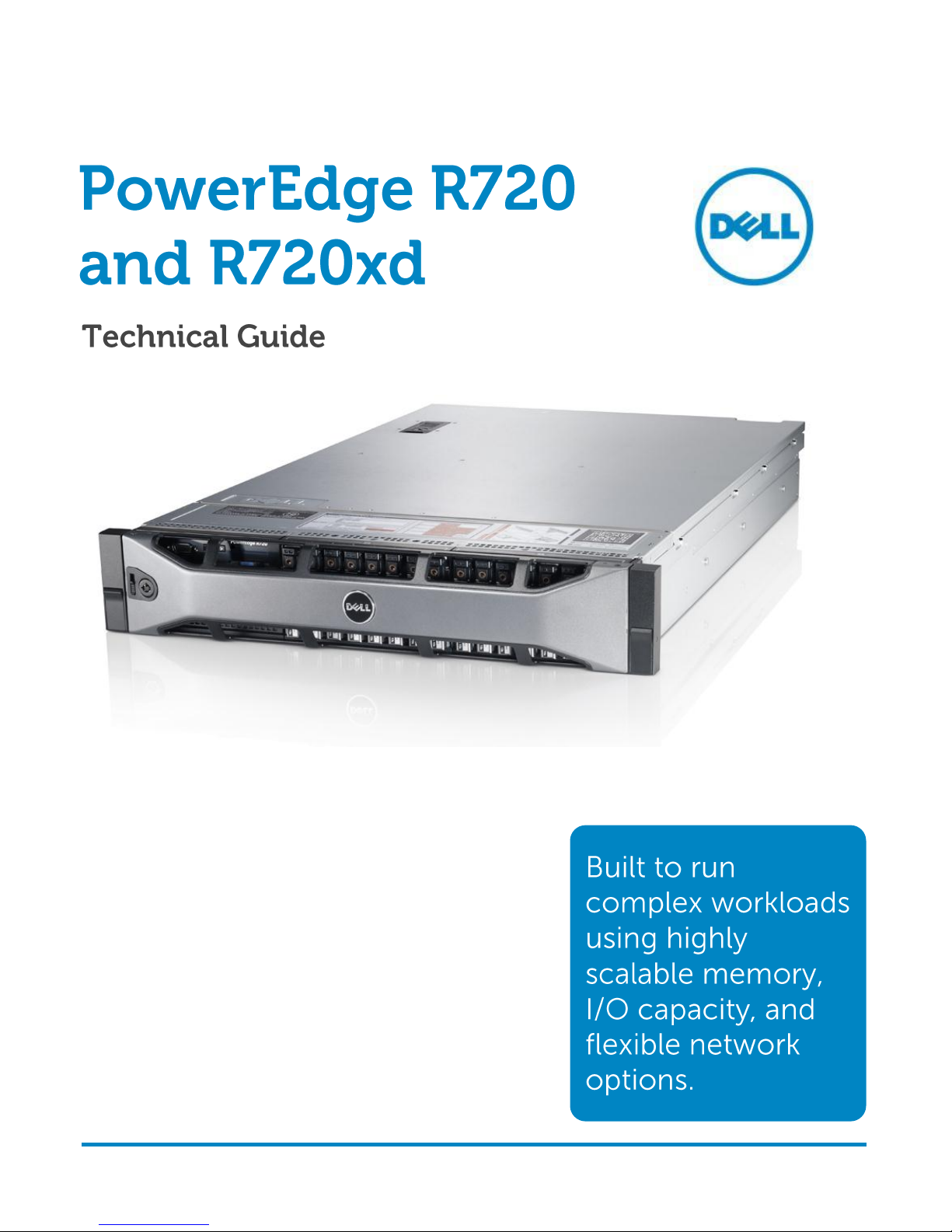
The Dell™ PowerEdge™ R720 and R720xd are Dell’s latest 2-socket, 2U rack servers that are
designed to run complex workloads using highly scalable memory, I/O capacity, and flexible
network options. Both systems feature the Intel® Xeon® processor E5-2600 product family,
up to 24 DIMMS, PCI Express® (PCIe) 3.0 enabled expansion slots, and a choice of NIC technologies.
The PowerEdge R720 is a general-purpose platform with highly expandable memory (up to 768GB)
and impressive I/O capabilities to match. The R720 can readily handle very demanding workloads,
such as data warehouses, e-commerce, virtual desktop infrastructure (VDI), databases, and
high-performance computing (HPC).
In addition to the R720’s capabilities, the R720xd offers extraordinary storage capacity, making it well
suited for data-intensive applications that require storage and I/O performance, like medical imaging
and email servers.
Keep pace with the explosion of data in the virtual age with the flexible I/O and storage capabilities
of the R720 and R720xd. The R720 supports up to sixteen internal hard drives to increase your
capacity, while optional hot-plug, front-access Express Flash PCIe solid-state drives (up to four)
enable performance-enhancing, in-box storage tiering.
The PowerEdge R720xd allows you to quickly access and process vast amounts of data with up to
twenty-six internal hot-plug hard disks. The R720xd is a great solution for any mid-size or large
business that requires scalability in storage capacity.
The R720 and R720xd allow you to tailor your network throughput to match your application needs,
enabling added I/O performance. Select Network Adapters, Dell’s flexible NIC technology, let you
choose the right network fabric without using up a valuable PCI slot. You can pick speed,
technology, vendor and other options, like switch independent partitioning that lets you share and
manage bandwidth on 10GbE connections.
Maximize your data center’s application capacity by expanding your virtual environment using the
large memory footprint of the R720 and R720xd. Choose an industry-leading hypervisor and take
advantage of our system management capability to manage both physical and virtual assets.
Redundant failsafe hypervisors can also help maximize your virtual machines’ uptime. Dell’s Virtual
Integrated System (VIS) solution lets you enable complex virtualization environments in just a few
mouse clicks.
The Dell OpenManage™ systems management portfolio includes the Integrated Dell Remote Access
Controller 7 (iDRAC7) with Lifecycle Controller. Dell embedded server management features help IT
Administrators manage Dell servers in physical, virtual, local and remote environments, operating
in-band or out-of-band, with or without a systems management software agent. OpenManage also
integrates with and connects to third-party systems management solutions so you can maintain
your single point of control and capitalize on your existing investment. OpenManage solutions
6 PowerEdge R720 and R720xd Technical Guide
Page 7

simplify the lifecycle of deploying, updating, monitoring, and maintaining your Dell PowerEdge
New technologies
Detailed descriptions
Intel Xeon
processor
E5-2600 product
family
This new family of Intel processors has embedded PCIe lanes for improved I/O
performance. See the Processors section for details.
Intel C600 series
chipset
The Intel Platform Controller Hub (PCH) chip is used on the R720 and R720xd.
1600 MT/s DDR3
memory
Certain models of E5-2600 series processors support 1600 MT/s memory. The R720 and
R720xd support two DIMMs per channel at 1600 MT/s with these processors. See the
Memory section for details.
LRDIMM
This new memory option, load reduced DIMM (LRDIMM), is designed with a buffer chip
(or chips) to replace the register to help minimize loading. LRDIMMs can increase overall
server system memory capacity and speed. See the Memory section for more
information.
Flexible LOM
Dell’s Select Network Adapter options allow you to customize your LAN port
combinations from your choice of controller vendors. See the Networking and PCIe
section for details.
Next generation
PERC options
The R720 and R720xd support new PERC controller cards with improved functionality
and faster performance. See the Storage section for details.
PERC S110
software RAID
solution
This new software RAID solution supports RAID 0, 1, 5 and 10 and supports a maximum
of four hot-plug SATA HDDs or SSDs. See the Storage section for details.
Express Flash
drives
Dell Express Flash PCIe solid-state drives provide fast performance without requiring
processor resources or capturing DRAM. The R720 supports up to four Express Flash
drives. The R720xd does not support Express Flash drives.
iDRAC7 with
Lifecycle
Controller
The new embedded system management solution for Dell servers features hardware and
firmware inventory and alerting, in-depth memory alerting, faster performance, a
dedicated gigabit port and many more features. See the Dell OpenManage systems
management section for details.
Internal GPU
support
The R720 supports internal graphics processing units (GPUs) for extreme computing
power to solve high performance computing (HPC) needs. The R720xd does not support
internal GPUs. See the Processors section for details.
Advanced power
management
The R720 and R720xd support advanced power monitoring and power capping tools
that can help manage power consumption.
DC power supply
A new 1100W DC power supply option is available for the R720 and R720xd.
Failsafe
hypervisors
The internal dual SD module enables Dell's unique Failsafe Virtualization architecture,
ensuring uptime by providing failover capability for embedded hypervisors, such as
VMware® vSphere® ESXi™.
servers.
New technologies featured on the PowerEdge R720 and R720xd systems are detailed in Table 1.
7 PowerEdge R720 and R720xd Technical Guide
Page 8

New technologies
Detailed descriptions
Fresh Air cooling
Dell has tested and validated an integrated data center solution that enables you to
operate at higher temperatures or even chiller-less. See the Power, thermal, and
acoustics section for details.
8 PowerEdge R720 and R720xd Technical Guide
Page 9
Feature
PowerEdge R710
PowerEdge R720
PowerEdge R720xd
Chassis
2U rack
2U rack
2U rack
Processors
Intel Xeon processors 5500
and 5600 series
Intel Xeon processor E5-2600
product family
Intel Xeon processor E5-2600
product family
Internal interconnect
Intel QuickPath Interconnect
Intel QuickPath Interconnect
Intel QuickPath Interconnect
Memory1
18 x DDR3 RDIMM and
UDIMM
Up to 288GB
24 x DDR3 RDIMM, UDIMM,
and LRDIMM
Up to 768GB
24 x DDR3 RDIMM, UDIMM,
and LRDIMM
Up to 768GB
Hard drive bays
(hot plug)
Up to 8 x 2.5” or 6 x 3.5”
Up to 16 x 2.5“ or 8 x 3.5”
Up to 24 x 2.5“+ 2 x 2.5” or 12
x 3.5” + 2 x 2.5”
RAID controller
PERC 6/i, SAS 6/iR, PERC 6/E,
H200, H700, H800
PERC S110, H310, H710,
H710P, H810 (external);
supports multiple (2) internal
RAID controllers
PERC H310, H710, H710P,
H810 (external)
PCI slots
4 PCIe 2.0
7 PCIe 3.0
6 PCIe 3.0
Express Flash drives
Not supported
Up to 4
Not supported
Embedded NICs
4 x 1GbE with optional TOE
Select Network Adapter:
minimum configuration of
4 x 1Gb
Optional: 2 x 10GbE
Select Network Adapter:
minimum configuration of
4 x 1Gb
Optional: 2 x 10GbE
Power supplies
Hot-plug, redundant power
supply units: 570W or 870W
Hot-plug, redundant power
supply units: 495W, 750W,
1100W, 1100W DC
Hot-plug, redundant power
supply units: 495W, 750W,
1100W, or 1100W DC
Power efficiency
Gold
Titanium
Titanium
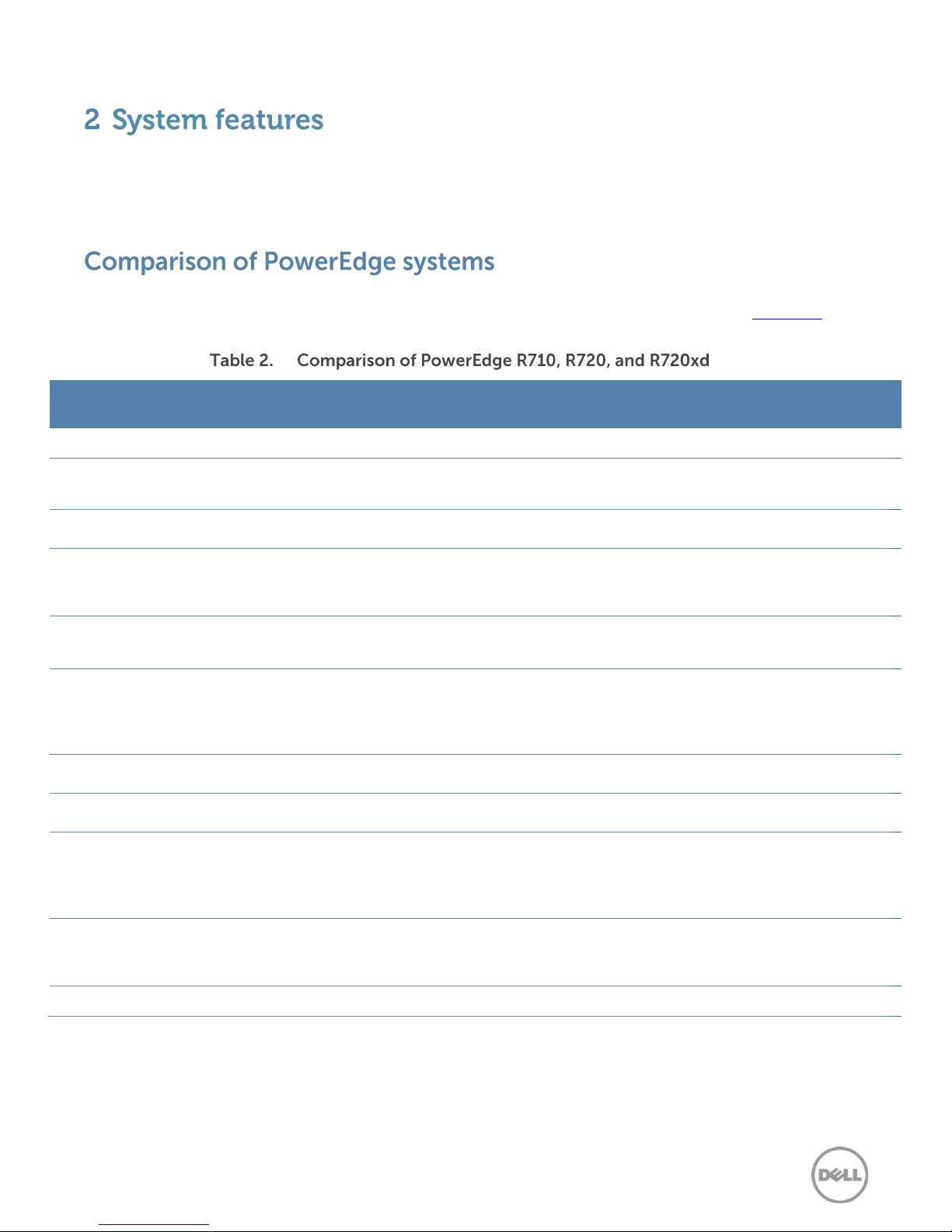
Compared to the previous generation of Dell PowerEdge servers, the R720 and R720xd have more
drive bay options, more PCIe slots, a larger memory footprint, flexible I/O, Express Flash PCIe
solid-state drives, and advanced system management. The R720 also supports optional dual internal
RAID controllers and up to four optional internal GPUs.
The PowerEdge R720 and R720xd are replacements for the predecessor R710 system, three systems
which are compared in Table 2. For the latest information on supported features, visit Dell.com.
9 PowerEdge R720 and R720xd Technical Guide
Page 10
Feature
PowerEdge R710
PowerEdge R720
PowerEdge R720xd
Dell OpenManage
Systems
Management
Dell OpenManage
Dell Management Console
Lifecycle Controller 1.x
iDRAC6 (Express or Enterprise)
with Lifecycle Controller 1.x
OpenManage Essentials
Dell Management Console
IT Assistant
OMSA Agent
OpenManage Power Center
(requires iDRAC7 Enterprise
with Lifecycle Controller)
OpenManage Integrations and
Connections
iDRAC7 Express with Lifecycle
Controller (standard option)
OpenManage Essentials
Dell Management Console
IT Assistant
OMSA Agent
OpenManage Power Center
(requires iDRAC7 Enterprise
with Lifecycle Controller)
OpenManage Integrations and
Connections
iDRAC7 Express with Lifecycle
Controller (standard option)
Internal GPU
Not supported
2 x 300W (double wide) or
4 x 150W (single wide)
Not supported
Availability
Hot-plug drives
Hot-plug redundant cooling
Hot-plug redundant PSUs
Hot-plug drives
Hot-plug redundant cooling
Hot-plug redundant PSUs
Internal dual SD module
Hot-plug drives
Hot-plug redundant cooling
Hot-plug redundant PSUs
Internal dual SD module
1
Feature
Specification
Form factor
2U rack
Processors
Intel Xeon processor E5-2600 product family
Processor sockets
2 sockets
Internal interconnect
2 Intel QuickPath Interconnect (QPI) links; 6.4GT/s; 7.2GT/s; 8.0GT/s
Cache
2.5MB per core; core options: 2, 4, 6, 8
Chipset
Intel C600
Memory1
Up to 768GB (24 DIMM slots): 2GB/4GB/8GB/16GB/32GB DDR3 up to 1600MT/s
PCIe slots
R720:
7 PCIe slots:
One x16 full-length, full-height
Three x8 full-length, full-height
Three x8 half-length, half-height
R720xd:
6 PCIe slots:
Two x16 full-length, full-height
One x8 full-length, full-height
Three x8 half-length, half-height
RAID controller
Internal controllers:
PERC S110 (software RAID; R720 only)
PERC H310
PERC H710
PERC H710P
External HBAs (RAID):
PERC H810
External HBAs (non-RAID):
6Gbps SAS HBA
GB means 1 billion bytes and TB means 1 trillion bytes; actual capacity varies with preloaded material and operating environment and will be
less.
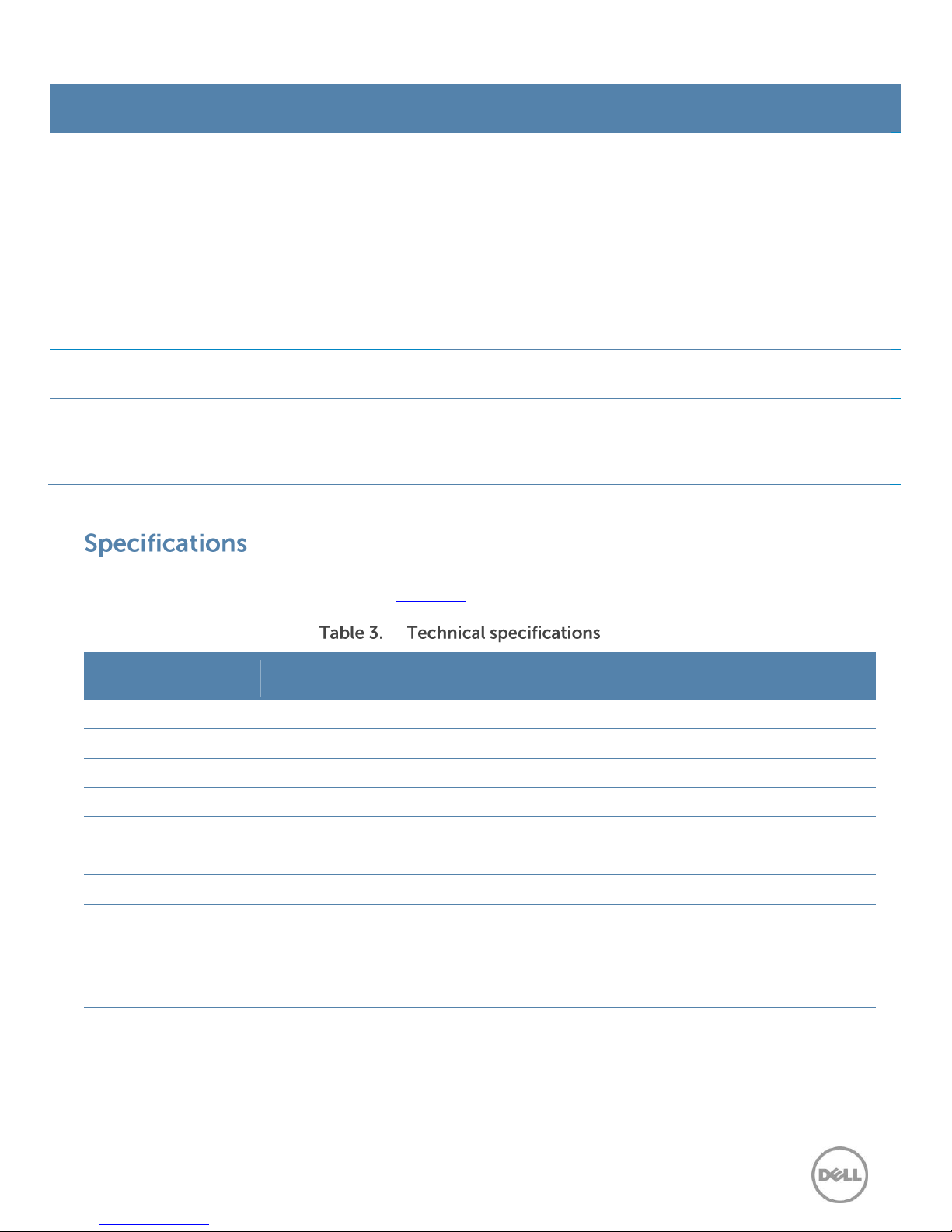
Table 3 lists the technical specifications for the PowerEdge R720 and R720xd systems. For the latest
information on supported features, visit Dell.com.
10 PowerEdge R720 and R720xd Technical Guide
Page 11

Feature
Specification
Hard drives
(hot-plug)
R720 drive bay options:
Up to 16 x 2.5“
Up to 8 x 2.5” + 8 x 2.5” (with dual RAID controllers)
Up to 8 x 2.5”
Up to 8 x 2.5” + 4 x 2.5” Express Flash
Up to 8 x 3.5”
R720xd drive bay options:
Up to 24 x 2.5” (front) + 2 x 2.5” (back)
Up to 12 x 3.5” (front) + 2 x 2.5” (back)
Hard drive options:
2.5” SAS SSD, SATA SSD, SAS (15K, 10K), nearline SAS (7.2K), SATA (7.2K)
2.5” Express Flash PCIe SSD (R720 only)
3.5” SAS (15K), nearline SAS (7.2K), SATA (7.2K)
Self-encrypting drives (SEDs) available
Embedded NIC
Select Network Adapter options:
Broadcom® 5720 4x1Gb Base-T
Intel I350 4x1Gb Base-T
Intel X540 2x1Gb + 2x10Gb Base-T
Broadcom 57800S 2x1Gb + 2x10Gb Base-T
Broadcom 57800S 2x1Gb + 2x10Gb SFP+
Power supply
Auto-ranging Titanium efficiency 750W AC power supply
Auto-ranging Platinum efficiency 495W, 750W or 1100W AC power supply
1100W DC power supply
Availability
High-efficiency, hot-plug, redundant power supplies; hot-plug drive bays; TPM; dual
internal SD support; hot-plug redundant fan; optional bezel; information tag; ECC
memory, interactive LCD screen (R720 only); extended thermal support; ENERGY
STAR® compliant configuration; switch independent partitioning
Dell OpenManage
Systems Management
(Agent-free or with
OpenManage Server
Administrator [OMSA]
Agent)
OpenManage Essentials
Dell Management Console
IT Assistant
OMSA Agent
OpenManage Power Center (requires iDRAC7 Enterprise with Lifecycle Controller)
OpenManage Integrations and Connections:
- OpenManage Integration Suite for Microsoft
®
System Center
- Dell Management Plug-in for VMware vCenter™
- Connections for HP
®
Operations Manager, IBM® Tivoli® Netcool® and CA
Network and Systems Management
iDRAC7 Express with Lifecycle Controller (standard option)
- Upgrade to iDRAC7 Enterprise with Lifecycle Controller
- Upgrade to 8GB vFlash media or 16GB vFlash media for iDRAC7 Enterprise
with Lifecycle Controller
- Trial evaluation available for IDRAC7 Enterprise with Lifecycle Controller
Rack support
ReadyRails™ sliding rails for tool-less mounting in 4-post racks with square or
unthreaded round holes or tooled mounting in 4-post threaded hole racks, with
support for optional tool-less cable management arm
ReadyRails static rails for tool-less mounting in 4-post racks with square or
unthreaded round holes or tooled mounting in 4-post threaded and 2-post
11 PowerEdge R720 and R720xd Technical Guide
Page 12

Feature
Specification
(Telco) racks
Operating systems
Microsoft Windows Server® 2012
Microsoft Windows Server 2008 R2 SP1, x64 (includes Hyper-V® v2)
Microsoft Windows® HPC Server 2008
Microsoft Windows Small Business Server 2011
Novell® SUSE® Linux Enterprise Server
Red Hat® Enterprise Linux®
Virtualization options:
Citrix® XenServer®
VMware vSphere including ESX™ and ESXi™
Red Hat Enterprise Virtualization
®
For more information on the specific versions and additions, visit
Dell.com/OSsupport.
1
GB means 1 billion bytes and TB means 1 trillion bytes; actual capacity varies with preloaded material and operating
environment and will be less.
12 PowerEdge R720 and R720xd Technical Guide
Page 13
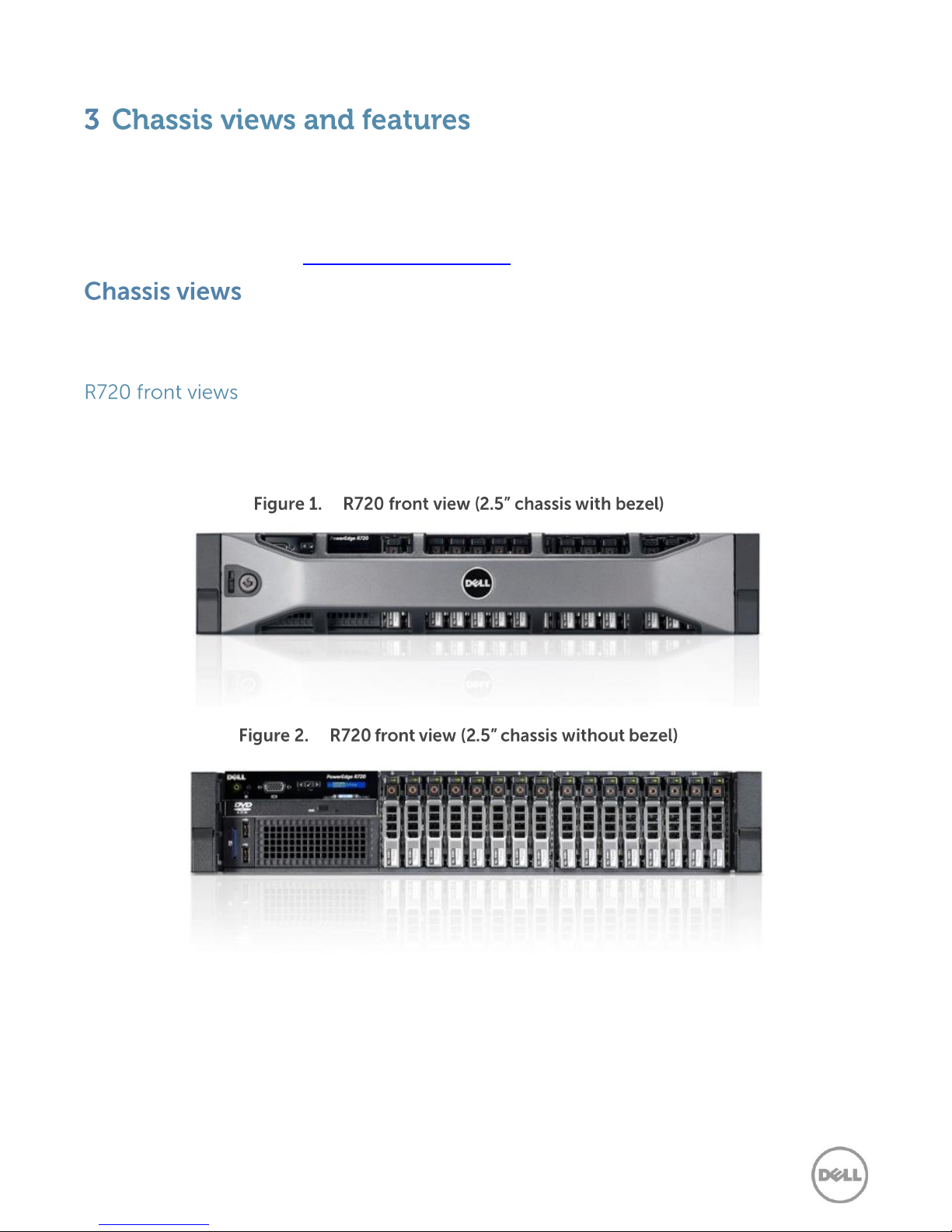
The Dell PowerEdge R720 and R720xd implement a new chassis design which supports an increased
number of DIMMs, PCIe slots, and hard drives, relative to their predecessor servers. The following
sections provide external and internal views of the systems and describe the chassis features.
For information on features and descriptions for these systems, see the
R720xd Owner's Manual
The R720 and R720xd are available in several chassis options with varying numbers of drive bays.
Note: A chassis cannot be reconfigured or upgraded after point of purchase.
The R720 supports up to 16 2.5-inch or up to 8 3.5-inch front-accessible, hot-plug hard drives that
are secured by a removable front bezel. Other front-panel features include an interactive LCD
control panel, 2 USB connectors, a video connector, and a vFlash media card slot.
on Support.Dell.com/Manuals.
Dell PowerEdge R720 and
13 PowerEdge R720 and R720xd Technical Guide
Page 14

The R720xd supports up to 24 2.5-inch or up to 12 3.5-inch front-accessible, hot-plug hard drives
that are secured by a removable front bezel. Other front-panel features include an LED control
panel, a USB connector, and a video connector.
The R720 back panel includes features such as redundant hot-plug power supply units (PSUs), 4
Ethernet connectors, PCI expansion slots, and many other features that are described in the rest of
this guide.
14 PowerEdge R720 and R720xd Technical Guide
Page 15
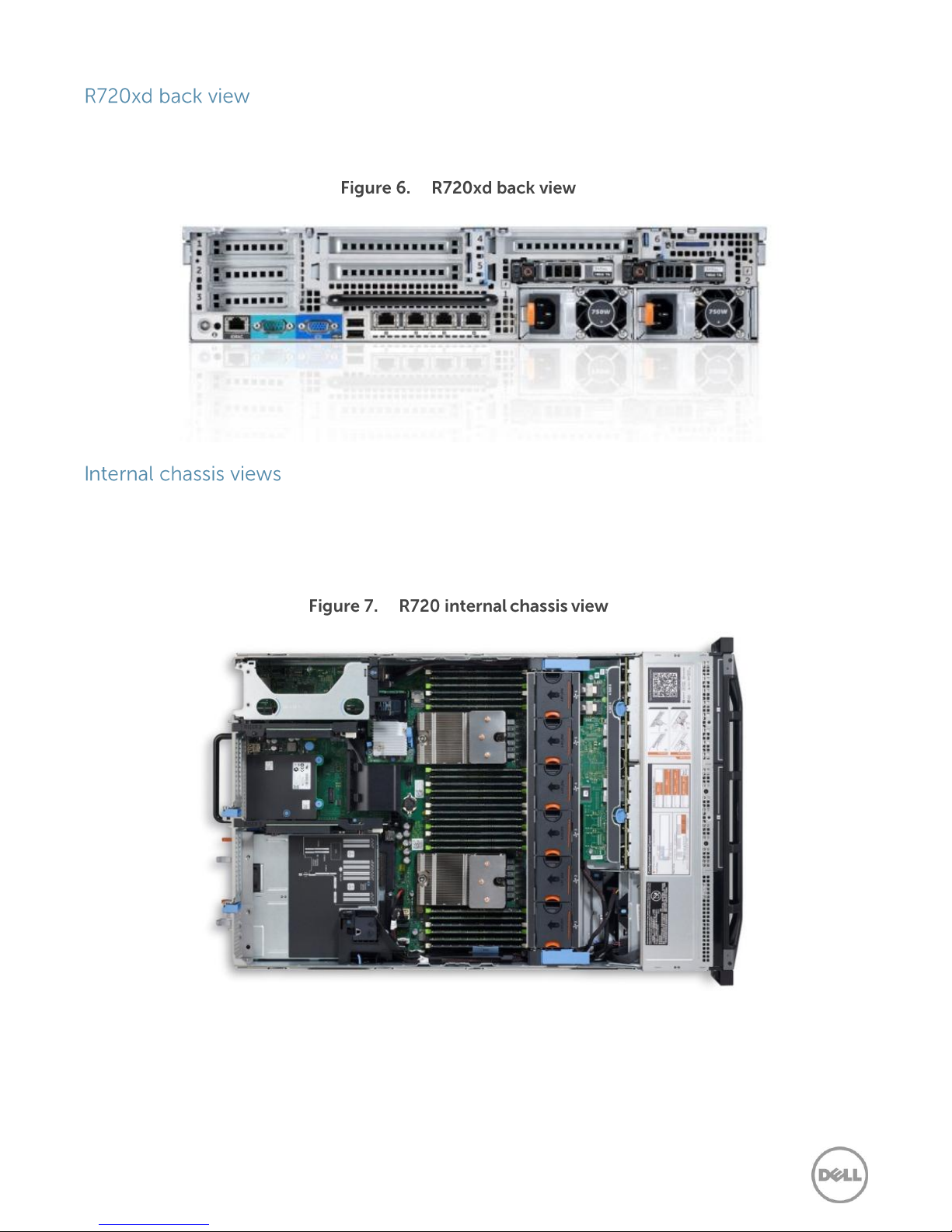
In addition to the R720 back-panel features, the R720xd also includes 2 optional 2.5-inch
hot-plug drives in the back of the system.
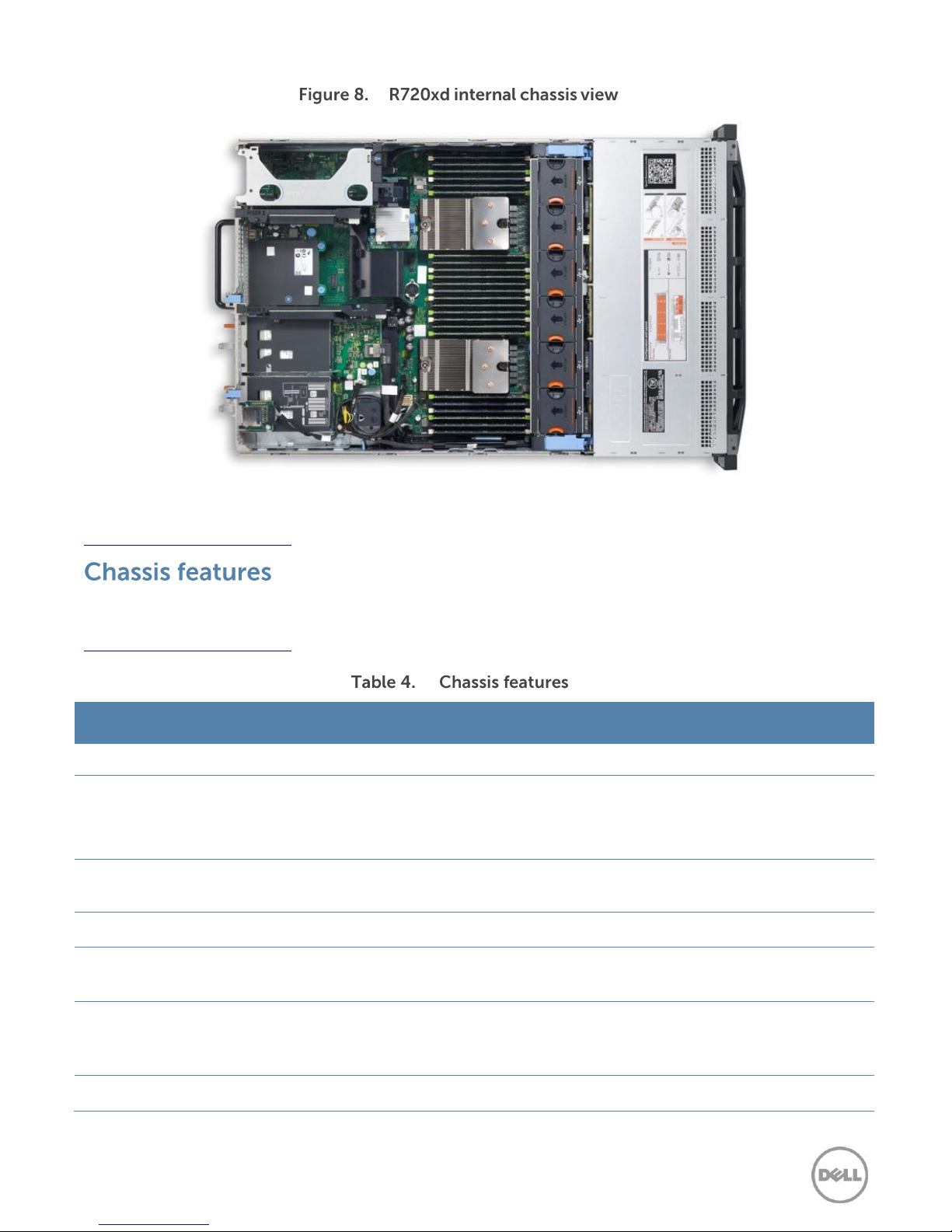
The chassis design of the R720 and R720xd is optimized for easy access to components and for
airflow for effective and efficient cooling. The R720 and R720xd support up to 24 DIMMs,
2 processors, hot-plug redundant fans, and many other components and features that are described
in this guide.
15 PowerEdge R720 and R720xd Technical Guide
Page 16
Feature
Description
Power button and indicator
ACPI-complaint power button with an integrated green power LED
NMI button
Recessed non-maskable interrupt (NMI) button used to troubleshoot
software and device driver errors; use only if directed to do so by
qualified support personnel or by the operating system's
documentation
System identification button
Buttons on the back and front of a system to help identify the unit in a
data center environment
Hard drive activity LEDs
Indicate the status and activity of the hard drives
USB connectors
Two (R720) or one (R720xd) front, two back, and one internal USB
connector
vFlash media reader
Supports one vFlash media card (the R720 slot is located in the front of
the system and the R720x slot is located in the back); functionality is
activated only when iDRAC7 Enterprise is enabled
Video connector
Connects a monitor to the system
For additional system views, see the
Dell PowerEdge R720 and R720xd Owner’s Manual
on
Support.Dell.com/Manuals.
Table 4 lists the chassis features for the R720 and R720xd systems. For additional information on
these features, see the
Dell PowerEdge R720 and R720xd Owner’s Manual
on
Support.Dell.com/Manuals.
16 PowerEdge R720 and R720xd Technical Guide
Page 17
Feature
Description
LCD control panel
Provides user access to buttons, display, and I/O interfaces (R720 only)
LED panel
Indicates the status of system conditions (R720xd only)
Hard drives
Front-accessible, hot-plug hard drives plus two optional
back-accessible hot-plug hard drives (R720xd only)
Optical drive (optional)
The R720 supports one optional slimline SATA DVD-ROM drive or
DVD+/-RW drive; R720xd does not support an internal optical drive
System identification panel
Slide-out label panel for system information
Serial connector
Connects a serial device to the system and for console redirect
iDRAC7 Enterprise port
Dedicated management port for optional iDRAC7 Enterprise
PCIe expansion card slots
The R720 supports up to seven PCIe expansion cards; R720xd supports
up to six PCIe expansion cards
Ethernet connectors
Choice of network connectors through Select Network Adapter family
Power supply units
Up to two back-accessible, hot-plug power supplies
Power supply indicators
Indicate whether system has power
NIC indicators
Indicate network activity and status
Quick Resource Locator (QRL)
This code on the chassis can be scanned by a phone application to
access information about the server
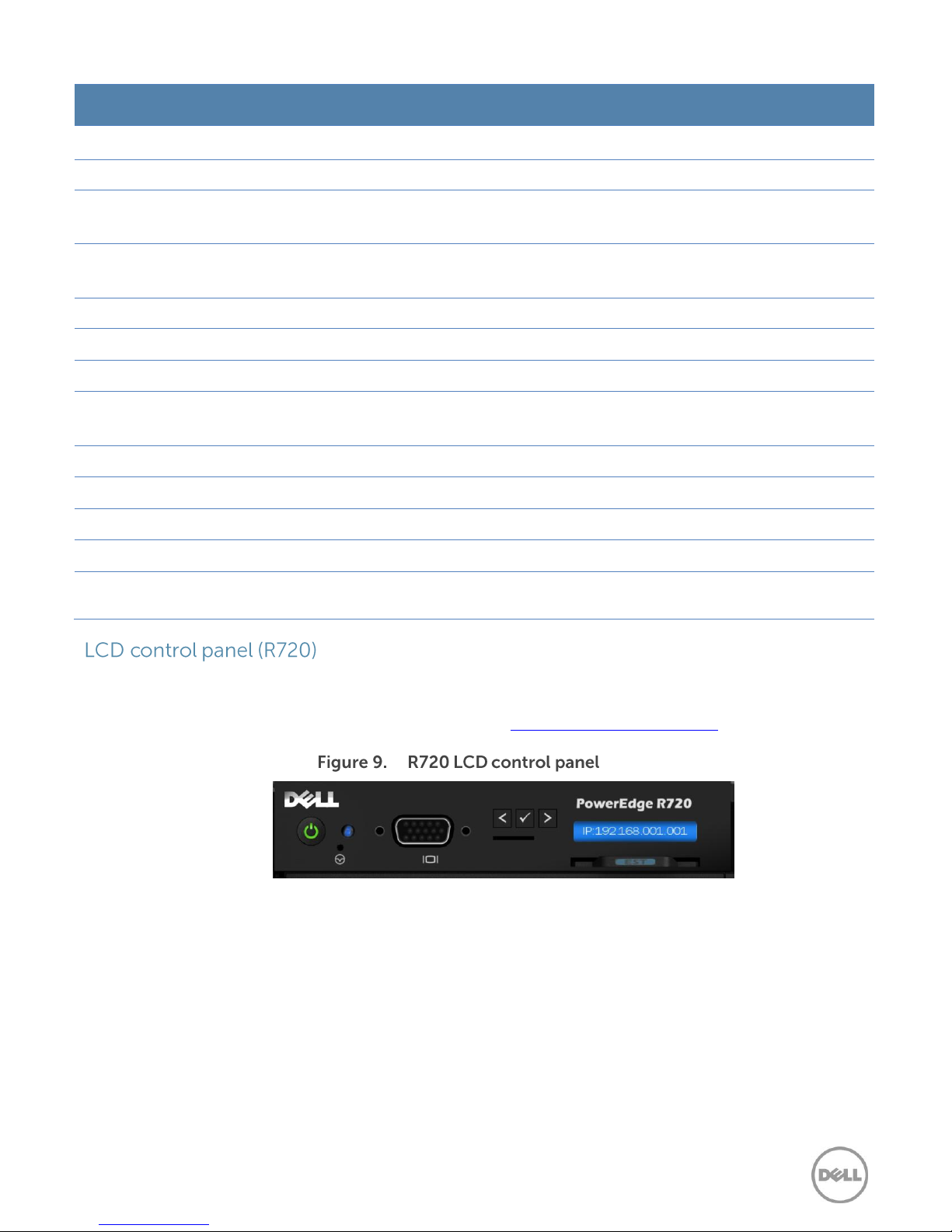
The R720 system control panel is located on the front of the chassis to provide user access to
buttons, display, and I/O interfaces. For more information on the R720 LCD control panel, see the
Dell PowerEdge R720 and R720xd Owner's Manual
on Support.Dell.com/Manuals.
17 PowerEdge R720 and R720xd Technical Guide
Page 18
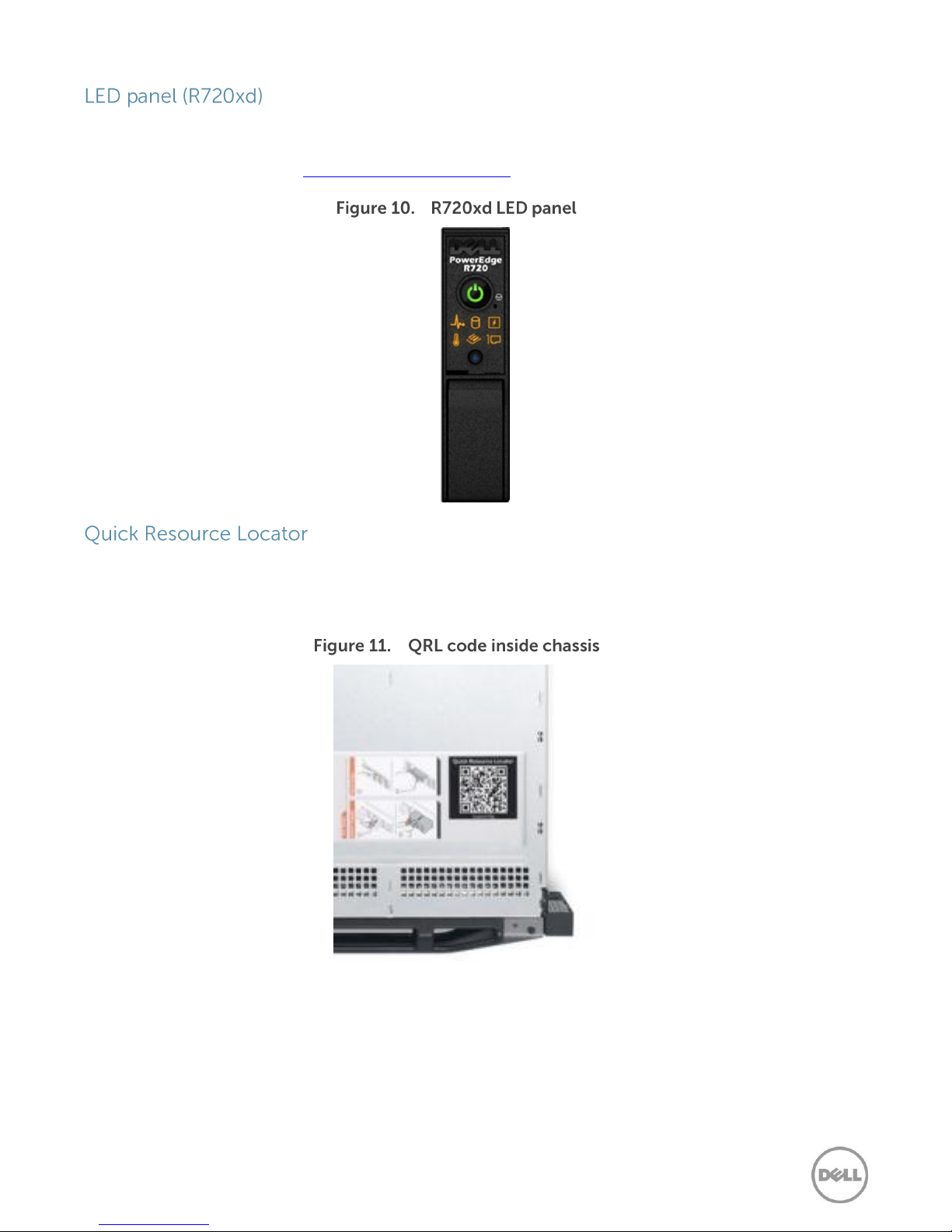
The R720xd LED panel is located on the front of the chassis to indicate the status of system
conditions. For more information on the R720xd LED panel, see the
R720xd Owner's Manual
on Support.Dell.com/Manuals.
Dell PowerEdge R720 and
A useful feature included with Dell PowerEdge 12th generation servers is the Quick Resource Locator
(QRL)—a model-specific Quick Response (QR) code that is located on the server (shown in Figure
11). Just use your smartphone to access the Dell QRL application to learn more about the server.
This QRL code allows you to:
View step-by-step videos, including overviews of system internals and externals, as well as
detailed, concise, task-oriented videos and installation wizards
Locate reference materials, including searchable owner’s manual content, LCD diagnostics, and
an electrical overview
18 PowerEdge R720 and R720xd Technical Guide
Page 19
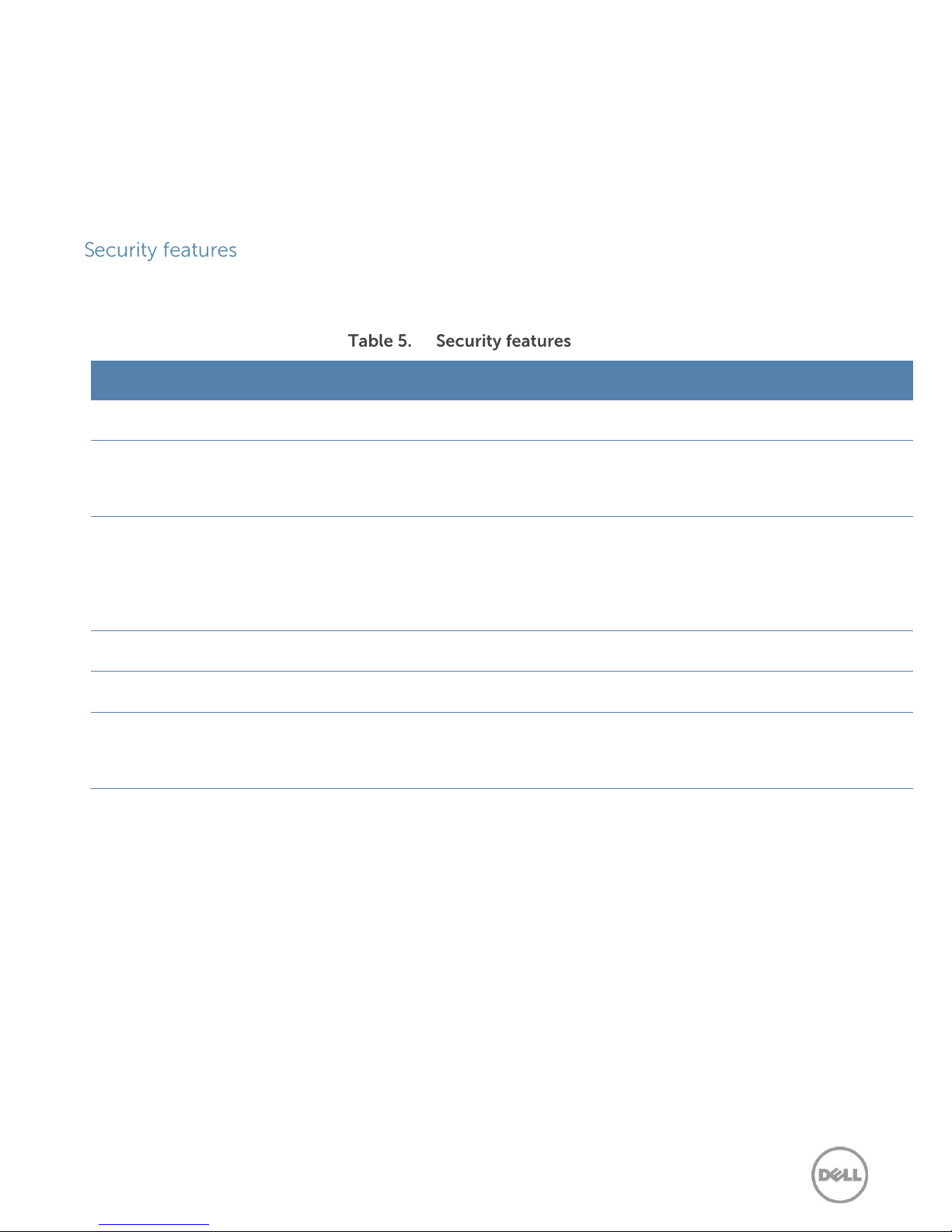
Look up your service tag so you can quickly gain access to your specific hardware configuration
Security feature
Description
Cover latch
A tooled latch is integrated in the top cover to secure it to the rack chassis.
Front bezel
An optional metal bezel is mounted to the chassis front to provide the Dell ID.
A lock on the bezel is used to protect un-authorized access to hard drives.
System status is viewable on the LCD or LED panel when the bezel is installed.
TPM
The Trusted Platform Module (TPM) is used to generate/store keys,
protect/authenticate passwords, and create/store digital certificates. It also
supports the Intel Xeon TXT functionality. TPM can also be used to enable the
BitLocker™ hard drive encryption feature in Windows Server 2008. TPM 1.2 is
supported. No TPM version is available for China or Russia.
Power-off security
BIOS has the ability to disable the power button function.
Intrusion alert
An internal switch is used to detect chassis intrusion.
Secure mode
BIOS has the ability to enter a secure boot mode through system setup. This
mode includes the option to lock out the power and NMI switches on the
control panel or set up a system password.
info and warranty information
Contact Dell directly (by link) to get in touch with technical support and sales teams and provide
feedback to Dell
These codes provide an easy way to retrieve the critical support information you need when you
need it, making you more efficient and effective in managing your hardware.
The latest generation of PowerEdge servers has the features listed in Table 5 to help ensure the
security of your data center.
19 PowerEdge R720 and R720xd Technical Guide
Page 20
The Dell PowerEdge R720 and R720xd feature the Intel Xeon processor E5-2600 product family,
offering an ideal combination of performance, power efficiency, and cost. These processors provide
high performance no matter what your constraint is—floor space, power, or budget—and on
workloads that range from the most complicated scientific exploration to crucial web-serving and
infrastructure applications. In addition to providing raw performance gains, improved I/O is also
made possible with Intel Integrated I/O, which can reduce latency by adding more lanes and
doubling bandwidth. This helps to reduce network and storage bottlenecks, unleashing the
processor’s performance capabilities.
The new Intel Xeon processor E5-2600 product family not only adds new features, but also
improves upon many features of the predecessor Intel Xeon processor 5600 series, including:
Up to two additional cores and up to 8MB more last level cache
More memory—six additional DIMMs and support for up to 32GB DIMMs, which increases
memory capacity from 288GB (R710) to 768GB (R720/R720xd)
Intel Integrated I/O has support for up to 80 lanes of PCIe 3.0, which can reduce latency
Faster connections are provided throughout the system with support for DDR3 1600MT/s
memory and 8.0GT/s QPI
Intel Data Direct I/O (DDIO) allows I/O traffic to skip the main system memory and be directed
straight to the processor cache, which can provide a significant reduction in latency as well as
allowing memory to remain in a low-power state
Intel Advanced Vector Extensions offer up to double the floating point operations per clock
cycle by doubling the length of registers, which can be useful for addressing very complex
problems or dealing with large-number calculations, which are integral to many technical,
financial, and scientific computing problems
Intel Turbo Boost Technology 2.0 delivers up to double the boost than the
previous-generation turbo technology
Continued improvements to both Intel TXT and AES-NI help to better protect systems and data
For more information on the Intel Xeon processor E5-2600 product family, visit Intel.com.
20 PowerEdge R720 and R720xd Technical Guide
Page 21
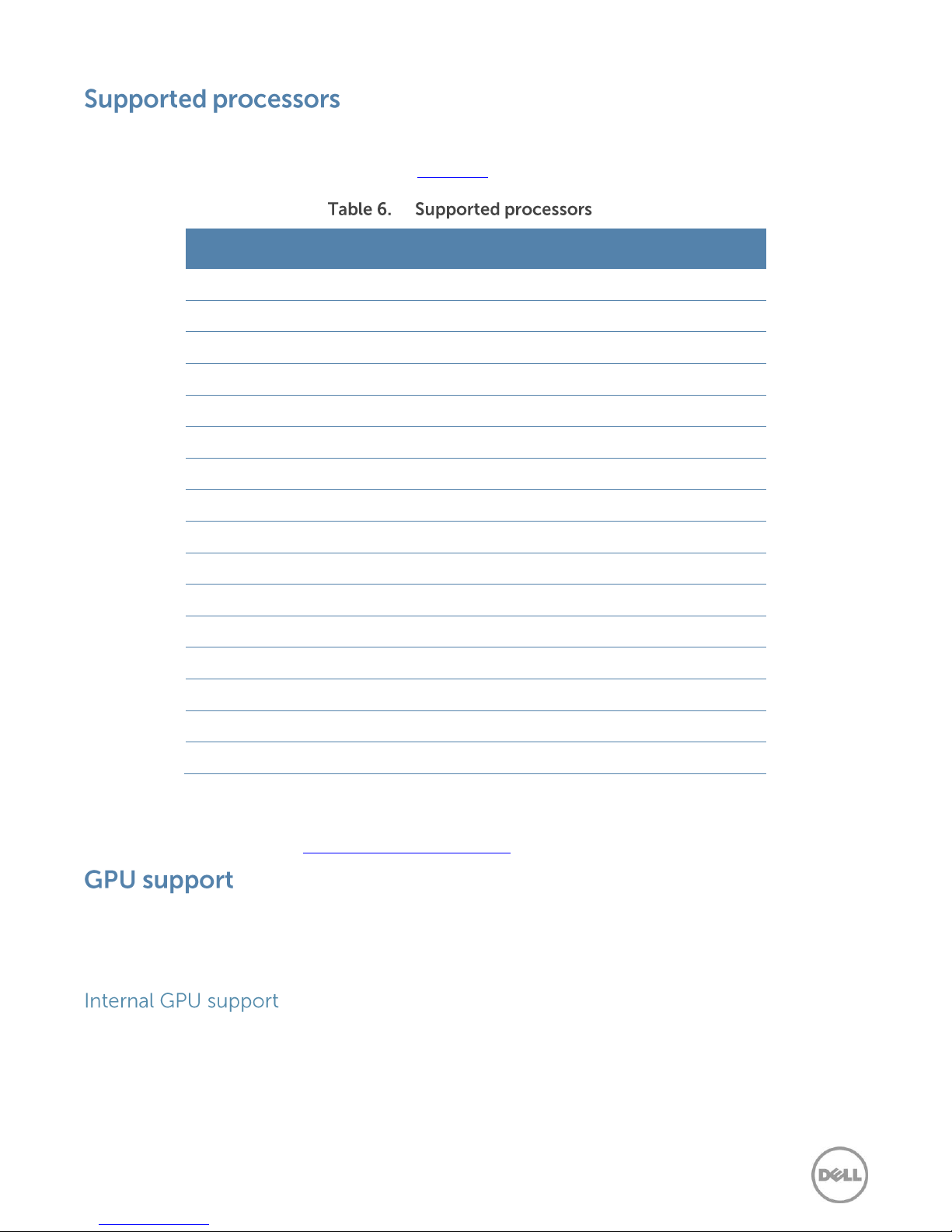
The R720 and R720xd support up to two processors with up to eight cores per processor. Table 6
Model
Speed
Cache
QPI
Cores
Turbo
TDP
E5-26901
2.9GHz
20M
8.0GT/s
8
Yes
135W
E5-2680
2.7GHz
20M
8.0GT/s
8
Yes
130W
E5-2670
2.6GHz
20M
8.0GT/s
8
Yes
115W
E5-2667
2.9GHz
15M
8.0GT/s
6
Yes
130W
E5-2665
2.4GHz
20M
8.0GT/s
8
Yes
115W
E5-2660
2.2GHz
20M
8.0GT/s
8
Yes
95W
E5-2650L
1.8GHz
20M
8.0GT/s
8
Yes
70W
E5-2650
2.0GHz
20M
8.0GT/s
8
Yes
95W
E5-2643
3.3GHz
10M
8.0GT/s
4
Yes
130W
E5-2640
2.5GHz
15M
7.2GT/s
6
Yes
95W
E5-2637
3.0GHz
5M
8.0GT/s
2
Yes
80W
E5-2630
2.3GHz
15M
7.2GT/s
6
Yes
95W
E5-2630L
2.0GHz
15M
7.2GT/s
6
Yes
60W
E5-2620
2.0GHz
15M
7.2GT/s
6
Yes
95W
E5-2609
2.4GHz
10M
6.4GT/s
4
No
80W
E5-2603
1.8GHz
10M
6.4GT/s
4
No
80W
lists the Intel Xeon processors supported by the PowerEdge R720 and R720xd. For the latest
information on supported processors, visit Dell.com.
1
Not supported on the R720xd 3.5-inch chassis.
For information on processor installation and configuration, see the
R720xd Owner’s Manual
on Support.Dell.com/Manuals.
The R720 supports GPU technology, which can provide accelerated performance for a variety of
applications, including virtual desktop infrastructure (VDI) and HPC implementations.
The R720xd does not support internal or external GPUs.
The R720 can support two 300W, full-length, double-wide GPUs or up to four 150W, full-length,
single-wide GPUs. Each GPU can support up to 6GB of dedicated GDDR5 memory and is either
actively or passively cooled. The GPUs are installed on the PCIe x16 2.0 interfaces available on riser 2
and GPU-optional riser 3. A system must have the optional riser 3 with a single x16 slot to support
more than two GPUs.
21 PowerEdge R720 and R720xd Technical Guide
Dell PowerEdge R720 and
Page 22
Because GPUs demand high power, each GPU has up to two power connectors for power delivery.
The GPU enablement kit is required for internal GPU installation. The kit contains the power cables
and other items to enable GPU support on the R720 chassis.
Due to the high power consumption of GPUs, there is an ambient temperature restriction of 30oC
maximum system inlet temperature to ensure adequate system cooling the R720 has one or more
GPUs installed. Note that this temperature is less than the standard environmental specification of
35oC.
The following GPU restrictions for the R720 are enforced by the order validator:
Requires two processors
Processors must be 115W or less
Maximum of two double-wide GPUs (since they take up two slots)
Maximum of four single-wide GPUs
All GPUs must be same type and model
GPUs require a redundant 1100W power supply and GPU enablement kit
Two double-wide GPUs require the optional riser 3 with a single x16 slot
Four single-wide GPUs cannot occupy optional riser 3 with a single x16 slot
Dell PowerVault RD1000 backup unit not supported
For external GPU support, the R720 connects to the PowerEdge C410x through a host interface
card (HIC) and an iPass cable. Both the NVIDIA® and Dell x16 HIC require one x16 PCIe slot. Each
HIC supports up to four GPUs maximum due to internal memory allocation for the PCIe subsystem.
More than four GPUs per HIC attached to the server will impact performance of other PCIe
devices. The R720 supports up to eight GPUs in the PowerEdge C410x external chassis. For a list of
supported GPU HICs, see Table 18. For more information about the PowerEdge C410x, see
Dell.com/PowerEdgeC.
For a list of supported GPUs, see Table 18 and Dell.com/PowerEdge/GPU.
Some operating systems have not been validated to support GPUs. See Table 24 and Table 25 for
more information on operating system support of GPUs.
The Intel C600 chipset is implemented on the PowerEdge R720 and R720xd. For more information,
visit Intel.com.
22 PowerEdge R720 and R720xd Technical Guide
Page 23
Feature
UDIMM
RDIMM
LRDIMM
Register
No
Yes
Yes
Buffer
No
No
Yes
Frequencies*
800, 1066, 1333, or
1600MT/s
800, 1066, 1333, or
1600MT/s
1066 or 1333MT/s
Ranks supported
1 or 2
1, 2, or 4
4
Capacity per DIMM
2 or 4GB
2, 4, 8, 16, or 32GB
32GB
Maximum DIMMs per
channel
2 3 3
DRAM technology
x8
x4 or x8
x4
Temperature sensor
Yes
Yes
Yes
Error Correction Code
(ECC)
Yes
Yes
Yes
Single Device Disable
Code (SDDC)
Yes (with advanced
ECC mode)
Yes
Yes
Address parity
Yes
Yes
Yes
More memory options are available than ever before with the Dell PowerEdge R720 and R720xd—
greater capacities, higher frequencies, and more flexibility. The R720 and R720xd support up to
768GB of memory (24 DIMMs) and speeds up to 1600MT/s, providing high performance in a variety
of applications. High memory density means there is no compromise when it comes to virtualization.
Increase your uptime and reduce data loss due to Dell’s focus on reliability, availability, and
serviceability (RAS) features. RAS aids in the rapid and accurate diagnosis of faults which require
service, increasing your memory reliability. System uptime is reinforced with RAS features like
memory mirroring, sparing, and many others.
In addition to supporting existing unbuffered DIMMs (UDIMMs) and registered DIMMs (RDIMMs), the
R720 and R720xd support load reduced DIMMs (LRDIMMs), which use a buffer to reduce memory
loading and provide greater density, allowing for the maximum platform memory capacity.
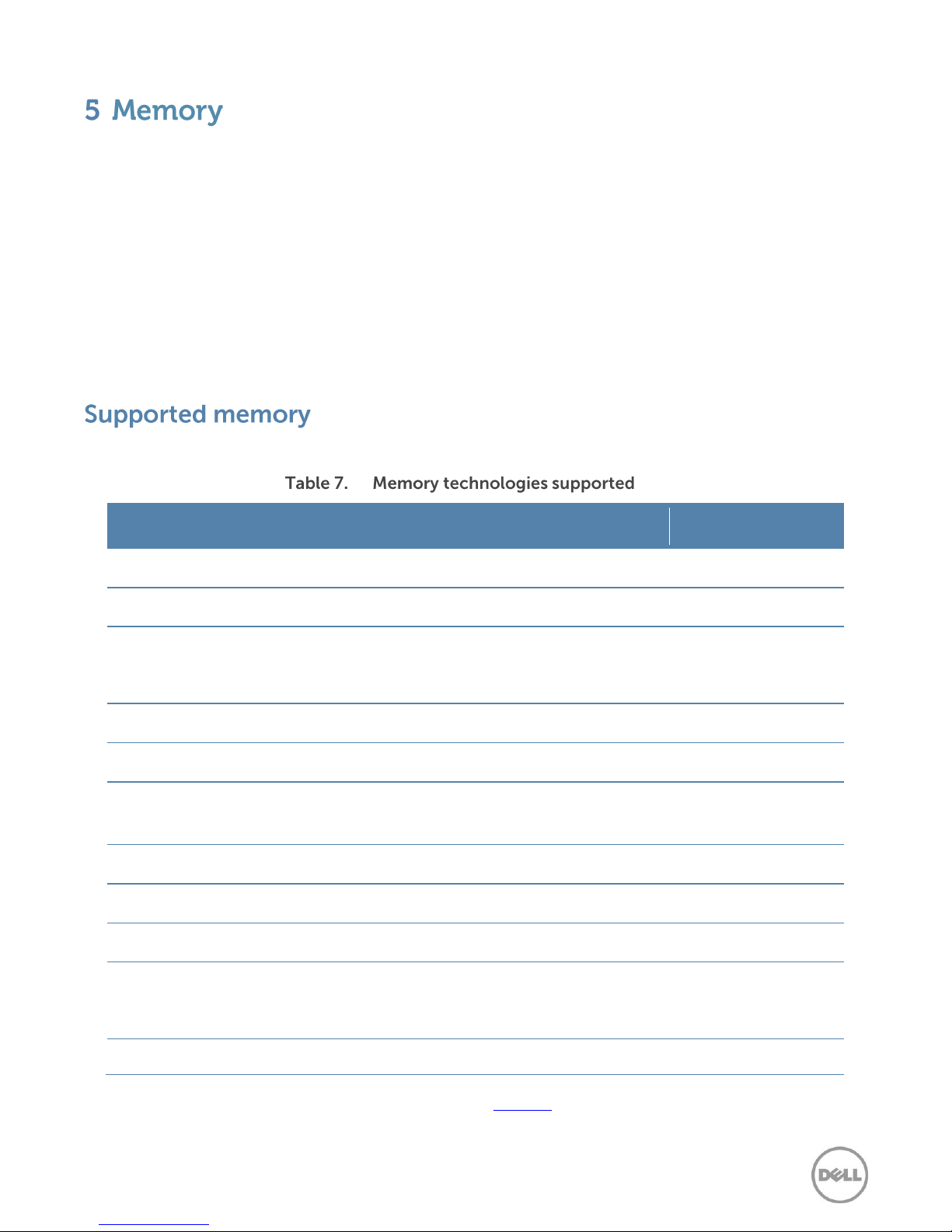
Table 7 lists the memory technologies supported by the R720 and R720xd.
*Although the R720 and R720xd support DIMM speeds of 800MT/s and 1066MT/s, you can only purchase these
systems with DIMM speeds of 1333MT/s and 1600MT/s on Dell.com.
23 PowerEdge R720 and R720xd Technical Guide
Page 24
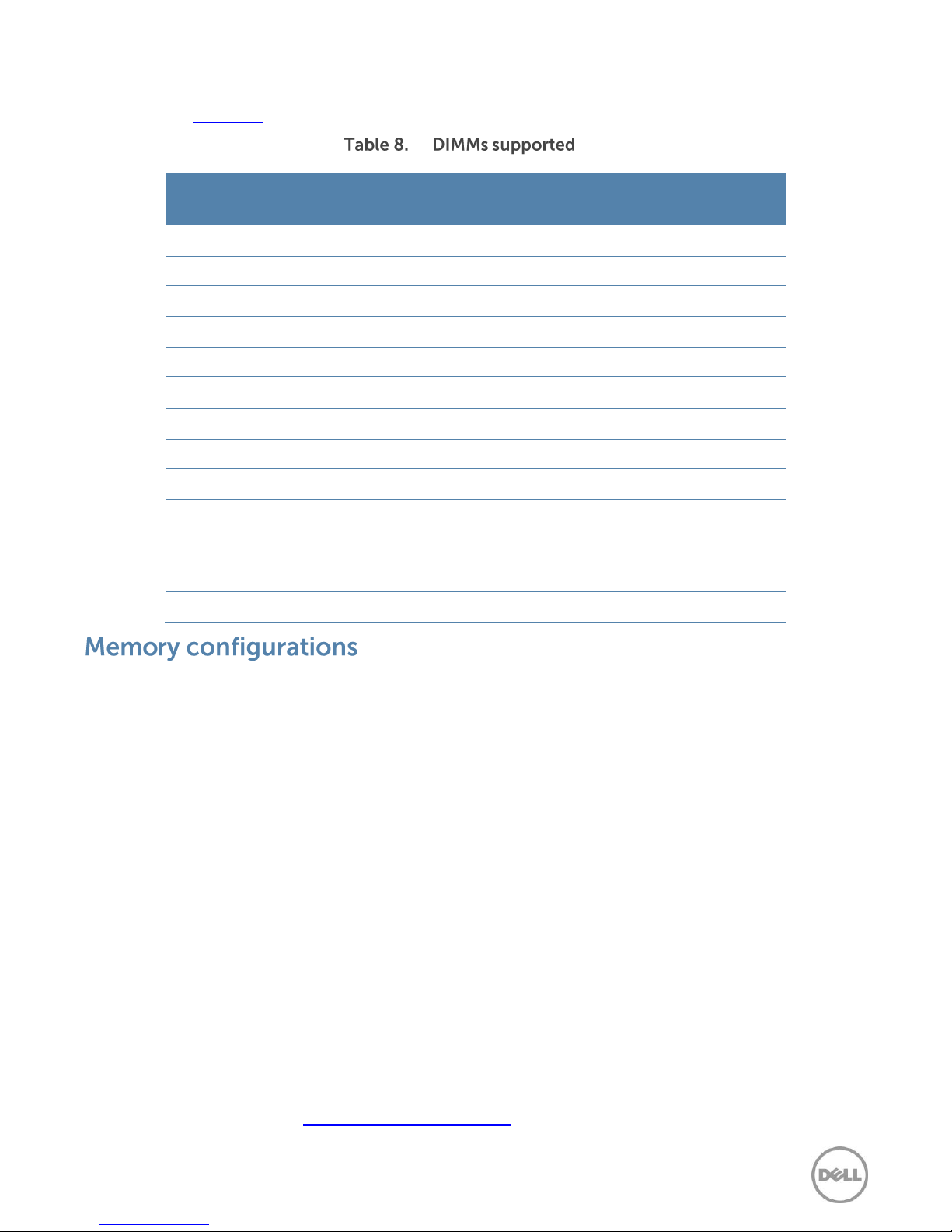
Table 8 lists the DIMMs supported on the R720 and R720xd. For the latest information on supported
Capacity
(GB)
Speed
(MT/s)
Type
Ranks per
DIMM
Data
width
SDDC support
Voltage
2
1600
UDIMM
1
x8
Advanced ECC
1.35
4
1600
UDIMM
2
x8
Advanced ECC
1.35
2
1333
RDIMM
1
x8
Advanced ECC
1.35
2
1600
RDIMM
1
x8
Advanced ECC
1.35
4
1333
RDIMM
2
x8
Advanced ECC
1.35
4
1333
RDIMM
1
x4
Advanced ECC
1.35
4
1600
RDIMM
2
x8
Advanced ECC
1.35
8
1333
RDIMM
2
x4
All modes
1.35
8
1600
RDIMM
2
x4
All modes
1.35
16
1333
RDIMM
2
x4
All modes
1.35
16
1600
RDIMM
2
x4
All modes
1.35
32
1333
RDIMM
4
x4
All modes
1.35
32
1333
LRDIMM
4
x4
All modes
1.35
memory, visit Dell.com.
Only
The R720 and R720xd servers support flexible memory configurations ranging from capacities of
2GB (minimum) to 768GB (maximum). The R720 and R720xd support up to 12 DIMMs per processor
(up to 24 DIMMs in a dual-processor configuration). Each server has 4 memory channels per
processor, with each channel supporting up to 3 DIMMs.
Both systems support a flexible memory configuration, according to the following basic rules:
Speed: If DIMMs of different speeds are mixed, all channels across all processors operate at the
slowest DIMM’s common frequency.
DIMM type: Only one type of DIMM is allowed per system: UDIMM, RDIMM, or LRDIMM. These
types cannot be mixed.
The following additional memory-population guidelines apply to the R720 and R720xd:
Up to two quad-rank (QR) DIMMs and up to three dual-rank (DR) or single-rank (SR) DIMMs may
be populated per channel. Although an LRDIMM is physically a QR DIMM, logic on the LRDIMM
can make it appear as a DR DIMM to the system, allowing up to three LDRIMMs per channel.
DIMMs must be installed in each channel, starting with the DIMM farthest from the processor.
DIMMs should be installed with largest rank count to smallest. For example, if DR DIMMS are
mixed with SR DIMMs, DR DIMMS should be placed in the lowest DIMM slots, followed by the SR
DIMMs.
For more information on memory configuration and population, see the
R720xd Owner’s Manual
on Support.Dell.com/Manuals.
Dell PowerEdge R720 and
24 PowerEdge R720 and R720xd Technical Guide
Page 25
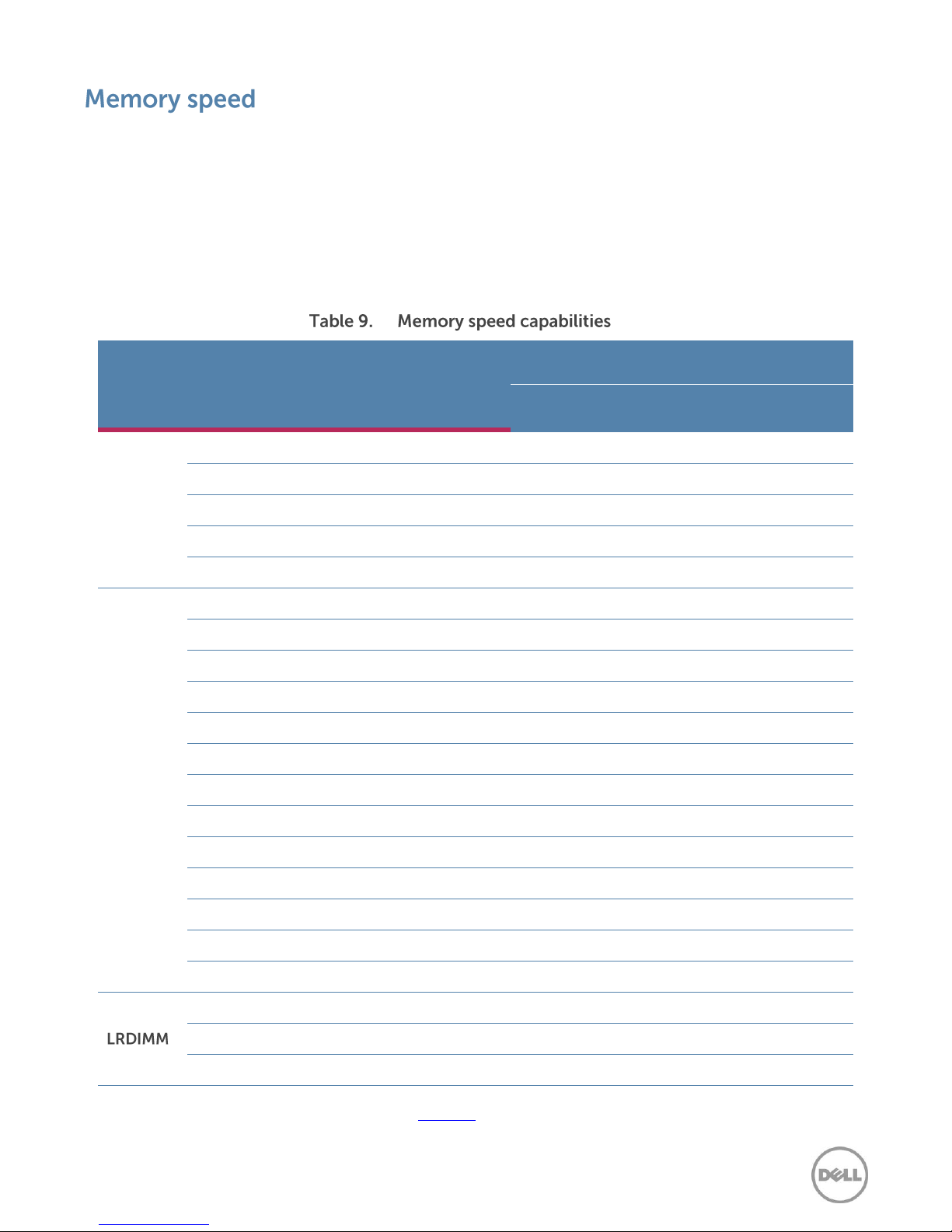
The R720 and R720xd support memory speeds of 1600MT/s, 1333MT/s, 1066MT/s, and 800MT/s
DIMM
type
DIMM 0
DIMM 1
DIMM 2
Number
of
DIMMs
Speed (MT/s)
800*
1066*
1333
1600
UDIMM
SR
1 ∞ ∞ ∞
∞
DR
1 ∞ ∞ ∞ ∞ SR
SR
2 ∞ ∞ ∞ ∞ SR
DR
2 ∞ ∞ ∞ ∞ DR
DR
2 ∞ ∞ ∞
∞
RDIMM
SR
1 ∞ ∞ ∞ ∞ DR
1 ∞ ∞ ∞ ∞ QR
1 ∞ ∞ ∞
SR
SR
2 ∞ ∞ ∞ ∞ SR
DR
2 ∞ ∞ ∞ ∞ DR
DR
2 ∞ ∞ ∞
∞
QR
SR 2 ∞ ∞ QR
DR 2 ∞ ∞ QR
QR
2 ∞ ∞ SR
SR
SR
3 ∞ ∞ ∞
SR
SR
DR
3 ∞ ∞ ∞
SR
DR
DR
3 ∞ ∞ ∞
DR
DR
DR
3 ∞ ∞ ∞
QR
1 ∞ ∞
QR
QR
2 ∞ ∞
QR
QR
QR
3 ∞
∞
depending on the DIMM types installed and the configuration. All memory on all processors and
channels run at the same speed and voltage. By default, the systems run at the highest speed for the
channel with the lowest DIMM voltage and speed. The operating speed of the memory is also
determined by the maximum speed supported by the processor, the speed settings in the BIOS, and
the operating voltage of the system.
Table 9 lists the memory configuration and performance details for the R720 and R720xd, based on
the population of the number and type of DIMMs per memory channel.
*Although the R720 and R720xd support DIMM speeds of 800MT/s and 1066MT/s, you can only purchase these systems
with DIMM speeds of 1333MT/s and 1600MT/s on Dell.com.
25 PowerEdge R720 and R720xd Technical Guide
Page 26
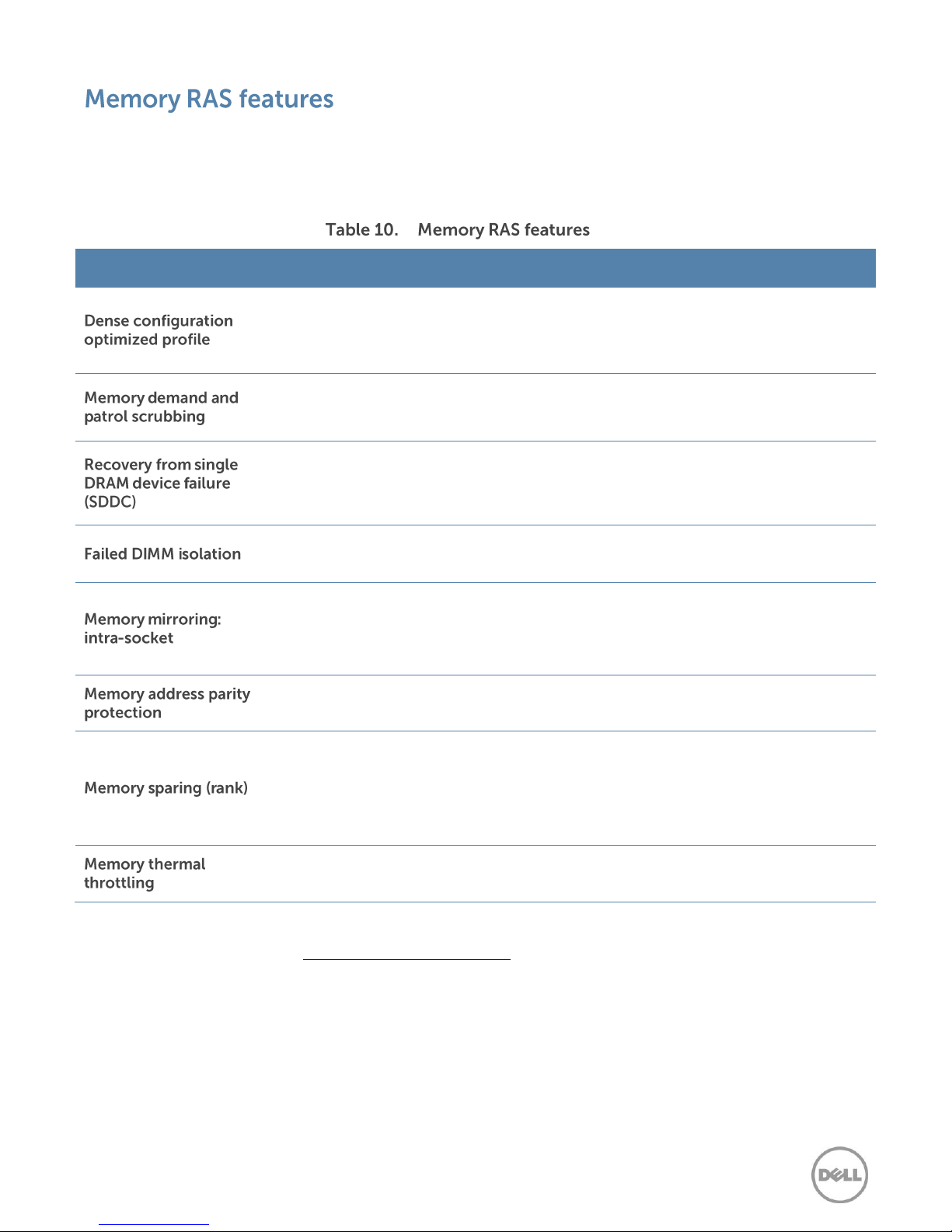
Reliability, availability, and serviceability (RAS) features help keep the system online and operational
Feature
Description
Increased memory reliability can be a result from this selectable platform profile
that adjusts parameters to reduce faults regarding refresh rates, speed,
temperature and voltage
Demand scrubbing is the ability to write corrected data back to the memory once
a correctable error is detected on a read transaction. Patrol scrubbing proactively
searches the system memory, repairing correctable errors.
Recovery from Single DRAM Device Failure (SDDC) provides error checking and
correction that protects against any single memory chip failure as well as multi-bit
errors from any portion of a single memory chip.
This feature provides the ability to identify a specific failing DIMM channel pair,
thereby enabling the user to replace only the failed DIMM pair.
Memory mirroring is a method of keeping a duplicate (secondary or mirrored)
copy of the contents of memory as a redundant backup for use if the primary
memory fails. The mirrored copy of the memory is stored in memory of the same
processor socket.
This feature provides the ability to detect transient errors on the address lines of
the DDR channel.
Memory sparing allocates one rank per channel as a spare. If excessive correctable
errors occur in a rank or channel, they are moved to the spare area while the
operating system is running to prevent the errors from causing an uncorrectable
failure.
This feature helps to optimize power/performance and can also be used to
prevent DIMMs from overheating.
without significant impact to performance, and can decrease data loss and crashing due to errors.
RAS aids in rapid, accurate diagnosis of faults which require service. Table 10 describes the memory
RAS features supported on the R720 and R720xd.
For information on memory mirroring and sparing configurations, see the
R720xd Owner’s Manual
on Support.Dell.com/Manuals. Memory RAID is not supported.
26 PowerEdge R720 and R720xd Technical Guide
Dell PowerEdge R720 and
Page 27
PowerEdge server
Chassis option
16 x 2.5” drives
8 x 2.5” + 8 x 2.5” drives
(with dual RAID controllers)
8 x 2.5” drives
8 x 2.5” + 4 x Express Flash drives
8 x 3.5” drives
24 x 2.5” drives (front) +
2 x 2.5” drives (back)1
12 x 3.5” drives (front) +
2 x 2.5” drives (back)1
The Dell PowerEdge R720 and R720xd provide storage expandability that allows you to adapt to
your workload and operational demands. With comprehensive storage options, the R720 and
R720xd offer various drive types, internal and external storage controllers, and different chassis and
backplanes for varied numbers of drives.
Due to their massive internal storage capacities, the R720 and R720xd are optimized for a variety of
implementations, including virtual desktop infrastructure (VDI) environments and collaboration
solutions. The R720 supports up to 16 and the R720xd supports up to 26 internal 2.5-inch drives.
Features such as Express Flash PCIe solid-state drives and CacheCade provide vastly accelerated
performance over previous technologies. Dell Express Flash drives use PCIe lanes to connect
directly to the processor and chipset and are easily accessible through a hot-plug drive bay.
CacheCade uses Dell PERC storage controllers to accelerate performance over hard drives or
traditional solid-state drives.
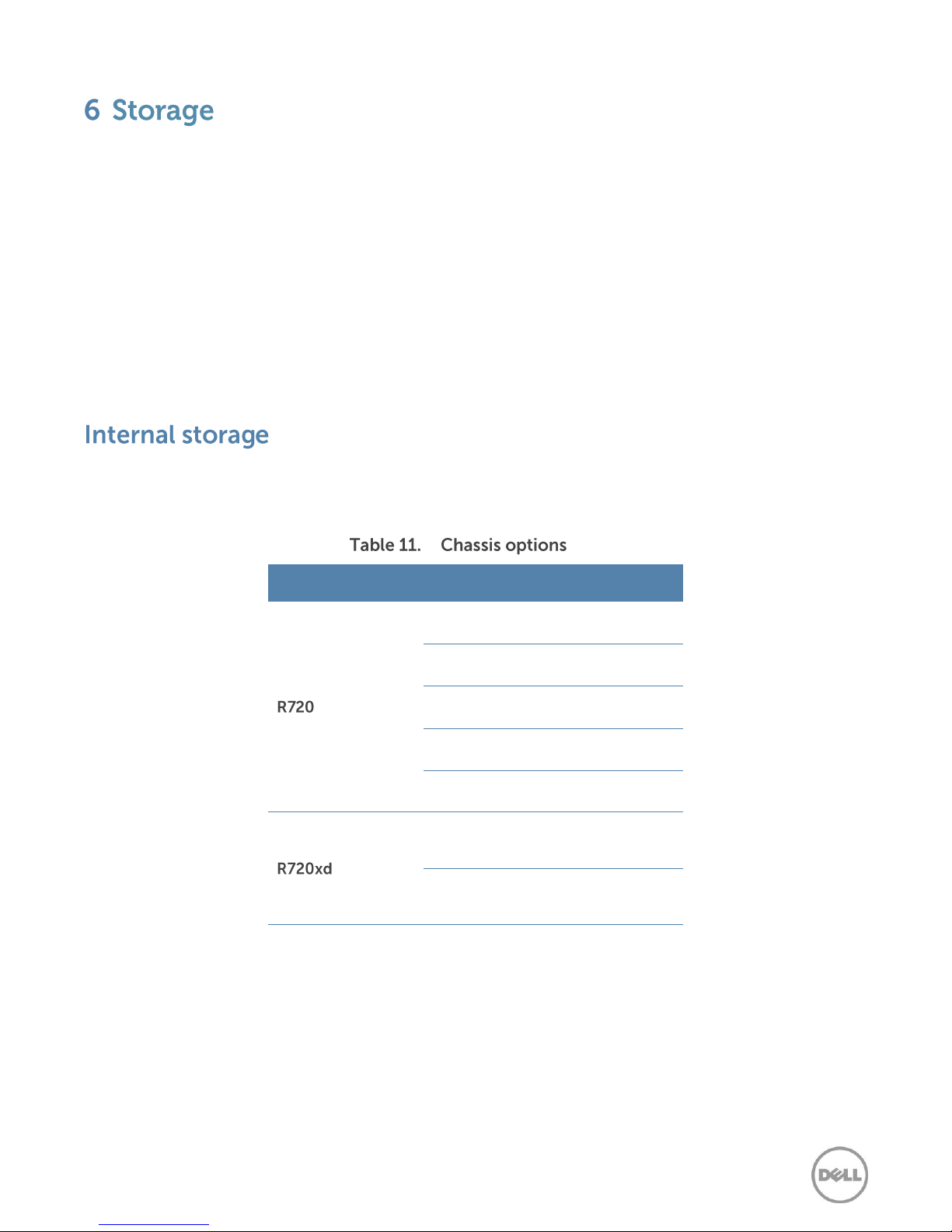
The R720 and R720xd are available in several hot-plug, hard-drive chassis options, as detailed in
Table 11. Note that the chassis option must be selected at the point of purchase and cannot be
changed or upgraded later.
1
Back-accessible 2.5” drives are optional
27 PowerEdge R720 and R720xd Technical Guide
Page 28
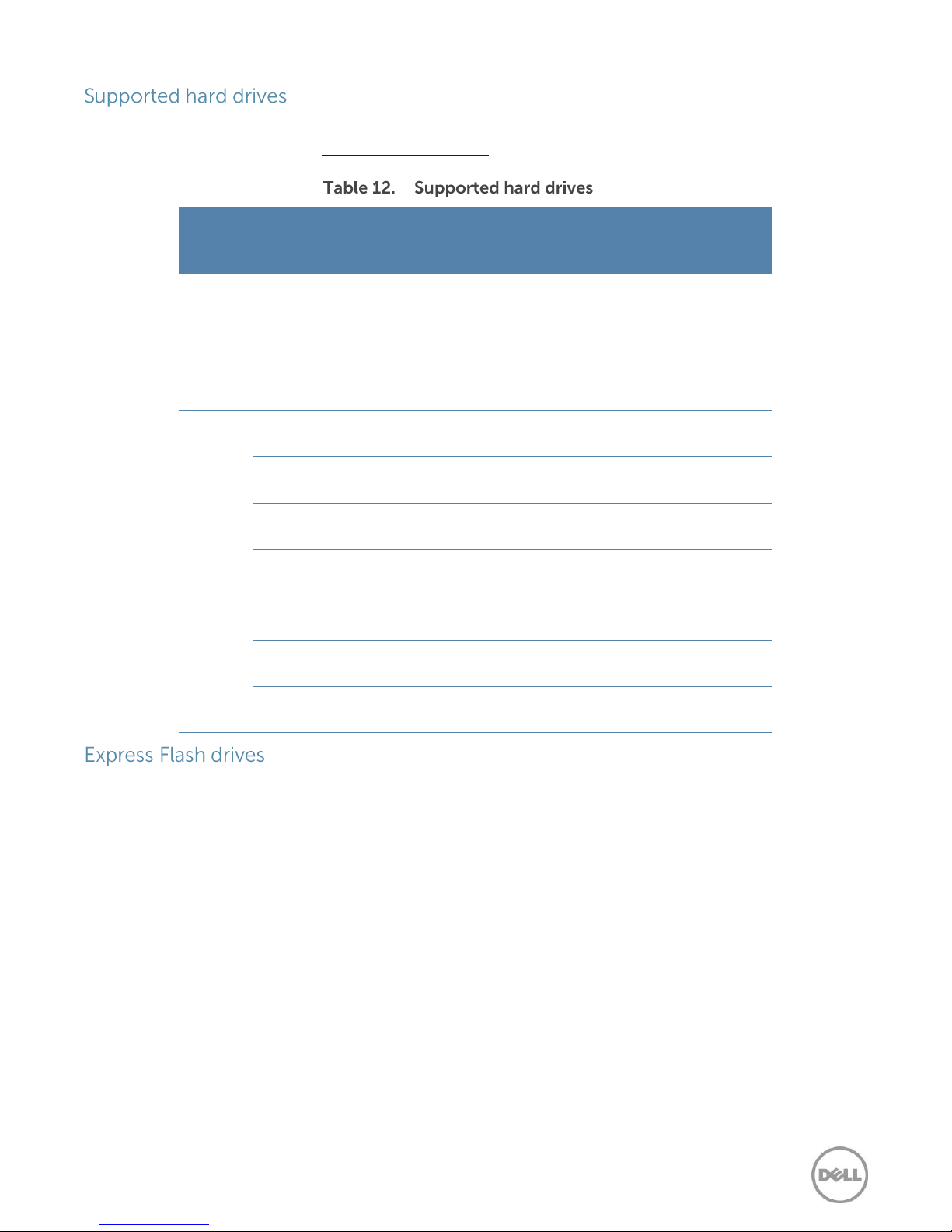
Table 12 lists the internal hard drives supported by the R720 and R720xd. For the latest information
Form
factor
Type
Speed
(rpm)
Capacities
3.5”
SATA (3Gb)
7.2K
250GB, 500GB, 1TB, 2TB, 4TB
Nearline SAS (6Gb)
7.2K
1TB, 2TB, 3TB, 4TB
SAS (6Gb)
15K
300GB, 600GB
2.5”
SATA (3Gb)
7.2K
250GB, 500GB, 1TB
Nearline SAS (6Gb)
7.2K
500GB, 1TB, 1TB (SED)
SAS (6Gb)
10K
300GB, 600GB, 900GB, 900GB
(SED)
SAS (6Gb)
15K
146GB, 300GB, 300GB (SED)
SAS SSD (SLC, 6Gb)
N/A
200GB, 400GB
SATA SSD (MLC,
3Gb)
N/A
100GB, 200GB
Express Flash
PCIe SSD (SLC)
N/A
175GB, 350GB
on supported hard drives, visit Dell.com/PowerEdge.
Express Flash drives use PCIe and SSD technologies to provide performance, scalability, and optimal
serviceability. Accelerated performance with high IOPs is made possible without requiring processor
resources or capturing DRAM. Also, Express Flash drives use a standardized, 2.5-inch hot-plug form
factor, which saves critical PCIe slot space by moving drives from the back to the front of the system
and allows a common management process for all drives.
The PowerEdge R720 has an option to support up to four hot-plug Express Flash PCIe SSDs in the
2.5-inch chassis.
The R720xd does not support Express Flash drives.
28 PowerEdge R720 and R720xd Technical Guide
Page 29
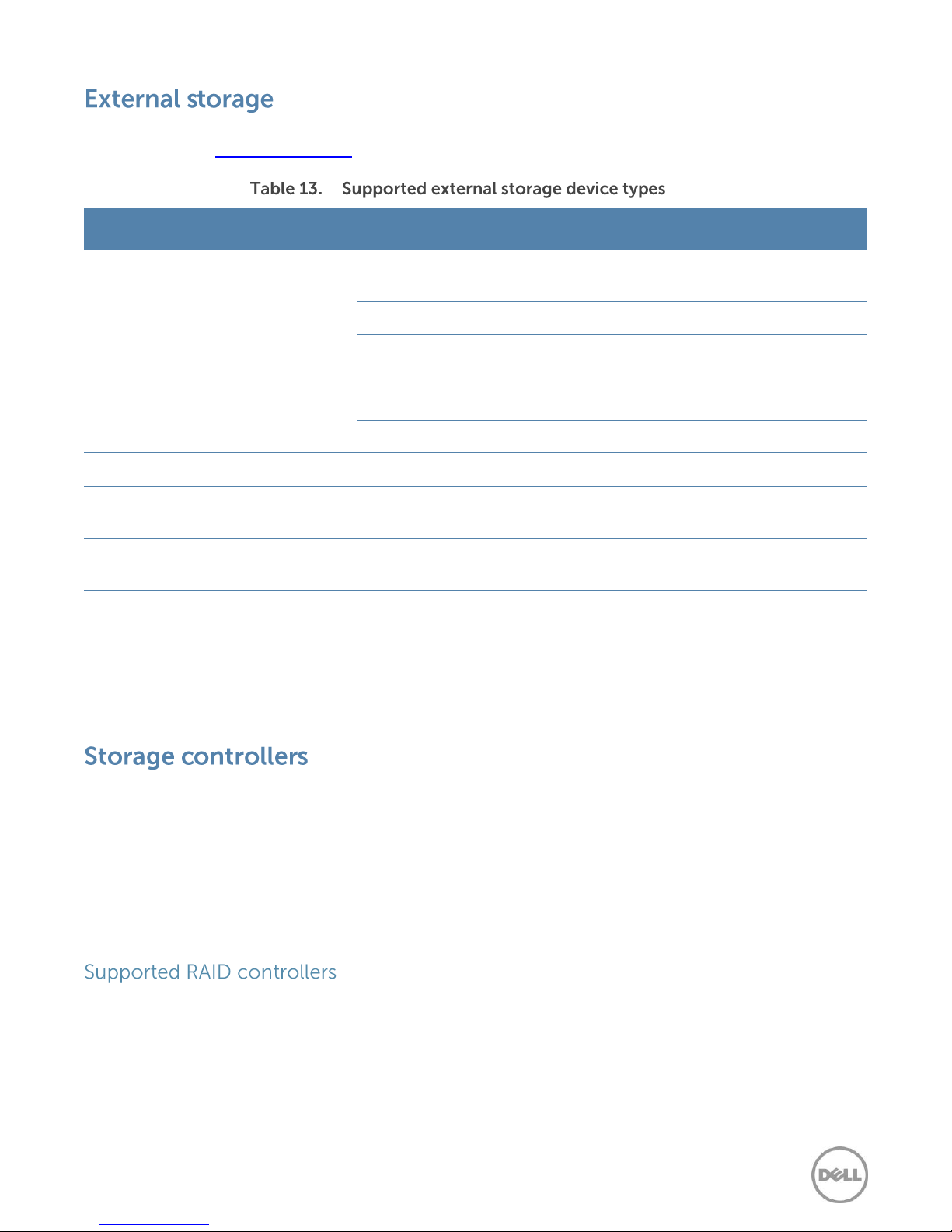
The R720 and R720xd support the external storage devices types listed in Table 13. For more storage
Device type
Description
External tape
Supports connection to external USB tape products (supports boot
from Dell PowerVault™ RD1000)
Supports connection to external SAS tape products
Supports connection to external FC tape products
Supports connection to external SCSI tape products (legacy support
only)
Supports connection to external iSCSI tape products
NAS / IDM appliance software
Supports NAS software stack
Dell PowerVault NAS
Supports connection to current PowerVault NAS (Network Attached
Storage) products
PowerVault DAS
Supports connection to current PowerVault direct-attach storage
(DAS) (including JBOD and RBOD enclosures) products
PowerVault SAN
Supports connection to current PowerVault storage area network
(SAN) (including Dell EqualLogic™, iSCSI, Dell-EMC arrays, and JBOD
disk enclosures) products
PowerVault IDM
Supports connection to current PowerVault intelligent data
management (IDM) (archive solutions, de-duplication, B2D, and
data-protection appliances) products
information, see Dell.com/Storage.
Dell provides highly capable RAID options for you to ensure that your data remains safe. Dell’s RAID
controller options offer impressive performance improvements, including the following features:
FastPath™ I/O: This feature can help accelerate performance when operating on SSDs.
Split mirror: This function allows you to break mirrored disk connection in order to quickly
replace a drive.
Physical disk power management (Dimmer Switch™): This feature allows for power control of
spare or idle drives, which can save energy and operating expenses.
The newest line of PowerEdge RAID Controllers (PERCs) offer high I/O performance for a variety of
uses, including database applications and streaming digital media environments. The internal RAID
controllers have a dedicated connection to the system board. The PERC S110 is supported on the
R720 (3.5-inch chassis only) and is not supported on the R720xd.
29 PowerEdge R720 and R720xd Technical Guide
Page 30
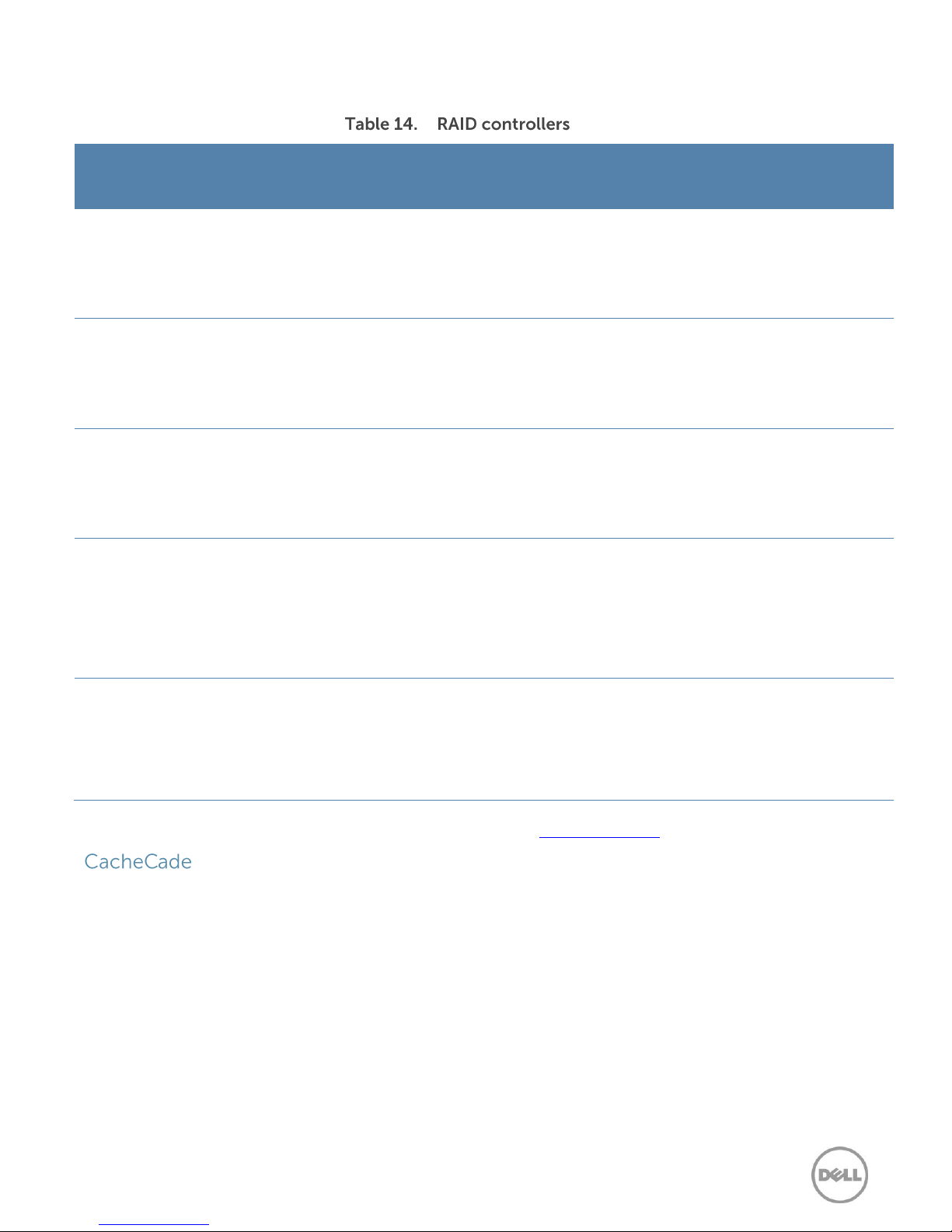
Table 14 lists the RAID controllers supported on the R720 and R720xd.
Controller
Description
Features
RAID
modes
Form factor
Usage model
PERC
H810
External
Eight-port, external,
6Gb/s PCIe RAID
controller that supports
up to 192 SATA and SAS
HDDs or SSDs
Includes 1GB NV DDR3
cache, premium
performance and feature
set, security SED/EKMS,
and SSD as cache
0, 1, 10, 5,
50, 6, 60
Adapter
Premium
performance
PERC
H710P
Internal
Eight-port, internal,
6Gb/s PCIe RAID
controller that supports
up to 32 SATA and SAS
HDDs or SSDs
Includes 1GB NV DDR3
cache, premium
performance and feature
set, security SED/EKMS,
and SSD as cache
0, 1, 10, 5,
50, 6, 60
Adapter
Premium
performance
PERC H710
Eight-port, internal,
6Gb/s PCIe RAID
controller that supports
up to 32 SATA and SAS
HDDs or SSDs
Includes 512MB DDR3
cache, advanced feature
set, security SED/EKMS
0, 1, 10, 5,
50, 6, 60
Adapter
Performance
PERC
H310
Eight-port, internal,
6Gb/s PCIe RAID
controller that is a
low-cost, entry-level
solution supporting up
to 32 SATA and SAS
HDDs or SSDs
Supports hot-plug drives,
expansion, pass-through
0, 1, 10, 5,
50
Adapter
Value
PERC S110
Software
RAID
(R720 only)
3Gb/s SATA software
RAID controller that is a
low-cost, entry-level
solution, supporting up
to 4 physical disks or
eight virtual disks
Supports up to 4
hot-plug SATA drives, no
expansion, Microsoft
Windows only
0, 1, 5, 10
System
boardembedded
SATA
Entry-level
For more information about the latest PERC offerings, see Dell.com/PERC.
CacheCade is a technology that provides automated storage tiering on SSDs with the PERC H810
and H710P. It works by detecting the most-often accessed data and copying it over time to the
CacheCade SSD(s) where that cached data is accessed directly, instead of accessing the hard disk
drives. This can dramatically increase how your applications respond when they are under peak
traffic times and how they perform when response time is critical.
CacheCade provides cost-effective performance scaling for database-type applications that
perform lots of random reads, and saves the cost of adding extra drives.
30 PowerEdge R720 and R720xd Technical Guide
Page 31

The PowerEdge R720 supports one of the following internal optical drive options:
DVD-ROM
DVD+RW
The R720xd does not support an internal optical drive.
The R720 supports the Dell PowerVault RD1000 internal backup device on the 2.5-inch chassis only.
Internal tape drives are not supported on the R720, and the R720xd does not support any internal
backup device.
31 PowerEdge R720 and R720xd Technical Guide
Page 32
The Dell PowerEdge R720 and R720xd offer balanced, scalable I/O capabilities, including integrated
PCIe 3.0-capable expansion slots. Dell Select Network Adapters, Dell’s network daughter cards, let
you choose the right network fabric without using up a valuable PCI slot. Pick the speed, technology,
vendor, and other options, such as switch independent partitioning, which lets you share and
manage bandwidth on 10GbE connections.
The Select Network Adapter family is purpose-built and includes flexible LAN on Motherboard (LOM)
card options for Dell PowerEdge 12th generation servers. The Select Network Adapter form factor
delivers the value of LOM integration with the system, including BIOS integration and shared port for
manageability while providing the flexibility of a modular card.
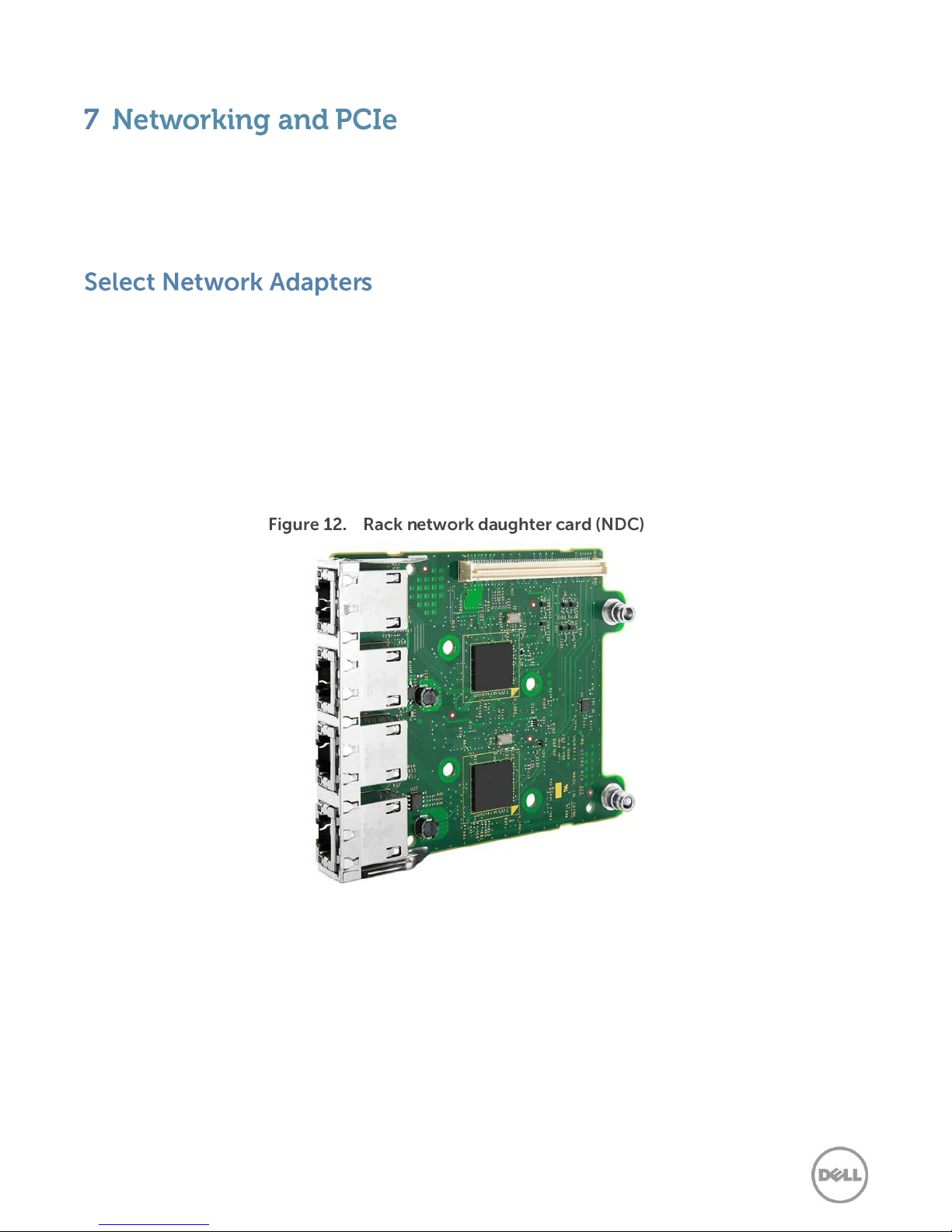
The PowerEdge R720 and R720xd support one custom network daughter card (NDC), as part of
Select Network Adapters family, to house the complete LOM subsystem. There are two form factors
of Select Network Adapters—one for blade servers and one for rack servers (shown Figure 12). The
rack NDC options supported on the R720 and R720xd include a selection of 1GbE and 10GbE port
cards, such as 1000 Base-T, 10Gb Base-T, and 10Gb SFP+.
32 PowerEdge R720 and R720xd Technical Guide
Page 33
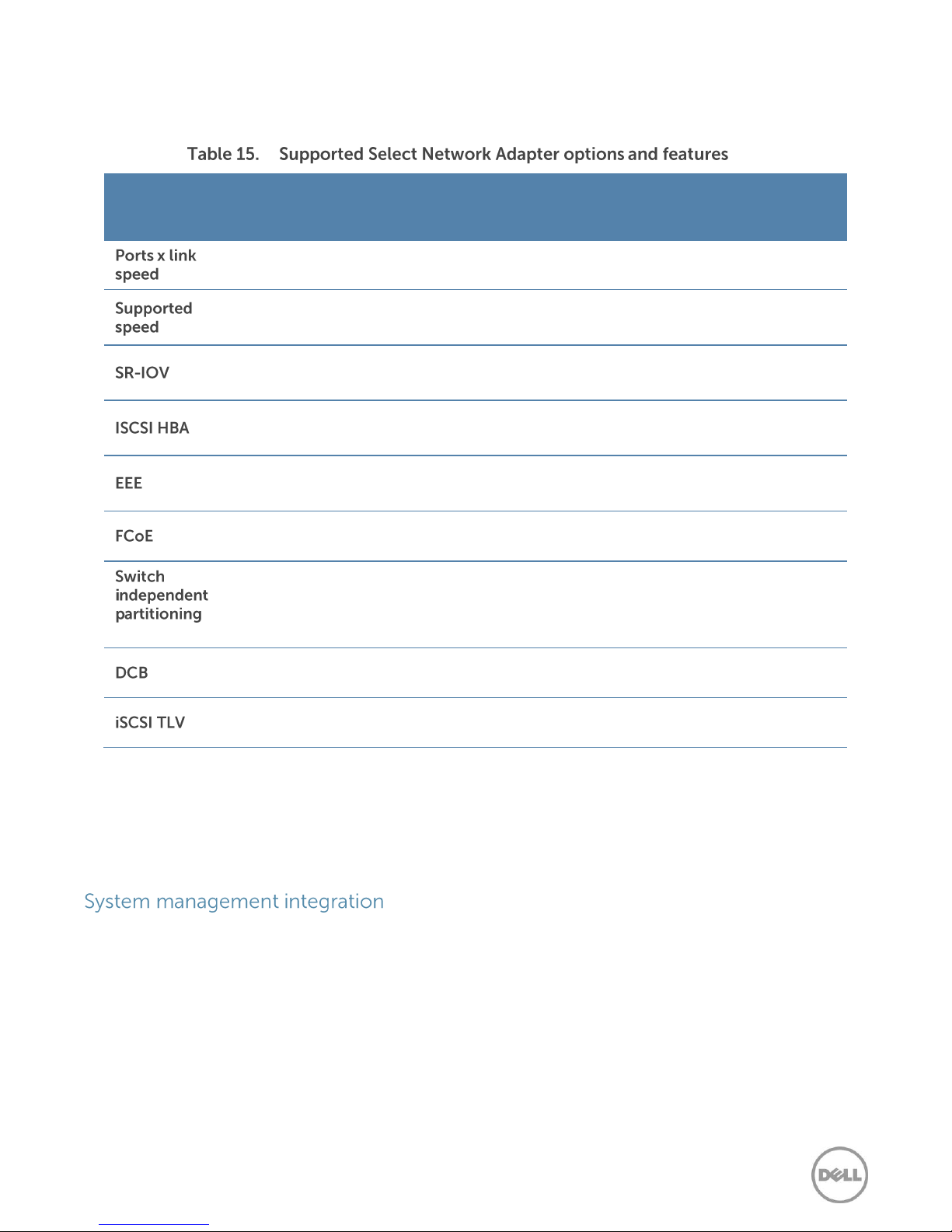
Table 15 lists the available Select Network Adapter options and supported features for the R720 and
Features
Broadcom
5720 Base-T
Intel I350
Base-T
Broadcom
57800 SFP+1
Broadcom
57800 Base-T1
Intel X540
Base-T 1
4 x 1Gb
4 x 1Gb
2 x 1Gb +
2 x 10Gb
2 x 1Gb +
2 x 10Gb
2 x 1Gb +
2 x 10Gb
1Gb
1Gb
1Gb and 10Gb
1Gb and 10Gb
1Gb and
10Gb
Not
supported
Not
supported
Not
supported
Not
supported
Supported
(10Gb only)
Not
supported
Not
supported
Supported2
Supported2
Not
supported
Supported
Supported
Not
supported
Not
supported
Not
supported
Not
supported
Not
supported
Supported3
Supported3
Supported3
Not
supported
Not
supported
Supported4
Supported4
Not
supported
Not
supported
Not
supported
Supported5
Supported5
Supported5
Not
supported
Not
supported
Supported6
Supported6
Supported6
R720xd.
1
These cards have two chipsets that offer the choice of either 10GbE or 1GbE.
2
Only 10Gb ports have iSCSI HBA support.
3
Only 10Gb ports have FCoE support.
4
Only 10Gb ports have switch independent partitioning support. The maximum number of partitions supported is four
(two partitions per 10Gb port). 1Gb ports do not support switch independent partitioning.
5
Only 10Gb ports have DCB support.
6
Only 10Gb ports have ISCSI TLV support.
With R720 and R720xd, the job of deploying, updating, monitoring, and maintaining the Select
Network Adapters is fast and easy. System management integration features include the following:
Pre-boot: Use the Dell Lifecycle Controller graphical user interface (GUI) to set configuration
such as bandwidth allocation or firmware revision level
Post-boot: Agent-free out-of-band or high-speed in-band connection over LOM through the
Operating System/BMC pass-thru feature for sensory information
Automation of firmware and driver version deployment upon component replacement
Automatic monitoring of NIC status and notification on SNMP traps
33 PowerEdge R720 and R720xd Technical Guide
Page 34
Local or remote re-configuration of any NIC, physical or virtual
System
R720
R720xd
Slots1
7
6
Slot types
One x16 full-length, full-height
Three x8 full-length, full-height
Three x8 half-length, half-height
Two x16 full-length, full-height
One x8 full-length, full-height
Three x8 half-length, half-height
Type
Adapter
1Gb/10Gb NICs
Broadcom 5720 2x1Gb Base-T
Broadcom 5719 4x1Gb Base-T
Intel I350 2x1Gb Base-T
Intel I350 4x1Gb Base-T
Broadcom 57810S 2x10Gb SFP+
Broadcom 57810S 2x10Gb Base-T
Intel X520 2x10Gb SFP+
Intel X540 2x10Gb Base-T
QLogic® QLE8262 2x10Gb SFP+
Brocade® BR1020 2x10Gb SFP+
PXE boot enabled on all LOM and NDCs for ease of use
Boot from SAN (iSCSI, FCoE) configuration for networking devices through the Lifecycle
Controller GUI
For information on card installation, requirements, and slot priorities, see the
R720xd Owner’s Manual
on Support.Dell.com/Manuals.
PowerEdge R720 and
The R720 and R720xd provide greatly expanded PCIe slot capability over their predecessor servers.
This is made possible by the 40 PCIe lanes available from each processor in the system. Two
processors are required in the system to enable all PCIe slots. The R720 and R720xd have been
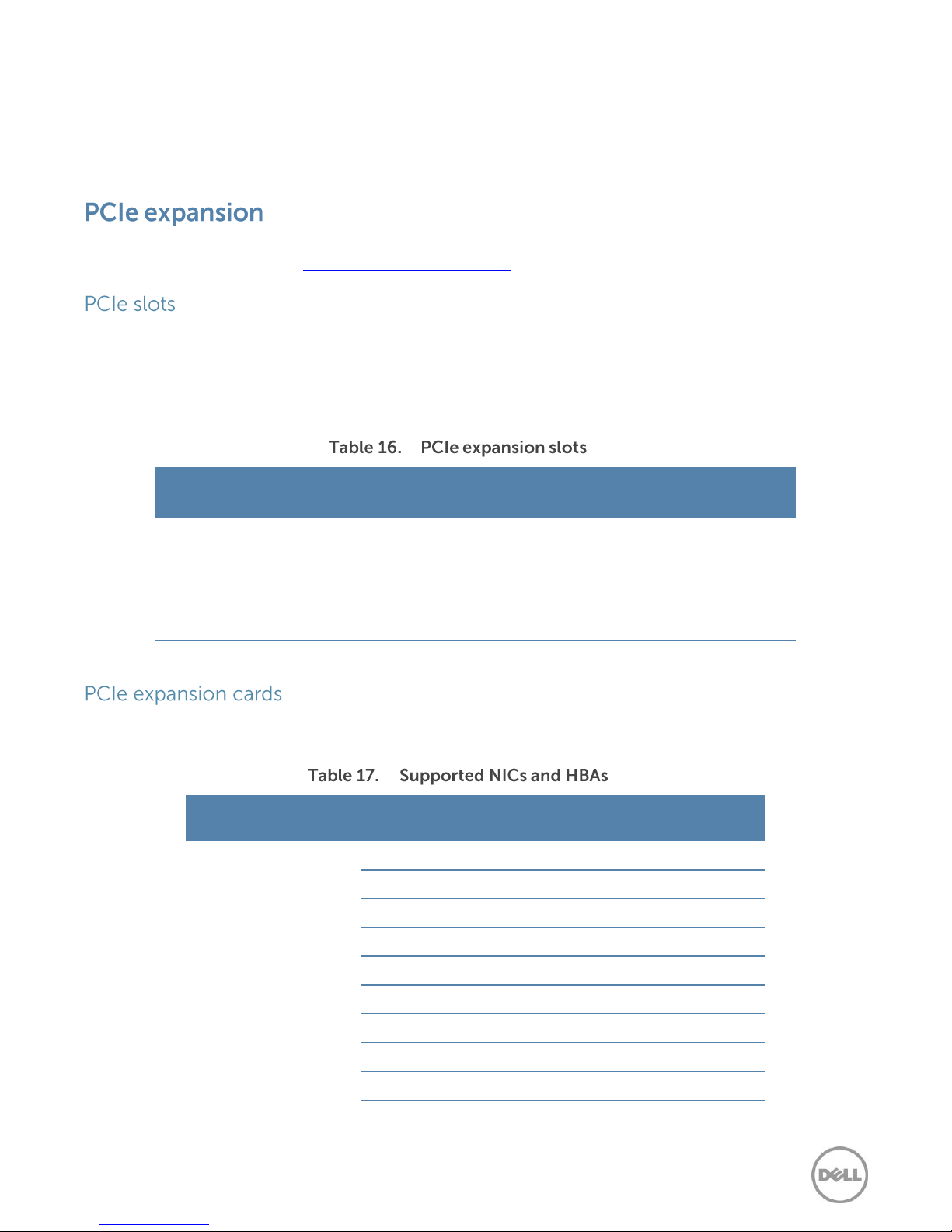
designed to be PCIe 3.0 compliant in order to take full advantage of the processor capabilities. Table
16 details the R720 and R720xd PCIe slots.
1
In a single-processor configuration, slots 1–4 are not usable.
The R720 and R720xd support a variety of PCIe expansion cards. Table 17 lists the supported add-in
NICs and HBAs for the R720 and R720xd.
34 PowerEdge R720 and R720xd Technical Guide
Page 35
Type
Adapter
FC4/FC8/F16 HBAs
QLogic QLE2460 4Gb
QLogic QLE2462 4Gb
QLogic QLE2560 8Gb
QLogic QLE2562 8Gb
QLogic QLE2660 16Gb
QLogic QLE2662 16Gb
Emulex® LPe12000 8Gb
Emulex LPe12002 8Gb
Brocade BR815 8Gb
Brocade BR825 8Gb
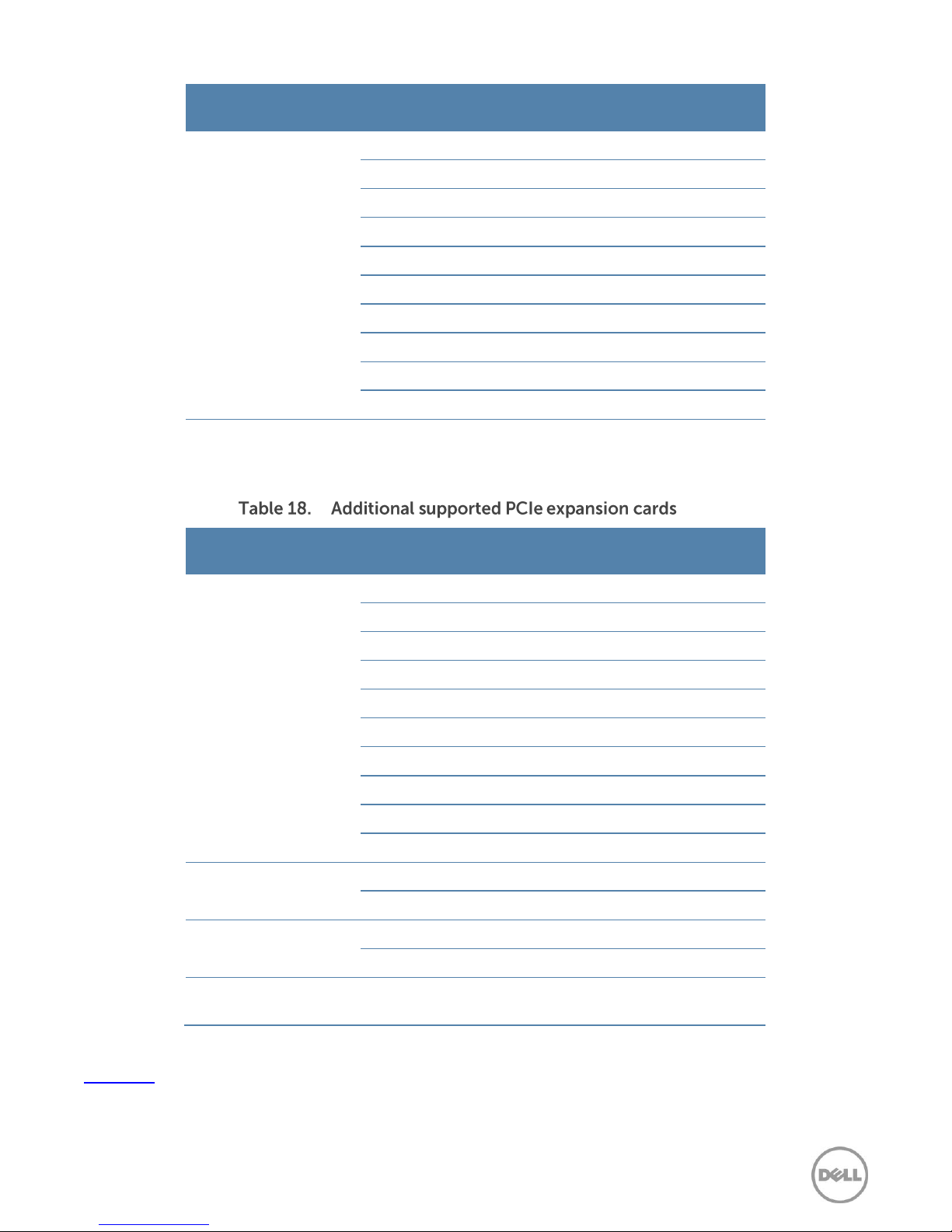
In addition to the NICs and HBAs listed in Table 17, the supported PCIe expansion cards for the R720
Type
Adapter
GPUs
(R720 only)
NVIDIA M2090 (double wide)
NVIDIA M2075 (double wide)
NVIDIA M2070Q (double wide)
NVIDIA Tesla K10 (double wide)
NVIDIA Tesla K20 (double wide)
NVIDIA GRID™ (VGX) K1 (double wide)
NVIDIA GRID (VGX) K2 (double wide)
AMD V7800P FirePro™ (single wide)
AMD S7000 FirePro (single wide)
AMD S9000 FirePro (double wide)
GPU HICs
(R720 only)
NVIDIA HIC
Dell PLX HIC
PCIe SSDs
Fusion-io® IoDrive® 640GB V1
Fusion-io PCIe SSD V2
PCIe bridge
PCIe bridge adapter for front-accessible, hot-plug
Express Flash PCIe SSDs
and R720xd are listed in Table 18.
For the latest information on supported PCIe expansion cards for the R720 and R720xd, visit
Dell.com.
35 PowerEdge R720 and R720xd Technical Guide
Page 36
Feature
Description
Power supply units (PSU)
portfolio
Dell’s PSU portfolio includes intelligent features such as dynamically
optimizing efficiency while maintaining availability and redundancy. Find
additional information in the Power supply units section.
Tools for right-sizing
Energy Smart Solution Advisor (ESSA) is a tool that can help you determine
the most efficient configuration possible. With Dell’s ESSA, you can calculate
the power consumption of your hardware, power infrastructure, and storage.
ESSA can help you determine exactly how much power your server will use
at a given workload, and the PSU Advisor can help you choose the best,
most efficient PSU for your workload. Learn more at Dell.com/calc.
Energy Smart Data Center Assessment is a Dell Services offering that uses
infrastructure and thermal analysis to help maximize system efficiency. Learn
more at Dell.com/EnergySmart.
Industry compliance
Dell’s servers are compliant with all relevant industry certifications and
guidelines, including 80 PLUS, Climate Savers, and ENERGY STAR.
Power monitoring
accuracy
PSU power monitoring improvements include:
Dell’s power monitoring accuracy is currently 1%, whereas the industry
standard is 5%
More accurate reporting of power
Better performance under a power cap
Power capping
Use Dell’s systems management to set the power cap limit for your systems
to limit the output of a PSU and reduce system power consumption. Dell is
the first hardware vendor to leverage Intel Node Manager for circuit-breaker
fast capping.
Systems management
iDRAC7 Enterprise provides server-level management that monitors, reports,
and controls power consumption at the processor, memory, and system
level.
Dell OpenManage Power Center delivers group power management at the
rack, row, and data center level for servers, power distribution units, and
uninterruptible power supplies.
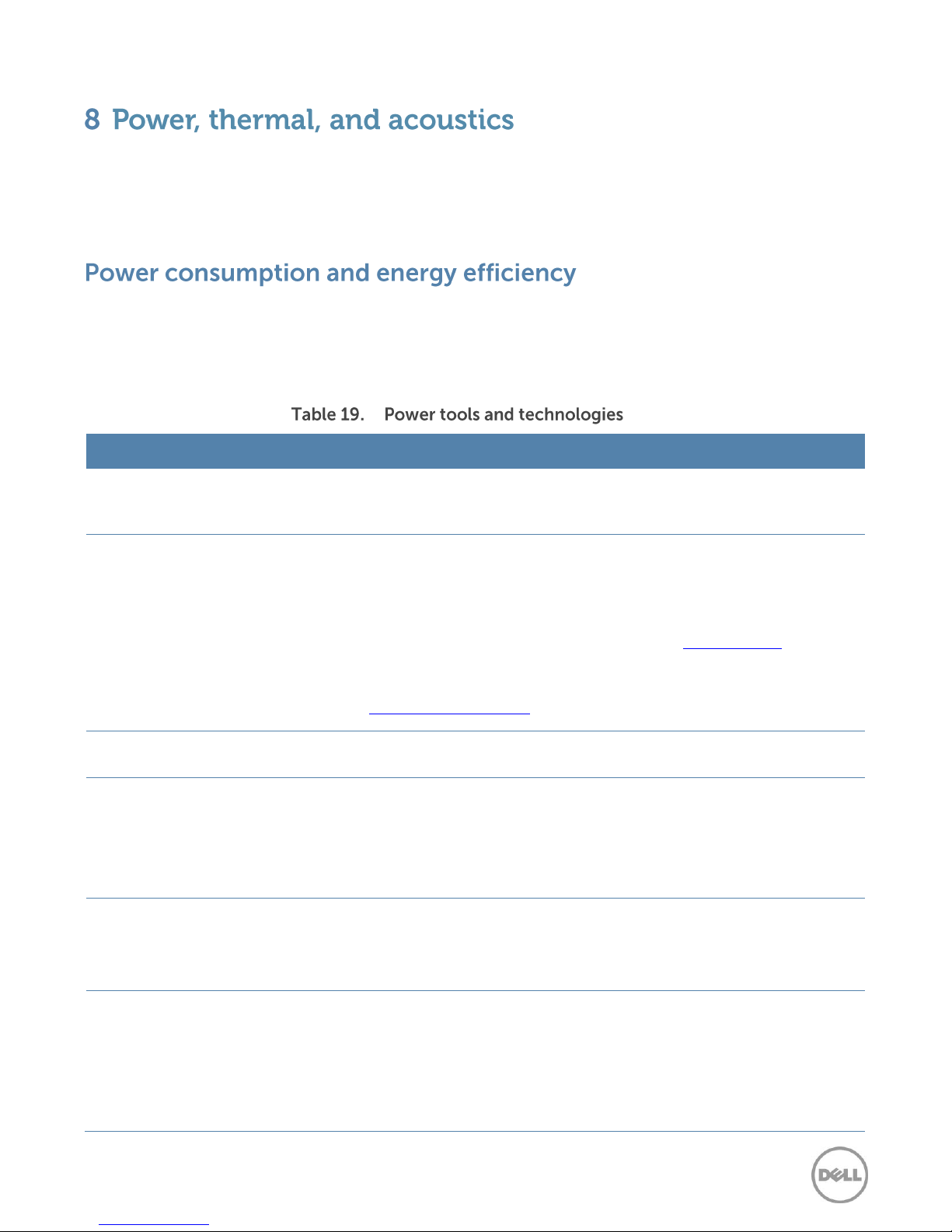
Lower overall system-level power draw is a result of Dell’s breakthrough system design. PowerEdge
servers maximize performance per watt through a combination of power and cooling, energy
efficient technologies, and tools. Additionally, PowerEdge servers have an extensive collection of
sensors that automatically track thermal activity, which helps regulate temperature thereby reducing
server noise and power consumption.
With the rise in the cost of energy coupled with increasing data center density, Dell provides tools
and technologies to help you realize greater performance with less energy cost and waste. More
efficient data center usage can reduce costs by slowing the need for additional data center space.
Table 19 lists the tools and technologies Dell offers to help you achieve your data center goals by
lowering power consumption and increasing energy efficiency.
36 PowerEdge R720 and R720xd Technical Guide
Page 37
Feature
Description
Active power management
Intel Node Manager is an embedded technology that provides individual
server-level power reporting and power limiting functionality. Dell offers a
complete power management solution comprised of Intel Node Manager
accessed through Dell iDRAC7 Enterprise and OpenManage Power Center
that allows policy-based management of power and thermals at the
individual server, rack, and data center level.
Hot spare reduces power consumption of redundant power supplies.
Thermal control of fan speed optimizes the thermal settings for your
environment to reduce fan consumption and lower system power
consumption.
Idle power enables Dell servers to run as efficiently when idle as when at full
workload.
Fresh Air cooling
With the thermal design and reliability of Dell products, you can have the
capability to operate at excursion-based temperatures beyond the industry
standard of 35°C (95°F) without impacting your availability model. This
solution takes into account servers, networking, storage, and other
infrastructure. Find additional information at Dell.com/FreshAir.
Rack infrastructure
Dell offers some of the industry’s highest-efficiency power infrastructure
solutions, including:
Power distribution units (PDUs)
Uninterruptible power supplies (UPSs)
Energy Smart containment rack enclosures
Find additional information at: http://content.dell.com/us/en/enterprise/
power-and-cooling-technologies-components-rack-infrastructure.aspx.
Find additional information at Dell.com/PowerAndCooling and Power.com/PowerCenter.
Energy Smart power supplies have intelligent features, such as the ability to dynamically optimize
efficiency while maintaining availability and redundancy. Also featured are enhanced
power-consumption reduction technologies, such as high-efficiency power conversion and
advanced thermal-management techniques, and embedded power-management features,
including high-accuracy power monitoring.
The following power supply unit options are available for the R720 and R720xd:
495W AC
750W AC
1100W AC
1100W DC
37 PowerEdge R720 and R720xd Technical Guide
Page 38
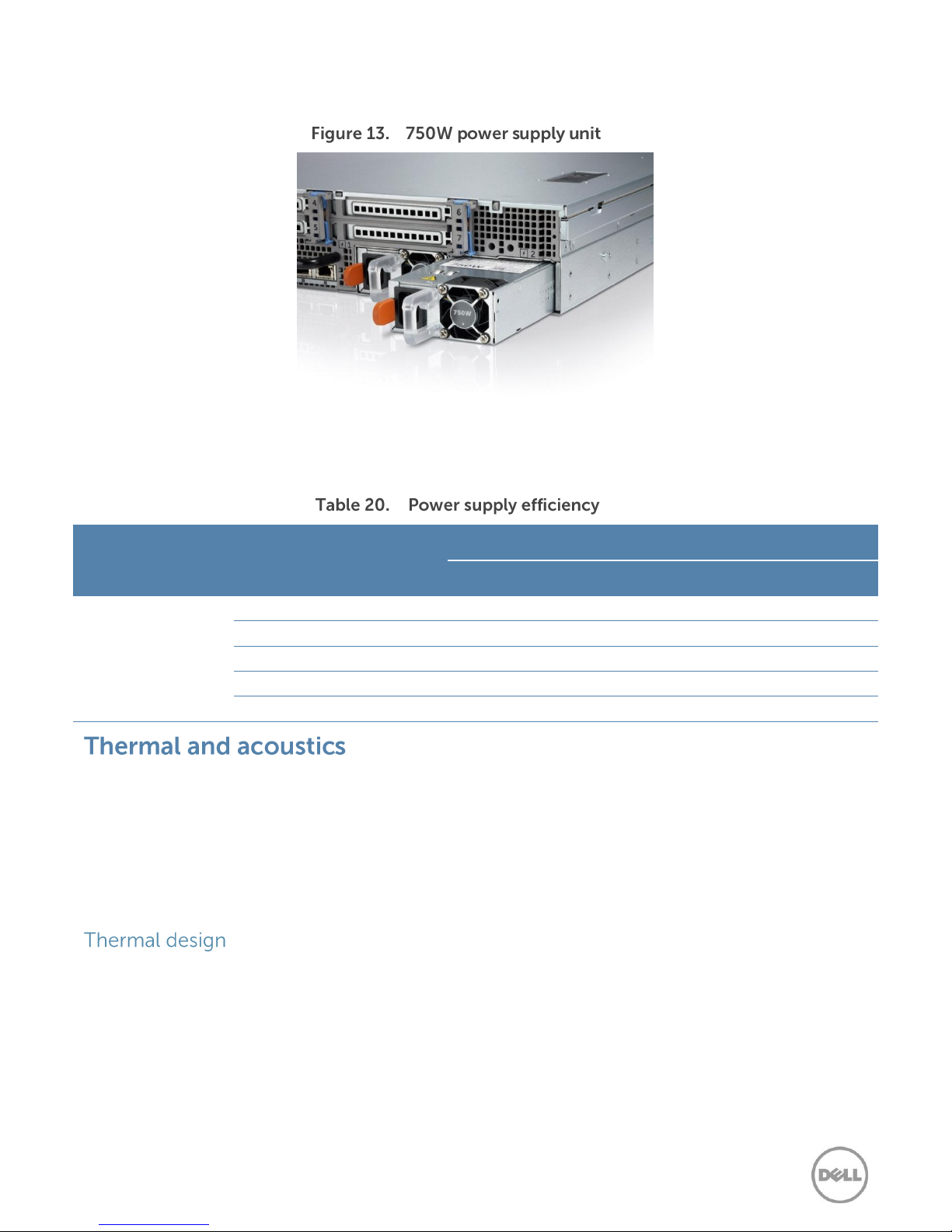
Figure 13 shows a 750W power supply unit extended from an R720 system.
Form factor
Output
Class
Efficiency targets by load
10%
20%
50%
100%
Redundant 86mm
495W AC
Platinum
82.0%
90.0%
94.0%
91.0%
750W AC
Titanium
90.0%
94.0%
96.0%
91.0%
750W AC
Platinum
82.0%
90.0%
94.0%
91.0%
1100W AC
Platinum
89.0%
93.0%
94.5%
92.0%
1100W DC
N/A
80.0%
88.0%
91.0%
88.0%
The PowerEdge R720 and R720xd support up to two AC or DC power supplies with 1 + 1
redundancy, auto sensing, and auto-switching capability.
Dell PSUs have achieved Platinum and Titanium efficiency levels as shown in Table 20.
Thermal management of PowerEdge R720 and R720xd delivers high performance for the right
amount of cooling to components at the lowest fan speeds across a wide range of ambient
temperatures from 10°C to 35°C (50°F to 95°F) and to extended ambient temperature ranges (see
Table 31) . The benefits to you are lower fan power consumption (lower server system power and
data center power consumption) and greater acoustical versatility. The PowerEdge R720 is quiet
enough to be used in an office environment in typical and minimum configurations, and the R720xd
can also operate at a similar level in certain configurations.
The thermal design of the PowerEdge R720 and R720xd reflect the following:
Optimized thermal design: The system layout is architected for optimum thermal design.
System component placement and layout are designed to provide maximum airflow coverage to
critical components with minimum expense of fan power.
Comprehensive thermal management: The thermal control system regulates the fan speed
based on several different responses from all system-component temperature sensors, as well as
38 PowerEdge R720 and R720xd Technical Guide
Page 39
inventory for system configurations. Temperature monitoring includes components such as
processors, DIMMs, chipset, the inlet air ambient, hard disk drives, NDC, and GPU.
Open and closed loop thermal fan speed control: Open loop thermal control uses system
configuration to determine fan speed based on inlet air ambient temperature. Closed loop
thermal control method uses feedback temperatures to dynamically determine proper fan
speeds.
User-configurable settings: With the understanding and realization that every customer has
unique set of circumstances or expectations from the system, in this generation of servers, we
have introduced limited user-configurable settings residing in the iDRAC7 BIOS setup screen. For
more information, see the
PowerEdge R720 and R720xd Owner’s Manual
on
Support.Dell.com/Manuals and “Advanced Thermal Control: Optimizing across Environments
and Power Goals” on Dell.com.
Cooling redundancy: The R720 and R720xd allow N+1 fan redundancy, allowing continuous
operation with one fan failure in the system.
Environmental specifications: The optimized thermal management makes the R720 and R720xd
reliable under a wide range of operating environments as shown in Table 31.
The acoustical design of the PowerEdge R720 and R720xd reflect the following:
Versatility: The R720 and R720xd save you power draw in the data center but are also quiet
enough for office environment in typical and minimum configurations. Compare the values for
LpA in Table 21 and Table 22 for these configurations, and note that they are lower than ambient
measurements of typical office environments. You may find that the system is sufficiently quiet
where the sound it emits blends into the environment.
Adherence to Dell’s high sound quality standards: Sound quality is different from sound power
level and sound pressure level in that it describes how humans respond to annoyances in sound,
like whistles and hums. One of the sound quality metrics in the Dell specification is prominence
ratio of a tone, which is listed in Table 21 and Table 22.
Noise ramp and descent at bootup from power off: Fan speeds and noise levels ramp during
the boot process (from power-off to power-on) in order to add a layer of protection for
component cooling in the event that the system were not to boot properly. In order to keep the
bootup process as quiet as possible, the fan speed reached during bootup is limited to about half
of full speed.
Noise level dependencies: If acoustics is important to you, several configuration choices and
settings are important to consider:
For lower acoustical output, use a small number of lower rotational-speed SATA hard drives,
nearline SAS hard drives, or non-rotational devices like SSDs. 15k hard drives generate more
acoustic noise than that of lower rotational-speed hard drives, and noise increases with
number of hard drives.
Fan speeds and noise may increase from baseline factory configurations if certain profiles are
changed by the user or the system configurations are updated. The following is a list of items
that impact fan speeds and acoustical output:
> iDRAC7 BIOS settings: Performance Per Watt (DAPC or OS) may be quieter than
Performance or Dense Configuration (iDRAC Settings > Thermal > Max. Exhaust
Temperature or Fan speed offset).
> The quantity and type of PCIe cards installed: This affects overall system acoustics.
Installation of more than two PCIe cards results in an increase in overall system acoustics.
39 PowerEdge R720 and R720xd Technical Guide
Page 40
> Using a GPU card: This results in an increase in overall system acoustics.
Configuration
(23 ± 2°C
ambient)
CPUs
Hard drives
Power
supply
unit
Memory
PCI
card/HDD
controller
Operating
mode
LWAUL1
(bels)
LpA2
(dBA)
Prominent
tones3
Minimum
1
1 x 250GB
SATA (7.2k)
1 x
495W
1 x
8GB
1 x PERC
H310
Idle
4.0
20
None
Stressed4
4.1
20
None
Typical
2
6 x 300GB
SAS (10K)
2 x
750W
8 x
8GB
1 x PERC
H710,
1 x GbE
NIC
Idle
4.4
25
None
Stressed4
4.5
26
None
Configuration
(23 ± 2°C
ambient)
CPUs
Hard drives
Power
supply
unit
Memory
PCI
card/HDD
controller
Operating
mode
LWA-UL1
(bels)
L
pA2
(dBA)
Prominent
tones3
Minimum
1
1 x 250GB
SATA (7.2k)
1 x
495W
1 x
8GB
1 x PERC
H310
Idle4
4.7
28
None
Stressed5
4.8
28
None
Typical
2
14 x 300GB
SAS (10K)
2 x
750W
8 x
8GB
1 x PERC
H710,
1 x GbE
NIC
Idle4
4.8
28
None
Stressed5
5.0
30
None
> PCIe controller-based SSD drives: Drives such as Express flash drives and Fusion-io cards
require greater airflow for cooling, and result in significantly higher noise levels.
> Systems with an H310 PERC: This configuration may be quieter than those with an H710
PERC with battery backup. However, higher noise levels result when a system is
configured as non-RAID.
> Hot spare feature of power supply unit: In the system default setting, the Hot Spare
Feature is disabled; acoustical output from the power supplies is lowest in this setting.
Table 21 and Table 22 detail the acoustical performance for the R720 and R720xd.
1
LwA – UL is the upper limit sound power levels (LwA) calculated per section 4.4.1 of ISO 9296 (1988) and measured in
accordance to ISO 7779 (2010).
2
LpA is the average A-weighted sound pressure level from the four bystander positions calculated per section 4.3 of
ISO9296 (1988) and measured in accordance with ISO 7779 (2010). The system is placed in a half rack enclosure (base of
system is 25 cm above reflective floor).
3
Prominent tone: Criteria of D.6 and D.11 of ECMA-74 11th ed. (2010) are followed to determine if discrete tones are
prominent. The system is placed in a half rack enclosure (base of system is 75 cm above reflective floor) and acoustic
transducer is at front bystander position, ref ISO 7779 (2010 Section 8.6.2).
4
Idle: Reference ISO 7779 (2010) definition 3.1.7; system is running in its OS but no other specific activity.
5
Stressed processor: An operating mode per ISO 7779 (2010) definition 3.1.6. The software SPECPower at 50% loading is
activated to stress the processors.
For more information on Dell’s acoustical design, see the Dell Enterprise Acoustics white paper.
40 PowerEdge R720 and R720xd Technical Guide
Page 41
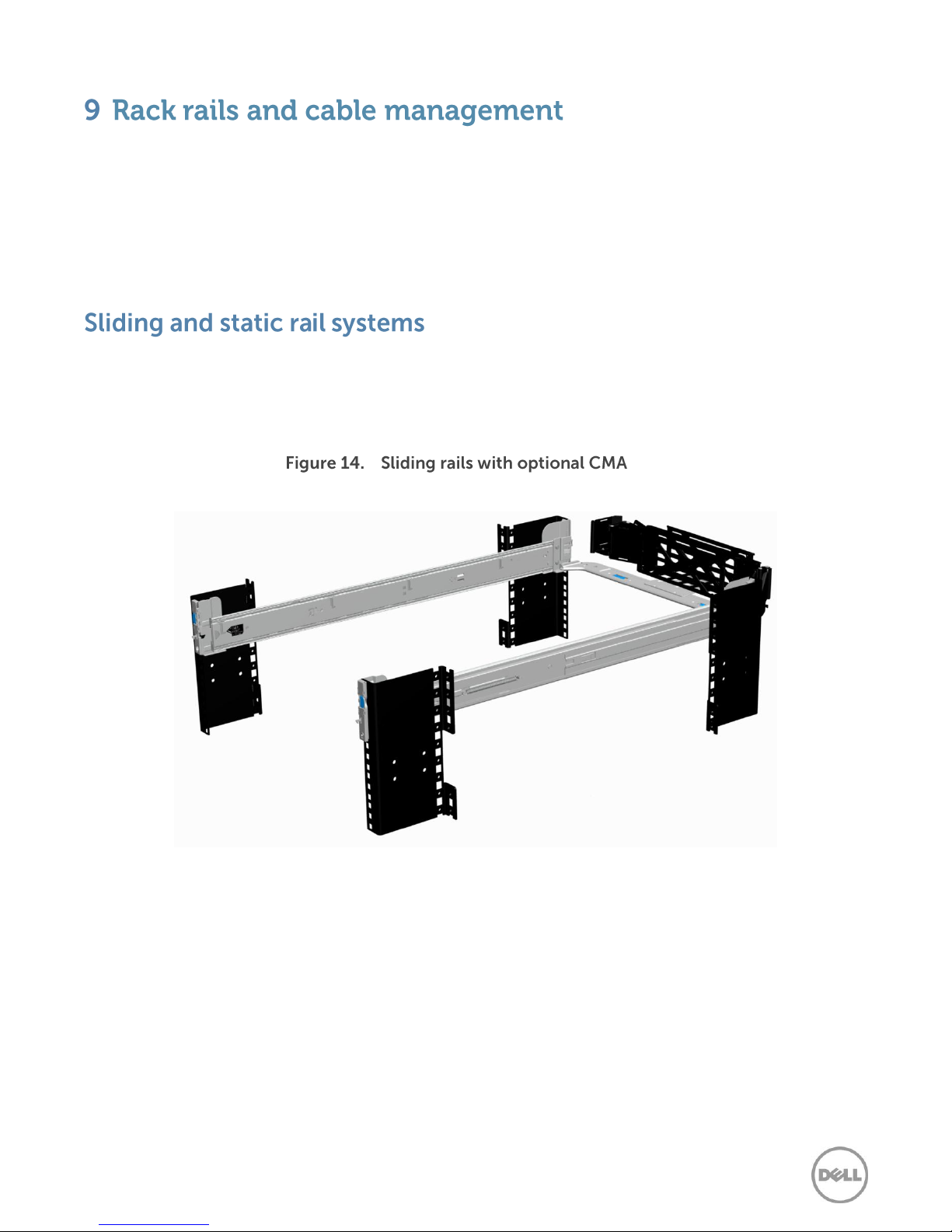
The rack rail systems for the Dell PowerEdge R720 and R720xd provide tool-less support for
4-post racks with square or unthreaded round mounting holes, including all generations of Dell
racks. Compared to the predecessor R710 sliding rails that required the use of adapter brackets, the
sliding rails for the R720 and R720xd now offer native support for threaded-hole racks with the new
ReadyRails II mounting interface.
The optional cable management arm (CMA) can be mounted on either the left or right side of the
sliding rails without the use of tools for fast and easy deployment.
The R720 and R720xd support both sliding rails and static rails. Both rails have a new slim rail design
that supports the wide system chassis.
The sliding rails (shown in Figure 14) allow the system to be fully extended out of the rack for service
and are available with or without the optional CMA.
41 PowerEdge R720 and R720xd Technical Guide
Page 42
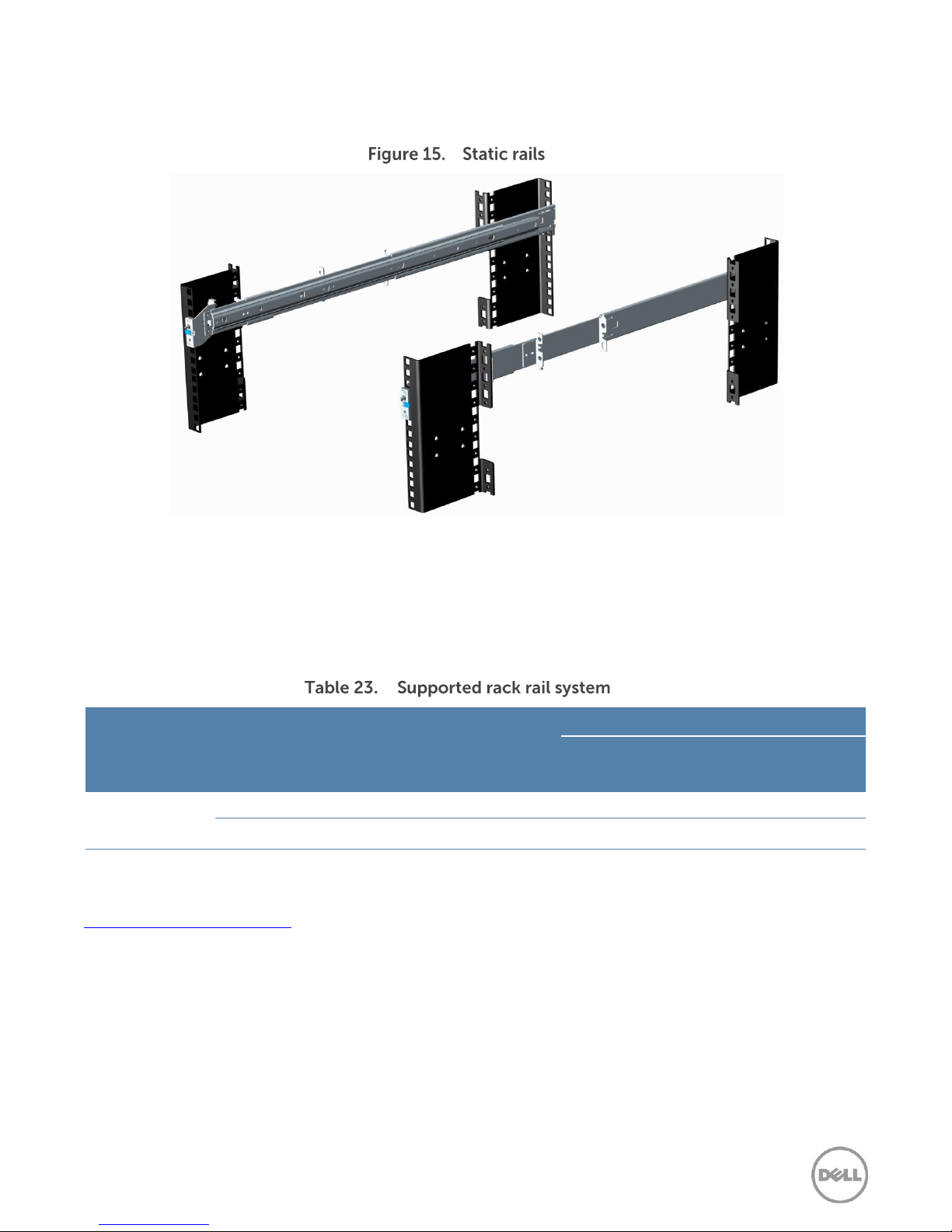
The static rails (shown in Figure 15) support a wider variety of racks than the sliding rails, but do not
System
Rail
identifier
Mounting interface
Rail
type
Rack types supported
4-post
2-post
Square
Round
Thread
Flush
Center
R720/R720xd
B6
ReadyRails II
Sliding
X
X
B4
ReadyRails
Static
support serviceability in the rack and are not compatible with the CMA.
One key factor in selecting the proper rails is identifying the type of rack in which they will be
installed. Both the sliding rails and the static rails support tool-less mounting in 19”-wide, EIA-310-E
compliant square hole and unthreaded round-hole 4-post racks. Both also support tooled mounting
in threaded hole 4-post racks, but only the static rails, as the more universal solution, support
mounting in 2-post (Telco) racks.
Table 23 lists the rack rail systems that the R720 and R720xd support.
For detailed information about rail dimensions, see the Rack rail specifications section in Appendix A.
For more information on installing the T620 in a rack, see the
Rack Installation Instructions
on
Support.Dell.com/Manuals.
42 PowerEdge R720 and R720xd Technical Guide
Page 43
The optional cable management arm (CMA) for the R720 and R720xd organizes and secures the
cords and cables exiting the back of the server and unfolds to allow the server to extend out of the
rack without having to detach the cables. Some key features of the CMA include:
Large U-shaped baskets to support dense cable loads
Open vent pattern for optimal airflow
Ability to be mounted on either side
Use of hook-and-loop straps rather than plastic tie wraps to eliminate the risk of cable damage
during cycling
Low-profile fixed tray to both support and retain the CMA in its fully closed position
Ability to mount the CMA and tray without the use of tools, due to snap-in designs
For more information on installing the R720 and R720xd in a rack, see the
Instructions
on Support.Dell.com/Manuals.
Rack Installation
43 PowerEdge R720 and R720xd Technical Guide
Page 44
Operating System
Platform
Edition
Red Hat Enterprise Linux 5.81
x32
x64
N/A
Red Hat Enterprise Linux 6.32
x64
N/A
Red Hat Enterprise Linux for HPC
x64
N/A
SUSE Linux Enterprise Server 11 SP2
x64
N/A
SUSE Linux Enterprise Server 10 SP4
x64
N/A
Microsoft Windows Server 2012
x64
Standard
Data center
Microsoft Windows Small Business Server 20113
x64
Standard
Premium add-on
Microsoft Windows Server 2008 with SP2
x86
Web
Standard
Enterprise
x64
(with Microsoft
Hyper-V role enabled)
Web
Standard
Enterprise
Data center
Microsoft Windows Server 2008 R2 with SP1
x64
(with Hyper-V role
enabled)
Web
Standard
Enterprise
Data center
HPC
The Dell PowerEdge R720 and R720xd support a wide range of industry-standard operating systems
and virtualization software.
Table 24 lists the primary operating systems supported on the R720 and R720xd. For the latest
information on supported operating systems, see Dell.com/OSsupport.
1
RHEL 5.7 is the minimum supported version. Current drop in box option is RHEL 5.8.
2
RHEL 6.1 is the minimum supported version. Current factory install is RHEL 6.3.
3
Not validated for use with GPUs.
44 PowerEdge R720 and R720xd Technical Guide
Page 45
Support of the operating systems listed in Table 25 is limited to a virtual environment as a guest
Operating System
Platform
Edition
Microsoft Windows 20031
x86
Web
Microsoft Windows 2003 R2 with SP21
x86
Standard
Enterprise
x64
Standard
Enterprise
Data center
Operating systems
Install version
Factory
options
Internal dual SD
module install
support
VMware
vSphere v4.1 U3
ESX Classic
DIB
No
vSphere v4.1 U3
ESXi Installable
DIB
No
vSphere v4.1 U3
ESXi Embedded
FI (v4.1 U2)1
Yes
vSphere v5.0
ESXi
DIB
Yes
vSphere v5.0 U1
ESXi (one version)
DIB
Yes
vSphere v5.1
ESXi (one version)
DIB
Yes
Red Hat2
Enterprise Virtualization 3.1
N/A
DIB
Yes
Citrix
XenServer v6.1
N/A
DIB
No
operating system. Please contact the software vendor for additional support or questions about
running the operating system in a virtualized environment.
1
Not validated for use with AMD® GPUs
One of the key features for virtualization on the R720 and R720xd is the support for a failsafe
hypervisor. By running the hypervisor on an optional SD card and installing a backup copy on the
other mirrored SD card, you can protect against hardware failure and maximize virtualization uptime.
Table 26 highlights the virtualization support for the R720 and R720xd.
FI = factory install; DIB = drop in box
1
v4.1 U3 image is available from support.dell.com, either as an upgrade to v4.1 U2 or for a clean install
2
No OpenManage support; drop-in-box license registration card only
45 PowerEdge R720 and R720xd Technical Guide
Page 46
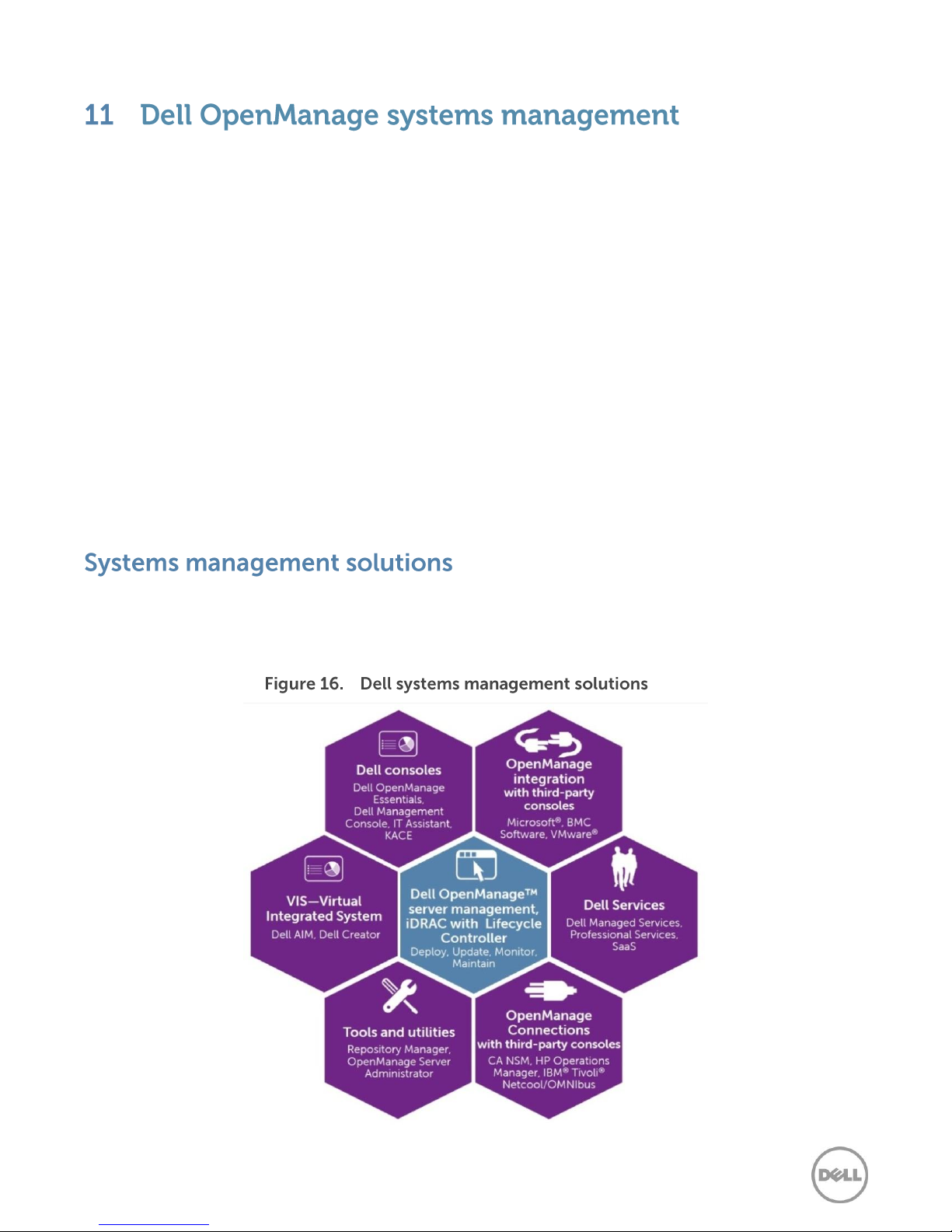
Whether your IT environment consists of a few servers or a few thousand servers,
Dell OpenManage systems management solutions provide comprehensive management for
evolving IT environments. OpenManage is based on open standards and provides agent-based and
agent-free server lifecycle management functionality for Dell PowerEdge servers. OpenManage
solutions help you automate and streamline essential hardware management tasks.
The advanced management capabilities of Dell OpenManage also integrates into offerings from
other popular systems management solutions that you may already use, making Dell platforms easy
to manage and deploy in any IT environment. This ensures your IT services are available when your
business needs them. If you have already standardized on offerings from industry leaders, such as
BMC Software, Microsoft, Symantec™, VMware, or other vendors, you can leverage OpenManage
integration and connections developed for use with your existing systems management framework
to efficiently manage Dell servers, storage, business-client PCs, and network devices.
Start with a firm foundation for efficient hardware management using OpenManage tools, utilities,
and management consoles. OpenManage systems management solutions consist of a combination
of embedded management features and software products that help you automate and simplify the
entire server lifecycle: deploy, update, monitor, and maintain. OpenManage solutions are
innovatively designed for simplicity and ease of use to help you reduce complexity, save time,
achieve efficiency, control costs, and empower productivity.
Dell systems management solutions include a wide variety of tools, products, and services that
enable you to leverage an existing systems management framework. As shown in Figure 16, Dell
systems management solutions are centered around OpenManage server management, featuring
iDRAC7 with Lifecycle Controller.
46 PowerEdge R720 and R720xd Technical Guide
Page 47
The Dell OpenManage systems management portfolio includes powerful hardware and software
Feature
Function
Benefit
Out of band
(OOB)
iDRAC7 offers real-time OOB
discovery, inventory, deployment
monitoring, alerting and updates for
servers and internal storage
Manage servers independent of the OS type
or status—even if an OS is not installed
Single code base
All server types have the same
embedded management hardware
and firmware
Simplified and consistent maintenance
across server platforms
Dedicated
GigE port
(PowerEdge
rack and tower
systems)
Gigabit Ethernet replaces 10/100 on
predecessor iDRAC6
Fast throughput for better performance;
compatibility with setup for switches
Email alerts
Simplified, more informative, and
expanded coverage than previous
versions of iDRAC
More detail allows IT administrators to be
more efficient in diagnosing and remediating
an issue; alerts include a direct, embedded
URL in the email notification to further speed
resolution
vFlash media
Enabled with iDRAC7 Enterprise
Allows for use of a non-Dell SD card
Enhanced power
management
Integration with Intel Node Manager
provides data center level power
monitoring and capping
(requires iDRAC7 Enterprise)
Fine tune data center power policies,
capping, and usage; report on historical
power usage by rack, row or room using
Power Center Manager (new)
Electronic
licensing
Upgrades to iDRAC7 Express or
iDRAC7 Enterprise by software
licensing key and license portal (may
require installation of hardware option
for 300-500 series servers)
Digital license installed in factory; free 30day trial versions are available; uses a license
management portal versus paper-based
licenses and simplifies license management.
For most server models, embedded server
management and electronic licensing
enables feature enhancements that do not
require installation of additional hardware or
system downtime.
management tools and consoles. OpenManage simplifies the lifecycle of deploying, updating,
monitoring, and maintaining your Dell PowerEdge servers.
The Integrated Dell Remote Access Controller 7 (iDRAC7) with Lifecycle Controller is the heart of the
second generation of Dell PowerEdge server embedded management functionality. In addition to
enabling agent-free management, iDRAC7 with Lifecycle Controller provides remote access to the
system—whether or not there is a functioning operating system running on the server. These
embedded features improve all aspects of a typical server lifecycle. Table 27 describes the functions
and benefits of iDRAC7 with Lifecycle Controller.
47 PowerEdge R720 and R720xd Technical Guide
Page 48
iDRAC7 Enterprise is available for the PowerEdge R720 and R720xd, and Dell also offers an option of
Feature (function)
iDRAC7
Enterprise
iDRAC7
Express
Local configuration with Lifecycle Controller GUI
∞
∞
IPMI 2.0 ∞ ∞
Embedded diagnostics
∞
∞
Local OS install
∞
∞
Local updates
∞
∞
Driver pack
∞
∞
Shared NIC (LOM)
∞
∞
Remote update
∞
∞
Power control
∞
∞
Encryption
∞
∞
Crash screen capture1
∞
∞
IPv6 ∞ ∞
Auto-discovery
∞
∞
Auto-recovery
∞
∞
Web GUI ∞ ∞
Remote CLI
∞
∞
Local/SSH CLI
∞
∞
Serial redirection
∞
∞
Remote configuration
∞
∞
Email alerts
∞
∞
SNMP alerts
∞
∞
Power monitoring
∞
∞
Comprehensive monitoring
∞
∞
Dedicated NIC 1Gbps (100MB in iDRAC6)
∞
Part replacement
∞
Backup and restore configurations
∞
Virtual console (4 user)
∞
Virtual console chat
∞
Support for customer-supplied SD cards for vFlash media
∞
iDRAC7 Express. A detailed feature comparison for iDRAC7 Enterprise and iDRAC7 Express is shown
in Table 28.
48 PowerEdge R720 and R720xd Technical Guide
Page 49
Feature (function)
iDRAC7
Enterprise
iDRAC7
Express
Virtual flash partitions
∞
Virtual media
∞
Virtual folders
∞
Remote file share
∞
Crash video playback
∞
Boot record/playback
∞
Power capping
∞
Enterprise group power management
∞
Directory services (AD, LDAP)
∞
PK authentication
∞
Two-factor authentication2
∞
1
Requires OMSA agent on target server
2
Uses Microsoft ActiveX® on Internet Explorer® only
Most systems management solutions require pieces of software, called agents, to be installed on
each node in order to be managed within the IT environment. Additionally, the same agent is often
used as a local interface into the hardware health and may be accessed remotely as a management
interface, typically referred to as a one-to-one interface. For customers that continue to use agentbased solutions, Dell provides OpenManage Server Administrator.
The Dell OpenManage Server Administrator (OMSA) agent gives you a comprehensive, one-to-one
systems management solution for both local and remote servers and their storage. OMSA can help
simplify single-server monitoring with a secure command-line interface (CLI) or Web-based
management graphical user interface (GUI). It can also be used to view system configuration,
inventory, health, and performance.
Because Dell PowerEdge servers have embedded server lifecycle management, in many cases, there
is no need to install an OpenManage systems management software agent into the operating
system of a Dell PowerEdge server. This greatly simplifies and streamlines the management footprint.
The central console in a systems management solution is often referred to as the one-to-many
console. The central console provides a rapid view and insight into the overall health of all systems
in the IT environment. The Dell systems management portfolio includes several powerful consoles,
depending upon your needs, including the following:
Dell OpenManage Essentials— OpenManage Essentials (OME) is a recently released systems
management console that provides a comprehensive view of Dell systems, devices, and
components in an enterprise network. It is used to monitor Dell PowerEdge servers, EqualLogic
and PowerVault storage, and PowerConnect™ switches; to update and configure Dell servers;
49 PowerEdge R720 and R720xd Technical Guide
Page 50
and to create asset reports. OpenManage Essentials also communicates health status alerts for
Dell servers, storage, and network devices to the Dell KACE™ K1000 service desk. OpenManage
Essentials is available as a no-charge software download from Support.Dell.com.
Dell Management Console—Dell Management Console (DMC) offers sophisticated data-center
management capabilities with comprehensive reporting features. DMC can perform basic
hardware management and can manage operating systems and applications using various plugins from Symantec.
Dell IT Assistant—Dell IT Assistant (ITA) is a console for managing Dell servers, storage arrays,
and other components distributed throughout a network. Dell IT Assistant allows for easy
identification of system issues through alerts, helping to reduce system downtime. Systems
administrators can easily monitor systems anywhere within their network using ITA. ITA is
supported on the R720 and R720xd, however, enhanced functionality is now available with
OpenManage Essentials.
Dell OpenManage systems management tools and utilities consist of the following:
Dell Repository Manager—The Dell Repository Manager (RM) is a standalone GUI-based
productivity tool that helps simplify the process of managing downloads and baseline BIOS,
firmware, and driver updates. Repository Manager can create deployment disks as well as create
and manage customized repositories.
Dell OpenManage Server Update Utility—The Dell Server Update Utility (SUU) is a DVD-based
application for identifying and applying BIOS and firmware updates to your Dell PowerEdge
servers.
Dell OpenManage Systems Build and Update Utility—The Dell System Build and Update Utility
(SBUU) provides one-to-one and one-to-many deployment and single-server update
capabilities in the pre-operating system environment.
Dell Update Packages—The Dell Update Packages (DUP) is a self-contained executable in a
standard package format that updates a software element on a Dell server such as the BIOS, a
driver, firmware and other software updates.
Dell OpenManage Deployment Toolkit—The Dell OpenManage Deployment Toolkit (DTK) is a
CLI-based tool that includes a set of utilities for configuring and deploying Dell PowerEdge
systems, and can be used to build scripted, unattended OS installations to deploy large numbers
of servers in a reliable fashion.
RACADM—The RACADM command-line utility provides a scriptable interface that allows you to
locally or remotely configure iDRAC7.
IPMITool—IPMITool includes scriptable console application programs used to control and
manage remote systems using the IPMI version 1.5 and later protocol.
Dell OpenManage easily integrates with several leading third-party consoles, including:
Dell Server Management Pack Suite for Microsoft System Center Operations
Manager (SCOM)—This suite of server management packs enables several functions through
System Center Operations Manager, including in-band discovery and monitoring of racks and
towers, out-of-band discovery and monitoring through iDRAC7 with Lifecycle Controller, as well
as performance and advanced monitoring.
50 PowerEdge R720 and R720xd Technical Guide
Page 51
Dell Lifecycle Controller Integration (DLCI) for Microsoft System Center Configuration
Manager (SCCM)—This pack contains Dell Lifecycle Controller Integration (DLCI), which
integrates OpenManage functions in SCCM to manage the Dell PowerEdge servers, including
auto-discovery, operating system deployment and configuration of hardware elements, (RAID,
NIC, BIOS, iDRAC), OS and hypervisor agnostic updates, firmware management, and system
viewer utilities.
Dell Server PRO Management Pack for Microsoft System Center Virtual Machine
Manager (SCVMM)—This pack manages Dell physical servers and hosts of virtual machines (VMs)
by using Microsoft System Center Operations Manager/System Center Essentials (SCOM/SCE)
and System Center Virtual Machine Manager (SCVMM). It provides guidance for remedial actions
based on alerts to best manage virtual machines and handle the impacts appropriately.
Dell Management Plug-in for VMware vCenter—This plug-in allows IT administrators to monitor,
provision, and manage the physical PowerEdge server hardware and firmware from a dedicated
Dell menu accessed through the VMware vCenter console using the same role-based access
control model as vCenter, combining physical server management.
BMC Software—Dell and BMC Software work together to simplify IT by ensuring tight integration
between Dell server, storage, and network management functionality and the BMC Software
process and data center automation products.
Dell OpenManage provides connections with many third-party consoles, including:
Dell OpenManage Connection for Computer Associates Network and
Systems Management—This connection allows you to monitor PowerEdge servers and
PowerVault storage arrays from within the Computer Associates Network and Systems
Management (CANSM) console.
Dell OpenManage Connection for HP Operations Manager—This connection enables several
functions through HP Operations Manager, including auto-grouping, SNMP trap reception,
global health monitoring, and a context-sensitive launch of OpenManage Server Administrator.
Dell OpenManage Connection for IBM Tivoli Netcool/OMNIBus—This connection provides
event monitoring capabilities to monitor Dell PowerEdge servers and Dell EqualLogic systems. It
allows event monitoring, automatic event correlation, and launching device consoles from the
Netcool/OMNIbus console.
Dell OpenManage systems management is centered on automating the server management
lifecycle—deploy, update, monitor, and maintain. To manage an infrastructure properly and
efficiently, you must perform all of these functions easily and quickly. iDRAC7 with Lifecycle
Controller technology provides you with these intelligent capabilities embedded within the server
infrastructure. This allows you to invest more time and energy on business improvements and less
on maintenance. Figure 17 illustrates the various operations that can be performed during the
server’s lifecycle.
51 PowerEdge R720 and R720xd Technical Guide
Page 52
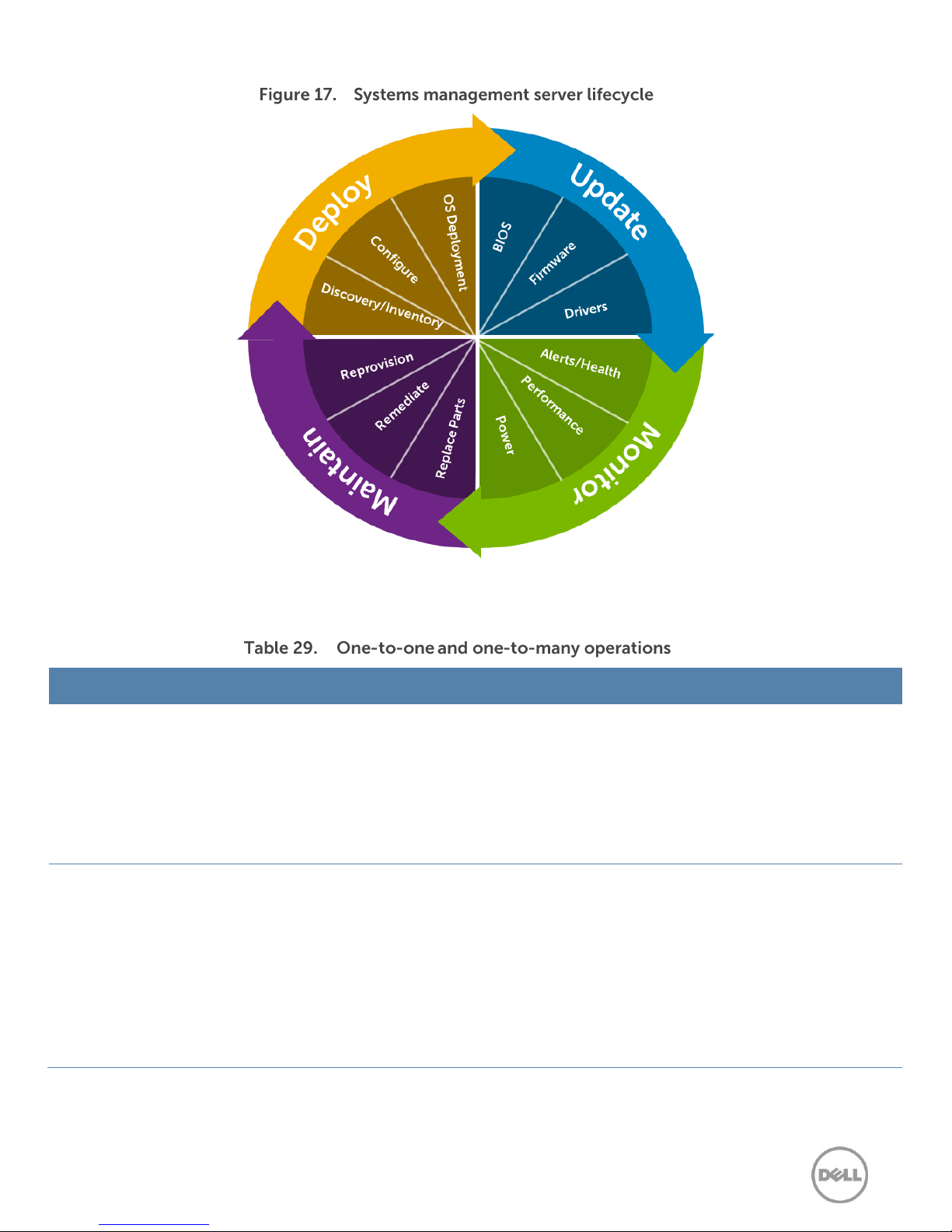
Operation
One-to-one
One-to-many
Deploy
Lifecycle Controller GUI
DTK
SBUU
Symantec Deployment Server
Dell Management Plug-in for
VMware vCenter
KACE K1000 Appliance
Lifecycle Controller Remote
Services
BMC BladeLogic integration
with Lifecycle Controller
Dell Server Deployment Pack
(DSDP) for Microsoft System
Center Configuration Manager and
Dell Lifecycle Controller
Integration (DLCI) for Microsoft
System Center Configuration
Manager
Update
iDRAC7 with LifeCycle
Controller
Lifecycle Controller GUI
Repository Manager
DUP
SUU
SBUU
Dell Management
Plug-in for VMware
vCenter
Dell OpenManage Essentials
Dell OpenManage ITA
Dell Management Console
Lifecycle Controller Remote
Services
Dell Update Catalogs for Microsoft
System Center Configuration
Manager
Dell Lifecycle Controller
Integration (DLCI) for Microsoft
System Center Configuration
Manager
Table 29 lists the products that are available for one-to-one and one-to-many operations, and
when they are used in the server’s lifecycle:
52 PowerEdge R720 and R720xd Technical Guide
Page 53

Operation
One-to-one
One-to-many
Monitor
iDRAC7
OMSA
Dell OpenManage Essentials
Dell OpenManage ITA
BMC ProactiveNet
Performance Management
Dell OpenManage Power
Center
Dell Management Console
Dell Management Plug-in for
VMware vCenter
BMC ProactiveNet
Dell Server Management Pack Suite
for Microsoft System Center
Operations Manager (SCOM)
Maintain
IPMI
iDRAC7
Lifecycle Controller GUI
Lifecycle Controller Remote
Services
Remediate:
Dell Server PRO Management Pack
for Microsoft System Center Virtual
Machine Manager (SCVMM)
Replace parts:
Dell Lifecycle Controller
Integration (DLCI) for Microsoft
System Center Configuration
Manager
For additional detailed information on Dell’s systems management portfolio, see the
Management Overview Guide
on Support.Dell.com/Manuals.
Dell Systems
53 PowerEdge R720 and R720xd Technical Guide
Page 54
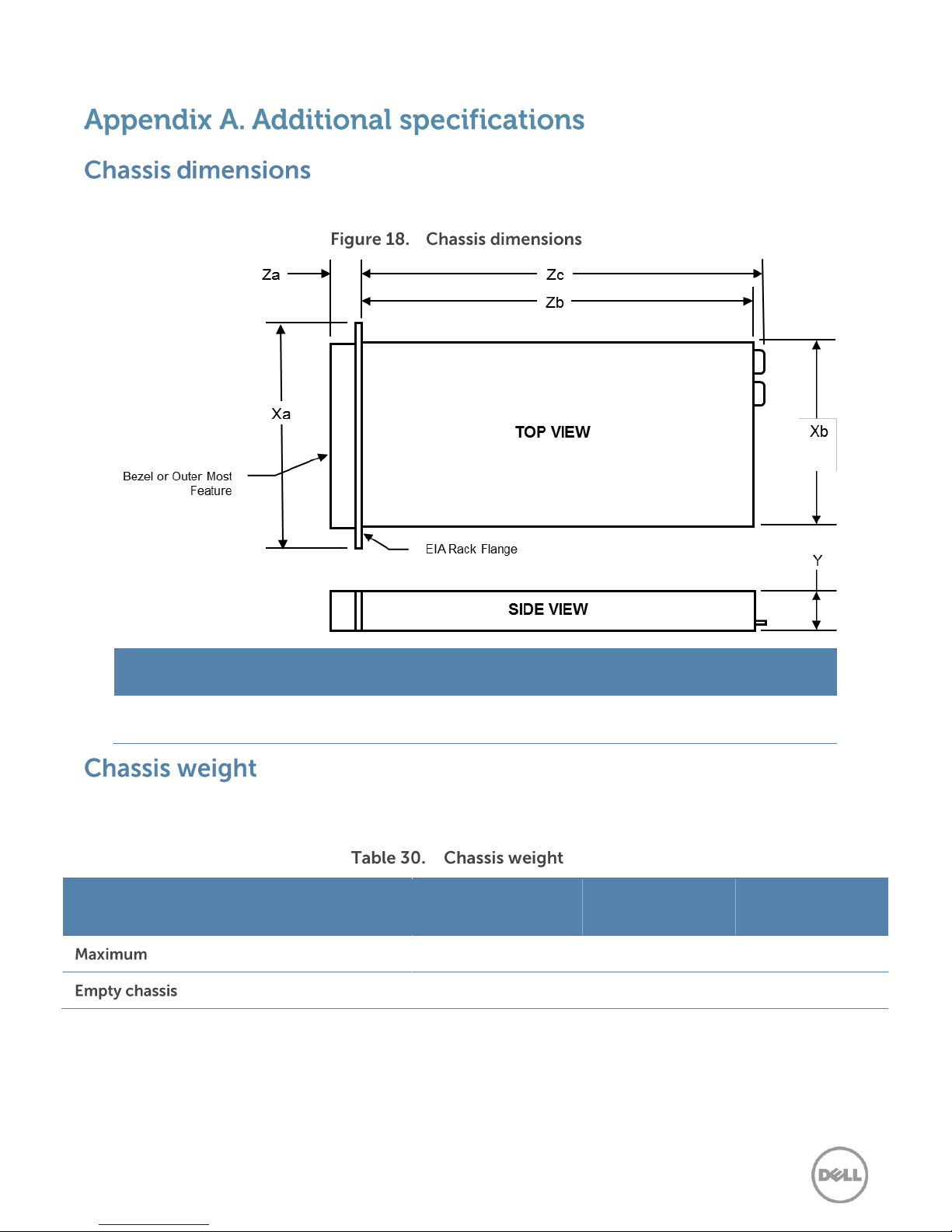
Xa
Xb
Y
Za
(with bezel)
Za
(without bezel)
Zb
Zc
482.4mm
444.0mm
87.3mm
32.0mm
18.0mm
684.0mm
723.0mm
Configuration
R720
(2.5” chassis)
R720
(3.5” chassis)
R720xd
(2.5” chassis)
R720xd
(3.5” chassis)
29.5kg (64.9lbs)
29.2kg (64.3lbs)
29.5kg (64.9lbs)
32.5kg (71.5lbs)
11.7kg (25.7lbs)
10.3kg (22.7lbs)
11.7kg (25.7 lbs)
10.3kg (22.7lbs)
Figure 18 details the dimensions of the Dell PowerEdge R720 and R720xd chassis.
Table 30 lists the weight of the R720 and R720xd chassis at maximum configuration as well as
empty of any hardware.
54 PowerEdge R720 and R720xd Technical Guide
Page 55
Table 31 details the environmental specifications for the R720 and R720xd. For additional
Fresh Air: temperature, humidity, altitude de-rating
Continuous
operation
10°C to 35°C (50°F to 95°F) at 10% to 80% relative humidity with 26°C (78.8°F) maximum
dew point (maximum wet bulb temperature). De-rate maximum allowable dry bulb
temperature at 1°C per 300m above 950m (1°F per 547 ft above 3117 ft).
Expanded
operation
When operating in the expanded temperature range, system performance may be impacted,
and ambient temperature warnings may be reported on the LCD and in the System Event
Log.
≤ 10% of annual operating hours: 5°C to 10°C and 35°C to 40°C (with no direct sunlight on
the equipment) at 5% to 85% relative humidity with 26°C dew point (maximum wet bulb
temperature). Outside the standard operating temperature (10°C to 35°C), the system can
operate down to 5°C or up to 40°C for a maximum of 10% of its annual operating hours. For
temperatures between 35°C and 40°C (95°F to 104°F), de-rate maximum allowable dry bulb
temperature by 1°C per 175m above 950m (1°F per 319 ft above 3117 ft).
≤ 1% of annual operating hours: –5°C to 5°C and 40°C to 45°C (with no direct sunlight on
the equipment) at 5% to 90% relative humidity with 26°C dew point (maximum wet bulb
temperature). Outside the standard operating temperature (10°C to 35°C), the system can
operate down to –5°C or up to 45°C for a maximum of 1% of its annual operating hours. For
temperatures between 40°C and 45°C (104°F to 113°F), de-rate maximum allowable dry bulb
temperature by 1°C per 125m above 950m (1°F per 228 ft above 3117 ft).
Expanded operation restrictions:
No cold startup below 5°C
Maximum altitude for the operating temperature must be 3050m (10,000ft)
Redundant power supplies are required
Not supported:
- Express Flash PCIe SSD
- GPU
- LRDIMM
- 130W 4-core processors
- Non-redundant power supplies
- Peripheral cards not qualified by Dell
- Peripheral cards greater than 25W
For the PowerEdge R720, a maximum 130W processor is supported in either the 8-drive
bay or 16-drive bay chassis.
The following additional restrictions apply to PowerEdge R720xd:
- Maximum 95W processor is supported on 3.5-inch hard drive chassis
- Maximum 115 W processor is supported on 2.5-inch hard drive chassis
- Only SSDs are supported in the hard drive slots on the back of the 3.5-inch hard
drive chassis.
Temperature
Operating
See Fresh Air for temperature information
Storage
–40oC to 65oC (-40oF to 149oF) with a maximum temperature gradation of 20oC per hour
Relative humidity
Operating
See Fresh Air for relative humidity information
Storage
5% to 95% at a maximum wet bulb temperature of 33°C (91°F); atmosphere must be
condensing at all times
information about environmental measurements for specific system configurations, see
Dell.com/environmental_datasheets.
55 PowerEdge R720 and R720xd Technical Guide
Page 56
Maximum vibration
Operating
0.26 Grms at 5Hz to 350Hz in all orientations
Storage
1.87 Grms at 10Hz to 500Hz for 15 minutes (all six sides tested)
Maximum shock
Operating
Half sine shock in all operational orientations of 31G +/– 5% with a pulse duration of 2.6ms
+/– 10%
Storage
Half sine shock on all six sides of 71G +/– 5% with a pulse duration of 2ms +/–10%; square
wave shock on all six sides of 27G with velocity change at 235 in/sec or greater
Altitude
Operating
–15.2m to 3048m (–50 ft to 10,000 ft)
Storage
–15.2m to 12,000m (–50 ft to 39,370 ft)
Airborne contaminant level
Class G1 or lower as defined by ISA-S71.04-1985
Table 32 lists power supply specifications for the PowerEdge R720 and R720xd.
Specification
1100W DC
1100W AC
750W AC
495W AC
Current consumption
32A
12A–6.5A
10A–5A
6.5A–3A
Supply voltage
-48V to -60V DC
100–240VAC1
100–240VAC1
100–240VAC1
Frequency
N/A
50/60Hz
50/60Hz
50/60Hz
Heat dissipation (BTU/hr max)
4416
4100
28432 / 28913
1908
Maximum inrush current4
55A
55A
55A
55A
Resolution
Refresh rate (Hz)
Color depth (bit)
640 x 480
60, 70
8, 16, 32
800 x 600
60, 75, 85
8, 16, 32
1024 x 768
60, 75, 85
8, 16, 32
1152 x 864
60, 75, 85
8, 16, 32
1280 x 800 (UI)
—
—
1
Auto-ranging
2
Titanium efficiency
3
Platinum efficiency
4
Under typical line conditions and over the entire system ambient operating range, the inrush current may reach 55A per
power supply for 10ms or less.
The Dell PowerEdge R720 and R720xd iDRAC7 incorporates an integrated video subsystem. The
graphics controller is the 2D Matrox® G200. The video frame buffer (16 MB) is contained within the
iDRAC RAM (256 MB) device. The R720 and R720xd systems support the 2D graphics video modes
listed in Table 33.
56 PowerEdge R720 and R720xd Technical Guide
Page 57
Resolution
Refresh rate (Hz)
Color depth (bit)
1280 x 1024
60, 75
8, 16, 32
1440 x 900
60
8, 16, 32
The rack rail adjustability ranges are listed in Table 34.
Server
Rail
identifier
Rail
type
Rail adjustability range (mm)
Rail depth (mm)
Square
Round
Threaded
without
CMA
with
CMA
Min
Max
Min
Max
Min
Max
R720/R720xd
B6
Sliding
676
868
662
861
676
883
714
845
B4
Static
608
879
594
872
604
890
622
—
The adjustment range of the rails is a function of the type of rack in which they are being mounted.
The minimum and maximum values listed above represent the allowable distance between the front
and rear mounting flanges in the rack. Rail depth without the CMA represents the minimum depth
of the rail with the outer CMA brackets removed (if applicable) as measured from the front mounting
flanges of the rack.
USB peripherals are supported through the front, back, and internal USB ports. They are USB 2.0
compliant.
57 PowerEdge R720 and R720xd Technical Guide
Page 58
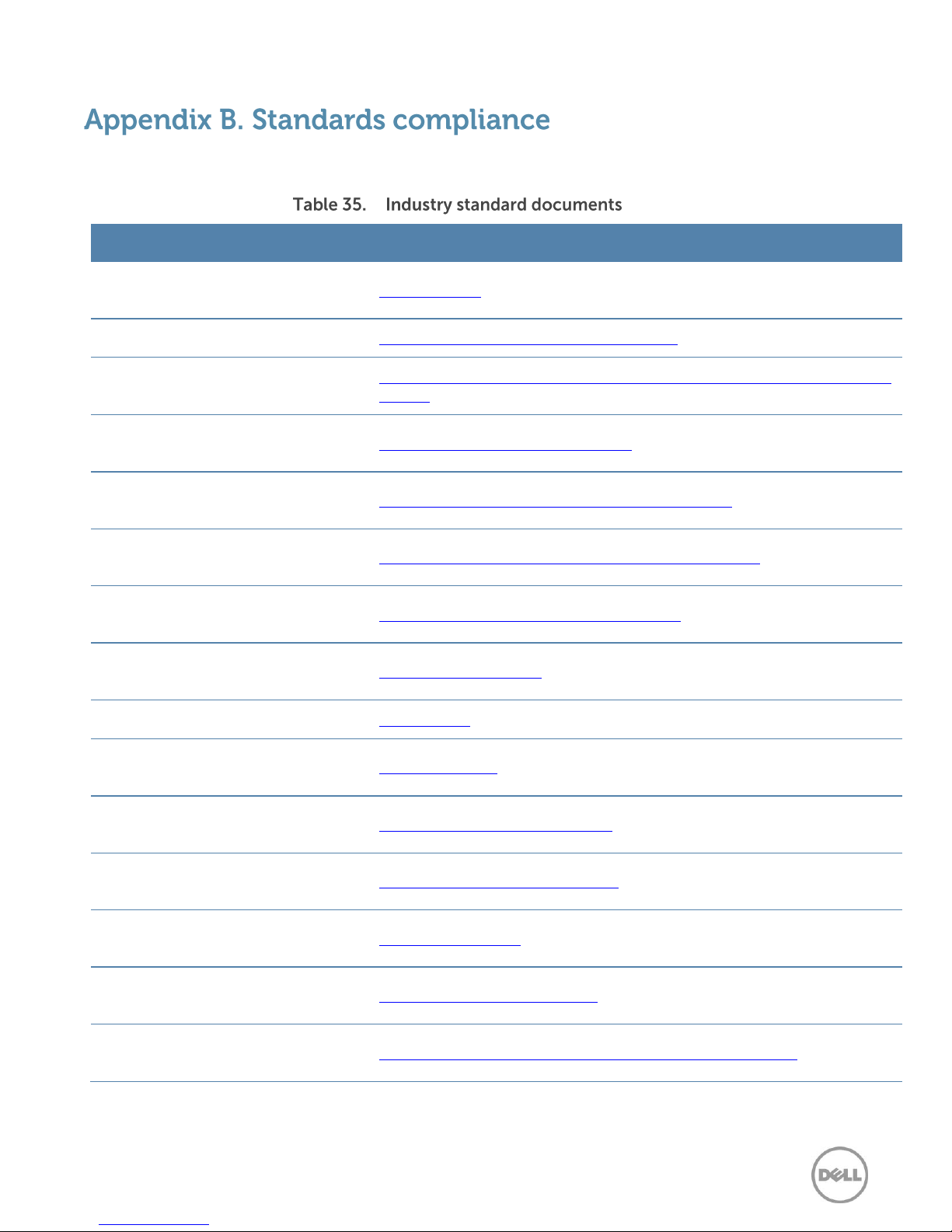
Standard
URL for information and specifications
ACPI
Advance Configuration and Power
Interface Specification, v2.0c
www.acpi.info
Ethernet
IEEE 802.3-2005
standards.ieee.org/getieee802/802.3.html
HDG
Hardware Design Guide Version 3.0
for Microsoft Windows Server
www.microsoft.com/whdc/system/platform/pcdesign/desguide/serverd
g.mspx
IPMI
Intelligent Platform Management
Interface, v2.0
www.intel.com/design/servers/ipmi
DDR3 Memory
DDR3 SDRAM Specification,
Rev. 3A
www.jedec.org/download/search/JESD79-3C.pdf
LPC
Low Pin Count Interface
Specification, Rev. 1.1
developer.intel.com/design/chipsets/industry/lpc.htm
PCI Express
PCI Express Base Specification Rev.
2.0 and 3.0
www.pcisig.com/specifications/pciexpress
PMBus
Power System Management
Protocol Specification, v1.2
pmbus.info/specs.html
SAS
Serial Attached SCSI, v1.1
www.t10.org
SATA
Serial ATA Rev. 2.6; SATA II, SATA
1.0a Extensions, Rev. 1.2
www.sata-io.org
SMBIOS
System Management BIOS
Reference Specification, v2.7
www.dmtf.org/standards/smbios
TPM
Trusted Platform Module
Specification, v1.2
www.trustedcomputinggroup.org
UEFI
Unified Extensible Firmware
Interface Specification, v2.1
www.uefi.org/specs
USB
Universal Serial Bus Specification,
Rev. 2.0
www.usb.org/developers/docs
Windows Logo
Windows Logo Program System and
Device Requirements, v3.10
www.microsoft.com/whdc/winlogo/hwrequirements.mspx
The R720 and R720xd systems conform to the industry standards in Table 35.
58 PowerEdge R720 and R720xd Technical Guide
Page 59

Resource
Description of contents
Location
PowerEdge R720
and R720xd
Owner’s Manual
This manual, available in PDF format, provides the
following information:
Chassis features
System Setup program
System messages
System codes and indicators
System BIOS
Remove and replace procedures
Troubleshooting
Diagnostics
Jumpers and connectors
Support.Dell.com/Manuals
PowerEdge R720
and R720xd
Getting Started
Guide
This guide is printed and shipped with the system, and is
also available in PDF format on the Dell support site. This
guide provides information on the following:
Initial setup steps
Key system features
Technical specifications
Support.Dell.com/Manuals
Rack Installation
Instructions
This printed document is provided with the rack kits. The
document provides the instructions for installing the
server in a rack.
Support.Dell.com/Manuals
Cable
Management Arm
Installation
Instructions
This printed document is provided with the rack kits. The
document provides the instructions for installing the
cable management arm on the rack.
Support.Dell.com/Manuals
System
Information Label
The system information label documents the system
board layout and system jumper settings.
Inside the system chassis
Quick Resource
Locator (QRL)
code
This code can be scanned by a phone application to
access additional information and resources for the
server, including videos, reference materials, service tag
information, and Dell contact information.
Inside the system chassis
Information
Update
This document provides updated system information and
is printed and shipped with the system. It is also available
in PDF format on the Dell support site.
Support.Dell.com/Manuals
Dell Energy Smart
Data Center
Assessment
uses infrastructure and thermal analysis to help maximize
system efficiency
Dell.com/EnergySmart
Energy Smart
Solution Advisor
(ESSA)
The Dell online advisor console enables easier and more
meaningful estimates to help you determine the most
efficient configuration possible. Use ESSA to calculate the
power consumption of your hardware, power
Dell.com/ESSA
Table 36 provides a list of documents and websites that provide for more information on the Dell
PowerEdge R720 and R720xd.
59 PowerEdge R720 and R720xd Technical Guide
Page 60
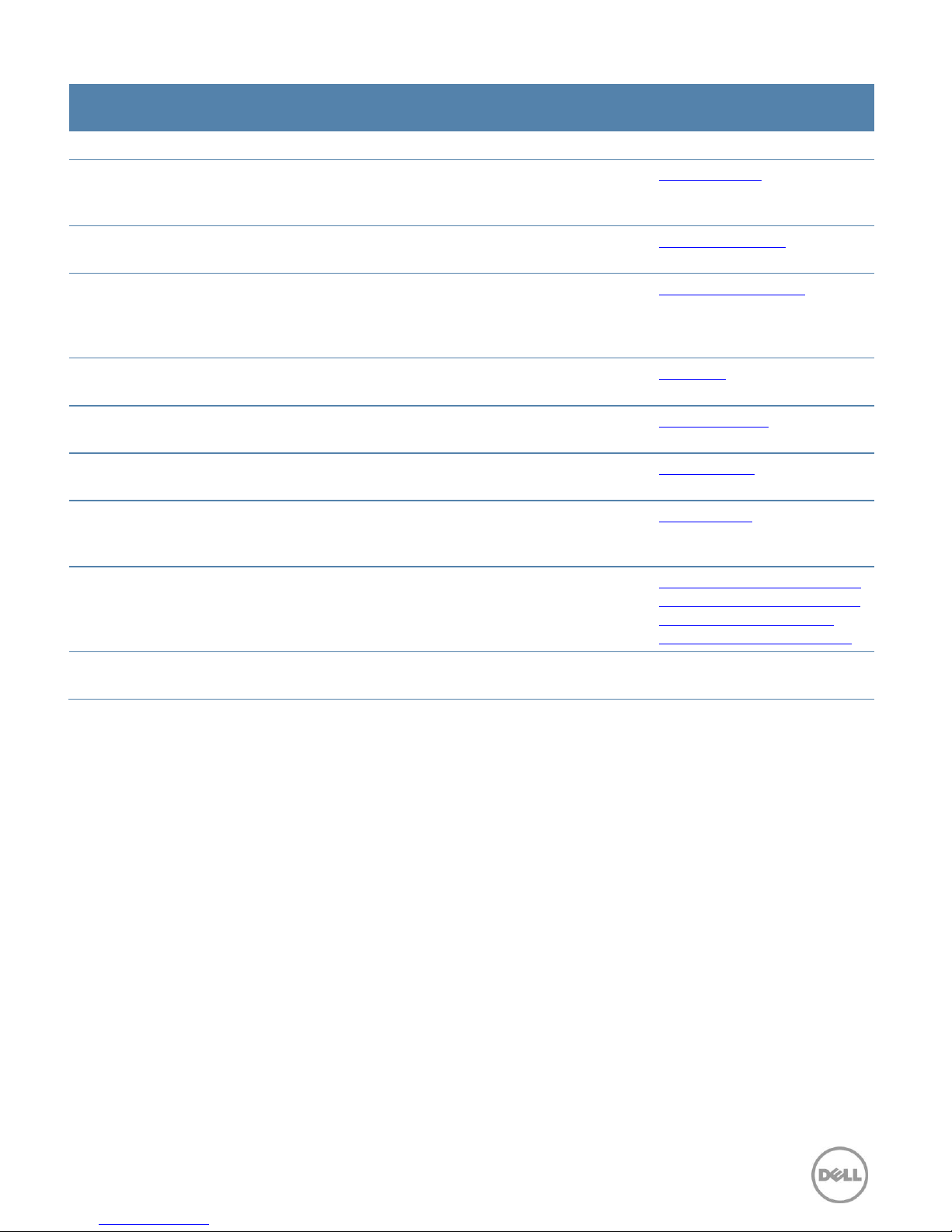
Resource
Description of contents
Location
infrastructure, and storage.
Power and
cooling
technologies
Provides details for improving energy efficiency in the
data center.
Dell.com/PNC
Energy
management
Provides information on Dell’s Fresh Air solutions.
Dell.com/FreshAir
Operating system
matrix for Dell
PowerEdge
systems
Provides updated information on which operating
systems are available on which PowerEdge systems.
Dell.com/OSsupport
Processor and
chipset
Provides more information about the R620 processors
and chipset.
Intel.com
Dell PowerEdge
RAID controllers
Provides more information on Dell PowerEdge RAID
controllers (PERC).
Dell.com/PERC
Power distribution
unit (PDU)
Provides help selecting a power distribution unit (PDU).
DellPDU.com
Uninterruptible
power supply
(UPS)
Provides help selecting an uninterruptible power supply
(UPS) model.
DellUPS.com
Dell Enterprise
Acoustics
White paper that explores the mechanisms of, people’s
reaction to, language of, and Dell’s work to control noise
from Enterprise products.
www.dell.com/downloads/g
lobal/products/pedge/en/ac
oustical-education-dellenterprise-white-paper.pdf
Volatility
information
Contact your Dell Sales Representative.
60 PowerEdge R720 and R720xd Technical Guide
Page 61
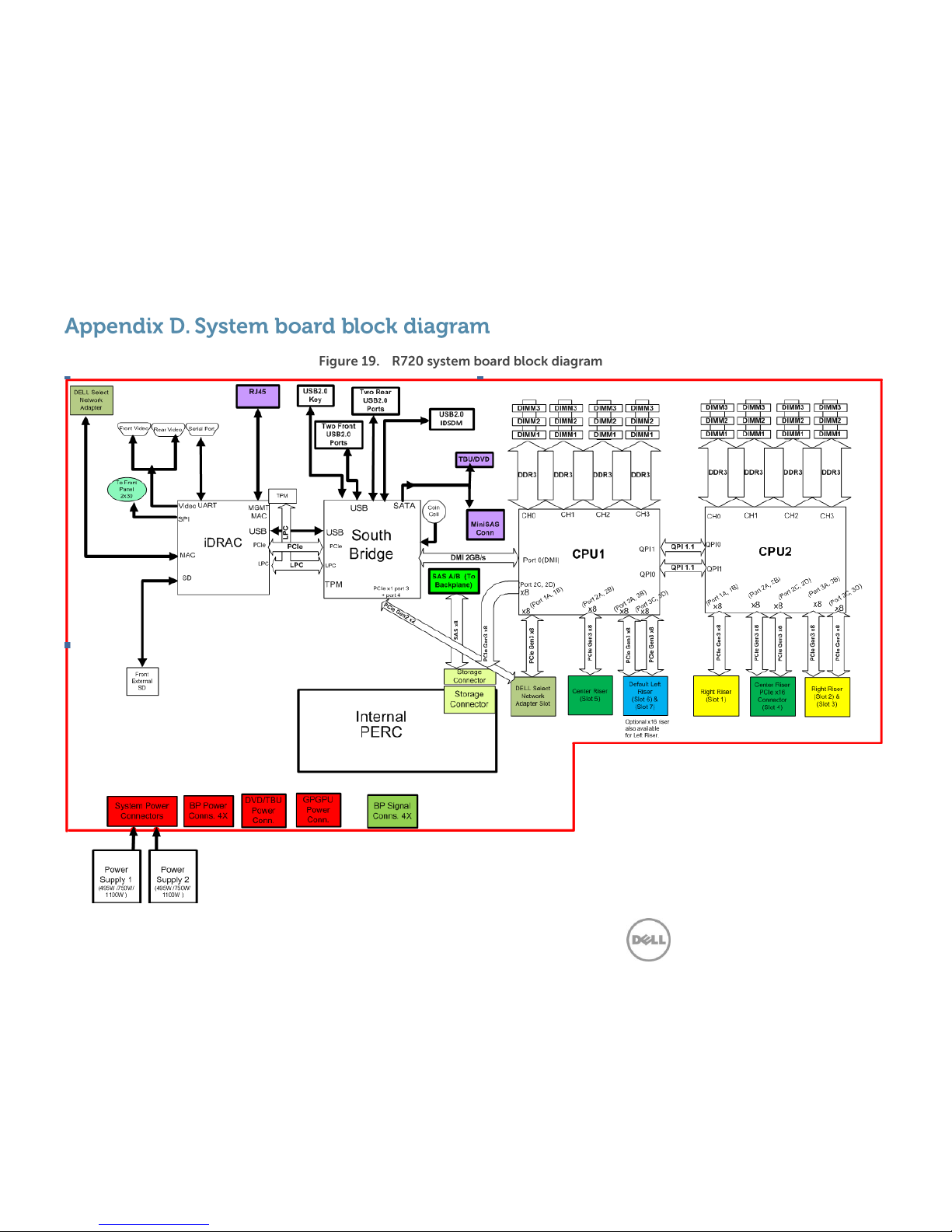
61 PowerEdge R720 and R720xd Technical Guide
Page 62
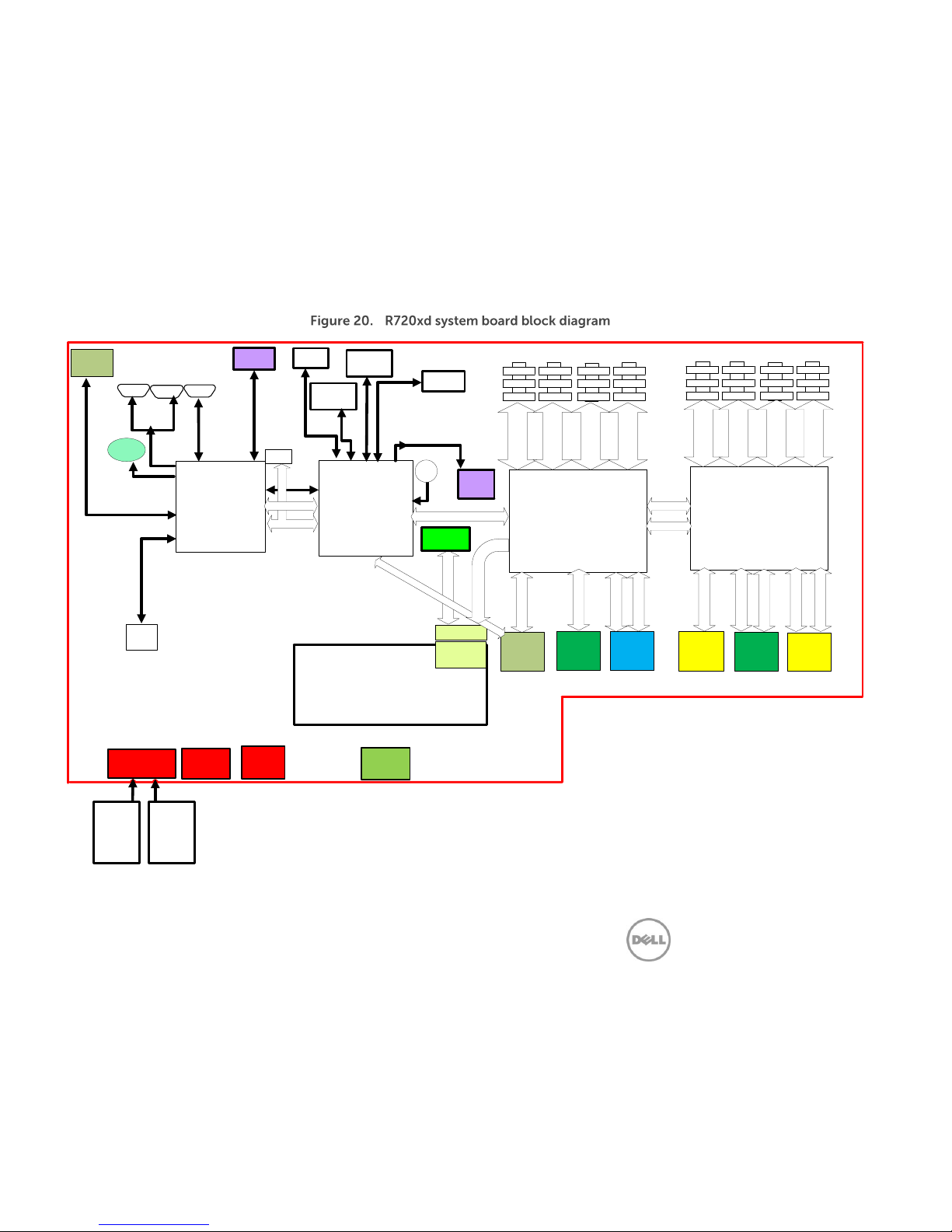
62 PowerEdge R720 and R720xd Technical Guide
CPU2
CPU1
Internal
PERC
South
Bridge
Rear Video
SATA
iDRAC
USB
x8
x8 x8
(
Port
3
A
, 3
B
)
(Port 2C, 2D)
QPI1
DMI 2GB/s
Port 0(DMI)
QPI0
PCIe
(
Port
3
C
,
3D
)
Storage
Connector
To Front
Panel
2x30
TPM
(
Port
1
A
, 1B
)
QPI0
DDR3 DDR3 DDR3 DDR3
DIMM1 DIMM1 DIMM1 DIMM1
DIMM2 DIMM2 DIMM2 DIMM2
DIMM3 DIMM3 DIMM3 DIMM3
QPI1
DDR3 DDR3 DDR3 DDR3
DIMM1 DIMM1 DIMM1 DIMM1
DIMM2 DIMM2 DIMM2 DIMM2
DIMM3 DIMM3 DIMM3 DIMM3
QPI 1.1
QPI 1.1
Storage
Connector
PCIe Gen3 x8
Front Video
Video
UART
USB
USB
LPC
Serial Port
Rear
External
SD
MGMT
MAC
RJ45
TPM
SPI
System Power
Connectors
x8
PCIe Gen3 x8
PCIe Gen3 x8
PCIe Gen3 x8
x8
x8
x8
x8
x8
PCIe Gen3 x8
PCIe Gen3 x8
PCIe Gen3 x8
Center Riser
PCIe x16
Connector
(Slot 4)
Power
Supply 2
(495W /750W/
1100W )
CH0
CH1 CH2
CH3
CH0
CH2
CH3
CH1
BP Power
Conns. 4X
PCIe
LPC
LPC
Right Riser
(Slot 1)
(
Port
1
A
, 1
B
)
(
Port
2A
, 2
B
)
(
Port
2C
, 2
D
)
(
Port
3A
, 3B
)
(
Port
3
C
,
3
D
)
SD
PCIe Gen3 x8
PCIe Gen3 x8
GPGPU
Power
Conn.
PCIe x1 port 3
+ port 4
Coin
Cell
MAC
DELL Select
Network
Adapter
USB2.0
Key
USB2.0
IDSDM
One Front
USB2.0
Ports
Two Rear
USB2.0
Ports
LPC
PCIe
SAS x8
Right Riser
(Slot 2) &
(Slot 3)
X16 Left Riser
(Slot 6)
DELL Select
Network
Adapter Slot
(
Port
2
A
, 2
B
)
x8
Center Riser
(Slot 5)
BP Signal
Conns. 4X
PCIe Gen
2
x
2
SAS A/B (To
Backplane)
PCIe Gen3 x8
MiniSAS
Conn
Power
Supply 1
(495W /750W/
1100W )
 Loading...