

Page 1
VRE303
Low Cost
Precision Reference
DESCRIPTION
FEATURES
The VRE303 is a low cost, high precision 3.0V
reference. Packaged in the industry standard 8
pin DIP, the device is ideal for upgrading systems
that use lower performance references.
The device provides ultrastable +3.000V output
with ±0.3000 mV (.01%) initial accuracy and a
temperature coefficient of 0.6 ppm/°C. This
improvement in accuracy is made possible by a
unique, patented multipoint laser compensation
technique developed by Thaler Corporation.
Significant improvements have been made in
other performance parameters as well, including
initial accuracy, warm-up drift, line regulation, and
long-term stability, making the VRE303 series the
most accurate reference available in the standard
8 pin DIP package.
For enhanced performance, the VRE303 has an
external trim option for users who want less than
0.01% initial error. For ultra low noise
applications, an external capacitor can be
attached between the noise reduction pin and the
ground pin. A reference ground pin is provided to
eliminate socket contact resistance errors.
5
6
7
8
VRE303
TOP
VIEW
1
2
3
4
N/C
+V
IN
TEMP
GND
NOISE
REDUCTION
REF. GND
V
OUT
TRIM
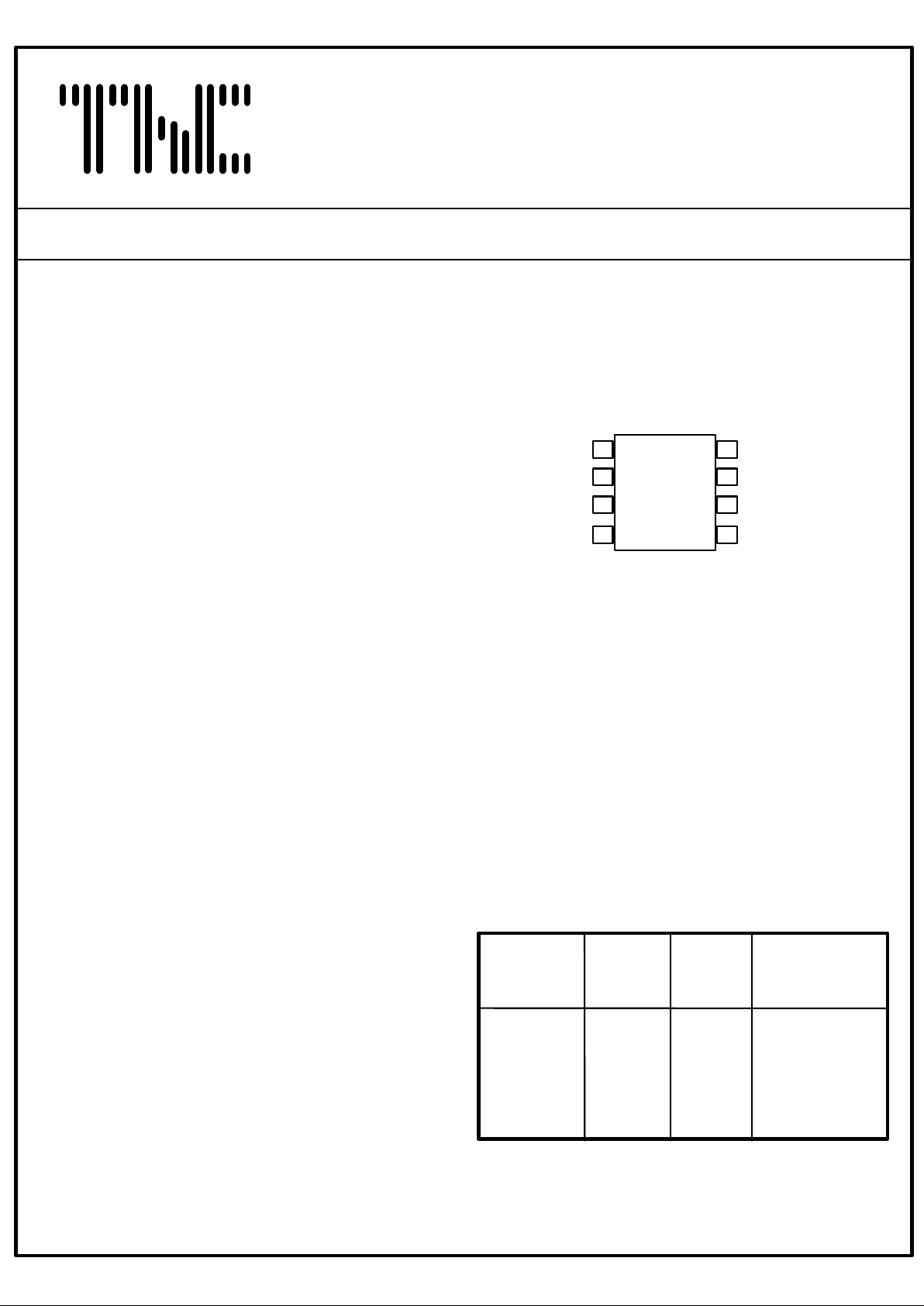
PIN CONFIGURATION
The VRE303 is recommended for use as a
reference for 14, 16, or 18 bit D/A converters
which require an external precision reference.
The device is also ideal for calibrating scale factor
on high resolution A/D converters. The VRE303
offers superior performance over monolithic
references.
• 3.000 V OUTPUT ± 0.300 mV (.01%)
• TEMPERATURE DRIFT: 0.6 ppm/°C
• LOW NOISE: 1.5µV
p-p
(0.1-10Hz)
• INDUSTRY STD PINOUT- 8 PIN DIP OR
SURFACE MOUNT PACKAGE
•EXCELLENT LINE REGULATION: 6ppm/V Typ.
• OUTPUT TRIM CAPABILITY
FIGURE 1
VRE303DS REV. B MAY 2001
SELECTION GUIDE
Model
Temp.
Range
°C
Temp.
Coeff.
ppm/°C
VRE303A 0.30 0.6 0°C to +70°C
VRE303B 0.48 1.0 0°C to +70°C
VRE303C 0.60 2.0 0°C to +70°C
VRE303J 0.30 0.6 -40°C to +85°C
VRE303K 0.48 1.0 -40°C to +85°C
VRE303L 0.60 2.0 -40°C to +85°C
For package option add D for DIP or S for Surface Mount
to end of model number.
Initial
Error
mV
THALER CORPORATION • 2015 N. FORBES BOULEVARD • TUCSON, AZ. 85745 • (520) 882-4000
Page 2
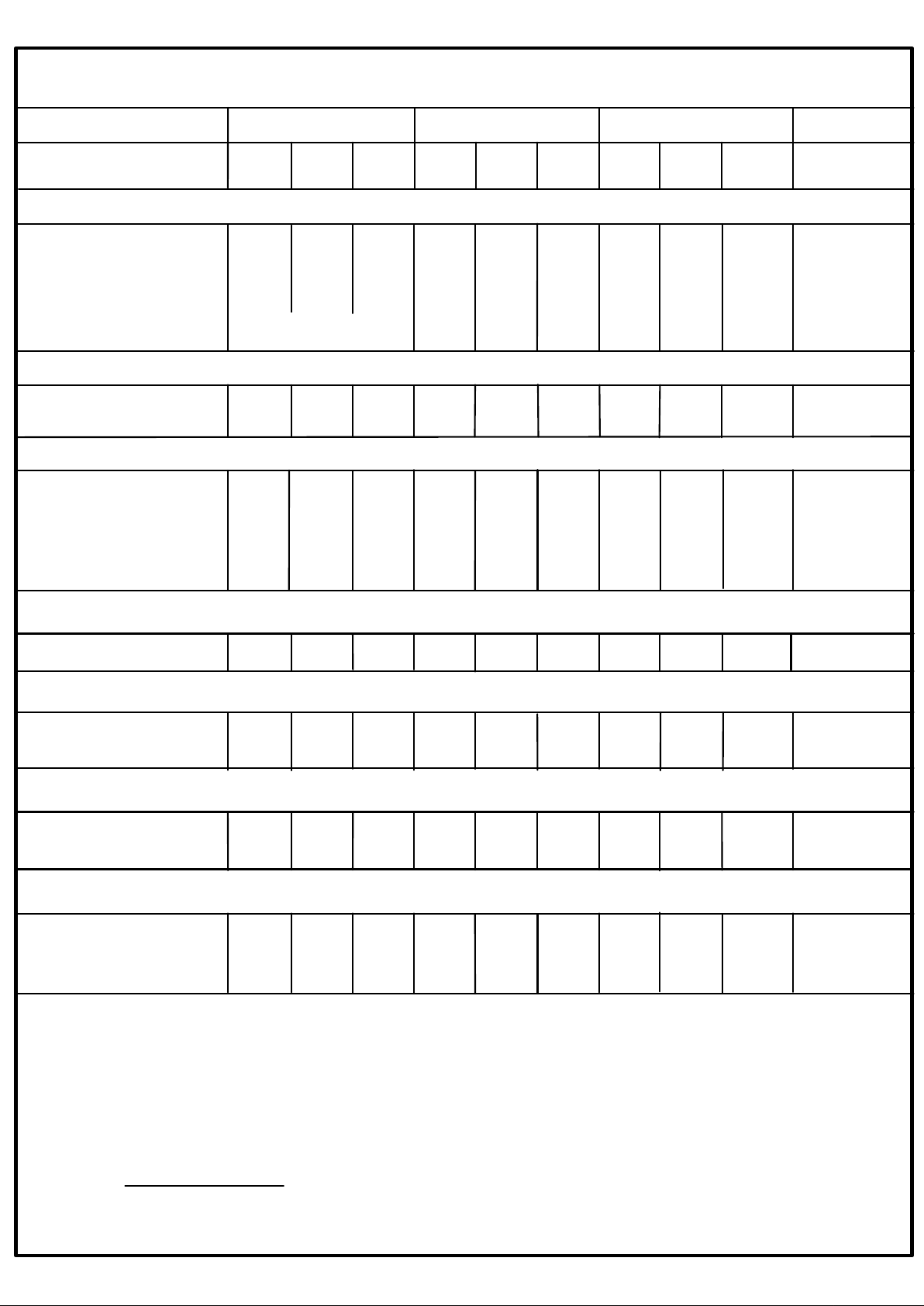
MODEL A/J B/K C/L
PARAMETER MIN TYP MAX MIN TYP MAX MIN TYP MAX UNITS
ABSOLUTE RATINGS
Power Supply +14 +15 +16 * * * * * * V
Operating Temp. (A,B,C) 0 +70 * * * * °C
Operating Temp. (J,K,L) -40 +85 * * * * °C
Storage Temperature -65 +150 * * * * °C
Short Circuit Protection Continuous * *
OUTPUT VOLTAGE
VRE303 3.000 * * V
Temp. Sensor Voltage 630 * * mV
OUTPUT VOLTAGE ERRORS
Initial Error 0.30 0.48 0.60 mV
Warmup Drift 1 2 3 ppm
T
min
- T
max
0.6 1.0 2.0 ppm/°C
Long-Term Stability 6 * * ppm/1000hrs
Noise (.1-10Hz) 2.0 * * µVpp
OUTPUT CURRENT
Range ±10 * * mA
REGULATION
Line 6 10 * * * * ppm/V
Load 3 * * ppm/mA
OUTPUT ADJUSTMENT
Range 10 * * mV
POWER SUPPLY CURRENTS
VRE303 +PS 5 7 * * * * mA
VRE303
NOTES: *Same as A/J Models.
1. The temp. reference TC is 2.1mV/ °C
2. The specified values are without external trim.
3. The temperature coefficient is determined by the box
method using the following formula:
V
max
- V
min
T.C. = x 10
6
V
nominal
x (T
max-Tmin
)
(1)
(5)
(2)
(3)
VRE303DS REV. B MAY 2001
Vps =+15V, T = 25°C, RL = 10KΩ unless otherwise noted.
ELECTRICAL SPECIFICATIONS
4. The specified values are without the external
noise reduction capacitor.
5. The specified values are unloaded.
(4)
Page 3

TYPICAL PERFORMANCE CURVES
TemperatureoC
VRE303A
V
OUT
vs. TEMPERATURE
TemperatureoC
VRE303B
V
OUT
vs. TEMPERATURE
VRE303DS REV. B MAY 2001
V
OUT
vs. TEMPERATURE
TemperatureoC
VRE303C
TemperatureoC
VRE303J
V
OUT
vs. TEMPERATURE
TemperatureoC
VRE303K
V
OUT
vs. TEMPERATURE
TemperatureoC
VRE303L
V
OUT
vs. TEMPERATURE
QUIESCENT CURRENT VS. TEMP
TemperatureoC
JUNCTION TEMP. RISE VS. OUTPUT CURRENT
Output Current (mA)
PSRR VS. FREQUENCY
Frequency (Hz)
Page 4

DISCUSSION OF PERFORMANCE
THEORY OF OPERATION
The following discussion refers to the schematic in
figure 2 below. A FET current source is used to bias a
6.3V zener diode. The zener voltage is divided by the
resistor network R1 and R2. This voltage is then applied
to the noninverting input of the operational amplifier which
amplifies the voltage to produce a 3.000V output. The
gain is determined by the resistor networks R3 and R4:
G=1 + R4/R3. The 6.3V zener diode is used because it is
the most stable diode over time and temperature.
The current source provides a closely regulated zener
current, which determines the slope of the references’
voltage vs. temperature function. By trimming the zener
current a lower drift over temperature can be achieved.
But since the voltage vs. temperature function is nonlinear
this compensation technique is not well suited for wide
temperature ranges.
Thaler Corporation has developed a nonlinear
compensation network of thermistors and resistors that is
used in the VRE series voltage references. This
proprietary network eliminates most of the nonlinearity in
the voltage vs. temperature function. By adjusting the
slope, Thaler Corporation produces a very stable voltage
over wide temperature ranges.
VRE303
FIGURE 2
VRE303DS REV. B MAY 2001
This network is less than 2% of the overall network
resistance so it has a negligible effect on long term
stability.
Figure 3 shows the proper connection of the VRE303
series voltage references with the optional trim resistor for
initial error and the optional capacitor for noise reduction.
The VRE303 reference has the ground terminal brought
out on two pins (pin 4 and pin 7) which are connected
together internally. This allows the user to achieve greater
accuracy when using a socket. Voltage references have a
voltage drop across their power supply ground pin due to
quiescent current flowing through the contact resistance.
If the contact resistance was constant with time and
temperature, this voltage drop could be trimmed out.
When the reference is plugged into a socket, this source
of error can be as high as 20ppm. By connecting pin 4 to
the power supply ground and pin 7 to a high impedance
ground point in the measurement circuit, the error due to
the contact resistance can be eliminated. If the unit is
soldered into place, the contact resistance is sufficiently
small that it does not effect performance. Pay careful
attention to the circuit layout to avoid noise pickup and
voltage drops in the lines.
EXTERNAL CONNECTIONS
FIGURE 3
8
4
6
5
+ V
OUT
2
+ V
IN
VRE303
10kΩ
C
N
1µF
OPTIONAL
NOISE REDUCTION
CAPACITOR
OPTIONAL
FINE TRIM
ADJUSTMENT
3
V TEMP OUT
7
REF. GND
Page 5

DIM MIN MAX MIN MAX DIM MIN MAX MIN MAX
A .115 .125 2.92 3.17 E .397 .403 10.0 10.2
B .018 .022 .457 .558 E1 .264 .270 6.70 6.85
B1 .046 .051 1.14 1.29 G1 .290 .310 7.36 7.87
B2 .098 .102 2.48 2.59 L .195 .215 4.95 5.46
C .009 .012 0.22 0.30 P .085 .095 2.15 2.41
D .397 .403 10.0 10.2 Q .055 .065 1.39 1.65
D 1 .372 .380 9.44 9.65 S .045 .055 1.14 1.39
INCHES MILLIMETER
INCHES MILLIMETER
VRE303DS REV. B MAY 2001
MECHANICAL
FIGURE 4
FIGURE 3
INCHES MILLIMETER
DIM MIN MAX MIN MAX DIM MIN MAX MIN MAX
A .115 .125 2.92 3.17 D2 .018 .023 0.46 0.58
B .098 .102 2.48 2.59 E .507 .513 12.8 13.0
B1 .046 .051 1.14 1.29 E1 .397 .403 10.0 10.2
C .107 .113 2.71 2.89 E2 .264 .270 6.70 6.85
C1 .009 .012 0.22 0.30 P .085 .095 2.15 2.41
C2 .052 .058 1.32 1.47 Q .020 .030 .508 .762
D .397 .403 10.0 10.2 S .045 .055 1.14 1.39
D1 .372 .380 9.44 9.65
INCHES MILLIMETER
D2
E
E1
E2
PIN 1 IDENTIFIER
D
D1
BASE
SEATING
A
Q
B
B1
S
E1
C1
C
C2
P
 Loading...