

Page 1
12
Note:
Non-Isolate
Output
Gate In
Gate Out
ZCS
Boost
Converter
Inrush
& Short
Circuit
Protection
High Frequency
Control
Voltage
Waveform
Current
Sense
AC
Line
Control
& House-
keeping
Circuitry
Output Voltage
Module Enable
Power OK
DC
Out
Recti-
fier
Aux. Supply
+
–
NOTE: No input to output isolation.
1-800-735-6200
VI-HAM
Harmonic Attenuator
Modules
Features
■ Unity Power Factor
■ Safety Agency Approvals:
UL, CSA, TÜV, BABT
■ Meets IEC 6100-3-2 for Line
Current Harmonic Content
■ Reduces Peak and RMS Line
Currents
■ Universal Input: 85-264Vac:
50/60 Hz
■ Up to 600W of Power
■ Power Density Up to100W/in
■ Adaptive Output Voltage Control
■ Short-Circuit Protection
■ Input Surge Current Limiting
■ Converter Enable
■ Power OK Output
■ Size: 4.6" x 2.4" x 0.5"
(116,8mm x 61,0mm x 12,7mm)
■ Efficiency: 90-94% Typical
■ CE Marked
3
Unity Power Factor
Conventional capacitive-input front ends draw
energy from the AC line in short bursts of current
at the peaks of the line voltage waveform. These
current bursts are characterized by high peak currents
and high harmonic content. The effect of the
distorted line current can be appreciated by
measuring the rms line current drawn by a
conventional front end: the product of the
measured rms current and the rms line voltage —
the "apparent power" being delivered by the line
— will be significantly greater (typically 1.6X)
than the DC power delivered by the front end.
The "extra" rms current at the input is circulating
harmonic currents which deliver no power to the
load but which flow in the delivery system and
contribute to losses. Only the fundamental
component of the line current contributes to "real"
power flow. Power factor — the ratio of "real" to
"apparent" power — is a measure of the
effectiveness with which an AC load can extract
usable power from an AC source.
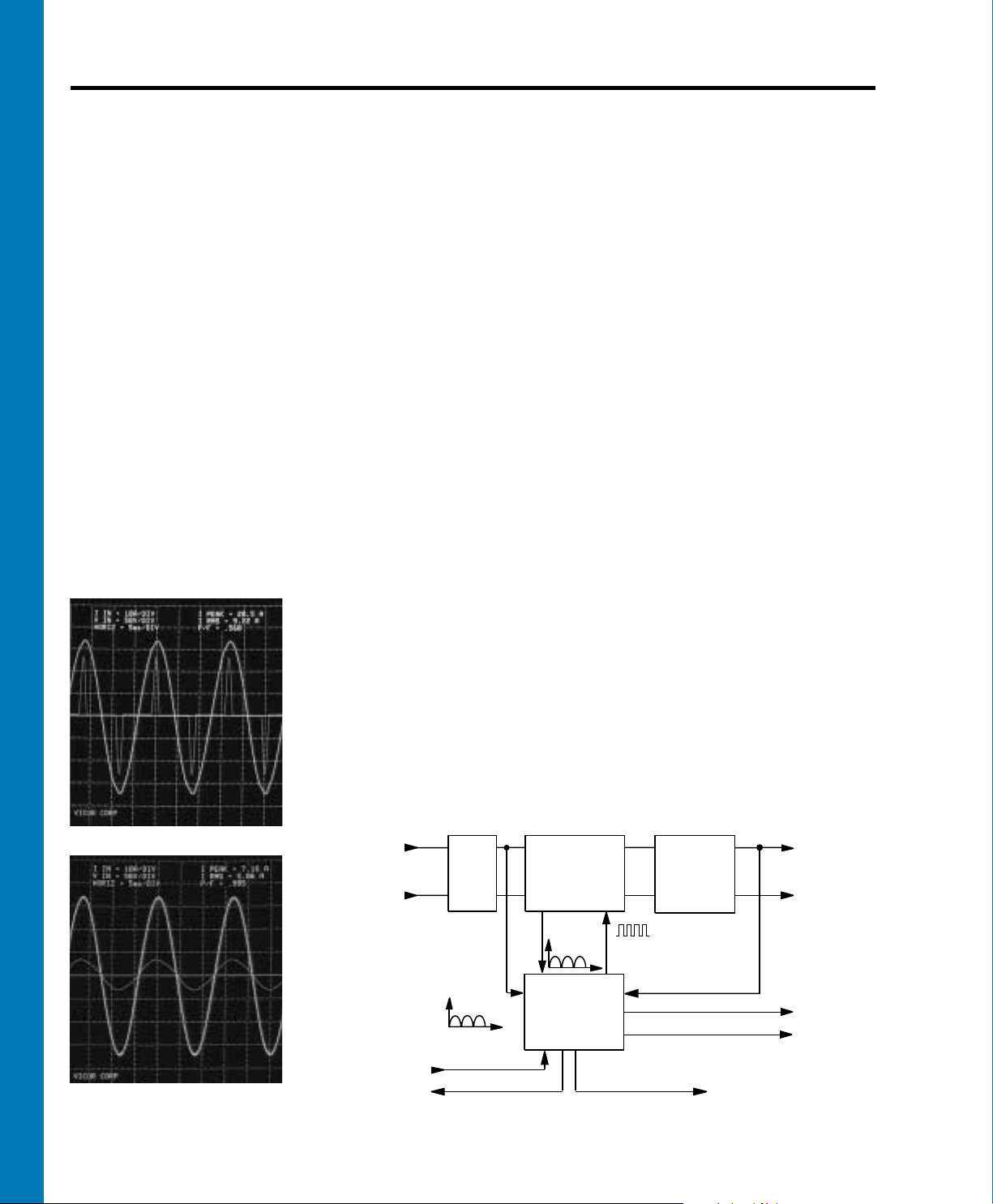
The VI-HAM (see Fig. 2) consists of a
full-wave rectifier, a proprietary high-frequency zerocurrent switching (ZCS) boost regulator (patents
applied for), active inrush, short-circuit protection,
control and housekeeping circuitry. The incoming
AC line is rectified and fed to the ZCS boost
converter. The control circuitry varies the operating
frequency of the ZCS boost converter so as to
simultaneously maintain the output voltage of the
HAM at a DC voltage value above the peak of the
incoming line, while forcing the input current to
the ZCS converter to follow the waveshape of the
rectified line. By this means, the AC input current
follows the AC voltage waveform and a power
factor better than 0.99 is achieved. Operating
efficiency of the ZCS boost converter is optimized
at any incoming line voltage by a patented
adaptive output voltage control scheme.
The HAM also includes active circuitry which
controls inrush currents when power is applied and
active short circuit protection circuitry — features
not normally found in conventional power factor
correctors.
Housekeeping circuitry provides two signals of use
to the system designer (see Fig. 2): Module Enable
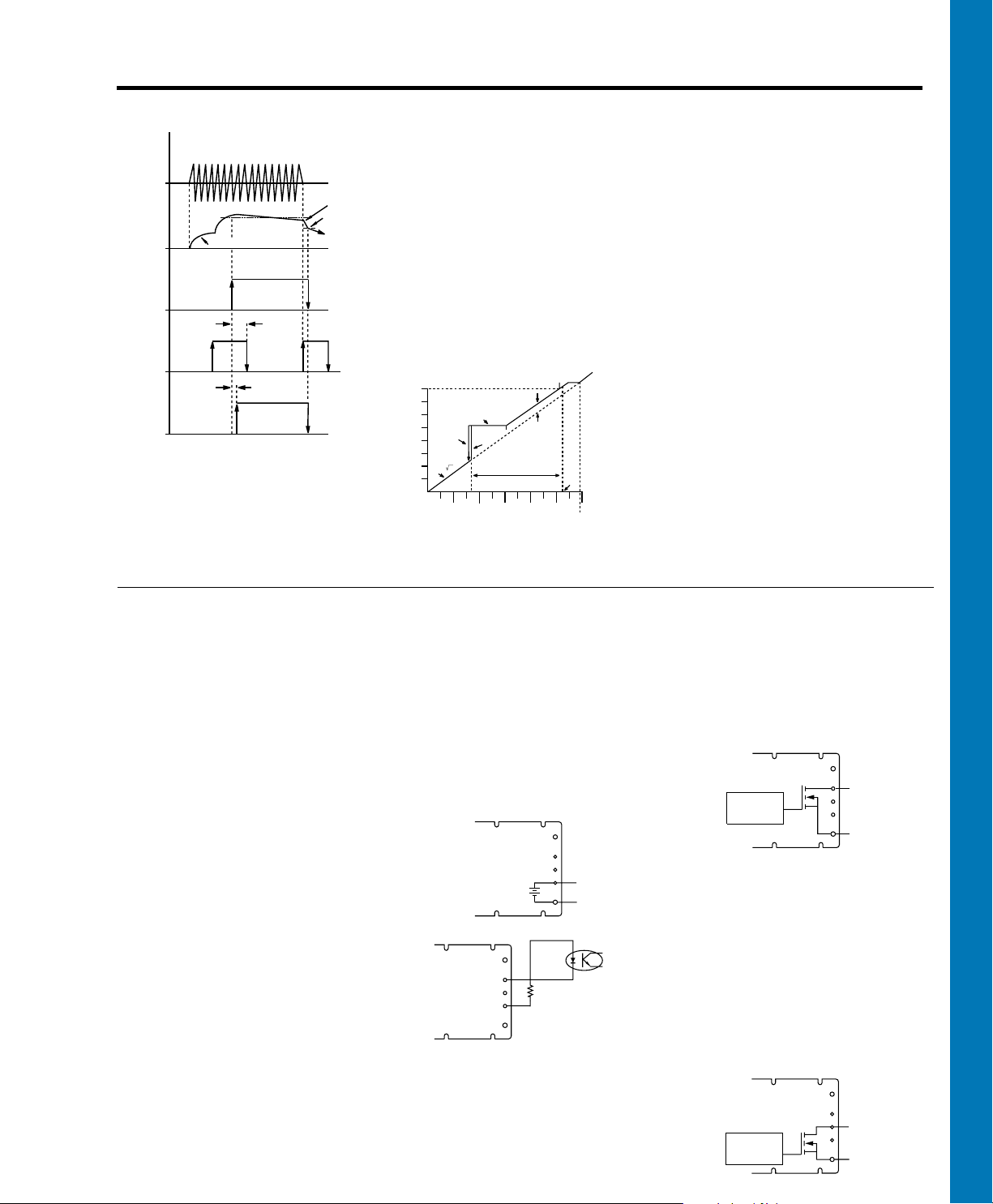
and Power OK. Referencing the timing diagram
(see Fig. 3), the Module Enable signal, which is
connected to the Gate In inputs of the Vicor DCDC converters powered by the HAM, will come
high and enable the DC-DC converters when the
HAM output voltage exceeds 240Vdc. The
DC-DC converter voltage outputs will be up
approximately 10 ms after Module Enable goes
high. Typically, 20 ms after Module Enable goes
high the HAM Power OK signal, which can be
used by the system designer to enable circuitry
powered by the DC-DC converter modules, goes
low. On loss of power or brownout, the Power OK
signal will go high when the HAM DC output
voltage drops below 230V, signaling an impending
loss of input power to the converter modules.
When the DC output dips below 195V, the Module
Enable signal will toggle low, disabling the
converter modules and unloading the HAM.
The HAM will provide at least 16 ms of
ride-through or holdup time, and at least 5 ms of
AC fail warning time with a 1000 µF output
capacitor.
Figure 1a.
Figure 1b.
Above: Oscilloscope photos showing input
voltage and current without power factor
correction (A) and with power factor correction
as provided by the VI-HAM (B).
Figure 2 • VI-HAM Block Diagram
Page 2
12
Outputs
VI-200
DC-DC
Converter(s)
Rectified Line
Module
Enable
DC
Output
of HAM
Power OK
AC
Mains
120V
RMS
Boost Voltage
195
Vdc
240
Vdc
Off at
195
Vdc
Off at
230
Vdc
230
Vdc
25 ms
10 ms
50 100 150 200 250
300
Output Voltage
as a Function
of Input Voltage
Vac
400 Vdc
350 Vdc
300 Vdc
250 Vdc
200 Vdc
150 Vdc
100 Vdc
50 Vdc
25
75 125
175 225
275
80 Vac
85 Vac
260 Vdc
152 Vac
Operating Region
250 Vac
264
Vac
46V
Boost
296
Vin x
2
1-800-735-6200
Figure 3 • Functional Timing Diagram
Active power factor correctors incorporate a
boost regulator which must operate over a range
of incoming AC line voltages. Conventionally,
the output voltage of the boost regulator is set
to a value greater than the maximum anticipated
peak value of the incoming AC line.
Vicor varies the output voltage of the HAM as
a function of incoming AC line voltage
(see Fig. 4, patent applied for). On a nominal
120Vac line the output voltage of the HAM is
260Vdc — well within the input operating
voltage range of standard Vicor converters.
As input line increases, so does the HAM
output voltage; at 220Vac the delivered voltage
will be about 350V. For any given input line
voltage, the HAM maintains enough headroom
between the output voltage and peak input
voltage to ensure high quality active power
factor correction without unnecessarily
sacrificing operating efficiency.
Figure 4 • Input Voltage vs. Output Voltage
VI-HAM Protection Features
Overtemperature Shutdown
The HAM incorporates overtemperature
shut-down, and is designed to shut down when
the temperature of the baseplate exceeds
90–100°C. It is not safe to run the HAM for
extended periods above its maximum operating
temperature of 85°C.
Short Circuit Protection
The HAM contains a short circuit shutdown
function. Operation of this function does not
clear the input fuse and the output will resume
normal operation after removal of the short. A
small period of time may be required to allow
for cooling of an internal PTC. Overcurrent
protection is provided by the Vicor DC-DC
converters.
Output Overvoltage Protection
The HAM contains output overvoltage
protection. In the event the output voltage
exceeds approximately 420Vdc, the boost will
decrease to maintain 420Vdc on the output.
When the peak of the AC line exceeds 420V
(approximately 293Vac) the boost will have
been reduced to zero. Beyond this the protection
circuit will be enabled and the output voltage
will decrease.
Pin Function Description
• L1 and L2/N (VI-HAM):
These pins are to be connected to the AC mains
output of a suitable EMI/RFI filter (Vicor
P/N 07818 or equivalent). Do not connect an
X capacitor across these pins as power factor
correction will be slightly degraded.
• +IN, –IN (VI-HAMD, VI-BAMD):
These pins are connected to the output of the external
bridge rectifier.
• Gate Input (VI-HAM):
This pin disables the boost converter only. Rectified
line current may still be present on the output. This pin
does not provide the same function as the gate input
pin of VI-200/VI-J00 modules. The user should not
make any connection to this pin.
• Gate Input (VI-HAMD):
This pin serves as a rectified AC following pin for
power factor correction synchronization to line. This
connection must be made through the synchronization
diodes between the line filter and bridge rectifier (see
Fig. 10, page 84).
• Gate Input (VI-BAMD):
The Gate Input pin is an interface pin to the Gate Out
pin of a VI-HAM, VI-HAMD or VI-BAMD depending
on configuration. The user should not make any other
connection to this pin.
• Gate Output:
The Gate Output pin is an interface pin to BAMDs;
the user should not make any other connection to
this pin.
• +Output and -Output and Holdup Capacitor:
These outputs should be connected to the respective
inputs of Vicor DC/DC converters. In addition, an
external holdup capacitor of 1000 µF with a minimum
voltage rating of 450Vdc, is required across the
output for 16 ms ride through time at 600W (500 µF
for 300W, etc). Do not exceed 3000 µF of total
output capacitance. Lower values of capacitance may
be used for reduced holdup requirements, but not less
than 330 µF. Lower capacitance values may degrade
power factor specifications.
• Auxiliary Supply (A/S):
The VI-HAM and VI-BAMD contain an internal low
voltage output (A/S) that may be used to power
primary side logic. This output is 19-23Vdc,
referenced to -OUT, at 3 mA max. Do not overload or
short this output as the HAM will fail. A typical use for
A/S is to power an optical coupler that isolates the
Power OK signal.
18 kΩ, 1/4W
A/S
≤ 3mA
-OUT
"Power OK" Status
Low = OK
+ OUT
P/OK
– OUT
E/O
A/S
19 - 23V
+
–
Figure 5 • Auxiliary Supply (A/S)
• Power OK (P/OK)
P/OK is a monitor signal that indicates the status of the
AC mains and the DC output voltage of the HAM.
P/OK, during normal operation, is an active low
(see Fig. 6). In the event AC mains or DC output fails,
this pin goes to an open circuit state. P/OK is asserted
when the output bus voltage is within normal operating
range and 20-25 ms after DC-DC converters are
enabled by the Module Enable output of the HAM.
This provides sufficient time for the converters to turn
on and their outputs to stabilize prior to P/OK being
asserted. When the AC mains is removed and the
output of the HAM drops below 230V, P/OK goes to
an open circuit state. When the output voltage drops
below 195V the converters are disabled via Module
Enable. P/OK will provide power fail warning at least
1 ms prior to converter shutdown.
P/OK
D
LOGIC
S
G
-OUT
Figure 6 • Power OK (P/OK)
• Module Enable (E/O)
The Module Enable output is used to disable the
DC-DC converters until there is sufficient energy in
the holdup capacitor (240V) to support normal
operation, while limiting inrush current. Module
Enable must be connected to the Gate Input of all
driver DC-DC converters. It is not necessary to
connect this pin to boosters as they are controlled by
their respective driver. If the AC mains fail, Module
Enable goes low when the DC output of the HAM
drops below 195V. Failure to connect Module Enable
may result in the output of the HAM latching low
during turn-on.
E/O
LOGIC
D
S
G
-OUT
Figure 7 • Enable/Output (E/O)
Page 3

12
VI-HAMD
Vac
VI-BAMD
Line Filter
VI-BAMD
1-800-735-6200
VI-HAM Protection Features
(continued)
Inrush Current Limit
The HAM contains inrush current protection
in the form of a PTC and a shunt device. The
same PTC is used for overcurrent protection
on the output.
Input Transient Overvoltage Surge Protection
This function is included in all HAM
compatible filters. If any other filter is used
this function must be provided externally,
typically by a transient suppressor.
• Safety Note •
All VI-HAM configurations must be
preceded by an appropriately rated fast-blow
3AG fuse ahead of the line filter. This fuse
would be a 10A for a single VI-HAM
connected to line. For fusing information on
other VI-HAM configurations, please contact
Vicor’s Application Engineering Department.
Compatible Modules
Over the full range of input voltages (85 to 264
Vac), the output varies from 260 to 415Vdc.
Therefore the modules used with the HAM are
from the VI-260 and VI-J60 families.
When ordering add the prefix VI- to the part
number below; i.e., VI-260-CU.
Filter Requirements for the VI-HAM
The VI-HAM requires an external filter to meet international standards for conducted
EMI/RFI emissions. P/N 07818 (for use up to 600W) incorporates transient protection
for compliance with IEC 61000-4-5 Level 3 and meets conducted emissions standards
EN55022 and FCC Part 15 Level A (minimum loading of 150W required).
VI-HAM Configurations
VI-HAM-CM Driver HAM: Fully configured power factor correcting front end.
VI-HAMD-CM Driver HAM: No internal bridge rectifier or synchronization diodes.
VI-BAMD-CM Booster HAM: Companion module to VI-HAMD-CM used for
additional output power. No internal bridge rectifier.
Use the VI-HAM-CM for applications requiring up to 600W from the front end.
For applications in excess of 600W, it is not possible to simply parallel two driver
HAMs due to conflicting control loops. Gate Out to Gate In connections on
respective driver/boosters are used to ensure that the power train of the HAMs
current-share. However, this does not ensure that the diodes in the lower half of the
bridge rectifier will current-share. A solution for this situation is illustrated (see Fig. 8).
VI-200 Family
5V 12V 15V 24V 48V Output
260-CU 261-CU 262-CU 263-CU 264-CU 200W
260-CV 261-CV 262-CV 263-CV 264-CV 150W
260-CW 261-CW 262-CW 263-CW 264-CW 100W
260-CX 261-CX 262-CX 263-CX 264-CX 75W
260-CY 261-CY 262-CY 263-CY 264-CY 50W
Framed area available as boosters.
Change VI-2XX-XX to VI-BXX-XX.
VI-J00 Family
5V 12V 15V 24V 48V Output
J60-CW J61-CW J62-CW J63-CW J64-CW 100W
J60-CX J61-CX J62-CX J63-CX J64-CX 75W
J60-CY J61-CY J62-CY J63-CY J64-CY 50W
J60-CZ J61-CZ J62-CZ J63-CZ J64-CZ 25W
Prod. Baseplate Storage Model
Grade Temp. Temp.
E -10°C to +85°C -20°C to +100°C VI-HAM-EM
C -25°C to +85°C -40°C to +100°C VI-HAM-CM
I -40°C to +85°C -55°C to +100°C VI-HAM-IM
M -55°C to +85°C -65°C to +100°C VI-HAM-MM
Figure 8 • VI-HAMD with Booster HAMs (BAMDs) — No Internal Bridge Rectifier
A solution to bridge rectifier current sharing issues is to remove the bridge rectifier
from each HAM and use one diode bridge sized to handle the entire load.
Approximately 25% of the heat is removed from the HAM in this approach; use a
VI-HAMD-CM with one or more VI-BAMD-CMs. Note: Synchronization diodes
are required when using this approach (see Fig. 10, page 84).
Page 4

12
1-800-735-6200
Specifications
VI-HAM and VI-HAMD With External Bridge and Synchronization Diodes, 1000 µF Output Capacitor and Vicor Line Filter P/N 07818.
VI-BAMD When Operated with VI-HAM and VI-HAMD, Respectively.
(Unless otherwise indicated, specifications apply over operating input voltage and temperature range)
Parameter VI-HAM VI-HAMD VI-BAMD Remarks
Line Input 85V to 264V 85V to 264V 85V to 264V Unit will operate from 400 Hz, but
47–63 Hz (Volts AC) (Rectified AC) (Rectified AC) may not meet PF or THD specs
Output Power Up to 600W Up to 600W Up to 600W Derate from 110Vac to 85 Vac @
Efficiency 90–91% 90-91% (With ext. rectifier loss) 90–91% (With ext. rectifier loss) 120Vac, full load
Efficiency 93–94% 93-94% (With ext. rectifier loss) 93–94% (With ext. rectifier loss) 240Vac, full load
Power Factor 0.99 0.99 0.99 120/240Vac, 50-100% of full load
Total Har. Distortion (line current)* <7.5% <7.5% <7.5% Sinusoidal, 120Vac, full load
Total Har. Distortion (line current)* <8.5% <8.5% <8.5% Sinusoidal, 240Vac, full load
Output Ripple 7V p-p 7V p-p 7V p-p 120Vac, full load
Output Ripple 5V p-p 5V p-p 5V p-p 240Vac, full load
Inrush Current <13A peak <13A peak <13A peak 120Vac, full load
Inrush Current <20A peak <20A peak <20A peak 240Vac, full load
Output Capacitance 500-3000 µF 500-3000 µF 500-3000 µF External to HAM (for 600W load)
Ride Through/Holdup Time 16 ms 16 ms 16 ms 600W output with a 1000 µF hold-
Transient Surge Withstand, Included in the Included in the Included in the
Normal Mode external filter external filter external filter
Isolation Voltage
Input to Output None None None Isolation provided
Input to Baseplate 1,500 VRMS 1,500 VRMS 1,500 VRMS by DC-DC converters
Output to Baseplate 1,500 VRMS 1,500 VRMS 1,500 VRMS
Auxiliary Output 19-23Vdc 19-23Vdc 19-23Vdc Note: Not short circuit protected
Thermal Shutdown 90°C-100°C baseplate 90°C-100°C baseplate N/A
Baseplate Temperature -10°C to +85°C (E Grade) -25˚C to +85˚C (C Grade) -40˚C to +85˚C (I-Grade) -55˚C to +85˚C (M-Grade)
Storage Temperature -40˚C to +100˚C (C Grade) -55˚C to +100˚C (I-Grade) -65˚C to +100˚C (M-Grade)
Short Circuit Protection Yes Yes Yes
MTBF (GB, 25˚C) >420,000 hours >424,000 hours >818,000 hours
Size 4.6" x 2.4" x 0.5" 4.6" x 2.4" x 0.5" 4.6" x 2.4" x 0.5"
Weight 6 Ounces (170 Grams) 6 Ounces (170 Grams) 6 Ounces (170 Grams)
* I
= HAM
THD
– V
THD
THD
Line current total harmonic distortion = input voltage distortion plus 8.5% max.
@ ≤3 mA @ ≤3 mA @ ≤10 mA
(116,8 x 61,0 x 12,7) (116,8 x 61,0 x 12,7) (116,8 x 61,0 x 12,7)
8W/Volt
(1000 µF Nom.)
up capacitor (300W = 500 µF, etc.)
Application of the VI-HAM
The HAM must be used in conjunction with a
suitable line filter, such as Vicor’s P/N 07818**,
output holdup capacitor and Vicor DC-DC
converters (see Fig. 9). Connect single phase
AC mains to the input of the line filter via a
standard 10A AC fuse. Connect the output of
the filter to L1 and L2/N of the HAM. Do not
put an X capacitor across the input of the
HAM or use a line filter with an X capacitor
on its output as power factor correction may
be impacted. Connect the +Output of the
HAM to the +Input of the converters via a 3A
PC Tron DC fuse. Connect the -Output of the
HAM to the -Input of the converters. Connect
a 1000 µF electrolytic capacitor rated at a
minimum of 450Vdc across the + and -Output
of the HAM (or 500 µF for 300W, etc). This
capacitor must be in close proximity to the
HAM. Connect the Enable Output of the
HAM to the Gate Input of each driver
converter to disable the converters until the
output of the HAM is within normal operating
range. Please refer to Vicor's Applications
Manual for information on the proper
connection of the DC-DC converters.
The aforementioned connections are the
minimum required. In addition, there are
other features available.
• The Auxiliary Supply output is approximately
21V at 3 mA max
. This output is usually used
in conjunction with the Power OK signal.
Power OK provides an indication of the
status of the DC output and the AC mains.
• The Enable Output of the HAM must be
connected to the Gate Input of all driver
modules. The HAM will then disable the
module output until the input exceeds 85Vac
and the output has been boosted to 260Vdc.
If an external load is connected directly to
the output of the HAM, do not apply the load
until the output of the HAM is in boost mode.
• Although the efficiency of the HAM is
quite high, it still dissipates significantly
more power than a VI-200 DC-DC converter.
Care should be taken to cool it. Thermal
compound should be used between the
heatsink and baseplate of the VI-HAM,
VI-HAMD and VI-BAMD.
• When making any connections to the
VI-HAM for measurement purposes,
remember that it is not isolated from the
line — either input or output. A line
isolation transformer must be used when
making scope measurements.
• The input voltage range of the VI-HAM is
85 to 264Vac; however it may not start
boosting until the AC mains has exceeded
87Vac. Once the VI-HAM has started, it will
operate down to 85Vac. The VI-HAM
contains 2.5 to 6V of input hysteresis,
therefore if the AC line impedance is high,
i.e., when using a variable autotransformer,
the VI-HAM may start, but the AC line may
then fall enough to drop below undervoltage
lockout. When this happens the AC line will
go up, the HAM starts and the cycle repeats.
Therefore avoid soft AC lines at or near
low line.
Page 5

12
Module
Output
Voltage
+IN
Vicor 26X or J6X
Family Converters
GATE IN
GATE OUT
-IN
260-400 Vdc
Up to 600W
Driver
L2/N
GATE
OUT
GATE
IN
L1
– OUT
E/O
+ OUT
A/S
P/OK
VI-HAM
GATE IN
GATE OUT
-IN
Booster (n)
Y-Capacitor
Y-Capacitor
PC-Tron
3A
+
+IN
+OUT
+OUT
-OUT
-OUT
+S
T
-S
L1
GND
L2/N
L1
LOAD
L2/N
Vicor
Line Filter
P/N 07818
6.3A
LINE
10A
24V
Zener
(1N4709)
PC-Tron
3A
PC-Tron
0.5A
MOV
P/N 03040
270µF HUB270-P 150W max
470µF HUB470-P 300W
870µF HUB870-P 450W
1100µF HUB1100-P 600W
1000 µF
Holdup Box (HUB) available as
accessory product through Vicor Express
Line Filter
12.6A*
+IN
GATE IN
GATE OUT
-IN
+OUT
-OUT
P/OK
E/O
A/S
HAMD
GATE IN
GATE OUT
-IN
+IN
+OUT
-OUT
BAMD
1000 µF @
450 Vdc
+
+
1000 µF @
450 Vdc
Input
Bridge
Rectifier
+
–
L1
GND
L2/N
L1
L2/N
1N4006
1N4006
N/C
N/C
A/S
* Please consult Vicor's Application Engineering Department
for specific VI-HAMD/VI-BAMD filtering information.
10A
10A
20A
MOV
P/N 03040
410V Transorb
1.5 KE 130CA
1.5 KE 130CA
1.5 KE 150CA
Product ID
this surface
FULL R
5
6
7
8
9
4
3
2
1
.040 (1,0) Dia (7) places
Solder plate
over copper alloy
.080 (2,0) Dia.
Solder plate
over copper alloy
.30 (7,6)
±.015 (0,38)
1.80
(45,7)
4.60 (116,8)
.15
(3,8)
2.10
(53,3)
.40
(10,2)
.35 (8,9)
±.015 (0,38)
1.40
(35,6)
1.00
(25,4)
.70
(17,8)
3.60 (91,4)
.50
(12,7)
.15
(3,8)
Pin #
1
2
3
4
5
6
7
8
9
HAM
L1
Gate In
Gate Out
L2/N
+Out
P/OK
E/O
A/S
–Out
HAMD
+IN
Gate In
Gate Out
–IN
+Out
P/OK
E/O
A/S
–Out
BAMD
+IN
Gate In
Gate Out
–IN
+Out
N/C
N/C
A/S
–Out
(2) places
VI-HAM
+.030 (0,76)
-.000
.01
.50 (12,7)
(5,6) MIN
4.20 (106,7)
.22
.12 (3,0)
.30 (7,6)
Min
Aluminum Base
2.40 (61,0)
1.75 (44,5)
1-800-735-6200
Connection Diagram, VI-HAM/DC-DC Converters
Figure 9 • VI-HAM Connection Diagram
Connection Diagram, VI-HAMD/VI-BAMD
Figure 10 • VI-HAMD/BAMD Connection Diagram
VI-HAM /HAMD /BAMD Mechanical Diagram
Page 6

12
1-800-735-6200
Typical HAM Filter Applications
Operating voltage = 85 to 250Vac
Operating current = 6.3A
Operating frequency = 50/60 Hz
Operating temperature = 20 to 50˚C
Diel. withstanding (line - case) = 1500Vac
Diel. withstanding (line - line) = 1500Vac
Leakage current = 1.0 ma at 220Vac, 50 Hz
Max residual voltage after 1 sec. = 34V
Agency approvals = UL, CSA, TÜV
MOV
P/N 03040
LINE
R
Cx = 1.5uF(x2)SH Cy = .01uF SH LC = 6.9mH LD = .72mH
LD
C
x
HAM Filter P/N 07818
R = 235K OHM D1,2 = 1.5KE130CA D3 = 1.5KE150CA
LC
D1
C
y
D2
C
y
D3
LOAD
RATED CURRENT VS AMBIENT TEMPERATURE
90
80
70
60
50
OPERATING TEMP (DEG C)
40
1.0 2.0 3.0 4.0 5.0 6.0 7.0
CURRENT (AMPS)
HAM Filter Mechanical Diagram
4-40 INSERT
.25 DP 4 PL
4.60±.02
2.50
1.200
90
80
70
60
50
40
30
20
INSERTION LOSS (db)
10
0
.01 .04 .1 .4 1 4 10 40 100
.02 .07 .2 .7 2 7 20 70
ø.080 PIN
6 PLACES
DM
CM
FREQUENCY (MEGAHERTZ)
SEE
.060
NOTE 1
2.40
±.02
2.00
.100
LINE
.500 .500
1.45
2.800
LOAD
.900
1.800
.30±.02
FACE MAY BE
BOWED .04 MAX
.13±.02
'
'
1.00
MAX
VICOR
LABEL
SEE NOTE 2
 Loading...