

Page 1
INTEGRATED CIRCUITS
DATA SH EET
TSA5060A
1.3 GHz I
2
C-bus controlled low
phase noise frequency synthesizer
Product specification
Supersedes data of 2000 Sep 19
File under Integrated Circuits, IC02
2000 Oct 24
Page 2

Philips Semiconductors Product specification
1.3 GHz I2C-bus controlled low phase
noise frequency synthesizer
FEATURES
• Complete 1.3 GHz single chip system
• Optimized for low phase noise
• Selectable divide-by-two prescaler
• Operationupto1.3 GHzwithoutdivide-by-twoprescaler
• Selectable reference divider ratio
• Compatible with UK-DTT (Digital Terrestrial Television)
offset requirements
• Selectable crystal or comparison frequency output
• Four selectable charge pump currents
• Four selectable I2C-bus addresses
• Standard and fast mode I2C-bus
• I2C-bus compatible with 3.3 and 5 V microcontrollers
• 5-level Analog-to-Digital Converter (ADC)
• Low power consumption
• Three I/O ports and one output port.
APPLICATIONS
• Digital terrestrial and cable tuning systems
• Hybrid (digital and analog) terrestrial and cable tuning
systems
• Digital set-top boxes.
GENERAL DESCRIPTION
The TSA5060A is a single chipPLL frequency synthesizer
designed for terrestrial and cable tuning systems up to
1.3 GHz.
TSA5060A
The comparison frequency is obtained from an on-chip
crystal oscillator that can also be driven from an external
source. Either the crystal frequency or the comparison
frequency can be switched to the XT/COMP output pin to
drive the reference input of another synthesizer or the
clock input of a digital demodulation IC.
Bothdividedand comparison frequencies are compared in
the fast phase detector which drives the charge pump.
The loop amplifier is also on-chip, however an external
NPN transistor to drive directly the 33 V tuning voltage.
Controldataisenteredvia the I2C-bus;fiveserialbytesare
required to address the device, select the main divider
ratio, the reference divider ratio, program the four output
ports,set the charge pump current,select the prescaler by
two, select the signal to switch to the XT/COMP output pin
and select a specific test mode. Three of the four output
ports can also be used as input ports and a 5-level ADC is
provided. Digital information concerning the input ports
andtheADC can be read out oftheTSA5060Aon the SDA
line (one status byte) during a READ operation. A flag is
set when the loop is ‘in-lock’ and is read during a READ
operation, as well as the Power-on reset flag. The device
has four programmable addresses, programmed by
applying a specific voltage at pin AS, enabling the use of
multiple synthesizers in the same system.
TheRF preamplifierdrivesthe17-bitmaindividerenabling
astep size equal tothe comparison frequency, foran input
frequency up to 1.3 GHz covering the complete terrestrial
frequency range. A fixed divide-by-two additional
prescaler can be inserted between the preamplifier and
the main divider. In this case, the step size is twice the
comparison frequency.
2000 Oct 24 2
Page 3
Philips Semiconductors Product specification
1.3 GHz I2C-bus controlled low phase
TSA5060A
noise frequency synthesizer
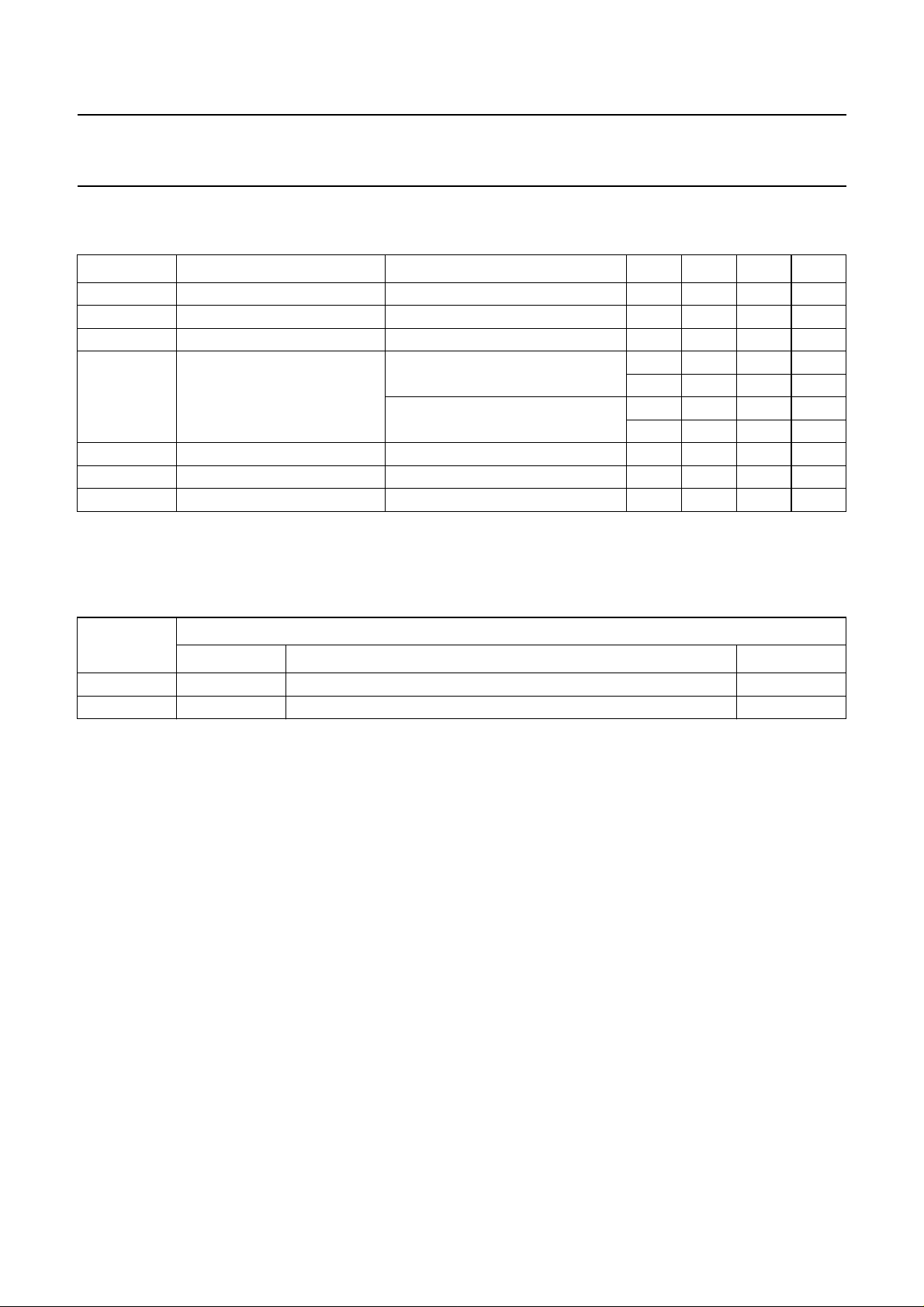
QUICK REFERENCE DATA
VCC= 4.5 to 5.5 V; T
SYMBOL PARAMETER CONDITIONS MIN. TYP. MAX. UNIT
V
CC
I
CC
f
i(RF)
V
i(RF)(rms)
f
xtal
T
amb
T
stg
supply voltage 4.5 5.0 5.5 V
supply current T
RF input frequency 64 − 1300 MHz
RF input voltage (RMS value) f
crystal frequency 4 − 16 MHz
ambient temperature −20 − +85 °C
storage temperature −40 − +150 °C
Note
1. Asymmetrical drive on pin RFA or RFB; see Fig.3.
= −20 to +85 °C; unless otherwise specified.
amb
=25°C 303745mA
amb
from 64 to 150 MHz; note 1 12.6 − 300 mV
i(RF)
from 150 to 1300 MHz; note 1 7.1 − 300 mV
f
i(RF)
−25 − +2.5 dBm
−30 − +2.5 dBm
ORDERING INFORMATION
TYPE
NUMBER
NAME DESCRIPTION VERSION
PACKAGE
TSA5060AT SO16 plastic small outline package; 16 leads; body width 3.9 mm SOT109-1
TSA5060ATS SSOP16 plastic shrink small outline package; 16 leads; body width 4.4 mm SOT369-1
2000 Oct 24 3
Page 4
Philips Semiconductors Product specification
1.3 GHz I2C-bus controlled low phase
noise frequency synthesizer
BLOCK DIAGRAM
handbook, full pagewidth
XTAL
RFA
RFB
2
13
14
OSCILLATOR
PRE
AMP
XTAL
DIVIDER
1/2
REFERENCE
DIVIDER
4-BIT LATCH
DIVIDER
17-BIT
LOCK
DETECT
DIGITAL PHASE
COMPARATOR
CHARGE PUMP
TSA5060A
3
XT/COMP
AS
SCL
SDA
ADC
4
6
5
11
TRANSCEIVER
3-BIT
ADC
POWER-ON
RESET
1-BIT
LATCH
I2C-BUS
3-BIT
INPUT
PORTS
17-BIT LATCH
DIVIDE RATIO
4-BIT LATCH
AND
OUTPUT PORTS
P3 P2 P1 P0
1
2-BIT
LATCH
AMP
MODE
CONTROL
LOGIC
CP
16
DRIVE
12
V
CC
15
GND
TSA5060A
10987
FCE717
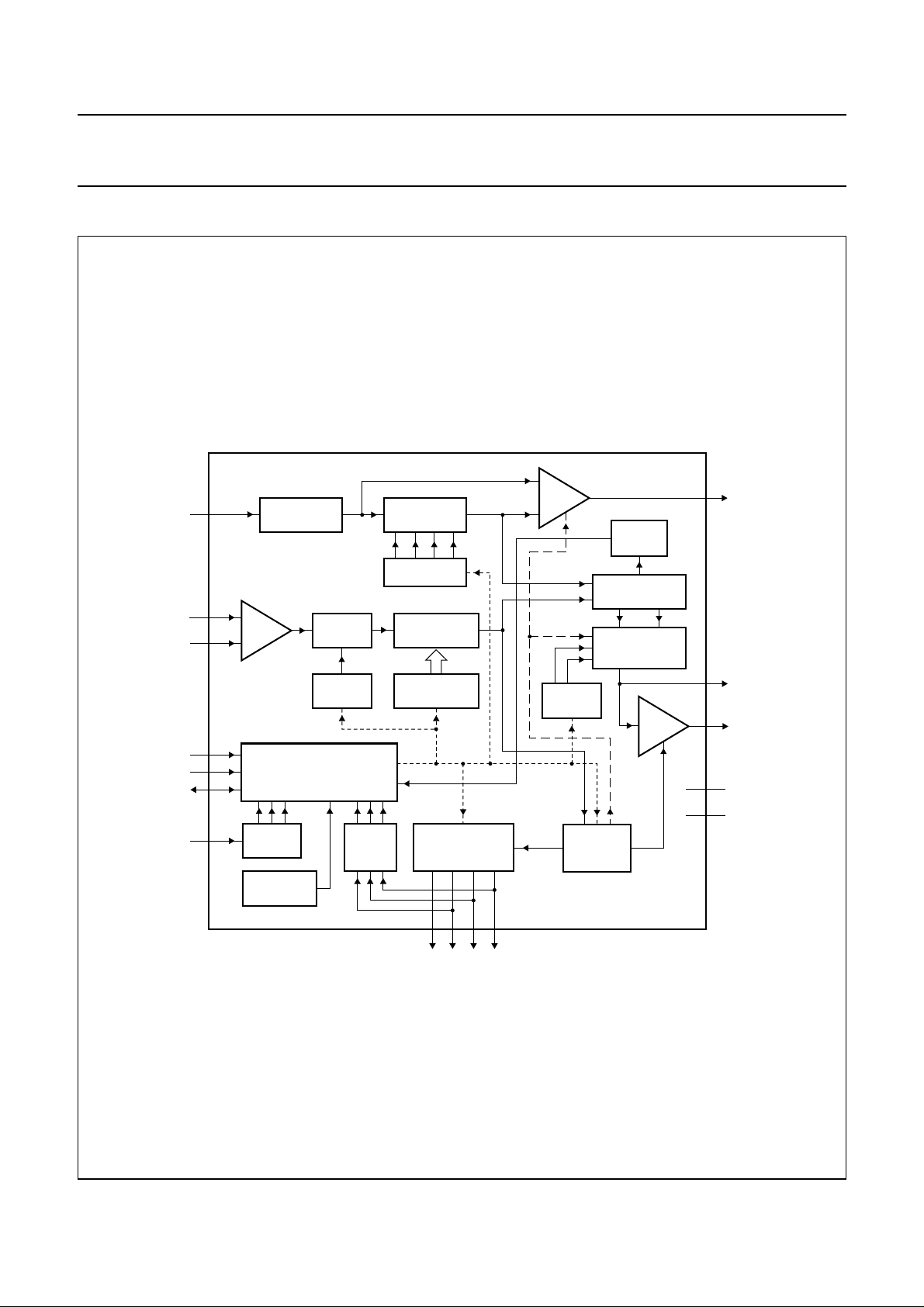
Fig.1 Block diagram.
2000 Oct 24 4
Page 5
Philips Semiconductors Product specification
1.3 GHz I2C-bus controlled low phase
noise frequency synthesizer
PINNING
SYMBOL PIN DESCRIPTION
CP 1 charge pump output
XTAL 2 crystal oscillator input
XT/COMP 3 f
AS 4 I
SDA 5 I
SCL 6 I
P3 7 general purpose output Port 3
P2 8 general purpose input/output Port 2
P1 9 general purpose input/output Port 1
P0 10 general purpose input/output Port 0
ADC 11 analog-to-digital converter input
V
CC
12 supply voltage
RFA 13 RF signal input A
RFB 14 RF signal input B
GND 15 ground
DRIVE 16 external NPN drive output
or f
xtal
2
C-bus address selection input
2
C-bus serial data input/output
2
C-bus serial clock input
signal output
comp
handbook, halfpage
XT/COMP
CP
1
XTAL
2
3
4
AS
TSA5060A
5
SDA
6
SCL
7
P3
8
P2
FCE718
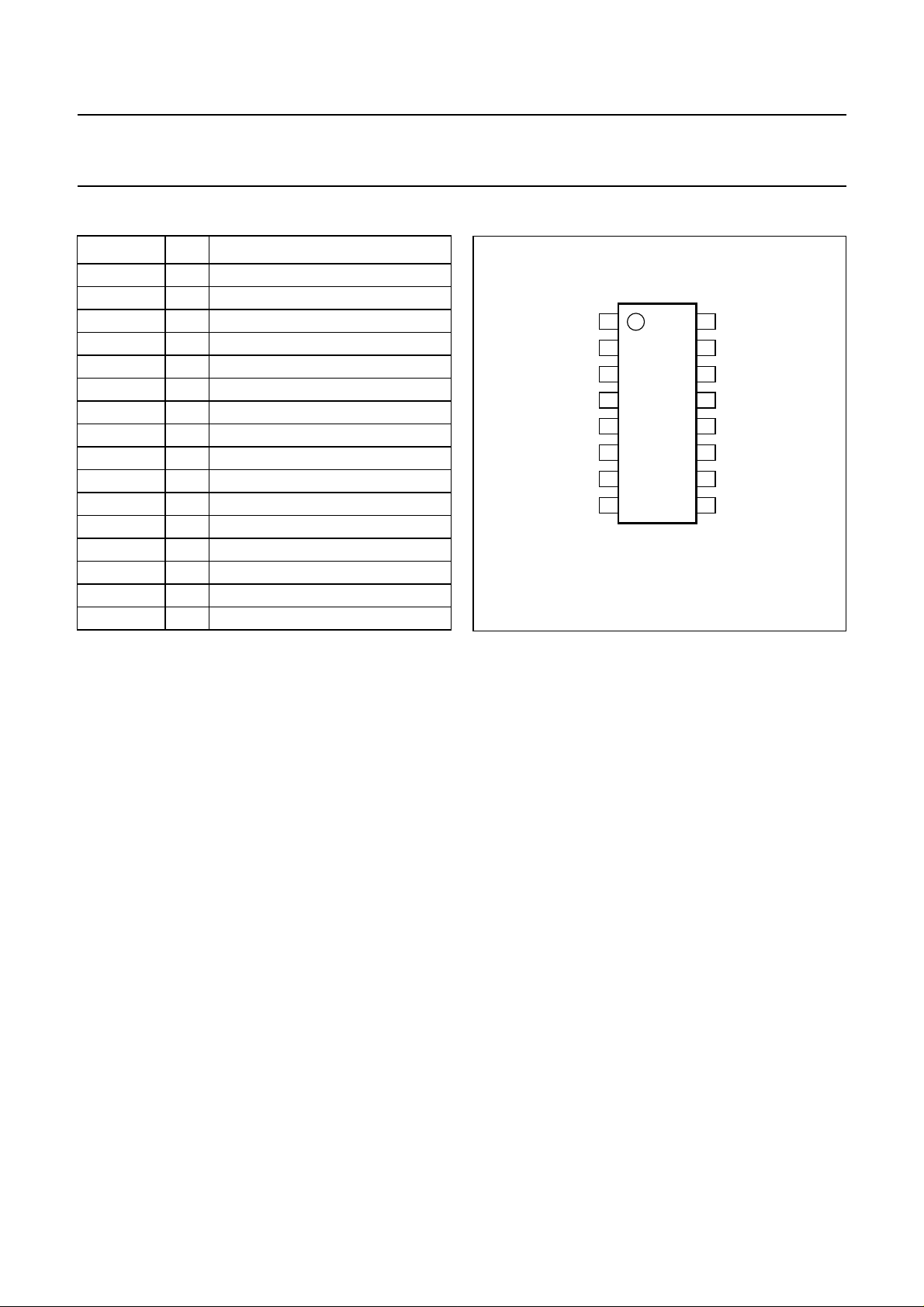
Fig.2 Pin configuration.
TSA5060A
16
DRIVE
15
GND
14
RFB
13
RFA
12
V
CC
11
ADC
10
P0
9
P1
FUNCTIONAL DESCRIPTION
The TSA5060A contains all the necessary elements
except a reference source, a loop filter and an external
NPN transistor to control a varicap tuned local oscillator
forming a phase locked loop frequency synthesized
source. The IC is designed in a high speed process with a
fast phase detector to allow a high comparison frequency
to reach a low phase noise level on the oscillator.
The block diagram is shown in Fig.1. The RF signal is
applied at pins RFA and RFB. The input preamplifier
provides a good sensitivity. The output of the preamplifier
is fed to the 17-bit programmable divider either through a
divide-by-two prescaler or directly. Because ofthe internal
high speed process, the RF divider is working at a
frequency up to 1.3 GHz, without the need for the
divide-by-two prescaler to be used.
The output of the 17-bit programmable divider f
DIV
is fed
into the phase comparator, where it is compared in both
phaseandfrequency with the comparison frequency f
comp
This frequency is derived from the signal present at
pin XTAL, f
, divided down in the reference divider. It is
xtal
possible either to connecta quartz crystalto pin XTAL and
then using the on-chip crystal oscillator, or to feed this pin
with a reference signal from an external source.
The reference divider can have a dividing ratio selected
from 16 different values between 2 and 320, including the
ratio 24 to cope with the offset requirement of the UK-DTT
system, see Table 8.
The output of the phase comparator drives the
charge pump and the loop amplifier section. This amplifier
requires the use of an external NPN transistor. Pin CP is
the output of the charge pump, and pin DRIVE is
connected to the base of the external transistor. This
transistor has its emitter grounded and the collector drives
the tuning voltage to the varicap diode of the Voltage
Controlled Oscillator (VCO). The loop filter has to be
connected between pin CP and the collector of the
external NPN transistor (see Fig.4).
It is also possible to drive another PLL synthesizer, or the
clock input of a digital demodulation IC, from
pin XT/COMP. It is possible to select by software either
f
, the crystal oscillator frequency or f
xtal
, the frequency
comp
present after the reference divider. It is also possible to
switch off this output, in case it is not used.
.
For test and alignment purposes, it is possible to release
the drive output to be able to apply an external voltage on
it, to select one of the three charge pump test modes, and
to monitor half the f
at Port P0. See Table 10 for all
DIV
possible modes.
Four open-collector output portsare provided on the IC for
general purpose; three of these can also be used as input
ports. A 3-bit ADC is also available.
2000 Oct 24 5
Page 6
Philips Semiconductors Product specification
1.3 GHz I2C-bus controlled low phase
noise frequency synthesizer
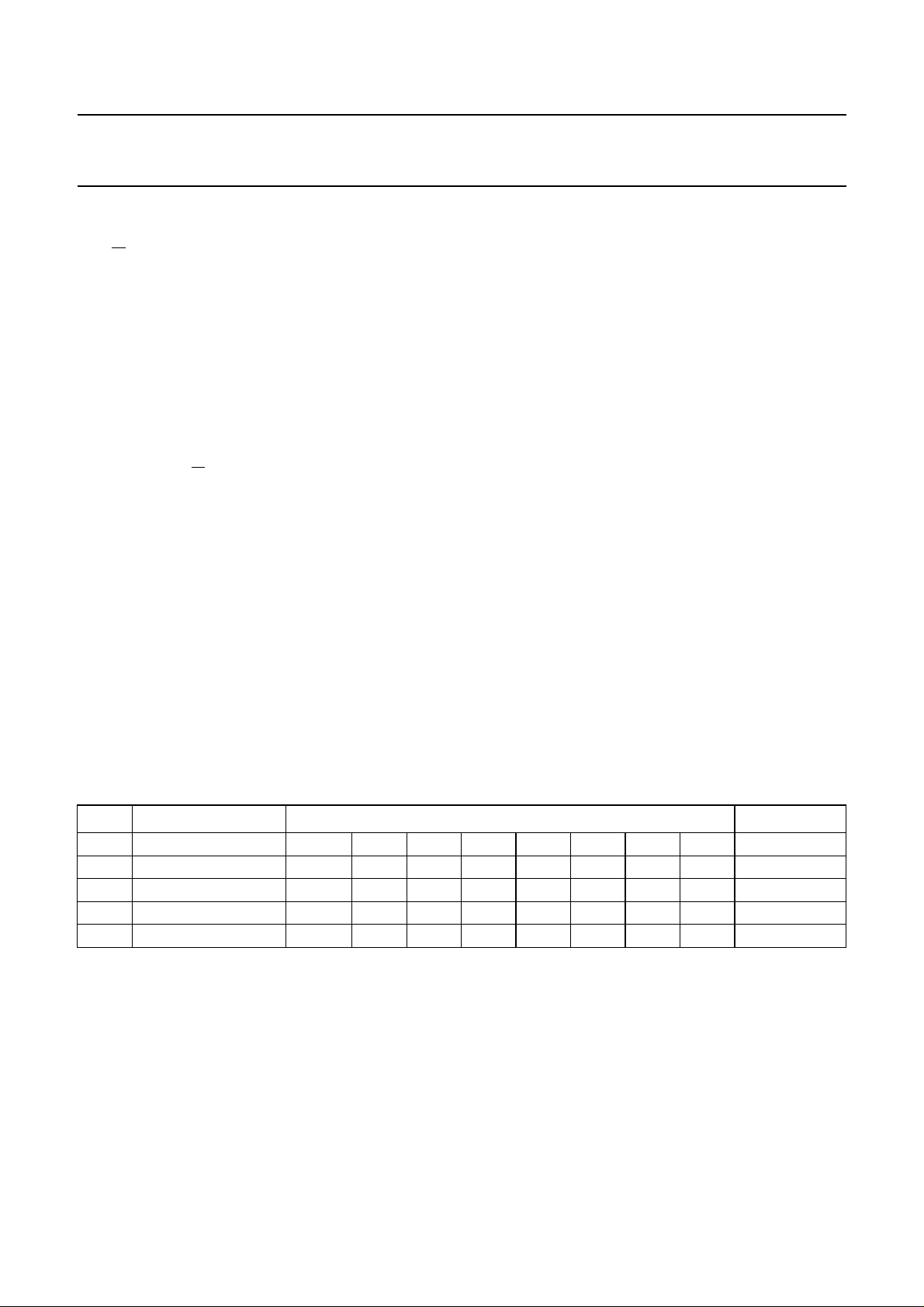
The TSA5060A is controlled via the two-wire I2C-bus.
For programming, there is one 7-bit module address and
bit R/W for selecting READ or WRITE mode.
To be able to have more than one synthesizer in an
I2C-bussystem,oneoffourpossible addresses is selected
depending on the voltage applied at pin AS (see Table 3).
The TSA5060A fulfils the fast mode I2C-bus, according to
the Philips I2C-bus specification. The I2C-bus interface is
designed in such a way that pins SCL and SDA can be
connected either to 5 or 3.3 V pulled-up I2C-bus lines,
allowing the PLL synthesizer to be connected directly to
the bus lines of a 3.3 V microcontroller.
WRITE mode: R/W=0
After the address transmission (first byte), data bytes can
be sent to the device (see Table 1). Four data bytes are
needed to fully program the TSA5060A. The bus
transceiver has an auto-increment facility that permits
programming of the TSA5060A within one single
transmission (address + 4 data bytes).
TSA5060A
To allow a smooth frequency sweep for fine tuning, and
while the data of the dividing ratio of the main divider is in
data bytes 2, 3 and 4, it is necessary to change the
frequency to send the data bytes 2 to 5 in a repeated
sending, or to finish an incomplete transmission by a
STOP condition. Repeated sending of data bytes 2 and 3
without ending the transmission does not change the
dividing ratio. To illustrate, the following data sequences
will change the dividing ratio:
• Bytes 2, 3, 4 and 5
• Bytes 4, 5, 2 and 3
• Bytes 2, 3, 4 and STOP
• Bytes 4, 5, 2 and STOP
• Bytes 2, 3 and STOP
• Bytes 2 and STOP
• Bytes 4 and STOP.
The TSA5060A can also be partly programmed on the
condition that the first data byte following the address is
byte 2 or 4. The meaning of the bits in the data bytes is
given in Table 1. The first bit of the first databyte indicates
whether byte 2 (first bit is logic 0) or byte 4 (first bit is
logic 1) will follow.Until an I2C-bus STOP conditionis sent
by the controller, additional data bytes can be entered
without the need to re-address the device.
Table 1 Write data format
BYTE DESCRIPTION MSB
1 address 1 1 0 0 0 MA1 MA0 0 A
2 programmable divider 0 N14 N13 N12 N11 N10 N9 N8 A
3 programmable divider N7 N6 N5 N4 N3 N2 N1 N0 A
4 control data 1 N16 N15 PE R3 R2 R1 R0 A
5 control data C1 C0 XCE XCS P3 P2/T2 P1/T1 P0/T0 A
Note
1. MSB is transmitted first.
(1)
LSB CONTROL BIT
2000 Oct 24 6
Page 7
Philips Semiconductors Product specification
1.3 GHz I2C-bus controlled low phase
TSA5060A
noise frequency synthesizer
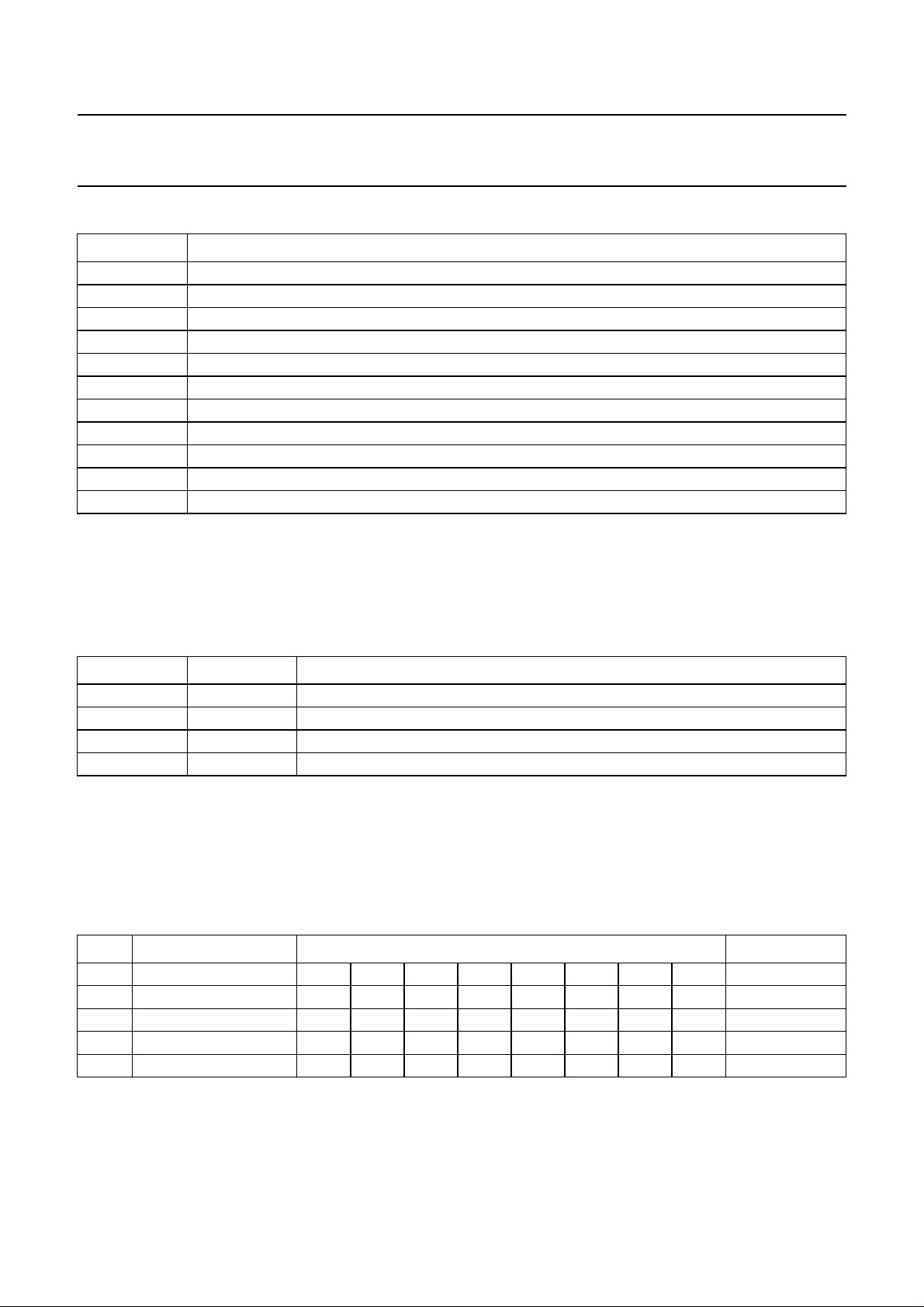
Table 2 Explanation of Table 1
BIT DESCRIPTION
MA1 and MA0 programmable address bits; see Table 3
A acknowledge bit
N16 to N0 programmable main divider ratio control bits; N = N16 × 2
PE prescaler enable (prescaler by 2 is active when bit PE = 1)
R3 to R0 programmable reference divider ratio control bits; see Table 8
C1 and C0 charge pump current select bits; see Table 9
XCE XT/COMP enable; XT/COMP output active when bit XCE = 1; see Table 10
XCS XT/COMP select; signal select when bit XCE = 1, test mode enable when bit XCE = 0; see Table 10
T2, T1 and T0 test mode select when bit XCE = 0 and bit XCS = 1; see Table 10
P3, P2 and P1 Port P3, P2 and P1 output states
P0 Port P0 output state, except in test mode; see Table 10
Address selection
The module address contains the programmable address bits MA1 and MA0, which offer the possibility of having
up to 4 synthesizers in one system. The relationship between MA1 and MA0 and the input voltage at pin AS is given in
Table 3.
16
+ N15 × 215+ ... + N1 × 21+N0
Table 3 Address selection
MA1 MA0 VOLTAGE APPLIED TO PIN AS
0 0 0 to 0.1V
CC
0 1 open-circuit
1 0 0.4V
1 1 0.9V
to 0.6VCC; note 1
CC
to V
CC
CC
Note
1. This address is selected by connecting a 15 kΩ resistor between pin AS and pin V
CC
.
Status at Power-On Reset (POR)
At power-on or whenthe supply voltage drops below approximately 2.75 V internalregisters are set according to Table 4.
Table 4 Status at Power-on reset; note 1
BYTE DESCRIPTION MSB LSB CONTROL BIT
1 address 11000MA1MA00 A
2 programmable divider 0 XXXXXXX A
3 programmable divider XXXXXXXX A
4 control data 1 XXXXXXX A
5 control data 0001X
(2)
(2)
1
(2)
X
(2)
X
A
Notes
1. X = don’t care.
2. At Power-on reset, all output ports are in high-impedance state.
2000 Oct 24 7
Page 8
Philips Semiconductors Product specification
1.3 GHz I2C-bus controlled low phase
TSA5060A
noise frequency synthesizer
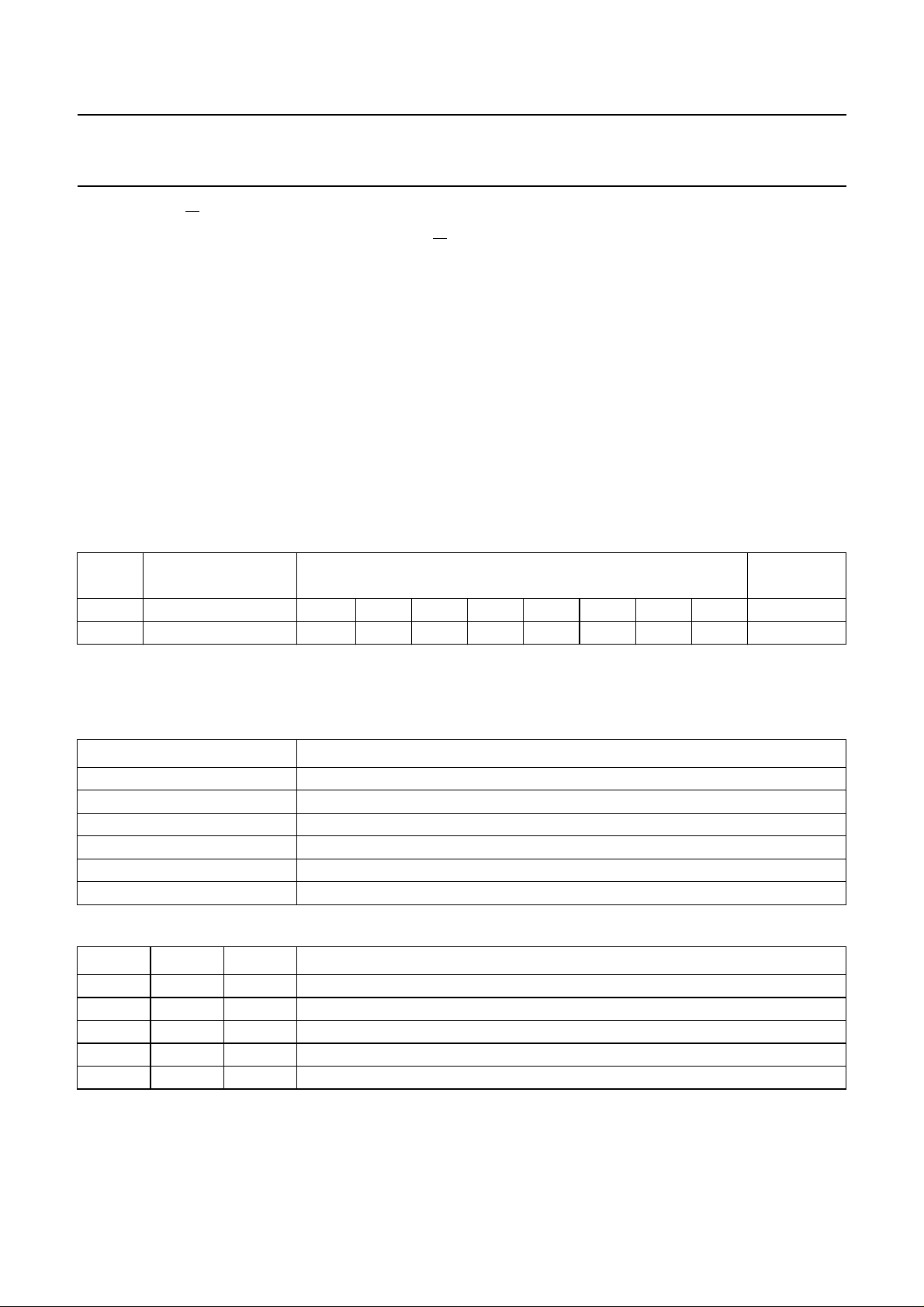
READ mode: R/W=1
Data can be read out of the TSA5060A by setting bit R/W
to logic 1 (see Table 5). After the slave address has been
recognized, the TSA5060A generates an acknowledge
pulse and the first data byte(status word) is transferred on
the SDA line. Data is valid on the SDA line during a
HIGH-level of the SCL clock signal.
Asecond data byte canbe read out of theTSA5060A if the
microcontroller generates an acknowledge bit on the
SDA line.End oftransmissionwilloccur if no acknowledge
bit from the controller occurs.The TSA5060A will then
release the data line to allow the microcontroller to
generate a STOP condition. When ports P0 to P2 are
used as inputs, they must be programmed in their
high-impedance state.
Table 5 Read data format
BYTE DESCRIPTION MSB
(1)
1 address 1 1000MA1MA01 A
2 status byte POR FL I2 I1 I0 A2 A1 A0 −
The POR flag is set to logic 1 when VCC drops below
approximately 2.75 V and at power-on.
It is reset to logic 0 when an end of data is detected by the
TSA5060A (end of a READ sequence).
Control of the loop is made possible with the in-lock flag
which indicates if the loop is phase-locked (bit FL = 1).
The bits I2, I1 and I0 represent the status of the I/O ports
P2, P1 and P0 respectively. A logic 0 indicates a
LOW-level and a logic 1 indicates a HIGH-level.
A built-in 5-level ADC is available at pin ADC. This
converter can be used to feed AFC information to the
microcontroller through the I2C-bus. The relationship
between bits A2, A1, A0 and the input voltage at pin ADC
is given in Table 7.
LSB
CONTROL
BIT
Note
1. MSB is transmitted first.
Table 6 Explanation of Table 5
BIT DESCRIPTION
A acknowledge bit
MA1 and MA0 programmable address bits; see Table 3
POR Power-on reset flag (bit POR = 1 at power-on)
FL in-lock flag (bit FL = 1 when the loop is phase-locked)
I2, I1 and I0 digital information for I/O ports P2, P1 and P0 respectively
A2, A1 and A0 digital outputs of the 5-level ADC; see Table 7
Table 7 ADC levels
A2 A1 A0 VOLTAGE APPLIED TO PIN ADC
1 0 0 0.6VCCto V
0 1 1 0.45VCCto 0.6V
0 1 0 0.3VCCto 0.45V
0 0 1 0.15VCCto 0.3V
0 0 0 0 to 0.15V
CC
CC
CC
CC
CC
Note
1. Accuracy is ±0.03 V
CC
.
(1)
2000 Oct 24 8
Page 9

Philips Semiconductors Product specification
1.3 GHz I2C-bus controlled low phase
TSA5060A
noise frequency synthesizer
Reference divider ratio
The reference divider ratio is set by 4 bits in the WRITE
mode, giving 16 different ratios. This allows the
comparison frequency to be adjusted to different values,
depending on the compromise which has to be found
between step size and phase noise.
Table 8 Reference dividing ratios
R3 R2 R1 R0 RATIO
0000 2 2MHz 2MHz 4MHz
0001 4 1MHz 1MHz 2MHz
0010 8 500kHz 500kHz 1MHz
001116 250kHz 250kHz 500kHz
010032 125kHz 125kHz 250kHz
010164 62.5 kHz 62.5 kHz 125 kHz
0110128 31.25 kHz 31.25 kHz 62.5 kHz
0111256 15.625 kHz 15.625 kHz 31.25 kHz
100024 166.67 kHz 166.67 kHz 333.33 kHz
1001 5 800kHz 800kHz 1.6MHz
101010 400kHz 400kHz 800kHz
101120 200kHz 200kHz 400kHz
110040 100kHz 100kHz 200kHz
110180 50kHz 50kHz 100kHz
1110160 25kHz 25kHz 50kHz
1111320 12.5 kHz 12.5 kHz 25 kHz
COMPARISON
FREQUENCY
Table 8 shows the different dividing ratios and the
corresponding comparison frequencies and step size,
assuming the device is provided with a 4 MHz signal at
pin XTAL.
Thedividing ratio of 24 isimplemented to fulfil theUK-DTT
recommendation regarding offset frequency of1⁄6MHz.
STEP
(1)
BIT PE = 0
(1)
BIT PE = 1
(1)
Note
1. Only valid when the IC is used with a 4 MHz crystal.
Charge pump current
The charge pump current can be chosen from 4 different values depending onthe value of bits C1 and C0 inthe I2C-bus
byte 4; see Table 9.
Table 9 Charge pump current
I
(µA) (absolute value)
C1 C0
MIN. TYP. MAX.
0 0 100 135 170
0 1 210 280 350
1 0 450 600 750
1 1 920 1230 1540
2000 Oct 24 9
cp
Page 10

Philips Semiconductors Product specification
1.3 GHz I2C-bus controlled low phase
noise frequency synthesizer
XT/COMP frequency output
It is possible to output either the crystal or the comparison
frequency at pin XT/COMP to be used in the application.
For example, to drive a second PLL synthesizer saving a
quartz crystal. To output f
to logic 1 and bit XCS to logic 0, or bit XCE to logic 0 and
bit XCS to logic 1 during a test mode, while to output f
it is necessary to set both bits XCE and XCS to logic 1.
Iftheoutputsignal at this pin is not used it isrecommended
to disable it by setting both bits XCE and XCS to logic 0.
Table 10 shows how thispin is programmed. At power-on,
the XT/COMP output is set with the f
Prescaler enable
The TSA5060A is able to work with the relationship
f
= step size for an input frequency up to 1.3 GHz,
comp
covering the complete terrestrial and cable frequency
range.
it is necessary to set bit XCE
xtal
signal selected.
xtal
comp
TSA5060A
If needed, the prescaler can be selected by setting bit PE
to logic 1 while it is not in use if bit PE is set to logic 0.
If it is important to reach a low phase noise on the
controlled VCO, it is recommended to set bit PE to logic 0
and not to use the prescaler allowing the comparison
frequency to be equal to the step size.
Test modes
It is possible to access the test modes by setting bit XCE
to logic 0 and bit XCS to logic 1. One specific test mode is
then selected using bits T2, T1 and T0, as described in
Table 10.
Table 10 XT/COMP and test mode selection; note 1
XCE XCS T2 T1 T0 XT/COMP OUTPUT TEST MODE
0 0 X X X disabled normal operation
10XXXf
11XXXf
01000f
xtal
comp
xtal
normal operation
normal operation
test operation: charge pump sink;
status byte bit FL = 1
01001f
xtal
test operation: charge pump source;
status byte bit FL = 0
01010f
xtal
test operation: charge pump disabled;
status byte bit FL = 0
01011f
011XXf
xtal
xtal
test operation:1⁄2f
DIV
test operation: drive voltage (pin DRIVE)
is off (high-impedance); note 2
Notes
1. X = don’t care.
2. Status at Power-on reset.
switched to Port P0
2000 Oct 24 10
Page 11

Philips Semiconductors Product specification
1.3 GHz I2C-bus controlled low phase
TSA5060A
noise frequency synthesizer
LIMITING VALUES
In accordance with the Absolute Maximum Rating System (IEC 60134); note 1.
SYMBOL PARAMETER CONDITIONS MIN. MAX. UNIT
V
CC
V
n
I
O(drive)
I
O(SDA)
I
O(Px)
I
O(ΣPx)
T
amb
T
stg
T
j(max)
Note
1. Maximum ratings cannot be exceeded, not even momentarily without causing irreversible IC damage. Maximum
ratings cannot be accumulated.
supply voltage −0.3 +6.0 V
voltage on pins
CP, XTAL, XT/COMP, AS, P0, P1, P2,
−0.3 V
+ 0.3 V
CC
P3, ADC, RFA and RFB
SCL and SDA −0.3 +6.0 V
output current on pin DRIVE −1+1 mA
serial data output current −1.0 +10.0 mA
P0, P1, P2 and P3 output current port switched on −1.0 +20.0 mA
sum of currents in P0, P1, P2 and P3 − 50.0 mA
ambient temperature −20 +85 °C
storage temperature −40 +150 °C
maximum junction temperature − 150 °C
HANDLING
Inputs and outputsare protected against electrostatic dischargein normal handling. However, tobe completely safe, it is
desirable to take normal precautions appropriate to handling integrated circuits.
THERMAL CHARACTERISTICS
SYMBOL PARAMETER CONDITIONS VALUE UNIT
R
th(j-a)
thermal resistance from junction to ambient in free air
TSA5060AT 115 K/W
TSA5060ATS 144 K/W
2000 Oct 24 11
Page 12

Philips Semiconductors Product specification
1.3 GHz I2C-bus controlled low phase
TSA5060A
noise frequency synthesizer
CHARACTERISTICS
VCC= 4.5 to 5.5 V; T
SYMBOL PARAMETER CONDITIONS MIN. TYP. MAX. UNIT
Supply (pin V
V
CC
I
CC
V
CC(POR)
CC
supply voltage 4.5 5.0 5.5 V
supply current T
supply voltage below which POR is active T
RF inputs (pins RFA and RFB)
f
i(RF)
V
i(RF)(rms)
Z
i(RF)
C
i(RF)
RF input frequency 64 − 1300 MHz
RF input voltage (RMS value) f
RF input impedance see Fig.6 −−− Ω
RF input capacitance see Fig.6 −−− pF
MDR main divider ratio prescaler disabled 64 − 131071
Crystal oscillator (pin XTAL)
f
xtal
Z
XTAL
Z
XTAL
P
XTAL
f
i(ext)
V
i(ext)(p-p)
crystal frequency 4 − 16 MHz
crystal oscillator negative impedance 4 MHz crystal 400 680 −Ω
recommended crystal series resistance 4 MHz crystal −−200 Ω
crystal drive level 4 MHz crystal; note 2 − 40 −µW
external reference input frequency note 3 2 − 20 MHz
external reference input voltage
(peak-to-peak value)
Phase comparator and charge pump
f
comp
N
comp
comparison frequency −−2 MHz
equivalent phase noise at the phase
detector input
I
charge pump current C1 = 0; C0 = 0 100 135 170 µA
cp
I
LO(cp)
charge pump leakage output current −10 0 +10 nA
DRIVE output (pin DRIVE)
V
O(drive)
output voltage when the charge pump is
sinking current
I
O(drive)
output current when the charge pump is
sourcing current
= −20 to +85 °C; f
amb
)
= 4 MHz; measured according to Fig.4; unless otherwise specified.
xtal
=25°C303745mA
amb
=25°C − 2.75 − V
amb
between 64 and
i(RF)
150 MHz; note 1
f
between 150 and
i(RF)
1300 MHz; note 1
12.6 − 300 mV
−25 − +2.5 dBm
7.1 − 300 mV
−30 − +2.5 dBm
prescaler enabled 128 − 262142
note 3 200 − 500 mV
f
comp
= 250 kHz;
−−157 − dBc/Hz
C1=C0=1;
in the loop bandwidth
C1 = 0; C0 = 1 210 280 350 µA
C1 = 1; C0 = 0 450 600 750 µA
C1 = 1; C0 = 1 920 1230 1540 µA
XCE = 0; XCS = 1;
− 140 250 mV
T2 = 0; T1 = 0; T0 = 0
XCE = 0; XCS = 1;
100 250 −µA
T2 = 0; T1 = 0; T0 = 1
2000 Oct 24 12
Page 13

Philips Semiconductors Product specification
1.3 GHz I2C-bus controlled low phase
TSA5060A
noise frequency synthesizer
SYMBOL PARAMETER CONDITIONS MIN. TYP. MAX. UNIT
XT/COMP output (pin XT/COMP)
V
o(p-p)
Input/output and output ports (pins P0, P1, P2 and P3)
I
lO
V
O(sat)
V
IL
V
IH
ADC input (pin ADC)
I
LIH
I
LIL
Address selection (pin AS)
I
LIH
I
LIL
SCL and SDA inputs (pins SCL and SDA)
V
IL
V
IH
I
LIH
I
LIL
f
SCL
SDA output (pin SDA)
V
O(ack)
Notes
1. Asymmetrical drive on pin RFA or RFB; see Fig.3.
2. The drive level is expected with the crystal at series resonance with a series resistance of 50 Ω. The value will be
different with another crystal.
3. To drive pin XTAL from the pin XT/COMP of another TSA5060A, couple the signal through a capacitor of 1 nF
(to remove the DC level) in series with an 1.2 kΩ resistor; see Fig.5.
4. The voltage corresponding to a LOW-level on the I2C-bus includes the noise margin as defined in the I2C-bus
specification. The worst situation is a bus voltage of 5 V + 10%. In this case the noise margin is 0.55 V below
0.3 × 5.5 V, thus 1.1 V.
5. The voltage corresponding to a HIGH-level on the I2C-bus includes the noise margin as defined in the I2C-bus
specification. The worst situation is a bus voltage of 3.3 V − 10%. In this case the noise margin is 0.59 V above
0.7 × 2.97 V, thus 2.67 V.
AC output voltage (peak-to-peak value) XCE = 1 − 400 − mV
port leakage current port off; VO=V
output port saturation voltage port on; I
=10mA − 0.2 0.4 V
sink
CC
−−10 µA
LOW-level input voltage −−1.5 V
HIGH-level input voltage 3.0 −− V
HIGH-level input leakage current V
LOW-level input leakage current V
ADC=VCC
=0V −10 −− µA
ADC
HIGH-level input leakage current VAS=V
CC
−−10 µA
−−1mA
LOW-level input leakage current VAS=0V −0.5 −− mA
LOW-level input voltage including noise margin;
−−1.1 V
note 4
HIGH-level input voltage including noise margin;
2.67 −− V
note 5
HIGH-level input leakage current VIH= 5.5 V
V
= 5.5 V −−10 µA
CC
V
=0V −−10 µA
CC
LOW-level input leakage current VIL=0V; VCC= 5.5 V −10 −− µA
SCL clock frequency −−400 kHz
output voltage during acknowledge I
=3mA −−0.4 V
sink
2000 Oct 24 13
Page 14

Philips Semiconductors Product specification
1.3 GHz I2C-bus controlled low phase
noise frequency synthesizer
handbook, full pagewidth
V
i(RF)
(dBm)
+6
0
−6
−12
−18
−24
−30
−36
−42
−48
−54
−60
0 500 1000 1500
TSA5060A
FCE722
Guaranteed area
f (MHz)
Fig.3 Typical sensitivity curve.
2000 Oct 24 14
Page 15

Philips Semiconductors Product specification
1.3 GHz I2C-bus controlled low phase
TSA5060A
noise frequency synthesizer
APPLICATION INFORMATION
An example of atypical application is givenin Fig.4. In this application the VCO centrefrequency is 600 MHz with a slope
of 18 MHz/V. The expected loop bandwidth is 13 kHz with a charge pump current of 1230 µA and a comparison
frequency of 166.67 kHz. Filter components need to be adapted to each application depending on the VCO
characteristics and the required performance of the loop.
handbook, full pagewidth
4 MHz
18 pF
MICRO-
CONTROLLER
CP
XTAL
XT/COMP
AS
SDA
SCL
P3
P2
47 nF
1
2
3
4
TSA5060A
5
6
7
8
33 V
10 kΩ
180 pF
16
15
14
13
12
11
10
5 V
9
27 kΩ
DRIVE
GND
RFB
RFA
V
CC
ADC
P0
P1
BC847
1 kΩ
1.8 nF
1 nF
1 nF
10 nF
VCO
output
tuning
voltage
VCO
FCE719
Fig.4 Typical application.
Loop bandwidth
Most of the applications that the TSA5060A are dedicated
for require a large loop bandwidth, in the order of a
few kHz to a few tens of kHz. The calculation of the loop
filter elements has to be done for each application, while it
dependsontheVCOslopeand phase noise, as well as the
reference frequency and charge pump current.
A simulation of the loop can easily be done by using the
SIMPATA software from Philips.
Reference source
The TSA5060A is well suited to be used with a 4 MHz
crystal connected to pin XTAL. Philips crystal ordering
code 4322 143 04093 is recommended in this case.
2000 Oct 24 15
It is however possible to use a crystal with a higher
frequency (up to 16 MHz) to improve the noise
performance. When choosing a crystal, care should be
taken to select a crystal able to withstand the drive level of
the TSA5060A without suffering from accelerated ageing.
It is also possible to feed pin XTAL with an external signal
between2 and 20 MHz,coming from an external oscillator
or from the pin XT/COMP of another TSA5060A, when
more than one synthesizer is present in the same
application. The application given in Fig.5 should then be
used.
If the signal at pin XT/COMP is not used in an application,
the output should be switched off(bits XCE = 0, XCS = 0).
This pin should then be left open.
Page 16

Philips Semiconductors Product specification
1.3 GHz I2C-bus controlled low phase
noise frequency synthesizer
handbook, full pagewidth
4 MHz
18 pF
1
2
3
4
TSA5060A
5
6
7
8
16
15
14
13
12
11
10
TSA5060A
1.0 nF
1.2 kΩ
9
1
2
3
4
TSA5060A
5
6
7
8
16
15
14
13
12
11
10
9
FCE720
Fig.5 Application for using one crystal with two TSA5060As.
I2C-bus crosstalk
The TSA5060A includes a loop amplifier that requires an
externalNPNtransistor.Careshouldbe taken in the layout
of the application to ground the emitter of the NPN
transistor as close as possible to the ground of the VCO.
The best way to avoid any I
2
C-bus crosstalk in the
application (i.e. parasitic coupling between the I2C-bus
lines and the VCO coil) is to avoid the I2C-bus signal to
come in the RF part by using an I2C-bus gate that allows
only the messages for the PLL to go to the PLL and to
avoid unnecessary repeated sending. Such a gate is
integrated in most of the Philips digital demodulators.
2000 Oct 24 16
Page 17

Philips Semiconductors Product specification
1.3 GHz I2C-bus controlled low phase
noise frequency synthesizer
RF input impedance
handbook, full pagewidth
0.5
0.2
+ j
0
− j
0.2
0.2
0.5 1
TSA5060A
1
2
5
10
2
5
10
1.3 GHz
64 MHz
∞
10
5
0.5
1
Fig.6 RF input impedance.
2
FCE721
2000 Oct 24 17
Page 18

Philips Semiconductors Product specification
1.3 GHz I2C-bus controlled low phase
noise frequency synthesizer
PACKAGE OUTLINES
SO16: plastic small outline package; 16 leads; body width 3.9 mm
D
c
y
Z
16
9
TSA5060A
SOT109-1
E
H
E
A
X
v M
A
pin 1 index
1
e
0 2.5 5 mm
DIMENSIONS (inch dimensions are derived from the original mm dimensions)
mm
A
max.
1.75
0.069
A1A2A
0.25
1.45
0.10
1.25
0.010
0.057
0.004
0.049
0.25
0.01
b
3
p
0.49
0.25
0.36
0.19
0.0100
0.019
0.0075
0.014
UNIT
inches
Note
1. Plastic or metal protrusions of 0.15 mm maximum per side are not included.
(1)E(1) (1)
cD
10.0
9.8
0.39
0.38
8
b
p
scale
eHELLpQZywv θ
4.0
1.27
3.8
0.16
0.050
0.15
w M
6.2
5.8
0.244
0.228
A
2
1.05
0.041
Q
A
1
detail X
1.0
0.7
0.4
0.6
0.028
0.039
0.020
0.016
(A )
L
p
L
0.25 0.1
0.25
0.01
0.01 0.004
A
3
θ
0.7
0.3
0.028
0.012
o
8
o
0
OUTLINE
VERSION
SOT109-1
IEC JEDEC EIAJ
076E07 MS-012
REFERENCES
2000 Oct 24 18
EUROPEAN
PROJECTION
ISSUE DATE
97-05-22
99-12-27
Page 19

Philips Semiconductors Product specification
1.3 GHz I2C-bus controlled low phase
noise frequency synthesizer
SSOP16: plastic shrink small outline package; 16 leads; body width 4.4 mm
16
D
c
y
Z
9
E
H
E
TSA5060A
SOT369-1
A
X
v M
A
pin 1 index
18
w M
b
b
0.32
0.20
p
p
cD
0.25
5.30
0.13
5.10
0 2.5 5 mm
scale
(1)E(1)
eHELLpQZywv θ
4.5
0.65
4.3
e
DIMENSIONS (mm are the original dimensions)
mm
A
max.
1.5
0.15
0.00
1.4
1.2
A
2
3
0.25
UNIT A1A
Note
1. Plastic or metal protrusions of 0.20 mm maximum per side are not included.
Q
A
2
6.6
6.2
L
0.65
0.45
(A )
L
p
A
1
detail X
0.75
1.0
0.45
3
A
θ
0.130.2 0.1
0.48
0.18
(1)
o
10
o
0
OUTLINE
VERSION
SOT369-1 MO-152
IEC JEDEC EIAJ
REFERENCES
2000 Oct 24 19
EUROPEAN
PROJECTION
ISSUE DATE
95-02-04
99-12-27
Page 20

Philips Semiconductors Product specification
1.3 GHz I2C-bus controlled low phase
noise frequency synthesizer
SOLDERING
Introduction to soldering surface mount packages
Thistextgivesa very brief insight to a complex technology.
A more in-depth account of soldering ICs can be found in
our
“Data Handbook IC26; Integrated Circuit Packages”
(document order number 9398 652 90011).
There is no soldering method that is ideal for all surface
mount IC packages. Wavesoldering is not always suitable
for surface mount ICs, or for printed-circuit boards with
high population densities. In these situations reflow
soldering is often used.
Reflow soldering
Reflow soldering requires solder paste (a suspension of
fine solder particles, flux and binding agent) to be applied
tothe printed-circuit board by screen printing,stencilling or
pressure-syringe dispensing before package placement.
Several methods exist for reflowing; for example,
infrared/convection heating in a conveyor type oven.
Throughput times (preheating, soldering and cooling)vary
between 100 and 200 seconds depending on heating
method.
Typical reflow peak temperatures range from
215 to 250 °C. The top-surface temperature of the
packages should preferable be kept below 230 °C.
Wave soldering
Conventional single wave soldering is not recommended
forsurfacemountdevices(SMDs) or printed-circuit boards
with a high component density, as solder bridging and
non-wetting can present major problems.
To overcome these problems the double-wave soldering
method was specifically developed.
TSA5060A
If wave soldering is used the following conditions must be
observed for optimal results:
• Use a double-wave soldering method comprising a
turbulent wave with high upward pressure followed by a
smooth laminar wave.
• For packages with leads on two sides and a pitch (e):
– larger than or equal to 1.27 mm, the footprint
longitudinal axis is preferred to be parallel to the
transport direction of the printed-circuit board;
– smaller than 1.27 mm, the footprint longitudinal axis
must be parallel to the transport direction of the
printed-circuit board.
The footprint must incorporate solder thieves at the
downstream end.
• Forpackageswithleadson four sides, the footprint must
be placed at a 45° angle to the transport direction of the
printed-circuit board. The footprint must incorporate
solder thieves downstream and at the side corners.
During placement and before soldering, thepackage must
be fixed with a droplet of adhesive. The adhesive can be
applied by screen printing, pin transfer or syringe
dispensing. The package can be soldered after the
adhesive is cured.
Typical dwell time is 4 seconds at 250 °C.
A mildly-activated flux will eliminate the need for removal
of corrosive residues in most applications.
Manual soldering
Fix the component by first soldering two
diagonally-opposite end leads. Use a low voltage (24 V or
less) soldering iron applied to the flat part of the lead.
Contact time must be limited to 10 seconds at up to
300 °C.
When using a dedicated tool, all other leads can be
soldered in one operation within 2 to 5 seconds between
270 and 320 °C.
2000 Oct 24 20
Page 21

Philips Semiconductors Product specification
1.3 GHz I2C-bus controlled low phase
TSA5060A
noise frequency synthesizer
Suitability of surface mount IC packages for wave and reflow soldering methods
PACKAGE
BGA, SQFP not suitable suitable
HLQFP, HSQFP, HSOP, HTSSOP, SMS not suitable
(3)
PLCC
LQFP, QFP, TQFP not recommended
SSOP, TSSOP, VSO not recommended
Notes
1. All surface mount (SMD) packages are moisture sensitive. Depending upon the moisture content, the maximum
2. These packages are not suitable for wave soldering as a solder joint between the printed-circuit board and heatsink
3. If wave soldering is considered, then the package must be placed at a 45° angle to the solder wave direction.
4. Wave soldering is only suitable for LQFP, TQFP and QFP packages with a pitch (e) equal to or larger than 0.8 mm;
5. Wave soldering is only suitable for SSOP and TSSOP packages with a pitch (e) equal to or larger than 0.65 mm; it is
, SO, SOJ suitable suitable
temperature (with respect to time) and body size of the package, there is a risk that internal or external package
cracks may occur due to vaporization of the moisture in them (the so called popcorn effect). For details, refer to the
Drypack information in the
(at bottom version) can not be achieved, and as solder may stick to the heatsink (on top version).
The package footprint must incorporate solder thieves downstream and at the side corners.
it is definitely not suitable for packages with a pitch (e) equal to or smaller than 0.65 mm.
definitely not suitable for packages with a pitch (e) equal to or smaller than 0.5 mm.
“Data Handbook IC26; Integrated Circuit Packages; Section: Packing Methods”
WAVE REFLOW
(2)
(3)(4)
(5)
SOLDERING METHOD
(1)
suitable
suitable
suitable
.
2000 Oct 24 21
Page 22

Philips Semiconductors Product specification
1.3 GHz I2C-bus controlled low phase
TSA5060A
noise frequency synthesizer
DATA SHEET STATUS
DATA SHEET STATUS
Objective specification Development This data sheet contains the design target or goal specifications for
Preliminary specification Qualification This data sheet contains preliminary data, and supplementary data will be
Product specification Production This data sheet contains final specifications. Philips Semiconductors
Note
1. Please consult the most recently issued data sheet before initiating or completing a design.
DEFINITIONS
Short-form specification The data in a short-form
specification is extracted from a full data sheet with the
same type number and title. For detailed information see
the relevant data sheet or data handbook.
Limiting values definition Limiting values given are in
accordance with the Absolute Maximum Rating System
(IEC 60134). Stress above one or more of the limiting
values may cause permanent damage to the device.
These are stress ratings only and operation of the device
attheseor at any other conditions above thosegiveninthe
Characteristics sections of the specification is not implied.
Exposure to limiting values for extended periods may
affect device reliability.
Application information Applications that are
described herein for any of these products are for
illustrative purposes only. Philips Semiconductors make
norepresentationorwarrantythatsuchapplicationswillbe
suitable for the specified use without further testing or
modification.
PRODUCT
STATUS
DEFINITIONS
product development. Specification may change in any manner without
notice.
published at a later date. Philips Semiconductors reserves the right to
make changes at any time without notice in order to improve design and
supply the best possible product.
reserves the right to make changes at any time without notice in order to
improve design and supply the best possible product.
DISCLAIMERS
Life support applications These products are not
designed for use in life support appliances, devices, or
systems where malfunction of these products can
reasonably be expected toresult in personal injury. Philips
Semiconductorscustomersusingorsellingtheseproducts
for use in such applications do so at their own risk and
agree to fully indemnify Philips Semiconductors for any
damages resulting from such application.
Right to make changes Philips Semiconductors
reserves the right to make changes, without notice, in the
products, including circuits, standard cells, and/or
software, described or contained herein in order to
improve design and/or performance. Philips
Semiconductors assumes no responsibility or liability for
theuseofanyof these products, conveys no licence or title
under any patent, copyright, or mask work right to these
products,and makes no representations or warranties that
these products are free from patent, copyright, or mask
work right infringement, unless otherwise specified.
(1)
2
PURCHASE OF PHILIPS I
2000 Oct 24 22
C COMPONENTS
Purchase of Philips I
components in the I2C system provided the system conforms to the I2C specification defined by
Philips. This specification can be ordered using the code 9398 393 40011.
2
C components conveys a license under the Philips’ I2C patent to use the
Page 23

Philips Semiconductors Product specification
1.3 GHz I2C-bus controlled low phase
noise frequency synthesizer
NOTES
TSA5060A
2000 Oct 24 23
Page 24

Philips Semiconductors – a w orldwide compan y
Argentina: see South America
Australia: 3 Figtree Drive, HOMEBUSH, NSW 2140,
Tel. +61 2 9704 8141, Fax. +61 2 9704 8139
Austria: Computerstr. 6, A-1101 WIEN, P.O. Box 213,
Tel. +43 1 60 101 1248, Fax. +43 1 60 101 1210
Belarus: Hotel Minsk Business Center, Bld. 3, r. 1211, Volodarski Str. 6,
220050 MINSK, Tel. +375 172 20 0733, Fax. +375 172 20 0773
Belgium: see The Netherlands
Brazil: see South America
Bulgaria: Philips Bulgaria Ltd., Energoproject, 15th floor,
51 James Bourchier Blvd., 1407 SOFIA,
Tel. +359 2 68 9211, Fax. +359 2 68 9102
Canada: PHILIPS SEMICONDUCTORS/COMPONENTS,
Tel. +1 800 234 7381, Fax. +1 800 943 0087
China/Hong Kong: 501 Hong Kong Industrial Technology Centre,
72 Tat Chee Avenue, Kowloon Tong, HONG KONG,
Tel. +852 2319 7888, Fax. +852 2319 7700
Colombia: see South America
Czech Republic: see Austria
Denmark: Sydhavnsgade 23, 1780 COPENHAGEN V,
Tel. +45 33 29 3333, Fax. +45 33 29 3905
Finland: Sinikalliontie 3, FIN-02630 ESPOO,
Tel. +358 9 615 800, Fax. +358 9 6158 0920
France: 51 Rue Carnot, BP317, 92156 SURESNES Cedex,
Tel. +33 1 4099 6161, Fax. +33 1 4099 6427
Germany: Hammerbrookstraße 69, D-20097 HAMBURG,
Tel. +49 40 2353 60, Fax. +49 40 2353 6300
Hungary: see Austria
India: Philips INDIA Ltd, Band Box Building, 2nd floor,
254-D, Dr. Annie Besant Road, Worli, MUMBAI 400 025,
Tel. +91 22 493 8541, Fax. +91 22 493 0966
Indonesia: PT Philips DevelopmentCorporation, Semiconductors Division,
Gedung Philips, Jl. Buncit Raya Kav.99-100, JAKARTA 12510,
Tel. +62 21 794 0040 ext. 2501, Fax. +62 21 794 0080
Ireland: Newstead, Clonskeagh, DUBLIN 14,
Tel. +353 1 7640 000, Fax. +353 1 7640 200
Israel: RAPAC Electronics, 7 Kehilat Saloniki St, PO Box 18053,
TEL AVIV 61180, Tel. +972 3 645 0444, Fax. +972 3 649 1007
Italy: PHILIPS SEMICONDUCTORS, Via Casati,23 - 20052 MONZA (MI),
Tel. +39 039 203 6838, Fax +39 039 203 6800
Japan: Philips Bldg 13-37, Kohnan 2-chome, Minato-ku,
TOKYO 108-8507, Tel. +81 3 3740 5130, Fax. +81 3 3740 5057
Korea: Philips House, 260-199 Itaewon-dong, Yongsan-ku, SEOUL,
Tel. +82 2 709 1412, Fax. +82 2 709 1415
Malaysia: No. 76 Jalan Universiti, 46200 PETALING JAYA, SELANGOR,
Tel. +60 3 750 5214, Fax. +60 3 757 4880
Mexico: 5900 Gateway East, Suite 200, EL PASO, TEXAS 79905,
Tel. +9-5 800 234 7381, Fax +9-5 800 943 0087
Middle East: see Italy
Netherlands: Postbus 90050, 5600 PB EINDHOVEN, Bldg. VB,
Tel. +31 40 27 82785, Fax. +31 40 27 88399
New Zealand: 2 Wagener Place, C.P.O. Box 1041, AUCKLAND,
Tel. +64 9 849 4160, Fax. +64 9 849 7811
Norway: Box 1, Manglerud 0612, OSLO,
Tel. +47 22 74 8000, Fax. +47 22 74 8341
Pakistan: see Singapore
Philippines: Philips Semiconductors Philippines Inc.,
106 Valero St. Salcedo Village, P.O. Box 2108 MCC, MAKATI,
Metro MANILA, Tel. +63 2 816 6380, Fax. +63 2 817 3474
Poland: Al.Jerozolimskie 195 B, 02-222 WARSAW,
Tel. +48 22 5710 000, Fax. +48 22 5710 001
Portugal: see Spain
Romania: see Italy
Russia: Philips Russia, Ul. Usatcheva 35A, 119048 MOSCOW,
Tel. +7 095 755 6918, Fax. +7 095 755 6919
Singapore: Lorong 1, Toa Payoh, SINGAPORE 319762,
Tel. +65 350 2538, Fax. +65 251 6500
Slovakia: see Austria
Slovenia: see Italy
South Africa: S.A. PHILIPS Pty Ltd., 195-215 Main Road Martindale,
2092 JOHANNESBURG, P.O. Box 58088 Newville 2114,
Tel. +27 11 471 5401, Fax. +27 11 471 5398
South America: Al. Vicente Pinzon, 173, 6th floor,
04547-130 SÃO PAULO, SP, Brazil,
Tel. +55 11 821 2333, Fax. +55 11 821 2382
Spain: Balmes 22, 08007 BARCELONA,
Tel. +34 93 301 6312, Fax. +34 93 301 4107
Sweden: Kottbygatan 7, Akalla, S-16485 STOCKHOLM,
Tel. +46 8 5985 2000, Fax. +46 8 5985 2745
Switzerland: Allmendstrasse 140, CH-8027 ZÜRICH,
Tel. +41 1 488 2741 Fax. +41 1 488 3263
Taiwan: Philips Semiconductors, 5F, No. 96, Chien Kuo N. Rd., Sec. 1,
TAIPEI, Taiwan Tel. +886 2 2134 2451, Fax. +886 2 2134 2874
Thailand: PHILIPS ELECTRONICS (THAILAND) Ltd.,
60/14 MOO 11, Bangna Trad Road KM. 3, Bagna, BANGKOK 10260,
Tel. +66 2 361 7910, Fax. +66 2 398 3447
Turkey: Yukari Dudullu, Org. San. Blg., 2.Cad. Nr. 28 81260 Umraniye,
ISTANBUL, Tel. +90 216 522 1500, Fax. +90 216 522 1813
Ukraine: PHILIPS UKRAINE, 4 Patrice Lumumba str., Building B, Floor 7,
252042 KIEV, Tel. +380 44 264 2776, Fax. +380 44 268 0461
United Kingdom: Philips Semiconductors Ltd., 276 Bath Road, Hayes,
MIDDLESEX UB3 5BX, Tel. +44 208 730 5000, Fax. +44 208 754 8421
United States: 811 East Arques Avenue, SUNNYVALE, CA 94088-3409,
Tel. +1 800 234 7381, Fax. +1 800 943 0087
Uruguay: see South America
Vietnam: see Singapore
Yugoslavia: PHILIPS, Trg N. Pasica 5/v, 11000 BEOGRAD,
Tel. +381 11 3341 299, Fax.+381 11 3342 553
For all other countries apply to: Philips Semiconductors,
Marketing Communications, Building BE-p, P.O. Box 218, 5600 MD EINDHOVEN,
The Netherlands, Fax. +31 40 27 24825
© Philips Electronics N.V. SCA
All rights are reserved. Reproduction in whole or in part is prohibited without the prior written consent of the copyright owner.
The information presented in this document does not form part of any quotation or contract, is believed to be accurate and reliable and may be changed
without notice. No liability will be accepted by the publisher for any consequence of its use. Publication thereof does not convey nor imply any license
under patent- or other industrial or intellectual property rights.
2000
Internet: http://www.semiconductors.philips.com
70
Printed in The Netherlands 753504/03/pp24 Date of release: 2000 Oct 24 Document order number: 9397 750 07654
 Loading...