

Page 1

TLMB310.
Vishay Telefunken
SMD LED in P–LCC–2 Package
Color Type Technology Angle of Half Intensity
Blue TLMB310. GaN on SiC 60
Description
This device has been redesigned in 1998 replacing
SiC by GaN technology to meet the increasing
demand for high efficiency blue LEDs.
The package of the TLMB310. is the P–LCC–2
(equivalent to a size B tantalum capacitor).
It consists of a lead frame which is surrounded with a
white thermoplast. All LEDs are categorized in
luminous intensity groups. That allows users to
assemble LEDs with uniform appearance.
±
ö
°
Features
D
GaN on SiC technology
D
EIA and ICE standard package
D
Compatible with infrared, vapor phase and wave
solder processes according to CECC
D
Available in 8 mm tape
D
Non-diffused lens: excellent for coupling to light
pipes and backlighting
D
Luminous intensity ratio in one packaging unit
I
Vmax/IVmin
D
ESD class 1
x 1.6
Applications
Automotive: backlighting in dashboards and switches
Telecommunication: indicator and backlighting in telephone and fax
Indicator and backlight for audio and video equipment
Indicator and backlight in office equipment
Flat backlight for LCDs, switches and symbols
General use
94 8553
Rev. A2, 13-Jul-99
www.vishay .de • FaxBack +1-408-970-5600Document Number 83034
1 (6)
Page 2

TLMB310.
y
F
Vishay Telefunken
Absolute Maximum Ratings
T
= 25_C, unless otherwise specified
amb
TLMB310.
Parameter Test Conditions Symbol Value Unit
Reverse voltage V
DC forward current T
Surge forward current tp ≤ 10 ms I
Power dissipation T
Junction temperature T
Operating temperature range T
Storage temperature range T
Soldering temperature t ≤ 5 s T
Thermal resistance junction/ambient mounted on PC board (
Optical and Electrical Characteristics
T
= 25_C, unless otherwise specified
amb
Blue (TLMB310. )
≤ 60°C I
amb
≤ 60°C P
amb
pad size > 16 mm
2
)
R
R
F
FSM
V
amb
stg
sd
thJA
5 V
20 mA
0.1 A
100 mW
j
100
–40 to +100
–40 to +100
260
°
C
°
C
°
C
°
C
400 K/W
Parameter Test Conditions Type Symbol Min Typ Max Unit
Luminous intensity IF = 10 mA TLMB3100 I
TLMB3101 I
TLMB3104 I
TLMB3106 I
Dominant wavelength IF = 10 mA
Peak wavelength IF = 10 mA
V
V
V
V
l
d
l
p
4.0 8.0 mcd
4.0 12.5 mcd
5.0 12.5 mcd
5.0 20.0 mcd
466 nm
428 nm
Angle of half intensity IF = 10 mA ϕ ±60 deg
Forward voltage IF = 20 mA V
Reverse voltage IR = 10 mA V
F
R
3.9 4.5 V
5 V
www.vishay .de • FaxBack +1-408-970-5600 Document Number 83034
2 (6)
Rev. A2, 13-Jul-99
Page 3

TLMB310.
Vishay Telefunken
Typical Characteristics (T
125
100
75
50
V
25
P – Power Dissipation ( mW )
0
020406080
T
95 10904
– Ambient Temperature ( °C )
amb
= 25_C, unless otherwise specified)
amb
100
Figure 1 Power Dissipation vs. Ambient Temperature
60
50
40
100
10
F
I – Forward Current ( mA )
1
012345678
VF – Forward Voltage ( V )15846
Figure 4 Forward Current vs. Forward Voltage
1.6
1.4
1.2
1.0
IF = 10 mA
30
20
F
I – Forward Current ( mA )
10
15884
0
020406080
T
– Ambient Temperature ( °C )
amb
100
Figure 2 Forward Current vs. Ambient Temperature
0°
10°20
°
30°
1.0
0.9
0.8
0.7
v rel
I – Relative Luminous Intensity
0.4 0.2 0 0.2 0.4
0.6
95 10319
40°
50°
60°
70°
80°
0.6
0.8
0.6
0.4
Vrel
0.2
I – Relative Luminous Intensity
0
–100 102030405060708090100
T
– Ambient Temperature ( °C )15847
amb
Figure 5 Rel. Luminous Intensity vs. Ambient Temperature
10.00
1.00
0.10
Vrel
I – Relative Luminous Intensity
0.01
1 10 100
IF – Forward Current ( mA )15848
Figure 3 Rel. Luminous Intensity vs. Angular Displacement
Rev. A2, 13-Jul-99
Figure 6 Relative Luminous Intensity vs. Forward Current
www.vishay .de • FaxBack +1-408-970-5600Document Number 83034
3 (6)
Page 4
TLMB310.
Vishay Telefunken
120
IF = 10 mA
100
80
60
40
20
Vrel
I – Relative Luminous Intensity (%)
0
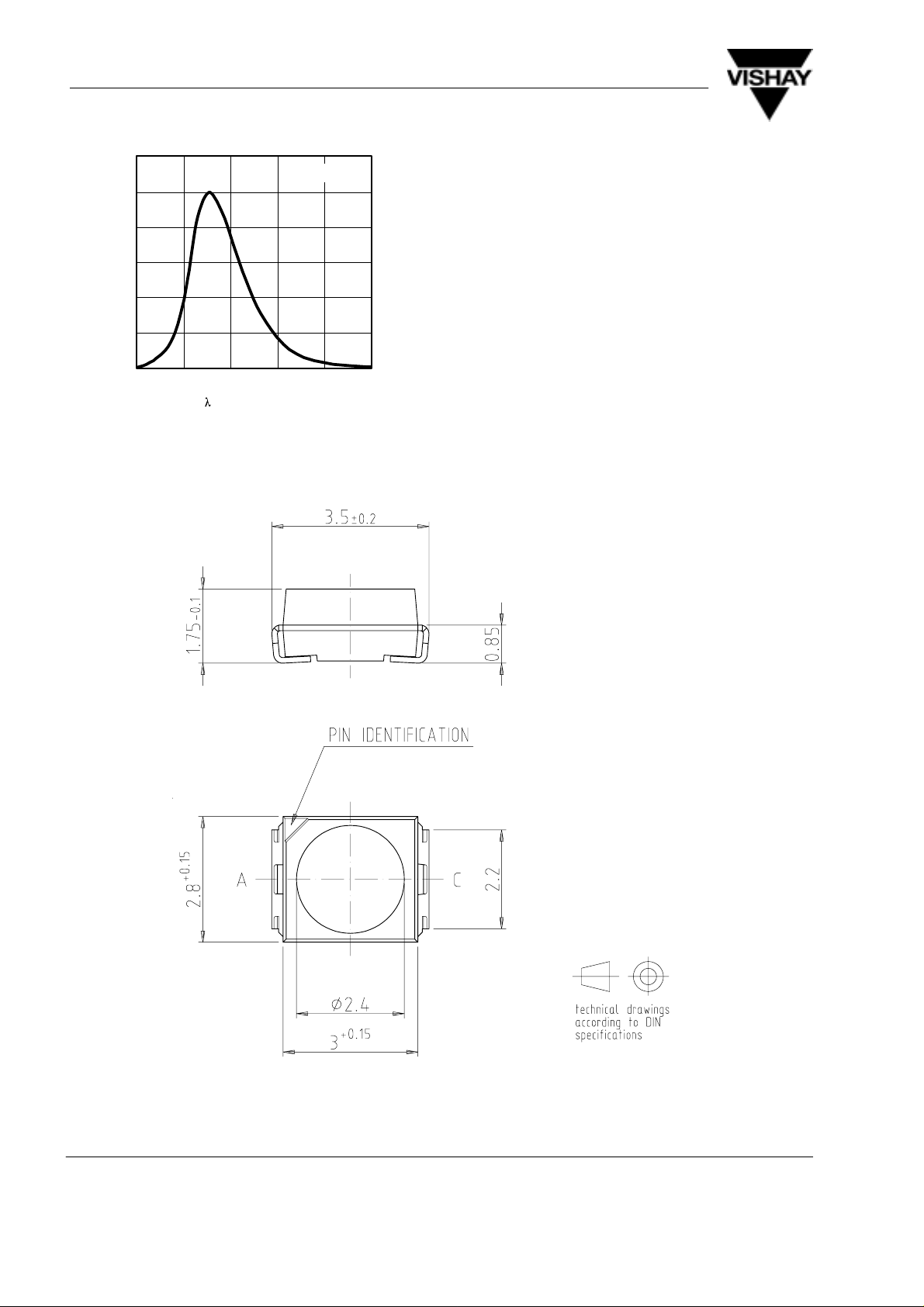
350 400 450 500 550 600
l
– Wavelength ( nm )15849
Figure 7 Relative Luminous Intensity vs. Wavelength
Dimensions in mm
95 11315
www.vishay .de • FaxBack +1-408-970-5600 Document Number 83034
4 (6)
Rev. A2, 13-Jul-99
Page 5
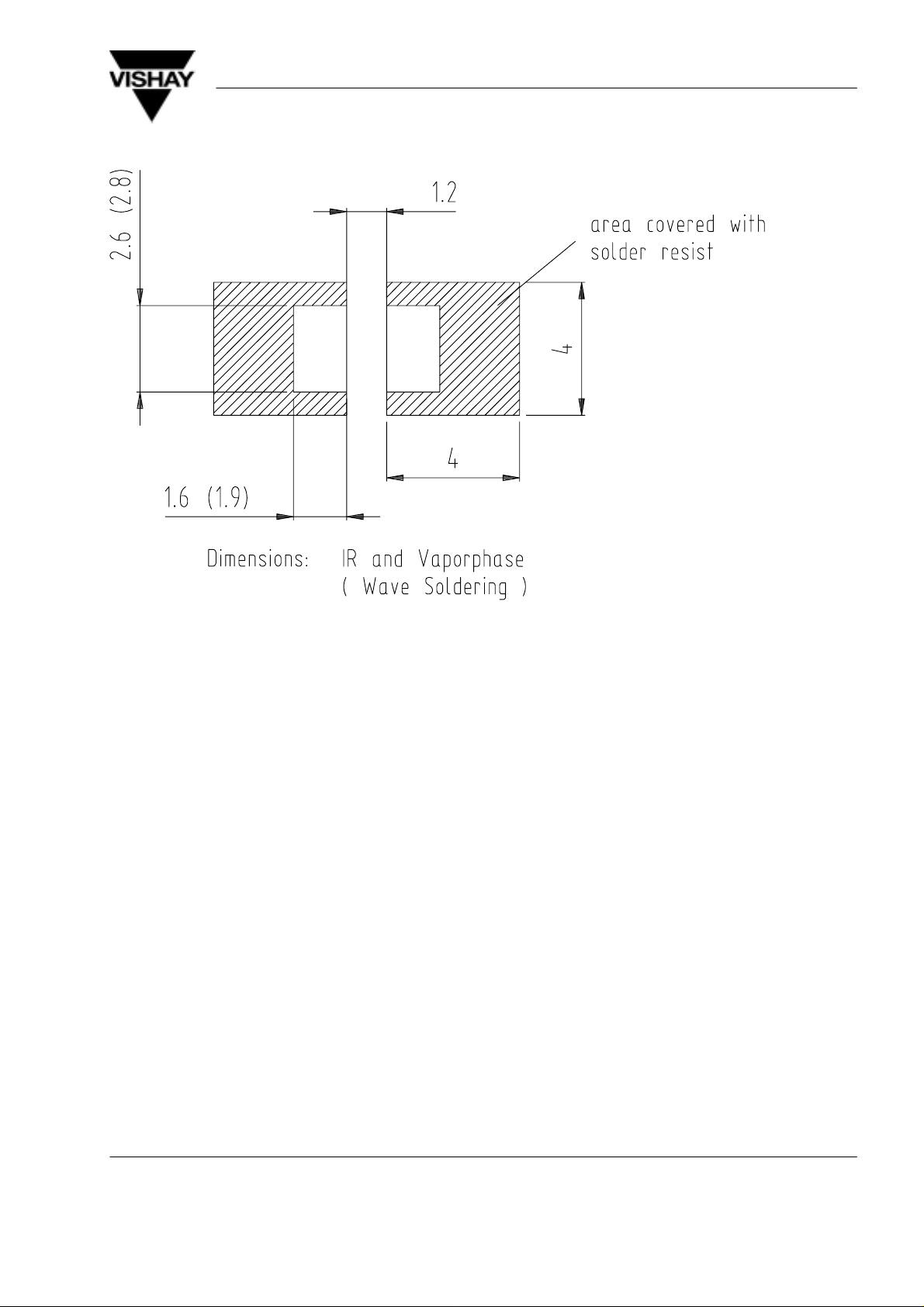
PCB Layout in mm
TLMB310.
Vishay Telefunken
95 10966
Rev. A2, 13-Jul-99
www.vishay .de • FaxBack +1-408-970-5600Document Number 83034
5 (6)
Page 6

TLMB310.
Vishay Telefunken
Ozone Depleting Substances Policy Statement
It is the policy of Vishay Semiconductor GmbH to
1. Meet all present and future national and international statutory requirements.
2. Regularly and continuously improve the performance of our products, processes, distribution and operating
systems with respect to their impact on the health and safety of our employees and the public, as well as their
impact on the environment.
It is particular concern to control or eliminate releases of those substances into the atmosphere which are known as
ozone depleting substances (ODSs).
The Montreal Protocol (1987) and its London Amendments (1990) intend to severely restrict the use of ODSs and
forbid their use within the next ten years. V arious national and international initiatives are pressing for an earlier ban
on these substances.
Vishay Semiconductor GmbH has been able to use its policy of continuous improvements to eliminate the use of
ODSs listed in the following documents.
1. Annex A, B and list of transitional substances of the Montreal Protocol and the London Amendments respectively
2. Class I and II ozone depleting substances in the Clean Air Act Amendments of 1990 by the Environmental
Protection Agency (EPA) in the USA
3. Council Decision 88/540/EEC and 91/690/EEC Annex A, B and C (transitional substances) respectively.
Vishay Semiconductor GmbH can certify that our semiconductors are not manufactured with ozone depleting
substances and do not contain such substances.
We reserve the right to make changes to improve technical design and may do so without further notice.
Parameters can vary in different applications. All operating parameters must be validated for each customer application
by the customer. Should the buyer use Vishay-Telefunken products for any unintended or unauthorized application, the
buyer shall indemnify Vishay-Telefunken against all claims, costs, damages, and expenses, arising out of, directly or
indirectly , any claim of personal damage, injury or death associated with such unintended or unauthorized use.
Vishay Semiconductor GmbH, P.O.B. 3535, D-74025 Heilbronn, Germany
Telephone: 49 (0)7131 67 2831, Fax number: 49 (0)7131 67 2423
www.vishay .de • FaxBack +1-408-970-5600 Document Number 83034
6 (6)
Rev. A2, 13-Jul-99
 Loading...