

Page 1
October 2001 TOKO, Inc. Page 1
TK717xxS
n Very Good Stability (CL = 0.22 mF is Stable For
Any Type Capacitor withV
OUT
³ 1.8 V)
n Built-in Shunt Circuit of Output to GND. The Stored
Energy of the Output Capacitor is Discharged
Quickly
n Wide Operating Voltage Range (1.8 V ~ 14 V)
n Very Low Dropout Voltage (V
DROP
= 103 mV at
100 mA)
n Peak Output Current is 370 mA (0.3 V DROP Point)
n Very Low Quiescent Current (I
Q
= 72 uA at I
OUT
= 0 mA)
n Good Ripple Rejection Ratio (80 dB at 1 kHz)
n High Precision Output Voltage (± 1.5 % or ± 50 mV)
n Suitable for Very Low Noise Applications
n Built-in Active High On/Off Control (0.1 mA Max
Standby Current)
n Built-in Short Circuit Protection
n Built-in Thermal Shutdown
n Very Small Surface Mount Package (SOT23-5)
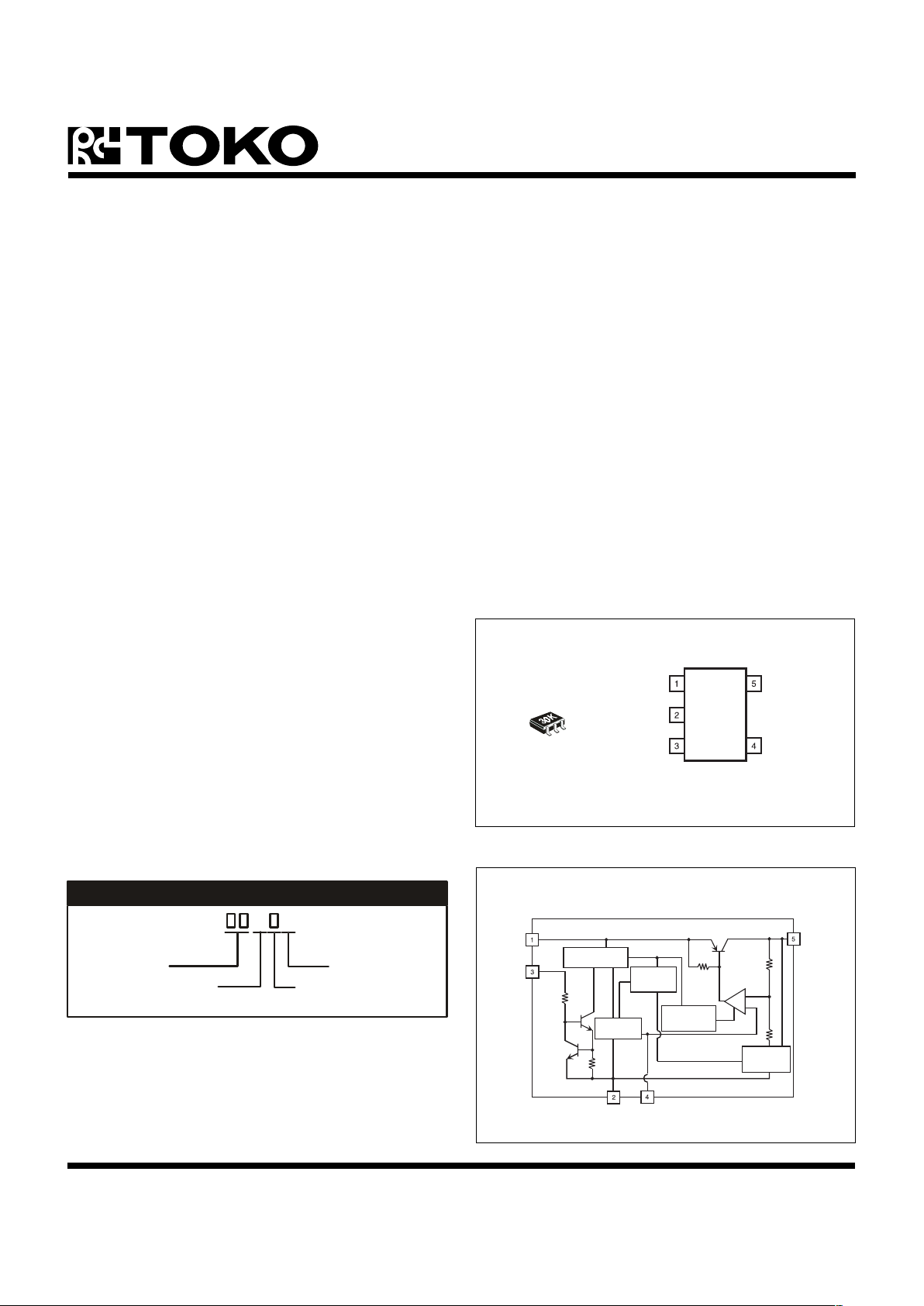
BLOCK DIAGRAM
TK717xxS
LOW DROPOUT VOLTAGE REGULATOR
FEATURES
APPLICATIONS
n Battery Powered Systems
n Measurement Systems
n Mobile Communications Systems
n Cordless Phone, PHS, GSM, CDMA
n Industrial Equipment
n Personal Computers, Barcode Readers
DESCRIPTION
TK717xxS is a low dropout linear regulator with a built-in
electronic switch. The internal switch can be controlled by
TTL or CMOS logic levels. The device is in the ON state
when the control pin is pulled to a logic high level. In the OFF
state, the output impedance becomes very low, quickly
discharging the output capacitor. An external capacitor can
be connected to the noise bypass pin to lower the output
noise level to 30 ~ 50 mV
RMS
. An internal PNP pass transistor
is included to achieve a low dropout voltage of 103 mV at
100 mA load current. The TK717xx has an exceptionally
low quiescent current of 72 mA at no load and 0.8 mA with
a 50 mA load. The standby current is typically 100 pA. The
circuit features very good stability. The ripple rejection is 90
dB at 400 Hz and 80 dB at 1 kHz. Stable operation is
achieved with an output capacitor as low as 0.22 mF; a
capacitor of any type may be used. (However, the larger the
output capacitor is, the better the overall characteristics will
be.)
The TK717xxS is available in a very small SOT23-5 surface
mount package.
CONTROL
GND
V
IN
+
-
BANDGAP
REFERENCE
THERMAL &
OVER CURRENT
PROTECTION
NOISE
BYPASS
CONTROL CIRCUIT
CONSTANT
CURRENT
SOURCE
V
OUT
AUTO
DISCHARGE
CIRCUIT
GND
V
IN
NOISE
BYPASS
V
OUT
CONTROL
TK717 S L
Voltage Code
ORDERING INFORMATION
Package Code
PACKAGE CODE
S: SOT23-5
VOLTAGE CODE
24 =2.4 V
25 =2.5 V
26 =2.6 V
27 =2.7 V
28 =2.8 V
29 =2.9 V
30 =3.0 V
31 =3.1 V
32 =3.2 V
33 = 3.3 V
34 = 3.4 V
35 = 3.5 V
36 = 3.6 V
37 = 3.7 V
38 = 3.8 V
39 = 3.9 V
40 = 4.0 V
41 = 4.1 V
15 = 1.5 V
16 = 1.6 V
17 = 1.7 V
18 = 1.8 V
19 = 1.9 V
20 = 2.0 V
21 = 2.1 V
22 = 2.2 V
23 = 2.3 V
42 = 4.2 V
43 = 4.3 V
44 = 4.4 V
45 = 4.5 V
46 = 4.6 V
47 = 4.7 V
48 = 4.8 V
49 = 4.9 V
50 = 5.0 V
Operating Temp. Range
Tape/Reel Code
OPERATING TEMP. RANGE
C: -30 ~ 80°C
TAPE/REEL CODE
L: Tape Left
0
1
S
Page 2
Page 2 October 2001 TOKO, Inc.
TK717xxS
ABSOLUTE MAXIMUM RATINGS
Supply Voltage............................................... -0.4 to16 V
Power Dissipation (Note 1) ................................. 500 mW
Reverse Bias Voltage ..................................... -0.4 to 6 V
Operating Voltage Range ............................... 1.8 to 14 V
Storage Temperature Range .....................-55 to +150 °C
Operating Temperature Range..................... -30 to +80 °C
Noise Bypass Pin Voltage .............................. -0.4 to 5 V
Control Pin Voltage ....................................... -0.4 to 16 V
Short Circuit Current............................................ 410 mA
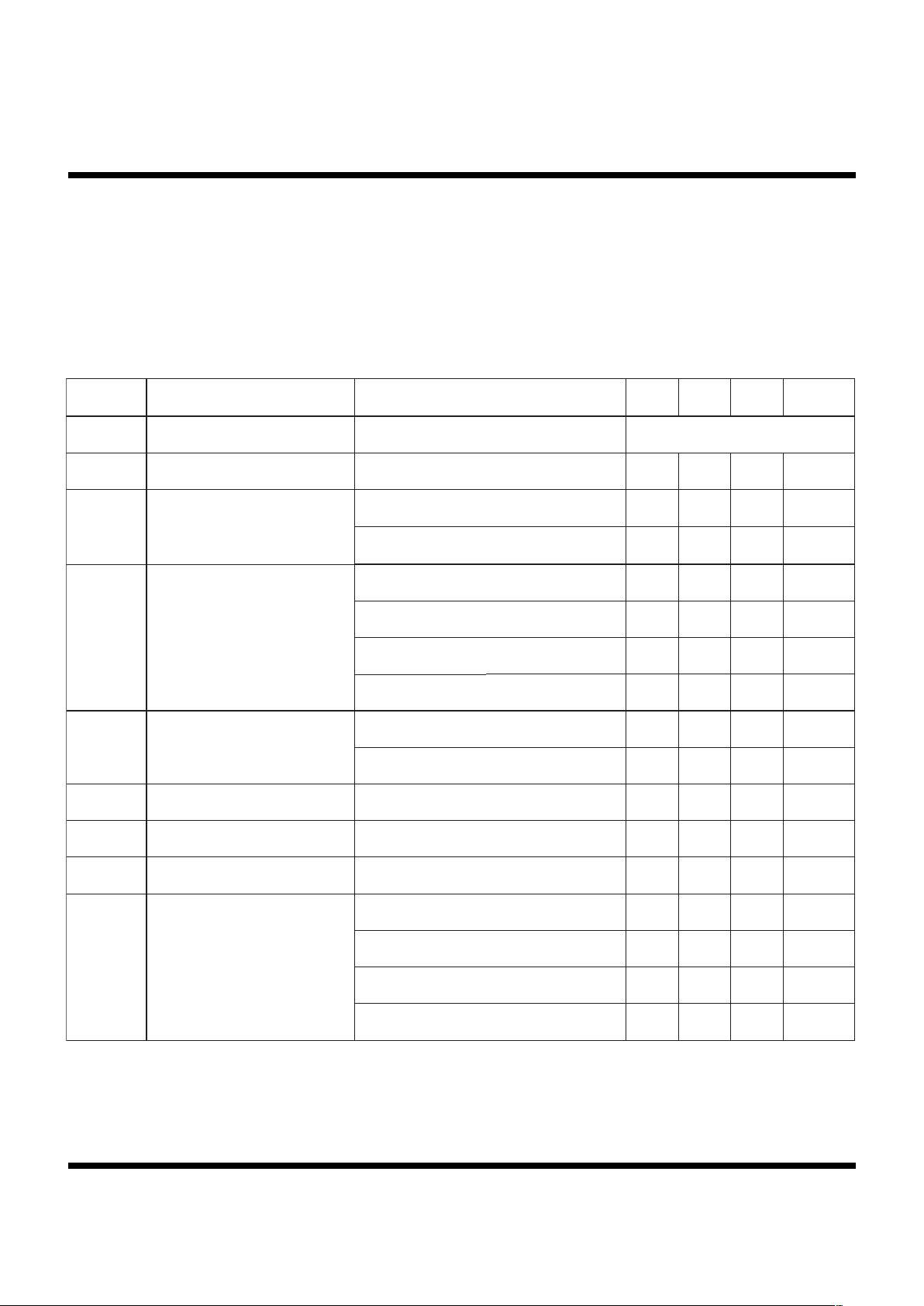
TK717xxSCL ELECTRICAL CHARACTERISTICS
Test conditions: TA = 25 °C, unless otherwise specified.
LOBMYSRETEMARAPSNOITIDNOCTSETNIMPYTXAMSTINU
V
TUO
egatloVtuptuO 1elbaTeeS
geReniLnoitalugeReniL
VNIV=
)PYT(TUO
VotV1+
)PYT(TUO
,V6+ D V5=V
3.05 Vm
geRdaoLnoitalugeRdaoL
I<Am5
TUO
2etoN,Am001<842Vm
I<Am5
TUO
2etoN,Am002<7216Vm
V
PORD
egatloVtuoporD
)5etoN(
I
TUO
Am05=56031Vm
I
TUO
Am001=301002Vm
I
TUO
V4.2(Am002= £ V
TUO
)361003Vm
I
TUO
V1.2(Am081= £ V
TUO
)V4.2<361003Vm
I
)XAM(TUO
tnerruCtuptuOmumixaMVnehW
TUO
2etoN,V3.0nwoD082073Am
V8.1 £ V
NI
£ eulaVecnerefeR,V1.2052Am
I
Q
tnerruCtnecseiuQI
TUO
IgnidulcxEAm0=
TNOC
27011
mA
I
YBTS
tnerruCybdnatSV
CC
V,V8=
TNOC
£ edoMffO,V51.00.01.0
mA
I
DNG
tnerruCniPDNGI
TUO
Am05=8.05.1Am
I
sid
tnerruCegrahcsiDV
VER
)02717(edoMffO,V2=3192Am
V
VER
)03717(edoMffO,V3=3283Am
V
VER
)04717(edoMffO,V4=5214Am
V
VER
)05717(edoMffO,V5=7244Am
Page 3
October 2001 TOKO, Inc. Page 3
TK717xxS
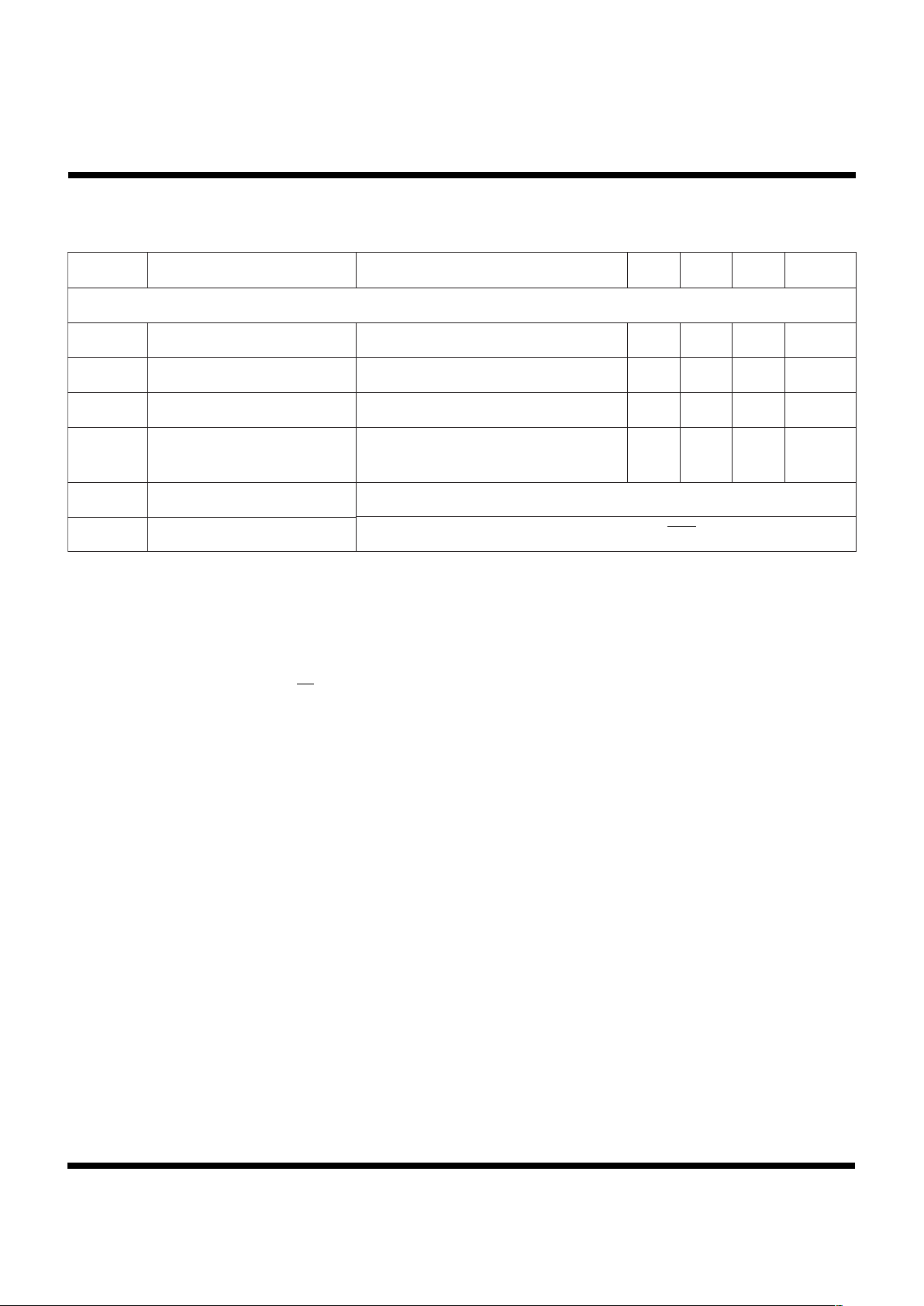
LOBMYSRETEMARAPSNOITIDNOCTSETNIMPYTXAMSTINU
)4dna3etoNeeS(SNOITACIFICEPSLANIMRETLORTNOC
I
TNOC
tnerruClortnoCV
TUO
etatSnOV8.1=68.05.2Aµ
V
)NO(TNOC
NOegatloVlortnoCedoMnO6.1V
V
)FFO(TNOC
FFOegatloVlortnoCedoMffO6.0V
V
FER
lanimreTssapyBesioN
egatloV
62.1V
DV
TUO
/DT
tneiciffeoCerutarepmeT C°/mpp52=pyTeulaVecnerefeR
V
ON
esioNtuptuO02.0eulaVecnerefeR m /V Ö zHk1talacipyTzH
TK717xxSCL ELECTRICAL CHARACTERISTICS (CONT.)
Test conditions: TA = 25 °C, unless otherwise specified.
Note 1: Power dissipation is 150 mW in free air. Power dissipation is 500 mW when mounted as recommended. Derate at 4.0 mW/°C for operation
above 25°C.
Note 2: This value depends on the output voltage. This is a reference value for a 3 V output device.
Note 3: The input current decreases to the pA level by connecting the control terminal to GND.
Note 4: The pull-down resistor is not built-in.
Note 5: The minimum operating voltage for VIN can be 1.8 V. Also, the minimum voltage required for VIN is VIN = V
DROP
+ V
OUT
. As a result, operating
at V
OUT
£ 2.0 V at the mimimum input operating voltage is not preferred.
General Note: The operation of -30 °C to 80 °C is guaranteed by design (verified by sample inspection).
General Note: Exceeding the “Absolute Maximum Rating “may damage the device.
General Note: Output noise is 0.20 mV/ ÖHz typical at 1 kHz: BW 400 to 30 kHz and 30 ~ 60 m Vrms.
General Note: Connecting a capacitor to the noise by pass pin will decrease the output noise voltage.
Page 4
Page 4 October 2001 TOKO, Inc.
TK717xxS
TUPTUO
EGATLOV
EGATLOV
EDOCV
TUO
NIMV
TUO
XAM
TSET
EGATLOV
TUPTUO
EGATLOV
EGATLOV
EDOCV
TUO
NIM
V
TUO
XAM
TSET
EGATLOV
V5.151V054.1V055.1V5.2V3.333V052.3V053.3V3.4
V6.161V055.1V056.1V6.2V4.343V943.3V154.3V4.4
V7.171V056.1V057.1V7.2V5.353V744.3V355.3V5.4
V8.181V057.1V058.1V8.2V6.363V645.3V456.3V6.4
V9.191V058.1V059.1V9.2V7.373V446.3V657.3V7.4
V0.202V059.1V050.2V0.3V8.383V347.3V758.3V8.4
V1.212V050.2V051.2V1.3V9.393V148.3V959.3V9.4
V2.222V051.2V052.2V2.3V0.404V049.3V060.4V0.5
V3.232V052.2V053.2V3.3V1.414V830.4V261.4V1.5
V4.242V053.2V054.2V4.3V2.424V731.4V362.4V2.5
V5.252V054.2V055.2V5.3V3.434V532.4V563.4V3.5
V6.262V055.2V056.2V6.3V4.444V433.4V664.4V4.5
V7.272V056.2V057.2V7.3V5.454V234.4V865.4V5.5
V8.282V057.2V058.2V8.3V6.464V135.4V966.4V6.5
V9.292V058.2V059.2V9.3V7.474V926.4V177.4V7.5
V0.303V059.2V050.3V0.4V8.484V827.4V278.4V8.5
V1.313V050.3V051.3V1.4V9.494V628.4V479.4V9.5
V2.323V051.3V052.3V2.4V0.505V529.4V570.5V0.6
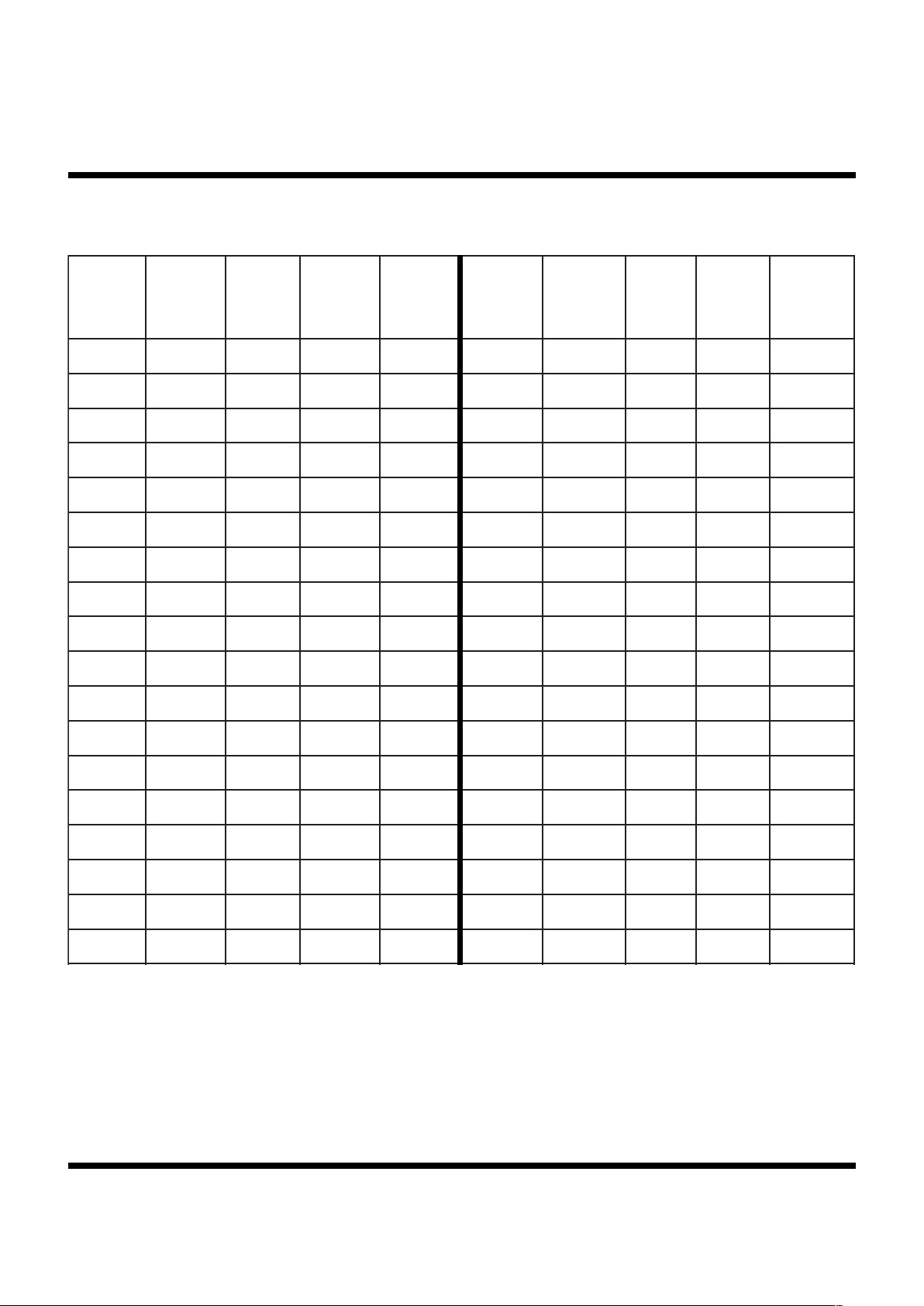
TK717xxSCL ELECTRICAL CHARACTERISTICS TABLE 1
Test Conditions: VIN = V
OUT(TYP)
+ 1 V, I
OUT
= 5 mA, TA = 25 °C, unless otherwise specified.
The output voltage table indicates the standard value when manufactured.
Page 5

October 2001 TOKO, Inc. Page 5
TK717xxS
TEST CIRCUIT
TYPICAL PERFORMANCE CHARACTERISTICS
Noise Performance
For better noise reduction it is
more effective to increase C
N
without increasing CL.
The recommended CN capacitance is 6800 pF or 0.01 mF.
As the output voltage increases,
the noise will also increase.
V
IN
V
OUT
V
CONT
I
CONT
On/Off C
ONT
CIN = 0.22 µF
Noise Bypass (V
REF
)
CN = 0.001 µF
CL = 0.22 µF
I
OUT
V
IN
GND
V
A
A
V
I
IN
NOISE (µVrms)
CN (pF)
0 10 100 1000 10000 100000
300
250
200
150
100
50
0
CL = TANTALUM
CL = CERAMIC
♦
♠
CL = 0.2 µF
CL = 0.4 µF
CL = 1.0 µF
CL = 2.2 µF
CL = 10 µF
♦
♠
I
OUT
= 30 mA
BPF = 400 Hz ~ 80 kHz
TK71730S NOISE vs. C
N
NOISE (µVrms)
V
OUT
(V)
1.0 1.5 2.0 2.5 3.0 3.5 4.0 4.5 5.0
70
60
50
40
30
20
10
NOISE vs V
OUT
BPF = 400 Hz ~ 80 kHz
I
OUT
= 30 mA
CN = 0.01µF
CL = 1.0 µF (TANTALUM)
NOISE (µVrms)
I
OUT
(mA)
0 25 50 75 100 125 150 175 200
70
60
50
40
30
65
55
45
35
NOISE vs. I
OUT
CN = 0.01 µF
CL = 0.22 µF
CL = 0.47 µF
CL = 1.0 µF
CL = 2.2 µF
CL = 10 µF
♦
♠
♦
♠
CL = TANTALUM
FREQUENCY (kHz)
0.01 0.1 1 10 100
10
1
0.1
0.01
NOISE vs. FREQUENCY
CN = 0.01 µF
CN = 0.10 µF
TK71730S
CIN = 10 µF
CL = 0.22 µF (CERAMIC)
I
OUT
= 10 mA
µ V/ Hz
I
OUT
(mA)
0 25 50 75 100 125 150 175 200
70
60
50
40
30
65
55
45
35
NOISE vs. I
OUT
CN = 0.01 µF
CL = 0.22 µF
CL = 0.47 µF
CL = 1.0 µF
CL = 2.2 µF
CL = 10 µF
♦
♠
♠
♦
CL = CERAMIC
NOISE (µVrms)
Page 6

Page 6 October 2001 TOKO, Inc.
TK717xxS
TYPICAL PERFORMANCE CHARACTERISTICS (CONT.)
The ripple rejection characteristic depends on the characteristic and the capacitance value of the capacitor connected to
the output side. The RR characteristic of 50 kHz or more varies greatly with the capacitor on the output side and the PCB.
Please confirm your expectations with your actual design, if necessary.
Ripple Rejection
Conditions:
V
IN
= 5.0 V
V
OUT
= 3.0 V
I
OUT
= 10 mA
V
RIPPLE
= 500 mVp-p
f = 100 Hz TO 1 MHz
CIN = 0 pF
CN = 0.01 mF
RR (dB)
I
OUT
(mA)
0 25 50 75 100 125 150 175 200
-10
-20
-30
-40
-50
-60
-70
RIPPLE REJECTION vs. I
OUT
0
-80
-90
-100
CN = 0.01 µF
CL = 0.22 µF (Ceramic)
VIN = 5.0 V
V
RIPPLE
= 500 mVp-p
Freq = 1 kHz
Freq = 400 Hz
V
OUT
(V)
I
OUT
(mA)
0 100 200 300 400 500
4.0
3.0
2.0
MAXIMUM OUTPUT CURRENT
5.0
1.0
0.0
RR (dB)
VIN - V
OUT
_ (TYP) (V)
+0.2 +0.4 +0.6 +0.8 +1
-10
-20
-30
-40
-50
-60
-70
RR AT LOW VOLTAGE
0
-80
-90
-100
CN = 0.01 µF
CL = 0.22 µF (CERAMIC)
I
OUT
: 1, 50, 100, 150,
200 mA
I
OUT
= 200mA
I
OUT
= 1mA
VIN = V
OUT
V
DROP
(mV)
I
OUT
(mA)
0 50 100 150 200 250 300
-50
-100
-150
DROP OUT VOLTAGE
0
-300
-350
-200
-250
TANTALUM CAPACITOR
0.1 1 10 100 1000
FREQUENCY (kHz)
0
-50
-80
-100
-10
-20
-30
-40
-60
-70
-90
CL = 0.22 µF
CL = 2.2 µF
RR (dB)
MULTILAYER CERAMIC CAPACITOR
0.1 1 10 100 1000
FREQUENCY (kHz)
0
-50
-80
-100
-10
-20
-30
-40
-60
-70
-90
CL = 0.22 µF
CL = 2.2 µF
RR (dB)
Page 7

October 2001 TOKO, Inc. Page 7
TK717xxS
DEFINITION AND EXPLANATION OF TECHNICAL TERMS
OUTPUT VOLTAGE (V
OUT
)
The output voltage is specified with VIN = (V
OUT(TYP)
+ 1 V)
and I
OUT
= 5 mA.
MAXIMUM OUTPUT CURRENT (I
OUT(MAX)
)
The rated output current is specified under the condition where the
output voltage drops 0.3 V below the value specified with I
OUT
=
5 mA. This input voltage is set to V
OUT(TYP)
+1 V, and the current
is pulsed to minimize temperature effect.
DROPOUT VOLTAGE (V
DROP
)
The dropout voltage is the difference between the input
voltage and the output voltage at which point the regulator
starts to fall out of regulation. Below this value, the output
voltage will fall as the input voltage is reduced. It is
dependent upon the load current and the junction temperature.
LINE REGULATION (Line Reg)
Line regulation is the ability of the regulator to maintain a
constant output voltage as the input voltage changes. The
line regulation is specified as the input voltage is changed
from V
IN
= V
OUT
+ 1 V to VIN = V
OUT
+ 6 V.
LOAD REGULATION (Load Reg)
Load regulation is the ability of the regulator to maintain a
constant output voltage as the load current changes. It is a
pulsed measurement to minimize temperature effects with
the input voltage set to VIN = V
OUT
+1 V. The load regulation
is specified under two output current step conditions of 5 mA
to 100 mA and 5 mA to 200 mA.
QUIESCENT CURRENT (IQ)
The quiescent current is the current which flows through the
ground terminal under no load conditions (I
OUT
= 0 mA).
RIPPLE REJECTION RATIO (RR)
Ripple rejection is the ability of the regulator to attenuate the
ripple content of the input voltage at the output. It is
specified with 200 mV
RMS
, 400 Hz and 1 kHz superimposed
on the input voltage, where VIN = V
OUT
+ 1.5 V. The output
decoupling capacitor is set to 1.0 µF, the noise bypass
capacitor is set to 0.01 µF, and the load current is set to 10
mA. Ripple rejection is the ratio of the ripple content of the
output vs. the input and is expressed in dB.
STANDBY CURRENT (I
STBY
)
Standby current is the current which flows into the regulator
when the output is turned off by the control function.
OVER CURRENT SENSOR
The overcurrent sensor protects the device if the output is
shorted to ground.
THERMAL SENSOR
The thermal sensor protects the device if the junction
temperature exceeds the safe value (T
j
= 150 °C). This
temperature rise can be caused by extreme heat, excessive
power dissipation caused by large output voltage drops, or
excessive output current. The regulator will shut off when
the temperature exceeds the safe value. As the junction
temperature decreases, the regulator will begin to operate
again. Under sustained fault conditions, the regulator output
will oscillate as the device turns off then resets. Damage
may occur to the device under extreme fault conditions.
REVERSE VOLTAGE PROTECTION
Reverse voltage protection prevents damage due to the
output voltage being higher than the input voltage. This fault
condition can occur when the output capacitor remains
charged and the input is reduced to zero, or when an external
voltage higher than the input voltage is applied to the output
side. Toko’s regulators do not need an inherent diode
connected between the input and output.
TK717xxS
V
OUT
V
IN
GND
Page 8

Page 8 October 2001 TOKO, Inc.
TK717xxS
DEFINITION AND EXPLANATION OF TECHNICAL TERMS (CONT.)
PACKAGE POWER DISSIPATION (PD)
This is the power dissipation level at which the thermal
sensor is activated. The IC contains an internal thermal
sensor which monitors the junction temperature. When the
junction temperature exceeds the monitor threshold of
150 °C, the IC is shut down. The junction temperature rises
as the difference between the input power (VIN x IIN) and the
output power (V
OUT
x I
OUT
) increases. The rate of temperature rise is greatly affected by the mounting pad configuration on the PCB, the board material, and the ambient
temperature. When the IC mounting has good thermal
conductivity, the junction temperature will be low even if the
power dissipation is great. When mounted on the recommended mounting pad, the power dissipation of the SOT235 is increased to 500 mW. For operation at ambient
temperatures over 25 °C, the power dissipation of the
SOT23-5 device should be derated at 4.0 mW/ °C. For
operation above 25 °C: To determine the power dissipation
for shutdown when mounted, attach the device on the actual
PCB and deliberately increase the output current (or raise
the input voltage) until the thermal protection circuit is
activated. Calculate the power dissipation of the device by
subtracting the output power from the input power. These
measurements should allow for the ambient temperature of
the PCB. The value obtained from P
D
/(150 °C - TA) is the
derating factor. The PCB mounting pad should provide
maximum thermal conductivity in order to maintain low
device temperatures. As a general rule, the lower the
temperature, the better the reliability of the device. The
thermal resistance when mounted is expressed as follows:
Tj = 0jA x PD + T
A
For Toko ICs, the internal limit for junction temperature is
150 °C. If the ambient temperature (TA) is 25 °C, then:
150 °C = 0jA x PD + 25 °C
0jA = 125 °C / P
D
0jA = 125 °C / PD (°C / mW)
PD is the value when the thermal protection circuit is
activated. A simple way to determine PD is to calculate V
IN
x IIN when the output side is shorted. Input current gradually
falls as temperature rises. You should use the value when
thermal equilibrium is reached.
The range of usable currents can also be found from the
graph below.
Procedure:
1) Find P
D
2) PD1 is taken to be PD x (~0.8 - 0.9)
3) Plot PD1 against 25 °C
4) Connect P
D1
to the point corresponding to the 150 °C with
a straight line.
5) In design, take a vertical line from the maximum
operating temperature (e.g., 75 °C) to the derating curve.
6) Read off the value of PD against the point at which the
vertical line intersects the derating curve. This is taken as
the maximum power dissipation, DPD.
The maximum operating current is:
I
OUT
= (D
PD
/ (V
IN(MAX) - VOUT
)
P
D
D
PD
25 50 75 150
TA (°C)
3
6
5
4
PD(mW)
Page 9

October 2001 TOKO, Inc. Page 9
TK717xxS
APPLICATION INFORMATION (CONT.)
+
NOISE
BYPASS
ON / OFF
V
IN
V
OUT
+
GND
TK717xx
500
0
25 50
(85)
150 °C
-4.0 MW / °C
PD(mW)
0
100
Mounted as shown
Free Air
SOT23-5 BOARD LAYOUT
BOARD LAYOUT
Page 10

Page 10 October 2001 TOKO, Inc.
TK717xxS
INPUT-OUTPUT CAPACITORS
Linear regulators require input and output capacitors in order to maintain the regulator’s loop stability. The equivalent series
resistance (ESR) of the output capacitor must be in the stable operation area. However, it is recommended to use as large
a value of capacitance as is practical. The output noise and the ripple noise decrease as the capacitance value increases.
The IC is never damaged by enlarging the capacitance.
ESR values vary widely between ceramic and tantalum capacitors. However, tantalum capacitors are assumed to provide
more ESR damping resistance, which provides greater circuit stability. This implies that a higher level of circuit stability
can be obtained by using tantalum capacitors when compared to ceramic capacitors with similar values. The IC provides
stable operation with an output side capacitor of 0.22 mF (V
OUT
³ 2.0 V). If the capacitor is 0.1 mF or more over its full range
of temperature, either a ceramic capacitor or tantalum capacitor can be used without considering ESR (V
OUT
³ 2.0 V).
APPLICATION INFORMATION (CONT.)
For output voltage device ³ 2.0 V applications, the recommended value of CL ³ 0.22 mF.
For output voltage device ³ 1.5 V applications, the recommended value of CL ³ 0.47 mF.
For load current £ 0.5 mA, increase the output capacitor to 1 mF.
The input capacitor is necessary when the battery is discharged,
the power supply impedance increases, or the line distance to the
power supply is long. This capacitor might be necessary on each
individual IC even if two or more regulator ICs are used. It is not
possible to determine this indiscriminately. Please confirm the
stability while mounted.
Please increase the output capacitor value when the load current is 0.5 mA or less. The stability of the regulator improves
if a big output side capacitor is used (the stable operation area extends).
For evaluation KYOCERA CM05B104K10AB, CM05B224K10AB, CM105B104K16A, CM105B224K16A,CM21B225K10A
MURATA GRM36B104K10, GRM42B104K10, GRM39B104K25, GRM39B224K10, GRM39B105K6.3
STABLE OPERATION AREA vs. VOLTAGE, CURRENT AND ESR
CL = 0.22 µF
V
OUT
CN = 0.01 µF
CIN = 0.22 µF
100
10
1
0.1
0 .01
0 50 100 150
I
OUT
(mA)
All Stable
CL ≥ 1.0 µ F
STABLE AREA
CL = 0.1 µ F
V
OUT
= 1.5 V - 1.9 V
ESR (Ω )
100
10
1
0.1
0 .01
0 50 100 150
I
OUT
(mA)
ESR (Ω )
100
10
1
0.1
0 .01
0 50 100 150
I
OUT
(mA)
ESR (Ω )
100
10
1
0.1
0 .01
0 50 100 150
I
OUT
(mA)
ESR (Ω )
100
10
1
0.1
0 .01
I
OUT
(mA)
All Stable
CL ≥ 0.22 µ F
ESR (Ω )
STABLE AREA
CL = 0.1 µ F
V
OUT
= 2.0 V
0 50 100 150
V
OUT
= 3.0 V
STABLE AREA
CL = 0.1 µ F
STABLE AREA
CL = 0.1 µ F
STABLE AREA
CL = 0.1 µ F
V
OUT
= 4.0 V
V
OUT
= 5.0 V
Page 11

October 2001 TOKO, Inc. Page 11
TK717xxS
Bias Voltage and Temperature Characteristics of Ceramic Capacitors
Generally, a ceramic capacitor has both a temperature characteristic and a voltage characteristic. Please consider
both characteristics when selecting the part. The B curves are the recommended characteristics.
Ta (° C)
-50 - 25 0 2 5 5 0 7 5 1 0 0
100
90
80
70
CAPACITANCE vs. TEMPERATURE
60
50
F CURVE
B CURVE
CAPACITANCE (%)
Bias Vol t age (V)
0 2 4 6 8 1 0
100
90
80
70
CAPACI T ANCE vs. BIAS VOLT AGE
60
50
40
F CURVE
B CURVE
CAPACITANCE (%)
APPLICATION INFORMATION (CONT.)
Page 12

Page 12 October 2001 TOKO, Inc.
TK717xxS
APPLICATION INFORMATION (CONT.)
As shown in the figure below, several components are required to discharge the charge in the output side capacitor in a
typical regulator.
Because the external electrical discharge circuit is unnecessary with the TK717xxS, the application becomes very simple.
Turning the regulator off automatically discharges the charge of the output side capacitor.
The TK112xxB is a normal regulator.
The TK717xx is built with the automatic discharge circuit during off time.
The TK716xxS, AS is built with the output disconnect circuit.
As shown here:
On/Off Control
V
IN
V
OUT
DISCHARGE CIRCUIT
TK717xxS (TOKO REGULATOR)
Doesn’t need discharge circuit
V
IN
V
OUT
DISCHARGE CURRENT IN OFF MODE
On/Off CONTROL
0 200 400 600
on off res pons e : CL = 2.2 µF
CN = 1000 pF I Load = 0mA
V
OUT
TK717xx
TK112xxB
TK716xxS, AS
CONTROL
TIME (µS)
Page 13

October 2001 TOKO, Inc. Page 13
TK717xxS
Marking Information
Product Code K
Part Number Voltage Code
TK71715 15
TK71716 16
TK71717 17
TK71718 18
TK71719 19
TK71720 20
TK71721 21
TK71722 22
TK71723 23
TK71724 24
TK71725 25
TK71726 26
TK71727 27
TK71728 28
TK71729 29
TK71730 30
TK71731 31
TK71732 32
TK71733 33
TK71734 34
TK71735 35
TK71736 36
TK71737 37
TK71738 38
TK71739 39
TK71740 40
TK71741 41
TK71742 42
TK71743 43
TK71744 44
TK71745 45
TK71746 46
TK71747 47
TK71748 48
TK71749 49
TK71750 50
SOT23-5
PACKAGE OUTLINE
Printed in the USA
© 1999 Toko, Inc.
All Rights Reserved
TOKO AMERICA REGIONAL OFFICES
Toko America, Inc. Headquarters
1250 Feehanville Drive, Mount Prospect, Illinois 60056
Tel: (847) 297-0070 Fax: (847) 699-7864
IC-216-TK716xx
0798O0.0K
Visit our Internet site at http://www.tokoam.com
The information furnished by TOKO, Inc. is believed to be accurate and reliable. However, TOKO reserves the right to make changes or improvements in the design, specification or manufacture of its
products without further notice. TOKO does not assume any liability arising from the application or use of any product or circuit described herein, nor for any infringements of patents or other rights of
third parties which may result from the use of its products. No license is granted by implication or otherwise under any patent or patent rights of TOKO, Inc.
Western Regional Office
Toko America, Inc.
2480 North First Street , Suite 260
San Jose, CA 95131
Tel: (408) 432-8281
Fax: (408) 943-9790
Midwest Regional Office
Toko America, Inc.
1250 Feehanville Drive
Mount Prospect, IL 60056
Tel: (847) 297-0070
Fax: (847) 699-7864
Semiconductor Technical Support
Toko Design Center
4755 Forge Road
Colorado Springs, CO 80907
Tel: (719) 528-2200
Fax: (719) 528-2375
5
0.95
0.95
2.9
0.1
1
.
1
0.95
0.95
e
M
0.1
0.4
±0.1
2.8
±0.3
1.90
2
.
4
Recommen d ed Mo unt Pad
4
1
.
0
0.7
0
-
0
.
1
1
.
4
m
a
x
1
2
3
e
e
e
e
1
Dimensions are shown in millimeters
Tolerance: x.x = ± 0.2 mm (unless ot herwise specified)
1.6
0
~
1
5
°
0
.
1
5
±
0
.
1
Kx
x
e
Marking
Product
Code
Voltage
Code
 Loading...