

Page 1

DATA SH EET
Preliminary specification
Supersedes data of 1999 Jan 05
File under Integrated Circuits, IC02
1999 Nov 12
INTEGRATED CIRCUITS
SAB9080
NTSC Picture-In-Picture (PIP)
controller
Page 2

1999 Nov 12 2
Philips Semiconductors Preliminary specification
NTSC Picture-In-Picture (PIP) controller SAB9080
FEATURES
• Double window Picture-In-Picture (PIP) in interlaced or
non-interlaced mode at 8-bit resolution
• Internal 1-Mbit DRAM
• Three 8-bit Analog-to-Digital Converters (ADCs) (7-bit
performance) with clamp circuit for each acquisition
channel
• One PLL which generatesthe line-locked clocks for the
subchannel
• One PLL which generates the line-locked clocks for the
main and display channels
• Three 8-bit Digital-to-Analog Converters (DACs)
• Linear zoom in both horizontal and vertical directions for
the subchannel
• Linear zoom in horizontal direction for the main channel.
GENERAL DESCRIPTION
The SAB9080 is an NTSC PIP controller which can be
used in double window applications. The SAB9080 inserts
oneortwolivevideosignalswithreducedsizeintoanother
live video signal. The incoming video signals are expected
to be analog baseband signals.
The conversion to the digital environment is done on chip
with ADCs. Processing and storage of the video data is
done entirely in the digital domain. The conversion back to
the analog domain is done by DACs.
Internal clocks are generated by PLLs which lock on to the
applied horizontal and vertical syncs.
The main input channel is compressed horizontally by a
factor of two and directly fed to the output. After
compression, a horizontal expansion of two is possible for
the main channel.
The subchannel is also compressed horizontally by a
factor of two but stored in memory before it is fed to the
outputs.
QUICK REFERENCE DATA
ORDERING INFORMATION
SYMBOL PARAMETER CONDITIONS MIN. TYP. MAX. UNIT
Supply
V
DDD
digital supply voltage 3.0 3.3 3.6 V
V
DDA
analog supply voltage 3.0 3.3 3.6 V
I
DDD
digital supply current − 50 − mA
I
DDA
analog supply current 140 165 210 mA
PLL
f
clk(sys)
system clock frequency 1792 × f
HSYNC
− 28 − MHz
B
loop
loop bandwidth − 4 − kHz
t
jitter
short-term stability peak-to-peak jitter for 64 µs −−4ns
ζ damping factor − 0.7 −
TYPE
NUMBER
PACKAGE
NAME DESCRIPTION VERSION
SAB9080H QFP100 plastic quad flat package; 100 leads (lead length 1.95 mm);
body 14 × 20 × 2.8 mm
SOT317-2
Page 3
1999 Nov 12 3
Philips Semiconductors Preliminary specification
NTSC Picture-In-Picture (PIP) controller SAB9080
This text is here in white to force landscape pages to be rotated correctly when browsing through the pdf in the Acrobat reader.This text is here in
_white to force landscape pagesto be rotated correctly when browsing through the pdf in theAcrobat reader.This text is here inThis text is here in
white toforce landscape pages to be rotated correctly when browsingthrough the pdf inthe Acrobat reader. whiteto force landscape pagesto be ...
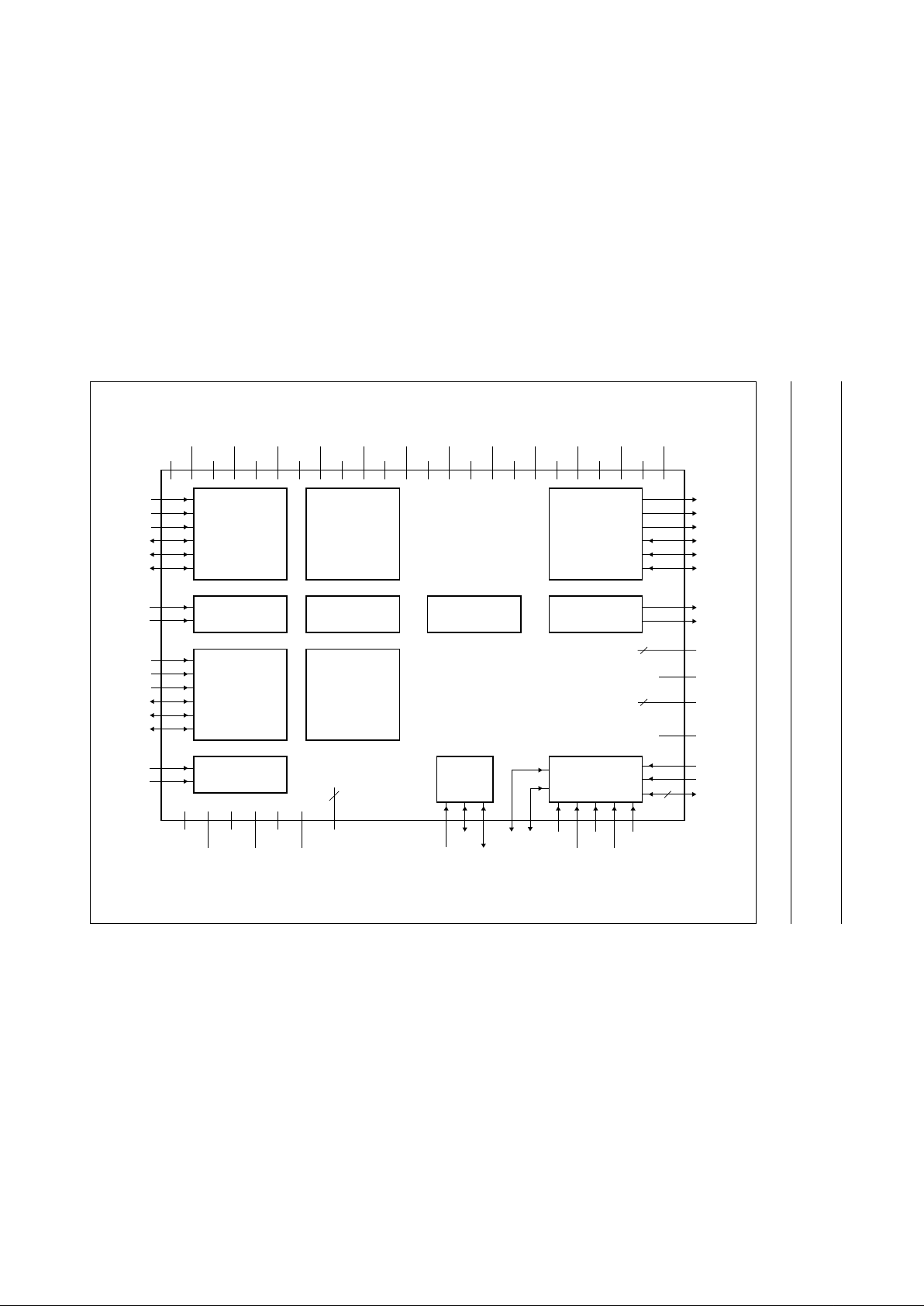
BLOCK DIAGRAM
handbook, full pagewidth
MGM808
73 88 93 44 43 45 46 47
SCL
74
SDA
T7
T6
TCLKTMTCBC
TCBD TCBR
75
POR
TEST
CONTROL
PKOFF
69
FBL
68
DAC AND BUFFER
DY
8
DV
10
DU
12
V
bias(DA)
9
V
ref(T)(DA)
11
V
ref(B)(DA)
13
SHSYNC
87
SVSYNC
72
SU
79
SV
81
SY
V
bias(SA)
V
ref(T)(SA)
V
ref(B)(SA)
83
84
82
80
DHSYNC
94
DVSYNC
70
MU
2
MY
98
MV
V
bias(MA)
V
ref(T)(MA)
V
ref(B)(MA)
100
97
99
1
PLL AND CLOCK
GENERATOR
DCLK
71
T5 to T0
32 to 37
TC
38
PLL AND CLOCK
GENERATOR
CLAMP AND ADC
CLAMP AND ADC
LINE MEMORY INTERNAL DRAM
DISPLAY
CONTROL
HORIZONTAL
AND
VERTICAL
FILTER
HORIZONTAL
FILTER
89
34
90 91 92 95
21 to 29, 31,
52 to 60
96
19
V
DDA(MF)
V
SSA(MA)
56
V
DDA(MA)
V
DDA(DA)
714
V
SSA(DA)
V
DDD(DA)
15 16
V
SSD(DA)
V
SSD(P1)
17 20
V
DDD(P1)
V
DDD(RP)
39 40
V
DDD(RL)
V
SSD(RL)
41 42
V
SSD(RM)
V
DDD(RM)
61 64
V
SSD(RP)
V
DDD(P2)
65 66
V
SSD(P2)
V
SSD(D)
67 76
V
DDD(D)
V
DDA(SA)
77 78
V
SSA(SA)
V
DDA(SF)
85 86
V
SSD(SA)
V
DDD(SA)
SAB9080
V
SSD(MA)
V
DDD(MA)
n.c.
V
DDA(DP)
V
SSA(DP)
V
SSA(SP)
V
DDA(SP)
I
2
C-BUS
CONTROL
6
V
SSD(T1)
and
V
SSD(T2)
V
SSD(T4)
to
V
SSD(T7)
V
SSD(T8)
and
V
SSD(T9)
18, 19
48 to 51
62, 63
V
SSD(T3)
30
4
2
Fig.1 Block diagram.
Page 4

1999 Nov 12 4
Philips Semiconductors Preliminary specification
NTSC Picture-In-Picture (PIP) controller SAB9080
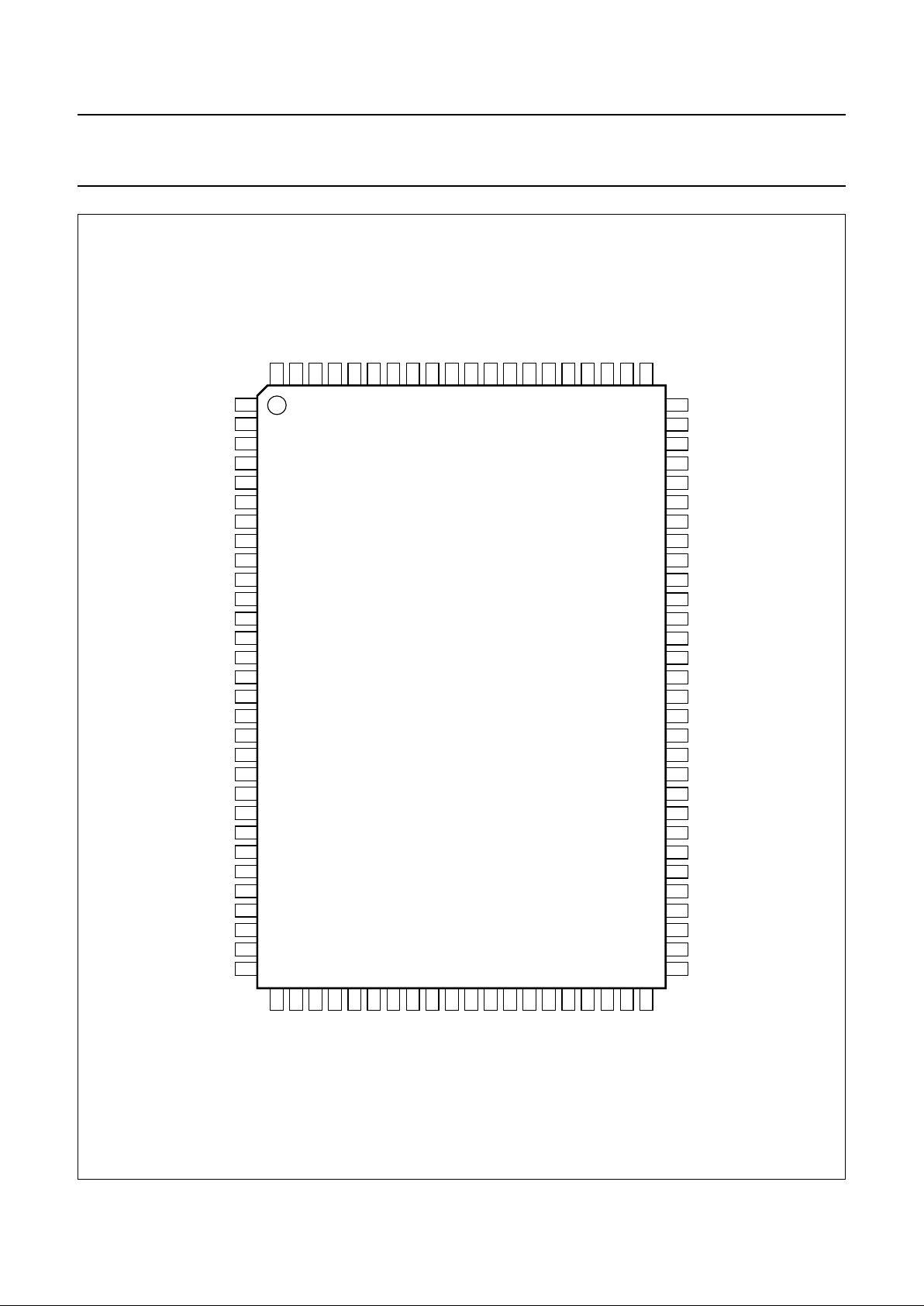
PINNING
SYMBOL PIN TYPE DESCRIPTION
V
ref(B)(MA)
1 I/O analog bottom reference voltage for main channel ADCs
MU 2 I analog U input for main channel
V
DDA(MF)
3 S analog supply voltage for main channel front-end buffers
V
SSA(MA)
4 S analog ground for main channel ADCs
V
DDA(MA)
5 S analog supply voltage for main channel ADCs
V
DDA(DA)
6 S analog supply voltage for DACs
V
SSA(DA)
7 S analog ground for DACs
DY 8 O analog Youtput of DAC
V
bias(DA)
9 I/O input/output analog bias reference voltage for DACs
DV 10 O analog Voutput of DAC
V
ref(T)(DA)
11 I/O input/output analog top reference voltage for DACs
DU 12 O analog U output of DAC
V
ref(B)(DA)
13 I/O analog bottom reference voltage for DACs
V
DDD(DA)
14 S digital supply voltage for DACs
V
SSD(DA)
15 S digital ground for DACs
V
SSD(P1)
16 S digital ground for periphery
V
DDD(P1)
17 S digital supply voltage for periphery
V
SSD(T1)
18 S digital ground for test
V
SSD(T2)
19 S digital ground for test
V
DDD(RP)
20 S digital supply voltage for memory periphery
n.c. 21 to 29 − not connected
V
SSD(T3)
30 S digital ground for test
n.c. 31 − not connected
T5 32 I/O test data input/output bit 5 (CMOS levels)
T4 33 I/O test data input/output bit 4 (CMOS levels)
T3 34 I/O test data input/output bit 3 (CMOS levels)
T2 35 I/O test data input/output bit 2 (CMOS levels)
T1 36 I/O test data input/output bit 1 (CMOS levels)
T0 37 I/O test data input/output bit 0 (CMOS levels)
TC 38 I test control input (CMOS levels)
V
DDD(RL)
39 S digital supply voltage for memory logic
V
SSD(RL)
40 S digital ground for memory logic
V
SSD(RM)
41 S digital ground for memory core
V
DDD(RM)
42 S digital supply voltage for memory core
TCLK 43 I test clock input (CMOS levels)
TM 44 I test mode input (CMOS levels)
TCBD 45 I test control block data input (CMOS levels)
TCBC 46 I test control block clock input (CMOS levels)
TCBR 47 I test control block reset input (CMOS levels)
V
SSD(T4) toVSSD(T7)
48 to 51 S digital ground for test
Page 5

1999 Nov 12 5
Philips Semiconductors Preliminary specification
NTSC Picture-In-Picture (PIP) controller SAB9080
n.c. 52 to 60 − not connected
V
SSD(RP)
61 S digital ground for memory periphery
V
SSD(T8)
and V
SSD(T9)
62 and 63 S digital ground for test
V
DDD(P2)
64 S digital supply voltage for periphery
V
SSD(P2)
65 S digital ground for periphery
V
SSD(D)
66 S digital ground for digital core
V
DDD(D)
67 S digital supply voltage for digital core
FBL 68 O fast blanking control signal output (CMOS levels; +5 V tolerant)
PKOFF 69 O peak off control signal output (CMOS levels; +5 V tolerant)
DVSYNC 70 I vertical sync display channel input (CMOS levels; +5 V tolerant)
DCLK 71 I test clock input (28 MHz; CMOS levels)
SVSYNC 72 I vertical sync for subchannel input (CMOS levels; +5 V tolerant)
SCL 73 I/O input/output serial clock (I
2
C-bus; CMOS levels; +5 V tolerant)
SDA 74 I/O input/output serial data/acknowledge output (I
2
C-bus; +5 V tolerant)
POR 75 I power-on reset input (CMOS levels; pull-up resistor connected to V
DD
)
V
DDA(SA)
76 S analog supply voltage for subchannel ADCs
V
SSA(SA)
77 S analog ground for subchannel ADCs
V
DDA(SF)
78 S analog supply voltage for subchannel front-end buffers and clamps
SU 79 I analog U input for subchannel
V
ref(B)(SA)
80 I/O input/output analog bottom reference voltage for subchannel ADCs
SV 81 I analog V input for subchannel
V
ref(T)(SA)
82 I/O input/output analog top reference voltage for subchannel ADCs
SY 83 I analog Y input for subchannel
V
bias(SA)
84 I/O analog bias reference voltage for subchannel ADCs
V
SSD(SA)
85 S digital ground for subchannel ADCs
V
DDD(SA)
86 S digital supply voltage for subchannel ADCs
SHSYNC 87 I horizontal sync input for subchannel (V
i<VSHSYNC
)
T6 88 I/O test data input/output bit 7 (CMOS levels)
V
DDA(SP)
89 S analog supply voltage for subchannel PLL
V
SSA(SP)
90 S analog ground for subchannel PLL
V
SSA(DP)
91 S analog ground for display channel PLL
V
DDA(DP)
92 S analog supply voltage for display channel PLL
T7 93 I/O test data input/output bit 6 (CMOS levels)
DHSYNC 94 I horizontal sync input for display channel (V
i<VDHSYNC
)
V
DDD(MA)
95 S digital supply voltage for main channel ADCs
V
SSD(MA)
96 S digital ground for main channel ADCs
V
bias(MA)
97 I/O analog bias reference voltage for main channel ADCs
MY 98 I analog Y input for main channel
V
ref(T)(MA)
99 I/O analog top reference voltage for main channel ADCs
MV 100 I analog V input for main channel
SYMBOL PIN TYPE DESCRIPTION
Page 6
1999 Nov 12 6
Philips Semiconductors Preliminary specification
NTSC Picture-In-Picture (PIP) controller SAB9080
Fig.2 Pin configuration.
handbook, full pagewidth
80
79
78
77
76
75
74
73
72
71
70
69
68
67
66
65
64
63
62
61
60
59
58
57
56
55
54
53
52
51
V
ref(B)(SA)
SU
V
DDA(SF)
V
SSA(SA)
V
DDA(SA)
POR
SDA
SCL
SVSYNC
DCLK
DVSYNC
PKOFF
FBL
V
DDD(D)
V
SSD(D)
V
SSD(P2)
V
DDD(P2)
V
SSD(RP)
V
SSD(T9)
V
SSD(T8)
V
SSD(T7)
n.c.
n.c.
n.c.
n.c.
n.c.
n.c.
n.c.
n.c.
n.c.
V
ref(B)(MA)
MU
V
DDA(MF)
V
SSA(MA)
V
DDA(MA)
V
DDA(DA)
V
SSA(DA)
DY
V
bias(DA)
DV
V
ref(T)(DA)
DU
V
ref(B)(DA)
V
DDD(DA)
V
SSD(DA)
V
SSD(P1)
V
SSD(T3)
n.c.
V
DDD(P1)
V
SSD(T1)
V
SSD(T2)
V
DDD(RP)
n.c.
n.c.
n.c.
n.c.
n.c.
n.c.
n.c.
n.c.
T5T4T3T2T1
T0
TC
V
DDD(RL)
V
SSD(RL)
n.c.
V
SSD(T4)VSSD(T5)VSSD(T6)
V
SSD(RM)
V
DDD(RM)
TCLK
TM
TCBD
TCBC
TCBR
MV
V
ref(T)(MA)
MY
V
bias(MA)VSSD(MA)VDDD(MA)
DHSYNCT7V
DDA(DP)VSSA(DP)VSSA(SP)VDDA(SP)
T6
SHSYNC
V
DDD(SA)VSSD(SA)Vbias(SA)
SY
V
ref(T)(SA)
SV
30
29
28
27
26
25
24
23
22
21
20
19
18
17
16
15
14
13
12
11
10
9
8
7
6
5
4
3
2
1
100
99989796959493929190898887868584838281
31323334353637383940414243444546474849
50
MGM809
SAB9080
Page 7

1999 Nov 12 7
Philips Semiconductors Preliminary specification
NTSC Picture-In-Picture (PIP) controller SAB9080
FUNCTIONAL DESCRIPTION
Acquisition
The internal pixel rate is 28 MHz for the Y, U and V
channels. It is expected that the bandwidth of the input
signals will be limited to 4.5 MHz for the Y input and
1.125 MHzfortheU and V inputs.Inset synchronisation is
achieved via the acquisition HSYNC and VSYNC pins of
the main channel. The display is driven by the main
channel clock.
The starting-point of the acquisition can be controlled with
the acquisition fine positioning added to a system
constant. With a nominal input 1792 × f
HSYNC
and
standard NTSC signals, 1408 samples (active video) are
acquired and processed by the SAB9080. Here, the
nominal input f
HSYNC
results in a nominal system clock
frequency of 1792 × f
HSYNC
(approximately 28 MHz).
PIP modes
Fig.3 PIP modes.
handbook, full pagewidth
MGM810
MAIN
REPLAY
MAIN SUB
SUB
MAIN
SUB
I2C-bus description
The I2C-bus provides bidirectional 2-line communication
between different ICs. The SDA line is the serial data line
and the SCL the serial clock line. Both lines must be
connected to a positive supply via a pull-up resistor when
connected to the output stages of a device.
Data transfer may be initiated only when the bus is not
busy. The SAB9080 has the I2C-bus address 2CH. Valid
subaddresses are 00H to 18H; registers 15H to 18H are
reserved for future extensions.
I
2
C-bus control is according to the I2C-bus protocol: first, a
START sequence must be put on the I2C-bus. Then, the
I2C-bus address of the circuit must be sent, followed by a
subaddress. After this sequence, the data of the
subaddresses must be sent. An auto-increment function
gives the option of sending data of the incremented
subaddresses until a STOP sequence is sent. Table 1
gives an overview of the I2C-bus addresses. The data bits
that are not used should be set to zero.
Page 8

1999 Nov 12 8
Philips Semiconductors Preliminary specification
NTSC Picture-In-Picture (PIP) controller SAB9080
Table 1 Overview of I2C-bus addresses
For a description of the various data bits, see the following pages.
SUB-
ADDRESS
DATA BYTES
BIT 7 BIT 6 BIT 5 BIT 4 BIT 3 BIT 2 BIT 1 BIT 0
00H MPIPON SPIPON S1FLD SFreeze DNonint PipMode2 PipMode1 PipMode0
01H SHBlow1 SHBlow0 SHRed5 SHRed4 SHRed3 SHRed2 SHRed1 SHRed0
02H SVBlow SVRed6 SVRed5 SVRed4 SVRed3 SVRed2 SVRed1 SVRed0
03H BGVfp3 BGVfp2 BGVfp1 BGVfp0 BGHfp3 BGHfp2 BGHfp1 BGHfp0
04H SDHfp7 SDHfp6 SDHfp5 SDHfp4 SDHfp3 SDHfp2 SDHfp1 SDHfp0
05H SDVfp7 SDVfp6 SDVfp5 SDVfp4 SDVfp3 SDVfp2 SDVfp1 SDVfp0
06H −−−−−−−−
07H −−−−−−−−
08H MAHfp3 MAHfp2 MAHfp1 MAHfp0 SAHfp3 SAHfp2 SAHfp1 SAHfp0
09H SAVfp7 SAVfp6 SAVfp5 SAVfp4 SAVfp3 SAVfp2 SAVfp1 SAVfp0
0AH DUVPol DVSPol DFPol DHsync SUVPol SVSPol SFPol SHsync
0BH MainFidPos7 MainFidPos6 MainFidPos5 MainFidPos4 MainFidPos3 MainFidPos2 MainFidPos1 MainFidPos0
0CH SubFidPos7 SubFidPos6 SubFidPos5 SubFidPos4 SubFidPos3 SubFidPos2 SubFidPos1 SubFidPos0
0DH BGOn BOn MFidPOn SFidPOn Prio AlgOff SFBlkPkOff1 SFBlkPkOff0
0EH BSel1 BSel0 SBBrt1 SBBrt0 − SBCol2 SBCol1 SBCol0
0FH −−SLSel5 SLSel4 SLSel3 SLSel2 SLSel1 SLSel0
10H I2CHold SV1 SDSel5 SDSel4 SDSel3 SDSel2 SDSel1 SDSel0
11H MDHfp7 MDHfp6 MDHfp5 MDHfp4 MDHfp3 MDHfp2 MDHfp1 MDHfp0
12H MDVfp7 MDVfp6 MDVfp5 MDVfp4 MDVfp3 MDVfp2 MDVfp1 MDVfp0
13H MHBlow SV2 MHRed5 MHRed4 MHRed3 MHRed2 MHRed1 MHRed0
14H − VBwidth2 VBwidth1 VBwidth0 − HBwidth2 HBwidth1 HBwidth0
15H to 18H all bits are reserved
Page 9

1999 Nov 12 9
Philips Semiconductors Preliminary specification
NTSC Picture-In-Picture (PIP) controller SAB9080
MPIPON (DOUBLE WINDOW)
Bit MPIPON is used to switch the main channel PIP on
(logic 1) or off (logic 0).
SPIPON
Bit SPIPON is used to switch the subchannel PIPs on
(logic 1) or off (logic 0).
PRIO
Theprioritybitdecideswhetherthe main channel PIP (Prio
set to logic 0) or the subchannel PIP (Prio set to logic 1)
will be on top when both PIPs overlap.
S1FLD
If S1FLD is set to logic 0, two fields are used for the live
PIP.Whena50/60 Hz or a 60/50 Hz mode is detected, the
SAB9080 automatically switches to the 1-Field mode
(1-Field resolution vertically).
If S1FLD is set to logic 1, only one field is used. This
causes joint line errors but saves memory. This bit should
not be set in normal modes.
SFREEZE
With SFreeze set to logic 1, the current live subchannel
PIP will be frozen. If set to logic 0, it is unfrozen.
ALGOFF
In double window mode, precautions are taken to prevent
a joint line error. Under some conditions, this feature
should be switched off. This can be realized by setting this
bit to logic 1. Normally, bit AlgOff should be set to logic 0.
DNONINT
Innormalmode(thisbit is logic 0), theSAB9080calculates
whether a signal is non-interlaced and reacts accordingly.
With bit DNonint set to logic 1, the display channel is
forced into the non-interlaced mode. In the non-interlaced
mode, only one field is used during the processing of the
PIPs.
PIPMODE
The PIP modes for the SAB9080 are shown in Table 2.
Table 2 PIP modes
PipMode<2:0> MODE
000 double window mode
001 replay mode
SHRED AND SVRED (DOUBLE WINDOW)
Bits SHRed<5:0> and SVRed<6:0> determine the
reduction factors in the double window mode.
Thehorizontal reduction is equal to SHRed/96; the vertical
reduction is equal to SVRed/96. SHRed should lie in the
range from 0 to 48; if set to logic 0, the PIP is off. SVRed
shouldlieintherangefrom0 to 96;ifsettologic 0, the PIP
is off.
When the horizontal reduction factor is 48/96),
704 samples are processed. The horizontal reduction is
linear; therefore, when it is 24/96, 352 samples are
processed.Thesameholdsfor the vertical reduction factor
but then with the number of lines. For NTSC, the number
of processed lines can be calculated from
SVRed/96 × 228 lines.
SHRED AND SVRED (REPLAY)
In replay mode, the ranges of SHRed and SVRed are
limited as follows: SHRed = 12; SVRed = 24, 16 or 12.
This leads to a fixed horizontal reduction factor of1⁄8; and
to a variable vertical reduction factor of1⁄4,1⁄6 or1⁄8.
Note that the resulting replay PIP can be expanded by
using SHBlow and/or SVBlow.
BGHFP AND BGVFP
These bits control the horizontal and vertical positioning of
the PIP configuration on the screen. The horizontal range
is adjustable in 16 steps of four 28 MHz clock periods.
The vertical range is 16 steps of 1 line/field.
The background colour can be adjusted with bits BSel,
SBBrt and SBCol.
SDHFP AND SDVFP
These bytes control the horizontal and vertical positioning
of the subchannel PIPs on the screen. The horizontal
range is 256 steps of eight 28 MHz clock periods.
The vertical range is 256 steps of 1 line/field.
MAHFP, SAHFP AND SAVFP
Bits MAHfp<3:0>, bits SAHfp<3:0> and byte SAVfp
control the horizontal and vertical inset starting-points of
the acquired data. The horizontal range is 16 steps of
eight 28 MHz clock periods when SV2 is set to logic 1.
When SV2 is set to logic 0, the horizontal range is
Page 10

1999 Nov 12 10
Philips Semiconductors Preliminary specification
NTSC Picture-In-Picture (PIP) controller SAB9080
restricted to eight steps. The vertical range is 256 steps of
1 line/field.
DUVPOL, DVSPOL,DFPOL AND DHSYNC
These bits control the PLL/deflection settings.
With DUVPol, the polarity of the border UV signals can be
inverted when the deflection circuit after the SAB9080
expects inverted signals.
With DVSPol set to logic 0, the SAB9080 triggers on
positive edges of the DVSYNC. If DVSPol is set to logic 1,
it triggers on negative edges. Bit DFPol can invert the
field ID of the incoming fields. Bit DHsync determines the
timing of the DHSYNC pulse. If it is set to logic 0, a
burstkey is expected; if it is set to logic 1, a horizontal sync
is expected at pin DHSYNC.
SUVPOL, SVSPOL, SFPOL AND SHSYNC
ThesebitscontrolthePLL/decodersettings.WithSUVPol,
the polarity of the video UV signals can be inverted when
the decoder circuit before the SAB9080 emits inverted
signals.
With SVSPol set to logic 0, the SAB9080 triggers on
positive edges of the SVSYNC. If it is set to logic 1, it
triggers on the negative edges. Bit SFPol can invert the
field ID of the incoming fields. Bit SHsync determines the
timing of the SHSYNC pulse. If it is set to logic 0, a
burstkey is expected; if it is set to logic 1, a horizontal sync
is expected at pin SHSYNC.
MFIDPON AND SFIDPON
Bits MFidPOn (main field identification position on) and
SFidPOn (subfield identification position on) enable the
field identification position fine tuning. The default value is
off(logic 0), no fine positioning. When on (logic 1), the field
identification position is determined by the value of
bytes MainFidPos and SubFidPos.
BGON
Bit BGOn determines whether the background is visible.
The background has a size of 720 pixels and 240 lines for
NTSC. The background colour can be adjusted with
bits BSel, SBBrt and SBCol.
BON, SBBRT , SBCOL AND BSEL
Bit BOn can switch the sub-borders on (logic 1) or off
(logic 0). Bits SBBrt<1:0> and SBCol<2:0> set the
brightness and colour type of the selected border.
The brightness is set in four levels: 30%, 50%, 70% and
100%IRE.Thecolourtypeis one of black (grey), blue, red,
magenta, green, cyan, yellow or white (grey). For black
and white, a finer scale is available.
Bits BSel<1:0> select which colour is set: background or
border, see Table 3.
Table 3 BSel modes
MDHFP AND MDVFP
These bytes control the horizontal and vertical positioning
of the main PIP on the screen. The horizontal range is
256 steps of eight 28 MHz clock periods. The vertical
range is 256 steps of 1 line/field.
MHRED
Bits MHRed<5:0>, in a range from 0 to 48, determine the
horizontal reduction factor MHRed/96. If they are set to
logic 0, the PIP is off. If they are set to the maximum value
of 48, the horizontal reduction factor is 0.5.
SHBLOW AND SVBLOW (REPLAY MODE)
Bits SHBlow<1:0> and bit SVBlow are used in the replay
mode. These bits can expand a pixel on the display side
by a factor two (01) or four (11) in the horizontal direction
(SHBlow) and a factor of two (1) in the vertical direction
(SVBlow). Zero values indicate no expansion.
MHBLOW
Bit MHBlow can expand the main picture by a factor of two
in the horizontal direction.
SLSEL (REPLAY MODE)
In the replay PIP mode, bits SLSel<5:0> determine at
which memory location the PIP data is written, the range
depends on the memory usage for each PIP.
The maximum number of PIPs that can be stored in NTSC
mode is 42.
BSel<1:0> BORDER COLOUR SET
00 main
01 sub
10 background
11 sub-border select
Page 11

1999 Nov 12 11
Philips Semiconductors Preliminary specification
NTSC Picture-In-Picture (PIP) controller SAB9080
SDSEL (REPLAY MODE)
Bits SDSel<5:0> select which PIP is read from memory.
Valid numbers are dependent on the maximum value of
SLSel.
SFBLKPKOFF
Bits SFBlkPkOff<1:> shift signals FBL and PKOFF with
respect to the YUV output, by half pixels, see Table 4.
Table 4 Shifts of FBL and PKOFF
I2CHOLD
Bit I2CHold controls the updating of the I2C-bus controlled
function towards the PIP. If set to logic 1, some updates
are on hold until the bit is set to logic 0. At the next main
Vsync, all settings are passed to the PIP functions.
The bits and bytes that are on hold when bit I2CHold is set
to logic 1 are:
• MPIPON, SPIPON, DNonint and PipMode
• SHBlow and SVBlow
• SHRed and SVRed
• BGHfp and BGVfp
• SDHfp and SDVfp
• SHPic and SVPic
• BGOn, BOn and Prio
• BSel, SBBrt and SBCol
• SDSel
• MDHfp and MDVfp
• HBWidth and VBWidth.
SV1
Bit SV1 controls the internal horizontal offset of the
background. When set to logic 0, the offset is 0.86 µs;
when set to logic 1, the offset is 4.56 µs.
SFBlkPkOff<1:0> SHIFT OF FBL AND PKOFF
00 no shift
01 +0.5 pixel
10 −0.5 pixel
11 −1 pixel
SV2
When set to logic 0, bit SV2 limits the range of the MAHfp
and SAHfp parameters. Otherwise (bit SV2 set to logic 1),
the parameters have their maximum range (which is
recommended).
HBWIDTH AND VBWIDTH
Bits HBWidth<2:0> and VBWidth<2:0>control the
horizontal and vertical border sizes in steps of two pixels
and one line. The default horizontal border size is four
pixels and the vertical border size is two lines per field.
Default means after power-up and no I2C-bus data sent to
the PIP controller.
NOTES
1. Whentheinputsignalsforthemainand/or subchannel
are non-interlaced, joint line errors can occur. When
non-interlaced signals are input, the SAB9080
switches automatically to the non-interlaced mode.
2. When the prevent joint line error algorithm is switched
off (AlgOff is set to logic 1), joint line errors can still
occur in the 2-Field mode.
Acquisition channel ADCs and clamping
Theanaloginputsignalsareconvertedtodigitalsignalsby
three ADCs per channel. The resolution of the ADCs is
8 bits (DNL is 7 bits and INL is 6 bits) and the sampling is
performedatthesystemclockfrequencyof28 MHz for the
Y input. A bias voltage (V
bias
) is used to decouple the AC
components on internal references.
The inputs should be AC coupled and an internal clamp
circuit (using external clamp capacitors) will clamp the
input to a level derived internally from V
ref(B)(MA/SA)
for the
luminancechannelsand,forthechrominancechannels,to
(V
ref(T)(MA/SA)+Vref(B)(MA/SA)
)/2 + LSB/2. The clamping
starts at the active edge of the burst key. Internal video
buffers amplify the standard Y, U and V input signals to
the correct ADC levels.
PLL
The PLL generates an internal system clock from the
f
HSYNC
of 1792 × f
HSYNC
, which is approximately 28 MHz.
DACs and video buffers
The 28 MHz digital video signals are fed to the 8-bit DACs
that produce the required analog video signals. The video
buffers amplify these signals prior to being fed to the
output to drive another device.
Page 12

1999 Nov 12 12
Philips Semiconductors Preliminary specification
NTSC Picture-In-Picture (PIP) controller SAB9080
LIMITING VALUES
In accordance with the Absolute Maximum Rating System (IEC 134).
QUALITY SPECIFICATION
In accordance with
“SNW-FQ-611, Part E”
, dated 14 December 1992.
ESD LEVELS
The standard ESD specification is JEDEC Class II (2 kV Human Body Model, 200 V Machine Model) unless indicated
otherwise.
Table 5 ESD performance
SYMBOL PARAMETER MIN. MAX. UNIT
V
DD
supply voltage range −0.5 5.0 V
T
stg
storage temperature −25 +150 °C
T
amb
ambient temperature 0 70 °C
V
esd
electrostatic discharge handling − 2kV
R
th(j-a)
thermal resistance − 45 K/W
P
max
maximum power dissipation − 1.0 W
PIN SYMBOL HUMAN BODY MODEL (V) MACHINE MODEL (V)
68 FBL 1000
standard specification
69 PKOFF 1000
70 DVSYNC 1000
72 SVSYNC 1000
73 SCL 1000
74 SDA 1000
rest in range 1 to 17
all other pins standard specification
rest in range 64 to 100
Page 13

1999 Nov 12 13
Philips Semiconductors Preliminary specification
NTSC Picture-In-Picture (PIP) controller SAB9080
ANALOG CHARACTERISTICS
V
DDA
= 3.3 V; V
DDD
= 3.3 V; T
amb
=25°C; unless otherwise specified.
SYMBOL PARAMETER CONDITIONS MIN. TYP. MAX. UNIT
Supplies
V
DDA
positive supply voltage 3.0 3.3 3.6 V
V
SSA
ground voltage − 0 − V
∆V
DDA(max)
maximum DC difference
between supply voltages
− 0 100 mV
∆V
SSA(max)
maximum DC difference
between ground voltages
− 0 100 mV
I
DDD(q)
quiescent current of digital
supply voltages
note 1 − 050µA
I
DDA(DP)
display PLL supply current − 0.4 − mA
I
DDA(SP)
sub-PLL supply current − 0.4 − mA
I
DDA(MA)
main ADCs supply current note 2 60 70 90 mA
I
DDA(SA)
sub-ADCs supply current note 2 60 70 90 mA
I
DDA(DA)
DACs supply current 8 10 12 mA
I
DDA(MF)
main buffers supply current 4 6 9 mA
I
DDA(SF)
sub-buffers supply current 4 6 9 mA
I
DDA(tot)
total analog supply current note 2 140 165 210 mA
I
DDD(tot)
total digital supply current − 50 − mA
Analog-to-digital converter and clamping
V
ref(T)
top reference voltage note 3 2.70 2.82 2.95 V
V
ref(B)
bottom reference voltage note 3 0.95 1.07 1.20 V
V
iY(p-p)
Y input signal amplitude
(peak-to-peak value)
note 4 − 1.00 1.04 V
V
i(V)(p-p)
V input signal amplitude
(peak-to-peak value)
note 4 − 1.05 1.10 V
V
i(U)(p-p)
U input signal amplitude
(peak-to-peak value)
note 4 − 1.33 1.38 V
I
i
input current clamping off − 0.1 −µA
clamping on − 55 −µA
C
i
input capacitance − 5 − pF
f
sample
sample frequency note 5 − 1792 × f
HSYNC
− kHz
RES resolution 8 8 8 bit
DNL differential non-linearity −1.4 − +1.4 LSB
INL integral non-linearity −2.0 − +2.0 LSB
α
cs
channel separation − 48 − dB
V
clamp(Y)
Y clamping voltage level note 6 1.25 1.34 1.45 V
V
clamp(U,V)
U/V clamping voltage level note 7 1.80 1.93 2.15 V
Page 14

1999 Nov 12 14
Philips Semiconductors Preliminary specification
NTSC Picture-In-Picture (PIP) controller SAB9080
Notes
1. Digital clocks are silent, input pins POR and TM are connected to V
DDA
.
2. This value is measured with an external bias resistor of 39 kΩ, resulting in a bias current of 55 µA.
3. Voltages V
ref(T)
and V
ref(B)
are made by a resistor division of V
DDA
. They can be calculated with the formulas:
and .
4. The input signals are amplified to meet an internal peak-to-peak voltage level of 0.8 × (V
ref(T)
− V
ref(B)
), which equals
the internal ADC input range.
5. The internal system clock frequency is 1792 × f
HSYNC
of the input channel.
6. The clamp level is not equal to the V
ref(B)
of the ADCs.
7. The UV channels are clamped to: .
8. The internal system clock frequency is 1792 × f
HSYNC
of the main channel.
Digital-to-analog converter and output stage
V
ref(T)
top reference voltage 1.10 1.20 1.30 V
V
ref(B)
bottom reference voltage 0.15 0.23 0.30 V
R
L
load resistance 1 − 1000 kΩ
C
L
load capacitance 0 − 5pF
f
sample
sample frequency note 8 − 1792 × f
HSYNC
− kHz
RES resolution 8 8 8 bit
DNL differential non-linearity −1.0 − +1.0 LSB
INL integral non-linearity −1.0 − +1.0 LSB
α
cs
channel separation − 48 − dB
Display PLL and clock generation
f
i(PLL)
input frequency NTSC 14 15.75 17 kHz
sub-PLL and clock generation
f
i(subPLL)
input frequency NTSC 14 15.75 17 kHz
SYMBOL PARAMETER CONDITIONS MIN. TYP. MAX. UNIT
V
ref(T)
V
DDA
2.82
V
DDA(nom)
-------------------------
V×= V
ref(B)
V
DDA
1.07
V
DDA(nom)
-------------------------
V×=
V
ref B()Vref T()VLSB
++
2
------------------------------------------------------------
Page 15

1999 Nov 12 15
Philips Semiconductors Preliminary specification
NTSC Picture-In-Picture (PIP) controller SAB9080
DIGITAL CHARACTERISTICS
V
DDA
= 3.3 V; V
DDD
= 3.0 to 3.6 V; T
amb
= 0 to 70 °C; unless otherwise specified.
Notes
1. The absolute maximum input voltage is 6.0 V.
2. X is the source/sink current under worst case conditions. X is reflected in the name of the I/O cell according to the
drive capability. The minimum value of X is 1 mA.
3. The internal system clock frequency is 1792 × f
HSYNC
of the main channel and subchannel.
SYMBOL PARAMETER CONDITIONS MIN. TYP. MAX. UNIT
DC characteristics
V
IH
HIGH-level input voltage −
default 0.8V
DDD
V
DDD
+ 0.5 V
pin 74 0.8V
DDD
5.5
(1)
V
5 V tolerant pins 68,
69, 70, 72, 73
0.8V
DDD
5.5
(1)
V
V
IL
LOW-level input voltage default −0.5 − 0.2V
DDD
V
V
hys
hysteresis voltage 0.8 −−V
V
OH
HIGH-level output voltage IOH= −X mA; V
DDD
= 3.0 V;
note 2
0.85V
DDD
−−V
V
OL
LOW-level output voltage IOL= X mA; V
DDD
= 3.0 V;
note 2
−− 0.4 V
I
OL
= 2 mA; V
DDD
= 3.0 V −− 0.4 V
|I
LI
| input leakage current VI=0V −− 1 µA
V
I=VDDD
−− 1 µA
|I
OZ
| 3-state output leakage
current
VO= 0 V or VO=V
DDD
−− 1 µA
I
lu(I/O)
I/O latch-up current V < 0 V; V > V
DDD
200 −−mA
R
pu
internal pull-up resistor 16 33 78 kΩ
AC characteristics
f
clk(sys)
system clock frequency note 3 − 1792 × f
HSYNC
− kHz
t
r
rise time − 625ns
t
f
fall time − 625ns
Page 16

1999 Nov 12 16
Philips Semiconductors Preliminary specification
NTSC Picture-In-Picture (PIP) controller SAB9080
TEST AND APPLICATION INFORMATION
Figure 4 gives the application diagram in a standard configuration. Input signals main channel CVBS and subchannel
CVBS from different video sources are processed by the SAB9080 and inserted by the YUV to RGB switch.
Fig.4 Application diagram.
handbook, full pagewidth
MGM811
subchannel CVBS
SUB
DECODER
TDA8310
MAIN
DECODER
TDA8310
SAB9080
PIP
CONTROLLER
YUV
YUV
FBL
YUV
to
RGB
SWITCH
TDA4780
YUV/RGB
PROCESSING
AND
DEFLECTION
CIRCUIT
RGB
main channel CVBS
HS/VS
RGB
HS/VS
YUV
HS/VS
YUV
HS/VS
Page 17

1999 Nov 12 17
Philips Semiconductors Preliminary specification
NTSC Picture-In-Picture (PIP) controller SAB9080
PACKAGE OUTLINE
UNIT A1A2A3b
p
cE
(1)
eH
E
LL
p
Zywv θ
REFERENCES
OUTLINE
VERSION
EUROPEAN
PROJECTION
ISSUE DATE
IEC JEDEC EIAJ
mm
0.25
0.05
2.90
2.65
0.25
0.40
0.25
0.25
0.14
14.1
13.9
0.65
18.2
17.6
1.0
0.6
7
0
o
o
0.15 0.10.21.95
DIMENSIONS (mm are the original dimensions)
Note
1. Plastic or metal protrusions of 0.25 mm maximum per side are not included.
1.0
0.6
SOT317-2
95-02-04
97-08-01
D
(1) (1)(1)
20.1
19.9
H
D
24.2
23.6
E
Z
0.8
0.4
D
e
θ
E
A
1
A
L
p
detail X
L
(A )
3
B
30
c
b
p
E
H
A
2
D
Z
D
A
Z
E
e
v M
A
1
100
81
80 51
50
31
pin 1 index
X
y
b
p
D
H
v M
B
w M
w M
0 5 10 mm
scale
QFP100: plastic quad flat package; 100 leads (lead length 1.95 mm); body 14 x 20 x 2.8 mm
SOT317-2
A
max.
3.20
Page 18

1999 Nov 12 18
Philips Semiconductors Preliminary specification
NTSC Picture-In-Picture (PIP) controller SAB9080
SOLDERING
Introduction to soldering surface mount packages
Thistextgivesaverybriefinsightto a complex technology.
A more in-depth account of soldering ICs can be found in
our
“Data Handbook IC26; Integrated Circuit Packages”
(document order number 9398 652 90011).
There is no soldering method that is ideal for all surface
mount IC packages. Wave soldering is not always suitable
for surface mount ICs, or for printed-circuit boards with
high population densities. In these situations reflow
soldering is often used.
Reflow soldering
Reflow soldering requires solder paste (a suspension of
fine solder particles, flux and binding agent) to be applied
totheprinted-circuitboardbyscreenprinting,stencillingor
pressure-syringe dispensing before package placement.
Several methods exist for reflowing; for example,
infrared/convection heating in a conveyor type oven.
Throughput times (preheating, soldering and cooling) vary
between 100 and 200 seconds depending on heating
method.
Typical reflow peak temperatures range from
215 to 250 °C. The top-surface temperature of the
packages should preferable be kept below 230 °C.
Wave soldering
Conventional single wave soldering is not recommended
forsurfacemountdevices(SMDs)orprinted-circuit boards
with a high component density, as solder bridging and
non-wetting can present major problems.
To overcome these problems the double-wave soldering
method was specifically developed.
If wave soldering is used the following conditions must be
observed for optimal results:
• Use a double-wave soldering method comprising a
turbulent wave with high upward pressure followed by a
smooth laminar wave.
• For packages with leads on two sides and a pitch (e):
– larger than or equal to 1.27 mm, the footprint
longitudinal axis is preferred to be parallel to the
transport direction of the printed-circuit board;
– smaller than 1.27 mm, the footprint longitudinal axis
must be parallel to the transport direction of the
printed-circuit board.
The footprint must incorporate solder thieves at the
downstream end.
• Forpackageswithleadsonfour sides, the footprint must
be placed at a 45° angle to the transport direction of the
printed-circuit board. The footprint must incorporate
solder thieves downstream and at the side corners.
During placement and before soldering, the package must
be fixed with a droplet of adhesive. The adhesive can be
applied by screen printing, pin transfer or syringe
dispensing. The package can be soldered after the
adhesive is cured.
Typical dwell time is 4 seconds at 250 °C.
A mildly-activated flux will eliminate the need for removal
of corrosive residues in most applications.
Manual soldering
Fix the component by first soldering two
diagonally-opposite end leads. Use a low voltage (24 V or
less) soldering iron applied to the flat part of the lead.
Contact time must be limited to 10 seconds at up to
300 °C.
When using a dedicated tool, all other leads can be
soldered in one operation within 2 to 5 seconds between
270 and 320 °C.
Page 19

1999 Nov 12 19
Philips Semiconductors Preliminary specification
NTSC Picture-In-Picture (PIP) controller SAB9080
Suitability of surface mount IC packages for wave and reflow soldering methods
Notes
1. All surface mount (SMD) packages are moisture sensitive. Depending upon the moisture content, the maximum
temperature (with respect to time) and body size of the package, there is a risk that internal or external package
cracks may occur due to vaporization of the moisture in them (the so called popcorn effect). For details, refer to the
Drypack information in the
“Data Handbook IC26; Integrated Circuit Packages; Section: Packing Methods”
.
2. These packages are not suitable for wave soldering as a solder joint between the printed-circuit board and heatsink
(at bottom version) can not be achieved, and as solder may stick to the heatsink (on top version).
3. If wave soldering is considered, then the package must be placed at a 45° angle to the solder wave direction.
The package footprint must incorporate solder thieves downstream and at the side corners.
4. Wave soldering is only suitable for LQFP, TQFP and QFP packages with a pitch (e) equal to or larger than 0.8 mm;
it is definitely not suitable for packages with a pitch (e) equal to or smaller than 0.65 mm.
5. Wavesoldering is only suitable for SSOP and TSSOP packages with a pitch (e) equal to or larger than 0.65 mm; it is
definitely not suitable for packages with a pitch (e) equal to or smaller than 0.5 mm.
PACKAGE
SOLDERING METHOD
WAVE REFLOW
(1)
BGA, SQFP not suitable suitable
HLQFP, HSQFP, HSOP, HTSSOP, SMS not suitable
(2)
suitable
PLCC
(3)
, SO, SOJ suitable suitable
LQFP, QFP, TQFP not recommended
(3)(4)
suitable
SSOP, TSSOP, VSO not recommended
(5)
suitable
Page 20

1999 Nov 12 20
Philips Semiconductors Preliminary specification
NTSC Picture-In-Picture (PIP) controller SAB9080
DEFINITIONS
LIFE SUPPORT APPLICATIONS
These products are not designed for use in life support appliances, devices, or systems where malfunction of these
products can reasonably be expected to result in personal injury. Philips customers using or selling these products for
use in such applications do so at their own risk and agree to fully indemnify Philips for any damages resulting from such
improper use or sale.
PURCHASE OF PHILIPS I
2
C COMPONENTS
Data sheet status
Objective specification This data sheet contains target or goal specifications for product development.
Preliminary specification This data sheet contains preliminary data; supplementary data may be published later.
Product specification This data sheet contains final product specifications.
Limiting values
Limiting values given are in accordance with the Absolute Maximum Rating System (IEC 134). Stress above one or
more of the limiting values may cause permanent damage to the device. These are stress ratings only and operation
of the device at these or at any other conditions above those given in the Characteristics sections of the specification
is not implied. Exposure to limiting values for extended periods may affect device reliability.
Application information
Where application information is given, it is advisory and does not form part of the specification.
Purchase of Philips I
2
C components conveys a license under the Philips’ I2C patent to use the
components in the I2C system provided the system conforms to the I2C specification defined by
Philips. This specification can be ordered using the code 9398 393 40011.
Page 21

1999 Nov 12 21
Philips Semiconductors Preliminary specification
NTSC Picture-In-Picture (PIP) controller SAB9080
NOTES
Page 22

1999 Nov 12 22
Philips Semiconductors Preliminary specification
NTSC Picture-In-Picture (PIP) controller SAB9080
NOTES
Page 23

1999 Nov 12 23
Philips Semiconductors Preliminary specification
NTSC Picture-In-Picture (PIP) controller SAB9080
NOTES
Page 24

© Philips Electronics N.V. SCA
All rights are reserved. Reproduction in whole or in part is prohibited without the prior written consent of the copyright owner.
The information presented in this document does not form part of any quotation or contract,isbelievedto be accurate and reliable and may be changed
without notice. No liability will be accepted by the publisher for any consequence of its use. Publication thereof does not convey nor imply any license
under patent- or other industrial or intellectual property rights.
Internet: http://www.semiconductors.philips.com
1999
68
Philips Semiconductors – a w orldwide compan y
For all other countries apply to: Philips Semiconductors,
International Marketing & Sales Communications, Building BE-p, P.O. Box 218,
5600 MD EINDHOVEN, The Netherlands, Fax. +31 40 27 24825
Argentina: see South America
Australia: 3 Figtree Drive, HOMEBUSH, NSW 2140,
Tel. +61 2 9704 8141, Fax. +61 2 9704 8139
Austria: Computerstr. 6, A-1101 WIEN, P.O. Box 213,
Tel. +43 1 60 101 1248, Fax. +43 1 60 101 1210
Belarus: Hotel Minsk Business Center, Bld. 3, r. 1211, Volodarski Str. 6,
220050 MINSK, Tel. +375 172 20 0733, Fax. +375 172 20 0773
Belgium: see The Netherlands
Brazil: see South America
Bulgaria: Philips Bulgaria Ltd., Energoproject, 15th floor,
51 James Bourchier Blvd., 1407 SOFIA,
Tel. +359 2 68 9211, Fax. +359 2 68 9102
Canada: PHILIPS SEMICONDUCTORS/COMPONENTS,
Tel. +1 800 234 7381, Fax. +1 800 943 0087
China/Hong Kong: 501 Hong Kong Industrial Technology Centre,
72 Tat Chee Avenue, Kowloon Tong, HONG KONG,
Tel. +852 2319 7888, Fax. +852 2319 7700
Colombia: see South America
Czech Republic: see Austria
Denmark: Sydhavnsgade 23, 1780 COPENHAGEN V,
Tel. +45 33 29 3333, Fax. +45 33 29 3905
Finland: Sinikalliontie 3, FIN-02630 ESPOO,
Tel. +358 9 615 800, Fax. +358 9 6158 0920
France: 51 Rue Carnot, BP317, 92156 SURESNES Cedex,
Tel. +33 1 4099 6161, Fax. +33 1 4099 6427
Germany: Hammerbrookstraße 69, D-20097 HAMBURG,
Tel. +49 40 2353 60, Fax. +49 40 2353 6300
Hungary: see Austria
India: Philips INDIA Ltd, Band Box Building, 2nd floor,
254-D, Dr. Annie Besant Road, Worli, MUMBAI 400 025,
Tel. +91 22 493 8541, Fax. +91 22 493 0966
Indonesia: PT Philips DevelopmentCorporation, SemiconductorsDivision,
Gedung Philips, Jl. Buncit Raya Kav.99-100, JAKARTA 12510,
Tel. +62 21 794 0040 ext. 2501, Fax. +62 21 794 0080
Ireland: Newstead, Clonskeagh, DUBLIN 14,
Tel. +353 1 7640 000, Fax. +353 1 7640 200
Israel: RAPAC Electronics, 7 Kehilat Saloniki St, PO Box 18053,
TEL AVIV 61180, Tel. +972 3 645 0444, Fax. +972 3 649 1007
Italy: PHILIPS SEMICONDUCTORS,Via Casati, 23 - 20052 MONZA (MI),
Tel. +39 039 203 6838, Fax +39 039 203 6800
Japan: Philips Bldg 13-37, Kohnan 2-chome, Minato-ku,
TOKYO 108-8507, Tel. +81 3 3740 5130, Fax. +81 3 3740 5057
Korea: Philips House, 260-199 Itaewon-dong, Yongsan-ku, SEOUL,
Tel. +82 2 709 1412, Fax. +82 2 709 1415
Malaysia: No. 76 Jalan Universiti, 46200 PETALING JAYA, SELANGOR,
Tel. +60 3 750 5214, Fax. +60 3 757 4880
Mexico: 5900 Gateway East, Suite 200, EL PASO, TEXAS 79905,
Tel. +9-5 800 234 7381, Fax +9-5 800 943 0087
Middle East: see Italy
Netherlands: Postbus 90050, 5600 PB EINDHOVEN, Bldg. VB,
Tel. +31 40 27 82785, Fax. +31 40 27 88399
New Zealand: 2 Wagener Place, C.P.O. Box 1041, AUCKLAND,
Tel. +64 9 849 4160, Fax. +64 9 849 7811
Norway: Box 1, Manglerud 0612, OSLO,
Tel. +47 22 74 8000, Fax. +47 22 74 8341
Pakistan: see Singapore
Philippines: Philips Semiconductors Philippines Inc.,
106 Valero St. Salcedo Village, P.O. Box 2108 MCC, MAKATI,
Metro MANILA, Tel. +63 2 816 6380, Fax. +63 2 817 3474
Poland: Al.Jerozolimskie 195 B, 02-222 WARSAW,
Tel. +48 22 5710 000, Fax. +48 22 5710 001
Portugal: see Spain
Romania: see Italy
Russia: Philips Russia, Ul. Usatcheva 35A, 119048 MOSCOW,
Tel. +7 095 755 6918, Fax. +7 095 755 6919
Singapore: Lorong 1, Toa Payoh, SINGAPORE 319762,
Tel. +65 350 2538, Fax. +65 251 6500
Slovakia: see Austria
Slovenia: see Italy
South Africa: S.A. PHILIPS Pty Ltd., 195-215 Main Road Martindale,
2092 JOHANNESBURG, P.O. Box 58088 Newville 2114,
Tel. +27 11 471 5401, Fax. +27 11 471 5398
South America: Al. Vicente Pinzon, 173, 6th floor,
04547-130 SÃO PAULO, SP, Brazil,
Tel. +55 11 821 2333, Fax. +55 11 821 2382
Spain: Balmes 22, 08007 BARCELONA,
Tel. +34 93 301 6312, Fax. +34 93 301 4107
Sweden: Kottbygatan 7, Akalla, S-16485 STOCKHOLM,
Tel. +46 8 5985 2000, Fax. +46 8 5985 2745
Switzerland: Allmendstrasse 140, CH-8027 ZÜRICH,
Tel. +41 1 488 2741 Fax. +41 1 488 3263
Taiwan: Philips Semiconductors, 6F, No. 96, Chien Kuo N. Rd., Sec. 1,
TAIPEI, Taiwan Tel. +886 2 2134 2886, Fax. +886 2 2134 2874
Thailand: PHILIPS ELECTRONICS (THAILAND) Ltd.,
209/2 Sanpavuth-Bangna Road Prakanong, BANGKOK 10260,
Tel. +66 2 745 4090, Fax. +66 2 398 0793
Turkey: Yukari Dudullu, Org. San. Blg., 2.Cad. Nr. 28 81260 Umraniye,
ISTANBUL, Tel. +90 216 522 1500, Fax. +90 216 522 1813
Ukraine: PHILIPS UKRAINE, 4 Patrice Lumumba str., Building B, Floor 7,
252042 KIEV, Tel. +380 44 264 2776, Fax. +380 44 268 0461
United Kingdom: Philips Semiconductors Ltd., 276 Bath Road, Hayes,
MIDDLESEX UB3 5BX, Tel. +44 208 730 5000, Fax. +44 208 754 8421
United States: 811 East Arques Avenue, SUNNYVALE, CA 94088-3409,
Tel. +1 800 234 7381, Fax. +1 800 943 0087
Uruguay: see South America
Vietnam: see Singapore
Yugoslavia: PHILIPS, Trg N. Pasica 5/v, 11000 BEOGRAD,
Tel. +381 11 62 5344, Fax.+381 11 63 5777
Printed in The Netherlands 545004/25/02/pp24 Date of release: 1999 Nov 12 Document order number: 9397 750 06141
 Loading...