

Page 1

INTEGRATED CIRCUITS
SA5222
Low-power FDDI transimpedance amp
Product specification 1995 Apr 26
IC19 Data Handbook
Philips
Semiconductors
Page 2
Philips Semiconductors Product specification
SA5222Low-power FDDI transimpedance amplifier
DESCRIPTION
The SA5222 is a low-power, wide-band, low noise transimpedance
amplifier with differential outputs, optimized for signal recovery in
FDDI fiber optic receivers. The part is also suited for many other RF
and fiber optic applications as a general purpose gain block.
FEA TURES
•Extremely low noise:
2.0pA
Hz
•Single 5V supply
•Low supply current: 9mA
•Large bandwidth: 165MHz
•Differential outputs
•Low output offset
•Low input/output impedances
•High power-supply-rejection ratio: 55dB
•Tight transresistance control
•High input overload: 115µA
•ESD protected
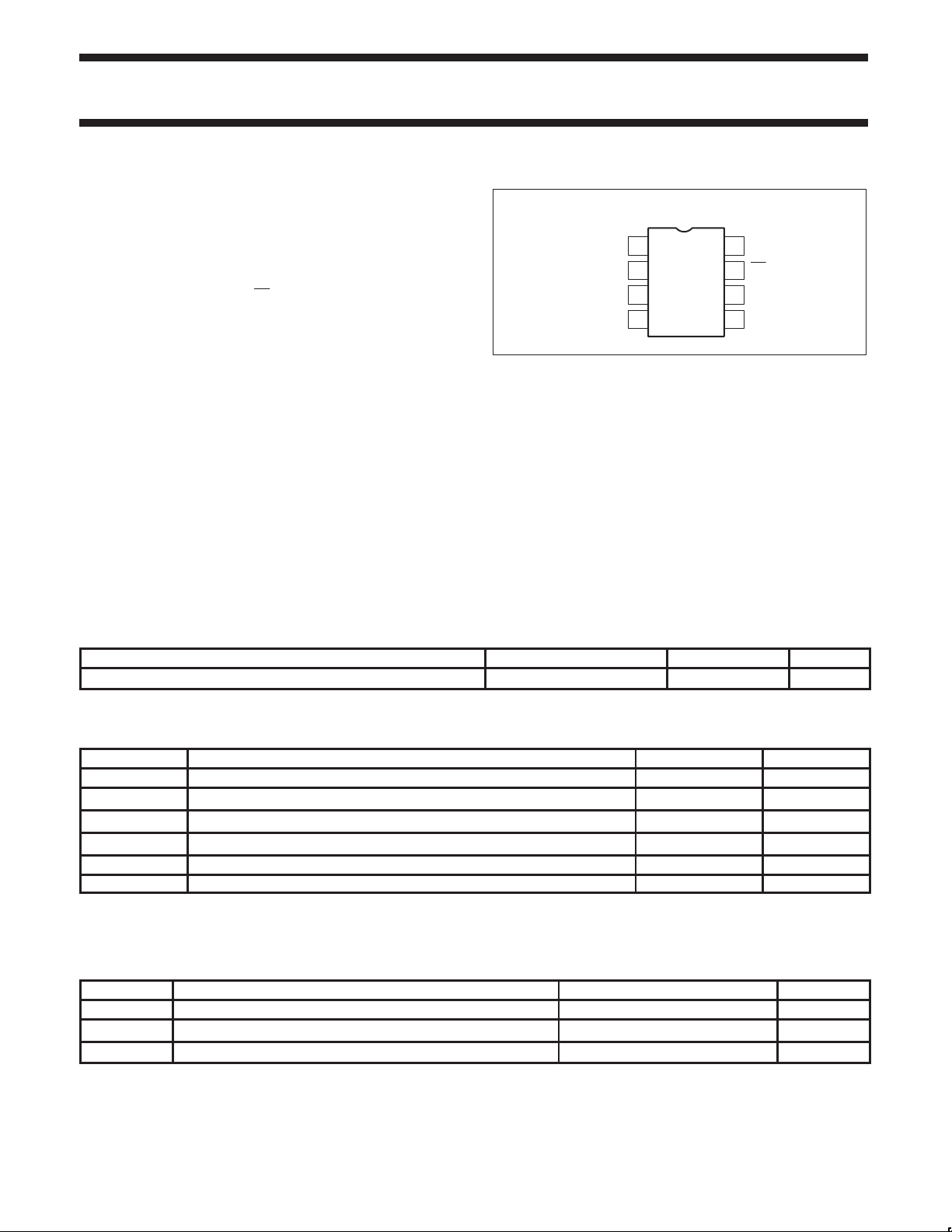
PIN DESCRIPTION
D Package
V
1
CC1
2
GND
1
3
IN
4
GND
1
Figure 1. Pin Configuration
APPLICATIONS
•FDDI preamp
•Current-to-voltage converters
•Wide-band gain block
•Medical and scientific instrumentation
•Sensor preamplifiers
•Single-ended to differential conversion
•Low noise RF amplifiers
•RF signal processing
V
8
OUT
7
6
OUT
5
GND
SD00360
CC2
2
ORDERING INFORMATION
DESCRIPTION TEMPERATURE RANGE ORDER CODE DWG #
8-Pin Plastic Small Outline (SO) package
-40 to +85°C
SA5222D SOT96-1
ABSOLUTE MAXIMUM RATINGS
SYMBOL PARAMETER RATING UNITS
V
CC1,2
T
A
T
J
T
STG
P
D
I
INMAX
NOTE:
1. Maximum power dissipation is determined by the operating ambient temperature and the thermal resistance θ
6.2mW/
°C above 25°C.
Power supply voltage 6 V
Ambient temperature range -40 to +85
Junction temperature range -55 to +150
Storage temperature range -65 to +150
Power dissipation TA = 25oC (still air)
Maximum input current 5 mA
1
0.78 W
= 158oC/W. Derate
JA
RECOMMENDED OPERATING CONDITIONS
SYMBOL PARAMETER RATING UNITS
V
CC1,2
T
A
T
J
Power supply voltage 4.5 to 5.5 V
Ambient temperature range: SA grade -40 to +85
Junction temperature range: SA grade -40 to +105
°C
°C
°C
°C
°C
1995 Apr 26 853-1582 15170
2
Page 3
Philips Semiconductors Product specification
SYMBOL
PARAMETER
TEST CONDITIONS
UNIT
SYMBOL
PARAMETER
TEST CONDITIONS
UNIT
T
SA5222Low-power FDDI transimpedance amplifier
DC ELECTRICAL CHARACTERISTICS
Typical data and Min and Max limits apply at TA = 25°C, and V
V
V
V
I
I
OMAX
I
INMAX
V
OMAX
Input bias voltage 1.3 1.55 1.8 V
IN
Output bias voltage 2.9 3.2 3.5 V
±
O
Output offset voltage 0 ±100 mV
OS
Supply current 6 9 12 mA
CC
Output sink/source current 1.5 2 mA
I
Input current (2% linearity) Test circuit 5, Procedure 2 ±60 ±90
IN
Maximum input current overload threshold Test circuit 5, Procedure 4 ±80 ±115
Maximum differential output voltage swing R
AC ELECTRICAL CHARACTERISTICS
Typical data and Min and Max limits apply at TA = 25°C and V
R
Transresistance (differential output)
T
R
R
R
f
R
C
∆R/∆V Transresistance power supply sensitivity V
∆R/∆T
PSRR Power supply rejection ratio DC Tested, ∆VCC = ±0.5V –55 dB
PSRR Power supply rejection ratio
I
INMAX
tr, tfRise and fall times 10 – 90% 2.2 ns
NOTES:
1. Bandwidth is tested into 50Ω load. Bandwidth into 1kΩ load is approximately 165MHz.
2. Does not include Miller-multiplied capacitance of input device.
3. PSRR is output referenced and is circuit board layout dependent at higher frequencies. For best performance use a RF filter in VCC line.
4. Monitored in production via linearity and over load tests.
Output resistance
O
(differential output)
Transresistance
T
(single-ended output)
Output resistance
O
(single-ended output)
Bandwidth (-3dB)
3dB
Input resistance 150
IN
Input capacitance
IN
1
2
Transresistance ambient temperature sensitivity
RMS noise current spectral density (referred
I
IN
to input)
Integrated RMS noise current over the band-
width (referred to input)
CS = 0pF ∆f = 100MHz 25
I
T
CS = 1pF ∆f = 50MHz 17
3
Maximum input amplitude for output duty
cycle of 50 ±5%
t
Group delay f = 10MHz 2.2 ns
D
4
= V
CC1
= +5V, unless otherwise specified.
CC2
SA5222
Min Typ Max
= ∞, Test Circuit 5, Procedure 3 3.6 V
L
= V
CC1
=+5V , unless otherwise specified.
CC2
SA5222
Min Typ Max
DC tested, RL = ∞, Test Circuit 5,
Procedure 1
13.3 16.6 19.9 kΩ
DC tested 30 60 90 Ω
DC tested, RL = ∞
6.65 8.3 9.95 kΩ
DC tested 15 30 45 Ω
Test Circuit 1 110 140 MHz
1
= V
CC1
∆TA = T
= 5 ±0.5V 1.0 %/V
CC2
A MAX
- T
A MIN
0.07
Test Circuit 2, f = 10MHz 2.0
Test circuit 2,
∆f = 50MHz
15
∆f = 150MHz 36
∆f = 100MHz 35
∆f = 150MHz 55
f = 1.0MHz, Test Circuit 3 –34 dB
Test circuit 4 ±120 µA
µA
µA
P-P
Ω
pF
%/oC
pA Hz
nA
1995 Apr 26
3
Page 4
Philips Semiconductors Product specification
SA5222Low-power FDDI transimpedance amplifier
TEST CIRCUITS
SINGLE-ENDED
V
OUT
R + 2 @ S21@ R
V
IN
1 + S22
-20
1 - S22
NETWORK ANALYZER
S-PARAMETER TEST SET
0.1uF
R=1k
GND
1
V
IN DUT
Z
O
RO = Z
= 50Ω
O
PORT1 PORT2
50
Test Circuit 1: Bandwidth
Figure 2. Test Circuit1
TEST CIRCUITS (continued)
CC
OUT
OUT
RT+
RO = 2Z
20
20
GND
2
DIFFERENTIAL
V
OUT
R + 4 @ S21@ RRT+
V
IN
1 + S22
O
1 - S22
Z
.1uF
.1uF
O
50
= 50Ω
-40
SD00361
5V
C
S
BIAS TEE
GND
1
SPECTRUM ANALYZER
V
CC
OUT
IN DUT
OUT
GND
.1µF
20
.1µF
20
2
Test Circuit 2: Noise
Figure 3. Test Circuit2
50Ω
10µF
NE5209
10µF
50Ω
SD00362
0.1uF
NC
GND
50Ω
1
V
CC
OUT
IN DUT
OUT
PORT1 PORT2
.1uF
20Ω
.1uF
20Ω
GND
100Ω
2
BAL.
Test Circuit 3: PSRR
Figure 4. Test Circuit4
NETWORK ANALYZER
S-PARAMETER TEST SET
NHO300HB
50Ω
UNBAL.
CAL
TRANSFORMER
CONVERSION
LOSS = 9dB
SD00363
1995 Apr 26
4
Page 5

Philips Semiconductors Product specification
SA5222Low-power FDDI transimpedance amplifier
TEST CIRCUITS (continued)
5V
PULSE GEN
.1µF
OUT
OUT
GND
1kΩ
.1µF
1kΩ
2
A
ZO = 50Ω
OSCILLOSCOPE
B
Z
= 50Ω
O
Meaurement done using
differential wave forms
SD00364
TEST CIRCUITS (continued)
OFFSET
0.1uF
DUT
IN
1kΩ
50Ω
GND
1
Test Circuit 4: Duty Cycle Distortion
Figure 5. Test Circuit4
5V
OUT +
GND
O6
OUT –
1
O
V
O2
V
O4
GND
2
(Differential) vs I
V
O
3
V
O1
V
O
S
CURRENT INPUT (µA)
I
IN (µA)
Typical V
2.25
1.80
1.35
0.90
0.45
0.00
–0.45
–0.90
DIFFERENTIAL OUTPUT VOLTAGE (V)
–1.35
–1.80
–2.25
–200 –160 –120 –80 –40 0 40 80 120 160 200
V
V
O8
SA5222 TEST CONDITIONS
Procedure 1
Procedure 3 Procedure 4
measured at 30µA
R
T
= (VO1 - VO2) / (+30µA - (-30µA)
R
T
Where: V
V
OMAX
Where: VO7 Measured at IIN = +130µA
Measure at IIN = +30µA
O1
Measured at IIN = -30µA
V
O2
= VO7 - V
O8
Measured at IIN = -130µA
V
O8
Procedure 2
Test Circuit 5: DC Tests
Figure 6. Test Circuit5
+
VO (VOLTS)
–
IN
V
O
V
O
7
5
Linearity = 1 - ABS((V
Where: V
I
INMAX
V
O7
Where: V
V
V
VOB = RT x (-60µA) + V
Test Pass Conditions:
- VO5 > 50mV and VO6 - VO8 < 50mV
V
V
V
- VOB / (VO3 - VO4))
OA
Measured at IIN = +60µA
O3
Measured at IIN = -60µA
O4
= RT x (+60µA) + V
OA
Measured at IIN = +80µA
O5
Measured at IIN = -80µA
O6
Measured at IIN = +130µA
O7
Measured at IIN = -130µA
OB
OS
OS
SD00365
1995 Apr 26
5
Page 6

Philips Semiconductors Product specification
SA5222Low-power FDDI transimpedance amplifier
10
9
8
SUPPLY CURRENT (mA)
7
6
4.5 5 5.5
25°C
85°C
–40°C
SUPPLY VOLTAGE (V)
Figure 7. ICC vs. VCC and Temperature
1.8
1.7
1.6
1.5
INPUT VOLTAGE (V)
1.4
–40°C
25°C
85°C
SD00366
5
OUT
4
3
OUT
VOLTAGE (V)
2
1
T
= +25°C
A
= 5V
V
0
–200 –100 0 100 200
INPUT CURRENT (µA)
CC
SD00548
Figure 10. Differential Output Voltages vs. Input Current
2.5
1.5
0.5
VOLTAGE (V)
–0.5
1.3
1.2
4.5 5 5.5
SUPPLY VOLTAGE (V)
SD00546
Figure 8. Input Voltage vs. VCC and Temperature
3.8
3.6
3.4
3.2
3
2.8
OUTPUT VOLTAGE (V)
2.6
2.4
2.2
2
4.5 5 5.5
85°C
–40°C
SUPPLY VOLTAGE (V)
25°C
PIN 6 OUTPUT
SD00547
Figure 9. Output Voltage vs. VCC and Temperature
–1.5
4.5V
= +25°C
T
5.5V
–2.5
–200 –100 0 100 200
INPUT CURRENT (µA)
A
SD00549
Figure 11. Differential Output Voltage vs Input Current and V
2.5
1.5
0.5
VOLTAGE (V)
–0.5
–1.5
–2.5
–200 –100 0 100 200
85°C
V
= 5V
CC
INPUT CURRENT (µA)
–40°C
SD00550
Figure 12. Diff. Output Voltage vs. Input Current and Temp.
CC
1995 Apr 26
6
Page 7

Philips Semiconductors Product specification
SA5222Low-power FDDI transimpedance amplifier
18
85°C
17
25°C
16
–40°C
15
14
TRANSRESISTANCE (KOHMS)
13
∆Iin = ±20µA
12
4.5 5 5.5
SUPPLY VOLTAGE (V)
SD00367
Figure 13. Differential Transresistance vs. VCC and
Temperature
50
40
30
–40°C
25°C
85°C
15
10
5
21
S (dB)
0
V
T
A
–5
1 10 100 300
FREQUENCY (MHz)
= 5V
CC
= +25°C
PIN 7
Figure 16. Insertion Gain vs. Frequency
15
5.5V
10
5
21
S (dB)
4.5V
PIN 6
SD00553
20
OUTPUT RESISTANCE (OHMS)
10
0
4.5 5 5.5
SUPPLY VOLTAGE (V)
SD00551
Figure 14. Output Resistance vs. VCC and Temperature
50
45
40
35
30
25
20
OUTPUT OFFSET (mV)
15
10
5
0
4.5 5 5.5
85°C
25°C
–40°C
SUPPLY VOLTAGE (V)
SD00552
Figure 15. Output Offset Voltage vs. VCC and Temperature
0
PIN 6 OUTPUT
T
= +25°C
–5
1 10 100 300
Figure 17. Insertion Gain vs. Frequency and V
15
+85°C
10
21
S (dB)
–5
–40°C
5
0
1 10 100 300
A
FREQUENCY (MHz)
PIN 6 OUTPUT
= 5V
V
CC
FREQUENCY (MHz)
SD00554
CC
+85°C
SD00555
Figure 18. Insertion Gain vs. Frequency and Temperature
1995 Apr 26
7
Page 8

Philips Semiconductors Product specification
SA5222Low-power FDDI transimpedance amplifier
200
PIN 7 OUTPUT
100
0
PIN 6 OUTPUT
21
S PHASE (DEG)
–100
= 5V
V
CC
T
= +25°C
A
–200
1 10 100 300
FREQUENCY (MHz)
Figure 19. Phase vs. Frequency
8
0.1µF COUPLING CAP’s
7
6
5
4
PIN 6 OUTPUT
= 5V
V
CC
TA = +25°C
21
S GROUP DELAY (ns)
3
2
1
SD00368
50
45
40
35
30
25
20
FREQUENCY
15
10
5
0
110
0
–20
PSRR (dB)
–4
0
VCC = 5V
Ω
50
Load
TA = 25°C
140
BANDWIDTH (MHz)
300 PARTS FROM
3 WAFERS
Figure 22. –3dB Bandwidth Distribution
DIFFERENTIAL OUTPUT
VCC = 5V
T
= +25°C
A
170
SD00558
0
1 10 100 300
FREQUENCY (MHz)
Figure 20. Group Delay vs. Frequency
115
95
75
55
35
OUT
Z MAGNITUDE (OHMS)
15
–5
1 10 100 300
FREQUENCY (MHz)
V
CC
T
= +25°C
A
PIN 6
PIN 7
= 5V
Figure 21. Output Impedance vs. Frequency
SD00556
SD00557
–60
0.1 1 10 100 300
FREQUENCY (MHz)
SD00559
Figure 23. Power–Supply Rejection Ratio vs. Frequency
8
7
6
5
4
3
INPUT NOISE (pA/ Hz)√
2
1
0
OUTPUT NOISE DIVIDED BY 10MHz GAIN
= 5V
V
CC
T
= +25°C
A
C
= 1pF
S
CS = 0pF
1 10 100 300
FREQUENCY (MHz)
SD00560
Figure 24. Input Noise Spectral Density vs. Frequency
1995 Apr 26
8
Page 9

Philips Semiconductors Product specification
SA5222Low-power FDDI transimpedance amplifier
VCC1
GND 1
GND 1
1
2
3
IN
4
Figure 25. SA5222 Bonding Diagram
Die Sales Disclaimer
Due to the limitations in testing high frequency and other parameters
at the die level, and the fact that die electrical characteristics may
shift after packaging, die electrical parameters are not specified and
die are not guaranteed to meet electrical characteristics (including
temperature range) as noted in this data sheet which is intended
only to specify electrical characteristics for a packaged device.
All die are 100% functional with various parametrics tested at the
wafer level, at room temperature only (25°C), and are guaranteed to
be 100% functional as a result of electrical testing to the point of
wafer sawing only. Although the most modern processes are
utilized for wafer sawing and die pick and place into waffle pack
VCC2
8
OUT
7
OUT
6
GND 2
5
SD00505
carriers, it is impossible to guarantee 100% functionality through this
process. There is no post waffle pack testing performed on
individual die.
Since Philips Semiconductors has no control of third party
procedures in the handling or packaging of die, Philips
Semiconductors assumes no liability for device functionality or
performance of the die or systems on any die sales.
Although Philips Semiconductors typically realizes a yield of 85%
after assembling die into their respective packages, with care
customers should achieve a similar yield. However, for the reasons
stated above, Philips Semiconductors cannot guarantee this or any
other yield on any die sales.
1995 Apr 26
9
Page 10

Philips Semiconductors Product specification
SA5222Low-power FDDI transimpedance amplifier
SO8: plastic small outline package; 8 leads; body width 3.9mm SOT96-1
1995 Apr 26
10
Page 11

Philips Semiconductors Product specification
SA5222Low-power FDDI transimpedance amplifier
NOTES
1995 Apr 26
11
Page 12

Philips Semiconductors Product specification
SA5222Low-power FDDI transimpedance amplifier
Data sheet status
Data sheet
status
Objective
specification
Preliminary
specification
Product
specification
Product
status
Development
Qualification
Production
Definition
This data sheet contains the design target or goal specifications for product development.
Specification may change in any manner without notice.
This data sheet contains preliminary data, and supplementary data will be published at a later date.
Philips Semiconductors reserves the right to make chages at any time without notice in order to
improve design and supply the best possible product.
This data sheet contains final specifications. Philips Semiconductors reserves the right to make
changes at any time without notice in order to improve design and supply the best possible product.
[1]
[1] Please consult the most recently issued datasheet before initiating or completing a design.
Definitions
Short-form specification — The data in a short-form specification is extracted from a full data sheet with the same type number and title. For
detailed information see the relevant data sheet or data handbook.
Limiting values definition — Limiting values given are in accordance with the Absolute Maximum Rating System (IEC 134). Stress above one
or more of the limiting values may cause permanent damage to the device. These are stress ratings only and operation of the device at these or
at any other conditions above those given in the Characteristics sections of the specification is not implied. Exposure to limiting values for extended
periods may affect device reliability.
Application information — Applications that are described herein for any of these products are for illustrative purposes only. Philips
Semiconductors make no representation or warranty that such applications will be suitable for the specified use without further testing or
modification.
Disclaimers
Life support — These products are not designed for use in life support appliances, devices or systems where malfunction of these products can
reasonably be expected to result in personal injury . Philips Semiconductors customers using or selling these products for use in such applications
do so at their own risk and agree to fully indemnify Philips Semiconductors for any damages resulting from such application.
Right to make changes — Philips Semiconductors reserves the right to make changes, without notice, in the products, including circuits, standard
cells, and/or software, described or contained herein in order to improve design and/or performance. Philips Semiconductors assumes no
responsibility or liability for the use of any of these products, conveys no license or title under any patent, copyright, or mask work right to these
products, and makes no representations or warranties that these products are free from patent, copyright, or mask work right infringement, unless
otherwise specified.
Philips Semiconductors
811 East Arques Avenue
P.O. Box 3409
Sunnyvale, California 94088–3409
Telephone 800-234-7381
Copyright Philips Electronics North America Corporation 1998
All rights reserved. Printed in U.S.A.
print code Date of release: 08-98
Document order number:
1995 Apr 26
12
 Loading...