

Page 1
Philips Semiconductors
SA5219
Wideband variable gain amplifier
Product specification
Replaces data of 1993 Dec 10
1997 Nov 07
INTEGRATED CIRCUITS
IC17 Data Handbook
Page 2
Philips Semiconductors Product specification
SA5219Wideband variable gain amplifier
2
1997 Nov 07 853-1724 18663
DESCRIPTION
The SA5219 represents a breakthrough in monolithic amplifier
design featuring several innovations. This unique design has
combined the advantages of a high speed bipolar process with the
proven Gilbert architecture.
The SA5219 is a linear broadband RF amplifier whose gain is
controlled by a single DC voltage. The amplifier runs off a single 5
volt supply and consumes only 40mA. The amplifier has high
impedance (1kΩ) differential inputs. The output is 50Ω differential.
Therefore, the 5219 can simultaneously perform AGC, impedance
transformation, and the balun functions.
The dynamic range is excellent over a wide range of gain setting.
Furthermore, the noise performance degrades at a comparatively
slow rate as the gain is reduced. This is an important feature when
building linear AGC systems.
FEA TURES
•700MHz bandwidth
•High impedance differential input
•50Ω differential output
•Single 5V power supply
•0 - 1V gain control pin
•>60dB gain control range at 200MHz
•26dB maximum gain differential
•Exceptional V
CONTROL
/ V
GAIN
linearity
•7dB noise figure minimum
•Full ESD protection
•Easily cascadable
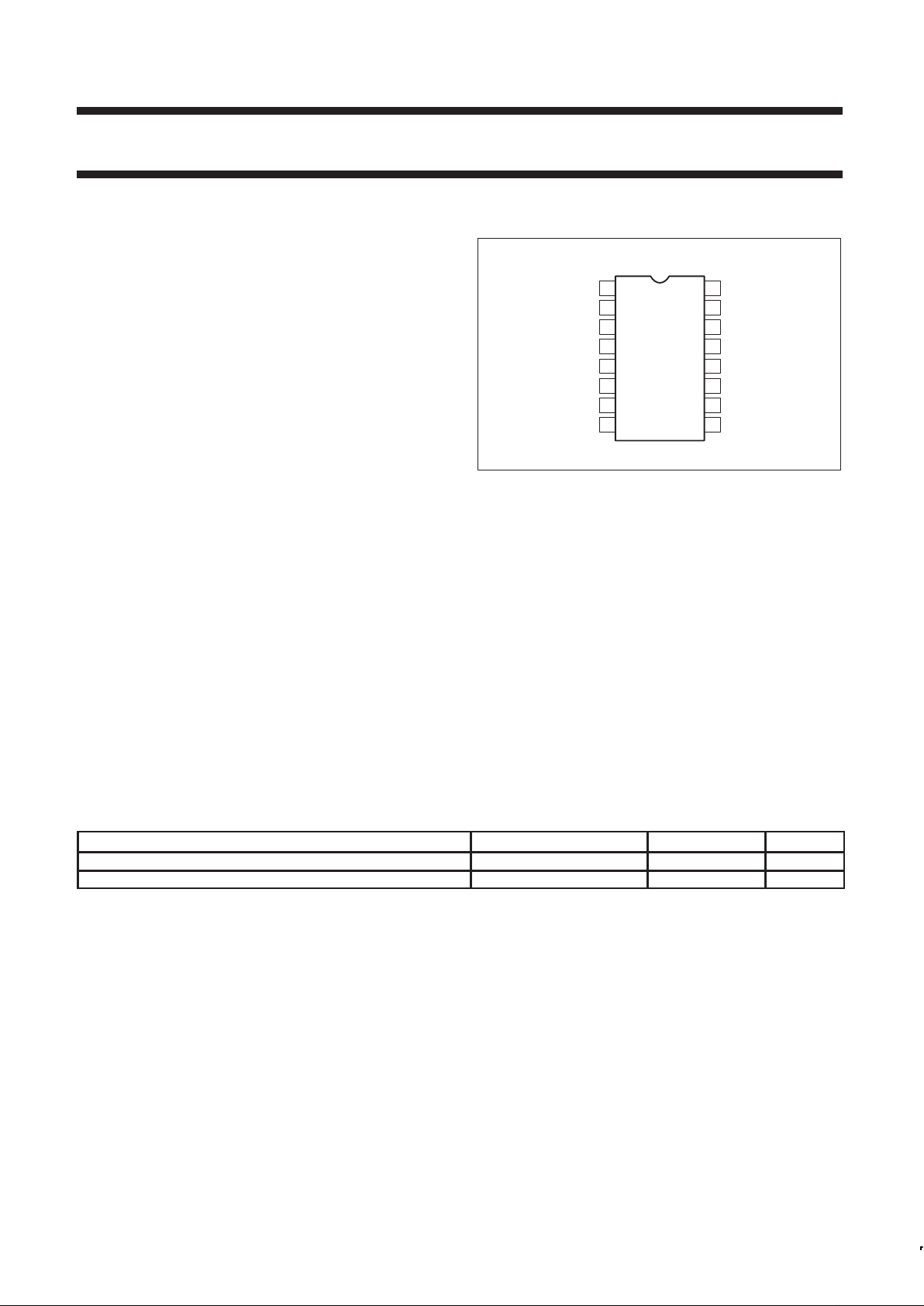
PIN CONFIGURATION
N, D PACKAGES
OUT
A
V
CC1
IN
A
GND
2
V
CC2
GND
1
GND
1
GND
2
1
2
3
4
5
6
7
8
9
10
11
12
13
14
16
15
IN
B
GND
1
V
BG
V
AGC
OUT
B
GND
2
GND
2
GND
2
SR00273
Figure 1. Pin Configuration
APPLICATIONS
•Linear AGC systems
•Very linear AM modulator
•RF balun
•Cable TV multi-purpose amplifier
•Fiber optic AGC
•RADAR
•User programmable fixed gain block
•Video
•Satellite receivers
•Cellular communications
ORDERING INFORMATION
Description Temperature Range Order Code DWG #
16-Pin Plastic Small Outline (SO) package -40 to +85°C SA5219D SOT109-1
16-Pin Plastic Dual In-Line package (DIP) -40 to +85°C SA5219N SOT38-4
Page 3

Philips Semiconductors Product specification
SA5219Wideband variable gain amplifier
1997 Nov 07
3
ABSOLUTE MAXIMUM RATINGS
SYMBOL PARAMETER RATING UNITS
V
CC
Supply voltage -0.5 to +8.0 V
P
D
Power dissipation, TA = 25oC (still air)
1
16-Pin Plastic DIP
16-Pin Plastic SO
1450
1100
mW
mW
T
JMAX
Maximum operating junction temperature 150
°C
T
STG
Storage temperature range -65 to +150
°C
NOTES:
1. Maximum dissipation is determined by the operating ambient temperature and the thermal resistance, θ
JA
:
16-Pin DIP: θ
JA
= 85°C/W
16-Pin SO: θ
JA
= 110°C/W
RECOMMENDED OPERATING CONDITIONS
SYMBOL PARAMETER RATING UNITS
V
CC
Supply voltage V
CC1
= V
CC2
= 4.5 to 7.0V V
T
A
Operating ambient temperature range
SA Grade -40 to +85
°C
T
J
Operating junction temperature range
SA Grade -40 to +105
°C
DC ELECTRICAL CHARACTERISTICS
TA = 25oC, V
CC1
= V
CC2
= +5V , V
AGC
= 1.0V , unless otherwise specified.
LIMITS
SYMBOL
PARAMETER
TEST CONDITIONS
MIN TYP MAX
UNIT
I
CC
Supply current DC tested 36 43 50 mA
A
V
Voltage gain (single-ended in/single-ended out) DC tested, RL = 10kΩ 16 19 22 dB
A
V
Voltage gain (single-ended in/differential out) DC tested, RL = 10kΩ 22 25 28 dB
R
IN
Input resistance (single-ended) DC tested at ±50µA 0.8 1.2 1.6 kΩ
R
OUT
Output resistance (single-ended) DC tested at ±1mA 35 60 80 Ω
V
OS
Output offset voltage (output referred) +20 ±150 mV
V
IN
DC level on inputs 1.6 2.0 2.4 V
V
OUT
DC level on outputs 1.9 2.4 2.9 V
PSRR Output offset supply rejection ratio 18 45 dB
V
BG
Bandgap reference voltage
4.5V<VCC<7V
RBG = 10kΩ
1.2 1.32 1.45 V
R
BG
Bandgap loading 2 10
kΩ
V
AGC
AGC DC control voltage range 0-1.3 V
I
BAGC
AGC pin DC bias current 0V<V
AGC
<1.3V -0.7 -6 µA
Page 4

Philips Semiconductors Product specification
SA5219Wideband variable gain amplifier
1997 Nov 07
4
AC ELECTRICAL CHARACTERISTICS
TA = 25oC, V
CC1
= V
CC2
= +5.0V , V
AGC
= 1.0V , unless otherwise specified.
LIMITS
SYMBOL
PARAMETER
TEST CONDITIONS
MIN TYP MAX
UNIT
BW -3dB bandwidth 700 MHz
GF Gain flatness DC - 500MHz +0.4 dB
V
IMAX
Maximum input voltage swing (single-ended) for
linear operation
1
200 mV
P-P
Maximum output voltage swing (single-ended)
RL = 50Ω 400 mV
P-P
V
OMAX
for linear operation
1
RL = 1kΩ 1.9 V
P-P
NF Noise figure (unmatched configuration) RS = 50Ω, f = 50MHz 9.3 dB
V
IN-EQ
Equivalent input noise voltage spectral density f = 100MHz 2.5
nV/√Hz
S12 Reverse isolation f = 100MHz -60 dB
∆G/∆V
CC
Gain supply sensitivity (single-ended) 0.3 dB/V
∆G/∆T Gain temperature sensitivity RL = 50Ω 0.013
dB/°C
C
IN
Input capacitance (single-ended) 2 pF
BW
AGC
-3dB bandwidth of gain control function 20 MHz
P
O-1dB
1dB gain compression point at output f = 100MHz -3 dBm
P
I-1dB
1dB gain compression point at input
f = 100MHz, V
AGC
=0.1V
-10 dBm
IP3
OUT
Third-order intercept point at output
f = 100MHz, V
AGC
>0.5V
+13 dBm
IP3
IN
Third-order intercept point at input
f = 100MHz, V
AGC
<0.5V
+5 dBm
∆G
AB
Gain match output A to output B f = 100MHz, V
AGC
= 1V 0.1 dB
NOTE:
1. With R
L
> 1kΩ, overload occurs at input for single-ended gain < 13dB and at output for single-ended gain > 13dB. With RL = 50Ω, overload
occurs at input for single-ended gain < 6dB and at output for single-ended gain > 6dB.
SA5219 APPLICATIONS
The SA5219 is a wideband variable gain amplifier (VGA) circuit
which finds many applications in the RF, IF and video signal
processing areas. This application note describes the operation of
the circuit and several applications of the VGA. The simplified
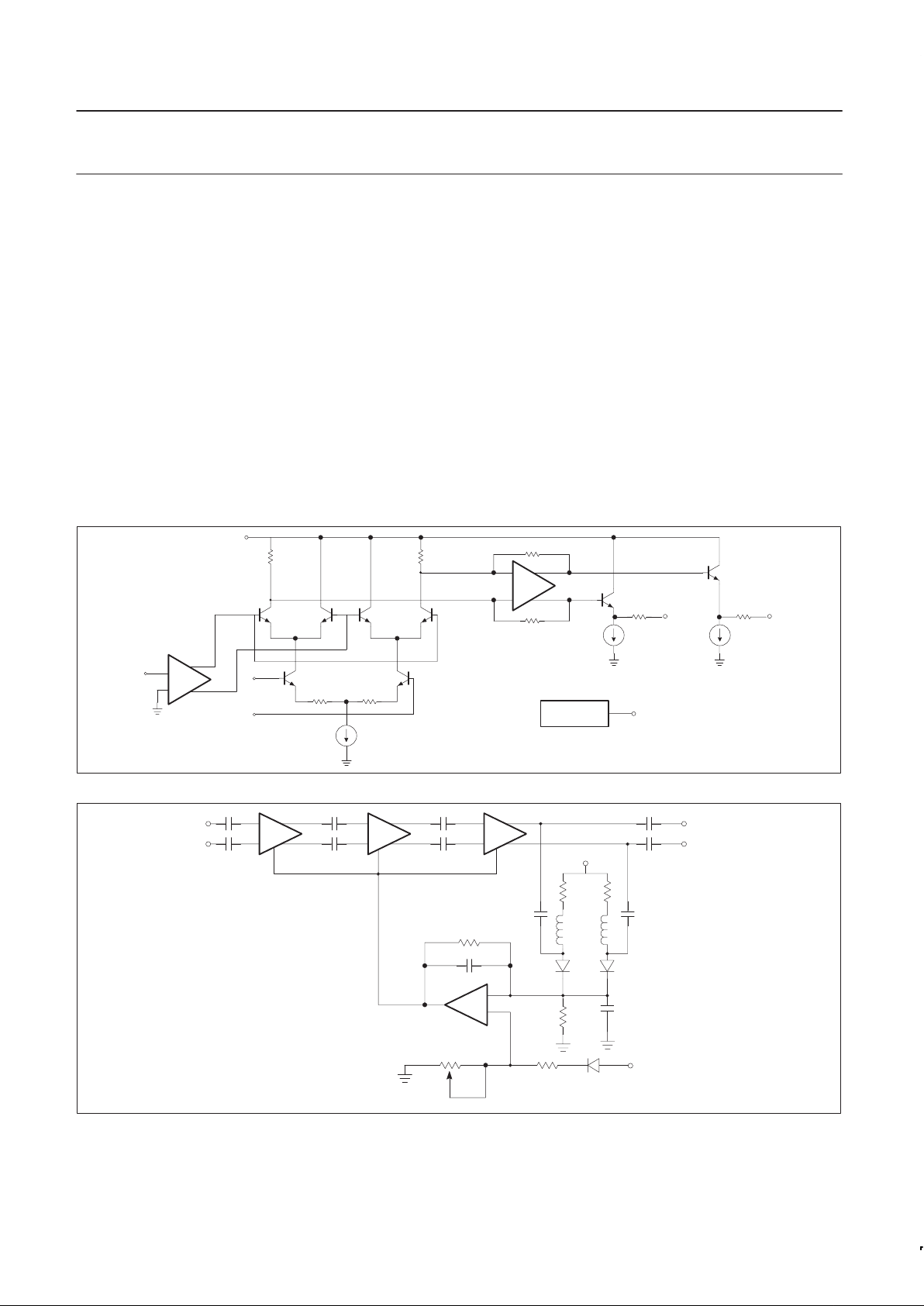
equivalent schematic of the VGA is shown in Figure 2. Transistors
Q1-Q6 form the wideband Gilbert multiplier input stage which is
biased by current source I1. The top differential pairs are biased
from a buffered and level-shifted signal derived from the V
AGC
input
and the RF input appears at the lower differential pair. The circuit
topology and layout offer low input noise and wide bandwidth. The
second stage is a differential transimpedance stage with current
feedback which maintains the wide bandwidth of the input stage.
The output stage is a pair of emitter followers with 50Ω output
impedance. There is also an on-chip bandgap reference with
buffered output at 1.3V, which can be used to derive the gain control
voltage.
Both the inputs and outputs should be capacitor coupled or DC
isolated from the signal sources and loads. Furthermore, the two
inputs should be DC isolated from each other and the two outputs
should likewise be DC isolated from each other. The SA5219 was
designed to provide optimum performance from a 5V power source.
However, there is some range around this value (4.5 - 7V) that can
be used.
The input impedance is about 1kΩ. The main advantage to a
differential input configuration is to provide the balun function.
Otherwise, there is an advantage to common mode rejection, a
specification that is not normally important to RF designs. The
source impedance can be chosen for two different performance
characteristics: Gain, or noise performance. Gain optimization will
be realized if the input impedance is matched to about 1kΩ. A 4:1
balun will provide such a broadband match from a 50Ω source.
Noise performance will be optimized if the input impedance is
matched to about 200Ω. A 2:1 balun will provide such a broadband
match from a 50Ω source. The minimum noise figure can then be
expected to be about 7dB. Maximum gain will be about 23dB for a
single-ended output. If the differential output is used and properly
matched, nearly 30dB can be realized. With gain optimization, the
noise figure will degrade to about 8dB. With no matching unit at the
input, a 9dB noise figure can be expected from a 50Ω source. If the
source is terminated, the noise figure will increase to about 15dB.
All these noise figures will occur at maximum gain.
The SA5219 has an excellent noise figure vs gain relationship. With
any VGA circuit, the noise performance will degrade with decreasing
gain. The 5219 has about a 1.2dB noise figure degradation for
each 2dB gain reduction. With the input matched for optimum gain,
the 8dB noise figure at 23dB gain will degrade to about a 20dB
noise figure at 0dB gain.
The SA5219 also displays excellent linearity between voltage gain
and control voltage. Indeed, the relationship is of sufficient linearity
that high fidelity AM modulation is possible using the SA5219. A
Page 5
Philips Semiconductors Product specification
SA5219Wideband variable gain amplifier
1997 Nov 07
5
maximum control voltage frequency of about 20MHz permits video
baseband sources for AM.
A stabilized bandgap reference voltage is made available on the
SA5219 (Pin 7). For fixed gain applications this voltage can be
resistor divided, and then fed to the gain control terminal (Pin 8).
Using the bandgap voltage reference for gain control produces very
stable gain characteristics over wide temperature ranges. The gain
setting resistors are not part of the RF signal path, and thus stray
capacitance here is not important.
The wide bandwidth and excellent gain control linearity make the
SA5219 VGA ideally suited for the automatic gain control (AGC)
function in RF and IF processing in cellular radio base stations,
Direct Broadcast Satellite (DBS) decoders, cable TV systems, fiber
optic receivers for wideband data and video, and other radio
communication applications. A typical AGC configuration using the
SA5219 is shown in Figure 3. Three SA5219s are cascaded with
appropriate AC coupling capacitors. The output of the final stage
drives the full-wave rectifier composed of two UHF Schottky diodes
BAT17 as shown. The diodes are biased by R1 and R2 to V
CC
such
that a quiescent current of about 2mA in each leg is achieved. An
SA5230 low voltage op amp is used as an integrator which drives
the V
AGC
pin on all three SA5219s. R3 and C3 filter the high
frequency ripple from the full-wave rectified signal. A voltage
divider is used to generate the reference for the non-inverting input
of the op amp at about 1.7V . Keeping D3 the same type as D1 and
D2 will provide a first order compensation for the change in Schottky
voltage over the operating temperature range and improve the AGC
performance. R6 is a variable resistor for adjustments to the op
amp reference voltage. In low cost and large volume applications
this could be replaced with a fixed resistor, which would result in a
slight loss of the AGC dynamic range. Cascading three SA5219s
will give a dynamic range in excess of 60dB.
The SA5219 is a very user-friendly part and will not oscillate in most
applications. However, in an application such as with gains in
excess of 60dB and bandwidth beyond 100MHz, good PC board
layout with proper supply decoupling is strongly recommended.
Q
1
Q
2
V
CC
Q
3
Q
4
Q
5
Q
6
V
BG
BANDGAP
REFERENCE
OUT
A
OUT
B
Q
8
Q
7
A1
V
AGC
0–1V
I
1
I
2
I
3
50
Ω
50
Ω
R
1
R
2
R
3
R
4
IN
A
IN
B
+
–
SR00274
Figure 2. Equivalent Schematic of VGA
RF/IF
INPUT
AGC
OUTPUT
BAT 17
BAT 17
5219 5219
5219
R4
C4
D1 D2
D3
R6
R1
R2
L1 L2
R3
C3
R5
5230
+
–
V
CC
V
CC
SR00275
Figure 3. AGC Configuration Using Cascaded SA5219s
Page 6

Philips Semiconductors Product specification
SA5219Wideband variable gain amplifier
1997 Nov 07
6
1
2
3
4
5
6
7
8
9
10
11
12
13
14
16
15
OUT
A
V
CC1
IN
A
GND2
V
CC2
GND1
GND1
GND2
IN
B
GND1
V
BG
V
AGC
GND
2
OUT
B
GND2
GND2
V
OUT
A
OUT
B
V
CC
5VDC
+
V
IN
10µF
0.1µF
0.1µF
0.1µF
0.1µF
0.1µF
0.1µF
50Ω
SR00276
Figure 4. VGA AC Evaluation Board
This circuit will exhibit about a 7dB
noise figure with approximately
22dB gain.
50Ω
50Ω
50Ω
+5V
+1V
MINI CIRCUITS
2:1 BALUN
OR SIMILAR
SOURCE
OUTPUT
5219
1 : 2
V
AGC
SR00277
Figure 5. Broadband Noise Optimization
This circuit will exhibit about a 7dB
noise figure with approximately
22dB gain. Narrowband circuits
have the advantage of greater stability, particularly when multiple devices are cascaded.
50Ω
50Ω
50Ω
+5V
+1V
2:1 TURNS RATIO
LC TUNED
TRANSFORMER
SOURCE
OUTPUT
5219
V
AGC
SR00278
Figure 6. Narrowband Noise Optimization
This circuit will exhibit about an 8dB
noise figure with 24dB gain.
50Ω
50Ω
50Ω
+5V
+1V
MINI CIRCUITS
4:1 BALUN OR
EQUIVALENT
SOURCE
OUTPUT
5219
1 : 4
V
AGC
SR00279
Figure 7. Broadband Gain Optimization
Page 7

Philips Semiconductors Product specification
SA5219Wideband variable gain amplifier
1997 Nov 07
7
This circuit will exhibit approximately an 8dB noise figure and 25dB gain.
50Ω
50Ω
50Ω
+5V
+1V
4:1 TURNS RATIO
LC TUNED
TRANSFORMER
SOURCE
OUTPUT
5219
V
AGC
SR00280
Figure 8. Narrowband Gain Optimization
The noise figure of this configuration
will be approximately 15dB.
50Ω
50Ω
50Ω
+5V
+1V
SOURCE
OUTPUT
5219
50Ω
V
AGC
SR00281
Figure 9. Simple Amplifier Configuration
With the 50Ω source left unterminated, the noise figure is 9dB.
50Ω
50Ω
50Ω
+5V
+1V
SOURCE
OUTPUT
5219
V
AGC
SR00282
Figure 10. Unterminated Configuration
50Ω
50Ω
50Ω
+5V
SOURCE
OUTPUT
5219
Gain = 19dB + 20log10 V
AGC
and is in units of Volts, for V
AGC
≤ 1V
where V
AGC
=
R
2
R1 R
2
V
BG
V
BG
V
AGC
R1R
2
SR00283
Figure 11. User-Programmable Fixed Gain Block
Page 8

Philips Semiconductors Product specification
SA5219Wideband variable gain amplifier
1997 Nov 07
8
All harmonic distortion products will be
at least -50dBc over the audio spectrum.
50Ω
50Ω
50Ω
+5V
SOURCE
OUTPUT
5219
+5V
RF INPUT
FULL CARRIER
AM (DSB)
MODULATING
SIGNAL
.5V
R9R
V
AGC
SR00284
Figure 12. AM Modulator
The high input impedance to the NE5219 makes matching
to crystal filters relatively easy. The total delta gain of this
system will approach 80dB. IF frequencies well into the UHF
region can be configured with this type of architecture.
50Ω
5219
CRYSTAL
GAIN CONTROL
SIGNAL
FILTER
50Ω
OUTPUT
52195219
V
AGC
V
AGC
V
AGC
SR00285
Figure 13. Receiver AGC IF Gain
R
L
5219
R
L
±
±
V
S
R
S
R
T
R
T
V
AGC
V
CC
(+5V, unless otherwise noted)
SR00286
Figure 14. Test Set-up 1 (Used for all Graphs)
Page 9

Philips Semiconductors Product specification
SA5219Wideband variable gain amplifier
1997 Nov 07
9
S Magnitude
10
0 0.6 10.80.40.2
V
CC
= 5.5V
V
CC
= 5.0V
V
CC
= 4.5V
V
AGC
(V)
21
9
8
7
6
5
4
3
2
1
0
1.2
T = 25°C
R
S
= RL = 50Ω
R
t
= ∞
f = 10MHz
DC Tested
See test-setup 1
SR00287
Figure 15. Gain vs V
AGC
and V
CC
RS = RL = 50Ω
R
t
= ∞
See test-setup 1
0 0.2 0.4 0.6 0.8
V
AGC
(V)
10
9
8
7
6
5
4
3
2
1
0
1 1.2
-55°C
+25°C
+125°C
S Magnitude
21
SR00288
Figure 16. Insertion Gain vs V
AGC
and Temperature
20
Differential Voltage Gain (dB)
Temperature (°C)
–100 50 1501000–50
5.5V
5.0V
4.5V
19.5
19
18.5
18
17.5
17
16.5
16
15.5
15
RS = 0Ω
R
L
= ∞
Rt = ∞
V
AGC
= 1.1V
See Test Setup 1
SR00289
Figure 17. Voltage Gain vs Temperature and V
CC
Supply Current (mA)
–100 –50 0 50 100
55
50
45
40
35
30
25
20
150
VCC = 7.0V
See test-setup 1
Temperature (°C)
VCC = 6.0V
VCC = 5.0V
VCC = 4.5V
SR00290
Figure 18. Supply Current vs Temperature and V
CC
Page 10

Philips Semiconductors Product specification
SA5219Wideband variable gain amplifier
1997 Nov 07
10
50
1.5
–100 –50 0 150100
V
CC
= 7.0V
V
CC
= 4.5V
Temperature (°C)
Input Resistance (k )Ω
1.45
1.4
1.35
1.3
1.25
1.2
1.15
1.1
1.05
1
DC Tested
See test-setup 1
SR00291
Figure 19. Input Resistance vs Temperature
2.5
–100 50 150100
Temperature (°C)
Input Bias Voltage (V)
0–50
2
1.5
1
0.5
0
V
CC
= 7.0V
V
CC
= 6.0V
V
CC
= 5.0V
V
CC
= 4.5V
DC Tested
See test-setup 1
SR00292
Figure 20. Input Bias Voltage vs Temperature
Output DC Voltage
5
–100 50 1501000–50
4.5
4
3.5
3
2.5
2
1.5
1
0.5
0
Temperature (°C)
DC Tested
See test-setup 1
VCC = 7.0V
VCC = 6.0V
VCC = 5.0V
VCC = 4.5V
SR00293
Figure 21. Output Bias Voltage vs Temperature and V
CC
DC OUTPUT SWING (V)
–100 –50 150
2.5
Temperature (°C)
0 50 100
2
1.5
1
0.5
0
V
AGC
= 1.1V
R
L
= 10kΩ
DC Tested
See test-setup 1
SR00294
Figure 22. DC Output Swing vs Temperature
Page 11

Philips Semiconductors Product specification
SA5219Wideband variable gain amplifier
1997 Nov 07
11
20
10 1500100
S Magnitude (dB)
1.1V
0.8V
0.4V
200mV
100mV
50mV
25mV
21
10
0
–10
–20
–30
1000
Frequency (MHz)
T = 25°C
R
S
= RL =
50Ω
R
t
= 50Ω
See Test
Setup 1
SR00295
Figure 23. Insertion Gain vs Frequency and V
AGC
15
10
100
15001000
Frequency (MHz)
10
5
0
–5
5.5V
4.5V
S Magnitude (dB)
21
T = 25°C
V
AGC
= 1.1V
R
S
= RL = 50Ω
R
t
= 50Ω
See Test Setup 1
SR00296
Figure 24. Insertion Gain vs Frequency and V
CC
16
–100
50
150100
Temperature (°C)
S Magnitude (dB)
21
VCC = 7.0V
V
CC
= 6.0V
V
CC
= 5.0V
V
CC
= 4.5V
14
12
10
8
6
4
2
0
0–50
T = 25°C
V
AGC
= 1.1V
R
t
= 50Ω
f = 10MHz
See Test Setup 1
SR00297
Figure 25. Insertion Gain vs Temperature and V
CC
0
10
100
15001000
Frequency (MHz)
S (dB)
22
–5
–10
–15
–20
–25
25°C
-55°C
125°C
RS = RL = 50Ω
R
t
= 50Ω
See Test Setup 1
SR00298
Figure 26. Output Return Loss vs Frequency
Page 12

Philips Semiconductors Product specification
SA5219Wideband variable gain amplifier
1997 Nov 07
12
S Magnitude (dB)
1500
0
10
100
1000
12
Frequency (MHz)
–10
–20
–30
–40
–50
–60
–70
–80
–90
T = 25°C
R
S
= RL = 50Ω
Rt = 50Ω
See test-setup 1
SR00299
Figure 27. Reverse Isolation vs Frequency
P (dBm)
0 0.2 1
0
0.4 0.6 0.8
–1
–5
–10
–15
–20
–25
–30
V
AGC
(V)
OUTPUT
INPUT
T = 25°C
R
S
= RL = 50Ω
R
t
= 50Ω
f = 100MHz
See test-setup 1
SR00300
Figure 28. 1dB Gain Compression vs V
AGC
IM Intercept (dBm)
0 0.2 0.4 0.6 0.8
15
10
5
0
–5
1
T = 25°C
R
S
= RL = 50Ω
R
t
= 50Ω
f = 100MHz
See test-setup 1
V
AGC
(V)
OUTPUT
INPUT
3
SR00301
Figure 29. Third-Order Intermodulation Intercept vs V
AGC
NF (dB)
0 0.2 1
20
V
AGC
(V)
T = 25°C
R
S
= RL = 50Ω
R
t
= ∞
f = 50MHz
See test-setup 1
0.4 0.6 0.8
18
16
14
12
10
8
6
4
2
0
SR00302
Figure 30. Noise Figure vs V
AGC
Page 13

Philips Semiconductors Product specification
SA5219Wideband variable gain amplifier
1997 Nov 07
13
NF (dB)
10 100 1000
16
T = 25°C
V
AGC
= 1.1V
R
S
= RL = 50Ω
R
t
= ∞ on INA
See test-setup 1
Frequency (MHz)
0Ω Termination
on INB
50Ω Termination
on INB
14
12
10
8
6
4
2
0
SR00303
Figure 31. Noise Figure vs Frequency
1.4
–100
50
150100
Temperature (°C)
Bandgap Voltage (V)
0–50
1.35
1.3
1.25
1.2
1.15
1.1
1.05
1
Bandgap Load = 2kΩ
VCC = 7.0V
V
CC
= 6.0V
V
CC
= 5.0V
V
CC
= 4.5V
SR00304
Figure 32. Bandgap Voltage vs Temperature and V
CC
S Magnitude (dB)
12
10
8
6
4
2
0
–60 –10 40 90 140
Temperature (°C)
21
RS = RL = 50Ω
R
t
= 50Ω
R
1
= R2 = 10k
f = 100MHz
See Figure 10
SR00305
Figure 33. Fixed Gain vs Temperature
Page 14

Philips Semiconductors Product specification
SA5219Wideband variable gain amplifier
1997 Nov 07
14
TOP VIEW - SOLDER SIDETOP VIEW - COMPONENT SIDE
OUT
B
OUT
A
GND
+V
CC
IN
B
IN
A
GND
AGC
VBG
NE5219
TOP VIEW - SOLDER SIDE
SR00306
Figure 34. VGA AC Evaluation Board Layout (DIP Package)
AMP10101 / NE5219SO/DN8.90
TOP VIEW - D Package
BOTTOM VIEW - D Package
SR00307
Figure 35. VGA AC Evaluation Board Layout (SO Package)
Page 15

Philips Semiconductors Product specification
SA5219Wideband variable gain amplifier
1997 Nov 07
15
DIP16: plastic dual in-line package; 16 leads (300 mil) SOT38-4
Page 16

Philips Semiconductors Product specification
SA5219Wideband variable gain amplifier
1997 Nov 07
16
SO16: plastic small outline package; 16 leads; body width 3.9 mm SOT109-1
Page 17

Philips Semiconductors Product specification
SA5219Wideband variable gain amplifier
1997 Nov 07
17
NOTES
Page 18

Philips Semiconductors Product specification
SA5219Wideband variable gain amplifier
1997 Nov 07
18
Philips Semiconductors and Philips Electronics North America Corporation reserve the right to make changes, without notice, in the products,
including circuits, standard cells, and/or software, described or contained herein in order to improve design and/or performance. Philips
Semiconductors assumes no responsibility or liability for the use of any of these products, conveys no license or title under any patent, copyright,
or mask work right to these products, and makes no representations or warranties that these products are free from patent, copyright, or mask
work right infringement, unless otherwise specified. Applications that are described herein for any of these products are for illustrative purposes
only. Philips Semiconductors makes no representation or warranty that such applications will be suitable for the specified use without further testing
or modification.
LIFE SUPPORT APPLICA TIONS
Philips Semiconductors and Philips Electronics North America Corporation Products are not designed for use in life support appliances, devices,
or systems where malfunction of a Philips Semiconductors and Philips Electronics North America Corporation Product can reasonably be expected
to result in a personal injury. Philips Semiconductors and Philips Electronics North America Corporation customers using or selling Philips
Semiconductors and Philips Electronics North America Corporation Products for use in such applications do so at their own risk and agree to fully
indemnify Philips Semiconductors and Philips Electronics North America Corporation for any damages resulting from such improper use or sale.
This data sheet contains preliminary data, and supplementary data will be published at a later date. Philips
Semiconductors reserves the right to make changes at any time without notice in order to improve design
and supply the best possible product.
Philips Semiconductors
811 East Arques Avenue
P.O. Box 3409
Sunnyvale, California 94088–3409
Telephone 800-234-7381
DEFINITIONS
Data Sheet Identification Product Status Definition
Objective Specification
Preliminary Specification
Product Specification
Formative or in Design
Preproduction Product
Full Production
This data sheet contains the design target or goal specifications for product development. Specifications
may change in any manner without notice.
This data sheet contains Final Specifications. Philips Semiconductors reserves the right to make changes
at any time without notice, in order to improve design and supply the best possible product.
Copyright Philips Electronics North America Corporation 1997
All rights reserved. Printed in U.S.A.
 Loading...