

Page 1
Liquid crystal displays
24 24 dots multicolored largesized liquid crystal display unit
RCM1381U-A
Thanks to the high contrast and wide viewing angle of the RCM1381U-A, which is provided by its unique design technology, this module brings forth new applications in brand new LCD fields. ROHM large-sized LCD units are perfect displays
for information or sign boards. As a media for informational display, large-sized LCD units must possess high visibility,
wide viewing angles, and other such superior qualities. ROHM large-sized LCDs boast an excellent track record and
possess guaranteed functionality for assured satisfaction in a variety of situations.
Moreover, the RCM1381U-A is a multi-purpose 2424 dot multicolor display that is capable of displaying eight dif ferent
colors for a vivid and colorful display .
Applications
Large displays such as airport displays,
train station displays, message boards,
etc.
Features
1) Wide viewing angle, high contrast,
and fast response.
2) Compact and lightweight for easy
assembly.
3) Low power consumption.
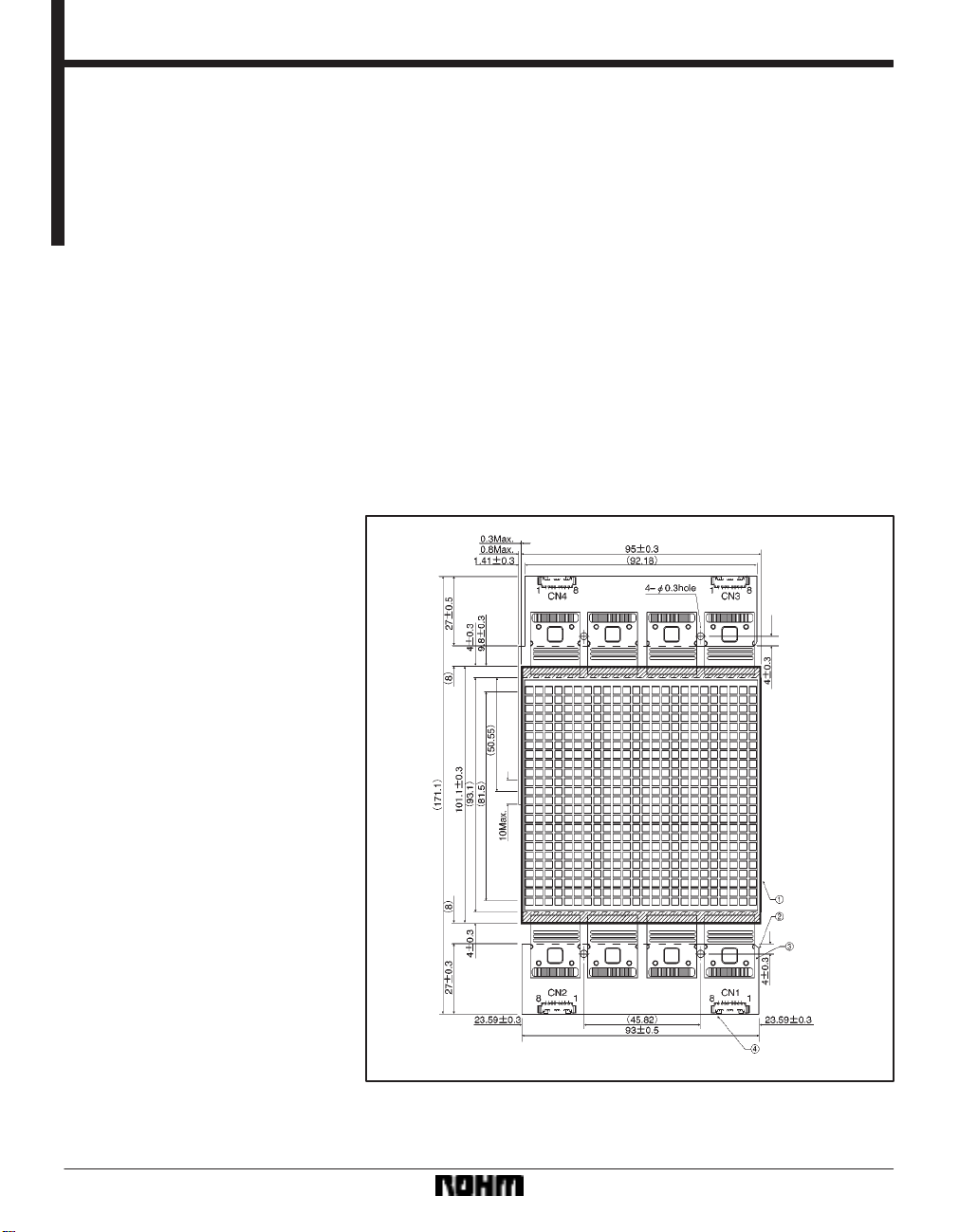
External dimensions (Unit: mm)
141
Page 2
Liquid crystal displays RCM1381U-A
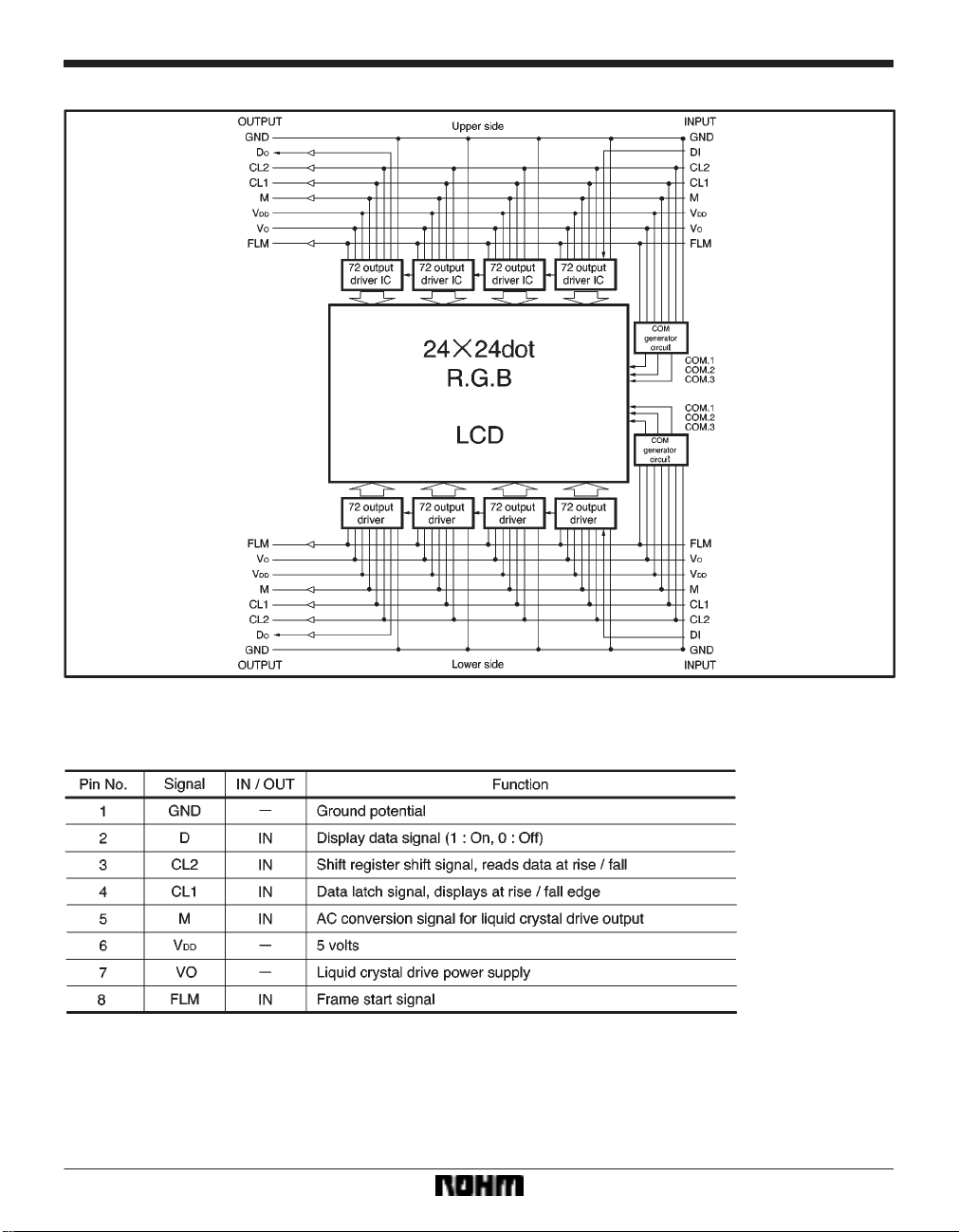
Block diagram
Pin functions
(1) Upper board
Input (CN3)
142
Page 3
Liquid crystal displays RCM1381U-A
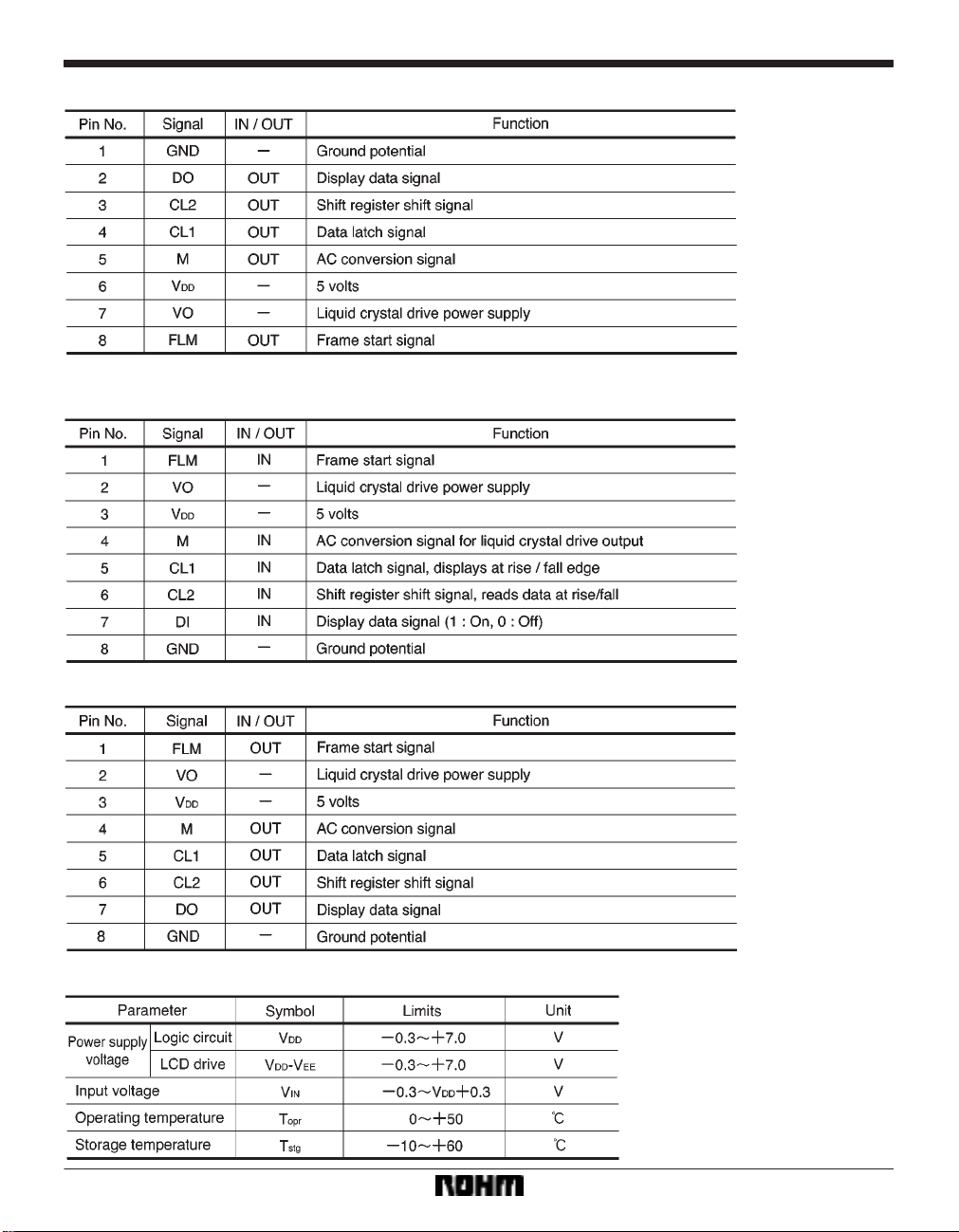
Output (CN4)
(2) Lower board
Input (CN1)
Output (CN2)
FAbsolute maximum ratings (Ta=25_C)
143
Page 4
Liquid crystal displays RCM1381U-A
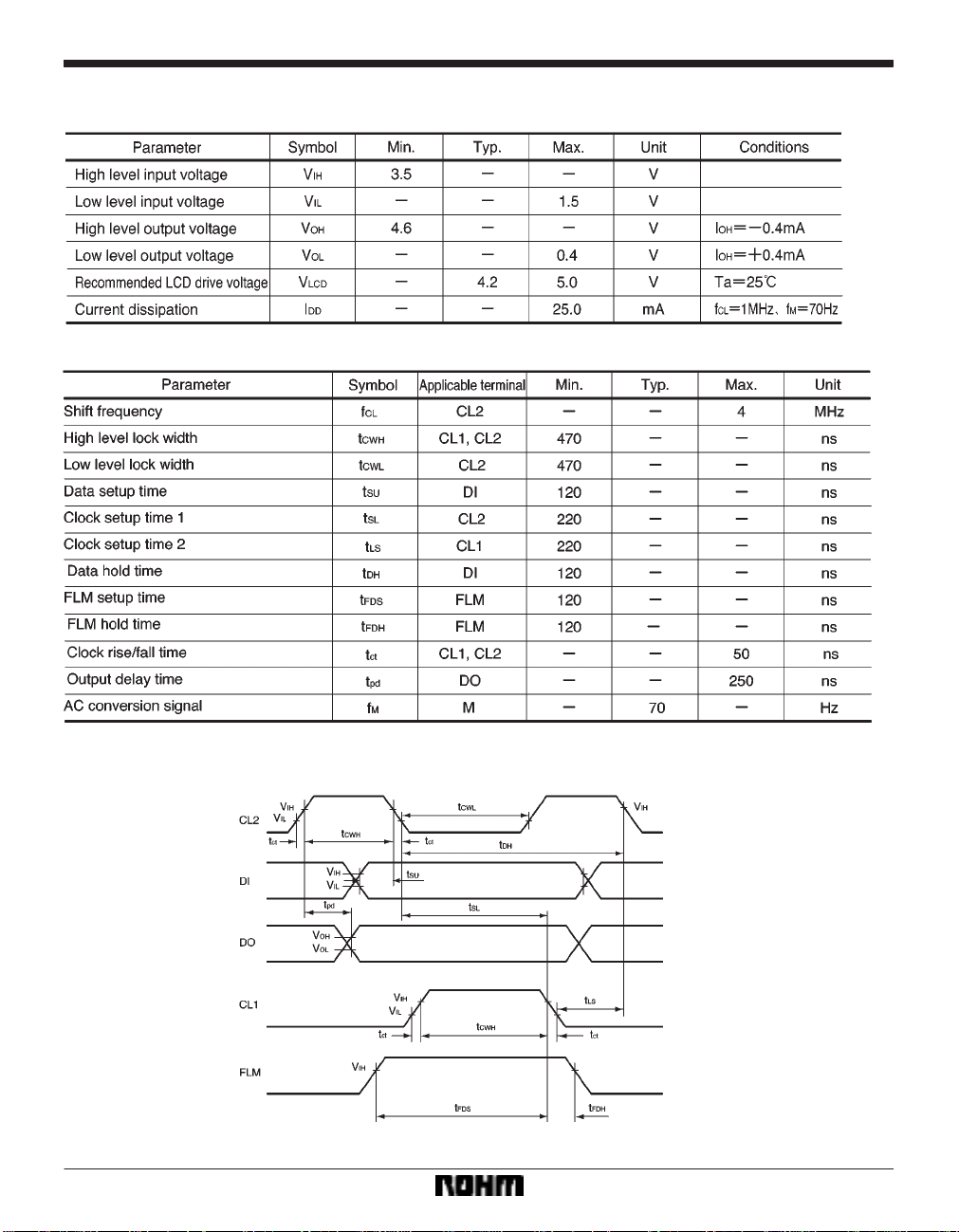
FElectrical characteristics
FDC characteristics (V
DD=5.0V±10%, VDD-VEE=3.0 to 6.0V, GND=0V, Ta=25_C)
FAC characteristics (V
FTiming characteristics
DD=5.0V±10%, VDD-VEE=3.0 to 6.0V, GND=0V, Ta=25_C)
144
Page 5
Liquid crystal displays RCM1381U-A
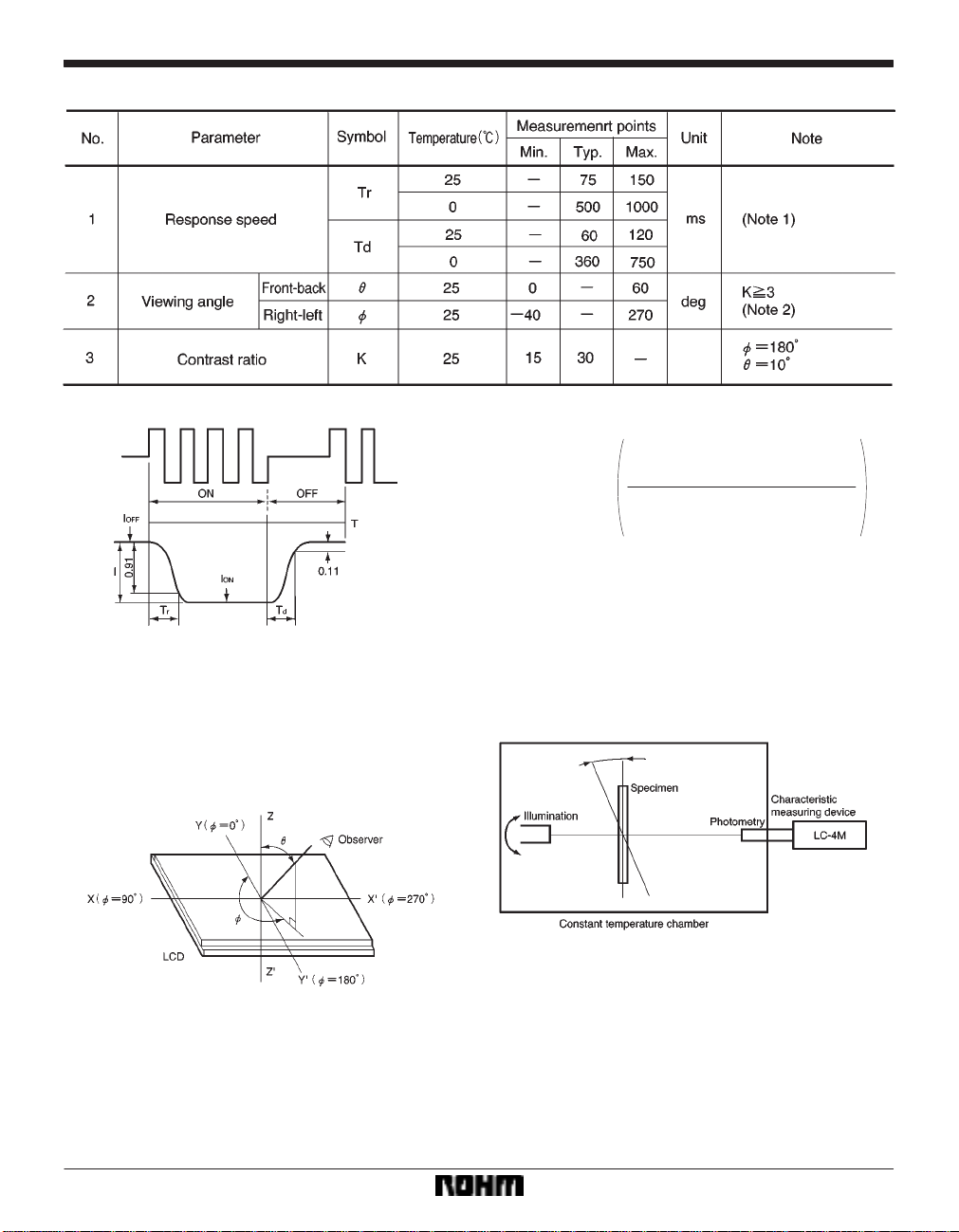
FOptical characteristics (Ta=25_C)
(Note 1) Definition of response speed
Tr : T ime for segment to darken 90% after selective wa-
veform switches to non-selective waveform.
φ = 180_, θ = 10_
Td: Time for segment to darken 90% after selective wa-
veform switches to non-selective waveform.
φ = 180_, θ = 10_
(Note 2) Definition of viewing angle (φ, θ)
(Note 3) Definition of contrast ratio
< Definition >
Luminance during application
Contrast ratio =
Except, n = 1 with positive display and n = *1 with negative display.
< Measurement conditions >
Drive conditions : As per specifications
Viewing angle : φ = 180_
(Note 4) Principles of optical measuring equipment
of non-selective waveform
Luminance during application
of selective waveform
: θ = 10_
n
(1) φ : Angle subtended by the Y-Y’-axis and the ob-
server’s position projected onto the XY-plane.
(2) θ : Angle subtended by observer and the normal
Z-Z’-axis (X-axis and Y-axis are positive)
(3) Maximum viewing angle: The direction with highest
contrast expressed at the time axis (refer to above
table).
145
Page 6
Liquid crystal displays RCM1381U-A
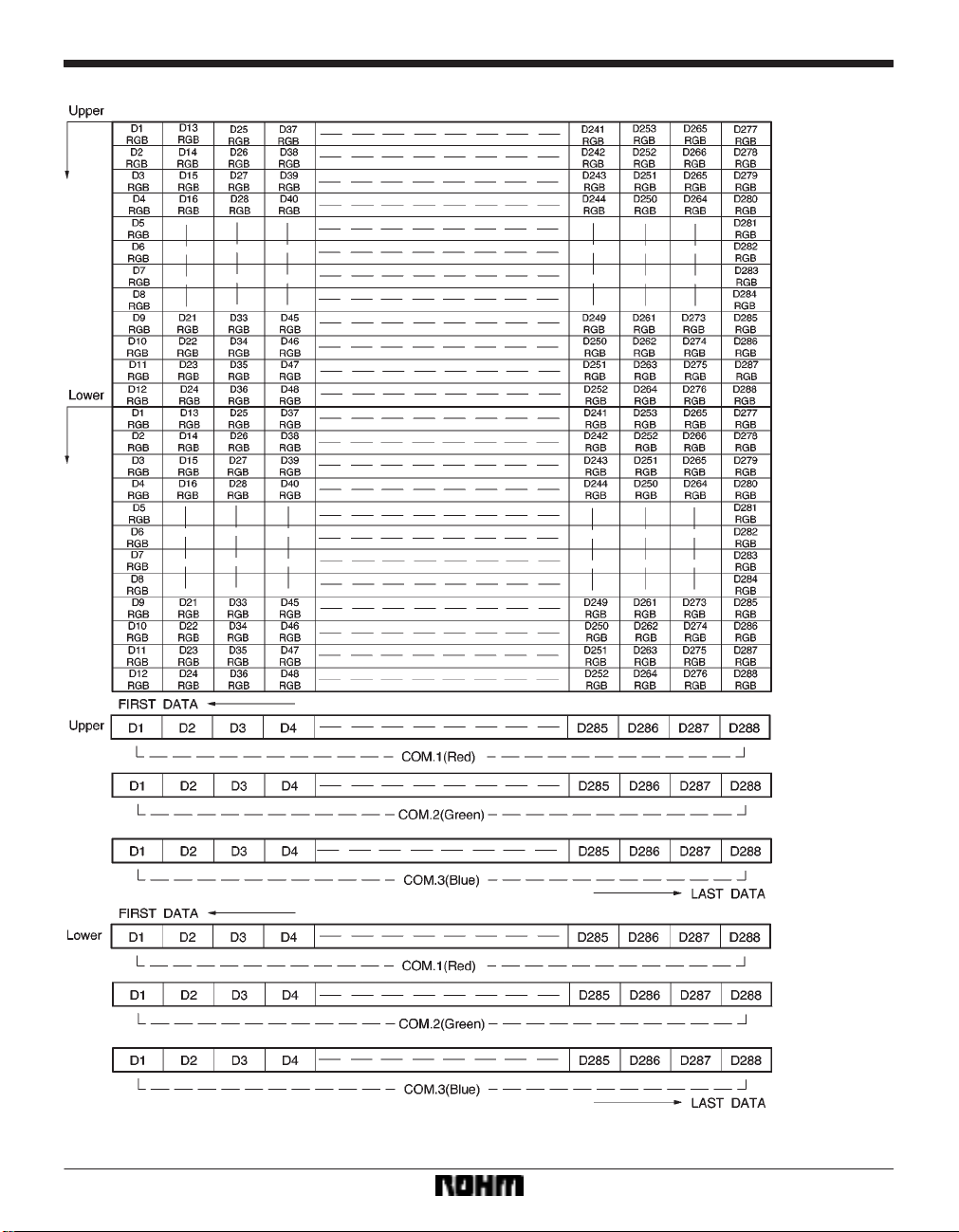
Data format
146
Page 7
Liquid crystal displays RCM1381U-A
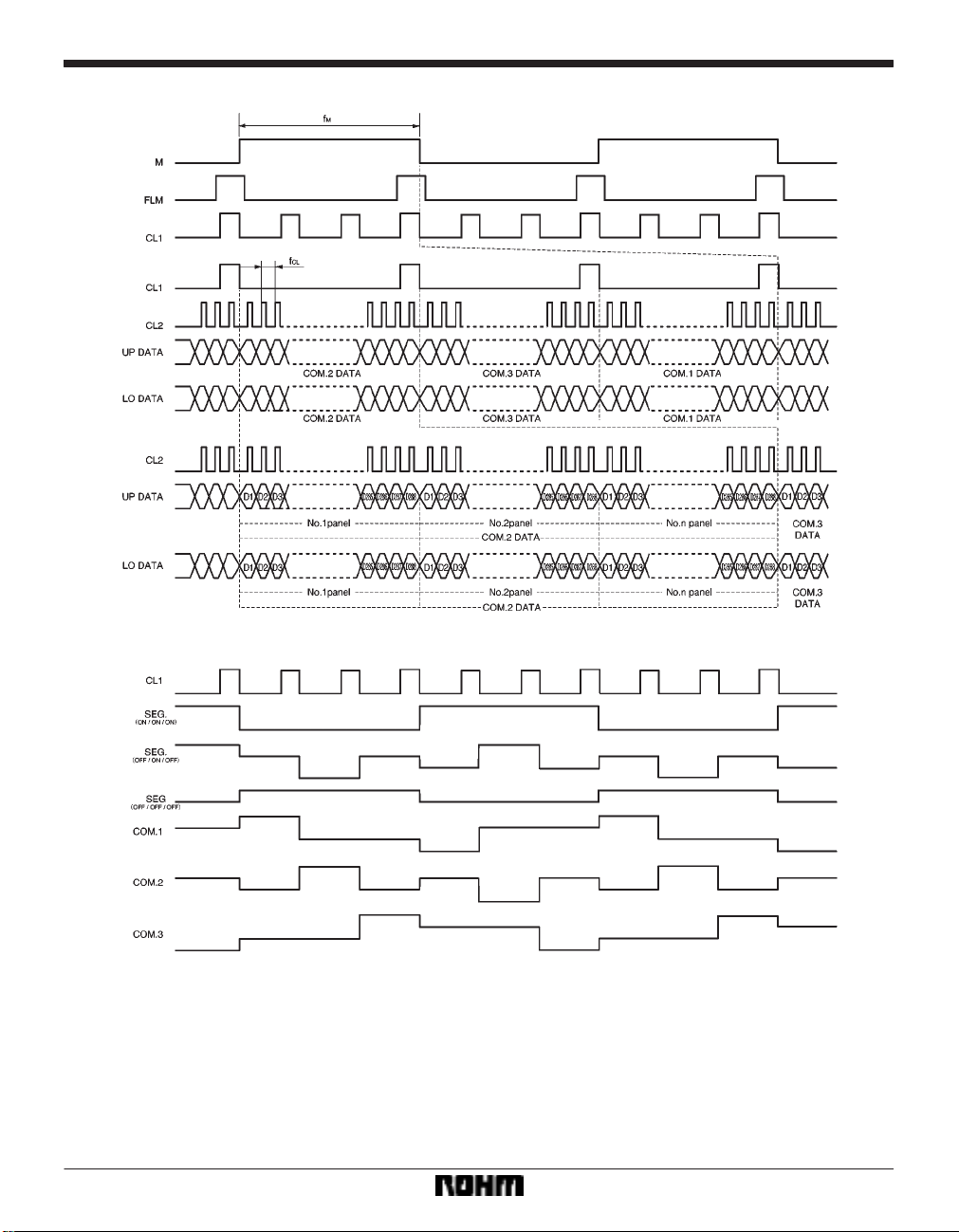
Timing chart
147
Page 8

Liquid crystal displays RCM1381U-A
FPrecautions during use
(1) Handling precautions
S Protect the module from strong shocks as they can
cause damage or defective operation.
S The polarizing plate on the surface of the module is
soft and can easily be scratched. Wipe away dirt and
dust using an alcohol-based cleanser.
S If the liquid crystal panel is damaged and liquid crystal
contacts your clothing or body, wash immediately with
soap and water.
S Do not touch the IC lead electrodes or the electrode
terminal components.
S If the module is to be used for long periods subjected
to direct sunlight, employ a filter to block the ultraviolet
rays.
(2) Precautions during operation
S Do not connect or disconnect the module while the
power supply is turned on.
S Input the input signal after the module power supply is
turned on. When turning it off, turn off the input signal
first. Otherwise the IC may be damaged by the latchup phenomenon.
(3) Precautions during installation
S Be careful to avoid damage from static electricity. A
CMOS-IC is used in the module circuitry that can be
easily damaged by static electricity .
S A protective film is pasted over the front and back of
the module to protect the panel surfaces. When peeling this film off, be sure to peel as slow as possible in
order to minimize the generation of static electricity.
Use of an ion blower or other deionizing device is recommended.
148
 Loading...