

Page 1
DATA SHEET
PHOTOCOUPLER
PS2707-1,PS2707-2,PS2707-4
AC INPUT RESPONSE
HIGH COLLECTOR TO EMITTER VOLTAGE TYPE
SOP MULTI PHOTOCOUPLER SERIES
DESCRIPTION
The PS2707-1, PS2707-2, PS2707-4 are optically coupled isolators containing GaAs light emitting diodes and an
NPN silicon phototransistor.
Each is mounted in a plastic SOP (Small Outline Package) for high density applications.
This package has shield effect to cut off ambient light.
FEATURES
• AC input response
• High collector to emitter voltage (V
• High isolation voltage (BV = 3 750 Vr.m.s.)
• Small and thin (SOP) package
• High-speed switching (tr, tf = 10 µs TYP.)
• Ordering number of taping product (1-ch only): PS2707-1-E3, E4, F3, F4
• UL approved: File No. E72422 (S)
• VDE0884 approved (Option)
CEO
= 120 V)
−NEPOCTM Series−
APPLICATIONS
•Hybrid IC
• Telephone/FAX
• FA/OA equipment
• Programmable logic controllers
ORDERING INFORMATION
Part Number Package Safety Standard Approval
PS2707-1 4-pin SOP Standard specificat i on products
PS2707-2 8-pin SOP • UL approved
PS2707-4 16-pin SOP
PS2707-1-V 4-pin SOP VDE0884 specificat i on produc ts (Option)
PS2707-2-V 8-pin SOP
PS2707-4-V 16-pin SOP
The information in this document is subject to change without notice. Before using this document, please
confirm that this is the latest version.
Not all devices/types available in every country. Please check with local NEC representative for
availability and additional information.
Document No. P11311EJ5V0DS00 (5th edition)
Date Published February 1999 NS CP(K)
Printed in Japan
The mark
••••
shows major revised points.
©
1988, 1999
Page 2
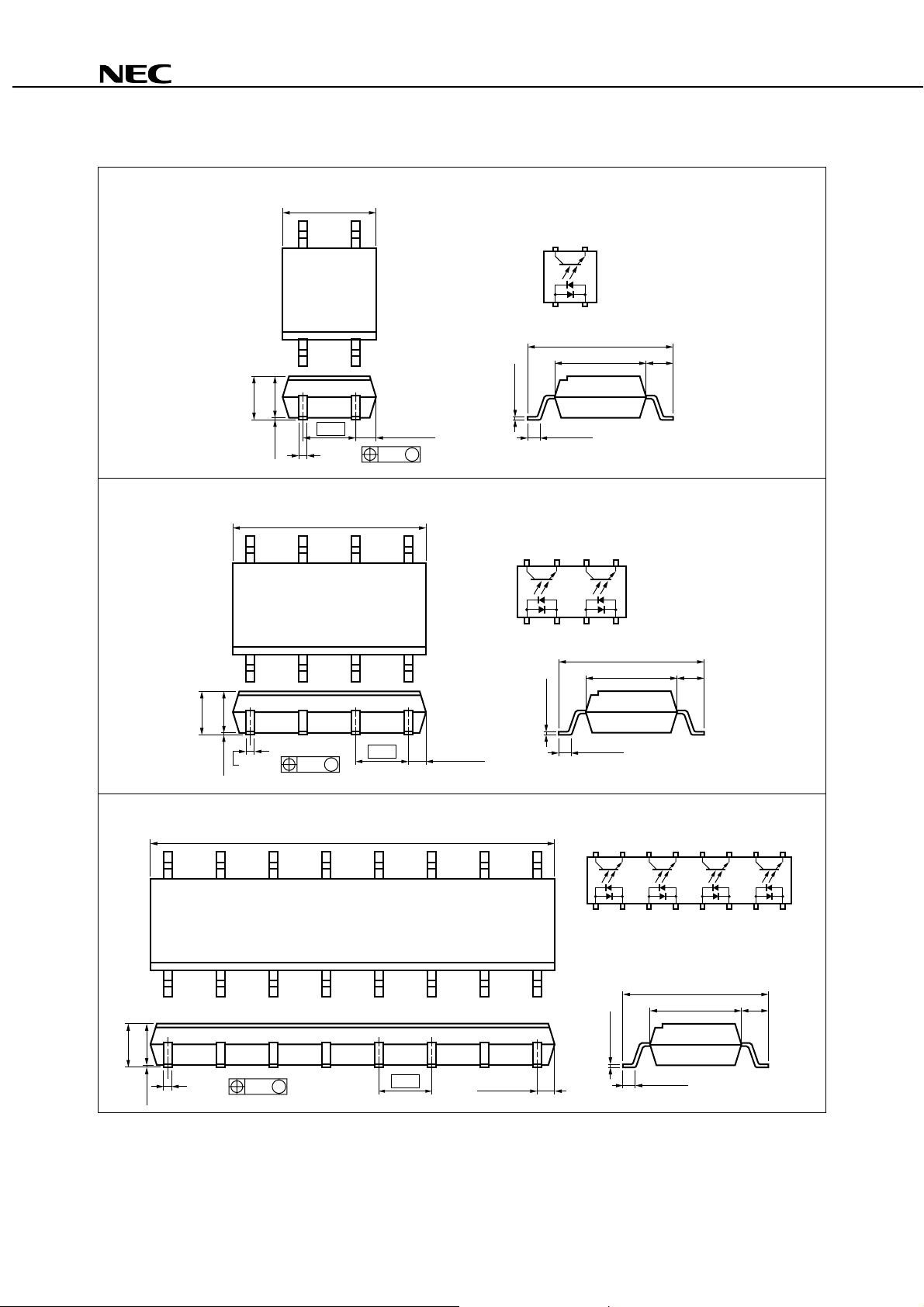
PACKAGE DIMENSIONS (in millimeters)
PS2707-1,PS2707-2,PS2707-4
2.0
2.3 MAX.
0.1±0.1
2.0
2.3 MAX.
0.1±0.1
+0.10
0.4
–0.05
4.5 MAX.
2.54
0.4
9.3 MAX.
0.25 M
+0.10
–0.05
1.2 MAX.
0.25 M
2.54
PS2707-1
PS2707-2
1.2 MAX.
TOP VIEW
43
12
7.0±0.3
4.4
+0.10
–0.05
0.15
0.5±0.3
TOP VIEW
8765
1234
+0.10
–0.05
0.15
0.5±0.3
1. Anode, Cathode
2. Cathode, Anode
3. Emitter
4. Collector
1.3
1. 3. Anode, Cathode
2. 4. Cathode, Anode
5. 7. Emitter
6. 8. Collector
7.0±0.3
4.4
1.3
2
2.0
2.3 MAX.
0.1±0.1
0.4
+0.10
–0.05
0.25 M
19.46 MAX.
PS2707-4
2.54
Data Sheet P11311EJ5V0DS00
1.2 MAX.
TOP VIEW
16 15 14 13 12 11 10 9
2345678
1
1. 3. 5. 7. Anode, Cathode
2. 4. 6. 8. Cathode, Anode
9. 11. 13. 15. Emitter
10. 12. 14. 16. Collector
7.0±0.3
1.3
+0.10
–0.05
0.15
4.4
0.5±0.3
Page 3
PS2707-1,PS2707-2,PS2707-4
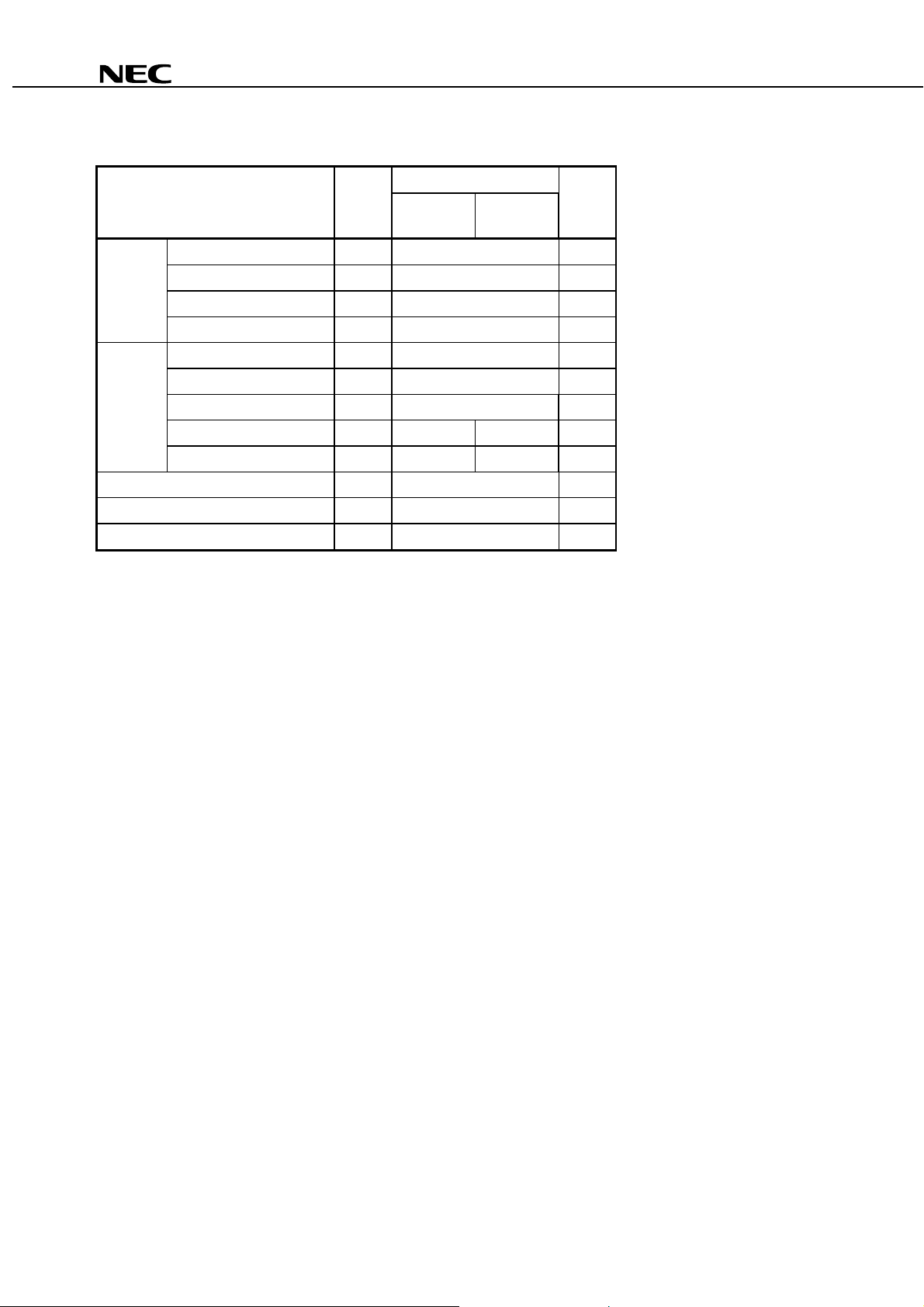
ABSOLUTE MAXIMUM RATINGS (TA = 25 °°°°C, unless otherwise specified)
Ratings
Parameter Symbol PS2707-1 PS2707-2,
PS2707-4
Unit
Diode Forward Current (DC) I
F
±
50 mA
Power Dissipation Derati ng∆PD/°C0.8mW/
I
D
FP
CEO
ECO
C
80 mW/ch
±
1A
120 V
6V
30 mA/ch
Power Dissipation P
Peak Forward Current
*1
Transistor Collector to Emitter Voltage V
Emitter to Collector Voltage V
Collector Current I
Power Dissipation Derati ng∆PC/°C 1.5 1.2 mW/°C
Power Dissipation P
Isolation Voltage
*2
Operating Ambient Temperature T
Storage Temperature T
PW = 100
*1
AC voltage for 1 minute at TA = 25 °C, RH = 60 % between input and output
*2
µ
s, Duty Cycle = 1 %
C
150 120 mW/ch
BV 3 750 V r. m .s.
A
stg
–55 to +100
–55 to +150
°
C
°
C
°
C
Data Sheet P11311EJ5V0DS00
3
Page 4
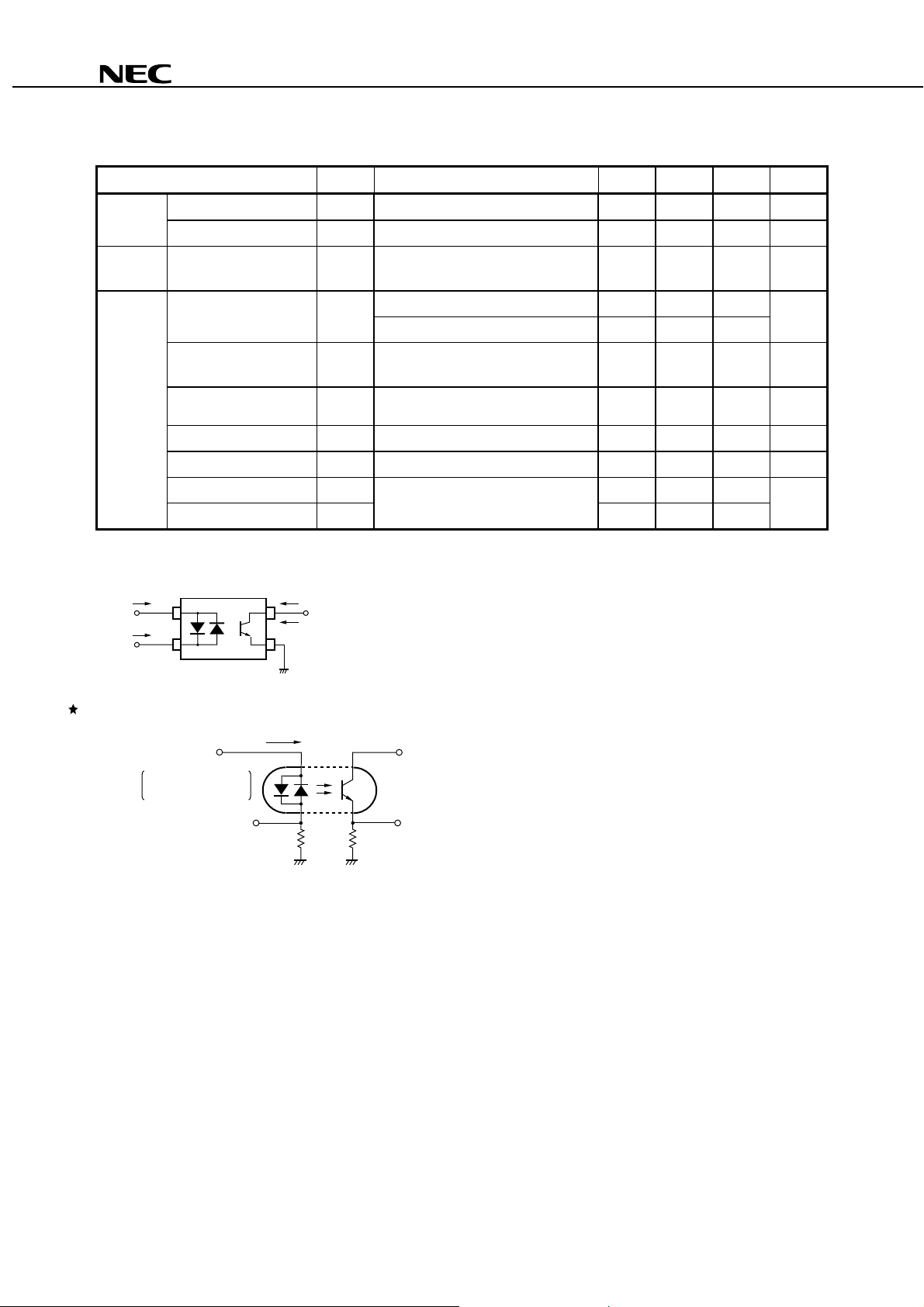
ELECTRICAL CHARACTERISTICS (TA = 25 °°°°C)
Parameter Symbol Conditions MIN. TYP. MAX. Unit
PS2707-1,PS2707-2,PS2707-4
Diode Forward Voltage V
Terminal Capacitance C
Transistor Collector to Emitter
Current
Coupled CTR IF = ± 5 mA, VCE = 5 V 50 150 400 %Current Transfer Ratio
C/IF
(I
)
CTR Ratio
*1
CTR1/
CTR2
Collector Satura tio n
V
Voltage
Isolation Resistance R
Isolation Capacitance C
*2
*2
C1/IF1
, CTR2 = IC2/I
F2
I
C1
V
CE
I
C2
CTR1 = I
*1
I
F1
I
F2
Rise Time
Fall Time
F
IF = ± 5 mA 1.1 1.4 V
t
V = 0 V, f = 1 MHz 60 pF
CEOIF
I
= 0 mA, VCE = 120 V 100 nA
F
= ± 1 mA, VCE = 5 V 10 80
I
IF = ± 5 mA, VCE = 5 V 0.3 1.0 3.0
CE (sat)IF
t
t
= ± 10 mA, IC = 2 mA 0.3 V
I-O
I-O
V
I-O
V = 0 V, f = 1 MHz 0.4 pF
r
VCC = 5 V, IC = 2 mA, RL = 1 k
f
= 1 kV
DC
Ω
10
11
10
10
Ω
µ
s
Test circuit for switching time
*2
I
Pulse Input
PW = 100 s
µ
F
Duty Cycle = 1/10
Input monitor
50 Ω
RL = 1 kΩ
V
CC
V
OUT
4
Data Sheet P11311EJ5V0DS00
Page 5

PS2707-1,PS2707-2,PS2707-4
TYPICAL CHARACTERISTICS (TA = 25 °C, unless otherwise specified)
DIODE POWER DISSIPATION vs.
AMBIENT TEMPERATURE
100
(mW)
D
75
50
25
Diode Power Dissipation P
0
25 50 75 100
Ambient Temperature T
FORWARD CURRENT vs.
FORWARD VOLTAGE
100
TA = +100 ˚C
10
(mA)
F
+75 ˚C
+50 ˚C
A
(˚C)
TRANSISTOR POWER DISSIPATION vs.
AMBIENT TEMPERATURE
200
(mW)
C
150
PS2707-1
1.5 mW/˚C
100
PS2707-2,
PS2707-4
50
Transistor Power Dissipation P
0
1.2 mW/˚C
25 50 75 100
A
Ambient Temperature T
(˚C)
FORWARD CURRENT vs.
FORWARD VOLTAGE
80
60
40
(mA)
F
20
1
+25 ˚C
0 ˚C
–25 ˚C
0.1
Forward Current I
0.01
0.6 1.0 1.4 1.60.8 1.2
Forward Voltage V
–55 ˚C
F
(V)
COLLECTOR TO EMITTER DARK
CURRENT vs. AMBIENT TEMPERATURE
50 000
(nA)
10 000
CEO
5 000
1 000
500
100
50
10
5
1
0.5
0.1
Collector to Emitter Dark Current I
–60 0 40 80–40 –20 20 60 100
Ambient Temperature T
VCE = 40 V
24 V
10 V
A
(˚C)
0
–20
–40
Forward Current I
–60
–80
–1.2 0 0.4 1.2 1.6–1.6 –0.8 –0.4 0.8
Forward Voltage VF (V)
COLLECTOR CURRENT vs.
COLLECTOR SATURATION VOLTAGE
10
IF = 25 mA
5
(mA)
C
1
0.5
Collector Current I
0.1
0.2 0.6 1.00.0 0.4
Collector Saturation Voltage V
0.8
CE (sat)
10 mA
5 mA
2.5 mA
2 mA
1.5 mA
1 mA
0.5 mA
(V)
Data Sheet P11311EJ5V0DS00
5
Page 6

PS2707-1,PS2707-2,PS2707-4
COLLECTOR CURRENT vs.
COLLECTOR TO EMITTER VOLTAGE
10
8
= 10 mA
F
(mA)
C
I
6
4
2
Collector Current I
0
61024 8
Collector to Emitter Voltage V
CURRENT TRANSFER RATIO vs.
FORWARD CURRENT
300
250
200
150
5 mA
4 mA
3 mA
2 mA
1 mA
0.5 mA
CE
(V)
VCE = 5 V
NORMALIZED CURRENT TRANSFER
RATIO vs. AMBIENT TEMPERATURE
1.2
1.0
0.8
0.6
0.4
0.2
Normalized Current Transfer Ratio CTR
0.0
–50
–25
0
Ambient Temperature T
Normalized to 1.0
A
= 25 ˚C,
at T
F
= 5 mA, VCE = 5 V
I
25
50
A
(˚C)
SWITCHING TIME vs.
LOAD RESISTANCE
100
VCC = 5V,
I
C
= 2 mA
µ
10
75
100
t
f
t
r
t
d
t
s
100
50
Current Transfer Ratio CTR (%)
0
0.1 0.5 5
110
Forward Current I
SWITCHING TIME vs.
LOAD RESISTANCE
1 000
IF = 5 mA, VCC = 5 V,
CTR = 90 %
100
µ
10
1
Switching Time t ( s)
0.1
1 10 100
Load Resistance R
F
(mA)
L
(kΩ)
1
Switching Time t ( s)
50
0.1
10 1 k
100
Load Resistance R
L
(Ω)
10 k
FREQUENCY RESPONSE
1.2
t
f
t
s
t
r
t
d
1.0
V
0.8
0.6
0.4
Normalized Gain G
0.2
0.0
1100.5 50 1005
RL = 1 kΩ
510 Ω
300 Ω
100 Ω
500
Frequency f (kHz)
6
Data Sheet P11311EJ5V0DS00
Page 7

LONG TERM CTR DEGRADATION
1.2
1.0
PS2707-1,PS2707-2,PS2707-4
0.8
0.6
IF = 1 mA, TA = 25 ˚C
F
= 5 mA, TA = 25 ˚C
I
I
F
= 20 mA, TA = 25 ˚C
F
= 20 mA, TA = 60 ˚C
I
0.4
CTR (Relative Value)
0.2
0.0
110
10
2
10
3
4
10
5
Time (Hr)
Remark
The graphs indicate nominal characteristics.
Data Sheet P11311EJ5V0DS00
7
Page 8

TAPING SPECIFICATIONS (in millimeters)
Outline and Dimensions (Tape)
2.0±0.1
4.0±0.1
1.55±0.1
PS2707-1,PS2707-2,PS2707-4
1.75±0.1
2.4±0.1
1.55±0.1
8.0±0.1
Tape Direction
PS2707-1-E3
PS2707-1-F3
Outline and Dimensions (Reel)
4.6±0.1
1
2
0
5.5±0.1
˚
12.0±0.2
PS2707-1-E4
PS2707-1-F4
0.3
7.4±0.1
1.5±0.1
1.5±0.1
21.0±0.8
φ
2.0±0.5
1.5±0.5
6
0
˚
6.0±1
Packing: PS2707-1-E3, E4 900 pcs/reel
φ
φ
66
φ
13.0±0.5
φ
PS2707-1-E3, E4: 178
PS2707-1-F3, F4: 330
12.4
18.4 MAX.
+2.0
–0.0
PS2707-1-F3, F4 3 500 pcs/reel
8
Data Sheet P11311EJ5V0DS00
Page 9

PS2707-1,PS2707-2,PS2707-4
RECOMMENDED SOLDERING CONDITIONS
(1) Infrared reflow soldering
• Peak reflow temperature 235 °C (package surface temperature)
• Time of temperature higher than 210 °C 30 seconds or less
• Number of reflows Three
• Flux Rosin flux containing small amount of chlorine (The flux with a
maximum chlorine content of 0.2 Wt % is recommended.)
Recommended Temperature Profile of Infrared Reflow
(heating)
to 10 s
235 ˚C (peak temperature)
210 ˚C
to 30 s
120 to 160 ˚C
60 to 90 s
(preheating)
Package Surface Temperature T (˚C)
Time (s)
Peak temperature 235 ˚C or below
(2) Dip soldering
• Temperature 260 °C or below (molten solder temperature)
• Time 10 seconds or less
• Number of times One
• Flux Rosin flux containing small amount of chlorine (The flux with a maximum chlorine content of
0.2 Wt % is recommended.)
(3) Cautions
•Fluxes
Avoid removing the residual flux with freon-based and chlorine-based cleaning solvent.
Data Sheet P11311EJ5V0DS00
9
Page 10

PS2707-1,PS2707-2,PS2707-4
SPECIFICATION OF VDE MARKS LICENSE DOCUMENT (VDE0884)
Parameter Symbol Speck Unit
Application class i fication (DIN VDE 0109)
for rated line voltages ≤ 300 Vr.m.s.
for rated line voltages ≤ 600 Vr.m.s.
Climatic test c l ass (DIN IEC 68 Teil 1/09.80) 55/100/21
Dielectric strength
IORM
maximum operating isolat i on voltage
Test voltage (partial dis charge test, procedure a for ty pe test and random test)
pr
= 1.2 × U
U
IORM
, Pd < 5 pC
Test voltage (partial dis charge test, procedure b for random test)
pr
= 1.6 × U
U
IORM
, Pd < 5 pC
Highest permissible ov ervoltage U
U
pr
U
pr
U
TR
Degree of pollution (DIN VDE 0109) 2
Clearance distance
Creepage distance
Comparative tracking index (DIN IEC 112/VDE 0303 part 1) CTI 175
Material group (DIN VDE 0109) III a
Storage temperature range T
Operating temperature range T
stg
A
Isolation resistance, minimum value
IO
= 500 V dc at TA = 25 °C
V
IO
= 500 V dc at TA MAX. at least 100 °C
V
Ris MIN.
Ris MIN.
Safety maximum rat i ngs (maximum permissi bl e i n c ase of fault, see thermal
derating curve)
Package temperature
F
Current (input current I
, Psi = 0)
Power (output or total power diss i pat i on)
Tsi
Isi
Psi
Isolation resistance
IO
= 500 V dc at TA = 175 °C (Tsi)
V
Ris MIN.
IV
III
710
850
1 140 V
6 000 V
>
5mm
>
5mm
−
55 to +150 °C
–55 to +100
10
10
150
200
300
10
peak
V
peak
V
peak
peak
°
C
12
11
Ω
Ω
°
C
mA
mW
9
Ω
10
Data Sheet P11311EJ5V0DS00
Page 11

[MEMO]
PS2707-1,PS2707-2,PS2707-4
Data Sheet P11311EJ5V0DS00
11
Page 12

PS2707-1,PS2707-2,PS2707-4
CAUTION
Within this device there exists GaAs (Gallium Arsenide) material which is a
harmful substance if ingested. Please do not under any circumstances break the
hermetic seal.
NEPOC is a trademark of NEC Corporation.
• The information in this document is subject to change without notice. Before using this document, please
confirm that this is the latest version.
• No part of this document may be copied or reproduced in any form or by any means without the prior written
consent of NEC Corporation. NEC Corporation assumes no responsibility for any errors which may appear in
this document.
• NEC Corporation does not assume any liability for infringement of patents, copyrights or other intellectual property
rights of third parties by or arising from use of a device described herein or any other liability arising from use
of such device. No license, either express, implied or otherwise, is granted under any patents, copyrights or other
intellectual property rights of NEC Corporation or others.
• Descriptions of circuits, software, and other related information in this document are provided for illustrative
purposes in semiconductor product operation and application examples. The incorporation of these circuits,
software, and information in the design of the customer's equipment shall be done under the full responsibility
of the customer. NEC Corporation assumes no responsibility for any losses incurred by the customer or third
parties arising from the use of these circuits, software, and information.
• While NEC Corporation has been making continuous effort to enhance the reliability of its semiconductor devices,
the possibility of defects cannot be eliminated entirely. To minimize risks of damage or injury to persons or
property arising from a defect in an NEC semiconductor device, customers must incorporate sufficient safety
measures in its design, such as redundancy, fire-containment, and anti-failure features.
• NEC devices are classified into the following three quality grades:
"Standard", "Special", and "Specific". The Specific quality grade applies only to devices developed based on a
customer designated "quality assurance program" for a specific application. The recommended applications of
a device depend on its quality grade, as indicated below. Customers must check the quality grade of each device
before using it in a particular application.
Standard: Computers, office equipment, communications equipment, test and measurement equipment,
audio and visual equipment, home electronic appliances, machine tools, personal electronic
equipment and industrial robots
Special: Transportation equipment (automobiles, trains, ships, etc.), traffic control systems, anti-disaster
systems, anti-crime systems, safety equipment and medical equipment (not specifically designed
for life support)
Specific: Aircraft, aerospace equipment, submersible repeaters, nuclear reactor control systems, life
support systems or medical equipment for life support, etc.
The quality grade of NEC devices is "Standard" unless otherwise specified in NEC's Data Sheets or Data Books.
If customers intend to use NEC devices for applications other than those specified for Standard quality grade,
they should contact an NEC sales representative in advance.
M7 98. 8
 Loading...