

Page 1
PC364
PC364
■ Features
1. Low input current type (IF=±0.5mA)
2. AC input type
3. High resistance to noise due to high common mode rejection
voltage (CMR:MIN. 10kV/µs)
4. Mini-flat package
5. Isolation voltage (Viso:3 750Vrms)
6. Recognized by UL, file No. 64380
■ Applications
1. Programmable controllers
2. Facsimiles
3. Telephones
■ Rank Table
Model No. Rank mark Ic (mA) Conditions
PC364N
PC364N1
A or no mark
A
0.25 to 2.0
0.5 to 1.5
■ Absolute Maximum Ratings
Parameter Symbol Rating Unit
Forward current
*1
Input
Peak forward current
Power dissipation
Collector-emitter voltage
Output
Emitter-collector voltage
Collector current
Collector power dissipation
Total power dissipation
Operating temperature
Storage temperature
*2
Isolation voltage
*3
Soldering temperature
*1 Pulse width<=100µs, Duty ratio=0.001
*2 40 to 60%RH, AC for 1 minute, f=60Hz
*3 For 10s
IF
IFM
P 15
VCEO
ECO
V
IC
PC
tot
P
−30 to +100
Topr
−40 to +125
T
stg
Viso kVrms
Tsol
±10
±200
70
6
50
150
170
3.75
260
IF=±0.5mA
V
CE=5V
T
a=25°C
(Ta=25°C)
mA
mA
mW
V
V
mA
mW
mW
°C
°C
°C
AC Input, Low Input Current
Type Photocoupler
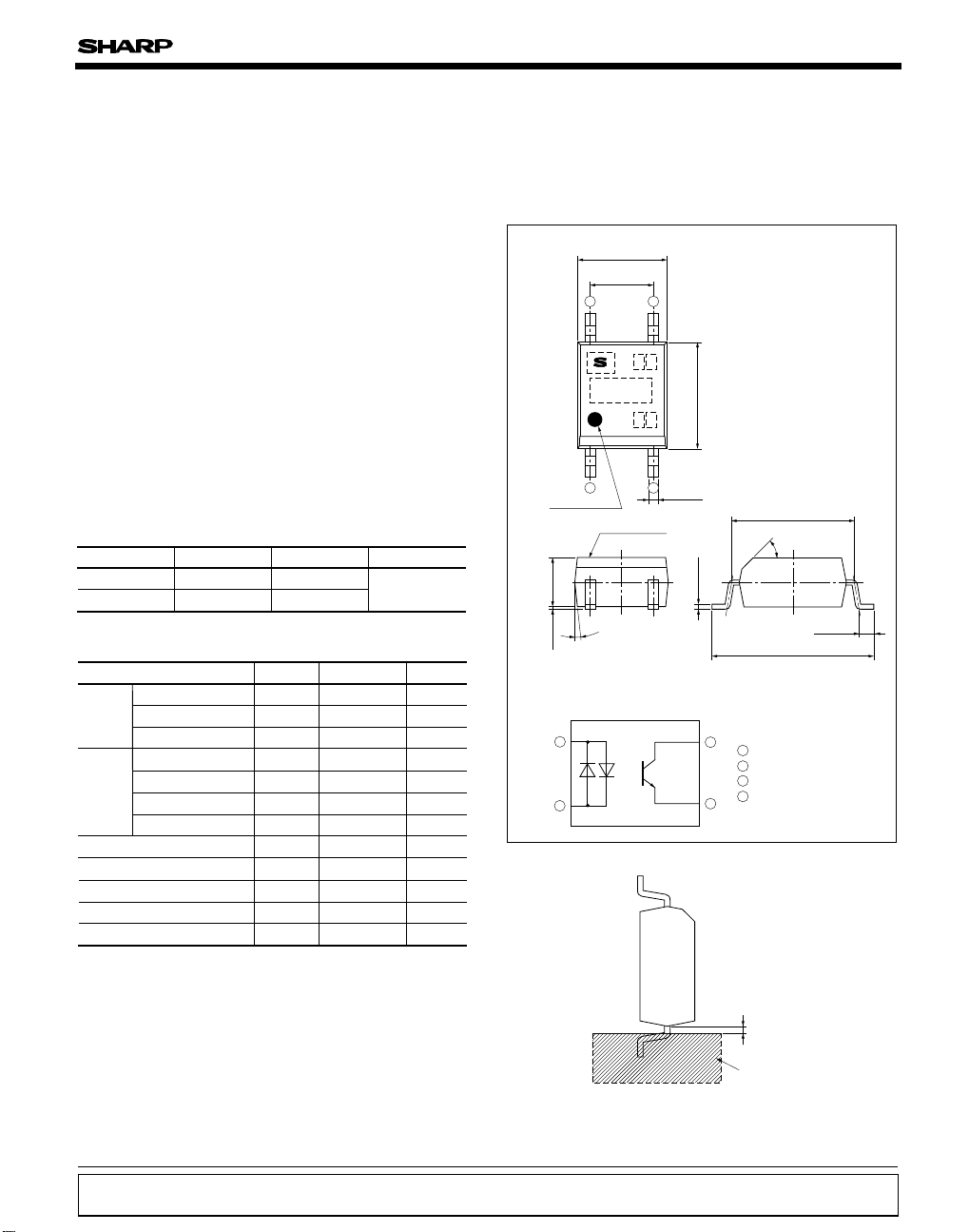
■ Outline Dimensions
±0.3
3.6
±0.25
2.54
4 3
1 2
Anode mark
±0.2
2.6
±0.1
6°
0.1
1
2
3 6 4
Epoxy resin
Internal connection diagram
0.4
±0.2
±0.1
±0.05
4.4
0.2
4
1
AnodeAnode (Cathode)
2
Cathode (Anode)
3
Emitter
4
Collector
3
5.3
45°
7.0
±0.3
+0.2
−0.7
0.5
(Unit : mm)
+0.4
−0.2
0.2mm or more
Soldering area
Notice In the absence of confirmation by device specification sheets, SHARP takes no responsibility for any defects that may occur in equipment using any SHARP
devices shown in catalogs, data books, etc. Contact SHARP in order to obtain the latest device specification sheets before using any SHARP device.
Internet Internet address for Electronic Components Group http://www.sharp.co.jp/ecg/
Page 2
PC364
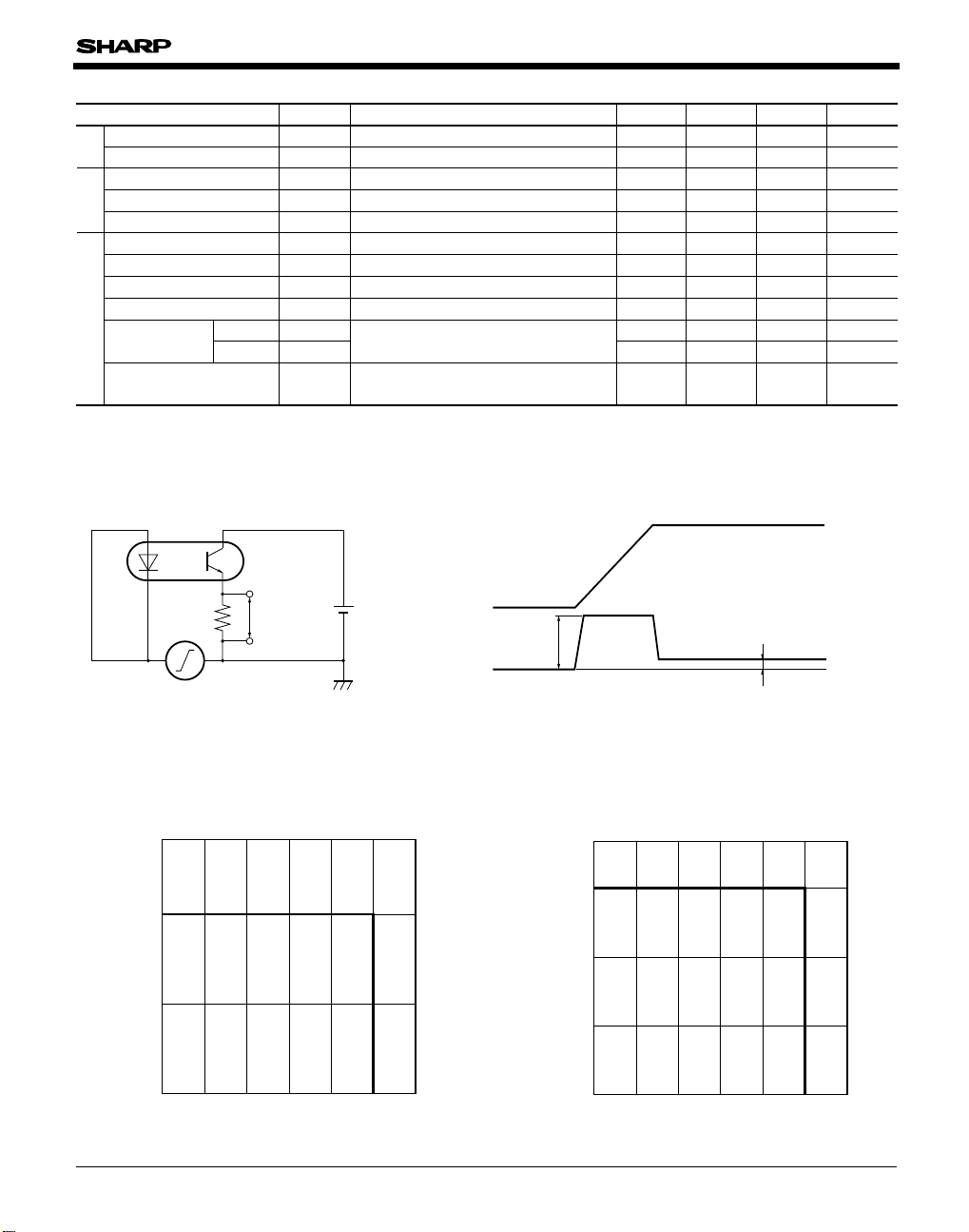
■ Electro-optical Characteristics
Parameter Symbol
Forward voltage
Terminal capacitance
InputOutputTransfer characteristics
Collector dark current
Collector-emitter breakdown voltage
Emitter-collector breakdown voltage
Collector current
Collector-emitter saturation voltage
Isolation resistance
Floating capacitance
Response time
*4
Common mode rejection voltage
*4 Refer to Fig.1
Rise time
Fall time
F
V
Ct
ICEO
BVCEO
BVECO
IC
VCE (sat)
RISO
Cf
tr
tf
CMR
Ta=25°C, R
I
F=0mA, VCC=9V, Vnp=100mV
Conditions
I
F=±10mA
V=0, f=1kHz
CE=50V, IF=0
V
I
C=0.1mA, IF=0
I
E=10µA, IF=0
I
F=±0.5mA, VCE=5V
I
F=±10mA, IC=1mA
DC500V 40 to 60%RH
V=0, f=1MHz
V
CE=2V, IC=2mA, RL=100Ω
L=470Ω, VCM=1.5kV (peak),
Fig.1 Test Circuit for Common Mode Rejection Voltage
V
CC
R
L
V
O
V
High wave
CM :
V
CM
pulse
=470Ω
R
L
=9V
V
CC
V
CM
1)
V
cp
V
O
(V
Nearly = dV/dt×Cf×RL)
cp
1) V
: Voltage which is generated by displacement current in floating
cp
capacitance between primary and secondary side.
(dV/dt)
MIN.
−
−
−
70
6
0.25
−
5×10
−
−
−
10
TYP. MAX. Unit
1.2
30
−
−
−
−
−
10
1×10
11
0.6
4
3
−
V
250
100
np
1.4
2.0
0.2
1.0
18
18
−
−
−
−
(Ta=25°C)
V
pF
nA
V
V
mA
V
Ω
pF
µs
µs
kV/µs
Fig.2 Forward Current vs. Ambient
Temperature
10
(mA)
F
5
Forward current I
0
−30 0 25 50 75 100 125
Ambient temperature Ta (°C)
Fig.3
Diode Power Dissipation vs. Ambient
Temperature
15
10
5
Diode power dissipation P (mW)
0
−30 0 25 50 75 100 125
Ambient temperature Ta (°C)
Page 3

Fig.4 Collector Power Dissipation vs.
Ambient Temperature
Fig.5
Total Power Dissipation vs. Ambient
Temperature
PC364
200
(mW)
C
150
100
50
Collector power dissipation P
0
−30 0 25 50 75 100 125
Ambient temperature Ta (°C)
200
(mW)
tot
170
150
100
50
Total power dissipation P
0
−30 0 25 50 75 100 125
Ambient temperature Ta (°C)
Fig.6 Peak Forward Current vs. Duty Ratio Fig.7 Forward Current vs. Forward Voltage
100
10
(mA)
F
Ta=100°C
Ta=75°C
1
Forward current I
0.1
Ta=50°C
0 0.5 1.0 1.5 2.0
Forward voltage V
Ta=25°C
Ta=0°C
Ta=−25°C
(V)
F
(mA)
FM
Peak forward current I
2000
1000
500
200
100
Pulse width <=100µs
=25°C
T
a
50
20
10
−3
10
−2
10
Duty ratio
−1
10
22 2555 5 1
Fig.8 Current Transfer Ratio vs. Forward
Current
500
400
300
200
Current transfer ratio CTR (%)
100
0
0.1 1 10
Forward current IF (mA)
VCE=5V
=25°C
T
a
Fig.9 Collector Current vs. Collector-emitter
Voltage
40
30
(mA)
C
20
Collector current I
10
0
0 2 4 6 8 10
IF=7mA
IF=5mA
Collector-emitter voltage VCE (V)
PC (MAX.)
IF=3mA
IF=2mA
IF=1mA
Ta=25°C
IF=0.5mA
Page 4

PC364
Fig.10 Relative Current Transfer Ratio vs.
Ambient Temperature
150
VCE=5V
=0.5mA
I
F
100
50
Relative current transfer ratio (%)
0
−30 1009080706050403020100−10−20
Ambient temperature Ta (°C)
Fig.12 Collector Dark Current vs. Ambient
Temperature
−5
10
VCE=50V
−6
10
(A)
−7
CEO
10
−8
10
−9
10
Collector dark current I
−10
10
−11
10
−30 1009080706050403020100−10−20
Ambient temperature Ta (°C)
Fig.14
Response Time vs. Load Resistance
(Saturation)
1000
Response time (µs)
=5V
V
CC
=16mA
I
T
F
=25°C
a
t
f
100
t
s
10
t
1
0.1
1 10 100
Load resistance R
d
t
r
(kΩ)
L
Fig.11 Collector - emitter Saturation Voltage
vs. Ambient Temperature
0.16
(V)
0.14
CE (sat)
0.12
0.10
0.08
0.06
0.04
0.02
Collector-emitter saturation voltage V
0
−30 1009080706050403020100−10−20
Ambient temperature Ta (°C)
IF=10mA
=1mA
I
C
Fig.13 Response Time vs. Load Resistance
1000
VCE=2V
=2mA
I
C
=25°C
T
a
100
t
f
t
d
10
t
t
r
s
Response time (µs)
1
0.1
0.1 1 10
Load resistance R
(kΩ)
L
Fig.15 Test Circuit for Response Time
V
CC
R
L
Output
Input
Output
10%
90%
t
t
d
t
r
s
t
f
Input
R
D
Page 5

PC364
Fig.16
Voltage Gain vs Frequency
5
0
−5
(dB)
V
−10
−15
Voltage gain A
−20
−25
RL=10kΩ
0.1 1 10 100 1000
Frequency f (kHz)
VCE=2V
=2mA
I
C
=25°C
T
a
1kΩ
100Ω
Fig.18 Reflow Soldering
Only one time soldering is recommended within the temperature
profile shown below.
230°C
200°C
180°C
Fig.17 Collector-emitter Saturation Voltage
vs. Forward Current
5
(V)
4
CE (sat)
3
2
1
Collector-emitter saturation voltage V
0
0 2 4 6 8 10
IC=7mA
IC=5mA
IC=3mA
IC=2mA
IC=1mA
IC=0.5mA
Forward current IF (mA)
Ta=25°C
25°C
30 seconds
2 minutes
1 minute
1.5 minutes
1 minute
 Loading...