

Datasheet NM24W04EM8X, NM24W04LEM8, NM24W04LEM8X, NM24W04LMT8, NM24W04N Datasheet (Fairchild Semiconductor)
...Page 1
1
www.fairchildsemi.com
NM24Wxx Rev. C.2
NM24Wxx 2K/4K/8K/16K-Bit Standard 2-Wire Bus Interface
Serial EEPROM with Full Array Write Protect
PRELIMINARY
March 1999
© 1999 Fairchild Semiconductor Corporation
NM24Wxx
2K/4K/8K/16K-Bit Standard 2-Wire Bus Interface
Serial EEPROM with Full Array Write Protect
General Description
The NM24Wxx devices are 2048/4096/8192/16,384 bits, respectively, of CMOS non-volatile electrically erasable memory. These
devices conform to all specifications in the IIC 2-wire protocol and
are designed to minimize device pin count, and simplify PC board
layout requirements.
The entire ememory can be disabled (Write Protected) by connecting the WP pin to VCC. The memory then becomes unalterable
unless WP is switched to VSS.
This communications protocol uses CLOCK (SCL) and DATA
I/O (SDA) lines to synchronously clock data between the master
(for example a microprocessor) and the slave EEPROM device(s).
The Standard IIC protocol allows for a maximum of 16K of
EEPROM memory which is supported by Fairchild's family in 2K,
4K, 8K, and 16K devices, allowing the user to configure the
memory as the application requires with any combination of
EEPROMs.
Fairchild EEPROMs are designed and tested for applications
requiring high endurance, high reliability and low power consumption.
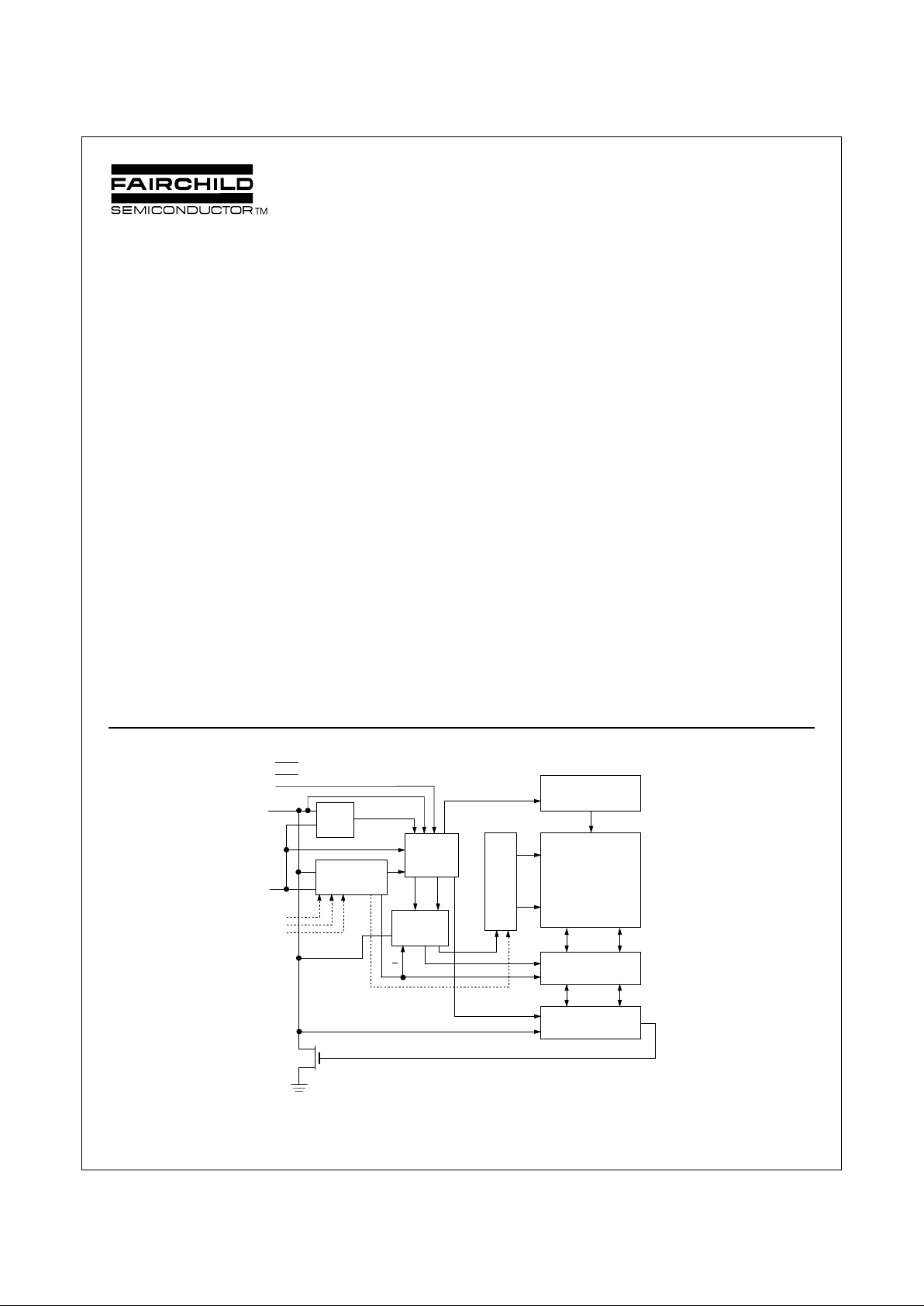
Block Diagram
DS500074-1
H.V. GENERATION
TIMING &CONTROL
E2PROM
ARRAY
16
YDEC
8
DATA REGISTER
XDEC
CONTROL
LOGIC
WORD
ADDRESS
COUNTER
SLAVE ADDRESS
REGISTER &
COMPARATOR
START
STOP
LOGIC
START CYCLE
16/
32/
64/
128/
4
4
CK
D
IN
R/W
LOAD INC
SDA
V
SS
V
CC
WP
D
OUT
A2
A1
A0
Device Address Bits
0/1/2/3
SCL
Features
■ Hardware Write Protect for entire memory
■ Low Power CMOS
200µA active current typical
10µA standby current typical
1µA standby typical (L)
0.1µA standby typical (LZ)
■ IIC Compatible interface
— Provides bidirectional data transfer protocol
■ Sixteen byte page write mode
— Minimizes total write time per byte
■ Self timed write cycle
— Typical write cycle time of 6ms
■ Endurance: 1,000,000 data changes
■ Data retention greater than 40 years
■ Packages available: 8-pin DIP, 8-pin SO, and 8-pin TSSOP
■ Available in three temperature ranges
- Commercial: 0° to +70°C
- Extended (E): -40° to +85C
- Automotive (V): -40° to +125°C
Page 2
2
www.fairchildsemi.com
NM24Wxx Rev. C.2
NM24Wxx 2K/4K/8K/16K-Bit Standard 2-Wire Bus Interface
Serial EEPROM with Full Array Write Protect
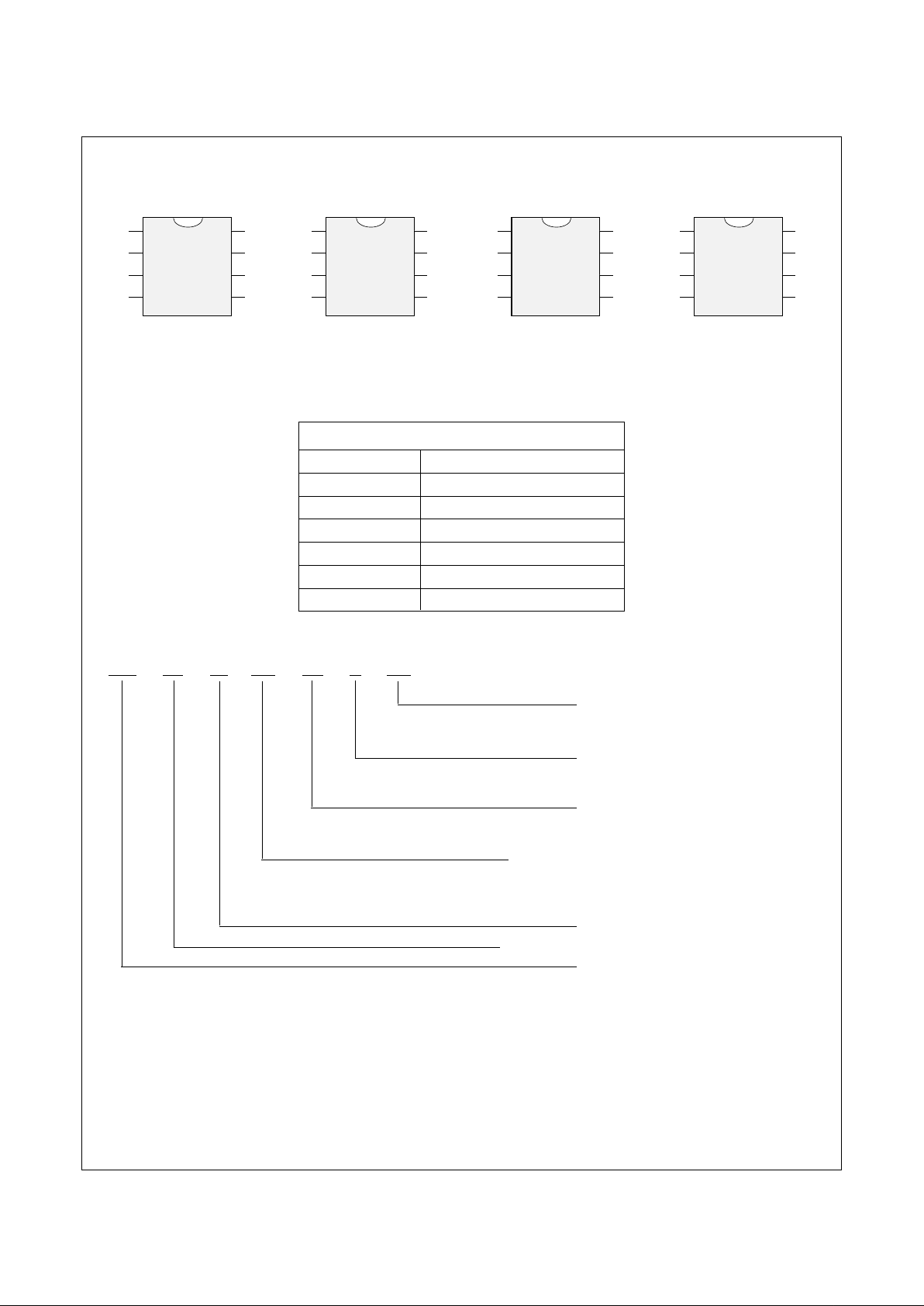
Connection Diagrams
Dual-In-Line Package (N), SO Package (M8), and TSSOP Package (MT8)
Top View
See Package Number N08E (N), M08A (M8), and MTC08 (MT8)
Pin Names
A0,A1,A2 Device Address Inputs
V
SS
Ground
SDA Data I/O
SCL Clock Input
WP Write Protect
V
CC
Power Supply
NC No Connect
Ordering Information
NM 24 W XX LZ E XX Letter Description
Package N 8-Pin DIP
M8 8-Pin SO8
MT8 8-Pin TSSOP
Temp. Range None 0 to 70°C
E -40 to +85°C
V -40°C to +125°C
Voltage Operating Range Blank 4.5V to 5.5V
L 2.7V to 4.5V
LZ 2.7V to 4.5V and
<1µA Standby Current
Density 02 2K
04 4K
08 8K
16 16K
W Total Array Write Protect
Interface 24 IIC
NM Fairchild Non-Volatile
Memory
A0
A1
A2
V
SS
V
CC
WP
SCL
SDA
8
7
6
5
1
2
3
4
DS500074-3
NM24W02
NC
A1
A2
V
SS
V
CC
WP
SCL
SDA
8
7
6
5
1
2
3
4
NC
NC
A2
V
SS
V
CC
WP
SCL
SDA
8
7
6
5
1
2
3
4
NC
NC
NC
V
SS
V
CC
WP
SCL
SDA
8
7
6
5
1
2
3
4
NM24W04 NM24W08 NM24W16
DS500074-4 DS500074-18DS500074-2
Page 3
3
www.fairchildsemi.com
NM24Wxx Rev. C.2
NM24Wxx 2K/4K/8K/16K-Bit Standard 2-Wire Bus Interface
Serial EEPROM with Full Array Write Protect
Product Specifications
Absolute Maximum Ratings
Ambient Storage Temperature –65°C to +150°C
All Input or Output Voltages
with Respect to Ground 6.5V to –0.3V
Lead Temperature
(Soldering, 10 seconds) +300°C
ESD Rating 2000V min.
Operating Conditions
Ambient Operating Temperature
NM24Wxx 0°C to +70°C
NM24WxxE -40°C to +85°C
NM24WxxV -40°C to +125°C
Positive Power Supply
NM24Wxx 4.5V to 5.5V
NM24WxxL 2.7V to 4.5V
NM24WxxLZ 2.7V to 4.5V
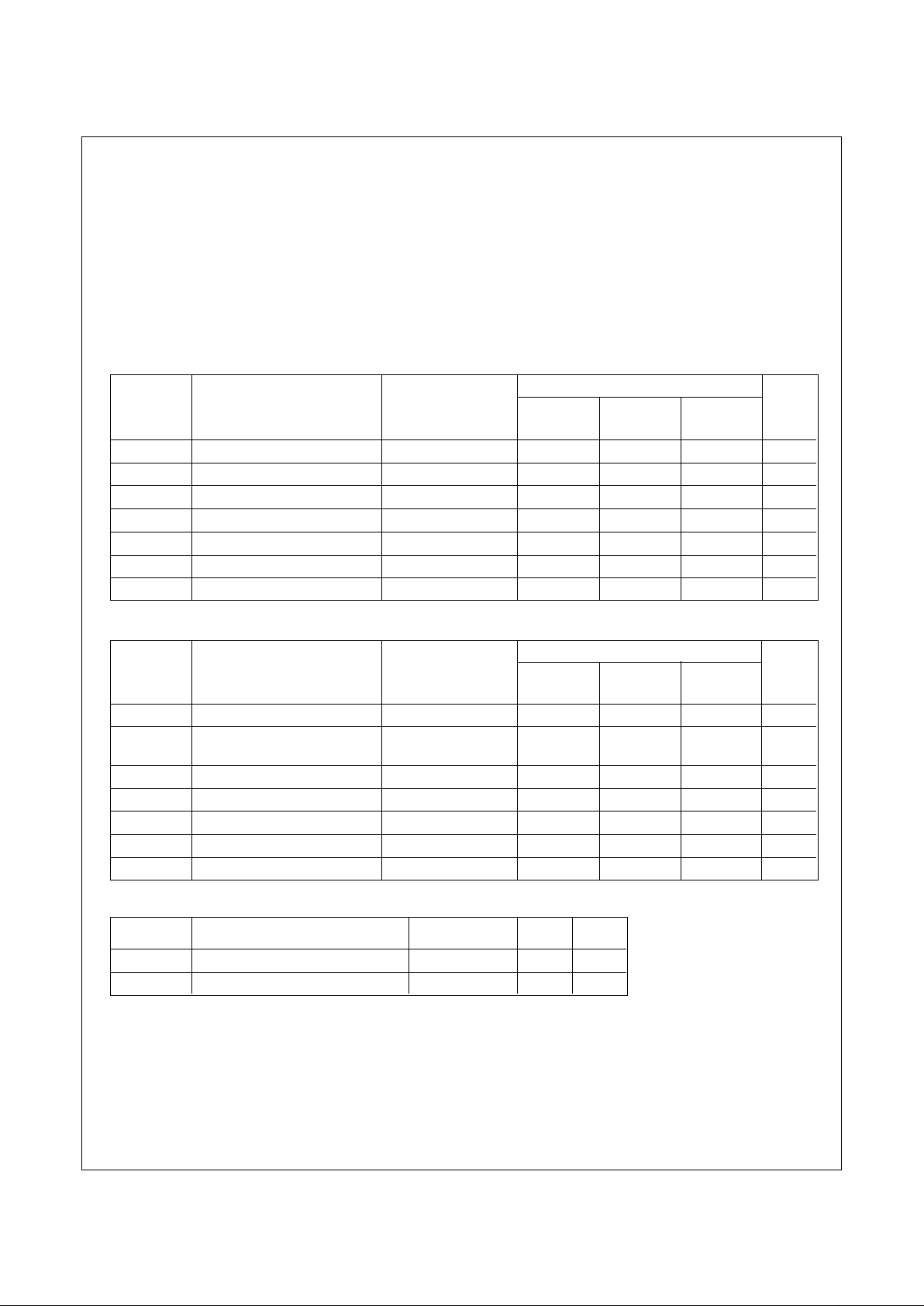
Standard VCC (4.5V to 5.5V) DC Electrical Characteristics
Symbol Parameter Test Conditions Limits Units
Min Typ Max
(Note 1)
I
CCA
Active Power Supply Current f
SCL
= 100 kHz 0.2 1.0 mA
I
SB
Standby Current VIN = GND or V
CC
10 50 µA
I
LI
Input Leakage Current VIN = GND to V
CC
0.1 1 µA
I
LO
Output Leakage Current V
OUT
= GND to V
CC
0.1 1 µA
V
IL
Input Low Voltage –0.3 VCC x 0.3 V
V
IH
Input High Voltage VCC x 0.7 VCC + 0.5 V
V
OL
Output Low Voltage I
OL
= 3 mA 0.4 V
Low VCC (2.7V to 5.5V) DC Electrical Characteristics
Symbol Parameter Test Conditions Limits Units
Min Typ Max
(Note 1)
I
CCA
Active Power Supply Current f
SCL
= 100 kHz 0.2 1.0 mA
I
SB
Standby Current for L VIN = GND or V
CC
110µA
Standby Current for LZ VIN = GND or V
CC
0.1 1 µA
I
LI
Input Leakage Current VIN = GND to V
CC
0.1 1 µA
I
LO
Output Leakage Current V
OUT
= GND to V
CC
0.1 1 µA
V
IL
Input Low Voltage –0.3 V
CC
x 0.3 V
V
IH
Input High Voltage VCC x 0.7 VCC + 0.5 V
V
OL
Output Low Voltage IOL = 3 mA 0.4 V
Capacitance T
A
= +25°C, f = 100/400 KHz, VCC = 5V (Note 2)
Symbol Test Conditions Max Units
C
I/O
Input/Output Capacitance (SDA) V
I/O
= 0V 8 pF
C
IN
Input Capacitance (A0, A1, A2, SCL) VIN = 0V 6 pF
Note 1: Typical values are TA = 25°C and nominal supply voltage (5V).
Note 2: This parameter is periodically sampled and not 100% tested.
Page 4
4
www.fairchildsemi.com
NM24Wxx Rev. C.2
NM24Wxx 2K/4K/8K/16K-Bit Standard 2-Wire Bus Interface
Serial EEPROM with Full Array Write Protect
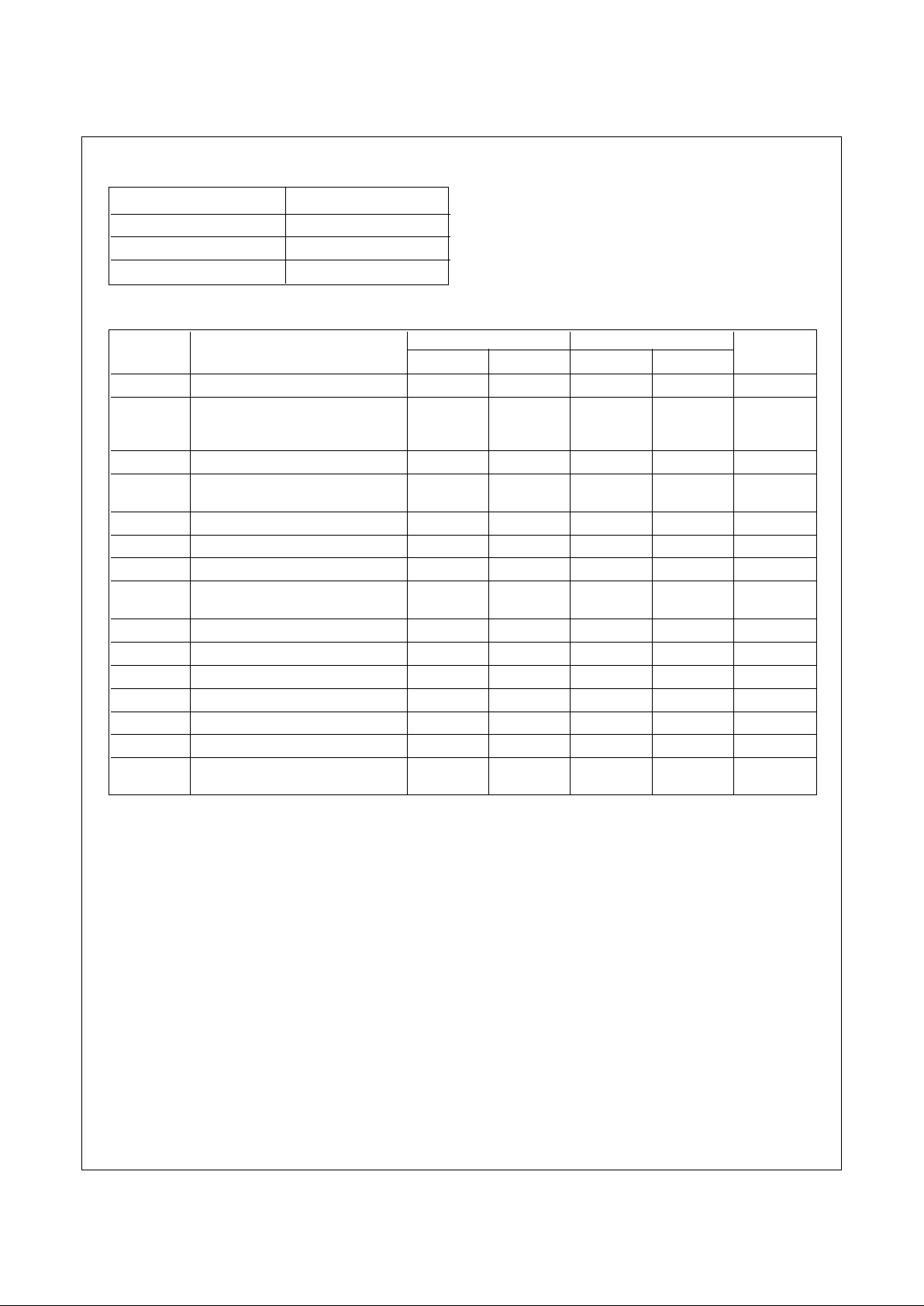
AC Conditions of Test
Input Pulse Levels VCC x 0.1 to VCC x 0.9
Input Rise and Fall Times 10 ns
Input & Output Timing Levels VCC x 0.5
Output Load 1 TTL Gate and CL = 100 pF
Read and Write Cycle Limits (Standard and Low VCC Range 2.7V - 4.5V)
Symbol Parameter 100 KHz 400 KHz Units
Min Max Min Max
f
SCL
SCL Clock Frequency 100 400 KHz
T
I
Noise Suppression Time Constant at
SCL, SDA Inputs (Minimum V
IN
100 50 ns
Pulse width)
t
AA
SCL Low to SDA Data Out Valid 0.3 3.5 0.1 0.9 µs
t
BUF
Time the Bus Must Be Free before 4.7 1.3 µs
a New Transmission Can Start
t
HD:STA
Start Condition Hold Time 4.0 0.6 µs
t
LOW
Clock Low Period 4.7 1.5 µs
t
HIGH
Clock High Period 4.0 0.6 µs
t
SU:STA
Start Condition Setup Time 4.7 0.6 µs
(for a Repeated Start Condition)
t
HD:DAT
Data in Hold Time 0 0 ns
t
SU:DAT
Data in Setup Time 250 100 ns
t
R
SDA and SCL Rise Time 1 0.3 µs
t
F
SDA and SCL Fall Time 300 300 ns
t
SU:STO
Stop Condition Setup Time 4.7 0.6 µs
t
DH
Data Out Hold Time 300 50 ns
t
WR
Write Cycle Time - NM24Wxx 10 10 ms
(Note 3) - NM24WxxL, NM24WxxLZ 15 15
Note 3: The write cycle time (tWR) is the time from a valid stop condition of a write sequence to the end of the internal erase/program cycle. During the write cycle, the
NM24Wxx bus interface circuits are disabled, SDA is allowed to remain high per the bus-level pull-up resistor, and the device does not respond to its slave address.
Page 5
5
www.fairchildsemi.com
NM24Wxx Rev. C.2
NM24Wxx 2K/4K/8K/16K-Bit Standard 2-Wire Bus Interface
Serial EEPROM with Full Array Write Protect
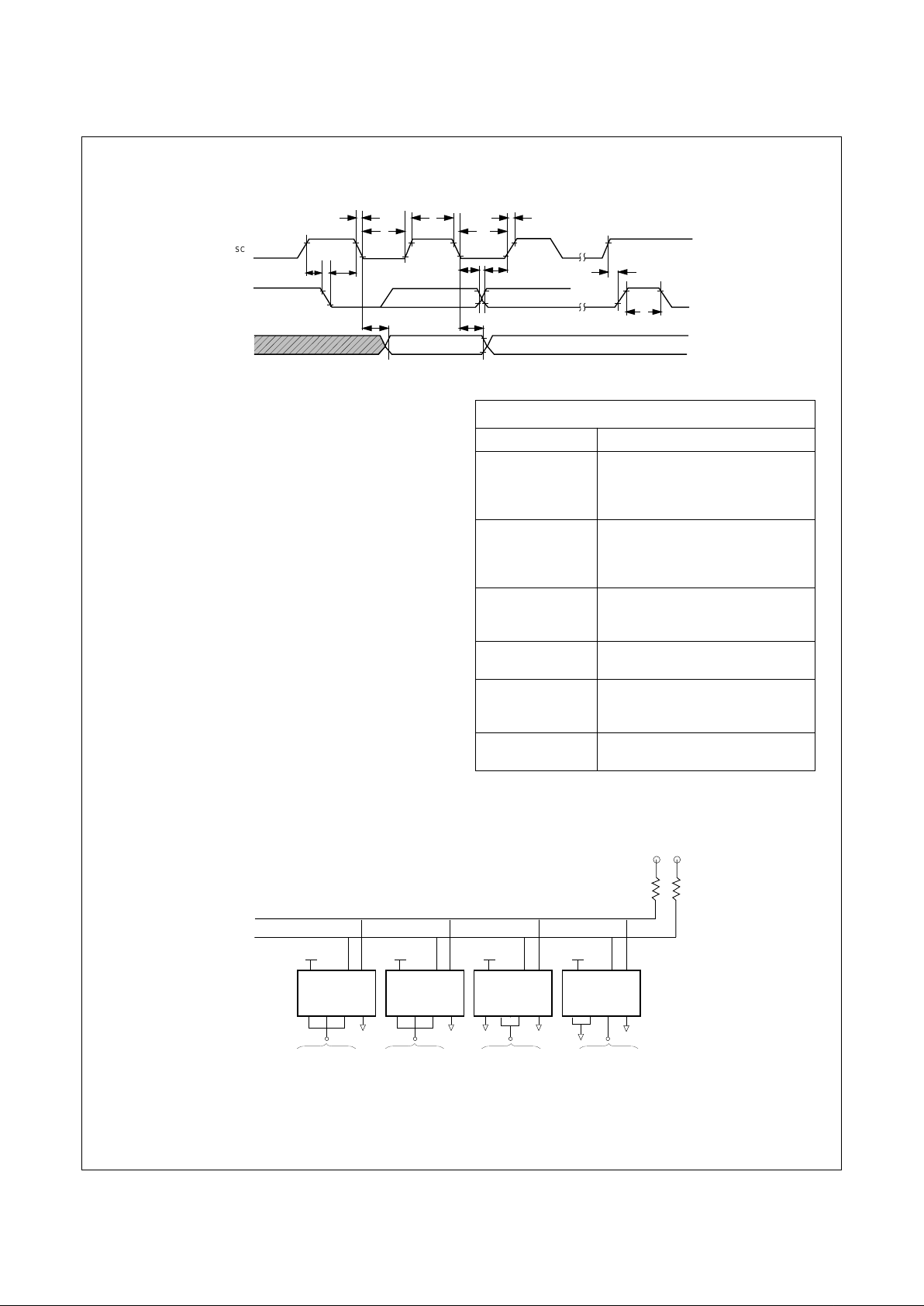
Bus Timing
Background Information (IIC Bus)
As mentioned, the IIC bus allows synchronous bidirectional communication between Transmitter/Receiver using the SCL (clock)
and SDA (Data I/O) lines. All communication must be started with
a valid START condition, concluded with a STOP condition and
acknowledged by the Receiver with an ACKNOWLEDGE condition.
In addition, since the IIC bus is designed to support other devices
such as RAM, EPROMs, etc., a devce type identifier string must
follow the START condition. For EEPROMs, this 4-bit string is
1010 and is the first 4 bits in the slave address.
As shown below, the EEPROMs on the IIC bus may be configured
in any manner required, and for the Standard IIC protocol, the total
memory addressed can not exceed 16K (16,384 bits). EEPROM
memory address programming is controlled by 2 methods:
• Hardware configuring the A0, A1, and A2 pins (Device
Address pins) with pull-up or pull-down to resistors. All
unused pins must be grounded (tied to VSS).
• Software addressing the required PAGE BLOCK within the
device memory array (as sent in the Slave Address string).
Addressing an EEPROM memory location involves sending a
command string with the following information:
[DEVICE TYPE]—[DEVICE ADDRESS]—[PAGE BLOCK
ADDRESS]—[BYTE ADDRESS]
DEFINITIONS
WORD 8 bits of data
PAGE 16 sequential addresses (one byte
each) that may be programmed
during a 'Page Write' programming
cycle
PAGE BLOCK 2,048 (2K) bits organized into 16
pages of addressable memory. (8
bits) x (16 bytes) x (16 pages) = 2,048
bits
MASTER Any IIC device CONTROLLING the
transfer of data (such as a microprocessor)
SLAVE Device being controlled (EEPROMs
are always considered Slaves)
TRANSMITTER Device currently SENDING data on
the bus (may be either a Master or
Slave).
RECEIVER Device currently receiving data on the
bus (Master or Slave)
Example of 16K of Memory on 2-Wire Bus
Note: The SDA pull-up resistor is required due to the open-drain/open collector output of IIC bus devices.
The SCL pull-up resistor is recommended because of the normal SCL line inactive 'high' state.
It is recommended that the total line capacitance be less than 400pF.
Specific timing and addressing considerations are described in greater detail in the following sections.
DS500074-5
DS500074-6
SDA
SCL
NM24W02
V
CC
V
CC
A0 A1 A2 V
SS
NM24W02
A0 A1 A2 V
SS
NM24W04
A0 A1 A2 V
SS
NM24W08
A0 A1 A2 V
SS
V
CC
To V
CC
or V
SS
To V
CC
or V
SS
To V
CC
or V
SS
To V
CC
or V
SS
V
CC
V
CC
V
CC
SCL
SDA
IN
SDA
OUT
t
F
t
LOW
t
HIGH
t
R
t
LOW
t
AA
t
DH
t
BUF
t
SU:STA
t
HD:DAT
t
HD:STA
t
SU:DAT
t
SU:STO
Page 6

6
www.fairchildsemi.com
NM24Wxx Rev. C.2
NM24Wxx 2K/4K/8K/16K-Bit Standard 2-Wire Bus Interface
Serial EEPROM with Full Array Write Protect
Device Address Pins
Memory Size
Number of
A0 A1 A2 Page Blocks
NM24W02 ADR ADR ADR 2048 Bits 1
NM24W04 NC ADR ADR 4096 Bits 2
NM24W08 NC NC ADR 8192 Bits 4
NM24W16 NC NC NC 16,384 Bits 8
ADR is the hardware address (VCC/1 or VSS/0) of the device(s) used.
Pin Descriptions
Serial Clock (SCL)
The SCL input is used to clock all data into and out of the device.
Serial Data (SDA)
SDA is a bidirectional pin used to transfer data into and out of the
device. It is an open drain output and may be wire–ORed with any
number of open drain or open collector outputs.
Device Operation Inputs (A0, A1, A2)
Device address pins A0, A1, and A2 are connected to VCC or V
SS
to configure the EEPROM chip address. Table 1 shows the active
pins across the NM24Wxx device family.
TABLE 1.
Device A0 A1 A2 Effects of Addresses
NM24W02 ADR ADR ADR 23 = 8; 8*x(1x2K)**=16K
NM24W04 x ADR ADR 22 = 4; 4*x(2x2K)**=16K
NM24W08 x x ADR 21 = 2; 2*x(4x2K)**=16K
NM24W16 x x x 2
0
= 1; 1*x(8x2K)**=16K
* Max # of devices on bus
** Number of page blocks per density
WP Write Protection
If tied to VCC, PROGRAM operations onto memory will not be
executed. (Only READ operations are possible.) If tied to VSS,
normal operation is enabled (READ/WRITE over the entire memory
is possible).
Device Operation
The NM24Wxx supports a bidirectional bus oriented protocol. The
protocol defines any device that sends data onto the bus as a
transmitter and the receiving device as the receiver. The device
controlling the transfer is the master and the device that is
controlled is the slave. The master will always initiate data
transfers and provide the clock for both transmit and receive
operations. Therefore, the NM24Wxx will be considered a slave in
all applications.
Clock and Data Conventions
Data states on the SDA line can change only during SCL LOW.
SDA state changes during SCL HIGH are reserved for indicating
start and stop conditions. Refer to
Figures 1
and
2.
Start Condition
All commands are preceded by the start condition, which is a
HIGH to LOW transition of SDA when SCL is HIGH. The NM24Wxx
continuously monitors the SDA and SCL lines for the start condition and will not respond to any command until this condition has
been met.
Stop Condition
All communications are terminated by a stop condition, which is a
LOW to HIGH transition of SDA when SCL is HIGH. The stop
condition is also used by the NM24Wxx to place the device in the
standby power mode.
ACKNOWLEDGE
Acknowledge is a software convention used to indicate successful
data transfers. The transmitting device, either master or slave, will
release the bus after transmitting eight bits.
During the ninth clock cycle the receiver will pull the SDA line to
LOW to acknowledge that it received the eight bits of data. Refer
to
Figure 3.
The NM24Wxx device will always respond with an acknowledge
after recognition of a start condition and its slave address. If both
the device and a write operation have been selected, the NM24Wxx
will respond with an acknowledge after the receipt of each
subsequent eight bit byte.
In the read mode the NM24Wxx slave will transmit eight bits of
data, release the SDA line and monitor the line for an acknowledge. If an acknowledge is detected and no stop condition is
generated by the master, the slave will continue to transmit data.
If an acknowledge is not detected, the slave will terminate further
data transmissions and await the stop condition to return to the
standby power mode.
Page 7

7
www.fairchildsemi.com
NM24Wxx Rev. C.2
NM24Wxx 2K/4K/8K/16K-Bit Standard 2-Wire Bus Interface
Serial EEPROM with Full Array Write Protect
Write Cycle Timing
SDA
SCL
STOP
CONDITION
START
CONDITION
WORD n
8th BIT ACK
t
WR
DS500074-7
SDA
SCL
START
CONDITION
STOP
CONDITION
SDA
SCL
DATA STABLE
DATA
CHANGE
SCL FROM
MASTER
DATA OUTPUT
FROM
TRANSMITTER
DATA OUTPUT
FROM
RECEIVER
189
START
ACKNOWLEDGE
DS500074-8
DS500074-9
Data Validity (Figure 1)
Start and Stop Definition (Figure 2)
Acknowledge Responses from Receiver (Figure 3)
DS500074-10
Page 8

8
www.fairchildsemi.com
NM24Wxx Rev. C.2
NM24Wxx 2K/4K/8K/16K-Bit Standard 2-Wire Bus Interface
Serial EEPROM with Full Array Write Protect
Device Addressing
Following a start condition the master must output the address of
the slave it is accessing. The most significant four bits of the slave
address are those of the device type identifier (
see Figure 4)
. This
is fixed as 1010 for all EEPROM devices.
Slave Addresses (Figure 4)
All Standard IIC protocol EEPROMs use an internal protocol that
defines a PAGE BLOCK size of 2K bits (for Byte addresses 00
through FF). Therefore, address bits A0, A1, or A2 (if designated
'P') are used to access a PAGE BLOCK in conjuction with the Byte
address used to access any individual data byte.
Refer to the following table for Slave Address string details:
Device A0 A1 A2 Page Page Block
Blks Addresses
NM24W02 A A A 1 (2K) (None)
NM24W04 P A A 2 (4K) 0 1
NM24W08 P P A 4 (8K) 00 01 10 11
NM24W16 P P P 8 (16K) 000 001 010 011 100
101 110 111
Note: A: Refers to a hardware configured Device Address pin.
P: Refers to an internal PAGE BLOCK memory segment
The last bit of the slave address defines whether a write or read
condition is requested by the master. A '1' indicates that a read
operation is to be executed, and a '0' initiates the write mode.
A simple review: After the NM24Wxx recognizes the start condition, the devices interfaced to the IIC bus wait for a slave address
to be transmitted over the SDA line. If the transmitted slave
address matches an address of one of the devices, the designated
slave pulls the line LOW with an acknowledge signal and awaits
further transmissions.
Device Type
Identifier
Device
Address
1 0 1 0 A2 A1 A0 R/W (LSB)
NM24W02
Device Type
Identifier
Device
Address
Page
Block Address
1 0 1 0 A2 A1 A0 R/W (LSB)
NM24W04
Device Type
Identifier
Device
Address
Page
Block Address
1 0 1 0 A2 A1 A0 R/W (LSB)
NM24W08
Device Type
Identifier
Page
Block Address
1 0 1 0 A2 A1 A0 R/W (LSB)
NM24W16
DS500074-11
Page 9

9
www.fairchildsemi.com
NM24Wxx Rev. C.2
NM24Wxx 2K/4K/8K/16K-Bit Standard 2-Wire Bus Interface
Serial EEPROM with Full Array Write Protect
Write Operations
Byte Write
For a write operation a second address field is required which is
a word address that is comprised of eight bits and provides access
to any one of the 256 words in the selected page of memory. Upon
receipt of the word address the NM24Wxx responds with an
acknowledge and waits for the next eight bits of data, again,
responding with an acknowledge. The master then terminates the
transfer by generating a stop condition, at which time the NM24Wxx
begins the internal write cycle to the nonvolatile memory. While
the internal write cycle is in progress the NM24Wxx inputs are
disabled, and the device will not respond to any requests from the
master. Refer to
Figure 5
for the address, acknowledge and data
transfer sequence.
Page Write
The NM24Wxx is capable of a sixteen byte page write operation.
It is initiated in the same manner as the byte write operation; but
instead of terminating the write cycle after the first data word is
transferred, the master can transmit up to fifteen more words. After
the receipt of each word, the NM24Wxx will respond with an
acknowledge.
After the receipt of each word, the internal address counter
increments to the next address and the next SDA data is accepted.
If the master should transmit more than sixteen words prior to
generating the stop condition, the address counter will 'roll over'
and the previously written data will be overwritten. As with the byte
write operation, all inputs are disabled until completion of the
internal write cycle. Refer to
Figure 6
for the address, acknowl-
edge, and data transfer sequence.
Acknowledge Polling
Once the stop condition is issued to indicate the end of the host’s
write operation the NM24Wxx initiates the internal write cycle.
ACK polling can be initiated immediately. This involves issuing the
start condition followed by the slave address for a write operation.
If the NM24Wxx is still busy with the write operation no ACK will
be returned. If the NM24Wxx has completed the write operation an
ACK will be returned and the host can then proceed with the next
read or write operation.
Write Protection
Programming of the memory will not take place if the WP pin of the
NM24Wxx is connected to VCC. The NM24Wxx will accept slave
and word addresses; but if the memory accessed is write protected by the WP pin, the NM24Wxx will not generate an acknowledge after the first byte of data has been received, and thus the
program cycle will not be started when the stop condition is
asserted.
S
T
O
P
Bus Activity:
Master
Bus Activity:
NM24Wxx
SDA Line
DATA n + 15
DATA n + 1DATA nBYTE ADDRESS (n)
A
C
K
S
T
A
R
T
SLAVE
ADDRESS
A
C
K
A
C
K
A
C
K
A
C
K
S
T
O
P
A
C
K
DATA
A
C
K
A
C
K
S
T
A
R
T
WORD
ADDRESS
SLAVE
ADDRESS
Bus Activity:
Master
Bus Activity:
NM24Wxx
SDA Line
Byte Write (Figure 5)
Page Write (Figure 6)
DS500074-12
DS500074-13
Page 10

10
www.fairchildsemi.com
NM24Wxx Rev. C.2
NM24Wxx 2K/4K/8K/16K-Bit Standard 2-Wire Bus Interface
Serial EEPROM with Full Array Write Protect
DS500074-15
Read Operations
Read operations are initiated in the same manner as write
operations, with the exception that the R/W bit of the slave address
is set to a one. There are three basic read operations: current
address read, random read, and sequential read.
Current Address Read
Internally the NM24Wxx contains an address counter that maintains the address of the last word accessed, incremented by one.
Therefore, if the last access (either a read or write) was to address
n, the next read operation would access data from address n + 1.
Upon receipt of the slave address with R/W set to one, the
NM24Wxx issues an acknowledge and transmits the eight bit
word. The master will not acknowledge the transfer but does
generate a stop condition, and therefore the NM24Wxx discontinues transmission. Refer to
Figure 7
for the sequence of address,
acknowledge and data transfer.
Random Read
Random read operations allow the master to access any memory
location in a random manner. Prior to issuing the slave address
with the R/W bit set to one, the master must first perform a
“dummy” write operation. The master issues the start condition,
slave address, R/W bit set to zero, and then the word address it is
to read. After the word address acknowledge, the master imme-
diately reissues the start condition and the slave address with the
R/W bit set to one. This will be followed by an acknowledge from
the NM24Wxx and then by the eight bit word. The master will not
acknowledge the transfer but does generate the stop condition,
and therefore the NM24Wxx discontinues transmission. Refer to
Figure 8
for the address, acknowledge and data transfer se-
quence.
Sequential Read
Sequential reads can be initiated as either a current address read
or random access read. The first word is transmitted in the same
manner as the other read modes; however, the master now
responds with an acknowledge, indicating it requires additional
data. The NM24Wxx continues to output data for each acknowledge received. The read operation is terminated by the master not
responding with an acknowledge or by generating a stop condition.
The data output is sequential, with the data from address n
followed by the data from n + 1. The address counter for read
operations increments all word address bits, allowing the entire
memory contents to be serially read during one operation. After
the entire memory has been read, the counter 'rolls over' and the
NM24Wxx continues to output data for each acknowledge received. Refer to
Figure 9
for the address, acknowledge, and data
transfer sequence.
Current Address Read (Figure 7)
S
T
O
P
A
C
K
SLAVE
ADDRESS
A
C
K
A
C
K
S
T
A
R
T
S
T
A
R
T
BYTE
ADDRESS
SLAVE
ADDRESS
Bus Activity:
Master
SDA Line
S
DATA n
S
T
O
P
A
C
K
Bus Activity:
Master
SDA Line
A
C
K
DATA n + x
A
C
K
DATA n + 2DATA n +1DATA n
A
C
K
SLAVE
ADDRESS
S
T
O
P
DATA
A
C
K
S
T
A
R
T
SLAVE
ADDRESS
Bus Activity:
Master
SDA Line
Random Read (Figure 8)
Sequential Read (Figure 9)
DS500074-16
DS500074-14
Page 11

11
www.fairchildsemi.com
NM24Wxx Rev. C.2
NM24Wxx 2K/4K/8K/16K-Bit Standard 2-Wire Bus Interface
Serial EEPROM with Full Array Write Protect
DS500074-17
SDA
SCL
Master
Transmitter/
Receiver
Slave
Transmitter/
Receiver
Master
Transmitter
Slave
Receiver
Master
Transmitter/
Receiver
V
CC
Read Operations (Continued)
Typical System Configuration (Figure 11)
Note: Due to open drain configuration of SDA, a bus-level resistor is called for (Typical value = 4.7Ω)
Page 12

12
www.fairchildsemi.com
NM24Wxx Rev. C.2
NM24Wxx 2K/4K/8K/16K-Bit Standard 2-Wire Bus Interface
Serial EEPROM with Full Array Write Protect
8-Pin Molded Small Outline Package (M8)
Package Number M08A
Physical Dimensions inches (millimeters) unless otherwise noted
1234
8765
0.189 - 0.197
(4.800 - 5.004)
0.228 - 0.244
(5.791 - 6.198)
Lead #1
IDENT
Seating
Plane
0.004 - 0.010
(0.102 - 0.254)
0.014 - 0.020
(0.356 - 0.508)
0.014
(0.356)
Typ.
0.053 - 0.069
(1.346 - 1.753)
0.050
(1.270)
Typ
0.016 - 0.050
(0.406 - 1.270)
Typ. All Leads
8° Max, Typ.
All leads
0.150 - 0.157
(3.810 - 3.988)
0.0075 - 0.0098
(0.190 - 0.249)
Typ. All Leads
0.04
(0.102)
All lead tips
0.010 - 0.020
(0.254 - 0.508)
x 45°
Page 13

13
www.fairchildsemi.com
NM24Wxx Rev. C.2
NM24Wxx 2K/4K/8K/16K-Bit Standard 2-Wire Bus Interface
Serial EEPROM with Full Array Write Protect
8-Pin Molded TSSOP, JEDEC
Package Number MTC08
Physical Dimensions inches (millimeters) unless otherwise noted
0.114 - 0.122
(2.90 - 3.10)
0.123 - 0.128
(3.13 - 3.30)
0.246 - 0.256
(6.25 - 6.5)
14
85
0.169 - 0.177
(4.30 - 4.50)
(7.72) Typ
(4.16) Typ
(1.78) Typ
(0.42) Typ
(0.65) Typ
0.002 - 0.006
(0.05 - 0.15)
0.0256 (0.65)
Typ.
0.0433
(1.1)
Max
0.0075 - 0.0098
(0.19 - 0.30)
Pin #1 IDENT
0.0035 - 0.0079
0°-8°
0.020 - 0.028
(0.50 - 0.70)
0.0075 - 0.0098
(0.19 - 0.25)
Seating
plane
Gage
plane
See detail A
Notes: Unless otherwise specified
1. Reference JEDEC registration MO153. Variation AA. Dated 7/93
Land pattern recommendation
DETAIL A
Typ. Scale: 40X
Page 14

14
www.fairchildsemi.com
NM24Wxx Rev. C.2
NM24Wxx 2K/4K/8K/16K-Bit Standard 2-Wire Bus Interface
Serial EEPROM with Full Array Write Protect
Physical Dimensions inches (millimeters) unless otherwise noted
Molded Dual-In-Line Package (N)
Package Number N08E
0.373 - 0.400
(9.474 - 10.16)
0.092
(2.337)
DIA
+
1234
8765
0.250 - 0.005
(6.35 ± 0.127)
87
0.032 ± 0.005
(0.813 ± 0.127)
Pin #1
Option 2
RAD
1
0.145 - 0.200
(3.683 - 5.080)
0.130 ± 0.005
(3.302 ± 0.127)
0.125 - 0.140
(3.175 - 3.556)
0.020
(0.508)
Min
0.018 ± 0.003
(0.457 ± 0.076)
90° ± 4°
Typ
0.100 ± 0.010
(2.540 ± 0.254)
0.040
(1.016)
0.039
(0.991)
Typ.
20° ± 1°
0.065
(1.651)
0.050
(1.270)
0.060
(1.524)
Pin #1 IDENT
Option 1
0.280
MIN
0.300 - 0.320
(7.62 - 8.128)
0.030
(0.762)
MAX
0.125
(3.175)
DIA
NOM
0.009 - 0.015
(0.229 - 0.381)
0.045 ± 0.015
(1.143 ± 0.381)
0.325
+0.040
-0.015
8.255
+1.016
-0.381
95° ± 5°
0.090
(2.286)
(7.112)
IDENT
Fairchild does not assume any responsibility for use of any circuitry described, no circuit patent licenses are implied and Fairchild reserves the right at any time without notice to change said circuitry and specifications.
Life Support Policy
Fairchild's products are not authorized for use as critical components in life support devices or systems without the express written
approval of the President of Fairchild Semiconductor Corporation. As used herein:
1. Life support devices or systems are devices or systems which,
(a) are intended for surgical implant into the body, or (b) support
or sustain life, and whose failure to perform, when properly
used in accordance with instructions for use provided in the
labeling, can be reasonably expected to result in a significant
injury to the user.
2. A critical component is any component of a life support device
or system whose failure to perform can be reasonably expected to cause the failure of the life support device or system,
or to affect its safety or effectiveness.
Fairchild Semiconductor Fairchild Semiconductor Fairchild Semiconductor Fairchild Semiconductor
Americas Europe Hong Kong Japan Ltd.
Customer Response Center Fax: +44 (0) 1793-856858 8/F, Room 808, Empire Centre 4F, Natsume Bldg.
Tel. 1-888-522-5372 Deutsch Tel: +49 (0) 8141-6102-0 68 Mody Road, Tsimshatsui East 2-18-6, Yushima, Bunkyo-ku
English Tel: +44 (0) 1793-856856 Kowloon. Hong Kong Tokyo, 113-0034 Japan
Français Tel: +33 (0) 1-6930-3696 Tel; +852-2722-8338 Tel: 81-3-3818-8840
Italiano Tel: +39 (0) 2-249111-1 Fax: +852-2722-8383 Fax: 81-3-3818-8841
 Loading...