

Page 1
查询L7900 SERIES供应商
NEGATIVEVOLTAGE REGULATORS
■ OUTPUTCURRENT UPTO1.5 A
■ OUTPUTVOLTAGESOF-5; -5.2;-6; -8;-9;
-12;-15; -18;-20;-22; -24V
■ THERMAL OVERLOADPROTECTION
■ SHORTCIRCUIT PROTECTION
■ OUTPUTTRANSITION SOA PROTECTION
L7900
SERIES
DESCRIPTION
The L7900 series of three-terminal negative
regulators is available in TO-220, ISOWATT220
TO-3 and D
2
PAK packages and several fixed
output voltages, making it useful in a wide range
of applications.Theseregulators can providelocal
on-card regulation, eliminating the distribution
problems associated with single point regulation;
furthermore, having the same voltage option as
the L7800 positive standard series, they are
particularly suited for split power supplies. In
addition, the -5.2V is also available for ECL
system. If adequate heat sinking is provided,
they can deliver over 1.5A output current.
Although designed primarily as fixed voltage
regulators, these devices can be used with
external components to obtain adjustable
voltagesand currents.
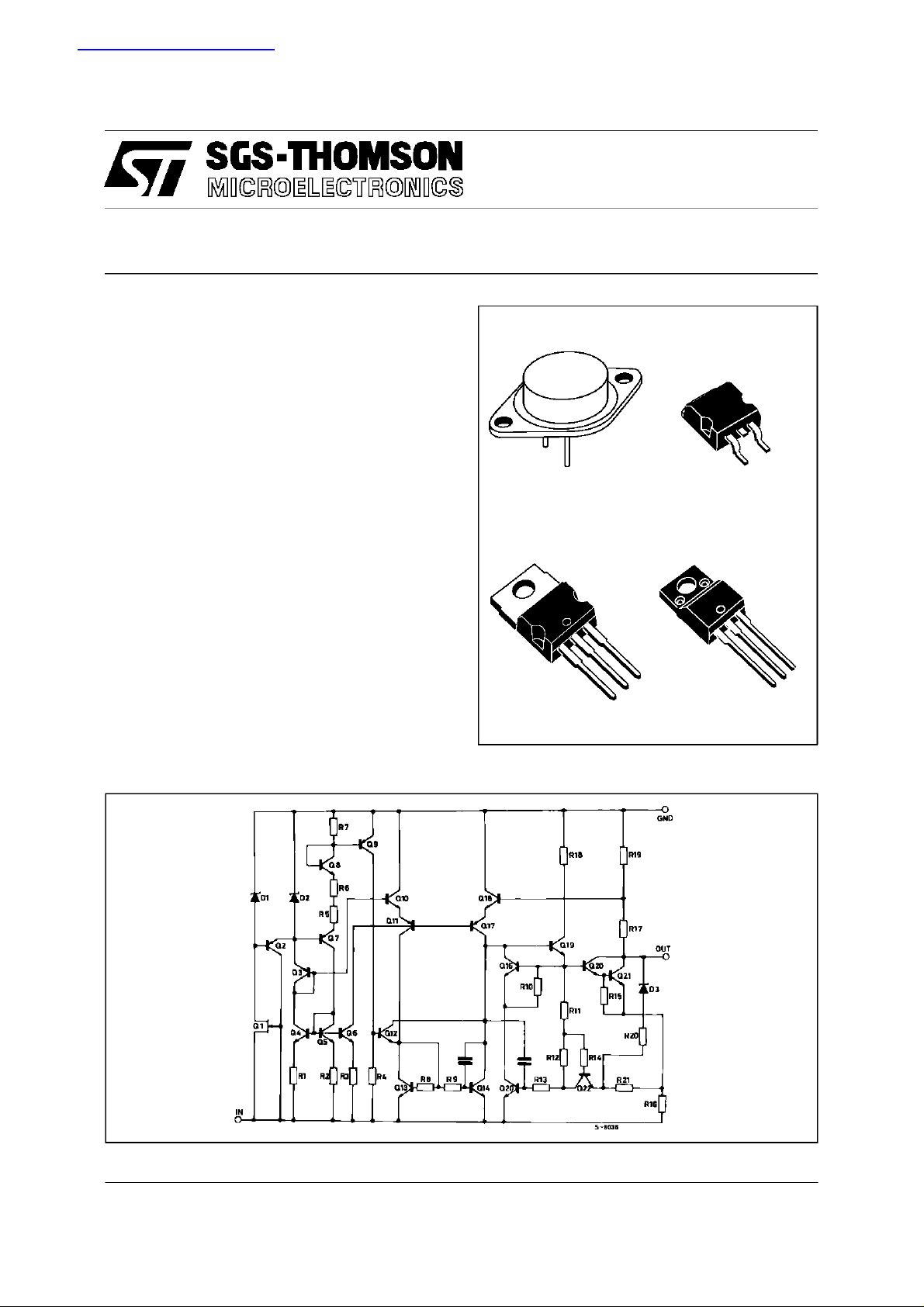
SCHEMATICDIAGRAM
1
2
TO-3
TO-220 ISOWATT220
D2PAK
3
1
3
2
1
April 1997
1/13
Page 2
L7900
ABSOLUTE MAXIMUMRATINGS
Symbol Parameter Value Unit
DC Input Voltage (forVO=5 to 18V)
V
i
OutputCurrent Internally limited
I
o
P
Power Dissipation Internally limited
tot
Operating Junction Temperature Range 0 to 150
T
op
StorageTemperatureRange - 65 to 150
T
stg
(forV
= 20, 24V)
O
THERMAL DATA
Symbol Parameter D2PAK TO-220 ISOWATT220 TO-3 Unit
R
thj-case
R
thj-amb
Thermal Resistance Junction-case Max
Thermal Resistance Junction-ambient Max
3
62.5
50
3
60
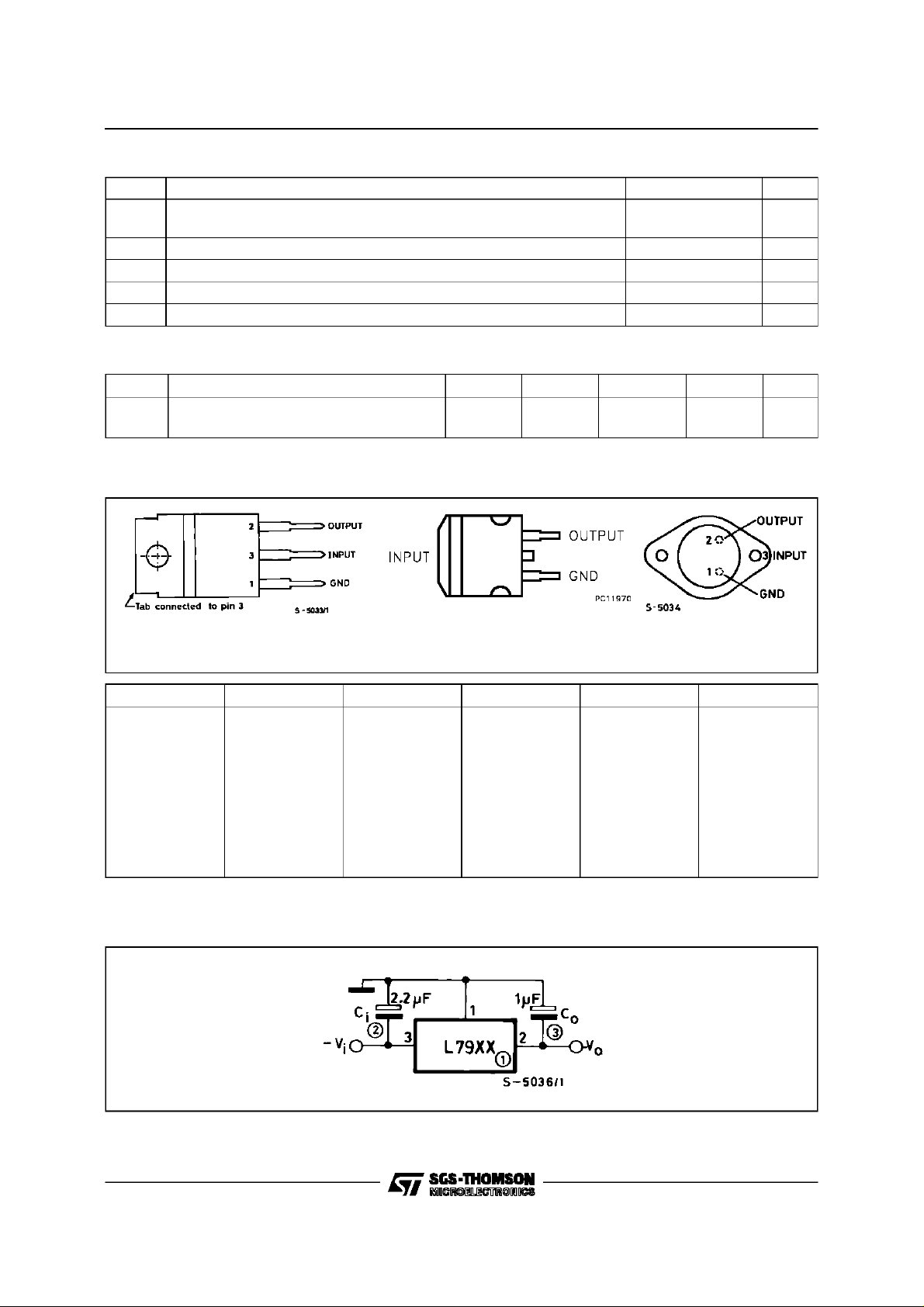
CONNECTION DIAGRAM AND ORDERINGNUMBERS (top view)
-35
-40
4
4
35
o
o
V
V
o
C
o
C
C/W
C/W
TO-220 & ISOWATT220 TO-3D2PAK
Type TO-220 D
L7905C
L7952C
L7906C
L7908C
L7912C
L7915C
L7918C
L7920C
L7922C
L7924C
(*) AVAILABLE IN TAPE AND REEL WITH ”-TR” SUFFIX
L7905CV
L7952CV
L7906CV
L7908CV
L7912CV
L7915CV
L7918CV
L7920CV
L7922CV
L7924CV
2
L7905CD2T
L7952CD2T
L7906CD2T
L7908CD2T
L7912CD2T
L7915CD2T
L7918CD2T
L7920CD2T
L7922CD2T
L7924CD2T
APPLICATIONCIRCUIT
PAK (*) ISOWATT220 TO-3 Output Voltage
L7905CP
L7906CP
L7908CP
L7912CP
L7915CP
L7918CP
L7920CP
L7924CP
L7905CT
L7952CT
L7906CT
L7908CT
L7912CT
L7915CT
L7918CT
L7920CT
L7922CT
L7924CT
-5V
-5.2V
-6V
-8V
-12V
-15V
-18V
-20V
-22V
-24V
2/13
Page 3
L7900
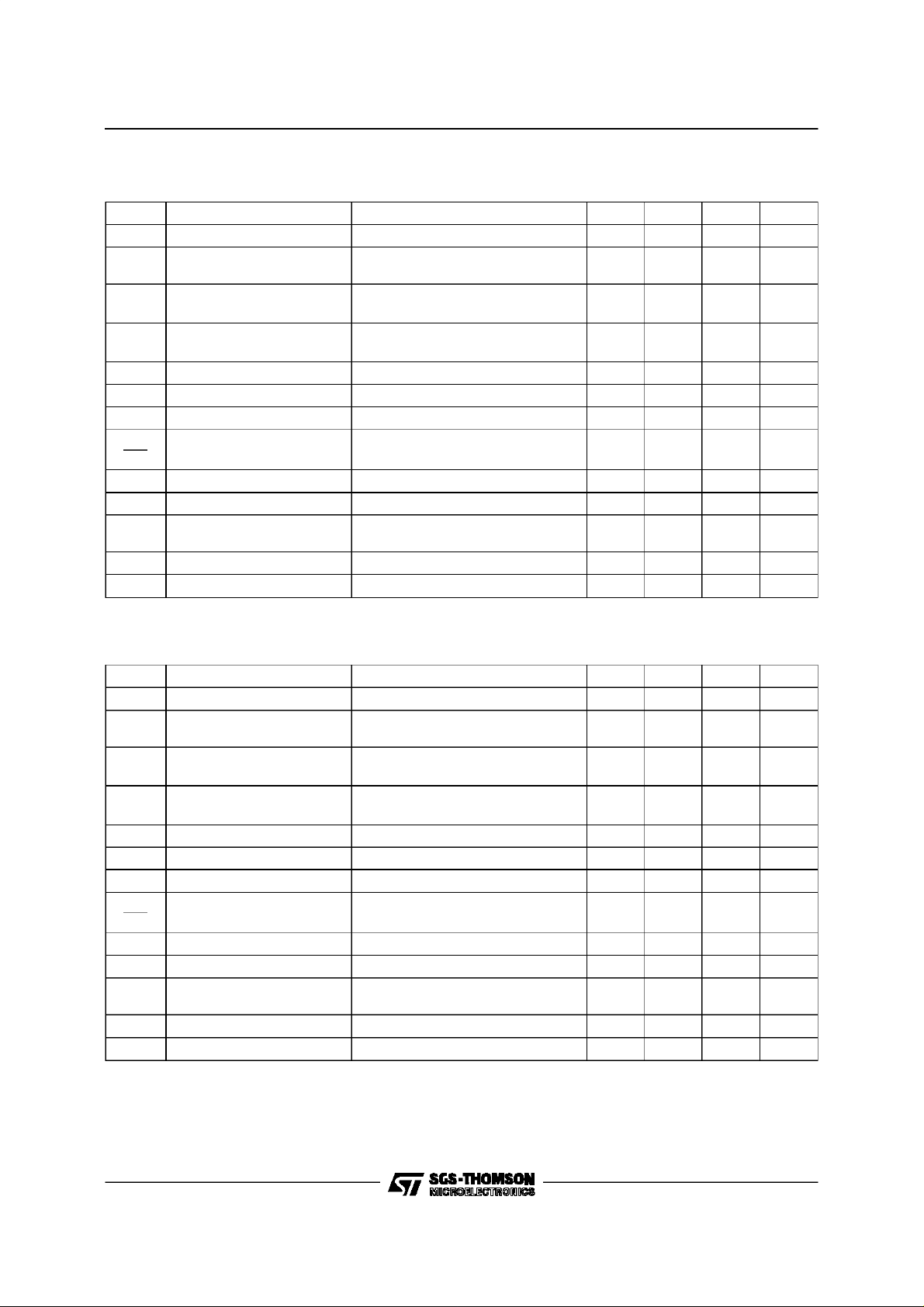
ELECTRICALCHARACTERISTICS FOR L7905C (refer to the test circuits,Tj= 0 to150oC,
=-10V, Io=500 mA, Ci= 2.2 µF, Co=1µF unless otherwise specified)
V
i
Symbol Parameter Test Conditions Min. Typ. Max. Unit
V
OutputVoltage Tj=25oC -4.8-5-5.2V
o
V
OutputVoltage Io=-5mAto-1A Po≤15 W
o
* Line Regulation Vi=-7 to -25 V Tj=25oC
∆V
o
∆V
* Load Regulation Io= 5 to 1500 mA Tj=25oC
o
I
Quiescent Current Tj=25oC3mA
d
∆I
Quiescent Current Change Io= 5 to 1000 mA 0.5 mA
d
∆I
Quiescent Current Change Vi=-8 to -25 V 1.3 mA
d
∆
V
OutputVoltage Drift Io= 5 mA -0.4 mV/oC
o
∆
T
OutputNoise Voltage B = 10Hz to 100KHz Tj=25oC 100 µ V
e
N
SVR Supply Voltage Rejection ∆V
V
Dropout Voltage Io=1A Tj=25oC
d
ShortCircuit Current 2.1 A
I
sc
I
ShortCircuit Peak Current Tj=25oC2.5A
scp
=8 to 20 V
V
i
=-8 to -12 V Tj=25oC
V
i
= 250 to 750mA Tj=25oC
I
o
=10V f=120Hz 54 60 dB
i
=100mV
∆V
O
-4. 75 -5 -5. 25 V
100
50
100
50
1.4 V
mV
mV
mV
mV
ELECTRICALCHARACTERISTICS FOR L7952C (refer to the test circuits,Tj= 0 to150oC,
=-10V, Io=500 mA, Ci= 2.2 µF, Co=1µF unless otherwise specified)
V
i
Symbol Parameter Test Conditions Min. Typ. Max. Unit
V
OutputVoltage Tj=25oC -5.0 -5. 2 -5.4 V
o
V
OutputVoltage Io=-5mAto-1A Po≤15 W
o
* Line Regulation Vi=-8 to -25 V Tj=25oC
∆V
o
∆V
* Load Regulation Io= 5 to 1500 mA Tj=25oC
o
I
Quiescent Current Tj=25oC3mA
d
∆I
Quiescent Current Change Io= 5 to 1000 mA 0.5 mA
d
∆I
Quiescent Current Change Vi=-9 to -25 V 1.3 mA
d
∆
V
OutputVoltage Drift Io= 5 mA -0.5 mV/oC
o
∆
T
OutputNoise Voltage B = 10Hz to 100KHz Tj=25oC 125 µ V
e
N
SVR Supply Voltage Rejection ∆V
V
Dropout Voltage Io=1A Tj=25oC
d
ShortCircuit Current 2 A
I
sc
I
ShortCircuit Peak Current Tj=25oC2.5A
scp
* Load and line regulation are specified at constant junction temperature. Changes in Vodue to heating effects must be taken into account
separately. Pulce testing with low duty cycle is used.
=-9 to -21 V
V
i
=-9 to -12 V Tj=25oC
V
i
= 250 to 750mA Tj=25oC
I
o
=10V f=120Hz 54 60 dB
i
=100mV
∆V
O
-4. 95 -5. 2 -5. 45 V
105
52
105
52
mV
mV
mV
mV
1.4 V
3/13
Page 4
L7900
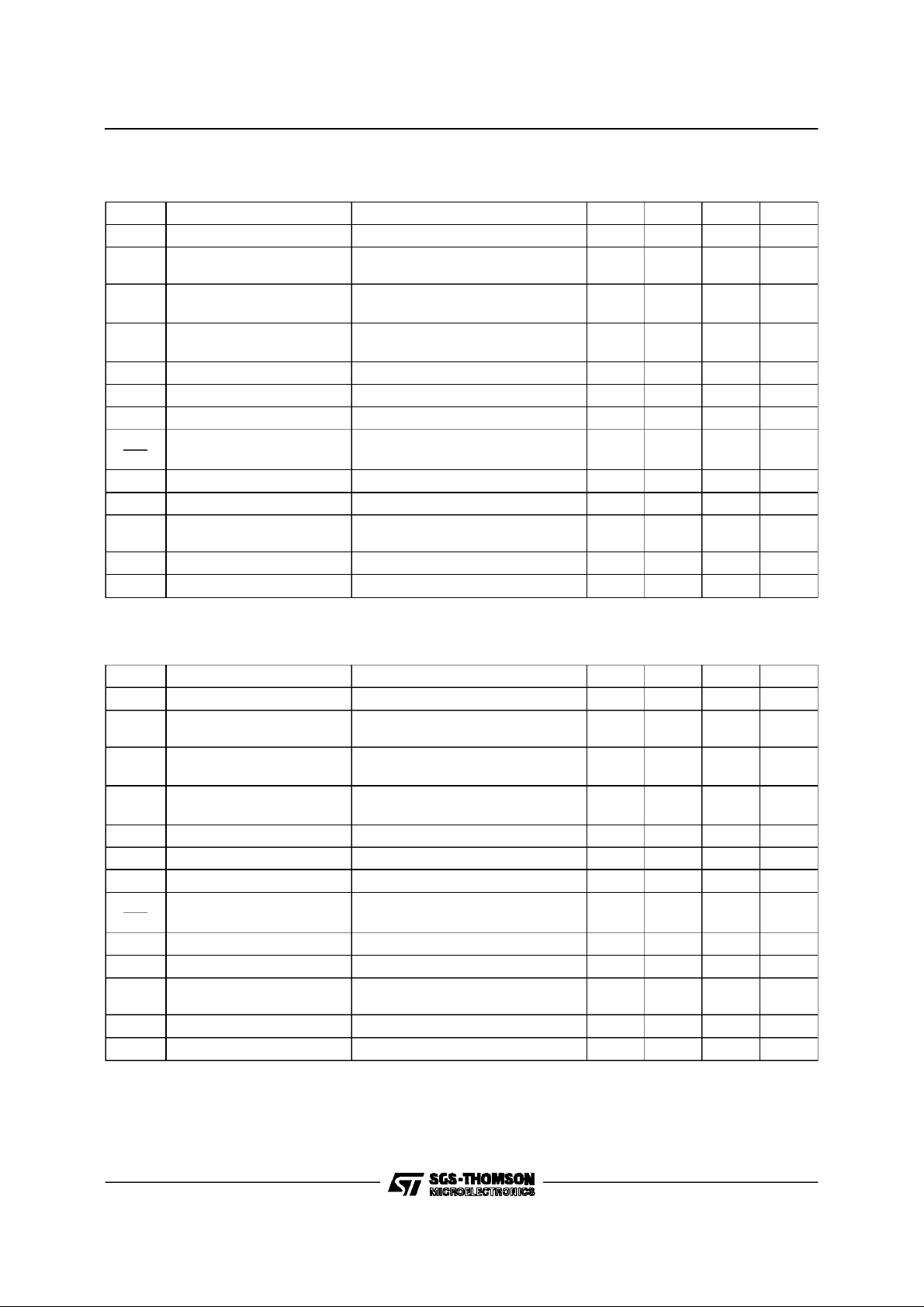
ELECTRICALCHARACTERISTICS FOR L7906C (refer to the test circuits,Tj= 0 to150oC,
=-11V, Io=500 mA, Ci= 2.2 µF, Co=1µF unless otherwise specified)
V
i
Symbol Parameter Test Conditions Min. Typ. Max. Unit
V
OutputVoltage Tj=25oC -5.75 -6 -6.25 V
o
V
OutputVoltage Io=-5mAto-1A Po≤15 W
o
* Line Regulation Vi=-8.5to -25V Tj=25oC
∆V
o
∆V
* Load Regulation Io= 5 to 1500 mA Tj=25oC
o
I
Quiescent Current Tj=25oC3mA
d
∆I
Quiescent Current Change Io= 5 to 1000 mA 0.5 mA
d
∆I
Quiescent Current Change Vi=-9.5to -25V 1.3 mA
d
∆
V
OutputVoltage Drift Io= 5 mA -0.6 mV/oC
o
∆
T
OutputNoise Voltage B = 10Hz to 100KHz Tj=25oC 144 µ V
e
N
SVR Supply Voltage Rejection ∆V
V
Dropout Voltage Io=1A Tj=25oC
d
ShortCircuit Current 2 A
I
sc
I
ShortCircuit Peak Current Tj=25oC2.5A
scp
=-9.5to -21.5 V
V
i
=-9 to -15 V Tj=25oC
V
i
= 250 to 750mA Tj=25oC
I
o
=10V f=120Hz 54 60 dB
i
=100mV
∆V
O
-5.7 -6 -6.3 V
120
60
120
60
1.4 V
mV
mV
mV
mV
ELECTRICALCHARACTERISTICS FOR L7908C (refer to the test circuits,Tj= 0 to150oC,
=-14V, Io=500 mA, Ci= 2.2 µF, Co=1µF unless otherwise specified)
V
i
Symbol Parameter Test Conditions Min. Typ. Max. Unit
V
OutputVoltage Tj=25oC -7.7-8-8.3V
o
V
OutputVoltage Io=-5mAto-1A Po≤15 W
o
* Line Regulation Vi=-10.5to -25 V Tj=25oC
∆V
o
∆V
* Load Regulation Io= 5 to 1500 mA Tj=25oC
o
I
Quiescent Current Tj=25oC3mA
d
∆I
Quiescent Current Change Io= 5 to 1000 mA 0.5 mA
d
∆I
Quiescent Current Change Vi=-11.5to -25 V 1.3 mA
d
∆
V
OutputVoltage Drift Io= 5 mA -0.6 mV/oC
o
∆
T
OutputNoise Voltage B = 10Hz to 100KHz Tj=25oC 175 µ V
e
N
SVR Supply Voltage Rejection ∆V
V
Dropout Voltage Io=1A Tj=25oC
d
ShortCircuit Current 1.5 A
I
sc
I
ShortCircuit Peak Current Tj=25oC2.5A
scp
* Load and line regulation are specified at constant junction temperature. Changes in Vodue to heating effects must be taken into account
separately. Pulce testing with low duty cycle is used.
=-11.5to -23 V
V
i
=-11 to -17V Tj=25oC
V
i
= 250 to 750mA Tj=25oC
I
o
=10V f=120Hz 54 60 dB
i
=100mV
∆V
O
-7.6 -8 -8.4 V
160
80
160
80
mV
mV
mV
mV
1.1 V
4/13
Page 5

L7900
ELECTRICALCHARACTERISTICS FOR L7912C (refer to the test circuits,Tj= 0 to150oC,
=-19V, Io=500 mA, Ci= 2.2 µF, Co=1µF unless otherwise specified)
V
i
Symbol Parameter Test Conditions Min. Typ. Max. Unit
V
OutputVoltage Tj=25oC -11. 5 -12 -12. 5 V
o
V
OutputVoltage Io=-5mAto-1A Po≤15 W
o
* Line Regulation Vi=-14.5to -30 V Tj=25oC
∆V
o
∆V
* Load Regulation Io= 5 to 1500 mA Tj=25oC
o
I
Quiescent Current Tj=25oC3mA
d
∆I
Quiescent Current Change Io= 5 to 1000 mA 0.5 mA
d
∆I
Quiescent Current Change Vi=-15 to -30V 1 mA
d
∆
V
OutputVoltage Drift Io= 5 mA -0.8 mV/oC
o
∆
T
OutputNoise Voltage B = 10Hz to 100KHz Tj=25oC 200 µ V
e
N
SVR Supply Voltage Rejection ∆V
V
Dropout Voltage Io=1A Tj=25oC
d
ShortCircuit Current 1.5 A
I
sc
I
ShortCircuit Peak Current Tj=25oC2.5A
scp
=-15.5to -27 V
V
i
=-16 to -22V Tj=25oC
V
i
= 250 to 750mA Tj=25oC
I
o
=10V f=120Hz 54 60 dB
i
=100mV
∆V
O
-11. 4 -12 -12. 6 V
240
120
240
120
1.1 V
mV
mV
mV
mV
ELECTRICALCHARACTERISTICS FOR L7915C (refer to the test circuits,Tj= 0 to150oC,
=-23V, Io=500 mA, Ci= 2.2 µF, Co=1µF unless otherwise specified)
V
i
Symbol Parameter Test Conditions Min. Typ. Max. Unit
V
OutputVoltage Tj=25oC -14. 4 -15 -15. 6 V
o
V
OutputVoltage Io=-5mAto-1A Po≤15 W
o
* Line Regulation Vi=-17.5to -30 V Tj=25oC
∆V
o
∆V
* Load Regulation Io= 5 to 1500 mA Tj=25oC
o
I
Quiescent Current Tj=25oC3mA
d
∆I
Quiescent Current Change Io= 5 to 1000 mA 0.5 mA
d
∆I
Quiescent Current Change Vi=-18.5to -30 V 1 mA
d
∆
V
OutputVoltage Drift Io= 5 mA -0.9 mV/oC
o
∆
T
OutputNoise Voltage B = 10Hz to 100KHz Tj=25oC 250 µ V
e
N
SVR Supply Voltage Rejection ∆V
V
Dropout Voltage Io=1A Tj=25oC
d
ShortCircuit Current 1.3 A
I
sc
I
ShortCircuit Peak Current Tj=25oC2.2A
scp
* Load and line regulation are specified at constant junction temperature. Changes in Vodue to heating effects must be taken into account
separately. Pulce testing with low duty cycle is used.
=-18.5to -30 V
V
i
=-20 to -26V Tj=25oC
V
i
= 250 to 750mA Tj=25oC
I
o
=10V f=120Hz 54 60 dB
i
=100mV
∆V
O
-14. 3 -15 -15. 7 V
300
150
300
150
mV
mV
mV
mV
1.1 V
5/13
Page 6

L7900
ELECTRICALCHARACTERISTICS FOR L7918C (refer to the test circuits,Tj= 0 to150oC,
=-27V, Io=500 mA, Ci= 2.2 µF, Co=1µF unless otherwise specified)
V
i
Symbol Parameter Test Conditions Min. Typ. Max. Unit
V
OutputVoltage Tj=25oC -17. 3 -18 -18. 7 V
o
V
OutputVoltage Io=-5mAto-1A Po≤15 W
o
* Line Regulation Vi=-21 to -33V Tj=25oC
∆V
o
∆V
* Load Regulation Io= 5 to 1500 mA Tj=25oC
o
I
Quiescent Current Tj=25oC3mA
d
∆I
Quiescent Current Change Io= 5 to 1000 mA 0.5 mA
d
∆I
Quiescent Current Change Vi=-22 to -33V 1 mA
d
∆
V
OutputVoltage Drift Io= 5 mA -1 mV/oC
o
∆
T
OutputNoise Voltage B = 10Hz to 100KHz Tj=25oC 300 µ V
e
N
SVR Supply Voltage Rejection ∆V
V
Dropout Voltage Io=1A Tj=25oC
d
ShortCircuit Current 1.1 A
I
sc
I
ShortCircuit Peak Current Tj=25oC2.2A
scp
=-22 to -33V
V
i
=-24 to -30V Tj=25oC
V
i
= 250 to 750mA Tj=25oC
I
o
=10V f=120Hz 54 60 dB
i
=100mV
∆V
O
-17. 1 -18 -18. 9 V
360
180
360
180
1.1 V
mV
mV
mV
mV
ELECTRICALCHARACTERISTICS FOR L7920C (refer to the test circuits,Tj= 0 to150oC,
=-29V, Io=500 mA, Ci= 2.2 µF, Co=1µF unless otherwise specified)
V
i
Symbol Parameter Test Conditions Min. Typ. Max. Unit
V
OutputVoltage Tj=25oC -19. 2 -20 -20. 8 V
o
V
OutputVoltage Io=-5mAto-1A Po≤15 W
o
* Line Regulation Vi=-23 to -35V Tj=25oC
∆V
o
∆V
* Load Regulation Io= 5 to 1500 mA Tj=25oC
o
I
Quiescent Current Tj=25oC3mA
d
∆I
Quiescent Current Change Io= 5 to 1000 mA 0.5 mA
d
∆I
Quiescent Current Change Vi=-24 to -35V 1 mA
d
∆
V
OutputVoltage Drift Io= 5 mA -1.1 mV/oC
o
∆
T
OutputNoise Voltage B = 10Hz to 100KHz Tj=25oC 350 µ V
e
N
SVR Supply Voltage Rejection ∆V
V
Dropout Voltage Io=1A Tj=25oC
d
ShortCircuit Current 0.9 A
I
sc
I
ShortCircuit Peak Current Tj=25oC2.5A
scp
* Load and line regulation are specified at constant junction temperature. Changes in Vodue to heating effects must be taken into account
separately. Pulce testing with low duty cycle is used.
=-24 to -35V
V
i
=-26 to -32V Tj=25oC
V
i
= 250 to 750mA Tj=25oC
I
o
=10V f=120Hz 54 60 dB
i
=100mV
∆V
O
-19 -20 -21 V
400
200
400
200
mV
mV
mV
mV
1.1 V
6/13
Page 7

L7900
ELECTRICALCHARACTERISTICS FOR L7922C (refer to the test circuits,Tj= 0 to150oC,
=-31V, Io=500 mA, Ci= 2.2 µF, Co=1µF unless otherwise specified)
V
i
Symbol Parameter Test Conditions Min. Typ. Max. Unit
V
OutputVoltage Tj=25oC -21. 1 -22 -22. 9 V
o
V
OutputVoltage Io=-5mAto-1A Po≤15 W
o
* Line Regulation Vi=-25 to -37V Tj=25oC
∆V
o
∆V
* Load Regulation Io= 5 to 1500 mA Tj=25oC
o
I
Quiescent Current Tj=25oC3mA
d
∆I
Quiescent Current Change Io= 5 to 1000 mA 0.5 mA
d
∆I
Quiescent Current Change Vi=-26 to -37V 1 mA
d
∆
V
OutputVoltage Drift Io= 5 mA -1.1 mV/oC
o
∆
T
OutputNoise Voltage B = 10Hz to 100KHz Tj=25oC 375 µ V
e
N
SVR Supply Voltage Rejection ∆V
V
Dropout Voltage Io=1A Tj=25oC
d
ShortCircuit Current 1.1 A
I
sc
I
ShortCircuit Peak Current Tj=25oC2.2A
scp
=-26 to -37V
V
i
=-28 to -34V Tj=25oC
V
i
= 250 to 750mA Tj=25oC
I
o
=10V f=120Hz 54 60 dB
i
=100mV
∆V
O
-20. 9 -22 -23. 1 V
440
220
440
220
1.1 V
mV
mV
mV
mV
ELECTRICALCHARACTERISTICS FOR L7924C (refer to the test circuits,Tj= 0 to150oC,
=-33V, Io=500 mA, Ci= 2.2 µF, Co=1µF unless otherwise specified)
V
i
Symbol Parameter Test Conditions Min. Typ. Max. Unit
V
OutputVoltage Tj=25oC -23 -24 -25 V
o
V
OutputVoltage Io=-5mAto-1A Po≤15 W
o
* Line Regulation Vi=-27 to -38V Tj=25oC
∆V
o
∆V
* Load Regulation Io= 5 to 1500 mA Tj=25oC
o
I
Quiescent Current Tj=25oC3mA
d
∆I
Quiescent Current Change Io= 5 to 1000 mA 0.5 mA
d
∆I
Quiescent Current Change Vi=-27 to -38V 1 mA
d
∆
V
OutputVoltage Drift Io= 5 mA -1 mV/oC
o
∆
T
OutputNoise Voltage B = 10Hz to 100KHz Tj=25oC 400 µ V
e
N
SVR Supply Voltage Rejection ∆V
V
Dropout Voltage Io=1A Tj=25oC
d
ShortCircuit Current 1.1 A
I
sc
I
ShortCircuit Peak Current Tj=25oC2.2A
scp
* Load and line regulation are specified at constant junction temperature. Changes in Vodue to heating effects must be taken into account
separately. Pulce testing with low duty cycle is used.
=-27 to -38V
V
i
=-30 to -36V Tj=25oC
V
i
= 250 to 750mA Tj=25oC
I
o
=10V f=120Hz 54 60 dB
i
=100mV
∆V
O
-22. 8 -24 -25. 2 V
480
240
480
240
mV
mV
mV
mV
1.1 V
7/13
Page 8

L7900
APPLICATIONINFORMATION
Figure1 : Fixed Output Regulator. Figure 2 : Split PowerSupply(± 15V/1A).
Notes :
1. To specify an output voltage, substitute voltage value for ”XX”.
2. Required for stability. For value given, capacitor must be solid
tantalum. If aluminium electrolitics are used, at least ten times
value should be selected. C
appreciable distance from power supply filter.
3. To improve transient response. If large capacitors are used, a
high current diode from input to output (1N4001 or similar) should
be introduced to protect the device from momentary input short
circuit.
is required if regulator is located an
1
Against potential latch-up problems.
Figure3 : Circuit for IncreasingOutput Voltage. Figure 4 : High CurrentNegative Regulator
(– 5V/4Awith 5A currentlimiting).
R
+
R
1
=
V
V
O
XX
2
R
2
V
XX
> 3
I
d
R
2
C3 Optional for improved transient response and ripple rejection.
Figure5 : TypicalECL System Power Supply
(– 5.2V/4A).
Optional dropping resistor to reduce the power dissipated in the
boost transistor.
8/13
Page 9

TO-3 (R) MECHANICALDATA
L7900
DIM.
mm inch
MIN. TYP. MAX. MIN. TYP. MAX.
A 11.7 0.460
B 0.96 1.10 0.037 0.043
C 1.70 0.066
D 8.7 0.342
E 20.0 0.787
G 10.9 0.429
N 16.9 0.665
P 26.2 1.031
R 3.88 4.09 0.152 0.161
U 39.50 1.555
V 30.10 1.185
P
G
U
V
N
O
R
B
DA
C
E
P003N
9/13
Page 10

L7900
TO-220 MECHANICAL DATA
DIM.
MIN. TYP. MAX. MIN. TYP. MAX.
A 4.8 0.189
C 1.37 0.054
D 2.4 2.8 0.094 0.110
D1 1.2 1.35 0.047 0.053
E 0.35 0.55 0.014 0.022
F 0.61 0.94 0.024 0.037
F2 1.15 1.4 0.045 0.055
G 4.95 5.08 5.21 0.195 0.200 0.205
H2 10.4 0.409
H3 10.05 10.4 0.396 0.409
L2 16.2 0.638
L3 26.3 26.7 27.1 1.035 1.051 1.067
L5 2.6 3 0.102 0.118
L6 15.1 15.8 0.594 0.622
L7 6 6.6 0.236 0.260
Dia. 3.65 3.85 0.144 0.152
mm inch
10/13
P011D
Page 11

ISOWATT220MECHANICAL DATA
L7900
DIM.
MIN. TYP. MAX. MIN. TYP. MAX.
A 4.4 4.6 0.173 0.181
B 2.5 2.7 0.098 0.106
D 2.5 2.75 0.098 0.108
E 0.4 0.7 0.015 0.027
F 0.75 1 0.030 0.039
F1 1.15 1.7 0.045 0.067
F2 1.15 1.7 0.045 0.067
G 4.95 5.2 0.195 0.204
G1 2.4 2.7 0.094 0.106
H 10 10.4 0.393 0.409
L2 16 0.630
L3 28.6 30.6 1.126 1.204
L4 9.8 10.6 0.385 0.417
L6 15.9 16.4 0.626 0.645
L7 9 9.3 0.354 0.366
Ø 3 3.2 0.118 0.126
mm inch
E
A
D
B
L3
L6
L7
¯
F1
F
G1
H
G
F2
123
L2
L4
P011G
11/13
Page 12

L7900
TO-263 (D2PAK) MECHANICAL DATA
DIM.
MIN. TYP. MAX. MIN. TYP. MAX.
A 4.3 4.6 0.169 0.181
A1 2.49 2.69 0.098 0.106
B 0.7 0.93 0.027 0.036
B2 1.25 1.4 0.049 0.055
C 0.45 0.6 0.017 0.023
C2 1.21 1.36 0.047 0.053
D 8.95 9.35 0.352 0.368
E 10 10.28 0.393 0.404
G 4.88 5.28 0.192 0.208
L 15 15.85 0.590 0.624
L2 1.27 1.4 0.050 0.055
L3 1.4 1.75 0.055 0.068
mm inch
E
A
C2
L2
D
L
L3
B2
B
A1
C
G
P011P6/C
12/13
Page 13

L7900
Information furnished is believed to be accurateand reliable.However, SGS-THOMSONMicroelectronics assumes no responsabilityfor the
consequences of use of such informationnor for any infringement of patents or other rights of third parties whichmay resultsfrom its use. No
licenseis granted by implication or otherwise underanypatent orpatent rights ofSGS-THOMSON Microelectronics. Specifications mentioned
in this publicationare subject to change without notice.This publicationsupersedesand replaces all informationpreviously supplied.
SGS-THOMSONMicroelectronicsproducts are notauthorizedfor useas critical components in lifesupport devicesor systems withoutexpress
writtenapproval of SGS-THOMSONMicroelectonics.
1997 SGS-THOMSONMicroelectronics- Printedin Italy - All Rights Reserved
Australia- Brazil- Canada- China - France - Germany - Hong Kong- Italy- Japan - Korea - Malaysia - Malta - Morocco- TheNetherlands -
Singapore- Spain- Sweden - Switzerland- Taiwan - Thailand - United Kingdom- U.S.A
SGS-THOMSONMicroelectronics GROUPOF COMPANIES
.
13/13
 Loading...