

Page 1

HA13563, HA13563V
Three-Phase Brushless Motor Driver
ADE-207-218A (Z)
2nd Edition
December 1998
Description
The HA13563/V are 3-phase brushless motor driver ICs with digital speed control. It is designed for use as
a PPC or LBP drum motor driver and provides the functions and features listed below.
Functions
• Three-phase brushless motor driver
• Direct PWM drive
• Digital discriminator plus PLL speed control
• Speed monitor
• Stuck rotor protection
• Current limiter
• Thermal protection (OTSD)
• Low voltage inhibit (LVI)
Features
• Low saturation voltage
• Fly wheel diodes built-in
• FG signal digital filter built-in
Ordering Information
Product No. Package
HA13563 SP-23TA
HA13563V SP-23TB
Page 2
HA13563/V
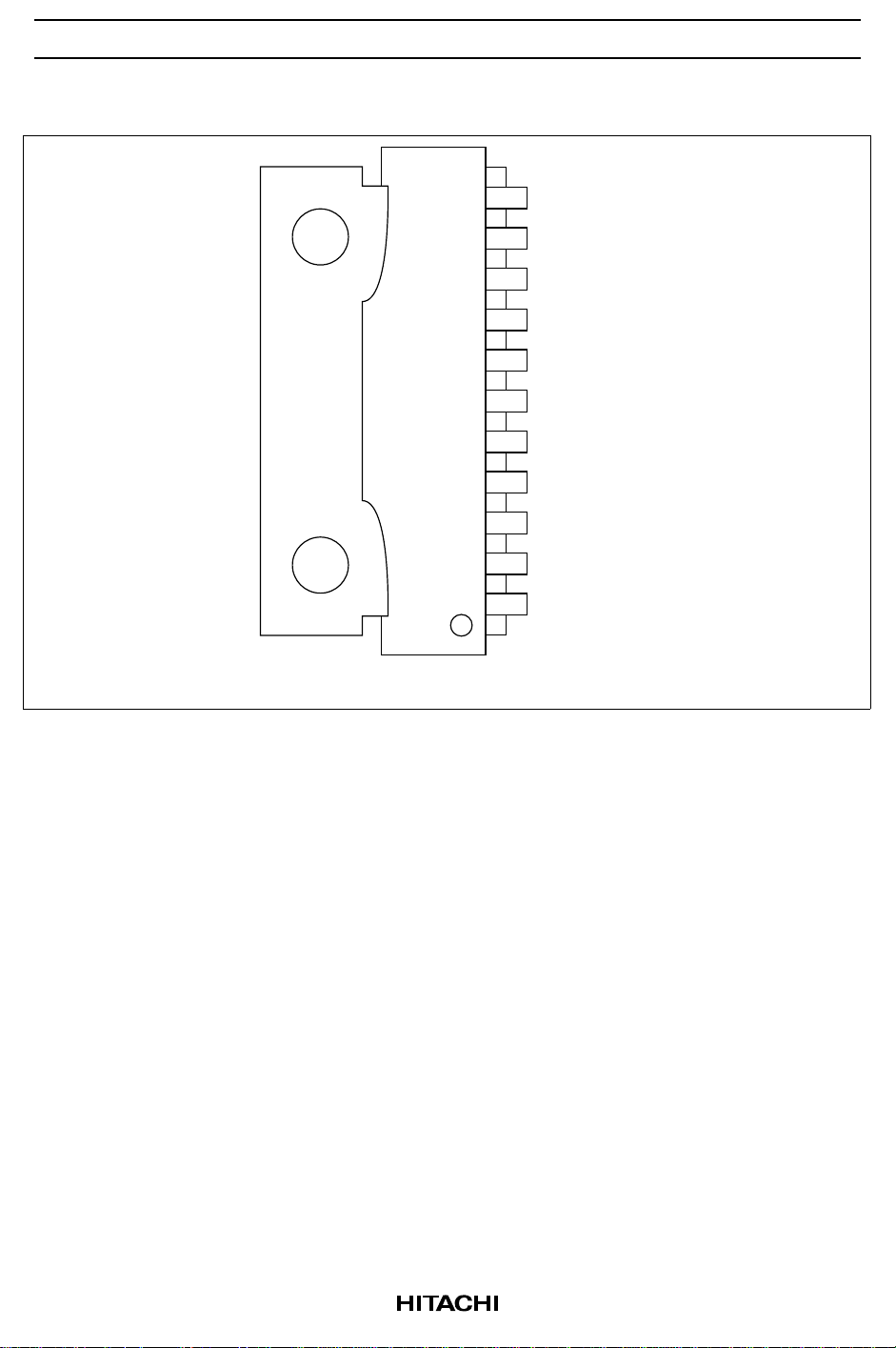
Pin Arrangement
23 R
NF
22 U
21 V
20 W
19 V
CC
18 READY
17 u
16 v
15 w
14 FG+
13 FG−
12 PROT
11 REG
10 PWM
9 CE
8 D2
7 OSC OUT
6 OSC IN
5 PLL OUT
4 DIS OUT
3 INT IN
2 INT OUT
1 GND
(Top view)
2
Page 3
HA13563/V
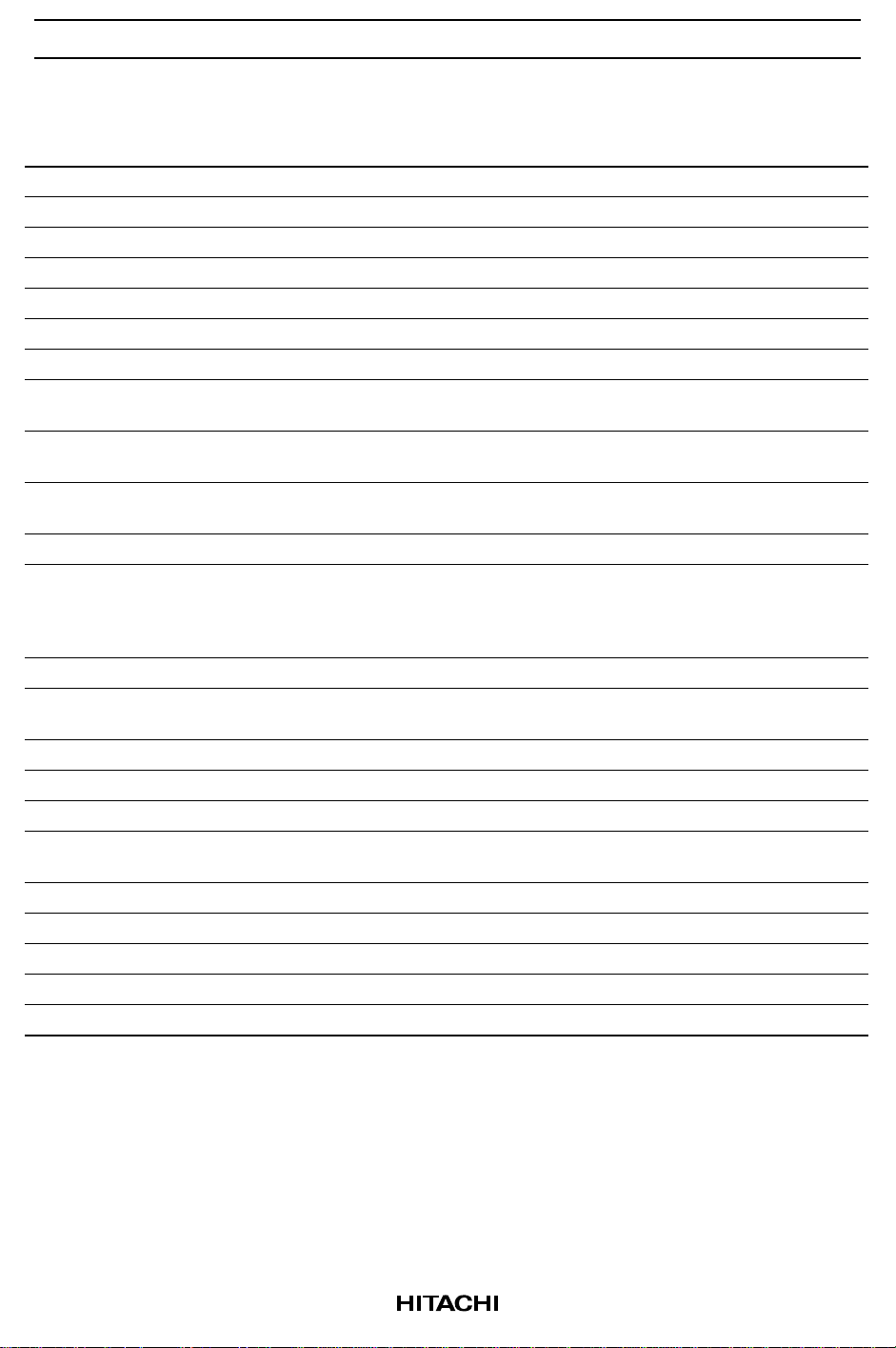
Pin Functions
Pin No. Pin Name Function
1 GND Ground
2 INT OUT Integrator output
3 INT IN Integrator input
4 DIS OUT Speed discriminator output
5 PLL OUT PLL output
6 OSC IN Clock oscillator input. Apply the external clock signal to this pin.
7 OSC OUT Clock oscillator output. Use this pin to monitor the oscillator waveform.
8 D2 Clock divider selector input
High: 1/8, Middle or Open: 1/32, and Low: 1/16.
9 CE Chip enable input
High or Open: stop, Low: drive on.
10 PWM PWM carrier oscillator. An external capacitor to charge and discharge, and an
external resistor must be provided.
11 REG 5 V fixed voltage output. Always output regardless of the state of the CE input.
12 PROT An external capacitor sets the time until the stuck rotor protection circuit
operates. If this pin is shorted to ground, the protection circuit will not operate.
After the stuck rotor protection circuit operates, the IC can be reset by turning the
power off and then on again, or switching CE from low to high.
13 FG– FG amplifier – input.
14 FG+ FG amplifier + input. This pin is used for temperature monitoring. See the
reference data.
15 w The w+ and v– Hall amplifier input
16 v The v+, u– Hall amplifier input
17 u The u+, w– Hall amplifier input
18 READY Speed monitor output. Outputs a low level during fixed speed drive. This is an
open collector output.
19 V
20 W W-phase output
21 V V-phase output
22 U U-phase output
23 R
CC
NF
Power supply
Current detector. Connect a current detection resistor to this pin.
3
Page 4
HA13563/V
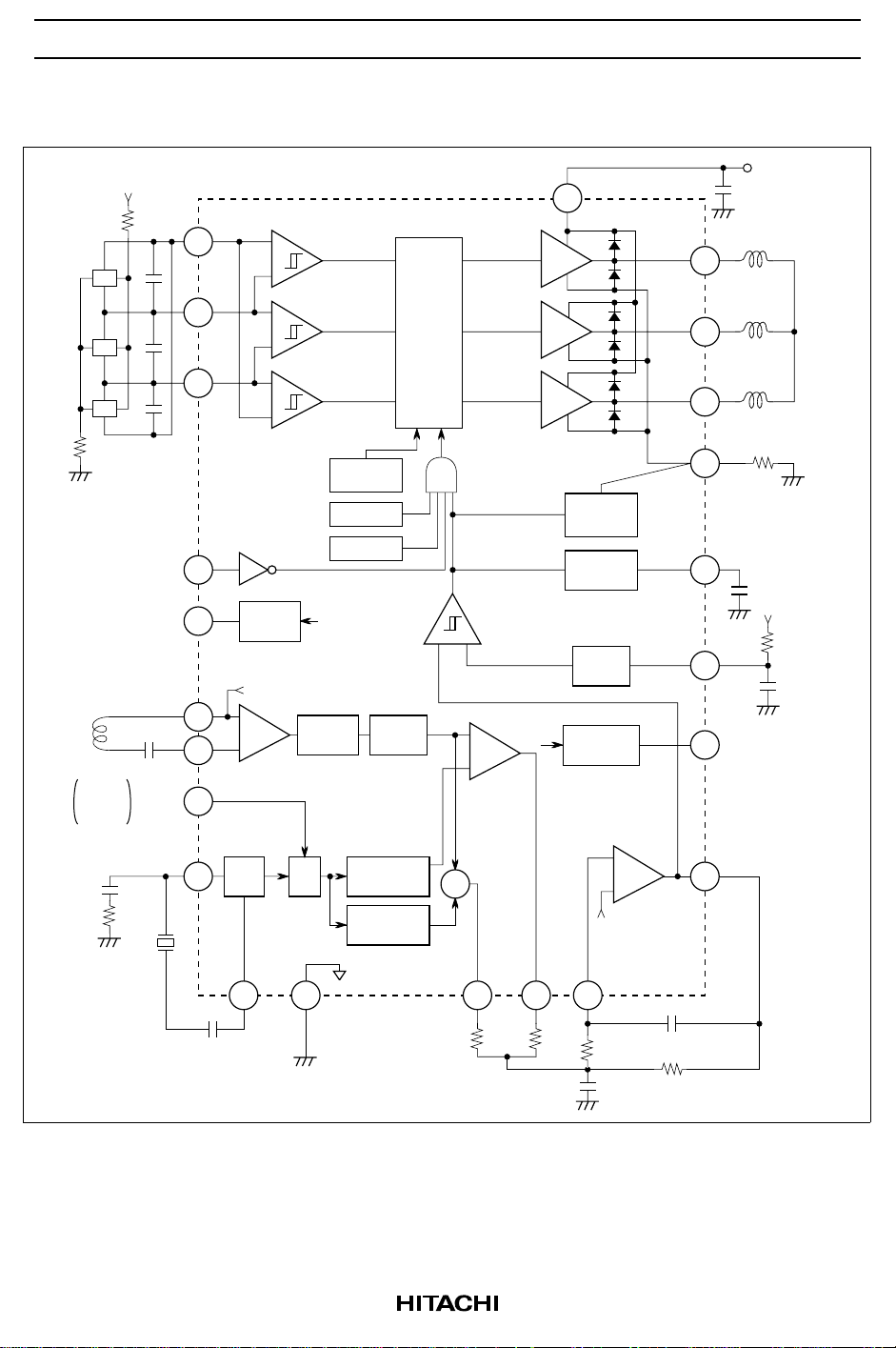
Block Diagram
V
CC
R101
+
Hu
C102C103C104
−
+
Hv
−
+
Hw
−
R102
CE
FG
M:
C109
R103
H:
1/8
1/32
L:
1/16
X'tal
9.2MHz Max
C108
D2
select
Phase
switching
logic
+ −
DIS OUT
Output amplifiers
PLL
−
PLL OUT
R1
R2
Hall amplifiers
17
16
15
9
11
14
13
8
6
C110
+
−
+
−
+
−
Open circuit
protection
LVI
OTSD
PWM
V
REG
FG amplifier
2.1V
+
−
OSC
71 3
shaping
D2
CC
Wave
comparator
Digital
filter
1/1024
Discriminator
54
19
U
V
W
Current
limiter
Vref1
Stuck rotor
protection
PWM
OSC
Speed
monitor
±6.25%
Integrator
2.8V
R3
V
CC
C101
−
+
C2
17.5 to 27.6V
22
21
20
23
12
Ct2
10
Monitor output
Constant speed:
18
Low (O/C)
2
R
NF
Vreg
Rt
Ct1
C1
R4
4
Page 5

Timing Chart
HA13563/V
Hu Hv Hw
Hall element
output
U-phase
output voltage
V-phase
output voltage
W-phase
output voltage
Vhhys
V
CC
PWMPWM
0
V
CC
PWM
0
V
CC
PWMPWM
0
5
Page 6
HA13563/V
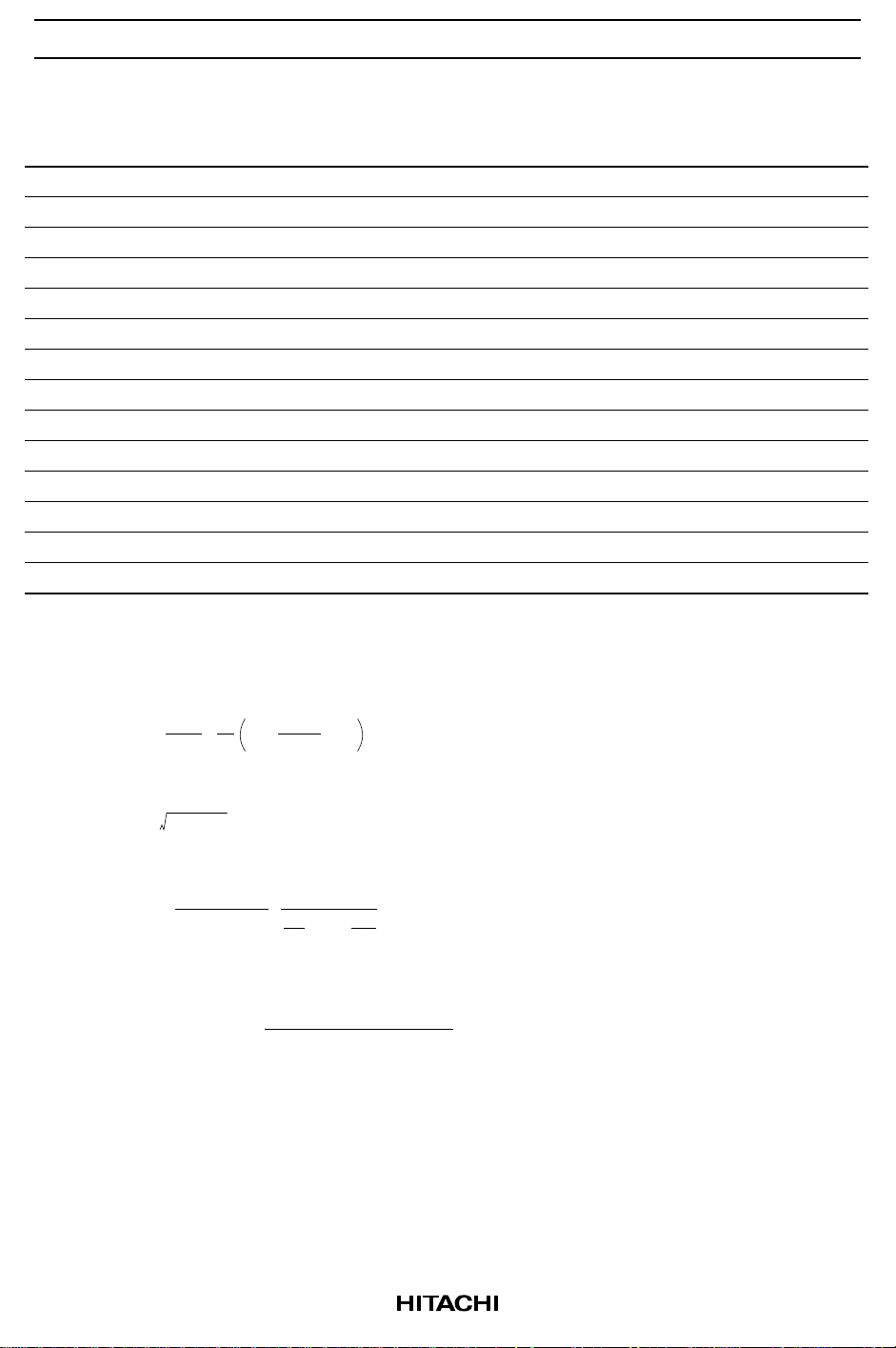
External Components
Part No. Recommended Value Purpose Note
R1 to R4 — Integration constant 1
R101, R102 — Hall element bias 2
R103 1 kΩ Clock oscillator stabilization 9
R
NF
Rt — PWM carrier oscillator time constant 6
C1, C2 — Integration constant 1
C101 ≥ 0.1 µF Power supply bypass 4
C102, C103, C104 0.047 µF Stabilization 4
C108 — FG coupling 5
C109 0.047 µF Clock oscillator stabilization 9
C110 10 pF Crystal coupling 9
Ct1 1000 pF PWM carrier oscillator time constant 6
Ct2 — Stuck rotor protection circuit time constant 7
X’tal — Reference oscillator 8
Notes: 1. Determine the component values using the following as a guidline:
First determine the angular frequency of ω
ω
= 2π · ffg [rad/sec] (1)
P
— Current detection 3
for DIS OUT and PLL OUT.
P
Determine the the angular frequency of ω
9.55
ωM ≈
1
⋅
N
J
O
Determine the ω
ω
= ωP ⋅ ωM[rad/sec]
O
Determine the integrator’s DC gain G
G
(E)
J ⋅ ω
=
9.55 ⋅ KT ⋅ A
Vref1
R
NF
.
O
O
1
⋅
Z
⋅ 2π ⋅
60
L
Kø
ω
[rad/sec]KT ⋅− T
.
(E)
O
where, kφ : PLL gain = 0.4 (V/rad/sec)
− 0.83 ⋅ VE − Vsat
2 V
A =
CC
Rm ⋅ Vosc
Z : FG pulse per round (P/R)
N
: Motor speed (min–1)
O
ω
: Control loop angular frequency (rad/sec)
O
ffg : FG frequency (Hz)
J : Moment of inertia of the motor (kg m
Rm : Motor coil resistance (Ω/T–T)
for motor.
P
(2)
(3)
(4)
2
)
6
Page 7

K
: Torque constant (N•m/A)
T
T
: Rated load torque (N•m)
L
: PWM carrier oscillator amplitude (VPP, See the Electrical Charasteristics)
V
OSC
V
: Motor back EMF (VPP/T–T)
E
R
: Current detection resistor (Ω)
NF
Vref1 : Current limiter reference voltage (See the Electrical Charasteristics)
Vsat : Saturation voltage (See the Electrical Charasteristics)
Set C2 and derive the integration constants from the following formulas.
ω
G
R4
1
⋅ C2
P
(E)
R4 =
R2 =
HA13563/V
(5)
(6)
C1 =
1
2 ⋅ R2 ⋅ ω
O
(7)
R3 = R2 (8)
Next, determine R1 to match the phase of PLL output.
R1 =
When log ω
1.89 ⋅ R4
1.6 − 0.33 ⋅ R4 / R2
is greater than 2, a phase advance to compensate for this phenomenon is
P/ωM
(9)
required. Use the following formula to set the phase advance:
1
C4 ⋅ R5
<
ω
P
20 ⋅ 2
DIS OUT
PLL OUT
R1
R5
C4
R2 C1
R3
R4
2.8V
(10)
C2
−
+
Integrating
amplifier
Figure 1 Integration Constants
2. The Hall output bias voltage is determined by R101 and R102.
3. The output current is controlled according to the following formula:
Iomax =
Vref1
R
NF
Where, Vref1 is the current limiter reference voltage. (See the Electrical Charasteristics)
Mount this resistor as close as possible to the IC and use a resistor with a small inductance
component.
4. Connect these components as close to the IC as possible.
7
Page 8

HA13563/V
5. Determine the component value using the following formula as a guideline:
C108 (µF) =
220
ffg (Hz)
Digital filter time T
T
(sec) =
MASK
of FG signal is determined as follows.
MASK
1
CLK × D22CLK × D2
∼
where, CLK : The reference frequency.
D2 : CLK frequency dividing ratio.
FG signal
wave shaping output
After digital filter
T
MASK
T
MASK
6. The PWM carrier frequency is determined roughly by the following formula:
f
PWM
=
1180
Rt (kΩ) Ct1 (pF)
× 10
3
7. The formula shown below roughly determines the time, Tprot (s), until the stuck rotor protection
circuit operates. Figure 2 shows the operating waveforms. The latched state can be cleared by
either CE or V
. Note that a capacitor with a leakage current sufficiently smaller than the
CC
charging current Ict+ must be used.
Tprot = 0.24 Ct2 (µF)
V
HYS
V
CC
LVI
PROT
H
L
Vref1
R
NF
0
Vth+0.7V
Vth
0
Tprot Tset = 0.004 ⋅ Ct2 (µF) [sec]
CE
I
RNF
V
Figure 2 Stuck Rotor Protection Operating Waveforms
8. The reference frequency CLK (Hz) and the FG frequency ffg (Hz) are related by the following
formula:
1024 ffg
CLK =
8
D2
Page 9

HA13563/V
Also note that the value of the resistor (Rosc) inserted between the external clock and pin 6
when an external clock is used can be calculated from the following formulas:
Rosc ≥ 2 (V
Rosc ≤ 6 (2.1 – V
where, V
If an external clock signal is input to pin 6 through a capacitor (Cosc), we recommend using a 10
pF capacitor for Cosc.
9. The relationship with CLK crystal oscillator frequency refer to the following.
Oscillator f c C110 C109 R103
Crystal 6.0 to 9.2 MHz 10 pF 0.047 µF1 kΩ
– 2.1) – 1.5 (kΩ)
IH
) – 1.5 (kΩ)
IL
: The clock driver high-level voltage.
IH
V
: The clock driver low-level voltage.
IL
2.0 to 6.0 MHz 10 pF Uselessness Uselessness
9
Page 10

HA13563/V
Absolute Maximum Ratings (Ta = 25°C)
Item Symbol Rating Unit Note
Power supply voltage V
CC
Instantaneous output current Iop 3.0 A 2
Steady-state output current I
O
Input voltage Vi –0.3 to 7 V 3
Allowable power dissipation P
T
Junction temperature Tj 150 °C1
Storage temperature Tstg –55 to +125 °C
Notes: 1. The operating ranges are as follows:
V
= 17.5 to 27.6 V
CC
Tjop = –20 to +125°C
2. See the safe operating range data.
3. Applies to the logic input pins.
4. The allowable value when theTAB temperature, Ttab, is 120°C. However, the thermal resistance
is as follows:
θj-c ≤ 3°C/W
θj-a ≤ 40°C/W
30 V 1
2.0 A 2
10 W 4
(A)
C
I
Output Transistor Safe Operation Range
5
3
2
1
0.5
0.2
0.1
1
2
V
(V)
CE
20105
Pulse widths
t = 10ms
t = 5ms
t = 2ms
t = 1ms
30
10
Page 11

HA13563/V
Electrical Characteristics (Ta = 25°C, VCC = 24 V)
Applicable
Item Symbol M in Typ Max Unit Test Conditions
Current Standby current I
drain Current drain with
outputs off
CCO
I
CC
—8 11mACE = H, VCC = 30 V 19
—3244mACE = L, Pin 3 = H,
VCC = 30 V, output
OFF
Logic Low-level voltage Vil1 — — 0.8 V 9
input 1 High-level voltage Vih1 2.0 — — V
Low-level current Iil1 — –0.25 –0.35 mA Vil = 0 V
High-level current Iih1 –0.1 0 0.1 mA Vih = 7 V
Logic Low-level voltage Vil2 — — 1.0 V 8
input 2 Middle-level voltage Vim 2.0 2. 5 3.0 V
High-level voltage Vih2 4.0 — — V
Low-level current Iil2 — –0.25 –0.35 mA Vil = 0 V
Middle-level current Iim — — ±35 µA Vi = 2.5 V
High-level current Iih2 — 0.5 0.7 mA Vih = 7 V
Logic Low-level voltage Vol1 — 0.2 0.4 V Iol = 2 mA 18
output Leakage current Ioh1 — — ±10 µA Voh = 30 V
Hall
amplifier
Commonmode input
voltage range
Differentialmode input
Vh 2.0 — VCC–2 V 15, 16, 17
Vd 60—VCC/2 mV
voltage range
Hysteresis *
1
Vhhys — 20 — mV Rh = 400 Ω
Output Leakage current Icer — — ±100 µA Vce = 30 V 20, 21, 22
amplifier Output drive current I
Saturation voltage *
2
B1
I
B2
Vsat1 — 1.8 2.7 V IO = 2 A
—4964mAI
—3546mAI
= 2 A
O
= 1 A
O
Vsat2 — 1.35 1.7 V IO = 1 A
Impulse response tphl — — 2 µs
time tplh — — 2 µs
tr — — 0.5 µs
tf — — 0.5 µs
Current limiter
Vref1 0.45 0.5 0.55 V 23
reference voltage
Flywheel Forward voltage V
F
— 1.15 1.4 V IF = 1 A 19, 20, 21,
diode Substrate current Isub — 6.5 10 % 22
Pins
11
Page 12

HA13563/V
Electrical Characteristics (Ta = 25°C, VCC = 24 V) (cont)
Applicable
Item Symbol Min Typ Max Unit Test Conditions
PWM
oscillator
and PWM
comparator
Oscillator frequency
range
Oscillator frequency
precision
Oscillator high-level
f
PWM
2.0 — 30 kHz 10
ferr 11.7 13 14.3 kHz Rt1 = 91 kΩ,
Ct1 = 1000 pF
Vosch 2.7 3.0 3.3 V
voltage
Oscillator low-level
Voscl 1.0 1.1 1. 2 V
voltage
Oscillator amplitude Vosc 1.7 1.9 2.1 V
Comparator
hysteresis *
1
Vchys — 20 — mV 2
PP
Vosch – Voscl
Integrator Input current Iin — — ±250 nA 2, 3
High-level voltage Voh2 3.2 3.5 — V IO = –0.5 mA
Low-level voltage Vol2 — 0.9 1.1 V IO = 0.5 mA
Voltage gain *
Gainbandwidth
produc t *
1
Gi —60—dB
Bi — 0.5 — MHz
1
Reference voltage Vp 2.65 2.8 2.95 V
FG amplifier
Input sensitivity vfg 1 5 — 1000 mV
PP
and
waveform
Noise margin nd — — 4.0 mV
PP
shaping
PLL, DIS Ouput high-level
nc — — 1.0 V
Voh3 4.3 4.5 — V IO = –0.1 mA 4, 5
PP
voltage
Ouput low-level
Vol3 — — 0.25 V IO = 0.1 mA
voltage
OSC Oscillator frequency
f
OSC
2 — 9.2 MHz 6, 7
range
Speed
Oscillator frequency
1
error *
Number of counts N — 1023 — Count
∆f
OSC
——±0.01 % X’tal
discriminator
and monitor
Operating frequency
CLK — — 1.15 MHz
range
Lock range LR — ±6.25 — % 18
Pins
13, 14
12
Page 13

HA13563/V
Electrical Characteristics (Ta = 25°C, VCC = 24 V) (cont)
Item Symbol M in Typ Max Unit Test Conditions
REG Output voltage Vreg 4.65 5.0 5.35 V Ireg = 20 mA, CE = L 11
Power supply
regulation
Load regulation ∆Vreg2 — 10 100 mV Ireg = 0 to 20 mA,
Stuck rotor
protection
circuit
LVI Operation cleaning
OTSD Operating
Ct2 charge current Ict+ 18.5 23 27.5 µAV
Ct2 discharge current Ict– 1.0 1.4 — mA
Threshold voltage Vth 4.5 5. 0 5.5 V
3
voltage *
Hysteresis Vhys 0.75 1.1 1.45 V
temperature *
Hysteresis *
1
1
Note: 1 . These are design target values and only checked during development.
2. Stipulated ad the sum of the source and sink values.
3. See figure 3.
∆Vreg1 — 20 100 mV VCC = 17.5 to 27.6 V,
CE = L
CE = L
= 2.5 V 12
PROT
VLVI 12.5 14.7 16.9 V 19
Tsd 125 150 175 °C
Thys — 20 — °C
Applicable
Pins
V
LVI
V
CC
Output on
Output off
Vhys
Figure 3
13
Page 14

HA13563/V
Reference Data
50
CE = Low
Pin 3 = 5V
Tj = 25°C
40
(mA)
CC
30
20
Current Drain I
10
0
0
Current Drain vs.
Supply voltage
10 20 30
Supply voltage V
CC
(V)
Output Saturation voltage vs.
4
VCC = 24V
Tj = 25°C
3
2
1
0
Output Saturation voltage VsatH & VsatL (V)
Output Current
Sink + Source
Source
Sink
1230
Output Current IO (A)
Output Drive Current vs.
100
CE = Low
VCC = 24V
Tj = 25°C
80
(mA)
B
60
40
20
Output Drive Current I
0
0
Output Current
123 0
Output Current IO (A)
Diode Forward Current vs.
5
4
(A)
F
3
2
1
Diode Forward Current I
0
Diode Forward Voltage
VCC = 24V
Tj = 25°C
Diode Forward Voltage VF (V)
12
14
Page 15

HA13563/V
PWM Frequency vs.
30
(kHz)
20
PWM
10
PWM Frequency f
0
−25
Junction Temperature
VCC = 24V
Rt = 91 kΩ
Ct = 1000 p
Junction Temperature Tj (°C)
25 75 125
Current Limiter Reference Voltage vs.
0.8
0.6
0.4
0.2
Current Limiter Reference Voltage Vref1 (V)
−25 25 75 125
Junction Temperature
VCC = 24V
Junction Temperature Tj (°C)
FG+ Pin Voltage vs.
3.0
(V)
2.5
FG+
2.0
FG+ Pin Voltage V
1.5
−25 25 75 125
Junction Temperature
VCC = 24V
−5.17 mV/°C
Junction Temperature Tj (°C)
REG Output Voltage vs.
Output Current
CE = Low
VCC = 24V
5.2
Tj = 25°C
5.1
5.0
REG Output Voltage Vreg (V)
4.9
0 10 20 30
Output Current Ireg (mA)
15
Page 16

HA13563/V
Package Dimensions
14.7 Max
3.6 ± 0.2
1
1.23 ± 0.25
30.0 31.0 Max
28.0 ± 0.3
20.0 ± 0.2
4.1 ± 0.3
1.27
0.6 ± 0.1
2.54
23.97 ± 0.30
23
φ
3.6 ± 0.2
9.0
7.7
1.80 ± 0.25
11.2 ± 0.3
3.8 Max
1.5 Max
+ 0.10
− 0.05
0.25
5.0 Min
6.2 Min
Unit: mm
12.33 ± 0.45
2.2 ± 0.5
16
Hitachi Code
JEDEC
EIAJ
Weight
(reference value)
SP-23TA
4.61 g
Page 17

14.7 Max
3.6 ±0.2
30.0 31.0 Max
28.0 ± 0.3
20.0 ± 0.2
4.1 ± 0.3
φ
3.6 ± 0.2
7.7
9.0
11.2 ± 0.3
3.8 Max
1.5 Max
13.5 ±0.5
HA13563/V
Unit: mm
17.3 Max
1.23 ± 0.25
1.27
2.54
23.97 ± 0.30
0.6 ± 0.1
231
0.925 ± 0.250
Hitachi Code
JEDEC
EIAJ
Weight
6.3 Min
2.2 ± 0.5
(reference value)
1.80 ± 0.25
+ 0.10
0.25
− 0.05
1.275 ± 0.250
SP-23TB
4.6 g
6.0 Min
17
Page 18

Cautions
1. Hitachi neither warrants nor grants licenses of any rights of Hitachi’s or any third party’s patent,
copyright, trademark, or other intellectual property rights for information contained in this document.
Hitachi bears no responsibility for problems that may arise with third party’s rights, including
intellectual property rights, in connection with use of the information contained in this document.
2. Products and product specifications may be subject to change without notice. Confirm that you have
received the latest product standards or specifications before final design, purchase or use.
3. Hitachi makes every attempt to ensure that its products are of high quality and reliability. However,
contact Hitachi’s sales office before using the product in an application that demands especially high
quality and reliability or where its failure or malfunction may directly threaten human life or cause risk
of bodily injury, such as aerospace, aeronautics, nuclear power, combustion control, transportation,
traffic, safety equipment or medical equipment for life support.
4. Design your application so that the product is used within the ranges guaranteed by Hitachi particularly
for maximum rating, operating supply voltage range, heat radiation characteristics, installation
conditions and other characteristics. Hitachi bears no responsibility for failure or damage when used
beyond the guaranteed ranges. Even within the guaranteed ranges, consider normally foreseeable
failure rates or failure modes in semiconductor devices and employ systemic measures such as failsafes, so that the equipment incorporating Hitachi product does not cause bodily injury, fire or other
consequential damage due to operation of the Hitachi product.
5. This product is not designed to be radiation resistant.
6. No one is permitted to reproduce or duplicate, in any form, the whole or part of this document without
written approval from Hitachi.
7. Contact Hitachi’s sales office for any questions regarding this document or Hitachi semiconductor
products.
Hitachi, Ltd.
Semiconductor & Integrated Circuits.
Nippon Bldg., 2-6-2, Ohte-machi, Chiyoda-ku, Tokyo 100-0004, Japan
Tel: Tokyo (03) 3270-2111 Fax: (03) 3270-5109
URL NorthAmerica : http:semiconductor.hitachi.com/
For further information write to:
Hitachi Semiconductor
(America) Inc.
179 East Tasman Drive,
San Jose,CA 95134
Tel: <1> (408) 433-1990
Fax: <1>(408) 433-0223
Europe : http://www.hitachi-eu.com/hel/ecg
Asia (Singapore) : http://www.has.hitachi.com.sg/grp3/sicd/index.htm
Asia (Taiwan) : http://www.hitachi.com.tw/E/Product/SICD_Frame.htm
Asia (HongKong) : http://www.hitachi.com.hk/eng/bo/grp3/index.htm
Japan : http://www.hitachi.co.jp/Sicd/indx.htm
Hitachi Europe GmbH
Electronic components Group
Dornacher Stra§e 3
D-85622 Feldkirchen, Munich
Germany
Tel: <49> (89) 9 9180-0
Fax: <49> (89) 9 29 30 00
Hitachi Europe Ltd.
Electronic Components Group.
Whitebrook Park
Lower Cookham Road
Maidenhead
Berkshire SL6 8YA, United Kingdom
Tel: <44> (1628) 585000
Fax: <44> (1628) 778322
Hitachi Asia Pte. Ltd.
16 Collyer Quay #20-00
Hitachi Tower
Singapore 049318
Tel: 535-2100
Fax: 535-1533
Hitachi Asia Ltd.
Taipei Branch Office
3F, Hung Kuo Building. No.167,
Tun-Hwa North Road, Taipei (105)
Tel: <886> (2) 2718-3666
Fax: <886> (2) 2718-8180
Copyright ' Hitachi, Ltd., 1999. All rights reserved. Printed in Japan.
Hitachi Asia (Hong Kong) Ltd.
Group III (Electronic Components)
7/F., North Tower, World Finance Centre,
Harbour City, Canton Road, Tsim Sha Tsui,
Kowloon, Hong Kong
Tel: <852> (2) 735 9218
Fax: <852> (2) 730 0281
Telex: 40815 HITEC HX
 Loading...