

Page 1
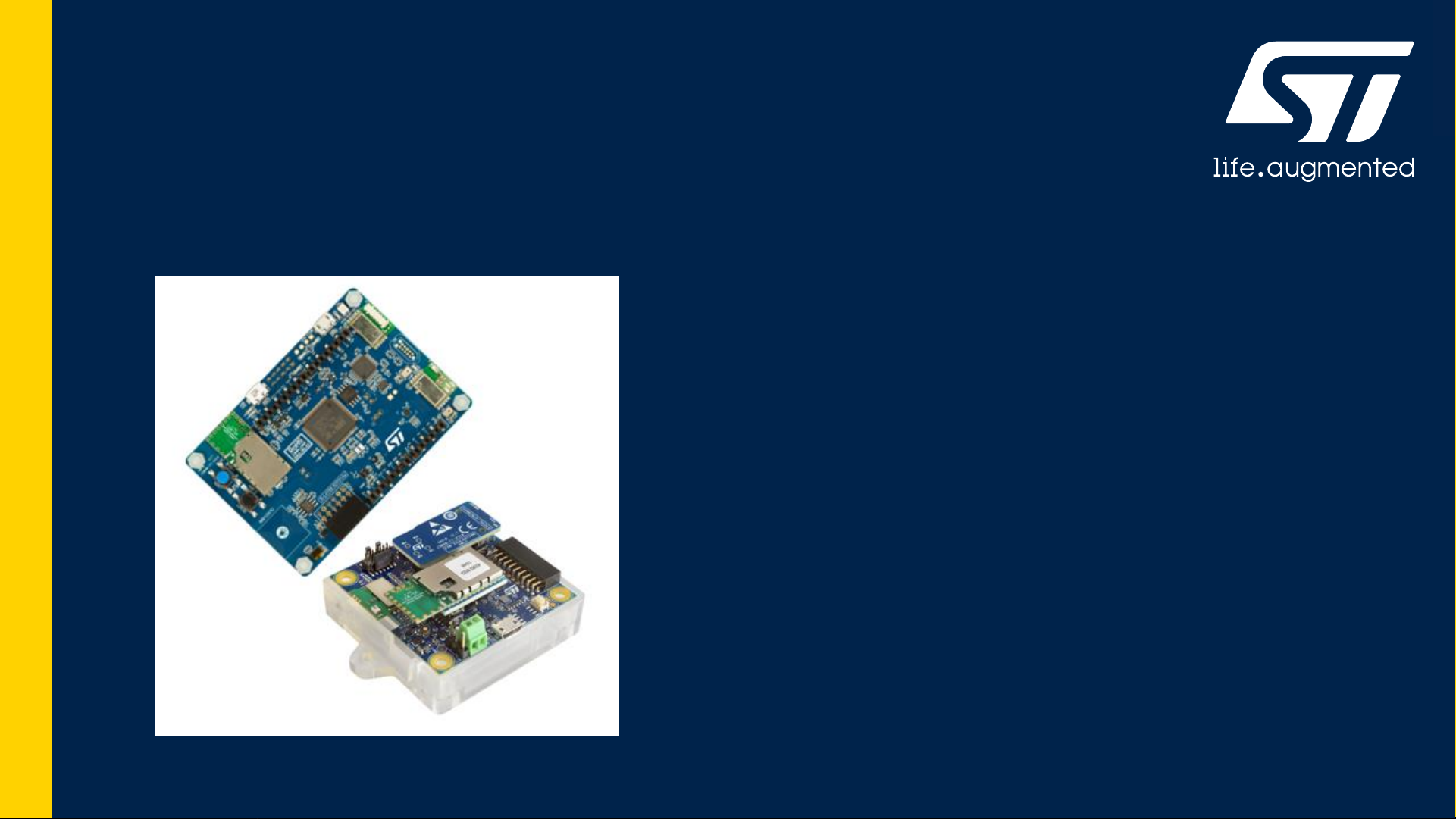
Quick Start Guide
STM32Cube function pack for IoT sensor node
with telemetry and device management
applications for Microsoft Azure cloud
(FP-CLD-AZURE1)
Version 5.2 (March 08, 2021)
Page 2

Agenda
1
Hardware and Software overview
3
Documents & Related Resources
4
STM32 Open Development Environment: Overview
2
2
Setup & Demo Examples
Page 3

1- Hardware and Software overview
Page 4
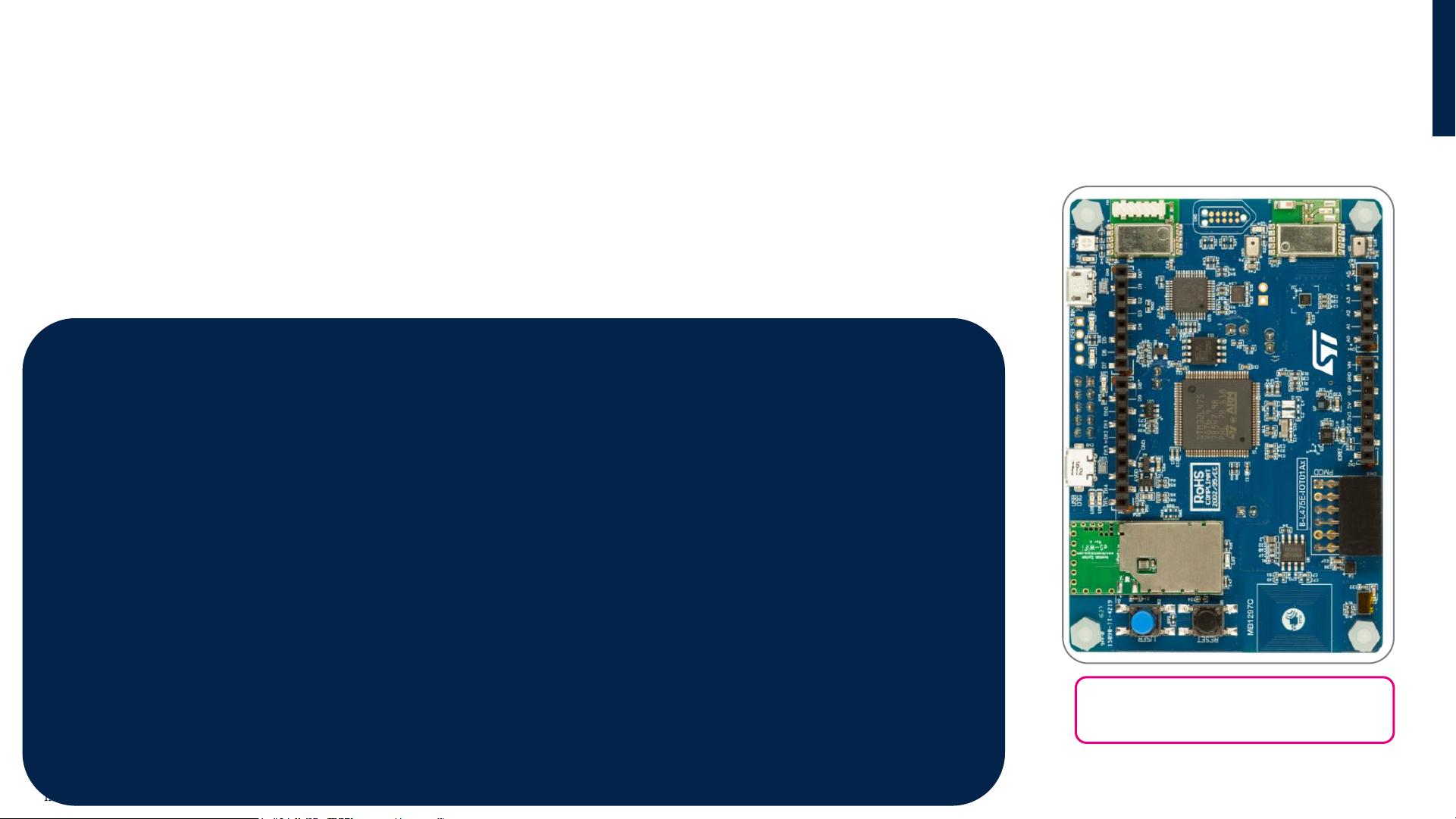
STM32L4 Discovery Board for IoT node (B-L475E-IOT01A)
Hardware Overview
STM32L4 Discovery Board for IoT node Hardware Description
The STM32L4 Discovery kit for the IoT node (B-L475E-IOT01A) allows users to develop applications with direct
connection to cloud servers. The STM32L4 Discovery kit enables a wide diversity of applications by exploiting lowpower multilink communication (BLE, Sub- GHz), multiway sensing (detection, environmental awareness) and ARM®
Cortex®-M4 core-based STM32L4 Series features. Arduino™ Uno V3 and PMOD connectivity provide unlimited
expansion capabilities with a large choice of specialized add-on boards.
Key Product on board
• Ultra-low-power STM32L4 Series MCUs based on ARM® Cortex® -M4 core with 1 Mbyte of Flash memory and 128 Kbytes
of SRAM, in LQFP100 package
• Bluetooth® V4.1 module (SPBTLE-RF)
• Sub-GHz (868 or 915 MHz) low-power-programmable RF module (SPSGRF-868 or SPSGRF-915)
• Wi-Fi® module Inventek ISM43362-M3G-L44 (802.11 b/g/n compliant)
• Dynamic NFC tag based on M24SR with its printed NFC antenna
• 2 digital omnidirectional microphones (MP34DT01)
• Capacitive digital sensor for relative humidity and temperature (HTS221)
• High-performance 3-axis magnetometer (LIS3MDL), 3D accelerometer and 3D gyroscope (LSM6DSL), 260-1260 hPa
absolute digital output barometer (LPS22HB), Time-of-Flight and gesture-detection sensor (VL53L0X)
• USB OTG FS with Micro-AB connector
• Expansion connectors: Arduino™ Uno V3, PMOD
• Flexible power-supply options: ST LINK USB VBUS or external sources
• On-board ST-LINK/V2-1 debugger/programmer with USB re-enumeration capability: mass storage, virtual COM port and
debug port
Latest info available at www.st.com
B-L475E-IOT01A
Page 5
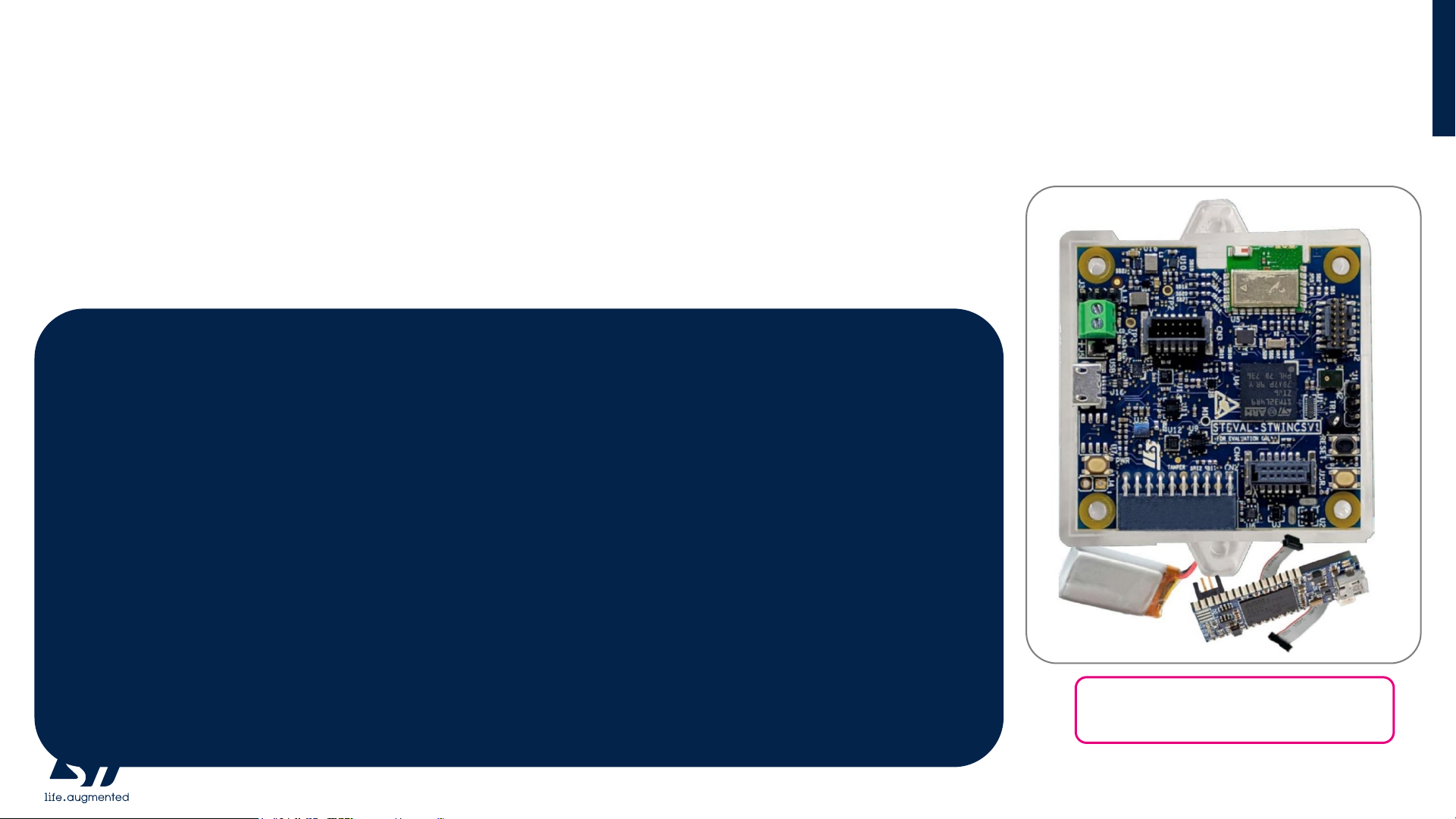
STWIN SensorTile Wireless Industrial Node development kit
(STEVAL-STWINKT1)
Hardware Overview
STWIN SensorTile Wireless Industrial Node development kit Hardware
Description
The STWIN SensorTile wireless industrial node (STEVAL-STWINKT1) is a development kit and reference design that
simplifies prototyping and testing of advanced industrial IoT applications such as condition monitoring and predictive
maintenance. The kit supports BLE wireless connectivity through an on-board module, and Wi-Fi connectivity through
a special plugin expansion board (STEVAL-STWINWFV1).
Key Product on board
• Multi-sensing wireless platform implementing vibration monitoring and ultrasound detection
• Built around STWIN core system board with processing, sensing, connectivity and expansion capabilities
• Micro SD Card slot for standalone data logging applications
• Wireless BLE4.2 (on-board) and Wi-Fi (with STEVAL-STWINWFV1 expansion board), and wired RS485 and USB OTG
connectivity
• Option to implement Authentication and Brand protection secure solution with STSAFE-A110 (footprint)
• Wide range of industrial IoT sensors: ultra-wide bandwidth (up to 6 kHz), low-noise, 3-axis digital vibration sensor
(IIS3DWB), 3D accelerometer + 3D Gyro iNEMO inertial measurement unit (ISM330DHCX) with machine learning core,
ultra-low-power high performance MEMS motion sensor (IIS2DH), 3-axis magnetometer (IIS2MDC), digital absolute
pressure sensor (LPS22HH), relative humidity and temperature sensor (HTS221) and low-voltage digital local
temperature sensor (STTS751)
• industrial grade digital MEMS microphone (IMP34DT05) and wideband analog MEMS microphone (MP23ABS1)
• Modular architecture, expandable via on-board connectors: STMOD+ and 40-pin flex general purpose expansions, 12-pin
male plug for connectivity expansions and 12-pin female plug for sensing expansions
• Other kit components: Li-Po battery 480 mAh, STLINK-V3MINI debugger with programming cable and Plastic box
Latest info available at www.st.com
STEVAL-STWINKIT1
Page 6
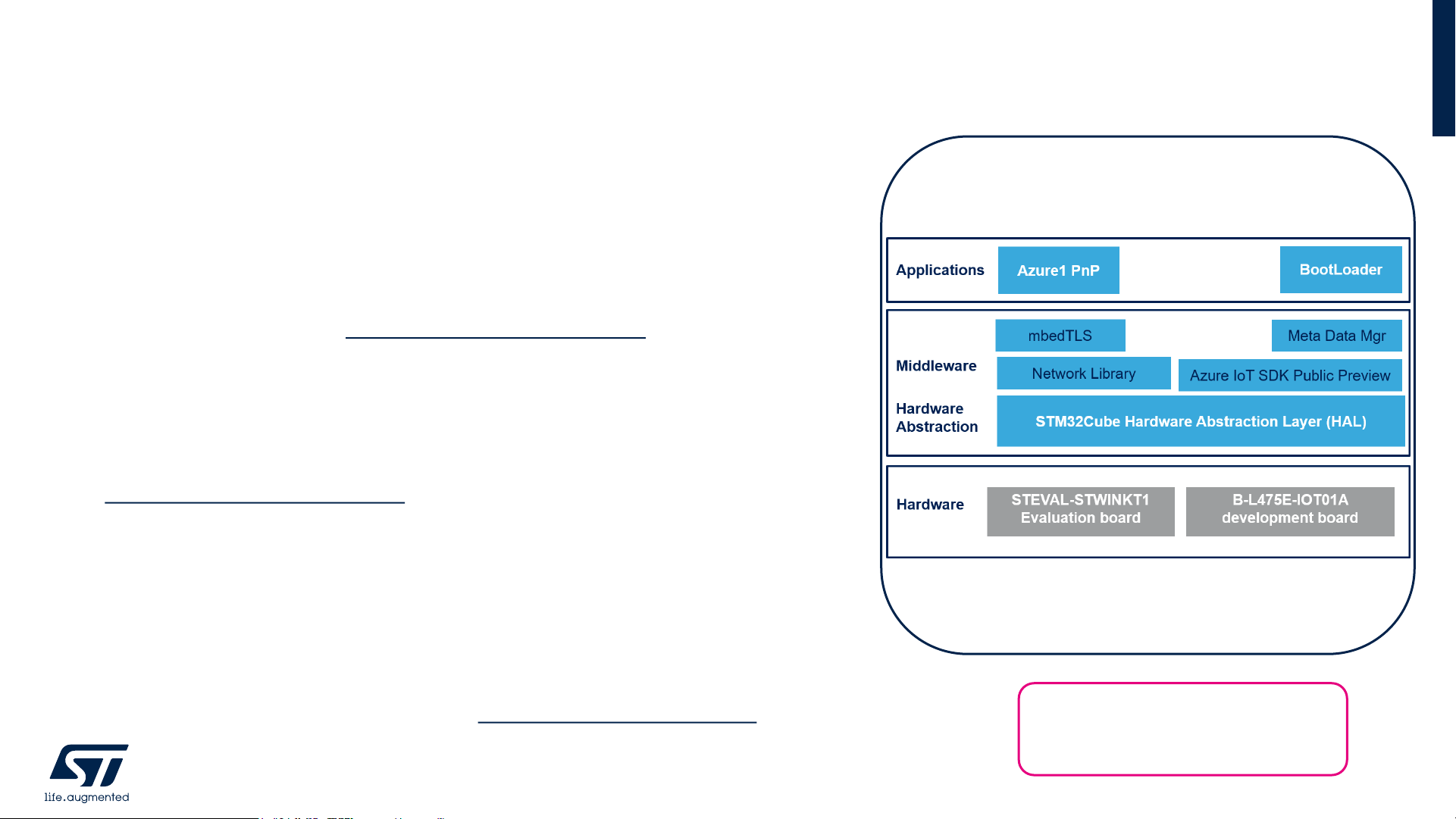
FP-CLD-AZURE1
Software Overview
6
FP-CLD-AZURE1 Software Description
FP-CLD-AZURE1 is an STM32Cube Function Pack. Thanks to this package you can
directly connect your IoT sensor node to the Microsoft Azure IoT, transmit sensor
data, and receive commands from Cloud applications.
Key features
• Complete firmware to safely connect an IoT node with sensors and actuators to
Microsoft Azure IoT using Wi-Fi communication technology. One sample
application for data telmetry/device management that can be connected to
«Azure IoT Central PnP» (https://apps.azureiotcentral.com)
• Capability to setup Wi-Fi SSD/Passwd using UART console or Bluetooth with
ST BLE Sensors application for Android/iOS (Version >4.7.1)
• Middleware libraries featuring the Microsoft Azure IoT software development kit,
transport-level security (mbedTLS), and metadata management
• Ready-to-use binaries to connect the IoT node «Azure IoT Central PnP»
(https://apps.azureiotcentral.com) for sensor data visualization, actuator control,
and device management (FOTA)
• Sample implementations available for STM32L4 Discovery Kit for IoT node (BL475E-IOT01A) and on STWIN SensorTile Wireless Industrial Node
development kit (STEVAL-STWINKT1)
• Easy portability across different MCU families, thanks to STM32Cube
• Free, user-friendly license terms
• STM32 Nucleo is Microsoft Azure certified for IoT (for more information on
Microsoft Azure Certification please visit http://azure.com/certifiedforiot)
Overall Software Architecture
FP-CLD-AZURE1
Latest info available at www.st.com
Page 7

2- Setup & Demo Examples
Page 8
Setup & Application Examples
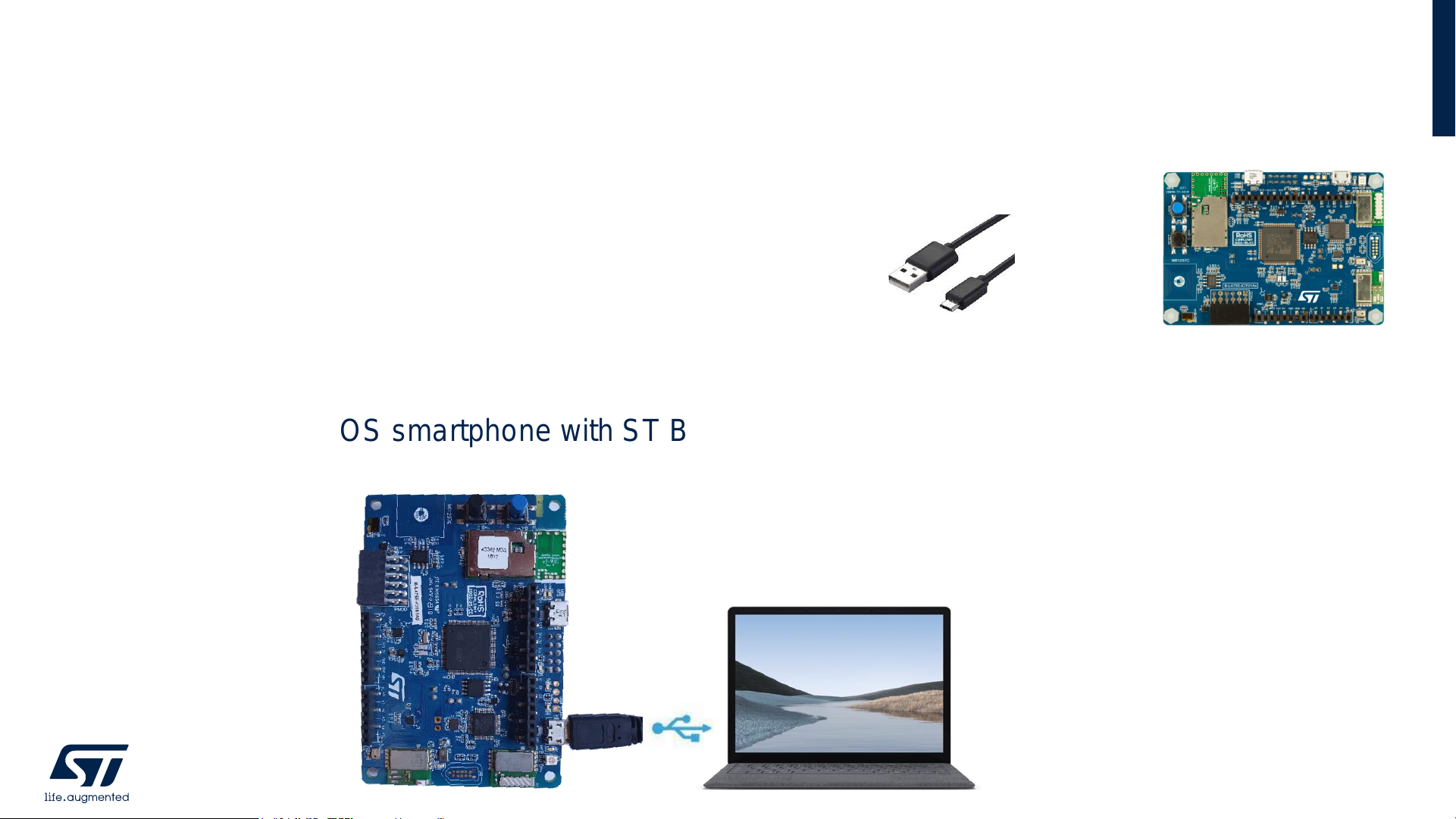
HW prerequisites for B-L475E-IOT01A
8
• 1x B-L475E-IOT01A development board
• Laptop/PC with Windows 7, 8 or 10
• 1 x microUSB cable
• Wi-Fi Router or access to a Wi-Fi network
• (optional) Android/iOS smartphone with ST BLE Sensor application (Version > 4.7.1)
B-L475E-IOT01A
MicroUSB Cable
Page 9

Setup & Application Examples
HW prerequisites for STEVAL-STWINKT1
9
• 1x STEVAL-STWINKT1 development board
• Laptop/PC with Windows 7, 8 or 10
• 2 x microUSB cables
• STEVAL-STWINWFV1
• Wi-Fi Router or access to a Wi-Fi network
• (optional) Android/iOS smartphone with ST BLE Sensor application (Version > 4.7.1)
STEVAL-STWINKT1
MicroUSB Cable
STEVAL-STWINWFV1
Page 10

Setup & Application Examples
Software and Other prerequisites
10
• STM32 ST-Link Utility
• Download and install STSW-LINK004 from www.st.com
• FP-CLD-AZURE1
• Download the FP-CLD-AZURE1 package from www.st.com, copy the .zip file contents into a folder on your PC. The
package contains binaries and source code with project files (Keil, IAR, STM32CubeIDE) based on B-L475EIOT01A/STEVAL-STWINKT1.
• Serial line monitor, e.g. TeraTerm (https://ttssh2.osdn.jp/)
• To test FP-CLD-AZURE1 with IoT Central PnP, in order to use the application template, copy this link to your
web browser:
https://apps.azureiotcentral.com/build/new/9aee24e1-6f99-4123-9d7d-9d50d19302b2
Then create your application starting from this application template.
Page 11

FP-CLD-AZURE1. Sample applications
Start coding in just a few minutes
11
Download & unpack
1
FP-CLD-AZURE1
Select Function Pack:
2
3
4
5
6
Visualize log of sensors data and
control the device
www.st.com/stm32ode
Use the pre-compiled binaries for registering your
devices
FP-CLD-AZURE1 package structure
Docs
BSP, HAL
drivers
Azure IoT SDK,
mbedTLS
Microsoft Azure
Client sample
applications
BootLoader
Page 12

2.1- Test FP-CLD-AZURE1 with
IoT Central PnP
Page 13

13
FP-CLD-AZURE1. Step by step setup
Launch sample application. Configure Serial Terminal
• Open a serial terminal and then configure the baud rate speed to 115200 (Setup → Serial port in TeraTerm) and set the
transmit delay:
Page 14

14
• The pre-compiled binary are in AzurePnP\Binary folder (Example STEVAL-STWINKT1):
• Projects\STWINCSV1\Applications\AzurePnP\Binary\Azure1_BL.bin (Program + BootLoader)
• Projects\STWINCSV1\Applications\AzurePnP\Binary\Azure1.bin (Use Only for FOTA)
• To start the application:
• Connect your board to your PC
• Using Explorer, drag the binary to the board’s USB storage
FP-CLD-AZURE1. Step by step setup
Launch sample application. Use pre-compiled binary
Page 15

15
• Go to the following URL using your web browser:
https://apps.azureiotcentral.com/build/new/9aee24e1-6f99-4123-9d7d-9d50d19302b2
• Select the application name
• Select the “Pricing plan”
FP-CLD-AZURE1. Step by step setup
Create one IoT Central PnP application
Page 16

16
FP-CLD-AZURE1. Step by step setup
Create one device
Devices
Select device
template which
matches your board
Add one Device
1
2
3
Page 17

17
FP-CLD-AZURE1. Step by step setup
Retrieve Device Connection informations
Click on
Connect
1
Take the:
- ID Scope
- Device ID
- Primary key
2
Page 18

18
FP-CLD-AZURE1. Step by step setup
Configure Wi-Fi parameters
• Open a serial terminal to visualize the log of
messages
• Default values for Wi-Fi SSID and PWD
can be modified by pressing the USER (blue)
button within 3 seconds of boot:
• pressing the button 1 time, the firmware will ask to add
the credentials using the serial port
• Press y for changing the Wi-Fi credentials
• Then enter SSID, PWD and
Encryption mode when requested
• pressing the button 2 times, the firmware will start the
Bluetooth and it will wait the Wi-Fi credentials from ST
BLE sensors Android/iOS application
• This data will be saved in flash
Page 19

19
• After the Wi-Fi configuration, the board will ask to
you to add:
1) The “ID scope”
(as shown in the previous slides)
• Answer NO to the next question on
Automatic Group enrollment Configured
2) The “Device ID”
(as shown in the previous slides)
3) The “Primary Key”
(as shown in the previous slide)
• This data will be saved in flash
FP-CLD-AZURE1. Step by step setup
Add your Device
Page 20

20
FP-CLD-AZURE1. Step by step setup
Visualize sensors data and control the board
Page 21

3- Documents & Related Resources
Page 22

Documents & Related Resources
FP-CLD-AZURE1:
• DB2891: STM32Cube function pack for wireless sensor node connected to MicrosoftAzure Cloud – databrief
• UM2043: Getting started with the FP-CLD-AZURE1 software B-L475E-IOT01A/STEVAL-STWINKT1 node with Wi-Fi and sensors connected
to MicrosoftAzure cloud – user manual
• Software setup file
STEVAL-STWINKT1:
• Gerber files, BOM, Schematic
• DB3969: STWIN SensorTile Wireless Industrial Node development kit and reference design for industrial IoT applications – databrief
• UM2622: How to use the STEVAL-STWINKT1 SensorTile Wireless Industrial Node for condition monitoring and predictive maintenance
applications – user manual
STEVAL-STWINWFV1:
• Gerber files, BOM, Schematic
• DB3971: Wi-Fi expansion for the SensorTile Wireless Industrial Node (STWIN) kit - databrief
B-L475E-IOT01A:
• Gerber files, BOM, Schematic
• DB3143: Discovery kit for IoT node, multi-channel communication with STM32L4 – databrief
• UM2153: Discovery kit for IoT node, multi-channel communication with STM32L4 – user manual
• UM2052: Getting started with STM32 MCU Discovery Kits software development tools – user manual
22
All documents are available in the DESIGN tab of the related products webpage
Consult www.st.com for the complete list
Page 23

4- STM32 Open Development
Environment: Overview
Page 24

STM32 Open Development Environment
Fast, affordable Prototyping and Development
24
• The STM32 Open Development Environment (STM32 ODE) is an open, flexible, easy, and affordable way
to develop innovative devices and applications based on the STM32 32-bit microcontroller family combined
with other state-of-the-art ST components connected via expansion boards. It enables fast prototyping with
leading-edge components that can quickly be transformed into final designs
For further information, please visit www.st.com/stm32ode
Function Packs
(FP)
STM32Cube
development software
STM32 Nucleo
expansion boards
(X-NUCLEO)
STM32 Nucleo
development boards
STM32Cube
expansion software
(X-CUBE)
Page 25

© STMicroelectronics - All rights reserved.
The STMicroelectronics corporate logo is a registered trademark of the STMicroelectronics
group of companies. All other names are the property of their respective owners.
Thank you
 Loading...