

Page 1
GENERAL DESCRIPTION
The EMC ADB Mouse Controller is a mouse controller for apple mouse system.
The following functions are supported:
• Controller receives command or data from Host.
• Controller transmits data to Host.
FEATURES
• Two-button mouse and trackball controller.
• Key Lock function is available.
• Both photo discharge and non-discharge modes are available.
• Discharge mode can reduce X,Y DC offset level.
• Dynamic LEDs Control to reduce system power consumption.
• Four stages sample rate at 1KHz,2.5KHz,5KHz,10KHz.
• Include Noise Immunity methodology to avoid false entry.
• Operating frequence at 3.58MHz.
• 18 Pin DIP.
EM85000
EM85000
APPLE DESKTOP BUS MOUSE CONTROLLER
APPLE DESKTOP BUS MOUSE CONTROLLER
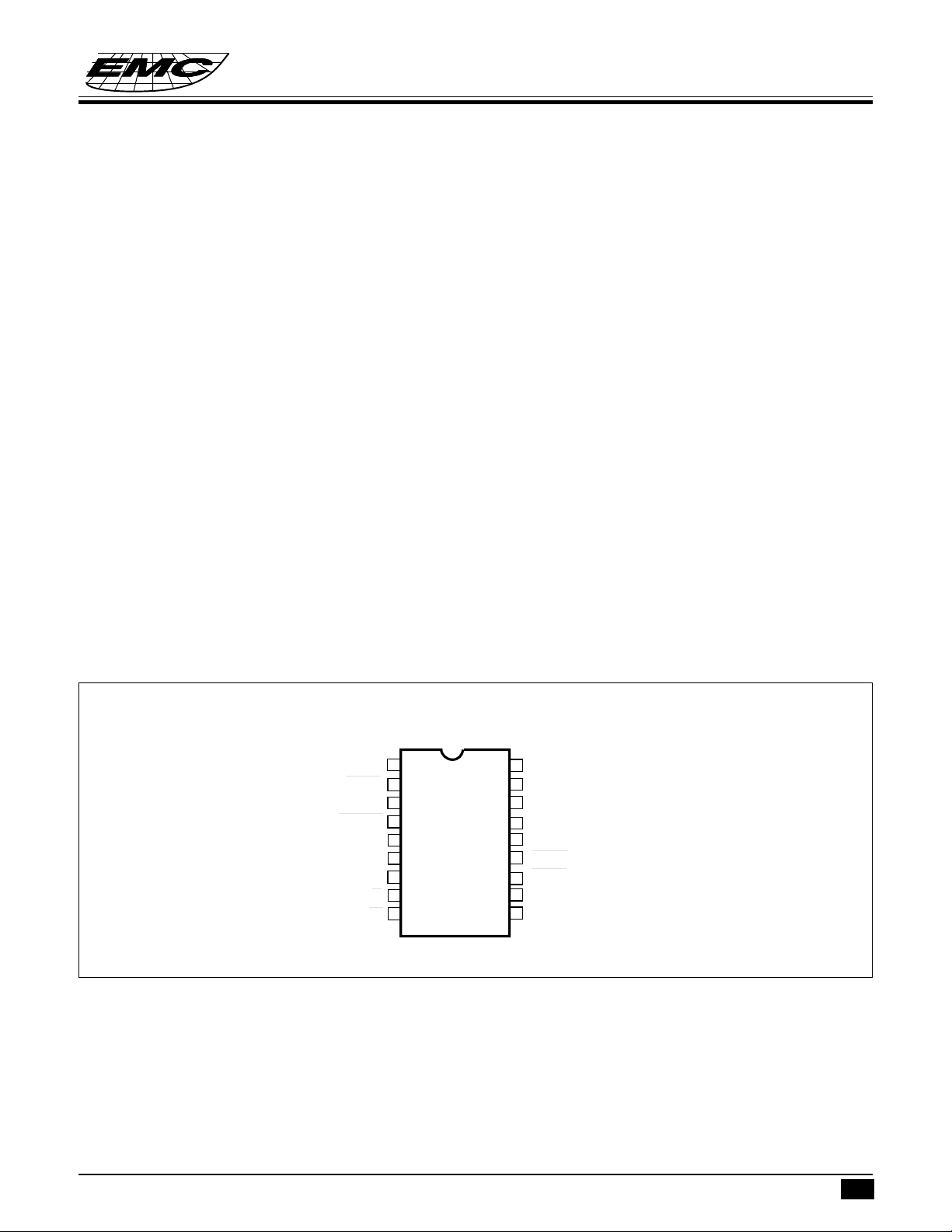
PIN ASSIGNMENTS
DISC
LLED
VDD
RESET
VSS
X1
X2
EM85000
1
2
3
4
5
6
7
R
8
M
9
18
17
16
15
14
13
12
11
10
DIN
DOUT
OSCI
OSCO
VDD
DLED
LOCK
Y1
Y2
* This specification are subject to be changed without notice.
11.6.1995
1
Page 2
APPLE DESKTOP BUS MOUSE CONTROLLER
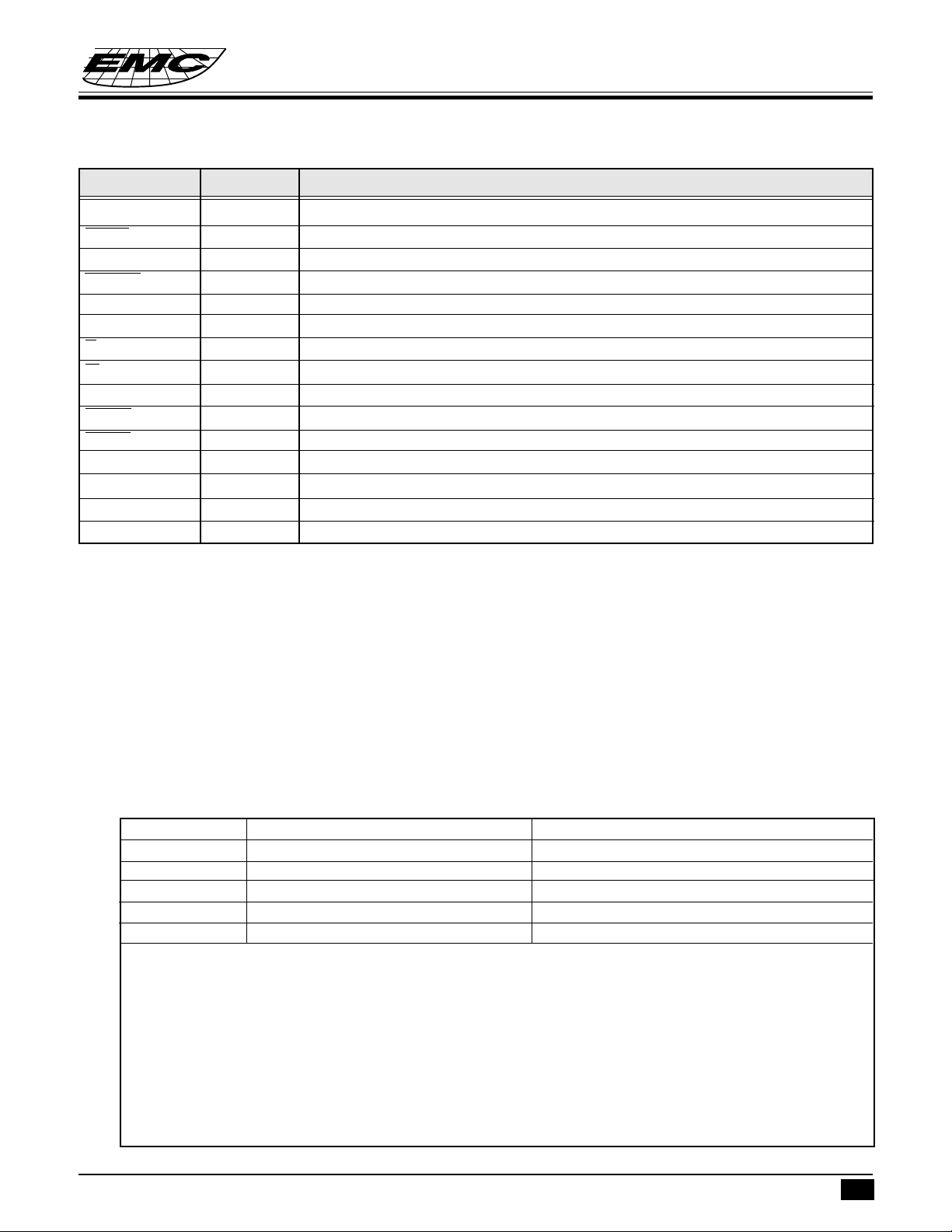
PIN DESCRIPTIONS
Symbol I/O Function
DISC I H=discharge mode,L=non-discharge mode.(internal pull low)
LLED O Trackball lock led display.
V
DD
RESET I Low active for chip reset.
V
SS
X1,X2 I Horizontal direction status for x counter data.
R I Right mouse key. (internal pull high)
M I Main mouse key. (internal pull high)
Y1,Y2 I Vertical direction status for y counter data.
LOCK I Optional trackball key lock button to lock /M key. (internal pull high)
DLED O Active low to turn on photo LEDs.
OSCO O Crystal clock output.
OSCI I Crystal clock input.
DOUT O Transmit data to Host.(open drain)
DIN I Receive data or command from Host.
- +5v power.
- GND.
EM85000
FUNCTION DESCRIPTIONS
The ADB Mouse Controller is communicated with Host by the ADB bus.Only Host sends command to mouse
controller,the mouse doesn’t send any command to the other devices or Host on the bus.The signal of the data
or command is transmitted by asynchronous protocol.First,Host sends Attention and Sync signals to synchronize
all devices on the bus,then sends command or data according the command defined.
If the addess which the device receives in command is the same as the device address,then the device will execute
this command.If there are more then two devices to contend the ADB bus,then the bus collision will happen.
Therefore,every devices must have capability to detect and to solve collision.On the contrary,if the address in
the command is not the same with the address in the device,the device will discard the command,or sends SRQ
signal to Host when device has data to be send.
COMMAND B7 B6 B5 B4 B3 B2 B1 B0 DESCRIPTION
FLUSH A3 A2 A1 A0 0001Mouse will clear all X,Y counter data(R0=0).
SENDRESET - - - - 0000Soft Reset(equal power-on reset).
TALK A3 A2 A1 A0 1 1 Rh Rl Controller transmits data to Host.
LISTEN A3 A2 A1 A0 1 0 Rh Rl Controller receives data from Host.
OTHER - - - - - - - - - - - - - - - - - - - - - - - - - Reserved command.
1.B7 ~ B4:Device Address(0~F)is the position of the device.(Ref table 2)
2.B0 ~ B1:Selected Register(R0~R3),each register has two bytes.
R0:Mouse counter data register(read only by Host)
R3:Control register(can be read or written by Host)
R1,R2:No use in mouse.
3.B3,B2=11:TALK command.(1 byte)
TALK R0:IF mouse has data to report,mouse will send two bytes (R0)to Host.
IF mouse has’t data to report,Host will continue polling(R0) or execute other command.
TALK R3:Host can read mouse R3 register(2 bytes).
TALK R1,R2:No use in mouse.
COMMANDS
* This specification are subject to be changed without notice.
11.6.1995
2
Page 3
EM85000
APPLE DESKTOP BUS MOUSE CONTROLLER
4.B3,B2=10:LISTEN command.(3 bytes)
LISTEN R3:Host writes controll status to mouse R3.
LISTEN R0 ~R2:No use in mouse.
Host must send 3 bytes. (1 byte command and 2 bytes register data to mouse R3)
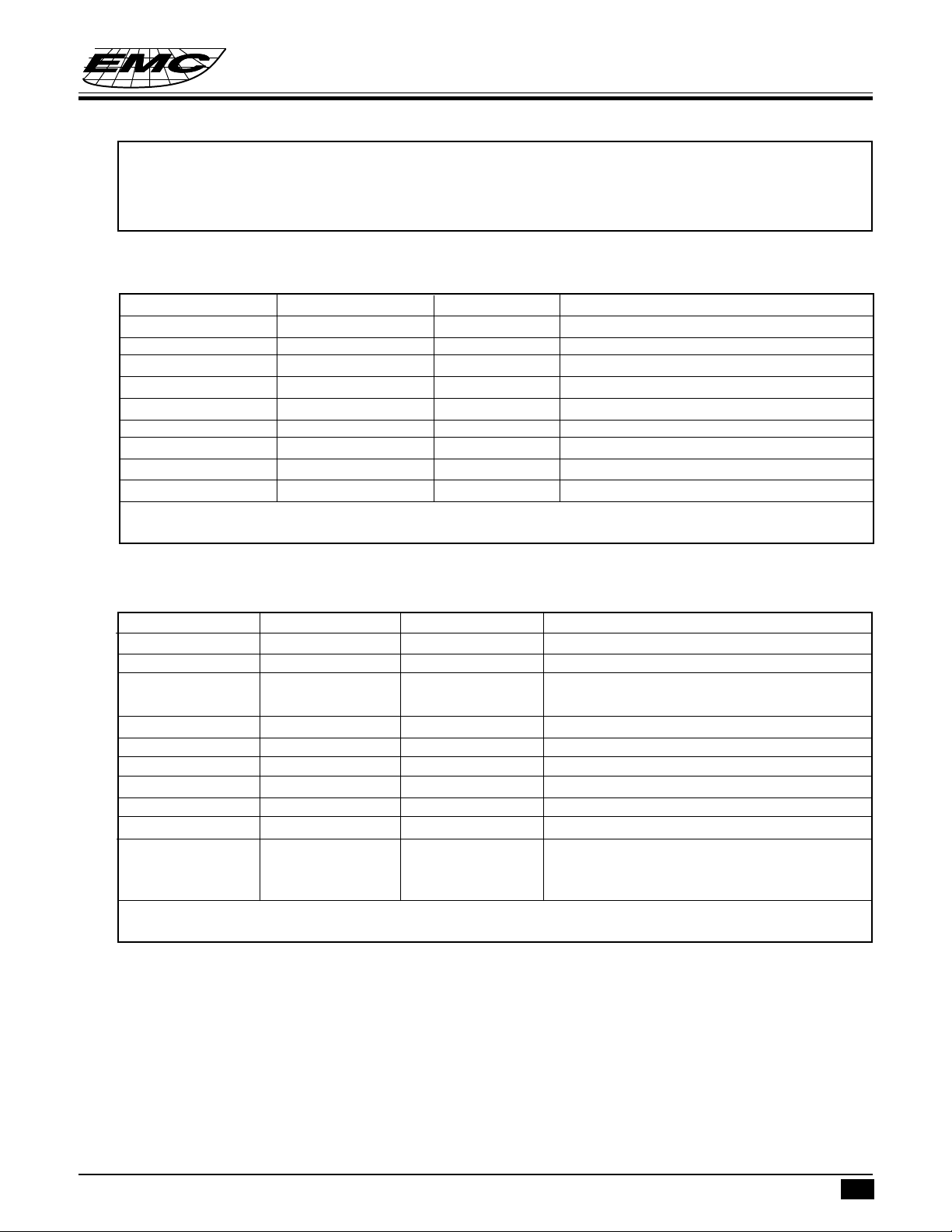
TABLE 1
DEVICE ADDRESS
Device Address Device Type Addressing Example
0 Reserved Extended
1 Appliances Extended
2 Encoded Device Movable Keyboard address for initial address.
3 Relative Device Movable Mouse address for initial address.
4 Absolute Device Movable Tablet address for initial address.
5 Reserved - - - - - - - - 6 Reserved - - - - - - - - 7 Reserved - - - - - - - - -
8 ~ F Soft address - - - - - - - - -
1. Device address=0~F.
2. Movable:Host can change device address to new address(ex:Soft,reserved address)by LISTEN R3command.
TABLE 2
DATA STRUCTURE
COMMAND LENGTH DEVICE ECHO DESCRIPTION
SENDRESET 1 BYTE NO
FLUSH 1 BYTE NO
TALK R0 1 BYTE 2 BYTES If mouse has data to report,device echoes two
bytes(R0) to Host,otherwise no echo data.
TALK R1 - - - - - - - - - - - - - - - - - - No use.
TALK R2 - - - - - - - - - - - - - - - - - - No use.
TALK R3 1 BYTE 2 BYTES Device always echoes two bytes(R3) to Host.
LISTEN R0 - - - - - - - - - - - - - - - - - - No use.
LISTEN R1 - - - - - - - - - - - - - - - - - - No use.
LISTEN R2 - - - - - - - - - - - - - - - - - - No use.
LISTEN R3 3 BYTES NO Host sends control status (R3) to mouse.
First byte:command.
Second and last bytes:R3 control register.
1. CODE:First byte reference TABLE 1.
2. LISTEN R3 command reference TABLE 4.
TABLE 3
* This specification are subject to be changed without notice.
11.6.1995
3
Page 4
LISTEN R3 COMMAND
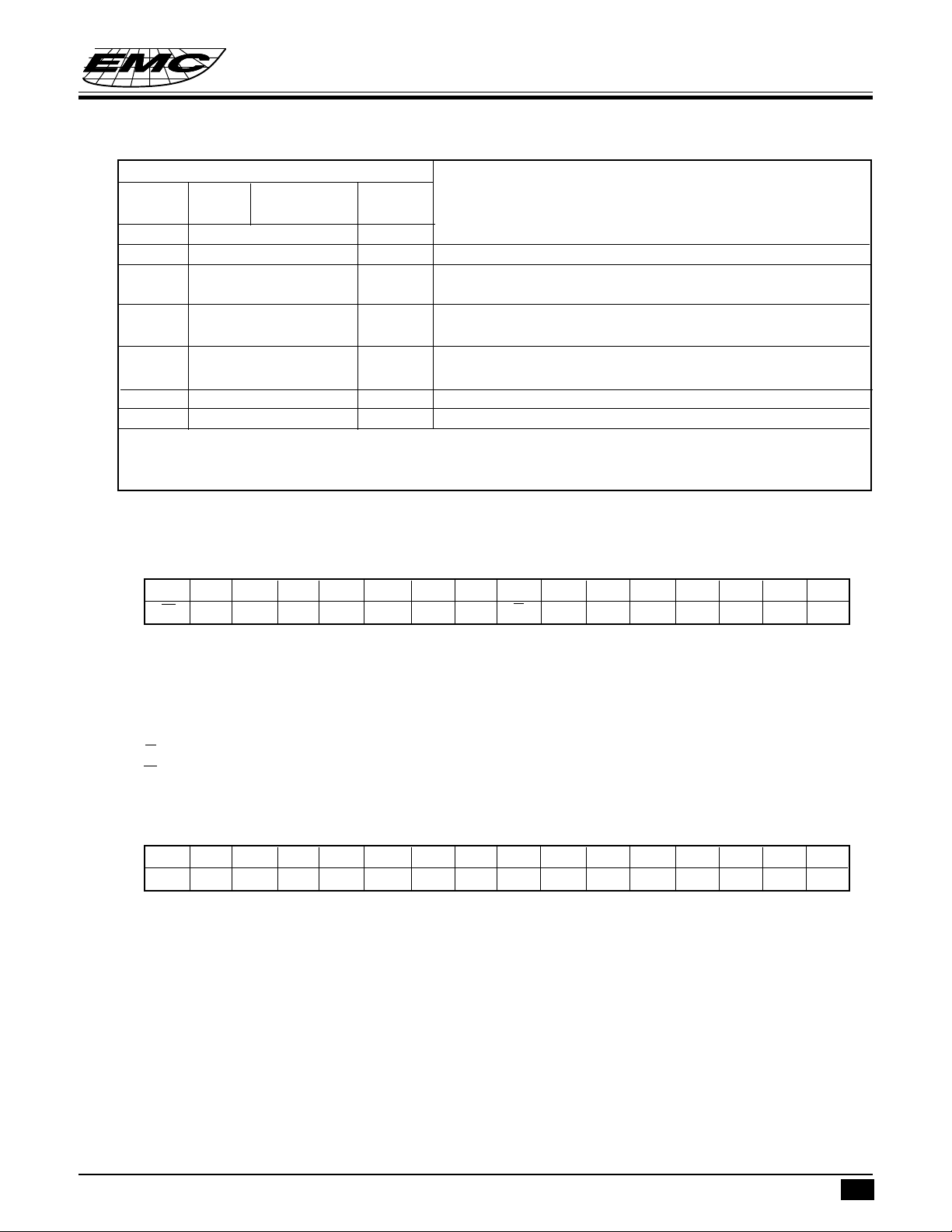
CODE DESCRIPTION
Listen SRQ Device ID
R3 (B13) Address Number
- - - - B15 ~ B8 B7~B0
3B - - - - - - - - FF Self Test.
3B - - - - A3 A2 A1 A0 FE Device will change to new address(A0~A3)if no collision
3B - - - - A3 A2 A1 A0 FD Device will change to new address(A0~A3)if no collision
3B 0 1 - 1 A3 A2 A1 A0 00 IF no collision has been detected,device will change to
3B ---- - - - - 01 2 counts/dot for X/Y axis.
3B - - - - - - - - 02 1 count/dot for X/Y axis.
1. LISTEN R3:Host transmits data to device.
2. IF mouse Address=3 and Command=Listen R3 then command data=3B.(Ref table 1)
3. B0 ~ B 15:R3 control register.
TABLE 4
REGISTER DESCRIPTION
REGISTER 0 (R0):mouse counter data.
EM85000
APPLE DESKTOP BUS MOUSE CONTROLLER
has been detected.
and /Mkey is pressed.
new address (A0~A3)and set (or clear)SRQ depend on B13(R3).
B15 B14 B13 B12 B11 B10 B9 B8 B7 B6 B5 B4 B3 B2 B1 B0
M Y6 Y5 Y4 Y3 Y2 Y1 Y0 R X6 X5 X4 X3 X2 X1 X0
1. X0 ~ X6:X direction counter data.
2. Y0 ~ Y6:Y direction counter data.
3. X6(Y6)=0:Positive count when mouse move to right(down).
X6(Y6)=1:Negative count when mouse move to left(up).
Negative count uses 2’S complement form.
4. R:When right key is pressed,B7 is cleared to zero,otherwise B7 status is set to one.
5. M:When main key is pressed,B15 is cleared to zero,otherwise B15 status is set to one.
REGISTER 3 (R3):control register.
B15 B14 B13 B12 B11 B10 B9 B8 B7 B6 B5 B4 B3 B2 B1 B0
0 EESRQ 1 A3A2 A1A0D7D6D5 D4D3 D2 D1D0
1. D0 ~ D7:Device Handler ID number. (00h ~ FFh)
2. A0 ~ A3:Device Address can be changed when host send LISTEN R3 command with ID=00,FE,FD.
3. B12:Always be“1”.
4. SRQ:Can be set or cleared when host send LISTEN R3 command with ID=00.
SRQ=1:Device can transmit data to Host.
SRQ=0:Device can’t transmit data to Host.
5. EE(Exception Event status):No use=1.
6. B15:Always be“0”.
SIGNAL PROTOCOL
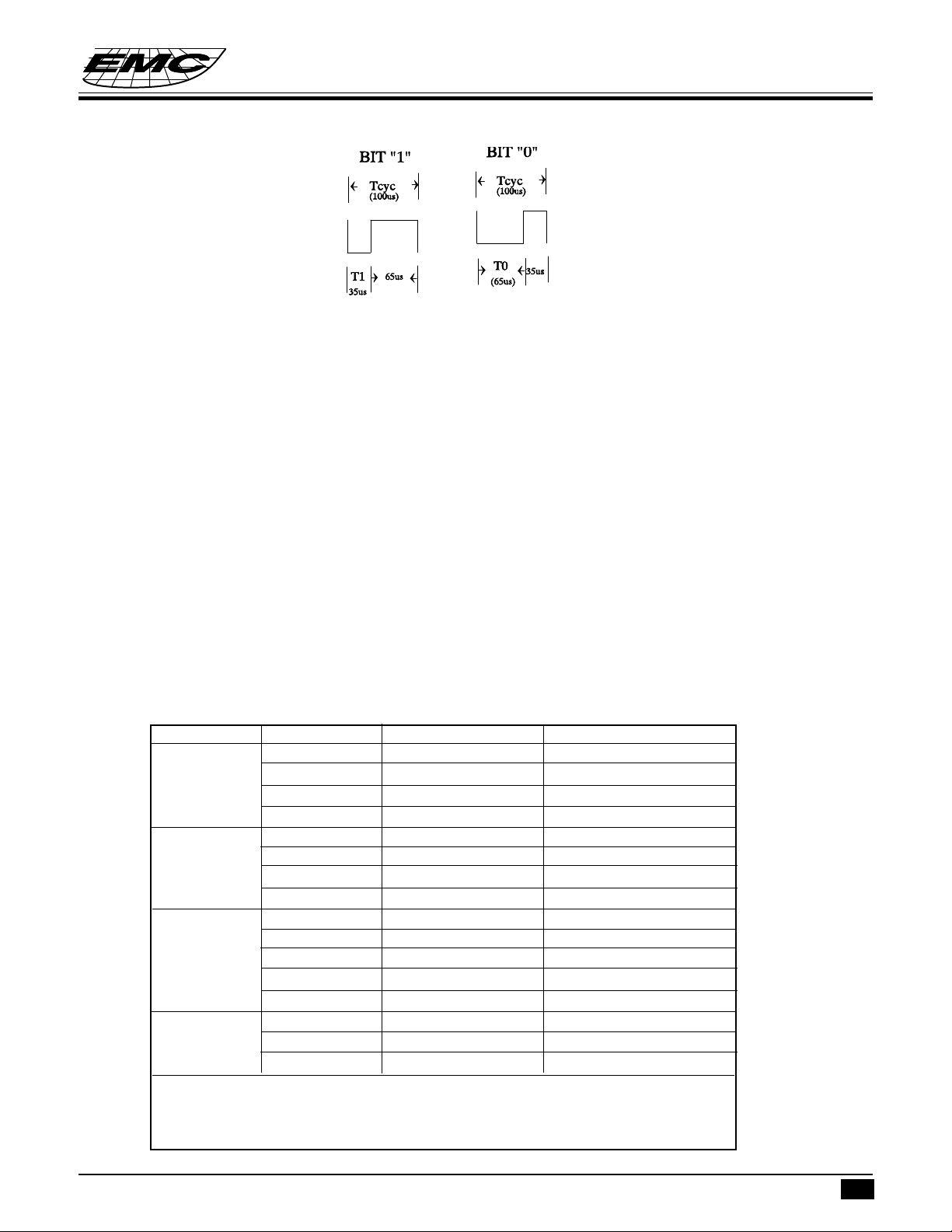
1. Attn(800us)+Sync(65us):Synchronous signal.
Host out Attn+Sync signals to tell device when to get command code.
2. Data and command code:Data bit is discriminated by pulse code modulation.
* This specification are subject to be changed without notice.
11.6.1995
4
Page 5
EM85000
APPLE DESKTOP BUS MOUSE CONTROLLER
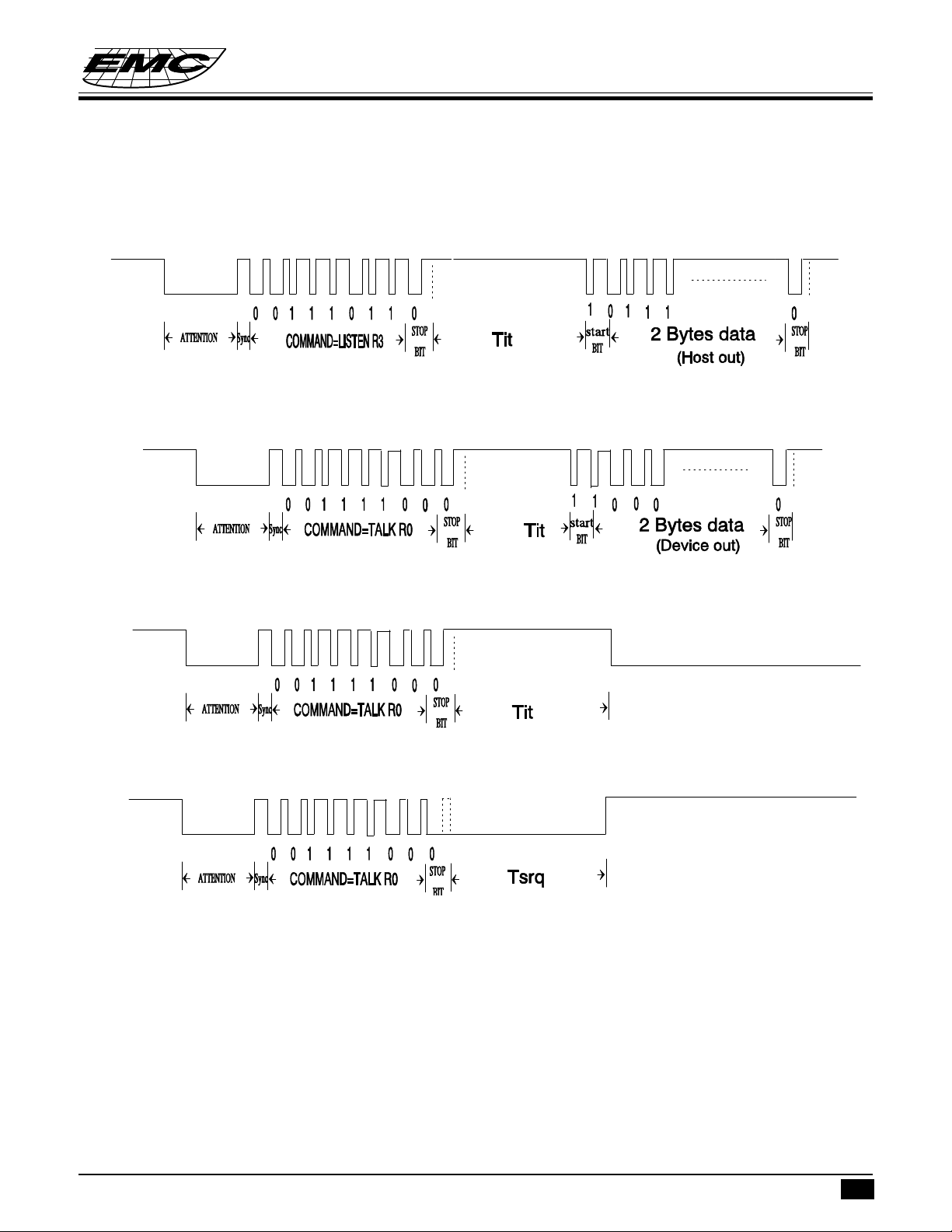
3. Tit (200us)signal:If no collision has been detected,
LISTEN command:Device waiting until Tit=“0” then device start to read data in.
TALK command:Device send two bytes data after Tit.
4. Stop bit(“0”).
5. Start bit(“1”).
6. Service Request:When the device has data to report with SRQ=1,it will pull the ADB bus to be low for 300us
after first stop bit of the command send by Host.
COLLISION:
1. Host send one command,but many devices respond to it.
2. Losing device:
a. Device detects “0” at Tit-time before device wants to send start bit.
b. Data line must hold “1” at Tit-time,but device detects “0” by another device send.
c. Device detects“0”while sending“1”.
3. Losing device must give up ADB bus and data is saved.
4. Every devices must have detecting collision ability.
DYNAMIC SAMPLING RATE
When the mouse is moved,the frequence of sampling rate depends on the mouse’s speed.If the mouse is still,the
sampling rate is at low speed(1KHz).It can reduce system power consumption.
DPI DOTS SPEED(cm/sec) SAMPLING RATE
0 - - - - - - - - - 1KHz
1 2.54 2.5KHz
200 2 5.08 5KHz
4 10.16 10KHz
0 - - - - - - - - - 1KHz
1 1.5875 2.5KHz
320 2 3.175 5KHz
4 6.35 10KHz
0 - - - - - - - - - 1KHz
1 1.27 2.5KHz
400 2 2.54 5KHz
4 5.08 10KHz
0 - - - - - - - - - 1KHz
1 0.907 2.5KHz
560 2 1.814 5KHz
4 3.632 10KHz
Formula:speed=[ ( dots / DPI ) * 2.54 ) ] / Tb.
EX:dot=1,DPI=200 dots/inch,Tb(Time Base)=5ms
speed=[ ( 1 / 200 ) * 2.54 ] / 5ms=2.54 cm/sec
* This specification are subject to be changed without notice.
11.6.1995
5
Page 6
APPLE DESKTOP BUS MOUSE CONTROLLER
ABSOLUTE MAXIMUM RATINGS
Temperature under bias 0°C to 70°C
Storage temperature -65°C to 150°C
Input voltage -0.3V to +6.0V
Output voltage -0.3V to +6.0V
DC ELECTRICAL CHARACTERISTICS
(T
0°C~150°C, VDD = 5.0V±5%, V
A =
Parameter Sym. Min. Typ. Max. Unit Condition
= 0V )
SS
EM85000
Input High Voltage V
Input Low Voltage V
Output High Voltage V
Output Low Voltage V
Clock Input High Voltage V
Clock Input Low Voltage V
Input Leakage Current I
IH
IL
OH
OL
IHX
ILX
IL1
2.0 - - V VIN=VDD,V
- - 0.8 V VIN=VDD,V
SS
SS
2.4 - - V IOH=-12.0mA
- - 0.4 V IOH=12.0mA
3.5 - - V OSCI
- - 1.5 V OSCI
--±10 µAVIN=VDD,V
SS
for input pin
Pull-high current I
Pull-down current I
Operating supply current I
PH
PD
CC
-50 -100 -240 uA Pull-high active, input pin at V
20 50 120 uA Pull-down active input pin at V
- - 4 mA RESET=HIGH, Fosc=3.58MHz
AC ELECTRICAL CHARACTERISTICS
(T
0°C~70°C, VDD = 5.0V±5%, V
A =
Parameter Sym. SPEC Min. Typ. Max. Unit
Attention signal time Attn 800±3% 550 - 2150 µs
Sync pulse time Sync 65±3% - - 286 µs
From first stop bit to start bit. Tit 200±30% 150 - - µs
Service request time Tsrq 300±30% 290 - 315 µs
Reset time Tres 3 2.15 - - ms
Bit cell time Tcyc 100±30% - 100 - µs
Bit”0” low time T0 65±30% - 65 - µs
Bit”1” low time T1 35±30% - 35 - µs
DLED low time DLED - 23 - - µs
= 0V )
SS
SS
DD
* This specification are subject to be changed without notice.
11.6.1995
6
Page 7
WAVE FORM
LISTEN COMMAND:
Host out control status to device.
TALK COMMAND
1. Device has data to send.
EM85000
APPLE DESKTOP BUS MOUSE CONTROLLER
2. Host is polling device.
3. Service Request
* This specification are subject to be changed without notice.
11.6.1995
7
Page 8
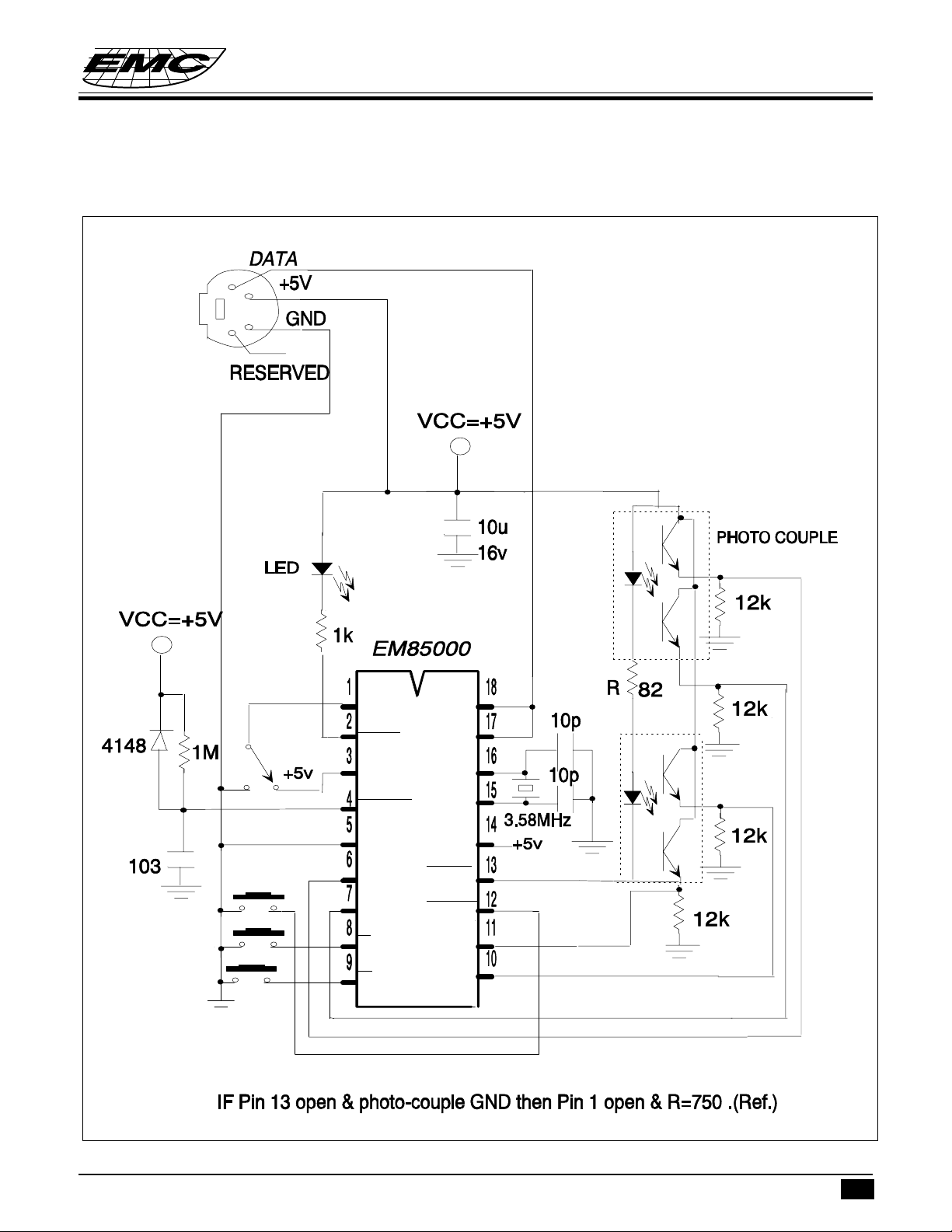
APPLICATION CIRCUIT
EM85000
APPLE DESKTOP BUS MOUSE CONTROLLER
DIST
LLED
VDD
RESET
VSS
X1
X2
R
M
DIN
DOUT
OSCI
OSCO
VDD
DLED
LOCK
Y1
Y2
* This specification are subject to be changed without notice.
11.6.1995
8
Page 9
EM85000
APPLE DESKTOP BUS MOUSE CONTROLLER
DIST
LLED
VDD
RESET
VSS
X1
X2
R
M
DIN
DOUT
OSCI
OSCO
VDD
DLED
LOCK
Y1
Y2
* This specification are subject to be changed without notice.
11.6.1995
9
 Loading...