

Datasheet BQ2050HSN-A508, BQ2050HSN-A308TR, BQ2050HSN-A308, BQ2050HSN-A304TR, BQ2050HSN-A508TR Datasheet (Texas Instruments)
Page 1

Features
➤
Accurate measurement of avail
-
able capacity in Lithium Ion bat
-
teries
➤
Provides a low-cost battery man
agement solution for pack
integration
-
Complete circuit can fit in as
little as
1
2
square inch of PCB
-
Low operating current (120µA
typical)
-
Less than 100nA of data
retention current
➤
High-speed (5kb) single-wire
communication interface (HDQ
bus) for critical battery
parameters
➤ Monitors and controls charge FET
in Li-Ion pack protection circuit
➤ Direct drive of remaining capacity
LEDs
➤ Measurements automatically
compensated for rate and
temperature
➤ 16-pin narrow SOIC
General Description
The bq2050H Lithium Ion Power
Gauge™ IC is intended for batterypack or in-system installation to
maintain an accurate record of
available battery capacity. The IC
monitors a voltage drop across a
sense resistor connected in series
between the negative battery termi
nal and ground to determine
charge and discharge activity of
the battery. Compensations for bat
tery temperature, self discharge,
and rate of discharge are applied to
the charge counter to provide avail
able capacity information across a
wide range of operating conditions.
Battery capacity is automatically re
calibrated, or “learned,” in the
course of a discharge cycle from full
to empty.
Nominal available capacity may be
directly indicated using a fivesegment LED display. These seg-
ments are used to graphically indi
cate available capacity. The
bq2050H also supports a simple
single-line bidirectional serial link
to an external processor (common
ground). The 5kb HDQ bus interface
reduces communications overhead
in the external microcontroller.
Internal registers include available
capacity, temperature, scaled avail
able energy, battery ID, battery
status, and Li-Ion charge FET
status. The external processor may
also overwrite some of the bq2050H
power gauge data registers.
The bq2050H can operate from the
batteries in the pack. The REF out
put and an external transistor allow
a simple, inexpensive voltage regulator to supply power to the circuit
from the cells.
1
bq2050H
LCOM LED common output
SEG
1
/PROG1LED segment 1/
program 1 input
SEG
2
/PROG2LED segment 2/
program 2 input
SEG
3
/PROG3LED segment 3/
program 3 input
SEG
4
/PROG4LED segment 4/
program 4 input
SEG
5
/PROG5LED segment 5/
program 5 input
CFC Charge FET control
output
1
PN2050H1.eps
16-Pin Narrow SOIC
2
3
4
5
6
7
8
16
15
14
13
12
11
10
9
V
CC
REF
PSTAT
HDQ
RBI
SB
DISP
SR
LCOM
SEG1/PROG
1
SEG2/PROG
2
SEG3/PROG
3
SEG4/PROG
4
SEG5/PROG
5
CFC
V
SS
V
SS
System ground
SR Sense resistor input
DISP
Display control input
SB Battery sense input
RBI Register backup input
HDQ Serial communications
input/output
PSTAT Protector status input
REF Voltage reference output
V
CC
Supply voltage
Pin Connections
SLUS150–MAY 1999 D
Low-Cost Lithium Ion Power Gauge™ IC
Pin Names
Page 2

Pin Descriptions
LCOM
LED common output
This open-drain output switches V
CC
to
source current for the LEDs. The switch is
off during initialization to allow reading of
the soft pull-up or pull-down program resis
tors. LCOM is also high impedance when the
display is off.
SEG
1
–
SEG
5
LED display segment outputs (dual func
tion with PROG
1
–PROG5)
Each output may activate an LED to sink
the current sourced from LCOM.
PROG
1
–
PROG
2
Programmed full count selection inputs
(dual function with SEG
1
–SEG2)
These three-level input pins define the pro
grammed full count (PFC) thresholds de
scribed in Table 2.
PROG
3
–
PROG
4
Power gauge scale selection inputs (dual
function with SEG
3
–SEG4)
These three-level input pins define the scale
factor described in Table 2.
PROG
5
Self-discharge rate selection (dual function with SEG
5
)
This three-level input pin defines the
self-discharge and battery compensation factors as shown in Table 1.
CFC
Charge FET control output
This pin can be used as an additional control
to the charge FET of the Li-Ion pack protec
tion circuitry.
V
SS
Ground
SR
Sense resistor input
The voltage drop (V
SR
) across the sense re
sistor R
S
is monitored and integrated over
time to interpret charge and discharge activ
ity. The SR input is tied between the nega
tive terminal of the battery and the sense re
sistor. V
SR<VSS
indicates discharge, and
V
SR>VSS
indicates charge. The effective
voltage drop, V
SRO
, as seen by the bq2050H
is V
SR+VOS
.
DISP
Display control input
DISP
high disables the LED display. DISP
tied to VCCallows PROGXto connect di
-
rectly to V
CC
or VSSinstead of through a
pull-up or pull-down resistor. DISP
floating
allows the LED display to be active during
charge. DISP
low activates the display. See
Table 1.
SB
Secondary battery input
This input monitors the battery cell voltage
potential through a high-impedance resis
tive divider network for end-of-discharge
voltage (EDV) thresholds and battery-removed
detection.
RBI
Register backup input
This pin is used to provide backup potential to
the bq2050H registers during periods when
V
CC
≤
3V. A storage capacitor or a battery
can be connected to RBI.
HDQ
Serial communication input/output
This is the open-drain bidirectional communications port.
PSTAT
Protector status input
This input provides overvoltage status from
the Li-Ion protector circuit. It should connect to V
SS
when not used.
REF
Voltage reference output for regulator
REF provides a voltage reference output for
an optional micro-regulator.
V
CC
Supply voltage input
2
bq2050H
Page 3
Functional Description
General Operation
The bq2050H determines battery capacity by moni
toring the amount of current input to or removed
from a rechargeable battery. The bq2050H meas
ures discharge and charge currents, measures bat
tery voltage, estimates self-discharge, monitors the
battery for low battery-voltage thresholds, and com
pensates for temperature and discharge rate. Cur
rent measurement is measured by monitoring the
voltage across a small-value series sense resistor be
tween the negative battery terminal and ground.
Scaled available energy is estimated using the re
maining average battery voltage during the dis
charge cycle and the remaining nominal available
capacity. The scaled available energy measurement
is corrected for environmental and operating condi
-
tions.
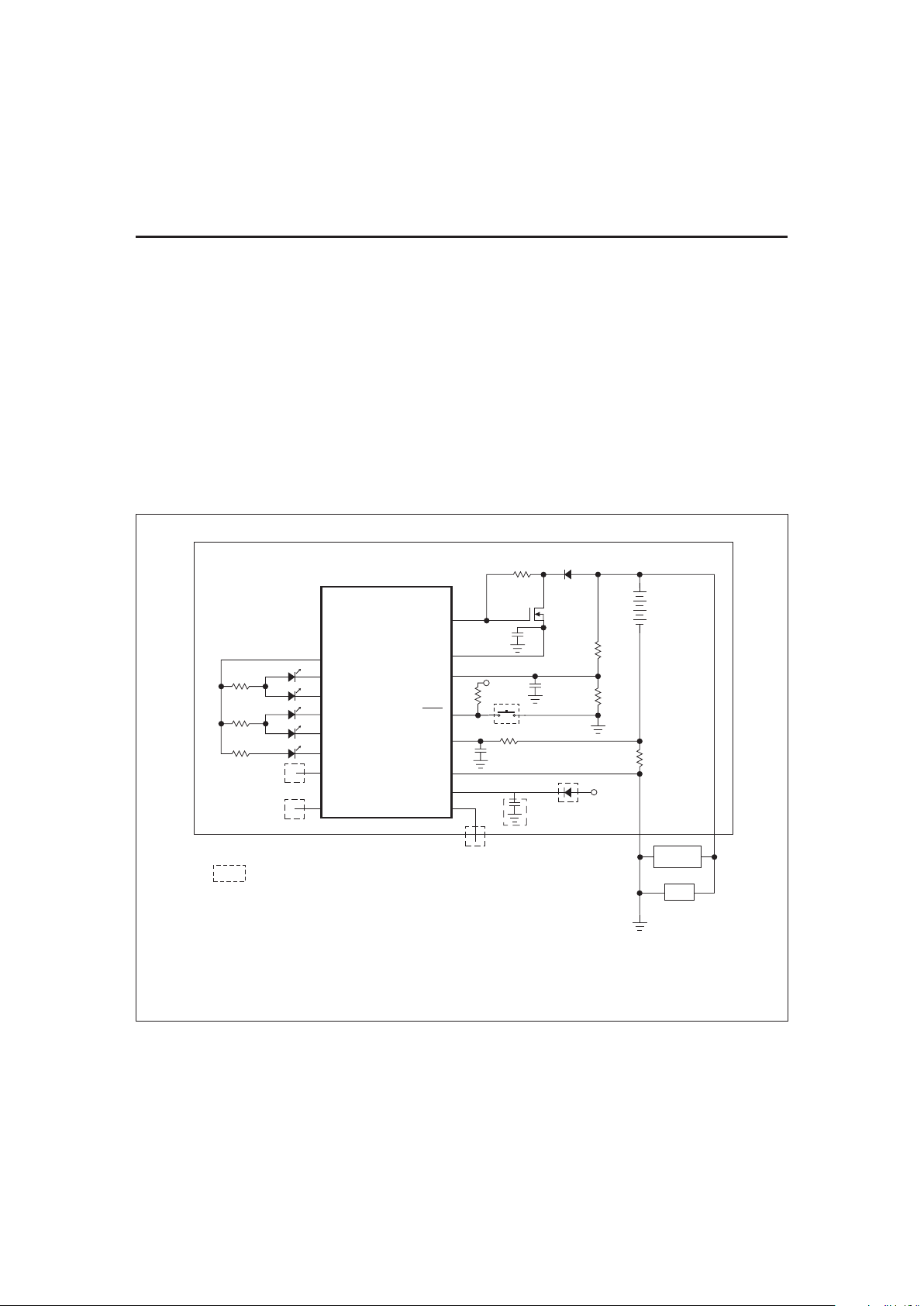
Figure 1 shows a typical battery pack application of the
bq2050H using the LED display capability as a chargestate indicator. The bq2050H is configured to display
capacity in relative display mode. The relative display
mode uses the last measured discharge capacity of the
battery as the battery “full” reference. A push-button
display feature is available for momentarily enabling
the LED display.
The bq2050H monitors the charge and discharge cur
-
rents as a voltage across a sense resistor. (See R
S
in Fig
ure 1.) A filter between the negative battery terminal
and the SR pin is required.
3
bq2050H
FG2050H1.eps
CFC
SEG5/PROG
5
SEG4/PROG
4
SEG3/PROG
3
SEG2/PROG
2
SEG1/PROG
1
SR
DISP
SB
V
CC
REF
bq2050H
Power Gauge IC
LCOM
V
SS
RBI
HDQ
V
CC
C1
C2
Q1
ZVNL110A
R
1
R
S
RB
1
RB
2
See note 4
Load
Charger
1. Indicates optional.
2. Programming resistors and ESD-protection diodes are not shown.
3. RC on SR is required.
4. A series diode is required on RBI if the bottom series cell is used as the backup source.
If the cell is used, the backup capacitor is not required, and the anode is connected to the
positive terminal of the cell.
100K
PSTAT
Notes:
0.1µF
Figure 1. Battery Pack Application Diagram—LED Display
Page 4

Voltage Thresholds
In conjunction with monitoring VSRfor charge/discharge
currents, the bq2050H monitors the battery potential
through the SB pin. The voltage is determined through
a resistor-divider network per the following equation:
RB1
RB2
4N=−1
where N is the number of cells, RB1 is connected to the
positive battery terminal, and RB2 is connected to the
negative battery terminal. The single-cell battery volt
age is monitored for the end-of-discharge voltage (EDV)
thresholds. The EDV threshold levels are used to deter
mine when the battery has reached an “empty” state.
The EDV thresholds for the bq2050H are programmable
with the default values fixed at:
EDV1 (first) = 0.76V
EDVF (final) = EDV1-0.025V = 0.735V
If V
SB
is below either of the two EDV thresholds, the as
sociated flag is latched and remains latched, independent of V
SB
, until the next valid charge. The VSBvalue is
also available over the serial port.
During discharge and charge, the bq2050H monitors
V
SR
for various thresholds used to compensate the
charge counter. EDV monitoring is disabled if the discharge rate is greater than 2C (OVLD Flag = 1) and resumes
1
2
second after the rate falls below 2C.
RBI Input
The RBI input pin is intended to be used with a storage
capacitor or external supply to provide backup potential
to the internal bq2050H registers when V
CC
drops below
3.0V. V
CC
is output on RBI when VCCis above 3.0V. If us
ing an external supply (such as the bottom series cell) as
the backup source, an external diode is required for isola
tion.
Reset
The bq2050H can be reset by removing VCCand ground
ing the RBI pin for 15 seconds or by commands over the
serial port. The serial port reset command sequence re
quires writing 00h to register PPFC (address = 1Eh) and
then writing 00h to register LMD (address = 05h).
Temperature
The bq2050H internally determines the temperature in
10°C steps centered from approximately -35°C to +85°C.
The temperature steps are used to adapt charge and dis
charge rate compensations, self-discharge counting, and
available charge display translation. The temperature
range is available over the serial port in 10°C incre
ments as shown in the following table:
Layout Considerations
The bq2050H measures the voltage differential between
the SR and V
SS
pins. VOS(the offset voltage at the SR
pin) is greatly affected by PC board layout. For optimal
results, the PC board layout should follow the strict rule
of a single-point ground return. Sharing high-current
ground with small signal ground causes undesirable
noise on the small signal nodes. Additionally:
■
The capacitors (C1 and C2) should be placed as
close as possible to the V
CC
and SB pins,
respectively, and their paths to V
SS
should be as
short as possible. A high-quality ceramic capacitor
of 0.1µF is recommended for V
CC
.
■
The sense-resistor capacitor should be placed as close
as possible to the SR pin.
■
The sense resistor (RS) should be as close as possible to
the bq2050H.
4
bq2050H
TMP (hex) Temperature Range
0x < -30°C
1x -30°C to -20°C
2x -20°C to -10°C
3x -10°C to 0°C
4x 0°C to 10°C
5x 10°C to 20°C
6x 20°C to 30°C
7x 30°C to 40°C
8x 40°C to 50°C
9x 50°C to 60°C
Ax 60°C to 70°C
Bx 70°C to 80°C
Cx > 80°C
Page 5
Gas Gauge Operation
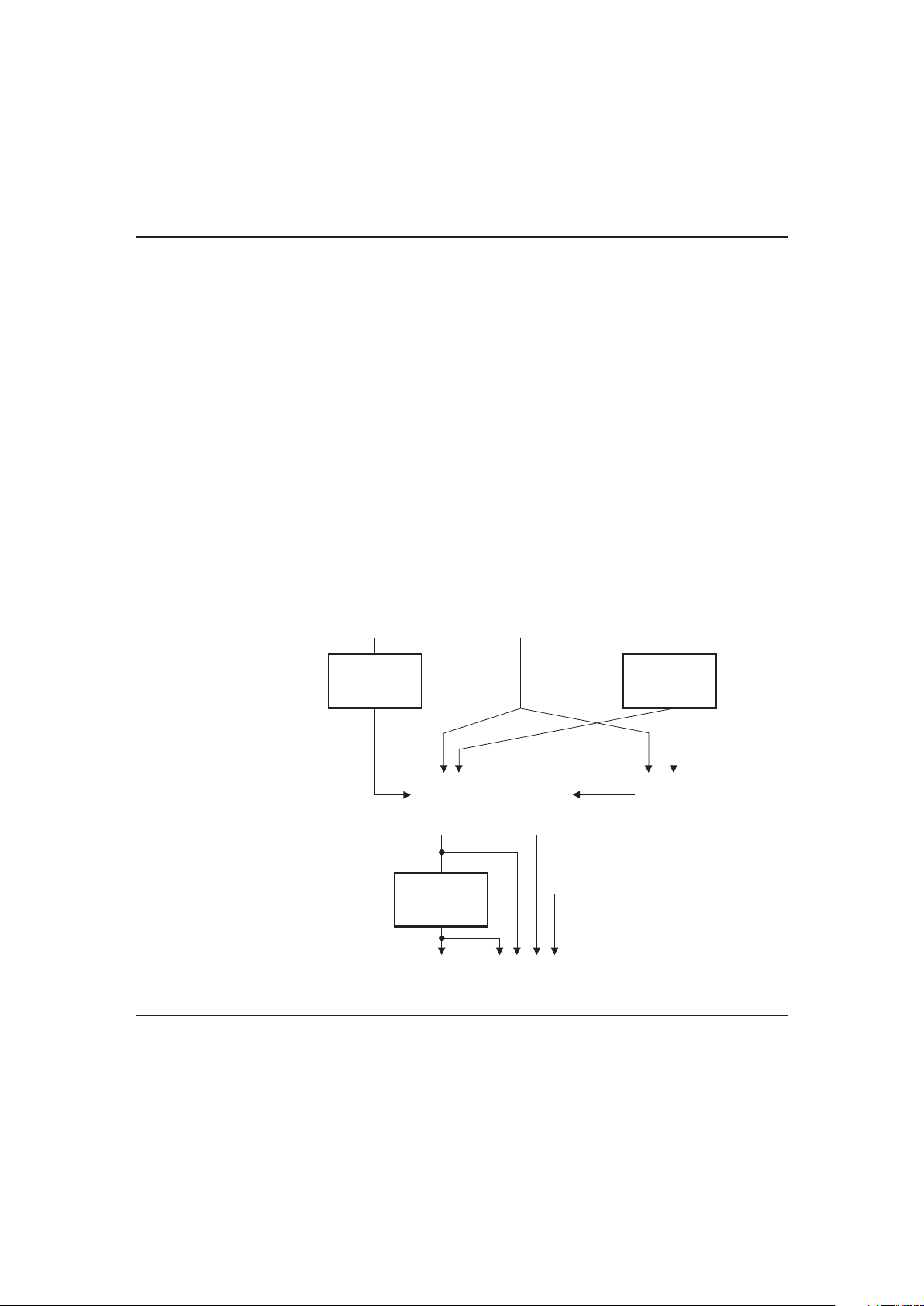
The operational overview diagram in Figure 2 illustrates
the operation of the bq2050H. The bq2050H accumu
lates a measure of charge and discharge currents, as
well as an estimation of self-discharge. The accumu
lated charge and discharge currents are adjusted for
temperature and rate to provide the indication of com
pensated available capacity to the host system or user.
The main counter, Nominal Available Capacity (NAC),
represents the available battery capacity at any given
time. Battery charging increments the NAC register,
while battery discharging and self-discharge decrement
the NAC register and increment the DCR (Discharge
Count Register).
The Discharge Count Register is used to update the Last
Measured Discharge (LMD) register only if a complete
battery discharge from full to empty occurs without any
partial battery charges. Therefore, the bq2050H adapts
its capacity determination based on the actual condi
tions of discharge.
The battery's initial capacity equals the Programmed
Full Count (PFC) shown in Table 2. Until LMD is up
dated, NAC counts up to but not beyond this threshold
during subsequent charges. This approach allows the
gas gauge to be charger-independent and compatible
with any type of charge regime.
1. Last Measured Discharge (LMD) or learned
battery capacity:
LMD is the last measured discharge capacity of the
battery. On initialization (application of V
CC
or bat
-
tery replacement), LMD = PFC. During subsequent
discharges, the LMD is updated with the latest
measured capacity in the Discharge Count Register
representing a discharge from full to below EDV1.
A qualified discharge is necessary for a capacity
transfer from the DCR to the LMD register. The
LMD also serves as the 100% reference threshold
used by the relative display mode.
5
bq2050H
FG2050H2.eps
Temperature
Compensation
Charge
Current
Discharge
Current
Self-Discharge
Timer
Nominal
Available
Charge
(NAC)
Last
Measured
Discharged
(LMD)
Discharge
Count
Register
(DCR)
<
Qualified
Transfer
+
Rate and
Temperature
Compensation
Temperature
Compensation
Temperature Step,
Other Data
+
--
+
Inputs
Main Counters
and Capacity
Reference (LMD)
Outputs
Serial
Port
Compensated
Available Charge
LED Display, etc.
Rate and
Temperature
Compensation
Figure 2. Operational Overview
Page 6

2. Programmed Full Count (PFC) or initial bat
-
tery capacity:
The initial LMD and gas gauge rate values are pro
-
grammed by using PROG
1
–PROG4. The bq2050H
is configured for a given application by selecting a
PFC value from Table 2. The correct PFC may be
determined by multiplying the rated battery capac
-
ity in mAh by the sense resistor value:
Battery capacity (mAh)*sense resistor (Ω) =
PFC (mVh)
Selecting a PFC slightly less than the rated capac
ity provides a conservative capacity reference until
the bq2050H “learns” a new capacity reference.
Example: Selecting a PFC Value
Given:
Sense resistor = 0.05
Ω
Number of cells = 2
Capacity = 1000mAh, Li-Ion battery, coke-anode
Current range = 50mA to 1A
Relative display mode
Self-discharge =
NAC
512
per day @ 25°C
Voltage drop over sense resistor = 2.5mV to 50mV
Nominal discharge voltage = 3.6V
Therefore:
1000mAh*0.05Ω= 50mVh
6
bq2050H
PROG
x
Pro-
grammed
Full
Count
(PFC)
PROG
4
= L PROG4= Z or H
Units
12
PROG
3
= H PROG3= Z PROG3= L PROG3= H PROG3= Z PROG3= L
-- -
SCALE =
1/80
SCALE =
1/160
SCALE =
1/320
SCALE =
1/640
SCALE =
1/1280
SCALE =
1/2560
mVh/
count
H H 49152 614 307 154 76.8 38.4 19.2 mVh
H Z 45056 563 282 141 70.4 35.2 17.6 mVh
H L 40960 512 256 128 64.0 32.0 16.0 mVh
Z H 36864 461 230 115 57.6 28.8 14.4 mVh
Z Z 33792 422 211 106 53.0 26.4 13.2 mVh
Z L 30720 384 192 96.0 48.0 24.0 12.0 mVh
L H 27648 346 173 86.4 43.2 21.6 10.8 mVh
L Z 25600 320 160 80.0 40.0 20.0 10.0 mVh
L L 22528 282 141 70.4 35.2 17.6 8.8 mVh
V
SR
equivalent to 2
counts/s (nom.)
90 45 22.5 11.25 5.6 2.8 mV
Table 2. bq2050H Programmed Full Count mVh, VSRGain Selections
Pin
Connection
PROG5Compensation/Self-Discharge
(See Tables 3 and 4)
DISP
Display State
H Coke anode/disabled LEDs disabled
Z Coke anode/
NAC
512
LEDs on when charging
L Graphite anode/
NAC
512
LEDs on for 4 s
Table 1. Self-Discharge and Capacity Compensation
Page 7

Select:
PFC = 30720 counts or 48mVh
PROG
1
= float
PROG
2
= low
PROG
3
= high
PROG
4
= float
PROG
5
= float
The initial full battery capacity is 48mVh (960mAh)
until the bq2050H “learns” a new capacity with a
qualified discharge from full to EDV1.
3. Nominal Available Capacity (NAC):
NAC counts up during charge to a maximum value
of LMD and down during discharge and self-dis
charge to 0. NAC is reset to 0 on initialization and
on the first valid charge following discharge to
EDV1. To prevent overstatement of charge during
periods of overcharge, NAC stops incrementing
when NAC = LMD.
4. Discharge Count Register (DCR):
The DCR counts up during discharge independent
of NAC and could continue increasing after NAC
has decremented to 0. Prior to NAC = 0 (empty
battery), both discharge and self-discharge increment the DCR. After NAC = 0, only discharge
increments the DCR. The DCR resets to 0 when
NAC = LMD. The DCR does not roll over but stops
counting when it reaches FFh.
The DCR value becomes the new LMD value on the
first charge after a valid discharge to V
EDV1
if all
the following conditions are met:
■
No valid charge initiations (charges greater than
2 NAC updates where V
SRO>VSRQ
) occurred
during the period between NAC = LMD and EDV1.
■
The self-discharge is less than 6% of NAC.
■
The temperature is≥0°C when the EDV1 level
is reached during discharge.
■
VDQ is set
The valid discharge flag (VDQ) indicates whether
the present discharge is valid for LMD update. If
the DCR update value is less than 0.94 ∗ LMD, LMD
will only be modified by 0.94 ∗ LMD. This prevents
invalid DCR values from corrupting LMD.
5. Scaled Available Energy (SAE):
SAE is useful in determining the available energy
within the battery, and may provide a more useful
capacity reference in battery chemistries with
sloped voltage profiles during discharge. SAE may
be converted to an mWh value using the following
formula:
E(mWh) =
(SAEH SAEL)∗+ ∗256
12. ∗∗
∗
SCALE (R + R )
RR
B1 B2
SB2
where RB1,RB2, and RSare resistor values in
ohms, as shown in Figure 1. SCALE is the selected
scale from Table 2.
6. Compensated Available Capacity (CACT)
CACT counts similarly to NAC, but contains the available
capacity compensated for discharge rate and temperature.
Charge Counting
Charge activity is detected based on a positive voltage
on the SR input. If charge activity is detected, the
bq2050H increments NAC at a rate proportional to V
SR
and, if enabled, activates an LED display.
The bq2050H counts charge activity when the voltage at
theSRinput(V
SRO
) exceeds the minimum charge
threshold (V
SRQ
). A valid charge is detected when NAC
has been updated twice without discharging or reaching
the digital magnitude filter time-out. Once a valid
charge is detected, charge counting continues until V
SR
,
including offset, falls below V
SRQ
.
Discharge Counting
Discharge activity is detected based on a negative voltage on the SR input. All discharge counts where V
SRO
is less than the minimum discharge threshold (V
SRD
)
cause the NAC register to decrement and the DCR to
increment.
Self-Discharge Counting
The bq2050H continuously decrements NAC and incre
-
ments DCR for self-discharge based on time and tempera
-
ture.
Charge/Discharge Current
The bq2050H current-scale registers, VSRH and VSRL,
can be used to determine the battery charge or dis
-
charge current. See the Current Scale Register descrip
-
tion for details.
Count Compensations
Compensated Available Capacity
Compensated Available Capacity compensation is based
on the rate of discharge, temperature, and negative
electrode type. Tables 3A and 3B outline the correction
factor typically used for graphite-anode Li-Ion batteries,
and Tables 4A and 4B outline the factors typically used for
coke-anode Li-Ion batteries. The compensation factor is
applied to NAC to derive the CACD and CACT values.
7
bq2050H
Page 8

The CACD value is the available charge compensated
for the rate of discharge. At high discharge rates, CACD
is reduced. The reduction is maintained until a valid
charge is detected. The CACT value is the available
charge compensated for the rate of discharge and tem
-
perature. The CACT value is used to drive the LED dis
-
play.
Charge Compensation
The bq2050H also monitors temperature during charge.
If the temperature is <0°C, NAC will only increment up
to 0.94 * LMD, inhibiting VDQ from being set. This
keeps a “learn” cycle from occurring when the battery is
charged at very low temperatures. If the temperature
rises above 0°C, NAC will be allowed to count up to NAC
= LMD.
Self-Discharge Compensation
The self-discharge compensation is programmed for a
nominal rate of
1
512
∗ NAC per day. This is the rate that
NAC is reduced for a battery within the 20–30°C tem
perature range. This rate varies across 8 ranges from
<10°C to >70°C, as shown in Table 5.
Self-discharge may be disabled by connecting PROG
5
=H.
Digital Magnitude Filter
The bq2050H has a digital filter to eliminate charge and
discharge counting below a set threshold. The minimum
charge (V
SRQ
) and discharge (V
SRD
) threshold for the
bq2050H is 250µV.
Pack Protection Supervision
The bq2050H can monitor the charge FET in a Li-Ion
pack protector circuit as shown in Figure 3. If the bat
tery voltage is too high or the temperature is out of the
0—60°C range, the bq2050H disables the charge FET
with the CFC output, which turns off the charge to the
pack.
The PSTAT input is used to monitor the protector state. If
PSTAT is above 2.5V, bit 5 of FLGS1 is set to 1. If PSTAT
is below 0.5V, bit 5 of FLGS1 is cleared to zero. Using this
input, the system can monitor the state of the charge con
-
8
bq2050H
Temperature Range
Typical Rate
PROG
5
= Z or L
< 10°C
NAC
2048
10–20°C
NAC
1024
20–30°C
NAC
512
30–40°C
NAC
256
40–50°C
NAC
128
50–60°C
NAC
64
60–70°C
NAC
32
> 70°C
NAC
16
Table 5. Self-Discharge Compensation
Approximate Discharge
Rate
Available Capacity
Reduction
<
0.5C 0
≥
0.5C
0.05 ∗ LMD
Table 3A. Graphite Anode
Temperature
Available Capacity
Reduction
≥
10°C 0
0°C to 10°C
0.05 ∗ LMD
-20°C to 0°C
0.15 ∗ LMD
≤
-20°C
0.37 ∗ LMD
Table 3B. Graphite Anode
Approximate Discharge
Rate
Available Capacity
Reduction
<
0.5C 0
≥
0.5C
0.10 ∗ LMD
Table 4A. Coke Anode
Temperature
Available Capacity
Reduction
≥
10°C 0
0°C to 10°C
0.10 ∗ LMD
-20°C to 0°C
0.30 ∗ LMD
≤
-20°C
0.60 ∗ LMD
Table 4B. Coke Anode
Page 9

trol FET signal and can quickly determine if the protector
circuit is operating properly during charge.
Register 15h, NMCV, is used to set the maximum bat
-
tery voltage for the battery stack. If V
SB
> NMCV or the
battery temperature is < 0°Cor>60°C, then CFC is
driven low.
Error Summary
Capacity Inaccurate
The LMD is susceptible to error on initialization or if no
updates occur. On initialization, the LMD value includes the error between the programmed full capacity
and the actual capacity. This error is present until a
valid discharge occurs and LMD is updated (see the
DCR description). The other cause of LMD error is battery wear-out. As the battery ages, the measured capacity must be adjusted to account for changes in actual
battery capacity.
A Capacity Inaccurate counter (CPI) is maintained and
incremented each time a valid charge occurs (qualified
by NAC; see the CPI register description). It is reset
whenever LMD is updated from the DCR. The counter
does not wrap around but stops counting at 255. The ca
pacity inaccurate flag (CI) is set if LMD has not been
updated following 64 valid charges.
Current-Sensing Error
Table 6 shows the non-linearity and non-repeatability
errors associated with the bq2050H current sensing.
Table 7 illustrates the current-sensing error as a function of V
OS
. A digital filter prevents charge and dis-
charge counts to the NAC register when V
SRO
is be-
tween V
SRQ
and V
SRD
.
9
bq2050H
Symbol Parameter Typical Maximum Units Notes
INL
Integrated non-linearity
error
±
2
±
4
%
Add 0.1% per °C above or below 25°C
and 1% per volt above or below 4.25V.
INR
Integrated nonrepeatability error
±
1
±
2
%
Measurement repeatability given
similar operating conditions.
Table 6. bq2050H Current-Sensing Errors
FG2050H3.eps
Charger
P S TAT
Charge
Control
Discharge
Control
CFC
R
LOAD
R
S
SR
V
SS
bq2050H
Figure 3. bq2050H Pack Supervision
Page 10

Communicating With the bq2050H
The bq2050H includes a simple single-pin (HDQ plus return)
serial data interface. A host processor uses the interface to
access various bq2050H registers. Battery characteristics
may be easily monitored by adding a single contact to the
battery pack. The open-drain HDQ pin on the bq2050H
should be pulled up by the host system, or may be left float
-
ing if the serial interface is not used.
The interface uses a command-based protocol, where the
host processor sends a command byte to the bq2050H.
The command directs the bq2050H to either store the
next eight bits of data received to a register specified by
the command byte or output the eight bits of data specified by the command byte. (See Figure 4.)
The communication protocol is asynchronous return-toone. Command and data bytes consist of a stream of
eight bits that have a maximum transmission rate of
5K bits/sec. The least-significant bit of a command or
data byte is transmitted first. The protocol is simple
enough that it can be implemented by most host proces
-
sors using either polled or interrupt processing. Data in
-
put from the bq2050H may be sampled using the pulse-
-
width capture timers available on some microcontrollers.
If a communication error occurs (e.g., t
CYCB
> 250µs),
the bq2050H should be sent a BREAK to reinitiate the
serial interface. A BREAK is detected when the HDQ
pin is driven to a logic-low state for a time, t
B
or greater.
The HDQ pin should then be returned to its normal
ready-high logic state for a time, t
BR
. The bq2050H is
now ready to receive a command from the host proces
-
sor.
The return-to-one data bit frame consists of three dis
tinct sections. The first section is used to start the
transmission by either the host or the bq2050H taking
the HDQ pin to a logic-low state for a period, t
STRH;B
.
The next section is the actual data transmission, where
the data should be valid by a period, t
DSU;B
, after the
negative edge used to start communication. The data
should be held for a period, t
DH;DV
, to allow the host or
bq2050H to sample the data bit.
The final section is used to stop the transmission by re
turning the HDQ pin to a logic-high state by at least a
period, t
SSU;B
, after the negative edge used to start com
munication. The final logic-high state should be until a
period t
CYCH;B
, to allow time to ensure that the bit
transmission was stopped properly. The timings for data
and break communication are given in the serial com
-
munication timing specification and illustration sec
-
tions.
Communication with the bq2050H is always performed
with the least-significant bit being transmitted first. Fig
ure 5 shows an example of a communication sequence to
read the bq2050H NACH register.
bq2050H Command Code and
Registers
The bq2050H status registers are listed in Table 8 and de
scribed below. All registers are Read/Write in the bq2050H.
Caution: When writing to bq2050H registers ensure
that proper data is written. A write-verify read is recommended.
Command Code
The bq2050H latches the command code when eight
valid command bits have been received by the bq2050H.
The command code contains two fields:
■
W/R bit
■
Command address
The W/R
bit of the command code is used to select whether
the received command is for a read or a write function.
The W/R
values are:
Where W/R
is:
0 The bq2050H outputs the requested register
contents specified by the address portion of com
-
mand code.
1 The following eight bits should be written to the
register specified by the address portion of com
-
mand code.
The lower seven-bit field of the command code contains
the address portion of the register to be accessed.
10
bq2050H
V
OS
(µV)
Sense Resistor
20 50 100
mΩ
50 0.25 0.10 0.05 %
100 0.50 0.20 0.10 %
150 0.75 0.30 0.15 %
180 0.90 0.36 0.18 %
Table 7. VOS-Related Current Sense Error
(Current = 1A)
Command Code Bits
7654 3 2 1 0
W/R
- -- - - - -
Page 11

11
bq2050H
Send Host to bq-HDQ
CDMR
Send Host to bq-HDQ or
Receive from bq-HDQ
Data
Address
Break
LSB
Bit0
R/W
MSB
Bit7
TD201807.eps
Start-bit
Address-Bit/
Data-Bit
Stop-Bit
t
RR
t
RSPS
Figure 4. bq2050H Communication Example
TD2050H2.eps
HDQ
Break 0 0 0000 1010011
Written by Host to bq2050H
CMDR = 03h
Received by Host to bq2050H
NACH = 65h
LSB MSB LSB MSB
110
t
RSPS
Figure 5. Typical Communication With the bq2050H
Page 12

12
bq2050H
Symbol Register Name
Loc.
(hex)
Read/
Write
Control Field
7(MSB) 6 5 4 3 2 1 0(LSB)
FLGS1
Primary status flags
register
01h R CHGS BRP PSTAT CI VDQ 1 EDV1 EDVF
TMP Temperature register 02h R TMP3 TMP2 TMP1 TMP0 GG3 GG2 GG1 GG0
NACH
Nominal available capac
-
ity high byte register
03h R/W NACH7 NACH6 NACH5 NACH4 NACH3 NACH2 NACH1 NACH0
NACL
Nominal available
capacity low byte register
17h R/W NACL7 NACL6 NACL5 NACL4 NACL3 NACL2 NACL1 NACL0
BATID
Battery identification
register
04h R/W BATID7 BATID6 BATID5 BATID4 BATID3 BATID2 BATID1 BATID0
LMD
Last measured
discharge register
05h R/W LMD7 LMD6 LMD5 LMD4 LMD3 LMD2 LMD1 LMD0
FLGS2
Secondary status flags
register
06h R RSVD DR2 DR1 DR0 ENINT VQ RSVD OVLD
PPD
Program pin pull-down
register
07h R RSVD RSVD RSVD PPD5 PPD4 PPD3 PPD2 PPD1
PPU
Program pin pull-up
register
08h R RSVD RSVD RSVD PPU5 PPU4 PPU3 PPU2 PPU1
CPI
Capacity
inaccurate count register
09h R/W CPI7 CPI6 CPI5 CPI4 CPI3 CPI2 CPI1 CPI0
VSB
Battery voltage
register
0bh R VSB7 VSB6 VSB5 VSB4 VSB3 VSB2 VSB1 VSB0
VTS
End-of-discharge threshold select register
0ch R/W VTS7 VTS6 VTS5 VTS4 VTS3 VTS2 VTS1 VTS0
CACT
Temperature and Discharge Rate compensated
available capacity
0dh R/W CACT7 CACT6 CACT5 CACT4 CACT3 CACT2 CACT1 CACT0
CACD
Discharge Rate com
pensated available
capacity
0eh R/W CACD7 CACD6 CACD5 CACD4 CACD3 CACD2 CACD1 CACD0
SAEH
Scaled available energy
high byte register
0fh R SAEH7 SAEH6 SAEH5 SAEH4 SAEH3 SAEH2 SAEH1 SAEH0
SAEL
Scaled available energy
low byte register
10h R SAEL7 SAEL6 SAEL5 SAEL4 SAEL3 SAEL2 SAEL1 SAEL0
RCAC Relative CAC 11h R - RCAC6 RCAC5 RCAC4 RCAC3 RCAC2 RCAC1 RCAC0
VSRH Current scale high 12h R VSRH7 VSRH6 VSRH5 VSRH4 VSRH3 VSRH2 VSRH1 VSRH0
VSRL Current scale low 13h R VSRL7 VSRL6 VSRL5 VSRL4 VSRL3 VSRL2 VSRL1 VSRL0
NMCV Maximum cell voltage 15h R/W NMCV7 NMCV6 NMCV5 NMCV4 NMCV3 NMCV2 NMCV1 NMCV0
DCR Discharge register 18h R/W DCR7 DCR6 DCR5 DCR4 DCR3 DCR2 DCR1 DCR0
PPFC Program pin data 1eh R/W RSVD RSVD RSVD RSVD RSVD RSVD RSVD RSVD
INTSS V
OS
Interrupt 38h R RSVD RSVD RSVD RSVD DCHGI RSVD RSVD CHGI
RST Reset register 39h R/W RST 0 0 0 0 0 0 0
HEXFF Check register 3fh R/W 1 1 1 1 1 1 1 1
Notes: RSVD = reserved.
All other registers not documented are reserved.
Table 8. bq2050H Command and Status Registers
Page 13

Primary Status Flags Register (FLGS1)
The FLGS1 register (address = 01h) contains the pri
-
mary bq2050H flags.
The charge status flag (CHGS) is asserted when a
valid charge rate is detected. Charge rate is deemed
valid when V
SRO>VSRQ
.AV
SRO
of less than V
SRQ
or
discharge activity clears CHGS.
The CHGS values are:
Where CHGS is:
0 Either discharge activity detected or V
SRO
≤ V
SRQ
1V
SRO
> V
SRQ
The battery replaced flag (BRP) is asserted whenever
the bq2050H is reset either by application of V
CC
or by a
serial port command. BRP is reset when either a valid
charge action increments NAC to be equal to LMD, or a
valid charge action is detected after the EDV1 flag is as
-
serted. BRP = 1 signifies that the device has been reset.
The BRP values are:
Where BRP is:
0 Battery is charged until NAC = LMD or dis
-
charged until the EDV1 flag is asserted
1 bq2050H is reset
The protector status flag (PSTAT) provides information
on the state of the overvoltage protector within the LiIon battery pack. The PSTAT flag is asserted whenever
this input is high and is cleared when the input is low.
The PSTAT values are:
Where PSTAT is:
0 PSTAT input is low (PSTAT < 0.5V)
1 PSTAT input is high (PSTAT > 2.5V)
The capacity inaccurate flag (CI) is used to warn the
user that the battery has been charged a substantial
number of times since LMD has been updated. The CI
flag is asserted on the 64th charge after the last LMD
update or when the bq2050H is reset. The flag is cleared
after an LMD update.
The CI values are:
Where CI is:
0 When LMD is updated with a valid full dis-
charge
1 After the 64th valid charge action with no
LMD updates or the bq2050H is reset
The valid discharge flag (VDQ) is asserted when the
bq2050H is discharged from NAC=LMD. The flag re
mains set until either LMD is updated or one of three
actions that can clear VDQ occurs:
■
When NAC has been reduced by more than 6%
because of self-discharge since VDQ was set.
■
A valid charge action sustained at V
SRO>VSRQ
for
at least 2 NAC updates.
■
The EDV1 flag was set at a temperature below 0°C
The VDQ values are:
Where VDQ is:
0 Self-discharge of 6% of NAC, valid charge
action detected, EDV1 asserted with the
temperature less than 0°C, or reset
1 On first discharge after NAC = LMD
13
bq2050H
FLGS1 Bits
7654 3 2 1 0
---CI- - - -
FLGS1 Bits
7654 3 2 1 0
CHGS - -- - - - -
FLGS1 Bits
7654 3 2 1 0
- BRP - - - - - -
FLGS1 Bits
76 5 43210
--PSTAT-----
Command Code Bits
765 4 3 2 1 0
- AD6 AD5 AD4 AD3 AD2 AD1
AD0
(LSB)
FLGS1 Bits
7654 3 2 1 0
- - - - VDQ - - -
Page 14

The first end-of-discharge warning flag (EDV1)
warns the user that the battery is almost empty. The
first segment pin, SEG
1
, is modulated at a 4Hz rate if
the display is enabled once EDV1 is asserted, which
should warn the user that loss of battery power is immi
nent. The EDV1 flag is latched until a valid charge has
been detected. The EDV1 threshold is externally con
trolled via the VTS register (see Voltage Threshold Reg
ister).
The EDV1 values are:
Where EDV1 is:
0 Valid charge action detected, V
SB
≥
V
TS
1VSB<VTSproviding that the discharge rate
is<2C
The final end-of-discharge warning flag (EDVF) flag
is used to warn that battery power is at a failure condition. All segment drivers are turned off. The EDVF flag
is latched until a valid charge has been detected. The
EDVF threshold is set 25mV below the EDV1 threshold.
The EDVF values are:
Where EDVF is:
0 Valid charge action detected,V
SB
≥
(V
TS
- 25mV)
1V
SB
< (VTS-25mV) providing the discharge
rate is < 2C
Temperature Register (TMP)
The TMP register (address=02h) contains the battery
temperature.
The bq2050H contains an internal temperature sensor.
The temperature is used to set charge and discharge ef
ficiency factors as well as to adjust the self-discharge co
efficient. The temperature register contents may be
translated as shown in Table 9.
The bq2050H calculates the gas gauge bits, GG3-GG0 as a
function of CACT and LMD. The results of the calculation
give available capacity in
1
16
increments from 0 to
15
16
.
Nominal Available Capacity Registers
(NACH/NACL)
The NACH high-byte register (address=03h) and the
NACL low-byte register (address=17h) are the main gas
gauging registers for the bq2050H. The NAC registers are
incremented during charge actions and decremented dur
ing discharge and self-discharge actions. NACH and
NACL are set to 0 during a bq2050H reset.
Writing to the NAC registers affects the available charge
counts and, therefore, affects the bq2050H gas gauge opera
tion. Do not write the NAC registers to a value greater than
LMD.
Battery Identification Register (BATID)
The BATID register (address=04h) is available for use
by the system to determine the type of battery pack.
The BATID contents are retained as long as V
RBI
is
greater than 2V. The contents of BATID have no effect
on the operation of the bq2050H. There is no default
setting for this register.
14
bq2050H
TMP3 TMP2 TMP1 TMP0 Temperature
0000 T < -30°C
0001-30°C < T < -20°C
0010-20°C < T < -10°C
0011-10°C < T < 0°C
01000°C < T < 10°C
010110°C < T < 20°C
011020°C < T < 30°C
011130°C < T < 40°C
100040°C < T < 50°C
100150°C < T < 60°C
101060°C < T < 70°C
101170°C < T < 80°C
1100 T > 80°C
Table 9. Temperature Register
TMP Gas Gauge Bits
76 5 4 321 0
- - - - GG3 GG2 GG1 GG0
FLGS1 Bits
7654 3 2 1 0
- - - - - - EDV1 -
FLGS1 Bits
7654 3 2 1 0
---- - - -EDVF
TMP Temperature Bits
76543210
TMP3 TMP2 TMP1 TMP0 - - - -
Page 15

Last Measured Discharge Register (LMD)
LMD is the register (address=05h) that the bq2050H
uses as a measured full reference. The bq2050H adjusts
LMD based on the measured discharge capacity of the
battery from full to empty. In this way the bq2050H up
dates the capacity of the battery. LMD is set to PFC
during a bq2050H reset.
LMD is set to DCR upon the first valid charge after EDV
is set if VDQ is set.
If DCR < 0.94 LMD, then LMD is set to 0.94 ∗ LMD.
Secondary Status Flags Register (FLGS2)
The FLGS2 register (address=06h) contains the secon
dary bq2050H flags.
Bit 7 and bit 1 of FLGS2 are reserved. Do not write to
these bits.
The discharge rate flags, DR2–0, are bits 6–4.
They are used to determine the current discharge regime as follows:
The enable interrupt flag (ENINT) is a test bit used to
determine V
SR
activity sensed by the bq2050H. The
state of this bit will vary and should be ignored by the
system.
The valid charge flag (VQ), bit 2 of FLGS2, is used to
indicate whether the bq2050H recognizes a valid charge
condition. This bit is reset on the first discharge after
NAC = LMD.
The VQ values are:
Where VQ is:
0 Valid charge action not detected between a
discharge from NAC = LMD and EDV1
1 Valid charge action detected
The overload flag (OVLD) is asserted when a discharge
rate in excess of 2C is detected. OVLD remains asserted
as long as the condition persists and is cleared 0.5 sec
-
onds after the rate drops below 2C. The overload condi
-
tion is used to stop sampling of the battery terminal char
-
acteristics for end-of-discharge determination.
Program Pin Pull-Down Register (PPD)
The PPD register (address=07h) contains some of the pro
gramming pin information for the bq2050H. The segment
drivers, SEG
1–5
, have a corresponding PPD register loca
tion, PPD
1–5
. A given location is set if a pull-down resistor has been detected on its corresponding segment driver.
For example, if SEG
1
and SEG4have pull-down resistors,
the contents of PPD are xxx01001.
Program Pin Pull-Up Register (PPU)
The PPU register (address=08h) contains the rest of the
programming pin information for the bq2050H. The segment drivers, SEG
1–5
, have a corresponding PPU register
location, PPU
1–5
. A given location is set if a pull-up resistor has been detected on its corresponding segment driver.
For example, if SEG
3
and SEG5have pull-up resistors, the
contents of PPU are xxx10100.
Capacity Inaccurate Count Register (CPI)
The CPI register (address=09h) is used to indicate the
number of times a battery has been charged without an
LMD update. Because the capacity of a rechargeable
battery varies with age and operating conditions, the
bq2050H adapts to the changing capacity over time. A
complete discharge from full (NAC=LMD) to empty
(EDV1=1) is required to perform an LMD update assum
ing there have been no intervening valid charges, the
temperature is greater than or equal to 0°C, and there
has been no more than a 6% self-discharge reduction.
15
bq2050H
PPD/PPU Bits
7 6 5 43210
RSVD RSVD RSVD PPU
5
PPU4PPU3PPU2PPU
1
RSVD RSVD RSVD PPD5PPD4PPD3PPD2PPD
1
FLGS2 Bits
76543 2 1 0
- - - - - - - OVLD
FLGS2 Bits
7 6 5 4 3210
- DR2 DR1 DR0 - - -
DR2 DR1 DR0 Discharge Rate
0 0 0 DRATE<0.5C
0 0 1 0.5C≤DRATE<2C
0 1 0 2C < DRATE
FLGS2 Bits
76543210
- - - - ENINT - -
FLGS2 Bits
76543210
-----VQ-
Page 16

The CPI register is incremented every time a valid
charge is detected. When NAC > 0.94*LMD, however,
the CPI register increments on the first valid charge;
CPI does not increment again for a valid charge until
NAC < 0.94*LMD. This prevents continuous trickle
charging from incrementing CPI if self-discharge decre
-
ments NAC. The CPI register increments to 255 with
-
out rolling over. When the contents of CPI are incre
-
mented to 64, the capacity inaccurate flag, CI, is as
serted in the FLGS1 register. The CPI register is reset
whenever an update of the LMD register is performed,
and the CI flag is also cleared.
Battery Voltage Register (VSB)
The battery voltage register is used to read the single-cell
battery voltage on the SB pin. The VSB register (address
= 0Bh) is updated approximately once per second with the
present value of the battery voltage.
V
SB
= 1.2V*(VSB/256).
VSB Register Bits
76543210
VSB7 VSB6 VSB5 VSB4 VSB3 VSB2 VSB1 VSB0
Voltage Threshold Register (VTS)
The end-of-discharge threshold voltages (EDV1 and
EDVF) can be set using the VTS register (address =
0Ch). The VTS register sets the EDV1 trip point. EDVF
is set 25mV below EDV1. The default value in the VTS
register is A2h, representing EDV1 = 0.76V and EDVF =
0.735V. EDV1 = 1.2V*(VTS/256).
VTS Register Bits
76543210
VTS7 VTS6 VTS5 VTS4 VTS3 VTS2 VTS1 VTS0
Compensated Available Charge Registers
(CACT/CACD)
The CACD register (address = 0Eh) contains the NAC
value compensated for discharge rate. This is a mono
tonicly decreasing value during discharge. If the dis
charge rate is > 0.5C then this value is lower than NAC.
CACD is updated only when the discharge rate compen
sated NAC value is a lower value than CACD during
discharge. During charge, CACD is continuously up
dated with the NAC value.
The CACT register (address = 0Dh) contains the CACD
value compensated for temperature. CACT will contain
a value lower than CACD when the battery temperature
is below 10°C. The CACT value is also used in calculat
ing the LED display pattern.
Scaled Available Energy Registers
(SAEH/SAEL)
The SAEH high-byte register (address = 0Fh) and the
SAEL low-byte register (address = 10h) are used to scale
battery voltage and CACT to a value that can be trans
-
lated to watt-hours remaining under the present condi
-
tions.
Relative CAC Register (RCAC)
The RCAC register (address = 11h) provides the relative
battery state-of-charge by dividing CACT by LMD.
RCAC varies from 0 to 64h representing relative stateof-charge from 0 to 100%.
Current Scale Register (VSRH/VSRL)
The VSRH register (address = 12h) and the VSRL regis
ter (address = 13h) report the average signal across the
SR and V
SS
pins. The bq2050H updates this register
pair every 22.5s. V
SRH
(high-byte) and V
SRL
(low-byte)
form a 16-bit signed integer value representing the av
erage current during this time. The battery pack current
can be calculated from:
I(mA) = (V
SRH
∗ 256 + V
SRL
)/(8 ∗RS)
where:
R
S
= sense resistor value in Ω.
V
SRH
= high-byte value of battery current
V
SRL
= low-byte value of battery current
The bq2050H indicates an average discharge current
with a “1” in the MSB position of the VSRH register. To
calculate discharge current, use the 2’s complement if
the concatenated register contents in the above equa
tion.
16
bq2050H
Page 17

Maximum Cell Voltage Register (NMCV)
The NMCV register (address 15h) is used to set the
maximum battery pack voltage for control of the CFC
pin. If desired, the system can write a value to NMCV to
enable CFC to go low if V
SB
exceeds this value. This
may be useful as a secondary protection of the Li-Ion
battery pack. NMCV should be set to the following
equation:
NMCV = 2s complement of
()
256 MCV RB2
1.2 RB1 + RB2
∗∗
∗
Where:
MCV = maximum desired battery stack voltage.
NMCV = set to 00h on power up or reset and
should be programmed to the desired value
by the host system.
Discharge Count Register (DCR)
The DCR register (address = 18h) stores the high-byte of
the discharge count. DCR is reset to zero at the start of
a valid discharge cycle and can count to a maximum of
FFh. DCR will not increment if EDV1 = 1 and will not
roll over from FFh.
Program Pin Full Count (PPFC)
The PPFC register contains information concerning the
program pin configuration. This information is used to
determine the data integrity of the bq2050H. The only
approved user application for this register is to
write a zero to this register as part of a reset re
-
quest.
Voltage Offset (VOS) Interrupt (INTSS)
The INTSS register (address = 38h) is useful during in
tial characterization of bq2050H designs. When the
bq2050H counts a charge pulse, CHGI (bit 0) will be set
to 1. When the bq2050H counts a discharge pulse,
DCHGI (bit 3) will be set to 1. All other locations in the
INTSS register are reserved.
Reset Register (RST)
The reset register (address = 39h) provides an alternate
means of initializing the bq2050H via software. Since this
register contains device test bits, it is recommended to use
the PPFC and LMD registers to reset the bq2050H. Set
ting any bits in the reset register is not allowed and
will result in improper bq2050H operation. The rec
ommended reset method for the bq2050H is :
■
Write PPFC to zero
■
Write LMD to zero
After these operations, a software reset will occur.
Resetting the bq2050H sets the following:
■
LMD = PFC
■
CPI, VDQ, RCAC, NACH/L, CACH/L, SAEH/L,
NMCV = 0
■
CI and BRP = 1
Check Register (HEXFF)
The HEXFF register (address = 3F) is useful in de
terming if the device is a bq2050H or a bq2050. This
register is always set to FFh for the bq2050H. The
bq2050 returns data other than FFh.
Display
The bq2050H can directly display capacity information
using low-power LEDs. If LEDs are used, the program
pins should be resistively tied to V
CC
or VSSfor a pro
gram high or program low, respectively.
The bq2050H displays the battery charge state in relative
mode. In relative mode, the battery charge is represented
as a percentage of the LMD. Each LED segment represents 20% of the LMD.
The capacity display is also adjusted for the present battery
temperature and discharge rate. The temperature adjustment reflects the available capacity at a given temperature
but does not affect the NAC register. The temperature adjustments are detailed in the CACT and CACD register descriptions.
When DISP
is tied to VCC, the SEG
1–5
outputs are inac
tive. When DISP
is left floating, the display becomes ac
tive whenever the bq2050H detects a charge in progress
V
SRO>VSRQ
. When pulled low, the segment outputs be
come active for a period of four seconds,±0.5 seconds.
The segment outputs are modulated as two banks, with seg
ments 1, 3, and 5 alternating with segments 2 and 4. The
segment outputs are modulated at approximately 100Hz with
each segment bank active for 30% of the period.
SEG
1
blinks at a 4Hz rate whenever VSBhas been de
tected to be below V
EDV1
(EDV1 = 1), indicating a low-
battery condition. V
SB
below V
EDVF
(EDVF = 1) disables
the display output.
Microregulator
A micropower source for the bq2050H can be inexpen
sively built using a FET and an external resistor. (See
Figure 1.)
17
bq2050H
Page 18

18
DC Voltage Thresholds (T
A=TOPR
; V = 3.0 to 6.5V)
Symbol Parameter Minimum Typical Maximum Unit Notes
V
EDV1
First empty warning 0.73 0.76 0.79 V SB, default
V
EDVF
Final empty warning V
EDV1
- 0.035 V
EDV1
- 0.025 V
EDV1
- 0.015 V SB, default
V
SRO
SR sense range -300 - +500 mV SR, VSR+V
OS
V
SRQ
Valid charge 250 - -
µ
VVSR+VOS(see note)
V
SRD
Valid discharge - - -250
µ
VVSR+VOS(see note)
V
MCV
Maximum SB voltage 1.10 1.12 1.15 V SB pin
Note: VOSis affected by PC board layout. Proper layout guidelines should be followed for optimal performance.
See “Layout Considerations.”
Absolute Maximum Ratings
Symbol Parameter Minimum Maximum Unit Notes
V
CC
Relative to V
SS
-0.3 +7.0 V
All other pins Relative to V
SS
-0.3 +7.0 V
REF Relative to V
SS
-0.3 +8.5 V Current limited by R1 (see Figure 1)
V
SR
Relative to V
SS
-0.3 Vcc+0.7 V
100kΩseries resistor should be used
to protect SR in case of a shorted bat
-
tery.
T
OPR
Operating temperature 0 +70 °C Commercial
Note: Permanent device damage may occur if Absolute Maximum Ratings are exceeded. Functional
operation should be limited to the Recommended DC Operating Conditions detailed in this data sheet.
Exposure to conditions beyond the operational limits for extended periods of time may affect device reli
-
ability.
bq2050H
Page 19

19
bq2050H
DC Electrical Characteristics (T
A
=T
OPR
)
Symbol Parameter Minimum Typical Maximum Unit Notes
V
CC
Supply voltage 3.0 4.25 6.5 V
V
CC
excursion from < 2.0V to
≥
3.0V initializes the unit.
V
OS
Offset referred to V
SR
-
±50 ±150 µV
DISP = VCC
V
REF
Reference at 25°C 5.7 6.0 6.3 V I
REF
= 5µA
Reference at -40°C to +85°C 4.5 - 7.5 V I
REF
= 5µA
R
REF
Reference input impedance 2.0 5.0 - MΩV
REF
= 3V
- 90 135
µ
AV
CC
= 3.0V, HDQ = 0
I
CC
Normal operation - 120 180
µ
AVCC= 4.25V, HDQ = 0
- 170 250
µ
AV
CC
= 6.5V, HDQ = 0
V
SB
Battery input 0 - V
CC
V
R
SBmax
SB input impedance 10 - - MΩ0 < VSB<V
CC
I
DISP
DISP input leakage - - 5
µ
AV
DISP=VSS
I
LCOM
LCOM input leakage -0.2 - 0.2
µ
A DISP =V
CC
I
RBI
RBI data retention current - - 100 nA V
RBI>VCC
< 3V
R
HDQ
Internal pulldown 500 - - K
Ω
R
SR
SR input impedance 10 - - MΩ-200mV < VSR<V
CC
V
IHPFC
Logic input high VCC- 0.2 - - V PROG
1–5
V
ILPFC
Logic input low - - VSS+ 0.2 V PROG
1–5
V
IZPFC
Logic input Z float - float V PROG
1–5
V
OLSL
SEG output low, low V
CC
- 0.1 - V
V
CC
= 3V, I
OLS
≤
1.75mA
SEG
1
–SEG5, CFC
V
OLSH
SEG output low, high V
CC
- 0.4 - V
V
CC
= 6.5V, I
OLS
≤
11.0mA
SEG
1
–SEG5, CFC
V
OHML
LCOM output high, low V
CCVCC
- 0.3 - - V VCC=3V,I
OHLCOM
= -5.25mA
V
OHMH
LCOM output high, high VCCVCC- 0.6 - - V VCC> 3.5V, I
OHLCOM
= -33.0mA
I
OLS
SEG sink current 11.0 - - mA At V
OLSH
= 0.4V, VCC= 6.5V
I
OL
Open-drain sink current 5.0 - - mA At VOL=VSS+ 0.3V, HDQ
V
OL
Open-drain output low - - 0.3 V I
OL
≤
5mA, HDQ
V
IHDQ
HDQ input high 2.5 - - V HDQ
V
ILDQ
HDQ input low - - 0.8 V HDQ
V
IH
Logic input high 2.5 - - V PSTAT
V
IL
Logic input low - - 0.5 V PSTAT
R
PROG
Soft pull-up or pull-down resis
-
tor value (for programming)
- - 200
K
Ω
PROG
1–5
R
FLOAT
Float state external impedance - 5 - MΩPROG1–
5
Note: All voltages relative to VSS.
Page 20

20
bq2050H
High-Speed Serial Communication Timing Specification (T
A
= T
OPR
)
Symbol Parameter Minimum Typical Maximum Unit Notes
t
CYCH
Cycle time, host to bq2050H (write) 190 - -
µ
s See note
t
CYCB
Cycle time, bq2050H to host (read) 190 205 250
µ
s
t
STRH
Start hold, host to bq2050H (write) 5 - - ns
t
STRB
Start hold, bq2050H to host (read) 32 - -
µ
s
t
DSU
Data setup - - 50
µ
s
t
DSUB
Data setup - - 50
µs
t
DH
Data hold 90 - -
µ
s
t
DV
Data valid - - 80
µ
s
t
SSU
Stop setup - - 145
µ
s
t
SSUB
Stop setup - - 145
µ
s
t
RSPS
Response time, bq2050H to host 190 - 320
µs
t
B
Break 190 - -
µ
s
t
BR
Break recovery 40 - -
µ
s
Note: The open-drain HDQ pin should be pulled to at least VCCby the host system for proper HDQ operation.
HDQ may be left floating if the serial interface is not used.
Page 21

21
bq2050H
TD201803.eps
t
B
t
BR
Break Timing
t
STRH
t
DSU
t
DH
t
SSU
t
CYCH
Write "1"
Write "0"
Host to bq2050H
t
STRB
t
DSUB
t
DV
t
SSUB
t
CYCB
Read "1"
Read "0"
bq2050H to Host
Page 22

22
bq2050H
16-Pin SOIC Narrow (SN)
A
A1
.004
C
B
e
D
E
H
L
16-Pin SN(0.150" SOIC
)
Dimension
Inches Millimeters
Min. Max. Min. Max.
A 0.060 0.070 1.52 1.78
A1 0.004 0.010 0.10 0.25
B 0.013 0.020 0.33 0.51
C 0.007 0.010 0.18 0.25
D 0.385 0.400 9.78 10.16
E 0.150 0.160 3.81 4.06
e 0.045 0.055 1.14 1.40
H 0.225 0.245 5.72 6.22
L 0.015 0.035 0.38 0.89
Page 23

23
bq2050H
bq2050H
Package Option:
SN = 16-pin narrow SOIC
Device:
bq2050H Power Gauge IC
Temperature Range:
blank = Commercial (0 to +70°C)
Ordering Information
ChangeNo. Page No. Description of Change
1 All “Final” changes from “Preliminary” version
28
Digital magnitude filter changed from 200µV to 250µV.
218
VSRQ changed from 200µV(min) to 250µV(min).
218
VSRD changed from -200µV(max) to -250µV(max).
3 3 Updated application diagram
3 12 Changed designation on appropriate locations from “R/W” to “R”
3 16 Clarified current scale register description
3 18 Changed V
SRO
max. from +2000mV to +500mV
3 19 Changed V
OL
max. from 0.5V to 0.3V
320
Changed t
SSUB
max. from 95µs to 145µs
Notes: Change 1 = Aug. 1997 B changes from June 1996 “Preliminary.”
Change 2 = June 1998 C changes from Aug. 1997 B.
Change 3 = May 1999 D changes from June 1998 C.
Data Sheet Revision History
Page 24

24
IMPORTANT NOTICE
Texas Instruments and its subsidiaries (TI) reserve the right to make changes to their products or to discontinue any
product or service without notice, and advise customers to obtain the latest version of relevant information to verify,
before placing orders, that information being relied on is current and complete. All products are sold subject to the
terms and conditions of sale supplied at the time of order acknowledgement, including those pertaining to warranty,
patent infringement, and limitation of liability.
TI warrants performance of its semiconductor products to the specifications applicable at the time of sale in accor
dance with TI’s standard warranty. Testing and other quality control techniques are utilized to the extent TI deems
necessary to support this warranty. Specific testing of all parameters of each device is not necessarily performed, ex
cept those mandated by government requirements.
CERTAIN APPLICATIONS USING SEMICONDUCTOR PRODUCTS MAY INVOLVE POTENTIAL RISKS OF DEATH,
PERSONAL INJURY, OR SEVERE PROPERTY OR ENVIRONMENTAL DAMAGE (“CRITICAL APPLICATIONS”). TI
SEMICONDUCTOR PRODUCTS ARE NOT DESIGNED, AUTHORIZED, OR WARRANTED TO BE SUITABLE FOR
USE IN LIFE-SUPPORT DEVICES OR SYSTEMS OR OTHER CRITICAL APPLICATIONS. INCLUSION OF TI
PRODUCTS IN SUCH APPLICATIONS IS UNDERSTOOD TO BE FULLY AT THE CUSTOMER’S RISK.
In order to minimize risks associated with the customer’s applications, adequate design and operating safeguards
must be provided by the customer to minimize inherent or procedural hazards.
TI assumes no liability for applications assistance or customer product design. TI does not warrant or represent that
any license, either express or implied, is granted under any patent right, copyright, mask work right, or other intellec
tual property right of TI covering or relating to any combination, machine, or process in which such semiconductor
products or services might be or are used. TI’s publication of information regarding any third party’s products or ser
vices does not constitute TI’s approval, warranty or endorsement thereof.
Copyright © 1999, Texas Instruments Incorporated
 Loading...