

Page 1
ICs for Telephone
AN6123MS
Speech network IC with ALC
■ Overview
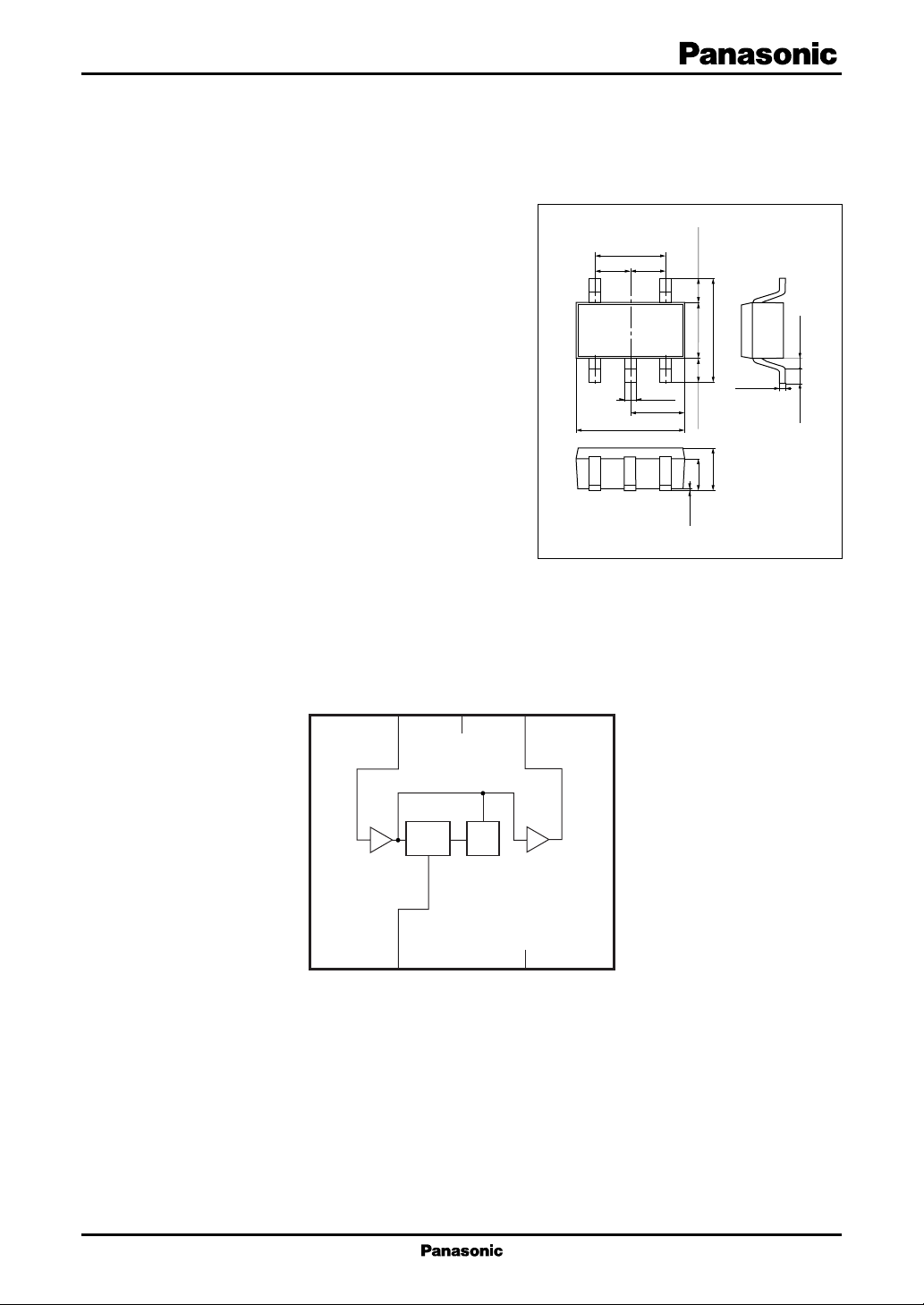
The AN6123MS is an ALC IC for level control of
audio signal (300 Hz to 3 kHz).
Adopting a mini 5-pin package, mounting on a small
area is possible.
■ Features
• Wide supply voltage operation range of VCC = 2.4 V to
6.0 V
• Small current consumption of I
= 500 µA
CC
• Reduction of a bad effect by the external noise thanks to
a package for a rear side mounting.
■ Applications
• Cordless telephone, PDC, PHS telephone
■ Block Diagram
32
GND
4
Output
51
4
0.3
+ 0.1
− 0.05
0.15
0.65 ±
+ 0.2
− 0.3
+ 0.25
− 0.05
2.8
1.5
35
0.15
0.1
0.65 ±
+ 0.2
− 0.1
0.8
1.1
0 to 0.1
0.1
1.9 ±
0.95
0.95
12
1.45 ±
+ 0.2
2.9
− 0.05
MINI-5D
0.16
+ 0.10
− 0.06
Unit: mm
0.1 to 0.3
0.2
0.4 ±
DET
DET Input
g
m
CC
V
1
Page 2
AN6213MS ICs for Telephone
■ Pin Descriptions
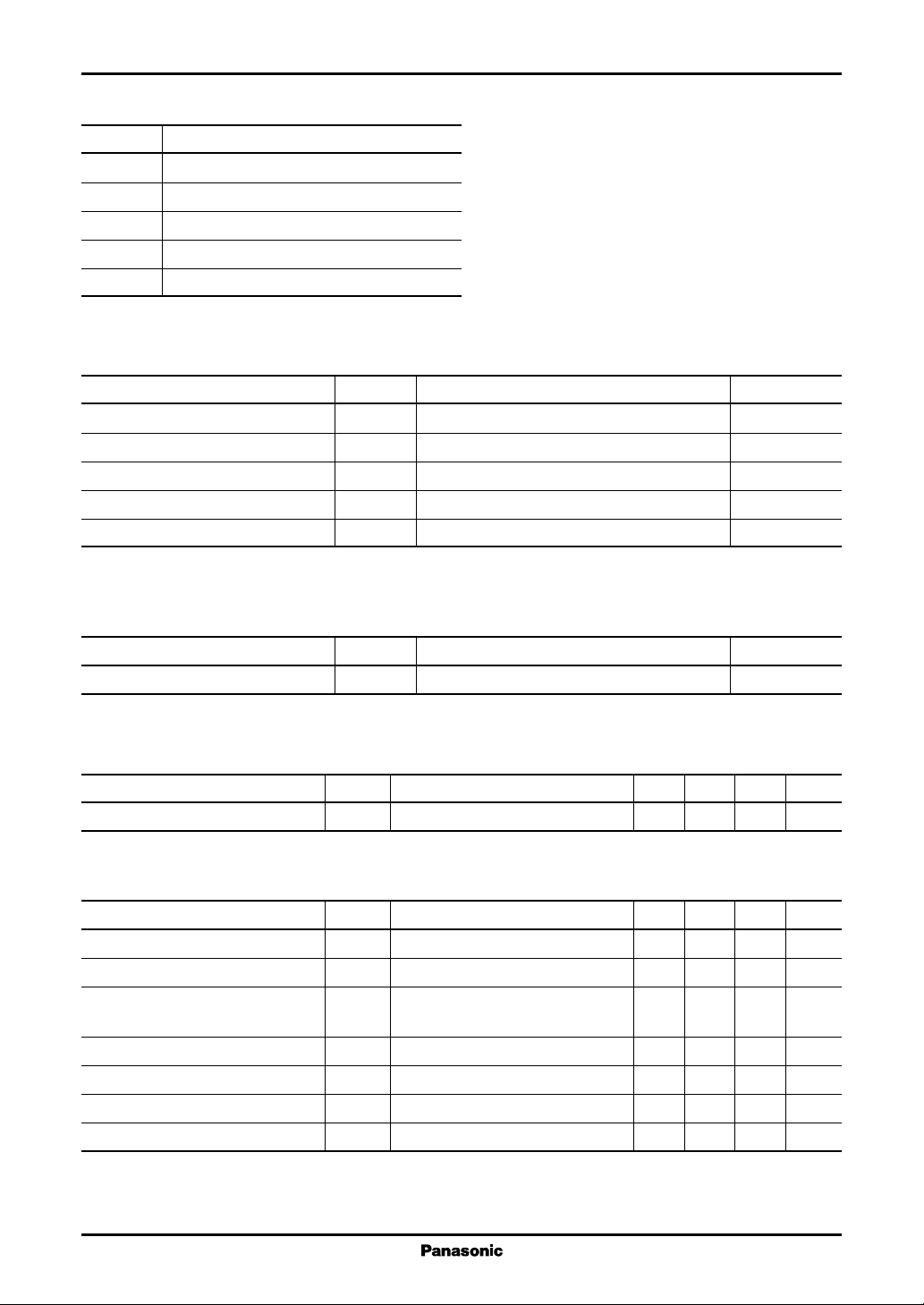
Pin No. Description
1VCCSupply voltage pin
2 DET Detection pin
3 Input Signal input pin
4 GND Grounding pin
5 Output Signal output pin
■ Absolute Maximum Ratings
Parameter Symbol Rating Unit
Supply voltage V
Supply current I
Power dissipation P
Operating ambient temperature
Storage temperature
Note)*: Except for the operating ambient temperature and storage temperature, all ratings are for Ta = 25°C.
*
*
CC
CC
D
T
opr
T
stg
6.5 V
3.0 mA
19.5 mW
−20 to +75 °C
−55 to +125 °C
■ Recommended Operating Range
Parameter Symbol Range Unit
Supply voltage V
CC
2.4 to 6.0 V
■ Electrical Characteristics at VCC = 3.0 V, f = 1 kHz, Ta = 25°C
Parameter Symbol Conditions Min Typ Max Unit
Operating current I
• Design reference data
Note) The characteristics listed below are theoretical values based on the IC design and are not guaranteed.
Parameter Symbol Conditions Min Typ Max Unit
Voltage gain G
Output level V
ALC control range ∆ALC Output level varying amount −1.5 1.5 dB
Total harmonic distortion factor THD At VIN = −10 dBm 1 3 %
Output noise voltage V
Input impedance Z
Output impedance Z
Without signal input 450 900 µA
CC
VIN = −40 dBm 22 24 26 dB
V
VIN = −10 dBm −9.5 −7.5 −5.5 dBm
O
at VIN = −25 dBm, V
Terminated by CCIT filter input 2 kΩ
NO
Pin 3 input impedance 15 30 45 k Ω
IN
Pin 5 output impedance 200 400 600 Ω
OUT
= 0 dBm
IN
−70 −60 dBm
2
Page 3

ICs for Telephone AN6123MS
■ Application Notes
1. I/O characteristics and distortion
33 µF
Signal input
(Input frequency = 1 kHz)
C
GND
10 kΩ
Signal output
The I/O characteristics in the circuit shown
3
AN6123MS
2
4
5
2 200 pF
1
on the left can be referred to in the graph below.
Also note that if the C in the circuit is lowered,
the distortion characteristics will become worse
(Graph 2).
1 MΩ
3.0 V
10 µF
Graph 1. I/O characteristics and distortion (when C = 10 µF)
0
−5
−10
−15
−20
−25
−30
−35
Output level (dBm)
−40
−45
−50
Output level
Distortion
−70 −60 −50 −40 −30 −20 −10 0 10
Input level (dBm)
12
10
8
6
4
Distortion (%)
2
0
Graph 2. Distortion characteristics when C is variable
13
12
11
10
9
8
7
6
5
Distortion (%)
4
3
2
1
0
−40 −35 −30 −25 −20
C = 4.7 µF
C = 10 µF
C = 2.2 µF
−10 −5
−15
Input lebve; (dBm)
C = 1.0 µF
0510
3
Page 4

AN6213MS ICs for Telephone
■ Application Notes (continued)
2. Input level adjustment for maximum output
You can adjust R in the left circuit diagram
Signal input
(1 kHz)
3.3 kΩ
10 µF
33 µF
R
GND
3
4
AN6123MS
2
1M Ω
0
−5
−10
−15
−20
−25
−30
−35
−40
−45
Output level (dBm)
−50
−55
−60
−70 −65 −60 −55 −50
1
3.0 V
10 kΩ
5
10 µF
I/O characteristics
R = Open
Signal output
2 200 pF
R = 3 kΩ
R = 1 kΩ
−40 −35 −30 −25 −20 −15 −10 −50
−45
Input level (dBm)
to find the operation point for a maximum output level. For example, since the input level for
a maximum output is −30 dBm when R is open
and the attenuation in the input stage is 20 log
(3k/6.3k) = −6.4 dB when R is 3 kΩ. This means
a total gain loss is −6.4 dB as compared with
open mode, hence the input level to get the
maximum output is −23.6 dBm.
Likewise, the attenuation is 12.7 dB for R =
1 kΩ and the desired input level becomes 17.3
dBm.
3. Output level adjustment for a maximum output
Signal input
(1 kHz)
3.3 kΩ
33 µF
GND
3
4
10 kΩ
5
R
AN6123MS
1
10 µF
10 µF
2
1M Ω
3.0 V
I/O characteristics
0
−5
−10
−15
−20
−25
Output level (dBm)
−30
−35
−50 −45 −40 −35 −30 −25 −20 −15 −10
Input level (dBm)
Signal output
2 200 pF
The maximum output level can be adjusted
by R in the left circuit diagram.
Since the maximum output is −7.5 dBm
when R is open, it is 20 log (20k/30k) = −3.5
dBm at R = 20 kΩ. It is an attenuated value of by
3.4 dB against open mode. Therefore, the maximum output becomes −11 dBm. Likewise, for R
= 10 kΩ, attenuation is 6 dB and the maximum
output becomes −13.5 dBm.
R = Open
R = 20 kΩ
R = 10 kΩ
4
Page 5

ICs for Telephone AN6123MS
■ Application Notes (continued)
4. Frequency characteristics
Signal input
10 µF
33 µF
GND
3
AN6123MS
2
1 MΩ
10
8
6
4
2
(dB)
0
−2
Gain
−4
−6
−8
−10
10 kΩ
Signal output
R
4
5
C
1
10 µF
3.0 V
Frequency characteristics
Input signal level: −10 dBm
For C = 2 200 pF
100 1k 10k 100k
Input frequency
(Hz)
The AN6123MS itself has an almost flat frequency characteristic in the audio frequency band.
The high-band frequency is set with R and C
shown in the left circuit. The cut-off frequency f
at R = 10 kΩ and C = 2 200 pF, that is the frequency
at which the frequency characteristic deteriorates
by 3 dB, is f
= 1/2πCR = 7.2 kHz. At R = 10 kΩ
C
and C = 1 000 pF, it is 16 kHz. (Refer to the graph.)
For C = 1 000 pF
C
■ Application Circuit Example
Signal input
(300 Hz ∼ 3 kHz)
3.3 kΩ
G = 30 dB
R
10 µF
33 µF
32
DET
1 MΩ
GND
4
g
m
V
CC
2.4 V ∼ 6.0 V
10 kΩ
51
Signal output
0.9 V[p-p]
Noise = −70 dBm
Distortion = 1%
2 200 pF
10 µF
5
 Loading...