

Page 1

ADVANCED
LINEAR
DEVICES, INC.
EPAD™ ULTRA MICROPOWER OPERATIONAL AMPLIFIER
ALD1726E/ALD1726
KEY FEATURES
• EPAD ( Electrically Programmable Analog Device)
• User programmable V
trimmer
OS
• Computer-assisted trimming
• Rail-to-rail input/output
• Compatible with standard EPAD Programmer
• High precision through in-system circuit precision trimming
• Reduces or eliminates V
, PSRR, CMRR and TCVOS errors
OS
• System level “calibration” capability
• Application-Specific Programming mode
• In-System Programming mode
• Electrically programmable to compensate for
external component tolerances
• Achieves 0.01pA input bias current and 50
µV
input offset voltage simultaneously
• Compatible with industry standard pinout
GENERAL DESCRIPTION
The ALD1726E/ALD1726 is a monolithic rail-to-rail ultra-micropower
precision CMOS operational amplifier with integrated user programmable
EPAD (Electrically Programmable Analog Device) based offset voltage
adjustment. The ALD1726E/ALD1726 is a direct replacement of the
ALD1706 operational amplifier, with the added feature of user-programmable offset voltage trimming resulting in significantly enhanced total
system performance and user flexibility. EPAD technology is an exclusive
ALD design which has been refined for analog applications where precision voltage trimming is necessary to achieve a desired performance. It
utilizes CMOS FETs as in-circuit elements for trimming of offset voltage
bias characteristics with the aid of a personal computer under software
control. Once programmed, the set parameters are stored indefinitely
within the device even after power-down. EPAD offers the circuit designer
a convenient and cost-effective trimming solution for achieving the very
highest amplifier/system performance.
The ALD1726E/ALD1726 operational amplifier features rail-to-rail input
and output voltage ranges, tolerance to over-voltage input spikes of
300mV beyond supply rails, extremely low input currents of 0.01pA typical,
high open loop voltage gain, useful bandwidth of 200KHz, slew rate of 0.17
V/µs, and low typical supply current of 25µA.
BENEFITS
• Eliminates manual and elaborate
system trimming procedures
• Remote controlled automated trimming
• In-System Programming capability
• No external components
• No internal chopper clocking noise
• No chopper dynamic power dissipation
• Simple and cost effective
• Small package size
• Extremely small total functional
volume size
• Low system implementation cost
• Micropower and Low Voltage
APPLICATIONS
• Sensor interface circuits
• Transducer biasing circuits
• Capacitive and charge integration circuits
• Biochemical probe interface
• Signal conditioning
• Portable instruments
• High source impedance electrode
amplifiers
• Precision Sample and Hold amplifiers
• Precision current to voltage converter
• Error correction circuits
• Sensor compensation circuits
• Precision gain amplifiers
• Periodic In-system calibration
• System output level shifter
PIN CONFIGURATION
VE2
VE1
1
8
ORDERING INFORMATION
-IN
+IN
V
2
3
-
4
Operating Temperature Range
-55°C to +125°C0°C to +70°C0°C to +70°C
8-Pin 8-Pin 8-Pin
CERDIP Small Outline Plastic Dip
Package Package (SOIC) Package
ALD1726E DA ALD1726E SA ALD1726E PA
ALD1726 DA ALD1726 SA ALD1726 PA
* Contact factory for industrial temperature range
© 1998 Advanced Linear Devices, Inc. 415 T asman Drive, Sunnyvale, California 94089 -1706 Tel: (408) 747-1155 Fax: (408) 747-1286 http://www .aldinc.com
2
TOP VIEW
DA, PA, SA PACKAGE
+
7
V
OUT
6
5
N/C
Page 2

FUNCTIONAL DESCRIPTION
The ALD1726E/ALD1726 uses EPADs as in-circuit elements for trimming of offset voltage bias characteristics.
Each ALD1726E/ALD1726 has a pair of EPAD-based circuits connected such that one circuit is used to adjust V
OS
in one direction and the other circuit is used to adjust VOS in
the other direction.
Functional Description of ALD1726E
While each of the EPAD devices is a monotonically adjustable programmable device, the V
of the ALD1726E can be
OS
adjusted many times in both directions. Once programmed,
the set V
levels are stored permanently, even when the
OS
device power is removed.
The ALD1726E provides the user with an operational ampli-
fier that can be trimmed with user application-specific programming or in-system programming conditions. User application-specific circuit programming refers to the situation
where the Total Input Offset Voltage of the ALD1726E (V
OST)
can be trimmed with the actual intended operating conditions.
The ALD1726E is pre-programmed at the factory under
standard operating conditions for minimum equivalent input
offset voltage. It also has a guaranteed offset voltage
program range, which is ideal for applications that require
electrical offset voltage programming.
For example, an application circuit may have +6V and -2.5V
power supplies, and the operational amplifier input is biased
at +0.7V, and the average operating temperature is at 55
°C.
The circuit can be wired up to these conditions within an
environmental chamber, and the ALD1726E can be inserted
into a test socket connected to this circuit while it is being
electrically trimmed. Any error in V
conditions can be automatically zeroed out. The Total V
due to these bias
OS
OS
error is now limited only by the adjustable range and the
stability of V
amplifier. Therefore, this Total V
, and the input noise voltage of the operational
OS
error now includes V
OS
OS
as VOS is traditionally specified; plus the VOS error contributions from PSRR, CMRR, TCV
total V
error term (V
OS
OST
, and noise. Typically this
OS
) is approximately ±50µV for the
ALD1726E.
The V
contribution due to PSRR, CMRR, TCVOS and
OS
external components can be large for operational amplifiers
without trimming. Therefore the ALD1726E with EPAD trimming is able to provide much improved system performance
by reducing these other sources of error to provide significantly reduced V
OST.
In-System Programming refers to the condition where the
EPAD adjustment is made after the ALD1726E has been
inserted into a circuit board. In this case, the circuit design
must provide for the ALD1726E to operate in normal mode
and in programming mode. One of the benefits of in-system
programming is that not only is the ALD1726E offset voltage
from operating bias conditions accounted for, any residual
errors introduced by other circuit components, such as resis-
tor or sensor induced voltage errors, can also be corrected.
In this way, the “in-system” circuit output can be adjusted to
a desired level eliminating other trimming components.
Functional Description of ALD1726
The ALD1726 is pre-programmed at the factory under standard operating conditions for minimum equivalent input offset
voltage. The ALD1726 offers similar programmable features
as the ALD1726E, but with more limited offset voltage program range. It is intended for standard operational amplifier
applications where little or no electrical programming by the
user is necessary.
USER PROGRAMMABLE V
FEATURE
OS
Each ALD1726E/ALD1726 has two pins named VE1 and
VE2 which are internally connected to an internal offset bias
circuit. VE1/VE2 have initial typical values of 1.0 to 1.5 Volt.
The voltage on these pins can be programmed using the ALD
E100 EPAD Programmer and the appropriate Adapter Module. The useful programming range of VE1 and VE2 is 1.2
Volt to 3.0 Volts. VE1 and VE2 pins are programming pins,
used during programming mode. The Programming pin is
used during electrical programming to inject charge into the
internal EPADs. Increases of VE1 decrease the offset voltage while increases of VE2 increase the offset voltage of the
operational amplifier. The injected charge is permanently
stored and determines the offset voltage of the operational
amplifier. After programming, VE1 and VE2 terminals must
be left open to settle on a voltage determined by internal bias
currents.
During programming, the voltages on VE1 or VE2 are increased incrementally to set the offset voltage of the operational amplifier to the desired Vos. Note that desired V
OS
can
be any value within the offset voltage programmable ranges,
and can be either zero, a positive value or a negative value.
This V
value can also be reprogrammed to a different
OS
value at a later time, provided that the useful VE1 or VE2
programming voltage range has not been exceeded. VE1 or
VE2 pins can also serve as capacitively coupled input pins.
Internally, VE1 and VE2 are programmed and connected
differentially. Temperature drift effects between the two
internal offset bias circuits cancel each other and introduce
less net temperature drift coefficient change than offset
voltage trimming techniques such as offset adjustment with
an external trimmer potentiometer.
While programming, V+, VE1 and VE2 pins may be alternately pulsed with 12V (approximately) pulses generated by
the EPAD Programmer. In-system programming requires the
ALD1726E/ALD1726 application circuit to accommodate
these programming pulses. This can be accomplished by
adding resistors at certain appropriate circuit nodes. For
more information, see Application Note AN1700.
2 Advanced Linear Devices ALD1726E/ALD1726
Page 3
ABSOLUTE MAXIMUM RATINGS
Supply voltage, V
+
Differential input voltage range -0.3V to V
Power dissipation 600 mW
Operating temperature range PA,SA package 0°C to +70°C
DA package -55°C to +125°C
Storage temperature range -65°C to +150°C
Lead temperature, 10 seconds +260°C
13.2V
+
+0.3V
OPERATING ELECTRICAL CHARACTERISTICS
T
A
= 25
oC
V
= ±2.5V unless otherwise specified
S
1726E 1726
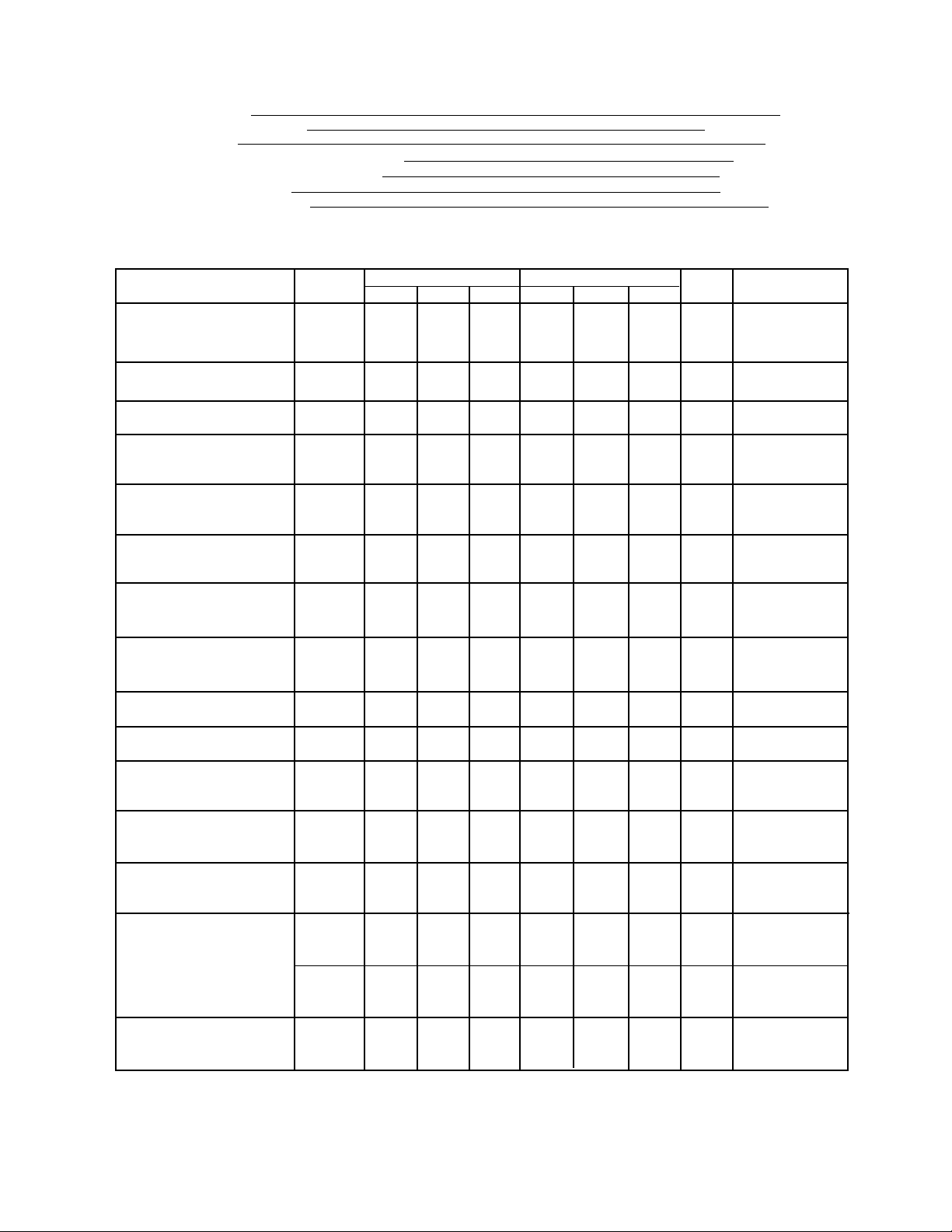
Parameter Symbol Min Typ Max Min Typ Max Unit Test Conditions
Supply Voltage V
Initial Input Offset Voltage
Offset Voltage Program Range
1
2
Programmed Input Offset V
Voltage Error
Total Input Offset Voltage
Input Offset Current
Input Bias Current
Input Voltage Range
3
4
5
5
6
V
V
∆V
V
I
I
V
OS
B
S
+
OS i
OS
OS
OST
IR
±1.0 ±5.0 ±1.0 ±5.0 V
2.0 10.0 2.0 10.0 V Single Supply
50 100 75 150 µVR
≤ 100KΩ
S
±10 ±20 ±1 ±5mV
50 100 75 150 µV At user specified
target offset voltage
50 100 75 150 µV At user specified
target offset voltage
0.01 10 0.01 10 pA TA = 25°C
240 240 pA 0°C ≤ TA ≤ +70°C
0.01 10 0.01 10 pA TA = 25°C
-0.3 5.3 -0.3 5.3 V V+ = +5V
-2.8 +2.8 -2.8 +2.8 V VS = ±2.5V
Input Resistance R
Input Offset Voltage Drift
7
IN
TCV
OS
Initial Power Supply PSRR
Rejection Ratio
8
Initial Common Mode CMRR
Rejection Ratio
Large Signal Voltage Gain A
8
V
14
10
77µV/°CRS ≤ 100KΩ
i
i
80 80 dB RS ≤ 100KΩ
83 83 dB RS ≤ 100KΩ
32 100 32 100 V/mV RL =1MΩ
10
14
Ω
20 20 V/mV 0°C ≤ TA ≤ +70°C
VO low 0.001 0.01 0.001 0.01 V RL =1MΩ V+ = 5V
Output Voltage Range VO high 4.99 4.999 4.99 4.999 V 0°C ≤ TA ≤ +70°C
VO low -2.48 -2.40 -2.48 -2.40 V RL =100KΩ
VO high 2.40 2.48 2.40 2.48 V 0°C ≤ TA ≤ +70°C
Output Short Circuit Current I
\* NOTES 1 through 9, see section titled "Definitions and Design Notes".
SC
200 200 µA
ALD1726E/ALD1726 Advanced Linear Devices 3
Page 4

OPERATING ELECTRICAL CHARACTERISTICS (cont'd)
oC
= 25
T
A
Parameter Symbol Min Typ Max Min Typ Max Unit Test Conditions
V
= ±2.5V unless otherwise specified
S
1726E 1726
Supply Current I
Power Dissipation P
Input Capacitance C
Maximum Load Capacitance C
Equivalent Input Noise Voltage e
Equivalent Input Current Noise i
Bandwidth B
Slew Rate S
Rise time t
Overshoot Factor 20 20 % RL = 1MΩ,
Settling Time t
S
D
IN
L
n
n
W
R
r
s
25 40 25 40 µAV
200 200 µWV
11
25 25 pF
55 55 nV/√Hz f = 1KHz
0.6 0.6 fA/√Hz f =10Hz
400 400 KHz
0.17 0.17 V/µsA
1.0 1.0 µsR
10 10 µs 0.1%
pF
= 0V
IN
No Load
= ±2.5V
S
= +1
V
RL = 1MΩ
= 1MΩ
L
CL = 25pF
AV = 1,RL=1MΩ
CL = 25pF
A
= 25
oC
VS = ±2.5V unless otherwise specified
T
1726E 1726
Parameter Symbol Min Typ Max Min Typ Max Unit Test Conditions
Average Long Term Input Offset ∆ V
Voltage Stability
Initial VE Voltage VE1 i, VE2
Programmable VE Range ∆VE1, ∆VE2 1.0 2.0 0.5 V
Programmed VE Voltage Error e(VE1-VE2) 0.1 0.1 %
VE Pin Leakage Current i
9
OS
∆ time 1000 hrs
i
eb
0.02 0.02 µV/
1.0 1.5 V
-5 -5 µA
4 Advanced Linear Devices ALD1726E/ALD1726
Page 5

V
= ±2.5V -55°C ≤ T
S
≤ +125°C unless otherwise specified
A
1726E 1726
Parameter Symbol Min Typ Max Min Typ Max Unit Test Conditions
Initial Input offset Voltage V
Input Offset Current I
Input Bias Current I
OS i
OS
B
Initial Power Supply PSRR
Rejection Ratio
8
Initial Common Mode CMRR
RejectionRatio
Large Signal Voltage Gain A
8
V
i
i
15 50 15 50 V/mV RL = 1MΩ
0.7 0.7 mV RS ≤ 100KΩ
2.0 2.0 nA
2.0 2.0 nA
75 75 dB RS ≤ 1MΩ
83 83 dB RS ≤ 1MΩ
Output Voltage Range VO low -2.40 -2.30 -2.40 -2.30 V
VO high 2.30 2.40 2.30 2.40 V RL = 1MΩ
= 25
A
oC
VS = ±1.0V unless otherwise specified
T
1726E 1726
Parameter Symbol Min Typ Max Min Typ Max Unit Test Conditions
Initial Power Supply PSRR
Rejection Ratio
8
i
70 70 dB RS ≤ 1MΩ
Initial Common Mode CMRR
Rejection Ratio
Large Signal Voltage Gain A
8
V
i
70 70 dB RS ≤ 1MΩ
50 50 V/mV RL = 1MΩ
Output Voltage Range VO low -0.95 -0.9 -0.95 -0.90 V RL = 1MΩ
VO high 0.9 0.95 0.90 0.95
Bandwidth B
Slew Rate S
W
R
0.3 0.3 MHz
0.17 0.17 V/µ sAV = +1, CL = 50pF
ALD1726E/ALD1726 Advanced Linear Devices 5
Page 6

TYPICAL PERFORMANCE CHARACTERISTICS
OUTPUT VOLTAGE SWING AS A FUNCTION
OF SUPPLY VOLTAGE
±6
±25°C ≤ TA ≤ +125°C
±5
R
= 100KΩ
L
±4
±3
±2
OUTPUT VOLTAGE SWING (V)
±1
0
±1 ±2 ±3 ±4 ±7±6±5
SUPPLY VOLTAGE (V)
INPUT BIAS CURRENT AS A FUNCTION
OF AMBIENT TEMPERATURE
1000
= ±2.5V
100
10
V
S
OPEN LOOP VOLTAGE GAIN AS A FUNCTION
OF SUPPLY VOLTAGE AND TEMPERATURE
1000
100
10
GAIN (V/mV)
OPEN LOOP VOLTAGE
1
0 ±2 ±4 ±6 ±8
SUPPLY VOLTAGE (V)
±55°C ≤ T
RL = 100KΩ
SUPPLY CURRENT AS A FUNCTION
OF SUPPLY VOLTAGE
100
INPUTS GROUNDED
OUTPUT UNLOADED
80
TA = -55°C
60
≤ +125°C
A
-25°C
+25°C
1.0
0.1
INPUT BIAS CURRENT (pA)
0.01
AMBIENT TEMPERATURE (°C)
ADJUSTMENT IN INPUT OFFSET VOLTAGE
AS A FUNCTION OF CHANGE IN VE1 AND VE2
10
8
6
4
(mV)
OS
2
0
-2
-4
VOLTAGE ∆V
-6
-8
CHANGE IN INPUT OFFSET
-10
0.0 0.1 0.2 0.3 0.4 0.5 0.6
CHANGE IN VE1 AND VE2 (V)
100-25 0 75 1255025-50
VE2
VE1
40
20
SUPPLY CURRENT (µA)
0
0 ±1 ±2 ±3 ±4 ±5 ±6
OPEN LOOP VOLTAGE GAIN AS
A FUNCTION OF FREQUENCY
120
100
80
60
40
GAIN (db)
20
OPEN LOOP VOLTAGE
0
-20
1 10 100 1K 10K 1M 10M100K
+70°C
SUPPLY VOLTAGE (V)
FREQUENCY (Hz)
+125°C
VS = ±2.5V
T
= 25°C
A
6 Advanced Linear Devices ALD1726E/ALD1726
PHASE SHIFT IN DEGREES
0
45
90
135
180
Page 7

TYPICAL PERFORMANCE CHARACTERISTICS
COMMON MODE INPUT VOLTAGE RANGE
AS A FUNCTION OF SUPPLY VOLTAGE
±7
±6
±5
TA = 25°C
±4
±3
±2
VOLTAGE RANGE (V)
COMMON MODE INPUT
±1
0
0 ±1 ±2 ±3 ±4 ±5 ±6 ±7
SUPPLY VOLTAGE (V)
OPEN LOOP VOLTAGE GAIN AS AFUNCTION
OF LOAD RESISTANCE
1000
100
LARGE - SIGNAL TRANSIENT
RESPONSE
2V/div
500mV/div
SMALL - SIGNAL TRANSIENT
RESPONSE
100mV/div
VS = ±1.0V
= 25°C
T
A
= 100KΩ
R
L
= 25pF
C
L
10µs/div
= ±2.5V
V
S
T
= 25°C
A
R
= 100KΩ
L
C
= 25pF
L
10
GAIN (V/mV)
OPEN LOOP VOLTAGE
1
10K 100K 1M
LOAD RESISTANCE (Ω)
LARGE - SIGNAL TRANSIENT
5V/div
2V/div 10µs/div
RESPONSE
VS = ±2.5V
T
= 25°C
A
V
= ±2.5V
S
T
= 25°C
A
R
= 100KΩ
L
C
= 25pF
L
10M
100
EXAMPLE B:
V
AFTER EPAD
OST
80
PROGRAMMING
TARGET = -750µV
V
OST
60
40
PERCENTAGE OF UNITS (%)
20
0
-2000
-2500
50mV/div
DISTRIBUTION OF TOTAL INPUT OFFSET VOLTAGE
BEFORE AND AFTER EPAD PROGRAMMING
EXAMPLE A:
V
PROGRAMMING
V
-1500
-500
-1000
TOTAL INPUT OFFSET VOLTAGE (µV)
500
0
10µs/div
AFTER EPAD
OST
TARGET = 0.0µV
OST
V
BEFORE EPAD
OST
PROGRAMMING
1000 1500 2000 2500
ALD1726E/ALD1726 Advanced Linear Devices 7
Page 8

TWO EXAMPLES OF EQUIVALENT INPUT OFFSET VOLTAGE DUE TO
CHANGE IN SUPPLY VOLTAGE vs. SUPPLY VOLTAGE
500
PSRR = 80 dB
400
300
200
100
CHANGE IN SUPPLY VOLTAGE (µV)
EQUIVALENT INPUT OFFSET VOLTAGE DUE TO
0
0
1
EXAMPLE A:
V
EPAD PROGRAMMED
OS
AT V
2
SUPPLY
3
= +5V
4
SUPPLY VOLTAGE (V)
6
5
EXAMPLE B:
EPAD
V
OS
PROGRAMMED
AT V
789 10
SUPPLY
= +8V
THREE EXAMPLES OF EQUIVALENT INPUT OFFSET VOLTAGE DUE TO
CHANGE IN COMMON MODE VOLTAGE vs. COMMON MODE VOLTAGE
500
400
V
= ±5V
SUPPLY
CMRR = 80dB
300
EXAMPLE B:
EPAD
V
OS
PROGRAMMED
200
100
CHANGE IN COMMON MODE VOLTAGE (µV)
0
EQUIVALENT INPUT OFFSET VOLTAGE DUE TO
-5
AT V
= -4.3V
IN
-4
-3
EXAMPLE A:
EPAD PROGRAMMED
V
OS
= 0V
AT V
IN
-1
-2
COMMON MODE VOLTAGE (V)
0
EXAMPLE C:
EPAD PROGRAMMED
V
OS
= +5V
AT V
IN
1
2345
EXAMPLE OF MINIMIZING EQUIVALENT INPUT OFFSET VOLTAGE
FOR A COMMON MODE VOLTAGE RANGE OF 0.5V
50
40
30
20
CMRR = 80dB
10
COMMON MODE VOLTAGE RANGE OF 0.5V
VOS EPAD
PROGRAMMED
AT COMMON MODE
VOLTAGE OF 0.25V
CHANGE IN COMMON MODE VOLTAGE (µV)
0
EQUIVALENT INPUT OFFSET VOLTAGE DUE TO
-0.5
-0.4
-0.3
-0.2 -0.1
COMMON MODE VOLTAGE (V)
0.0
0.1
0.2 0.3 0.4 0.5
8 Advanced Linear Devices ALD1726E/ALD1726
Page 9

APPLICATION SPECIFIC / IN-SYSTEM PROGRAMMING
Examples of applications where accumulated total input offset voltage from various
contributing sources is minimized under different sets of user-specified operating conditions
TOTAL INPUT OFFSET VOLTAGE (µV)
TOTAL INPUT OFFSET VOLTAGE (µV)
2500
2000
1500
1000
500
-500
-1000
-1500
-2000
-2500
2500
2000
1500
1000
500
-500
-1000
-1500
-2000
-2500
V
BUDGET AFTER
OS
EPAD PROGRAMMING
0
VOS BUDGET BEFORE
EPAD PROGRAMMING
EXAMPLE A
VOS BUDGET BEFORE
EPAD PROGRAMMING
0
VOS BUDGET AFTER
EPAD PROGRAMMING
EXAMPLE C
2500
2000
1500
1000
500
TOTAL INPUT OFFSET VOLTAGE (µV)
TOTAL INPUT OFFSET VOLTAGE (µV)
-500
-1000
-1500
-2000
-2500
2500
2000
1500
1000
500
0
-500
-1000
-1500
-2000
-2500
+
X
+
X
VOS BUDGET AFTER
EPAD PROGRAMMING
0
VOS BUDGET BEFORE
EPAD PROGRAMMING
EXAMPLE B
VOS BUDGET AFTER
EPAD PROGRAMMING
VOS BUDGET BEFORE
EPAD PROGRAMMING
EXAMPLE D
+
X
+
X
Device input V
PSRR equivalent V
+
CMRR equivalent V
TA equivalent V
Noise equivalent V
X
External Error equivalent V
OS
OS
OS
OS
OS
OS
Total Input VOS
after EPAD
Programming
ALD1726E/ALD1726 Advanced Linear Devices 9
Page 10

DEFINITIONS AND DESIGN NOTES:
1. Initial Input Offset Voltage is the initial offset voltage of the
ALD1726E/ALD1726 operational amplifier when shipped from
the factory. The device has been pre-programmed and tested
for programmability.
2. Offset Voltage Program Range is the range of adjustment of
user specified target offset voltage. This is typically an adjustment in either the positive or the negative direction of the input
offset voltage from an initial input offset voltage. The input
offset programming pins, VE1 or VE2, change the input offset
voltage in the negative or positive direction, respectively. User
specified target offset voltage can be any offset voltage within
this programming range.
3. Programmed Input Offset Voltage Error is the final offset
voltage error after programming when the Input Offset Voltage
is at target Offset Voltage. This parameter is sample tested.
4. Total Input Offset Voltage is the same as Programmed Input
Offset Voltage, corrected for system offset voltage error. Usually this is an all inclusive system offset voltage, which also
includes offset voltage contributions from input offset voltage,
PSRR, CMRR, TCV
and noise. It can also include errors
OS
introduced by external components, at a system level. Programmed Input Offset Voltage and Total Input Offset Voltage is
not necessarily zero offset voltage, but an offset voltage set to
compensate for other system errors as well. This parameter is
sample tested.
5. The Input Offset and Bias Currents are essentially input
protection diode reverse bias leakage currents. This low input
bias current assures that the analog signal from the source will
not be distorted by it. For applications where source impedance
is very high, it may be necessary to limit noise and hum pickup
through proper shielding.
6. Input Voltage Range is determined by two parallel complementary input stages that are summed internally, each stage
having a separate input offset voltage. While Total Input Offset
Voltage can be trimmed to a desired target value, it is essential
to note that this trimming occurs at only one user selected input
bias voltage. Depending on the selected input bias voltage
relative to the power supply voltages, offset voltage trimming
may affect one or both input stages. For the ALD1726E/
ALD1726, the switching point between the two stages occur at
approximately 1.5V below positive supply voltage.
7. Input Offset Voltage Drift is the average change in Total Input
Offset Voltage as a function of ambient temperature. This
parameter is sample tested.
8. Initial PSRR and initial CMRR specifications are provided as
reference information. After programming, error contribution to
the offset voltage from PSRR and CMRR is set to zero under the
specific power supply and common mode conditions, and
becomes part of the Programmed Input Offset Voltage Error.
9. Average Long Term Input Offset Voltage Stability is based on
input offset voltage shift through operating life test at 125°C
extrapolated to T
A = 25 °C, assuming activation energy of
1.0eV. This parameter is sample tested.
ADDITIONAL DESIGN NOTES:
A. The ALD1726E/ALD1726 is internally compensated for unity
gain stability using a novel scheme which produces a single pole
role off in the gain characteristics while providing more than 60
degrees of phase margin at unity gain frequency. A unity gain
buffer using the ALD1726E/ALD1726 will typically drive 25pF of
external load capacitance.
B. The ALD1726E/ALD1726 has complementary p-channel
and n-channel input differential stages connected in parallel to
accomplish rail-to-rail input common mode voltage range. The
switching point between the two differential stages is 1.5V below
positive supply voltage. For applications such as inverting
amplifier or non-inverting amplifier with a gain larger than 2.5
(5V operation), the common mode voltage does not make
excursions below this switching point. However, this switching
does take place if the operational amplifier is connected as a railto-rail unity gain buffer and the design must allow for input offset
voltage variations.
C. The output stage consists of class AB complementary output
drivers. The oscillation resistant feature, combined with the railto-rail input and output feature, makes the ALD1726E/ALD1726
an effective analog signal buffer for high source impedance
sensors, transducers, and other circuit networks.
D. The ALD1726E/ALD1726 has static discharge protection.
Care must be exercised when handling the device to avoid
strong static fields that may degrade a diode junction, causing
increased input leakage currents. The user is advised to power
up the circuit before, or simultaneously with, any input voltages
applied and to limit input voltages not to exceed 0.3V of the
power supply voltage levels.
E. VE1 and VE2 are high impedance terminals, as the internal
bias currents are set very low to a few microamperes to
conserve power. For some applications, these terminals may
need to be shielded from external coupling sources. For example, digital signals running nearby may cause unwanted
offset voltage fluctuations. Care during the printed circuit board
layout to place ground traces around these pins and to isolate
them from digital lines will generally eliminate such coupling
effects. In addition, optional decoupling capacitors of 1000pF or
greater value can be added to VE1 and VE2 terminals.
F. The ALD1726E/ALD1726 is designed for use in low voltage,
micropower circuits. The maximum operating voltage during
normal operation should remain below 10 Volts at all times. Care
should be taken to insure that the application in which the device
is used do not experience any positive or negative transient
voltages that will cause any of the terminal voltages to exceed
this limit.
G. All inputs or unused pins except VE1 and VE2 pins should be
connected to a supply voltage such as Ground so that they do
not become floating pins, since input impedance at these pins
is very high. If any of these pins are left undefined, they may
cause unwanted oscillation or intermittent excessive current
drain. As these devices are built with CMOS technology, normal
operating and storage temperature limits, ESD and latchup
handling precautions pertaining to CMOS device handling
should be observed.
10 Advanced Linear Devices ALD1726E/ALD1726
 Loading...