

Page 1
Voltage-to-Frequency and
a
FEATURES
High Linearity
60.01% max at 10 kHz FS
60.05% max at 100 kHz FS
60.2% max at 500 kHz FS
Output TTL/CMOS Compatible
V/F or F/V Conversion
6 Decade Dynamic Range
Voltage or Current Input
Reliable Monolithic Construction
MIL-STD-883 Compliant Versions Available
PRODUCT DESCRIPTION
The industry standard ADVFC32 is a low cost monolithic
voltage-to-frequency (V/F) converter or frequency-to-voltage
(F/V) converter with good linearity (0.01% max error at
10 kHz) and operating frequency up to 0.5 MHz. In the V/F
configuration, positive or negative input voltages or currents can
be converted to a proportional frequency using only a few external components. For F/V conversion, the same components are
used with a simple biasing network to accommodate a wide
range of input logic levels.
TTL or CMOS compatibility is achieved in the V/F operating
mode using an open collector frequency output. The pullup resistor can be connected to voltages up to 30 volts, or to +15 V
or +5 V for conventional CMOS or TTL logic levels. This resistor should be chosen to limit current through the open collector
output to 8 mA. A larger resistance can be used if driving a high
impedance load.
Input offset drift is only 3ppm of full scale per °C, and fullscale calibration drift is held to a maximum of 100 ppm/°C
(ADVFC32BH) due to a low T.C. Zener diode.
The ADVFC32 is available in commercial, industrial, and extended temperature grades. The commercial grade is packaged
in a 14-pin plastic DIP while the two wider temperature range
parts are packaged in hermetically sealed TO-100 cans.
PRODUCT HIGHLIGHTS
1. The ADVFC32 uses a charge balancing circuit technique
(see Functional Block Diagram) which is well suited to high
accuracy voltage-to-frequency conversion. The full-scale
operating frequency is determined by only one precision resistor and capacitor. The tolerance of other support components (including the integration capacitor) is not critical.
Inexpensive ±20% resistors and capacitors can be used without affecting linearity or temperature drift.
Frequency-to-Voltage Converter
ADVFC32
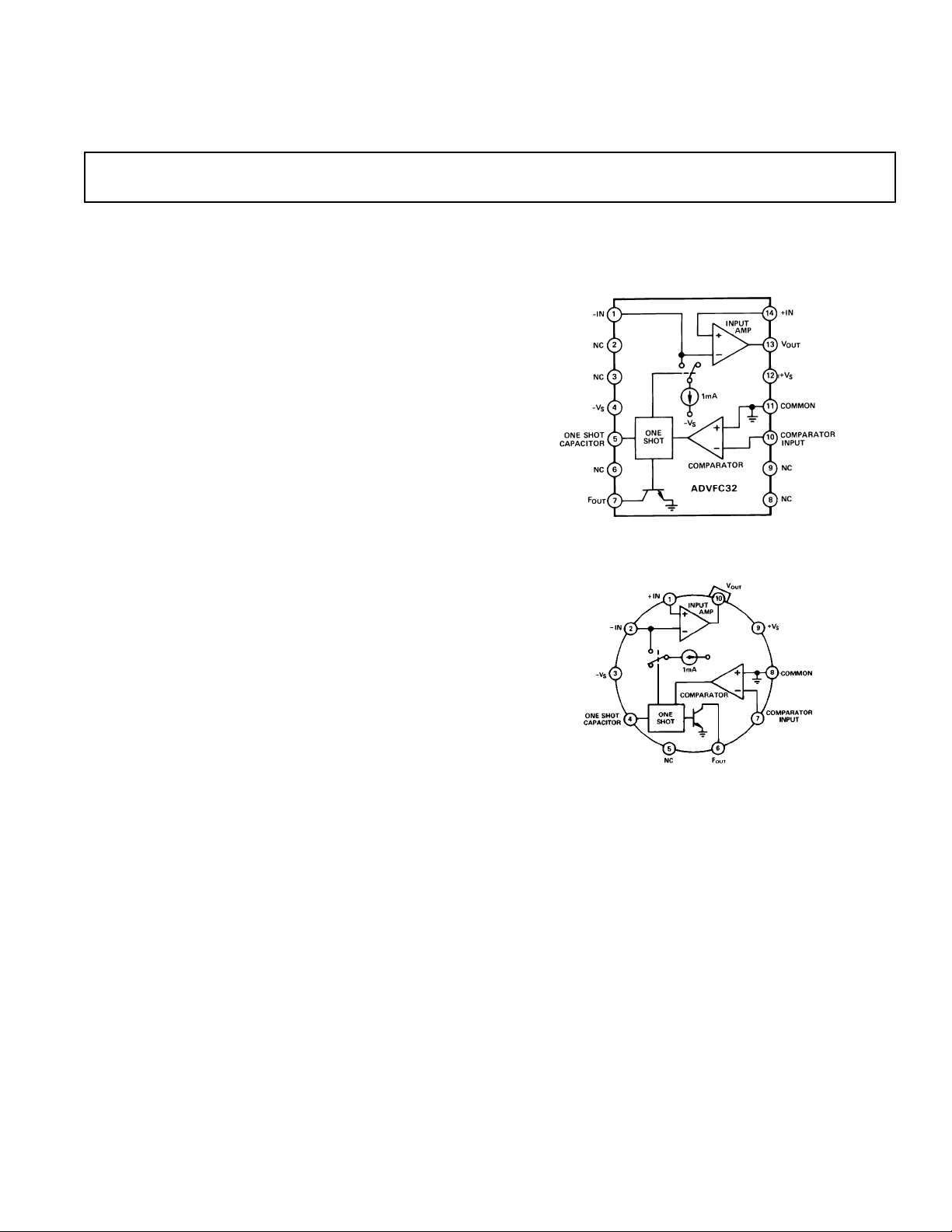
PIN CONFIGURATION
(TOP VIEW)
“N” Package
“H” Package – TO-100
NC = NO CONNECT
2. The ADVFC32 is easily configured to satisfy a wide range of
system requirements. Input voltage scaling is set by selecting
the input resistor which sets the input current to 0.25 mA at
the maximum input voltage.
3. The same components used for V/F conversion can also be
used for F/V conversion by adding a simple logic biasing network and reconfiguring the ADVFC32.
4. The ADVFC32 is intended as a pin-for-pin replacement for
VFC32 devices from other manufacturers.
5. The ADVFC32 is available in versions compliant with MILSTD-883. Refer to the Analog Devices Military Products
Databook or current ADVFC32/883B data sheet for detailed
specifications.
REV. A
Information furnished by Analog Devices is believed to be accurate and
reliable. However, no responsibility is assumed by Analog Devices for its
use, nor for any infringements of patents or other rights of third parties
which may result from its use. No license is granted by implication or
otherwise under any patent or patent rights of Analog Devices.
One Technology Way, P.O. Box 9106, Norwood, MA 02062-9106, U.S.A.
Tel: 617/329-4700 Fax: 617/326-8703
Page 2

ADVFC32–SPECIFICA TIONS
(typical @ +258C with VS = 615 V unless otherwise noted)
ADVFC32K ADVFC32B ADVFC32S
Model Min Typ Max Min Typ Max Min Typ Max Units
DYNAMIC PERFORMANCE
Full Scale Frequency Range 0 500 0 500 0 500 kHz
Nonlinearity
f
f
f
Full-Scale Calibration Error
1
= 10 kHz –0.01 ±0.01 –0.01 +0.01 –0.01 +0.01 %
MAX
= 100 kHz –0.05 +0.05 –0.05 +0.05 –0.05 +0.05 %
MAX
= 0.5 MHz –0.20 ±0.05 +0.20 –0.20 ±0.05 +0.20 –0.20 ±0.05 +0.20 %
MAX
(Adjustable to Zero) ± 5 ± 5 ± 5%
vs. Supply
(Full Scale Frequency = 100 kHz)
–0.015 +0.015 –0.015 +0.015 –0.015 +0.015
% ofFSR%
vs. Temperature
(Full Scale Frequency = 10 kHz)
± 75 –100 +100 +150 +150
ppm/°C
DYNAMIC RESPONSE
Maximum Settling Time for Full Scale
Step Input 1 Pulse of New Frequency Plus 1 µs 1 Pulse of New Frequency Plus 1 µs 1 Pulse of New Frequency Plus 1 µs
Overload Recovery Time 1 Pulse of New Frequency Plus 1 µs 1 Pulse of New Frequency Plus 1 µs 1 Pulse of New Frequency Plus 1 µs
ANALOG INPUT AMPLIFIER
(V/F Conversion)
Current Input Range 0 +0.25 0 +0.25 0 +0.25 mA
Voltage Input Range 0 –10 0 –10 0 –10 V
0.25 0.25 0.25 mA
Differential Impedance
300 kΩ||10 pF
3
× R
2 MΩ||10 pF 300 kΩ||10 pF 2 MΩ||10 pF 300 kΩ||10 pF 2 MΩ||10 pF
IN
× R
3
IN
× R
2
3
IN
Common-Mode Impedance 300 MΩ||3 pF 750 MΩ||3 pF 300 MΩ||3 pF 750 MΩ||10 pF 300 MΩ||3 pF 750 MΩ||10 pF
Input Bias Current
Noninverting Input 40 250 40 250 40 250 nA
Inverting Input –100 ± 8 +100 –100 ± 8 +100 –100 ±8 +100 nA
Input Offset Voltage
(Trimmable to Zero)
vs. Temperature (T
Safe Input Voltage ± V
MIN
2, 3
MAX
S
± V
S
± V
S
to T
444mV
)30 30 30 µV/°C
COMPARATOR (F/V Conversion)
Logic “0” Level –V
Logic “1” Level +1 +V
Pulse Width Range
4
S
0.1 0.15/f
Input Impedance 50 kΩ||10 pF 250 kΩ 50 kΩ||10 pF 250 kΩ 50 kΩ||10 pF 250 kΩ
–0.6 –V
S
+1 +V
0.1 0.15/f
MAX
S
–0.6 –V
+1 +V
S
0.1
MAX
S
–0.6 V
S
0.15/f
MAX
V
µs
OPEN COLLECTOR OUTPUT
(V/F Conversion)
Output Voltage in Logic “0”
I
= 8 mA 0.4 0.4 0.4 V
SINK
Output Leakage Current in Logic “1”
111µA
Voltage Range 0 +30 0 +30 0 +30 V
Fall Times (Load = 500 pF and
I
= 5 mA) 400 400 400 ns
SINK
AMPLIFIER OUTPUT (F/V Conversion)
Voltage Range (0 mA≤IO≤7 mA) 0 +10 0 +10 0 +10 V
Source Current (0≤V
Capacitive Load (Without Oscillation) 100 100 100 pF
≤7 V) 10 10 10 mA
O
Closed Loop Output Impedance 1 1 1 Ω
POWER SUPPLY
Rated Voltage ± 15 ±15 ±15 V
Voltage Range ±9 ±18 ±9 ±18 ±9 ±18 V
Quiescent Current 6 8 6 8 6 8 mA
TEMPERATURE RANGE
Specified Range 0 +70 –25 +85 –55 +125 °C
Operating Range –25 +85 –55 +125 –55 +125 °C
Storage –25 +85 –65 +150 –65 +150 °C
PACKAGE OPTIONS
Plastic DIP (N-14) ADVFC32KN
TO–100 (H-10A)
NOTES
1
Nonlinearity defined as deviation from a straight line from zero to full scale, expressed as a percentage of full scale.
2
See Figure 3.
3
See Figure 1.
4
f
expressed in units of MHz.
MAX
Specifications subject to change without notice.
Specifications shown in boldface are tested on all production units at
final electrical test. Results from those tests are used to calculate
outgoing quality levels. All min and max specifications are guaranteed,
although only those shown in boldface are tested on all production units.
ADVFC32BH ADVFC32SH
–2–
REV. A
Page 3

ADVFC32
WARNING!
ESD SENSITIVE DEVICE
UNIPOLAR V/F, POSITIVE INPUT VOLTAGE
When operated as a V/F converter, the transformation from
voltage to frequency is based on a comparison of input signal
magnitude to the 1 mA internal current source.
A more complete understanding of the ADVFC32 requires a
close examination of the internal circuitry of this part. Consider
the operation of the ADVFC32 when connected as shown in
Figure 1. At the start of a cycle, a current proportional to the
Figure 1. Connection Diagram for V/F Conversion,
Positive Input Voltage
input voltage flows through R3 and R1 to charge integration
capacitor C2. As charge builds up on C2, the output voltage of
the input amplifier decreases. When the amplifier output voltage (Pin 13) crosses ground (see Figure 2 at time t
), the
1
comparator triggers a one shot whose time period is determined
during the remainder of the cycle to return the integrator to its
original voltage. Since the charge taken out of C2 is equal to the
charge that is put on C2 every cycle,
(1 mA – I
) × tOS = IIN ×
IN
1
F
OUT
– t
OS
or, rearranging terms,
I
F
OUT
=
IN
1mA × t
OS
The complete transfer equation can now be derived by substituting I
= VIN/RIN and the equation relating C1 and tOS. The
IN
final equation describing ADVFC32 operation is:
V
IIN/RIN
1mA × C1+44 pF
()
×6.7kΩ
Components should be selected to optimize performance over
the desired input voltage and output frequency range using the
equations listed below:
3.7×10⁷pF / sec
F
OUT FS
10–4Farads /sec
C2 =
R
IN
R2 ≥
=
+V
F
V
IN FS
0.25mA
LOGIC
8mA
OUT FS
–44 pF
1000pF minimum
()
Both RIN and C1 should have very low temperature coefficients
as changes in their values will result in a proportionate change in
the V/F transfer function. Other component values and temperature coefficients are not critical.
Figure 2. Voltage-to-Frequency Conversion Waveforms
by capacitor C1. Specifically, the one shot time period (in nanoseconds) is:
During this period, a current of (1 mA – I
tegration capacitor. The total amount of charge depleted during
one cycle is, therefore (1 mA – I
CAUTION
ESD (electrostatic discharge) sensitive device. Electrostatic charges as high as 4000 V readily
accumulate on the human body and test equipment and can discharge without detection.
Although the ADVFC32 features proprietary ESD protection circuitry, permanent damage may
occur on devices subjected to high energy electrostatic discharges. Therefore, proper ESD
precautions are recommended to avoid performance degradation or loss of functionality.
REV. A
t
≅ (Cl + 44 pF) × 6.7 kΩ
OS
) × tOS. This charge is replaced
IN
) flows out of the in-
IN
V
IN FS
Table I. Suggested Values for C1, RIN and C
F
OUT FS
C
1
R
IN
2
C
2
1 V 10 kHz 3650 pF 4.0 kΩ 0.01 µF
10 V 10 kHz 3650 pF 40 kΩ 0.01 µF
1 V 100 kHz 330 pF 4.0 kΩ 1000 pF
10 V 100 kHz 330 pF 40 kΩ 1000 pF
ORDERING GUIDE
Part Gain Tempco Temp Range Package
Number
1
ppm/8C 8C Option
ADVFC32KN ±75 typ 0 to +70 14-Pin
Plastic DIP
ADVFC32BH ±100 max –25 to +85 TO-100
ADVFC32SH ±150 max –55 to +125 TO-100
NOTE
1
For details on grade and package offerings screened in accordance with
MIL-STD-883, refer to the Analog Devices Military Products Databook or current
ADVFC32/883B data sheet.
–3–
Page 4

ADVFC32
Input resistance R
variable resistor (R3) to allow for initial gain error compensa
To cover all possible situations, R3 should be 20% of R
R1 should be 90% of R
is composed of a fixed resistor (R1) and a
IN
tion.
, and
. This allows a ±10% gain adjustment
IN
IN
to compensate for the ADVFC32 full-scale error and the tolerance of C1.
If more accurate initial offset is required, the circuit of R4 and
R5 can be added. R5 can have a value between 10 kΩ and
100 kΩ, and R4 should be approximately 10 MΩ. The amount
of current required to trim zero offset will be relatively small, so
the temperature coefficients of these resistors are not critical. If
large offsets are added using this circuit, temperature drift of
both of these resistors is much more important.
BIPOLAR V/F
By adding another resistor from Pin 1 (Pin 2 of TO-100 can) to
a stable positive voltage, the ADVFC32 can be operated with a
bipolar input voltage. For example, an 80 kΩ resistor to +10 V
causes an additional current of 0.125 mA to flow into the integrator so that the net current flow to the integrator is positive
even for negative input voltages. At negative full-scale input
voltage, 0.125 mA will flow into the integrator from V
cancel-
IN
ling out the 0.125 mA from the offset resistor, resulting in an
output frequency of zero. At positive full scale, the sum of the
two currents will be 0.25 mA and the output will be at its maximum frequency.
F/V CONVERSION
Although the mathematics of F/V conversion can be very complex, the basic principle is easy to understand. Figure 4 shows
the connection diagram for F/V conversion with TTL input
logic levels. Each time the input signal crosses the comparator
threshold going negative, the one shot is activated and switches
1 mA into the integrator input for a measured time period (determined by C1). As the frequency increases, the amount of
charge injected into the integration capacitor increases proportionately. The voltage across the integration capacitor is stabilized when the leakage current through R1 and R3 equals the
average current being switched into the integrator. The net result of these two effects is an average output voltage which is
proportional to the input frequency. Optimum performance can
be obtained by selecting components using the same guidelines
and equations listed in the V/F conversion section.
UNIPOLAR V/F, NEGATIVE INPUT VOLTAGE
Figure 3 shows the connection diagram for V/F conversion of
negative input voltages. In this configuration full-scale output
frequency occurs at negative full-scale input, and zero output
frequency corresponds to zero input voltage.
Figure 3. Connection Diagram for V/F Conversion,
Negative Input Voltage
A very high impedance signal source may be used since it only
drive the noninverting integrator input. Typical input impedance at this terminal is 250 MΩ or higher. For V/F conversion
of positive input signals the signal generator must be able to
source 0.25 mA to properly drive the ADVFC32, but for negative V/F conversion the 0.25 mA integration current is drawn
from ground through R1 and R3.
Circuit operation for negative input voltages is very similar to
positive input unipolar conversion described in the previous section. For best operating results use component equations listed
in that section.
–4–
Figure 4. Connection Diagram for F/V Conversion, TTL
Input
DECOUPLING
Decoupling power supplies at the device is good practice in any
system, but absolutely imperative in high resolution applications. For the ADVFC32, it is important to remember where
the voltage transients and ground currents flow. For example,
the current drawn through the output pulldown transistor originates from the logic supply, and is directed to ground through
Pin 11 (Pin 8 of TO-100). Therefore, the logic supply should be
decoupled near the ADVFC32 to provide a low impedance return path for switching transients. Also, if there is a separate
digital ground it should be connected to the analog ground at
the ADVFC32. This will prevent ground offsets that could be
created by directing the full 8 mA output current into the analog
ground, and subsequently back to the logic supply.
Although some circuits may operate satisfactorily with the
power supplies decoupled at only one location on each board,
this practice is not recommended for the ADVFC32. For best
results, each supply should be decoupled with 0.1 µF capacitor
at the ADVFC32. In addition, a larger board level decoupling
capacitor of 1 µF to 10 µF should be located relatively close to
the ADVFC32 on each power supply.
COMPONENT TEMPERATURE COEFFICIENTS
The drift specifications of the ADVFC32 do not include temperature effects of any of the supporting resistors or capacitors.
The drift of the input resistors R1 and R3 and the timing capacitor C1 directly affect the overall temperature stability. In the
application of Figure 2, a 10 ppm/°C input resistor used with a
REV. A
Page 5

ADVFC32
100 ppm/°C capacitor may result in a maximum overall circuit
gain drift of:
100 ppm/°C (ADVFC32BH) + 100 ppm/°C (C1)
+ 10 ppm/°C (R
Although R
IN
) = 210 ppm/°C
IN
and C1 have the most pronounced effect on temperature stability, the offset circuit of resistors R4 and R5 may
also have a slight effect on the offset temperature drift of the circuit. The offset will change with variations in the resistance of
R4 and supply voltage changes. In most applications the offset
adjustment is very small, and the offset drift attributable to this
circuit will be negligible. In the bipolar mode, however, both the
positive reference and the resistor used to offset the signal range
will have a pronounced effect on offset drift. A high quality
reference and resistor should be used to minimize offset drift
errors.
Other circuit components do not directly influence temperature
performance as long as their actual values are not so different
from nominal value as to preclude operation. This includes
integration capacitor C2. A change in the capacitance value of
C2 results in a different rate of voltage change across C2, but
this is compensated by an equal effect when C2 is discharged by
the switched 1 mA current source so that no net effect occurs.
The temperature effects of the components described above are
the same when the ADVFC32 is configured for negative or bipolar input ranges, or F/V conversion.
OTHER CIRCUIT CONSIDERATIONS
The input amplifier connected to Pins 1, 13, and 14 is not a
standard operational amplifier. Although it operates like an op
amp in most applications, two key differences should be noted.
First, the bias current of the positive input is typically 40 nA
while the bias current of the inverting input is ± 8 nA. Therefore,
any attempt to cancel input offset voltage due to bias currents by
matching input resistors will create worse offsets. Second, the
output of this amplifier will sink only 1 mA, even though it will
source as much as 10 mA. When used in the F/V mode, the amplifier must be buffered if large sink currents are required.
MICROPROCESSOR OPERATED A/D CONVERTER
With the addition of a few external components the ADVFC32
can be used as a ±10 V A/D microprocessor front end. Although
the nonlinearity of the ADVFC32 is only 0.05% maximum
(0.01% typ), the resolution is much higher, allowing it to be
used in 16-bit measurement and control systems where a monotonic transfer function is essential. The resolution of the circuit
shown in Figure 5 is dependent on the amount of time allowed
to count the ADVFC32 frequency output. Using a full scale frequency of 100 kHz, an 8-bit conversion can be made in about
10 ms, and a 2 second time period allows a 16-bit measurement,
including offset and gain calibration cycles.
As shown in Figure 5, the input signal is selected via the AD7590
input multiplexer. Positive and negative references as well as a
ground input are provided to calibrate the A/D. This is very important in systems subject to moderate or extreme temperature
changes since the gain temperature coefficient of the ADVFC32
is as high as ±150 ppm/°C. By using the calibration cycles, the
A/D conversion will be as accurate as the references provided.
The AD542 following the input multiplexer provides a high impedance input (10
12
ohms) and buffers the switch resistance
from the relatively low impedance ADVFC32 input.
If higher linearity is required, the ADVFC32 can be operated at
10 kHz, but this will require a proportionately longer conversion, time. Conversely, the conversion time can be decreased at
the expense of nonlinearity by increasing the maximum frequency to as high as 500 kHz.
Figure 5. High Resolution, Self-Calibrating, Microprocessor
Operated A/D Converter
HIGH NOISE IMMUNITY, HIGH CMRR ANALOG DATA
LINK
In many applications, a signal must be sensed at a remote site
and sent through a very noisy environment to a central location
for further processing. In these cases, even a shielded cable may
not protect the signal from noise pickup. The circuit of Figure 6
provides a solution in these cases. Due to the optocoupler and
REV. A
–5–
voltage-to-frequency conversion, this data link is extremely
insensitive to noise and common-mode voltage interference. For
even more protection, an optical fiber link substituted for the
HCPL2630 will provide common-mode rejection of more than
several hundred kilovolts and virtually total immunity to electrical noise. For most applications, however, the frequency modulated
signal has sufficient noise immunity without using an optical
Page 6

ADVFC32
Figure 6. High Noise Immunity Data Link
fiber link, and the optocoupler provides common-mode isolation
up to 3000 V dc.
The data link input voltage is changed in a frequency modulated
signal by the first ADVFC32. A 42.2 kΩ input resistor and a
100 kΩ offset resistor set the scaling so that a 0 V input signal
corresponds to 50 kHz, and a 10 V input results in the maximum output frequency of 500 kHz. A high frequency optocoupler is then used to transmit the signal across any commonmode voltage potentials to the receiving ADVFC32. The optocoupler is not necessary in systems where common-mode noise
is either very small or a constant low level dc voltage. In systems
where common-mode voltage may present a problem, the connection between the two locations should be through the optocoupler; no power or ground connections need to be made.
The output of the optocoupler drives an ADVFC32 hooked up
in the F/V configuration. Since the reconstructed signal at Pin
10 has a considerable amount of carrier feedthrough, it is desirable to filter out any frequencies in the carrier range of 50 kHz
to 500 kHz. The frequency response of the F/V converter is only
3 kHz due to the pole made by the integrator, so a second 3 kHz
filter will not significantly limit the bandwidth. With the simple
one pole filter shown in Figure 6, the input to output 3 dB point
is approximately 2 kHz, and the output noise is less than
15 mV. If a lower output impedance drive is needed, a two pole
active filter is recommended as an output stage.
C754c–5–2/89
Although the F/V conversion technique used in this circuit is
quite simple, it is also very limited in terms of its frequency response and output ripple. The frequency response is limited by
the integrator time constant and while it is possible to decrease
that time constant, either signal range or output ripple must be
sacrificed. The performance of the circuit of Figure 6 is shown
in the photograph below. The top trace is the input signal, the
middle trace is the frequency-modulated signal at the
optocoupler’s output, and the bottom trace is the recovered
signal at the output of the F/V converter.
OUTLINE DIMENSIONS
Dimensions shown in inches and (mm).
14-Pin Plastic DIP Package TO-100 Package
–6–
PRINTED IN U.S.A.
REV. A
 Loading...