

Page 1
Professional
Extended-10
™
a
FEATURES
10-Bit Extended CCIR-656 Input Data Port
Six High-Quality 10-Bit Video DACs
10-Bit Internal Digital Video Processing
Multistandard Video Input
Multistandard Video Output
4ⴛ Oversampling with Internal 54 MHz PLL
Programmable Video Control Includes:
Digital Noise Reduction
Gamma Correction
Black Burst
LUMA Delay
CHROMA Delay
Multiple Luma and Chroma Filters
Luma SSAF™ (Super Sub-Alias Filter)
Average Brightness Detection
Field Counter
CGMS (Copy Generation Management System)
WSS (Wide Screen Signaling)
Closed Captioning Support
Teletext Insertion Port (PAL-WST)
2-Wire Serial MPU Interface (I
Fast I
2
C)
Supply Voltage 5 V and 3.3 V Operation
80-Lead LQFP Package
2
C Compatible and
Video Encoder with 54 MHz Oversampling
ADV7194*
APPLICATIONS
Professional DVD Playback Systems
PC Video/Multimedia Playback Systems
Progressive Scan Playback Systems
Professional Studio Equipment
GENERAL DESCRIPTION
The ADV7194 is part of the new generation of video encoders
from Analog Devices. The device builds on the performance of
previous video encoders and provides new features like interfacing progressive scan devices, digital noise reduction, gamma
correction, 4× oversampling and 54 MHz operation, average
brightness detection, black burst signal generation, chroma delay,
an additional Chroma Filter, etc.
The ADV7194 supports NTSC-M, NTSC-N (Japan), PAL N,
PAL-B/D/G/H/I and PAL-60 standards. Input standards supported include ITU-R.BT656 4:2:2 YCrCb in 8-, 10-, 16- or
20-bit format and 3× 10-bit YCrCb progressive scan format.
The ADV7194 can output composite video (CVBS), S-Video
(Y/C), Component YUV or RGB and analog progressive scan in
YPrPb format. The analog component output is also compatible
with Betacam, MII and SMPTE/EBU N10 levels, SMPTE 170M
NTSC and ITU-R.BT 470 PAL.
For more information about the ADV7194’s features refer to
Detailed Description of Features section.
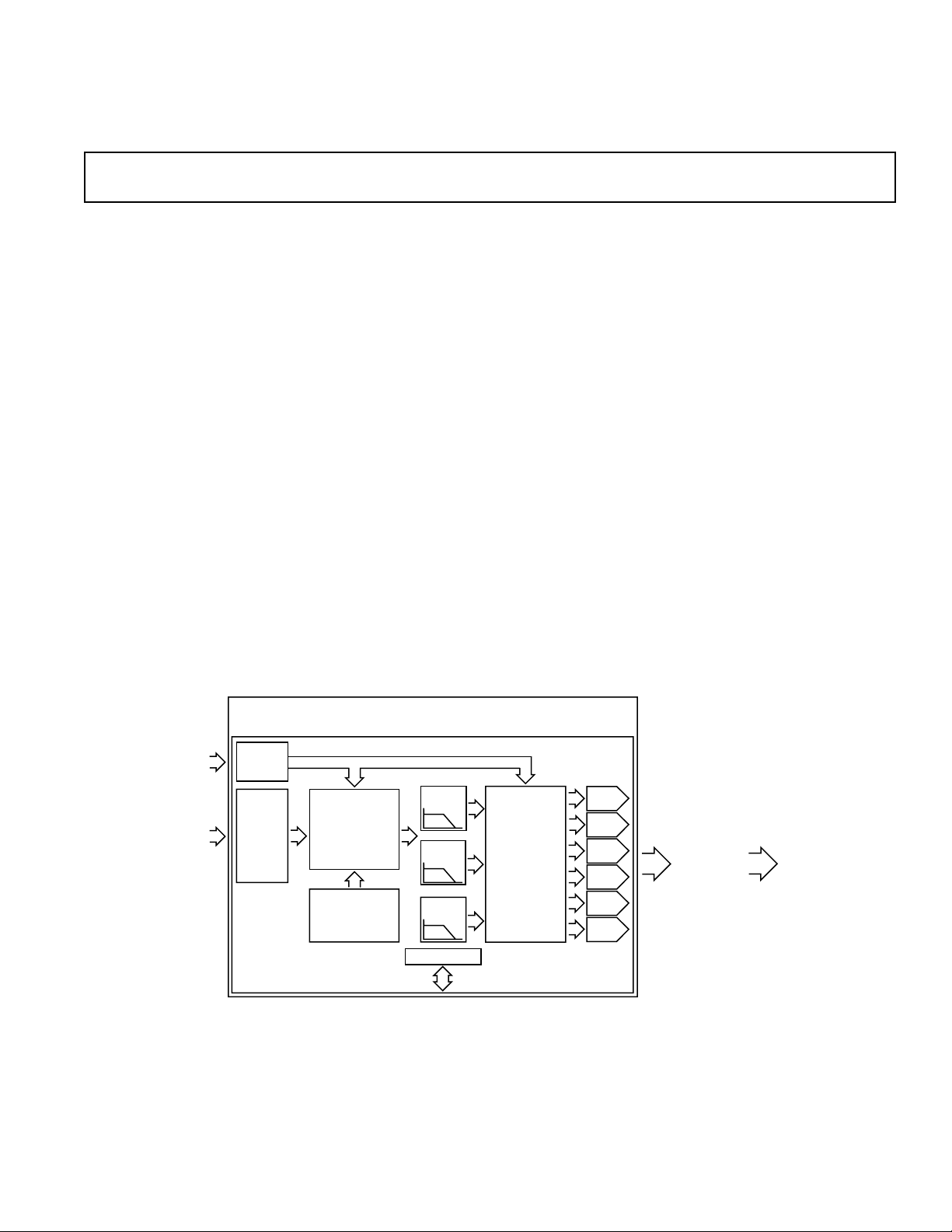
SIMPLIFIED BLOCK DIAGRAM
DIGITAL
INPUT
27MHz
CLOCK
ITU–R.BT
656/601
10-BIT YCrCb
IN 4:2:2 FORMAT
*This device is protected by U.S. Patent Numbers 4631603, 4577216, and 4819098 and other intellectual property rights.
Extended-10 is a trademark of Analog Devices, Inc. This technology combines 10-bit conversion, 10-bit digital video data processing, and 10-bit external interfacing.
SSAF is a trademark of Analog Devices Inc.
ITU-R and CCIR are used interchangeably in this document (ITU-R has replaced CCIR recommendations).
I2C is a registered trademark of Philips Corporation.
VIDEO
INPUT
PROCESSING
PLL
AND
54MHz
DEMUX
AND
YCrCb-
TO-
YUV
MATRIX
VIDEO
SIGNAL
PROCESSING
COLOR CONTROL
DNR
GAMMA
CORRECTION
VBI
TELETEXT
CLOSED CAPTION
CGMS/WSS
CHROMA
LPF
SSAF
LPF
LUMA
LPF
I2C INTERFACE
VIDEO
OUTPUT
PROCESSING
2ⴛ
OVERSAMPLING
OR
4ⴛ
OVERSAMPLING
10-BIT
DAC
10-BIT
DAC
10-BIT
DAC
10-BIT
DAC
10-BIT
DAC
10-BIT
DAC
ADV7194
ANALOG
OUTPUT
COMPOSITE VIDEO
Y [S-VIDEO]
C [S-VIDEO]
RGB
YUV
YPrPb
REV. 0
Information furnished by Analog Devices is believed to be accurate and
reliable. However, no responsibility is assumed by Analog Devices for its
use, nor for any infringements of patents or other rights of third parties
which may result from its use. No license is granted by implication or
otherwise under any patent or patent rights of Analog Devices.
One Technology Way, P.O. Box 9106, Norwood, MA 02062-9106, U.S.A.
Tel: 781/329-4700 World Wide Web Site: http://www.analog.com
Fax: 781/326-8703 © Analog Devices, Inc., 2000
TV SCREEN
OR
PROGRESSIVE
SCAN DISPLAY
Page 2

ADV7194
CONTENTS
FEATURES . . . . . . . . . . . . . . . . . . . . . . . . . . . . . . . . . . . . . 1
APPLICATIONS . . . . . . . . . . . . . . . . . . . . . . . . . . . . . . . . . 1
GENERAL DESCRIPTION . . . . . . . . . . . . . . . . . . . . . . . . . 1
SIMPLIFIED BLOCK DIAGRAM . . . . . . . . . . . . . . . . . . . 1
SPECIFICATIONS
5 V Specifications . . . . . . . . . . . . . . . . . . . . . . . . . . . . . . . . 3
3.3 V Specifications . . . . . . . . . . . . . . . . . . . . . . . . . . . . . . 4
5 V Dynamic Specifications . . . . . . . . . . . . . . . . . . . . . . . . 5
3.3 V Dynamic Specifications . . . . . . . . . . . . . . . . . . . . . . . 5
5 V Timing Characteristics . . . . . . . . . . . . . . . . . . . . . . . . 6
3.3 V Timing Characteristics . . . . . . . . . . . . . . . . . . . . . . . 7
ABSOLUTE MAXIMUM RATINGS . . . . . . . . . . . . . . . . . 9
PIN CONFIGURATION . . . . . . . . . . . . . . . . . . . . . . . . . . . 9
ORDERING GUIDE . . . . . . . . . . . . . . . . . . . . . . . . . . . . . . 9
PACKAGE THERMAL PERFORMANCE . . . . . . . . . . . . . 9
PIN FUNCTION DESCRIPTIONS . . . . . . . . . . . . . . . . . 10
DETAILED DESCRIPTION OF FEATURES . . . . . . . . . 11
GENERAL DESCRIPTION . . . . . . . . . . . . . . . . . . . . . . . . 11
DATA PATH DESCRIPTION . . . . . . . . . . . . . . . . . . . . . 12
INTERNAL FILTER RESPONSE . . . . . . . . . . . . . . . . . . . 13
FEATURES: FUNCTIONAL DESCRIPTION . . . . . . . . . 17
BLACK BURST OUTPUT . . . . . . . . . . . . . . . . . . . . . . . . 17
BRIGHTNESS DETECT . . . . . . . . . . . . . . . . . . . . . . . . . . 17
CHROMA/LUMA DELAY . . . . . . . . . . . . . . . . . . . . . . . . 17
CLAMP OUTPUT . . . . . . . . . . . . . . . . . . . . . . . . . . . . . . . 17
CSO, HSO AND VSO OUTPUTS . . . . . . . . . . . . . . . . . . . 17
COLOR BAR GENERATION . . . . . . . . . . . . . . . . . . . . . . 17
COLOR BURST SIGNAL CONTROL . . . . . . . . . . . . . . . 17
COLOR CONTROLS . . . . . . . . . . . . . . . . . . . . . . . . . . . . 17
CHROMINANCE CONTROL . . . . . . . . . . . . . . . . . . . . . 17
UNDERSHOOT LIMITER . . . . . . . . . . . . . . . . . . . . . . . . 18
DIGITAL NOISE REDUCTION . . . . . . . . . . . . . . . . . . . . 18
DOUBLE BUFFERING . . . . . . . . . . . . . . . . . . . . . . . . . . . 18
GAMMA CORRECTION CONTROL . . . . . . . . . . . . . . . 18
NTSC PEDESTAL CONTROL . . . . . . . . . . . . . . . . . . . . . 18
POWER-ON RESET . . . . . . . . . . . . . . . . . . . . . . . . . . . . . 18
PROGRESSIVE SCAN INPUT . . . . . . . . . . . . . . . . . . . . . 18
REAL-TIME CONTROL, SUBCARRIER RESET, AND
TIMING RESET . . . . . . . . . . . . . . . . . . . . . . . . . . . . . . . 19
SCH PHASE MODE . . . . . . . . . . . . . . . . . . . . . . . . . . . . . 19
SLEEP MODE . . . . . . . . . . . . . . . . . . . . . . . . . . . . . . . . . . 19
SQUARE PIXEL MODE . . . . . . . . . . . . . . . . . . . . . . . . . . 19
VERTICAL BLANKING DATA INSERTION
AND BLANK INPUT . . . . . . . . . . . . . . . . . . . . . . . . . . . 19
YUV LEVELS . . . . . . . . . . . . . . . . . . . . . . . . . . . . . . . . . . . 20
20-/16-BIT INTERFACE . . . . . . . . . . . . . . . . . . . . . . . . . . 20
4× OVERSAMPLING AND INTERNAL PLL . . . . . . . . . 20
VIDEO TIMING DESCRIPTION . . . . . . . . . . . . . . . . . . . 20
RESET SEQUENCE . . . . . . . . . . . . . . . . . . . . . . . . . . . . . 20
MPU PORT DESCRIPTION . . . . . . . . . . . . . . . . . . . . . . . 28
REGISTER ACCESSES . . . . . . . . . . . . . . . . . . . . . . . . . . . 29
REGISTER PROGRAMMING . . . . . . . . . . . . . . . . . . . . . 29
MODE REGISTERS 0–9 . . . . . . . . . . . . . . . . . . . . . . . 30–35
TIMING REGISTERS 0–17 . . . . . . . . . . . . . . . . . . . . . . . 36
SUBCARRIER FREQUENCY AND
PHASE REGISTERS . . . . . . . . . . . . . . . . . . . . . . . . . . . 37
CLOSED CAPTIONING REGISTERS . . . . . . . . . . . . . . . 37
NTSC PEDESTAL/PAL TELETEXT CONTROL
REGISTERS . . . . . . . . . . . . . . . . . . . . . . . . . . . . . . . . . . 37
TELETEXT REQUEST CONTROL REGISTER . . . . . . 38
CGMS_WSS REGISTERS . . . . . . . . . . . . . . . . . . . . . . . . . 38
CONTRAST CONTROL REGISTERS . . . . . . . . . . . . . . . 39
COLOR CONTROL REGISTERS . . . . . . . . . . . . . . . . . . 39
HUE ADJUST CONTROL REGISTER (HCR) . . . . . . . . 40
HCR BIT DESCRIPTION . . . . . . . . . . . . . . . . . . . . . . . . . 40
BRIGHTNESS CONTROL REGISTER (BCR) . . . . . . . . 40
BCR BIT DESCRIPTION . . . . . . . . . . . . . . . . . . . . . . . . . 40
SHARPNESS RESPONSE REGISTER (PR) . . . . . . . . . . . 41
PR BIT DESCRIPTION . . . . . . . . . . . . . . . . . . . . . . . . . . 41
DNR REGISTERS . . . . . . . . . . . . . . . . . . . . . . . . . . . . . . . 41
DNR BIT DESCRIPTIONS . . . . . . . . . . . . . . . . . . . . . . . . 41
GAMMA CORRECTION REGISTERS . . . . . . . . . . . . . . 43
BRIGHTNESS DETECT REGISTER . . . . . . . . . . . . . . . . 44
OUTPUT CLOCK REGISTER . . . . . . . . . . . . . . . . . . . . . 44
OCR BIT DESCRIPTION . . . . . . . . . . . . . . . . . . . . . . . . . 44
APPENDIX 1
Board Design and Layout Considerations . . . . . . . . . . . . 45
APPENDIX 2
Closed Captioning . . . . . . . . . . . . . . . . . . . . . . . . . . . . . . 47
APPENDIX 3
Copy Generation Management System (CGMS) . . . . . . . 48
APPENDIX 4
Wide Screen Signaling . . . . . . . . . . . . . . . . . . . . . . . . . . . 49
APPENDIX 5
Teletext Insertion . . . . . . . . . . . . . . . . . . . . . . . . . . . . . . . 50
APPENDIX 6
Optional Output Filter . . . . . . . . . . . . . . . . . . . . . . . . . . . 51
APPENDIX 7
DAC Buffering . . . . . . . . . . . . . . . . . . . . . . . . . . . . . . . . . 52
APPENDIX 8
Recommended Register Values . . . . . . . . . . . . . . . . . . . . 53
Power-On Reset Register Values . . . . . . . . . . . . . . . . . . . 55
APPENDIX 9
NTSC Waveforms (With Pedestal) . . . . . . . . . . . . . . . . . 56
NTSC Waveforms (Without Pedestal) . . . . . . . . . . . . . . . 57
PAL Waveforms . . . . . . . . . . . . . . . . . . . . . . . . . . . . . . . . 58
UV Waveforms . . . . . . . . . . . . . . . . . . . . . . . . . . . . . . . . . 60
Output Waveforms . . . . . . . . . . . . . . . . . . . . . . . . . . . . . . 61
Video Measurement Plots . . . . . . . . . . . . . . . . . . . . . . . . 64
APPENDIX 10
Vector Plots . . . . . . . . . . . . . . . . . . . . . . . . . . . . . . . . . . . 68
OUTLINE DIMENSIONS . . . . . . . . . . . . . . . . . . . . . . . . . 69
–2–
REV. 0
Page 3

ADV7194
SPECIFICATIONS
(VAA = 5 V, V
5 V SPECIFICATIONS
1
otherwise noted.)
Parameter Min Typ Max Unit Test Conditions
STATIC PERFORMANCE
Resolution (Each DAC) 10 Bits
Accuracy (Each DAC)
Integral Nonlinearity
Differential Nonlinearity
3
3
DIGITAL INPUTS
Input High Voltage, V
Input Low Voltage, V
Input Current, I
Input Capacitance, C
Input Leakage Current
Input Leakage Current
INH
INL
IN
IN
4
5
DIGITAL OUTPUTS
Output High Voltage, V
Output Low Voltage, V
Three-State Leakage Current
Three-State Leakage Current
OH
OL
6
7
Three-State Output Capacitance 6 10 pF
ANALOG OUTPUTS
Output Current (Max) 4.125 4.33 4.625 mA RL = 300 Ω
Output Current (Min) 2.16 mA R
DAC-to-DAC Matching
Output Compliance, V
Output Impedance, R
Output Capacitance, C
VOLTAGE REFERENCE
Reference Range, V
3
OC
OUT
OUT
8
REF
POWER REQUIREMENTS
V
AA
Normal Power Mode
9
I
DAC
(2× Oversampling)
I
CCT
I
(4× Oversampling)
CCT
I
PLL
10, 11
10, 11
Sleep Mode
I
DAC
I
CCT
NOTES
1
All measurements are made in 4× Oversampling Mode unless otherwise specified.
2
Temperature range T
3
Guaranteed by characterization.
4
For all inputs but PAL_NTSC and ALSB.
5
For PAL_NTSC and ALSB inputs.
6
For all outputs but VSO/TIX/CLAMP.
7
For VSO/TTX/CLAMP outputs.
8
Measurement made in 2× Oversampling Mode.
9
I
is the total current required to supply all DACs including the V
DAC
10
All six DACs on.
11
I
or the circuit current, is the continuous current required to drive the digital core without I
CCT
Specifications subject to change without notice.
MIN
to T
: 0°C to 70°C.
MAX
= 1.235 V, R
REF
= 1200 ⍀ unless otherwise noted. All specifications T
SET1,2
MIN
to T
± 1.0 LSB
± 1.0 LSB Guaranteed Monotonic
2V
0.8 V
0 ± 1 µAV
= 0.4 V or 2.4 V
IN
610 pF
1 µA
200 µA
2.4 V I
0.8 0.4 V I
SOURCE
= 3.2 mA
SINK
= 400 µA
10 µA
200 µA
= 600 Ω, R
L
SET1,2
0.4 2.5 %
0 1.4 V
100 kΩ
6pFI
OUT
= 0 mA
1.112 1.235 1.359 V
4.75 5.0 5.25 V
29 35 mA
80 120 mA
120 170 mA
610 mA
0.01 µA
85 µA
circuitry.
REF
.
PLL
2
unless
MAX
= 2400 Ω
REV. 0
–3–
Page 4

ADV7194–SPECIFICATIONS
2
to T
MAX
= 2400 Ω
3.3 V SPECIFICATIONS
(VAA = 3.0 V, V
1
unless otherwise noted.)
= 1.235 V, R
REF
= 1200 ⍀ unless otherwise noted. All specifications T
SET1,2
MIN
Parameter Min Typ Max Unit Test Conditions
STATIC PERFORMANCE
Resolution (Each DAC) 10 Bits
Accuracy (Each DAC)
Integral Nonlinearity ± 1.0 LSB
Differential Nonlinearity ± 1.0 LSB Guaranteed Monotonic
DIGITAL INPUTS
Input High Voltage, V
Input Low Voltage, V
Input Current, I
Input Capacitance, C
INH
INL
IN
IN
Input Leakage Current
Input Leakage Current
3
4
2V
0.8 V
± 1 µAV
= 0.4 V or 2.4 V
IN
610 pF
1 µA
200 µA
DIGITAL OUTPUTS
Output High Voltage, V
Output Low Voltage, V
Three-State Leakage Current
Three-State Leakage Current
OL
OH
5
6
2.4 V I
0.4 V I
10 µA
200 µA
SOURCE
= 3.2 mA
SINK
= 400 µA
Three-State Output Capacitance 6 10 pF
ANALOG OUTPUTS
Output Current (Max) 4.125 4.33 4.625 mA RL = 300 Ω
Output Current (Min) 2.16 mA R
= 600 Ω, R
L
SET1,2
DAC-to-DAC Matching 0.4 2.5 %
Output Compliance, V
Output Impedance, R
Output Capacitance, C
VOLTAGE REFERENCE
Reference Range
OC
OUT
OUT
7
100 kΩ
6pFI
1.235 V
1.4 V
OUT
= 0 mA
POWER REQUIREMENTS
V
AA
Normal Power Mode
8
I
DAC
(2× Oversampling)
I
CCT
I
(4× Oversampling)
CCT
I
PLL
9, 10
9, 10
3.15 3.3 3.6 V
29 mA
42 54 mA
68 86 mA
6mA
Sleep Mode
I
DAC
I
CCT
NOTES
1
All measurements are made in 4× Oversampling Mode unless otherwise specified and are guaranteed by characterization. For 2 × Oversampling Mode, the power
requirements for the ADV7194 are typically 3.0 V.
2
Temperature range T
3
For all inputs but PAL_NTSC and ALSB.
4
For PAL_NTSC and ALSB inputs.
5
For all outputs but VSO/TTX/CLAMP.
6
For VSO/TTX/CLAMP outputs.
7
Measurement made in 2× Oversampling Mode.
8
I
is the total current required to supply all DACs including the V
DAC
9
All six DACs on.
10
I
or the circuit current, is the continuous current required to drive the digital core without I
CCT
Specifications subject to change without notice.
MIN
to T
: 0°C to 70°C.
MAX
0.01 µA
85 µA
circuitry.
REF
.
PLL
–4–
REV. 0
Page 5

ADV7194
5 V DYNAMIC SPECIFICATIONS
(VAA = 5 V ⴞ 250 mV, V
1
specifications T
MIN
= 1.235 V, R
REF
2
to T
unless otherwise noted.)
MAX
= 1200 ⍀ unless otherwise noted. All
SET1,2
Parameter Min Typ Max Unit Test Conditions
Hue Accuracy 0.5 Degrees
Color Saturation Accuracy 0.7 %
Chroma Nonlinear Gain 0.7 0.9 ± % Referenced to 40 IRE
Chroma Nonlinear Phase 0.5 ± Degrees
Chroma/Luma Intermod 0.1 ± %
Chroma/Luma Gain Ineq 1.7 ±%
Chroma/Luma Delay Ineq 2.2 ns
Luminance Nonlinearity 0.6 0.7 ± %
Chroma AM Noise 82 dB
Chroma PM Noise 72 dB
Differential Gain
Differential Phase
SNR (Pedestal)
SNR (Ramp)
3
3
3
3
0.1 (0.4) 0.3 (0.5) %
0.4 (0.15) 0.5 (0.3) Degrees
78.5 (78) dB rms RMS
78 (78) dB p-p Peak Periodic
61.7 (61.7) dB rms RMS
62 (63) dB p-p Peak Periodic
NOTES
1
All measurements are made in 4× Oversampling Mode unless otherwise specified.
2
Temperature range T
3
Values in parentheses apply to 2× Oversampling Mode.
Specifications subject to change without notice.
MIN
to T
: 0°C to 70°C.
MAX
3.3 V DYNAMIC SPECIFICATIONS
(VAA = 3.3 V ⴞ 150 mV, V
1
specifications T
MIN
to T
= 1.235 V, R
REF
2
unless otherwise noted.)
MAX
SET1,2
= 1200 ⍀ unless otherwise noted. All
Parameter Min Typ Max Unit Test Conditions
Hue Accuracy 0.5 Degrees
Color Saturation Accuracy 0.8 %
Luminance Nonlinearity 0.6 ± %
Chroma AM Noise 83 dB
Chroma PM Noise 71 dB
Chroma Nonlinear Gain 0.7 ± % Referenced to 40 IRE
Chroma Nonlinear Phase 0.5 ± Degrees
Chroma/Luma Intermod 0.1 ± %
Differential Gain
Differential Phase
SNR (Pedestal)
SNR (Ramp)
3
3
3
3
0.2 (0.5) %
0.5 (0.2) Degrees
78.5 (78) dB rms RMS
78 (78) dB p-p Peak Periodic
62.3 (62) dB rms RMS
61 (62.5) dB p-p Peak Periodic
NOTES
1
All measurements are made in 4× Oversampling Mode unless otherwise specified.
2
Temperature range T
3
Values in brackets apply to 2× Oversampling Mode.
Specifications subject to change without notice.
MIN
to T
: 0°C to 70°C.
MAX
REV. 0
–5–
Page 6

ADV7194
5 V TIMING CHARACTERISTICS
(VAA = 5 V ⴞ 250 mV, V
specifications T
MIN
= 1.235 V, R
REF
1
to T
unless otherwise noted.)
MAX
= 1200 ⍀ unless otherwise noted. All
SET1,2
Parameter Min Typ Max Unit Test Conditions
MPU PORT
2
SCLOCK Frequency 0 400 kHz
SCLOCK High Pulsewidth, t
SCLOCK Low Pulsewidth, t
Hold Time (Start Condition), t
Setup Time (Start Condition), t
Data Setup Time, t
5
SDATA, SCLOCK Rise Time, t
SDATA, SCLOCK Fall Time, t
Setup Time (Stop Condition), t
ANALOG OUTPUTS
2
1
2
3
4
6
7
8
0.6 µs
1.3 µs
0.6 µs After This Period the First Clock Is Generated
0.6 µs Relevant for Repeated Start Condition
100 ns
300 ns
300 ns
0.6 µs
Analog Output Delay 8 ns
DAC Analog Output Skew 0.1 ns
CLOCK CONTROL AND PIXEL
3
PORT
f
CLOCK
Clock High Time, t
Clock Low Time, t
Data Setup Time, t
Data Hold Time, t
Control Setup Time, t
Control Hold Time, t
9
10
11
12
11
12
Digital Output Access Time, t
Digital Output Hold Time, t
Pipeline Delay, t
(2× Oversampling) 57 Clock Cycles
15
27 MHz
8ns
8ns
6ns
5ns
6ns
4ns
13
14
13 24 ns
12 ns
Pipeline Delay, t15 (4× Oversampling) 67 Clock Cycles
TELETEXT PORT
Digital Output Access Time, t
Data Setup Time, t
Data Hold Time, t
4
16
17
18
11 ns
3ns
6ns
RESET CONTROL
Reset Low Time 3 20 ns
2
PLL
PLL Output Frequency 54 MHz
NOTES
1
Temperature range T
2
Guaranteed by characterization.
3
Pixel Port consists of the following:
Data: P0–P9, Y0/P10–Y9/P19,
Control: HSYNC, VSYNC, BLANK
Clock: CLKIN Input.
4
Teletext Port consists of:
Digital Output: TTXRQ,
Data: TTX.
Specifications subject to change without notice.
MIN
to T
: 0°C to 70°C.
MAX
–6–
REV. 0
Page 7

ADV7194
3.3 V TIMING CHARACTERISTICS
(VAA = 3.3 V ⴞ 150 mV, V
specifications T
MIN
to T
= 1.235 V, R
REF
1
unless otherwise noted.)
MAX
SET1,2
= 1200 ⍀ unless otherwise noted. All
2
Parameter Min Typ Max Unit Test Conditions
MPU PORT
SCLOCK Frequency 0 400 kHz
SCLOCK High Pulsewidth, t
SCLOCK Low Pulsewidth, t
Hold Time (Start Condition), t
Setup Time (Start Condition), t
Data Setup Time, t
5
1
2
3
4
SDATA, SCLOCK Rise Time, t
SDATA, SCLOCK Fall Time, t
Setup Time (Stop Condition), t
7
8
0.6 µs
1.3 µs
0.6 µs After This Period the First Clock Is Generated
0.6 µs Relevant for Repeated Start Condition
100 ns
6
300 ns
300 ns
0.6 2 µs
ANALOG OUTPUTS
Analog Output Delay 8 ns
DAC Analog Output Skew 0.1 ns
CLOCK CONTROL AND PIXEL
3
PORT
f
CLOCK
Clock High Time, t
Clock Low Time, t
Data Setup Time, t
Data Hold Time, t
Control Setup Time, t
Control Hold Time, t
9
10
11
12
11
12
Digital Output Access Time, t
Digital Output Hold Time, t
27 MHz
8ns
8ns
6ns
4ns
2.5 ns
3ns
13
14
13 ns
12 ns
Pipeline Delay, t15, 2× Oversampling 37 Clock Cycles
TELETEXT PORT
Digital Output Access Time, t
Data Setup Time, t
Data Hold Time, t
4
16
17
18
11 ns
3ns
6ns
RESET CONTROL
Reset Low Time 3 20 ns
PLL
PLL Output Frequency 54 MHz
NOTES
1
Temperature range T
2
Guaranteed by characterization.
3
Pixel Port consists of the following:
Data: P0–P9, Y0/P10–Y9/P19,
Control: HSYNC, VSYNC, BLANK
Clock: CLKIN Input.
4
Teletext Port consists of:
Digital Output: TTXRQ,
Data: TTX.
Specifications subject to change without notice.
MIN
to T
: 0°C to 70°C.
MAX
REV. 0
–7–
Page 8
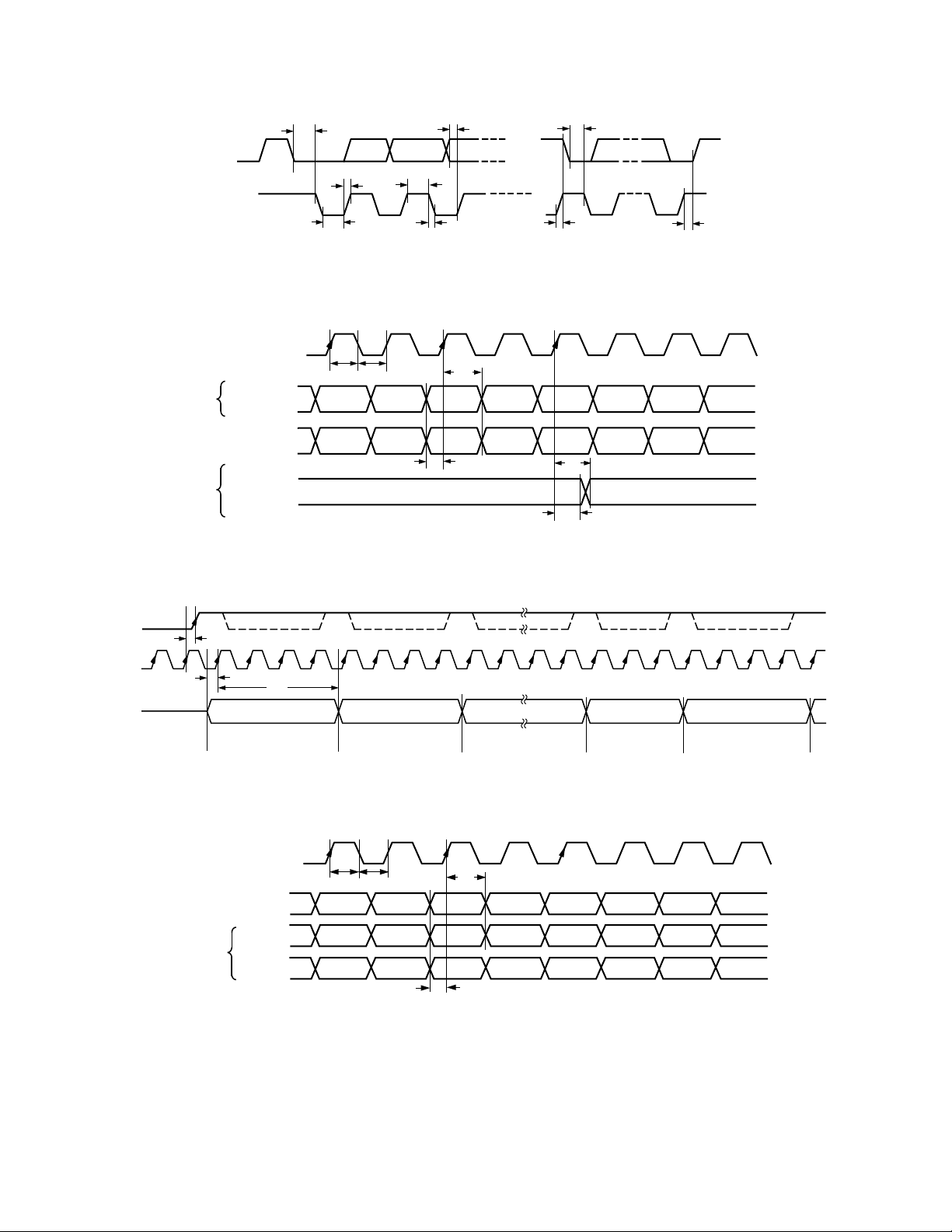
ADV7194
CONTROL
I/PS
CONTROL
O/PS
SDA
SCL
PIXEL INPUT
VSO, CLAMP
CLOCK
HSYNC,
VSYNC,
BLANK
DATA
HSYNC,
VSYNC,
BLANK,
CSO_HSO,
t
t
3
t
6
t
2
5
t
1
t
7
t
3
t
4
Figure 1. MPU Port Timing Diagram
t
t
9
10
Cb Y Cr Y Cb Y
t
12
t
11
t
13
t
14
Figure 2. Pixel and Control Data Timing Diagram
t
8
TTXREQ
CLOCK
TTX
t
16
SYNC INFORMATION
PROGRESSIVE
SCAN INPUT
t
17
4 CLOCK
CYCLES
CLOCK
Y0 – Y9
INCLUDING
Cb0 – Cb9
Cr0 – Cr9
t
18
4 CLOCK
CYCLES
4 CLOCK
CYCLES
3 CLOCK
CYCLES
4 CLOCK
CYCLES
Figure 3. Teletext Timing Diagram
t
t9t
10
Y0 Y1 Y2
Cb0 Cb1 Cb2 Cb3 Cb4 Cb5
Cr0 Cr1 Cr2 Cr3 Cr4 Cr5
12
Y3 Y4
t
11
Y5
Figure 4. Progressive Scan Input Timing
–8–
REV. 0
Page 9
ADV7194
WARNING!
ESD SENSITIVE DEVICE
ABSOLUTE MAXIMUM RATINGS
V
to GND . . . . . . . . . . . . . . . . . . . . . . . . . . . . . . . . . . . 7 V
AA
Voltage on Any Digital Input Pin . . . . GND – 0.5 V to V
Storage Temperature (T
Junction Temperature (T
) . . . . . . . . . . . . . . –65°C to +150°C
S
) . . . . . . . . . . . . . . . . . . . . . . 150°C
J
1
+ 0.5 V
AA
Body Temperature (Soldering, 10 secs) . . . . . . . . . . . . . 220°C
Analog Outputs to GND2 . . . . . . . . . . . . . . GND – 0.5 to V
NOTES
1
Stresses above those listed under Absolute Maximum Ratings may cause perma-
nent damage to the device. This is a stress rating only; functional operation of the
device at these or any other conditions above those listed in the operational sections
of this specification is not implied. Exposure to absolute maximum rating conditions for extended periods may affect device reliability.
2
Analog Output Short Circuit to any Power Supply or Common can be of an
indefinite duration.
AA
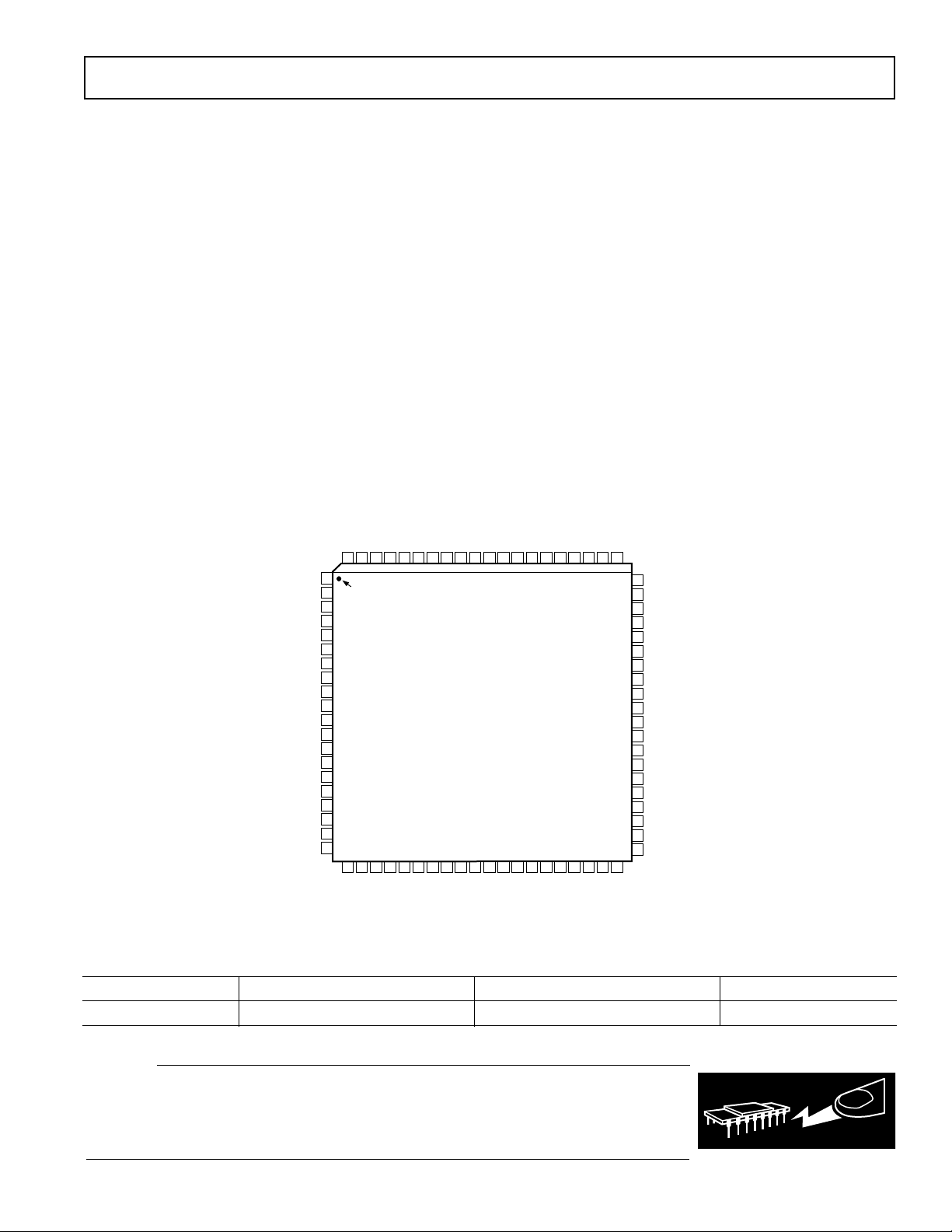
PIN CONFIGURATION
DGND
VDDCb[3]
Cb[2]
Cb[1]
Cb[0]
Cr[9]
Cr[8]
Cr[7]
ADV7194
TOP VIEW
(Not to Scale)
Cb[5]
Cb[6]
Cb[7]
Cr[6]
LQFP
Cb[8]
Y[0] /P10
Y[1] /P11
Y[2] /P12
Y[3] /P13
Y[4] /P14
Y[5] /P15
Y[6] /P16
Y[7] /P17
Y[8] /P18
Y[9] /P19
80 79 78 77 76 71 70 69 68 67 66 6575 74 73 72 64 63 62 61
1
P0
PIN 1
2
IDENTIFIER
P1
3
P2
4
P3
5
P4
6
P5
7
P6
8
P7
9
P8
10
P9
11
12
13
14
15
16
17
18
19
20
21 22 23 24 25 26 27 28 29 30 31 32 33 34 35 36 37 38 39 40
DD
V
DGND
VSYNC
HSYNC
Cb[4]
BLANK
PACKAGE THERMAL PERFORMANCE
The 80-lead package is used for this device. The junction-toambient (θ
) thermal resistance in still air on a four-layer PCB
JA
is 24.7°C.
To reduce power consumption when using this part the user
can run the part on a 3.3 V supply, turn off any unused DACs.
The user must at all times stay below the maximum junction
temperature of 110°C. The following equation shows how to
calculate this junction temperature:
Junction Temperature = (V
I
= 10 mA + (sum of the average currents consumed by
DAC
AA
× (I
DAC
+ I
)) × θJA + 70°C (T
CCT
AMB
each powered-on DAC)
Average current consumed by each powered-on DAC =
(V
× K )/R
REF
V
REF
= 1.235 V
SET
K = 4.2146
DGND
Cr[5]
VDDCr[4]
Cr[3]
Cr[2]
Cr[1]
VSO/ TTX/ CLAMP
CSO_HSO
Cr[0]
60
RESET
59
PAL_NTSC
58
R
SET1
57
V
REF
56
COMP 1
55
DAC A
54
DAC B
53
V
AA
52
AGND
51
DAC C
50
DAC D
49
AGND
48
V
AA
47
DAC E
46
DAC F
45
COMP 2
R
44
SET2
43
DGND
42
ALSB
41
SCRESET/ RTC/ TR
Cb[9]
DGND
TTXREQ
DD
V
AGND
CLKIN
AA
V
CLKOUT
SCL
SDA
)
ORDERING GUIDE
Model Temperature Range Package Description Package Option
ADV7194KST 0°C to 70°C 80-Lead Quad Flatpack ST-80
CAUTION
ESD (electrostatic discharge) sensitive device. Electrostatic charges as high as 4000 V readily
accumulate on the human body and test equipment and can discharge without detection. Although
the ADV7194 features proprietary ESD protection circuitry, permanent damage may occur on
devices subjected to high-energy electrostatic discharges. Therefore, proper ESD precautions are
recommended to avoid performance degradation or loss of functionality.
REV. 0
–9–
Page 10
ADV7194
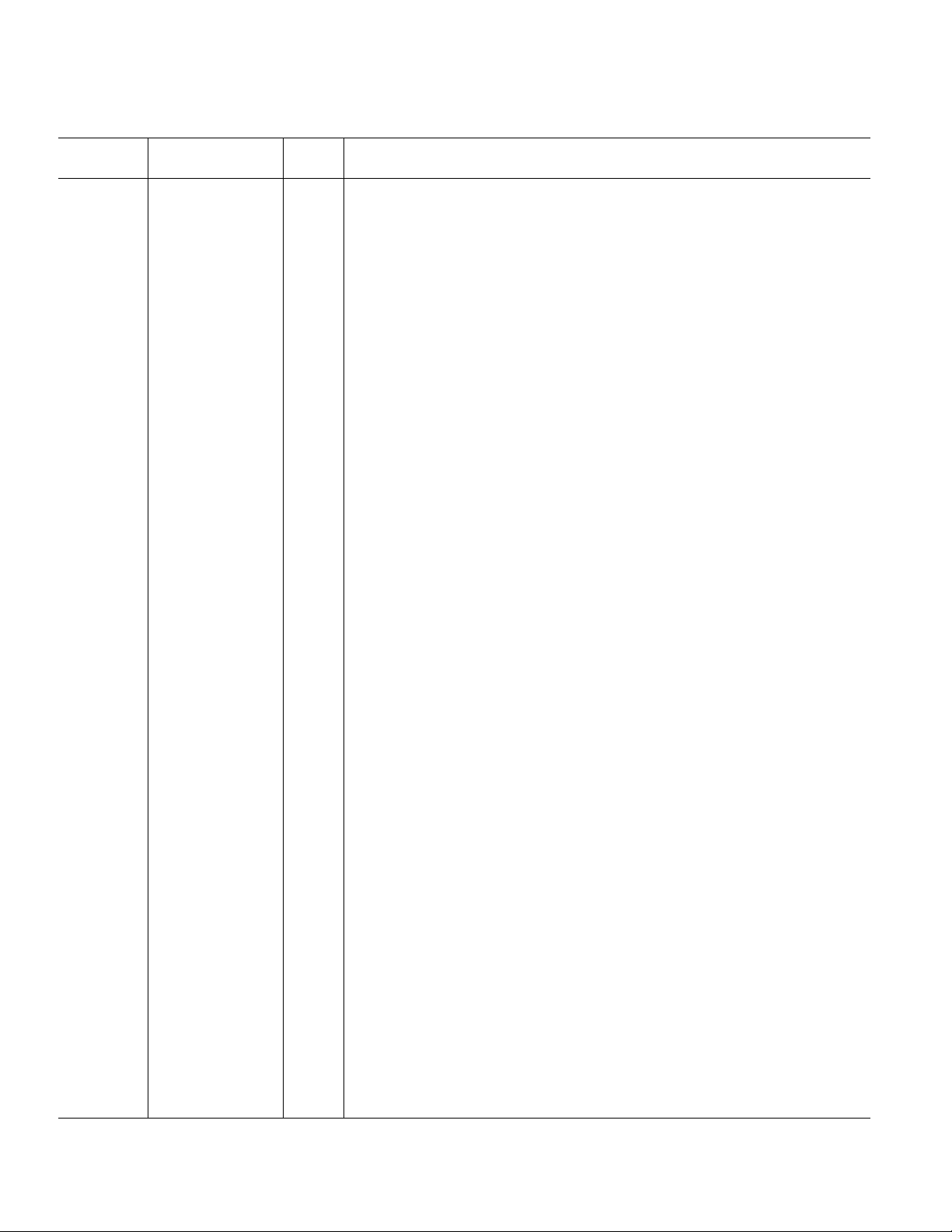
PIN FUNCTION DESCRIPTIONS
Pin Input/
No. Mnemonic Output Function
1–10 P0–P9 I 10-Bit or 8-Bit 4:2:2 Multiplexed YCrCb Pixel Port. The LSB of the input data is set up
on Pin P0 (Pin Number 1) in 10-bit input mode.
11–20 Y0/P10–Y9/P19 I 20-Bit or 16-Bit Multiplexed YCrCb Pixel Port or 1× 10-bit progressive scan input for Y data.
21, 34, 68, 79 V
DD
22, 33, 43, 69, DGND G Digital Ground.
80
23 HSYNC I/O HSYNC (Modes 1, 2, and 3) Control Signal. This pin may be configured to be an output
24 VSYNC I/O VSYNC Control Signal. This pin may be configured as an output (Master Mode) or as an input
25 BLANK I/O Video Blanking Control Signal. This signal is optional. For further information see Verti-
26–31, 75–78 Cb0–Cb9 I 1 × 10-Bit Progressive Scan Input Port for Cb Data.
32 TTXREQ O Teletext Data Request Output Signal, used to control teletext data transfer.
35, 49, 52 AGND G Analog Ground.
36 CLKIN I TTL Clock Input. Requires a stable 27 MHz reference clock for standard operation. Alterna-
37 CLKOUT O Clock Output Pin.
38, 48, 53 V
AA
39 SCL I MPU Port Serial Interface Clock Input.
40 SDA I/O MPU Port Serial Data Input/Output.
41 SCRESET/RTC/TR I Multifunctional Input: Real-Time Control (RTC) input, Timing Reset input, Subcarrier
42 ALSB I TTL Address Input. This signal sets up the LSB of the MPU address.
44 R
SET2
45 COMP 2 O Compensation Pin for DACs D, E, and F. Connect a 0.1 µF Capacitor from COMP 2 to
46 DAC F O S-Video C/Pr/V/RED Analog Output. This DAC is capable of providing 4.33 mA output.
47 DAC E O S-Video Y/Pb/U/BLUE Analog Output. This DAC is capable of providing 4.33 mA output.
50 DAC D O Composite/Y/Y/GREEN Analog Output. This DAC is capable of providing 4.33 mA output.
51 DAC C O S-Video C/Pr/V/RED Analog Output. This DAC is capable of providing 4.33 mA output.
54 DAC B O S-Video Y/Pb/U/BLUE Analog Output. This DAC is capable of providing 4.33 mA output.
55 DAC A O Composite/Y/Y/GREEN Analog Output. This DAC is capable of providing 4.33 mA output.
56 COMP 1 O Compensation Pin for DACs A, B, and C. Connect a 0.1 µF Capacitor from COMP 1 to
57 V
58 R
REF
SET1
59 PAL_NTSC I Input signal to select PAL or NTSC mode of operation, pin set to Logic 1 selects PAL.
60 RESET I The input resets the on-chip timing generator and sets the ADV7194 into default mode
61 CSO_HSO O Dual function CSO or HSO output Sync Signal at TTL level.
62 VSO/TTX/CLAMP I/O M ultif unctional Pin. VSO Output Sync Signal at TTL level. Teletext Data Input pin.
63–67, 70–74 Cr0–Cr9 I 1 × 10-Bit Progressive Scan Input Port for Cr Data.
P Digital Power Supply (3.3 V to 5 V).
(Master Mode) or an input (Slave Mode) and accept Sync Signals.
(Slave Mode) and accept VSYNC as a Control Signal.
cal Blanking and Data Insertion Blanking Input section.
tively, a 24.5454 MHz (NTSC) or 29.5 MHz (PAL) can be used for square pixel operation.
P Analog Power Supply (3.3 V to 5 V).
Reset input.
I A 1200 Ω resistor connected from this pin to GND is used to control full-scale amplitude s of
the Video Signals from the DAC D, E, F.
.
V
AA
.
V
AA
I/O Voltage Reference Input for DACs or Voltage Reference Output (1.235 V). An external
V
can not be used in 4× oversampling mode.
REF
I A 1200 Ω resistor connected from this pin to GND is used to control full- scale ampli tudes of
the Video Signals from the DAC A, B, C.
See Appendix 8 for Default Register settings.
CLAMP TTL Output Signals can be used to drive external circuitry to enable clamping
of all Video Signals.
–10–
REV. 0
Page 11
ADV7194
DETAILED DESCRIPTION OF FEATURES
Clocking
Single 27 MHz Clock Required to Run the Device
4ⴛ Oversampling with Internal 54 MHz PLL
Square Pixel Operation
Advanced Power Management
Programmable Video Control Features
Digital Noise Reduction
Black Burst Signal Generation
Pedestal level
Hue, Brightness, Contrast and Saturation
Clamping Output signal
VBI (Vertical Blanking Interval)
Subcarrier Frequency and Phase
LUMA Delay
CHROMA Delay
Gamma Correction
Luma and Chroma Filters
Luma SSAF (Super Subalias Filter)
Average Brightness Detection
Field Counter
Interlaced/Noninterlaced Operation
Complete On-Chip Video Timing Generator
Programmable Multimode Master/Slave Operation
CGMS (Copy Generation Management System)
WSS (Wide Screen Signaling)
Closed Captioning Support
Teletext Insertion Port (PAL-WST)
2-Wire Serial MPU Interface
2
C Compatible and Fast I2C)
(I
2
C Registers Synchronized to VSYNC
I
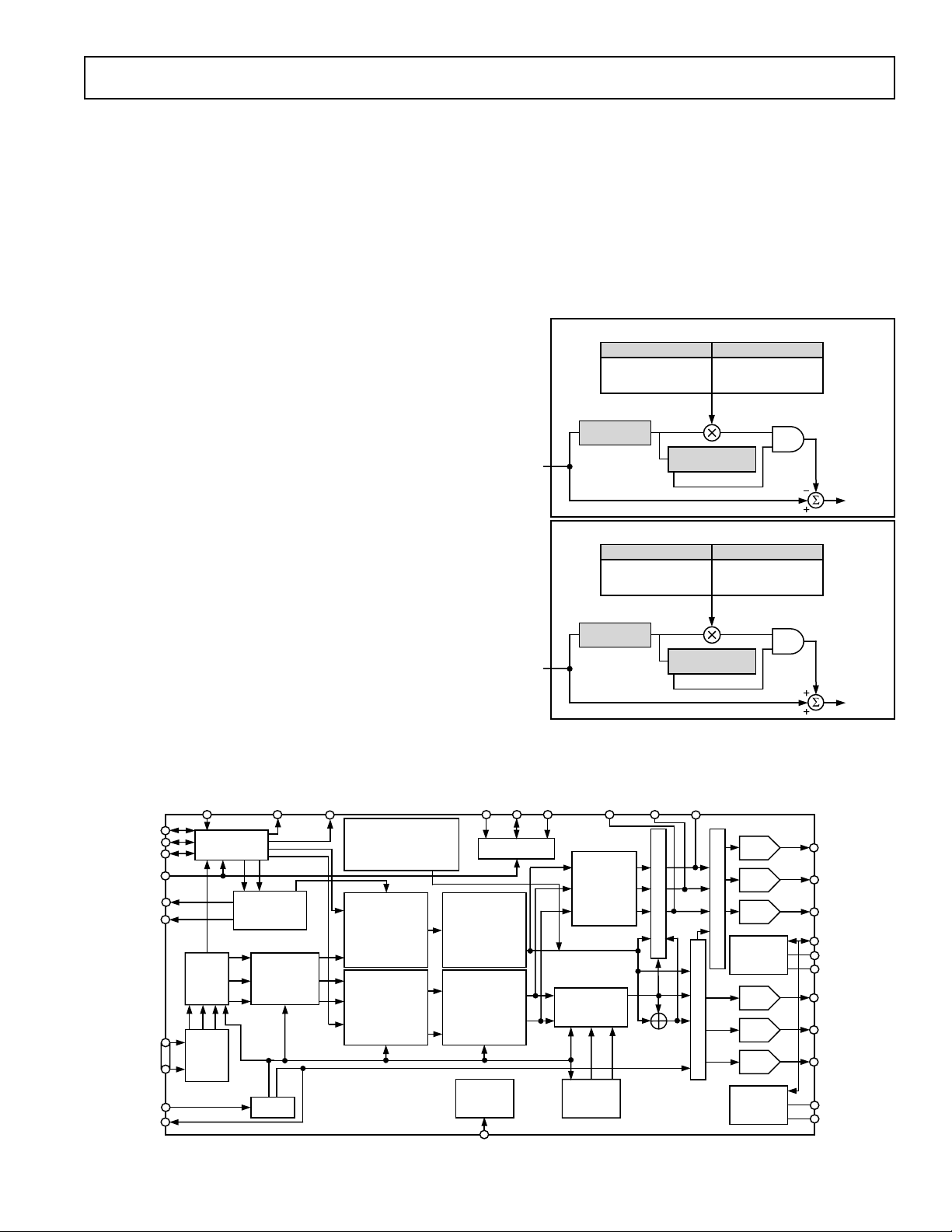
GENERAL DESCRIPTION
The ADV7194 is an integrated Digital Video Encoder that converts digital CCIR-601/656 4:2:2 10-bit (or 20-bit or 8-/16-bit)
component video data into a standard analog baseband television
signal compatible with worldwide standards. Additionally there
is the possibility to input video data in 3× 10-bit YCrCb progressive scan format to facilitate interfacing devices such as progressive
scan systems.
HSYNC
VSYNC
BLANK
RESET
TTX
TTXRQ
P15
CLKIN
CLKOUT
PAL_NTSC
YCrCb-
MATRIX
10 1010
P0
DEMUX
VSO/CLAMP
VIDEO TIMING
GENERATOR
10
Y
TO-
10
YUV
U
10
V
TELETEXT
INSERTION
BLOCK
CORRECTION
DNR
AND
GAMMA
PLL
CSO_HSO
10
Y
10
U
10
V
INTERPOLATOR
INTERPOLATOR
ADV7194
CGMS/WSS
AND
CLOSED CAPTIONING
CONTROL
BRIGHTNESS
CONTROL
AND
ADD SYNC
AND
SATURATION
CONTROL
AND
ADD BURST
AND
I2C MPU PORT
PROGRAMMABLE
LUMA FILTER
AND
SHARPNESS
FILTER
PROGRAMMABLE
CHROMA
FILTER
REAL-TIME
CONTROL
CIRCUIT
SCRESET/RTC/TR
Figure 5. Detailed Functional Block Diagram
There are six DACs available on the ADV7194, each of these
DACs is capable of providing 4.33 mA of current. In addition to
the composite output signal there is the facility to output SVideo (Y/C Video), RGB Video, and YUV Video. All YUV
formats (SMPTRE/EBU N10, MII or Betacam) are supported.
The on-board SSAF (Super Subalias Filter) with extended
luminance frequency response and sharp stopband attenuation
enables studio quality video playback on modern TVs, giving
optimal horizontal line resolution. An additional sharpness
control feature allows high-frequency enhancement on the luminance signal.
DNR MODE
Y DATA
INPUT
DNR CONTROL
BLOCK SIZE CONTROL
BORDER AREA
BLOCK OFFSET
NOISE SIGNAL PATH
INPUT FILTER
BLOCK
MAIN SIGNAL PATH
FILTER OUTPUT
<THRESHOLD?
FILTER OUTPUT>
THRESHOLD
GAIN
CORING GAIN DATA
CORING GAIN BORDER
SUBTRACT SIGNAL IN THRESHOLD
RANGE FROM ORIGINAL SIGNAL
DNR OUT
DNR SHARPNESS MODE
Y DATA
INPUT
DNR CONTROL
BLOCK SIZE CONTROL
BORDER AREA
BLOCK OFFSET
NOISE SIGNAL PATH
INPUT FILTER
BLOCK
MAIN SIGNAL PATH
FILTER OUTPUT
>THRESHOLD?
FILTER OUTPUT<
THRESHOLD
GAIN
CORING GAIN DATA
CORING GAIN BORDER
ADD SIGNAL ABOVE THRESHOLD
RANGE TO ORIGINAL SIGNAL
DNR OUT
Figure 6. Block Diagram for DNR Mode and DNR Sharpness Mode
ALSBSDASCL
MODULATOR
HUE CONTROL
YUV-TO-RGB
MATRIX
AND
YUV LEVEL
CONTROL
BLOCK
AND
SIN/COS
DDS
BLOCK
Y0–Y9Cb0–Cb9Cr0–Cr9
M
U
L
T
I
P
L
E
X
E
R
I
10-BIT
N
DAC
T
E
10-BIT
R
DAC
P
O
10-BIT
L
DAC
A
T
O
R
DAC
CONTROL
BLOCK
10-BIT
DAC
10-BIT
DAC
10-BIT
DAC
DAC
CONTROL
BLOCK
I
N
T
E
R
P
O
L
A
T
O
R
DAC A
DAC B
DAC C
V
REF
R
SET2
COMP2
DAC D
DAC F
DAC E
R
SET1
COMP1
REV. 0
–11–
Page 12
ADV7194
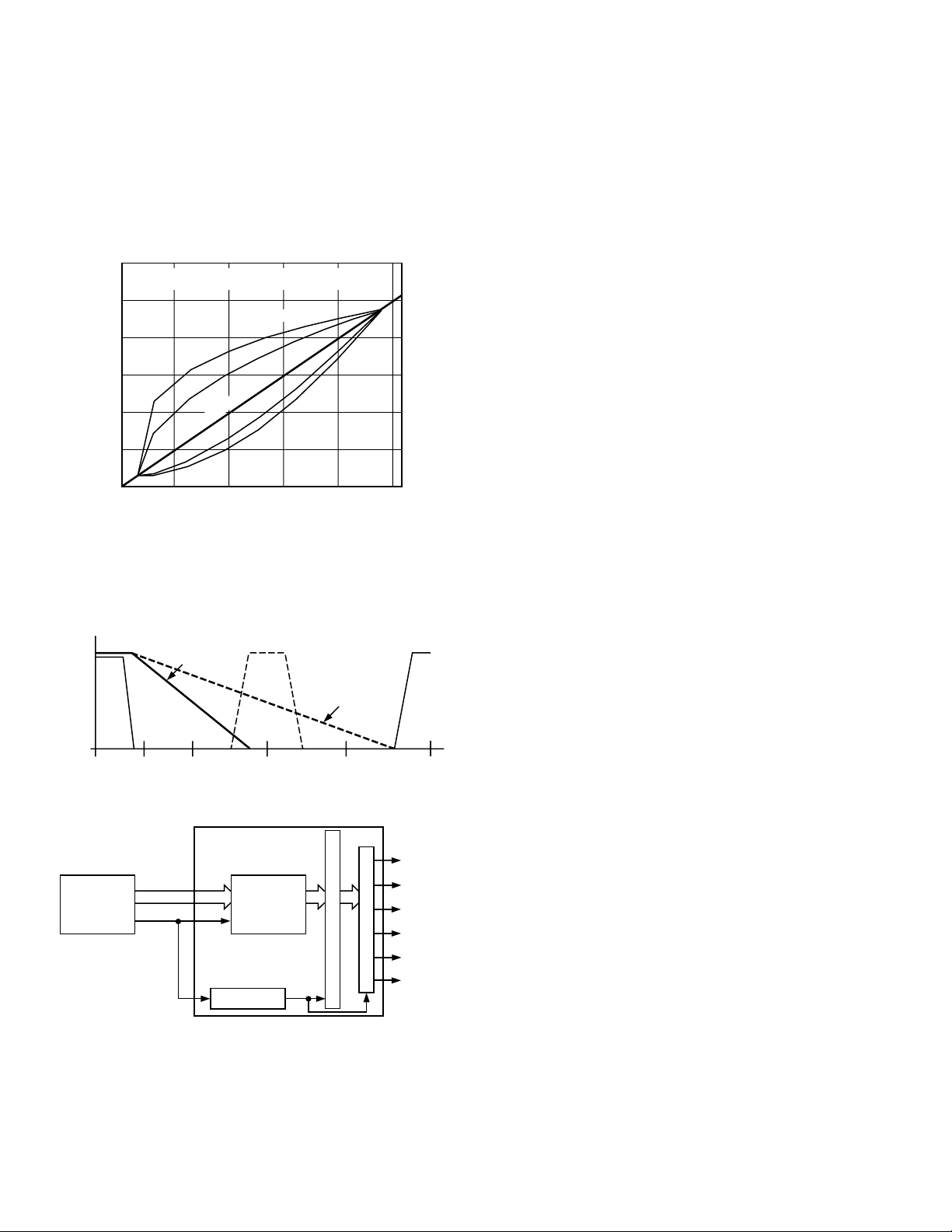
Digital noise reduction allows improved picture quality in
removing low-amplitude, high-frequency noise. The block diagram below shows the DNR functionality in the two modes
available.
Programmable gamma correction is also available. The figure
below shows the response of different gamma values to a ramp
input signal.
300
GAMMA CORRECTION BLOCK OUTPUT
TO A RAMP INPUT FOR VARIOUS GAMMA VALUES
250
200
150
100
GAMMA-CORRECTED AMPLITUDE
50
0
0 50 100 150 200 250
SIGNAL OUTPUTS
0.3
0.5
1.5
SIGNAL INPUT
LOCATION
1.8
Figure 7. Signal Input (Ramp) and Selectable Gamma
Output Curves
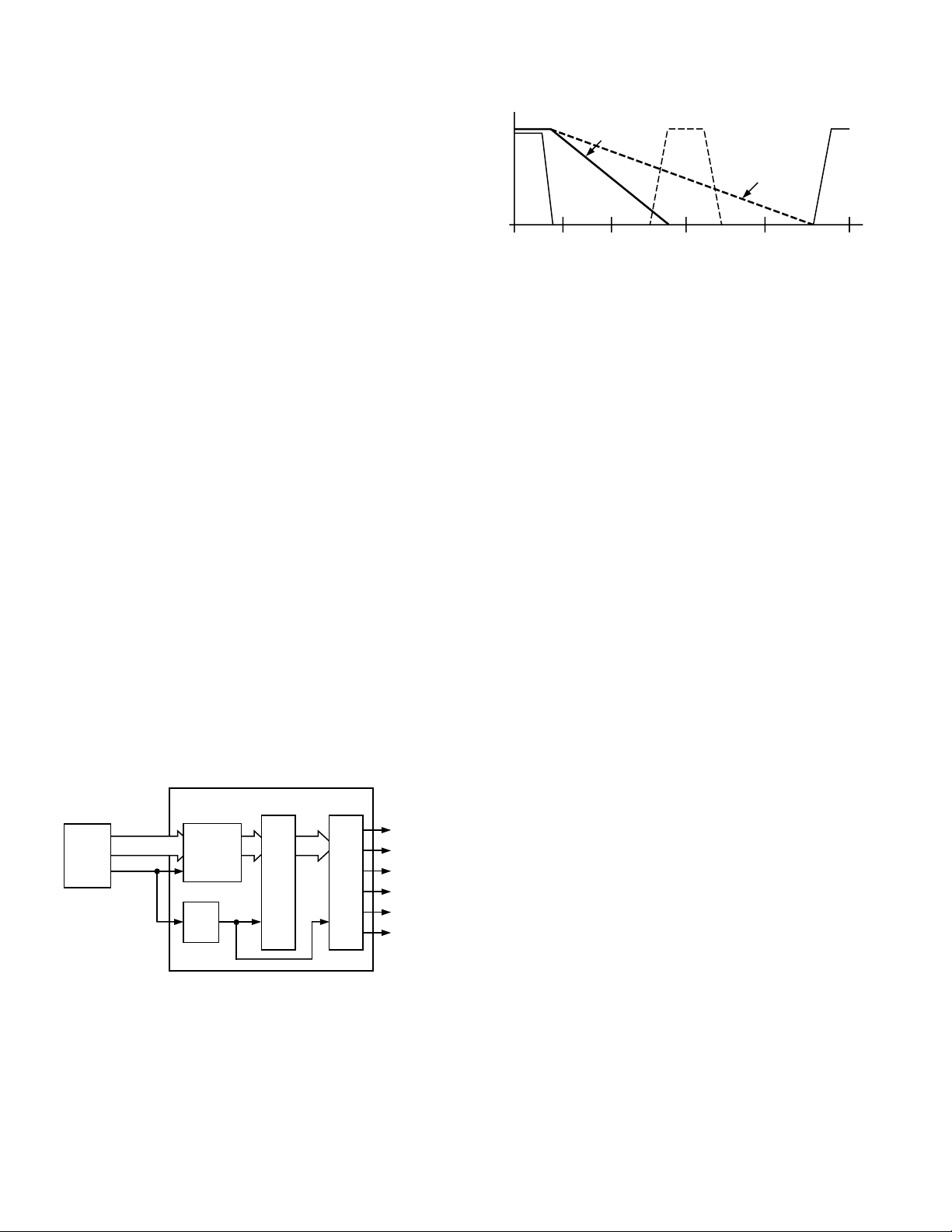
The device is driven by a 27 MHz clock. Data can be output at
27 MHz or 54 MHz (on-board PLL) when 4× oversampling is
enabled. Also, the filter requirements in 4× oversampling and 2×
oversampling differ, as can be seen in the figure below.
0dB
–30dB
Figure 8. Output Filter Requirements in 2× and 4
2ⴛ FILTER
REQUIREMENTS
4ⴛ FILTER
REQUIREMENTS
6.75MHz 13.5MHz 27.0MHz 40.5MHz 54.0MHz
×
Oversampling Mode
54MHz
2
ⴛ
6
I
D
N
A
T
C
E
R
P
O
L
A
T
I
O
N
54MHZ
O
OUTPUT
U
RATE
T
P
U
T
S
MPEG2
PIXEL BUS
27MHz
ADV7194
ENCODER
CORE
PLL
Figure 9. PLL and 4x Oversampling Block Diagram
The ADV7194 also supports both PAL and NTSC square pixel
operation. In this case, the encoder requires a 24.5454 MHz
clock for NTSC or 29.5 MHz clock for PAL square pixel mode
operation. All internal timing is generated on-chip.
An advanced power management circuit enables optimal control
of power consumption in both normal operating modes or sleep
modes.
–12–
The output video frames are synchronized with the incoming
data timing reference codes. Optionally the encoder accepts
(and can generate) HSYNC, VSYNC and FIELD timing signals. These timing signals can be adjusted to change pulsewidth
and position while the part is in master mode.
HSO/CSO and VSO TTL outputs are also available and are
timed to the analog output video.
A separate teletext port enables the user to directly input teletext
data during the vertical blanking interval.
The ADV7194 also incorporates WSS and CGMS-A data control
generation.
The ADV7194 modes are set up over a 2-wire serial bidirectional
2
port (I
C-compatible) with two slave addresses and the device is
register-compatible with the ADV7172/ADV7173.
The ADV7194 is packaged in an 80-lead LQFP package.
DATA PATH DESCRIPTION
For PAL B, D, G, H, I, N, and NTSC M, N modes, YCrCb
4:2:2 Data is input via the CCIR-656/601-compatible Pixel Port at
a 27 MHz Data Rate. The Pixel Data is demultiplexed to form
three data paths. Y typically has a range of 16 to 235, Cr and Cb
typically have a range of 128+/–112; however, it is possible to input
data from 1 to 254 on both Y, Cb, and Cr. The ADV7194 supports PAL (B, D, G, H, I, N) and NTSC M, N (with and without
Pedestal) and PAL60 standards.
Digital Noise Reduction can be applied to the Y signal. Programmable gamma correction can also be applied to the Y
signal if required.
The Y data can be manipulated for contrast control and a setup
level can be added for brightness control. The Cr, Cb data can
be scaled to achieve color saturation control. All settings become
effective at the start of the next field when double buffering is
enabled.
The appropriate sync, blank and burst levels are added to the
YCrCb data. Closed-Captioning and Teletext levels are also
added to Y and the resultant data is interpolated to 54 MHz
(4× Oversampling Mode). The interpolated data is filtered and
scaled by three digital FIR filters.
The U and V signals are modulated by the appropriate Subcarrier
Sine/Cosine waveforms and a phase offset may be added onto the
color subcarrier during active video to allow hue adjustment. The
resulting U and V signals are added together to make up the
Chrominance Signal. The Luma (Y) signal can be delayed by up
to six clock cycles (at 27 MHz) and the Chroma signal can be
delayed by up to eight clock cycles (at 27 MHz).
The Luma and Chroma signals are added together to make up
the Composite Video Signal. All timing signals are controlled.
The YCrCb data is also used to generate RGB data with appropriate sync and blank levels. The YUV levels are scaled to output the
suitable SMPTE/EBU N10, MII, or Betacam levels.
Each DAC can be individually powered off if not required. A
complete description of DAC output configurations is given in
the Mode Register 2 section.
Video output levels are illustrated in Appendix 9.
REV. 0
Page 13

ADV7194
When used to interface progressive scan systems, the ADV7194
allows input to YCrCb signals in Progressive Scan format (3 × 10
bit) before these signals are routed to the interpolation filters
and the DACs.
In Extended Mode there is the option of 12 responses in the
range from –4 dB to +4 dB. The desired response can be chosen
by the user by programming the correct value via the I
2
C. The
variation of frequency responses can be seen in the tables on
the following pages.
INTERNAL FILTER RESPONSE
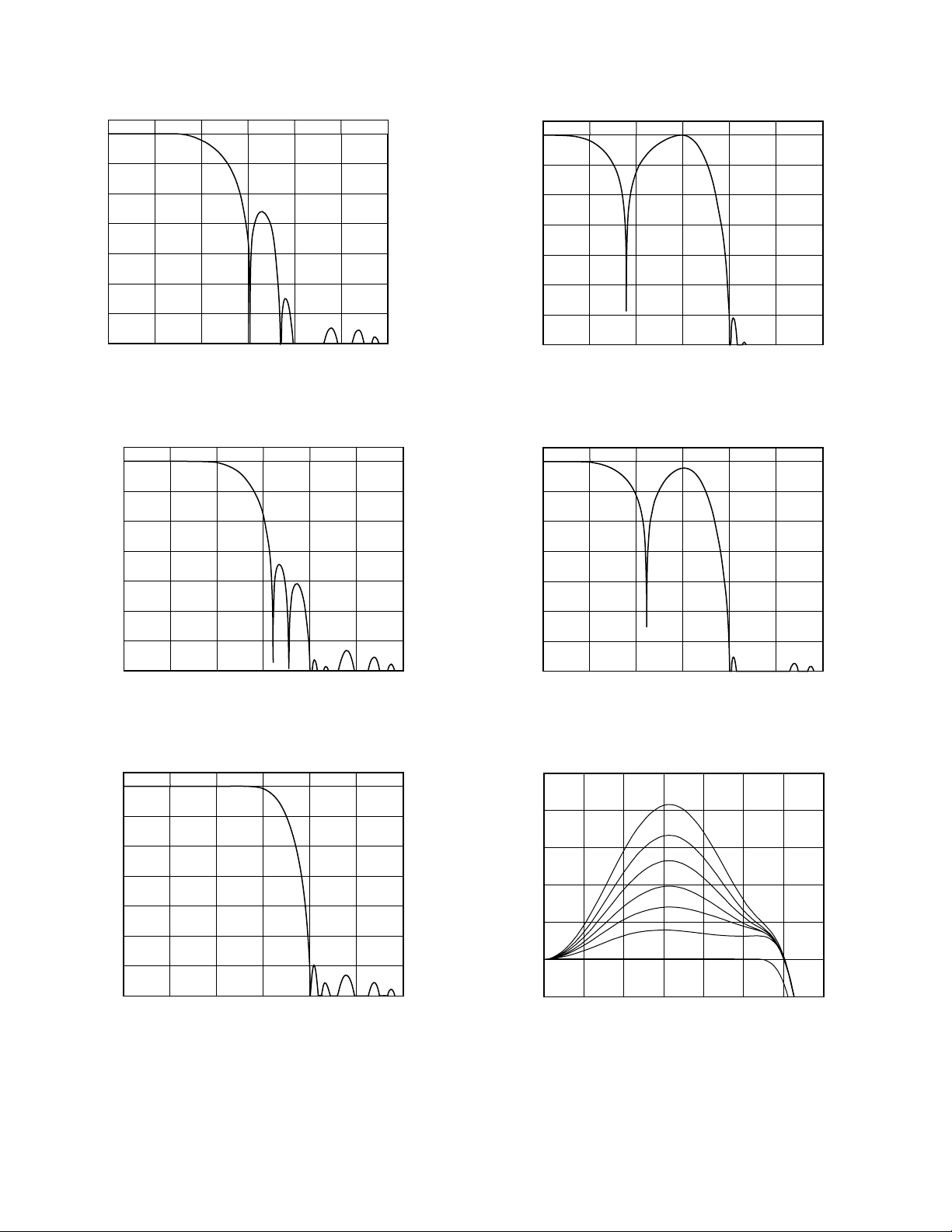
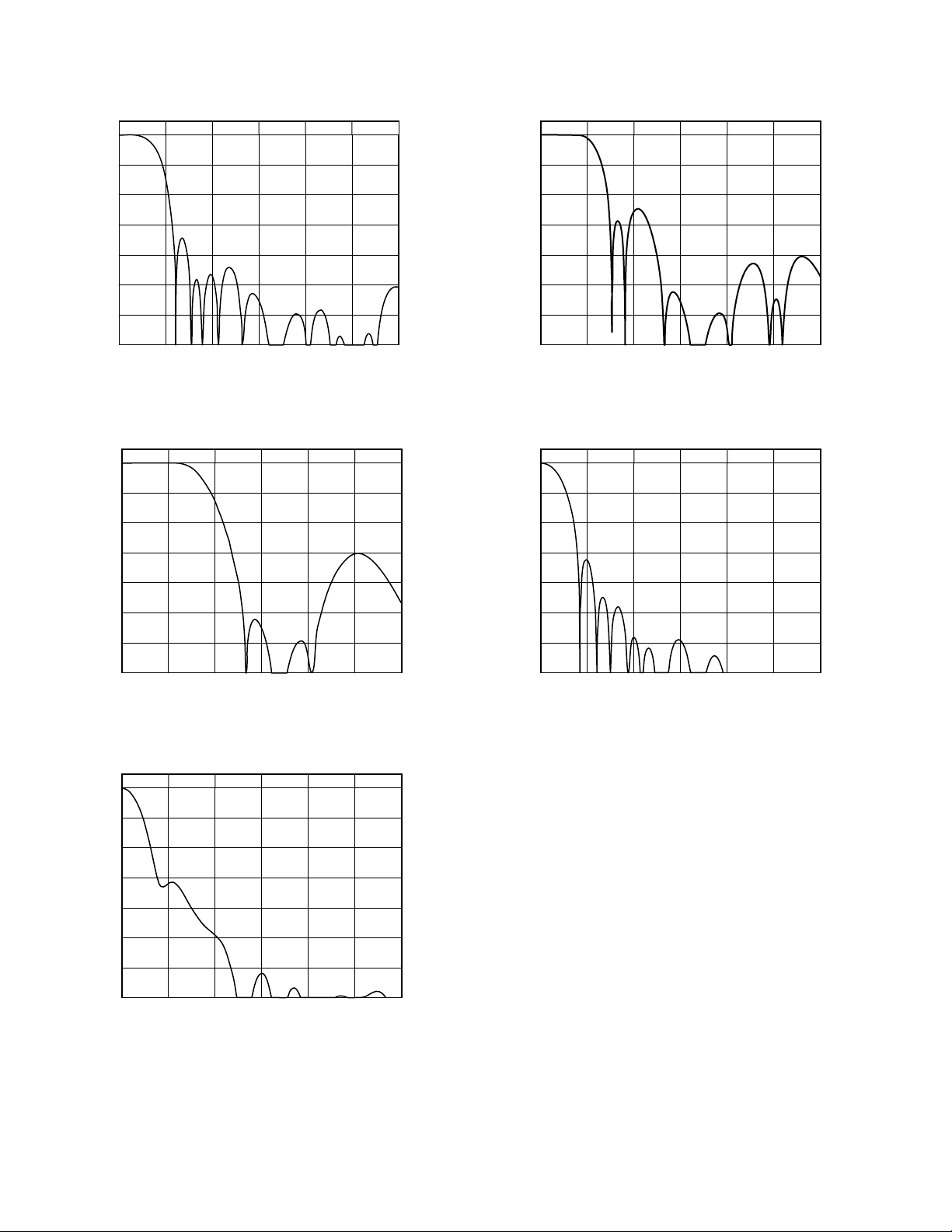
The Y Filter supports several different frequency responses
including two low-pass responses, two notch responses, an
For a more detailed filter specification, refer to Analog Devices’
application note AN-562.
Extended (SSAF) response with or without gain boost/attenuation,
a CIF response and a QCIF response. The UV Filter supports
several different frequency responses including five low-pass
responses, a CIF response and a QCIF response, as can be seen in
the following figures.
Table I. Luminance Internal Filter Specifications (4ⴛ Oversampling)
Passband 3 dB Bandwidth2Stopband Stopband
Filter Type Filter Selection Ripple1 (dB) (MHz) Cutoff 3 (MHz) Attentuation4 (dB)
MR04 MR03 MR02
Low-Pass (NTSC) 0 0 0 0.16 4.24 6.05 –75.2
Low-Pass (PAL) 0 0 1 0.1 4.81 6.41 –64.6
Notch (NTSC) 0 1 0 0.09 2.3/4.9/6.6 8.03 –87.3
Notch (PAL) 0 1 1 0.1 3.1/5.6/6.4 8.02 –79.7
Extended (SSAF) 1 0 0 0.04 6.45 8.03 –86.6
CIF 1 0 1 0.127 3.02 5.09 –62.6
QCIF 1 1 0 Monotonic 1.5 3.74 –88.2
NOTES
1
Passband Ripple is defined to be fluctuations from the 0 dB response in the passband, measured in (dB). The passband is defined to have 0–fc frequency limits for a
low-pass filter, 0–f1 and f2–infinity for a notch filter, where fc, f1, f2 are the –3 dB points.
2
3 dB bandwidth refers to the –3 dB cutoff frequency.
3
Stopband Cutoff refers to the frequency of the attenuation point referred to in Note 4.
4
Stopband Attenuation refers to the attenuation point (dB) of the frequency referred to in Note 3.
Table II. Chrominance Internal Filter Specifications (4ⴛ Oversampling)
Passband 3 dB Bandwidth2Stopband Stopband
Filter Type Filter Selection Ripple1 (dB) (MHz) Cutoff 3 (MHz) Attentuation4 (dB)
MR07 MR06 MR05
1.3 MHz Low-Pass 0 0 0 0.09 1.395 2.46 –83.9
0.65 MHz Low-Pass 0 0 1 Monotonic 0.65 2.41 –71.1
1.0 MHz Low-Pass 0 1 0 Monotonic 1.0 1.89 –64.43
2.0 MHz Low-Pass 0 1 1 0.048 2.2 3.1 –65.9
3.0 MHz Low-Pass 1 0 0 Monotonic 3.2 5.3 –84.5
CIF 1 0 1 Monotonic 0.65 2.41 –71.1
QCIF 1 1 0 Monotonic 0.5 1.75 –33.1
NOTES
1
Passband Ripple is defined to be fluctuations from the 0 dB response in the passband, measured in (dB). The passband is defined to have 0–fc frequency limits for a
low-pass filter, 0–f1 and f2–infinity for a notch filter, where fc, f1, f2 are the –3 dB points.
2
3 dB bandwidth refers to the –3 dB cutoff frequency.
3
Stopband Cutoff refers to the frequency of the attenuation point referred to in Note 4.
4
Stopband Attenuation refers to the attenuation point (dB) of the frequency referred to in Note 3.
REV. 0
–13–
Page 14
ADV7194
0
–10
–20
–30
–40
MAGNITUDE – dB
–50
–60
–70
24 10
0
68
FREQUENCY – MHz
Figure 10. NTSC Low-Pass Luma Filter
0
–10
–20
–30
–40
MAGNITUDE – dB
–50
0
–10
–20
–30
–40
MAGNITUDE – dB
–50
–60
12
–70
0
24 10
68
FREQUENCY – MHz
12
Figure 13. NTSC Notch Luma Filter
0
–10
–20
–30
–40
MAGNITUDE – dB
–50
–60
–70
24 10
0
68
FREQUENCY – MHz
12
Figure 11. PAL Low-Pass Luma Filter
0
–10
–20
–30
–40
MAGNITUDE – dB
–50
–60
–70
24 10
0
68
FREQUENCY – MHz
12
Figure 12. Extended Mode (SSAF) Luma Filter
–60
–70
0
24 10
68
FREQUENCY – MHz
12
Figure 14. PAL Notch Luma Filter
5
4
3
2
MAGNITUDE – dB
1
0
–1
0
12
FREQUENCY – MHz
4
6
5
73
Figure 15. Extended SSAF and Programmable Gain,
Showing Range 0 dB/4 dB
–14–
REV. 0
Page 15
ADV7194
1
0
–1
–2
MAGNITUDE – dB
–3
–4
–5
0
12
FREQUENCY – MHz
4
6
5
73
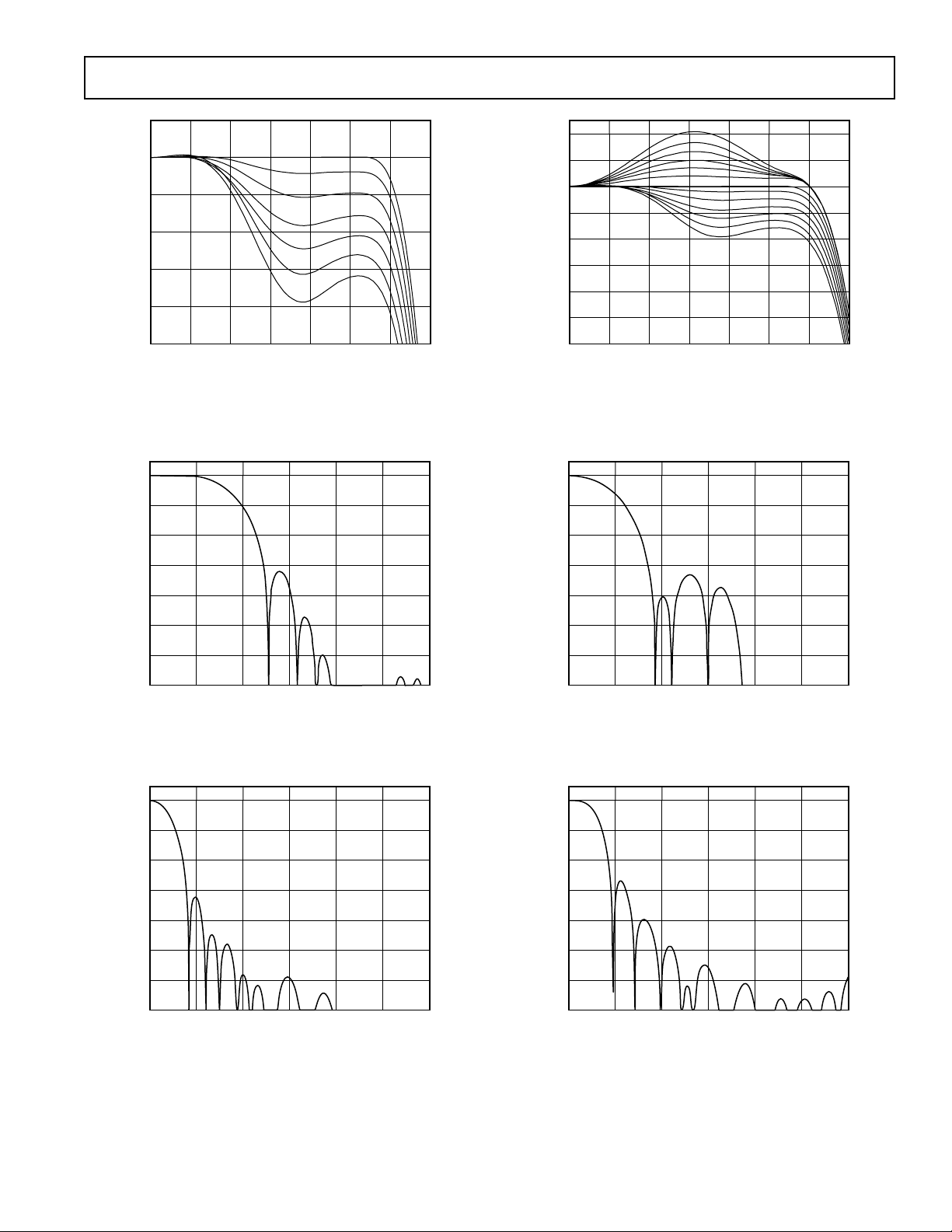
Figure 16. Extended SSAF and Programmable Attenuation, Showing Range 0 dB/–4 dB
0
–10
–20
–30
4
2
0
–2
–4
–6
MAGNITUDE – dB
–8
–10
–12
0
12
FREQUENCY – MHz
4
6
5
73
Figure 19. Extended SSAF and Programmable Gain/
Attenuation, Showing Range +4 dB/–12 dB
0
–10
–20
–30
–40
MAGNITUDE – dB
–50
–60
–70
0
24 10
68
FREQUENCY – MHz
Figure 17. Luma CIF Filter
0
–10
–20
–30
–40
MAGNITUDE – dB
–50
–60
–70
0
24 10
68
FREQUENCY – MHz
Figure 18. Chroma 0.65 MHz Low-Pass Filter
–40
MAGNITUDE – dB
–50
–60
–70
12
0
24 10
68
FREQUENCY – MHz
12
Figure 20. Luma QCIF Filter
0
–10
–20
–30
–40
MAGNITUDE – dB
–50
–60
–70
12
0
24 10
68
FREQUENCY – MHz
12
Figure 21. Chroma 1 MHz Low-Pass Filter
REV. 0
–15–
Page 16
ADV7194
0
–10
–20
–30
–40
MAGNITUDE – dB
–50
–60
–70
0
24 10
68
FREQUENCY – MHz
Figure 22. Chroma 1.3 MHz Low-Pass Filter
0
–10
–20
–30
–40
MAGNITUDE – dB
–50
0
–10
–20
–30
–40
MAGNITUDE – dB
–50
–60
–70
12
0
24 10
68
FREQUENCY – MHz
12
Figure 25. Chroma 2 MHz Low-Pass Filter
0
–10
–20
–30
–40
MAGNITUDE – dB
–50
–60
–70
0
24 10
68
FREQUENCY – MHz
Figure 23. Chroma 3 MHz Low-Pass Filter
0
–10
–20
–30
–40
MAGNITUDE – dB
–50
–60
–70
0
24 10
68
FREQUENCY – MHz
Figure 24. Chroma QCIF Filter
–60
–70
12
0
24 10
68
FREQUENCY – MHz
12
Figure 26. Chroma CIF Filter
12
–16–
REV. 0
Page 17
ADV7194
FEATURES—FUNCTIONAL DESCRIPTION
BLACK BURST OUTPUT
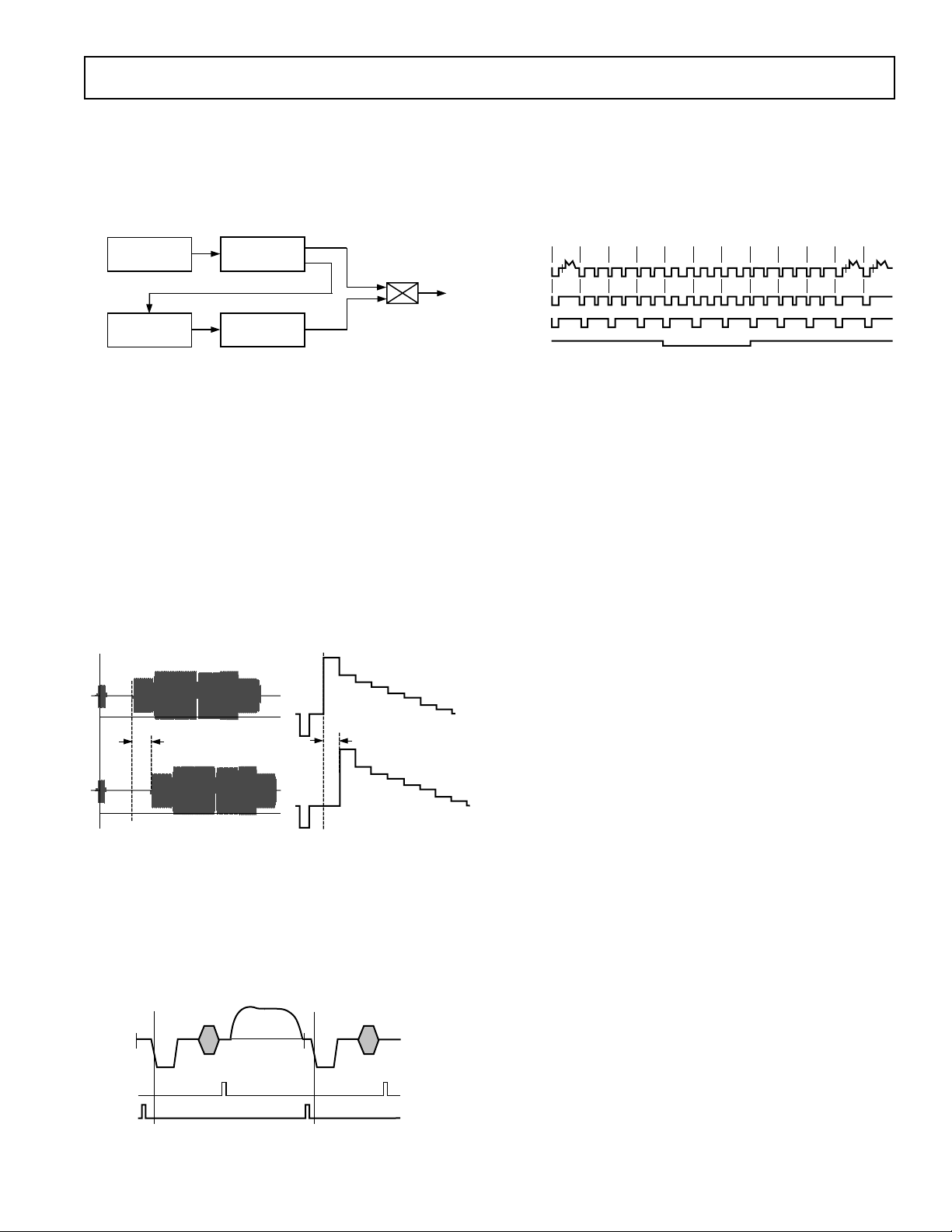
It is possible to output a black burst signal from two DACs. This
signal output is very useful for professional video equipment
since it enables two video sources to be locked together. (Mode
Register 9.)
DIGITAL DATA
GENERATOR
BLACK BURST OUTPUT
DIGITAL DATA
GENERATOR
ADV7194
CVBS
CVBS
ADV7194
Figure 27. Possible Application for the Black Burst Output
Signal
BRIGHTNESS DETECT
This feature is used to monitor the average brightness of the
incoming Y video signal on a field by field basis. The information is read from the I
2
C and based on this information the color
saturation, contrast and brightness controls can be adjusted
(for example to compensate for very dark pictures). (Brightness Detect Register.)
CHROMA/LUMA DELAY
The luminance data can be delayed by maximum of six clock
cycles. Additionally the Chroma can be delayed by a maximum
of eight clock cycles (one clock cycle at 27 MHz). (Timing Register 0 and Mode Register 9.)
CHROMA DELAY
LUMA DELAY
Figure 28. Chroma Delay Figure 29. Luma Delay
CLAMP OUTPUT
The ADV7194 has a programmable clamp TTL output signal.
This clamp signal is programmable to the front and back porch.
The clamp signal can be varied by one to three clock cycles in
a positive and negative direction from the default position. (Mode
Register 5, Mode Register 7.)
CLAMP O/P SIGNALS
CVBS
OUTPUT PIN
CSO, HSO AND VSO OUTPUTS
The ADV7194 supports three output timing signals, CSO (composite sync signal), HSO (Horizontal Sync Signal) and VSO
(Vertical Sync Signal). These output TTL signals are aligned
with the analog video outputs. See Figure 31 for an example
of these waveforms. (Mode Register 7.)
EXAMPLE:- NTSC
OUTPUT
5251234567891011–19
VIDEO
CSO
HSO
VSO
Figure 31.
CSO, HSO, VSO
Timing Diagram
COLOR BAR GENERATION
The ADV7194 can be configured to generate 100/7.5/75/7.5
color bars for NTSC or 100/0/75/0 color bars for PAL. (Mode
Register 4.)
COLOR BURST SIGNAL CONTROL
The burst information can be switched on and off the composite
and chroma video output. (Mode Register 4.)
COLOR CONTROLS
The ADV7194 allows the user to control the brightness, contrast,
hue and saturation of the color. The control registers may be
double-buffered, meaning that any modification to the registers
will be done outside the active video region and, therefore, changes
made will not be visible during active video.
Contrast Control
Contrast adjustment is achieved by scaling the Y input data by a
factor programmed by the user. This factor allows the data to be
scaled between 0% and 150%. (Contrast Control Register.)
Brightness Control
The brightness is controlled by adding a programmable setup level
onto the scaled Y data. This brightness level may be added onto
the Y data. For NTSC with pedestal, the setup can vary from
0 IRE to 22.5 IRE. For NTSC without pedestal and PAL, the
setup can vary from –7.5 IRE to +15 IRE. (Brightness Control
Register.)
Color Saturation
Color adjustment is achieved by scaling the Cr and Cb input
data by a factor programmed by the user. This factor allows the
data to be scaled between 0% and 200%. (U Scale Register and
V Scale Register.)
Hue Adjust Control
The hue adjustment is achieved on the composite and chroma
outputs by adding a phase offset onto the color subcarrier in the
active video but leaving the color burst unmodified, i.e., only
the phase between the video and the colorburst is modified and
hence the hue is shifted. The ADV7194 provides a range of
± 22° in increments of 0.17578125°. (Hue Adjust Register.)
MR57 = 1
MR57 = 0
REV. 0
Figure 30. Clamp Output Timing
CLAMP
OUTPUT PIN
CHROMINANCE CONTROL
The color information can be switched on and off the composite, chroma and color component video outputs. (Mode
Register 4.)
–17–
Page 18
ADV7194
UNDERSHOOT LIMITER
A limiter is placed after the digital filters. This prevents any
synchronization problems for TVs. The level of undershoot is
programmable between –1.5 IRE, –6 IRE, –11 IRE when operating in 4× Oversampling Mode. In 2× Oversampling Mode the
limits are –7.5 IRE and 0 IRE. (Mode Register 9 and Timing
Register 0.)
DIGITAL NOISE REDUCTION
DNR is applied to the Y data only. A filter block selects the
high frequency, low-amplitude components of the incoming
signal (DNR Input Select). The absolute value of the filter output
is compared to a programmable threshold value (DNR Threshold Control). There are two DNR modes available: DNR Mode
and DNR Sharpness Mode.
In DNR Mode, if the absolute value of the filter output is smaller
than the threshold, it is assumed to be noise. A programmable
amount (Coring Gain Control) of this noise signal will be subtracted from the original signal.
In DNR Sharpness Mode, if the absolute value of the filter output
is less than the programmed threshold, it is assumed to be noise,
as before. Otherwise, if the level exceeds the threshold, now
being identified as a valid signal, a fraction of the signal (Coring
Gain Control) will be added to the original signal in order to boost
high frequency components and to sharpen the video image.
In MPEG systems it is common to process the video information
in blocks of 8 × 8 pixels for MPEG2 systems, or 16 × 16 pixels
for MPEG1 systems (Block Size Control). DNR can be applied
to the resulting block transition areas that are known to contain
noise. Generally the block transition area contains two pixels. It
is possible to define this area to contain four pixels (Border Area
Control).
It is also possible to compensate for variable block positioning or
differences in YCrCb pixel timing with the use of the Block Offset
Control. (Mode Register 8, DNR Registers 0–2.)
POWER-ON RESET
After power-up, it is necessary to execute a RESET operation.
A reset occurs on the falling edge of a high-to-low transition on
the RESET pin. This initializes the pixel port such that the data
on the pixel inputs pins is ignored. See Appendix 8 for the register settings after RESET is applied.
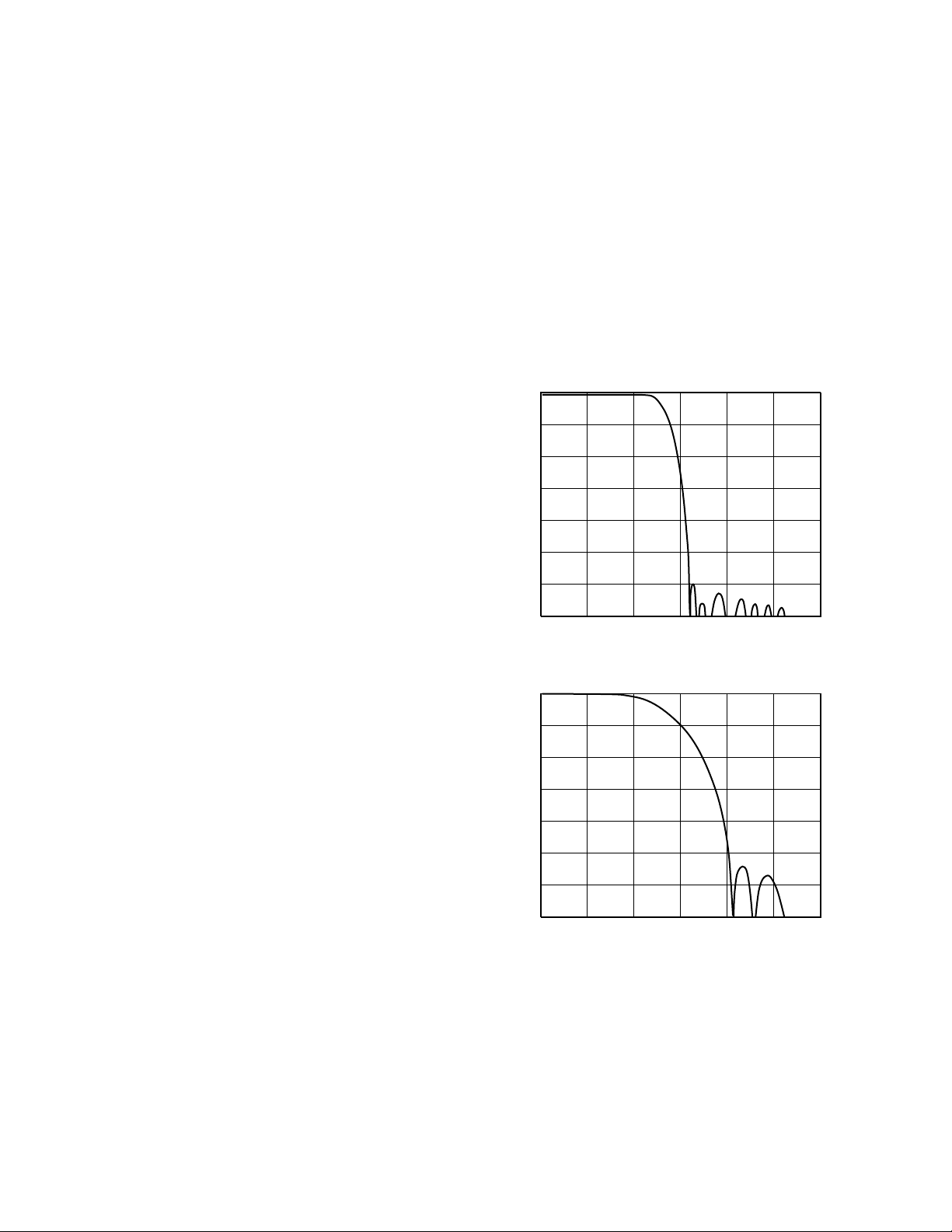
PROGRESSIVE SCAN INPUT
It is possible to input data to the ADV7194 in progressive scan
format. For this purpose the input pins Y0/P10–Y9/P19, Cr0–Cr9,
Cb0–Cb9 accept 10-bit Y data, 10-bit Cb data and 10-bit Cr
data. The data is clocked into the part at 27 MHz. The data
is then filtered and sinc corrected in an 2× Interpolation filter
and then output to three video DACs at 54 MHz (to interface to
a progressive scan monitor).
0
–10
–20
–30
–40
AMPLITUDE – dB
–50
–60
–70
0305
10 15 20 25
FREQUENCY – MHz
Figure 32. Plot of the Interpolation Filter for the Y Data
0
–10
DOUBLE BUFFERING
Double buffering can be enabled or disabled on the following
registers: Closed Captioning Registers, Brightness Control
Register, V-Scale Register, U-Scale Register, Contrast Control
Register, Hue Adjust Register, and the Gamma Curve Select
bit. These registers are updated once per field on the falling
edge of the VSYNC signal. Double Buffering improves the overall performance of the ADV7194, since modifications to register
settings will not be made during active video, but take effect on
the start of the active video. (Mode Register 8.)
GAMMA CORRECTION CONTROL
Gamma correction may be performed on the luma data. The
user has the choice to use either of two different gamma curves,
A or B. At any one time one of these curves is operational if
gamma correction is enabled. Gamma correction allows the
mapping of the luma data to a user-defined function. (Mode
Register 8, Gamma Correction Registers 0–13.)
NTSC PEDESTAL CONTROL
In NTSC mode it is possible to have the pedestal signal generated on the output video signal. (Mode Register 2.)
–18–
–20
–30
–40
AMPLITUDE – dB
–50
–60
–70
0305
10 15 20 25
FREQUENCY – MHz
Figure 33. Plot of the Interpolation Filter for the CrCb Data
It is assumed that there is no color space conversion or any other
such operation to be performed on the incoming data. Thus if
these DAC outputs are to drive a TV, all relevant timing and
synchronization data should be contained in the incoming digital
Y data.
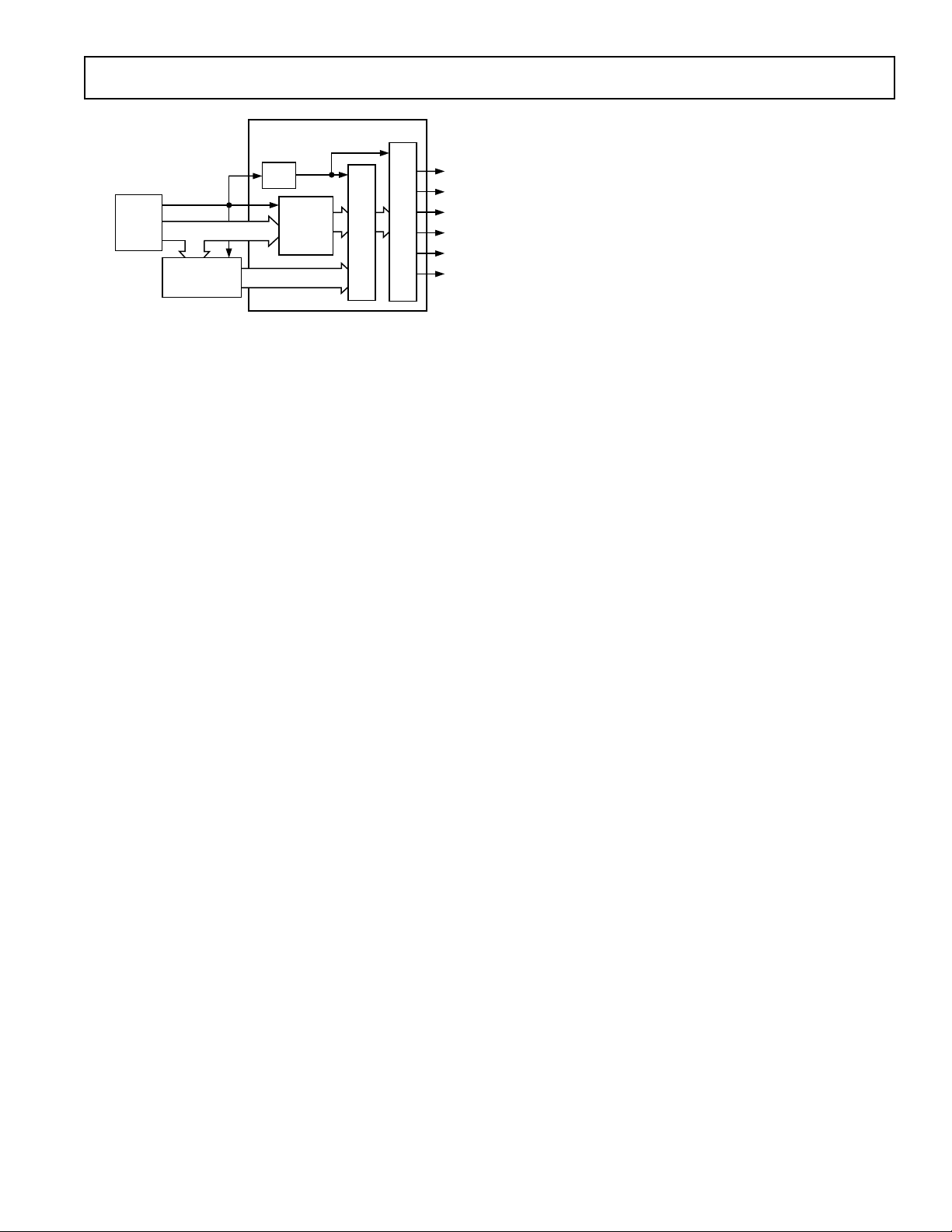
The block diagram below shows a possible configuration for
progressive scan mode using the ADV7194.
REV. 0
Page 19
ADV7194
ADV7194
54MHz
MPEG2
27MHz
PIXEL BUS
PROGRESSIVE
SCAN
DECODER
PLL
ENCODER
CORE
30-BIT INTERFACE
I
N
O
T
U
6
E
T
R
P
D
P
2
ⴛ
U
A
O
T
C
L
S
A
T
I
O
N
Figure 34. Block Diagram Using the ADV7194 in Progressive Scan Mode
The progressive scan decoder deinterlaces the data from the
MPEG2 decoder. This now means that there are 525 video lines
per field in NTSC mode and 625 video lines per field in PAL
mode. The duration of the video line is now 32 µs.
It is important to note that the data from the MPEG2 decoder is
in 4:2:2 format. The data output from the progressive scan decoder
is in 4:4:4 format. Thus it is assumed that some form of interpolation on the color component data is performed in the progressive
scan decoder IC. (Mode Register 8.)
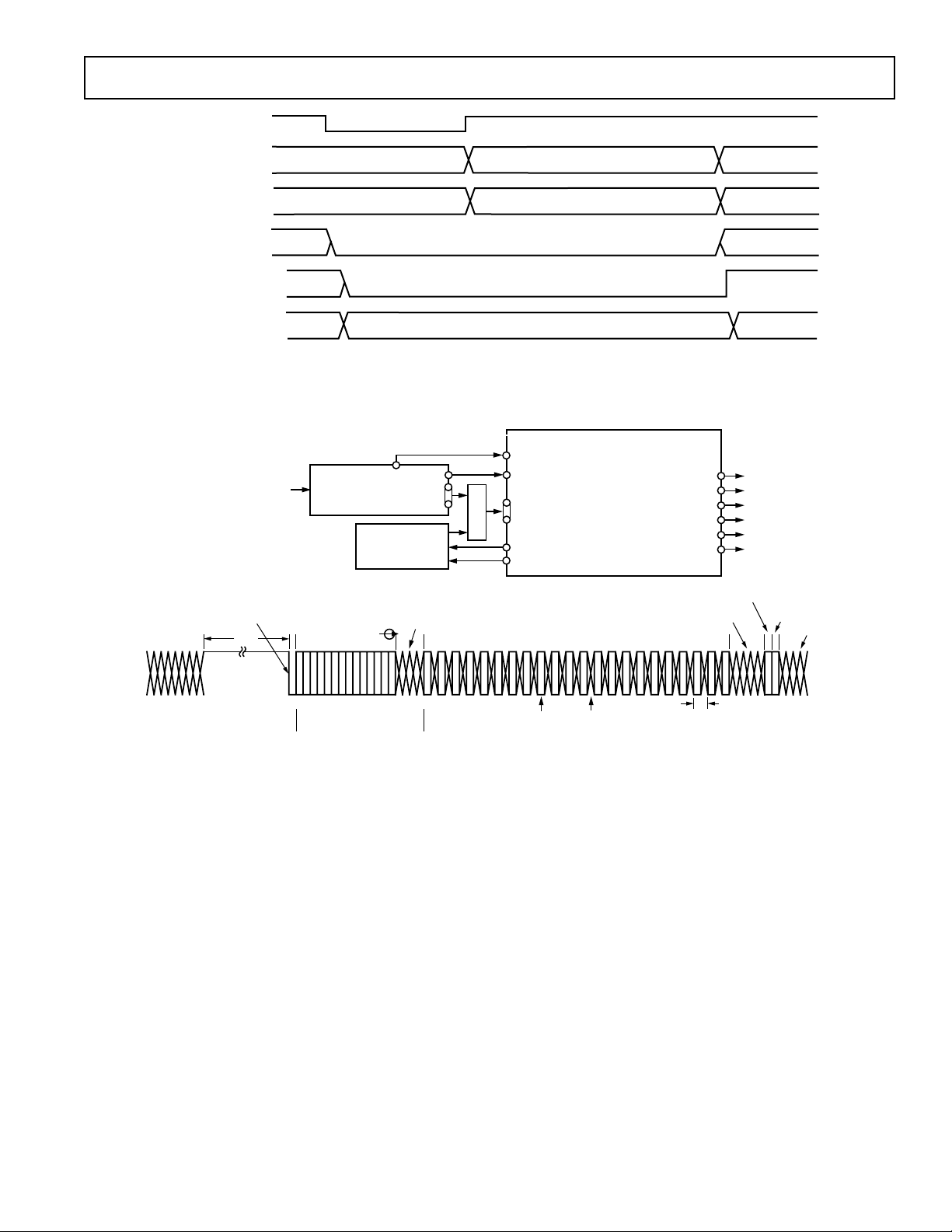
REAL-TIME CONTROL, SUBCARRIER RESET AND
TIMING RESET
Together with the SCRESET/RTC/TR pin and of Mode
Register 4 (Genlock Control), the ADV7194 can be used in
(a) Timing Reset Mode, (b) Subcarrier Phase Reset Mode or
(c) RTC Mode.
(a) A TIMING RESET is achieved in holding this pin high. In
this state the horizontal and vertical counters will remain
reset. On releasing this pin (set to low), the internal counters
will commence counting again. The minimum time the pin
has to be held high is 37 ns (1 clock cycle at 27 MHz),
otherwise the reset signal might not be recognized.
(b) The SUBCARRIER PHASE will reset to that of Field 0 at
the start of the following field when a low to high transition
occurs on this input pin.
(c) In RTC MODE, the ADV7194 can be used to lock to an
external video source.
The real-time control mode allows the ADV7194 to automatically alter the subcarrier frequency to compensate for line
length variations. When the part is connected to a device that
outputs a digital datastream in the RTC format (such as an
ADV7185 video decoder, see Figure 37), the part will automatically change to the compensated subcarrier frequency
on a line-by-line basis. This digital datastream is 67 bits wide
and the subcarrier is contained in Bits 0 to 21. Each bit is
two clock cycles long. 00Hex should be written into all four
Subcarrier Frequency registers when using this mode. (Mode
Register 4.)
SCH PHASE MODE
The SCH phase is configured in default mode to reset every
four (NTSC) or eight (PAL) fields to avoid an accumulation of
SCH phase error over time. In an ideal system, zero SCH phase
error would be maintained forever, but, in reality, this is impossible
to achieve due to clock frequency variations. This effect is reduced
by the use of a 32-bit DDS, which generates this SCH.
Resetting the SCH phase every four or eight fields avoids the
accumulation of SCH phase error, and results in very minor
SCH phase jumps at the start of the four or eight field sequence.
Resetting the SCH phase should not be done if the video source
does not have stable timing or the ADV7194 is configured in RTC
mode. Under these conditions (unstable video) the Subcarrier
Phase Reset should be enabled but no reset applied. In this
configuration the SCH Phase will never be reset; this means
that the output video will now track the unstable input video. The
Subcarrier Phase Reset when applied will reset the SCH phase
to Field 0 at the start of the next field (e.g., Subcarrier Phase
Reset applied in Field 5 (PAL) on the start of the next field SCH
phase will be reset to Field 0). (Mode Register 4.)
SLEEP MODE
If, after RESET, the SCRESET/RTC/TR and NTSC_PAL pins
are both set high, the ADV7194 will power-up in Sleep Mode to
facilitate low-power consumption before all registers have been
initialized.
If Power-up in Sleep Mode is disabled, Sleep Mode control
passes to the Sleep Mode control in Mode Register 2 (i.e., control via I
2
C). (Mode Register 2 and Mode Register 6.)
SQUARE PIXEL MODE
The ADV7194 can be used to operate in square pixel mode. For
NTSC operation an input clock of 24.5454 MHz is required.
Alternatively, for PAL operation, an input clock of 29.5 MHz
is required. The internal timing logic adjusts accordingly for
square pixel mode operation. Square pixel mode is not available
in 4× Oversampling mode. (Mode Register 2.)
VERTICAL BLANKING DATA INSERTION AND BLANK
INPUT
It is possible to allow encoding of incoming YCbCr data on
those lines of VBI that do not have line sync or pre-/post-equalization pulses. This mode of operation is called Partial Blanking. It
allows the insertion of any VBI data (Opened VBI) into the
encoded output waveform, this data is present in digitized
incoming YCbCr data stream (e.g., WSS data, CGMS, VPS
etc.). Alternatively the entire VBI may be blanked (no VBI data
inserted) on these lines. VBI is available in all timing modes.
Complete VBI is comprised of the following lines:
525/60 systems, Lines 525 to 21 for field one and Lines 262 to
Line 284 for field two.
625/50 systems, Lines 624 to Line 22 and Lines 311 to 335.
The Opened VBI consists of:
525/60 systems, Lines 10 to 21 for field one and second half of
Line 273 to Line 284 for field two.
625/50 systems, Lines 7 to 22 and Lines 319 to 335.
(Mode Register 3.)
It is possible to allow control over the BLANK signal using
Timing Register 0. When the BLANK input is enabled (TR03 =
0 and input pin tied low), the BLANK input can be used to
input externally generated blank signals in Slave Mode 1, 2, or
3. When the BLANK input is disabled (TR03 = 1 and input pin
tied low or tied high) the BLANK input is not used and the
REV. 0
–19–
Page 20
ADV7194
ADV7194 automatically blanks all normally blank lines as per
CCIR-624. (Timing Register 0.)
YUV LEVELS
This functionality allows the ADV7194 to output SMPTE levels
or Betacam levels on the Y output when configured in PAL or
NTSC mode.
Sync Video
Betacam 286 mV 714 mV
SMPTE 300 mV 700 mV
MII 300 mV 700 mV
As the data path is branched at the output of the filters the luma
signal relating to the CVBS or S-Video Y/C output is unaltered.
It is only the Y output of the YCrCb outputs that is scaled.
This control allows color component levels to have a peak-peak
amplitude of 700 mV, 1000 mV or the default values of 934 mV
in NTSC and 700 mV in PAL. (Mode Register 5.)
20-/16-BIT INTERFACE
It is possible to input data in 20-bit or 16-bit format. In this
case, the interface only operates if the data is accompanied by
separate HSYNC/VSYNC/BLANK signals. Twenty-bit or 16-
bit mode is not available in Slave Mode 0 since EAV/SAV timing
codes are used. (Mode Register 8.)
4ⴛ OVERSAMPLING AND INTERNAL PLL
It is possible to operate all six DACs at 27 MHz (2× Oversampling) or 54 MHz (4× Oversampling).
The ADV7194 is supplied with a 27 MHz clock synced with the
incoming data. Two options are available: to run the device
throughout at 27 MHz or to enable the PLL. In the latter case,
even if the incoming data runs at 27 MHz, 4× Oversampling
and the internal PLL will output the data at 54 MHz.
NOTE
In 4× Oversampling Mode the requirements for the optional
output filters are different than from those in 2× Oversampling.
(Mode Register 1, Mode Register 6.)
ADV7194
I
N
MPEG2
PIXEL BUS
27MHz
ENCODER
CORE
PLL
54MHz
T
E
R
P
2
O
ⴛ
L
A
T
I
O
N
O
6
U
T
D
A
C
54MHz
P
OUTPUT
U
T
S
Figure 35a. PLL and 4× Oversampling Block Diagram
0dB
–30dB
2ⴛ FILTER
REQUIREMENTS
4ⴛ FILTER
REQUIREMENTS
6.75MHz 13.5MHz 27.0MHz 40.5MHz 54.0MHz
Figure 35b. Output Filter Requirements in 4× Oversampling Mode
VIDEO TIMING DESCRIPTION
The ADV7194 is intended to interface to off-the-shelf MPEG1
and MPEG2 Decoders. As a consequence, the ADV7194 accepts
4:2:2 YCrCb Pixel Data via a CCIR-656 Pixel Port and has
several Video Timing Modes of operation that allow it to be
configured as either System Master Video Timing Generator or
a Slave to the System Video Timing Generator. The ADV7194
generates all of the required horizontal and vertical timing periods
and levels for the analog video outputs.
The ADV7194 calculates the width and placement of analog sync
pulses, blanking levels, and color burst envelopes. Color bursts
are disabled on appropriate lines and serration and equalization
pulses are inserted where required.
In addition, the ADV7194 supports a PAL or NTSC square pixel
operation. The part requires an input pixel clock of 24.5454 MHz
for NTSC square pixel operation and an input pixel clock of
29.5 MHz for PAL square pixel operation. The internal horizontal line counters place the various video waveform sections in
the correct location for the new clock frequencies.
The ADV7194 has four distinct Master and four distinct Slave
timing configurations. Timing Control is established with the
bidirectional HSYNC, BLANK and VSYNC pins. Timing Register 1 can also be used to vary the timing pulsewidths and where
they occur in relation to each other. (Mode Register 2, Timing
Register 0, 1.)
RESET SEQUENCE
When RESET becomes active the ADV7194 reverts to the
default output configuration (see Appendix for register settings).
The ADV7194 internal timing is under the control of the logic
level on the NTSC_PAL pin.
When RESET is released Y, Cr, Cb values corresponding to a
black screen are input to the ADV7194. Output timing signals
are still suppressed at this stage. DACs A, B, C are switched off
and DACs D, E, F are switched on.
When the user requires valid data, Pixel Data Valid Control is
enabled (MR26 = 1) to allow the valid pixel data to pass through
the encoder. Digital output timing signals become active and
the encoder timing is now under the control of the Timing Registers. If at this stage, the user wishes to select a different video
standard to that on the NTSC_PAL pin, Standard I
2
C Control should be enabled (MR25 = 1) and the video standard
required is selected by programming Mode Register 0 (Output Video Standard Selection). Figure 36 illustrates the RESET
sequence timing.
–20–
REV. 0
Page 21
RESET
ADV7194
DAC D,
DAC E
DAC F
DAC A,
DAC B,
DAC C
PIXEL_DATA_VALID
DIGITAL TIMING
MR26
COMPOSITE
e.g., VCR
OR CABLE
H/L TRANSITION
COUNT START
128
XXXXXXX XXXXXXX
XXXXXXX XXXXXXX
XXXXXXX
XXXXXXX
XXXXXXX
Figure 36.
VIDEO
LOW
VIDEO
DECODER
ADV7185
14 BITS
RESERVED
LCC1
P19–P12
MPEG
DECODER
4 BITS
RESERVED
BLACK VALUE WITH SYNC
BLACK VALUE
OFF
0
DIGITAL TIMING SIGNALS SUPPRESSED
RESET
Sequence Timing Diagram
CLOCK
GLL
21013
M
U
X
SCRESET/RTC/TR
P9–P0
HSYNC
FIELD/VSYNC
F
PLL INCREMENT
SC
ADV7194
GREEN/ COMPOSITE/ Y
BLUE/ LUMA/U
RED/ CHROMA/ V
GREEN/ COMPOSITE/ Y
BLUE/ LUMA/U
RED/ CHROMA/ V
1
1
SEQUENCE
5 BITS
RESERVED
0
VALID VIDEO
VALID VIDEO
VALID VIDEO
TIMING ACTIVE
2
BIT
RESET
3
BIT
RESERVED
RTC
TIME SLOT: 01
NOTES:
1
FSC PLL INCREMENT IS 22 BITS LONG, VALUE LOADED INTO ADV7194 FSC DDS REGISTER IS FSC PLL INCREMENTS BITS 21:0
PLUS BITS 0:9 OF SUBCARRIER FREQUENCY REGISTERS. ALL ZEROS SHOULD BE WRITTEN TO THE SUBCARRIER FREQUENCY
REGISTERS OF THE ADV7194.
2
SEQUENCE BIT
PAL: 0 = LINE NORMAL, 1 = LINE INVERTED
NTSC: 0 = NO CHANGE
3
RESET BIT
RESET ADV7194’s DDS
NOT USED IN
ADV7194
19
14
VALID
SAMPLE
INVALID
SAMPLE
8/ LINE
LOCKED CLOCK
67 68
Figure 37. RTC Timing and Connections
REV. 0
–21–
Page 22

ADV7194
Mode 0 (CCIR–656): Slave Option
(Timing Register 0 TR0 = X X X X X 0 0 0)
The ADV7194 is controlled by the SAV (Start Active Video) and EAV (End Active Video) Time Codes in the Pixel Data. All timing
information is transmitted using a 4-byte synchronization pattern. A synchronization pattern is sent immediately before and after
each line during active picture and retrace. Mode 0 is illustrated in Figure 38. The HSYNC, VSYNC and BLANK (if not used) pins
should be tied high during this mode. Blank output is available.
ANALOG
VIDEO
EAV CODE SAV CODE
C
INPUT PIXELS
NTSC/ PAL M SYSTEM
(525 LlNES/ 60Hz)
PAL SYSTEM
(625 LINES/ 50Hz)
FF0000XY8
Y
Y
r
4 CLOCK
4 CLOCK
END OF ACTIVE
VIDEO LINE
0
10801
0
Figure 38. Timing Mode 0, Slave Mode
Mode 0 (CCIR–656): Master Option
(Timing Register 0 TR0 = X X X X X 0 0 1)
The ADV7194 generates H, V, and F signals required for the SAV (Start Active Video) and EAV (End Active Video) Time Codes in
the CCIR656 standard. The H bit is output on the HSYNC pin, the V bit is output on the BLANK pin and the F bit is output on
the VSYNC pin. Mode 0 is illustrated in Figure 39 (NTSC) and Figure 40 (PAL). The H, V, and F transitions relative to the video
waveform are illustrated in Figure 41.
FF00FFABABAB80108
ANCILLARY DATA
(HANC)
268 CLOCK
280 CLOCK
000
10F
0
F
4 CLOCK
4 CLOCK
START OF ACTIVE
C
X
0
b
Y
VIDEO LINE
CrC
Y
Y
1440 CLOCK
1440 CLOCK
C
C
Y
Y
b
r
b
DISPLAY
522 523 524 525 1 2 3 4
H
V
F
DISPLAY
260 261 262 263 264 265 266 267 268 269 270 271 272 273 274
H
V
F
ODD FIELD
ODD FIELDEVEN FIELD
EVEN FIELD
VERTICAL BLANK
67
5
VERTICAL BLANK
9
8
Figure 39. Timing Mode 0, NTSC Master Mode
DISPLAY
10 11 20 21 22
DISPLAY
283 284 285
–22–
REV. 0
Page 23

ADV7194
DISPLAY
622 623 624 625 1 2 3 4
H
V
F ODD FIELDEVEN FIELD
DISPLAY
309 310 311 312 314 315 316 317
H
V
F
ODD FIELD
313
EVEN FIELD
Figure 40. Timing Mode 0, PAL Master Mode
VERTICAL BLANK
5
VERTICAL BLANK
67
318
319 320 334
DISPLAY
22 23
21
DISPLAY
335 336
ANALOG
VIDEO
H
F
V
Figure 41. Timing Mode 0 Data Transitions, Master Mode
REV. 0
–23–
Page 24

ADV7194
Mode 1: Slave Option HSYNC, BLANK, FIELD
(Timing Register 0 TR0 = X X X X X 0 1 0)
In this mode the ADV7194 accepts Horizontal SYNC and Odd/Even FIELD signals. A transition of the FIELD input when HSYNC is
low indicates a new frame, i.e., Vertical Retrace. The BLANK signal is optional. When the BLANK input is disabled the ADV7194
automatically blanks all normally blank lines as per CCIR-624. Mode 1 is illustrated in Figure 42 (NTSC) and Figure 43 (PAL).
HSYNC
BLANK
FIELD
HSYNC
BLANK
FIELD
DISPLAY
522 523 524 525
DISPLAY
260 261 262 263 264 265 266 267 268 269 270 271 272 273 274
1234
ODD FIELDEVEN FIELD
ODD FIELD EVEN FIELD
VERTICAL BLANK
678
5
VERTICAL BLANK
10 11
9
Figure 42. Timing Mode 1, NTSC
DISPLAY
VERTICAL BLANK
DISPLAY
20 21 22
DISPLAY
283
284
DISPLAY
285
HSYNC
BLANK
FIELD
HSYNC
BLANK
FIELD
6226236246251234
ODD FIELDEVEN FIELD
DISPLAY
309 310 311 312 313 314 315 316
ODD FIELD EVEN FIELD
VERTICAL BLANK
Figure 43. Timing Mode 1, PAL
5
317
67
318 319
320
21 22 23
DISPLAY
334 335 336
–24–
REV. 0
Page 25

ADV7194
Mode 1: Master Option HSYNC, BLANK, FIELD
(Timing Register 0 TR0 = X X X X X 0 1 1)
In this mode the ADV7194 can generate Horizontal SYNC and Odd/Even FIELD signals. A transition of the FIELD input when
HSYNC is low indicates a new frame, i.e., Vertical Retrace. The BLANK signal is optional. When the BLANK input is disabled the
ADV7194 automatically blanks all normally blank lines as per CCIR-624. Pixel data is latched on the rising clock edge following the timing signal transitions. Mode 1 is illustrated in Figure 42 (NTSC) and Figure 43 (PAL). Figure 44 illustrates the HSYNC,
BLANK and FIELD for an odd-or-even field transition relative to the pixel data.
HSYNC
FIELD
BLANK
PIXEL
DATA
PAL = 12 ⴛ CLOCK/2
NTSC = 16 ⴛ CLOCK/ 2
PAL = 132 ⴛ CLOCK/2
NTSC = 122 ⴛ CLOCK/2
Cb Y Cr Y
Figure 44. Timing Mode 1 Odd/Even Field Transitions Master/Slave
Mode 2: Slave Option HSYNC, VSYNC, BLANK
(Timing Register 0 TR0 = X X X X X 1 0 0)
In this mode the ADV7194 accepts Horizontal and Vertical SYNC signals. A coincident low transition of both HSYNC and VSYNC
inputs indicates the start of an Odd Field. A VSYNC low transition when HSYNC is high indicates the start of an Even Field. The
BLANK signal is optional. When the BLANK input is disabled, the ADV7194 automatically blanks all normally blank lines as per
CCIR-624. Mode 2 is illustrated in Figure 45 (NTSC) and Figure 46 (PAL).
DISPLAY
20 21 22
HSYNC
BLANK
VSYNC
DISPLAY
522 523 524 525
1234
VERTICAL BLANK
678
5
ODD FIELDEVEN FIELD
9
10 11
HSYNC
BLANK
VSYNC
REV. 0
DISPLAY
260 261 262 263 264 265 266 267 268 269 270 271 272 273 274
ODD FIELD EVEN FIELD
VERTICAL BLANK
Figure 45. Timing Mode 2, NTSC
–25–
283
284
DISPLAY
285
Page 26

ADV7194
HSYNC
BLANK
VSYNC
HSYNC
BLANK
VSYNC
DISPLAY
6226236246251234
DISPLAY
309 310 311 312 313 314 315 316
ODD FIELD EVEN FIELD
VERTICAL BLANK
ODD FIELDEVEN FIELD
VERTICAL BLANK
5
317
67
318 319
21 22 23
320
DISPLAY
DISPLAY
334 335 336
Figure 46. Timing Mode 2, PAL
Mode 2: Master Option HSYNC, VSYNC, BLANK
(Timing Register 0 TR0 = X X X X X 1 0 1)
In this mode the ADV7194 can generate Horizontal and Vertical SYNC signals. A coincident low transition of both HSYNC and
VSYNC inputs indicates the start of an Odd Field. A VSYNC low transition when HSYNC is high indicates the start of an Even
Field. The BLANK signal is optional. When the BLANK input is disabled, the ADV7194 automatically blanks all normally blank lines as
per CCIR-624. Mode 2 is illustrated in Figure 45 (NTSC) and Figure 46 (PAL). Figure 47 illustrates the HSYNC, BLANK and
VSYNC for an even-to-odd field transition relative to the pixel data. Figure 48 illustrates the HSYNC, BLANK and VSYNC for
an odd-to-even field transition relative to the pixel data.
HSYNC
VSYNC
BLANK
PIXEL
DATA
HSYNC
VSYNC
BLANK
PIXEL
DATA
PAL = 12 ⴛ CLOCK/2
NTSC = 16 ⴛ CLOCK/2
Cb Y Cr Y
PAL = 132 ⴛ CLOCK/2
NTSC = 122 ⴛ CLOCK/2
Figure 47. Timing Mode 2, Even-to-Odd Field Transition Master/Slave
PAL = 12 ⴛ CLOCK/2
NTSC = 16 ⴛ CLOCK/2
PAL = 132 ⴛ CLOCK/2
NTSC = 122 ⴛ CLOCK/2
PAL = 864 ⴛ CLOCK/2
NTSC = 858 ⴛ CLOCK/2
Cb Y Cr Y Cb
Figure 48. Timing Mode 2, Odd-to-Even Field Transition Master/Slave
–26–
REV. 0
Page 27

ADV7194
Mode 3: Master/Slave Option HSYNC, BLANK, FIELD
(Timing Register 0 TR0 = X X X X X 1 1 0 or X X X X X 1 1 1)
In this mode the ADV7194 accepts or generates Horizontal SYNC and Odd/Even FIELD signals. A transition of the FIELD input
when HSYNC is high indicates a new frame, i.e., Vertical Retrace. The BLANK signal is optional. When the BLANK input is dis-
abled the ADV7194 automatically blanks all normally blank lines as per CCIR-624. Mode 3 is illustrated in Figure 49 (NTSC) and
Figure 50 (PAL).
HSYNC
BLANK
FIELD
HSYNC
BLANK
FIELD
DISPLAY
522 523 524 525
DISPLAY
260 261 262 263 264 265 266 267 268 269 270 271 272 273 274
1234
ODD FIELDEVEN FIELD
ODD FIELD EVEN FIELD
VERTICAL BLANK
678
5
VERTICAL BLANK
9
10 11
Figure 49. Timing Mode 3, NTSC
DISPLAY
VERTICAL BLANK
DISPLAY
20 21 22
DISPLAY
283
284
DISPLAY
285
HSYNC
BLANK
FIELD
HSYNC
BLANK
FIELD
622 623 624 625 1 2 3 4
ODD FIELDEVEN FIELD
DISPLAY
309 310 311 312 313 314 315 316
EVEN FIELD
ODD FIELD
VERTICAL BLANK
Figure 50. Timing Mode 3, PAL
5
317
67
318 319
320
21 22 23
DISPLAY
334 335 336
REV. 0
–27–
Page 28

ADV7194
MPU PORT DESCRIPTION
The ADV7194 supports a 2-wire serial (I2C-compatible) microprocessor bus driving multiple peripherals. Two inputs Serial
Data (SDA) and Serial Clock (SCL) carry information between
any device connected to the bus. Each slave device is recognized
by a unique address. The ADV7194 has four possible slave addresses for both read and write operations. These are unique
addresses for each device and are illustrated in Figure 51 and
Figure 53. The LSB sets either a read or write operation. Logic
Level 1 corresponds to a read operation while Logic Level 0
corresponds to a write operation. A1 is set by setting the ALSB
pin of the ADV7194 to Logic Level 0 or Logic Level 1. When
ALSB is set to 0, there is greater input bandwidth on the I
lines, which allows high speed data transfers on this bus. When
ALSB is set to 1, there is reduced input bandwidth on the I
lines, which means that pulses of less than 50 ns will not pass
into the I
2
C internal controller. This mode is recommended for
2
C
2
C
noisy systems.
0
ADDRESS
CONTROL
SETUP BY
ALSB
X1010 1A1
READ/ WRITE
CONTROL
0 WRITE
1 READ
Figure 51. Slave Address
To control the various devices on the bus the following protocol
must be followed. First the master initiates a data transfer by
establishing a start condition, defined by a high to low transition on
SDA while SCL remains high. This indicates that an address/data
stream will follow. All peripherals respond to the start condition
and shift the next eight bits (7-bit address + R/W bit). The bits are
transferred from MSB down to LSB. The peripheral that recognizes the transmitted address responds by pulling the data line
low during the ninth clock pulse. This is known as an acknowledge
bit. All other devices withdraw from the bus at this point and
maintain an idle condition. The idle condition is where the device
monitors the SDA and SCL lines waiting for the start condition and the correct transmitted address. The R/W bit determines
the direction of the data.
A Logic 0 on the LSB of the first byte means that the master
will write information to the peripheral. A Logic 1 on the LSB
of the first byte means that the master will read information
from the peripheral.
The ADV7194 acts as a standard slave device on the bus. The data
on the SDA pin is 8 bits long supporting the 7-bit addresses plus
the R/W bit. It interprets the first byte as the device address and
the second byte as the starting subaddress. The subaddresses
autoincrement allowing data to be written to or read from the
starting subaddress. A data transfer is always terminated by a
stop condition. The user can also access any unique subaddress
register on a one by one basis without having to update all the
registers. There is one exception. The Subcarrier Frequency
Registers should be updated in sequence, starting with Subcarrier Frequency Register 0. The autoincrement function should
be then used to increment and access Subcarrier Frequency
Registers 1, 2, and 3. The Subcarrier Frequency Registers
should not be accessed independently.
Stop and start conditions can be detected at any stage during
the data transfer. If these conditions are asserted out of sequence
with normal read and write operations, then these cause an
immediate jump to the idle condition. During a given SCL high
period the user should only issue one start condition, one stop
condition or a single stop condition followed by a single start
condition. If an invalid subaddress is issued by the user, the
ADV7194 will not issue an acknowledge and will return to the
idle condition. If in autoincrement mode, the user exceeds the
highest subaddress then the following action will be taken:
1. In Read Mode, the highest subaddress register contents
will continue to be output until the master device issues
a no-acknowledge. This indicates the end of a read. A
no-acknowledge condition is where the SDA line is not
pulled low on the ninth pulse.
2. In Write Mode, the data for the invalid byte will be not be
loaded into any subaddress register, a no-acknowledge will
be issued by the ADV7194 and the part will return to the
idle condition.
SDATA
SCLOCK
START ADDR
1 7
89 1 789 1789 PS
ACK SUBADDRESS ACK DATA ACK STOP
R/W
Figure 52. Bus Data Transfer
Figure 52 illustrates an example of data transfer for a read
sequence and the start and stop conditions.
Figure 53 shows bus write and read sequences.
WRITE
SEQUENCE
READ
SEQUENCE
LSB = 0
S SLAVE ADDR A(S) SUB ADDR
S = START BIT
P = STOP BIT
A(S) = ACKNOWLEDGE BY SLAVE
A(M) = ACKNOWLEDGE BY MASTER
Figure 53. Write and Read Sequences
DATA A(S)S SLAVE ADDR A(S) SUB ADDR A(S)
LSB = 1
A(S) S SLAVE ADDR A(S) DATA
A(S) = NO ACKNOWLEDGE BY SLAVE
A(M) = NO ACKNOWLEDGE BY MASTER
–28–
DATA
A(M)
A(S)
P
DATA P
A(M )
REV. 0
Page 29

ADV7194
REGISTER ACCESSES
The MPU can write to or read from all of the registers of the
ADV7194 except the Subaddress Registers which are write only
registers. The Subaddress Register determines which register the
next read or write operation accesses. All communications with
the part through the bus start with an access to the Subaddress
Register. Then a read/write operation is performed from/to the
target address which then increments to the next address until
a stop command on the bus is performed.
REGISTER PROGRAMMING
The following section describes each register. All registers can
be read from as well as written to.
SR7 SR6 SR5 SR4 SR3 SR2 SR1 SR0
SR7
ZERO SHOULD
BE WRITTEN
HERE
ADDRESS SR6 SR5 SR4 SR3 SR2 SR1 SR0
00H 0 0 0 0 0 0 0 MODE REGISTER 0
01H 0 0 0 0 0 0 1 MODE REGISTER 1
02H 0 0 0 0 0 1 0 MODE REGISTER 2
03H 0 0 0 0 0 1 1 MODE REGISTER 3
04H 0 0 0 0 1 0 0 MODE REGISTER 4
05H 0 0 0 0 1 0 1 MODE REGISTER 5
06H 0 0 0 0 1 1 0 MODE REGISTER 6
07H 0 0 0 0 1 1 1 MODE REGISTER 7
08H 0 0 0 1 0 0 0 MODE REGISTER 8
09H 0 0 0 1 0 0 1 MODE REGISTER 9
0AH 0 0 0 1 0 1 0 TIMING REGISTER 0
0BH 0 0 0 1 0 1 1 TIMING REGISTER 1
0CH 0 0 0 1 1 0 0 SUBCARRIER FREQUENCY REGISTER 0
0DH 0 0 0 1 1 0 1 SUBCARRIER FREQUENCY REGISTER 1
0EH 0 0 0 1 1 1 0 SUBCARRIER FREQUENCY REGISTER 2
0FH 0 0 0 1 1 1 1 SUBCARRIER FREQUENCY REGISTER 3
10H 0 0 1 0 0 0 0 SUBCARRIER PHASE REGISTER
11H 0 0 1 0 0 0 1 CLOSED CAPTIONING EXTENDED DATA BYTE 0
12H 0 0 1 0 0 1 0 CLOSED CAPTIONING EXTENDED DATA BYTE 1
13H 0 0 1 0 0 1 1 CLOSED CAPTIONING DATA BYTE 0
14H 0 0 1 0 1 0 0 CLOSED CAPTIONING DATA BYTE 1
15H 0 0 1 0 1 0 1 NTSC PEDESTAL/TELETEXT CONTROL REGISTER 0
16H 0 0 1 0 1 1 0 NTSC PEDESTAL/TELETEXT CONTROL REGISTER 1
17H 0 0 1 0 1 1 1 NTSC PEDESTAL/TELETEXT CONTROL REGISTER 2
18H 0 0 1 1 0 0 0 NTSC PEDESTAL/TELETEXT CONTROL REGISTER 3
19H 0 0 1 1 0 0 1 CGMS/WSS 0
1AH 0 0 1 1 0 1 0 CGMS/WSS 1
1BH 0 0 1 1 0 1 1 CGMS/WSS 2
1CH 0 0 1 1 1 0 0 TELETEXT REQUEST CONTROL REGISTER
1DH 0 0 1 1 1 0 1 CONTRAST CONTROL REGISTER
1EH 0 0 1 1 1 1 0 U SCALE REGISTER
1FH 0 0 1 1 1 1 1 V SCALE REGISTER
20H 0 1 0 0 0 0 0 HUE ADJUST REGISTER
21H 0 1 0 0 0 0 1 BRIGHTNESS CONTROL REGISTER
22H 0 1 0 0 0 1 0 SHARPNESS CONTROL REGISTER
23H 0 1 0 0 0 1 1 DNR REGISTER 0
24H 0 1 0 0 1 0 0 DNR REGISTER 1
25H 0 1 0 0 1 0 1 DNR REGISTER 2
26H 0 1 0 0 1 1 0 GAMMA CORRECTION REGISTER 0
27H 0 1 0 0 1 1 1 GAMMA CORRECTION REGISTER 1
28H 0 1 0 1 0 0 0 GAMMA CORRECTION REGISTER 2
29H 0 1 0 1 0 0 1 GAMMA CORRECTION REGISTER 3
2AH 0 1 0 1 0 1 0 GAMMA CORRECTION REGISTER 4
2BH 0 1 0 1 0 1 1 GAMMA CORRECTION REGISTER 5
2CH 0 1 0 1 1 0 0 GAMMA CORRECTION REGISTER 6
2DH 0 1 0 1 1 0 1 GAMMA CORRECTION REGISTER 7
2EH 0 1 0 1 1 1 0 GAMMA CORRECTION REGISTER 8
2FH 0 1 0 1 1 1 1 GAMMA CORRECTION REGISTER 9
30H 0 1 1 0 0 0 0 GAMMA CORRECTION REGISTER 10
31H 0 1 1 0 0 0 1 GAMMA CORRECTION REGISTER 11
32H 0 1 1 0 0 1 0 GAMMA CORRECTION REGISTER 12
33H 0 1 1 0 0 1 1 GAMMA CORRECTION REGISTER 13
34H 0 1 1 0 1 0 0 BRIGHTNESS DETECT REGISTER
35H 0 1 1 0 1 0 1 OUTPUT CLOCK REGISTER
36H 0 1 1 0 1 1 0 RESERVED
37H 0 1 1 0 1 1 1 RESERVED
38H 0 1 1 1 0 0 0 RESERVED
39H 0 1 1 1 0 0 1 RESERVED
3AH 0 1 1 1 0 1 0 RESERVED
3BH 0 1 1 1 0 1 1 RESERVED
3CH 0 1 1 1 1 0 0 RESERVED
3DH 0 1 1 1 1 0 1 RESERVED
3EH 0 1 1 1 1 1 0 RESERVED
3FH 1 1 1 1 1 1 1 RESERVED
40H 1 0 0 0 0 0 0 RESERVED
41H 1 0 0 0 0 0 1 RESERVED
42H 1 0 0 0 0 1 0 RESERVED
43H 1 0 0 0 0 1 1 RESERVED
44H 1 0 0 0 1 0 0 RESERVED
45H 1 0 0 0 1 0 1 RESERVED
46H 1 0 0 0 1 1 0 RESERVED
47H 1 0 0 1 1 1 1 RESERVED
48H 1 0 0 1 0 1 0 RESERVED
49H 1 0 0 1 0 0 1 RESERVED
4AH 1 0 0 1 0 0 0 RESERVED
4BH 1 0 0 1 0 1 1 RESERVED
ADV7194 SUBADDRESS REGISTER
Subaddress Register (SR7–SR0)
The Communications Register is an 8-bit write-only register. After
the part has been accessed over the bus and a read/write operation
is selected, the subaddress is set up. The Subaddress Register
determines to/from which register the operation takes place.
Figure 54 shows the various operations under the control of the
Subaddress Register 0 should always be written to SR7.
Register Select (SR6–SR0)
These bits are set up to point to the required starting address.
REV. 0
Figure 54. Subaddress Register for the ADV7194
–29–
Page 30

ADV7194
MODE REGISTER 0
MR0 (MR07–MR00)
(Address (SR4–SR0) = 00H)
Figure 55 shows the various operations under the control of
Mode Register 0.
MR0 BIT DESCRIPTION
Output Video Standard Selection (MR00–MR01)
These bits are used to setup the encoder mode. The ADV7194
can be set up to output NTSC, PAL (B, D, G, H, I), or PAL N
standard video.
Luminance Filter Select (MR02–MR04)
These bits specify which luma filter is to be selected. The filter
selection is made independent of whether PAL or NTSC is
selected.
Chrominance Filter Select (MR05–MR07)
These bits select the chrominance filter. A low-pass filter can be
selected with a choice of cutoff frequencies (0.65 MHz, 1.0 MHz,
1.3 MHz, 2 MHz, or 3 MHz) along with a choice of CIF or
QCIF filters.
MR07 MR06 MR05 MR04 MR03 MR02 MR01 MR00
MR07 MR06 MR05
CHROMA FILTER SELECT
0 0 0 1.3 MHz LOW-PASS FILTER
0 0 1 0.65 MHz LOW-PASS FILTER
0 1 0 1.0 MHz LOW-PASS FILTER
0 1 1 2.0 MHz LOW-PASS FILTER
1 0 0 RESERVED
1 0 1 CIF
1 1 0 QCIF
1 1 1 3.0 MHz LOW-PASS FILTER
MODE REGISTER 1
MR1 (MR17–MR10)
(Address (SR4–SR0) = 01H)
Figure 56 shows the various operations under the control of
Mode Register 1.
MR1 BIT DESCRIPTION
DAC Control (MR10–MR15)
Bits MR15–MR10 can be used to power down the DACs. This are
used to reduce the power consumption of the ADV7194 or if any
of the DACs are not required in the application.
4 Oversampling Control (MR16)
To enable 4× Oversampling this bit has to be set to 1. When
enabled, the data is output at a frequency of 54 MHz.
Note that PLL Enable Control has to be enabled (MR61 = 0) in
4× Oversampling mode.
Reserved (MR17)
A Logical 0 must be written to this bit.
OUTPUT VIDEO
STANDARD SELECTION
MR01 MR00
0 0 NTSC
0 1 PAL (B, D, G, H, I)
1 0 RESERVED
1 1 PAL (N)
LUMA FILTER SELECT
MR04 MR03 MR02
0 0 0 LOW-PASS FILTER (NTSC)
0 0 1 LOW-PASS FILTER (PAL)
0 1 0 NOTCH FILTER (NTSC)
0 1 1 NOTCH FILTER (PAL)
1 0 0 EXTENDED MODE
1 0 1 CIF
1 1 0 QCIF
1 1 1 RESERVED
Figure 55. Mode Register 0, MR0
MR17 MR16 MR15 MR14 MR13 MR12 MR11 MR10
MR17
ZERO MUST
BE WRITTEN
TO THIS BIT
4 OVERSAMPLING
CONTROL
MR16
02 OVERSAMPLING
14 OVERSAMPLING
DAC A
DAC CONTROL
MR15
0 POWER-DOWN
1 NORMAL
MR14
0 POWER-DOWN
1 NORMAL
MR13
DAC B
DAC CONTROL
DAC C
DAC CONTROL
0 POWER-DOWN
1 NORMAL
DAC CONTROL
MR12
0 POWER-DOWN
1 NORMAL
DAC CONTROL
MR11
0 POWER-DOWN
1 NORMAL
DAC D
DAC E
MR10
0 POWER-DOWN
1 NORMAL
Figure 56. Mode Register 1, MR1
DAC F
DAC CONTROL
–30–
REV. 0
Page 31

ADV7194
MODE REGISTER 2
MR2 (MR27–MR20)
(Address (SR4–SR0) = 02H)
Mode Register 2 is an 8-bit-wide register.
Figure 57 shows the various operations under the control of Mode
Register 2.
MR2 BIT DESCRIPTION
RGB/YUV Control (MR20)
This bit enables the output from the DACs to be set to YUV or
RGB output video standard.
DAC Output Control (MR21)
This bit controls the output from DACs A, B, and C. When this
bit is set to 1, Composite, Luma and Chroma Signals are output
from DACs A, B and C (respectively). When this bit is set to 0,
RGB or YUV may be output from these DACs.
SCART Enable Control (MR22)
This bit is used to switch the DAC outputs from SCART to a
EUROSCART configuration. A complete table of all DAC output configurations is shown below.
Pedestal Control (MR23)
This bit specifies whether a pedestal is to be generated on the
NTSC composite video signal. This bit is invalid when the device
is configured in PAL mode.
Square Pixel Control (MR24)
This bit is used to setup square pixel mode. This is available in
Slave Mode only. For NTSC, a 24.54 MHz clock must be supplied. For PAL, a 29.5 MHz clock must be supplied. Square
pixel operation is not available in 4× Oversampling mode.
Standard I2C Control (MR25)
This bit controls the video standard used by the ADV7194.
When this bit is set to 1 the video standard is as programmed in
Mode Register 0 (Output Video Standard Selection). When it is
set to 0, the ADV7194 is forced into the standard selected by
the NTSC_PAL pin. When NTSC_PAL is low the standard is
NTSC, when the NTSC_PAL pin is high, the standard is PAL.
Pixel Data Valid Control (MR26)
After resetting the device this bit has the value 0 and the pixel
data input to the encoder is blanked such that a black screen is
output from the DACs. The ADV7194 will be set to Master
Mode timing. When this bit is set to 1 by the user (via the I
2
C),
pixel data passes to the pins and the encoder reverts to the timing mode defined by Timing Mode Register 0.
Sleep Mode Control (MR27)
When this bit is set (1), Sleep Mode is enabled. With this mode
enabled the ADV7194 current consumption is reduced to typically
less than 0.1 mA. The I
2
C registers can be written to and read
from when the ADV7194 is in Sleep Mode.
When the device is in Sleep Mode and 0 is written to MR27, the
ADV7194 will come out of Sleep Mode and resume normal
operation. Also, if a RESET is applied during Sleep Mode the
ADV7194 will come out of Sleep Mode and resume normal
operation.
For this to operate, Power up in Sleep Mode control has to be
enabled (MR60 is set to a Logic 1), otherwise Sleep Mode is
controlled by the PAL_NTSC and SCRESET/RTC/TR pins.
MR27 MR26 MR25 MR24 MR23 MR22 MR21 MR20
RGB/ YUV
CONTROL
MR20
0 RGB OUTPUT
1 YUV OUTPUT
CONTROL
SLEEP MODE
CONTROL
MR27
0 DISABLE
1 ENABLE
PIXEL DATA
VALID CONTROL
MR26
0 DISABLE
1 ENABLE
STANDARD I2C
CONTROL
MR25
0 DISABLE
1 ENABLE
SQUARE PIXEL
CONTROL
MR24
0 DISABLE
1 ENABLE
MR22
PEDESTAL
CONTROL
MR23
0 PEDESTAL OFF
1 PEDESTAL ON
SCART ENABLE
CONTROL
0 DISABLE
1 ENABLE
MR21
DAC OUTPUT
0 RGB/YUV/COMP
1 COMP/LUMA/CHROMA
Figure 57. Mode Register 2, MR2
Table V. DAC Output Configuration
MR22 MR21 MR20 DAC A DAC B DAC C DAC D DAC E DAC F
0 0 0 G (Y) B (Pb) R (Pr) CVBS LUMA CHROMA
0 0 1 Y (Y) U (Pb) V (Pr) CVBS LUMA CHROMA
0 1 0 CVBS LUMA CHROMA G (Y) B (Pb) R (Pr)
0 1 1 CVBS LUMA CHROMA Y (Y) U (Pb) V (Pr)
1 0 0 CVBS B (Pb) R (Pr) G (Y) LUMA CHROMA
1 0 1 CVBS U (Pb) V (Pr) Y (Y) LUMA CHROMA
1 1 0 CVBS LUMA CHROMA G (Y) B (Pb) R (Pr)
1 1 1 CVBS LUMA CHROMA Y (Y) U (Pb) V (Pr)
NOTE
In Progressive Scan Mode (MR80, 1) the DAC output configuration is stated in the brackets.
REV. 0
–31–
Page 32

ADV7194
MODE REGISTER 3
MR3 (MR37–MR30)
(Address (SR4–SR0) = 03H)
Mode Register 3 is an 8-bit-wide register. Figure 58 shows
the various operations under the control of Mode Register 3.
MR3 BIT DESCRIPTION
Revision Code (MR30–MR31)
This bit is read only and indicates the revision of the device.
VBI_Open (MR32)
This bit determines whether or not data in the Vertical Blanking
Interval (VBI) is output to the analog outputs or blanked. Note
that this condition is also valid in Timing Slave Mode 0. For
further information see Vertical Blanking section.
Teletext Enable (MR33)
This bit must be set to 1 to enable teletext data insertion on
the TTX pin. Note: TTX functionality is shared with VSO and
CLAMP on Pin 62. CLAMP/VSO Select (MR77) and TTX
Input/CLAMP/VSO Output (MR76) have to be set accordingly.
Teletext Bit Request Mode Control (MR34)
This bit enables switching of the teletext request signal from a
continuous high signal (MR34 = 0) to a bitwise request signal
(MR34 = 1).
Closed Captioning Field Control (MR35–MR36)
These bits control the fields that closed captioning data is displayed on, closed captioning information can be displayed on
an odd field, even field or both fields.
Reserved (MR37)
A Logic 0 must be written to this bit.
MODE REGISTER 4
MR4 (MR47–MR40)
(Address (SR4–SR0) = 04H)
Mode Register 4 is an 8-bit-wide register. Figure 59 shows
the various operations under the control of Mode Register 4.
MR4 BIT DESCRIPTION
VSYNC_3H Control (MR40)
When this bit is enabled (1) in Slave Mode, it is possible to
drive the VSYNC input low for 2.5 lines in PAL mode and
three lines in NTSC mode. When this bit is enabled in Master
Mode the ADV7194 outputs an active low VSYNC signal for
three lines in NTSC mode and 2.5 lines in PAL mode.
Genlock Control (MR41–MR42)
These bits control the Genlock feature and timing reset of the
ADV7194 Setting MR41 and MR42 to Logic 0 disables the
SCRESET/RTC/TR pin and allows the ADV7194 to operate in
normal mode.
1. By setting MR41 to zero and MR42 to one, a timing reset is
applied, resetting the horizontal and vertical counters. This
has the effect of resetting the Field Count to Field 0.
If the SCRESET/RTC/TR pin is held high, the counters
will remain reset. Once the pin is released the counters will
commence counting again. For correct counter reset, the
SCRESET/RTC/TR pin has to remain high for at least
37 ns (one clock cycle at 27 MHz).
2. If MR41 is set to one and MR42 is set to zero, the SCRESET/
RTC/TR pin is configured as a subcarrier reset input and
the subcarrier phase will reset to Field 0 whenever a low-tohigh transition is detected on the SCRESET/RTC/TR pin
(SCH phase resets at the start of the next field).
3. If MR41 is set to one and MR42 is set to one, the SCRESET/
RTC/TR pin is configured as a real time control input and
the ADV7194 can be used to lock to an external video source
working in RTC mode. See page TBD.
Active Video Line Duration Control (MR43)
This bit switches between two active video line durations. A zero
selects CCIR Rec. 601 (720 pixels PAL/NTSC) and a one
selects ITU-R BT. 470 standard for active video duration (710
pixels NTSC, 702 pixels PAL).
Chrominance Control (MR44)
This bit enables the color information to be switched on and off
the chroma, color component, composite video outputs.
Burst Control (MR45)
This bit enables the color burst to be switched on and off the
chroma and composite video outputs.
Color Bar Control (MR46)
This bit can be used to generate and output an internal color
bar test pattern. The color bar configuration is 100/7.5/75/7.5
for NTSC and 100/0/75/0 for PAL. It is important to note that
when color bars are enabled the ADV7194 is configured in a
Master Timing mode. The output pins VSYNC, HSYNC and
BLANK are three-state during color bar mode.
Interlaced Mode Control (MR47)
This bit is used to setup the output to interlaced or noninterlaced
mode.
MR37 MR36 MR35 MR34 MR33 MR32 MR31 MR30
MR37
ZERO MUST BE
WRITTEN TO
THIS BIT
MR36 MR35
MR34
CLOSED CAPTIONING
FIELD CONTROL
0 0 NO DATA OUT
0 1 ODD FIELD ONLY
1 0 EVEN FIELD ONLY
1 1 DATA OUT
(BOTH FIELDS)
TTX BIT REQUEST
MODE CONTROL
0 DISABLE
1 ENABLE
MR33
TELETEXT
ENABLE
0 DISABLE
1 ENABLE
VBI OPEN
MR32
0 DISABLE
1 ENABLE
Figure 58. Mode Register 3, MR3
–32–
MR31 MR30
RESERVED FOR
REVISION CODE
REV. 0
Page 33

MR47 MR46 MR45 MR44 MR43 MR42 MR41 MR40
ADV7194
INTERLACED
MODE CONTROL
MR47
0 INTERLACED
1 NONINTERLACED
COLOR BAR
CONTROL
MR46
0 DISABLE
1 ENABLE
BURST
CONTROL
MR45
0 ENABLE BURST
1 DISABLE BURST
CHROMINANCE
CONTROL
MR44
0 ENABLE COLOR
1 DISABLE COLOR
MR43
0 720 PIXELS
1 710 PIXELS /702 PIXELS
Figure 59. Mode Register 4, MR4
MODE REGISTER 5
MR5 (MR57–MR50)
(Address (SR4–SR0) = 05H)
Mode Register 5 is an 8-bit-wide register. Figure 60 shows
the various operations under the control of Mode Register 5.
MR5 BIT DESCRIPTION
Y-Level Control (MR50)
This bit controls the component Y output level on the ADV7194.
If this bit is set (0), the encoder outputs Betacam levels when
configured in PAL or NTSC mode. If this bit is set (1), the
encoder outputs SMPTE levels when configured in PAL or
NTSC mode.
UV-Level Control (MR51–MR52)
These bits control the component U and V output levels on
the ADV7194. It is possible to have UV levels with a peak-topeak amplitude of either 700 mV (MR52 + MR51 = 01 ) or
1000 mV (MR52 + MR51 = 10) in NTSC and PAL. It is also
possible to have default values of 934 mV for NTSC and 700 mV
for PAL (MR52 + MR51 = 00).
GENLOCK CONTROL
MR42 MR41
0 0 DISABLE GENLOCK
0 1 ENABLE SUBCARRIER
1 0 TIMING RESET
1 1 ENABLE RTC PIN
ACTIVE VIDEO
LINE DURATION
RESET PIN
VSYNC 3H
CONTROL
MR40
0 DISABLE
1 ENABLE
RGB Sync (MR53)
This bit is used to set up the RGB outputs with the sync information encoded on all RGB outputs.
Clamp Delay (MR54–MR55)
These bits control the delay or advance of the CLAMP signal in
the front or back porch of the ADV7194. It is possible to delay or
advance the pulse by zero, one, two, or three clock cycles.
Note: TTX functionality is shared with VSO and CLAMP on Pin
62. CLAMP/VSO Select (MR77) and TTX Input/CLAMP/VSO
Output (MR76) have to be set accordingly.
Clamp Delay Direction (MR56)
This bit controls a positive or negative delay in the CLAMP signal. If this bit is set (1), the delay is negative. If it is set (0), the
delay is positive.
Clamp Position (MR57)
This bit controls the position of the CLAMP signal. If this bit is
set (1), the CLAMP signal is located in the back porch position.
If this bit is set (0), the CLAMP signal is located in the front
porch position.
REV. 0
MR57 MR56 MR55 MR54 MR53 MR52 MR51 MR50
CLAMP
POSITION
MR57
0 FRONT PORCH
1 BACK PORCH
CLAMP DELAY
DIRECTION
MR56
0 POSITIVE
1 NEGATIVE
CLAMP DELAY
MR55 MR54
0 0 NO DELAY
011 PCLK
102 PCLK
113 PCLK
RGB SYNC
MR53
0 DISABLE
1 ENABLE
UV-LEVEL CONTROL
MR52 MR51
0 0 DEFAULT LEVELS
0 1 700mV
1 0 1000mV
1 1 RESERVED
Figure 60. Mode Register 5, MR5
–33–
Y-LEVEL
CONTROL
MR50
0 DISABLE
1 ENABLE
Page 34

ADV7194
MR67 MR66 MR65 MR64 MR63 MR62 MR61 MR60
MR67 MR66 MR65
FIELD COUNTER
MR64 MR63 MR62
ZERO MUST
BE WRITTEN
TO THESE BITS
Figure 61. Mode Register 6, MR6
MODE REGISTER 6
MR6 (MR67–MR60)
(ADDRESS (SR4–SR0) = 06H)
Mode Register 6 is an 8-bit-wide register. Figure 61 shows the
various operations under the control of Mode Register 6.
MR6 BIT DESCRIPTION
Power-Up Sleep Mode Control (MR60)
After RESET is applied this control is enabled (MR60 = 0) if
both SCRESET/RTC/TR and NTSC_PAL pins are tied high.
The ADV7194 will then power up in Sleep Mode to facilitate
low power consumption before the I
this control is disabled (MR60 = 1, via the I
2
C is initialized. When
2
C) Sleep Mode con-
trol passes to Sleep Mode Control, MR27.
PPL Enable Control (MR61)
The PLL control should be enabled (MR61 = 0 ) when 4×
Oversampling is enabled (MR16 = 1). It is also used to reset the
PLL when this bit is toggled.
Reserved (MR62, MR63, MR64)
A Logic 0 must be written to these bits.
Field Counter (MR65, MR66, MR67)
These three bits are read-only bits. The field count can be read
back over the I
2
C interface. In NTSC mode the field count goes
from 0–3, in PAL Mode from 0–7.
MODE REGISTER 7
MR7 (MR77–MR70)
(Address (SR4–SR0) = 07H)
Mode Register 7 is an 8-bit-wide register. Figure 62 shows the
various operations under the control of Mode Register 7.
MR7 BIT DESCRIPTION
Color Control Enable (MR70)
This bit is used to enable control of contrast and saturation of
color. If this bit is set (1) color controls are enabled (Contrast
Control, U-Scale, V-Scale Registers). If this bit is set (0), the color
control features are disabled.
Luma Saturation Control (MR71)
When this bit is set (1), the luma signal will be clipped if it reaches
a limit that corresponds to an input luma value of 255 (after
scaling by the Contrast Control Register). This prevents the
PLL ENABLE
CONTROL
MR61
0 ENABLED
1 DISABLED
POWER-UP SLEEP
MODE CONTROL
MR60
0 ENABLED
1 DISABLED
chrominance component of the composite video signal being
clipped if the amplitude of the luma is too high. When this bit is
set (0), this control is disabled.
Hue Adjust Control (MR72)
This bit is used to enable hue adjustment on the composite and
chroma output signals of the ADV7194. When this bit is set (1),
the hue of the color is adjusted by the phase offset described in
the Hue Adjust Control Register. When this bit is set (0), hue
adjustment is disabled.
Brightness Enable Control (MR73)
This bit is used to enable brightness control on the ADV7194.
The actual brightness level is programmed in the Brightness
Control Register. This value or set-up level is added to the scaled
Y data. When this bit is set (1), brightness control is enabled.
When this bit is set (0), brightness control is disabled.
Sharpness Filter Enable (MR74)
This bit is used to enable the sharpness control of the luminance
signal on the ADV7194 (Luma Filter Select has to be set to
Extended, MR04–MR02 = 100). The various responses of the
filter are determined by the Sharpness Control Register. When
this bit is set 1, the luma response is altered by the amount
described in the Sharpness Control Register. When this bit is
set 0, the sharpness control is disabled. See Internal Filter
Response section.
CSO_HSO Output Control (MR75)
This bit is used to determine whether HSO or CSO TTL output
signal is output at the CSO_HSO pin. If this bit is set 1, then
the CSO TTL signal is output. If this bit is set 0, the HSO TTL
signal is output.
TTX Input/ CLAMP–VSO Output Control (MR76)
This bit controls whether Pin 62 is configured as an output or as
an input pin. A 1 selects Pin 62 to be an output for CLAMP or
VSO functionality. A 0 selects this pin as a TTX input pin.
CLAMP/VSO Select Control (MR77)
This bit is used to select the functionality of Pin 62. Setting this
bit to 1 selects CLAMP as the output signal. A 0 selects VSO
as the output signal. Since this pin is also shared with the TTX
functionality, TTX Input/ CLAMP–VSO Output has to be set
accordingly (MR76).
MR77 MR76 MR75 MR74 MR73 MR72 MR71 MR70
TTX INPUT/CLAMP/VSO
OUTPUT CONTROL
MR76
0 TXX INPUT
1 CLAMP/VSO
OUTPUT
CLAMP/ VSO
OUTPUT CONTROL
MR77
0 VSO OUTPUT
1 CLAMP OUTPUT
SHARPNESS FILTER
MR74
0 DISABLE
1 ENABLE
CSO_HSO
OUTPUT CONTROL
MR75
0 HSO OUT
1 CSO OUT
ENABLE
ENABLE CONTROL
MR73
BRIGHTNESS
0 DISABLE
1 ENABLE
HUE ADJUST
CONTROL
MR72
0 DISABLE
1 ENABLE
LUMA SATURATION
MR71
0 DISABLE
1 ENABLE
Figure 62. Mode Register 7, MR7
–34–
MR70
CONTROL
COLOR CONTROL
ENABLE
0 DISABLE
1 ENABLE
REV. 0
Page 35

MR87 MR86 MR85 MR84 MR83 MR82 MR81 MR80
ADV7194
GAMMA ENABLE
MR86
GAMMA CURVE
SELECT CONTROL
MR87
0 CURVE A
1 CURVE B
CONTROL
0 DISABLE
1 ENABLE
MR85
DNR ENABLE
CONTROL
0 DISABLE
1 ENABLE
10-BIT PIXEL
PORT CONTROL
MR84
0 DISABLE
1 ENABLE
20-/16-BIT PIXEL
PORT CONTROL
MR83
0 DISABLE
1 ENABLE
Figure 63. Mode Register 8, MR8
MODE REGISTER 8
MR8 (MR87–MR80)
(Address (SR4–SR0) = 08H)
Mode Register 8 is an 8-bit-wide register. Figure 63 shows the
various operations under the control of Mode Register 8.
MR8 BIT DESCRIPTION
Progressive Scan Control (MR80)
This control enables the progressive scan inputs, Y0–Y9, Cr0–Cr9,
Cb0–Cb9. To enable this control MR80 has to be set to 1. It
is assumed that the incoming Y data contains all necessary sync
information.
Note: Simultaneous progressive scan input and 16-bit pixel input
is not possible.
10-Bit Pixel Port (MR84)
This bit selects 8-bit or 10-bit input format. In 8-bit mode, the
LSB of the pixel data is input on Pin 3, in 10-bit mode, on Pin 1.
Double Buffer Control (MR82)
Double Buffering can be enabled or disabled on the Contrast
Control Register, U Scale Register, V Scale Register, Hue Adjust
Control, Closed Captioning Register, Brightness Control Register, Gamma Curve Select Bit. Double Buffering is not available in
Mastering Timing mode.
20-, 16-Bit Pixel Port (MR83)
This bit controls whether the ADV7194 is operated in 16-bit
mode (10-Bit Pixel Port disabled, MR 84 = 0, MR83 = 1) or
20-bit mode (10-Bit Pixel Port enabled, MR84 =1, MR83 = 1).
10-Bit Pixel Port (MR84)
This bit selects 8-bit or 10-bit format. In 8-bit mode, the LSB of
the pixel data is input on Pin 3, in 10-bit mode on Pin 1.
DNR Enable Control (MR85)
To enable the DNR process this bit has to be set to 1. If this bit
is set to 0, the DNR processing is bypassed. For further information on DNR controls see the DNR Bit Description section.
Gamma Enable Control (MR86)
To enable the programmable gamma correction this bit has
to be set to enabled (MR86 = 1). For further information on
Gamma Correction controls see the Gamma Correction Registers section.
Gamma Curve Select Control (MR87)
This bit selects which of the two programmable gamma curves is
to be used. When setting MR87 to 0, the gamma correction curve
selected is Curve A. Otherwise, Curve B is selected. Each curve
will have to be programmed by the user. For further information
on Gamma Correction controls see DNR Bit Description and
Gamma Correction sections.
MR81
PROGRESSIVE
SCAN CONTROL
MR80
0 DISABLE
1 ENABLE
DOUBLE BUFFER
CONTROL
MR82
0 DISABLE
1 ENABLE
ZERO MUST
BE WRITTEN
TO THIS BIT
MODE REGISTER 9
MR9 (MR97–MR90)
(Address (SR4–SR0) = 09H)
Mode Register 9 is an 8-bit-wide register. Figure 65 shows the
various operations under the control of Mode Register 9.
MR9 BIT DESCRIPTION
Undershoot Limiter (MR90–MR91)
This control ensures that no luma video data will go below a
programmable level. This prevents any synchronization problems
due to luma signals going below the blanking level. Available
limit levels are –1.5 IRE, –6 IRE, –11 IRE. Note that this facility is only available in 4× Oversampling mode (MR16 = 1). When
the device is operated in 2× Oversampling mode (MR16 = 0),
or RGB output without RGB sync is selected, the minimum
luma level is set in Timing Register 0, TR06 (Min Luma Control).
Black Burst Y-DAC (MR92)
It is possible to output a Black Burst signal from the DAC which is
selected to be the Luma DAC (MR22, MR21, MR20). When
this control is set to enabled, MR92 is set to 1. This signal can be
useful for locking two video sources together using professional
video equipment. See also the Black Burst Output section.
Black Burst Luma-DAC (MR93)
It is possible to output a Black Burst signal from the DAC which
is selected to be the Y-DAC (MR22, MR21, MR20). When this
control is set to enabled, MR93 set to 1. This signal can be
useful for locking two video sources together using professional
video equipment. See also the Black Burst Output section.
3.58MHz
20 IRE
0 IRE
–20 IRE
–40 IRE
21.5 IRE
0 IRE
–21.5 IRE
–43 IRE
COLOR BURST
(9 CYCLES)
4.43MHz
COLOR BURST
(10 CYCLES)
NTSC BLACK BURST SIGNAL
PAL BLACK BURST SIGNAL
Figure 64. Black Burst Signals for PAL and NTSC Standards
Chroma Delay Control (MR95–MR97)
The Chroma signal can be delayed by up to eight clock cycles
at 27 MHz using MR94–95. For further information see also
the Chroma/Luma Delay section.
REV. 0
–35–
Page 36

ADV7194
MR97 MR96 MR95 MR94 MR93 MR92 MR91 MR90
MR97 MR96
ZERO MUST
BE WRITTEN
TO THESE BITS
CHROMA
DELAY CONTROL
MR95 MR94
0 0 0ns DELAY
0 1 148ns DELAY
1 0 296ns DELAY
1 1 RESERVED
BLACK BURST
LUMA DAC
MR93
0 DISABLE
1 ENABLE
Figure 65. Mode Register 9, MR9
TIMING REGISTER 0 (TR07–TR00)
(Address (SR4–SR0) = 0AH)
Figure 66 shows the various operations under the control of
Timing Register 0. This register can be read from as well as
written to.
TR0 BIT DESCRIPTION
Master/Slave Control (TR00)
This bit controls whether the ADV7194 is in master or slave mode.
Timing Mode Selection (TR01–TR02)
These bits control the timing mode of the ADV7194. These
modes are described in more detail in the Timing and Control section of the data sheet.
BLANK Input Control (TR03)
This bit controls whether the BLANK input is used to accept
blank signals or whether blank signals are internally generated.
Note: When this input pin is tied high (to 5 V), the input is disabled regardless of the register setting. It, therefore, should be
tied low (to Ground) to allow control over the I
2
C register.
Luma Delay (TR04–TR05)
The luma signal can be delayed by up to 222 ns (or six clock
cycles at 27 MHz) using TR04–05. For further information see
Chroma/Luma Delay section.
Min Luminance Value (TR06)
This bit is used to control the minimum luma output value
by the ADV7194. When this bit is set to a Logic 1, the luma is
limited to 7IRE below the blank level. When this bit is set to (0),
the luma value can be as low as the sync bottom level.
Timing Register Reset (TR07)
Toggling TR07 from low to high and low again resets the internal timing counters. This bit should be toggled after power-up,
reset or changing to a new timing mode.
BLACK BURST
Y-DAC
MR92
0 DISABLE
1 ENABLE
UNDERSHOOT
LIMITER
MR91 MR90
0 0 DISABLED
01–11 IRE
10–6 IRE
11–1.5 IRE
TIMING REGISTER 1
(TR17–TR10)
(Address (SR4–SR0) = 0BH)
Timing Register 1 is an 8-bit-wide register.
Figure 67 shows the various operations under the control of
Timing Register 1. This register can be read from as well written
to. This register can be used to adjust the width and position of
the master mode timing signals.
TR1 BIT DESCRIPTION
HSYNC Width (TR10–TR11)
These bits adjust the HSYNC pulsewidth.
T
= one clock cycle at 27 MHz.
PCLK
HSYNC to VSYNC Delay Control (TR13–TR12)
These bits adjust the position of the HSYNC output relative to
the VSYNC output.
T
= one clock cycle at 27 MHz.
PCLK
HSYNC to VSYNC Rising Edge Control (TR14–TR15)
When the ADV7194 is in Timing Mode 1, these bits adjust the
position of the HSYNC output relative to the VSYNC output rising edge.
T
= one clock cycle at 27 MHz.
PCLK
VSYNC Width (TR14–TR15)
When the ADV7194 is configured in Timing Mode 2, these bits
adjust the VSYNC pulsewidth.
T
= one clock cycle at 27 MHz.
PCLK
HSYNC to Pixel Data Adjust (TR16–TR17)
This enables the HSYNC to be adjusted with respect to the
pixel data. This allows the Cr and Cb components to be swapped.
This adjustment is available in both master and slave timing
modes.
T
= one clock cycle at 27 MHz.
PCLK
TR07 TR06 TR05 TR04 TR03 TR02 TR01 TR00
TIMING
REGISTER RESET
TR07
MIN LUMINANCE VALUE
TR06
0 LUMA MIN =
SYNC BOTTOM
1 LUMA MIN =
BLANK –7.5 IRE
LUMA DELAY
TR05 TR04
0 0 0ns DELAY
0 1 74ns DELAY
1 0 148ns DELAY
1 1 222ns DELAY
BLANK INPUT
CONTROL
TR03
0 ENABLE
1 DISABLE
TIMING MODE
SELECTION
TR02 TR01
0 0 MODE 0
0 1 MODE 1
1 0 MODE 2
1 1 MODE 3
Figure 66. Timing Register 0
–36–
MASTER / SLAVE
CONTROL
TR00
0 SLAVE TIMING
1 MASTER TIMING
REV. 0
Page 37

TR17 TR16 TR15 TR14 TR13 TR12 TR11 TR10
ADV7194
HSYNC TO PIXEL
DATA ADJUST
TR17 TR16
0 0 0 T
011 T
102 T
113 T
TIMING MODE 1 (MASTER/ PAL)
HSYNC
VSYNC
PCLK
PCLK
PCLK
PCLK
HSYNC TO VSYNC
RISING EDGE DELAY
(MODE 1 ONLY)
TR15 TR14 T
0 T
1TB + 32s
VSYNC WIDTH
(MODE 2 ONLY)
TR15 TR14
0 0 1 T
014 T
1 0 16 T
1 1 128 T
T
A
T
B
C
B
PCLK
PCLK
PCLK
PCLK
Figure 67. Timing Register 1
SUBCARRIER FREQUENCY REGISTERS 3–0
(FSC31–FSC0) (Address (SR4–SR0) = 0CH–0FH)
These 8-bit-wide registers are used to set up the Subcarrier Frequency. The value of these registers are calculated by using the
following equation:
Subcarrier Frequency
Example: NTSC Mode, f
Subcarrier Frequency alueV =
Register =
= 27 MHz, f
CLK
32
(
SCF
32 6
2 1 3 5795454 10
(
××
– .
)
27 10
f
×21
–
)
SCF
f
CLK
= 3.5795454 MHz
6
×
Subcarrier Register Value = 21F07C16 Hex
Figure 68 shows how the frequency is set up by the four registers.
SUBCARRIER
FREQUENCY
SUBCARRIER
FREQUENCY
SUBCARRIER
FREQUENCY
SUBCARRIER
FREQUENCY
FSC31 FSC30 FSC29 FSC28 FSC27 FSC26 FSC25 FSC24
REG 3
FSC23 FSC22 FSC21 FSC20 FSC19 FSC18 FSC17 FSC16
REG 2
FSC15 FSC14 FSC13 FSC12 FSC11 FSC10 FSC9 FSC8
REG 1
FSC7 FSC6 FSC5 FSC4 FSC3 FSC2 FSC1 FSC0
REG 0
Figure 68. Subcarrier Frequency Registers
SUBCARRIER PHASE REGISTER (FPH7–FPH0)
(Address (SR4–SR0) = 10H)
This 8-bit-wide register is used to set up the Subcarrier Phase.
Each bit represents 1.41°. For normal operation this register is
set to 00Hex.
SUBCARRIER
REGISTER
FPH7 FPH6 FPH5 FPH4 FPH3 FPH2 FPH1 FPH0
PHASE
Figure 69. Subcarrier Phase Register
HSYNC TO
VSYNC DELAY
TR13 TR12 T
0 0 0 T
014 T
108 T
1 1 18 T
B
PCLK
PCLK
PCLK
PCLK
TR11 TR10 T
0 0 1 T
014 T
1 0 16 T
1 1 128 T
LINE 313 LINE 314LINE 1
T
C
HSYNC WIDTH
A
PCLK
PCLK
PCLK
PCLK
CLOSED CAPTIONING EVEN FIELD
DATA REGISTER 1–0 (CCD15–CCD00)
(Address (SR4–SR0) = 11–12H)
These 8-bit-wide registers are used to set up the closed captioning
extended data bytes on Even Fields. Figure 70 shows how the
high and low bytes are set up in the registers.
CCD15 CCD14 CCD13 CCD12 CCD11 CCD10 CCD9 CCD8
BYTE 1
CCD7 CCD6 CCD5 CCD4 CCD3 CCD2 CCD1 CCD0
BYTE 0
Figure 70. Closed Captioning Extended Data Register
CLOSED CAPTIONING ODD FIELD
DATA REGISTER 1–0 (CCD15–CCD0)
(Subaddress (SR4–SR0) = 13–14H)
These 8-bit-wide registers are used to set up the closed captioning
data bytes on Odd Fields. Figure 71 shows how the high and low
bytes are set up in the registers.
BYTE 1
CCD15
CCD14 CCD13 CCD12 CCD11 CCD10 CCD9 CCD8
BYTE 0
CCD7 CCD6 CCD5 CCD4 CCD3 CCD2 CCD1 CCD0
Figure 71. Closed Captioning Data Register
NTSC PEDESTAL/PAL TELETEXT CONTROL
REGISTERS 3–0
(PCE15–0, PCO15–0)/(TXE15–0, TXO15–0)
(Subaddress (SR4–SR0) = 15–18H)
These 8-bit-wide registers are used to enable the NTSC pedestal/PAL Teletext on a line by line basis in the vertical blanking
interval for both odd and even fields. Figures 68 and 69 show
the four control registers. A Logic 1 in any of the bits of these
registers has the effect of turning the Pedestal OFF on the
equivalent line when used in NTSC. A Logic 1 in any of the
bits of these registers has the effect of turning Teletext ON on
the equivalent line when used in PAL.
REV. 0
–37–
Page 38

ADV7194
LINE 17 LINE 16 LINE 15 LINE 14 LINE 13 LINE 12 LINE 11 LINE 10
FIELD 1/3
FIELD 1/3
FIELD 2/4
FIELD 2/4
PCO7 PCO6 PCO5 PCO4 PCO3 PCO2 PCO1 PCO0
LINE 25 LINE 24 LINE 23 LINE 22 LINE 21 LINE 20 LINE 19 LINE 18
PCO15 PCO14 PCO13 PCO12 PCO11 PCO10 PCO9 PCO8
LINE 17 LINE 16 LINE 15 LINE 14 LINE 13 LINE 12 LINE 11 LINE 10
PCE7 PCE6 PCE5 PCE4 PCE3 PCE2 PCE1 PCE0
LINE 25 LINE 24 LINE 23 LINE 22 LINE 21 LINE 20 LINE 19 LINE 18
PCE15 PCE14 PCE13 PCE12 PCE11 PCE10 PCE9 PCE8
Figure 72. Pedestal Control Registers
LINE 14 LINE 13 LINE 12 LINE 11 LINE 10 LINE 9 LINE 8 LINE 7
FIELD 1/3
FIELD 1/3
FIELD 2/4
FIELD 2/4
TXO7 TXO6 TXO5 TXO4 TXO3 TXO2 TXO1 TXO0
LINE 22 LINE 21 LINE 20 LINE 19 LINE 18 LINE 17 LINE 16 LINE 15
TXO15 TXO14 TXO13 TXO12 TXO11 TXO10 TXO9 TXO8
LINE 14 LINE 13 LINE 12 LINE 11 LINE 10 LINE 9 LINE 8 LINE 7
TXE7 TXE6 TXE5 TXE4 TXE3 TXE2 TXE1 TXE0
LINE 22 LINE 21 LINE 20 LINE 19 LINE 18 LINE 17 LINE 16 LINE 15
TXE15 TXE14 TXE13 TXE12 TXE11 TXE10 TXE9 TXE8
Figure 73. Teletext Control Registers
TELETEXT REQUEST CONTROL REGISTER TC07
(TC07–TC00)
(Address (SR4–SR0) = 1CH)
Teletext Control Register is an 8-bit-wide register. See Figure
74.
TTXREQ Falling Edge Control (TC00–TC03)
These bits control the position of the falling edge of TTXREQ.
It can be programmed from zero clock cycles to a maximum of 15
clock cycles. This controls the active window for Teletext data.
Increasing this value reduces the amount of Teletext bits below the
default of 360. If Bits TC00–TC03 are 00Hex when Bits TC04–
TC07 are changed then the falling edge of TTREQ will track that
of the rising edge (i.e., the time between the falling and rising
edge remains constant).
PCLK = clock cycle at 27 MHz.
TTXREQ Rising Edge Control (TC04–TC07)
These bits control the position of the rising edge of TTXREQ.
It can be programmed from zero clock cycles to a maximum of 15
clock cycles.
PCLK = clock cycle at 27 MHz.
TC07 TC06 TC05 TC04 TC03 TC02 TC01 TC00
TTXREQ
RISING EDGE CONTROL
TC07 TC06 TC05 TC04
0 0 0 0 0 PCLK
0 0 0 1 1 PCLK
'' '' '' '' '' PCLK
1 1 1 0 14 PCLK
1 1 1 1 15 PCLK
TC03 TC02 TC01 TC00
0 0 0 0 0 PCLK
0 0 0 1 1 PCLK
'' '' '' '' '' PCLK
1 1 1 0 14 PCLK
1 1 1 1 15 PCLK
TTXREQ
FALLING EDGE CONTROL
Figure 74. Teletext Control Register
CGMS_WSS REGISTER 0 C/W0 (C/W07–C/W00)
(Address (SR4–SR0) = 19H)
CGMS_WSS register 0 is an 8-bit-wide register. Figure 71 shows
the operations under control of this register.
C/W0 BIT DESCRIPTION
CGMS Data (C/W00–C/W03)
These four data bits are the final four bits of CGMS data output stream. Note it is CGMS data ONLY in these bit positions,
i.e., WSS data does not share this location.
CGMS CRC Check Control (C/W04)
When this bit is enabled (1), the last six bits of the CGMS data,
i.e., the CRC check sequence, is internally calculated by the
ADV7194. If this bit is disabled (0), the CRC values in the register are output to the CGMS data stream.
CGMS Odd Field Control (C/W05)
When this bit is set (1), CGMS is enabled for odd fields. Note
this is only valid in NTSC mode.
CGMS Even Field Control (C/W06)
When this bit is set (1), CGMS is enabled for even fields. Note
this is only valid in NTSC mode.
WSS Control (C/W07)
When this bit is set (1), wide screen signalling is enabled. Note
this is only valid in PAL mode.
C/W07 C/W06 C/W05 C/W04 C/W03 C/W02 C/W01 C/W00
WWS CONTROL
C/W07
0 DISABLE
1 ENABLE
CGMS ODD FIELD
C/W05
CGMS EVEN FIELD
CONTROL
C/W06
0 DISABLE
1 ENABLE
CONTROL
0 DISABLE
1 ENABLE
CGMS CRC CHECK
C/W04
CONTROL
0 DISABLE
1 ENABLE
C/W03 – C/W00
CGMS DATA
Figure 75. CGMS_WSS Register 0
–38–
REV. 0
Page 39

ADV7194
CGMS_WSS REGISTER 1 C/W1 (C/W17–C/W10)
(Address (SR4–SR0) = 1AH)
CGMS_WSS register 1 is an 8-bit-wide register. Figure 76 shows
the operations under control of this register.
C/W1 BIT DESCRIPTION
CGMS/WSS Data (C/W10–C/W15)
These bit locations are shared by CGMS data and WSS data. In
NTSC mode these bits are CGMS data. In PAL mode these bits
are WSS data.
CGMS Data (C/W16–C/W17)
These bits are CGMS data bits only.
C/W17 C/W16 C/W15 C/W14 C/W13 C/W12 C/W11 C/W10
C/W17 – C/W16
CGMS DATA
C/W15 – C/W10
CGMS/WSS DATA
Figure 76. CGMS_WSS Register 1
CGMS_WSS REGISTER 2
C/W1 (C/W27–C/W20)
(ADDRESS (SR4–SR0) = 1BH)
CGMS_WSS Register 2 is an 8-bit-wide register. Figure 77 shows
the operations under control of this register.
C/W2 BIT DESCRIPTION
CGMS/WSS Data (C/W20–C/W27)
These bit locations are shared by CGMS data and WSS data. In
NTSC mode these bits are CGMS data. In PAL mode these bits
are WSS data.
C/W27 C/W26 C/W25 C/W24 C/W23 C/W22 C/W21 C/W20
C/W27 – C/W20
CGMS/WSS DATA
Figure 77. CGMS_WSS Register 2
CONTRAST CONTROL REGISTER (CC00–CC07)
(Address (SR4–SR0) = 1DH)
The contrast control register is an 8-bit-wide register used to
scale the Y output levels. Figure 78 shows the operation under
control of this register.
Y Scale Value (CC00–CC07)
These eight bits represent the value required to scale the Y pixel
data from 0.0 to 1.5 of its initial level. The value of these eight
bits is calculated using the following equation:
Y Scale Value = Scale Factor × 128
Example:
Scale Factor = 1.18
Y Scale Value = 1.18 × 128 = 151.04
Y Scale Value = 151 (rounded to the nearest integer)
Y Scale Value = 10010111
Y Scale Value = 97
b
h
CC07 CC06 CC05 CC04 CC03 CC02 CC01 CC00
CC07 – CC00
Y SCALE VALUE
Figure 78. Contrast Control Register
COLOR CONTROL REGISTERS 1–2 (CC10–CC27)
(Address (SR4–SR0) = 1EH–1FH)
The color control registers are 8-bit-wide registers used to scale
the U and V output levels. Figure 79 shows the operations under
control of these registers.
CC1 BIT DESCRIPTION
U Scale Value (CC10–CC17)
These eight bits represent the value required to scale the U level
from 0.0 to 2.0 of its initial level. The value of these eight bits is
calculated using the following equation:
U Scale Value = Scale Factor × 128
Example:
Scale Factor = 1.18
U Scale Value = 1.18 × 128 = 151.04
U Scale Value = 151 (rounded to the nearest integer)
U Scale Value = 10010111
U Scale Value = 97
b
h
CC2 BIT DESCRIPTION
V Scale Value (CC20–CC27)
These eight bits represent the value required to scale the V pixel
data from 0.0 to 2.0 of its initial level. The value of these eight
bits is calculated using the following equation:
V Scale Value = Scale Factor × 128
Example:
Scale Factor = 1.18
V Scale Value = 1.18 × 128 = 151.04
V Scale Value = 151 (rounded to the nearest integer)
V Scale Value = 10010111
V Scale Value = 97
CC17 CC16 CC15 CC14 CC13 CC12 CC11 CC10
CC27 CC26 CC25 CC24 CC23 CC22 CC21 CC20
h
b
CC17 – CC10
U SCALE VALUE
CC27 – CC20
V SCALE VALUE
Figure 79. Color Control Register
REV. 0
–39–
Page 40

ADV7194
HUE ADJUST CONTROL REGISTER (HCR)
(Address (SR5–SR0) = 20H)
The hue control register is an 8-bit-wide register used to adjust
the hue on the composite and chroma outputs. Figure 80 shows
the operation under control of this register.
HCR7 HCR6 HCR5 HCR4 HCR3 HCR2 HCR1 HCR0
HCR7 – HCR0
HUE ADJUST VALUE
Figure 80. Hue Adjust Control Register
HCR BIT DESCRIPTION
Hue Adjust Value (HCR0–HCR7)
These eight bits represent the value required to vary the hue of
the video data, i.e., the variance in phase of the subcarrier during
active video with respect to the phase of the subcarrier during
the colorburst. The ADV7194 provides a range of ±22.5° incre-
ments of 0.17578125°. For normal operation (zero adjustment)
this register is set to 80Hex. FFHex and 00Hex represent the
upper and lower limit (respectively) of adjustment attainable.
Hue Adjust [°] = 0.17578125° × (HCR
– 128); for positive Hue
d
Adjust Value
Example:
To adjust the hue by +4° write 97
to the Hue Adjust Control
h
Register:
(4/0.17578125) + 128 = 151
* = 97
d
h
To adjust the hue by (–4°) write 69h to the Hue Adjust Control
Register:
(–4/0.17578125) + 128 = 105
*
Rounded to the nearest integer.
* = 69
d
h
BRIGHTNESS CONTROL REGISTERS (BCR)
(Address (SR5–SR0) = 21H)
The brightness control register is an 8-bit-wide register which
allows brightness control. Figure 81 shows the operation under
control of this register.
BCR BIT DESCRIPTION
Brightness Value (BCR0–BCR6)
Seven bits of this 8-bit-wide register are used to control the
brightness level. The brightness is controlled by adding a programmable setup level onto the scaled Y data. This brightness
level can be a positive or negative value.
The programmable brightness levels in NTSC without pedestal
and PAL are max 15 IRE and min –7.5 IRE, in NTSC with
pedestal max 22.5 IRE and min 0 IRE.
Table VI. Brightness Control Register Value
S
etup Setup Brightness
Level in Level in Setup Control
NTSC with NTSC No Level in Register
Pedestal Pedestal PAL Value
22.5 IRE 15 IRE 15 IRE 1E
15 IRE 7.5 IRE 7.5 IRE 0F
7.5 IRE 0 IRE 0 IRE 00
0 IRE –7.5 IRE –7.5 IRE 71
NOTE
Values in the range from 3Fh to 44h might result in an invalid output signal.
h
h
h
h
EXAMPLE
1. Standard: NTSC with Pedestal. To add +20 IRE brightness level, write 28H into the Brightness Control Register:
[Brightness Control Register Value]
= [IRE Value ⫻ 2.015631]h = [20 × 2.015631]h = [40.31262]h = 28
h
2. Standard: PAL. To add –7 IRE brightness level write 72h into the Brightness Control Register:
[|IRE Value| × 2.015631]
NTSC WITHOUT PEDESTAL
100 IRE
0 IRE
NO SETUP VALUE
ADDED
ZERO MUST BE
WRITTEN TO
THIS BIT
[0001110] into two’s complement = 1110010b = 72
BCR7 BCR6 BCR5 BCR4 BCR3 BCR2 BCR1 BCR0
BCR7
= [7 × 2.015631] = [14.109417] = 0001110
h
POSITIVE SETUP
VALUE ADDED
WRITE TO BRIGHTNESS
CONTROL REGISTER: 12
BCR6 – BCR0
BRIGHTNESS VALUE
NEGATIVE SETUP
VALUE ADDED
WRITE TO BRIGHTNESS
CONTROL REGISTER: 6E
h
h
b
+7.5 IRE
–7.5 IRE
Figure 81. Brightness Control Register
h
–40–
REV. 0
Page 41

ADV7194
SHARPNESS RESPONSE REGISTER (PR)
(Address (SR5–SR0) = 22H)
The sharpness response register is an 8-bit-wide register. The
four MSBs are set to 0. The four LSBs are written to in order to
select a desired filter response. Figure 82 shows the operation
under control of this register.
PR BIT DESCRIPTION
Sharpness Response Select Value (PR3–PR0)
These four bits are used to select the desired luma filter response. The
option of twelve responses is given supporting a gain boost/
attenuation in the range –4 dB to +4 dB. The value 12 (1100)
written to these four bits corresponds to a boost of +4 dB while
the value 0 (0000) corresponds to –4 dB. For normal operation
these four bits are set to 6 (0110). Note: Luma Filter Select has
to be set to Extended Mode and Sharpness Filter Control has to
be enabled for settings in the Sharpness Response Register to
take effect (MR02–04 = 100; MR74 = 1).
Reserved (PR4–PR7)
A Logic 0 must be written to these bits.
PR7 PR6 PR5 PR4 PR3 PR2 PR1 PR0
PR7 – PR4
ZERO MUST BE
WRITTEN TO
THESE BITS
PR3 – PR0
SHARPNESS
RESPONSE SELECT
Figure 82. Sharpness Response Register
DNR REGISTERS 2–0
(DNR 2–DNR 0)
(Address (SR5–SR0) = 23H–25H)
The Digital Noise Reduction Registers are three 8-bit-wide
register. They are used to control the DNR processing. See
also the Functional Description section.
Coring Gain Border (DNR00–DNR03)
These four bits are assigned to the gain factor applied to border
areas.
In DNR Mode the range of gain values is 0–1, in increments of
1/8. This factor is applied to the DNR filter output which lies
below the set threshold range. The result is then subtracted
from the original signal.
In DNR Sharpness Mode the range of gain values is 0–0.5, in
increments of 1/16. This factor is applied to the DNR filter output which lies above the threshold range.
The result is added to the original signal.
Coring Gain Data (DNR04–DNR07)
These four bits are assigned to the gain factor applied to the
luma data inside the MPEG pixel block.
In DNR Mode the range of gain values is 0–1, in increments of
1/8. This factor is applied to the DNR filter output which lies
below the set threshold range. The result is then subtracted
from the original signal.
In DNR Sharpness Mode the range of gain values is 0–0.5, in
increments of 1/16. This factor is applied to the DNR filter output which lies above the threshold range. The result is added to
the original signal.
Figures 79 and 80 show the various operations under the control
of DNR Register 0.
DNR07 DNR06 DNR05 DNR04 DNR03 DNR02 DNR01 DNR00
CORING GAIN DATA
DNR DNR DNR DNR
07 06 05 04
0 0 0 0
0001+1/16
0010+2/16
0011+3/16
0100+4/16
0101+5/16
0110+6/16
0111+7/16
1000+8/16
CORING GAIN BORDER
DNR DNR DNR DNR
03 02 01 00
0 0 0 0
0001+1/16
0010+2/16
0011+3/16
0100+4/16
0101+5/16
0110+6/16
0111+7/16
1000+8/16
Figure 83. DNR Register 0 in Sharpness Mode
DNR07 DNR06 DNR05 DNR04 DNR03 DNR02 DNR01 DNR00
CORING GAIN DATA
DNR DNR DNR DNR
07 06 05 04
0 0 0 0 0
0001– 1/8
0010– 2/8
0011– 3/8
0100– 4/8
0101– 5/8
0110– 6/8
0111– 7/8
1000– 1
CORING GAIN BORDER
DNR DNR DNR DNR
03 02 01 00
0 0 0 0 0
0001–1/8
0010–2/8
0011–3/8
0100–4/8
0101–5/8
0110–6/8
0111–7/8
1000–1
Figure 84. DNR Register 0 in DNR Mode
DNR1 BIT DESCRIPTION
DNR Threshold (DNR10–DNR15)
These six bits are used to define the threshold value in the range
of 0 to 63. The range is an absolute value.
Border Area (DNR16)
In setting DNR16 to a Logic 1 the block transition area can be
defined to consist of four pixels. If this bit is set to a Logic 0 the
border transition area consists of two pixels, where one pixel
refers to two clock cycles at 27 MHz.
Block Size Control (DNR17)
This bit is used to select the size of the data blocks to be processed (see Figure 85). Setting the block size control function to
a Logic 1 defines a 16 × 16 pixel data block, a Logic 0 defines an
8 × 8 pixel data block, where one pixel refers to two clock cycles
at 27 MHz.
720 485 PIXELS
(NTSC)
2 PIXEL
BORDER DATA
8 8
PIXEL BLOCK
8 8
PIXEL BLOCK
Figure 85. MPEG Block Diagram
REV. 0
–41–
Page 42

ADV7194
DNR17 DNR16 DNR15 DNR14 DNR13 DNR12 DNR11 DNR10
BLOCK SIZE
CONTROL
DNR17
0 8 PIXELS
1 16 PIXELS
BORDER AREA
DNR16
0 2 PIXELS
1 4 PIXELS
Figure 86. DNR Register 1
DNR2 BIT DESCRIPTION
DNR Input Select (DNR20–DNR22)
Three bits are assigned to select the filter which is applied to the
incoming Y data. The signal which lies in the passband of the
selected filter is the signal which will be DNR processed. Figure 87
shows the filter responses selectable with this control.
DNR Mode Control (DNR23)
This bit controls the DNR mode selected. A Logic 0 selects
DNR mode, a Logic 1 selects DNR Sharpness mode.
DNR works on the principle of defining low amplitude, highfrequency signals as probable noise and subtracting this noise
from the original signal.
In DNR mode, it is possible to subtract a fraction of the signal
which lies below the set threshold, assumed to be noise, from
the original signal. The threshold is set in DNR Register 1.
When DNR Sharpness mode is enabled it is possible to add a
fraction of the signal which lies above the set threshold to the
original signal, since this data is assumed to be valid data and
not noise. The overall effect being that the signal will be boosted
(similar to using Extended SSAF Filter).
1
FILTER D
0.8
DNR THRESHOLD
DNR DNR DNR DNR DNR DNR
15 14 13 12 11 10
0 0 0 0 0 0 0
0000011
•••••••
•••••••
•••••••
11111062
11111163
DNR
MODE
NOISE SIGNAL PATH
FILTER BLOCK
Y DATA
INPUT
MAIN SIGNAL PATH
DNR
SHARPNESS
MODE
NOISE SIGNAL PATH
FILTER BLOCK
Y DATA
INPUT
MAIN SIGNAL PATH
GAIN CONTROL
BLOCK SIZE CONTROL
BORDER AREA
BLOCK OFFSET
GAIN
CORING GAIN DATA
CORING GAIN BORDER
FILTER OUTPUT
< THRESHOLD ?
FILTER OUTPUT
> THRESHOLD
GAIN CONTROL
BLOCK SIZE CONTROL
BORDER AREA
BLOCK OFFSET
GAIN
CORING GAIN DATA
CORING GAIN BORDER
FILTER OUTPUT
> THRESHOLD ?
FILTER OUTPUT
< THRESHOLD
SUBTRACT
SIGNAL IN
THRESHOLD
RANGE
FROM
ORIGINAL
SIGNAL
DNR
OUT
ADD
SIGNAL
ABOVE
THRESHOLD
RANGE
TO
ORIGINAL
SIGNAL
DNR
OUT
0.6
FILTER C
0.4
MAGNITUDE – dB
0.2
0
01
FILTER B
FILTER A
234 65
FREQUENCY – MHz
Figure 87. Filter Response of Filters Selectable
Figure 88. Block Diagram for DNR Mode and DNR Sharpness Mode
Block Offset (DNR24–DNR27)
Four bits are assigned to this control which allows a shift of the
data block of 15 pixels maximum. Consider the coring gain
positions fixed. The block offset shifts the data in steps of one
pixel such that the border coring gain factors can be applied at the
same position regardless of variations in input timing of the data.
APPLY DATA
CORING GAIN
APPLY BORDER
CORING GAIN
OXXXXXXOOXXXXXXO
OFFSET CAUSED BY
VARIATIONS IN INPUT
TIMING
DNR27-DNR24
= 01HEX
OXXXXXXOOXXXXXXO
OXXXXXXOOXXXXXXO
Figure 89.
–42–
REV. 0
Page 43

DNR27 DNR26 DNR25 DNR24 DNR23 DNR22 DNR21 DNR20
ADV7194
BLOCK OFFSET CONTROL
DNR DNR DNR DNR
27 26 25 24
0000 0 PIXEL OFFSET
0001 1 PIXEL OFFSET
0010 2 PIXEL OFFSET
•••• •
•••• •
•••• •
110113 PIXEL OFFSET
111014 PIXEL OFFSET
111115 PIXEL OFFSET
DNR MODE
CONTROL
DNR23
0 DNR MODE
1 DNR
Figure 90. DNR Register 2
GAMMA CORRECTION REGISTERS 0–13 (GAMMA
CORRECTION 0–13)
(Address (SR5–SR0) = 26H–32H)
The Gamma Correction Registers are fourteen 8-bit-wide register. They are used to program the gamma correction Curves A
and B.
Generally gamma correction is applied to compensate for the
nonlinear relationship between signal input and brightness level
output (as perceived on the CRT). It can also be applied wherever nonlinear processing is used.
Gamma correction uses the function:
Signal
= (Signal
OUT
IN
γ
)
where
γ = gamma power factor
Gamma correction is performed on the luma data only. The
user has the choice to use two different curves, Curve A or
Curve B. At any one time only one of these curves can be used.
The response of the curve is programmed at seven predefined
locations. In changing the values at these locations the gamma
curve can be modified. Between these points linear interpolation
is used to generate intermediate values. Considering the curve
to have a total length of 256 points, the seven locations are at:
32, 64, 96, 128, 160, 192, and 224.
Location 0, 16, 240 and 255 are fixed and can not be changed.
For the length of 16 to 240 the gamma correction curve has to
be calculated as below:
y = x
γ
where
y = gamma corrected output
x = linear input signal
γ = gamma power factor
To program the gamma correction registers, the seven values for
y have to be calculated using the following formula:
y
= [x
n
/(240–16) ]γ × (240–16) + 16
(n–16)
where
x
= Value for x along x-axis at points n = 32, 64, 96, 128,
(n-16)
160, 192 or 224
y
= Value for y along the y-axis, which has to be written
n
into the gamma correction register
Example:
DNR INPUT SELECT CONTROL
DNR DNR DNR
22 21 20
0 0 1 FILTER A
SHARPNESS
MODE
y32= [(16/224)
y
= [(48/224)
64
y
= [(80/224)
96
= [(112/224)
y
128
*Rounded to the nearest integer.
0 1 0 FILTER B
0 1 1 FILTER C
1 0 0 FILTER D
0.5
× 224] + 16 = 76*
0.5
× 224] + 16 =120*
0.5
× 224] + 16 = 150*
0.5
× 224] + 16 = 174*
The above will result in a gamma curve shown below, assuming
a ramp signal as an input.
300
GAMMA CORRECTION BLOCK OUTPUT
TO A RAMP INPUT
250
300
200
250
200
150
150
100
100
GAMMA-CORRECTED AMPLITUDE
50
50
0
0 50 100 150 200 250
SIGNAL OUTPUT
0.5
SIGNAL INPUT
LOCATION
Figure 91. Signal Input (Ramp) and Signal Output for
Gamma 0.5
300
GAMMA CORRECTION BLOCK OUTPUT
TO A RAMP INPUT FOR VARIOUS GAMMA VALUES
250
200
150
100
SIGNAL INPUT
GAMMA-CORRECTED AMPLITUDE
50
0
0 50 100 150 200 250
SIGNAL OUTPUTS
0.3
0.5
1.5
LOCATION
1.8
Figure 92. Signal Input (Ramp) and Selectable Gamma
Output Curves
The gamma curves shown above are examples only, any user
defined curve is acceptable in the range of 16–240.
REV. 0
–43–
Page 44

ADV7194
BRIGHTNESS DETECT REGISTER
(Address (SR5–SR0) = 34H)
The Brightness Detect Register is an 8-bit-wide register used only
to read back data in order to monitor the brightness/darkness of
the incoming video data on a field-by-field basis. The brightness
information is read from the I
2
C and based on this information,
the color controls or the gamma correction controls may be
adjusted.
The luma data is monitored in the active video area only. The
average brightness I
2
C register is updated on the falling edge of
every VSYNC signal.
OUTPUT CLOCK REGISTER (OCR9–0)
(Address (SR4–SR0) = 35H)
The Output Clock Register is an 8-bit-wide register. Figure 93
shows the various operations under the control of this register.
OCR07 OCR06 OCR05
OCR07
ZERO MUST BE
WRITTEN TO
THIS BIT
OCR06 – OCR04
ONE MUST BE
WRITTEN TO
THESE BITS
OCR04
OCR BIT DESCRIPTION
Reserved (OCR00)
A Logic 0 must be written to this bit.
CLKOUT Pin Control (OCR01)
This bit enables the CLKOUT pin when set to 1 and, therefore, outputs a 54 MHz clock generated by the internal PLL.
The PLL and 4× Oversampling have to be enabled for this control to take effect, (MR61 = 0; MR16 = 1).
Reserved (OCR02–OCR03)
A Logic 0 must be written to these bits.
Reserved (OCR04–OCR06)
A Logic 1 must be written to these bits.
Reserved (OCR07)
A Logic 0 must be written to this bit.
OCR03 OCR02 OCR01 OCR00
OCR03 – OCR02
ZERO MUST BE
WRITTEN TO
THESE BITS
CLKOUT
PIN CONTROL
OCR01
0 ENSABLED
1 DISABLED
OCR00
ZERO MUST BE
WRITTEN TO
THIS BIT
Figure 93. Mode Register 10 (MR10)
–44–
REV. 0
Page 45

APPENDIX 1
BOARD DESIGN AND LAYOUT CONSIDERATIONS
ADV7194
The ADV7194 is a highly integrated circuit containing both
precision analog and high-speed digital circuitry. It has been
designed to minimize interference effects on the integrity of the
analog circuitry by the high-speed digital circuitry. It is imperative that these same design and layout techniques be applied
to the system level design such that high-speed, accurate performance is achieved. The Recommended Analog Circuit Layout
shows the analog interface between the device and monitor.
The layout should be optimized for lowest noise on the ADV7194
power and ground lines by shielding the digital inputs and providing good decoupling. The lead length between groups of V
AA
and GND pins should by minimized so as to minimize inductive
ringing.
Ground Planes
The ground plane should encompass all ADV7194 ground pins,
voltage reference circuitry, power supply bypass circuitry for
the ADV7194, the analog output traces, and all the digital signal
traces leading up to the ADV7194. This should be as substantial
as possible to maximize heat spreading and power dissipation on
the board.
Power Planes
The ADV7194 and any associated analog circuitry should have
its own power plane, referred to as the analog power plane (V
AA
).
This power plane should be connected to the regular PCB power
plane (V
) at a single point through a ferrite bead. This bead
CC
should be located within three inches of the ADV7194.
The metallization gap separating device power plane and board
power plane should be as narrow as possible to minimize the
obstruction to the flow of heat from the device into the general
board.
The PCB power plane should provide power to all digital logic
on the PC board, and the analog power plane should provide
power to all ADV7194 power pins and voltage reference circuitry.
Plane-to-plane noise coupling can be reduced by ensuring that
portions of the regular PCB power and ground planes do not
overlay portions of the analog power plane, unless they can be
arranged such that the plane-to-plane noise is common-mode.
Supply Decoupling
For optimum performance, bypass capacitors should be installed
using the shortest leads possible, consistent with reliable operation,
to reduce the lead inductance. Best performance is obtained
with 0.1 µF ceramic capacitor decoupling. Each group of V
AA
pins on the ADV7194 must have at least one 0.1 µF decoupling
capacitor to GND. These capacitors should be placed as close as
possible to the device.
It is important to note that while the ADV7194 contains circuitry to reject power supply noise, this rejection decreases with
frequency. If a high frequency switching power supply is used,
the designer should pay close attention to reducing power supply noise and consider using a three-terminal voltage regulator
for supplying power to the analog power plane.
Digital Signal Interconnect
The digital inputs to the ADV7194 should be isolated as much
as possible from the analog outputs and other analog circuitry.
Also, these input signals should not overlay the analog power
plane.
Due to the high clock rates involved, long clock lines to the
ADV7194 should be avoided to reduce noise pickup.
Any active termination resistors for the digital inputs should be
connected to the regular PCB power plane (V
), and not the
CC
analog power plane.
Analog Signal Interconnect
The ADV7194 should be located as close as possible to the output connectors to minimize noise pickup and reflections due to
impedance mismatch.
The video output signals should overlay the ground plane, and
not the analog power plane, to maximize the high frequency power
supply rejection.
Digital inputs, especially pixel data inputs and clocking signals
should never overlay any of the analog signal circuitry and should
be kept as far away as possible.
For best performance, the outputs should each have a 300 Ω load
resistor connected to GND. These resistors should be placed as
close as possible to the ADV7194 so as to minimize reflections.
The ADV7194 should have no inputs left floating. Any inputs
that are not required should be tied to ground.
REV. 0
–45–
Page 46

ADV7194
UNUSED
INPUTS
SHOULD BE
GROUNDED
5V (VAA)
4.7k
4.7F
6.3V
27MHz CLOCK
(SAME CLOCK AS
USED BY MPEG2
DECODER)
5V (V
)
AA
4.7k
5V (V
Cb0 – Cb9
Cr0 – Cr9
Y0/P10 – Y9/P19
5V (VAA)
)
AA
0.1F
COMP2
COMP1
V
REF
ADV7194
P9 – P0
CSO_HSO
VSO/TTX/CLAMP
PAL_NTSC
SCRESET/RTC/TR
HSYNC
VSYNC
BLANK
RESET
TTXREQ
CLKIN
ALSB
AGND
POWER SUPPLY DECOUPLING
FOR EACH POWER SUPPLY GROUP
10nF
79, 68,
53,
0.1F
48, 38
34, 21
V
V
AA
DD
DAC A
DAC B
DAC C
DAC D
DAC E
DAC F
SCL
SDATA
R
SET2
R
SET1
DGND
52, 49,3580, 69, 43,
33, 22
300
300
300
300
300
300
1.2k
0.1F
10nF
100
100
1.2k
5V (VAA)
5V (VAA)
5k
0.1F
5V (VDD)
5V (VAA)
5k
MPU BUS
Figure 94. Recommended Analog Circuit Layout
–46–
REV. 0
Page 47

APPENDIX 2
CLOSED CAPTIONING
ADV7194
The ADV7194 supports closed captioning conforming to the
standard television synchronizing waveform for color transmission. Closed captioning is transmitted during the blanked active
line time of Line 21 of the odd fields and Line 284 of even fields.
Closed captioning consists of a seven-cycle sinusoidal burst
that is frequency and phase locked to the caption data. After the
clock run-in signal, the blanking level is held for two data bits
and is followed by a Logic Level 1 start bit. Sixteen bits of data
follow the start bit. These consist of two eight-bit bytes, seven
data bits, and one odd parity bit. The data for these bytes is
stored in Closed Captioning Data Registers 0 and 1.
The ADV7194 also supports the extended closed captioning
operation which is active during even fields and is encoded on
Scan Line 284. The data for this operation is stored in Closed
Captioning Extended Data Registers 0 and 1.
All clock run-in signals and timing to support Closed Captioning
on Lines 21 and 284 are generated automatically by the ADV7194
All pixels inputs are ignored during Lines 21 and 284 if closed
captioning is enabled.
10.5 0.25s
50 IRE
12.91s
7 CYCLES
OF 0.5035 MHz
(CLOCK RUN-IN)
FCC Code of Federal Regulations (CFR) 47 Section 15.119
and EIA608 describe the closed captioning information for Lines
21 and 284.
The ADV7194 uses a single buffering method. This means that
the closed captioning buffer is only one byte deep, therefore,
there will be no frame delay in outputting the closed captioning
data unlike other two byte deep buffering systems. The data
must be loaded one line before (Line 20 or Line 283) it is outputted on Line 21 and Line 284. A typical implementation of
this method is to use VSYNC to interrupt a microprocessor, which
in turn will load the new data (two bytes) every field. If no new
data is required for transmission, 0s must be inserted in both
data registers, this is called NULLING. It is also important to
load control codes all of which are double bytes on Line 21 or a TV
will not recognize them. If there is a message like Hello World
which has an odd number of characters, it is important to pad it
out to even in order to get end of caption 2-byte control code to
land in the same field.
TWO 7-BIT + PARITY
ASCII CHARACTERS
(DATA)
S
T
D0–D6
A
R
T
BYTE 0 BYTE 1
P
A
D0–D6
R
I
T
Y
P
A
R
I
T
Y
REV. 0
40 IRE
REFERENCE COLOR BURST
FREQUENCY = F
AMPLITUDE = 40 IRE
(9 CYCLES)
10.003s
= 3.579545MHz
SC
27.382s
Figure 95. Closed Captioning Waveform (NTSC)
33.764s
–47–
Page 48

ADV7194
APPENDIX 3
COPY GENERATION MANAGEMENT SYSTEM (CGMS)
The ADV7194 supports Copy Generation Management System
(CGMS) conforming to the standard. CGMS data is transmitted on Line 20 of the odd fields and Line 283 of even fields.
Bits C/W05 and C/W06 control whether or not CGMS data is
put out on ODD and EVEN fields. CGMS data can only be
transmitted when the ADV7194 is configured in NTSC mode.
The CGMS data is 20 bits long, the function of each of these
bits is as shown below. The CGMS data is preceded by a reference pulse of the same amplitude and duration as a CGMS bit, see
Figure 96. These bits are put out from the configuration registers in
the following order: C/W00 = C16, C/W01 = C17, C/W02 =
C18, C/W03 = C19, C/W10 = C8, C/W11 = C9, C/W12 =
C10, C/W13 = C11, C/W14 = C12, C/W15 = C13, C/W16 =
C14, C/W17 = C15, C/W20 = C0, C/W21 = C1, C/W22 = C2,
C/W23 = C3, C/W24 = C4, C/W25 = C5, C/W26 = C6, C/W27
= C7. If the bit C/W04 is set to a Logic 1, the last six bits C19–C14
which comprise the 6-bit CRC check sequence are calculated automatically on the ADV7194 based on the lower 14 bits (C0–C13)
of the data in the data registers and output with the remaining
14 bits to form the complete 20 bits of the CGMS data. The calculation of the CRC sequence is based on the polynomial X
6
+ X + 1
with a preset value of 111111. If C/W04 is set to a Logic 0 then
all 20 bits (C0–C19) are output directly from the CGMS registers (no CRC calculated, must be calculated by the user).
Function of CGMS Bits
Word 0 – 6 Bits
Word 1 – 4 Bits
Word 2 – 6 Bits
CRC – 6 Bits CRC Polynomial = X6 + X + 1 (Preset to
111111)
WORD 0 1 0
B1 Aspect Ratio 16:9 4:3
B2 Display Format Letterbox Normal
B3 Undefined
WORD 0
B4, B5, B6 Identification Information About Video and
Other Signals (e.g., Audio)
WORD 1
B7, B8, B9, Identification Signal Incidental to Word 0
B10
WORD 2
B11, B12, Identification Signal and Information
B13, B14 Incidental to Word 0
100 IRE
70 IRE
0 IRE
–40 IRE
11.2s
REF
C0 C1 C2 C3 C4 C5 C6 C7 C8 C9 C10 C11 C12
2.235s 20ns
Figure 96. CGMS Waveform Diagram
49.1s 0.5s
CRC SEQUENCE
C13 C14 C15 C16
C17 C18 C19
–48–
REV. 0
Page 49

APPENDIX 4
WIDE SCREEN SIGNALING
ADV7194
The ADV7194 supports Wide Screen Signalling (WSS) conforming to the standard. WSS data is transmitted on Line 23. WSS
data can only be transmitted when the ADV7194 is configured in
PAL mode. The WSS data is 14 bits long, the function of each
of these bits is as shown below. The WSS data is preceded by a
run-in sequence and a Start Code, see Figure 97. The bits are
output from the configuration registers in the following order:
C/W20 = W0, C/W21 = W1, C/W22 = W2, C/W23 = W3,
C/W24 = W4, C/W25 = W5, C/W26 = W6, C/W27 = W7,
C/W10 = W8, C/W11 = W9, C/W12 = W10, C/W13 = W11,
C/W14 = W12, C/W15 = W13. If the bit C/W07 is set to a
Logic 1, it enables the WSS data to be transmitted on Line 23.
The latter portion of Line 23 (42.5 µs from the falling edge of
HSYNC) is available for the insertion of video.
Function of CGMS Bits
Bit 0–Bit 2 Aspect Ratio/Format/Position
Bit 3 Is Odd Parity Check of Bit 0–Bit 2
Aspect Format Position
B0, B1, B2, B3 Ratio Format Position
0 0 0 1 4:3 Full Format Nonapplicable
1 0 0 0 14:9 Letterbox Center
0 1 0 0 14:9 Letterbox Top
1 1 0 1 16:9 Letterbox Center
0 0 1 0 16:9 Letterbox Top
1 0 1 1 >16:9 Letterbox Center
0 1 1 1 14:9 Full Format Center
1 1 1 0 16:9 Nonapplicable Nonapplicable
B4
0 Camera Mode
1 Film Mode
B5
0 Standard Coding
1 Motion Adaptive Color Plus
B6
0 No Helper
1 Modulated Helper
B7 RESERVED
B9 B10
0 0 No Open Subtitles
1 0 Subtitles in Active Image Area
0 1 Subtitles Out of Active Image Area
1 1 RESERVED
B11
0 No Surround Sound Information
1 Surround Sound Mode
B12 RESERVED
B13 RESERVED
500mV
11.0s
RUN-IN
SEQUENCE
START
W0 W1 W2 W3 W4 W5 W6 W7 W8 W9
CODE
38.4s
42.5s
Figure 97. WSS Waveform Diagram
W10 W 11 W12 W 13
ACTIVE
VIDEO
REV. 0
–49–
Page 50

ADV7194
APPENDIX 5
TELETEXT INSERTION
Time, tPD, is the time needed by the ADV7194 to interpolate
input data on TTX and insert it onto the CVBS or Y outputs,
such that it appears T
SYNTTXOUT
the horizontal signal. Time TTX
= 10.2 µs after the leading edge of
is the pipeline delay time by
DEL
the source that is gated by the TTXREQ signal in order to deliver TTX data.
With the programmability that is offered with TTXREQ signal
on the Rising/Falling edges, the TTX data is always inserted at
the correct position of 10.2 µs after the leading edge of Horizontal
Sync pulse, thus this enables a source interface with variable
pipeline delays.
The width of the TTXREQ signal must always be maintained
such that it allows the insertion of 360 (in order to comply with
the Teletext Standard PAL-WST) teletext bits at a text data rate
of 6.9375 Mbits/s, this is achieved by setting TC03–TC00 to 0.
The insertion window is not open if the Teletext Enable bit
(MR34) is set to 0.
Teletext Protocol
The relationship between the TTX bit clock (6.9375 MHz) and
the system CLOCK (27 MHz) for 50 Hz is given as follows:
(27 MHz/4) = 6.75 MHz
(6.9375 × 10
6
/6.75 × 106) = 1.027777
TELETEXT VBI LINE
45 BYTES (360 BITS) – PAL
Thus 37 TTX bits correspond to 144 clocks (27 MHz), each bit
has a width of almost four clock cycles. The ADV7194 uses
an internal sequencer and variable phase interpolation filter
to minimize the phase jitter and thus generate a bandlimited
signal which can be output on the CVBS and Y outputs.
At the TTX input the bit duration scheme repeats after every
37 TTX bits or 144 clock cycles. The protocol requires that
TTX Bits 10, 19, 28, 37 are carried by three clock cycles, all
other bits by four clock cycles. After 37 TTX bits, the next bits
with three clock cycles are Bits 47, 56, 65, and 74. This scheme
holds for all following cycles of 37 TTX bits, until all 360 TTX
bits are completed. All teletext lines are implemented in the
same way. Individual control of teletext lines are controlled
by Teletext Setup Registers.
ADDRESS & DATA
CVBS/Y
HSYNC
TTX
DATA
TTXREQ
RUN-IN CLOCK
Figure 98. Teletext VBI Line
t
SYNTTXOUT
t
PD
t
PD
10.2s
TTX
DEL
TTX
ST
t
t
TTX
= 10.2s
SYNTTXOUT
= PIPELINE DELAY THROUGH ADV7194
PD
= TTXREQ TO TTX (PROGRAMMABLE RANGE = 4 BITS [0–15 CLOCK CYCLES])
DEL
PROGRAMMABLE PULSE EDGES
Figure 99. Teletext Functionality Diagram
–50–
REV. 0
Page 51

APPENDIX 6
FREQUENCY – Hz
20
–100
100kHz
1.0GHz1.0MHz
AMPLITUDE – dB
10MHz 100MHz
–60
–80
–20
–40
0
OPTIONAL OUTPUT FILTER
ADV7194
If an output filter is required for the CVBS, Y, UV, Chroma and
RGB outputs of the ADV7194, the following filter in Figure 100
can be used in 2× Oversampling Mode. In 4× Oversampling
Mode the filter in Figure 102 is recommended. The plot of the
filter characteristics are shown in Figures 101 and 103. An output
2.5H
FILTER I/P FILTER O/P
0.82H
470pF
Figure 100. Output Filter for 2× Oversampling Mode
50
0
–50
AMPLITUDE – dB
–100
filter is not required if the outputs of the ADV7194 are connected to most analog monitors or TVs, however, if the output
signals are applied to a system where sampling is used (e.g.,
Digital TVs) then a filter is required to prevent aliasing.
2.2H
FILTER I/P
470pF
FILTER O/P
(TO BUFFER)
Figure 102. Output Filter for 4× Oversampling Mode
–150
100kHz
Figure 101. Output Filter Plot for 2× Oversampling Filter
10MHz 100MHz
FREQUENCY – Hz
0
dB
–30
1.0GHz1.0MHz
2 FILTER
REQUIREMENTS
Figure 103. Output Filter Plot for 4× Oversampling Filter
27.0 40.5 54.013.56.75
FREQUENCY – MHz
4 FILTER
REQUIREMENTS
Figure 104. Output Filter Requirements in 4× Oversampling Mode
REV. 0
–51–
Page 52

ADV7194
APPENDIX 7
DAC BUFFERING
External buffering is needed on the ADV7194 DAC outputs.
The configuration in Figure 105 is recommended.
When calculating absolute output full-scale current and voltage
use the following equations:
V
= I
OUT
REF
× R
LOAD
× K)/R
REF
SET
= 1.235 V
OUT
I
= (V
OUT
K = 4.2146 constant, V
V
AA
ADV7194
OUTPUT
BUFFER
OUTPUT
BUFFER
OUTPUT
BUFFER
OUTPUT
BUFFER
OUTPUT
BUFFER
OUTPUT
BUFFER
LUMA
CHROMA
G
B
R
1.2k
1.2k
PIXEL
PORT
R
R
V
SET1
SET2
REF
DIGITAL
CORE
DAC A CVBS
DAC B
DAC C
DAC D
DAC E
DAC F
Figure 105. Output DAC Buffering Configuration
+V
CC
INPUT/
OPTIONAL
FILTER O/P
AD8051
–V
CC
OUTPUT TO
TV MONITOR
Figure 106. Recommended DAC Output Buffer Using an
Op Amp
–52–
REV. 0
Page 53

ADV7194
APPENDIX 8
RECOMMENDED REGISTER VALUES
The ADV7194 registers can be set depending on the user standard required. The following examples give the various register formats for several video standards.
NTSC (F
Address Data
00Hex Mode Register 0 10Hex
01Hex Mode Register 1 3FHex
02Hex Mode Register 2 62Hex
03Hex Mode Register 3 00Hex
04Hex Mode Register 4 00Hex
05Hex Mode Register 5 00Hex
06Hex Mode Register 6 00Hex
07Hex Mode Register 7 00Hex
08Hex Mode Register 8 04Hex
09Hex Mode Register 9 00Hex
0AHex Timing Register 0 08Hex
0BHex Timing Register 1 00Hex
0CHex Subcarrier Frequency Register 0 16Hex
0DHex Subcarrier Frequency Register 1 7CHex
0EHex Subcarrier Frequency Register 2 F0Hex
0FHex Subcarrier Frequency Register 3 21Hex
10Hex Subcarrier Phase Register 00Hex
11Hex Closed Captioning Ext Register 0 00Hex
12Hex Closed Captioning Ext Register 1 00Hex
13Hex Closed Captioning Register 0 00Hex
14Hex Closed Captioning Register 1 00Hex
15Hex Pedestal Control Register 0 00Hex
16Hex Pedestal Control Register 1 00Hex
17Hex Pedestal Control Register 2 00Hex
18Hex Pedestal Control Register 3 00Hex
19Hex CGMS_WSS Reg 0 00Hex
1AHex CGMS_WSS Reg 1 00Hex
1BHex CGMS_WSS Reg 2 00Hex
1CHex Teletext Control Register 00Hex
1DHex Contrast Control Register 00Hex
1EHex Color Control Register 1 00Hex
1FHex Color Control Register 2 00Hex
20Hex Hue Control Register 00Hex
21Hex Brightness Control Register 00Hex
22Hex Sharpness Response Register 00Hex
23Hex DNR 0 44Hex
24Hex DNR 1 20Hex
25Hex DNR 2 00Hex
35Hex Output Clock Register 70Hex
= 3.5795454 MHz)
SC
PAL B, D, G, H, I (FSC = 4.43361875 MHz)
Address Data
00Hex Mode Register 0 11Hex
01Hex Mode Register 1 3FHex
02Hex Mode Register 2 62Hex
03Hex Mode Register 3 00Hex
04Hex Mode Register 4 00Hex
05Hex Mode Register 5 00Hex
06Hex Mode Register 6 00Hex
07Hex Mode Register 7 00Hex
08Hex Mode Register 8 04Hex
09Hex Mode Register 9 00Hex
0AHex Timing Register 0 08Hex
0BHex Timing Register 1 00Hex
0CHex Subcarrier Frequency Register 0 CBHex
0DHex Subcarrier Frequency Register 1 8AHex
0EHex Subcarrier Frequency Register 2 09Hex
0FHex Subcarrier Frequency Register 3 2AHex
10Hex Subcarrier Phase Register 00Hex
11Hex Closed Captioning Ext Register 0 00Hex
12Hex Closed Captioning Ext Register 1 00Hex
13Hex Closed Captioning Register 0 00Hex
14Hex Closed Captioning Register 1 00Hex
15Hex Pedestal Control Register 0 00Hex
16Hex Pedestal Control Register 1 00Hex
17Hex Pedestal Control Register 2 00Hex
18Hex Pedestal Control Register 3 00Hex
19Hex CGMS_WSS Reg 0 00Hex
1AHex CGMS_WSS Reg 1 00Hex
1BHex CGMS_WSS Reg 2 00Hex
1CHex Teletext Control Register 00Hex
1DHex Contrast Control Register 00Hex
1EHex Color Control Register 1 00Hex
1FHex Color Control Register 2 00Hex
20Hex Hue Control Register 00Hex
21Hex Brightness Control Register 00Hex
22Hex Sharpness Response Register 00Hex
23Hex DNR0 44Hex
24Hex DNR1 20Hex
25Hex DNR2 00Hex
35Hex Output Clock Register 70Hex
REV. 0
–53–
Page 54

ADV7194
PAL N (FSC = 4.43361875 MHz)
Address Data
00Hex Mode Register 0 13Hex
01Hex Mode Register 1 3FHex
02Hex Mode Register 2 62Hex
03Hex Mode Register 3 00Hex
04Hex Mode Register 4 00Hex
05Hex Mode Register 5 00Hex
06Hex Mode Register 6 00Hex
07Hex Mode Register 7 00Hex
08Hex Mode Register 8 04Hex
09Hex Mode Register 9 00Hex
0AHex Timing Register 0 08Hex
0BHex Timing Register 1 00Hex
0CHex Subcarrier Frequency Register 0 CBHex
0DHex Subcarrier Frequency Register 1 8AHex
0EHex Subcarrier Frequency Register 2 09Hex
0FHex Subcarrier Frequency Register 3 2AHex
10Hex Subcarrier Phase Register 00Hex
11Hex Closed Captioning Ext Register 0 00Hex
12Hex Closed Captioning Ext Register 1 00Hex
13Hex Closed Captioning Register 0 00Hex
4Hex Closed Captioning Register 1 00Hex
15Hex Pedestal Control Register 0 00Hex
16Hex Pedestal Control Register 1 00Hex
17Hex Pedestal Control Register 2 00Hex
18Hex Pedestal Control Register 3 00Hex
19Hex CGMS_WSS Reg 0 00Hex
1AHex CGMS_WSS Reg 1 00Hex
1BHex CGMS_WSS Reg 2 00Hex
1CHex Teletext Control Register 00Hex
DHex Contrast Control Register 00Hex
1EHex Color Control Register 1 00Hex
1FHex Color Control Register 2 00Hex
20Hex Hue Control Register 00Hex
21Hex Brightness Control Register 00Hex
22Hex Sharpness Response Register 00Hex
23Hex DNR 0 44Hex
24Hex DNR 1 20Hex
25Hex DNR 2 00Hex
35Hex Output Clock Register 70Hex
PAL 60 (FSC = 4.43361875 MHz)
Address Data
00Hex Mode Register 0 12Hex
01Hex Mode Register 1 3FHex
02Hex Mode Register 2 62Hex
03Hex Mode Register 3 00Hex
04Hex Mode Register 4 00Hex
05Hex Mode Register 5 00Hex
06Hex Mode Register 6 00Hex
07Hex Mode Register 7 00Hex
08Hex Mode Register 8 04Hex
09Hex Mode Register 9 00Hex
0AHex Timing Register 0 08Hex
0BHex Timing Register 1 00Hex
0CHex Subcarrier Frequency Register 0 CBHex
0DHex Subcarrier Frequency Register 1 8AHex
0EHex Subcarrier Frequency Register 2 09Hex
0FHex Subcarrier Frequency Register 3 2AHex
10Hex Subcarrier Phase Register 00Hex
11Hex Closed Captioning Ext Register 0 00Hex
12Hex Closed Captioning Ext Register 1 00Hex
13Hex Closed Captioning Register 0 00Hex
14Hex Closed Captioning Register 1 00Hex
15Hex Pedestal Control Register 0 00Hex
16Hex Pedestal Control Register 1 00Hex
17Hex Pedestal Control Register 2 00Hex
18Hex Pedestal Control Register 3 00Hex
19Hex CGMS_WSS Reg 0 00Hex
1AHex CGMS_WSS Reg 1 00Hex
1BHex CGMS_WSS Reg 2 00Hex
1CHex Teletext Control Register 00Hex
1DHex Contrast Control Register 00Hex
1EHex Color Control Register 1 00Hex
1FHex Color Control Register 2 00Hex
20Hex Hue Control Register 00Hex
21Hex Brightness Control Register 00Hex
22Hex Sharpness Response Register 00Hex
23Hex DNR 0 44Hex
24Hex DNR 1 20Hex
25Hex DNR 2 00Hex
35Hex Output Clock Register 70Hex
–54–
REV. 0
Page 55

POWER-ON RESET REGISTER VALUES
ADV7194
POWER-ON RESET REG VALUES
(PAL_NTSC = 0, NTSC Selected)
Address Data
00Hex Mode Register 0 00Hex
01Hex Mode Register 1 07Hex
02Hex Mode Register 2 08Hex
03Hex Mode Register 3 00Hex
04Hex Mode Register 4 00Hex
05Hex Mode Register 5 00Hex
06Hex Mode Register 6 00Hex
07Hex Mode Register 7 00Hex
08Hex Mode Register 8 00Hex
09Hex Mode Register 9 00Hex
0AHex Timing Register 0 08Hex
0BHex Timing Register 1 00Hex
0CHex Subcarrier Frequency Register 0 16Hex
0DHex Subcarrier Frequency Register 1 7CHex
0EHex Subcarrier Frequency Register 2 F0Hex
0FHex Subcarrier Frequency Register 3 21Hex
10Hex Subcarrier Phase Register 00Hex
11Hex Closed Captioning Ext Register 0 00Hex
12Hex Closed Captioning Ext Register 1 00Hex
13Hex Closed Captioning Register 0 00Hex
14Hex Closed Captioning Register 1 00Hex
15Hex Pedestal Control Register 0 00Hex
16Hex Pedestal Control Register 1 00Hex
17Hex Pedestal Control Register 2 00Hex
18Hex Pedestal Control Register 3 00Hex
19Hex CGMS_WSS Reg 0 00Hex
1AHex CGMS_WSS Reg 1 00Hex
1BHex CGMS_WSS Reg 2 00Hex
1CHex Teletext Control Register 00Hex
1DHex Contrast Control Register 00Hex
1EHex Color Control Register 1 00Hex
1FHex Color Control Register 2 00Hex
20Hex Hue Control Register 00Hex
21Hex Brightness Control Register 00Hex
22Hex Sharpness Response Register 00Hex
23Hex DNR 0 00Hex
24Hex DNR 1 00Hex
25Hex DNR 2 00Hex
26Hex Gamma 0 xxHex
27Hex Gamma 1 xxHex
28Hex Gamma 2 xxHex
29Hex Gamma 3 xxHex
2AHex Gamma 4 xxHex
2BHex Gamma 5 xxHex
2CHex Gamma 6 xxHex
2DHex Gamma 7 xxHex
2EHex Gamma 8 xxHex
2FHex Gamma 9 xxHex
30Hex Gamma 10 xxHex
31Hex Gamma 11 xxHex
32Hex Gamma 12 xxHex
33Hex Gamma 13 xxHex
34Hex Brightness Detect Register xxHex
35Hex Output Clock Register 72Hex
POWER-ON RESET REG VALUES
(PAL_NTSC = 1, PAL Selected)
Address Data
00Hex Mode Register 0 00Hex
01Hex Mode Register 1 07Hex
02Hex Mode Register 2 08Hex
03Hex Mode Register 3 00Hex
04Hex Mode Register 4 00Hex
05Hex Mode Register 5 00Hex
06Hex Mode Register 6 00Hex
07Hex Mode Register 7 00Hex
08Hex Mode Register 8 00Hex
09Hex Mode Register 9 00Hex
0AHex Timing Register 0 08Hex
0BHex Timing Register 1 00Hex
0CHex Subcarrier Frequency Register 0 CBHex
0DHex Subcarrier Frequency Register 1 8AHex
0EHex Subcarrier Frequency Register 2 09Hex
0FHex Subcarrier Frequency Register 3 2AHex
10Hex Subcarrier Phase Register 00Hex
11Hex Closed Captioning Ext Register 0 00Hex
12Hex Closed Captioning Ext Register 1 00Hex
13Hex Closed Captioning Register 0 00Hex
14Hex Closed Captioning Register 1 00Hex
15Hex Pedestal Control Register 0 00Hex
16Hex Pedestal Control Register 1 00Hex
17Hex Pedestal Control Register 2 00Hex
18Hex Pedestal Control Register 3 00Hex
19Hex CGMS_WSS Reg 0 00Hex
1AHex CGMS_WSS Reg 1 00Hex
1BHex CGMS_WSS Reg 2 00Hex
1CHex Teletext Control Register 00Hex
1DHex Contrast Control Register 00Hex
1EHex Color Control Register 1 00Hex
1FHex Color Control Register 2 00Hex
20Hex Hue Control Register 00Hex
21Hex Brightness Control Register 00Hex
22Hex Sharpness Response Register 00Hex
23Hex DNR 0 00Hex
24Hex DNR 1 00Hex
25Hex DNR 2 00Hex
26Hex Gamma 0 xxHex
27Hex Gamma 1 xxHex
28Hex Gamma 2 xxHex
29Hex Gamma 3 xxHex
2AHex Gamma 4 xxHex
2BHex Gamma 5 xxHex
2CHex Gamma 6 xxHex
2DHex Gamma 7 xxHex
2EHex Gamma 8 xxHex
2FHex Gamma 9 xxHex
30Hex Gamma 10 xxHex
31Hex Gamma 11 xxHex
32Hex Gamma 12 xxHex
33Hex Gamma 13 xxHex
34Hex Brightness Detect Register xxHex
35Hex Output Clock Register 72Hex
REV. 0
–55–
Page 56

ADV7194
APPENDIX 9
NTSC WAVEFORMS (WITH PEDESTAL)
130.8 IRE
100 IRE
7.5 IRE
0 IRE
–40 IRE
100 IRE
7.5 IRE
0 IRE
–40 IRE
1067.7mV
650mV
286mV (pk-pk)
714.2mV
Figure 107. NTSC Composite Video Levels
714.2mV
Figure 108. NTSC Luma Video Levels
835mV (pk-pk)
PEAK COMPOSITE
REF WHITE
BLACK LEVEL
BLANK LEVEL
SYNC LEVEL
REF WHITE
BLACK LEVEL
BLANK LEVEL
SYNC LEVEL
PEAK CHROMA
BLANK/BLACK LEVEL
1268.1mV
1048.4mV
387.6mV
334.2mV
48.3mV
1048.4mV
387.6mV
334.2mV
48.3mV
232.2mV
0mV
100 IRE
7.5 IRE
0 IRE
–40 IRE
Figure 109. NTSC Chroma Video Levels
720.8mV
Figure 110. NTSC RGB Video Levels
PEAK CHROMA
REF WHITE
BLACK LEVEL
BLANK LEVEL
SYNC LEVEL
1052.2mV
387.5mV
331.4mV
45.9mV
–56–
REV. 0
Page 57

NTSC WAVEFORMS (WITHOUT PEDESTAL)
ADV7194
130.8 IRE
100 IRE
0 IRE
–40 IRE
100 IRE
0 IRE
–40 IRE
1101.6mV
650mV
307mV (pk-pk)
714.2mV
BLANK/BLACK LEVEL
Figure 111. NTSC Composite Video Levels
714.2mV
BLANK/BLACK LEVEL
Figure 112. NTSC Luma Video Levels
903.2mV (pk-pk)
PEAK COMPOSITE
REF WHITE
SYNC LEVEL
REF WHITE
SYNC LEVEL
PEAK CHROMA
BLANK/BLACK LEVEL
1289.8mV
1052.2mV
338mV
52.1mV
1052.2mV
338mV
52.1mV
198.4mV
0mV
100 IRE
0 IRE
–40 IRE
Figure 113. NTSC Chroma Video Levels
715.7mV
Figure 114. NTSC RGB Video Levels
PEAK CHROMA
REF WHITE
BLANK/BLACK LEVEL
SYNC LEVEL
1052.2mV
336.5mV
51mV
REV. 0
–57–
Page 58

ADV7194
PAL WAVEFORMS
1092.5mV
650mV
1284.2mV
1047.1mV
350.7mV
50.8mV
1047mV
350.7mV
50.8mV
300mV (pk-pk)
PEAK COMPOSITE
REF WHITE
696.4mV
BLANK/BLACK LEVEL
SYNC LEVEL
Figure 115. PAL Composite Video Levels
REF WHITE
696.4mV
BLANK/BLACK LEVEL
SYNC LEVEL
Figure 116. PAL Luma Video Levels
PEAK CHROMA
885mV (pk-pk)
BLANK/BLACK LEVEL
207.5mV
0mV
1050.2mV
351.8mV
51mV
PEAK CHROMA
Figure 117. PAL Chroma Video Levels
REF WHITE
698.4mV
BLANK/BLACK LEVEL
SYNC LEVEL
Figure 118. PAL RGB Video Levels
–58–
REV. 0
Page 59

PARADE SMPTE/EBU PAL
Y(A)
mV
700
600
500
mV
250
200
150
Pb(B)
mV
ADV7194
Pr(C)
250
200
150
400
300
200
100
0
100
200
300
100
50
0
–50
–100
–150
–200
–250
Figure 119. PAL YUV Parade Plot
mV GREEN (A) mV BLUE (B) mV RED (C)
700
600
500
400
300
200
100
0
100
200
300
700
600
500
400
300
200
100
0
100
200
300
100
50
0
–50
–100
–150
–200
–250
700
600
500
400
300
200
100
0
100
200
300
REV. 0
Figure 120. PAL RGB Waveforms
–59–
Page 60

ADV7194
WHITE
YELLOW
CYAN
GREEN
334mV
MAGENTA
RED
505mV
BLUE
UV WAVEFORMS
BLACK
WHITE
YELLOW
CYAN
GREEN
423mV
MAGENTA
RED
505mV
BLUE
BLACK
BETACAM LEVEL
0mV
171mV
0mV
171mV
334mV
505mV
Figure 121. NTSC 100% Color Bars No Pedestal U Levels
WHITE
YELLOW
CYAN
GREEN
MAGENTA
RED
BLUE
BLACK
467mV
309mV
BETACAM LEVEL
0mV
158mV
0mV
–158mV
BETACAM LEVEL
0mV
82mV
0mV
–82mV
–423mV
–505mV
Figure 124. NTSC 100% Color Bars No Pedestal V Levels
WHITE
YELLOW
CYAN
GREEN
MAGENTA
RED
BLUE
BLACK
0mV
–76mV
BETACAM LEVEL
0mV
467mV
391mV
76mV
–309mV
–467mV
Figure 122. NTSC 100% Color Bars with Pedestal U Levels
WHITE
YELLOW
CYAN
GREEN
MAGENTA
RED
BLUE
BLACK
350mV
232mV
SMPTE LEVEL
0mV
118mV
0mV
–118mV
–232mV
–350mV
Figure 123. PAL 100% Color Bars U Levels
–60–
–391mV
–467mV
Figure 125. NTSC 100% Color Bars with Pedestal V
WHITE
YELLOW
CYAN
GREEN
MAGENTA
RED
BLUE
350mV
293mV
SMPTE LEVEL
57mV
0mV
–293mV
–350mV
BLACK
0mV
–57mV
Figure 126. PAL 100% Color Bars V Levels
REV. 0
Page 61

0.6
0.4
VOLTS
0.2
0.0
ADV7194
OUTPUT WAVEFORMS
0.2
0.0 10.0 20.0 30.0 40.0 50.0 60.0
NOISE REDUCTION: 0.00 dB
APL = 39.1% PRECISION MODE OFF SOUND-IN-SYNC OFF
625 LINE PAL NO FILTERING SYNCHRONOUS SYNC = SOURCE
SLOW CLAMP TO 0.00 V AT 6.72 s FRAMES SELECTED: 1 2 3 4
L608
MICROSECONDS
Figure 127. 100%/75% PAL Color Bars
0.5
VOLTS
0.0
REV. 0
L575
0.0 10.0 20.0 30.0 40.0 50.0 60.0 70.0
MICROSECONDS
APL NEEDS SYNC = SOURCE! PRECISION MODE OFF SOUND-IN-SYNC OFF
625 LINE PAL NO FILTERING SYNCHRONOUS SYNC = A
SLOW CLAMP TO 0.00 V AT 6.72 s FRAMES SELECTED: 1
Figure 128. 100%/75% PAL Color Bars Luminance
–61–
Page 62

ADV7194
0.5
0.0
VOLTS
–0.5
APL NEEDS SYNC = SOURCE! PRECISION MODE OFF SOUND-IN-SYNC OFF
625 LINE PAL NO FILTERING SYNCHRONOUS SYNC = A
SLOW CLAMP TO 0.00 V AT 6.72 s FRAMES SELECTED: 1
L575
10.0 30.0 40.0 50.0 60.020.0
MICROSECONDS
NO BRUCH SIGNAL
Figure 129. 100%/75% PAL Color Bars Chrominance
100.0
0.5
50.0
VOLTS
0.0
IRE:FLT
0.0
F1
–50.0
L76
0.0 10.0 20.0 30.0 40.0 50.0 60.0
APL = 44.6% PRECISION MODE OFF
525 LINE NTSC NO FILTERING SYNCHRONOUS SYNC = A
SLOW CLAMP TO 0.00 V AT 6.72 s FRAMES SELECTED: 1 2
MICROSECONDS
Figure 130. 100%/75% NTSC Color Bars
–62–
REV. 0
Page 63

0.6
ADV7194
100.0
0.4
VOLTS
0.2
0.0
–0.2
NOISE REDUCTION: 15.05dB
APL = 44.7% PRECISION MODE OFF
525 LINE NTSC NO FILTERING SYNCHRONOUS SYNC = SOURCE
SLOW CLAMP TO 0.00 V AT 6.72 s FRAMES SELECTED: 1 2
50.0
IRE:FLT
0.0
F2
L238
10.0 20.0 30.0 40.0 50.0 60.0
MICROSECONDS
Figure 131. 100%/75% NTSC Color Bars Luminance
0.4
50.0
0.2
VOLTS
–0.2
–0.4
NOISE REDUCTION: 15.05dB
APL NEEDS SYNC = SOURCE! PRECISION MODE OFF
525 LINE NTSC NO FILTERING SYNCHRONOUS SYNC = B
SLOW CLAMP TO 0.00 V AT 6.72 s FRAMES SELECTED: 1 2
IRE:FLT
0.0
–50.0
F1
L76
0.0 10.0 20.0 30.0 40.0 50.0 60.0
MICROSECONDS
Figure 132. NTSC Color Bars Chrominance
REV. 0
–63–
Page 64

ADV7194
VIDEO MEASUREMENT PLOTS
COLOR BAR (NTSC)
FIELD = 1
LINE = 21
LUMINANCE LEVEL (IRE)
99.6 69.0 55.9 48.1 36.3 28.3 15.7 7.7
100
50
0
GRAY YELLOW CYAN GREEN MAGENTA RED BLUE BLACK
CHROMINANCE LEVEL (IRE)
0.0 62.1 87.6 81.8 81.8 87.8 62.1 0.0
100
50
0
GRAY YELLOW CYAN GREEN MAGENTA RED BLUE BLACK
CHROMINANCE PHASE (DEGREE)
400
200
0
GRAY YELLOW CYAN GREEN MAGENTA RED BLUE BLACK
AVERAGE 32
32
WFM
167.3 283.8 240.9 60.8 103.6 347.1
Figure 133. NTSC Color Bar Measurement
FCC COLOR BAR
COLOR BAR (PAL)
LINE = 570
LUMINANCE LEVEL (mV)
1000
500
1000
500
400
300
200
100
695.7 464.8 366.6 305.7 217.3 156.4 61.2 –0.4
0
GRAY YELLOW CYAN GREEN MAGENTA RED BLUE BLACK
CHROMINANCE LEVEL (mV)
0.0 474.4 669.1 623.5 624.7 669.6 475.2 0.0
0
GRAY YELLOW CYAN GREEN MAGENTA RED BLUE BLACK
CHROMINANCE PHASE (DEGREE)
0
GRAY YELLOW CYAN GREEN MAGENTA RED BLUE BLACK
AVERAGE 32 32
WFM COLOR BAR
166.7 283.3 240.4 60.4 103.2 346.7
Figure 134. PAL Color Bar Measurement
–64–
REV. 0
Page 65

ADV7194
DG DP (NTSC) WFM
FIELD = 1, LINE = 21
DIIFFERENTIAL GAIN (PERCENT)
0.00 0.21 0.02 0.07 0.27 0.08
2.5
1.5
0.5
–0.5
–1.5
–2.5
st
1
nd
2
DIFFERENTIAL PHASE (DEGREE)
0.00 0.10 0.12 0.15 0.13 0.10
2.5
1.5
0.5
–0.5
–1.5
–2.5
st
1
AVERAGE 32
nd
2
32
Figure 135. NTSC DG DP Measurement
MIN = 0.00, MAX = 0.27, p-p/MAX = 0.27
rd
3
th
4
MIN = 0.00, MAX = 0.20, pk-pk = 0.20
rd
3
th
4
5
5
th
th
MOD 5 STEP
th
6
th
6
DG DP (PAL) WFM
LINE = 570
DIIFFERENTIAL GAIN (PERCENT)
0.00 0.30 0.15 0.24 0.32 0.26
2.5
1.5
0.5
–0.5
–1.5
–2.5
st
1
nd
2
DIFFERENTIAL PHASE (DEGREE)
0.00 0.09 0.13 0.16 0.12 0.14
2.5
1.5
0.5
–0.5
–1.5
–2.5
st
1
AVERAGE 32
nd
2
32
Figure 137. PAL DG DP Measurement
MOD 5 STEP
MIN = 0.00, MAX = 0.32, pk-pk = 0.32
rd
3
th
4
th
5
th
6
MIN = 0.00, MAX = 0.16, pk-pk = 0.16
rd
3
th
4
th
5
th
6
LUMINANCE NONLINEARITY (NTSC) WFM
FIELD = 2, LINE = 77
LUMINANCE NONLINEARITY (PERCENT)
111
99.9 99.9 99.6 100.0 99.9
109
107
105
103
101
99
97
95
93
91
89
st
1
AVERAGE 32
nd
2
rd
3
32
Figure 136. NTSC Luminance Nonlinearity
MOD 5 STEP
LUMINANCE NONLINEARITY (PAL) WFM
MOD 5 STEP
LINE = 570
pk-pk = 0.4
LUMINANCE NONLINEARITY (PERCENT)
113
99.6 99.9 100.0 99.6 99.9
pk-pk = 0.8
111
109
107
105
103
101
99
97
95
93
th
4
th
5
91
AVERAGE 32
st
1
nd
2
rd
3
th
4
th
5
32
Figure 138. PAL Luminance Nonlinearity
REV. 0
–65–
Page 66

ADV7194
(
)
(
)
CHROMINANCE NONLINEARITY(NTSC) WFM NTSC–7 COMBINATION
FIELD = 2, LINE = 217
CHROMINANCE AMPLITUDE ERROR (PERCENT) REF = 40IRE PACKET
0.5 0.0 –0.3
10
0
–10
20IRE
CHROMINANCE PHASE ERROR (DEGREE) REF = 40IRE PACKET
5
0
–5
CHROMINANCE LUMINANCE INTERMODULATION (PERCENT OF 714mV)
0.2
0.1
0.0
–0.1
–0.2
AVERAGE 32
–0.0 0.0 0.0
20IRE
0.0 0.1 0.1
20IRE
32
40IRE 80IRE
40IRE 80IRE
40IRE 80IRE
Figure 139. NTSC Chrominance Nonlinearity
CHROMINANCE NONLINEARITY(PAL) WFM MOD 3 STEP
LINE = 572
CHROMINANCE AMPLITUDE ERROR (PERCENT) REF = 420mV PACKET
10
0
–10
CHROMINANCE PHASE ERROR (DEGREE) REF = 420mV PACKET
0
–5
CHROMINANCE LUMINANCE INTERMODULATION (PERCENT OF 700mV)
0.2
0.0
–0.2
AVERAGE 32
0.6 0.0 –0.4
140mV
–0.3 0.0 –0.3
140mV
0.0 0.0 0.1
140mV
32
420mV 700mV
420mV 700mV
420mV 700mV
Figure 141. PAL Chrominance Nonlinearity
CHROMINANCE AM/PM (NTSC) WFM RED FIELD
FIELD = 2, LINE = 217
BANDWIDTH 10kHz TO 100kHz
AM NOISE –86.5dB RMS
–95 –90 –85 –80 –75 –70 –65 –60
PM NOISE –82.7dB RMS
–95 –90 –85 –80 –75 –70 –65 –60
0dB = 714mV p-p WITH AGC FOR 100% CHROMINANCE LEVEL
Figure 140. NTSC Chrominance AM/PM
dB RMS
dB RMS
CHROMINANCE AM/PM (PAL) WFM APPROPRIATE
LINE = 572
BANDWIDTH 10kHz TO 100kHz
AM NOISE –84.2dB RMS
–95 –90 –85 –80 –75 –70 –65 –60
PM NOISE –80.5dB RMS
–95 –90 –85 –80 –75 –70 –65 –60
0dB = 700mV p-p WITH AGC FOR 100% CHROMINANCE LEVEL
Figure 142. PAL Chrominance AM/PM
dB RMS
dB RMS
–66–
REV. 0
Page 67

ADV7194
NOISE SPECTRUM (NTSC) WFM
FIELD = 2, LINE = 223
AMPLITUDE (0dB = 714mV p-p)
BANDWIDTH 10kHz TO FULL
20
0
–20
–40
–60
–80
–100
123456
MHz
NOISE LEVEL = –79.7dB RMS
Figure 143. NTSC Noise Spectrum: Pedestal
NOISE SPECTRUM (NTSC) WFM
FIELD = 2, LINE = 217
AMPLITUDE (0dB = 714mV p-p)
BANDWIDTH 100kHz TO FULL (TILT NULL)
0
–10
–20
–30
–40
–50
–60
–70
–80
–90
–100
1234 56
MHz
NOISE LEVEL = –63.1dB RMS
Figure 144. NTSC Noise Spectrum: Ramp
PEDESTAL
RAMP
NOISE SPECTRUM (PAL) WFM
LINE = 511
AMPLITUDE (0dB = 700mV p-p)
BANDWIDTH 10kHz TO FULL
0
–20
–40
–60
–80
–100
123 457
Figure 145. PAL Noise Spectrum: Pedestal
NOISE SPECTRUM (PAL) WFM
LINE = 572
AMPLITUDE (0dB = 700mV P–P)
BANDWIDTH 100kHz TO FULL (TILT NULL)
0
–10
–20
–30
–40
–50
–60
–70
–80
–90
–100
123 45
Figure 146. PAL Noise Spectrum: Ramp
MHz
MHz
PEDESTAL
NOISE LEVEL = –79.1dB RMS
6
RAMP
NOISE LEVEL = –62.3dB RMS
6
7
REV. 0
–67–
Page 68

ADV7194
APPENDIX 10
VECTOR PLOTS
APL = 39.6%
V
SYSTEM LINE L608
ANGLE (DEG) 0.0
cy
75%
R
M
g
100%
Cy
r
m
g
g
YI
yl
G
GAIN 1.000 0.000dB
625 LINE PAL
BURST FROM SOURCE
DISPLAY +V AND –V
b
B
U
SOUND IN SYNC OFF
APL = 45.1%
YI
–Q
Figure 147. PAL Vector Plot
R-Y
SYSTEM LINE L76F1
ANGLE (DEG) 0.0
I
R
100%
75%
G
cy
M
g
Cy
GAIN 1.000 0.000dB
525 LINE NTSC
BURST FROM SOURCE
b
B
Q
B-Y
SETUP 7.5%
Figure 148. NTSC Vector Plot
–68–
–I
REV. 0
Page 69

OUTLINE DIMENSIONS
Dimensions shown in inches and (mm).
80-Lead LQFP
(ST-80)
ADV7194
0.030 (0.75)
0.020 (0.50)
SEATING
PLANE
0.004 (0.10)
MAX
0.006 (0.15)
0.002 (0.05)
0.063 (1.60)
MAX
0.057 (1.45)
0.053 (1.35)
1
20
21
0.640 (16.25)
0.620 (15.75)
0.553 (14.05)
0.549 (13.95)
(PINS DOWN)
0.029 (0.73)
0.022 (0.57)
TOP VIEW
0.014 (0.35)
0.010 (0.25)
SQ
SQ
6180
60
0.486
(12.35)
TYP
SQ
41
40
C3750–4–5/00 (rev. 0) 00231
REV. 0
PRINTED IN U.S.A.
–69–
 Loading...