

Page 1

Multiformat SDTV Video Decoder
FEATURES
Multiformat video decoder supports NTSC-(J, M, 4.43),
PAL-(B/D/G/H/I/M/N), SECAM
Integrates three 54 MHz, 10-bit ADCs
Clocked from a single 27 MHz crystal
Line-locked clock-compatible (LLC)
Adaptive Digital Line Length Tracking (ADLLT™)
5-line adaptive comb filters
Proprietary architecture for locking to weak, noisy, and
unstable video sources such as VCRs and tuners
Subcarrier frequency lock and status information output
Integrated AGC with adaptive peak white mode
Macrovision® copy protection detection
CTI (chroma transient improvement)
DNR (digital noise reduction)
Multiple programmable analog input formats:
CVBS (composite video)
S-Video (Y/C)
YPrPb component (VESA, MII, SMPTE, and Betacam)
12 analog video input channels
Automatic NTSC/PAL/SECAM identification
Digital output formats (8-bit or16-bit):
ITU-R BT.656 YCrCb 4:2:2 output + HS, VS, and FIELD
0.5 V to 1.6 V analog signal input range
Differential gain: 0.5% typ
GENERAL DESCRIPTION
The ADV7183A integrated video decoder automatically detects
and converts a standard analog baseband television signalcompatible with worldwide standards NTSC, PAL, and SECAM
into 4:2:2 component video data-compatible with 16-/8-bit
CCIR601/CCIR656.
The advanced, highly flexible digital output interface enables
performance video decoding and conversion in line-locked
clock based systems. This makes the device ideally suited for a
broad range of applications with diverse analog video characteristics, including tape based sources, broadcast sources, security/
surveillance cameras, and professional systems.
The 10-bit accurate A/D conversion provides professional
quality video performance and is unmatched. This allows true
8-bit resolution in the 8-bit output mode.
The 12 analog input channels accept standard composite,
S-Video, YPrPb video signals in an extensive number of
combinations. AGC and clamp restore circuitry allow an input
Rev. B
Information furnished by Analog Devices is believed to be accurate and reliable.
However, no responsibility is assumed by Analog Devices for its use, nor for any
infringements of patents or other rights of third parties that may result from its use.
Specifications subject to change without notice. No license is granted by implication
or otherwise under any patent or patent rights of Analog Devices. Trademarks and
registered trademarks are the property of their respective owners.
ADV7183A
Differential phase: 0.5° typ
Programmable video controls:
Peak-white/hue/brightness/saturation/contrast
Integrated on-chip video timing generator
Free run mode (generates stable video ouput with no I/P)
VBI decode support for
Close captioning, WSS, CGMS, EDTV, Gemstar® 1×/2×
Power-down mode
2-wire serial MPU interface (I
3.3 V analog, 1.8 V digital core; 3.3 V IO supply
2 temperature grades: 0°C to 70°C and –40°C to +85°C
80-lead LQFP Pb-free package
APPLICATIONS
DVD recorders
Video projectors
HDD-based PVRs/DVDRs
LCD TVs
Set-top boxes
Security systems
Digital televisions
AVR receiver
video signal peak-to-peak range of 0.5 V up to 1.6 V.
Alternatively, these can be bypassed for manual settings.
The fixed 54 MHz clocking of the ADCs and datapath for all
modes allows very precise, accurate sampling and digital
filtering. The line-locked clock output allows the output data
rate, timing signals, and output clock signals to be synchronous,
asynchronous, or line locked even with ±5% line length variation.
The output control signals allow glueless interface connections
in almost any application. The ADV7183A modes are set up
over a 2-wire, serial, bidirectional port (I
The ADV7183A is fabricated in a 3.3 V CMOS process. Its
monolithic CMOS construction ensures greater functionality
with lower power dissipation.
The ADV7183A is packaged in a small 80-lead LQFP Pb-free
package.
One Technology Way, P.O. Box 9106, Norwood, MA 02062-9106, U.S.A.
Tel: 781.329.4700 www.analog.com
Fax: 781.461.3113 © 2005 Analog Devices, Inc. All rights reserved.
2
C®-compatible)
2
C-compatible).
Page 2

ADV7183A
TABLE OF CONTENTS
Introduction ...................................................................................... 4
Analog Front End......................................................................... 4
Standard Definition Processor ................................................... 4
Functional Block Diagram .............................................................. 5
Specifications..................................................................................... 6
Electrical Characteristics ............................................................. 6
Video Specifications..................................................................... 7
Timing Specifications .................................................................. 8
Analog Specifications................................................................... 8
Thermal Specifications ................................................................ 8
Timing Diagrams.......................................................................... 9
Absolute Maximum Ratings.......................................................... 10
ESD Caution................................................................................ 10
Pin Configuration and Function Descriptions........................... 11
Analog Front End........................................................................... 13
Color Controls............................................................................ 25
Clamp Operation........................................................................ 27
Luma Filter.................................................................................. 28
Chroma Filter.............................................................................. 31
Gain Operation........................................................................... 32
Chroma Transient Improvement (CTI) .................................. 36
Digital Noise Reduction (DNR)............................................... 37
Comb Filters................................................................................ 37
AV Code Insertion and Controls ............................................. 40
Synchronization Output Signals............................................... 42
Sync Processing .......................................................................... 50
VBI Data Decode ....................................................................... 51
Pixel Port Configuration ............................................................... 62
MPU Port Description................................................................... 63
Register Accesses........................................................................ 64
Analog Input Muxing ................................................................ 13
Global Control Registers ............................................................... 16
Power-Save Modes...................................................................... 16
Reset Control .............................................................................. 16
Global Pin Control..................................................................... 17
Global Status Registers................................................................... 19
Identification............................................................................... 19
Status 1......................................................................................... 19
Status 2......................................................................................... 20
Status 3......................................................................................... 20
Standard Definition Processor (SDP).......................................... 21
SD Luma Path ............................................................................. 21
SD Chroma Path......................................................................... 21
Sync Processing........................................................................... 22
VBI Data Recovery..................................................................... 22
Register Programming............................................................... 64
2
I
C Sequencer.............................................................................. 64
2
I
C Control Register Map.......................................................... 65
2
I
C Register Map Details ........................................................... 69
2
I
C Programming Examples.......................................................... 96
Mode 1—CVBS Input (Composite Video on AIN5)............. 96
Mode 2—S-Video Input (Y on AIN1 and C on AIN4)......... 96
Mode 3—525i/625i YPrPb Input (Y on AIN2, Pr on AIN3,
and Pb on AIN6) ........................................................................ 97
Mode 4—CVBS Tuner Input PAL Only on AIN4 ................. 98
PCB Layout Recommendations.................................................... 99
XTAL and Load Capacitor Value Selection .......................... 100
Typical Circuit Connection......................................................... 101
Outline Dimensions..................................................................... 103
Ordering Guide ........................................................................ 103
General Setup.............................................................................. 22
Rev. B | Page 2 of 104
Page 3

ADV7183A
REVISION HISTORY
3/05—Rev. A to Rev. B
Added NTSC J ...................................................................................1
Changes to the Analog Specifications Section.........................8
Changes to Figure 5 ........................................................................11
Changes to Table 9........................................................................14
Addition to
Changes to Figures 12.....................................................................30
Changes to Figures 13, 14, 15 .......................................................31
Deleted YPM Section and Renumbered Subsequent Tables .....31
Changes to Figure 16 ......................................................................32
Change to the Luma Gain Section ................................................33
Clamp Section........................................................27
Changes to Table 60......................................................................30
Changes to Table 104 and Table 105 ........................................43
Deleted Table 173 and Renumbered Subsequent Tables............69
Changes to Table 174................................................................73
Changes to Table 183................................................................80
Changes to Table 192................................................................87
Added XTAL and Load Capacitor Value Selection Section ....100
Change to Figure 43......................................................................102
Changes to Ordering Guide.........................................................103
6/04—Rev. 0 to Rev. A
Addition to Applications List ..........................................................1
Changes to Table 3 ............................................................................8
Changes to Table 5 ............................................................................8
Change to Drive Strength Selection (Data) Section...................17
Changes to Figure 42....................................................................103
5/04—Revision 0: Initial Version
Rev. B | Page 3 of 104
Page 4

ADV7183A
INTRODUCTION
The ADV7183A is a high quality, single chip, multiformat video
decoder that automatically detects and converts PAL, NTSC,
and SECAM standards in the form of composite, S-Video, and
component video into a digital ITU-R BT.656 format.
The advanced and highly flexible digital output interface
enables performance video decoding and conversion in linelocked clock based systems. This makes the device ideally suited
for a broad range of applications with diverse analog video
characteristics, including tape based sources, broadcast sources,
security/surveillance cameras, and professional systems.
ANALOG FRONT END
The ADV7183A analog front end comprises three 10-bit ADCs
that digitize the analog video signal before applying it to the
standard definition processor. The analog front end employs
differential channels to each ADC to ensure high performance
in mixed-signal applications.
The front end also includes a 12-channel input mux that enables
multiple video signals to be applied to the ADV7183A. Current
and voltage clamps are positioned in front of each ADC to
ensure that the video signal remains within the range of the
converter. Fine clamping of the video signals is performed
downstream by digital fine clamping within the ADV7183A.
The ADCs are configured to run in 4× oversampling mode.
STANDARD DEFINITION PROCESSOR
The ADV7183A is capable of decoding a large selection of
baseband video signals in composite, S-Video, and component
formats. The video standards supported by the ADV7183A
include PAL B /D/I/G / H , PA L60, PAL M , PAL N, PAL Nc,
NTSC M/J, NTSC 4.43, and SECAM B/D/G/K/L. The
ADV7183A can automatically detect the video standard and
process it accordingly.
The ADV7183A has a 5-line, superadaptive, 2D comb filter that
gives superior chrominance and luminance separation when
decoding a composite video signal. This highly adaptive filter
automatically adjusts its processing mode according to video
standard and signal quality with no user intervention required.
Video user controls such as brightness, contrast, saturation, and
hue are also available within the ADV7183A.
The ADV7183A implements a patented adaptive digital linelength tracking (ADLLT) algorithm to track varying video line
lengths from sources such as a VCR. ADLLT enables the
ADV7183A to track and decode poor quality video sources
such as VCRs, noisy sources from tuner outputs, VCD players,
and camcorders. The ADV7183A contains a chroma transient
improvement (CTI) processor that sharpens the edge rate of
chroma transitions, resulting in sharper vertical transitions.
The ADV7183A can process a variety of VBI data services, such
as closed captioning (CC), wide screen signaling (WSS), copy
generation management system (CGMS), EDTV, Gemstar 1×/
2×, and extended data service (XDS). The ADV7183A is fully
Macrovision certified; detection circuitry enables Type I, II, and
III protection levels to be identified and reported to the user.
The decoder is also fully robust to all Macrovision signal inputs.
Rev. B | Page 4 of 104
Page 5
ADV7183A
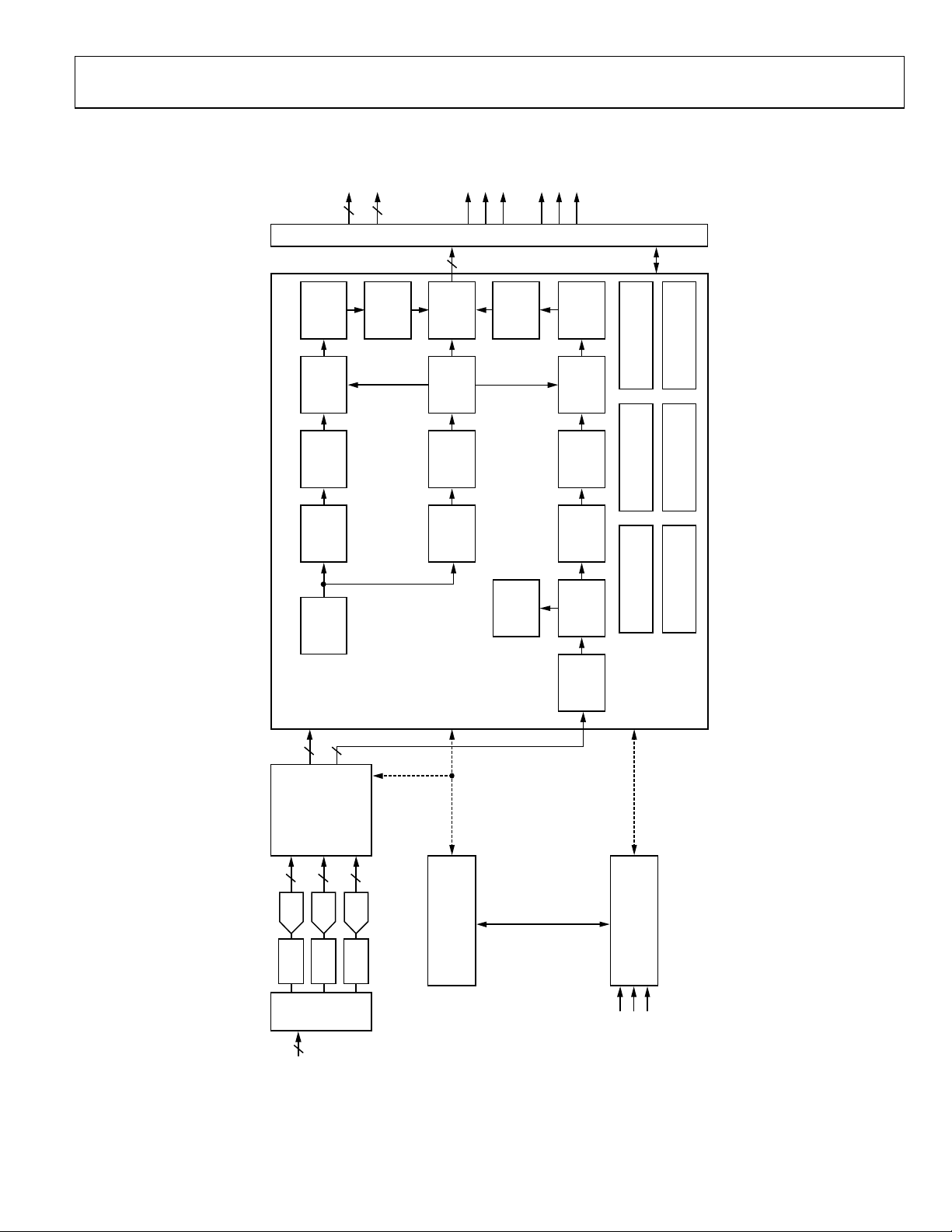
FUNCTIONAL BLOCK DIAGRAM
04821-001
HS
VS
FIELD
LLC1
LLC2
PIXEL
DATA
8
8
16
SFL
OUTPUT FORMATTER
LUMA
(4H MAX)
2D COMB
LUMA
RESAMPLE
GAIN
CONTROL
LUMA
FILTER
STANDARD DEFINITION PROCESSOR
FINE
LUMA
CLAMP
DIGITAL
10
10
L-DNR
AV
LINE
CODE
INSERTION
CONTROL
RESAMPLE
LENGTH
PREDICTOR
SYNC
EXTRACT
F
CTI
SC
C-DNR
RECOVERY
(4H MAX)
CHROMA
2D COMB
CHROMA
RESAMPLE
GAIN
CONTROL
FILTER
CHROMA
DEMOD
CHROMA
FINE
CLAMP
DIGITAL
CHROMA
FREE RUN
SYNTHESIZED
LLC CONTROL
OUTPUT CONTROL
STANDARD
AUTODETECTION
DETECTION
MACROVISION
VBI DATA RECOVERY GLOBAL CONTROL
DATA
10
12
PREPROCESSOR
A/DCLAMP
AIN1–AIN12
FILTERS
DOWNSAMPLING
DECIMATION AND
10
A/DCLAMP10A/DCLAMP
MUX
INPUT
CVBS
YPrPb
S-VIDEO
SYNC AND
CLK CONTROL
CLOCK GENERATION
SYNC PROCESSING AND
Figure 1.
Rev. B | Page 5 of 104
ADV7183A
CONTROL
AND DATA
SERIAL INTERFACE
CONTROL AND VBI DATA
SDA
SCLK
ALSB
Page 6

ADV7183A
SPECIFICATIONS
Temperature range: T
ELECTRICAL CHARACTERISTICS
A
= 3.15 V to 3.45 V, D
VDD
otherwise noted.
Table 1.
Parameter Symbol Test Conditions Min Typ Max Unit
STATIC PERFORMANCE
Resolution (Each ADC) N 10 Bits
Integral Nonlinearity INL BSL at 54 MHz –0.475/+0.6 ±3 LSB
Differential Nonlinearity DNL BSL at 54 MHz –0.25/+0.5 –0.7/+2 LSB
DIGITAL INPUTS
Input High Voltage VIH 2 V
Input Low Voltage VIL 0.8 V
Input Current IIN Pins listed in Note 1 –50 +50 µA
All other pins –10 +10 µA
Input Capacitance CIN 10 pF
DIGITAL OUTPUTS
Output High Voltage VOH I
Output Low Voltage VOL I
High Impedance Leakage Current I
All other pins 10 µA
Output Capacitance C
POWER REQUIREMENTS3
Digital Core Power Supply D
Digital I/O Power Supply D
PLL Power Supply P
Analog Power Supply A
Digital Core Supply Current I
Digital I/O Supply Current I
PLL Supply Current I
Analog Supply Current I
YPrPb input5 180 mA
Power-Down Current I
Power-Up Time t
1
Pins 36 and 79.
2
Pins 1, 2, 5, 6, 7, 8, 12, 17, 18, 19, 20, 21, 22, 23, 24, 32, 33, 34, 35, 73, 74, 75, 76, and 80.
3
Guaranteed by characterization.
4
ADC1 powered on.
5
All three ADCs powered on.
to T
MIN
MAX
= 1.65 V to 2.0 V, D
VDD
, –40°C to +85°C. The min/max specifications are guaranteed over this range.
= 3.0 V to 3.6 V, P
VDDIO
SOURCE
= 3.2 mA 0.4 V
SINK
Pins listed in Note 2 50 µA
LEAK
20 pF
OUT
1.65 1.8 2 V
VDD
3.0 3.3 3.6 V
VDDIO
1.65 1.8 2.0 V
VDD
3.15 3.3 3.45 V
VDD
82 mA
DVDD
2 mA
DVDDIO
10.5 mA
PVDD
CVBS input4 85 mA
AVDD
1.5 mA
PWRDN
20 ms
PWRUP
= 1.65 V to 2.0 V; operating temperature range, unless
VDD
= 0.4 mA 2.4 V
Rev. B | Page 6 of 104
Page 7

ADV7183A
VIDEO SPECIFICATIONS
Guaranteed by characterization. A
temperature range, unless otherwise noted.
Table 2.
Parameter Symbol Test Conditions Min Typ Max Unit
NONLINEAR SPECIFICATIONS
Differential Phase DP CVBS I/P, modulate 5-step 0.5 0.7 °
Differential Gain DG CVBS I/P, modulate 5-step 0.5 0.7 %
Luma Nonlinearity LNL CVBS I/P, 5-step 0.5 0.7 %
NOISE SPECIFICATIONS
SNR Unweighted Luma ramp 54 56 dB
Luma flat field 58 60 dB
Analog Front End Crosstalk 60 dB
LOCK TIME SPECIFICATIONS
Horizontal Lock Range –5 +5 %
Vertical Lock Range 40 70 Hz
FSC Subcarrier Lock Range ±1.3 Hz
Color Lock In Time 60 Lines
Sync Depth Range 20 200 %
Color Burst Range 5 200 %
Vertical Lock Time 2 Fields
Autodetection Switch Speed 100 Lines
CHROMA SPECIFICATIONS
Hue Accuracy HUE 1 °
Color Saturation Accuracy CL_AC 1 %
Color AGC Range 5 400 %
Chroma Amplitude Error 0.5 %
Chroma Phase Error 0.4 °
Chroma Luma Intermodulation 0.2 %
LUMA SPECIFICATIONS
Luma Brightness Accuracy CVBS, 1 V I/P 1 %
Luma Contrast Accuracy CVBS, 1 V I/P 1 %
= 3.15 V to 3.45 V, D
VDD
= 1.65 V to 2.0 V, D
VDD
= 3.0 V to 3.6 V, P
VDDIO
= 1.65 V to 2.0 V; operating
VDD
Rev. B | Page 7 of 104
Page 8

ADV7183A
TIMING SPECIFICATIONS
Guaranteed by characterization. A
temperature range, unless otherwise noted.
Table 3.
Parameter Symbol Test Conditions Min Typ Max Unit
SYSTEM CLOCK AND CRYSTAL
Nominal Frequency 27.00 MHz
Frequency Stability ±50 ppm
I2C PORT
SCLK Frequency 400 kHz
SCLK Min Pulse Width High t1 0.6 µs
SCLK Min Pulse Width Low t2 1.3 µs
Hold Time (Start Condition) t3 0.6 µs
Setup Time (Start Condition) t4 0.6 µs
SDA Setup Time t5 100 ns
SCLK and SDA Rise Time t6 300 ns
SCLK and SDA Fall Time t7 300 ns
Setup Time for Stop Condition t8 0.6 µs
RESET FEATURE
Reset Pulse Width 5 ms
CLOCK OUTPUTS
LLC1 Mark Space Ratio t9:t10 45:55 55:45 % Duty Cycle
LLC1 Rising to LLC2 Rising t11 0.5 ns
LLC1 Rising to LLC2 Falling t12 0.5 ns
DATA AND CONTROL OUTPUTS
Data Output Transitional Time t13
Data Output Transitional Time t14
Propagation Delay to Hi-Z t15 6 ns
Max Output Enable Access Time t16 7 ns
Min Output Enable Access Time t17 4 ns
ANALOG SPECIFICATIONS
Guaranteed by characterization. A
temperature range, unless otherwise noted. Recommended analog input video signal range: 0.5 V – 1.6 V, typically 1 V p-p.
Table 4.
Parameter Symbol Test Conditions Min Typ Max Unit
CLAMP CIRCUITRY
External Clamp Capacitor 0.1 µF
Input Impedance Clamps switched off 10 MΩ
Large Clamp Source Current 0.75 mA
Large Clamp Sink Current 0.75 mA
Fine Clamp Source Current 60 µA
Fine Clamp Sink Current 60 µA
THERMAL SPECIFICATIONS
Table 5.
Parameter Symbol Test Conditions Min Typ Max Unit
THERMAL CHARACTERISTICS
Junction-to-Case Thermal Resistance θJC 4-layer PCB with solid ground plane 7.6 °C/W
Junction-to-Ambient Thermal Resistance (Still Air) θJA 4-layer PCB with solid ground plane 38.1 °C/W
= 3.15 V to 3.45 V, D
VDD
= 3.15 V to 3.45 V, D
VDD
= 1.65 V to 2.0 V, D
VDD
= 3.0 V to 3.6 V, P
VDDIO
Negative clock edge to start of
= t
valid data (t
ACCESS
10
– t13)
End of valid data to negative
clock edge (t
= 1.65 V to 2.0 V, D
VDD
= t9 + t14)
HOLD
= 3.0 V to 3.6 V, P
VDDIO
= 1.65 V to 2.0 V; operating
VDD
6 ns
0.6 ns
= 1.65 V to 2.0 V; operating
VDD
Rev. B | Page 8 of 104
Page 9
ADV7183A
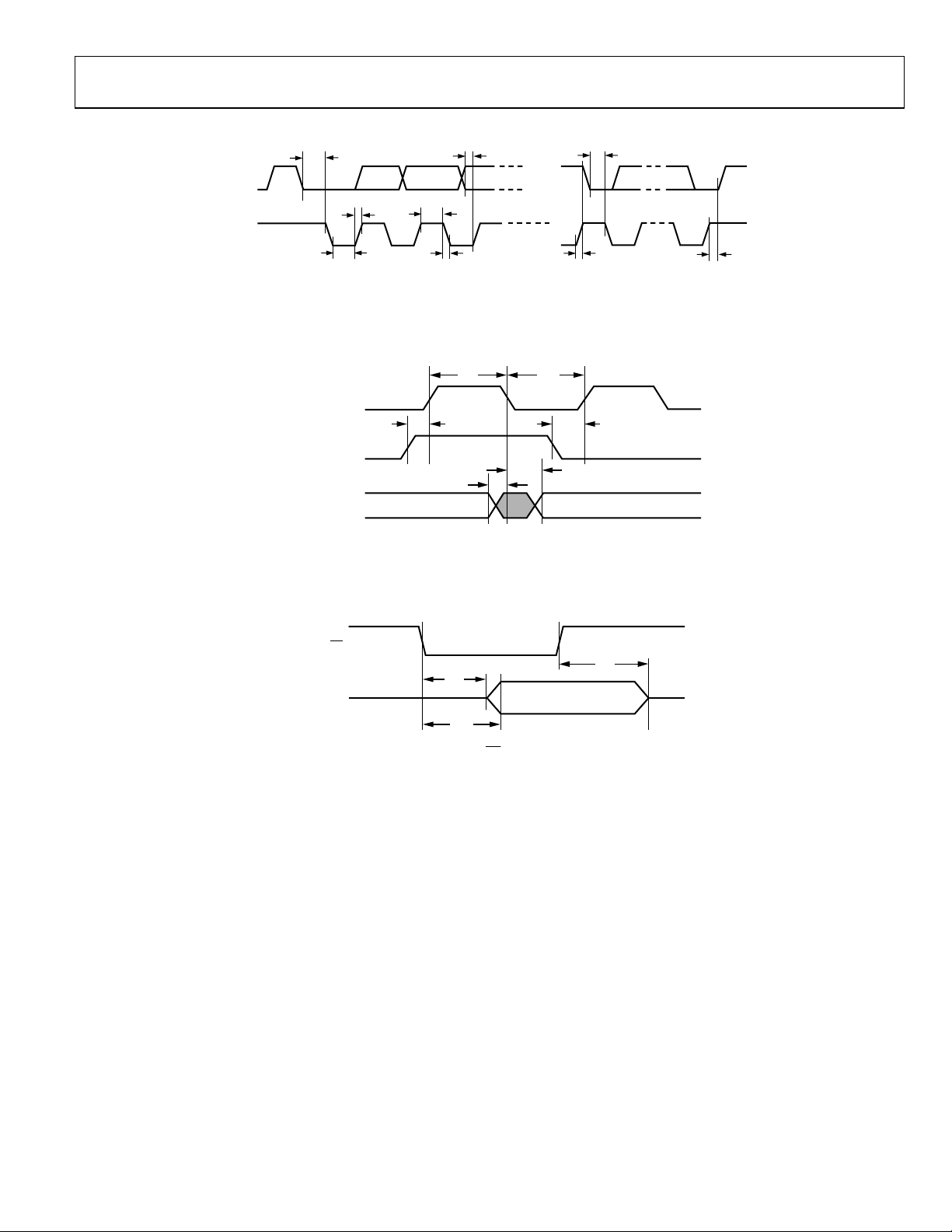
TIMING DIAGRAMS
t
t
t
7
5
1
Figure 2. I
2
C Timing
SDA
SCLK
t
3
t
6
t
2
t
3
t
4
t
8
04821-002
OUTPUT LLC1
OUTPUT LLC2
OUTPUTS P0–P15, VS,
HS, FIELD, SFL
t
9
t
11
t
14
t
10
t
12
t
13
04821-003
Figure 3. Pixel Port and Control Output Timing
OE
t
15
04821-004
P0–P15, HS,
VS, FIELD, SFL
t
17
t
16
Figure 4.
OE
Timing
Rev. B | Page 9 of 104
Page 10
ADV7183A
ABSOLUTE MAXIMUM RATINGS
Table 6.
Parameter Rating
A
to GND 4 V
VDD
A
to AGND 4 V
VDD
D
to DGND 2.2 V
VDD
P
to AGND 2.2 V
VDD
D
to DGND 4 V
VDDIO
D
to AVDD –0.3 V to +0.3 V
VDDIO
P
to D
VDD
D
VDDIO
D
VDDIO
A
VDD
A
VDD
Digital Inputs Voltage to DGND –0.3 V to D
Digital Output Voltage to DGND –0.3 V to D
Analog Inputs to AGND AGND – 0.3 V to A
Maximum Junction Temperature
(T
Storage Temperature Range –65°C to +150°C
Infrared Reflow Soldering (20 sec) 260°C
–0.3 V to +0.3 V
VDD
– P
–0.3V to +2 V
VDD
– D
–0.3 V to +2 V
VDD
– P
–0.3 V to +2 V
VDD
– D
–0.3 V to +2 V
VDD
max)
J
150°C
VDDIO
VDDIO
+ 0.3 V
+ 0.3 V
+ 0.3 V
VDD
Stresses above those listed under Absolute Maximum Ratings
may cause permanent damage to the device. This is a stress
rating only; functional operation of the device at these or any
other conditions above those indicated in the operational
sections of this specification is not implied. Exposure to absolute
maximum rating conditions for extended periods may affect
device reliability.
ESD CAUTION
ESD (electrostatic discharge) sensitive device. Electrostatic charges as high as 4000 V readily accumulate on the
human body and test equipment and can discharge without detection. Although this product features
proprietary ESD protection circuitry, permanent damage may occur on devices subjected to high energy
electrostatic discharges. Therefore, proper ESD precautions are recommended to avoid performance
degradation or loss of functionality.
Rev. B | Page 10 of 104
Page 11
ADV7183A
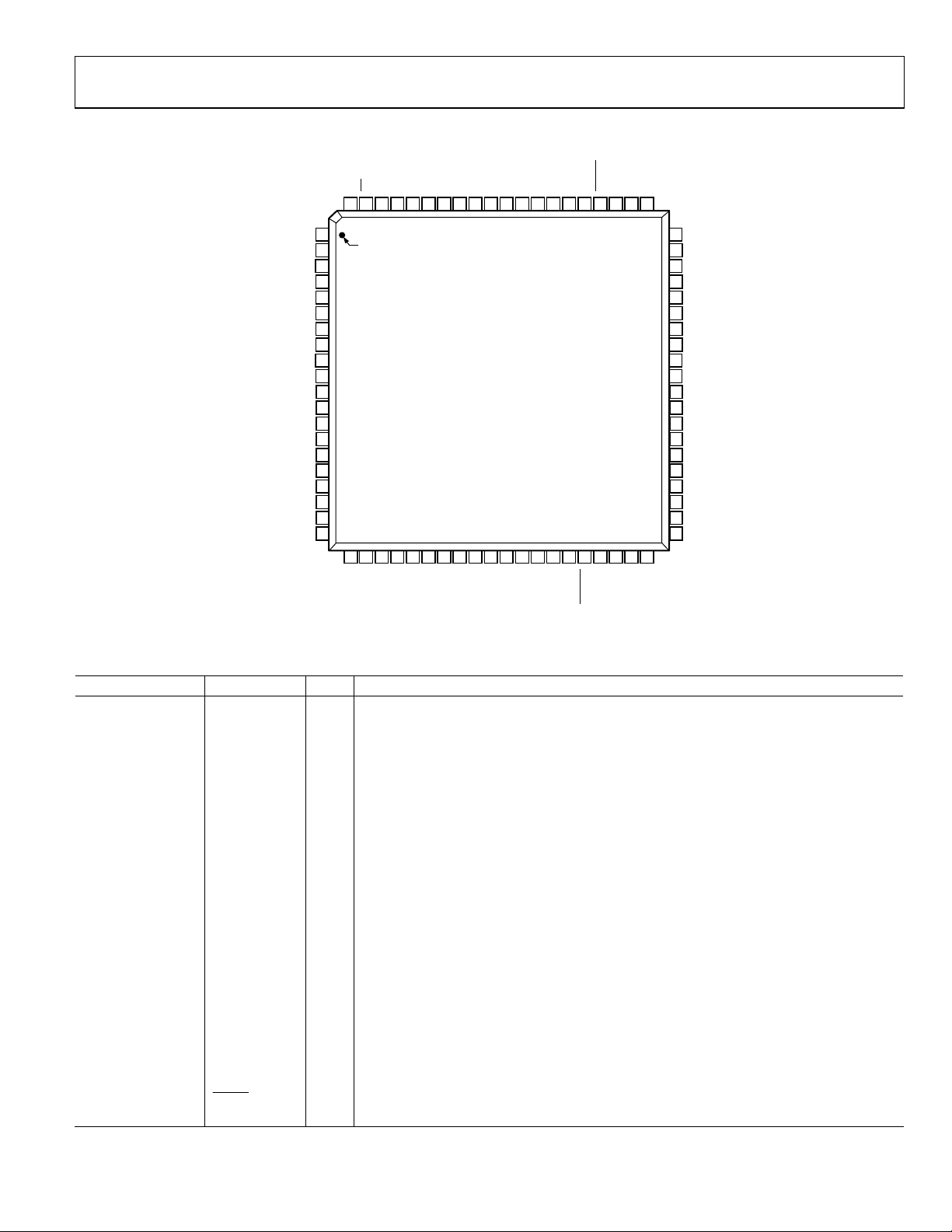
PIN CONFIGURATION AND FUNCTION DESCRIPTIONS
FIELD79OE78NC77NC76P1275P1374P1473P1572DVDD71DGND70NC69NC68SCLK67SDA66ALSB65NC64RESET63NC62AIN661AIN12
80
1
VS
HS
DGND
DVDDIO
P11
P10
P9
P8
DGND
DVDD
NC
SFL
NC
DGND
DVDDIO
NC
NC
NC
P7
P6
NC = NO CONNECT
2
3
4
5
6
7
8
9
10
11
12
13
14
15
16
17
18
19
20
21P522P423P324P225NC26
PIN 1
28
LLC227LLC1
ADV7183A
TOP VIEW
(Not to Scale)
29
30
31
XTAL
DVDD
XTAL1
32P133P034NC35NC36
DGND
37
PWRDN
38
ELPF
39
PVDD
AGND40AGND
Figure 5. 80-Lead LQFP Pin Configuration
Table 7. Pin Function Descriptions
Pin No. Mnemonic Type Function
3, 9, 14, 31, 71 DGND G Digital Ground.
39, 40, 47, 53, 56 AGND G Analog Ground.
4, 15 DVDDIO P Digital I/O Supply Voltage (3.3 V).
10, 30, 72 DVDD P Digital Core Supply Voltage (1.8 V).
50 AVDD P Analog Supply Voltage (3.3 V).
38 PVDD P PLL Supply Voltage (1.8 V).
42, 44, 46, 58, 60,
AIN1–AIN12 I Analog Video Input Channels.
62, 41, 43, 45, 57,
59, 61
11, 13, 16–18, 25,
NC No Connect Pins.
34, 35, 63, 65, 69,
70, 77, 78
33, 32, 24, 23, 22,
P0–P15 O Video Pixel Output Port.
21, 20, 19, 8, 7, 6, 5,
76, 75, 74, 73
2 HS O Horizontal Synchronization Output Signal.
1 VS O Vertical Synchronization Output Signal.
80 FIELD O Field Synchronization Output Signal.
67 SDA I/O I2C Port Serial Data Input/Output Pin.
68 SCLK I I2C Port Serial Clock Input (Max Clock Rate of 400 kHz).
66 ALSB I
This pin selects the I
2
C address for the ADV7183A. ALSB set to Logic 0 sets the address for a
write as 0x40; for ALSB set to logic high, the address selected is 0x42.
64
RESET
I
System Reset Input, Active Low. A minimum low reset pulse width of 5 ms is required to
reset the ADV7183A circuitry.
60
59
58
57
56
55
54
53
52
51
50
49
48
47
46
45
44
43
42
41
AIN5
AIN11
AIN4
AIN10
AGND
CAP C2
CAP C1
AGND
CML
REFOUT
AVDD
CAP Y2
CAP Y1
AGND
AIN3
AIN9
AIN2
AIN8
AIN1
AIN7
04821-005
Rev. B | Page 11 of 104
Page 12
ADV7183A
Pin No. Mnemonic Type Function
27 LLC1 O
26 LLC2 O
29 XTAL I
28 XTAL1 O
36
79
37 ELPF I
12 SFL O
51 REFOUT O
52 CML O
48, 49 CAPY1, CAPY2 I
54, 55 CAPC1, CAPC2 I
PWRDN
OE
I
I
This is a line-locked output clock for the pixel data output by the ADV7183A. Nominally
27 MHz, but varies up or down according to video line length.
This is a divide-by-2 version of the LLC1 output clock for the pixel data output by the
ADV7183A. Nominally 13.5 MHz, but varies up or down according to video line length.
This is the input pin for the 27 MHz crystal, or can be overdriven by an external 3.3 V,
27 MHz clock oscillator source. In crystal mode, the crystal must be a fundamental crystal.
This pin should be connected to the 27 MHz crystal or left as a no connect if an external
3.3 V, 27 MHz clock oscillator source is used to clock the ADV7183A. In crystal mode, the
crystal must be a fundamental crystal.
A logic low on this pin places the ADV7183A in a power-down mode. Refer to the I2C
Control Register Map for more options on power-down modes for the ADV7183A.
When set to a logic low, OE enables the pixel output bus, P15–P0 of the ADV7183A. A logic
high on the OE pin places Pins P15–P0, HS, VS, SFL into a high impedance state.
The recommended external loop filter must be connected to this ELPF pin, as shown in
Figure 43.
Subcarrier Frequency Lock. This pin contains a serial output stream that can be used to lock
the subcarrier frequency when this decoder is connected to any Analog Devices, Inc. digital
video encoder.
Internal Voltage Reference Output. Refer to Figure 43 for a recommended capacitor
network for this pin.
Common-Mode Level for the Internal ADCs. Refer to Figure 43 for a recommended
capacitor network for this pin.
ADC’s Capacitor Network. Refer to Figure 43 for a recommended capacitor network for
this pin.
ADC’s Capacitor Network. Refer to Figure 43 for a recommended capacitor network for
this pin.
Rev. B | Page 12 of 104
Page 13

ADV7183A
ANALOG FRONT END
ANALOG INPUT MUXING
ADC_SW_MAN_EN INSEL[3:0]
AIN12
AIN6
AIN11
AIN5
AIN10
AIN4
AIN9
AIN3
AIN8
AIN2
AIN7
AIN1
AIN1
AIN7
AIN2
AIN8
AIN3
AIN9
AIN4
AIN10
AIN5
AIN11
AIN6
AIN12
AIN3
AIN9
AIN4
AIN10
AIN5
AIN11
AIN6
AIN12
1
0
1
0
ADC0_SW[3:0]
ADC0
ADC1_SW[3:0]
ADC1
INTERNAL
MAPPING
FUNCTIONS
Figure 6. Internal Pin Connections
The ADV7183A has an integrated analog muxing section that
allows more than one source of video signal to be connected to
the decoder. Figure 6 outlines the overall structure of the input
muxing provided in the ADV7183A.
As can be seen in Figure 6, there are two ways in which the
analog input muxes can be controlled:
• Control via functional registers (INSEL).
Using INSEL[3:0] simplifies the setup of the muxes, and
minimizes crosstalk between channels by pre-assigning the
input channels. This is referred to as ADI recommended
input muxing.
2
• Control via an I
C manual override
(ADC_sw_man_en, ADC0_sw, ADC1_sw, ADC2_sw).
This is provided for applications with special requirements
(for example, number/combinations of signals) that would
not be served by the pre-assigned input connections. This
is referred to as manual input muxing.
AIN2
AIN8
AIN5
AIN11
AIN6
AIN12
ADC1_SW[3:0]
1
0
ADC2
04821-007
ADI Recommended Input Muxing
A maximum of 12 CVBS inputs can be connected and decoded
by the ADV7183A. As can be seen in Figure 5, the sources have
to be connected to adjacent pins on the IC. This calls for a careful design of the PCB layout, for example, ground shielding
between all signals routed through tracks that are physically
close together.
INSEL[3:0] Input Selection, Address 0x00 [3:0]
The INSEL bits allow the user to select an input channel as well
as the input format. Depending on the PCB connections, only a
subset of the INSEL modes are valid. The INSEL[3:0] does not
only switch the analog input muxing, it also configures the
standard definition processor core to process CVBS (Comp),
S-Video (Y/C), or component (YPbPr) format.
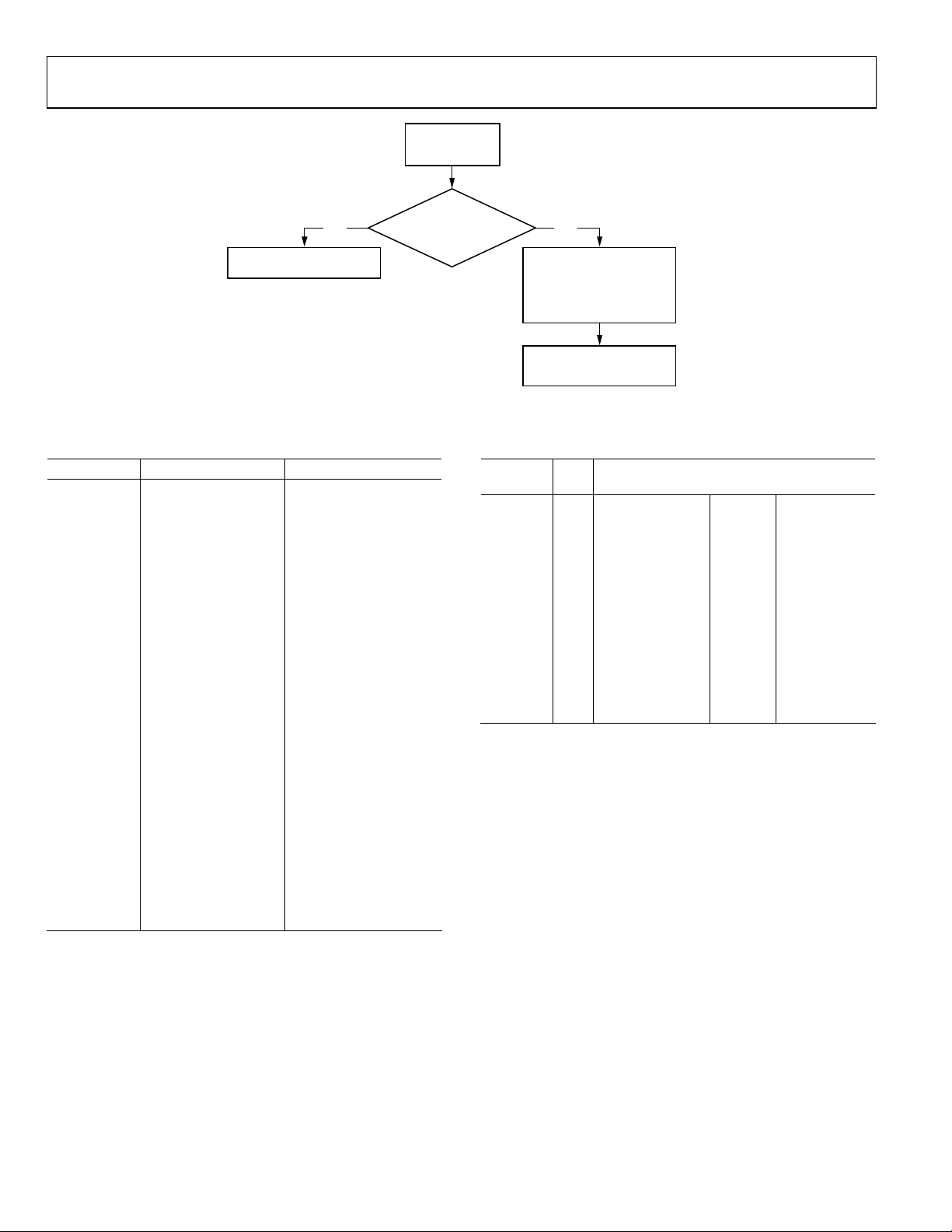
Refer to Figure 7 for an overview of the two methods of
controlling the ADV7183A’s input muxing.
Rev. B | Page 13 of 104
Page 14
ADV7183A
CONNECTING
ANALOG SIGNALS
TO ADV7183A
YES NO
SET INSEL[3:0] FOR REQUIRED
MUXING CONFIGURATION
Table 8. Input Channel Switching Using INSEL[3:0]
INSEL[3:0] Analog Input Pins Video Format
0000
CVBS1 = AIN1 Composite
(default)
0001 CVBS2 = AIN2 Composite
0010 CVBS3 = AIN3 Composite
0011 CVBS4 = AIN4 Composite
0100 CVBS5 = AIN5 Composite
0101 CVBS6 = AIN6 Composite
0110 Y1 = AIN1 YC
C1 = AIN4 YC
0111 Y2 = AIN2 YC
C2 = AIN5 YC
1000 Y3 = AIN3 YC
C3 = AIN6 YC
1001 Y1 = AIN1 YPrPb
PR1 = AIN4 YPrPb
PB1 = AIN5 YPrPb
1010 Y2 = AIN2 YPrPb
PR2 = AIN3 YPrPb
PB2 = AIN6 YPrPb
1011 CVBS7 = AIN7 Composite
1100 CVBS8 = AIN8 Composite
1101 CVBS9 = AIN9 Composite
1110 CVBS10 = AIN10 Composite
1111 CVBS11 = AIN11 Composite
ADI RECOMMENDED
INPUT MUXING; SEE TABLE 9
(ADC_SW_MAN_EN, ADC0_SW,
Figure 7. Input Muxing Overview
Table 9. Input Channel Assignments
Input
Channel
AIN7 41 CVBS7
AIN1 42 CVBS1 YC1-Y YPrPb1-Y
AIN8 43 CVBS8
AIN2 44 CVBS2 YC2-Y YPrPb2-Y
AIN9 45 CVBS9
AIN3 46 CVBS3 YC3-Y YPrPb2-Pr
AIN10 57 CVBS10
AIN4 58 CVBS4 YC1-C YPrPb1-Pr
AIN11 59 CVBS11
AIN5 60 CVBS5 YC2-C YPrPb1-Pb
AIN12 61 Not Available
AIN6 62 CVBS6 YC3-C YPrPb2-Pb
ADI recommended input muxing is designed to minimize
crosstalk between signal channels and to obtain the highest
level of signal integrity. Table 9 summarizes how PCB layout
should connect analog video signals to the ADV7183A.
Notes
• It is strongly recommended to connect any unused analog
input pins to AGND to act as a shield.
• Inputs AIN7 to AIN11 should be connected to AGND in
cases where only six input channels are used. This improves
the quality of the sampling due to better isolation between
the channels.
SET INSEL[3:0] TO
CONFIGURE ADV7183A TO
DECODE VIDEO FORMAT:
CVBS: 0000
YC: 0110
YPrPb: 1001
USE MANUAL INPUT MUXING
ADC1_SW, ADC2_SW)
Pin
ADI Recommended Input Muxing Control
No.
04821-008
INSEL[3:0]
• AIN12 is not under the control of INSEL[3:0]. It can only
Rev. B | Page 14 of 104
be routed to ADC0/ADC1/ADC2 by manual muxing. See
Table 10 for further details.
Page 15

ADV7183A
Manual Input Muxing
By accessing a set of manual override muxing registers, the
analog input muxes of the ADV7183A can be controlled
directly. This is referred to as manual input muxing.
Notes
• Manual input muxing overrides other input muxing
control bits, for example, INSEL.
• The manual muxing is activated by setting the
ADC_SW_MAN_EN bit. It affects only the analog
switches in front of the ADCs.
This means if the settings of INSEL and the manual input
muxing registers (ADC0/ADC1/ADC2_sw) contradict
each other, the ADC0/ADC1/ADC2_sw settings apply and
INSEL is ignored.
• Manual input muxing only controls the analog input
muxes. INSEL[3:0] still has to be set so the follow-on
blocks process the video data in the correct format.
This means INSEL must still be used to tell the ADV7183A
whether the input signal is of component, YC, or CVBS
format.
Restrictions in the channel routing are imposed by the analog
signal routing inside the IC; every input pin cannot be routed to
each ADC. Refer to Figure 6 for an overview on the routing
capabilities inside the chip. The three mux sections can be
controlled by the reserved control signal buses ADC0/ADC1/
ADC2_sw[3:0]. Table 10 explains the control words used.
SETADC_sw_man_en, Manual Input Muxing Enable,
Address 0xC4 [7]
ADC0_sw[3:0], ADC0 mux configuration, Address 0xC3 [3:0]
ADC1_sw[3:0], ADC1 mux configuration, Address 0xC3 [7:4]
ADC2_sw[3:0], ADC2 mux configuration, Address 0xC4 [3:0]
Table 10. Manual Mux Settings for All ADCs
SETADC_sw_man_en = 1
ADC0_sw[3:0] ADC0 Connected To: ADC1_sw[3:0] ADC1 Connected To: ADC2_sw[3:0] ADC2 Connected To:
0000 No Connection 0000 No Connection 0000 No Connection
0001 AIN1 0001 No Connection 0001 No Connection
0010 AIN2 0010 No Connection 0010 AIN2
0011 AIN3 0011 AIN3 0011 No Connection
0100 AIN4 0100 AIN4 0100 No Connection
0101 AIN5 0101 AIN5 0101 AIN5
0110 AIN6 0110 AIN6 0110 AIN6
0111 No Connection 0111 No Connection 0111 No Connection
1000 No Connection 1000 No Connection 1000 No Connection
1001 AIN7 1001 No Connection 1001 No Connection
1010 AIN8 1010 No Connection 1010 AIN8
1011 AIN9 1011 AIN9 1011 No Connection
1100 AIN10 1100 AIN10 1100 No Connection
1101 AIN11 1101 AIN11 1101 AIN11
1110 AIN12 1110 AIN12 1110 AIN12
1111 No Connection 1111 No Connection 1111 No Connection
Rev. B | Page 15 of 104
Page 16

ADV7183A
GLOBAL CONTROL REGISTERS
Register control bits listed in this section affect the whole chip.
POWER-SAVE MODES
Power-Down
PDBP, Address 0x0F [2]
There are two ways to shut down the digital core of the
ADV7183A: a pin (
PWRDN
The PDBP controls which of the two has the higher priority.
The default is to give the pin (
user to have the ADV7183A powered down by default.
Table 11. PDBP Function
PDBP Description
0 (default)
1 Bit has priority (pin is disregarded).
Digital core power controlled by the PWRDN
(bit is disregarded).
PWRDN, Address 0x0F [5]
Setting the PWRDN bit switches the ADV7183A into a chipwide power-down mode. The power-down stops the clock from
entering the digital section of the chip, thereby freezing its
operation. No I
2
C bits are lost during power-down. The
PWRDN bit also affects the analog blocks and switches them
into low current modes. The I
and remains operational in power-down mode.
The ADV7183A leaves the power-down state if the PWRDN
2
bit is set to 0 (via I
pin.
RESET
C), or if the overall part is reset using the
PDBP must be set to 1 for the PWRDN bit to power down the
ADV7183A.
Table 12. PWRDN Function
PWRDN Description
0 (default) Chip operational.
1 ADV7183A in chip-wide power-down.
ADC Power-Down Control
The ADV7183A contains three 10-bit ADCs (ADC0, ADC1,
and ADC2). If required, it is possible to power down each ADC
individually.
When should the ADCs be powered down?
• CVBS mode. ADC1 and ADC2 should be powered down
to save on power consumption.
• S-Video mode. ADC2 should be powered down to save on
power consumption.
) and a bit (PWRDN see below).
PWRDN
2
C interface itself is unaffected,
) priority. This allows the
pin
PWRDN_ADC_0, Address 0x3A [3]
Table 13. PWRDN_ADC_0 Function
PWRDN_ADC_0 Description
0 (default) ADC normal operation.
1 Power down ADC 0.
PWRDN_ADC_1, Address 0x3A [2]
Table 14. PWRDN_ADC_1 Function
PWRDN_ADC_1 Description
0 (default) ADC normal operation.
1 Power down ADC 1.
PWRDN_ADC_2, Address 0x3A [1]
Table 15. PWRDN_ADC_2 Function
PWRDN_ADC_2 Description
0 (default) ADC normal operation.
1 Power down ADC 2.
RESET CONTROL
Chip Reset (RES), Address 0x0F [7]
Setting this bit, equivalent to controlling the
2
ADV7183A, issues a full chip reset. All I
C registers get reset to
their default values. (Some register bits do not have a reset value
specified. They keep their last written value. Those bits are
marked as having a reset value of x in the register table.) After
the reset sequence, the part immediately starts to acquire the
incoming video signal.
Notes
• After setting the RES bit (or initiating a reset via the pin),
the part returns to the default mode of operation with
respect to its primary mode of operation. All I
loaded with their default values, making this bit selfclearing.
• Executing a software reset takes approximately 2 ms.
However, it is recommended to wait 5 ms before any
2
further I
• The I
C writes are performed.
2
C master controller receives a no acknowledge
condition on the ninth clock cycle when chip reset is
implemented. See the MPU Port Description section.
Table 16. RES Function
RES Description
0 (default) Normal operation.
1 Start reset sequence.
RESET
pin on the
2
C bits are
Rev. B | Page 16 of 104
Page 17

ADV7183A
GLOBAL PIN CONTROL
Three-State Output Drivers
TOD, Address 0x03 [6]
This bit allows the user to three-state the output drivers of the
ADV7183A.
Upon setting the TOD bit, the P15–P0, HS, VS, FIELD, and SFL
pins are three-stated.
The timing pins (HS/VS/FIELD) can be forced active via the
TIM_OE bit. For more information on three-state control, refer
to the following sections:
• Three-State LLC Driver
• Timing Signals Output Enable
The ADV7183A supports three-stating via a dedicated pin.
When set high, the
P15–P0, HS, VS, FIELD, and SFL. The output drivers are threestated if the TOD bit or the
Table 17. TOD Function
TOD Description
0 (default) Output drivers enabled.
1 Output drivers three-stated.
Three-State LLC Driver
TRI_LLC, Address 0x0E [6]
This bit allows the output drivers for the LLC1 and LLC2 pins
of the ADV7183A to be three-stated. For more information on
three-state control, refer to the following sections:
• Three-State Output Drivers
• Timing Signals Output Enable
Table 18. TRI_LLC Function
TRI_LLC Description
0 (default)
1 LLC pin drivers three-stated.
pin three-states the output drivers for
OE
pin is set high.
OE
LLC pin drivers working according to the
DR_STR_C[1:0] setting (pin enabled).
Timing Signals Output Enable
TIM_OE, Address 0x04 [3]
The TIM_OE bit should be regarded as an addition to the TOD
bit. Setting it high forces the output drivers for HS, VS, and
FIELD into the active (that is, driving) state even if the TOD bit
is set. If set to low, the HS, VS, and FIELD pins are three-stated
dependent on the TOD bit. This functionality is useful if the
decoder is used as a timing generator only. This may be the case
if only the timing signals are extracted from an incoming signal,
or if the part is in free-run mode where a separate chip can
output, for instance, a company logo.
For more information on three-state control, refer to the
following sections:
• Timing Signals Output Enable
• Three-State LLC Driver
Table 19. TIM_OE Function
TIM_OE Description
0 (default)
1
HS, VS, FIELD three-stated according to the
TOD bit.
HS, VS, FIELD are forced active all the time.
The DR_STR_S[1:0] setting determines drive
strength.
Drive Strength Selection (Data)
DR_STR[1:0] Address 0x04 [5:4]
For EMC and crosstalk reasons, it may be desirable to
strengthen or weaken the drive strength of the output drivers.
The DR_STR[1:0] bits affect the P[15:0] output drivers.
For more information on three-state control, refer to the
following sections:
• Drive Strength Selection (Clock)
• Drive Strength Selection (Sync)
Table 20. DR_STR Function
DR_STR[1:0] Description
00 Low drive strength (1×).
01 (default) Medium low drive strength (2×).
10 Medium high drive strength (3×).
11 High drive strength (4×).
Rev. B | Page 17 of 104
Page 18

ADV7183A
Drive Strength Selection (Clock)
Enable Subcarrier Frequency Lock Pin
DR_STR_C[1:0] Address 0x0E [3:2]
The DR_STR_C[1:0] bits can be used to select the strength of
the clock signal output driver (LLC pin). For more information,
refer to the following sections:
• Drive Strength Selection (Sync)
• Drive Strength Selection (Data)
Table 21. DR_STR Function
DR_STR[1:0] Description
00 Low drive strength (1×).
01 (default) Medium low drive strength (2×).
10 Medium high drive strength (3×).
11 High drive strength (4×).
Drive Strength Selection (Sync)
DR_STR_S[1:0] Address 0x0E [1:0]
The DR_STR_S[1:0] bits allow the user to select the strength of
the synchronization signals with which HS, VS, and F are
driven. For more information, refer to the following sections:
• Drive Strength Selection (Clock)
• Drive Strength Selection (Data)
Table 22. DR_STR Function
DR_STR[1:0] Description
00 Low drive strength (1×).
01 (default) Medium low drive strength (2×).
10 Medium high drive strength (3×).
11 High drive strength (4×).
EN_SFL_PIN Address 0x04 [1]
The EN_SFL_PIN bit enables the output of subcarrier lock
information (also known as GenLock) from the ADV7183A to
an encoder in a decoder/encoder back-to-back arrangement.
Table 23. EN_SFL_PIN
EN_SFL_PIN Description
0 (default) Subcarrier frequency lock output is disabled.
1
Subcarrier frequency lock information is
presented on the SFL pin.
Polarity LLC Pin
PCLK Address 0x37 [0]
The polarity of the clock leaving the ADV7183A via the LLC1
and LLC2 pins can be inverted using the PCLK bit.
Changing the polarity of the LLC clock output may be
necessary to meet the setup-and-hold time expectations of
follow-on chips.
This bit also inverts the polarity of the LLC2 clock.
Table 24. PCLK Function
PCLK Description
0 Invert LLC output polarity.
1 (default)
LLC output polarity normal (as per the Timing
Diagrams)
Rev. B | Page 18 of 104
Page 19

ADV7183A
GLOBAL STATUS REGISTERS
There are four registers that provide summary information
about the video decoder. The IDENT register allows the user to
identify the revision code of the ADV7183A. The other three
registers contain status bits from the ADV7183A.
IDENTIFICATION
Depending on the setting of the FSCLE bit, the Status[0] and
Status[1] are based solely on horizontal timing info or on the
horizontal timing and lock status of the color subcarrier. See the
FSCLE FSC Lock Enable, Address 0x51 [7] section.
Autodetection Result
IDENT[7:0] Address 0x11 [7:0]
Provides identification of the revision of the ADV7183A.
Review the list of IDENT code readback values for the various
versions shown in Table 25.
Table 25. IDENT Function
IDENT[7:0] Description
0x0D ADV7183A-ES1
0x0E ADV7183A-ES2
0x0F or 0x10 ADV7183A-FT
0x11 ADV7183A (Version 2)
STATUS 1
STATUS_1[7:0] Address 0x10 [7:0]
This read-only register provides information about the internal
status of the ADV7183A.
See CIL[2:0] Count Into Lock, Address 0x51 [2:0] and COL[2:0]
Count Out of Lock, Address 0x51 [5:3] for information on the
timing.
Table 27. STATUS 1 Function
STATUS 1 [7:0] Bit Name Description
0 IN_LOCK In lock (right now).
1 LOST_LOCK Lost lock (since last read of this register).
2 FSC_LOCK FSC locked (right now).
3 FOLLOW_PW AGC follows peak white algorithm.
4 AD_RESULT.0 Result of autodetection.
5 AD_RESULT.1 Result of autodetection.
6 AD_RESULT.2 Result of autodetection.
7 COL_KILL Color kill active.
AD_RESULT[2:0] Address 0x10 [6:4]
The AD_RESULT[2:0] bits report back on the findings from
the autodetection block. Consult the General Setup section for
more information on enabling the autodetection block, and the
Autodetection of SD Modes section to find out how to
configure it.
Table 26. AD_RESULT Function
AD_RESULT[2:0] Description
000 NTSM-MJ
001 NTSC-443
010 PAL-M
011 PAL-60
100 PAL-BGHID
101 SECAM
110 PAL-Combination N
111 SECAM 525
Rev. B | Page 19 of 104
Page 20

ADV7183A
STATUS 2
STATUS_2[7:0], Address 0x12 [7:0]
Table 28. STATUS 2 Function
STATUS 2 [7:0] Bit Name Description
0 MVCS DET Detected Macrovision color striping.
1 MVCS T3 Macrovision color striping protection. Conforms to Type 3 (if high), and Type 2 (if low).
2 MV_PS DET Detected Macrovision pseudo Sync pulses.
3 MV_AGC DET Detected Macrovision AGC pulses.
4 LL_NSTD Line length is nonstandard.
5 FSC_NSTD FSC frequency is nonstandard.
6 Reserved
7 Reserved
STATUS 3
STATUS_3[7:0], Address 0x13 [7:0]
Table 29. STATUS 3 Function
STATUS 3 [7:0] Bit Name Description
0 INST_HLOCK Horizontal lock indicator (instantaneous).
1 Reserved for future use.
2 Reserved for future use.
3 Reserved for future use.
4 FREE_RUN_ACT
5 STD_FLD_LEN Field length is correct for currently selected video standard.
6 INTERLACED Interlaced video detected (field sequence found).
7 PAL_SW_LOCK Reliable sequence of swinging bursts detected.
ADV7183A outputs a blue screen (see the DEF_VAL_AUTO_EN Default Value Automatic
Enable, Address 0x0C [1] section).
Rev. B | Page 20 of 104
Page 21
ADV7183A
STANDARD DEFINITION PROCESSOR (SDP)
STANDARD DEFINITION PROCESSOR
DIGITIZED CVBS
DIGITIZED Y (YC)
DIGITIZED CVBS
DIGITIZED C (YC)
MACROVISION
DETECTION
LUMA
DIGITAL
FINE
CLAMP
CHROMA
DIGITAL
FINE
CLAMP
RECOVERY
CHROMA
DEMOD
F
SC
RECOVERY
VBI DATA
LUMA
FILTER
EXTRACT
CHROMA
FILTER
AUTODETECTION
SYNC
STANDARD
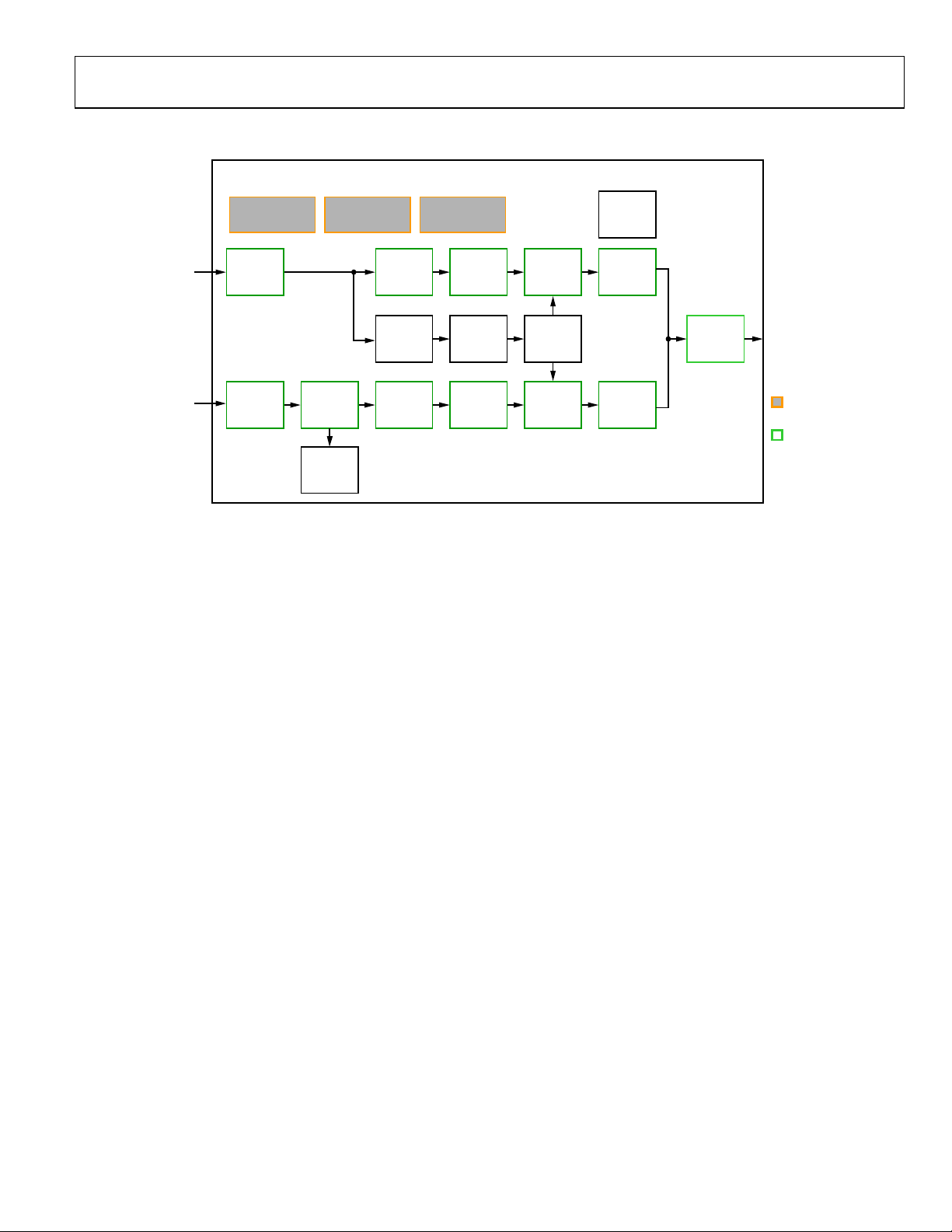
Figure 8. Block Diagram of the Standard Definition Processor
A block diagram of the ADV7183A’s standard definition
processor (SDP) is shown in Figure 8.
The SDP block can handle standard definition video in CVBS,
YC, and YPrPb formats. It can be divided into a luminance and
chrominance path. If the input video is of a composite type
(CVBS), both processing paths are fed with the CVBS input.
SD LUMA PATH
The input signal is processed by the following blocks:
• Digital Fine Clamp. This block uses a high precision
algorithm to clamp the video signal.
• Luma Filter Block. This block contains a luma decimation
filter (YAA) with a fixed response, and some shaping filters
(YSH) that have selectable responses.
• Luma Gain Control. The automatic gain control (AGC)
can operate on a variety of different modes, including gain
based on the depth of the horizontal sync pulse, peak white
mode, and fixed manual gain.
• Luma Resample. To correct for line-length errors as well as
dynamic line-length changes, the data is digitally
resampled.
• Luma 2D Comb. The two-dimensional comb filter
provides YC separation.
• AV Code Insertion. At this point, the decoded luma (Y)
signal is merged with the retrieved chroma values. AV
codes (as per ITU-R. BT-656) can be inserted.
GAIN
CONTROL
LINE
LENGTH
PREDICTOR
GAIN
CONTROL
SLLC
CONTROL
LUMA
RESAMPLE
RESAMPLE
CONTROL
CHROMA
RESAMPLE
LUMA
2D COMB
CHROMA
2D COMB
AV
CODE
INSERTION
VIDEO DATA
OUTPUT
MEASUREMENT
BLOCK (= >1
VIDEO DATA
PROCESSING
BLOCK
2
C)
04821-009
SD CHROMA PATH
The input signal is processed by the following blocks:
• Digital Fine Clamp. This block uses a high precision
algorithm to clamp the video signal.
• Chroma Demodulation. This block employs a color
subcarrier (F
subcarrier for any modulated chroma scheme. The
demodulation block then performs an AM demodulation
for PAL and NTSC and an FM demodulation for SECAM.
• Chroma Filter Block. This block contains a chroma
decimation filter (CAA) with a fixed response, and some
shaping filters (CSH) that have selectable responses.
• Gain Control. Automatic gain control (AGC) can operate
on several different modes, including gain based on the
color subcarrier’s amplitude, gain based on the depth of the
horizontal sync pulse on the luma channel, or fixed manual
gain.
• Chroma Resample. The chroma data is digitally resampled
to keep it perfectly aligned with the luma data. The
resampling is done to correct for static and dynamic linelength errors of the incoming video signal.
• Chroma 2D Comb. The two-dimensional, 5-line,
superadaptive comb filter provides high quality YC
separation in case the input signal is CVBS.
• AV Code Insertion. At this point, the demodulated chroma
(Cr and Cb) signal is merged with the retrieved luma
values. AV codes (as per ITU-R. BT-656) can be inserted.
) recovery unit to regenerate the color
SC
Rev. B | Page 21 of 104
Page 22

ADV7183A
SYNC PROCESSING
The ADV7183A extracts syncs embedded in the video data
stream. There is currently no support for external HS/VS
inputs. The sync extraction has been optimized to support
imperfect video sources, for example videocassette recorders
with head switches. The actual algorithm uses a coarse
detection based on a threshold crossing followed by a more
detailed detection using an adaptive interpolation algorithm.
The raw sync information is sent to a line-length measurement
and prediction block. The output of this is then used to drive
the digital resampling section to ensure that the ADV7183A
outputs 720 active pixels per line.
The sync processing on the ADV7183A also includes two
specialized postprocessing blocks that filter and condition the
raw sync information retrieved from the digitized analog video.
• VSync Processor. This block provides extra filtering of the
detected VSyncs to give improved vertical lock.
• HSync Processor. The HSync processor is designed to filter
incoming HSyncs that have been corrupted by noise,
providing much improved performance for video signals
with stable time base but poor SNR.
VBI DATA RECOVERY
The ADV7183A can retrieve the following information from
the input video:
• Wide-screen signaling (WSS)
• Copy generation management system (CGMS)
• Closed caption (CC)
• Macrovision protection presence
• EDTV data
• Gemstar-compatible data slicing
The ADV7183A is also capable of automatically detecting the
incoming video standard with respect to color subcarrier frequency, field rate, and line rate. It can configure itself to support
PAL-BGHID, PAL-M/N, PAL-combination N, NTSC-M, NTSCJ, SECAM 50 Hz/60 Hz, NTSC4.43, and PAL60.
GENERAL SETUP
Video Standard Selection
The VID_SEL[3:0] register allows the user to force the digital
core into a specific video standard. Under normal circumstances, this should not be necessary. The VID_SEL[3:0] bits
default to an autodetection mode that supports PAL, NTSC,
SECAM, and variants thereof.
Refer to the Autodetection of SD Modes section for more
information on the autodetection system.
Autodetection of SD Modes
In order to guide the autodetect system, individual enable bits
are provided for each of the supported video standards. Setting
the relevant bit to 0 inhibits the standard from being detected
automatically. Instead, the system picks the closest of the
remaining enabled standards. The autodetection result can be
read back via the status registers. See the Global Status Registers
section for more information.
Table 30. VID_SEL Function
VID_SEL[3:0]
Address 0x00 [7:4] Description
0000 (default)
0001
0010
0011
0100 NTSC J (1)
0101 NTSC M (1).
0110 PAL 60.
0111 NTSC 4.43 (1).
1000 PAL BGHID.
1001 PAL N ( = PAL BGHID (with pedestal)).
1010 PAL M (without pedestal).
1011 PAL M.
1100 PAL combination N.
1101 PAL combination N (with pedestal).
1110 SECAM.
1111 SECAM (with pedestal).
Autodetect (PAL BGHID) <–> NTSC J (no
pedestal), SECAM.
Autodetect (PAL BGHID) <–> NTSC M
(pedestal), SECAM.
Autodetect (PAL N) <–> NTSC J (no
pedestal), SECAM.
Autodetect (PAL N) <–> NTSC M
(pedestal), SECAM.
Rev. B | Page 22 of 104
Page 23

ADV7183A
AD_SEC525_EN Enable Autodetection of SECAM 525 Line
Video, Address 0x07 [7]
Table 31. AD_SEC525_EN Function
AD_SEC525_EN Description
0 (default)
1 Enable the detection.
Disable the autodetection of a 525-line
system with a SECAM style, FM-modulated
color component.
AD_SECAM_EN Enable Autodetection of SECAM,
Address 0x07 [6]
Table 32. AD_SECAM_EN Function
AD_SECAM_EN Description
0 Disable the autodetection of SECAM.
1 (default) Enable the detection.
AD_N443_EN Enable Autodetection of NTSC 443,
Address 0x07 [5]
Table 33. AD_N443_EN Function
AD_N443_EN Description
0
1 (default) Enable the detection.
Disable the autodetection of NTSC style
systems with a 4.43 MHz color subcarrier.
AD_P60_EN Enable Autodetection of PAL60,
Address 0x07 [4]
Table 34. AD_P60_EN Function
AD_P60_EN Description
0
1 (default) Enable the detection.
Disable the autodetection of PAL systems
with a 60 Hz field rate.
AD_PALN_EN Enable Autodetection of PAL N,
Address 0x07 [3]
Table 35. AD_PALN_EN Function
AD_PALN_EN Description
0 Disable the detection of the PAL N standard.
1 (default) Enable the detection.
AD_PALM_EN Enable Autodetection of PAL M,
Address 0x07 [2]
Table 36. AD_PALM_EN Function
AD_PALM_EN Description
0 Disable the autodetection of PAL M.
1 (default) Enable the detection.
AD_NTSC_EN Enable Autodetection of NTSC,
Address 0x07 [1]
Table 37. AD_NTSC_EN Function
AD_NTSC_EN Description
0 Disable the detection of standard NTSC.
1 (default) Enable the detection.
AD_PAL_EN Enable Autodetection of PAL,
Address 0x07 [0]
Table 38. AD_PAL_EN Function
AD_PAL_EN Description
0 Disable the detection of standard PAL.
1 (default) Enable the detection.
SFL_INV Subcarrier Frequency Lock Inversion
This bit controls the behavior of the PAL switch bit in the SFL
(GenLock Telegram) data stream. It was implemented to solve
some compatibility issues with video encoders. It solves two
problems:
• The PAL switch bit is only meaningful in PAL. Some
encoders (including Analog Devices encoders) also look at
the state of this bit in NTSC.
• There was a design change in Analog Devices encoders
from ADV717x to ADV719x. The older versions used the
SFL (GenLock Telegram) bit directly, while the later ones
invert the bit prior to using it. The reason for this is that
the inversion compensated for the 1-line delay of an SFL
(GenLock Telegram) transmission.
As a result:
• ADV717x encoders need the PAL switch bit in the SFL
(GenLock Telegram) to be 1 for NTSC to work.
• ADV7190/ADV7191/ADV7194 encoders need the PAL
switch bit in the SFL to be 0 to work in NTSC.
If the state of the PAL switch bit is wrong, a 180° phase shift
occurs.
In a decoder/encoder back-to-back system in which SFL is
used, this bit must be set up properly for the specific encoder
used.
Table 39. SFL_INV Function
SFL_INV
Address 0x41 [6]
0
1 (default)
Description
SFL-compatible with ADV7190/ADV7191/
ADV7194 encoders.
SFL-compatible with ADV717x/ADV7173x
encoders.
Rev. B | Page 23 of 104
Page 24
ADV7183A
Lock Related Controls
Lock information is presented to the user through Bits [1:0] of
the Status 1 register. See the STATUS_1[7:0] Address 0x10 [7:0]
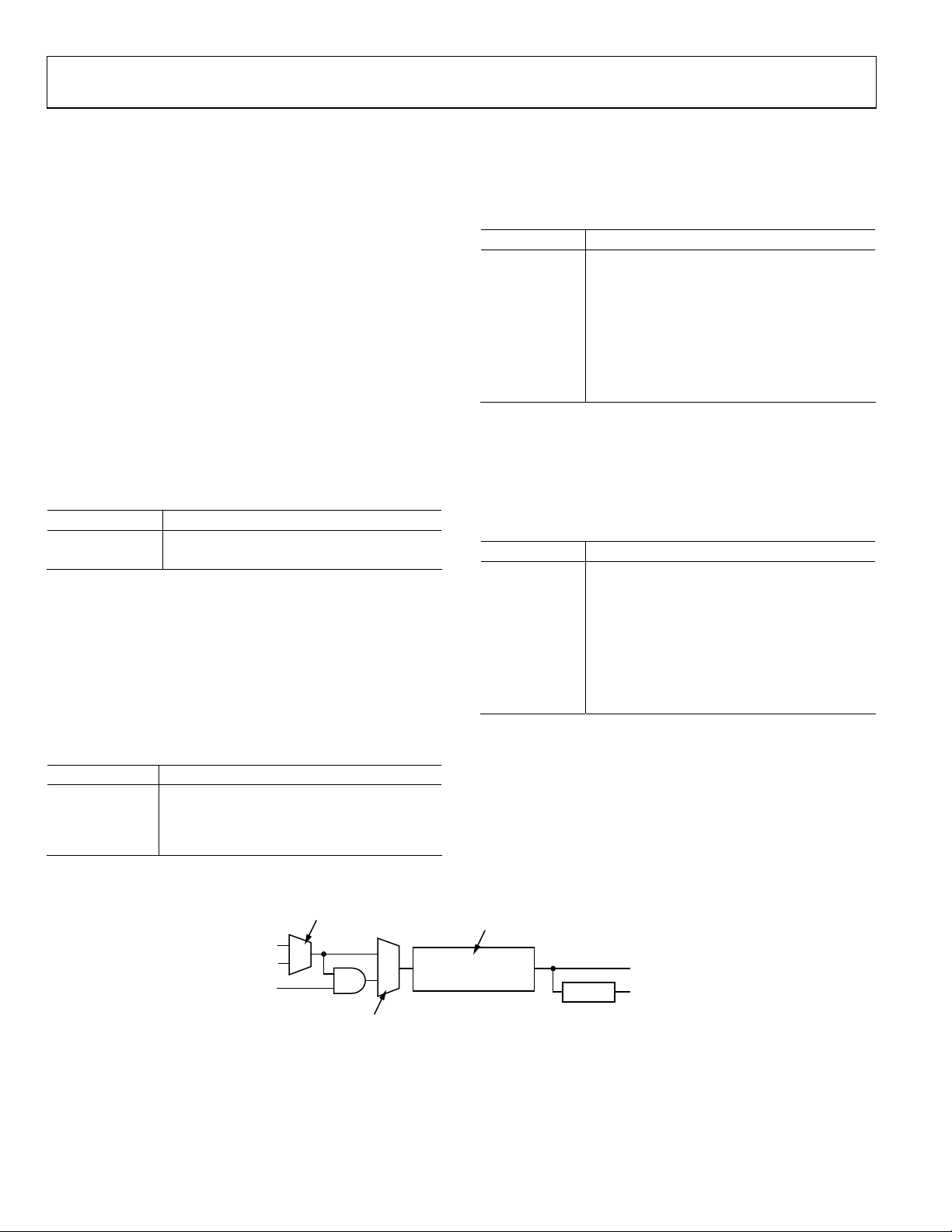
section. Figure 9 outlines the signal flow and the controls
available to influence the way the lock status information is
generated.
SRLS Select Raw Lock Signal, Address 0x51 [6]
Using the SRLS bit, the user can choose between two sources for
determining the lock status (per Bits [1:0] in the Status 1 register).
• The time_win signal is based on a line-to-line evaluation of
the horizontal synchronization pulse of the incoming
video. It reacts quite quickly.
• The free_run signal evaluates the properties of the
incoming video over several fields, and takes vertical
synchronization information into account.
Table 40. SRLS Function
SRLS Description
0 (default) Select the free_run signal.
1 Select the time_win signal.
FSCLE FSC Lock Enable, Address 0x51 [7]
The FSCLE bit allows the user to choose whether the status of
the color subcarrier loop is taken into account when the overall
lock status is determined and presented via Bits [1:0] in Status
Register 1. This bit must be set to 0 when operating the
ADV7183A in YPrPb component mode in order to generate a
reliable HLOCK status bit.
Table 41. FSCLE Function
FSCLE Description
0
1 (default)
Overall lock status only dependent on
horizontal sync lock.
Overall lock status dependent on horizontal
sync lock and F
SC
TIME_WIN
FREE_RUN
F
LOCK
SC
Lock.
SELECT THE RAW LOCK SIGNAL
SRLS
1
0
0
1
COUNTER INTO LOCK
COUNTER OUT OF LOCK
CIL[2:0] Count Into Lock, Address 0x51 [2:0]
CIL[2:0] determines the number of consecutive lines for which
the into lock condition must be true before the system switches
into the locked state, and reports this via Status 0 [1:0].
Table 42. CIL Function
CIL[2:0] Description (Count Value in Lines of Video)
000 1
001 2
010 5
011 10
100 (default) 100
101 500
110 1000
111 100000
COL[2:0] Count Out of Lock, Address 0x51 [5:3]
COL[2:0] determines the number of consecutive lines for which
the out of lock condition must be true before the system
switches into unlocked state, and reports this via Status 0 [1:0].
Table 43. COL Function
COL[2:0] Description (Count Value in Lines of Video)
000 1
001 2
010 5
011 10
100 (default) 100
101 500
110 1000
111 100000
FILTER THE RAW LOCK SIGNAL
CIL[2:0], COL[2:0]
STATUS 1 [0]
MEMORY
STATUS 1 [1]
LOCK INTO ACCOUNT
TAKE F
SC
FSCLE
Figure 9. Lock Related Signal Path
04821-006
Rev. B | Page 24 of 104
Page 25

ADV7183A
COLOR CONTROLS
The following registers provide user control over the picture
appearance, including control of the active data in the event of
video being lost. They are independent of any other controls.
For instance, brightness control is independent from picture
clamping, although both controls affect the signal’s dc level.
SD_SAT_Cr[7:0] SD Saturation Cr Channel,
Address 0xE4 [7:0]
This register allows the user to control the gain of the Cr
channel only.
CON[7:0] Contrast Adjust, Address 0x08 [7:0]
This register allows the user to adjust the contrast of the picture.
Table 44. CON Function
CON[7:0] Description (Adjust Contrast of the Picture)
0x80 (default) Gain on luma channel = 1.
0x00 Gain on luma channel = 0.
0xFF Gain on luma channel = 2.
SAT[7:0] Saturation Adjust, Address 0x09 [7:0]
The user can adjust the saturation of the color output using this
register.
ADI encourages users not to use the SAT[7:0] register, which
may be removed in future revisions of the ADV7183A. Instead,
the SD_SAT_Cb and SD_SAT_Cr registers should be used.
Table 45. SAT Function
SAT[7:0] Description (Adjust Saturation of the Picture)
0x80 (default) Chroma gain = 0 dB.
0x00 Chroma gain = –42 dB.
0xFF Chroma gain = +6 dB.
SD_SAT_Cb[7:0] SD Saturation Cb Channel,
Address 0xE3 [7:0]
This register allows the user to control the gain of the Cb
channel only.
For this register to be active, SAT[7:0] must be programmed
with its default value of 0x80. If SAT[7:0] is programmed with a
different value, SD_SAT_Cb[7:0] and SD_SAT_Cr[7:0] are
inactive.
Table 46. SD_SAT_Cb Function
Description
SD_SAT_Cb[7:0]
0x80 (default) Gain on Cb channel = 0 dB.
0x00 Gain on Cb channel = –42 dB.
0xFF Gain on Cb channel = +6 dB.
(Adjust Saturation of the Picture)
For this register to be active, SAT[7:0] must be programmed
with its default value of 0x80. If SAT[7:0] is programmed with a
different value, SD_SAT_Cb[7:0] and SD_SAT_Cr[7:0] are
inactive.
Table 47. SD_SAT_Cr Function
Description
SD_SAT_Cr[7:0]
0x80 (default) Gain on Cr channel = 0 dB.
0x00 Gain on Cr channel = –42 dB.
0xFF Gain on Cr channel = +6 dB.
(Adjust Saturation of the Picture)
SD_OFF_Cb[7:0] SD Offset Cb Channel, Address 0xE1 [7:0]
This register allows the user to select an offset for the Cb
channel only. There is a functional overlap with the Hue [7:0]
register.
Table 48. SD_OFF_Cb Function
Description
(Adjust Hue of the Picture by Selecting an
SD_OFF_Cb[7:0]
0x80 (default) 0 offset applied to the Cb channel.
0x00 –312 mV offset applied to the Cb channel.
0xFF +312 mV offset applied to the Cb channel.
Offset for Data on the Cb Channel)
SD_OFF_Cr [7:0] SD Offset Cr Chan, Address 0xE2 [7:0]
This register allows the user to select an offset for the Cr
channel only. There is a functional overlap with the Hue [7:0]
register.
Table 49. SD_OFF_Cr Function
Description
(Adjust Hue of the Picture by Selecting an
SD_OFF_Cr[7:0]
0x80 (default) 0 offset applied to the Cb channel.
0x00 –312 mV offset applied to the Cr channel.
0xFF +312 mV offset applied to the Cr channel.
Offset for Data on Cr Channel)
Rev. B | Page 25 of 104
Page 26

ADV7183A
BRI[7:0] Brightness Adjust, Address 0x0A [7:0]
This register controls the brightness of the video signal through
the ADV7183A.
Table 50. BRI Function
BRI[7:0]
0x00 (default) Offset of the luma channel = +0IRE.
0x7F Offset of the luma channel = +100IRE.
0x80 Offset of the luma channel = –100IRE.
HUE[7:0] Hue Adjust, Address 0x0B [7:0]
This register contains the value for the color hue adjustment.
HUE[7:0] has a range of ±90°, with 0x00 equivalent to an
adjustment of 0°. The resolution of HUE[7:0] is 1 bit = 0.7°.
The hue adjustment value is fed into the AM color demodulation block. Therefore, it only applies to video signals that
contain chroma information in the form of an AM modulated
carrier (CVBS or Y/C in PAL or NTSC). It does not affect
SECAM and does not work on component video inputs
(YPrPb).
Table 51. HUE Function
HUE[7:0] Description (Adjust Hue of the Picture)
0x00 (default) Phase of the chroma signal = 0°.
0x7F Phase of the chroma signal = –90°.
0x80 Phase of the chroma signal = +90°.
DEF_Y[5:0] Default Value Y, Address 0x0C [7:2]
In cases where the ADV7183A loses lock on the incoming video
signal or where there is no input signal, the DEF_Y[5:0] register
allows the user to specify a default luma value to be output.
This value is used under the following conditions:
• If DEF_VAL_AUTO_EN bit is set to high and the
ADV7183A lost lock to the input video signal. This is the
intended mode of operation (automatic mode).
• The DEF_VAL_EN bit is set, regardless of the lock status of
the video decoder. This is a forced mode that may be useful
during configuration.
The DEF_Y[5:0] values define the 6 MSBs of the output video.
The remaining LSBs are padded with 0s. For example, in 8-bit
mode, the output is Y[7:0] = {DEF_Y[5:0], 0, 0}.
Description (Adjust Brightness of the Picture)
Table 52. DEF_Y Function
DEF_Y[5:0] Description
0x0D (blue) (default) Default value of Y.
DEF_C[7:0] Default Value C, Address 0x0D [7:0]
The DEF_C[7:0] register complements the DEF_Y[5:0] value. It
defines the 4 MSBs of Cr and Cb values to be output if
• The DEF_VAL_AUTO_EN bit is set to high and the
ADV7183A cannot lock to the input video (automatic
mode).
• DEF_VAL_EN bit is set to high (forced output).
The data that is finally output from the ADV7183A for the
chroma side is Cr[7:0] = {DEF_C[7:4], 0, 0, 0, 0}, Cb[7:0] =
{DEF_C[3:0], 0, 0, 0, 0}.
Table 53. DEF_C Function
DEF_C[7:0] Description
0x7C (blue) (default) Default values for Cr and Cb.
DEF_VAL_EN Default Value Enable,
Address 0x0C [0]
This bit forces the use of the default values for Y, Cr, and Cb.
Refer to the descriptions for DEF_Y and DEF_C for additional
information. The decoder also outputs a stable 27 MHz clock,
HS, and VS in this mode.
Table 54. DEF_VAL_EN Function
DEF_VAL_EN Description
0 (default)
1
Do not force the use of default Y, Cr,
and Cb values. Output colors
dependent on DEF_VAL_AUTO_EN.
Always use default Y, Cr, and Cb values.
Override picture data even if the video
decoder is locked.
DEF_VAL_AUTO_EN Default Value Automatic Enable,
Address 0x0C [1]
This bit enables the automatic usage of the default values for Y,
Cr, and Cb in cases where the ADV7183A cannot lock to the
video signal.
Table 55. DEF_VAL_AUTO_EN Function
DEF_VAL_AUTO_EN Description
0
1 (default)
Do not use default Y, Cr, and Cb values.
If unlocked, output noise.
Use default Y, Cr, and Cb values when
decoder loses lock.
Rev. B | Page 26 of 104
Page 27
ADV7183A
A
G
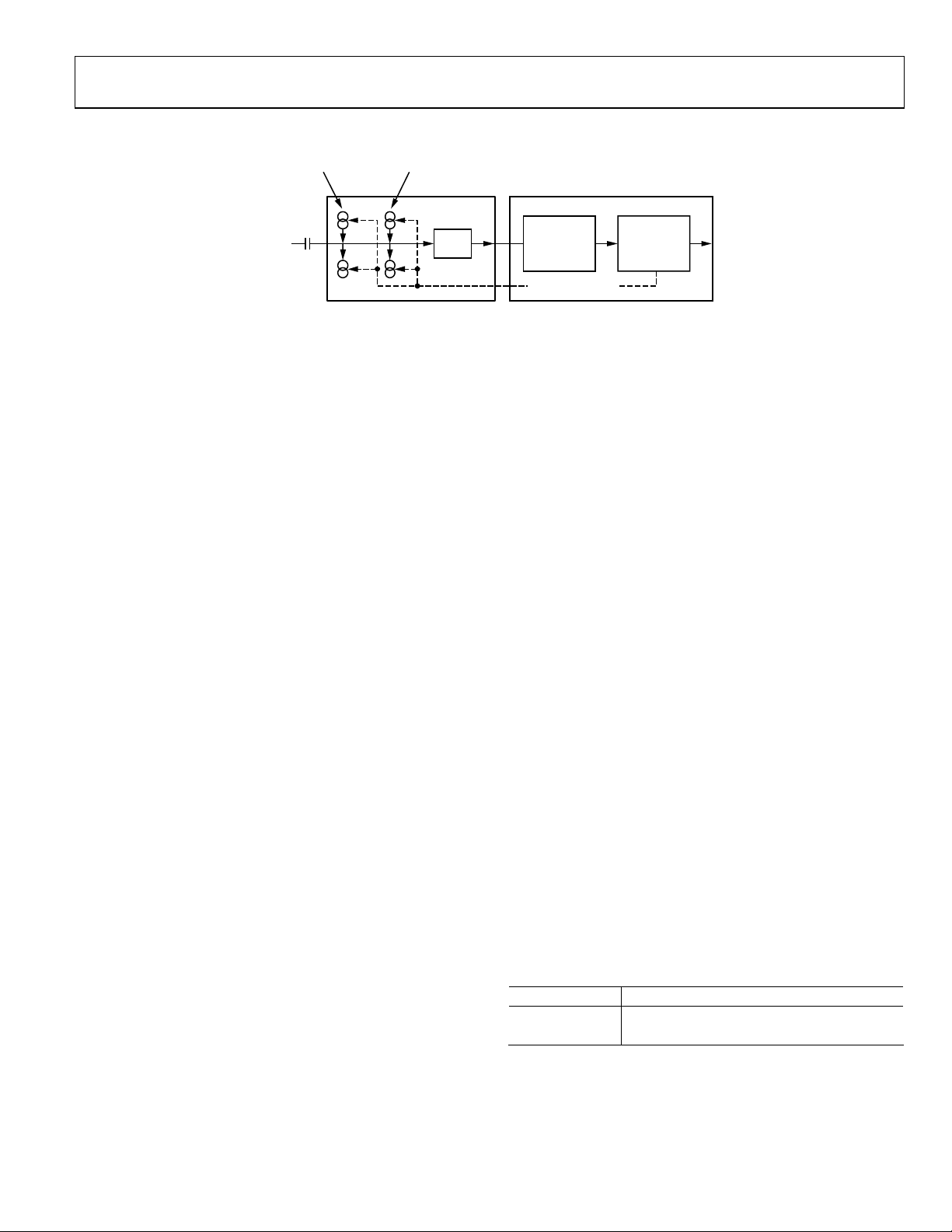
CLAMP OPERATION
FINE
CURRENT
SOURCES
COARSE
CURRENT
SOURCES
NALO
VIDEO
INPUT
ADC
Figure 10. Clamping Overview
The input video is ac-coupled into the ADV7183A through a
0.1 µF capacitor. It is recommended that the range of the input
video signal is 0.5 V to 1.6 V (typically 1 V p-p). If the signal
exceeds this range, it cannot be processed correctly in the
decoder. Since the input signal is ac-coupled into the decoder,
its dc value needs to be restored. This process is referred to as
clamping the video. This section explains the general process of
clamping on the ADV7183A, and shows the different ways in
which a user can configure its behavior.
The ADV7183A uses a combination of current sources and a
digital processing block for clamping, as shown in Figure 10.
The analog processing channel shown is replicated three times
inside the IC. While only one single channel (and only one
ADC) would be needed for a CVBS signal, two independent
channels are needed for YC (S-VHS) type signals, and three
independent channels are needed to allow component signals
(YPrPb) to be processed.
The clamping can be divided into two sections:
• Clamping before the ADC (analog domain): current
sources.
DATA
PRE
PROCESSOR
(DPP)
CLAMP CONTROL
SDP
WITH DIGITAL
FINE CLAMP
04821-010
The clamping scheme has to complete two tasks: it must be able
to acquire a newly connected video signal with a completely
unknown dc level, and it must maintain the dc level during
normal operation.
For a fast acquiring of an unknown video signal, the large current
clamps may be activated. (It is assumed that the amplitude of
the video signal at this point is of a nominal value.) Control of
the coarse and fine current clamp parameters is performed
automatically by the decoder.
Standard definition video signals may have excessive noise on
them. In particular, CVBS signals transmitted by terrestrial
broadcast and demodulated using a tuner usually show very
large levels of noise (>100 mV). A voltage clamp would be
unsuitable for this type of video signal. Instead, the ADV7183A
employs a set of four current sources that can cause coarse
(>0.5 mA) and fine (<0.1 mA) currents to flow into and away
from the high impedance node that carries the video signal (see
Figure 10).
2
The following sections describe the I
C signals that can be used
to influence the behavior of the clamping.
• Clamping after the ADC (digital domain): digital
processing block.
The ADCs can digitize an input signal only if it resides within
the ADC’s 1.6 V input voltage range. An input signal with a dc
level that is too large or too small is clipped at the top or bottom
of the ADC range.
The primary task of the analog clamping circuits is to ensure
that the video signal stays within the valid ADC input window
so the analog-to-digital conversion can take place. It is not necessary to clamp the input signal with a very high accuracy in the
analog domain as long as the video signal fits the ADC range.
After digitization, the digital fine clamp block corrects for any
remaining variations in dc level. Since the dc level of an input
video signal refers directly to the brightness of the picture
transmitted, it is important to perform a fine clamp with high
accuracy; otherwise, brightness variations may occur. Furthermore, dynamic changes in the dc level almost certainly lead to
visually objectionable artifacts and must, therefore, be prohibited.
Rev. B | Page 27 of 104
Previous revisions of the ADV7183A had controls (FACL/FICL,
fast and fine clamp length) to allow configuration of the length
for which the coarse (fast) and fine current sources are switched
on. These controls were removed on the ADV7183A-FT and
replaced by an adaptive scheme.
CCLEN Current Clamp Enable, Address 0x14 [4]
The current clamp enable bit allows the user to switch off the
current sources in the analog front end altogether. This may be
useful if the incoming analog video signal is clamped externally.
Table 56. CCLEN Function
CCLEN Description
0 Current sources switched off.
1 (default) Current sources enabled.
Page 28

ADV7183A
DCT[1:0] Digital Clamp Timing, Address 0x15 [6:5]
The Clamp Timing register determines the time constant of the
digital fine clamp circuitry. It is important to realize that the
digital fine clamp reacts very fast since it is supposed to immediately correct any residual dc level error for the active line. The
time constant of the digital fine clamp must be much quicker
than the one from the analog blocks.
By default, the time constant of the digital fine clamp is adjusted
dynamically to suit the currently connected input signal.
Table 57. DCT Function
DCT[1:0] Description
00 Slow (TC = 1 sec).
01 Medium (TC = 0.5 sec).
10 (default) Fast (TC = 0.1 sec).
11
DCFE Digital Clamp Freeze Enable, Address 0x15 [4]
This register bit allows the user to freeze the digital clamp loop
at any time. It is intended for users who would like to do their
own clamping. Users should disable the current sources for
analog clamping via the appropriate register bits, wait until the
digital clamp loop settles, and then freeze it via the DCFE bit.
Table 58. DCFE Function
DCFE Description
0 (default) Digital clamp operational.
1 Digital clamp loop frozen.
LUMA FILTER
Data from the digital fine clamp block is processed by three sets
of filters. The data format at this point is CVBS for CVBS input
or luma only for Y/C and YPrPb input formats.
• Luma Antialias Filter (YAA). The ADV7183A receives
video at a rate of 27 MHz. (In 4× oversampled video, the
ADCs sample at 54 MHz, and the first decimation is
performed inside the DPP filters. Therefore, the data rate
into the ADV7183A is always 27 MHz.) The ITU-R BT.601
recommends a sampling frequency of 13.5 MHz. The luma
antialias filter decimates the oversampled video using a
high quality, linear phase, low-pass filter that preserves the
luma signal while at the same time attenuating out-of-band
components. The luma antialias filter (YAA) has a fixed
response.
• Luma Shaping Filters (YSH). The shaping filter block is a
programmable low-pass filter with a wide variety of
responses. It can be used to selectively reduce the luma
Determined by ADV7183A dependent on video
parameters.
video signal bandwidth (needed prior to scaling, for
example). For some video sources that contain high
frequency noise, reducing the bandwidth of the luma
signal improves visual picture quality. A follow-on video
compression stage may work more efficiently if the video is
low-pass filtered.
The ADV7183A allows selection of two responses for the
shaping filter: one that is used for good quality CVBS,
component, and S-VHS type sources, and a second for
nonstandard CVBS signals.
The YSH filter responses also include a set of notches for
PAL and NTSC. However, it is recommended to use the
comb filters for YC separation.
• Digital Resampling Filter. This block is used to allow
dynamic resampling of the video signal to alter parameters
such as the time base of a line of video. Fundamentally, the
resampler is a set of low-pass filters. The actual response is
chosen by the system with no requirement for user
intervention.
Figure 12 through Figure 15 show the overall response of all
filters together. Unless otherwise noted, the filters are set into a
typical wideband mode.
Y Shaping Filter
For input signals in CVBS format, the luma shaping filters play
an essential role in removing the chroma component from a
composite signal. YC separation must aim for best possible
crosstalk reduction while still retaining as much bandwidth
(especially on the luma component) as possible. High quality
YC separation can be achieved by using the internal comb filters
of the ADV7183A. Comb filtering, however, relies on the
frequency relationship of the luma component (multiples of the
video line rate) and the color subcarrier (F
). For good quality
SC
CVBS signals, this relationship is known; the comb filter
algorithms can be used to separate out luma and chroma with
high accuracy.
In the case of nonstandard video signals, the frequency
relationship may be disturbed and the comb filters may not be
able to remove all crosstalk artifacts in an optimum fashion
without the assistance of the shaping filter block.
An automatic mode is provided. Here, the ADV7183A evaluates
the quality of the incoming video signal and selects the filter
responses in accordance with the signal quality and video
standard. YFSM, WYSFMOVR, and WYSFM allow the user to
manually override the automatic decisions in part or in full.
Rev. B | Page 28 of 104
Page 29
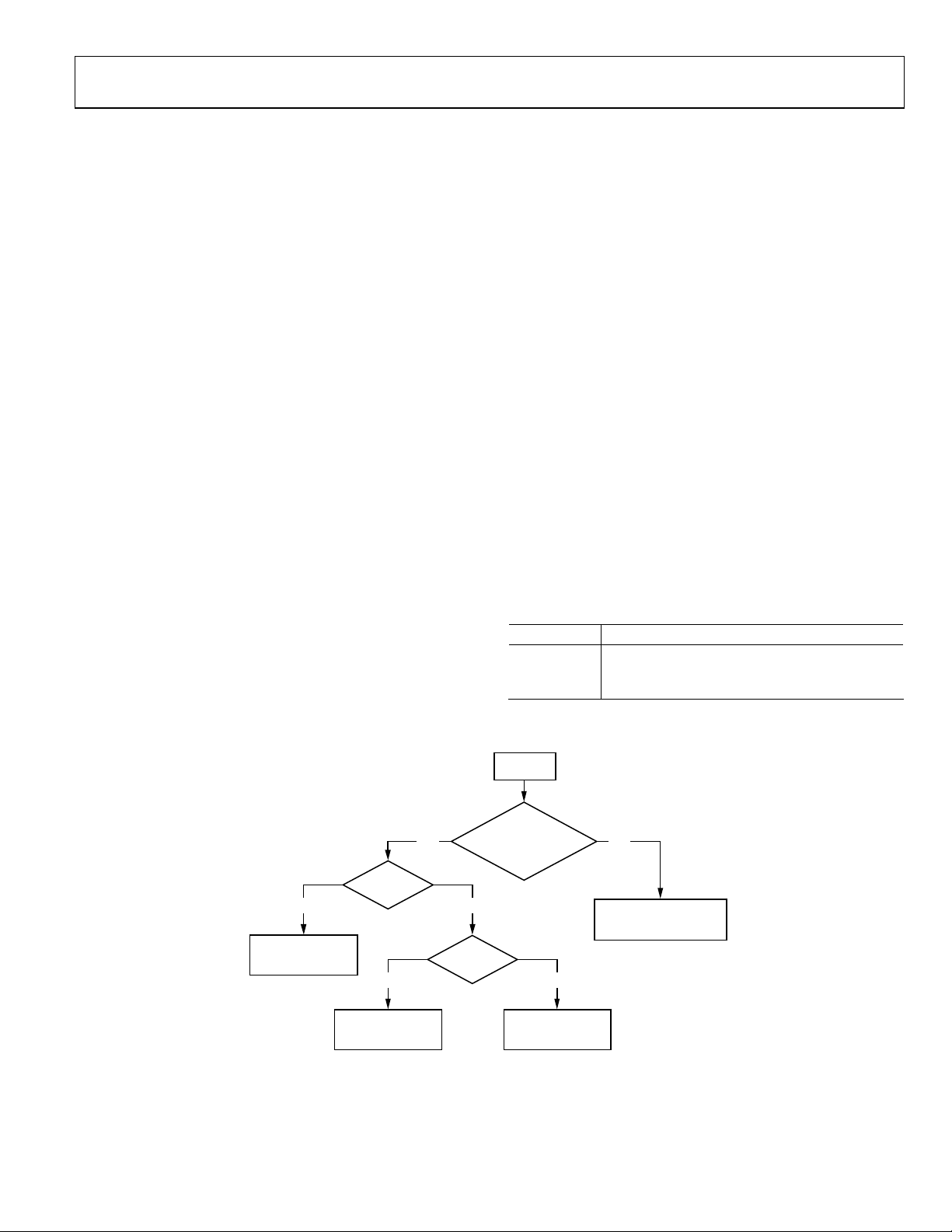
ADV7183A
The luma shaping filter has three control registers:
• YSFM[4:0] allows the user to manually select a shaping
filter mode (applied to all video signals) or to enable an
automatic selection (dependent on video quality and video
standard).
• WYSFMOVR allows the user to manually override the
WYSFM decision.
• WYSFM[4:0] allows the user to select a different shaping
filter mode for good quality CVBS, component (YPrPb),
and S-VHS (YC) input signals.
In automatic mode, the system preserves the maximum possible
bandwidth for good CVBS sources (since they can successfully
be combed) as well as for luma components of YPrPb and YC
sources, since they need not be combed. For poor quality
signals, the system selects from a set of proprietary shaping
filter responses that complements comb filter operation in order
to reduce visual artifacts.
The decisions of the control logic are shown in Figure 11.
YSFM[4:0] Y Shaping Filter Mode, Address 0x17 [4:0]
The Y shaping filter mode bits allow the user to select from a
wide range of low-pass and notch filters. When switched in
automatic mode, the filter is selected based on other register
selections, for example, detected video standard, as well as
properties extracted from the incoming video itself, for
ex ample, quality, time b ase stability. The automatic s election
always picks the widest possible bandwidth for the video input
encountered.
• If the YSFM settings specify a filter (that is, YSFM is set to
values other than 00000 or 00001), the chosen filter is
applied to all video, regardless of its quality.
• In automatic selection mode, the notch filters are only used
for bad quality video signals. For all other video signals,
wideband filters are used.
WYSFMOVR Wideband Y Shaping Filter Override,
Address 0x18 [7]
Setting the WYSFMOVR bit enables the use of the
WYSFM[4:0] settings for good quality video signals. For more
information, refer to the general discussion of the luma shaping
filters in the Y Shaping Filter section and the flowchart shown
in Figure 11.
Table 59. WYSFMOVR Function
WYSFMOVR Description
0
Automatic selection of shaping filter for good
quality video signals.
1 (default) Enable manual override via WYSFM[4:0].
SET YSFM
YSFM IN AUTO MODE?
00000 OR 00001
WYSFMOVR
SELECT AUTOMATIC
WIDEBAND FILTER
USE YSFM SELECTED
FILTER REGARDLESS FOR
GOOD AND BAD VIDEO
04821-011
VIDEO
BAD GOOD
AUTO SELECT LUMA
SHAPING FILTER TO
COMPLEMENT COMB
QUALITY
1 0
SELECT WIDEBAND
FILTER AS PER
WYSFM[4:0]
Figure 11. YSFM and WYSFM Control Flowchart
YES NO
Rev. B | Page 29 of 104
Page 30
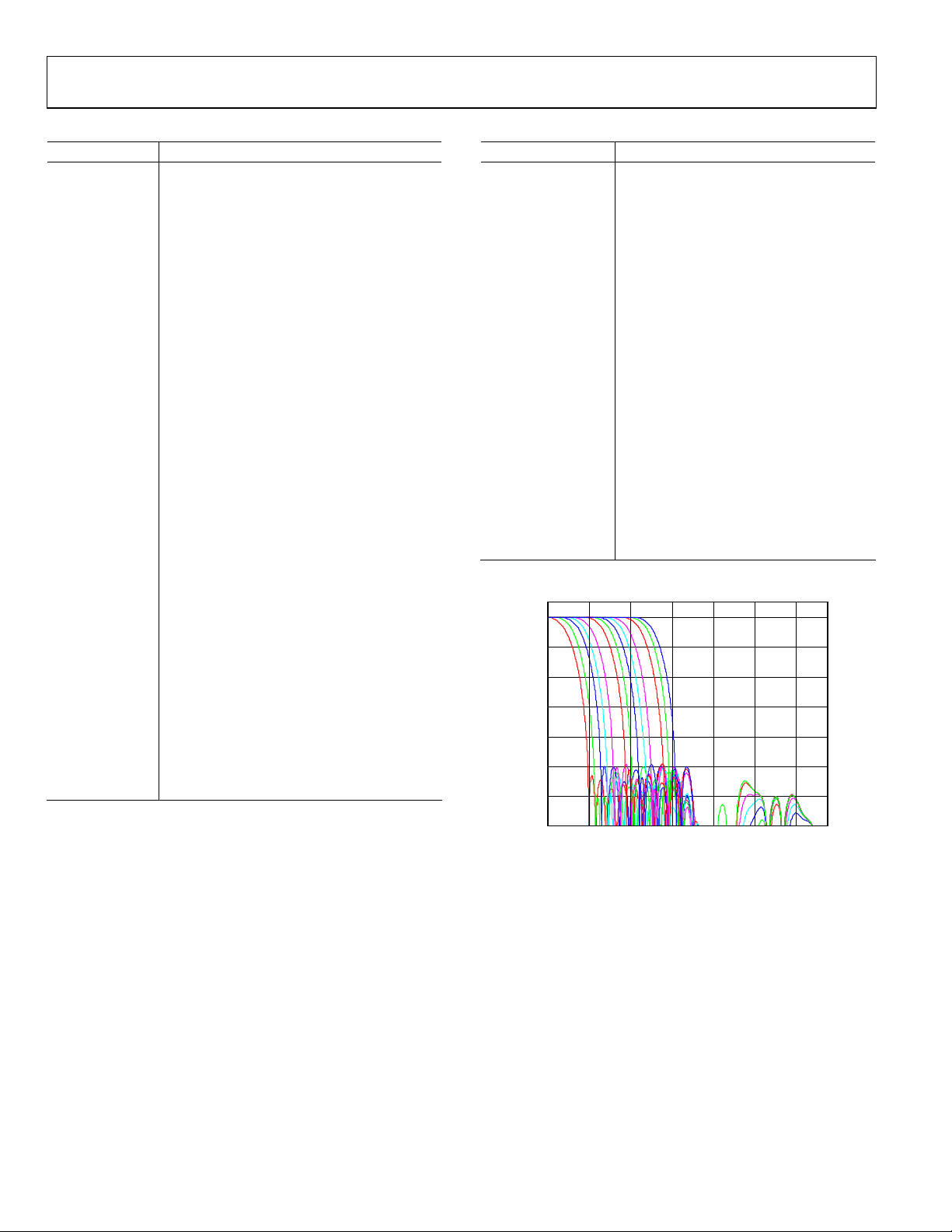
ADV7183A
Table 60. YSFM Function
YSFM[4:0] Description
0'0000
0'0001
0'0010 SVHS 1
0'0011 SVHS 2
0'0100 SVHS 3
0'0101 SVHS 4
0'0110 SVHS 5
0'0111 SVHS 6
0'1000 SVHS 7
0'1001 SVHS 8
0'1010 SVHS 9
0'1011 SVHS 10
0'1100 SVHS 11
0'1101 SVHS 12
0'1110 SVHS 13
0'1111 SVHS 14
1'0000 SVHS 15
1'0001 SVHS 16
1'0010 SVHS 17
1'0011 (default) SVHS 18 (CCIR 601)
1'0100 PAL NN 1
1'0101 PAL NN 2
1'0110 PAL NN 3
1'0111 PAL WN 1
1'1000 PAL WN 2
1'1001 NTSC NN 1
1'1010 NTSC NN 2
1'1011 NTSC NN 3
1'1100 NTSC WN 1
1'1101 NTSC WN 2
1'1110 NTSC WN 3
1'1111 Reserved
WYSFM[4:0] Wide Band Y Shaping Filter Mode,
Address 0x18 [4:0]
The WYSFM[4:0] bits allow the user to manually select a
shaping filter for good quality video signals, for example, CVBS
with stable time base, luma component of YPrPb, luma
component of YC. The WYSFM bits are only active if the
WYSFMOVR bit is set to 1. See the general discussion of the
shaping filter settings in the Y Shaping Filter section.
Automatic selection including a wide notch
response (PAL/NTSC/SECAM)
Automatic selection including a narrow
notch response (PAL/NTSC/SECAM)
Table 61. WYSFM Function
WYSFM[4:0] Description
0'0000 Do not use
0'0001 Do not use
0'0010 SVHS 1
0'0011 SVHS 2
0'0100 SVHS 3
0'0101 SVHS 4
0'0110 SVHS 5
0'0111 SVHS 6
0'1000 SVHS 7
0'1001 SVHS 8
0'1010 SVHS 9
0'1011 SVHS 10
0'1100 SVHS 11
0'1101 SVHS 12
0'1110 SVHS 13
0'1111 SVHS 14
1'0000 SVHS 15
1'0001 SVHS 16
1'0010 SVHS 17
1'0011 (default) SVHS 18 (CCIR 601)
1'0100–1’1111 Do not use
COMBINED Y ANTIALIAS, S-VHS LOW-PASS FILTERS,
0
–10
–20
–30
–40
AMPLITUDE (dB)
–50
–60
–70
010864212
Figure 12. Y S-VHS Combined Responses
Y RESAMPLE
04821-012
FREQUENCY (MHz)
The filter plots in Figure 12 show the S-VHS 1 (narrowest) to
S-VHS 18 (widest) shaping filter settings. Figure 14 shows the
PAL notch filter responses. The NTSC-compatible notches are
shown in Figure 15.
Rev. B | Page 30 of 104
Page 31

ADV7183A
–20
–40
–60
AMPLITUDE (dB)
–80
–100
–120
COMBINED Y ANTIALIAS, CCIR MODE SHAPING FILTER,
0
010864212
Y RESAMPLE
FREQUENCY (MHz)
Figure 13. Y S-VHS 18 Extra Wideband Filter (CCIR 601 Compliant)
COMBINED Y ANTIALIAS, PAL NOTCH FILTERS,
0
–10
–20
Y RESAMPLE
CHROMA FILTER
Data from the digital fine clamp block is processed by two sets
of filters. The data format at this point is CVBS for CVBS
inputs, chroma only for Y/C, or U/V interleaved for YPrPb
input formats.
• Chroma Antialias Filter (CAA). The ADV7183A over-
samples the CVBS by a factor of 2 and the Chroma/PrPb
by a factor of 4. A decimating filter (CAA) is used to
preserve the active video band and remove any out-ofband components. The CAA filter has a fixed response.
04821-013
• Chroma Shaping Filters (CSH). The shaping filter block
(CSH) can be programmed to perform a variety of lowpass responses. It can be used to selectively reduce the
bandwidth of the chroma signal for scaling or compression.
• Digital Resampling Filter. This block is used to allow
dynamic resampling of the video signal to alter parameters
such as the time base of a line of video. Fundamentally, the
resampler is a set of low-pass filters. The actual response is
chosen by the system with no requirement for user
intervention.
–30
–40
AMPLITUDE (dB)
–50
–60
–70
010864212
FREQUENCY (MHz)
04821-014
Figure 14. Pal Notch Filter Responses
COMBINED Y ANTIALIAS, NTSC NOTCH FILTERS,
0
–10
–20
–30
–40
AMPLITUDE (dB)
–50
–60
–70
010864212
Y RESAMPLE
FREQUENCY (MHz)
04821-015
The plots in Figure 16 show the overall response of all filters.
CSFM[2:0] C Shaping Filter Mode, Address 0x17 [7]
The C shaping filter mode bits allow the user to select from a
range of low-pass filters for the chrominance signal. When
switched in automatic mode, the widest filter is selected based
on the video standard/format and user choice (see settings 000
and 001 in Table 62).
Table 62. CSFM Function
CSFM[2:0] Description
000 (default) Autoselect 1.5 MHz bandwidth
001 Autoselect 2.17 MHz bandwidth
010 SH1
011 SH2
100 SH3
101 SH4
110 SH5
111 Wideband mode
Figure 16 shows the responses of SH1 (narrowest) to SH5
(widest) in addition to the wideband mode (in red).
Figure 15. NTSC Notch Filter Responses
Rev. B | Page 31 of 104
Page 32

ADV7183A
0
–10
–20
–30
–40
ATTENUATION (dB)
–50
–60
0543216
COMBINED C ANTIALIAS, C SHAPING FILTER,
C RESAMPLER
FREQUENCY (MHz)
04821-016
Figure 16. Chroma Shaping Filter Responses
GAIN OPERATION
The gain control within the ADV7183A is done on a purely
digital basis. The input ADCs support a 10-bit range, mapped
into a 1.6 V analog voltage range. Gain correction takes place
after the digitization in the form of a digital multiplier.
There are several advantages of this architecture over the
commonly used PGA (programmable gain amplifier) before the
ADCs; among them the gain is now completely independent of
supply, temperature, and process variations.
ANALOG VOLTAGE
MAXIMUM
VOLTAGE
RANGE SUPPORTED BY ADC (1.6V RANGE FOR ADV7183A)
As shown in Figure 17, the ADV7183A can decode a video
signal as long as it fits into the ADC window. There are two
components to this: the amplitude of the input signal and the dc
level it resides on. The dc level is set by the clamping circuitry
(see the Clamp Operation section).
If the amplitude of the analog video signal is too high, clipping
may occur, resulting in visual artifacts. The analog input range
of the ADC, together with the clamp level, determines the
maximum supported amplitude of the video signal.
The minimum supported amplitude of the input video is
determined by the ADV7183A’s ability to retrieve horizontal
and vertical timing and to lock to the color burst, if present.
There are two gain control units, one each for luma and chroma
data. Both can operate independently of each other. The
chroma unit, however, can also take its gain value from the
luma path.
Several AGC modes are possible; Table 63 summarizes them.
It is possible to freeze the automatic gain control loops. This
causes the loops to stop updating, and the AGC determined
gain at the time of the freeze stays active until the loop is either
unfrozen or the gain mode of operation is changed.
The currently active gain from any of the modes can be read
back. Refer to the description of the dual function manual gain
registers, LG[11:0] Luma Gain and CG[11:0] Chroma Gain, in
the Luma Gain and Chroma Gain sections.
SDP
(GAIN SELECTION ONLY)
GAIN
CONTROL
MINIMUM
VOLTAGE
CLAMP
LEVEL
ADC
DATA
PRE
PROCESSOR
(DPP)
Figure 17. Gain Control Overview
Table 63. AGC Modes
Input Video Type Luma Gain Chroma Gain
Any Manual gain luma. Manual gain chroma.
CVBS
Dependent on color burst amplitude. Dependent on horizontal sync depth.
Taken from luma path.
Peak White
Dependent on color burst amplitude.
Taken from luma path.
Y/C
Dependent on color burst amplitude. Dependent on horizontal sync depth.
Taken from luma path.
Peak White.
Dependent on color burst amplitude.
Taken from luma path.
YPrPb Dependent on horizontal sync depth. Taken from luma path.
Rev. B | Page 32 of 104
04821-017
Page 33

ADV7183A
Luma Gain
LAGC[2:0] Luma Automatic Gain Control,
Address 0x2C [7:0]
The luma automatic gain control mode bits select the mode of
operation for the gain control in the luma path.
There are ADI internal parameters to customize the peak white
gain control. Contact ADI for more information.
Table 64. LAGC Function
LAGC[2:0] Description
000 Manual fixed gain (use LMG[11:0]).
001
010 (default)
011 Reserved.
100 Reserved.
101 Reserved.
110 Reserved.
111 Freeze gain.
AGC (blank level to sync tip).
No override through white peak.
AGC (blank level to sync tip).
Automatic override through white peak.
LAGT[1:0] Luma Automatic Gain Timing,
Address 0x2F [7:6]
The luma automatic gain timing register allows the user to
influence the tracking speed of the luminance automatic gain
control. This register has an effect only if the LAGC[2:0]
register is set to 001, 010, 011, or 100 (automatic gain control
modes).
LG[11:0] Luma Gain, Address 0x2F [3:0]; Address 0x30 [7:0];
LMG[11:0] Luma Manual Gain, Address 0x2F [3:0];
Address 0x30 [7:0]
Luma gain [11:0] is a dual function register:
• If written to, a desired manual luma gain can be
programmed. This gain becomes active if the LAGC[2:0]
mode is switched to manual fixed gain.
• Equation 1 shows how to calculate a desired gain.
• If read back, this register returns the current gain value.
Depending on the setting in the LAGC[2:0] bits, this is one
of the following values:
o Luma manual gain value (LAGC[2:0] set to luma
manual gain mode).
o Luma automatic gain value (LAGC[2:0] set to any of
the automatic modes).
Table 66. LG/LMG Function
LG[11:0]/LMG[11:0] Read/Write Description
LG[11:0] Read Actual gain.
LMG[11:0] = X Write
Manual gain for luma
path.
)40950(
_ =
GainLuma
≤<=LG
2048
(1)
2....0
If peak white AGC is enabled and active (see the
STATUS_1[7:0] Address 0x10 [7:0] section), the actual gain
update speed is dictated by the peak white AGC loop and, as a
result, the LAGT settings have no effect. As soon as the part
leaves peak white AGC, LAGT becomes relevant again.
The update speed for the peak white algorithm can be customized by the use of internal parameters. Contact ADI for more
information.
Table 65. LAGT Function
LAGT[1:0] Description
00 Slow (TC = 2 sec)
01 Medium (TC = 1 sec)
10 Fast (TC = 0.2 sec)
11 (default) Adaptive
Example
Program the ADV7183A into manual fixed gain mode with a
desired gain of 0.89:
1. Use Equation 1 to convert the gain:
0.89 × 2048 = 1822.72
2. Truncate to integer value:
1822.72 = 1822
3. Convert to hexadecimal:
1822d = 0x71E
4. Split into two registers and program:
Luma Gain Control 1 [3:0] = 0x7
Luma Gain Control 2 [7:0] = 0x1E
5. Enable manual fixed gain mode:
Set LAGC[2:0] to 000
Rev. B | Page 33 of 104
Page 34

ADV7183A
BETACAM Enable Betacam Levels, Address 0x01 [5]
If YPrPb data is routed through the ADV7183A, the automatic
gain control modes can target different video input levels, as
outlined in Table 71. The BETACAM bit is valid only if the
input mode is YPrPb (component). The BETACAM bit sets the
target value for AGC operation.
A review of the following sections is useful:
• INSEL[3:0] Input Selection, Address 0x00 [3:0] to find how
component video (YPrPb) can be routed through the
ADV7183A.
• Video Standard Selection to select the various standards,
for example, with and without pedestal.
The automatic gain control (AGC) algorithms adjust the levels
based on the setting of the BETACAM bit (see Table 67).
Table 67. BETACAM Function
BETACAM Description
0 (default) Assuming YPrPb is selected as input format.
Selecting PAL with pedestal selects MII.
Selecting PAL without pedestal selects SMPTE.
Selecting NTSC with pedestal selects MII.
Selecting NTSC without pedestal selects SMPTE.
1 Assuming YPrPb is selected as input format.
Selecting PAL with pedestal selects BETACAM.
Selecting NTSC with pedestal selects BETACAM.
Selecting PAL without pedestal selects BETACAM
variant.
Selecting NTSC without pedestal selects BETACAM
variant.
Table 71. Betacam Levels
Name Betacam (mV) Betacam Variant (mV) SMPTE (mV) MII (mV)
Y Range 0 to 714 (incl. 7.5% pedestal) 0 to 714 0 to 700 0 to 700 (incl. 7.5% pedestal)
Pb and Pr Range –467 to +467 –505 to +505 –350 to +350 –324 to +324
Sync Depth 286 286 300 300
PW_UPD Peak White Update, Address 0x2B [0]
The peak white and average video algorithms determine the
gain based on measurements taken from the active video. The
PW_UPD bit determines the rate of gain change. The LAGC[2:0]
must be set to the appropriate mode to enable the peak white or
average video mode in the first place. For more information,
refer to the LAGC[2:0] Luma Automatic Gain Control,
Address 0x2C [7:0] section.
Table 68. PW_UPD Function
PW_UPD Description
0 Update gain once per video line.
1 (default) Update gain once per field.
Chroma Gain
CAGC[1:0] Chroma Automatic Gain Control,
Address 0x2C [1:0]
The two bits of Color Automatic Gain Control mode select the
basic mode of operation for automatic gain control in the
chroma path.
Table 69. CAGC Function
CAGC[1:0] Description
00 Manual fixed gain (use CMG[11:0]).
01 Use luma gain for chroma.
10 (default) Automatic gain (based on color burst).
11 Freeze chroma gain.
CAGT[1:0] Chroma Automatic Gain Timing,
Address 0x2D [7:6]
The Chroma Automatic Gain Timing register allows the user to
influence the tracking speed of the chroma automatic gain
control. This register only has an effect if the CAGC[1:0]
register is set to 10 (automatic gain).
Table 70. CAGT Function
CAGT[1:0] Description
00 Slow (TC = 2 sec)
01 Medium (TC = 1 sec)
10 Fast (TC = 0.2 sec)
11 (default) Adaptive
Rev. B | Page 34 of 104
Page 35

ADV7183A
CG[11:0] Chroma Gain, Address 0x2D [3:0];
Address 0x2E [7:0] CMG[11:0]
Chroma Manual Gain, Address 0x2D [3:0];
Address 0x2E [7:0]
Chroma gain [11:0] is a dual-function register:
• If written to, a desired manual chroma gain can be
programmed. This gain becomes active if the CAGC[1:0]
mode is switched to manual fixed gain.
• Refer to Equation 2 for calculating a desired gain.
• If read back, this register returns the current gain value.
Depending on the setting in the CAGC[1:0] bits, this will
be one of the following values:
o Chroma manual gain value (CAGC[1:0] set to chroma
manual gain mode).
o Chroma automatic gain value (CAGC[1:0] set to any
of the automatic modes).
Table 72. CG/CMG Function
CG[11:0]/CMG[11:0] Read/Write Description
CMG[11:0] Write
CG[11:0] Read Currently active gain.
_ =
()
GainChroma
1024
Manual gain for chroma
path.
40950
≤<=CG
(2)
4...0
Example
Freezing the automatic gain loop and reading back the
CG[11:0] register results in a value of 0x47A.
Convert the read back value to decimal:
1.
0x47A = 1146d
2.
Apply Equation 2 to convert the readback value:
1146/1024 = 1.12
CKE Color Kill Enable, Address 0x2B [6]
The Color Kill Enable bit allows the optional color kill function
to be switched on or off.
For QAM based video standards (PAL and NTSC) as well as FM
based systems (SECAM), the threshold for the color kill decision
is selectable via the CKILLTHR[2:0] bits.
If color kill is enabled, and if the color carrier of the incoming
video signal is less than the threshold for 128 consecutive video
lines, color processing is switched off (black and white output).
To switch the color processing back on, another 128 consecutive
lines with a color burst greater than the threshold are required.
The color kill option only works for input signals with a modulated chroma part. For component input (YPrPb), there is no
color kill.
Table 73. CKE Function
CKE Description
0 Color kill disabled.
1 (default) Color kill enabled.
CKILLTHR[2:0] Color Kill Threshold, Address 0x3D [6:4]
The CKILLTHR[2:0] bits allow the user to select a threshold for
the color kill function. The threshold only applies to QAM
based (NTSC and PAL) or FM modulated (SECAM) video
standards.
To enable the color kill function, the CKE bit must be set. For
settings 000, 001, 010, and 011, chroma demodulation inside
the ADV7183A may not work satisfactorily for poor input video
signals.
Table 74. CKILLTHR Function
CKILLTHR[2:0] SECAM NTSC, PAL
000 No color kill Kill at < 0.5%
001 Kill at < 5% Kill at < 1.5%
010 Kill at < 7% Kill at < 2.5%
011 Kill at < 8% Kill at < 4.0%
100 (default) Kill at < 9.5% Kill at < 8.5%
101 Kill at < 15% Kill at < 16.0%
110 Kill at < 32% Kill at < 32.0%
111
Reserved for ADI internal use only. Do not
select.
Description
Rev. B | Page 35 of 104
Page 36

ADV7183A
CHROMA TRANSIENT IMPROVEMENT (CTI)
The signal bandwidth allocated for chroma is typically much
smaller than that of luminance. In the past, this was a valid way
to fit a color video signal into a given overall bandwidth because
the human eye is less sensitive to chrominance than to
luminance.
The uneven bandwidth, however, may lead to some visual
artifact when it comes to sharp color transitions. At the border
of two bars of color, both components (luma and chroma)
change at the same time (see Figure 18). Due to the higher
bandwidth, the signal transition of the luma component is
usually a lot sharper than that of the chroma component. The
color edge is not sharp but blurred, in the worst case, over
several pixels.
CTI_AB_EN Chroma Transient Improvement Alpha Blend
Enable, Address 0x4D [1]
The CTI_AB_EN bit enables an alpha-blend function within
the CTI block. If set to 1, the alpha blender mixes the transient
improved chroma with the original signal. The sharpness of the
alpha blending can be configured via the CTI_AB[1:0] bits.
For the alpha blender to be active, the CTI block must be
enabled via the CTI_EN bit.
Table 76. CTI_AB_EN
CTI_AB_EN Description
0 Disable CTI alpha blender.
1 (default) Enable CTI alpha-blend mixing function.
LUMA SIGNAL WITH A
LUMA
SIGNAL
DEMODULATED
CHROMA
SIGNAL
Figure 18. CTI Luma/Chroma Transition
TRANSITION, ACCOMPANIED
BY A CHROMA TRANSITION
ORIGINAL, "SLOW" CHROMA
TRANSITION PRIOR TO CTI
SHARPENED CHROMA
TRANSITION AT THE
OUTPUT OF CTI
The chroma transient improvement block examines the input
video data. It detects transitions of chroma, and can be
programmed to “steepen” the chroma edges in an attempt to
artificially restore lost color bandwidth. The CTI block,
however, only operates on edges above a certain threshold to
ensure that noise is not emphasized. Care has also been taken to
ensure that edge ringing and undesirable saturation or hue
distortion are avoided.
Chroma transient improvements are needed primarily for
signals that experienced severe chroma bandwidth limitations.
For those types of signals, it is strongly recommended to enable
the CTI block via CTI_EN.
CTI_EN Chroma Transient Improvement Enable,
Address 0x4D [0]
The CTI_EN bit enables the CTI function. If set to 0, the CTI
block is inactive and the chroma transients are left untouched.
Table 75. CTI_EN Function
CTI_EN Description
0 (default) Disable CTI.
1 Enable CTI block.
04821-018
CTI_AB[1:0] Chroma Transient Improvement Alpha Blend,
Address 0x4D [3:2]
The CTI_AB[1:0] controls the behavior of alpha-blend circuitry
that mixes the sharpened chroma signal with the original one. It
thereby controls the visual impact of CTI on the output data.
For CTI_AB[1:0] to become effective, the CTI block must be
enabled via the CTI_EN bit, and the alpha blender must be
switched on via CTI_AB_EN.
Sharp blending maximizes the effect of CTI on the picture, but
may also increase the visual impact of small amplitude, high
frequency chroma noise.
Table 77. CTI_AB Function
CTI_AB[1:0] Description
00
Sharpest mixing between sharpened and
original chroma signal.
01 Sharp mixing.
10 Smooth mixing.
11 (default) Smoothest alpha-blend function.
CTI_C_TH[7:0] CTI Chroma Threshold,
Address 0x4E [7:0]
The CTI_C_TH[7:0] value is an unsigned, 8-bit number specifying how big the amplitude step in a chroma transition has to
be in order to be steepened by the CTI block. Programming a
small value into this register causes even smaller edges to be
steepened by the CTI block. Making CTI_C_TH[7:0] a large
value causes the block to improve large transitions only.
Table 78. CTI_C_TH Function
CTI_C_TH[7:0] Description
0x08 (default) Threshold for chroma edges prior to CTI.
Rev. B | Page 36 of 104
Page 37

ADV7183A
DIGITAL NOISE REDUCTION (DNR)
Digital noise reduction is based on the assumption that high
frequency signals with low amplitude are probably noise, and
that their removal therefore improves picture quality.
DNR_EN Digital Noise Reduction Enable,
Address 0x4D [5]
The DNR_EN bit enables the DNR block or bypasses it.
Table 79. DNR_EN Function
DNR_EN Description
0 Bypass DNR (disable).
1 (default)
DNR_TH[7:0] DNR Noise Threshold, Address 0x50 [7:0]
The DNR_TH[7:0] value is an unsigned 8-bit number used to
determine the maximum edge that will be interpreted as noise
and therefore blanked from the luma data. Programming a large
value into DNR_TH[7:0] causes the DNR block to interpret
even large transients as noise and remove them. The effect on
the video data will therefore be more visible.
Programming a small value causes only small transients to be
seen as noise and to be removed.
The recommended DNR_TH[7:0] setting for A/V inputs is
0x04, and the recommended DNR_TH[7:0] setting for tuner
inputs is 0x0A.
Table 80. DNR_TH Function
DNR_TH[7:0] Description
0x08 (default)
Enable digital noise reduction on the luma
data.
Threshold for maximum luma edges to be
interpreted as noise.
COMB FILTERS
The comb filters of the ADV7183A have been greatly improved
to automatically handle video of all types, standards, and levels
of quality. Two user registers are available to customize comb
filter operation.
Depending on whichever video standard has been detected (by
autodetection) or selected (by manual programming), the
NTSC or PAL configuration registers are used. In addition to
the bits listed in this section, there are some further ADI
internal controls; contact ADI for more information.
NTSC Comb Filter Settings
Used for NTSC-M/J CVBS inputs.
NSFSEL[1:0] Split Filter Selection NTSC, Address 0x19 [3:2]
The NSFSEL[1:0] control selects how much of the overall signal
bandwidth is fed to the combs. A narrow split filter selection
gives better performance on diagonal lines, but leaves more dot
crawl in the final output image. The opposite is true for selecting a wide bandwidth split filter.
Table 81. NSFSEL Function
NSFSEL[1:0] Description
00 (default) Narrow
01 Medium
10 Medium
11 Wide
CTAPSN[1:0] Chroma Comb Taps NTSC, Address 0x38 [7:6]
Table 82. CTAPSN Function
CTAPSN[1:0] Description
00 Do not use.
01
10 (default)
11
NTSC chroma comb adapts 3 lines (3 taps)
to 2 lines (2 taps).
NTSC chroma comb adapts 5 lines (5 taps)
to 3 lines (3 taps).
NTSC chroma comb adapts 5 lines (5 taps)
to 4 lines (4 taps).
Rev. B | Page 37 of 104
Page 38

ADV7183A
CCMN[2:0] Chroma Comb Mode NTSC, Address 0x38 [5:3]
Table 83. CCMN Function
CCMN[2:0] Description
0xx (default) Adaptive comb mode.
100 Disable chroma comb.
101 Fixed chroma comb (top lines of line memory).
110 Fixed chroma comb (all lines of line memory).
111 Fixed chroma comb (bottom lines of line memory).
YCMN[2:0] Luma Comb Mode NTSC, Address 0x38 [2:0]
Table 84. YCMN Function
YCMN[2:0] Description
0xx (default) Adaptive comb mode. Adaptive 3-line (3 taps) luma comb.
100 Disable luma comb. Use low-pass/notch filter; see the Y Shaping Filter section.
101 Fixed luma comb (top lines of line memory). Fixed 2-line (2 taps) luma comb.
110 Fixed luma comb (all lines of line memory). Fixed 3-line (3 taps) luma comb.
111 Fixed luma comb (bottom lines of line memory). Fixed 2-line (2 taps) luma comb.
Adaptive 3-line chroma comb for CTAPSN = 01.
Adaptive 4-line chroma comb for CTAPSN = 10.
Adaptive 5-line chroma comb for CTAPSN = 11.
Fixed 2-line chroma comb for CTAPSN = 01.
Fixed 3-line chroma comb for CTAPSN = 10.
Fixed 4-line chroma comb for CTAPSN = 11.
Fixed 3-line chroma comb for CTAPSN = 01.
Fixed 4-line chroma comb for CTAPSN = 10.
Fixed 5-line chroma comb for CTAPSN = 11.
Fixed 2-line chroma comb for CTAPSN = 01.
Fixed 3-line chroma comb for CTAPSN = 10.
Fixed 4-line chroma comb for CTAPSN = 11.
Rev. B | Page 38 of 104
Page 39

ADV7183A
PAL Comb Filter Settings
Use d f or PAL -B /G/H/I/ D, PAL- M , PAL-Combi n at i on a l N,
PAL-60 and NTSC443 CVBS inputs.
PSFSEL[1:0] Split Filter Selection PAL, Address 0x19 [1:0]
The PSFSEL[1:0] control selects how much of the overall signal
bandwidth is fed to the combs. A wide split filter selection
eliminates dot crawl, but shows imperfections on diagonal lines.
The opposite is true for selecting a narrow bandwidth split filter.
Table 85. PSFSEL Function
PSFSEL[1:0] Description
00 Narrow
01 (default) Medium
10 Wide
11 Widest
CCMP[2:0] Chroma Comb Mode PAL, Address 0x39 [5:3]
Table 87. CCMP Function
CCMP[2:0] Description
0xx (default) Adaptive comb mode.
100 Disable chroma comb.
101 Fixed chroma comb (top lines of line memory).
110 Fixed chroma comb (all lines of line memory).
111 Fixed chroma comb (bottom lines of line memory).
CTAPSP[1:0] Chroma Comb Taps PAL, Address 0x39 [7:6]
Table 86. CTAPSP Function
CTAPSP[1:0] Description
00 Do not use.
01
10
11 (default)
PAL chroma comb adapts 5 lines (3 taps) to
3 lines (2 taps); cancels cross luma only.
PAL chroma comb adapts 5 lines (5 taps) to
3 lines (3 taps); cancels cross luma and hue error
less well.
PAL chroma comb adapts 5 lines (5 taps) to
4 lines (4 taps); cancels cross luma and hue error
well.
Adaptive 3-line chroma comb for CTAPSP = 01.
Adaptive 4-line chroma comb for CTAPSP = 10.
Adaptive 5-line chroma comb for CTAPSP = 11.
Fixed 2-line chroma comb for CTAPSP = 01.
Fixed 3-line chroma comb for CTAPSP = 10.
Fixed 4-line chroma comb for CTAPSP = 11.
Fixed 3-line chroma comb for CTAPSP = 01.
Fixed 4-line chroma comb for CTAPSP = 10.
Fixed 5-line chroma comb for CTAPSP = 11.
Fixed 2-line chroma comb for CTAPSP = 01.
Fixed 3-line chroma comb for CTAPSP = 10.
Fixed 4-line chroma comb for CTAPSP = 11.
YCMP[2:0] Luma Comb Mode PAL, Address 0x39 [2:0]
Table 88. YCMP Function
YCMP[2:0] Description
0xx (default) Adaptive comb mode. Adaptive 5 lines (3 taps) luma comb.
100 Disable luma comb. Use low-pass/notch filter; see the Y Shaping Filter section.
101 Fixed luma comb (top lines of line memory). Fixed 3 lines (2 taps) luma comb.
110 Fixed luma comb (all lines of line memory). Fixed 5 lines (3 taps) luma comb.
111 Fixed luma comb (bottom lines of line memory). Fixed 3 lines (2 taps) luma comb.
Rev. B | Page 39 of 104
Page 40

ADV7183A
S
AV CODE INSERTION AND CONTROLS
This section describes the I2C based controls that affect
Insertion of AV codes into the data stream
•
Data blanking during the vertical blank interval (VBI)
•
The range of data values permitted in the output data
•
stream
SD_DUP_AV Duplicate AV codes, Address 0x03 [0]
Depending on the output interface width, it may be necessary to
duplicate the AV codes from the luma path into the chroma path.
In an 8-bit-wide output interface (Cb/Y/Cr/Y interleaved data),
the AV codes are defined as FF/00/00/AV, with AV being the
transmitted word that contains information about H/V/F.
•
The relative delay of luma vs. chroma signals
Some of the decoded VBI data is inserted during the horizontal
blanking interval. See the Gemstar Data Recovery section for
more information.
BT656-4 ITU Standard BT-R.656-4 Enable, Address 0x04 [7]
The ITU has changed the position for toggling of the V bit
within the SAV EAV codes for NTSC between revisions 3 and 4.
The BT656-4 standard bit allows the user to select an output
mode that is compliant with either the previous or the new
standard. For further information, review the standard at
http://www.itu.int.
The standard change affects NTSC only and has no bearing on
PAL.
Table 89. BT656-4 Function
BT656-4 Description
0 (default)
BT656-3 Spec: V bit goes low at EAV of Lines 10
and 273.
1
BT656-4 Spec: V bit goes low at EAV of Lines 20
and 283.
In this output interface mode, the following assignment takes
place: Cb = FF, Y = 00, Cr = 00, and Y = AV.
In a 16-bit output interface where Y and Cr/Cb are delivered via
separate data buses, the AV code is over the whole 16 bits. The
SD_DUP_AV bit allows the user to double up the AV codes, so
the full sequence can be found on the Y bus as well as
(= duplicated) the Cr/Cb bus. See Figure 19.
Table 90. SD_DUP_AV Function
SD_DUP_AV Description
0 (default)
AV codes in single fashion (to suit 8-bit
interleaved data output).
1 AV codes duplicated (for 16-bit interfaces).
VBI_EN Vertical Blanking Interval Data Enable,
Address 0x03 [7]
The VBI enable bit allows data such as intercast and closed
caption data to be passed through the luma channel of the
decoder with only a minimal amount of filtering. All data for
Lines 1 to 21 is passed through and available at the output port.
The ADV7183A does not blank the luma data, and automatically switches all filters along the luma data path into their
widest bandwidth. For active video, the filter settings for YSH
and YPK are restored.
Refer to the BL_C_VBI Blank Chroma During VBI section for
information on the chroma path.
Table 91. VBI_EN Function
VBI_EN Description
0 (default) All video lines are filtered/scaled.
1 Only active video region is filtered/scaled.
SD_DUP_AV = 1 SD_DUP_AV = 0
8-BIT INTERFACE16-BIT INTERFACE16-BIT INTERFACE
Y DATA BUS 00 AV YFF 00 00 AV Y
FFCr/Cb DATA BU
00 00 AV Cb FF 00 Cb
AV CODE SECTION AV CODE SECTION
Figure 19. AV Code Duplication Control
Cb/Y/Cr/Y
INTERLEAVED
FF 00 00 AV Cb
AV CODE SECTION
04821-019
Rev. B | Page 40 of 104
Page 41

ADV7183A
BL_C_VBI Blank Chroma During VBI,
Address 0x04 [2]
Setting BL_C_VBI high, the Cr and Cb values of all VBI lines
get blanked. This is done so any data that may come during VBI
is not decoded as color and output through Cr and Cb. As a
result, it should be possible to send VBI lines into the decoder,
then output them through an encoder again, undistorted.
Without this blanking, any wrongly decoded color gets encoded
by the video encoder; therefore, the VBI lines are distorted.
Table 92. BL_C_VBI Function
BL_C_VBI Description
0 Decode and output color during VBI.
1 (default) Blank Cr and Cb values during VBI (no color, 0x80).
RANGE Range Selection, Address 0x04 [0]
AV codes (as per ITU-R BT-656, formerly known as CCIR-656)
consist of a fixed header made up of 0xFF and 0x00 values.
These two values are reserved and are not to be used for active
video. Additionally, the ITU specifies that the nominal range for
video should be restricted to values between 16 and 235 for
luma and 16 to 240 for chroma.
The RANGE bit allows the user to limit the range of values
output by the ADV7183A to the recommended value range. In
any case, it is ensured that the reserved values of 255d (0xFF)
and 00d (0x00) are not presented on the output pins unless they
are part of an AV code header.
Table 93. RANGE Function
RANGE Description
0 16 ≤ Y ≤ 235 16 ≤ C/P ≤ 240
1 (default) 1 ≤ Y ≤ 254 1 ≤ C/P ≤ 254
AUTO_PDC_EN Automatic Programmed Delay Control,
Address 0x27 [6]
Enabling the AUTO_PDC_EN function activates a function
within the ADV7183A that automatically programs the
LTA[1:0] and CTA[2:0] to have the chroma and luma data
match delays for all modes of operation. If set, manual registers
LTA[1:0] and CTA[2:0] are not used by the ADV7183A. If the
automatic mode is disabled (via setting the AUTO_PDC_EN bit
to 0), the values programmed into LTA[1:0] and CTA[2:0]
registers take effect.
Table 94. AUTO_PDC_EN Function
AUTO_PDC_EN Description
0
1 (default)
Use LTA[1:0] and CTA[2:0] values for delaying
luma and chroma samples. Refer to the
LTA[1:0] Luma Timing Adjust, Address 0x27
[1:0] and CTA[2:0] Chroma Timing Adjust,
Address 0x27 [5:3] sections.
The ADV7183A automatically determines the
LTA and CTA values to have luma and chroma
aligned at the output.
LTA[1:0] Luma Timing Adjust, Address 0x27 [1:0]
The Luma Timing Adjust register allows the user to specify a
timing difference between chroma and luma samples.
There is a certain functionality overlap with the CTA[2:0]
register.
For manual programming, use the following defaults:
•
CVBS input LTA[1:0] = 00.
YC input LTA[1:0] = 01.
•
YPrPb input LTA[1:0] = 01.
•
Table 95. LTA Function
LTA[1:0] Description
00 (default) No delay.
01 Luma 1 clk (37 ns) delayed.
10 Luma 2 clk (74 ns) early.
11 Luma 1 clk (37 ns) early.
CTA[2:0] Chroma Timing Adjust, Address 0x27 [5:3]
The Chroma Timing Adjust register allows the user to specify a
timing difference between chroma and luma samples. This may
be used to compensate for external filter group delay differences
in the luma vs. chroma path, and to allow for a different
number of pipeline delays while processing the video downstrReview this functionality together with the LTA[1:0] register.
The chroma can be delayed/advanced only in chroma pixel
steps. One chroma pixel step is equal to two luma pixels. The
programmable delay occurs after demodulation, where one can
no longer delay by luma pixel steps.
For manual programming use the following defaults:
CVBS input CTA[2:0] = 011.
•
YC input CTA[2:0] = 101.
•
YPrPb input CTA[2:0] = 110.
•
Table 96. CTA Function
CTA[2:0] Description
000 Not used.
001 Chroma + 2 chroma pixel (early).
010 Chroma + 1 chroma pixel (early).
011 (default) No delay.
100 Chroma – 1 chroma pixel (late).
101 Chroma – 2 chroma pixel (late).
110 Chroma – 3 chroma pixel (late).
111 Not used.
Rev. B | Page 41 of 104
Page 42

ADV7183A
SYNCHRONIZATION OUTPUT SIGNALS
HS Configuration
The following controls allow the user to configure the behavior
of the HS output pin only:
•
Beginning of HS signal via HSB[10:0].
End of HS signal via HSE[10:0].
•
Polarity of HS using PHS.
•
The position of this edge is controlled by placing a binary
number into HSE[10:0]. The number applied offsets the edge
with respect to an internal counter that is reset to 0 immediately
after EAV code FF,00,00,XY (see Figure 20). HSE is set to
00000000000b, which is 0 LLC1 clock cycles from count[0].
Table 98. HSE Function
HSE[9:0] Description
000 (default)
HS pulse ends after HSE[10:0] pixel after falling
edge of HS.
HSB[10:0] HS Begin, Address 0x34 [6:4], Address 0x35 [7:0]
The HS Begin and HS End registers allow the user to freely
position the HS output (pin) within the video line. The values
in HSB[10:0] and HSE[10:0] are measured in pixel units from
the falling edge of HS. Using both values, the user can program
both the position and length of the HS output signal.
The position of this edge is controlled by placing a binary
number into HSB[10:0]. The number applied offsets the edge
with respect to an internal counter that is reset to 0 immediately
after EAV code FF,00,00,XY (see Figure 20). HSB is set to
00000000010b, which is 2 LLC1 clock cycles from count[0].
Table 97. HSB Function
Example
1. To shift the HS towards active video by 20 LLC1s, add 20
LLC1s to both HSB and HSE, that is, HSB[10:0] =
[00000010110], HSE[10:0] = [00000010100]
To shift the HS away from active video by 20 LLC1s, add
2.
1696 LLC1s to both HSB and HSE (for NTSC), that is,
HSB[10:0] = [11010100010], HSE[10:0] = [11010100000]
(1696 is derived from the NTSC total number of pixels =
1716.)
To move 20 LLC1s away from active video is equal to
subtracting 20 from 1716 and adding the result in binary to
both HSB[10:0] and HSE[10:0].
HSB[10:0] Description
0x002
The HS pulse starts after the HSB[10:0] pixel after
the falling edge of HS.
HSE[10:0] HS End, Address 0x34 [2:0], Address 0x36 [7:0]
The HS Begin and HS End registers allow the user to freely
position the HS output (pin) within the video line. The values
in HSB[10:0] and HSE[10:0] are measured in pixel units from
PHS Polarity HS, Address 0x37 [7]
The polarity of the HS pin can be inverted using the PHS bit.
Table 99. PHS Function
PHS Description
0 (default) HS active high.
1 HS active low.
the falling edge of HS. Using both values, the user can program
both the position and length of the HS output signal.
Table 100. HS Timing Parameters (see Figure 20)
Standard
HS Begin Adjust
(HSB[10:0])1
HS End Adjust
(HSE[10:0])1
HS to Active Video
(LLC1 Clock Cycles)
(C in Figure 20)1
Active Video
Samples/Line
(D in Figure 20)
Total LLC1
Clock Cycles
(E in Figure 20)
NTSC 00000000010b 00000000000b 272 720Y + 720C = 1440 1716
NTSC Square Pixel 00000000010b 00000000000b 276 640Y + 640C = 1280 1560
PAL 00000000010b 00000000000b 284 720Y + 720C = 1440 1728
1
Default.
LLC1
PIXEL
Cr Y FF 00 00 XY 80 10 80 10 80 10 FF 00 00 XY Cb Y Cr Y Cb Y Cr
BUS
ACTIVE
VIDEO
HS
SAV ACTIVE VIDEOH BLANKEAV
HSB[10:0]HSE[10:0]
D
E
4 LLC1
C
Figure 20. HS Timing
Rev. B | Page 42 of 104
D
E
04821-020
Page 43

ADV7183A
VS and FIELD Configuration
The following controls allow the user to configure the behavior
of the VS and FIELD output pins, as well as the generation of
embedded AV codes:
•
ADV encoder-compatible signals via NEWAVMODE
PVS, PF
•
HVSTIM
•
VSBHO, VSBHE
•
VSEHO, VSEHE
•
For NTSC control:
•
o NVBEGDELO, NVBEGDELE, NVBEGSIGN,
NVBEG[4:0]
o NVENDDELO, NVENDDELE, NVENDSIGN,
NVEND[4:0]
o NFTOGDELO, NFTOGDELE, NFTOGSIGN,
NFTOG[4:0]
For PAL control:
•
o PVBEGDELO, PVBEGDELE, PVBEGSIGN,
PVBEG[4:0]
o PVENDDELO, PVENDDELE, PVENDSIGN,
PVEND[4:0]
o PFTOGDELO, PFTOGDELE, PFTOGSIGN,
PFTOG[4:0]
NEWAVMODE New AV Mode, Address 0x31 [4]
Table 101. NEWAVMODE Function
NEWAVMODE Description
0
1 (default)
EAV/SAV codes generated to suit ADI
encoders. No adjustments possible.
Enable Manual Position of VSync, Field, and AV
codes using 0x34 to 0x37 and 0xE5 to 0xEA.
Default register settings are CCIR656
compliant; see Figure 21 for NTSC and
Figure 26 for PAL. For recommended manual
user settings, see Table 109 and Figure 22 for
NTSC; see Table 122 and Figure 27 for PAL.
HVSTIM Horizontal VS Timing, Address 0x31 [3]
The HVSTIM bit allows the user to select where the VS signal is
being asserted within a line of video. Some interface circuitry
may require VS to go low while HS is low.
Table 102. HVSTIM Function
HVSTIM Description
0 (default) Start of line relative to HSE.
1 Start of line relative to HSB.
VSBHO VS Begin Horizontal Position Odd, Address 0x32 [7]
The VSBHO and VSBHE bits select the position within a line at
which the VS pin (not the bit in the AV code) goes active. Some
follow-on chips require the VS pin to only change state when
HS is high/low.
Table 103. VSBHO Function
VSBHO Description
0 (default)
1
VS pin goes high at the middle of a line of video
(odd field).
VS pin changes state at the start of a line (odd
field).
VSBHE VS Begin Horizontal Position Even, Address 0x32 [6]
The VSBHO and VSBHE bits select the position within a line at
which the VS pin (not the bit in the AV code) goes active. Some
follow-on chips require the VS pin to only change state when
HS is high/low.
Table 104. VSBHE Function
VSBHE Description
0
1 (default)
VS pin goes high at the middle of a line of video
(even field).
VS pin changes state at the start of a line (even
field).
VSEHO VS End Horizontal Position Odd, Address 0x33 [7]
The VSEHO and VSEHE bits select the position within a line at
which the VS pin (not the bit in the AV code) goes active. Some
follow-on chips require the VS pin to only change state when
HS is high/low.
Table 105. VSEHO Function
VSEHO Description
0
1 (default)
VS pin goes low (inactive) at the middle of a line
of video (odd field).
VS pin changes state at the start of a line (odd
field).
Rev. B | Page 43 of 104
Page 44

ADV7183A
VSEHE VS End Horizontal Position Even, Address 0x33 [6]
The VSEHO and VSEHE bits select the position within a line at
which the VS pin (not the bit in the AV code) goes active. Some
follow-on chips require the VS pin to only change state when
HS is high/low.
Table 106. VSEHE Function
VSEHE Description
0 (default)
1
OUTPUT
VIDEO
VS pin goes low (inactive) at the middle of a line of
video (even field).
VS pin changes state at the start of a line (even
field).
FIELD 1
525 1 2 3 4 5 6 7 8 9 10 11 12 13 19 20 21 22
PVS Polarity VS, Address 0x37 [5]
The polarity of the VS pin can be inverted using the PVS bit.
Table 107. PVS Function
PVS Description
0 (default) VS active high.
1 VS active low.
PF Polarity FIELD, Address 0x37 [3]
The polarity of the FIELD pin can be inverted using the PF bit.
Table 108. PF Function
PF Description
0 (default) FIELD active high.
1 FIELD active low.
H
V
F
262 263 264 265 266 267 268 269 270 271 272 273 274 275 276 283 284 285
OUTPUT
VIDEO
H
V
F
*APPLIES IF NEMAVMODE = 0.
MUST BE MANUALLY SHIFTED IF NEWAVMODE = 1.
NVBEG[4:0] = 0x5
NFTOG[4:0] = 0x3
FIELD 2
NVBEG[4:0] = 0x5 NVEND[4:0] = 0x4
NFTOG[4:0] = 0x3
NVEND[4:0] = 0x4
Figure 21. NTSC Default (BT.656). The polarity of H, V, and F is embedded in the data.
*BT.656-4
REG 0x04. BIT 7 = 1
*BT.656-4
REG 0x04. BIT 7 = 1
04821-021
Rev. B | Page 44 of 104
Page 45

ADV7183A
FIELD 1
OUTPUT
VIDEO
HS
OUTPUT
VS
OUTPUT
FIELD
OUTPUT
525 1 2 3 4 5 6 7 8 9 10 11 12 13 14 15 21 22
NVBEG[4:0] = 0x0 NVEND[4:0] = 0x3
NFTOG[4:0] = 0x5
FIELD 2
262 263 264 265 266 267 268 269 270 271 272 273 274 275 276 277 284 285
OUTPUT
VIDEO
HS
OUTPUT
VS
OUTPUT
NVBEG[4:0] = 0x0 NVEND[4:0] = 0x3
FIELD
OUTPUT
NFTOG[4:0] = 0x5
04821-022
Figure 22. NTSC Typical VSync/Field Positions Using Register Writes in Table 109
Table 109. Recommended User Settings for NTSC (See Figure 22)
Register Register Name Write
0x31 VSync Field Control 1 0x12
0x32 VSync Field Control 2 0x81
0x33 VSync Field Control 3 0x84
0x37 Polarity 0x29
0xE5 NTSV_V_Bit_Beg 0x0
0xE6 NTSC_V_Bit_End 0x3
0xE7 NTSC_F_Bit_Tog 0x85
Rev. B | Page 45 of 104
Page 46

ADV7183A
ADVANCE BEGIN OF
VSYNC BY NVBEG[4:0]
NOT VALID FOR USER
PROGRAMMING
NVBEGDELO
1 0
ADDITIONAL
DELAY BY
1 LINE
NVBEGSIGN
ODD FIELD?
01
DELAY BEGIN OF
VSYNC BY NVBEG[4:0]
NOYES
NVBEGDELE
10
ADDITIONAL
DELAY BY
1 LINE
NVBEGSIGN NTSC VSync Begin Sign, Address 0xE5 [5]
Table 112. NVBEGSIGN Function
NVBEGSIGN Description
0
Delay start of VSync. Set for user manual
programming.
1 (default)
Advance start of VSync. Not recommended
for user programming.
NVBEG[4:0] NTSC VSync Begin, Address 0xE5 [4:0]
Table 113. NVBEG Function
NVBEG Description
00101 (default) NTSC VSync begin position.
For all NTSC/PAL VSync timing controls, both the V bit in the
AV code and the VSync on the VS pin are modified.
VSBHO
1 0
ADVANCE BY
0.5 LINE
VSYNC BEGIN
VSBHE
10
ADVANCE BY
0.5 LINE
Figure 23. NTSC VSync Begin
NVBEGDELO NTSC VSync Begin Delay on Odd Field,
Address 0xE5 [7]
Table 110. NVBEGDELO Function
NVBEGDELO Description
0 (default) No delay.
1
Delay VSync going high on an odd field by a line
relative to NVBEG.
NVBEGDELE NTSC VSync Begin Delay on Even Field,
Address 0xE5 [6]
Table 111. NVBEGDELE Function
NVBEGDELE Description
0 (default) No delay.
1
Delay VSync going high on an even field by a
line relative to NVBEG.
04821-023
NOT VALID FOR USER
PROGRAMMING
ADVANCE END OF
VSYNC BY NVEND[4:0]
NVENDDELO
1 0
ADDITIONAL
DELAY BY
1 LINE
VSEHO
1 0
ADVANCE BY
0.5 LINE
Figure 24. NTSC VSync End
NVENDSIGN
ODD FIELD?
VSYNC END
01
DELAY END OF VSYNC
BY NVEND[4:0]
NOYES
NVENDDELE
10
ADDITIONAL
DELAY BY
1 LINE
VSEHE
10
ADVANCE BY
0.5 LINE
04821-024
Rev. B | Page 46 of 104
Page 47

ADV7183A
NVENDDELO NTSC VSync End Delay on Odd Field,
Address 0xE6 [7]
Table 114. NVENDDELO Function
NVENDDELO Description
0 (default) No Delay.
1
Delay VSync going low on an odd field by a line
relative to NVEND.
NVENDDELE NTSC VSync End Delay on Even Field,
Address 0xE6 [6]
Table 115. NVENDDELE Function
NVENDDELE Description
0 (default) No delay.
1
Delay VSync going low on an even field by a
line relative to NVEND
NVENDSIGN NTSC VSync End Sign, Address 0xE6 [5]
Table 116. NVENDSIGN Function
NVENDSIGN Description
0 (default)
Delay end of VSync. Set for user manual
programming.
1
Advance end of VSync. Not recommended for
user programming.
NVEND NTSC[4:0] VSync End, Address 0xE6 [4:0]
Table 117. NVEND Function
NVEND Description
00100 (default) NTSC VSync end position.
For all NTSC/PAL VSync timing controls, both the V bit in the
AV code and the VSync on the VS pin are modified.
NFTOGDELO NTSC Field Toggle Delay on Odd Field,
Address 0xE7 [7]
Table 118. NFTOGDELO Function
NFTOGDELO Description
0 (default) No delay.
1
Delay Field toggle/transition on an odd field
by a line relative to NFTOG.
NFTOGDELE NTSC Field Toggle Delay on Even Field,
Address 0xE7 [6]
Table 119. NFTOGDELE Function
NFTOGDELE Description
0 No delay.
1 (default)
Delay Field toggle/transition on an even field
by a line relative to NFTOG.
ADVANCE TOGGLE OF
FIELD BY NFTOG[4:0]
NOT VALID FOR USER
PROGRAMMING
NFTOGDELO
1 0
ADDITIONAL
DELAY BY
1 LINE
Figure 25. NTSC FIELD Toggle
NFTOGSIGN NTSC Field Toggle Sign, Address 0xE7 [5]
Table 120. NFTOGSIGN Function
NFTOGSIGN Description
0
Delay field transition. Set for user manual
programming.
1 (default)
Advance field transition. Not recommended
for user programming.
NFTOG[4:0] NTSC Field Toggle, Address 0xE7 [4:0]
Table 121. NFTOG Function
NFTOG Description
00011 (default) NTSC Field toggle position.
For all NTSC/PAL Field timing controls, both the F bit in the
AV code and the Field signal on the FIELD/DE pin are
modified.
Table 122. Recommended User Settings for PAL
(see Figure 27)
Register Register Name Write
0x31 VSync Field Control 1 0x12
0x32 VSync Field Control 2 0x81
0x33 VSync Field Control 3 0x84
0x37 Polarity 0x29
0xE8 PAL_V_Bit_Beg 0x1
0xE9 PAL_V_Bit_End 0x4
0xEA PAL_F_Bit_Tog 0x6
NFTOGSIGN
ODD FIELD?
FIELD
TOGGLE
01
DELAY TOGGLE OF
FIELD BY NFTOG[4:0]
NOYES
NFTOGDELE
10
ADDITIONAL
DELAY BY
1 LINE
04821-025
Rev. B | Page 47 of 104
Page 48

ADV7183A
OUTPUT
VIDEO
OUTPUT
VIDEO
OUTPUT
VIDEO
FIELD 1
622 623 624 625 1 2 3 4 5 6 7 8 9 10 22 23 24
H
V
PVBEG[4:0] = 0x5 PVEND[4:0] = 0x4
F
PFTOG[4:0] = 0x3
FIELD 2
310 311 312 313 314 315 316 317 318 319 320 321 322 335 336 337
H
V
PVBEG[4:0] = 5 PVEND[4:0] = 0x4
F
PFTOG[4:0] = 0x3
04821-026
Figure 26. PAL Default (BT.656). The polarity of H, V, and F is embedded in the data.
FIELD 1
622 623 624
12345 678 91011 2324
625
HS
OUTPUT
VS
OUTPUT
FIELD
OUTPUT
PVBEG[4:0] = 0x1 PVEND[4:0] = 0x4
PFTOG[4:0] = 0x6
FIELD 2
OUTPUT
VIDEO
OUTPUT
OUTPUT
FIELD
OUTPUT
310 311 312
HS
VS
314 315 316 317 318 319 320 321 322 323 336 337
313
PVBEG[4:0] = 0x1 PVEND[4:0] = 0x4
PFTOG[4:0] = 0x6
04821-027
Figure 27. PAL Typical VSync/Field Positions Using Register Writes in Table 122
Rev. B | Page 48 of 104
Page 49

ADV7183A
PVBEG[4:0] PAL VSync Begin, Address 0xE8 [4:0]
Table 126. PVBEG Function
PVBEG Description
00101 (default) PAL VSync begin position.
For all NTSC/PAL VSync timing controls, both the V bit in the
AV code and the VSync on the VS pin are modified.
PVENDSIGN
01
ADVANCE BEGIN OF
VSYNC BY PVBEG[4:0]
NOT VALID FOR USER
PROGRAMMING
PVBEGSIGN
ODD FIELD?
01
DELAY BEGIN OF
VSYNC BY PVBEG[4:0]
NOYES
PVBEGDELO
1 0
ADDITIONAL
DELAY BY
1 LINE
VSBHO
1 0
ADVANCE BY
0.5 LINE
VSYNC BEGIN
PVBEGDELE
10
ADDITIONAL
DELAY BY
1 LINE
VSBHE
10
ADVANCE BY
0.5 LINE
Figure 28. PAL VSync Begin
PVBEGDELO PAL VSync Begin Delay on Odd Field,
Address 0xE8 [7]
Table 123. PVBEGDELO Function
PVBEGDELO Description
0 (default) No delay.
1
Delay VSync going high on an odd field by a line
relative to PVBEG.
PVBEGDELE PAL VSync Begin Delay on Even Field,
Address 0xE8 [6]
Table 124. PVBEGDELE Function
PVBEGDELE Description
0 No delay.
1 (default)
Delay VSync going high on an even field by a line
relative to PVBEG.
PVBEGSIGN PAL VSync Begin Sign, Address 0xE8 [5]
Table 125. PVBEGSIGN Function
PVBEGSIGN Description
0
Delay begin of VSync. Set for user manual
programming.
1 (default)
Advance begin of VSync. Not recommended for
user programming.
04821-028
ADVANCE END OF
VSYNC BY PVEND[4:0]
NOT VALID FOR USER
PROGRAMMING
PVENDDELO
ADDITIONAL
DELAY BY
1 LINE
VSEHO
ADVANCE BY
0.5 LINE
ODD FIELD?
1 0
1 0
VSYNC END
DELAY END OF VSYNC
BY PVEND[4:0]
NOYES
PVENDDELE
10
ADDITIONAL
DELAY BY
1 LINE
VSEHE
10
ADVANCE BY
0.5 LINE
Figure 29. PAL VSync End
PVENDDELO PAL VSync End Delay on Odd Field,
Address 0xE9 [7]
Table 127. PVENDDELO Function
PVENDDELO Description
0 (default) No delay.
1
Delay VSync going low on an odd field by a line
relative to PVEND.
PVENDDELE PAL VSync End Delay on Even Field,
Address 0xE9 [6]
Table 128. PVENDDELE Function
PVENDDELE Description
0 (default) No delay.
1
Delay VSync going low on an even field by a line
relative to PVEND.
04821-029
Rev. B | Page 49 of 104
Page 50

ADV7183A
PVENDSIGN PAL VSync End Sign, Address 0xE9 [5]
Table 129. PVENDSIGN Function
PVENDSIGN Description
0 (default)
1
PVEND[4:0] PAL VSync End, Address 0xE9 [4:0]
Table 130. PVEND Function
PVEND Description
10100 (default) PAL VSync end position.
For all NTSC/PAL VSync timing controls, both the V bit in the
AV code and the VSync on the VS pin are modified.
PFTOGDELO PAL Field Toggle Delay on Odd Field,
Address 0xEA [7]
Table 131. PFTOGDELO Function
PFTOGDELO Description
0 (default) No delay.
1
PFTOGDELE PAL Field Toggle Delay on Even Field,
Address 0xEA [6]
Table 132. PFTOGDELE Function
PFTOGDELE Description
0 No delay.
1 (default)
PFTOGSIGN PAL Field Toggle Sign, Address 0xEA [5]
Table 133. PFTOGSIGN Function
PFTOGSIGN Description
0
1 (default)
Delay end of VSync. Set for user manual
programming.
Advance end of VSync. Not recommended for
user programming.
Delay F toggle/transition on an odd field by a
line relative to PFTOG.
Delay F toggle/transition on an even field by
a line relative to PFTOG.
Delay Field transition. Set for user manual
programming.
Advance Field transition. Not recommended
for user programming.
ADVANCE TOGGLE OF
FIELD BY PTOG[4:0]
NOT VALID FOR USER
PROGRAMMING
PFTOGDELO
ADDITIONAL
DELAY BY
1 LINE
PFTOGSIGN
ODD FIELD?
1 0
FIELD
TOGGLE
Figure 30. PAL F Toggle
01
DELAY TOGGLE OF
FIELD BY PFTOG[4:0]
NOYES
PFTOGDELE
10
ADDITIONAL
DELAY BY
1 LINE
04821-030
SYNC PROCESSING
The ADV7183A has two additional sync processing blocks that
postprocess the raw synchronization information extracted from
the digitized input video. If desired, the blocks can be disabled
via the following two I
ENHSPLL Enable HSync Processor, Address 0x01 [6]
The HSync processor is designed to filter incoming HSyncs that
have been corrupted by noise, providing improved performance
for video signals with stable time bases but poor SNR.
For CVBS PAL/NTSC, YC PAL/NTSC enable the HSync processor. For SECAM disable the HSync processor. For YPrPb,
disable HSync processor.
Table 135. ENHSPLL Function
ENHSPLL Description
0 Disable the HSync processor.
1 (default) Enable the HSync processor.
2
C bits.
PFTOG PAL Field Toggle, Address 0xEA [4:0]
Table 134. PFTOG Function
PFTOG Description
00011 (default) PAL Field toggle position.
For all NTSC/PAL Field timing controls, the F bit in the AV
code and the Field signal on the FIELD/DE pin are modified.
ENVSPROC Enable VSync Processor, Address 0x01 [3]
This block provides extra filtering of the detected VSyncs to
give improved vertical lock.
Table 136. ENVSPROC Function
ENVSPROC Description
0 Disable VSync processor.
1 (default) Enable VSync processor.
Rev. B | Page 50 of 104
Page 51

ADV7183A
VBI DATA DECODE
The following low data rate VBI signals can be decoded by the
ADV7183A:
CCAPD Closed Caption Detected, Address 0x90 [1]
A Logic 1 for this bit indicates that the data in the CCAP1 and
CCAP2 registers is valid.
Wide screen signaling (WSS)
•
Copy generation management systems (CGMS)
•
Closed captioning (CCAP)
•
EDTV
•
Gemstar 1×- and 2×-compatible data recovery
•
The presence of any of the above signals is detected and, if
applicable, a parity check is performed. The result of this testing
is contained in a confidence bit in the VBI Info[7:0] register.
Users are encouraged to first examine the VBI Info register
before reading the corresponding data registers. All VBI data
decode bits are read-only.
All VBI data registers are double-buffered with the field signals.
This means that data is extracted from the video lines and
2
appears in the appropriate I
C registers with the next field
transition. They are then static until the next field.
The user should start an I
2
C read sequence with VS by first
examining the VBI Info register. Then, depending on what data
was detected, the appropriate data registers should be read.
The data registers are filled with decoded VBI data even if their
corresponding detection bits are low; it is likely that bits within
the decoded data stream are wrong.
Notes
• The closed captioning data (CCAP) is available in the I
2
C
registers, and is also inserted into the output video data
stream during horizontal blanking.
The Gemstar-compatible data is not available in the I
•
2
C
registers, and is inserted into the data stream only during
horizontal blanking.
WSSD Wide Screen Signaling Detected, Address 0x90 [0]
Logic 1 for this bit indicates that the data in the WSS1 and
WSS2 registers is valid.
The WSSD bit goes high if the rising edge of the start bit is
detected within a time window, and if the polarity of the parity
bit matches the data transmitted.
Table 137. WSSD Function
WSSD Description
0 No WSS detected. Confidence in decoded data is low.
1 WSS detected. Confidence in decoded data is high.
The CCAPD bit goes high if the rising edge of the start bit is
detected within a time window, and if the polarity of the parity
bit matches the data transmitted.
Table 138. CCAPD Function
CCAPD Description
0
1
No CCAP signals detected. Confidence in
decoded data is low.
CCAP sequence detected. Confidence in
decoded data is high.
EDTVD EDTV Sequence Detected, Address 0x90 [2]
A Logic 1 for this bit indicates that the data in the EDTV1, 2, 3
registers is valid.
The EDTVD bit goes high if the rising edge of the start bit is
detected within a time window, and if the polarity of the parity
bit matches the data transmitted.
Table 139. EDTVD Function
EDTVD Description
0
1
No EDTV sequence detected. Confidence in
decoded data is low.
EDTV sequence detected. Confidence in
decoded data is high.
CGMSD CGMS-A Sequence Detected, Address 0x90 [3]
Logic 1 for this bit indicates that the data in the CGMS1, 2, 3
registers is valid. The CGMSD bit goes high if a valid CRC
checksum has been calculated from a received CGMS packet.
Table 140. CGMSD Function
CGMSD Description
0 No CGMS transmission detected. Confidence low.
1 CGMS sequence decoded. Confidence high.
CRC_ENABLE CRC CGMS-A Sequence, Address 0xB2 [2]
For certain video sources, the CRC data bits may have an
invalid format. In such circumstances, the CRC checksum
validation procedure can be disabled. The CGMSD bit goes
high if the rising edge of the start bit is detected within a time
window.
Table 141. CRC_ENABLE Function
CRC_ENABLE Description
0
1 (default)
No CRC check performed. The CGMSD bit goes
high if the rising edge of the start bit is detected
within a time window.
Use CRC checksum to validate the CGMS-A
sequence. The CGMSD bit goes high for a valid
checksum. ADI recommended setting.
Rev. B | Page 51 of 104
Page 52

ADV7183A
Wide Screen Signaling Data
EDTV Data Registers
WSS1[7:0], Address 0x91 [7:0],
WSS2[7:0], Address 0x92 [7:0]
Figure 31 shows the bit correspondence between the analog
video waveform and the WSS1/WSS2 registers. WSS2[7:6] are
undetermined and should be masked out by software.
EDTV1[7:0], Address 0x93 [7:0],
EDTV2[7:0], Address 0x94 [7:0],
EDTV3[7:0], Address 0x95 [7:0]
Figure 32 shows the bit correspondence between the analog
video waveform and the EDTV1/EDTV2/EDTV3 registers.
EDTV3[7:6] are undetermined and should be masked out by
software. EDTV3[5] is reserved for future use and, for now, will
contain 0. The three LSBs of the EDTV waveform are currently
not supported.
WSS2[5:0]WSS1[7:0]
0 1 2 3 4 5 6 7 0 1 2 3 4 5
CODE
38.4µs
42.5µs
ACTIVE
VIDEO
11.0µs
RUN-IN
SEQUENCE
START
Figure 31. WSS Data Extraction
Table 142. WSS Access Information
Signal Name Register Location Address Register Default Value
WSS1 [7:0] WSS 1 [7:0] 145d 0x91 Readback only.
WSS2 [5:0] WSS 2 [5:0] 146d 0x92 Readback only.
04821-031
EDTV1[7:0] EDTV2[7:0] EDTV3[5:0]
01
2
NOT SUPPORTED
3456701234567012345
Figure 32. EDTV Data Extraction
Table 143. EDTV Access Information
Signal Name Register Location Address Register Default Value
EDTV1[7:0] EDTV 1 [7:0] 147d 0x93 Readback only.
EDTV2[7:0] EDTV 2 [7:0] 148d 0x94 Readback only.
EDTV3[7:0] EDTV 3 [7:0] 149d 0x95 Readback only.
04821-032
Rev. B | Page 52 of 104
Page 53

ADV7183A
CGMS Data Registers
Closed Caption Data Registers
CGMS1[7:0], Address 0x96 [7:0],
CGMS2[7:0], Address 0x97 [7:0],
CGMS3[7:0], Address 0x98 [7:0]
Figure 33 shows the bit correspondence between the analog
video waveform and the CGMS1/CGMS2/CGMS3 registers.
CGMS3[7:4] are undetermined and should be masked out by
software.
CCAP1[7:0], Address 0x99 [7:0],
CCAP2[7:0], Address 0x9A [7:0]
Figure 34 shows the bit correspondence between the analog
video waveform and the CCAP1/CCAP2 registers.
Notes
• CCAP1[7] contains the parity bit from the first word.
CCAP2[7] contains the parity bit from the second word.
•
Refer to the GDECAD Gemstar Decode Ancillary Data
Format, Address 0x4C [0] section.
WSS2[5:0]WSS1[7:0]
0 1 2 3 4 5 6 7 0 1 2 3 4 5
CODE
38.4µs
42.5µs
ACTIVE
VIDEO
11.0µs
RUN-IN
SEQUENCE
START
Figure 33. CGMS Data Extraction
Table 144. CGMS Access Information
Signal Name Register Location Address Register Default Value
CGMS1[7:0] CGMS 1 [7:0] 150d 0x96 Readback only.
CGMS2[7:0] CGMS 2 [7:0] 151d 0x97 Readback only.
CGMS3[3:0] CGMS 3 [3:0] 152d 0x98 Readback only.
10.5±0.25µs 12.91µs
7 CYCLES
50 IRE
40 IRE
REFERENCE COLOR BURST
FREQUENCY = F
(9 CYCLES)
= 3.579545MHz
SC
AMPLITUDE = 40 IRE
10.003µs
27.382µs
OF 0.5035MHz
(CLOCK RUN-IN)
CCAP1[7:0]
0
1
2 3 4 5 6 7 0 1 2 3 4 5 67
S
T
A
R
T
P
A
R
I
T
Y
33.764µs
CCAP2[7:0]
BYTE 1BYTE 0
P
A
R
I
T
Y
Figure 34. Closed Caption Data Extraction
Table 145. CCAP Access Information
Signal Name Register Location Address Register Default Value
CCAP1[7:0] CCAP 1 [7:0] 153d 0x99 Readback only.
CCAP2[7:0] CCAP 2 [7:0] 154d 0x9A Readback only.
04821-031
04821-034
Rev. B | Page 53 of 104
Page 54

ADV7183A
Letterbox Detection
Incoming video signals may conform to different aspect ratios
(16:9 wide screen of 4:3 standard). For certain transmissions in
the wide screen format, a digital sequence (WSS) is transmitted
with the video signal. If a WSS sequence is provided, the aspect
ratio of the video can be derived from the digitally decoded bits
WSS contains.
In the absence of a WSS sequence, letterbox detection may be
used to find wide screen signals. The detection algorithm examines the active video content of lines at the start and end of a
field. If black lines are detected, this may serve as an indication
that the currently shown picture is in wide screen format.
to come to a conclusion about the presence of letterbox
type video in software.
LB_LCT[7:0] Letterbox Line Count Top, Address 0x9B [7:0];
LB_LCM[7:0] Letterbox Line Count Mid, Address 0x9C [7:0];
LB_LCB[7:0] Letterbox Line Count Bottom,
Address 0x9D [7:0]
Table 146. LB_LCx Access Information
Signal Name Address Register Default Value
LB_LCT[7:0] 0x9B Readback only.
LB_LCM[7:0] 0x9C Readback only.
LB_LCB[7:0] 0x9D Readback only.
The active video content (luminance magnitude) over a line of
video is summed together. At the end of a line, this accumulated
value is compared with a threshold, and a decision is made as to
whether or not a particular line is black. The threshold value
needed may depend on the type of input signal; some control is
provided via LB_TH[4:0].
Detection at the Start of a Field
The ADV7183A expects a section of at least six consecutive
black lines of video at the top of a field. Once those lines have
been detected, Register LB_LCT[7:0] reports back the number
of black lines that were actually found. By default, the ADV7183A
starts looking for those black lines in sync with the beginning of
active video, for example, straight after the last VBI video line.
LB_SL[3:0] allows the user to set the start of letterbox detection
from the beginning of a frame on a line-by-line basis. The
detection window closes in the middle of the field.
Detection at the End of a Field
The ADV7183A expects at least six continuous lines of black
video at the bottom of a field before reporting back the number
of lines actually found via the LB_LCB[7:0] value. The activity
window for letterbox detection (end of field) starts in the middle of an active field. Its end is programmable via LB_EL[3:0].
Detection at the Midrange
Some transmissions of wide screen video include subtitles
within the lower black box. If the ADV7183A finds at least two
black lines followed by some more nonblack video, for example,
the subtitle, and finally followed by the remainder of the bottom
black block, it reports back a midcount via LB_LCM[7:0]. In
cases where no subtitles are found, LB_LCM[7:0] reports the
same number as LB_LCB[7:0].
Notes
• There is a 2-field delay in the reporting of any line count
parameters.
There is no “letterbox detected” bit. The user is asked to
•
read the LB_LCT[7:0] and LB_LCB[7:0] register values and
LB_TH[4:0] Letterbox Threshold Control, Address 0xDC [4:0]
Table 147. LB_TH Function
LB_TH[4:0] Description
01100
(default)
01101 to
10000
00000 to
01011
Default threshold for detection of black lines.
Increase threshold (need larger active video
content before identifying nonblack lines).
Decrease threshold (even small noise levels can
cause the detection of nonblack lines).
LB_SL[3:0] Letterbox Start Line, Address 0xDD [7:4]
Table 148. LB_SL Function
LB_SL[3:0] Description
0100
(default)
0001, 0010 For example, 0101 = 24/287 (NTSC).
Letterbox detection is aligned with active video.
Window starts after the EDTV VBI data line. For
example, 0100 = 23/286 (NTSC).
LB_EL[3:0] Letterbox End Line, Address 0xDD [3:0]
Table 149. LB_EL Function
LB_EL[3:0] Description
1101
(default)
0001,0010 For example, 1100 = 261/524 (NTSC).
Letterbox detection ends with the last active line
of video on a field. For example, 1101 = 262/ 525
(NTSC).
Gemstar Data Recovery
The Gemstar-compatible data recovery block (GSCD) supports
1× and 2× data transmissions. In addition, it can serve as a
closed caption decoder. Gemstar-compatible data transmissions
can occur only in NTSC. Closed caption data can be decoded in
both PAL and NTSC.
The block is configured via I
•
GDECEL[15:0] allow data recovery on selected video lines
2
C in the following ways:
on even fields to be enabled and disabled.
GDECOL[15:0] enable the data recovery on selected lines
•
for odd fields.
Rev. B | Page 54 of 104
Page 55

ADV7183A
• GDECAD configures the way in which data is embedded
in the video data stream.
The recovered data is not available through I
2
C, but is being
inserted into the horizontal blanking period of an ITU-R
BT656-compatible data stream. The data format is intended to
comply with the recommendation by the International Telecommunications Union, ITU-R BT.1364. See Figure 35. For
more information, see the ITU website at www.itu.ch
The format of the data packet depends on the following criteria:
•
Transmission is 1× or 2×.
Data is output in 8-bit or 4-bit format (see the description
•
of the GDECAD Gemstar Decode Ancillary Data Format,
Address 0x4C [0] bit).
Data is Closed Caption (CCAP) or Gemstar-compatible.
•
Data packets are output if the corresponding enable bit is set
(see the GDECEL and GDECOL descriptions), and if the
decoder detects the presence of data. This means that for video
lines where no data has been decoded, no data packet is output
even if the corresponding line enable bit is set.
Each data packet starts immediately after the EAV code of the
preceding line. See Figure 35 and Table 150, which show the
overall structure of the data packet.
Entries within the packet are as follows:
•
Fixed preamble sequence of 0x00, 0xFF, 0xFF.
Data identification word (DID). The value for the DID
•
marking a Gemstar or CCAP data packet is 0x140 (10-bit
value).
Secondary data identification word (SDID), which contains
•
information about the video line from which data was
retrieved, whether the Gemstar transmission was of 1× or
2× format, and whether it was retrieved from an even or
odd field.
•
Data count byte, giving the number of user data-words that
follow.
•
User data section.
•
Optional padding to ensure that the length of the user
data-word section of a packet is a multiple of four bytes.
(Requirement as set in ITU-R BT.1364.)
Checksum byte.
•
Table 150 lists the values within a generic data packet that is
output by the ADV7183A in 8-bit format. In 8-bit systems,
Bits D1 and D0 in the data packets are disregarded.
DATA IDENTIFICATION
00 FF FF DID SDID
PREAMBLE FOR ANCILLARY DATA
SECONDARY DATA IDENTIFICATION
DATA
COUNT
Figure 35. Gemstar and CCAP Embedded Data Packet (Generic)
USER DATA
USER DATA (4 OR 8 WORDS)
OPTIONAL PADDING
BYTES
CHECK
SUM
04821-035
Table 150. Generic Data Output Packet
Byte D[9] D[8] D[7] D[6] D[5] D[4] D[3] D[2] D[1] D[0] Description
0 0 0 0 0 0 0 0 0 0 0 Fixed preamble
1 1 1 1 1 1 1 1 1 1 1 Fixed preamble
2 1 1 1 1 1 1 1 1 1 1 Fixed preamble
3 0 1 0 1 0 0 0 0 0 0 DID
4 !EP EP EF 2X line[3:0] 0 0 SDID
5 !EP EP 0 0 0 0 DC[1] DC[0] 0 0 Data count (DC)
6 !EP EP 0 0 word1[7:4] 0 0 User data-words
7 !EP EP 0 0 word1[3:0] 0 0 User data-words
8 !EP EP 0 0 word2[7:4] 0 0 User data-words
9 !EP EP 0 0 word2[3:0] 0 0 User data-words
10 !EP EP 0 0 word3[7:4] 0 0 User data-words
11 !EP EP 0 0 word3[3:0] 0 0 User data-words
12 !EP EP 0 0 word4[7:4] 0 0 User data-words
13 !EP EP 0 0 word4[3:0] 0 0 User data-words
14 !CS[8] CS[8] CS[7] CS[6] CS[5] CS[4] CS[3] CS[2] 0 0 Checksum
Rev. B | Page 55 of 104
Page 56

ADV7183A
Table 151. Data Byte Allocation
Raw Information Bytes
2×
Retrieved from the Video Line GDECAD
1 4 0 8 0 10
1 4 1 4 0 01
0 2 0 4 0 01
0 2 1 4 2 01
Notes
• DID. The data identification value is 0x140 (10-bit value).
Care has been taken that in 8-bit systems, the 2 LSBs do
not carry vital information.
EP and !EP. The EP bit is set to ensure even parity on the
•
data-word D[8:0]. Even parity means there will always be
an even number of 1s within the D[8:0] bit arrangement.
This includes the EP bit. !EP describes the logic inverse of
EP and is output on D[9]. The !EP is output to ensure that
the reserved codes of 00 and FF cannot happen.
EF. Even field identifier. EF = 1 indicates that the data was
•
recovered from a video line on an even field.
User Data-Words
(Including Padding) Padding Bytes DC[1:0]
transmitted as four half bytes). Padding bytes are then
added where necessary.
CS[8:2]. The checksum is provided to determine the
•
integrity of the ancillary data packet. It is calculated by
summing up D[8:2] of DID, SDID, the Data Count byte,
and all UDWs, and ignoring any overflow during the
summation. Since all data bytes that are used to calculate
the checksum have their 2 LSBs set to 0, the CS[1:0] bits
are also always 0.
!CS[8] describes the logic inversion of CS[8]. The value
!CS[8] is included in the checksum entry of the data packet
to ensure that the reserved values of 0x00 and 0xFF do not
occur.
2X. This bit indicates whether the data sliced was in
•
Gemstar 1× or 2× format. A high indicates 2× format.
•
line[3:0]. This entry provides a code that is unique for each
of the possible 16 source lines of video from which
Gemstar data may have been retrieved. Refer to Table 163
and Table 164.
•
DC[1:0]. Data count value. The number of user data-words
(UDW) in the packet divided by 4. The number of user
data-words in any packet must be an integral number of 4.
Padding is required at the end, if necessary. (Requirement
as set in ITU-R BT.1364.) See Table 151.
•
The 2X bit determines whether the raw information
retrieved from the video line was 2 or 4 bytes. The state of
the GDECAD bit affects whether the bytes are transmitted
straight (that is, two bytes transmitted as two bytes) or
whether they are split into nibbles (that is, two bytes
Table 152 to Table 157 outline the possible data packages.
Gemstar 2× Format, Half-Byte Output Mode
Half-byte output mode is selected by setting CDECAD = 0; fullbyte output mode is selected by setting CDECAD = 1. See the
GDECAD Gemstar Decode Ancillary Data Format,
Address 0x4C [0] section.
Gemstar 1× Format
Half-byte output mode is selected by setting CDECAD = 0, fullbyte output mode is selected by setting CDECAD = 1. See the
GDECAD Gemstar Decode Ancillary Data Format,
Address 0x4C [0] section.
Rev. B | Page 56 of 104
Page 57

ADV7183A
Table 152. Gemstar 2× Data, Half-Byte Mode
Byte D[9] D[8] D[7] D[6] D[5] D[4] D[3] D[2] D[1] D[0] Description
0 0 0 0 0 0 0 0 0 0 0 Fixed preamble
1 1 1 1 1 1 1 1 1 1 1 Fixed preamble
2 1 1 1 1 1 1 1 1 1 1 Fixed preamble
3 0 1 0 1 0 0 0 0 0 0 DID
4 !EP EP EF
5 !EP EP 0 0 0 0
6 !EP EP 0 0 Gemstar word1[7:4] 0 0 User data-words
7 !EP EP 0 0 Gemstar word1[3:0] 0 0 User data-words
8 !EP EP 0 0 Gemstar word2[7:4] 0 0 User data-words
9 !EP EP 0 0 Gemstar word2[3:0] 0 0 User data-words
10 !EP EP 0 0 Gemstar word3[7:4] 0 0 User data-words
11 !EP EP 0 0 Gemstar word3[3:0] 0 0 User data-words
12 !EP EP 0 0 Gemstar word4[7:4] 0 0 User data-words
13 !EP EP 0 0 Gemstar word4[3:0] 0 0 User data-words
14 !CS[8] CS[8] CS[7] CS[6] CS[5] CS[4] CS[3] CS[2] CS[1] CS[0] Checksum
1
line[3:0]
1 0
Table 153. Gemstar 2× Data, Full-Byte Mode
Byte D[9] D[8] D[7] D[6] D[5] D[4] D[3] D[2] D[1] D[0] Description
0 0 0 0 0 0 0 0 0 0 0 Fixed preamble
1 1 1 1 1 1 1 1 1 1 1 Fixed preamble
2 1 1 1 1 1 1 1 1 1 1 Fixed preamble
3 0 1 0 1 0 0 0 0 0 0 DID
4 !EP EP EF
5 !EP EP 0 0 0 0
6 Gemstar word1[7:0] 0 0 User data-words
7 Gemstar word2[7:0] 0 0 User data-words
8 Gemstar word3[7:0] 0 0 User data-words
9 Gemstar word4[7:0] 0 0 User data-words
10 !CS[8] CS[8] CS[7] CS[6] CS[5] CS[4] CS[3] CS[2] CS[1] CS[0] Checksum
1
line[3:0]
0 1
Table 154. Gemstar 1× Data, Half-Byte Mode
Byte D[9] D[8] D[7] D[6] D[5] D[4] D[3] D[2] D[1] D[0] Description
0 0 0 0 0 0 0 0 0 0 0 Fixed preamble
1 1 1 1 1 1 1 1 1 1 1 Fixed preamble
2 1 1 1 1 1 1 1 1 1 1 Fixed preamble
3 0 1 0 1 0 0 0 0 0 0 DID
4 !EP EP EF
5 !EP EP 0 0 0 0
6 !EP EP 0 0 Gemstar word1[7:4] 0 0 User data-words
7 !EP EP 0 0 Gemstar word1[3:0] 0 0 User data-words
8 !EP EP 0 0 Gemstar word2[7:4] 0 0 User data-words
9 !EP EP 0 0 Gemstar word2[3:0] 0 0 User data-words
10 !CS[8] CS[8] CS[7] CS[6] CS[5] CS[4] CS[3] CS[2] CS[1] CS[0] Checksum
0
line[3:0]
0 1
0 0 SDID
0 0 Data count
0 0 SDID
0 0 Data count
0 0 SDID
0 0 Data count
Rev. B | Page 57 of 104
Page 58

ADV7183A
Table 155. Gemstar 1× Data, Full-Byte Mode
Byte D[9] D[8] D[7] D[6] D[5] D[4] D[3] D[2] D[1] D[0] Description
0 0 0 0 0 0 0 0 0 0 0 Fixed preamble
1 1 1 1 1 1 1 1 1 1 1 Fixed preamble
2 1 1 1 1 1 1 1 1 1 1 Fixed preamble
3 0 1 0 1 0 0 0 0 0 0 DID
4 !EP EP EF
5 !EP EP 0 0 0 0
6 Gemstar word1[7:0] 0 0 User data-words
7 Gemstar word2[7:0] 0 0 User data-words
8 1 0 0 0 0 0 0 0 0 0 UDW padding 0x200
9 1 0 0 0 0 0 0 0 0 0 UDW padding 0x200
10 !CS[8] CS[8] CS[7] CS[6] CS[5] CS[4] CS[3] CS[2] CS[1] CS[0] Checksum
0
line[3:0]
0 1
Table 156. NTSC CCAP Data, Half-Byte Mode
Byte D[9] D[8] D[7] D[6] D[5] D[4] D[3] D[2] D[1] D[0] Description
0 0 0 0 0 0 0 0 0 0 0 Fixed preamble
1 1 1 1 1 1 1 1 1 1 1 Fixed preamble
2 1 1 1 1 1 1 1 1 1 1 Fixed preamble
3 0 1 0 1 0 0 0 0 0 0 DID
4 !EP EP EF
5 !EP EP 0 0 0 0
6 !EP EP 0 0 CCAP word1[7:4] 0 0 User data-words
7 !EP EP 0 0 CCAP word1[3:0] 0 0 User data-words
8 !EP EP 0 0 CCAP word2[7:4] 0 0 User data-words
9 !EP EP 0 0 CCAP word2[3:0] 0 0 User data-words
10 !CS[8] CS[8] CS[7] CS[6] CS[5] CS[4] CS[3] CS[2] CS[1] CS[0] Checksum
0 1 0 1 1
0 1
Table 157. NTSC CCAP Data, Full-Byte Mode
Byte D[9] D[8] D[7] D[6] D[5] D[4] D[3] D[2] D[1] D[0] Description
0 0 0 0 0 0 0 0 0 0 0 Fixed preamble
1 1 1 1 1 1 1 1 1 1 1 Fixed preamble
2 1 1 1 1 1 1 1 1 1 1 Fixed preamble
3 0 1 0 1 0 0 0 0 0 0 DID
4 !EP EP EF
5 !EP EP 0 0 0 0
6 CCAP word1[7:0] 0 0 User data-words
7 CCAP word2[7:0] 0 0 User data-words
8 1 0 0 0 0 0 0 0 0 0 UDW padding 0x200
9 1 0 0 0 0 0 0 0 0 0 UDW padding 0x200
10 !CS[8] CS[8] CS[7] CS[6] CS[5] CS[4] CS[3] CS[2] CS[1] CS[0] Checksum
0 1 0 1 1
0 1
0 0 SDID
0 0 Data count
0 0 SDID
0 0 Data count
0 0 SDID
0 0 Data count
NTSC CCAP Data
Half-byte output mode is selected by setting CDECAD = 0, the
full-byte mode is enabled by CDECAD = 1. See the GDECAD
Gemstar Decode Ancillary Data Format, Address 0x4C [0]. The
data packet formats are shown in Table 156 and Table 157.
Rev. B | Page 58 of 104
Notes
• Only closed caption data from the SDP core can be
embedded in the output data stream.
NTSC closed caption data is sliced on Line 21d on even
•
and odd fields. The corresponding enable bit has to be set
high. See the GDECEL[15:0] Gemstar Decoding Even
Lines, Address 0x48 [7:0]; Address 0x49 [7:0] and
GDECOL[15:0] Gemstar Decoding Odd Lines,
Address 0x4A [7:0]; Address 0x4B [7:0] sections.
Page 59

ADV7183A
PAL CCAP Data
Half-Byte output mode is selected by setting CDECAD = 0, fullbyte output mode is selected by setting CDECAD = 1. See the
GDECAD Gemstar Decode Ancillary Data Format,
Address 0x4C [0] section. Table 158 and Table 159 list the bytes
of the data packet.
Table 158. PAL CCAP Data, Half-Byte Mode
Byte D[9] D[8] D[7] D[6] D[5] D[4] D[3] D[2] D[1] D[0] Description
0 0 0 0 0 0 0 0 0 0 0 Fixed preamble
1 1 1 1 1 1 1 1 1 1 1 Fixed preamble
2 1 1 1 1 1 1 1 1 1 1 Fixed preamble
3 0 1 0 1 0 0 0 0 0 0 DID
4 !EP EP EF
0 1 0 1 0
5 !EP EP 0 0 0 0
6 !EP EP 0 0 CCAP word1[7:4] 0 0 User data-words
7 !EP EP 0 0 CCAP word1[3:0] 0 0 User data-words
8 !EP EP 0 0 CCAP word2[7:4] 0 0 User data-words
9 !EP EP 0 0 CCAP word2[3:0] 0 0 User data-words
10 !CS[8] CS[8] CS[7] CS[6] CS[5] CS[4] CS[3] CS[2] CS[1] CS[0] Checksum
Table 159. PAL CCAP Data, Full-Byte Mode
Byte D[9] D[8] D[7] D[6] D[5] D[4] D[3] D[2] D[1] D[0] Description
0 0 0 0 0 0 0 0 0 0 0 Fixed preamble
1 1 1 1 1 1 1 1 1 1 1 Fixed preamble
2 1 1 1 1 1 1 1 1 1 1 Fixed preamble
3 0 1 0 1 0 0 0 0 0 0 DID
4 !EP EP EF
0 1 0 1 0
5 !EP EP 0 0 0 0
6 CCAP word1[7:0] 0 0 User data-words
7 CCAP word2[7:0] 0 0 User data-words
8 1 0 0 0 0 0 0 0 0 0 UDW padding 0x200
9 1 0 0 0 0 0 0 0 0 0 UDW padding 0x200
10 !CS[8] CS[8] CS[7] CS[6] CS[5] CS[4] CS[3] CS[2] CS[1] CS[0] Checksum
Notes
• PAL closed caption data is sliced from Lines 22 and 335.
The corresponding enable bits have to be set.
•
See the GDECEL[15:0] Gemstar Decoding Even Lines,
Address 0x48 [7:0]; Address 0x49 [7:0] and GDECOL[15:0]
Gemstar Decoding Odd Lines, Address 0x4A [7:0];
Address 0x4B [7:0] sections.
0 0 SDID
0 1
0 0 Data count
0 0 SDID
0 1
0 0 Data Count
Rev. B | Page 59 of 104
Page 60

ADV7183A
GDECEL[15:0] Gemstar Decoding Even Lines,
Address 0x48 [7:0]; Address 0x49 [7:0]
The 16 bits of the GDECEL[15:0] are interpreted as a collection
of 16 individual line decode enable signals. Each bit refers to a
line of video in an even field. Setting the bit enables the decoder
block trying to find Gemstar or closed caption-compatible data
on that particular line. Setting the bit to 0 prevents the decoder
from trying to retrieve data. See Table 163 and Table 164.
GDECAD Gemstar Decode Ancillary Data Format,
Address 0x4C [0]
The decoded data from Gemstar-compatible transmissions or
closed caption is inserted into the horizontal blanking period of
the respective line of video. There is a potential problem if the
retrieved data bytes have the value 0x00 or 0xFF. In an ITU-R
BT.656-compatible data stream, those values are reserved and
used only to form a fixed preamble.
Notes
• To retrieve closed caption data services on NTSC
(Line 284), GDECEL[11] must be set.
To retrieve closed caption data services on PAL (Line 335),
•
GDECEL[14] must be set.
Table 160. GDECEL Function
GDECEL[15:0] Description
0x0000
(default)
Do not attempt to decode Gemstar-compatible
data or CCAP on any line (even field).
GDECOL[15:0] Gemstar Decoding Odd Lines,
Address 0x4A [7:0]; Address 0x4B [7:0]
The 16 bits of the GDECOL[15:0] form a collection of 16
individual line decode enable signals. See Table 163 and
Table 164.
Notes
• To retrieve closed caption data services on NTSC (Line 21),
GDECOL[11] must be set.
To retrieve closed caption data services on PAL (Line 22),
•
GDECOL[14] must be set.
Table 161. GDECOL Function
GDECOL[15:0] Description
0x0000 (default)
Do not attempt to decode Gemstarcompatible data or CCAP on any line (odd
field).
The GDECAD bit allows the data to be inserted into the
horizontal blanking period in two ways:
Insert all data straight into the data stream, even the
•
reserved values of 0x00 and 0xFF, if they occur. This may
violate the output data format specification ITU-R BT.1364.
Split all data into nibbles and insert the half-bytes over
•
double the number of cycles in a 4-bit format.
Table 162. GDECAD Function
GDECAD Description
0 (default) Split data into half-bytes and insert.
1 Output data straight in 8-bit format.
Rev. B | Page 60 of 104
Page 61

ADV7183A
Table 163. NTSC Line Enable Bits and Corresponding
Line Numbering
Line Number
line[3:0]
0 10 GDECOL[0] Gemstar
1 11 GDECOL[1] Gemstar
2 12 GDECOL[2] Gemstar
3 13 GDECOL[3] Gemstar
4 14 GDECOL[4] Gemstar
5 15 GDECOL[5] Gemstar
6 16 GDECOL[6] Gemstar
7 17 GDECOL[7] Gemstar
8 18 GDECOL[8] Gemstar
9 19 GDECOL[9] Gemstar
10 20 GDECOL[10] Gemstar
11 21 GDECOL[11]
12 22 GDECOL[12] Gemstar
13 23 GDECOL[13] Gemstar
14 24 GDECOL[14] Gemstar
15 25 GDECOL[15] Gemstar
0 273 (10) GDECEL[0] Gemstar
1 274 (11) GDECEL[1] Gemstar
2 275 (12) GDECEL[2] Gemstar
3 276 (13) GDECEL[3] Gemstar
4 277 (14) GDECEL[4] Gemstar
5 278 (15) GDECEL[5] Gemstar
6 279 (16) GDECEL[6] Gemstar
7 280 (17) GDECEL[7] Gemstar
8 281 (18) GDECEL[8] Gemstar
9 282 (19) GDECEL[9] Gemstar
10 283 (20) GDECEL[10] Gemstar
11 284 (21) GDECEL[11]
12 285 (22) GDECEL[12] Gemstar
13 286 (23) GDECEL[13] Gemstar
14 287 (24) GDECEL[14] Gemstar
15 288 (25) GDECEL[15] Gemstar
(ITU-R BT.470) Enable Bit Comment
Gemstar or
closed caption
Gemstar or
closed caption
Table 164. PAL Line Enable Bits and Corresponding
Line Numbering
Line Number
line[3:0]
12 8 GDECOL[0] Not valid
13 9 GDECOL[1] Not valid
14 10 GDECOL[2] Not valid
15 11 GDECOL[3] Not valid
0 12 GDECOL[4] Not valid
1 13 GDECOL[5] Not valid
2 14 GDECOL[6] Not valid
3 15 GDECOL[7] Not valid
4 16 GDECOL[8] Not valid
5 17 GDECOL[9] Not valid
6 18 GDECOL[10] Not valid
7 19 GDECOL[11] Not valid
8 20 GDECOL[12] Not valid
9 21 GDECOL[13] Not valid
10 22 GDECOL[14] Closed caption
11 23 GDECOL[15] Not valid
12 321 (8) GDECEL[0] Not valid
13 322 (9) GDECEL[1] Not valid
14 323 (10) GDECEL[2] Not valid
15 324 (11) GDECEL[3] Not valid
0 325 (12) GDECEL[4] Not valid
1 326 (13) GDECEL[5] Not valid
2 327 (14) GDECEL[6] Not valid
3 328 (15) GDECEL[7] Not valid
4 329 (16) GDECEL[8] Not valid
5 330 (17) GDECEL[9] Not valid
6 331 (18) GDECEL[10] Not valid
7 332 (19) GDECEL[11] Not valid
8 333 (20) GDECEL[12] Not valid
9 334 (21) GDECEL[13] Not valid
10 335 (22) GDECEL[14] Closed caption
11 336 (23) GDECEL[15] Not valid
(ITU-R BT.470) Enable Bit Comment
Rev. B | Page 61 of 104
Page 62

ADV7183A
PIXEL PORT CONFIGURATION
The ADV7183A has a very flexible pixel port that can be configured in a variety of formats to accommodate downstream
ICs. Table 167 and Table 168 summarize the various functions
that the ADV7183A’s pins can have in different modes of
operation.
The ordering of components, for example Cr vs. Cb, CHA/B/C)
can be changed. Refer to the SWPC Swap Pixel Cr/Cb, Address
0x27 [7] section. Table 167 indicates the default positions for
the Cr/Cb components.
OF_SEL[3:0] Output Format Selection, Address 0x03 [5:2]
There are several modes in which the ADV7183A pixel port
can be configured. These modes are under the control of
OF_SEL[3:0]. See Table 168 for details.
The default LLC frequency output on the LLC1 pin is approximately 27 MHz. For modes that operate with a nominal data
rate of 13.5 MHz (0001, 0010), the clock frequency on the LLC1
pin stays at the higher rate of 27 MHz. For information on
outputting the nominal 13.5 MHz clock on the LLC1 pin,
see the LLC1 Output Selection, LLC_PAD_SEL[2:0],
Address 0x8F [6:4] section.
SWPC Swap Pixel Cr/Cb, Address 0x27 [7]
This bit allows Cr and Cb samples to be swapped.
Table 165. SWPC Function
SWPC Description
0 (default) No swapping.
1 Swap Cr and Cb values.
LLC1 Output Selection, LLC_PAD_SEL[2:0],
Address 0x8F [6:4]
The following I2C write allows the user to select between the
LLC1 (nominally at 27 MHz) and LLC2 (nominally at 13.5 MHz).
The LLC2 signal is useful for LLC2-compatible wide bus
(16-bit) output modes. See OF_SEL[3:0] Output Format
Selection, Address 0x03 [5:2] for additional information. The
LLC2 signal and data on the data bus are synchronized. By
default, the rising edge of LLC1/LLC2 is aligned with the Y
data; the falling edge occurs when the data bus holds C data.
The polarity of the clock, and therefore the Y/C assignments to
the clock edges, can be altered by using the Polarity LLC pin.
Table 166. LLC_PAD_SEL Function
LLC_PAD_SEL[2:0] Description
000 (default) Output nominal 27 MHz LLC on LLC1 pin.
101 Output nominal 13.5 MHz LLC on LLC1 pin.
Table 167. P15–P0 Input Pin Mapping
Data Port Pins P[15:0]
Format and Mode 15 14 13 12 11 10 9 8 7 6 5 4 3 2 1 0
Video Out, 8-Bit, 4:2:2 YCrCb[7:0]OUT
Video Out, 16-Bit, 4:2:2 Y[7:0]OUT CrCb[7:0] OUT
Table 168. Standard Definition Pixel Port Modes
P[15: 0]
OF_SEL[3:0] Format P[15:8] P[7: 0]
0010 16-Bit @ LLC2 4:2:2 Y[7:0] CrCb[7:0]
0011 (default) 8-Bit @ LLC1 4:2:2 YCrCb[7:0] Three-State
0110-1111 Reserved Reserved. Do not use.
Rev. B | Page 62 of 104
Page 63

ADV7183A
S
S
MPU PORT DESCRIPTION
The ADV7183A supports a 2-wire (I2C-compatible) serial interface. Two inputs, serial data (SDA) and serial clock (SCLK),
2
carry information between the ADV7183A and the system I
C
master controller. Each slave device is recognized by a unique
address. The ADV7183A’s I
2
C port allows the user to set up and
configure the decoder and to read back captured VBI data. The
ADV7183A has four possible slave addresses for both read and
write operations, depending on the logic level on the ALSB pin.
These four unique addresses are shown in Table 169. The
ADV7183A’s ALSB pin controls Bit 1 of the slave address. By
altering the ALSB, it is possible to control two ADV7183As in
an application without having a conflict with the same slave
address. The LSB (Bit 0) sets either a read or write operation.
Logic 1 corresponds to a read operation; Logic 0 corresponds
to a write operation.
Table 169. I2C Address for ADV7183A
ALSB R/W Slave Address
0 0 0x40
0 1 0x41
1 0 0x42
1 1 0x43
To control the device on the bus, a specific protocol must be
followed. First, the master initiates a data transfer by establishing a start condition, which is defined by a high-to-low
transition on SDA while SCLK remains high. This indicates that
an address/data stream will follow. All peripherals respond to
the start condition and shift the next eight bits (7-bit address +
R/W bit). The bits are transferred from MSB down to LSB. The
peripheral that recognizes the transmitted address responds by
pulling the data line low during the ninth clock pulse; this is
known as an acknowledge bit. All other devices withdraw from
the bus at this point and maintain an idle condition. The idle
condition is where the device monitors the SDA and SCLK
lines, waiting for the start condition and the correct transmitted
address. The R/W bit determines the direction of the data.
Logic 0 on the LSB of the first byte means the master will write
information to the peripheral. Logic 1 on the LSB of the first
byte means the master will read information from the
peripheral.
The ADV7183A acts as a standard slave device on the bus. The
data on the SDA pin is eight bits long, supporting the 7-bit
addresses plus the R/W bit. The ADV7183A has 196 subaddresses to enable access to the internal registers. It interprets the
first byte as the device address and the second byte as the starting
subaddress. The subaddresses auto-increment, allowing data to
be written to or read from the starting subaddress. A data
transfer is always terminated by a stop condition. The user can
also access any unique subaddress register on a one-by-one
basis without updating all the registers.
Stop and start conditions can be detected at any stage during the
data transfer. If these conditions are asserted out of sequence with
normal read and write operations, they cause an immediate
jump to the idle condition. During a given SCLK high period,
the user should issue only one start condition, one stop condition,
or a single stop condition followed by a single start condition. If
an invalid subaddress is issued by the user, the ADV7183A
cannot issue an acknowledge and returns to the idle condition.
If in auto-increment mode the user exceeds the highest
subaddress, the following action is taken:
In read mode, the highest subaddress register contents
1.
continue to be output until the master device issues a noacknowledge. This indicates the end of a read. A noacknowledge condition is where the SDA line is not pulled
low on the ninth pulse.
In write mode, the data for the invalid byte is not loaded
2.
into any subaddress register, a no acknowledge is issued by
the ADV7183A, and the part returns to the idle condition.
SDATA
SCLOCK
WRITE
EQUENCE
READ
EQUENCE
SLAVE ADDR A(S) SUB ADDR A(S) DATA A(S)
S
SLAVE ADDR SLAVE ADDRA(S) SUB ADDR A(S) S A(S) DATA A(M)
S
S = START BIT
P = STOP BIT
S P
1–7 1–789 8 9 1–789
START ADDR ACK ACK DATA ACK STOPSUBADDRESS
A(S) = ACKNOWLEDGE BY SLAVE
A(M) = ACKNOWLEDGE BY MASTER
R/W
Figure 36. Bus Data Transfer
LSB = 1LSB = 0
A(S) = NO-ACKNOWLEDGE BY SLAVE
A(M) = NO-ACKNOWLEDGE BY MASTER
Figure 37: Read and Write Sequence
Rev. B | Page 63 of 104
DATA A(S) P
04821-036
DATA A(M) P
04821-037
Page 64

ADV7183A
REGISTER ACCESSES
The MPU can write to or read from all of the ADV7183A’s
registers, except those registers that are read-only or write-only.
The Subaddress register determines which register the next read
or write operation accesses. All communications with the part
through the bus start with an access to the Subaddress register.
Then, a read/write operation is performed from/to the target
address, which then increments to the next address until a stop
command on the bus is performed.
REGISTER PROGRAMMING
The following section describes each register in terms of its
configuration. The Communications register is an 8-bit, writeonly register. After the part has been accessed over the bus and
a read/write operation is selected, the subaddress is set up. The
Subaddress register determines to/from which register the
operation takes place. Table 170 lists the various operations
under the control of the Subaddress register for the control
port.
Register Select (SR7–SR0)
These bits are set up to point to the required starting address.
I2C SEQUENCER
An I2C sequencer is employed in cases where a parameter
exceeds eight bits, and is therefore distributed over two or more
2
C registers, for example, HSB [11:0].
I
When such a parameter is changed using two or more I
operations, the parameter may hold an invalid value for the
time between the first I
2
C finishing and the last I2C being
completed. In other words, the top bits of the parameter may
already hold the new value while the remaining bits of the
parameter still hold the previous value.
2
To avoid this problem, the I
C sequencer holds the already
updated bits of the parameter in local memory; all bits of the
parameter are updated together once the last register write
operation has completed.
The correct operation of the I
2
C sequencer relies on the
following:
•
All I
2
C registers for the parameter in question must be
written to in order of ascending addresses, for example, for
HSB[10:0], write to Address 0x34 first, followed by 0x35.
No other I
•
2
C taking place between the two (or more) I2C
writes for the sequence, for example, for HSB[10:0], write
to Address 0x34 first, immediately followed by 0x35.
2
C write
Rev. B | Page 64 of 104
Page 65

ADV7183A
I2C CONTROL REGISTER MAP
Table 170. Control Port Register Map Details
Subaddress
Register Name Reset Value rw
Input Control 0000 0000 rw 0 00
Video Selection 1100 1000 rw 1 01
Reserved 0000 0100 rw 2 02
Output Control 0000 1100 rw 3 03
Extended Output Control 0101 0101 rw 4 04
Reserved 0000 0000 rw 5 05
Reserved 0000 0010 rw 6 06
Autodetect Enable 0111 1111 rw 7 07
Contrast 1000 0000 rw 8 08
Reserved 1000 0000 rw 9 09
Brightness 0000 0000 rw 10 0A
Hue 0000 0000 rw 11 0B
Default Value Y 0011 0110 rw 12 0C
Default Value C 0111 1100 rw 13 0D
ADI Control 0000 0101 rw 14 0E
Power Management 0000 0000 rw 15 0F
Status 1 xxxx xxxx r 16 10
Ident xxxx xxxx r 17 11
Status 2 xxxx xxxx r 18 12
Status 3 xxxx xxxx r 19 13
Analog Clamp Control 0001 0010 rw 20 14
Digital Clamp Control 1 0100 xxxx rw 21 15
Reserved xxxx xxxx rw 22 16
Shaping Filter Control 0000 0001 rw 23 17
Shaping Filter Control 2 1001 0011 rw 24 18
Comb Filter Control 1111 0001 rw 25 19
Reserved xxxx xxxx rw 26–38 1A–26
Pixel Delay Control 0101 1000 rw 39 27
Reserved xxxx xxxx rw 40 28–2A
Misc Gain Control 1110 0011 rw 43 2B
AGC Mode Control 1010 1110 rw 44 2C
Chroma Gain Control 1 1111 0100 rw 45 2D
Chroma Gain Control 2 0000 0000 rw 46 2E
Luma Gain Control 1 1111 xxxx rw 47 2F
Luma Gain Control 2 xxxx xxxx rw 48 30
VSync Field Control 1 0001 0010 rw 49 31
VSync Field Control 2 0100 0001 rw 50 32
VSync Field Control 3 1000 0100 51 33
HSync Position Control 1 0000 0000 rw 52 34
HSync Position Control 2 0000 0010 rw 53 35
HSync Position Control 3 0000 0000 rw 54 36
Polarity 0000 0001 rw 55 37
NTSC Comb Control 1000 0000 rw 56 38
PAL Comb Control 1100 0000 rw 57 39
ADC Control 0001 0000 rw 58 3A
Reserved xxxx xxxx rw 59–60 3B–3C
Manual Window Control 0100 0011 rw 61 3D
Reserved 0101 0000 rw 62–70 3E–47
Dec Hex
Register Name Reset Value rw Dec Hex
Gemstar Ctrl 1 00000000 rw 72 48
Gemstar Ctrl 2 0000 0000 rw 73 49
Gemstar Ctrl 3 0000 0000 rw 74 4A
Gemstar Ctrl 4 0000 0000 rw 75 4B
GemStar Ctrl 5 xxxx xxx0 rw 76 4C
CTI DNR Ctrl 1 1110 1111 rw 77 4D
CTI DNR Ctrl 2 0000 1000 rw 78 4E
Reserved xxxx xxxx rw 79 4F
CTI DNR Ctrl 4 0000 1000 rw 80 50
Lock Count 1010 0100 rw 81 51
Reserved xxxx xxxx rw 82–142 52–8E
Free Run Line Length 1 0000 0000 w 143 8F
Free Run Line Length 2 0000 0000 w 144 90
VBI Info xxxx xxxx r 144 90
WSS 1 xxxx xxxx r 145 91
WSS 2 xxxx xxxx r 146 92
EDTV 1 xxxx xxxx r 147 93
EDTV 2 xxxx xxxx r 148 94
EDTV 3 xxxx xxxx r 149 95
CGMS 1 xxxx xxxx r 150 96
CGMS 2 xxxx xxxx r 151 97
CGMS 3 xxxx xxxx r 152 98
CCAP 1 xxxx xxxx r 153 99
CCAP 2 xxxx xxxx r 154 9A
Letterbox 1 xxxx xxxx r 155 9B
Letterbox 2 xxxx xxxx r 156 9C
Letterbox 3 xxxx xxxx r 157 9D
Reserved xxxx xxxx rw 158–177 9E–B1
CRC Enable 0001 1100 w 178 B2
Reserved xxxx xxxx rw 179–194 B2–C2
ADC Switch 1 xxxx xxxx rw 195 C3
ADC Switch 2 0xxx xxxx rw 196 C4
Reserved xxxx xxxx rw 197–219 C5–DB
Letterbox Control 1 1010 1100 rw 220 DC
Letterbox Control 2 0100 1100 rw 221 DD
Reserved 0000 0000 rw 222 DE
Reserved 0000 0000 rw 223 DF
Reserved 0001 0100 rw 224 E0
SD Offset Cb 1000 0000 rw 225 E1
SD Offset Cr 1000 0000 rw 226 E2
SD Saturation Cb 1000 0000 rw 227 E3
SD Saturation Cr 1000 0000 rw 228 E4
NTSC V Bit Begin 0010 0101 rw 225 E5
NTSC V Bit End 0000 0100 rw 226 E6
NTSC F Bit Toggle 0110 0011 rw 227 E7
PAL V Bit Begin 0110 0101 rw 225 E8
PAL V Bit End 0001 0100 rw 226 E9
PAL F Bit Toggle 0110 0011 rw 227 EA
Subaddress
Rev. B | Page 65 of 104
Page 66

ADV7183A
Table 171. Control Port Register Map Bit Details
Register
Name
Input Control VID_SEL.3 VID_SEL.2 VID_SEL.1 VID_SEL.0 INSEL.3 INSEL.2 INSEL.1 INSEL.0
Video
Selection
Reserved
Output
Control
Extended
Output
Control
Reserved
Reserved
Autodetect
Enable
Contrast CON.7 CON.6 CON.5 CON.4 CON.3 CON.2 CON.1 CON.0
Reserved
Brightness BRI.7 BRI.6 BRI.5 BRI.4 BRI.3 BRI.2 BRI.1 BRI.0
Hue HUE.7 HUE.6 HUE.5 HUE.4 HUE.3 HUE.2 HUE.1 HUE.0
Default Value Y DEF_Y.5 DEF_Y.4 DEF_Y.3 DEF_Y.2 DEF_Y.1 DEF_Y.0 DEF_VAL_AUTO_EN DEF_VAL_EN
Default Value C DEF_C.7 DEF_C.6 DEF_C.5 DEF_C.4 DEF_C.3 DEF_C.2 DEF_C.1 DEF_C.0
ADI Control TRI_LLC DR_STR_C.1 DR_STR_C.0 DR_STR_S.1 DR_STR_S.0
Power
Management
Status 1 COL_KILL AD_RESULT.2 AD_RESULT.1 AD_RESULT.0 FOLLOW_PW FSC_LOCK LOST_LOCK IN_LOCK
Ident IDENT.7 IDENT.6 IDENT.5 IDENT.4 IDENT.3 IDENT.2 IDENT.1 IDENT.0
Status 2 FSC NSTD LL NSTD MV AGC DET MV PS DET MVCS T3 MVCS DET
Status 3 PAL SW LOCK INTERLACE STD FLD LEN FREE_RUN_ACT INST_HLOCK
Analog Clamp
Control
Digital Clamp
Control 1
Reserved
Shaping Filter
Control
Shaping Filter
Control 2
Comb Filter
Control
Reserved
Pixel Delay
Control
Reserved
Misc Gain
Control
AGC Mode
Control
Chroma Gain
Control 1
Chroma Gain
Control 2
Luma Gain
Control 1
Luma Gain
Control 2
VSync Field
Control 1
VSync Field
Control 2
VSync Field
Control 3
HSync
Position
Control 1
Bit 7 Bit 6 Bit 5 Bit 4 Bit 3 Bit 2 Bit 1 Bit 0
ENHSPLL BETACAM ENVSPROC
VBI_EN TOD OF_SEL.3 OF_SEL.2 OF_SEL.1 OF_SEL.0 SD_DUP_AV
BT656-4 DR_STR.1 DR_STR.0 TIM_OE BL_C_VBI EN_SFL_PI RANGE
AD_SEC525_EN AD_SECAM_EN AD_N443_EN AD_P60_EN AD_PALN_EN AD_PALM_EN AD_NTSC_EN AD_PAL_EN
PWRDN PDBP
CCLEN
DCT.1 DCT.0
CSFM.2 CSFM.1 CSFM.0 YSFM.4 YSFM.3 YSFM.2 YSFM.1 YSFM.0
WYSFMOVR WYSFM.4 WYSFM.3 WYSFM.2 WYSFM.1 WYSFM.0
NSFSEL.1 NSFSEL.0 PSFSEL.1 PSFSEL.0
SWPC AUTO_PDC_EN CTA.2 CTA.1 CTA.0 LTA.1 LTA.0
CKE PW_UPD
LAGC.2 LAGC.1 LAGC.0 CAGC.1 CAGC.0
CAGT.1 CAGT.0 CMG.11 CMG.10 CMG.9 CMG.8
CMG.7 CMG.6 CMG.5 CMG.4 CMG.3 CMG.2 CMG.1 CMG.0
LAGT.1 LGAT.0 LMG.11 LMG.10 LMG.9 LMG.8
LMG.7 LMG.6 LMG.5 LMG.4 LMG.3 LMG.2 LMG.1 LMG.0
NEWAVMODE HVSTIM
VSBHO VSBHE
VSEHO VSEHE
HSB.10 HSB.9 HSB.8 HSE.10 HSE.9 HSE.8
Rev. B | Page 66 of 104
Page 67

ADV7183A
Register
Name
HSync
Position
Control 2
HSync
Position
Control 3
Polarity PHS PVS PF PCLK
NTSC Comb
Control
PAL Comb
Control
ADC Control PWRDN_AD C_0 PWRDN_AD C_1 PWRDN_ADC_2
Reserved
Manual
Window
Control
Reserved
Gemstar Ctrl 1 GDECEL.15 GDECEL.14 GDECEL.13 GDECEL.12 GDECEL.11 GDECEL.10 GDECEL.9 GDECEL.8
Gemstar Ctrl 2 GDECEL.7 GDECEL.6 GDECEL.5 GDECEL.4 GDECEL.3 GDECEL.2 GDECEL.1 GDECEL.0
Gemstar Ctrl 3 GDECOL.15 GDECOL.14 GDECOL.13 GDECOL.12 GDECOL.11 GDECOL.10 GDECOL.9 GDECOL.8
Gemstar Ctrl 4 GDECOL.7 GDECOL.6 GDECOL.5 GDECOL.4 GDECOL.3 GDECOL.2 GDECOL.1 GDECOL.0
Gemstar Ctrl 5 GDECAD
CTI DNR Ctrl 1 DNR_EN CTI_AB.1 CTI_AB.0 CTI_AB_EN CTI_EN
CTI DNR Ctrl 2 CTI_C_TH.7 CTI_C_TH.6 CTI_C_TH.5 CTI_C_TH.4 CTI_C_TH.3 CTI_C_TH.2 CTI_C_TH.1 CTI_C_TH.0
Reserved
CTI DNR Ctrl 4 DNR_TH.7 DNR_TH.6 DNR_TH.5 DNR_TH.4 DNR_TH.3 DNR_TH.2 DNR_TH.1 DNR_TH.0
Lock Count FSCLE SRLS COL.2 COL.1 COL.0 CIL.2 CIL.1 CIL.0
Reserved
Free Run Line
Length 1
Reserved
VBI Info CGMSD EDTVD CCAPD WSSD
WSS 1 WSS1.7 WSS1.6 WSS1.5 WSS1.4 WSS1.3 WSS1.2 WSS1.1 WSS1.0
WSS 2 WSS2.7 WSS2.6 WSS2.5 WSS2.4 WSS2.3 WSS2.2 WSS2.1 WSS2.0
EDTV 1 EDTV1.7 EDTV1.6 EDTV1.5 EDTV1.4 EDTV1.3 EDTV1.2 EDTV1.1 EDTV1.0
EDTV 2 EDTV2.7 EDTV2.6 EDTV2.5 EDTV2.4 EDTV2.3 EDTV2.2 EDTV2.1 EDTV2.0
EDTV 3 EDTV3.7 EDTV3.6 EDTV3.5 EDTV3.4 EDTV3.3 EDTV3.2 EDTV3.1 EDTV3.0
CGMS 1 CGMS1.7 CGMS1.6 CGMS1.5 CGMS1.4 CGMS1.3 CGMS1.2 CGMS1.1 CGMS1.0
CGMS 2 CGMS2.7 CGMS2.6 CGMS2.5 CGMS2.4 CGMS2.3 CGMS2.2 CGMS2.1 CGMS2.0
CGMS 3 CGMS3.7 CGMS3.6 CGMS3.5 CGMS3.4 CGMS3.3 CGMS3.2 CGMS3.1 CGMS3.0
CCAP 1 CCAP1.7 CCAP1.6 CCAP1.5 CCAP1.4 CCAP1.3 CCAP1.2 CCAP1.1 CCAP1.0
CCAP 2 CCAP2.7 CCAP2.6 CCAP2.5 CCAP2.4 CCAP2.3 CCAP2.2 CCAP2.1 CCAP2.0
Letterbox 1 LB_LCT.7 LB_LCT.6 LB_LCT.5 LB_LCT.4 LB_LCT.3 LB_LCT.2 LB_LCT.1 LB_LCT.0
Letterbox 2 LB_LCM.7 LB_LCM.6 LB_LCM.5 LB_LCM.4 LB_LCM.3 LB_LCM.2 LB_LCM.1 LB_LCM.0
Letterbox 3 LB_LCB.7 LB_LCB.6 LB_LCB.5 LB_LCB.4 LB_LCB.3 LB_LCB.2 LB_LCB.1 LB_LCB.0
Reserved
CRC Enable CRC_ENABLE
Reserved
ADC Switch 1 ADC1_SW.3 ADC1_SW.2 ADC1_SW.1 ADC1_SW.0 ADC0_SW.3 ADC0_SW.2 ADC0_SW.1 ADC0_SW.0
ADC Switch 2 ADC_SW_M AN ADC2_SW.3 ADC2_SW.2 ADC2_SW.1 ADC2_SW.0
Reserved
Letterbox
Control 1
Letterbox
Control 2
Reserved
Reserved
Reserved
SD Offset Cb SD_OFF_CB.7 SD_OFF_CB.6 SD_OFF_CB.5 SD_OFF_CB.4 SD_OFF_CB.3 SD_OFF_CB.2 SD_OFF_CB.1 SD_OFF_CB.0
SD Offset Cr SD_OFF_CR.7 SD_OFF_CR.6 SD_OFF_CR.5 SD_OFF_CR.4 SD_OFF_CR.3 SD_OFF_CR.2 SD_OFF_CR.1 SD_OFF_CR.0
SD Saturation
Cb
SD Saturation
Cr
Bit 7 Bit 6 Bit 5 Bit 4 Bit 3 Bit 2 Bit 1 Bit 0
HSB.7 HSB.6 HSB.5 HSB.4 HSB.3 HSB.2 HSB.1 HSB.0
HSE.7 HSE.6 HSE.5 HSE.4 HSE.3 HSE.2 HSE.1 HSE.0
CTAPSN.1 CTAPSN.0 CCMN.2 CCMN.1 CCMN.0 YCMN.2 YCMN.1 YCMN.0
CTAPSP.1 CTAPSP.0 CCMP.2 CCMP.1 CCMP.0 YCMP.2 YCMP.1 YCMP.0
CKILLTHR.2 CKILLTHR.1 CKILLTHR.0
LLC_PAD_SEL.2 LLC_PAD_SEL.1 LLC_PAD_SEL.0
LB_TH.4 LB_TH.3 LB_TH.2 LB_TH.1 LB_TH.0
LB_SL.3 LB_SL.2 LB_SL.1 LB_SL.0 LB_EL.3 LB_EL.2 LB_EL.1 LB_EL.0
SD_SAT_CB.7 SD_SAT_CB.6 SD_SAT_CB.5 SD_SAT_CB.4 SD_SAT_CB.3 SD_SAT_CB.2 SD_SAT_CB.1 SD_SAT_CB.0
SD_SAT_CR.7 SD_SAT_CR.6 SD_SAT_CR.5 SD_SAT_CR.4 SD_SAT_CR.3 SD_SAT_CR.2 SD_SAT_CR.1 SD_SAT_CR.0
Rev. B | Page 67 of 104
Page 68

ADV7183A
Register
Name
NTSC V Bit
Begin
NTSC V Bit
End
NTSC F Bit
Toggle
PAL V Bit
Begin
PAL V Bit End PVENDDEL O PVENDDEL E PVENDSIGN PVEND.4 PVEND.3 PVEND.2 PVEND.1 PVEND.0
PAL F Bit
Toggle
Bit 7 Bit 6 Bit 5 Bit 4 Bit 3 Bit 2 Bit 1 Bit 0
NVBEGDEL O NVBEGDEL E NVBEGSIGN NVBEG.4 NVBEG.3 NVBEG.2 NVBEG.1 NVBEG.0
NVENDDEL O NVENDDEL E NVENDSIGN NVEND.4 NVEND.3 NVEND.2 NVEND.1 NVEND.0
NFTOGDEL O NFTOGDEL E NFTOGSIGN NFTOG.4 NFTOG.3 NFTOG.2 NFTOG.1 NFTOG.0
PVBEGDEL O PVBEGDEL E PVBEGSIGN PVBEG.4 PVBEG.3 PVBEG.2 PVBEG.1 PVBEG.0
PFTOGDEL O PFTOGDEL E PFTOGSIGN PFTOG.4 PFTOG.3 PFTOG.2 PFTOG.1 PFTOG.0
Rev. B | Page 68 of 104
Page 69

ADV7183A
I2C REGISTER MAP DETAILS
Grayed out sections mark the reset value of the register.
Table 172. Register 0x00
Bit
Subaddress Register Bit Description
0x00
0 0 0 0 CVBS in on AIN1
0 0 0 1 CVBS in on AIN2
0 0 1 0 CVBS in on AIN3
0 0 1 1 CVBS in on AIN4
0 1 0 0 CVBS in on AIN5
0 1 0 1 CVBS in on AIN6
0 1 1 0 Y on AIN1, C on AIN4
0 1 1 1 Y on AIN2, C on AIN5
1 0 0 0 Y on AIN3, C on AIN6
1 0 0 1 Y on AIN1, Pr on AIN4, Pb on
1 0 1 0 Y on AIN2, Pr on AIN3, Pb on
1 0 1 1 CVBS in on AIN7
1 1 0 0 CVBS in on AIN8
1 1 0 1 CVBS in on AIN9
1 1 1 0 CVBS in on AIN10
0 0 0 0 Autodetect PAL (BGHID),
0 0 0 1 Autodetect PAL (BGHID),
0 0 1 0 Autodetect PAL (N), NTSC
0 0 1 1 Autodetect PAL (N), NTSC
0 1 0 0 NTSC(J)
0 1 0 1 NTSC(M)
0 1 1 0 PAL 60
0 1 1 1 NTSC 4.43
1 0 0 0 PAL BGHID
1 0 0 1 PAL N (BGHID without
1 0 1 0 PAL M (without pedestal)
1 0 1 1 PAL M
1 1 0 0 PAL combination N
1 1 0 1 PAL combination N
1 1 1 0 SECAM (with pedestal)
Input
Control
INSEL [3:0]. The INSEL bits allow the
user to select an input channel as
well as the input format.
VID_SEL [3:0]. The VID_SEL bits
allow the user to select the input
video standard.
7 6 5 4 3 2 1 0
1 1 1 1 CVBS in on AIN11
1 1 1 1 SECAM (with pedestal)
Register Setting Comments
Composite
S-Video
YPbPr
AIN5
AIN6
Composite
NTSC (without pedestal),
SECAM
NTSC (M) (with pedestal),
SECAM
(M) (without pedestal),
SECAM
(M) (with pedestal), SECAM
pedestal)
Rev. B | Page 69 of 104
Page 70

ADV7183A
Table 173. Register 0x01
Bit
Subaddress Register Bit Description
0x01 Reserved 0 0 0 Set to default
1 Enable VSync processor
Reserved 0 Set to default
1 Betacam input enable
1 Enable HSync processor
Video
Selection
ENVSPROC
BETACAM
ENHSPLL
Reserved
7 6 5 4 3 2 1 0
0
0 Disable HSync processor SECAM standard and all YPrPb
1 Set to default
0
Register Setting Comments
Disable VSync processor
Standard video input
formats.
Rev. B | Page 70 of 104
Page 71

ADV7183A
Table 174. Register 0x03
Bit
Subaddress Register Bit Description
0x03
1 AV codes duplicated
Reserved. 0 Set as default
0 0 0 0 Reserved
0 0 0 1 Reserved
0 0 1 0 16-bit @ LLC1 4:2:2
0 0 1 1 8-bit @ LLC1 4:2:2
0 1 0 0 Not used
0 1 0 1 Not used
0 1 1 0 Not used
0 1 1 1 Not used
1 0 0 0 Not used
1 0 0 1 Not used
1 0 1 0 Not used
1 0 1 1 Not used
1 1 0 0 Not used
1 1 0 1 Not used
1 1 1 0 Not used
0 Output pins enabled
1 Drivers three-stated
0 All lines filtered and
Output
Control
SD_DUP_AV. Duplicates the AV codes
from the Luma into the chroma path.
OF_SEL [3:0]. Allows the user to choose
from a set of output formats.
TOD. Three-State Output Drivers. This bit
allows the user to three-state the output
drivers: P[19:0], HS, VS, FIELD, and SFL.
VBI_EN. Allows VBI data (Lines 1 to 21)
to be passed through with only a
minimum amount of filtering.
1 Only active video
7 6 5 4 3 2 1 0
0 AV codes to suit 8-bit
1 1 1 1 Not used
See also
Register Setting Comments
interleaved data
output
(for 16-bit interfaces)
ITU-R BT.656
scaled
region filtered
TIM_OE
(
Table 175);
TRI_LLC
(
Table 177)
Rev. B | Page 71 of 104
Page 72

ADV7183A
Table 175. Register 0x04
Bit
Subaddress Register Bit Description
0x04
0 16 < Y < 235,
0 SFL output is
1 SFL information
During VBI
0 Decode and
Controlled by TOD
0 HS, VS, F three-
Recommended
0 0 Low drive, 1×
0 1 Medium-low, 2×
1 0 Medium-high,
Reserved. 1 Set to default
0 BT656-3-
Extended
Output
Control
RANGE. Allows the user to select
the range of output values. Can
be BT656 compliant, or can fill the
whole accessible number range.
EN_SFL_PIN.
BL_C_VBI. Blank Chroma during
VBI. If set, enables data in the VBI
region to be passed through the
decoder undistorted.
TIM_OE. Timing signals output
enable.
DR_STR[1:0]. Drive strength of
output drivers can be increased or
decreased for EMC or crosstalk
reasons.
BT656-4. Allows the user to select
an output mode compatible with
ITU- R BT656-3/4.
7 6 5 4 3 2 1 0
1 1 < Y < 254,
1 HS, VS, F forced
1 1 High drive, 4×
1 BT656-4-
1 Blank Cr and Cb
Register
Setting
16 < C < 240
1 < C < 254
disabled
output on the
SFL pin
output color
stated
active
3×
compatible
compatible
Comments
ITU-R BT.656
Extended Range
SFL output enables
encoder and decoder to
be connected directly.
Rev. B | Page 72 of 104
Page 73

ADV7183A
Table 176. Registers 0x07 and 0x08
Bit
Subaddress Register Bit Description
0x07
0 Disable
1 Enable
0 Disable
1 Enable
0 Disable
1 Enable
0 Disable
1 Enable
0 Disable
1 Enable
0 Disable
1 Enable
0 Disable
1 Enable
0 Disable
Autodetect
Enable
AD_PAL_EN. PAL B/G/I/H autodetect enable.
AD_NTSC_EN. NTSC autodetect enable.
AD_PALM_EN. PAL M autodetect enable.
AD_PALN_EN. PAL N autodetect enable.
AD_P60_EN. PAL 60 autodetect enable.
AD_N443_EN. NTSC443 autodetect enable.
AD_SECAM_EN. SECAM autodetect enable.
AD_SEC525_EN. SECAM 525 autodetect
enable.
1 Enable
CON[7:0]. Contrast adjust. This is the user
control for contrast adjustment.
7 6 5 4 3 2 1 0
0x08 Contrast
1 0 0 0 0 0 0 0 Luma gain = 1
Register
Setting
Comments
0x00 gain = 0;
0x80 gain = 1;
0xFF gain = 2
Rev. B | Page 73 of 104
Page 74

ADV7183A
Table 177. Registers 0x09 to 0x0E
Bit
Subaddress Register Bit Description 7 6 5 4 3 2 1 0 Register Setting Comments
0x09 Reserved.
0x0A
0x0B
0x0C Default Value Y
0 Free Run mode
0 Disable Free Run
0x0D Default Value C
0x0E ADI Control
0 0 Low drive strength
0 1 Medium-low (2×)
1 0 Medium-high (3×)
0 0 Low drive strength (1×)
0 1 Medium-low (2×)
1 0 Medium-high (3×)
Set as default
0 LLC pin active
Reserved.
0 Set as default
Reserved
(Saturation)
Brightness
Hue
BRI[7:0]. This register controls
the brightness of the video
signal.
HUE[7:0]. This register
contains the value for the color
hue adjustment.
DEF_VAL_EN. Default value
enable.
DEF_VAL_AUTO_EN. Default
value.
DEF_Y[5:0]. Default value Y.
This register holds the Y
default value.
DEF_C[7:0]. Default value C. Cr
and Cb default values are
defined in this register.
DR_STR_S[1:0]. Select the
drive strength of the sync
signals. HS, VS, and F can be
increased or decreased for
EMC or crosstalk reasons.
DR_STR_C[1:0]. Select the
strength of the clock signal
output driver. Can be
increased or decreased for
EMC or crosstalk reasons.
Reserved.
TRI_LLC. Enables the LLC pin
to be three-stated.
1 0 0 0 0 0 0 0
0x00 = +0IRE;
0 0 0 0 0 0 0 0
0 0 0 0 0 0 0 0
dependent on
DEF_VAL_AUTO_EN
1 Force Free Run mode
on and output blue
screen
mode
1 Enable Automatic Free
Run mode (blue
screen)
0 0 1 1 0 1 Y[7:0] = {DEF_Y[5:0],
0, 0, 0, 0}
Cr[7:0] = {DEF_C[7:4],
0, 0, 0, 0, 0, 0}
Cb[7:0] = {DEF_C[3:0],
0, 0, 0, 0, 0, 0}
0 1 1 1 1 1 0 0
(1×)
1 1 High drive strength
(4×)
1 1 High drive strength
(4×)
0 0
1 LLC pin drivers three-
stated
0x7F = +100IRE;
0xFF = –100IRE
Hue range =
–90° to +90°
When lock is lost,
Free Run mode
can be enabled
to output stable
timing, clock,
and a set color.
Default Y value
output in freerun mode.
Default Cb/Cr
value output in
Free Run mode.
Default values
give blue screen
output.
See TOD
Table 174);
(
TIM_OE
(
Table 175).
Rev. B | Page 74 of 104
Page 75

ADV7183A
Table 178. Registers 0x0F to 0x11
Bit
Subaddress Register Bit Description 7 6 5 4 3 2 1 0 Register Setting Comments
0x0F Reserved.
0 Chip power-down
Reserved.
0 0 Set to default
0 System functional
Reserved.
0 Set to default
1 Start reset sequence
0x10
x In lock (right now) = 1
x FSC lock (right now) = 1
0 0 0 NTSM-MJ Detected standard.
0 0 1 NTSC-443
0 1 0 PAL-M
0 1 1 PAL-60
1 0 0 PAL-BGHID
1 0 1 SECAM
1 1 0 PAL combination N
0x11
Power
Management
Status Register
Read-Only
Info Register
Read-Only
PDBP. Power-down bit
priority selects between
PWRDN bit or PIN.
PWRDN. Power-down places
the decoder in a full powerdown mode.
RES. Chip Reset loads all I
bits with default values.
STATUS_1[7:0]. Provides
information about the
internal status of the
decoder.
STATUS_1[3:0].
STATUS_1[6:4]
AD_RESULT[2:0].
Autodetection result reports
the findings.
STATUS_1[7] COL_KILL.
Color Kill.
IDENT[7:0] Provides
identification on the revision
of the part.
2
C
1 Bit has priority (pin
1 Powered down
0 Normal operation
x Lost lock (since last
x Peak white AGC mode
1 1 1 SECAM 525
x Color kill is active = 1
x x x x x x x x
0 0 Set to default
controlled by pin
disregarded)
See PDBP, 0x0F
Bit 2.
Executing reset
takes approx. 2 ms.
This bit is selfclearing.
read)
active = 1
Rev. B | Page 75 of 104
Page 76

ADV7183A
Table 179. Registers 0x12 and 0x13
Bit
Subaddress Register Bit Description 7 6 5 4 3 2 1 0 Register Setting Comments
0x12 Status Register 2.
x MV color striping
x MV pseudosync
x MV AGC pulses
x Nonstandard line
x FSC frequency
Reserved
0x13
x 1 = horizontal
x x x 1 = Reserved bits No function
x 1 = Free Run
x 1 = Field length
Read-Only.
Status Register 3.
Read-Only.
STATUS_2[7:0]. Provides
information about the internal status
of the decoder.
STATUS_2[5:0].
STATUS_3[7:0]. Provides
information about the internal status
of the decoder.
Table 180. Register 0x14
Bit
Subaddress Register Bit Description 7 6 5 4 3 2 1 0 Register Setting
0x14
0 I sources switched off
Analog Clamp
Control
Reserved
CCLEN. Current clamp enable allows the user to
switch off the current sources in the analog front.
Reserved
Reserved
Table 181. Register 0x15
Bit
Subaddress Register Bit Description 7 6 5 4 3 2 1 0 Register Setting
0x15 Digital Clamp
Control 1
Reserved
x x x x x Set to default
DCT[1:0]. Digital clamp timing determines the
time constant of the digital fine clamp circuitry.
Reserved
x MV color striping
detected
type
detected
detected
length
nonstandard
x x
lock achieved
mode active
standard
x 1 = Swinging
burst detected
0 0 1 0 Reserved. Set to default.
1 I sources enabled
0 Reserved set to default
0 0 Reserved set to default
0 0 Slow (TC = 1 s)
0 1 Medium (TC = 0.5 s)
1 0 Fast (TC = 0.1 s)
1 1 TC dependant on video
0 Set to default
1 = Detected
0 = Type 2,
1 = Type 3
1 = Detected
1 = Detected
1 = Detected
1 = Detected
Unfiltered
Blue screen
output
Reliable
sequence
Rev. B | Page 76 of 104
Page 77

ADV7183A
Table 182. Register 0x17
Bit
Subaddress Register Bit Description
Shaping
Filter
Control
0 0 0 0 1 Auto narrow notch for poor
0 0 0 1 1 SVHS 2
0 0 1 0 0 SVHS 3
0 0 1 0 1 SVHS 4
0 0 1 1 0 SVHS 5
0 0 1 1 1 SVHS 6
0 1 0 0 0 SVHS 7
0 1 0 0 1 SVHS 8
0 1 0 1 0 SVHS 9
0 1 0 1 1 SVHS 10
0 1 1 0 0 SVHS 11
0 1 1 0 1 SVHS 12
0 1 1 1 0 SVHS 13
0 1 1 1 1 SVHS 14
1 0 0 0 0 SVHS 15
1 0 0 0 1 SVHS 16
1 0 0 1 0 SVHS 17
1 0 0 1 1 SVHS 18 (CCIR601)
1 0 1 0 0 PAL NN1
1 0 1 0 1 PAL NN2
1 0 1 1 0 PAL NN3
1 0 1 1 1 PAL WN 1
1 1 0 0 0 PAL WN 2
1 1 0 0 1 NTSC NN1
1 1 0 1 0 NTSC NN2
1 1 0 1 1 NTSC NN3
1 1 1 0 0 NTSC WN1
1 1 1 0 1 NTSC WN2
1 1 1 1 0 NTSC WN3
0 0 0 Auto selection 15 MHz
0 0 1 Auto selection 2.17 MHz
0 1 0 SH1
0 1 1 SH2
1 0 0 SH3
1 0 1 SH4
1 1 0 SH5
YSFM[4:0]. Selects Y
Shaping Filter mode
when in CVBS only
mode. Allows the user to
select a wide range of
low-pass and notch
filters.
If either auto mode is
selected, the decoder
selects the optimum Y
filter depending on the
CVBS video source
quality (good vs. bad).
CSFM[2:0]. C Shaping
Filter mode allows the
selection from a range of
low-pass chrominance
filters.
If either auto mode is
selected, the decoder
selects the optimum C
filter depending on the
CVBS video source
quality (good vs. bad).
Non auto settings force a
C filter for all standards
and quality of CVBS
video.
7 6 5 4 3 2 1 0
0x17
0 0 0 0 0 Auto wide notch for poor
0 0 0 1 0 SVHS 1
1 1 1 1 1 Reserved
1 1 1 Wideband mode
Register Setting Comments
Decoder selects
optimum Y shaping
quality sources or wideband filter with Comb for
good quality input
quality sources or wideband
filter with comb for good
quality input
filter depending on
CVBS quality.
If one of these modes is
selected. The decoder
does not change filter
modes depending on
video quality, a fixed
filter response (the one
selected) is used for
good and bad quality
video.
Automatically selects a
C filter based on video
standard and quality.
Selects a C filter for all
video standards and for
good and bad video.
Rev. B | Page 77 of 104
Page 78

ADV7183A
Table 183. Registers 0x18 and 0x19
Bit
Subaddress Register Bit Description 7 6 5 4 3 2 1 0 Comments
0x18
0 0 0 0 0 Reserved. Do not use.
0 0 0 1 0 SVHS 1
0 0 0 1 1 SVHS 2
0 0 1 0 0 SVHS 3
0 0 1 0 1 SVHS 4
0 0 1 1 0 SVHS 5
0 0 1 1 1 SVHS 6
0 1 0 0 0 SVHS 7
0 1 0 0 1 SVHS 8
0 1 0 1 0 SVHS 9
0 1 0 1 1 SVHS 10
0 1 1 0 0 SVHS 11
0 1 1 0 1 SVHS 12
0 1 1 1 0 SVHS 13
0 1 1 1 1 SVHS 14
1 0 0 0 0 SVHS 15
1 0 0 0 1 SVHS 16
1 0 0 1 0 SVHS 17
1 0 0 1 1 SVHS 18 (CCIR 601)
1 0 1 0 0 Reserved. Do not use.
Reserved. Do not use.
Reserved.
0 0 Set to default
0 Autoselection of best
0x19
0 0 Narrow
1 0 Wide
0 0 Narrow
0 1 Medium
1 0 Medium
Reserved
1 1 1 1 Set as default
Shaping
Filter
Control 2
Comb
Filter
Control
WYSFM[4:0]. Wideband Y Shaping Filter mode allows
the user to select which Y shaping filter is used for the Y
component of Y/C, YPbPr, B/W input signals; it is also
used when a good quality input CVBS signal is
detected. For all other inputs, the Y shaping filter
chosen is controlled by YSFM[4:0].
WYSFMOVR. Enables the use of automatic WYSFN
filter.
PSFSEL[1:0]. Controls the signal bandwidth that is fed
to the comb filters (PAL).
NSFSEL[1:0]. Controls the signal bandwidth that is fed
to the comb filters (NTSC).
0 0 0 0 1 Reserved. Do not use.
1 1 1 1 1 Reserved. Do not use.
filter
1 Manual select filter
using WYSFM[4:0]
0 1 Medium
1 1 Widest
1 1 Wide
Rev. B | Page 78 of 104
Page 79

ADV7183A
Table 184. Register 0x27
Bit
Subaddress Register Bit Description 7 6 5 4 3 2 1 0 Comments Notes
0x27
0 0 No Delay
0 1 Luma 1 clk (37 ns) delayed
Reserved.
0 Set to 0
0 0 0 Not a valid setting
0 0 1 Chroma + 2 pixels (early)
0 1 0 Chroma + 1 pixel (early)
0 1 1 No Delay
1 0 0 Chroma – 1 pixel (late)
1 0 1 Chroma – 2 pixels (late)
1 1 0 Chroma – 3 pixels (late)
0 Use values in LTA[1:0] and
0 No swapping
Pixel
Delay
Control
LTA[1:0]. Luma timing adjust
allows the user to specify a
timing difference between
chroma and luma samples.
CTA[2:0]. Chroma timing
adjust allows a specified
timing difference between
the luma and chroma
samples.
AUTO_PDC_EN.
Automatically programs the
LTA/CTA values so that luma
and chroma are aligned at the
output for all modes of
operation.
SWPC. Allows the Cr and Cb
samples to be swapped.
CVBS mode
LTA[1:0] = 00b;
S-Video mode
1 0 Luma 2 clk (72 ns) early
0 1 Luma 1 clk (37 ns) early
1 1 1 Not a valid setting
CTA[2:0] for delaying
luma/chroma
1 LTA and CTA values
1 Swap the Cr and Cb
determined automatically
LTA[1:0]= 01b,
YPrPb mode
LTA[1:0] = 01b
CVBS mode
CTA[2:0] = 011b,
S-Video mode
CTA[2:0] = 101b,
YPrPb mode
CTA[2:0] = 110b
Rev. B | Page 79 of 104
Page 80

ADV7183A
Table 185. Registers 0x2B and 0x2C
Bit
Subaddress Register Bit Description 7 6 5 4 3 2 1 0 Comments Notes
0x2B
0 Update once per
Reserved.
0
1 0 0 0 1 Set to default
For SECAM color kill,
0 Color kill disabled
Reserved.
0x2C
0 0 Manual fixed gain Use CMG[11:0]
0 1 Use luma gain for
1 0 Automatic gain Based on color burst
1 1 Freeze chroma gain
Reserved.
1 1 Set to 1
0 0 0 Manual fixed gain Use LMG[11:0]
0 0 1 AGC no override
0 1 0 AGC auto-override
0 1 1 AGC no override
1 0 0 AGC auto-override
1 0 1 AGC active video
1 1 0 AGC active video
Reserved.
Misc Gain
Control
AGC Mode
Control
PW_UPD. Peak white update
determines the rate of gain.
CKE. Color kill enable allows
the color kill function to be
switched on and off.
CAGC[1:0]. Chroma automatic
gain control selects the basic
mode of operation for the AGC
in the chroma path.
LAGC[2:0]. Luma automatic
gain control selects the mode
of operation for the gain
control in the luma path.
video line
1 Update once per
field
1 Color kill enabled See CKILLTHR[2:0]
1 1 1 Set to default
chroma
through white
peak. Man IRE
control.
through white
peak. Man IRE
control.
through white
peak. Auto IRE
control.
through white
peak. Auto IRE
control.
with white peak
with average video
1 1 1 Freeze gain
1 Set to 1
Peak white must be
enabled. See LAGC[2:0]
threshold is set at 8%
Table 193)
(
Blank level to sync tip
Blank level to sync tip
Blank level to sync tip
Blank level to sync tip
Rev. B | Page 80 of 104
Page 81

ADV7183A
Table 186. Registers 0x2D to 0x30
Bit
Subaddress Register Bit Description 7 6 5 4 3 2 1 0 Comments Notes
0x2D CAGC[1:0] settings
Reserved.
1 1 Set to 1
Has an effect only if
0 0 Slow (TC = 2 s)
0 1 Medium (TC = 1 s)
1 0 Fast (TC = 0.2 s)
0x2E CMG[11:0] = 750d;
0x2F LAGC[1:0] settings
Reserved.
1 1 Set to 1
Only has an effect if
0 0 Slow (TC = 2 s)
0 1 Medium (TC = 1 s)
1 0 Fast (TC = 0.2 s)
0x30 LMG[11:0] =
Chroma
Gain
Control 1
Chroma
Gain
Control 2
Luma Gain
Control 1
Luma Gain
Control 2
CMG[11:8]. Chroma manual
gain can be used to program a
desired manual chroma gain.
Reading back from this register
in AGC mode gives the current
gain.
CAGT[1:0]. Chroma automatic
gain timing allows adjustment of
the chroma AGC tracking speed.
CMG[7:0]. Chroma manual gain
lower 8 bits. See CMG[11:8] for
description.
LMG[11:8]. Luma manual gain
can be used program a desired
manual chroma gain, or to read
back the actual gain value used.
LAGT[1:0]. Luma automatic gain
timing allows adjustment of the
luma AGC tracking speed.
LMG[7:0]. Luma manual gain
can be used to program a
desired manual chroma gain or
read back the actual used gain
value.
decide in which
mode CMG[11:0]
operates
0 1 0 0
CAGC[1:0] is set to
auto gain (10)
1 1 Adaptive
gain is 1 in NTSC
CMG[11:0] = 741d;
gain is 1 in PAL
0 0 0 0 0 0 0 0
decide in which
mode LMG[11:0]
operates
x x x x
AGC[1:0] is set to
auto gain (001, 010,
011,or 100)
1 1 Adaptive
1234dec; gain is 1 in
NTSC LMG[11:0] =
1266dec; gain is 1 in
PAL
x x x x x x x x
Min value is 0dec
(G = –60 dB)
Max value is 3750
(G = 5)
Min value
NTSC 1024 (G = 0.85)
PAL (G = 0.81)
Max value
NTSC 2468 (G = 2),
PAL = 2532 (G = 2)
Rev. B | Page 81 of 104
Page 82

ADV7183A
Table 187. Register 0x31
Bit
Subaddress Register Bit Description 7 6 5 4 3 2 1 0 Comments Notes
0x31 Reserved.
0 1 0 Set to default
0 Start of line relative to HSE HSE = HSync end
0 EAV/SAV codes generated
Reserved.
Table 188. Registers 0x32 and 0x33
Bit
Subaddress Register
0x32 VSync Field
0 0 0 0 0 1 Set to default
0 VS goes high in the middle of
1 VS changes state at the start of
0 VS goes high in the middle of
1 VS changes state at the start of
0x33 Reserved
0 0 0 1 0 0 Set to default
0 VS goes low in the middle of the
1 VS changes state at the start of
0 VS goes low in the middle of the
VS and
FIELD
Control 1
Control 2
VSync Field
Control 3
HVSTIM. Selects where
within a line of video the VS
signal is asserted.
NEWAVMODE. Sets the
EAV/SAV mode.
0 0 0 Set to default
Bit
Description
Reserved
VSBHE
VSBHO
VSEHE
VSEHO
1 VS changes state at the start of
7 6 5 4 3 2 1 0
1 Start of line relative to HSB HSB = HSync begin
to suit ADI encoders
1 Manual VS/Field position
controlled by Registers
0x32, 0x33, and 0xE5–0xEA
Comments Notes
the line (even field)
the line (even field)
the line (odd field)
the line (odd field)
line (even field)
the line (even field)
line (odd field)
the line odd field
NEWAVMODE bit must
be set high
NEWAVMODE bit must
be set high
Rev. B | Page 82 of 104
Page 83

ADV7183A
Table 189. Registers 0x34 to 0x36
Bit
Subaddress Register Bit Description 7 6 5 4 3 2 1 0 Comments Notes
0x34
Reserved.
0 Set to 0
Reserved.
0 Set to 0
0x35
0x36
Table 190. Register 0x37
Bit
Subaddress Register Bit Description 7 6 5 4 3 2 1 0 Comment
0x37 Polarity
0 Invert polarity
1
Reserved.
0 0 Set to 0
0 Active high
1 Active low
Reserved.
0 Set to 0
0 Active high
1 Active low
Reserved.
0 Set to 0
0 Active high
1 Active low
HS Position
Control 1
HS Position
Control 2
HS Position
Control 3
HSE[10:8]. HS end allows the
positioning of the HS output
within the video line.
HSB[10:8]. HS begin allows
the positioning of the HS
output within the video line.
HSB[7:0] See above, using
HSB[9:0] and HSE[9:0], the user
can program the position and
length of HS output signal.
HSE[7:0] See above.
PCLK. Sets the polarity of LLC1.
PF. Sets the FIELD polarity.
PVS. Sets the VS Polarity.
PHS. Sets HS Polarity.
HS output ends
0 0 0
0 0 0 0 0 0 1 0
0 0 0 0 0 0 0 0
0 0 0
HSE[10:0] pixels
after the falling edge
of HSync
HS output starts
HSB[10:0] pixels
after the falling edge
of HSync
Normal polarity as per
Using HSB and HSE
the user can program
the position and
length of the output
HSync
Timing Diagrams
Rev. B | Page 83 of 104
Page 84

ADV7183A
Table 191. Register 0x38
Bit
Subaddress Register Bit Description 7 6 5 4 3 2 1 0 Comments Notes
0x38
1 0 0 Use low-pass notch
1 0 1 Fixed luma comb
1 1 0 Fixed luma comb
0 0 0 3-line adaptive for
4-line adaptive for
5-line adaptive for
1 0 0 Disable chroma comb
1 0 1 Fixed 2-line for
Fixed 3-line for
Fixed 4-line for
1 1 0 Fixed 3-line for
Fixed 4-line for
Fixed 5-line for
1 1 1 Fixed 2-line for
Fixed 3-line for
0 0 Adapts 3 lines – 2 lines
0 1 Not used
1 0 Adapts 5 lines – 3 lines
NTSC Comb
Control
YCMN[2:0]. Luma
Comb Mode, NTSC.
CCMN[2:0]. Chroma
Comb Mode, NTSC.
CTAPSN[1:0].
Chroma
Comb Taps, NTSC.
1 1 1 Fixed luma comb
Fixed 4-line for
1 1 Adapts 5 lines – 4 lines
0 0 0 Adaptive 3-line, 3-tap
luma
(2-line)
(3-Line)
(2-line)
CTAPSN = 01
CTAPSN = 10
CTAPSN = 11
CTAPSN = 01
CTAPSN = 10
CTAPSN = 11
CTAPSN = 01
CTAPSN = 10
CTAPSN = 11
CTAPSN = 01
CTAPSN = 10
CTAPSN = 11
Top lines of memory
All lines of memory
Bottom lines of memory
Top lines of memory
All lines of memory
Bottom lines of memory
Rev. B | Page 84 of 104
Page 85

ADV7183A
Table 192. Registers 0x39 and 0x3A
Bit
Subaddress Register Bit Description 7 6 5 4 3 2 1 0 Comments Notes
0x39 0 0 0 Adaptive 5-line, 3-tap luma comb
1 0 0 Use low-pass notch
1 1 0 Fixed luma comb Top lines of
1 1 0 Fixed luma comb (5-line) All lines of
0 0 0 3-line adaptive for CTAPSN = 01
1 0 0 Disable chroma comb
Fixed 3-line for CTAPSN = 01
Fixed 4-line for CTAPSN = 10
0 0 Not used
0 1 Adapts 5-lines – 3 lines (2 taps)
1 0 Adapts 5 lines – 3 lines (3 taps)
0x3A ADC
PAL Comb
Control
Control
YCMP[2:0]. Luma Comb
mode, PAL.
1 1 1 Fixed luma comb (3-line) Bottom lines
CCMP[2:0]. Chroma
Comb mode, PAL.
1 0 1 Fixed 2-line for CTAPSN = 01
1 1 0
1 1 1 Fixed 2-line for CTAPSN = 01
CTAPSP[1:0]. Chroma
comb taps, PAL.
1 1 Adapts 5 lines – 4 lines (4 taps)
Reserved 0 Set as default
PWRDN_ADC_2. Enables
power-down of ADC2.
PWRDN_ADC_1. Enables
power-down of ADC1.
PWRDN_ADC_0. Enables
power-down of ADC0.
Reserved
0 ADC2 normal operation
1 Power down ADC2
0 ADC1 normal operation
1 Power down ADC1
0 ADC0 normal operation
1 Power down ADC0
0 0 0 1 Set as default
4-line adaptive for CTAPSN = 10
5-line adaptive for CTAPSN = 11
Fixed 3-line for CTAPSN = 10
Fixed 4-line for CTAPSN = 11
Fixed 5-line for CTAPSN = 11
Fixed 3-line for CTAPSN = 10
Fixed 4-line for CTAPSN = 11
memory
memory
of memory
Top lines of
memory
All lines of
memory
Bottom lines
of memory
Rev. B | Page 85 of 104
Page 86

ADV7183A
Table 193. Register 0x3D
Bit
Subaddress Register Bit Description 7 6 5 4 3 2 1 0 Comments Notes
0x3D Reserved. 0 0 1 1 Set to default CKE = 1 enables the color kill function and
0 0 1 Kill at 1.5%
0 1 0 Kill at 2.5%
0 1 1 Kill at 4%
1 0 0 Kill at 8.5%
1 0 1 Kill at 16%
1 1 0 Kill at 32%
1 1 1 Reserved
Table 194. Registers 0x41 to 0x4C
Bit
Subaddress Register Bit Description 7 6 5 4 3 2 1 0 Comments Notes
0x41 Reserved 0 1 0 0 0 0 Set to default
0 SFL-compatible with
1 SFL-compatible with
0 Set to default.
0x48
0x49
0x4A
0x4B
0x4C Gemstar
Manual
Window
Resample
Control
Gemstar
Control 1
Gemstar
Control 2
Gemstar
Control 3
Gemstar
Control 4
Control 5
must be enabled for CKILLTHR[2:0] to take
effect.
CKILLTHR[2:0].
Reserved.
SFL_INV. Controls the
behavior of the PAL switch
bit.
Reserved.
GDECEL[15:0]. 16
individual enable bits that
select the lines of video
(even field lines 10–25)
that the decoder checks
for Gemstar-compatible
data.
GDECEL[15:8]. See above.
GDECEL[7:0]. See above.
GDECOL[15:0]. 16
individual enable bits that
select the lines of video
(odd field lines 10–25) that
the decoder checks for
Gemstar-compatible data.
GDECOL[15:8]. See above.
GDECOL[7:0]. See above.
GDECAD. Controls the
manner in which decoded
Gemstar data is inserted
into the horizontal
blanking period.
Reserved. 1 Output in straight 8-bit format
x x x x x x x Undefined To avoid 00/FF
0 0 0 Kill at 0.5%
0 Set to default
ADV7190/ADV7191/ADV7194
encoders
ADV717x/ADV7173x encoders
LSB = Line 10,
0 0 0 0 0 0 0 0
0 0 0 0 0 0 0 0
0 0 0 0 0 0 0 0
0 0 0 0 0 0 0 0
0 Split data into half byte
MSB = Line 25,
Default = Do not
check for
Gemstarcompatible data
on any lines [10–
25] in even fields
LSB = Line 10,
MSB = Line 25,
Default = Do not
check for
Gemstarcompatible data
on any lines [10–
25] in odd fields
code.
Rev. B | Page 86 of 104
Page 87

ADV7183A
Table 195. Registers 0x4D to 0x50
Bit
Subaddress Register Bit Description 7 6 5 4 3 2 1 0 Comments
0x4D
1 Enable CTI
0 Disable CTI alpha blender
1 Enable CTI alpha blender
0 0 Sharpest mixing
0 1 Sharp mixing
1 0 Smooth
1 1 Smoothest
Reserved. 0 Set to default
1 Enable the DNR block
Reserved. 1 Set to default
Reserved. 1 Set to default
0x4E 0 0 0 0 1 0 0 0
0x50
CTI DNR
Control 1
CTI DNR
Control 2
CTI DNR
Control 4
CTI_EN. CTI enable.
CTI_AB_EN. Enables the mixing of the
transient improved chroma with the
original signal.
CTI_AB[1:0]. Controls the behavior of the
alpha-blend circuitry.
DNR_EN. Enable or bypass the DNR block.
CTI_CTH[7:0]. Specifies how big the
amplitude step must be to be steepened
by the CTI block.
DNR_TH[7:0]. Specifies the maximum
edge that is interpreted as noise and is
therefore blanked.
0 Disable CTI
0 Bypass the DNR block
0 0 0 0 1 0 0 0
Set to 0x04 for A/V input; set to
0x0A for tuner input
Rev. B | Page 87 of 104
Page 88

ADV7183A
Table 196. Register 0x51
Bit
Subaddress Register Bit Description 7 6 5 4 3 2 1 0 Comments Notes
0x51 0 0 0 1 line of video
0 0 1 2 lines of video
0 1 0 5 lines of video
0 1 1 10 lines of video
1 0 0 100 lines of video
1 0 1 500 lines of video
1 1 0 1,000 lines of video
1 1 1 100,000 lines of video
0 0 0 1 line of video
0 0 1 2 lines of video
0 1 0 5 lines of video
0 1 1 10 lines of video
1 0 0 100 lines of video
1 0 1 500 lines of video
1 1 0 1,000 lines of video
1 1 1 100,000 lines of video
0 Over field with vertical
1 Line-to-line evaluation
Lock
Count
CIL[2:0]. Count-into-lock
determines the number of lines
the system must remain in lock
before showing a locked status.
COL[2:0]. Count-out-of-lock
determines the number of lines
the system must remain out-oflock before showing a lostlocked status.
SRLS. Select raw lock signal.
Selects the determination of
the lock. Status.
FSCLE. F
1 Lock status set by
Lock Enable.
SC
0 Lock status set only by
info
horizontal lock
horizontal lock and
subcarrier lock.
FSCLE must be set to
0 in YPrPb mode if a
reliable LOST_LOCK
bit is set to 0.
Rev. B | Page 88 of 104
Page 89

ADV7183A
Table 197. Registers 0x8F and 0x90
Bit
Subaddress Register Bit Description 7 6 5 4 3 2 1 0 Comments Notes
0x8F Reserved 0 0 0 0 Set to default
1 0 1 LLC2 (nominally
0x90
1 WSS detected
1 CCAP sequence
1 EDTV sequence
Reserved. x x x x 1
Free Run
Line
Length 1
VBI Info
Read Mode
Details
LLC_PAD_SEL [2:0]. Enables
manual selection of clock for
LLC1 pin.
Reserved. 0 Set to default
WSSD. Screen signaling
detected.
CCAPD. Closed caption data.
EDTVD. EDTV sequence.
CGMSD. CGMS sequence.
0 CGMS sequence
0 0 0 LLC1 (nominal 27 MHz)
selected out on LLC1
pin
13.5 MHz) selected out
on LLC1 pin
0 No WSS detected
0 No CCAP signals
detected
detected
0 No EDTV sequence
detected
detected
No CGMS transition
detected
decoded
For 16-bit 4:2:2 out,
OF_SEL[3:0] = 0010
Ready-only status
bits
Rev. B | Page 89 of 104
Page 90

ADV7183A
Table 198. Registers 0x91 to 0x9D
Bit
Subaddress Register Bit Description 7 6 5 4 3 2 1 0 Comments Notes
0x91 WSS1[7:0]
0x92 WSS2[7:0] WSS2[7:6] are
0x93 EDTV1[7:0]
0x94 EDTV2[7:0]
0x95 EDTV3[7:0] EDTV3[7:6] are
0x96 CGMS1[7:0]
0x97 CGMS2[7:0]
0x98 CGMS3[7:0] CGMS3[7:4] are
0x99 CCAP1[7:0] CCAP1[7]contains parity
0x9A CCAP2[7:0] CCAP2[7]contains parity
0x9B LB_LCT[7:0]
0x9C LB_LCM[7:0]
0x9D LB_LCB[7:0]
WSS1[7:0]. Wide
screen signaling
data. Read-only
register.
WSS1[7:0]. Wide
screen signaling
data. Read-only
register
EDTV1[7:0].
EDTV data
register. Readonly register.
EDTV2[7:0].
EDTV data
register. Readonly register.
EDTV3[7:0]
EDTV data
register. Readonly register.
CGMS1[7:0].
CGMS data
register. Readonly register.
CGMS2[7:0].
CGMS data
register. Readonly register.
CGMS3[7:0].
CGMS data
register. Readonly register.
CCAP1[7:0].
Closed caption
data register.
Read-only
register.
CCAP2[7:0].
Closed caption
data register.
Read-only
register.
Letterbox 1.
Read-only
register.
Letterbox 2.
Read-only
register.
Letterbox 3.
Read-only
register.
x x x x x x x x
undetermined
x x x x x x x x
x x x x x x x x
x x x x x x x x
undetermined
x x x x x x x x
x x x x x x x x
x x x x x x x x
undetermined
x x x x x x x x
bit for Byte 0
x x x x x x x x
bit for Byte 0
x x x x x x x x
Reports the number of
x x x x x x x x
x x x x x x x x
x x x x x x x x
black lines detected at
the top of active video.
Reports the number of
black lines detected in
the bottom half of active
video if subtitles are
detected.
Reports the number of
black lines detected at
the bottom of active
video.
EDTV3[5] is reserved for
future use
This feature examines the
active video at the start and
at the end of each field. It
enables format detection
even if the video is not
accompanied by a CGMS or
WSS sequence.
Rev. B | Page 90 of 104
Page 91

ADV7183A
Table 199. Register 0xB2
Bit
Subaddress Register Bit Description 7 6 5 4 3 2 1 0 Comments
0xB2 Reserved.
0 0 Set as default
0 Turn off CRC check
Reserved.
Table 200. Register 0xC3
Bit
Subaddress Register Bit Description 7 6 5 4 3 2 1 0 Comments Notes
0xC3 SETADC_sw_man_en = 1
0 0 0 0 No connection
0 0 0 1 AIN1
0 0 1 0 AIN2
0 0 1 1 AIN3
0 1 0 0 AIN4
0 1 0 1 AIN5
0 1 1 0 AIN6
0 1 1 1 No connection
1 0 0 0 No connection
1 0 0 1 AIN7
1 0 1 0 AIN8
1 0 1 1 AIN9
1 1 0 0 AIN10
1 1 0 1 AIN11
1 1 1 0 AIN12
0 0 0 0 No connection
0 0 0 1 No connection
0 0 1 0 No connection
0 0 1 1 AIN3
0 1 0 0 AIN4
0 1 0 1 AIN5
0 1 1 0 AIN6
0 1 1 1 No connection
1 0 0 0 No connection
1 0 0 1 No connection
1 0 1 0 No connection
1 0 1 1 AIN9
1 1 0 0 AIN10
1 1 0 1 AIN11
1 1 1 0 AIN12
CRC Enable
Write Register
ADC
SWITCH 1
CRC_ENABLE. Enable CRC checksum
decoded from CGMS packet to validate
CGMSD.
0 0 0 1 1 Set as default
ADC0_SW[3:0]. Manual muxing
control for ADC0.
1 1 1 1 No connection
ADC1_SW[3:0]. Manual muxing
control for ADC1.
1 1 1 1 No connection
1 CGMSD goes high with
valid checksum
Rev. B | Page 91 of 104
Page 92

ADV7183A
Table 201. Register 0xC4
Bit
Subaddress Register Bit Description 7 6 5 4 3 2 1 0 Comments Notes
0xC4
0 0 0 0 No connection
0 0 0 1 No connection
0 0 1 0 AIN2
0 0 1 1 No connection
0 1 0 0 No connection
0 1 0 1 AIN5
0 1 1 0 AIN6
0 1 1 1 No connection
1 0 0 0 No connection
1 0 0 1 No connection
1 0 1 0 AIN8
1 0 1 1 No connection
1 1 0 0 No connection
1 1 0 1 AIN11
1 1 1 0 AIN12
1 1 1 1 No connection
Reserved.
x x x
0 Disable
ADC
SWITCH 2
ADC2_SW[3:0]. Manual muxing
control for ADC2.
ADC_SW_MAN_EN. Enable manual
setting of the input signal muxing.
1 Enable
SETADC_sw_man_en = 1
Rev. B | Page 92 of 104
Page 93

ADV7183A
Table 202. Registers 0xDC to 0xE4
Bit
Subaddress Register Bit Description 7 6 5 4 3 2 1 0 Comments
0xDC Letterbox Control 1
Reserved.
1 0 1 Set as default
0xDD Letterbox Control 2
0xDE Reserved.
0 0 0 0 0 0 0 0
0xDF Reserved.
0 0 0 0 0 0 0 0
0xE0 Reserved.
0 0 0 1 0 1 0 0
0xE1 SD Offset Cb
0xE2 SD Offset Cr
0xE3 SD Saturation Cb
0xE4 SD Saturation Cr
LB_TH [4:0]. Sets the threshold value
that detects a black.
LB_EL[3:0]. Programs the end line of
the activity window for LB detection
(end of field).
LB_SL[3:0]. Program the start line of
the activity window for LB detection
(start of field).
SD_OFF_CB [7:0]. Adjusts the hue by
selecting the offset for the Cb
channel.
SD_OFF_CR [7:0]. Adjusts the hue by
selecting the offset for the Cr channel.
SD_SAT_CB [7:0]. Adjusts the
saturation of the picture by affecting
gain on the Cb channel.
SD_SAT_CR [7:0]. Adjusts the
saturation of the picture by affecting
gain on the Cr channel.
0 1 1 0 0 Default threshold for the
detection of black lines.
1 1 0 0 LB detection ends with the last
line of active video on a field.
1100: 262/525.
0 1 0 0 Letterbox detection aligned with
the start of active video,
0100: 23/286 NTSC.
1 0 0 0 0 0 0 0
1 0 0 0 0 0 0 0
1 0 0 0 0 0 0 0 Chroma gain = 0 dB
1 0 0 0 0 0 0 0 Chroma gain = 0 dB
Rev. B | Page 93 of 104
Page 94

ADV7183A
Table 203. Registers 0xE5 to 0xE7
Bit
Subaddress Register Bit Description 7 6 5 4 3 2 1 0 Comments
0xE5
0 Set to low when manual
1 Not suitable for user
0 No delay
0 No delay
0xE6
0 Set to low when manual
1 Not suitable for user
0 No delay
0 No delay
0xE7
0 Set to low when manual
1 Not suitable for user
0 No delay
0 No delay
NTSC V Bit
Begin
NTSC V Bit
End
NTSC F Bit
Toggle
NVBEG[4:0]. How many lines after l
to set V high.
NVBEGSIGN.
NVBEGDELE. Delay V bit going high by one line
relative to NVBEG (even field).
NVBEGDELO. Delay V bit going high by one line
relative to NVBEG (odd field).
NVEND[4:0]. How many lines after l
to set V low.
NVENDSIGN.
NVENDDELE. Delay V bit going low by one line
relative to NVEND (even field).
NVENDDELO. Delay V bit going low by one line
relative to NVEND (odd field).
NFTOG[4:0]. How many lines after l
to toggle F signal.
NFTOGSIGN.
NFTOGDELE. Delay F transition by one line
relative to NFTOG (even field).
NFTOGDELO. Delay F transition by one line
relative to NFTOG (odd field).
COUNT
COUNT
COUNT
rollover
rollover
rollover
1 Additional delay by 1 line
1 Additional delay by 1 line
1 Additional delay by 1 line
1 Additional delay by 1 line
1 Additional delay by 1 line
1 Additional delay by 1 line
0 0 1 0 1 NTSC Default(BT.656)
programming
programming
0 0 1 0 0 NTSC Default (BT.656)
programming
programming
0 0 0 1 1 NTSC Default
programming
programming
Rev. B | Page 94 of 104
Page 95

ADV7183A
Table 204. Registers 0xE8 to 0xEA
Bit
Subaddress Register Bit Description 7 6 5 4 3 2 1 0 Comments
0xE8
0 Set to low when manual
1 Not suitable for user
0 No delay
0 No delay
0xE9
0 Set to low when manual
1 Not suitable for user
0 No delay
0 No delay
0xEA
0 Set to low when manual
1 Not suitable for user
0 No delay
0 No delay
PAL V Bit
Begin
PAL V Bit
End
PAL F Bit
Toggle
PVBEG[4:0]. How many lines after l
COUNT
rollover
to set V high.
PVBEGSIGN.
PVBEGDELE. Delay V bit going high by one line
relative to PVBEG (even field).
PVBEGDELO. Delay V bit going high by one line
relative to PVBEG (odd field).
PVEND[4:0]. How many lines after l
COUNT
rollover
to set V low.
PVENDSIGN.
PVENDDELE. Delay V bit going low by one line
relative to PVEND (even field).
PVENDDELO. Delay V bit going low by one line
relative to PVEND (odd field).
PFTOG[4:0]. How many lines after l
COUNT
rollover
to toggle F signal.
PFTOGSIGN.
PFTOGDELE. Delay F transition by one line
relative to PFTOG (even field).
PFTOGDELO. Delay F transition by one line
relative to PFTOG (odd field).
0 0 1 0 1 PAL Default (BT.656)
programming
programming
1 Additional delay by 1 line
1 Additional delay by 1 line
1 0 1 0 0 PAL default (BT.656)
programming
programming
1 Additional delay by 1 line
1 Additional delay by 1 line
0 0 0 1 1 PAL Default (BT.656)
programming
programming
1 Additional delay by 1 line
1 Additional delay by 1 line
Rev. B | Page 95 of 104
Page 96

ADV7183A
I2C PROGRAMMING EXAMPLES
MODE 1—CVBS INPUT (COMPOSITE VIDEO ON AIN5)
All standards are supported through autodetect, 8-bit, 4:2:2, ITU-R BT.656 output on P15–P8.
Table 205. Mode 1 CVBS Input
Register Address Register Value Notes
0x00 0x04 CVBS input on AIN5.
0x01 0x88 Turn off HSync processor (SECAM only1).
0x17 0x41 Set CSFM to SH1.
0x2B 0xE2 AGC tweak
0x3A 0x16 Power down ADC 1 and ADC 2.
0x51 0x24 Turn off FSC detect for IN LOCK status.
0xD2 0x01 AGC tweak.
0xD3 0x01 AGC tweak.
0xDB 0x9B AGC tweak.
0x0E 0x85
0x89 0x0D Recommended setting.
0x8D 0x9B Recommended setting.
0x8F 0x48 Recommended setting.
0xB5 0x8B Recommended setting.
0xD4 0xFB Recommended setting.
0xD6 0x6D Recommended setting.
0xE2 0xAF Recommended setting.
0xE3 0x00 Recommended setting.
0xE4 0xB5 Recommended setting.
0xE8 0xF3 Recommended setting.
0x0E 0x05 Recommended setting.
1
For all SECAM modes of operation, the HSync processor must be turned off.
ADI recommended programming sequence. This sequence must be followed exactly when
setting up the decoder.
Rev. B | Page 96 of 104
Page 97

ADV7183A
MODE 2—S-VIDEO INPUT (Y ON AIN1 AND C ON AIN4)
All standards are supported through autodetect, 8-bit, ITU-R BT.656 output on P15–P8.
Table 206. Mode 2 S-Video Input
Register Address Register Value Notes
0x00 0x06 Y1 = AIN1, C1 = AIN4.
0x01 0x88 Turn off HSync processor (SECAM only).
0x2B 0xE2 AGC tweak.
0x3A 0x12 Power down ADC 2.
0x51 0x24 Turn off FSC detect for IN LOCK status.
0xD2 0x01 AGC tweak.
0xD3 0x01 AGC tweak.
0xDB 0x9B AGC tweak.
0x0E 0x85
0xB5 0x8B Recommended setting.
0xD4 0xFB Recommended setting.
0xD6 0x6D Recommended setting.
0xE2 0xAF Recommended setting.
0xE3 0x00 Recommended setting.
0xE4 0xB5 Recommended setting.
0xE8 0xF3 Recommended setting.
0x0E 0x05 Recommended setting.
ADI recommended programming sequence. This sequence must be followed exactly when
setting up the decoder.
MODE 3—525i/625i YPrPb INPUT (Y ON AIN2, Pr ON AIN3, AND Pb ON AIN6)
All standards are supported through autodetect, 8-bit, ITU-R BT.656 output on P15–P8.
Table 207. Mode 3 YPrPb Input 525i/625i
Register Address Register Value Notes
0x00 0x0A Y2 = AIN2, Pr2 = AIN3, Pb2 = AIN6.
0x01 0x88 Disable HSync PLL.
0x2B 0xE2 AGC tweak.
0x51 0x24 Turn off F
0xD2 0x01 AGC tweak.
0xD3 0x01 AGC tweak.
0xDB 0x9B AGC tweak.
0x0E 0x85
0xD6 0x6D Recommended setting.
0xE8 0xF3 Recommended setting.
0x0E 0x05 Recommended setting.
ADI recommended programming sequence. This sequence must be followed exactly when
setting up the decoder.
detect for IN LOCK status.
SC
Rev. B | Page 97 of 104
Page 98

ADV7183A
MODE 4—CVBS TUNER INPUT PAL ONLY ON AIN4
8-bit, ITU-R BT.656 output on P15–P8.
Table 208. Mode 4 Tuner Input CVBS PAL Only
Register Address Register Value Notes
0x00 0x83 CVBS AIN4 Force PAL only mode.
0x07 0x01 Enable PAL autodetection only.
0x17 0x41 Set CSFM to SH1.
0x19 0xFA Stronger dot crawl reduction.
0x2B 0xE2 AGC tweak.
0x3A 0x16 Power down ADC 1 and ADC 2.
0x50 0x0A Set higher DNR threshold.
0x51 0x24 Turn off FSC detect for IN LOCK status.
0xD2 0x01 AGC tweak.
0xD3 0x01 AGC tweak.
0xDB 0x9B AGC tweak.
0x0E 0x85
0x89 0x0D Recommended setting.
0x8D 0x9B Recommended setting.
0x8F 0x48 Recommended setting.
0xB5 0x8B Recommended setting.
0xD4 0xFB Recommended setting.
0xD6 0x6D Recommended setting.
0xE2 0xAF Recommended setting.
0xE3 0x00 Recommended setting.
0xE4 0xB5 Recommended setting.
0xE8 0xF3 Recommended setting.
0x0E 0x05 Recommended setting.
ADI recommended programming sequence. This sequence must be followed exactly when
setting up the decoder.
Rev. B | Page 98 of 104
Page 99

ADV7183A
PCB LAYOUT RECOMMENDATIONS
The ADV7183A is a high precision, high speed, mixed-signal
device. To achieve the maximum performance from the part, it
is important to have a well laid-out PCB board. The following is
a guide for designing a board using the ADV7183A.
Analog Interface Inputs
The inputs should receive care when being routed on the PCB.
Track lengths should be kept to a minimum, and 75 Ω trace
impedances should be used when possible. Trace impedances
other than 75 Ω also increase the chance of reflections.
Power Supply Decoupling
It is recommended to decouple each power supply pin with
0.1 µF and 10 nF capacitors. The fundamental idea is to have a
decoupling capacitor within about 0.5 cm of each power pin.
Also, avoid placing the capacitor on the opposite side of the PC
board from the ADV7183A, as doing so interposes resistive vias
in the path. The decoupling capacitors should be located
between the power plane and the power pin. Current should
flow from the power plane to the capacitor to the power pin. Do
not make the power connection between the capacitor and the
power pin. Placing a via underneath the 100 nF capacitor pads,
down to the power plane, is generally the best approach (see
Figure 38).
VDD
10nF
GND
Figure 38. Recommend Power Supply Decoupling
100nF
VIA TO SUPPLY
VIA TO GND
04821-038
It is particularly important to maintain low noise and good
stability of PVDD. Careful attention must be paid to regulation,
filtering, and decoupling. It is highly desirable to provide
separate regulated supplies for each of the analog circuitry
groups (AVDD, DVDD, DVDDIO, and PVDD).
Some graphic controllers use substantially different levels of
power when active (during active picture time) and when idle
(during horizontal and vertical sync periods). This can result in
a measurable change in the voltage supplied to the analog
supply regulator, which can, in turn, produce changes in the
regulated analog supply voltage. This can be mitigated by
regulating the analog supply, or at least PVDD, from a different,
cleaner, power source, for example, from a 12 V supply.
It is also recommended to use a single ground plane for the
entire board. This ground plane should have a spacing gap
between the analog and digital sections of the PCB (see
Figure 39).
ADV7183A
ANALOG
SECTION
Figure 39. PCB Ground Layout
DIGITAL
SECTION
04821-039
Experience has repeatedly shown that the noise performance is
the same or better with a single ground plane. Using multiple
ground planes can be detrimental because each separate ground
plane is smaller, and long ground loops can result.
In some cases, using separate ground planes is unavoidable. For
those cases, it is recommended to at least place a single ground
plane under the ADV7183A. The location of the split should be
under the ADV7183A. For this case, it is even more important
to place components wisely because the current loops will be
much longer (current takes the path of least resistance). An
example of a current loop: power plane to ADV7183A to digital
output trace to digital data receiver to digital ground plane to
analog ground plane.
PLL
Place the PLL loop filter components as close to the ELPF pin as
possible. Do not place any digital or other high frequency traces
near these components. Use the values suggested in the data
sheet with tolerances of 10% or less.
Digital Outputs (Both Data and Clocks)
Try to minimize the trace length that the digital outputs have to
drive. Longer traces have higher capacitance, which requires
more current, which causes more internal digital noise. Shorter
traces reduce the possibility of reflections.
Adding a series resistor of a value between 30 Ω and 50 Ω can
suppress reflections, reduce EMI, and reduce the current spikes
inside the ADV7183A. If series resistors are used, place them as
close to the ADV7183A pins as possible. However, try not to
add vias or extra length to the output trace to get the resistors
closer.
If possible, limit the capacitance that each of the digital outputs
drives to less than 15 pF. This can easily be accomplished by
keeping traces short and by connecting the outputs to only one
device. Loading the outputs with excessive capacitance increases
the current transients inside the ADV7183A, creating more
digital noise on its power supplies.
Rev. B | Page 99 of 104
Page 100

ADV7183A
Digital Inputs
The digital inputs on the ADV7183A were designed to work
with 3.3 V signals, and are not tolerant of 5 V signals. Extra
components are needed if 5 V logic signals are required to be
applied to the decoder.
Antialiasing Filters
For inputs from some video sources that are not bandwidth
limited, signals outside the video band can alias back into the
video band during A/D conversion and appear as noise on the
output video. The ADV7183A oversamples the analog inputs by
a factor of 4. This 54 MHz sampling frequency reduces the
requirement for an input filter; for optimal performance it is
recommended that an antialiasing filter be employed. The
recommended low cost circuit for implementing this buffer and
filter circuit for all analog input signals is shown in Figure 42.
The buffer is a simple emitter-follower using a single npn
transistor. The antialiasing filter is implemented using passive
components. The passive filter is a third-order Butterworth
filter with a −3 dB point of 9 MHz. The frequency response of
the passive filter is shown in Figure 40. The flat pass band up to
6 MHz is essential. The attenuation of the signal at the output of
the filter due to the voltage divider of R24 and R63 is compensated for in the ADV7183A part using the automatic gain
control. The ac coupling capacitor at the input to the buffer
creates a high-pass filter with the biasing resistors for the
transistor. This filter has a cut-off of
{2 × π × (
R39||R89) × C93}
–1
= 0.62 Hz
It is essential that the cutoff of this filter be less than 1 Hz to
ensure correct operation of the internal clamps within the part.
These clamps ensure that the video stays within the 5 V range of
the op amp used.
0
XTAL AND LOAD CAPACITOR VALUE SELECTION
Figure 41 shows an example reference clock circuit for the
ADV7183A. Special care must be taken when using a crystal
circuit to generate the reference clock for the ADV7183A. Small
variations in reference clock frequency may cause autodetection
issues and impair the ADV7183A performance.
XTAL
27 MHz
33pF 33pF
04821-043
Figure 41. Crystal Circuit
Use the following guidelines to ensure correct operation:
•
Use the correct frequency crystal, which is 27 MHz.
Tolerance should be 50 ppm or better.
•
Use a parallel-resonant crystal.
•
Know the C
value of Capacitors C1 and C2 must match C
specific crystal part number in the user’s system.
To f i nd C
C1 = C2 = 2C
where
Example:
C
= 20 pF
load
C1 = 33 pF
C2 = 33 pF
for the crystal part number selected. The
load
, use the following formula:
load
– C
stray
load
C
is 3pF to 8 pF, depending on board traces.
stray
for the
load
–20
–40
–60
–80
–100
–120
100kHz 30MHz10MHz3MHz1MHz300kHz 300MHz 1GHz100MHz
Figure 40. Third-Order Butterworth Filter Response
FREQUENCY
04821-040
Rev. B | Page 100 of 104
 Loading...