

Page 1
现货库存、技术资料、百科信息、热点资讯,精彩尽在鼎好!
Hot Swap Controller
FEATURES
Controls supply rails from 2.7 V to 16.5 V
Allows protected board removal and insertion to a live
backplane
External sense resistor provides adjustable analog current
limit with circuit breaker
Peak fault current limited with fast response
Charge pumped gate drive for external N-FET switch
Automatic retry or latch-off during current fault
Undervoltage lockout
Low profile (1 mm), 6-lead, TSOT package
Pin compatible with LTC4210-1 and LTC4210-2
APPLICATIONS
Hot swap board insertion: line cards, raid systems
Industrial high-side switches/circuit breakers
Electronic circuit breakers
GENERAL DESCRIPTION
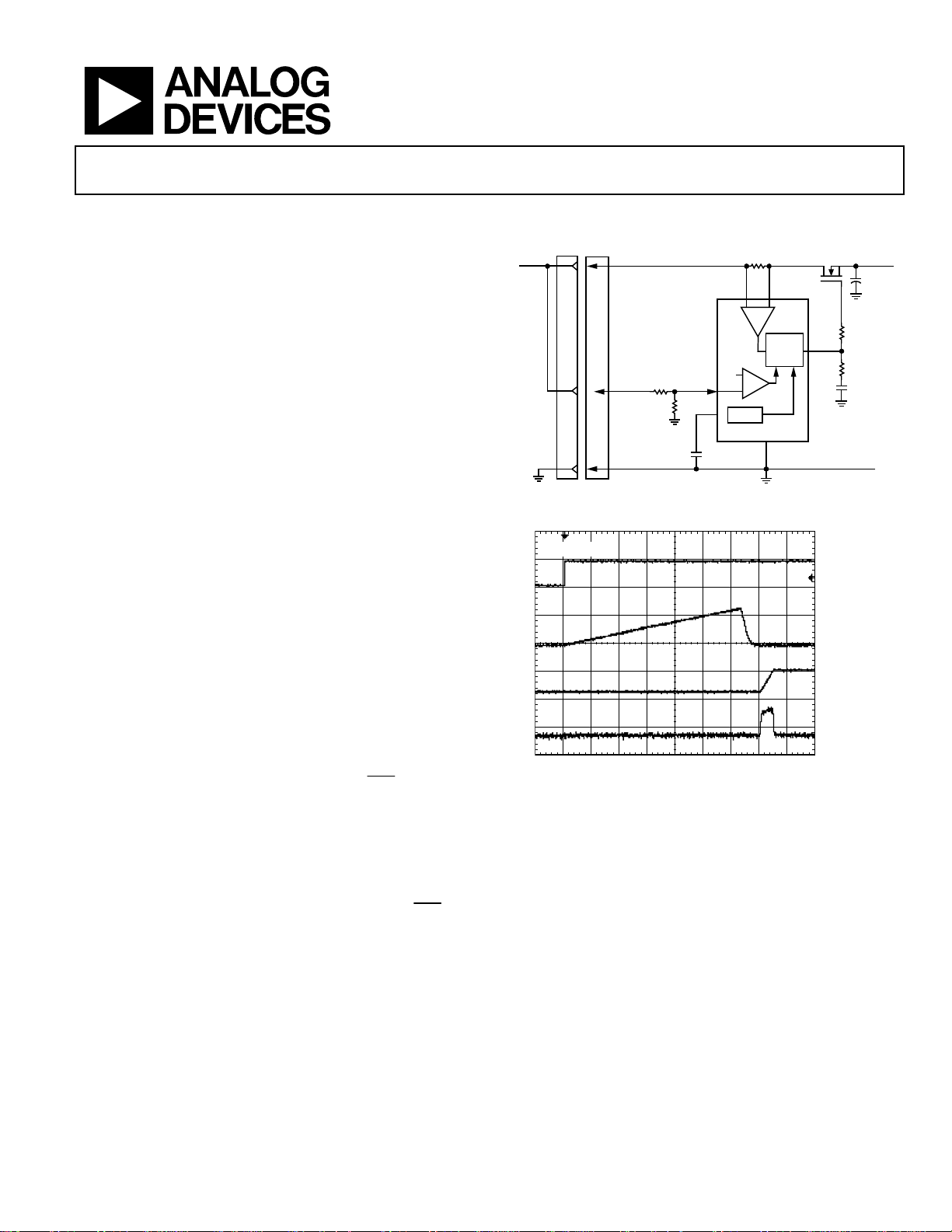
The ADM4210 is a hot swap controller that safely enables a
printed circuit board to be removed and inserted to a live
backplane. This is achieved using an external N-channel power
MOSFET with a current control loop that monitors the load
current through a sense resistor. An internal charge pump is
used to enhance the gate of the N-channel FET. When an
overcurrent condition is detected, the gate voltage of the FET is
reduced to limit the current flowing through the sense resistor.
During an overcurrent condition, the TIMER cap determines
the amount of time the FET remains at a current limiting mode
CLR
of operation until it is shut down. The ON (ONenable input for the device and can be used to monitor the
input supply voltage. The ADM4210 operates with a supply
voltage ranging from 2.7 V to 16.5 V.
) pin is the
in 6-Lead TSOT Package
ADM4210
FUNCTIONAL BLOCK DIAGRAM
R
ON
C
TIMER
0.22µF
V
1.3V
CC
TIMER
SENSE
0.01Ω
SENSE
GATE
DRIVE/
LOGIC
ADM4210
GND
Q
GATE
V
ON
(2V/DIV)
V
TIMER
(1V/DIV)
V
OUT
(5V/DIV)
I
OUT
(0.5A/ DIV)
1
VIN = 5V V
GND GND
LONG
SHORT
LONG
R
ON1
20kΩ
R
ON2
10kΩ
C
TIMER
Figure 1.
C
= 470µF
LOAD
10ms/DIV
Figure 2. Start-Up Sequence
OUT
+
R
G
100Ω
R
C
100Ω
C
0.01µF
C
470µF
C
= 5V
LOAD
05132-050
05132-001
The ADM4210 is available in two options: the ADM4210-1 with
automatic retry for overcurrent fault and the ADM4210-2 with
CLR
latch off for an overcurrent fault. Toggling the ON (ON-
)
pin resets a latched fault. The ADM4210 is packaged in a
6-lead TSOT.
Rev. 0
Information furnished by Analog Devices is believed to be accurate and reliable. However, no
responsibility is assumed by Anal og Devices for its use, nor for any infringements of patents or ot her
rights of third parties that may result from its use. Specifications subject to change without notice. No
license is granted by implication or otherwise under any patent or patent rights of Analog Devices.
Trademarks and registered trademarks are the property of their respective owners.
One Technology Way, P.O. Box 9106, Norwood, MA 02062-9106, U.S.A.
Tel: 781.329.4700 www.analog.com
Fax: 781.461.3113 ©2006 Analog Devices, Inc. All rights reserved.
Page 2

ADM4210
TABLE OF CONTENTS
Features.............................................................................................. 1
UVLO........................................................................................... 11
Applications....................................................................................... 1
General Description ......................................................................... 1
Functional Block Diagram .............................................................. 1
Revision History ............................................................................... 2
Specifications..................................................................................... 3
Absolute Maximum Ratings............................................................ 4
Thermal Characteristics .............................................................. 4
ESD Caution.................................................................................. 4
Pin Configurations and Function Descriptions ........................... 5
Typical Performance Characteristics ............................................. 6
Theory of Operation ...................................................................... 11
Overview...................................................................................... 11
REVISION HISTORY
7/06—Revision 0: Initial Version
ON (ON-
GATE ........................................................................................... 11
Current Limit Function............................................................. 11
Calculating the Current Limit.................................................. 11
Circuit Breaker Function........................................................... 12
Timer Function........................................................................... 12
Power-Up Timing Cycle............................................................ 12
Circuit Breaker Timing Cycle................................................... 13
Automatic Retry or Latched Off............................................... 13
Outline Dimensions....................................................................... 14
Ordering Guide .......................................................................... 14
CLR
) Pin..................................................................... 11
Rev. 0 | Page 2 of 16
Page 3

ADM4210
SPECIFICATIONS
VCC = 2.7 V to 16.5 V, TA = −40°C to +85°C, typical values at TA = 25°C, unless otherwise noted.
Table 1.
Parameter Symbol Min Typ Max Unit Conditions
VCC PIN
Operating Voltage Range VCC 2.7 16.5 V
Supply Current ICC 0.65 3.5 mA
Undervoltage Lockout V
Undervoltage Lockout Hysteresis V
ON (ON-CLR) PIN
Input Current
Threshold VON 1.22 1.3 1.38 V ON rising
Threshold Hysteresis V
SENSE PIN
Input Current
Circuit Breaker Limit Voltage VCB 44 50 56 mV VCB = (VCC− V
GATE PIN
Pull-Up Current I
Pull-Down Current I
V
V
Gate Drive Voltage
4.5 7.5 10 V V
5.0 8.5 12 V V
8.75 12 16 V V
7.6 12 16 V V
6.0 11 18 V V
TIMER PIN
Pull-Up Current I
−25 −60 −100 µA During current fault, V
Pull-Down Current
100 µA Normal operation, V
Threshold High V
Threshold Low V
t
OFF
Turn-Off Time (TIMER Rise to GATE Fall)
Turn-Off Time (ON (ON-CLR) Fall to GATE Fall)
Turn-Off Time (VCC Rise to IC Reset) t
2.2 2.5 2.65 V VCC rising
UVLO
100 mV
UVLOHYS
I
−10 0 +10 µA
INON
80 mV
ONHYST
I
−10 +5 +10 µA V
INSENSE
−5 −10 −15 µA V
GATEUP
25 mA V
GATEDN
V
GATE
−2 −5 −8.5 µA Initial cycle, V
TIMERUP
I
2 3.5 µA After current fault, V
TIMERDN
1.22 1.3 1.38 V TIMER rising
TIMERH
0.15 0.2 0.25 V TIMER falling
TIMERL
t
OFF(TMRHIGH)
t
OFF(ONLOW)
OFF(VCCLOW)
1 µs V
30 µs VON = 5 V to 0 V step, VCC = 5 V
30 µs VCC = 0 V to 2 V step, VON = 5 V
= VCC
SENSE
= 0 V
GATE
= 1.5 V, V
TIMER
= 0 V, V
ON
− V
CC
SENSE
− VCC, VCC = 3 V
GATE
− VCC, VCC = 3.3 V
GATE
− VCC, VCC = 5 V
GATE
− VCC, VCC = 12 V
GATE
− VCC, VCC = 15 V
GATE
= 0 V to 2 V step, VCC = VON = 5 V
TIMER
)
SENSE
= 3 V or
GATE
= 3 V or
GATE
= 100 mV, V
= 1 V
TIMER
TIMER
TIMER
GATE
TIMER
= 1 V
= 1 V
= 3 V
= 1 V
Rev. 0 | Page 3 of 16
Page 4
ADM4210
ABSOLUTE MAXIMUM RATINGS
Table 2.
Parameter Rating
VCC Pin −0.3 V to +20 V
SENSE Pin −0.3 V to +20 V
VCC − SENSE ±5 V
TIMER Pin −0.3 V to (VCC + 0.3 V)
ON (ON-CLR) Pin
GATE Pin −0.3 V to (VCC + 11 V)
Storage Temperature Range −65°C to +125°C
Operating Temperature Range −40°C to +85°C
Lead Temperature (10 sec) 300°C
Junction Temperature 150°C
−0.3 V to +20 V
ESD CAUTION
ESD (electrostatic discharge) sensitive device. Electrostatic charges as high as 4000 V readily accumulate on
the human body and test equipment and can discharge without detection. Although this product features
proprietary ESD protection circuitry, permanent damage may occur on devices subjected to high energy
electrostatic discharges. Therefore, proper ESD precautions are recommended to avoid performance
degradation or loss of functionality.
Stresses above those listed under Absolute Maximum Ratings
may cause permanent damage to the device. This is a stress
rating only; functional operation of the device at these or any
other conditions above those indicated in the operational
section of this specification is not implied. Exposure to absolute
maximum rating conditions for extended periods may affect
device reliability.
THERMAL CHARACTERISTICS
θJA is specified for the worst-case conditions, that is, a device
soldered in a circuit board for surface-mount packages.
Table 3. Thermal Resistance
Package Type θJA Unit
6-Lead TSOT 169.5 °C/W
Rev. 0 | Page 4 of 16
Page 5
ADM4210
A
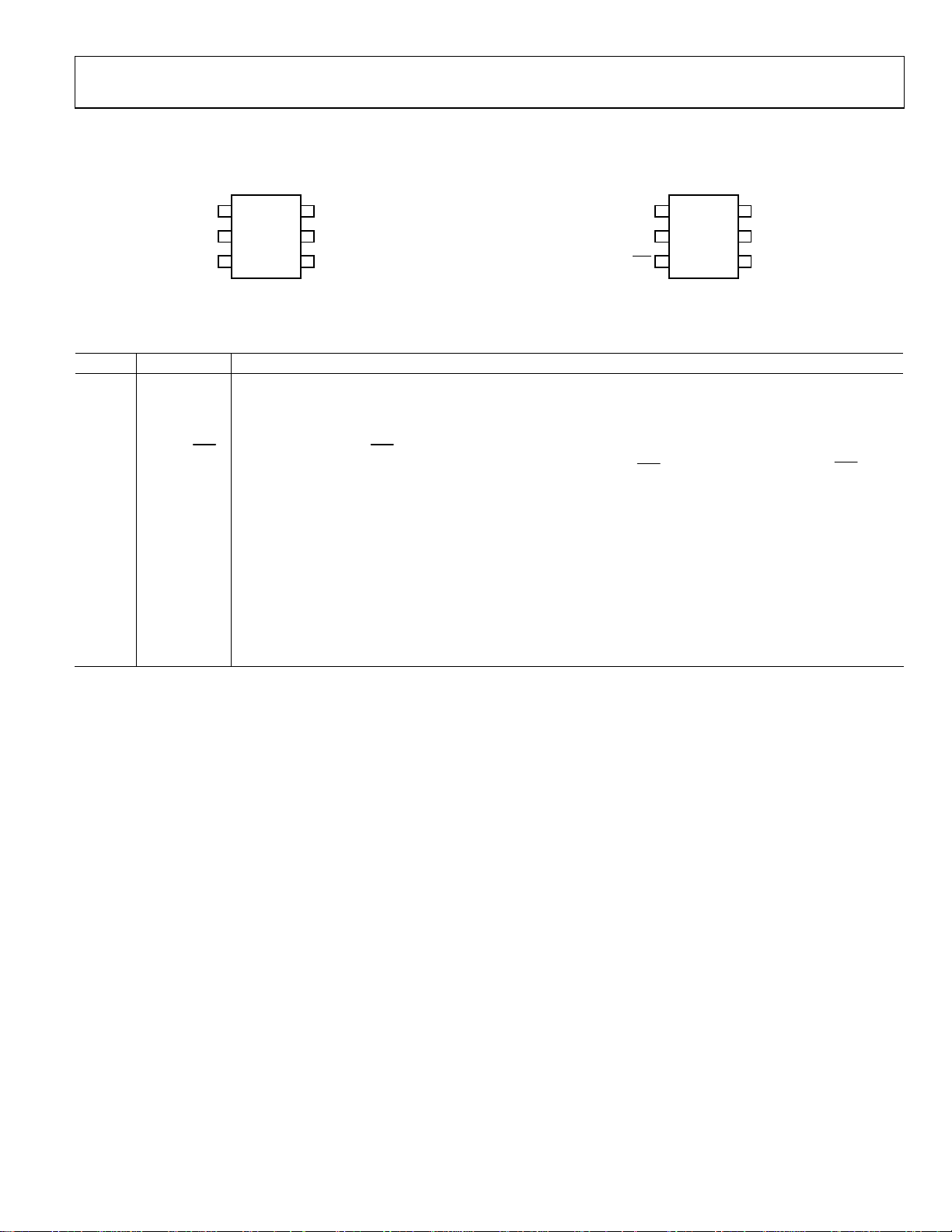
PIN CONFIGURATIONS AND FUNCTION DESCRIPTIONS
ADM4210-1AUJ
TIMER
GND
ON
1
TOP VIEW
2
(Not to Scale)
3
6
5
4
V
CC
SENSE
GATE
Figure 3. Pin Configuration, 1AUJ Model
Table 4. Pin Function Descriptions
Pin No. Mnemonic Description
1 TIMER
Timer Input Pin. The initial and circuit breaker timing cycles are set by this external capacitor. The initial timing
delay is 272.9 ms/F, and 21.7 ms/µF for a circuit breaker delay. When the TIMER pin is pulled beyond the upper
threshold, the GATE turns off.
2 GND Chip Ground Pin.
3
ON (ON-
CLR) Input Pin. The ON (ON-CLR) pin is an input to a comparator that has a low-to-high threshold of 1.3 V with 80 mV
hysteresis and a glitch filter. The ADM4210 is reset when the ON (ON-
high, the ADM4210 is enabled. A rising edge on this pin has the added function of clearing a fault and restarting
the device on the latched off model, the ADM4210-2.
4 GATE
Gate Output Pin. An internal charge pump provides a 12 µA pull-up current to drive the gate of an N-channel
MOSFET. In an overcurrent condition, the ADM4210 controls the external FET to maintain a constant load
current.
5 SENSE
Current Limit Sense Input Pin. The current limit is set via a sense resistor between the V
overcurrent condition, the gate of the FET is controlled to maintain the SENSE voltage at 50 mV. When this limit is
reached, the TIMER circuit breaker mode is activated. The circuit breaker limit can be disabled by connecting the
pin and SENSE pin together.
V
CC
6 VCC
Positive Supply Input Pin. The ADM4210 operates between 2.7 V to 16.5 V. An undervoltage lockout (UVLO)
circuit with a glitch filter resets the ADM4210 when the supply voltage drops below the specified UVLO limit.
DM4210-2AUJ
1
TIMER
GND 2
05132-006
ON-CLR
TOP VIEW
(Not to Scal e)
3
6
V
CC
SENSE5
GATE4
05132-007
Figure 4. Pin Configuration, 2AUJ Model
CLR) pin is low. When the ON (ON-
and SENSE pins. In an
CC
CLR
) pin is
Rev. 0 | Page 5 of 16
Page 6

ADM4210
–
TYPICAL PERFORMANCE CHARACTERISTICS
4.0
TA = 25°C
3.5
3.0
25
20
2.5
2.0
1.5
SUPPLY CURRENT (mA)
1.0
0.5
0
01
246810121416
SUPPLY VOLTAGE (V)
8
05132-032
Figure 5. Supply Current vs. Supply Voltage
1.0
0.9
0.8
0.7
0.6
0.5
0.4
0.3
SUPPLY CURRENT (mA)
0.2
0.1
0
–25 0 25 50 75 100 125
–50 150
VCC = 12V
VCC = 5V
TEMPERATURE (° C)
VCC = 15V
VCC = 3V
05132-033
Figure 6. Supply Current vs. Temperature
15
10
GATE VOLTAGE (V)
5
0
018
246810121416
Figure 8. GATE Voltage vs. Supply Voltage
25
20
15
10
GATE VOLTAGE (V)
5
0
–25 0 25 50 75 100 125
–50 150
Figure 9. GATE Voltage vs. Temperature
SUPPLY VOLTAGE (V)
VCC = 15V
VCC = 12V
VCC = 5V
VCC = 3V
TEMPERATURE (° C)
05132-013
05132-015
2.65
VCC = 5V
2.63
2.61
2.59
2.57
2.55
2.53
2.51
UVLO THRESHO LD (V)
2.49
2.47
2.45
–25 0 25 50 75 100 125
–50 150
TEMPERATURE (° C)
VCC RISING
VCC FALLING
Figure 7. UVLO Threshold vs. Temperature
05132-046
8
–9
–10
–11
–12
GATE CURRENT (µA)
–13
–14
246810121416
01
SUPPLY VOLTAGE (V)
8
05132-009
Figure 10. GATE Current (up) vs. Supply Voltage
Rev. 0 | Page 6 of 16
Page 7

ADM4210
–
–
11.0
–11.2
–11.4
–11.6
–11.8
–12.0
–12.2
GATE CURRENT (µ A)
–12.4
–12.6
–12.8
–13.0
VCC = 5V
VCC = 15V
–50 150
–25 0 25 50 75 100 125
TEMPERATURE (° C)
VCC = 3V
VCC = 12V
Figure 11. GATE Current (up) vs. Temperature
05132-017
0
TA = 25°C
–1
–2
–3
–4
(µA)
–5
–6
TIMERUP
I
–7
–8
–9
–10
01
246810121416
SUPPLY VOLTAGE (V)
Figure 14. I
(in Initial Cycle) vs. Supply Voltage
TIMERUP
8
05132-035
10
9
8
7
6
5
4
3
DELTA GATE VOLTAGE (V)
2
1
0
246810121416
01
SUPPLY VOLTAGE (V)
8
05132-014
Figure 12. Delta GATE Voltage vs. Supply Voltage
10
9
VCC = 12V
8
7
6
5
4
3
DELTA GATE VOLTAGE (V)
2
1
0
–25 0 25 50 75 100 125
–50 150
TEMPERATURE (° C)
VCC = 5V
VCC = 15V
VCC = 3V
05132-016
Figure 13. Delta GATE Voltage vs. Temperature
0
VCC = 5V
–1
–2
–3
–4
(µA)
–5
–6
TIMERUP
I
–7
–8
–9
–10
–50 150
–25 0 25 50 75 100 125
Figure 15. I
20
TA = 25°C
–30
–40
–50
(µA)
–60
TIMERUP
I
–70
–80
–90
–100
Figure 16. I
246810121416
01
TIMERUP
TEMPERATURE (° C)
(in Initial Cycle) vs. Temperature
TIMERUP
SUPPLY VOLTAGE (V)
(During Cct Breaker Delay) vs. Supply Voltage
05132-038
8
05132-036
Rev. 0 | Page 7 of 16
Page 8

ADM4210
–
20
VCC = 5V
–30
1.38
1.36
TA = 25°C
–40
–50
(µA)
–60
TIMERUP
I
–70
–80
–90
–100
–50 150
–25 0 25 50 75 100 125
TEMPERATURE (° C)
Figure 17. I
3.0
TA = 25°C
2.8
2.6
2.4
2.2
(µA)
2.0
1.8
TIMERDN
I
1.6
1.4
1.2
1.0
01
Figure 18. I
(During Cct Breaker Delay) vs. Temperature
TIMERUP
246810121416
SUPPLY VOLTAGE (V)
(in Cool-Off Cycle) vs. Supply Voltage
TIMERDN
05132-039
8
05132-034
1.34
1.32
1.30
1.28
1.26
TIMER HIGH THRESHOLD (V)
1.24
1.22
01
246810121416
Figure 20. TIMER High Threshold vs. Supply Voltage
1.38
VCC = 5V
1.36
1.34
1.32
1.30
1.28
1.26
TIMER HIGH THRESHOLD (V)
1.24
1.22
–25 0 25 50 75 100 125
–50 150
Figure 21. TIMER High Threshold vs. Temperature
SUPPLY VOLTAGE (V)
TEMPERATURE (° C)
8
05132-042
05132-044
3.0
VCC = 5V
2.8
2.6
2.4
2.2
(µA)
2.0
1.8
TIMERDN
I
1.6
1.4
1.2
1.0
–50 150
–25 0 25 50 75 100 125
TEMPERATURE (° C)
Figure 19. I
(in Cool-Off Cycle) vs. Temperature
TIMERDN
05132-037
Rev. 0 | Page 8 of 16
0.24
TA = 25°C
0.23
0.22
0.21
0.20
0.19
0.18
TIMER LOW THRESHOLD (V)
0.17
0.16
246810121416
01
SUPPLY VOLTAGE (V)
8
05132-043
Figure 22. TIMER Low Threshold vs. Supply Voltage
Page 9

ADM4210
0.24
0.23
VCC = 5V
1.45
1.40
VCC = 5V
0.22
0.21
0.20
0.19
0.18
TIMER LO W THRESHOL D (V)
0.17
0.16
–50 150
–25 0 25 50 75 100 125
TEMPERATURE (° C)
Figure 23. TIMER Low Threshold vs. Temperature
1.45
TA = 25°C
1.40
1.35
1.30
1.25
1.20
1.15
ON (ON- CLR) PI N THRESHOLD ( V)
1.10
HIGH THRESHOLD
LOW THRES HOLD
1.35
1.30
1.25
1.20
1.15
ON (ON-CLR) PI N THRESHOLD ( V)
1.10
1.05
–50 150
–25 0 25 50 75 100 125
05132-045
Figure 25. ON (ON-
80
TA = 25°C
70
60
50
(µs)
40
30
OFF(ONLOW)
t
20
10
HIGH THRESHOL D
LOW THRESHOLD
TEMPERATURE (° C)
CLR
) Pin Threshold vs. Temperature
05132-041
1.05
246810121416
01
SUPPLY VOLTAGE (V)
CLR
Figure 24. ON (ON-
) Pin Threshold vs. Supply Voltage
8
05132-040
0
246810121416
018
Figure 26. t
SUPPLY VOLTAGE (V)
vs. Supply Voltage
OFF(ONLOW)
05132-047
Rev. 0 | Page 9 of 16
Page 10

ADM4210
80
70
60
50
(µs)
40
30
OFF(ONLOW)
t
20
10
0
–50 150
–25 0 25 50 75 100 125
VCC = 15V
VCC = 5V
VCC = 3V
Figure 27. t
VCC = 12V
TEMPERATURE (° C)
vs. Temperature
OFF(ONLOW)
50
45
40
35
30
(mV)
25
CB
V
20
15
10
5
0
–50 150
–25 0 25 50 75 100 125
05132-048
TEMPERATURE (° C)
05132-021
Figure 29. Cct Breaker Voltage vs. Temperature
50
49
48
47
46
(mV)
45
CB
V
44
43
42
41
40
01
246810121416
SUPPLY VOLTAGE (V)
8
05132-049
Figure 28. Cct Breaker Voltage vs. Supply Voltage
Rev. 0 | Page 10 of 16
Page 11

ADM4210
THEORY OF OPERATION
Many systems require the insertion or removal of circuit boards
to live backplanes. During this event, the supply bypass and holdup capacitors can require substantial transient currents from the
backplane power supply as they charge. These currents can
cause permanent damage to connector pins or undesirable glitches
and resets to the system.
The ADM4210 is intended to control the powering of a system
(on and off) in a controlled manner, allowing the board to be
removed from, or inserted into, a live backplane by protecting it
from excess currents. The ADM4210 can reside either on the
backplane or on the removable board.
OVERVIEW
The ADM4210 operates over a supply range of 2.7 V to 16.5 V.
As the supply voltage is coming up, an undervoltage lockout
circuit checks if sufficient supply voltage is present for proper
operation. During this period, the FET is held off by the GATE
pin being held to GND. When the supply voltage reaches a level
CLR
above UVLO and the ON (ON-
) pin is high, an initial timing
cycle ensures that the board is fully inserted in the backplane
before turning on the FET. The TIMER pin capacitor sets the
periods for all of the TIMER pin functions. After the initial
timing cycle, the ADM4210 monitors the inrush current
through an external sense resistor. Overcurrent conditions are
actively limited to 50 mV/R
for the circuit breaker timer
SENSE
limit. The ADM4210-1 automatically retries after a current
limit fault and the ADM4210-2 latches off. The retry duty cycle
on the ADM4210-1 timer function is limited to 3.8% for FET
cooling.
UVLO
If the VCC supply is too low for normal operation, an undervoltage lockout circuit holds the ADM4210 in reset. The GATE
pin is held to GND during this period. When the supply reaches
this UVLO voltage, the ADM4210 starts when the ON (ON-
CLR
)
pin condition is satisfied.
ON (ON-CLR) PIN
The ON (ONcomparator that has a low-to-high threshold of 1.3 V with 80 mV
hysteresis and a glitch filter. The ADM4210 is reset when the
ON (ONthe ADM4210 is enabled. A rising edge on this pin has the
added function of clearing a fault and restarting the device on
the latched off model, the ADM4210-2. A low input on the ON
CLR
(ONpin to ground and resets the timer. An external resistor divider at
the ON (ONlockout value higher than the internal UVLO circuit. There is a
glitch filter delay of approximately 3 μs on rising allowing the
addition of an RC filter at the ON (ON-
CLR
) pin is the enable pin. It is connected to a
CLR
) pin is low. When the ON (ON-
CLR
) pin is high,
) pin turns off the external FET by pulling the GATE
CLR
) pin can be used to program an undervoltage
CLR
) pin to increase the
delay time at card insertion. If using a short pin system to
enable the device, a pull-down resistor should be used to hold
the device prior to insertion.
GATE
Gate drive for the external N-channel MOSFET is achieved
using an internal charge pump. The gate driver consists of a
12 μA pull-up from the internal charge pump. There are various
pull-down devices on this pin. At a hot swap condition the board
is hot inserted to the supply bus. During this event, it is possible
for the external FET GATE capacitance to be charged up by the
sudden presence of the supply voltage. This can cause uncontrolled
inrush currents. An internal strong pull-down circuit holds
GATE low while in UVLO. This reduces current surges at insertion. After the initial timing cycle, the GATE is then pulled high.
During an overcurrent condition, the ADM4210 servos the
GATE pin in an attempt to maintain a constant current to the
load until the circuit breaker timeout completes. In the event of
a timeout, the GATE pin abruptly shuts down using the 4 mA
pull-down device. Care must be taken not to load the GATE pin
resistively because this reduces the gate drive capability.
CURRENT LIMIT FUNCTION
The ADM4210 features a fast response current control loop that
actively limits the current by reducing the gate voltage of the
external FET. This current is measured by monitoring the
voltage drop across an external sense resistor. The ADM4210
tries to regulate the gate of the FET to achieve a 50 mV voltage
drop across the sense resistor.
CALCULATING THE CURRENT LIMIT
The sense resistor connected between VCC and the SENSE pin is
used to determine the nominal fault current limit. This is given
by the following equation:
NOM
= VCB
ILIMIT
The minimum load current is given by Equation 2
MIN
= VCB
ILIMIT
The maximum load current is given by Equation 3
ILIMIT
MAX
= VCB
For proper operation, the minimum current limit must exceed
the circuit maximum operating load current with margin. The
sense resistor power rating must exceed
(VCB
)2/RSENSE
MAX
/RSENSE
NOM
/RSENSE
MIN
/RSENSE
MAX
MIN
(1)
NOM
(2)
MAX
(3)
MIN
Rev. 0 | Page 11 of 16
Page 12

ADM4210
V
CIRCUIT BREAKER FUNCTION
When the supply experiences a sudden current surge, such as a
low impedance fault on load, the bus supply voltage can drop
significantly to a point where the power to an adjacent card is
affected, potentially causing system malfunctions. The
ADM4210 limits the current drawn by the fault by reducing the
gate voltage of the external FET. This minimizes the bus supply
voltage drop caused by the fault and protects neighboring cards.
This is the end of the first section of the initial cycle. The 100 µA
current source then pulls down the TIMER pin until it reaches
0.2 V at Time Point 4. The initial cycle delay (Time Point 2 to
Time Point 4) relates to C
= 1.3 × C
t
INITIAL
TIMER
by equation
TIMER
/5 µA (4)
When the initial cycle ends, a start-up cycle activates and the
GATE pin is pulled high; the TIMER pin continues to pull down.
As the voltage across the sense resistor approaches the current
limit, a timer activates. This timer resets again if the sense
voltage returns below this level. If the sense voltage is any
voltage below 44 mV, the timer is guaranteed to be off. Should
the current continue to increase, the ADM4210 tries to regulate
the gate of the FET to achieve a limit of 50 mV across the sense
resistor. However, if the device is unable to regulate the fault
current and the sense voltage further increases, a larger pulldown, in the order of milliamperes, is enabled to compensate
for fast current surges. If the sense voltage is any voltage greater
than 56 mV, this pull-down is guaranteed to be on. When the
timer expires, the GATE pin shuts down.
TIMER FUNCTION
The TIMER pin is responsible for several key functions on the
ADM4210. A capacitor controls the initial power on reset time
and the amount of time an overcurrent condition lasts before
the FET shuts down. On the ADM4210-1, the timer pin also
controls the time between auto retry pulses. There are pull-up
and pull-down currents internally available to control the timer
functions. The voltage on the TIMER pin is compared with two
threshold voltages: COMP1 (0.2 V) and COMP2 (1.3 V). The
four timing currents are listed in
Table 5.
Timing Current Level (μA)
Pull-up 5
Pull-up 60
Pull-down 2
Pull-down 100
Tabl e 5.
TIMER
V
GATE
V
V
TIMER
V
GATE
V
V
V
OUT
V
ON
V
OUT
IN
1
RESET
MODE
2
INITIAL
CYCLE
3
START-UP
CYCLE
4
NORMAL
CYCLE
05126-002
Figure 30. Power-Up Timing
IN
ON
5µA
60µA
2µA
100µA
POWER-UP TIMING CYCLE
I
The ADM4210 is in reset when the ON (ON-
CLR
) pin is held
low. The GATE pin is pulled low and the TIMER pin is pulled
low with a 100 µA pull-down. At Time Point 2 in
ON (ON-
CLR
) pin is pulled high. For the device to startup
Figure 30, the
correctly, the supply voltage must be above UVLO, the ON
CLR
(ON-
) pin must be above 1.3 V, and the TIMER pin voltage
must be less than 0.2 V. The initial timing cycle begins when these
three conditions are met, and the TIMER pin is pulled high with
5 µA. At Time Point 3, the TIMER reaches the COMP2 threshold.
Rev. 0 | Page 12 of 16
RSENSE
INITIAL
RESET
MODE
CYCLE
START-UP
CYCLE
Figure 31. Power-Up into Capacitor
NORMAL
CYCLE
05126-003
Page 13

ADM4210
CIRCUIT BREAKER TIMING CYCLE AUTOMATIC RETRY OR LATCHED OFF
When the voltage across the sense resistor exceeds the circuit
breaker trip voltage, the 60 µA timer pull-up current is activated.
If the sense voltage falls below this level before the TIMER pin
reaches 1.3 V, the 60 µA pull-up is disabled and the 2 µA pulldown is enabled. This is likely to happen if the overcurrent fault
is only transient, such as an inrush current. This is shown in
Figure 31. However, if the overcurrent condition is continuous
and the sense voltage remains above the circuit breaker trip
voltage, the 60 µA pull-up remains active. This allows the TIMER
pin to reach the high trip point of 1.3 V and initiate the GATE
shutdown. On the ADM4210-2, the TIMER pin continues pulling
up but switches to the 5 µA pull-up when it reaches the 1.3 V
threshold. The device can be reset by toggling the ON-
CLR
pin
or by manually pulling the TIMER pin low. On the ADM4210-1,
the TIMER pin activates the 2 µA pull-down once the 1.3 V
threshold is reached, and continues to pull down until it reaches
the 0.2 V threshold. At this point, the 100 µA pull-down is
activated and the GATE pin is enabled. The device keeps
retrying in the manner as shown in
Figure 32.
The duty cycle of this automatic retry cycle is set to the ratio of
2 µA/60 µA, which approximates 3.8% on. The value of the
timer capacitor determines the on time of this cycle. This time
is calculated as follows:
= 1.3 × C
t
ON
t
= 1.1 × C
OFF
I
RSENSE
TIMER
TIMER
/60 A
/2 A
The ADM4210 is available in two models. The ADM4210-1
has an automatic retry system whereby when a current fault is
detected, the FET is shut down after a time determined by the
timer capacitor, and it is switched on again in a controlled continuous cycle to determine if the fault remains (see
Figure 32
for details). The period of this cycle is determined by the timer
capacitor at a duty cycle of 3.8% on and 96.2% off.
The ADM4210-2 model has a latch off system whereby when a
current fault is detected, the GATE is switched off after a time
determined by the timer capacitor (see
Toggling the ON-
CLR
pin, or pulling the TIMER pin to GND
Figure 33 for details).
for a brief period, resets this condition.
I
RSENSE
5µA
V
TIMER
V
GSFET
V
OUT
Figure 33. ADM4210-2 Latch Off After Overcurrent Fault
60µA
SHORTCIRCUIT
EVENT
COMP1COMP2
05126-005
2µA
V
V
GSFET
TIMER
V
OUT
60µA
SHORTCIRCUIT
EVENT
FAULT
CYCLE
100µA
COMP1COMP2
FAULT
CYCLE
Figure 32. ADM4210-1 Automatic Retry During Overcurrent Fault
5126-004
Rev. 0 | Page 13 of 16
Page 14

ADM4210
R
OUTLINE DIMENSIONS
2.90 BSC
4526
1.60 BSC
13
PIN 1
INDICATO
*
0.90
0.87
0.84
0.10 MAX
*
COMPLIANT TO JEDEC STANDARDS MO-193-AA WITH
THE EXCEPTION OF PACKAGE HEIGHT AND THICKNESS.
1.90
BSC
0.50
0.30
Figure 34. 6-Lead Thin Small Outline Transistor Package [TSOT]
Dimensions shown in millimeters
ORDERING GUIDE
Model Temperature Range Package Description Package Option Branding
ADM4210-1AUJZ-RL7
ADM4210-2AUJZ-RL7
1
Z = Pb-free part.
1
1
−40°C to +85°C
−40°C to +85°C
2.80 BSC
0.95 BSC
*
1.00 MAX
SEATING
PLANE
0.20
0.08
8°
0.60
4°
0.45
0°
0.30
(UJ-6)
6-Lead TSOT UJ-6 M2P
6-Lead TSOT UJ-6 M2Q
Rev. 0 | Page 14 of 16
Page 15

ADM4210
NOTES
Rev. 0 | Page 15 of 16
Page 16

ADM4210
NOTES
©2006 Analog Devices, Inc. All rights reserved. Trademarks and
registered trademarks are the property of their respective owners.
D05132-0-7/06(0)
Rev. 0 | Page 16 of 16
 Loading...