

Page 1
现货库存、技术资料、百科信息、热点资讯,精彩尽在鼎好!
VCCV
16-Bit, 750 kSPS, Unipolar/Bipolar
FEATURES
Multiple pins/software programmable input ranges:
5 V, 1 0 V, ± 5 V, ±1 0 V
Pins or serial SPI®-compatible input ranges/mode selection
Throughput
750 kSPS (warp mode)
600 kSPS (normal mode)
500 kSPS (impulse mode)
INL: ±0.75 LSB typical, ±1.5 LSB maximum (±23 ppm of FSR)
16-bit resolution with no missing codes
SNR: 92 minimum (5 V) @ 2 kHz, 94 dB typical (±10 V) @ 2 kHz
THD: −107 dB typical
iCMOS™ process technology
5 V internal reference: typical drift 3 ppm/°C; TEMP output
No pipeline delay (SAR architecture)
Parallel (16- or 8-bit bus) and serial 5 V/3.3 V interface
SPI-/QSPI™-/MICROWIRE™-/DSP-compatible
Power dissipation: 190 mW @ 750 kSPS
Pb-free, 48-lead LQFP and LFCSP (7 mm × 7 mm) packages
APPLICATIONS
Process control
Medical instruments
High speed data acquisition
Digital signal processing
Instrumentation
Spectrum analysis
AT E
GENERAL DESCRIPTION
The AD7612 is a 16-bit charge redistribution successive
approximation register (SAR), architecture analog-to-digital
converter (ADC) fabricated on Analog Devices, Inc.’s iCMOS
high voltage process. The device is configured through hardware or
via a dedicated write only serial configuration port for input
range and operating mode. The AD7612 contains a high speed
16-bit sampling ADC, an internal conversion clock, an internal
reference (and buffer), error correction circuits, and both serial
and parallel system interface ports. A falling edge on
samples the analog input on IN+ with respect to a ground
sense, IN−. The AD7612 features four different analog input
ranges and three different sampling modes: warp mode for the
fastest throughput, normal mode for the fastest asynchronous
throughput, and impulse mode where power consumption is
scaled linearly with throughput. Operation is specified from
−40°C to +85°C.
CNVST
Programmable Input PulSAR® ADC
AD7612
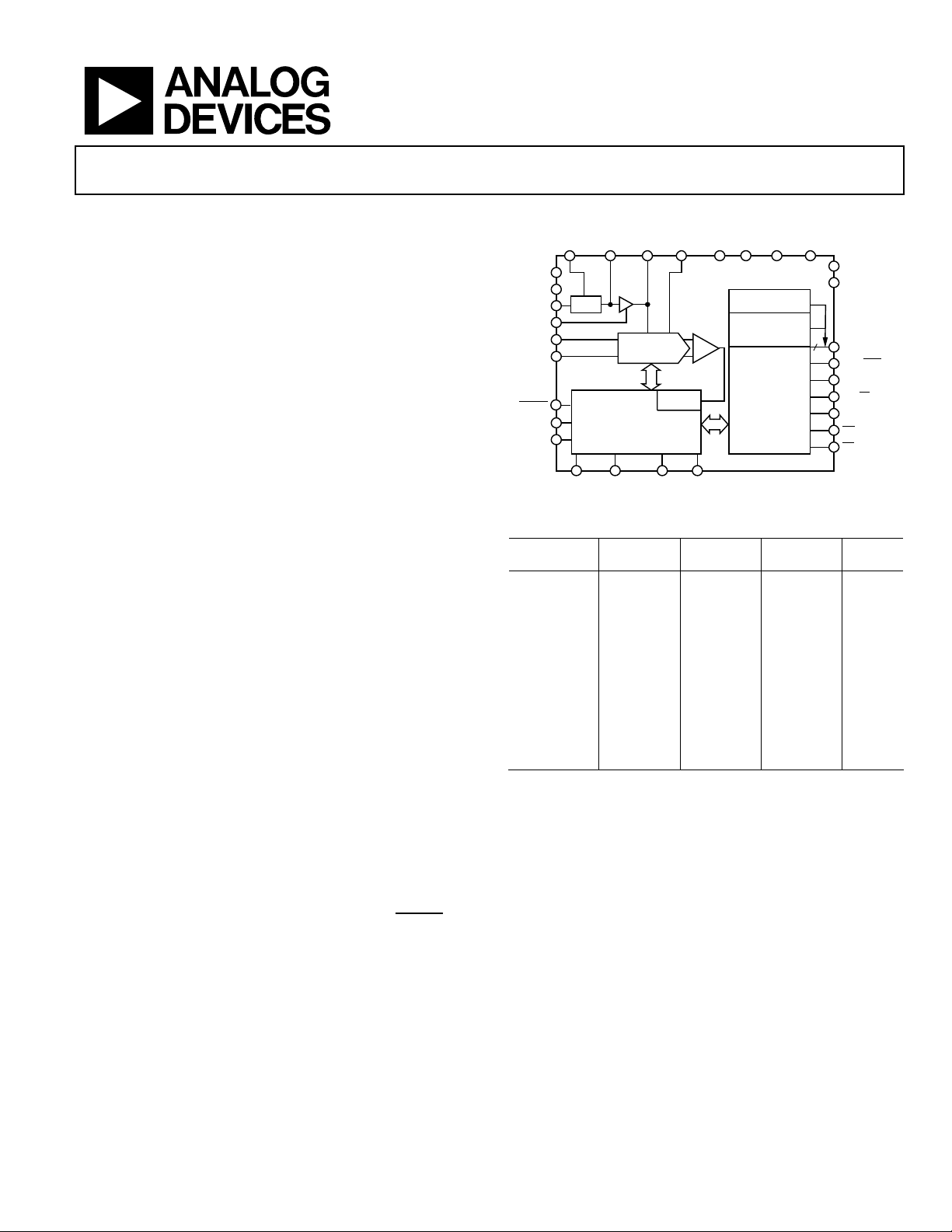
FUNCTIONAL BLOCK DIAGRAM
TEMP
REFBUFIN
AGND
AVDD
PDREF
PDBUF
CNVST
RESET
REF
IN+
IN–
PD
CONTROL L OGIC AND
CALIBRATI ON CIRCUITRY
WARP IMPULSE BI POLAR TEN
REF REFGND
REF
AMP
SWITCHED
CAP DAC
CLOCK
Figure 1.
EE
AD7612
SERIAL DATA
CONFIGURAT ION
PARALLEL
INTERFACE
Table 1. 48-Lead 14-/16-/18-Bit PulSAR Selection
100 kSPS to
Type
Pseudo
Differential
True Bipolar AD7663 AD7665 AD7612
True
Differential
18-Bit, True
Differential
Multichannel/
Simultaneous
250 kSPS
AD7651
AD7660
AD7661
AD7675 AD7676 AD7677 AD7621
AD7678 AD7679 AD7674 AD7641
AD7654
500 kSPS to
570 kSPS
AD7650
AD7652
AD7664
AD7666
AD7655
PRODUCT HIGHLIGHTS
1. Programmable input range and mode selection.
Pins or serial port for selecting input range/mode select.
2. Fast throughput.
In warp mode, the AD7612 is 750 kSPS.
3. Superior Linearity.
No missing 16-bit code. ±1.5 LSB max INL.
4. Internal Reference.
5 V internal reference with a typical drift of ±3 ppm/°C
and an on-chip temperature sensor.
5. Serial or Parallel Interface.
Versatile parallel (16- or 8-bit bus) or 2-wire serial interface
arrangement compatible with 3.3 V or 5 V logic.
DGNDDVDD
OVDD
OGND
PORT
SERIAL
PORT
16
D[15:0]
SER/PAR
BYTESWAP
OB/2C
BUSY
RD
CS
800 kSPS to
1000 kSPS
AD7653
AD7667
AD7671
>1000
kSPS
AD7622
AD7623
AD7643
06265-001
Rev. 0
Information furnished by Analog Devices is believed to be accurate and reliable. However, no
responsibility is assumed by Anal og Devices for its use, nor for any infringements of patents or ot her
rights of third parties that may result from its use. Specifications subject to change without notice. No
license is granted by implication or otherwise under any patent or patent rights of Analog Devices.
Trademarks and registered trademarks are the property of their respective owners.
One Technology Way, P.O. Box 9106, Norwood, MA 02062-9106, U.S.A.
Tel: 781.329.4700 www.analog.com
Fax: 781.461.3113 ©2006 Analog Devices, Inc. All rights reserved.
Page 2

AD7612
TABLE OF CONTENTS
Features.............................................................................................. 1
Analog Inputs .............................................................................20
Applications....................................................................................... 1
General Description......................................................................... 1
Functional Block Diagram ..............................................................1
Product Highlights........................................................................... 1
Revision History ...............................................................................2
Specifications..................................................................................... 3
Timing Specifications ..................................................................5
Absolute Maximum Ratings............................................................ 7
ESD Caution.................................................................................. 7
Pin Configuration and Function Descriptions............................. 8
Typical Performance Characteristics........................................... 12
Terminology.................................................................................... 16
Theory of Operation ......................................................................17
Overview...................................................................................... 17
Converter Operation.................................................................. 17
Driver Amplifier Choice ........................................................... 21
Voltage Reference Input/Output ..............................................21
Power Supplies............................................................................ 22
Conversion Control................................................................... 23
Interfaces.......................................................................................... 24
Digital Interface.......................................................................... 24
Parallel Interface......................................................................... 24
Serial Interface............................................................................ 25
Master Serial Interface............................................................... 25
Slave Serial Interface.................................................................. 27
Hardware Configuration........................................................... 29
Software Configuration............................................................. 29
Microprocessor Interfacing....................................................... 30
Application Information................................................................ 31
Layout Guidelines....................................................................... 31
Modes of Operation................................................................... 18
Transfer Functions......................................................................18
Typical Connection Diagram ...................................................19
REVISION HISTORY
10/06—Revision 0: Initial Version
Evaluating Performance ............................................................ 31
Outline Dimensions....................................................................... 32
Ordering Guide .......................................................................... 32
Rev. 0 | Page 2 of 32
Page 3

AD7612
SPECIFICATIONS
AVDD = DVDD = 5 V; OVDD = 2.7 V to 5.5 V; VCC = 15 V; VEE = −15 V; V
Table 2.
Parameter Conditions/Comments Min Typ Max Unit
RESOLUTION 16 Bits
ANALOG INPUT
Voltage Range, VIN V
V
V
V
V
Analog Input CMRR fIN = 100 kHz 75 dB
Input Current V
Input Impedance
THROUGHPUT SPEED
Complete Cycle In warp mode 1.33 s
Throughput Rate In warp mode 1 750
Time Between Conversions In warp mode 1 ms
Complete Cycle In normal mode 1.67 s
Throughput Rate In normal mode 0 600 kSPS
Complete Cycle In impulse mode 2 s
Throughput Rate In impulse mode 0 500 kSPS
DC ACCURACY
Integral Linearity Error
No Missing Codes
Differential Linearity Error
3
3
3
Transition Noise 0.55 LSB
Zero Error (Unipolar or Bipolar) −35 +35 LSB
Zero Error Temperature Drift ±1 ppm/°C
Bipolar Full-Scale Error −50 +50 LSB
Unipolar Full-Scale Error −70 +70 LSB
Full-Scale Error Temperature Drift ±1 ppm/°C
Power Supply Sensitivity AVDD = 5 V ± 5% 3 LSB
AC ACCURACY
Dynamic Range V
V
V
Signal-to-Noise Ratio V
V
Signal-to-(Noise + Distortion) (SINAD) V
V
V
Total Harmonic Distortion fIN = 2 kHz −107 dB
Spurious-Free Dynamic Range fIN = 2 kHz 107 dB
–3 dB Input Bandwidth V
Aperture Delay 2 ns
Aperture Jitter 5 ps rms
Transient Response Full-scale step 500 ns
INTERNAL REFERENCE PDREF = PDBUF = low
Output Voltage REF @ 25°C 4.965 5.000 5.035 V
Temperature Drift –40°C to +85°C ±3 ppm/°C
Line Regulation AVDD = 5 V ± 5% ±15 ppm/V
Long-Term Drift 1000 hours 50 ppm
Turn-On Settling Time C
− V
= 0 V to 5 V −0.1 +5.1 V
IN+
IN−
− V
= 0V to 10 V −0.1 +10.1 V
IN+
IN−
− V
= ±5 V −5.1 +5.1 V
IN+
IN−
− V
= ±10 V −10.1 +10.1 V
IN+
IN−
to AGND −0.1 +0.1 V
IN−
= ±5 V, ±10 V @ 750 kSPS 220
IN
See
Analog Inputs section
−1.5 ±0.75 +1.5 LSB
16 Bits
−1 +1.5 LSB
= 0 V to 5 V, fIN = 2 kHz, −60 dB 92.5 93.5 dB
IN
= 0 V to 10 V, ±5 V, fIN = 2 kHz, −60 dB 94 dB
IN
= ±10 V, fIN = 2 kHz, −60 dB 94.5 dB
IN
= 0 V to 5 V, 0 V to 10 V, fIN = 2 kHz 92 93 dB
IN
= ±5 V, ±10 V, fIN = 2 kHz 94 dB
IN
= ±5 V, fIN = 2 kHz 92.5 dB
IN
= 0 V to 10 V, ±5 V, fIN = 2 kHz 93 dB
IN
= ±10 V, fIN = 2 kHz 93.5 dB
IN
= 0 V to 5 V 45 MHz
IN
= 22 µF 10 ms
REF
= 5 V; all specifications T
REF
to T
MIN
, unless otherwise noted.
MAX
1
µA
2
kSPS
4
5
Rev. 0 | Page 3 of 32
Page 4

AD7612
Parameter Conditions/Comments Min Typ Max Unit
REFERENCE BUFFER PDREF = high
REFBUFIN Input Voltage Range 2.4 2.5 2.6 V
EXTERNAL REFERENCE PDREF = PDBUF = high
Voltage Range REF 4.75 5 AVDD + 0.1 V
Current Drain 750 kSPS throughput 250 µA
TEMPERATURE PIN
Voltage Output @ 25°C 311 mV
Temperature Sensitivity 1 mV/°C
Output Resistance 4.33 kΩ
DIGITAL INPUTS
Logic Levels
VIL −0.3 +0.6 V
VIH 2.1 OVDD + 0.3 V
IIL −1 +1 µA
IIH −1 +1 µA
DIGITAL OUTPUTS
Data Format Parallel or serial 16-bit
Pipeline Delay
VOL I
VOH I
POWER SUPPLIES
Specified Performance
AVDD 4.75
DVDD 4.75 5 5.25 V
OVDD 2.7 5.25 V
VCC 7 15 15.75 V
VEE −15.75 −15 0 V
Operating Current
AVDD
With Internal Reference 19.5 mA
With Internal Reference Disabled 18 mA
DVDD 6.5 mA
OVDD 0.5 mA
VCC VCC = 15 V, with internal reference buffer 3 mA
VCC = 15 V 2.3 mA
VEE VEE = −15 V 2 mA
Power Dissipation @ 750 kSPS throughput
With Internal Reference PDREF = PDBUF = low 205 230 mW
With Internal Reference Disabled PDREF = PDBUF = high 190 210 mW
In Power-Down Mode10 PD = high 10 µW
TEMPERATURE RANGE
Specified Performance T
1
With VIN = 0 V to 5 V or 0 V to 10 V ranges, the input current is typically 70 A. In all input ranges, the input current scales with throughput. See the Ana log Inp uts section.
2
All specified performance is guaranteed up to 750 kSPS throughout, however throughputs up to 900 kSPS can be used with some linearity performance degradation.
3
Linearity is tested using endpoints, not best fit. All linearity is tested with an external 5 V reference.
4
LSB means least significant bit. All specifications in LSB do not include the error contributed by the reference.
5
All specifications in decibels are referred to a full-scale range input, FSR. Tested with an input signal at 0.5 dB below full-scale, unless otherwise specified.
6
Conversion results are available immediately after completed conversion.
7
4.75 V or V
8
Tested in parallel reading mode.
9
With internal reference, PDREF = PDBUF = low; with internal reference disabled, PDREF = PDBUF = high. With internal reference buffer, PDBUF = low.
10
With all digital inputs forced to OVDD.
11
Consult sales for extended temperature range.
6
8, 9
11
– 0.1 V, whichever is larger.
REF
= 500 µA 0.4 V
SINK
= –500 µA OVDD − 0.6 V
SOURCE
7
5 5.25 V
@ 750 kSPS throughput
to T
MIN
−40 +85 °C
MAX
Rev. 0 | Page 4 of 32
Page 5
AD7612
TIMING SPECIFICATIONS
AVDD = DVDD = 5 V; OVDD = 2.7 V to 5.5 V; VCC = 15 V; VEE = −15 V; V
Table 3.
Parameter Symbol Min Typ Max Unit
CONVERSION AND RESET (See Figure 33 and Figure 34)
Convert Pulse Width t1 10 ns
Time Between Conversions t2
Warp Mode/Normal Mode/Impulse Mode1 1.33/1.67/2 μs
CNVST Low to BUSY High Delay
BUSY High All Modes (Except Master Serial Read After Convert) t4
Warp Mode/Normal Mode/Impulse Mode 950/1250/1450 ns
Aperture Delay t5 2 ns
End of Conversion to BUSY Low Delay t6 10 ns
Conversion Time t7
Warp Mode/Normal Mode/Impulse Mode 950/1250/1450 ns
Acquisition Time t8
Warp Mode/Normal Mode/Impulse Mode 380 ns
RESET Pulse Width t9 10 ns
PARALLEL INTERFACE MODES (See Figure 35 and Figure 37)
CNVST Low to DATA Valid Delay
Warp Mode/Normal Mode/Impulse Mode 910/1160/1410 ns
DATA Valid to BUSY Low Delay t11 20 ns
Bus Access Request to DATA Valid t12 40 ns
Bus Relinquish Time t13 2 15 ns
MASTER SERIAL INTERFACE MODES2 (See Figure 39 and Figure 40)
CS Low to SYNC Valid Delay
CS Low to Internal SDCLK Valid Delay2
CS Low to SDOUT Delay
CNVST Low to SYNC Delay, Read During Convert
Warp Mode/Normal Mode/Impulse Mode 65/315/560 ns
SYNC Asserted to SDCLK First Edge Delay t18 3 ns
Internal SDCLK Period3 t
Internal SDCLK High3 t
Internal SDCLK Low3 t
SDOUT Valid Setup Time3 t
SDOUT Valid Hold Time3 t
SDCLK Last Edge to SYNC Delay3 t
CS High to SYNC HI-Z
CS High to Internal SDCLK HI-Z
CS High to SDOUT HI-Z
BUSY High in Master Serial Read After Convert3 t
CNVST Low to SYNC Delay, Read After Convert
Warp Mode/Normal Mode/Impulse Mode t29 830/1070/1310 ns
SYNC Deasserted to BUSY Low Delay t30 25 ns
= 5 V; all specifications T
REF
t
35 ns
3
t
10
t
10 ns
14
t
10 ns
15
t
10 ns
16
t
17
30 45 ns
19
15 ns
20
10 ns
21
4 ns
22
5 ns
23
5 ns
24
t
10 ns
25
t
10 ns
26
t
10 ns
27
See Table 4
28
MIN
to T
, unless otherwise noted.
MAX
Rev. 0 | Page 5 of 32
Page 6
AD7612
Parameter Symbol Min Typ Max Unit
SLAVE SERIAL/SERIAL CONFIGURATION INTERFACE MODES2 (See Figure 42,
Figure 43, and Figure 45)
External SDCLK, SCCLK Setup Time t31 5 ns
External SDCLK Active Edge to SDOUT Delay t32 2 18 ns
SDIN/SCIN Setup Time t33 5 ns
SDIN/SCIN Hold Time t34 5 ns
External SDCLK/SCCLK Period t35 25 ns
External SDCLK/SCCLK High t36 10 ns
External SDCLK/SCCLK Low t37 10 ns
1
In warp mode only, the time between conversions is 1 ms; otherwise, there is no required maximum time.
2
In serial interface modes, the SDSYNC, SDSCLK, and SDOUT timings are defined with a maximum load CL of 10 pF; otherwise, the load is 60 pF maximum.
3
In serial master read during convert mode. See Table 4 for serial master read after convert mode.
Table 4. Serial Clock Timings in Master Read After Convert Mode
DIVSCLK[1]
DIVSCLK[0] Symbol 0 1 0 1 Unit
SYNC to SDCLK First Edge Delay Minimum t18 3 20 20 20 ns
Internal SDCLK Period Minimum t19 30 60 120 240 ns
Internal SDCLK Period Maximum t19 45 90 180 360 ns
Internal SDCLK High Minimum t20 15 30 60 120 ns
Internal SDCLK Low Minimum t21 10 25 55 115 ns
SDOUT Valid Setup Time Minimum t22 4 20 20 20 ns
SDOUT Valid Hold Time Minimum t23 5 8 35 90 ns
SDCLK Last Edge to SYNC Delay Minimum t24 5 7 35 90 ns
BUSY High Width Maximum t28
Warp Mode 1.65 2.35 3.75 6.53 μs
Normal Mode 1.9 2.6 4.00 6.78 μs
Impulse Mode 2.15 2.85 4.25 7.03 μs
0 0 1 1
1.6mA I
TO OUTPUT
PIN
C
L
60pF
500µA I
NOTES
1. IN SERIAL INTERFACE MODES, THE S Y NC, SCLK, AND
SDOUT ARE DEF INED WITH A M AXIMUM LOAD
OF 10pF; OTHERWISE, THE LOAD IS 60pF MAXIMUM.
C
L
OL
1.4V
OH
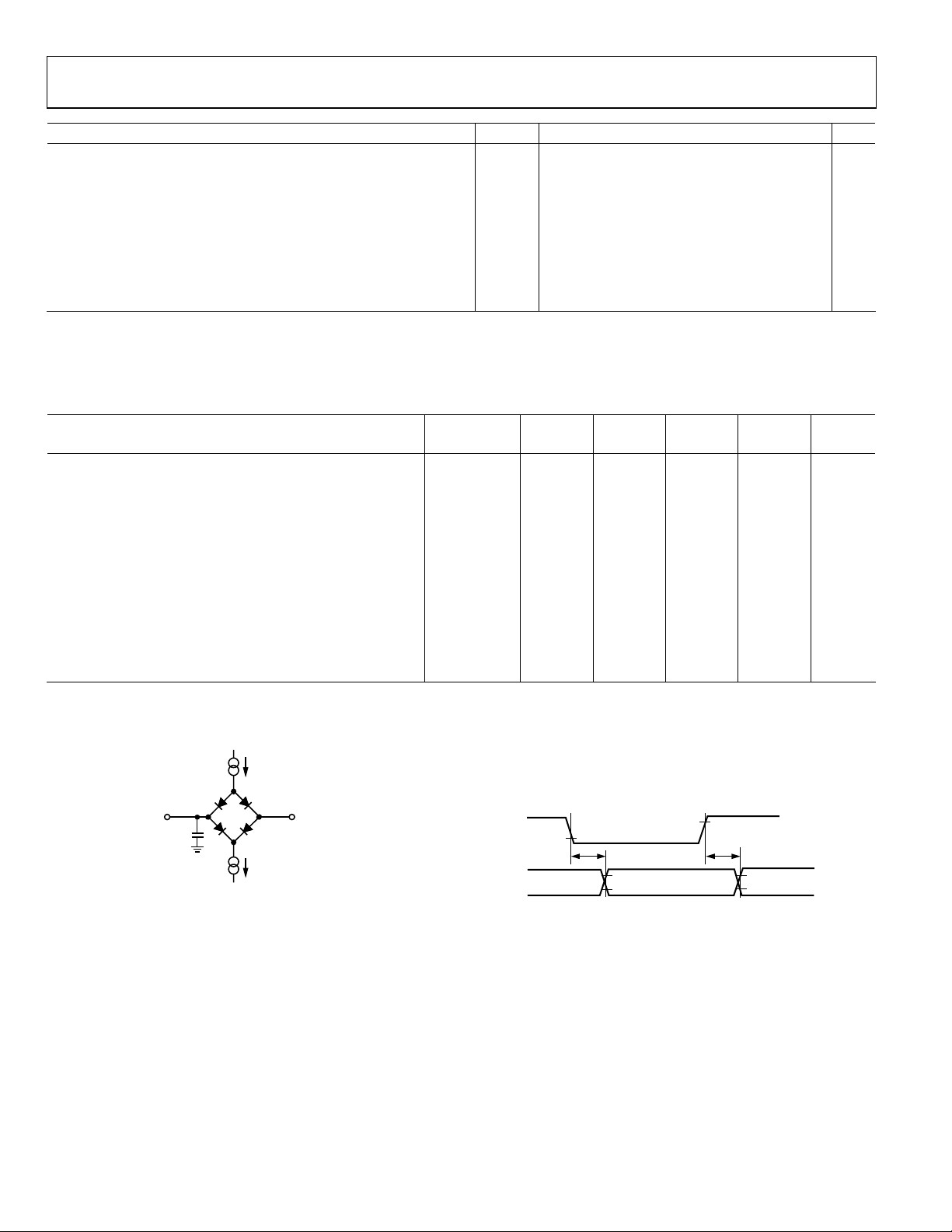
Figure 2. Load Circuit for Digital Interface Timing,
SDOUT, SYNC, and SCLK Outputs, C
= 10 pF
L
6265-002
Rev. 0 | Page 6 of 32
2V
0.8V
t
DELAY
2V
t
DELAY
2V
0.8V0.8V
06265-003
Figure 3. Voltage Reference Levels for Timing
Page 7
AD7612
ABSOLUTE MAXIMUM RATINGS
Table 5.
Parameter Rating
Analog Inputs/Outputs
IN+1, IN−1 to AGND VEE − 0.3 V to VCC + 0.3 V
REF, REFBUFIN, TEMP,
REFGND to AGND
AVDD + 0.3 V to
AGND − 0.3 V
Ground Voltage Differences
AGND, DGND, OGND ±0.3 V
Supply Voltages
AVDD, DVDD, OVDD −0.3 V to +7 V
AVDD to DVDD, AVDD to OVDD ±7 V
DVDD to OVDD ±7 V
VCC to AGND, DGND –0.3 V to +16.5
VEE to GND +0.3 V to −16.5
Digital Inputs −0.3 V to OVDD + 0 .3 V
PDREF, PDBUF
2
±20 mA
Internal Power Dissipation3 700 mW
Internal Power Dissipation4 2.5 W
Junction Temperature 125°C
Storage Temperature Range −65°C to +125°C
1
See the Analog Inputs section.
2
See the Voltage Reference Input section.
3
Specification is for the device in free air: 48-Lead LFQP; θJA = 91°C/W,
θJC = 30°C/W.
4
Specification is for the device in free air: 48-Lead LFCSP; θJA = 26°C/W.
Stresses above those listed under Absolute Maximum Ratings
may cause permanent damage to the device. This is a stress
rating only; functional operation of the device at these or any
other conditions above those indicated in the operational
section of this specification is not implied. Exposure to absolute
maximum rating conditions for extended periods may affect
device reliability.
ESD CAUTION
Rev. 0 | Page 7 of 32
Page 8
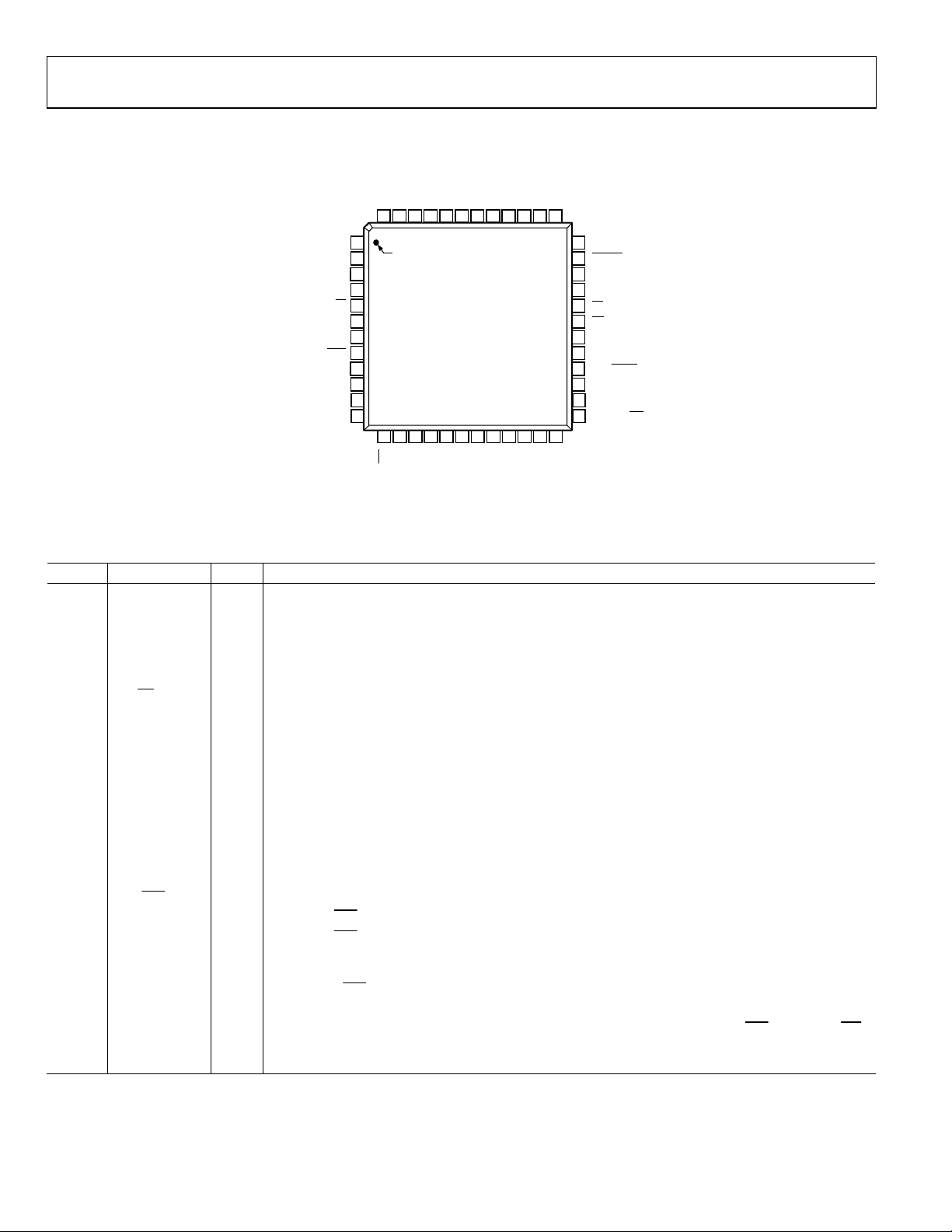
AD7612
PIN CONFIGURATION AND FUNCTION DESCRIPTIONS
VEE
DGND
IN–
VCC
REFGND
REF
36
BIPOLAR
35
CNVST
34
PD
33
RESET
32
CS
31
RD
30
TEN
29
BUSY
28
D15/SCCS
27
D14/SCCLK
26
D13/SCIN
25
D12/HW/SW
D10/SYNC
D8/SDOUT
D9/SDCLK
06265-004
D11/RDERROR
AGND
AVDD
AGND
BYTESWAP
OB/2C
WARP
IMPULSE
SER/PAR
D0
D1
D2/DIVSCLK[0]
D3/DIVSCLK[1]
PDBUF
PDREF
REFBUFIN
48 47 46 45 44 43 42 41 40 39 38 37
1
PIN 1
2
3
4
5
6
7
8
9
10
11
12
13
14 15 16 17 18 19 20 21 22 23 24
D4/EXT/INT
D6/INVSCLK
D5/INVSYNC
IN+
TEMP
AVDD
AD7612
TOP VIEW
(Not to Scale)
OVDD
OGND
D7/RDC/SDIN
AGND
DVDD
Figure 4. Pin Configuration
Table 6. Pin Function Descriptions
Pin No. Mnemonic Type1 Description
1, 3, 42 AGND P
Analog Power Ground Pins. Ground reference point for all analog I/O. All analog I/O should be
referenced to AGND and should be connected to the analog ground plane of the system. In addition,
the AGND, DGND, and OGND voltages should be at the same potential.
2, 44 AVDD P Analog Power Pins. Nominally 4.75 V to 5.25 V and decoupled with 10 μF and 100 nF capacitors.
4 BYTESWAP DI
Parallel Mode Selection (8-Bit/16-Bit). When high, the LSB is output on D[15:8] and the MSB is output
on D[7:0]; when low, the LSB is output on D[7:0] and the MSB is output on D[15:8].
2
5
OB/2C
DI
Straight Binary/Binary Twos Complement Output. When high, the digital output is straight binary.
When low, the MSB is inverted resulting in a twos complement output from its internal shift register.
6 WARP DI2 Conversion Mode Selection. Used in conjunction with the IMPULSE input per the following:
Conversion Mode WARP IMPULSE
Normal Low Low
Impulse Low High
Warp High Low
Normal High High
See the Modes of Operation section for a more detailed description.
7 IMPULSE DI2
Conversion Mode Selection. See the WARP pin description in the previous row of this table. See the
Modes of Operation section for a more detailed description.
8
SER/PAR
DI Serial/Parallel Selection Input.
When SER/PAR
When SER/PAR
= low, the parallel mode is selected.
= high, the serial modes are selected. Some bits of the data bus are used as a serial port
and the remaining data bits are high impedance outputs.
9, 10 D[0:1] DO
Bit 0 and Bit 1 of the parallel port data output bus. These pins are always outputs regardless of the
state of SER/PAR
.
11, 12 D[2:3] or DI/O In parallel mode, these outputs are used as Bit 2 and Bit 3 of the parallel port data output bus.
DIVSCLK[0:1]
Serial Data Division Clock Selection. In serial master read after convert mode (SER/PAR
= high, EXT/INT
= low, RDC/SDIN = low) these inputs can be used to slow down the internally generated serial data
clock that clocks the data output. In other serial modes, these pins are high impedance outputs.
Rev. 0 | Page 8 of 32
Page 9
AD7612
Pin No. Mnemonic Type1 Description
13 D4 or DI/O In parallel mode, this output is used as Bit 4 of the parallel port data output bus.
14 D5 or DI/O In parallel mode, this output is used as Bit 5 of the parallel port data output bus.
INVSYNC
15 D6 or DI/O In parallel mode, this output is used as Bit 6 of the parallel port data output bus.
INVSCLK In all serial modes, invert SDCLK/SCCLK select. This input is used to invert both SDCLK and SCCLK.
16 D7 or DI/O In parallel mode, this output is used as Bit 7 of the parallel port data output bus.
RDC or
SDIN
17 OGND P
18 OVDD P
19 DVDD P
20 DGND P
21 D8 or DO In parallel mode, this output is used as Bit 8 of the parallel port data output bus.
SDOUT
22 D9 or DI/O In parallel mode, this output is used as Bit 9 of the parallel port data output bus.
SDCLK
23 D10 or DO In parallel mode, this output is used as Bit 10 of the parallel port data output bus.
SYNC
EXT/INT
Serial Data Clock Source Select. In serial mode, this input is used to select the internally generated
(master) or external (slave) serial data clock for the AD7612 output data.
When EXT/INT
When EXT/INT = high, slave mode; the output data is synchronized to an external clock signal (gated by CS)
connected to the SDCLK input.
Serial Data Invert Sync Select. In serial master mode (SER/PAR
to select the active state of the SYNC signal.
When INVSYNC = low, SYNC is active high.
When INVSYNC = high, SYNC is active low.
When INVSCLK = low, the rising edge of SDCLK/SCCLK are used.
When INVSCLK = high, the falling edge of SDCLK/SCCLK are used.
Serial Data Read During Convert. In serial master mode (SER/PAR
select the read mode. Refer to the Master Serial Interface section.
When RDC = low, the current result is read after conversion. Note the maximum throughput is not
attainable in this mode.
When RDC = high, the previous conversion result is read during the current conversion.
Serial Data In. In serial slave mode (SER/PAR
daisy-chain the conversion results from two or more ADCs onto a single SDOUT line. The digital data
level on SDIN is output on SDOUT with a delay of 16 SDCLK periods after the initiation of the read sequence.
Input/Output Interface Digital Power Ground. Ground reference point for digital outputs. Should be
connected to the system digital ground ideally at the same potential as AGND and DGND.
Input/Output Interface Digital Power. Nominally at the same supply as the supply of the host interface
2.5 V, 3 V, or 5 V and decoupled with 10 μF and 100 nF capacitors.
Digital Power. Nominally at 4.75 V to 5.25 V and decoupled with 10 μF and 100 nF capacitors. Can be
supplied from AVDD.
Digital Power Ground. Ground reference point for digital outputs. Should be connected to system
digital ground ideally at the same potential as AGND and OGND.
Serial Data output. In all serial modes this pin is used as the serial data output synchronized to SDCLK.
Conversion results are stored in an on-chip register. The AD7612 provides the conversion result, MSB
first, from its internal shift register. The data format is determined by the logic level of OB/2C
When EXT/INT
When EXT/INT = high, (slave mode).
When INVSCLK = low, SDOUT is updated on SDCLK rising edge.
When INVSCLK = high, SDOUT is updated on SDCLK falling edge.
Serial Data Clock. In all serial modes, this pin is used as the serial data clock input or output, dependent
on the logic state of the EXT/INT
the logic state of the INVSCLK pin.
Serial Data Frame Synchronization. In serial master mode (SER/PAR
is used as a digital output frame synchronization for use with the internal data clock.
When a read sequence is initiated and INVSYNC = low, SYNC is driven high and remains high while the
SDOUT output is valid.
When a read sequence is initiated and INVSYNC = high, SYNC is driven low and remains low while the
SDOUT output is valid.
= low, master mode; the internal serial data clock is selected on SDCLK output.
= high, EXT/INT = low). This input is used
= high, EXT/INT = low) RDC is used to
= high EXT/INT = high) SDIN can be used as a data input to
.
= low, (master mode) SDOUT is valid on both edges of SDCLK.
pin. The active edge where the data SDOUT is updated depends on
= high, EXT/INT= low), this output
Rev. 0 | Page 9 of 32
Page 10
AD7612
Pin No. Mnemonic Type1 Description
24 D11 or DO In parallel mode, this output is used as Bit 11 of the parallel port data output bus.
RDERROR
25 D12 or DI/O In parallel mode, this output is used as Bit 12 of the parallel port data output bus.
26 D13 or DI/O In parallel mode, this output is used as Bit 13 of the parallel port data output bus.
SCIN
27 D14 or DI/O In parallel mode, this output is used as Bit 14 of the parallel port data output bus.
SCCLK
28 D15 or DI/O In parallel mode, this output is used as Bit 15 of the parallel port data output bus.
29 BUSY DO
30 TEN DI2 Input Range Select. Used in conjunction with BIPOLAR per the following:
31
32
33 RESET DI
34 PD DI2
35
36 BIPOLAR DI2 Input Range Select. See description for Pin 30.
37 REF AI/O
38 REFGND AI Reference Input Analog Ground. Connected to analog ground plane.
39 IN− AI Analog Input Ground Sense. Should be connected to the analog ground plane or to a remote sense ground.
40 VCC P High Voltage Positive Supply. Normally +7 V to +15 V.
41 VEE P High Voltage Negative Supply. Normally 0 V to −15 V (0 V in unipolar ranges).
HW/SW
SCCS
RD
CS
CNVST
DI
DI
DI
Serial Data Read Error. In serial slave mode (SER/PAR
incomplete data read error flag. If a data read is started and not completed when the current
conversion is complete, the current data is lost and RDERROR is pulsed high.
Serial Configuration Hardware/Software Select. In serial mode, this input is used to configure
the AD7612 by hardware or software. See the Hardware Configuration section and Software
Configuration section.
When HW/SW
When HW/SW
Serial Configuration Data Input. In serial software configuration mode (SER/PAR
this input is used to serially write in, MSB first, the configuration data into the serial configuration
register. The data on this input is latched with SCCLK. See the Software Configuration section.
Serial Configuration Clock. In serial software configuration mode (SER/PAR
input is used to clock in the data on SCIN. The active edge where the data SCIN is updated depends on
the logic state of the INVSCLK pin. See the Software Configuration section.
Serial Configuration Chip Select. In serial software configuration mode (SER/PAR = high, HW/SW = low)
this input enables the serial configuration port. See the Software Configuration section.
Busy Output. Transitions high when a conversion is started, and remains high until the conversion
is complete and the data is latched into the on-chip shift register. The falling edge of BUSY can be
used as a data ready clock signal. Note that in master read after convert mode (SER/PAR
EXT/INT = low, RDC = low) the busy time changes according to Table 4.
Input Range BIPOLAR TEN
0 V to 5 V Low Low
0 V to 10 V Low High
±5 V High Low
±10 V High High
Read Data. When CS and RD are both low, the interface parallel or serial output bus is enabled.
Chip Select. When CS and RD are both low, the interface parallel or serial output bus is enabled. CS is
also used to gate the external clock in slave serial mode (not used for serial programmable port).
Reset Input. When high, reset the AD7612. Current conversion, if any, is aborted. The falling edge of
RESET resets the data outputs to all zero’s (with OB/2C
See the Digital Interface section. If not used, this pin can be tied to OGND.
Power-Down Input. When PD = high, power down the ADC. Power consumption is reduced and
conversions are inhibited after the current one is completed. The digital interface remains active
during power down.
Conversion Start. A falling edge on CNVST puts the internal sample-and-hold into the hold state and
initiates a conversion.
Reference Input/Output.
When PDREF/PDBUF = low, the internal reference and buffer are enabled, producing 5 V on this pin.
When PDREF/PDBUF = high, the internal reference and buffer are disabled, allowing an externally
supplied voltage reference up to AVDD volts. Decoupling with at least a 22 μF is required with or
without the internal reference and buffer. See the Reference Decoupling section.
= low, the AD7612 is configured through software using the serial configuration register.
= high, the AD7612 is configured through dedicated hardware input pins.
= high, EXT/INT = high), this output is used as an
= high, HW/SW = low)
= high, HW/SW = low) this
= high,
= high) and clears the configuration register.
Rev. 0 | Page 10 of 32
Page 11

AD7612
Pin No. Mnemonic Type1 Description
43 IN+ AI Analog Input. Referenced to IN−.
45 TEMP AO Temperature Sensor Analog Output.
46 REFBUFIN AI
47 PDREF DI Internal Reference Power-Down Input.
48 PDBUF DI Internal Reference Buffer Power-Down Input.
1
AI = analog input; AI/O = bidirectional analog; AO = analog output; DI = digital input; DI/O = bidirectional digital; DO = digital output; P = power.
2
In serial configuration mode (SER/
Hardware Configuration section and Software Configuration section.
Reference Buffer Input. When using an external reference with the internal reference buffer (PDBUF =
low, PDREF = high), applying 2.5 V on this pin produces 5 V on the REF pin. See the Voltage Reference
Input section.
When low, the internal reference is enabled.
When high, the internal reference is powered down, and an external reference must be used.
When low, the buffer is enabled (must be low when using internal reference).
When high, the buffer is powered-down.
PAR
= high, HW/SW = low), this input is programmed with the serial configuration register and this pin is a don’t care. See the
Rev. 0 | Page 11 of 32
Page 12

AD7612
TYPICAL PERFORMANCE CHARACTERISTICS
AVDD = DVDD = 5 V; OVDD = 5 V; VCC = 15 V; VEE = −15 V; V
1.5
= 5 V; TA = 25°C.
REF
1.5
1.0
0.5
0
INL (LSB)
–0.5
–1.0
–1.5
0 65536
16384 32768 49152
CODE
Figure 5. Integral Nonlinearity vs. Code
180
NEGATIVE INL
POSITIVE INL
160
140
120
100
80
60
NUMBER OF UNITS
40
20
0
–1.0 1.0
–0.8 –0.6 –0.4 –0.2 0 0.2 0.4 0. 6 0. 8
INL DI STRIBUTIO N (LSB)
Figure 6. Integral Nonlinearity Distribution (239 Devices)
200k
180k
160k
140k
120k
100k
COUNTS
80k
60k
40k
20k
0015 930 0
0
7FFE 8006
7FFF 8000 8001 8002 8003 8004 8005
181942
47749
31321
CODE IN HEX
Figure 7. Histogram of 261,120 Conversions of a DC Input
at the Code Center
σ = 0.55
1.0
0.5
DNL (LSB)
0
–0.5
–1.0
0 65536
06265-005
16384 32768 49152
CODE
06265-008
Figure 8. Differential Nonlinearity vs. Code
180
NEGATIVE DNL
POSITIVE DNL
160
140
120
100
80
60
NUMBER OF UNITS
40
20
0
–1.0 1.0
–0.8 –0.6 –0.4 –0.2 0 0.2 0.4 0. 6 0. 8
06265-006
DNL DISTRIBUT ION (LSB)
06265-009
Figure 9. Differential Nonlinearity Distribution (239 Devices)
140k
120k
100k
80k
60k
COUNTS
40k
20k
0001
0
7FFE 80078006
7FFF 8000 8001 8002 8003 8004 8005
06265-007
917
130570
128400
CODE IN HEX
1232
σ = 0.52
00
06265-010
Figure 10. Histogram of 261,120 Conversions of a DC Input
at the Code Transition
Rev. 0 | Page 12 of 32
Page 13

AD7612
–
0
–20
–40
–60
–80
–100
–120
–140
AMPLITUDE (dB of Full Scale)
–160
–180
0 375
125 250
FREQUENCY (kHz)
f
= 750kSPS
S
f
= 19.99kHz
IN
SNR = 93.23dB
THD = –107.5dB
SFDR = 113.9dB
SINAD = 93.1d B
Figure 11. FFT 20 kHz
06265-011
95.0
SNR
SINAD
94.5
94.0
SNR, SINAD (dB)
93.5
93.0
–60 0
–50 –40 –30 –2 0 –10
INPUT LEVEL (dB)
±10V
±5V
0V TO +10V
0V TO +5V
Figure 14. SNR and SINAD vs. Input Level (Referred to Full Scale)
06265-014
96
SNR
94
SINAD
92
90
ENOB
88
86
SNR, SI NAD (dB)
84
82
80
1 100
10
FREQUENCY (kHz)
Figure 12. SNR, SINAD, and ENOB vs. Frequency
96
95
94
93
SNR (dB)
92
±10V
±5V
0V TO +10V
0V TO +5V
16.0
15.8
15.6
15.4
15.2
15.0
14.8
14.6
14.4
70
SFDR
–80
–90
–100
ENOB (Bits)
06265-012
THD
THIRD
–110
HARMONIC
THD, HARMONICS (dB)
–120
SECOND
HARMONIC
–130
1 100
10
FREQUENCY (kHz)
120
110
100
90
80
70
60
50
40
30
20
SFDR (dB)
06265-015
Figure 15. THD, Harmonics, and SFDR vs. Frequency
96
95
94
93
SINAD (dB)
92
±10V
±5V
0V TO +10V
0V TO +5V
91
90
–55 125
–35 –15 5 25 45 65 85 105
TEMPERATURE ( °C)
Figure 13. SNR vs. Temperature
06265-013
91
90
–55 125
–35 –15 5 25 45 65 85 105
TEMPERATURE ( °C)
Figure 16. SINAD vs. Temperature
06265-016
Rev. 0 | Page 13 of 32
Page 14

AD7612
–
96
–98
–100
–102
–104
–106
–108
THD (dB)
–110
–112
–114
–116
–118
–120
–55 125
–35 –15 5 25 45 65 85 105
TEMPERATURE ( °C)
±10V
±5V
0V TO +10V
0V TO +5V
Figure 17. THD vs. Temperature
06265-017
124
122
120
118
116
114
SFDR (dB)
112
110
108
106
–55 125
–35 –15 5 25 45 65 85 105
TEMPERATURE ( °C)
0V TO +10V
±5V
±10V
0V TO +5V
Figure 20. SFDR vs. Temperature (Excludes Harmonics)
06265-020
5
4
3
POSITIVE
FULL SCALE ERROR
2
ZERO
1
ERROR
0
NEGATIVE
FULL SCALE ERROR
–1
–2
–3
–4
ZERO ERROR, FULL SCAL E ERROR (LSB)
–5
–55 125
–35 –15 5 25 45 65 85 105
TEMPERATURE (° C)
Figure 18. Zero Error, Positive and Negative Full Scale vs. Temperature
60
50
40
30
5.002
5.001
5.000
4.999
4.998
VREF (V)
4.997
4.996
4.995
–55 125
–35 –15 5 25 45 65 85 105
06265-018
TEMPERATURE (° C)
06265-021
Figure 21. Typical Reference Voltage Output vs. Temperature (3 Devices)
100000
10000
1000
100
10
20
NUMBER OF UNITS
10
0
08
1234567
REFERENCE DRIFT (ppm/° C)
06265-019
Figure 19. Reference Voltage Temperature Coefficient Distribution (247 Devices)
1
0.1
OPERATING CURRENTS (µA)
0.01
PDREF = PDBUF = HIGH
0.001
10 1000000
100 1000 10000 100000
SAMPLI NG RAT E (SPS)
Figure 22. Operating Currents vs. Sample Rate
AVDD, WARP/NO RMAL
DVDD, ALL MO DES
AVDD, IMPULS E
VCC +15V, VEE –15V,
ALL MODES
OVDD, ALL MODES
06265-022
Rev. 0 | Page 14 of 32
Page 15

AD7612
700
PD = PDBUF = PDREF = HIGH
600
500
400
300
200
100
POWER-DOWN OPERATI NG CURRENTS (nA)
0
–55 105
–35 –15 5 25 45 65 85
TEMPERATURE (° C)
VEE, –15V
VCC, +15V
DVDD
OVDD
AVDD
Figure 23. Power-Down Operating Currents vs. Temperature
06265-023
50
45
40
35
30
25
DELAY (ns)
20
12
t
15
10
5
0
0 50 100 150 200
OVDD = 2.7V @ 25° C
OVDD = 5V @ 25°C
C
L
OVDD = 2.7V @ 85°C
OVDD = 5V @ 85°C
(pF)
Figure 24. Typical Delay vs. Load Capacitance C
6265-024
L
Rev. 0 | Page 15 of 32
Page 16

AD7612
TERMINOLOGY
Least Significant Bit (LSB)
The least significant bit, or LSB, is the smallest increment that
can be represented by a converter. For an analog-to-digital converter with N bits of resolution, the LSB expressed in volts is
V
INp-p
VLSB2)( =
N
Integral Nonlinearity Error (INL)
Linearity error refers to the deviation of each individual code
from a line drawn from negative full-scale through positive fullscale. The point used as negative full-scale occurs a ½ LSB before
the first code transition. Positive full-scale is defined as a level
1½ LSBs beyond the last code transition. The deviation is measured from the middle of each code to the true straight line.
Differential Nonlinearity Error (DNL)
In an ideal ADC, code transitions are 1 LSB apart. Differential
nonlinearity is the maximum deviation from this ideal value. It
is often specified in terms of resolution for which no missing
codes are guaranteed.
Bipolar Zero Error
The difference between the ideal midscale input voltage (0 V)
and the actual voltage producing the midscale output code.
Total Harmonic Distortion (THD)
THD is the ratio of the rms sum of the first five harmonic
components to the rms value of a full-scale input signal and
is expressed in decibels.
Signal-to-(Noise + Distortion) Ratio (SINAD)
SINAD is the ratio of the rms value of the actual input signal to
the rms sum of all other spectral components below the Nyquist
frequency, including harmonics but excluding dc. The value for
SINAD is expressed in decibels.
Spurious-Free Dynamic Range (SFDR)
The difference, in decibels (dB), between the rms amplitude of
the input signal and the peak spurious signal.
Effective Number of Bits (ENOB)
ENOB is a measurement of the resolution with a sine wave
input. It is related to SINAD and is expressed in bits by
ENOB = [(SINAD
− 1.76)/6.02]
dB
Aperture Delay
Aperture delay is a measure of the acquisition performance
measured from the falling edge of the
CNVST
input to when
the input signal is held for a conversion.
Unipolar Offset Error
The first transition should occur at a level ½ LSB above analog
ground. The unipolar offset error is the deviation of the actual
transition from that point.
Full-Scale Error
The last transition (from 111…10 to 111…11) should occur for
an analog voltage 1½ LSB below the nominal full-scale. The fullscale error is the deviation in LSB (or % of full-scale range) of
the actual level of the last transition from the ideal level and
includes the effect of the offset error. Closely related is the gain
error (also in LSB or % of full-scale range), which does not
include the effects of the offset error.
Dynamic Range
Dynamic range is the ratio of the rms value of the full-scale to
the rms noise measured for an input typically at −60 dB. The
value for dynamic range is expressed in decibels.
Signal-to-Noise Ratio (SNR)
SNR is the ratio of the rms value of the actual input signal to the
rms sum of all other spectral components below the Nyquist
frequency, excluding harmonics and dc. The value for SNR is
expressed in decibels.
Transi ent Res p ons e
The time required for the AD7612 to achieve its rated accuracy
after a full-scale step function is applied to its input.
Reference Voltage Temperature Coefficient
Reference voltage temperature coefficient is derived from the
typical shift of output voltage at 25°C on a sample of parts at the
maximum and minimum reference output voltage (V
ured at T
, T(25°C), and T
MIN
REF
. It is expressed in ppm/°C as
MAX
((
)(TCV
Cppm/ ×
=°
REF
REFREF
×°
C25
MAX
MIN
) meas-
REF
)MinV–)MaxV
6
10
)T–T()(V
where:
V
(Max) = maximum V
REF
(Min) = minimum V
V
REF
V
(25°C) = V
REF
T
MAX
T
MIN
= +85°C.
= –40°C.
REF
at 25°C.
REF
REF
at T
at T
MIN
MIN
, T(25°C), or T
, T(25°C), or T
MAX
MAX
.
.
Rev. 0 | Page 16 of 32
Page 17

AD7612
THEORY OF OPERATION
IN+
REF
REFGND
MSB
32,768C
16,384C 4C 2C C C
IN–
Figure 25. ADC Simplified Schematic
OVERVIEW
The AD7612 is a very fast, low power, precise, 16-bit analog-todigital converter (ADC) using successive approximation capacitive
digital-to-analog (CDAC) architecture.
The AD7612 can be configured at any time for one of four input
ranges and conversion mode with inputs in parallel and serial
hardware modes or by a dedicated write only, SPI-compatible
interface via a configuration register in serial software mode.
The AD7612 uses Analog Device’s patented iCMOS high voltage
process to accommodate 0 to 5 V, 0 to 10 V, ±5 V, and ±10 V
input ranges without the use of conventional thin films. Only
one acquisition cycle, t
correct configuration. Resetting or power cycling is not
required for reconfiguring the ADC.
The AD7612 features different modes to optimize performance
according to the applications. It is capable of converting 750,000
samples per second (750 kSPS) in warp mode, 600 kSPS in normal
mode, and 500 kSPS in impulse mode.
The AD7612 provides the user with an on-chip track-and-hold,
successive approximation ADC that does not exhibit any pipeline or latency, making it ideal for multiple multiplexed channel
applications.
For unipolar input ranges, the AD7612 typically requires three
supplies; VCC, AVDD (which can supply DVDD), and OVDD
which can be interfaced to either 5 V, 3.3 V, or 2.5 V digital logic.
For bipolar input ranges, the AD7612 requires the use of the
additional VEE supply.
, is required for the inputs to latch to the
8
65,536C
SWITCHES
LSB
SW
SW
A
COMP
B
CONTROL
CONTROL
LOGIC
CNVST
BUSY
OUTPUT
CODE
06265-025
CONVERTER OPERATION
The AD7612 is a successive approximation ADC based on a
charge redistribution DAC.
schematic of the ADC. The CDAC consists of two identical
arrays of 16 binary weighted capacitors, which are connected
to the two comparator inputs.
During the acquisition phase, terminals of the array tied to the
comparator’s input are connected to AGND via SW+ and SW−.
All independent switches are connected to the analog inputs.
Thus, the capacitor arrays are used as sampling capacitors and
acquire the analog signal on IN+ and IN− inputs. A conversion
phase is initiated once the acquisition phase is complete and the
CNVST
input goes low. When the conversion phase begins, SW+
and SW− are opened first. The two capacitor arrays are then
disconnected from the inputs and connected to the REFGND
input. Therefore, the differential voltage between the inputs
(IN+ and IN−) captured at the end of the acquisition phase is
applied to the comparator inputs, causing the comparator to
become unbalanced. By switching each element of the capacitor
array between REFGND and REF, the comparator input varies
by binary weighted voltage steps (V
65536). The control logic toggles these switches, starting with
the MSB first, in order to bring the comparator back into a
balanced condition.
After the completion of this process, the control logic generates
the ADC output code and brings the BUSY output low.
Figure 25 shows the simplified
/2, V
REF
/4 through V
REF
REF
/
The device is housed in Pb-free, 48-lead LQFP or tiny LFCSP
7 mm × 7 mm packages that combine space savings with flexibility. In addition, the AD7612 can be configured as either a
parallel or serial SPI-compatible interface.
Rev. 0 | Page 17 of 32
Page 18

AD7612
MODES OF OPERATION
The AD7612 features three modes of operation: warp, normal,
and impulse. Each of these modes is more suitable to specific
applications. The mode is configured with the input pins, WARP
and IMPULSE, or via the configuration register. See
the pin details and the
Hardware Configuration section and
Software Configuration section for programming the mode
selection with either pins or configuration register. Note that
when using the configuration register, the WARP and IMPULSE
inputs are don’t cares and should be tied to either high or low.
Warp Mode
Setting WARP = high and IMPULSE = low allow the fastest conversion rate up to 750 kSPS. However, in this mode, the full
specified accuracy is guaranteed only when the time between
conversions does not exceed 1 ms. If the time between two
consecutive conversions is longer than 1 ms (after power-up),
the first conversion result should be ignored since in warp mode,
the ADC performs a background calibration during the SAR
conversion process. This calibration can drift if the time between
conversions exceeds 1 ms thus causing the first conversion to
appear offset. This mode makes the AD7612 ideal for applications
where both high accuracy and fast sample rate are required. In
addition, the AD7612 can run up to 900 kSPS throughput with
some performance degradation, mainly dc linearity.
Normal Mode
Setting WARP = IMPULSE = low or WARP = IMPULSE = high
allows the fastest mode (600 kSPS) without any limitation on
time between conversions. This mode makes the AD7612 ideal
for asynchronous applications such as data acquisition systems,
where both high accuracy and fast sample rate are required.
Table 6 for
Impulse Mode
Setting WARP = low and IMPULSE = high uses the lowest power
dissipation mode and allows power saving between conversions.
The maximum throughput in this mode is 500 kSPS and in this
mode, the ADC powers down circuits after conversion making
the AD7612 ideal for battery-powered applications.
TRANSFER FUNCTIONS
Using the OB/2C digital input or via the configuration register,
the AD7612 offers two output codings: straight binary and twos
complement. See
acteristic and digital output codes for the different analog input
ranges, V
2C
OB/
input is a don’t care and should be tied to either high or low.
111... 111
111... 110
111... 101
ADC CODE (Straigh t Binary)
000... 010
000... 001
000... 000
Figure 26 and Tab le 7 for the ideal transfer char-
. Note that when using the configuration register, the
IN
–FSR
–FSR + 0.5 LSB
ANALOG INPUT
Figure 26. ADC Ideal Transfer Function
+FSR –1LSB–FSR + 1 LSB
+FSR – 1.5 LSB
06265-026
Table 7. Output Codes and Ideal Input Voltages
V
= 5 V Digital Output Code
REF
Description VIN = 5 V VIN = 10 V VIN = ±5 V VIN = ±10 V Straight Binary Twos Complement
FSR − 1 LSB 4.999924 V 9.999847 V +4.999847 V +9.999695 V 0xFFFF
1
0x7FFF
1
FSR − 2 LSB 4.999847 V 9.999695 V +4.999695 V +9.999390 V 0xFFFE 0x7FFE
Midscale + 1 LSB 2.500076 V 5.000153 V +152.6 µV +305.2 µV 0x8001 0x0001
Midscale 2.5 V 5.000000 V 0 V 0 V 0x8000 0x0000
Midscale − 1 LSB 2.499924 V 4.999847 V −152.6 µV −305.2 µV 0x7FFF 0xFFFF
−FSR + 1 LSB 76.3 µV 152.6 µV −4.999847 V −9.999695 V 0x0001 0x8001
−FSR 0 V 0 V −5 V −10 V 0x0000
1
This is also the code for overrange analog input (V
2
This is also the code for overrange analog input (V
− V
above V
IN+
IN−
− V
below V
IN+
IN−
− V
− V
REFGND
REFGND
).
).
REF
REF
2
0x8000
2
Rev. 0 | Page 18 of 32
Page 19

AD7612
TYPICAL CONNECTION DIAGRAM
Figure 27 shows a typical connection diagram for the AD7612 using the internal reference, serial data interface, and serial configuration
port. Different circuitry from that shown in
ANALOG
SUPPLY (5V)
+7V TO +15. 75V
SUPPLY
–7V TO –15.75V
SUPPLY
NOTE 6
ANALOG
INPUT +
ANALOG
INPUT–
10µF
10µF
NOTE 4
NOTE 2
U1
C
C
NOTE 1
10µF
C
22µF
100nF
100nF
100nF
REF
100nF
2.7nF
Figure 27 is optional and is discussed in the following sections.
DIGIT AL
AD7612
NOTE 3
PDBUF
SUPPLY (5V)
RD CS
10µF
BUSY
SDCLK
SDOUT
SCCLK
SCIN
SCCS
CNVST
OB/2C
SER/PAR
HW/SW
BIPOL AR
TEN
WAR P
IMPULSE
RESETPD
NOTE 5
10µF
100nF 100nF
AVDD
AGND DGND DVDD OVDD OGND
VCC
VEE
NOTE 3
REF
REFBUFI N
REFGND
IN+
IN–
PDREF
DIGITAL
INTERF ACE
SUPPLY
(2.5V, 3.3V, or 5V)
NOTE 7
D
OVDD
CLOCK
MICROCONVERTE R/
MICROP ROCESSOR/
DSP
SERIAL
PORT 1
SERIAL
PORT 2
NOTES
1. SEE ANALOG INPUT SECTION. ANALOG INPUT(–) I S REFERENCED TO AGND ±0.1V.
2. THE AD8021 IS RECOMMENDED. SEE DRIVER AMPL IFIER CHOI CE SECTION.
3. THE CONFIGURAT ION SHOWN IS USI NG THE INTERNAL REF ERENCE. SEE VOLTAGE REFERENCE INPUT SECT ION.
4. A 22µF CERAMI C CAPACIT OR (X5R, 1206 SIZE) IS RECO MMENDED (F OR EXAM PLE, PANASONIC ECJ4YB1A226M).
SEE VOLTAGE REFERENCE INPUT SECTION.
5. OPTION, SEE POWER SUPPLY SECTION.
6. THE VCC AND VEE SUPPLIES SHOULD BE VCC = [VIN(MAX) +2V] and VEE = [ VIN(MIN) –2V] FOR BIP OLAR INPUT RANGES.
FOR UNIPOLAR INPUT RANG ES, VEE CAN BE 0V. SEE POWER SUPPLY SECTION.
7. OPTIONAL LOW JI TTER CNVST, SEE CONVERSION CONTROL SECTION.
Figure 27. Typical Connection Diagram Shown with Serial Interface and Serial Programmable Port
Rev. 0 | Page 19 of 32
06265-027
Page 20

AD7612
ANALOG INPUTS
Input Range Selection
In parallel mode and serial hardware mode, the input range is
selected by using the BIPOLAR (bipolar) and TEN (10 Volt range)
inputs. See Table 6 for pin details and the Hardware Configuration
section and Software Configuration section for programming
the mode selection with either pins or configuration register. Note
that when using the configuration register, the BIPOLAR and
TEN inputs are don’t cares and should be tied to either high or low.
Input Structure
Figure 28 shows an equivalent circuit for the input structure of
the AD7612.
0TO 5V
RANGE ONLY
VCC
IN+ OR IN–
C
PIN
VEE
Figure 28. AD7612 Simplified Analog Input
The four diodes, D1 to D4, provide ESD protection for the analog
inputs, IN+ and IN−. Care must be taken to ensure that the analog
input signal never exceeds the supply rails by more than 0.3 V,
because this causes the diodes to become forward-biased and to
start conducting current. These diodes can handle a forwardbiased current of 120 mA maximum. For instance, these conditions
could eventually occur when the input buffer’s U1 supplies are
different from AVDD, VCC, and VEE. In such a case, an input
buffer with a short-circuit current limitation can be used to protect
the part although most op amps’ short circuit current is <100 mA.
Note that D3 and D4 are only used in the 0 V to 5 V range to
allow for additional protection in applications that are switching
from the higher voltage ranges.
This analog input structure allows the sampling of the differential
signal between IN+ and IN−. By using this differential input,
small signals common to both inputs are rejected as shown in
Figure 29, which represents the typical CMRR over frequency.
AVDD
D1
D2
D3
D4
R
IN
AGND
C
IN
6265-028
For instance, by using IN− to sense a remote signal ground,
ground potential differences between the sensor and the local
ADC ground are eliminated.
100
90
80
70
60
50
CMRR (dB)
40
30
20
10
0
1 10000
10 100 1000
FREQUENCY (kHz)
Figure 29. Analog Input CMRR vs. Frequency
06265-029
During the acquisition phase for ac signals, the impedance of
the analog inputs, IN+ and IN−, can be modeled as a parallel
combination of Capacitor C
series connection of R
itance. R
is typically 70 Ω and is a lumped component comprised
IN
IN
of serial resistors and the on resistance of the switches. C
and the network formed by the
PIN
and CIN. C
is primarily the pin capac-
PIN
is pri-
IN
marily the ADC sampling capacitor and depending on the input
range selected is typically 48 pF in the 0 V to 5 V range, typically
24 pF in the 0 V to 10 V and ±5 V ranges and typically 12 pF in
the ±10 V range. During the conversion phase, when the switches
are opened, the input impedance is limited to C
PIN
.
Since the input impedance of the AD7612 is very high, it can be
directly driven by a low impedance source without gain error. To
further improve the noise filtering achieved by the AD7612 analog
input circuit, an external, one-pole RC filter between the amplifier’s outputs and the ADC analog inputs can be used, as shown
in Figure 27. However, large source impedances significantly
affect the ac performance, especially total harmonic distortion
(THD). The maximum source impedance depends on the amount
of THD that can be tolerated. The THD degrades as a function
of the source impedance and the maximum input frequency.
Rev. 0 | Page 20 of 32
Page 21

AD7612
AD8021 meets these requirements and is appropriate for
DRIVER AMPLIFIER CHOICE
Although the AD7612 is easy to drive, the driver amplifier must
meet the following requirements:
• For multichannel, multiplexed applications, the driver
amplifier and the AD7612 analog input circuit must be
able to settle for a full-scale step of the capacitor array at
a 16-bit level (0.0015%). For the amplifier, settling at 0.1%
to 0.01% is more commonly specified. This differs significantly from the settling time at a 16-bit level and should
be verified prior to driver selection. The
combines ultra-low noise and high gain bandwidth and
meets this settling time requirement even when used with
gains of up to 13.
• The noise generated by the driver amplifier needs to be
kept as low as possible to preserve the SNR and transition
noise performance of the AD7612. The noise coming from
the driver is filtered by the external 1-pole low-pass filter
as shown in
Figure 27. The SNR degradation due to the
amplifier is
⎛
SNR
LOSS
⎜
⎜
=
log20
⎜
⎜
⎜
⎝
NADC
V
NADC
π
2
+
−23
2
where:
is the noise of the ADC, which is:
V
NADC
V
INp-p
10
SNR
20
22
V =
NADC
f
is the cutoff frequency of the input filter (3.9 MHz).
–3dB
N is the noise factor of the amplifier (+1 in buffer
configuration).
is the equivalent input voltage noise density of the op
e
N
amp, in nV/√Hz.
• The driver needs to have a THD performance suitable to
that of the AD7612.
Figure 15 shows the THD vs. frequency
that the driver should exceed.
AD8021 op amp
⎞
⎟
⎟
⎟
⎟
()
NefV
N
dB
⎟
⎠
The
almost all applications. The
AD8021 needs a 10 pF external
compensation capacitor that should have good linearity as an
NPO ceramic or mica type. Moreover, the use of a noninverting
+1 gain arrangement is recommended and helps to obtain the
best signal-to-noise ratio.
The
AD8022 can also be used when a dual version is needed
and a gain of 1 is present. The
AD829 is an alternative in appli-
cations where high frequency (above 100 kHz) performance is not
required. In applications with a gain of 1, an 82 pF compensation
capacitor is required. The
AD8610 is an option when low bias
current is needed in low frequency applications.
Since the AD7612 uses a large geometry, high voltage input
switch, the best linearity performance is obtained when using
the amplifier at its maximum full power bandwidth. Gaining
the amplifier to make use of the more dynamic range of the
ADC results in increased linearity errors. For applications
requiring more resolution, the use of an additional amplifier
with gain should precede a unity follower driving the AD7612.
See
Table 8 for a list of recommended op amps.
Table 8. Recommended Driver Amplifiers
Amplifier Typical Application
ADA4841-x
12 V supply, very low noise, low distortion,
low power, low frequency
AD829 ±15 V supplies, very low noise, low frequency
AD8021 ±12 V supplies, very low noise, high frequency
AD8022
±12 V supplies, very low noise, high
frequency, dual
AD8610/AD8620
±13 V supplies, low bias current, low
frequency, single/dual
VOLTAGE REFERENCE INPUT/OUTPUT
The AD7612 allows the choice of either a very low temperature
drift internal voltage reference, an external reference or an external
buffered reference.
The internal reference of the AD7612 provides excellent performance and can be used in almost all applications. However, the
linearity performance is guaranteed only with an external reference.
Rev. 0 | Page 21 of 32
Page 22

AD7612
Internal Reference (REF = 5 V)
(PDREF = Low, PDBUF = Low)
To use the internal reference, the PDREF and PDBUF inputs
must be low. This enables the on-chip band gap reference, buffer,
and TEMP sensor resulting in a 5.00 V reference on the REF pin.
The internal reference is temperature-compensated to 5.000 V
±35 mV. The reference is trimmed to provide a typical drift of
3 ppm/°C. This typical drift characteristic is shown in
Figure 19.
External 2.5 V Reference and Internal Buffer (REF = 5 V)
(PDREF = High, PDBUF = Low)
To use an external reference with the internal buffer, PDREF
should be high and PDBUF should be low. This powers down
the internal reference and allows the 2.5 V reference to be applied
to REFBUFIN producing 5 V on the REF pin. The internal reference buffer is useful in multiconverter applications since a
buffer is typically required in these applications.
External 5 V Reference (PDREF = High, PDBUF = High)
To use an external reference directly on the REF pin, PDREF
and PDBUF should both be high. PDREF and PDBUF power
down the internal reference and the internal reference buffer,
respectively. For improved drift performance, an external reference such as the
ADR445 or ADR435 is recommended.
Reference Decoupling
Whether using an internal or external reference, the AD7612
voltage reference input (REF) has a dynamic input impedance;
therefore, it should be driven by a low impedance source with
efficient decoupling between the REF and REFGND inputs. This
decoupling depends on the choice of the voltage reference, but
usually consists of a low ESR capacitor connected to REF and
REFGND with minimum parasitic inductance. A 22 µF (X5R,
1206 size) ceramic chip capacitor (or 47 µF tantalum capacitor)
is appropriate when using either the internal reference or the
ADR445/ADR435 external reference.
The placement of the reference decoupling is also important to
the performance of the AD7612. The decoupling capacitor should
be mounted on the same side as the ADC right at the REF pin
with a thick PCB trace. The REFGND should also connect to
the reference decoupling capacitor with the shortest distance
and to the analog ground plane with several vias.
Temperature Sensor
The TEMP pin measures the temperature of the AD7612. To
improve the calibration accuracy over the temperature range, the
output of the TEMP pin is applied to one of the inputs of the
analog switch (such as
ADG779), and the ADC itself is used to
measure its own temperature. This configuration is shown
in
Figure 30.
ANALOG INPUT
(UNIPOLAR)
ADG779
Figure 30. Use of the Temperature Sensor
AD8021
C
C
IN+
TEMP
AD7612
TEMPERATURE
SENSOR
06265-030
POWER SUPPLIES
The AD7612 uses five sets of power supply pins:
• AVDD: analog 5 V core supply
• VCC: analog high voltage positive supply
• VEE: high voltage negative supply
• DVDD: digital 5 V core supply
• OVDD: digital input/output interface supply
Core Supplies
The AVDD and DVDD supply the AD7612 analog and digital
cores respectively. Sufficient decoupling of these supplies is
required consisting of at least a 10 F capacitor and 100 nF on
each supply. The 100 nF capacitors should be placed as close as
possible to the AD7612. To reduce the number of supplies needed,
the DVDD can be supplied through a simple RC filter from the
analog supply, as shown in
High Voltage Supplies
The high voltage bipolar supplies, VCC and VEE are required
and must be at least 2 V larger than the maximum input, V
For example, if using the bipolar 10 V range, the supplies should
be ±12 V minimum. Sufficient decoupling of these supplies is
also required consisting of at least a 10 F capacitor and 100 nF
on each supply. For unipolar operation, the VEE supply can be
grounded with some slight THD performance degradation.
Figure 27.
.
IN
For applications that use multiple AD7612 or other PulSAR
devices, it is more effective to use the internal reference buffer
to buffer the external 2.5 V reference voltage.
The voltage reference temperature coefficient (TC) directly impacts
full scale; therefore, in applications where full-scale accuracy
matters, care must be taken with the TC. For instance, a
±15 ppm/°C TC of the reference changes full-scale by ±1 LSB/°C.
Rev. 0 | Page 22 of 32
Digital Output Supply
The OVDD supplies the digital outputs and allows direct interface
with any logic working between 2.3 V and 5.25 V. OVDD should
be set to the same level as the system interface. Sufficient decoupling is required consisting of at least a 10 F capacitor and 100 nF
with the 100 nF placed as close as possible to the AD7612.
Page 23

AD7612
R
Power Sequencing
The AD7612 is independent of power supply sequencing and is
very insensitive to power supply variations on AVDD over a wide
frequency range as shown in
80
75
70
65
60
(dB)
55
PSR
50
45
40
35
30
1 10000
EXT REF
10 100 1000
Figure 31. AVDD PSRR vs. Frequency
INT REF
FREQUENCY (kHz)
Figure 31.
6265-031
Power Dissipation vs. Throughput
In impulse mode, the AD7612 automatically reduces its power
consumption at the end of each conversion phase. During the
acquisition phase, the operating currents are very low, which allows
a significant power savings when the conversion rate is reduced
(see
Figure 32). This feature makes the AD7612 ideal for very
low power, battery-operated applications.
It should be noted that the digital interface remains active even
during the acquisition phase. To reduce the operating digital supply
currents even further, drive the digital inputs close to the power
rails (that is, OVDD and OGND).
1000
PDREF = PDBUF = HI GH
Power Down
Setting PD = high powers down the AD7612, thus reducing
supply currents to their minimums as shown in
Figure 23. When
the ADC is in power down, the current conversion (if any) is
completed and the digital bus remains active. To further reduce
the digital supply currents, drive the inputs to OVDD or OGND.
Power down can also be programmed with the configuration
register. See the
Software Configuration section for details. Note
that when using the configuration register, the PD input is a
don’t care and should be tied to either high or low.
CONVERSION CONTROL
The AD7612 is controlled by the
CNVST
on
is all that is necessary to initiate a conversion. Detailed
timing diagrams of the conversion process are shown in
Once initiated, it cannot be restarted or aborted, even by the
power-down input, PD, until the conversion is complete. The
CNVST
signal operates independently of CS and RD signals.
t
1
CNVST
BUSY
MODE
t
3
t
5
t
4
CONVERT ACQUI REACQUIRE CONVERT
t
7
Figure 33. Basic Conversion Timing
Although
CNVST
is a digital signal, it should be designed with
special care with fast, clean edges, and levels with minimum
overshoot, undershoot, or ringing.
CNVST
t
2
t
6
input. A falling edge
Figure 33.
t
8
6265-033
CNVST
trace should be shielded with ground and a low value
CNVST
signal should
WARP MODE POW ER
100
The
(such as 50 Ω) serial resistor termination should be added close
to the output of the component that drives this line.
For applications where SNR is critical, the
have very low jitter. This can be achieved by using a dedicated
10
IMPULSE MODE POWER
POWER DISSIPATIO N (mW)
1
1 1000
10 100
SAMPLING RATE (kSPS)
Figure 32. Power Dissipation vs. Sample Rate
oscillator for
high frequency, low jitter clock, as shown in
06265-032
CNVST
generation, or by clocking
CNVST
Figure 27.
with a
Rev. 0 | Page 23 of 32
Page 24

AD7612
INTERFACES
DIGITAL INTERFACE
The AD7612 has a versatile digital interface that can be set up
as either a serial or a parallel interface with the host system. The
serial interface is multiplexed on the parallel data bus. The AD7612
digital interface also accommodates 2.5 V, 3.3 V, or 5 V logic. In
most applications, the OVDD supply pin is connected to the host
system interface 2.5 V to 5.25 V digital supply. Finally, by using
2C
the OB/
coding can be used.
Two signals,
these signals is high, the interface outputs are in high impedance.
Usually,
applications and is held low in a single AD7612 design.
erally used to enable the conversion result on the data bus.
RESET
The RESET input is used to reset the AD7612. A rising edge on
RESET aborts the current conversion (if any) and tristates the
data bus. The falling edge of RESET resets the AD7612 and clears
the data bus and configuration register. See
RESET timing details.
input pin, both twos complement or straight binary
CS
and RD, control the interface. When at least one of
CS
allows the selection of each AD7612 in multi-circuit
RD
is gen-
Figure 34 for the
CS = RD = 0
CNVST
BUSY
DATA
BUS
t
t
1
t
10
t
3
PREVIO US CONVERS ION DATA NEW DATA
4
t
11
Figure 35. Master Parallel Data Timing for Reading (Continuous Read)
Slave Parallel Interface
In slave parallel reading mode, the data can be read either after
each conversion, which is during the next acquisition phase, or
during the following conversion, as shown in
Figure 36 and
Figure 37, respectively. When the data is read during the conversion, it is recommended that it is read only during the first half
of the conversion phase. This avoids any potential feedthrough
between voltage transients on the digital interface and the most
critical analog conversion circuitry.
CS
06265-035
t
9
RESET
BUSY
DATA
BUS
t
8
CNVST
Figure 34. RESET Timing
PARALLEL INTERFACE
The AD7612 is configured to use the parallel interface when
PA R
SER/
Master Parallel Interface
Data can be continuously read by tying CS and RD low, thus
requiring minimal microprocessor connections. However, in
this mode, the data bus is always driven and cannot be used in
shared bus applications (unless the device is held in RESET).
Figure 35 details the timing for this mode.
is held low.
RD
BUSY
DATA
BUS
6265-034
t
12
CURRENT
CONVERS ION
t
13
06265-036
Figure 36. Slave Parallel Data Timing for Reading (Read After Convert)
CS = 0
CNVST,
RD
BUSY
DATA
BUS
t
3
t
12
t
1
PREVIOUS
CONVERSION
t
4
t
13
06265-037
Figure 37. Slave Parallel Data Timing for Reading (Read During Convert)
Rev. 0 | Page 24 of 32
Page 25

AD7612
8-Bit Interface (Master or Slave)
The BYTESWAP pin allows a glueless interface to an 8-bit bus.
As shown in Figure 38, when BYTESWAP is low, the LSB byte is
output on D[7:0] and the MSB is output on D[15:8]. When
BYTESWAP is high, the LSB and MSB bytes are swapped; the
LSB is output on D[15:8] and the MSB is output on D[7:0]. By
connecting BYTESWAP to an address line, the 16-bit data can
be read in two bytes on either D[15:8] or D[7:0]. This interface
can be used in both master and slave parallel reading modes.
CS
RD
BYTESWAP
PINS D[15:8]
PINS D[7:0]
HI-Z
HI-Z
Figure 38. 8-Bit and 16-Bit Parallel Interface
HIGH BYTE LOW BYTE
t
12
LOW BYT E HI GH BYTE
t
12
t
HI-Z
13
HI-Z
SERIAL INTERFACE
The AD7612 has a serial interface (SPI-compatible) multiplexed
on the data pins D[15:2]. The AD7612 is configured to use the
serial interface when SER/
PA R
is held high.
06265-038
MASTER SERIAL INTERFACE
The pins multiplexed on D[10:2] and used for master serial inter-
INT
INT
= Low)
, INVSYNC,
face are DIVSCLK[0], DIVSCLK[1], EXT/
INVSCLK, RDC, SDOUT, SDCLK and SYNC.
Internal Clock (SER/
PAR
= high, EXT/
The AD7612 is configured to generate and provide the serial
INT
data clock, SDCLK, when the EXT/
pin is held low. The
AD7612 also generates a SYNC signal to indicate to the host
when the serial data is valid. The SDCLK, and the SYNC signals can be inverted, if desired using the INVSCLK and INVSYNC
inputs, respectively. Depending on the input, RDC, the data can
be read during the following conversion or after each conversion. Figure 39 and Figure 40 show detailed timing diagrams of
these two modes.
Read During Convert (RDC = High)
Setting RDC = high allows the master read (previous conversion
result) during conversion mode. Usually, because the AD7612 is
used with a fast throughput, this mode is the most recommended
serial mode. In this mode, the serial clock and data toggle at appropriate instances, minimizing potential feed through between digital
activity and critical conversion decisions. In this mode, the SDCLK
period changes since the LSBs require more time to settle and
the SDCLK is derived from the SAR conversion cycle. In this
mode, the AD7612 generates a discontinuous SDCLK of two
different periods and the host should use an SPI interface.
Data Interface
The AD7612 outputs 16 bits of data, MSB first, on the SDOUT
pin. This data is synchronized with the 16 clock pulses provided
on the SDCLK pin. The output data is valid on both the rising
and falling edge of the data clock.
Serial Configuration Interface
The AD7612 can be configured through the serial configuration
register only in serial mode as the serial configuration pins are
also multiplexed on the data pins D[15:12]. Refer to the Hardware
Configuration section and Software Configuration section for
more information.
Read During Convert (RDC = Low, DIVSCLK[1:0] = [0 to 3])
Setting RDC = low allows the read after conversion mode. Unlike
the other serial modes, the BUSY signal returns low after the 16
data bits are pulsed out and not at the end of the conversion phase,
resulting in a longer BUSY width (refer to Table 4 for BUSY timing
specifications). The DIVSCLK[1:0] inputs control the SDCLK
period and SDOUT data rate. As a result, the maximum throughput cannot be achieved in this mode. In this mode, the AD7612
also generates a discontinuous SDCLK however, a fixed period and
hosts supporting both SPI and serial ports can also be used.
Rev. 0 | Page 25 of 32
Page 26

AD7612
CS, RD
CNVST
EXT/INT = 0
t
3
RDC/SDIN = 0 INVSCLK = INVSYNC = 0
BUSY
SYNC
SDCLK
SDOUT
t
29
t
14
t
15
X
t
16
t
22
t
18
t
19
t
20
123 141516
D15 D14 D2 D1 D0
t
28
t
30
t
25
t
t
21
t
23
24
t
26
t
27
06265-039
Figure 39. Master Serial Data Timing for Reading (Read After Convert)
CS, RD
CNVST
BUSY
SYNC
SDCLK
SDOUT
EXT/INT = 0
t
1
t
3
t
17
t
14
t
15
t
18
D15 D14 D2 D1 D0X
t
16
t
22
RDC/SDIN = 1 INVSCLK = INVSYNC = 0
t
19
t20t
21
123 141516
t
23
t
25
t
24
t
26
t
27
06265-040
Figure 40. Master Serial Data Timing for Reading (Read Previous Conversion During Convert)
Rev. 0 | Page 26 of 32
Page 27

AD7612
+
=
SLAVE SERIAL INTERFACE
The pins multiplexed on D[11:4] used for slave serial
INT
interface are: EXT/
SDCLK and RDERROR.
External Clock (SER/
Setting the EXT/
externally supplied serial data clock on the SDCLK pin. In this
mode, several methods can be used to read the data. The external serial clock is gated by
the data can be read after each conversion or during the following
conversion. A clock can be either normally high or normally low
when inactive. For detailed timing diagrams, see
Figure 43.
While the AD7612 is performing a bit decision, it is important
that voltage transients be avoided on digital input/output pins,
or degradation of the conversion result may occur. This is particularly important during the last 475 ns of the conversion phase
because the AD7612 provides error correction circuitry that can
correct for an improper bit decision made during the first part
of the conversion phase. For this reason, it is recommended that
any external clock provided, is a discontinuous clock that transitions only when BUSY is low, or, more importantly, that it does not
transition during the last 475 ns of BUSY high.
External Discontinuous Clock Data Read After
Conversion
Though the maximum throughput cannot be achieved using
this mode, it is the most recommended of the serial slave modes.
Figure 42 shows the detailed timing diagrams for this method.
After a conversion is complete, indicated by BUSY returning low,
the conversion result can be read while both
Data is shifted out MSB first with 16 clock pulses and, depending
on the SDCLK frequency, can be valid on the falling and rising
edges of the clock.
One advantage of this method is that conversion performance is
not degraded because there are no voltage transients on the digital
interface during the conversion process. Another advantage is
the ability to read the data at any speed up to 40 MHz, which
accommodates both the slow digital host interface and the fastest
serial reading.
Daisy-Chain Feature
Also in the read after convert mode, the AD7612 provides a daisychain feature for cascading multiple converters together using
the serial data input, SDIN, pin. This feature is useful for reduceing component count and wiring connections when desired, for
instance, in isolated multiconverter applications. See
for the timing details.
An example of the concatenation of two devices is shown in
Figure 41. Simultaneous sampling is possible by using a common
CNVST
signal. Note that the SDIN input is latched on the opposite
, INVSCLK, SDIN, SDOUT,
PAR
= High, EXT/
INT
= high allows the AD7612 to accept an
CS
. When CS and RD are both low,
INT
= High)
CS
and RD are low.
Figure 42 and
Figure 42
edge of SDCLK used to shift out the data on SDOUT (SDCLK
falling edge when INVSCLK = low). Therefore, the MSB of the
upstream converter follows the LSB of the downstream converter on the next SDCLK cycle. In this mode, the 40 MHz
SDCLK rate cannot be used since the SDIN to SDCLK setup
time, t
, is less than the minimum time specified. (SDCLK to
33
SDOUT delay, t
, is the same for all converters when simul-
32
taneously sampled). For proper operation, the SDCLK edge for
latching SDIN (or ½ period of SDCLK) needs to be:
ttt
SDCLK
2/1
3332
Or the max SDCLK frequency needs to be:
1
SDCLK
=
)(2
ttf+
3332
If not using the daisy-chain feature, the SDIN input should be
tied either high or low.
BUSY
OUT
BUSYBUSY
AD7612
#2
(UPSTREAM)
RDC/SDIN SDOUT
CNVST
CS
SCLK
SCLK IN
CS IN
CNVST IN
Figure 41. Two AD7612 Devices in a Daisy-Chain Configuration
AD7612
#1
(DOWNSTREAM)
SDOUTRDC/SDIN
CNVST
SCLK
CS
DATA
OUT
6265-041
External Clock Data Read During Previous Conversion
Figure 43 shows the detailed timing diagrams for this method.
CS
During a conversion, while both
and RD are low, the result
of the previous conversion can be read. Data is shifted out MSB
first with 16 clock pulses and, depending on the SDCLK frequency,
can be valid on the falling and rising edges of the clock. The
16 bits have to be read before the current conversion is complete;
otherwise, RDERROR is pulsed high and can be used to interrupt
the host interface to prevent incomplete data reading.
To reduce performance degradation due to digital activity, a fast
discontinuous clock of at least 40 MHz is recommended to ensure
that all the bits are read during the first half of the SAR
conversion phase.
The daisy-chain feature should not be used in this mode since
digital activity occurs during the second half of the SAR
conversion phase likely resulting in performance degradation.
Rev. 0 | Page 27 of 32
Page 28

AD7612
External Clock Data Read After/During Conversion
It is also possible to begin to read data after conversion and
continue to read the last bits after a new conversion has been
initiated. This method allows the full throughput and the use of
a slower SDCLK frequency. Again, it is recommended to use a
CS
BUSY
SDCLK
SDOUT
SDIN
SER/PAR = 1 RD = 0
t
31
X*
t
16
t
31
1 2 3 15 16
t
32
D15
X15
EXT/INT = 1 INVSCLK = 0
D14
X14
t
t
35
4
t
37
D13
X13
discontinuous SDCLK whenever possible to minimize potential
incorrect bit decisions. For the different modes, the use of a slower
SDCLK such as 20 MHz in warp mode, 15 MHz in normal mode
and 13 MHz in impulse mode can be used.
36
14
D2
D1
X2
X1
17 18
D0
X0
19
X15 X14
Y15 Y14
t
33
*A DISCONTINUO US SDCLK IS RECOMMENDED.
t
34
06265-042
Figure 42. Slave Serial Data Timing for Reading (Read After Convert)
SER/PAR = 1 RD = 0
CS
CNVST
BUSY
t
31
SDCLK
SDOUT
*A DISCONTINUO US SDCLK IS RECO MMENDED.
X*
t
16
t
31
123
t
32
D15
Figure 43. Slave Serial Data Timing for Reading (Read Previous Conversion During Convert)
EXT/INT = 1 INVSCLK = 0
t
35
15
t
37
D14
t
36
X* X*
X*
16
D0
DATA = SDIN
t
27
D1
X*
X*
06265-043
Rev. 0 | Page 28 of 32
Page 29

AD7612
HARDWARE CONFIGURATION
The AD7612 can be configured at any time with the dedicated
2C
hardware pins WARP, IMPULSE, BIPOLAR, TEN, OB/
PD for parallel mode (SER/
PA R
(SER/
= high, HW/SW = high). Programming the AD7612
PA R
= low) or serial hardware mode
, and
for mode selection and input range configuration can be done
before or during conversion. Like the RESET input, the ADC
requires at least one acquisition time to settle as indicated in
Figure 44. See Table 6 for pin descriptions. Note that these inputs
are high impedance when using the software configuration mode.
SOFTWARE CONFIGURATION
The pins multiplexed on D[15:12] used for software configura-
SW
tion are: HW/
, SCIN, SCCLK, and
programmed using the dedicated write-only serial configurable
port (SCP) for conversion mode, input range selection, output
coding, and power-down using the serial configuration register.
See
Table 9 for details of each bit in the configuration register.
The SCP can only be used in serial software mode selected with
PA R
SER/
= high and HW/SW = low since the port is multiplexed
on the parallel interface.
The SCP is accessed by asserting the port’s chip select,
and then writing SCIN synchronized with SCCLK, which (like
SDCLK) is edge sensitive depending on the state of INVSCLK.
Figure 45 for timing details. SCIN is clocked into the con-
See
figuration register MSB first. The configuration register is an
internal shift register that begins with Bit 8, the start bit. The 9
SPPCLK edge updates the register and allows the new settings to be
used. As indicated in the timing diagram, at least one acquisition
th
time is required from the 9
SCCLK edge. Bits [1:0] are reserved
bits and are not written to while the SCP is being updated.
The SCP can be written to at any time, up to 40 MHz, and it is
recommended to write to while the AD7612 is not busy converting, as detailed in
Figure 45. In this mode, the full 750 kSPS is not
attainable because the time required for SCP access is (t
SCCLK +t
) minimum. If the full throughput is required, the
8
SCP can be written to during conversion, however it is not
SCCS
. The AD7612 is
SCCS
+ 8 × 1/
31
,
th
recommended to write to the SCP during the last 475 ns of conversion (BUSY = high) or performance degradation can result.
In addition, the SCP can be accessed in both serial master and
serial slave read during and read after convert modes.
Note that at power up, the configuration register is undefined.
The RESET input clears the configuration register (sets all bits
to 0), thus placing the configuration to 0 V to 5 V input, normal
mode, and twos complemented output.
Table 9. Configuration Register Description
Bit Name Description
8 START
7 BIPOLAR Input Range Select. Used in conjunction with
6 TEN Input Range Select. See Bit 7, BIPOLAR.
5 PD Power Down.
4 IMPULSE Mode Select. Used in conjunction with Bit 3,
3 WARP Mode Select. See Bit 4, IMPULSE.
2
1 RSV Reserved.
0 RSV Reserved.
OB/
2C
START bit. With the SCP enabled (
when START is high, the first rising edge of SCCLK
(INVSCLK = low) begins to load the register with
the new configuration.
Bit 6, TEN, per the following:
Input Range BIPOLAR TEN
0 V to 5 V Low Low
0 V to 10 V Low High
±5 V High Low
±10 V Low High
PD = Low, normal operation.
PD = High, power down the ADC. The SCP is accessi-
ble while in power down. To power up the ADC,
write PD = low on the next configuration setting.
WARP per the following:
Mode WARP IMPULSE
Normal Low Low
Impulse Low High
Warp High Low
Normal High High
Output Coding
2C
= Low, use twos complement output.
OB/
2C
OB/
= High, use straight binary output.
SCCS
= low),
CNVST
BUSY
BIPOLAR,
TEN
WARP,
IMPULSE
HW/SW = 0
t
8
Figure 44. Hardware Configuration Timing
Rev. 0 | Page 29 of 32
SER/PAR = 0, 1PD = 0
t
8
6265-044
Page 30

AD7612
K
CNVST
SCCL
BUSY
SCCS
SCIN
WAR P = 0 OR 1
IMPULSE = 0 OR 1
t
31
X
t
33
BIP = 0 OR 1
TEN = 0 OR 1
t
31
123 67
t
34
START
BIPOLAR
SER/PAR = 1
HW/SW = 0
TEN
PD = 0
t
35
4
t
37
PD
INVSCLK = 0
t
36
5
IMPULSE
Figure 45. Serial Configuration Port Timing
MICROPROCESSOR INTERFACING
The AD7612 is ideally suited for traditional dc measurement
applications supporting a microprocessor, and ac signal processing
applications interfacing to a digital signal processor. The AD7612
is designed to interface with a parallel 8-bit or 16-bit wide
interface, or with a general-purpose serial port or I/O ports on a
microcontroller. A variety of external buffers can be used with
the AD7612 to prevent digital noise from coupling into the ADC.
SPI Interface
The AD7612 is compatible with SPI and QSPI digital hosts and
DSPs such as Blackfin® ADSP-BF53x and ADSP-218x/ADSP-219x.
Figure 46 shows an interface diagram between the AD7612 and
the SPI-equipped ADSP-219x. To accommodate the slower speed
of the DSP, the AD7612 acts as a slave device, and data must be
read after conversion. This mode also allows the daisy-chain
feature. The convert command could be initiated in response to
an internal timer interrupt.
The reading process can be initiated in response to the end-ofconversion signal (BUSY going low) using an interrupt line of
t
8
89
OB/2C
WARP
X
the DSP. The serial peripheral interface (SPI) on the ADSP-219x
is configured for master mode (MSTR) = 1, clock polarity bit
(CPOL) = 0, clock phase bit (CPHA) = 1, and SPI interrupt enable
(TIMOD) = 0 by writing to the SPI control register (SPICLTx).
It should be noted that to meet all timing requirements, the SPI
clock should be limited to 17 Mbps allowing it to read an ADC
result in less than 1 μs. When a higher sampling rate is desired,
use one of the parallel interface modes.
DVDD
SER/PAR
EXT/INT
RD
INVSCLK
1
ADDITIONA L PINS OMIT TED FOR CLARITY.
Figure 46. Interfacing the AD7612 to SPI Interface
AD7612
SDOUT
CNVST
1
BUSY
SCLK
CS
ADSP-219x
PFx
SPIxSEL (PFx)
MISOx
SCKx
PFx OR TFSx
06265-045
1
06265-046
Rev. 0 | Page 30 of 32
Page 31

AD7612
APPLICATION INFORMATION
LAYOUT GUIDELINES
While the AD7612 has very good immunity to noise on the
power supplies, exercise care with the grounding layout. To facilitate the use of ground planes that can be easily separated, design
the printed circuit board that houses the AD7612 so that the
analog and digital sections are separated and confined to certain
areas of the board. Digital and analog ground planes should be
joined in only one place, preferably underneath the AD7612, or
as close as possible to the AD7612. If the AD7612 is in a system
where multiple devices require analog-to-digital ground connections, the connections should still be made at one point only, a
star ground point, established as close as possible to the AD7612.
To prevent coupling noise onto the die, avoid radiating noise,
and to reduce feedthrough:
•
Do not run digital lines under the device.
Do run the analog ground plane under the AD7612.
•
•
Do shield fast switching signals, like
digital ground to avoid radiating noise to other sections of
the board, and never run them near analog signal paths.
Avoid crossover of digital and analog signals.
•
•
Run traces on different but close layers of the board, at right
angles to each other, to reduce the effect of feedthrough through
the board.
The power supply lines to the AD7612 should use as large a trace
as possible to provide low impedance paths and reduce the effect
of glitches on the power supply lines. Good decoupling is also
important to lower the impedance of the supplies presented to
the AD7612, and to reduce the magnitude of the supply spikes.
Decoupled ceramic capacitors, typically 100 nF, should be placed
on each of the power supplies pins, AVDD, DVDD, and OVDD,
VCC, and VEE. The capacitors should be placed close to, and
ideally right up against, these pins and their corresponding ground
pins. Additionally, low ESR 10 µF capacitors should be located
in the vicinity of the ADC to further reduce low frequency ripple.
CNVST
or clocks, with
The DVDD supply of the AD7612 can be either a separate supply
or come from the analog supply, AVDD, or from the digital interface supply, OVDD. When the system digital supply is noisy, or
fast switching digital signals are present, and no separate supply is
available, it is recommended to connect the DVDD digital supply
to the analog supply AVDD through an RC filter, and to connect
the system supply to the interface digital supply OVDD and the
remaining digital circuitry. See
configuration. When DVDD is powered from the system supply,
it is useful to insert a bead to further reduce high frequency spikes.
The AD7612 has four different ground pins: REFGND, AGND,
DGND, and OGND.
REFGND senses the reference voltage and, because it carries
•
pulsed currents, should be a low impedance return to the
reference.
AGND is the ground to which most internal ADC analog
•
signals are referenced; it must be connected with the least
resistance to the analog ground plane.
DGND must be tied to the analog or digital ground plane
•
depending on the configuration.
•
OGND is connected to the digital system ground.
The layout of the decoupling of the reference voltage is important.
To minimize parasitic inductances, place the decoupling capacitor
close to the ADC and connect it with short, thick traces.
Figure 27 for an example of this
EVALUATING PERFORMANCE
A recommended layout for the AD7612 is outlined in the EVALAD7612CB evaluation board documentation. The evaluation
board package includes a fully assembled and tested evaluation
board, documentation, and software for controlling the board
from a PC via the EVAL-CONTROL BRD3.
Rev. 0 | Page 31 of 32
Page 32

AD7612
OUTLINE DIMENSIONS
9.20
48
1
12
13
0.50
BSC
0.60 MAX
9.00 SQ
8.80
PIN 1
TOP VIEW
(PINS DOWN)
0.30
0.23
0.18
37
24
48
0.27
0.22
0.17
36
7.20
7.00 SQ
6.80
25
051706-A
PIN 1
INDICATOR
1
1.45
1.40
1.35
0.15
SEATING
0.05
PLANE
VIEW A
ROTATED 90° CCW
7.00
BSC SQ
PIN 1
INDICATOR
0.75
0.60
0.45
0.20
0.09
7°
3.5°
0°
0.08
COPLANARITY
COMPLIANT TO JEDEC S TANDARDS MS-026-BBC
1.60
MAX
VIEW A
LEAD PITCH
Figure 47. 48-Lead Low Profile Quad Flat Package [LQFP]
(ST-48)
Dimensions shown in millimeters
0.60 MAX
37
36
1.00
0.85
0.80
12° MAX
SEATING
PLANE
TOP
VIEW
6.75
BSC SQ
0.50
0.40
0.30
0.80 MAX
0.65 TYP
0.50 BSC
COMPLIANT TO JEDEC STANDARDS MO-220- VKKD-2
0.20 REF
0.05 MAX
0.02 NOM
25
24
COPLANARITY
0.08
EXPOSED
P
A
D
(BOTTOM VIEW)
5.50
REF
13
5.25
5.10 SQ
4.95
12
0.25 MIN
PADDLE CONNECTED TO VEE.
THIS CONNECT ION IS NOT
REQUIRED TO MEET THE
ELECTRICAL P E RFORMANCES.
Figure 48. 48-Lead Lead Frame Chip Scale Package [LFCSP_VQ]
7 mm × 7 mm Body, Very Thin Quad
(CP-48-1)
Dimensions shown in millimeters
ORDERING GUIDE
Model Temperature Range Package Description Package Option
AD7612BCPZ1 −40°C to +85°C 48-Lead Lead Frame Chip Scale Package (LFCSP_VQ) CP-48-1
AD7612BCPZ-RL1 −40°C to +85°C 48-Lead Lead Frame Chip Scale Package (LFCSP_VQ) CP-48-1
AD7612BSTZ1 −40°C to +85°C 48-Lead Low Profile Quad Flat Package (LQFP) ST-48
AD7612BSTZ-RL1 −40°C to +85°C 48-Lead Low Profile Quad Flat Package (LQFP) ST-48
EVAL-AD7612CB2 Evaluation Board
EVAL-CONTROL BRD33 Controller Board
1
Z = Pb-free part.
2
This board can be used as a standalone evaluation board or in conjunction with the EVAL-CONTROL BRD3 for evaluation/demonstration purposes.
3
This board allows a PC to control and communicate with all Analog Devices. evaluation boards ending with the CB designators.
©2006 Analog Devices, Inc. All rights reserved. Trademarks and
registered trademarks are the property of their respective owners.
D06265-0-10/06(0)
Rev. 0 | Page 32 of 32
 Loading...