

Page 1
8-Bit, High Bandwidth
FEATURES
2.5 V to 5.5 V supply operation
50 MHz serial interface
9.5 MSPS update rate
INL of ±0.25 LSB
10 MHz multiplying bandwidth
±10 V reference input
Low glitch energy: <2 nV-s
Extended temperature range: −40°C to +125°C
10-lead MSOP package
Guaranteed monotonic
4-quadrant multiplication
Power-on reset with brownout detection
function
LDAC
0.4 µA typical power consumption
APPLICATIONS
Portable battery-powered applications
Waveform generators
Analog processing
Instrumentation applications
Programmable amplifiers and attenuators
Digitally controlled calibration
Programmable filters and oscillators
Composite video
Ultrasound
Gain, offset, and voltage trimming
Multiplying DAC with Serial Interface
GENERAL DESCRIPTION
The AD54251 is a CMOS, 8-bit, current output digital-to-analog
converter that operates from a 2.5 V to 5.5 V power supply,
making it suitable for battery-powered applications and many
other applications.
This DAC utilizes a double buffered, 3-wire serial interface that
is compatible with SPI
interface standards. An
simultaneous updates in a multi-DAC configuration. On powerup, the internal shift register and latches are filled with 0s and
the DAC outputs are 0 V.
As a result of manufacturing on a CMOS submicron process,
this DAC offers excellent 4-quadrant multiplication characteristics with large signal multiplying bandwidths of 10 MHz.
The applied external reference input voltage (V
the full-scale output current. An integrated feedback resistor,
, provides temperature tracking and full-scale voltage output
R
FB
when combined with an external I-to-V precision amplifier.
The AD5425 is available in a small, 10-lead MSOP package.
1
U.S. Patent No. 5,969,657
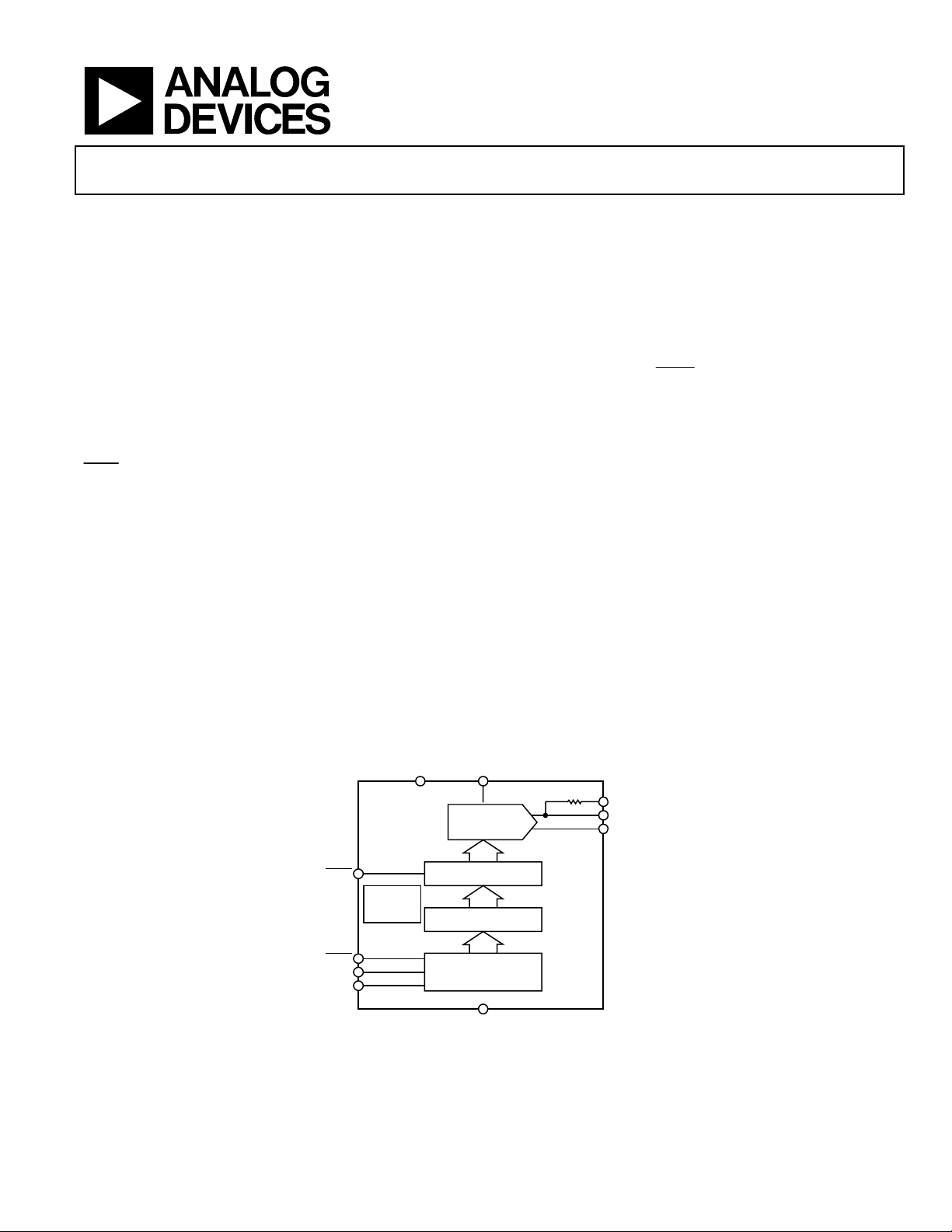
FUNCTIONAL BLOCK DIAGRAM
AD5425
V
DD
V
REF
8-BIT
R-2R DAC
R
AD5425
®, QSPI™, MICROWIRE™, and most DSP
pin is also provided, which allows
LDAC
REF
R
FB
I
1
OUT
I
2
OUT
) determines
LDAC
POWER-ON
RESET
SYNC
SCLK
SDIN
Rev. A
Information furnished by Analog Devices is believed to be accurate and reliable.
However, no responsibility is assumed by Analog Devices for its use, nor for any
infringements of patents or other rights of third parties that may result from its use.
Specifications subject to change without notice. No license is granted by implication
or otherwise under any patent or patent rights of Analog Devices. Trademarks and
registered trademarks are the property of their respective owners.
DAC REGISTER
INPUT LATCH
CONTROL LOGIC AND
INPUT SHIFT REGISTER
GND
Figure 1.
03161-001
One Technology Way, P.O. Box 9106, Norwood, MA 02062-9106, U.S.A.
Tel: 781.329.4700
Fax: 781.326.8703 © 2005 Analog Devices, Inc. All rights reserved.
www.analog.com
Page 2

AD5425 Preliminary Technical Data
TABLE OF CONTENTS
Specifications..................................................................................... 3
Timing Characteristics..................................................................... 5
Absolute Maximum Ratings............................................................ 6
ESD Caution.................................................................................. 6
Pin Configuration and Function Descriptions............................. 7
Typical Performance Characteristics............................................. 8
Te r m in o l o g y .................................................................................... 13
Theory of Operation ...................................................................... 14
Circuit Operation ....................................................................... 14
Single-Supply Applications........................................................ 16
Positive Output Voltage ............................................................. 16
REVISION HISTORY
3/05—Rev. 0 to Rev. A
Updated Format................................................................ Universal
Changes to Specifications Section.................................................3
Added Figure 18, Figure 20, Figure 21........................................10
Change to Table 7 ..........................................................................18
Adding Gain................................................................................ 17
DACs Used as a Divider or Programmable Gain Element... 17
Reference Selection .................................................................... 17
Amplifier Selection .................................................................... 18
Serial Interface............................................................................ 19
Microprocessor Interfacing....................................................... 19
PCB Layout and Power Supply Decoupling................................ 22
Evaluation Board ........................................................................ 22
Operating the Evaluation Board .............................................. 22
Outline Dimensions....................................................................... 27
Ordering Guide .......................................................................... 27
2/04—Revision 0: Initial Version
Rev. A | Page 2 of 28
Page 3

Preliminary Technical Data AD5425
SPECIFICATIONS
VDD = 2.5 V to 5.5 V, V
otherwise noted. DC performance measured with OP177, ac performance with AD8038, unless otherwise noted.
Table 1.
Parameter Min Typ Max Unit Conditions/Comments
STATIC PERFORMANCE
Resolution 8 Bits
Relative Accuracy ±0.25 LSB
Differential Nonlinearity ±0.5 LSB Guaranteed monotonic
Gain Error ±10 mV
Gain Error Temperature Coefficient ±5 ppm FSR/°C
Output Leakage Current ±10 nA Data = 0x0000, TA = 25°C, I
±20 nA Data = 0x0000, T = −40°C to +125°C, I
REFERENCE INPUT
Reference Input Range ±10 V
V
Input Resistance 8 10 12 kΩ Input resistance TC = −50 ppm/°C
REF
RFB Resistance 8 10 12 kΩ Input resistance TC = −50 ppm/°C
Input Capacitance
Code Zero Scale 3 6 pF
Code Full Scale 5 8 pF
DIGITAL INPUT/OUTPUT1
Input High Voltage, VIH 1.7 V
Input Low Voltage, VIL 0.6 V
Output High Voltage, VOH VDD − 1 V VDD = 4.5 V to 5 V, I
V
Output Low Voltage, VOL 0.4 V VDD = 4.5 V to 5 V, I
0.4 V VDD = 2.5 V to 3.6 V, I
Input Leakage Current, IIL 1 µA
Input Capacitance 4 10 pF
DYNAMIC PERFORMANCE1
Reference Multiplying Bandwidth 10 MHz V
Output Voltage Settling Time
Measured to ±1 mV 90 160 ns
Measured to ±4 mV 55 110 ns
Measured to ±16 mV 50 100 ns
Digital Delay 40 75 ns Interface delay time
10% to 90% Settling Time 15 30 ns Rise and fall time, V
Digital-to-Analog Glitch Impulse 2 nV-s 1 LSB change around major carry V
Multiplying Feedthrough Error DAC latch loaded with all 0s. V
70 dB 1 MHz
48 dB 10 MHz
Output Capacitance
I
1 12 17 pF All 0s loaded
OUT
25 30 pF All 1s loaded
I
2 22 25 pF All 0s loaded
OUT
10 12 pF All 1s loaded
Digital Feedthrough 0.1 nV-s
Analog THD 81 dB V
= 10 V, I
REF
1
2 = 0 V. Temperature range for Y version: −40°C to +125°C. All specifications T
OUT
− 0.5 V VDD = 2.5 V to 3.6 V, I
DD
= ±3.5 V, DAC loaded all 1s
REF
= ±3.5 V, R
V
REF
LOAD
MIN
= 200 µA
SOURCE
SOURCE
= 200 µA
SINK
= 200 µA
SINK
to T
OUT
= 200 µA
, unless
MAX
1
= 100 Ω, DAC latch
OUT
1
alternately loaded with 0s and 1s
= 10 V, R
REF
Feedthrough to DAC output with
= 100 Ω
LOAD
REF
= ±3.5 V
REF
SYNC high
= 0 V
and alternate loading of all 0s and all 1s
= 3.5 V p-p; all 1s loaded, f = 1 kHz
REF
Rev. A | Page 3 of 28
Page 4

AD5425 Preliminary Technical Data
Parameter Min Typ Max Unit Conditions/Comments
Digital THD Clock = 1 MHz, V
50 kHz f
20 kHz f
Output Noise Spectral Density 25
70 dB
OUT
OUT
73 dB
Hz
nV√
@ 1 kHz
SFDR Performance (Wide Band) Clock = 2 MHz , V
50 kHz f
20 kHz f
67 dB
OUT
68 dB
OUT
SFDR Performance (Narrow Band) Clock = 2 MHz, V
50 kHz f
20 kHz f
Intermodulation Distortion 79 dB
73 dB
OUT
75 dB
OUT
= 20 kHz, f2 = 25 kHz, clock = 2 MHz,
f
1
V
= 3.5 V
REF
POWER REQUIREMENTS
Power Supply Range 2.5 5.5 V
IDD 0.6 µA TA = 25°C, logic inputs = 0 V or VDD
0.4 5 µA Logic inputs = 0 V or VDD, T = −40°C to +125°C
Power Supply Sensitivity 0.001 %/% ∆V
1
Guaranteed by design and characterization, not subject to production test.
= ±5%
DD
= 3.5 V, C
REF
= 3.5 V
REF
= 3.5 V
REF
COMP
= 1.8 pF
Rev. A | Page 4 of 28
Page 5
Preliminary Technical Data AD5425
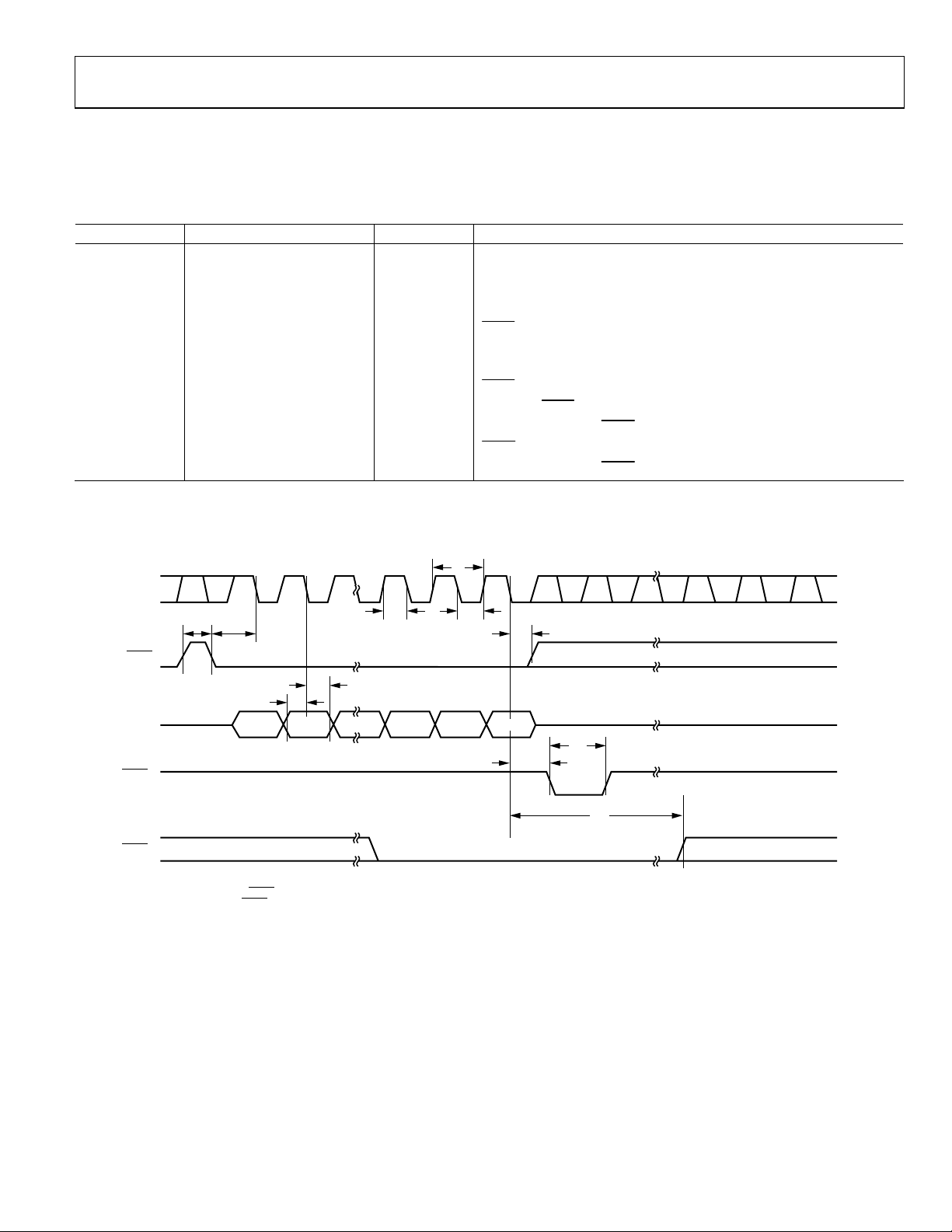
TIMING CHARACTERISTICS
All input signals are specified with tr = tf = 1 ns (10% to 90% of VDD) and timed from a voltage level of (VIL + VIH)/2. VDD =2.5 V to 5.5 V,
= 10 V, I
V
REF
Table 2. Timing Characteristics
Parameter
f
50 MHz max Maximum clock frequency
SCLK
t1 20 ns min SCLK cycle time
t2 8 ns min SCLK high time
t3 8 ns min SCLK low time
2
t
4
t5 5 ns min Data setup time
t6 3 ns min Data hold time
t7 5 ns min
t8 30 ns min
t9 0 ns min
t10 12 ns min
t11 10 ns min
1
Guaranteed by design and characterization, not subject to production test.
2
Falling or rising edge as determined by control bits of serial word.
2 = 0 V, temperature range for Y version: −40°C to +125°C ; all specifications T
OUT
1
VDD = 2.5 V to 5.5 V Unit Conditions/Comments
13 ns min
SYNC falling edge to SCLK falling edge setup time
SYNC rising edge to SCLK falling edge
Minimum
SYNC high time
SCLK falling edge to
LDAC pulse width
SCLK falling edge to
to T
MIN
MAX
LDAC falling edge
LDAC rising edge
, unless otherwise noted.
t
1
SCLK
t
t
8
4
SYNC
DIN
1
LDAC
2
LDAC
NOTES:
1
ASYNCHRONOUS LDAC UPDATE MODE.
2
SYNCHRONOUS LDAC UPDATE MODE.
DB7
t
2
t
6
t
5
t
3
t
7
DB0
t
t
10
9
t
11
03161-002
Figure 2. Timing Diagram
Rev. A | Page 5 of 28
Page 6
AD5425 Preliminary Technical Data
ABSOLUTE MAXIMUM RATINGS
TA = 25°C, unless otherwise noted.
Table 3.
Parameter Rating
VDD to GND −0.3 V to +7 V
V
, RFB to GND −12 V to +12 V
REF
I
1, I
OUT
Logic Input and Output
2 to GND −0.3 V to VDD + 0.3 V
OUT
1
−0.3 V to VDD + 0.3 V
Operating Temperature Range
Extended Industrial (Y Version) −40°C to +125°C
Storage Temperature Range −65°C to +150°C
Junction Temperature 150°C
10-lead MSOP
θ
Thermal Impedance
JA
Lead Temperature, Soldering
206°C/W
300°C
(10 secs)
IR Reflow, Peak Temperature
235°C
(<20 secs)
Stresses above those listed under Absolute Maximum Ratings
may cause permanent damage to the device. This is a stress
rating only and functional operation of the device at these or
any other conditions above those listed in the operational
sections of this specification is not implied. Exposure to
absolute maximum rating conditions for extended periods may
affect device reliability. Only one absolute maximum rating may
be applied at any one time.
1
Overvoltages at SCLK,
Current should be limited to the maximum ratings given.
SYNC
, DIN, and
LDAC
are clamped by internal diodes.
ESD CAUTION
ESD (electrostatic discharge) sensitive device. Electrostatic charges as high as 4000 V readily accumulate on the
human body and test equipment and can discharge without detection. Although this product features
proprietary ESD protection circuitry, permanent damage may occur on devices subjected to high energy
electrostatic discharges. Therefore, proper ESD precautions are recommended to avoid performance
degradation or loss of functionality.
Rev. A | Page 6 of 28
Page 7
Preliminary Technical Data AD5425
PIN CONFIGURATION AND FUNCTION DESCRIPTIONS
I
1
1
OUT
I
2
2
OUT
GND
SCLK
SDIN
AD5425
3
TOP VIEW
4
(Not to Scale)
5
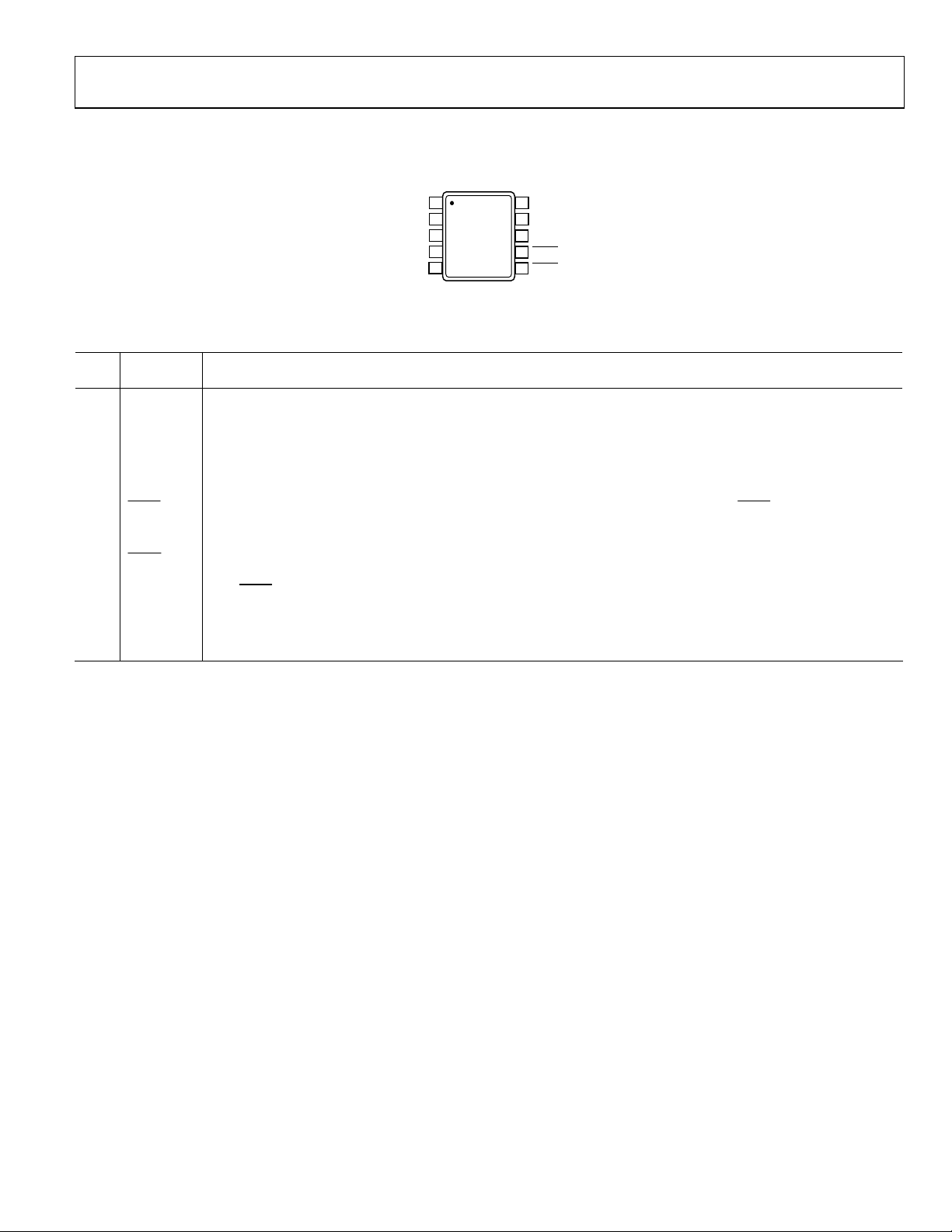
Figure 3. Pin Configuration
Table 4. Pin Function Descriptions
Pin
No. Mnemonic Function
1 I
2 I
1 DAC Current Output.
OUT
2 DAC Analog Ground. This pin should normally be tied to the analog ground of the system.
OUT
3 GND Digital Ground Pin.
4 SCLK
Serial Clock Input. Data is clocked into the input shift register on each falling edge of the serial clock input.
This device can accommodate clock rates of up to 50 MHz.
5 SDIN Serial Data Input. Data is clocked into the 8-bit input register on each falling edge of the serial clock input.
6
SYNC
Active Low Control Input. This is the frame synchronization signal for the input data. When SYNC
on the SCLK and DIN buffers and the input shift register is enabled. Data is transferred on each falling edge of the
following 8 clocks.
7
LDAC
Load DAC Input. Updates the DAC output. The DAC is updated when this signal goes low or alternatively; if this line is
held permanently low, an automatic update mode is selected whereby the DAC is updated after 8 SCLK falling edges
SYNC
with
low.
8 VDD Positive Power Supply Input. This part can be operated from a supply of 2.5 V to 5.5 V.
9 V
DAC Reference Voltage Input Terminal.
REF
10 RFB DAC Feedback Resistor Pin. Establishes voltage output for the DAC by connecting to external amplifier output.
10
R
FB
9
V
REF
8
V
DD
LDAC
7
SYNC6
03161-003
goes low, it powers
Rev. A | Page 7 of 28
Page 8
AD5425 Preliminary Technical Data
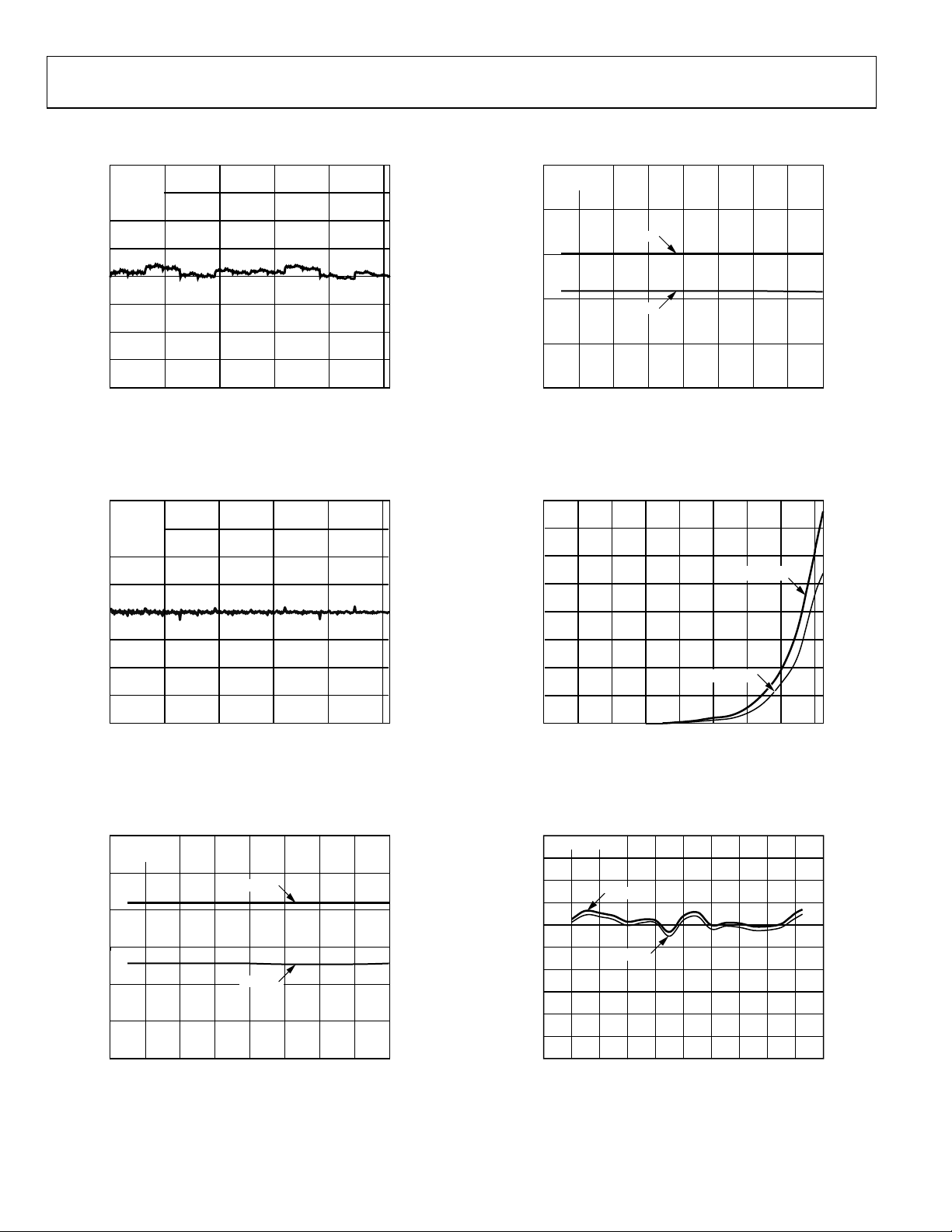
TYPICAL PERFORMANCE CHARACTERISTICS
INL (LSB)
0.20
0.15
0.10
0.05
–0.05
–0.10
–0.15
TA = 25°C
V
REF
VDD = 5V
0
= 10V
0.4
TA= 25°C
VDD= 5V
0.2
MIN DNL
0
–0.2
DNL (LSB)
–0.4
MAX DNL
INL (LSB)
INL (LSB)
–0.20
0.20
0.15
0.10
0.05
–0.05
–0.10
–0.15
–0.20
0.3
0.2
0.1
–0.1
–0.2
–0.3
TA = 25°C
V
V
0
TA= 25°C
V
0
Figure 4. INL vs. Code (8-Bit DAC)
= 10V
REF
= 5V
DD
Figure 5. DNL vs. Code (8-Bit DAC)
= 5V
DD
REFERENCE VOLTAGE
Figure 6. INL vs. Reference Voltage
CODE
CODE
MAX INL
MIN INL
2500 50 100 150 200
03161-004
–0.6
REFERENCE VOLTAGE
1023456789
xxxxx-xxx
Figure 7. DNL vs. Reference Voltage
1.6
1.4
1.2
I
1 VDD 5V
I
OUT
OUT
1 VDD 3V
120–40 –20 0 20 40 60 80 100
03161-008
140–60 –40 –20 0 20 40 60 80 100 120
03161-009
1.0
0.8
0.6
LEAKAGE (nA)
OUT
I
0.4
0.2
2500 50 100 150 200
03161-005
1023456789
xxxxx-xxx
0
TEMPERATURE (°C)
Figure 8. I
5
V
= 10V
REF
4
3
2
1
0
–1
ERROR (mV)
–2
–3
–4
–5
1 Leakage Current vs. Temperature
OUT
VDD = 5V
VDD = 2.5V
TEMPERATURE (°C)
Figure 9. Gain Error vs. Temperature
Rev. A | Page 8 of 28
Page 9
Preliminary Technical Data AD5425
LSBs
–0.1
–0.3
0.5
0.3
0.1
TA = 25°C
VDD = 3V
V
= 0V
REF
MAX INL
MIN INL
MAX DNL
MIN DNL
2.5
VDD = 5V
V
= 0V
REF
2.0
1.5
1.0
VOLTAGE (mV)
0.5
0
GAIN ERROR
OFFSET ERROR
–0.5
V
BIAS
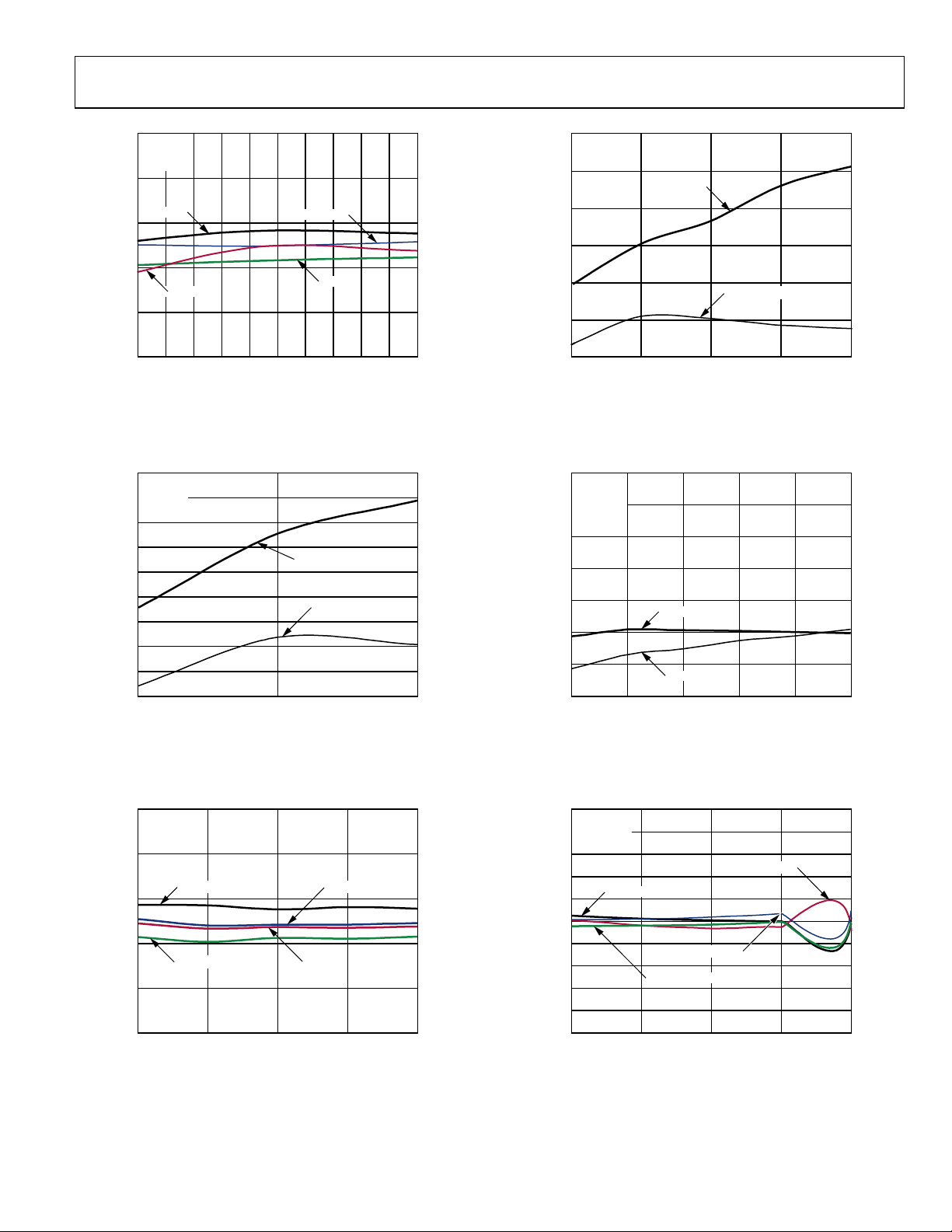
Figure 10. Linearity vs. V
1.4
TA = 25°C
= 3V
V
DD
1.2
V
= 0V
REF
1.0
0.8
0.6
0.4
VOLTAGE(mV)
0.2
0
–0.2
–0.4
BIAS
V
BIAS
Figure 11. Gain and Offset Errors vs. V
(V)
Voltage Applied to I
GAIN ERROR
OFFSET ERROR
(V)
Voltage Applied to I
BIAS
OUT
1.50.5 0.6 0.7 0.8 0.9 1.0 1.1 1.2 1.3 1.4
03161-010
2
1.50.5 1.0
03161-011
2
OUT
–0.5
V
(V)
BIAS
Figure 13. Gain and Offset Errors vs. Voltage Applied to I
10.0
TA = 25°C
= 5V
V
DD
V
= 2.5V
8.0
REF
6.0
4.0
2.0
VOLTAGE (mV)
0
–2.0
–4.0
Figure 14. Gain and Offset Errors vs. V
OFFSET ERROR
GAIN ERROR
V
(V)
BIAS
Voltage Applied to I
BIAS
OUT
2.50.5 1.0 1.5 2.0
2.50 0.5 1.0 1.5 2.0
OUT
03161-013
2
03161-014
2
0.5
VDD = 5V
V
= 0V
REF
0.3
0.1
LSBs
–0.1
–0.3
–0.5
Figure 12. Linearity vs. V
MAX INL
MIN DNL
MIN INL
V
(V)
BIAS
Voltage Applied to I
BIAS
MAX DNL
OUT
1.0
TA = 25°C
= 5V
V
DD
0.8
= 2.5V
V
REF
0.6
0.4
0.2
LSBs
–0.2
–0.4
–0.6
–0.8
2.50.5 1.0 1.5 2.0
03161-012
–1.0
2
MAX INL BIAS
0
MAX DNL BIAS
MIN DNL BIAS
Figure 15. Linearity vs. V
MIN INL BIAS
V
(V)
BIAS
Voltage Applied to I
BIAS
OUT
2.00 0.5 1.0 1.5
03161-015
2
Rev. A | Page 9 of 28
Page 10

AD5425 Preliminary Technical Data
0.7
0.6
0.5
0.4
0.3
CURRENT (mA)
0.2
0.1
T
= 25°C
A
VDD = 5V
VDD = 2.5V
VDD = 3V
0
INPUT VOLTAGE (V)
Figure 16. Supply Current vs. Input Voltage
501234
03161-016
0.060
0.050
0.040
0.030
0.020
0.010
OUTPUT VOLTAGE (V)
0
–0.010
–0.020
Figure 19. Midscale Transition, V
VDD 5V, 0V REF
NRG = 2.049nVs
07xFF TO 0x800
VDD 3V, 0V REF
NRG = 0.088nVs
0x800 TO 0x7FF
VDD 5V, 0V REF
NRG = 0.119nVs,
0x800 TO 0x7FF
TIME (ns)
TA = 25°C
V
REF
AD8038 AMPLIFIER
C
COMP
VDD 3V, 0V REF
NRG = 1.877nVs
0x7FF TO 0x800
REF
= 0V
= 1.8pF
= 3.5 V
3000 50 100 150 200 250
03161-019
1.8
TA = 25°C
1.6
1.4
1.2
1.0
0.8
0.6
0.4
THRESHOLD VOLTAGE (V)
0.2
0
V
IH
V
IL
VOLTAGE (V)
5.52.5 3.0 3.5 4.0 4.5 5.0
03161-017
Figure 17. Thres hold Vol tages v s. Supp ly Voltag e
0.2
0
–0.2
–0.4
GAIN (dB)
6
= 25°C
T
A
0
LOADING
–6
ZS TO FS
–12
–18
–24
–30
–36
–42
–48
–54
–60
GAIN (dB)
–66
–72
–78
–84
–90
–96
–102
ALL ON
DB11
DB10
DB9
DB8
DB7
DB6
DB5
DB4
DB3
DB2
DB1
DB0
ALL OFF
FREQUENCY (Hz)
= 25°C
T
A
= 5V
V
DD
= ±3.5V
V
REF
INPUT
= 1.8pF
C
COMP
AD8083 AMPLIFIER
100M1 10 100 1k 10k 100k 1M 10M
Figure 20. Reference Multiplying Bandwidth vs. Frequency and Code
3
V
= ±0.15V, AD8038 CC 1pF
REF
V
= ±2V, AD8038 CC 1pF
REF
0
V
= ±3.51V, AD8038 CC 1.8pF
REF
= ±2V, AD8038 CC 1.47pF
V
REF
–3
GAIN (dB)
= ±0.15V, AD8038 CC 1.47pF
V
REF
03161-020
TA = 25°C
–0.6
= 5V
V
DD
= ±3.5V
V
REF
= 1.8pF
C
COMP
AD8083 AMPLIFIER
–0.8
FREQUENCY (Hz)
Figure 18. Reference Multiplying Bandwidth—All 1s Loaded
100M1 10 100 1k 10k 100k 1M 10M
03161-018
Rev. A | Page 10 of 28
–6
TA = 25°C
= 5V
V
DD
AD8038 AMPLIFIER
–9
FREQUENCY (Hz)
100M10k 100k 1M 10M
Figure 21. Reference Multiplying Bandwidth vs. Frequency and
Compensation Capacitor
03161-021
Page 11

Preliminary Technical Data AD5425
–60
TA = 25°C
V
DD
V
REF
–65
–70
–75
THD + N (dB)
–80
–85
–90
= 3V
= 3.5V p-p
FREQUENCY (Hz)
1M1 10 100 1k 10k 100k
03161-022
–10
–20
–30
–40
–50
–60
SFDR (dB)
–70
–80
–90
–100
–110
0
FREQUENCY (Hz)
TA = 25°C
= 5V
V
DD
= 3.5V
V
REF
AD8038 AMPLIFIER
1M0 200k 400k 600k 800k
03161-025
Figure 22. THD and Noise vs. Frequency
20
VDD = 3V
AMPLIFIER = AD8038
0
–20
–40
POWER SUPPLY REJECTION
–60
–80
–100
–120
FULL SCALE
ZERO SCALE
FREQUENCY (Hz)
Figure 23. Power Supply Rejection vs. Frequency
0
–10
–20
–30
–40
–50
–60
SFDR (dB)
–70
–80
–90
–100
–110
FREQUENCY (Hz)
Figure 24. Wideband SFDR, Clock = 2 MHz, f
TA = 25°C
= 5V
V
DD
= 3.5V
V
REF
AD8038 AMPLIFIER
= 50 kHz
OUT
Figure 25. Wideband SFDR, Clock = 2 MHz, f
0
–10
–20
–30
–40
–50
–60
SFDR (dB)
–70
–80
–90
–100
10M1 10 100 1k 10k 100k 1M
03161-023
–110
FREQUENCY (Hz)
Figure 26. Narrowband SFDR, Clock = 2 MHz, f
0
–10
–20
–30
–40
–50
–60
SFDR (dB)
–70
–80
–90
–100
1M0 200k 400k 600k 800k
03161-024
–110
FREQUENCY (Hz)
Figure 27. Narrowband SFDR, Clock = 2 MHz, f
= 20 kHz
OUT
TA = 25°C
= 5V
V
DD
= 3.5V
V
REF
AD8038 AMPLIFIER
= 20 kHz
OUT
TA = 25°C
= 5V
V
DD
= 3.5V
V
REF
AD8038 AMPLIFIER
= 50 kHz
OUT
30k10k 14k12k 18k 22k 26k16k 20k 24k 28k
03161-026
75k25k 35k30k 45k 55k 65k40k 50k 60k 70k
03161-027
Rev. A | Page 11 of 28
Page 12

AD5425 Preliminary Technical Data
0
–10
–20
–30
–40
–50
IMD (dB)
–60
–70
–80
–90
–100
FREQUENCY (Hz)
Figure 28. Narrowband IMD (±50%) Clock = 2 MHz,
1 = 20 kHz, f
f
OUT
2 = 25 kHz
OUT
VDD = 5V
= 3.5V
V
REF
AD8038 AMPLIFIER
35k10k 15k 20k 25k 30k
03161-028
Rev. A | Page 12 of 28
Page 13

Preliminary Technical Data AD5425
(
TERMINOLOGY
Relative Accuracy
Relative accuracy or endpoint nonlinearity is a measure of the
maximum deviation from a straight line passing through the
endpoints of the DAC transfer function. It is measured after
adjusting for zero and full scale and is normally expressed in
LSBs or as a percentage of full-scale reading.
Differential Nonlinearity
Differential nonlinearity is the difference between the measured
change and the ideal 1 LSB change between any two adjacent
codes. A specified differential nonlinearity of −1 LSB maximum
over the operating temperature range ensures monotonicity.
Gain Error
Gain error or full-scale error is a measure of the output error
between an ideal DAC and the actual device output. For these
DACs, ideal maximum output is V
− 1 LSB. Gain error of the
REF
DACs is adjustable to 0 with external resistance.
Output Leakage Current
Output leakage current is current that flows in the DAC ladder
switches when these are turned off. For the I
1 terminal, it can
OUT
be measured by loading all 0s to the DAC and measuring the
1 current. Minimum current flows in the I
I
OUT
2 line when
OUT
the DAC is loaded with all 1s.
Output Capacitance
Capacitance from I
OUT
1 or I
2 to AGND.
OUT
Output Current Settling Time
This is the amount of time it takes for the output to settle to a
specified level for a full-scale input change. For these devices, it
is specified with a 100 Ω resistor to ground.
The settling time specification includes the digital delay from
rising edge to the full-scale output charge.
SYNC
Digital-to-Analog Glitch Impulse
The amount of charge injected from the digital inputs to the
analog output when the inputs change state. This is normally
specified as the area of the glitch in either pA-s or nV-s
depending upon whether the glitch is measured as a current or
voltage signal.
Digital Feedthrough
When the device is not selected, high frequency logic activity on
the device digital inputs can be capacitively coupled to show up
as noise on the I
pins and subsequently into the following
OUT
circuitry. This noise is digital feedthrough.
Multiplying Feedthrough Error
This is the error due to capacitive feedthrough from the DAC
reference input to the DAC I
1 terminal, when all 0s are
OUT
loaded to the DAC.
Total Harmonic Distortion (THD)
The DAC is driven by an ac reference. The ratio of the rms sum
of the harmonics of the DAC output to the fundamental value is
the THD. Usually only the lower order harmonics are included,
such as second to fifth.
2
2
2
THD
2
=
2
log20
4
3
V
1
)
VVVV
+++
5
Digital Intermodulation Distortion
Second-order intermodulation distortion (IMD) measurements
are the relative magnitude of the fa and fb tones generated
digitally by the DAC and the second-order products at 2fa − fb
and 2fb − fa.
Spurious-Free Dynamic Range (SFDR)
SFDR is the usable dynamic range of a DAC before spurious
noise interferes or distorts the fundamental signal. It is the measure of the difference in amplitude between the fundamental
and the largest harmonically or nonharmonically related spur
from dc to full Nyquist bandwidth (half the DAC sampling rate,
/2). Narrow band SFDR is a measure of SFDR over an
or f
S
arbitrary window size, in this case 50% of the fundamental.
Digital SFDR is a measure of the usable dynamic range of the
DAC when the signal is a digitally generated sine wave.
Rev. A | Page 13 of 28
Page 14

AD5425 Preliminary Technical Data
THEORY OF OPERATION
The AD5425 is an 8-bit current output DAC consisting of a
standard inverting R-2R ladder configuration. A simplified
diagram is shown in Figure 29. The feedback resistor, R
, has a
FB
value of R. The value of R is typically 10 kΩ (minimum 8 kΩ
and maximum 12 kΩ). If I
OUT
1 and I
2 are kept at the same
OUT
potential, a constant current flows in each ladder leg, regardless
of digital input code. Therefore, the input resistance presented
is always constant and nominally of value R. The DAC
at V
REF
output, I
, is code-dependent, producing various resistances
OUT
and capacitances. When choosing the external amplifier, take
into account the variation in impedance generated by the DAC
on the amplifiers inverting input node.
S3
REF
RRR
, RFB, I
2R 2R
S8
1, and I
OUT
R
R
FB
I
1
OUT
I
2
OUT
2 terminals of
OUT
03161-029
V
REF
2RS12RS22R
DAC DATA LATCHES
AND DRIVERS
Figure 29. Simplified Ladder
Access is provided to the V
the DAC, making the device extremely versatile and allowing it
to be configured in several different operating modes, for example, to provide a unipolar output, bipolar output, or in singlesupply modes of operation in unipolar mode or 4-quadrant
multiplication in bipolar mode. Note that a matching switch is
used in series with the internal R
attempt to measure R
, power must be applied to VDD to
FB
feedback resistor. If users
FB
achieve continuity.
CIRCUIT OPERATION
Unipolar Mode
Using a single op amp, this device can easily be configured to
provide 2-quadrant multiplying operation or a unipolar output
voltage swing, as shown in Figure 30.
When an output amplifier is connected in unipolar mode, the
output voltage is given by
D
OUT
VV
REF
×−=
n
2
where D is the fractional representation of the digital word
loaded to the DAC, in this case 0 to 255, and n is the number
of bits.
Note that the output voltage polarity is opposite to the V
polarity for dc reference voltages.
This DAC is designed to operate with either negative or positive
reference voltages. The V
power pin is used by only the inter-
DD
nal digital logic to drive the DAC switches’ on and off states.
This DAC is also designed to accommodate ac reference input
signals in the range of −10 V to +10 V.
With a fixed 10 V reference, the circuit shown in Figure 30 gives
a unipolar 0 V to −10 V output voltage swing. When V
signal, the circuit performs 2-quadrant multiplication.
Table 5 shows the relationship between digital code and the
expected output voltage for unipolar operation.
Table 5. Unipolar Code Table
Digital Input Analog Output (V)
1111 1111 −V
1000 0000 −V
0000 0001 −V
0000 0000 −V
V
REF
R1
MICROCONTROLLER
NOTES:
1. R1 AND R2 USED ONLY IF GAIN ADJUSTMENT IS REQUIRED.
2. C1 PHASE COMPENSATION (1pF TO 2pF) MAY BE REQUIRED
IF A1 IS A HIGH SPEED AMPLIFIER.
V
REF
SCLK SDIN GND
SYNC
Figure 30. Unipolar Operation
(255/256)
REF
(128/256) = −V
REF
(1/256)
REF
(0/256) = 0
REF
V
DD
V
DD
AD5425
/2
REF
R2
R
FB
I
OUT
I
OUT
C1
1
2
AGND
A1
A1
V
TO –V
is an ac
IN
= 0
OUT
REF
REF
03161-030
Rev. A | Page 14 of 28
Page 15

Preliminary Technical Data AD5425
V
R3
20kΩ
V
DD
V
R
FB
DD
I
V
REF
±10V
R1
MICROCONTROLLER
NOTES:
1. R1 AND R2 ARE USED ONLY IF GAIN ADJUSTMENT IS REQUIRED. ADJUST R1 FOR
V
= 0 V WITH CODE 10000000 LOADED TO DAC.
OUT
2. MATCHING AND TRACKING IS ESSENTIAL FOR RESISTOR PAIRS R3 AND R4.
3. C1 PHASE COMPENSATION (1pF TO 2pF) MAY BE REQUIRED IF A1/A2 IS A HIGH
SPEED AMPLIFIER.
REF
SCLK SDIN GND
SYNC
AD5425
OUT
I
OUT
Figure 31. Bipolar Operation (4-Quadrant Multiplication)
Bipolar Operation
In some applications, it may be necessary to generate full 4quadrant multiplying operation or a bipolar output swing. This
can be easily accomplished by using another external amplifier
and some external resistors, as shown in Figure 31. In this
circuit, the second amplifier, A2, provides a gain of 2. Biasing
the external amplifier with an offset from the reference voltage,
results in full 4-quadrant multiplying operation. The transfer
function of this circuit shows that both negative and positive
output voltages are created as the input data, D, is incremented
from code zero (V
scale (V
= +V
OUT
()
OUT
REF
REF
OUT
= −V
).
) to midscale (V
REF
n
−1
VDVV −×=
2/
REF
= 0 V ) to full
OUT
Where D is the fractional representation of the digital word
loaded to the DAC and n is the resolution of the DAC.
R5
R2
C1
1
2
AGND
10kΩ
A1
A1
20kΩ
R4
A2
V
=–V
OUT
REF
TO +V
REF
03161-031
Stability
In the I-to-V configuration, the I
of the DAC and the
OUT
inverting node of the op amp must be connected as closely as
possible and proper PCB layout techniques must be employed.
Since every code change corresponds to a step function, gain
peaking can occur if the op amp has limited GBP and there is
excessive parasitic capacitance at the inverting node. This
parasitic capacitance introduces a pole into the open-loop
response, which can cause ringing or instability in closed-loop
applications.
An optional compensation capacitor, C1, can be added in
parallel with R
for stability, as shown in Figure 30 and Figure
FB
31. Too small a value of C1 can produce ringing at
the output, while too large a value can adversely affect the
settling time. C1 should be found empirically, but 1 pF to
2 pF is generally adequate for compensation.
When V
is an ac signal, the circuit performs 4-quadrant
IN
multiplication.
Table 6 shows the relationship between digital code and the
expected output voltage for bipolar operation.
Table 6. Bipolar Code Table
Digital Input Analog Output (V)
1111 1111 +V
(127/128)
REF
1000 0000 0
0000 0001 −V
0000 0000 −V
(127/128)
REF
(128/128)
REF
Rev. A | Page 15 of 28
Page 16

AD5425 Preliminary Technical Data
V
SINGLE-SUPPLY APPLICATIONS
Current Mode Operation
In the current mode circuit of Figure 32, I
is biased positive by an amount applied to V
configuration, the output voltage is given by
= [D × (RFB/R
V
OUT
DAC
) × (V
− VIN)] + V
BIAS
As D varies from 0 to 255, the output voltage varies from
= V
to V
V
DD
V
DD
GND
OUT
= 2V
V
BIAS
V
OUT
BIAS
V
V
IN
REF
NOTES:
1. ADDITIONAL PINS OMITTED FOR CLARITY.
2. C1 PHASE COMPENSATION (1pF TO 2pF) MAY BE
REQUIRED IF A1 IS A HIGH SPEED AMPLIFIER.
− V
BIAS
R
FB
1
I
OUT
I
2
OUT
Figure 32. Single-Supply Current Mode Operation
V
should be a low impedance source capable of sinking and
BIAS
sourcing all possible variations in current at the I
without any problems.
It is important to note that V
is limited to low voltages because
IN
the switches in the DAC ladder no longer have the same sourcedrain drive voltage. As a result, their on resistance differs and
this degrades the linearity of the DAC.
Voltage Switching Mode of Operation
Figure 33 shows this DAC operating in the voltage switching
mode. The reference voltage V
is applied to the I
IN
is connected to AGND, and the output voltage is available at the
terminal. In this configuration, a positive reference voltage
V
REF
results in a positive output voltage, making single-supply
operation possible. The output from the DAC is voltage at a
constant impedance (the DAC ladder resistance), thus an op
amp is necessary to buffer the output voltage. The reference
input no longer sees constant input impedance, but one that
varies with code. So, the voltage input should be driven from a
low impedance source.
IN
C1
2 and hence I
OUT
. In this
BIAS
BIAS
A1
A1
OUT
OUT
OUT
V
OUT
03161-032
2 terminal
1 pin, I
OUT
1
V
DD
R
V
FB
I
I
OUT
OUT
1
2
IN
NOTES:
1. ADDITIONAL PINS OMITTED FOR CLARITY.
2. C1 PHASE COMPENSATION (1pF TO 2pF) MAY BE REQUIRED
IF A1 IS A HIGH SPEED AMPLIFIER.
DD
GND
V
REF
R2R1
A1
A1
V
OUT
03161-033
Figure 33. Single-Supply Voltage Switching Mode Operation
It is important to note that VIN is limited to low voltage because
the switches in the DAC ladder no longer have the same source
drain drive voltage. As a result, their on resistance differs, which
degrades the linearity of the DAC.
must also not go negative by more than 0.3 V, otherwise an
V
IN
internal diode turns on, exceeding the maximum ratings of the
device. In this type of application, the full range of the DAC
multiplying capability is lost.
POSITIVE OUTPUT VOLTAGE
Note that the output voltage polarity is opposite to the V
polarity for dc reference voltages. To achieve a positive voltage
output, an applied negative reference to the input of the DAC is
preferred over the output inversion through an inverting
amplifier because of the resistor tolerance errors. To generate a
negative reference, the reference can be level shifted by an
op amp such that the V
and GND pins of the reference
OUT
become the virtual ground and −2.5 V respectively, as shown
in Figure 34.
V
REF
VDD = 5V
V
DD
GND
R
FB
I
OUT
I
OUT
C1
1
2
V
OUT
ADR03
V
OUTVIN
GND
+5V
2
–5V
–2.5V
NOTES:
1
ADDITIONAL PINS OMITTED FOR CLARITY.
2
C1 PHASE COMPENSATION (1pF TO 2pF) MAY BE REQUIRED,
IF A1 IS A HIGH SPEED AMPLIFIER.
Figure 34. Positive Voltage Output with Minimum of Components
REF
= 0V TO +2.5V
04588-033
Rev. A | Page 16 of 28
Page 17

Preliminary Technical Data AD5425
V
V
ADDING GAIN
In applications where the output voltage is required to be
greater than V
, gain can be added with an additional external
IN
amplifier or it can be achieved in a single stage. It is important
to take into consideration the effect of temperature coefficients
of the thin film resistors of the DAC. Simply placing a resistor in
series with the R
resistor causes mismatches in the temp-
FB
erature coefficients and results in larger gain temperature
coefficient errors. Instead, the circuit of Figure 35 is a recommended method of increasing the gain of the circuit. R1, R2,
and R3 should all have similar temperature coefficients, but
they need not match the temperature coefficients of the DAC.
This approach is recommended in circuits where gains of
greater than 1 are required.
V
DD
R
V
R1
IN
V
REF
GND
NOTES:
1. ADDITIONAL PINS OMITTED FOR CLARITY.
2. C1 PHASE COMPENSATION (1pF TO 2pF) MAY BE REQUIRED
IF A1 IS A HIGH SPEED AMPLIFIER.
FB
DD
I
I
OUT
OUT
Figure 35. Increasing the Gain of Current Output DAC
C1
1
2
A1
R3
R2
V
OUT
GAIN = R2 + R3
R2
R1 = R2R3
R2 + R3
03161-035
DACS USED AS A DIVIDER OR PROGRAMMABLE GAIN ELEMENT
Current steering DACs are very flexible and lend themselves to
many different applications. If this type of DAC is connected as
the feedback element of an op amp and R
resistor as shown in Figure 36, then the output voltage is
inversely proportional to the digital input fraction, D.
−n
For D = 1 − 2
V
OUT
, the output voltage is
= −VIN/D = −VIN/(1 − 2−n)
As D is reduced, the output voltage increases. For small values
of D, it is important to ensure that the amplifier does not saturate and that the required accuracy is met. For example, an 8-bit
DAC driven with the Binary Code 0x10 (00010000), that is, 16
decimal, in the circuit of Figure 36, should cause the output
voltage to be 16 × V
. However, if the DAC has a linearity
IN
specification of ±0.5 LSB, then D can in fact have a weight
anywhere in the range 15.5/256 to 16.5/256. Therefore, the
possible output voltage is in the range of 15.5 V
an error of 3%, even though the DAC itself has a maximum
error of 0.2%.
is used as the input
FB
to 16.5 VIN—
IN
V
IN
R
I
1
OUT
NOTE:
1. ADDITIONAL PINS OMITTED FOR CLARITY.
DD
V
FB
DD
V
REF
GND
V
OUT
03161-036
Figure 36. Current Steering DAC Used as a Divider or
Programmable Gain Element
DAC leakage current is also a potential error source in divider
circuits. The leakage current must be counterbalanced by an
opposite current supplied from the op amp through the DAC.
Since only a fraction, D, of the current into the V
routed to the I
1 terminal, the output voltage has to change
OUT
terminal is
REF
as follows:
Output Error Voltage Due to DAC Leakage = (Leakage × R)/D
where R is the DAC resistance at the V
terminal. For a DAC
REF
leakage current of 10 nA, R = 10 kΩ. With a gain (that is, 1/D)
of 16 the error voltage is 1.6 mV.
REFERENCE SELECTION
When selecting a reference for use with the AD5425 current
output DAC, pay attention to the reference’s output voltage
temperature coefficient specification. This parameter not only
affects the full-scale error, but can also affect the linearity (INL
and DNL) performance. The reference temperature coefficient
should be consistent with the system accuracy specifications.
For example, an 8-bit system required to hold its overall
specification to within 1 LSB over the temperature range 0°C to
50°C dictates that the maximum system drift with temperature
should be less than 78 ppm/°C. A 12-bit system with the same
temperature range to overall specification within 2 LSB requires
a maximum drift of 10 ppm/°C. By choosing a precision
reference with a low output temperature coefficient, this error
source can be minimized. Table 7 suggests some of the
references available from Analog Devices that are suitable for
use with this range of current output DACs.
Rev. A | Page 17 of 28
Page 18

AD5425 Preliminary Technical Data
AMPLIFIER SELECTION
The primary requirement for the current-steering mode is an
amplifier with low input bias currents and low input offset voltage. The input offset voltage of an op amp is multiplied by the
variable gain (due to the code dependent output resistance of
the DAC) of the circuit. A change in this noise gain between two
adjacent digital fractions produces a step change in the output
voltage due to the amplifier’s input offset voltage. This output
voltage change is superimposed on the desired change in output
between the two codes and gives rise to a differential linearity
error, which if large enough, could cause the DAC to be
nonmonotonic.
Common-mode rejection of the op amp is important in voltage
switching circuits, since it produces a code dependent error at
the voltage output of the circuit. Most op amps have adequate
common-mode rejection for use at an 8-bit resolution.
Provided the DAC switches are driven from true wideband low
impedance sources (V
and AGND), they settle quickly. Conse-
IN
quently, the slew rate and settling time of a voltage switching
DAC circuit is determined largely by the output op amp. To
obtain minimum settling time in this configuration, it is important to minimize capacitance at the V
node (voltage output
REF
node in this application) of the DAC. This is done by using low
inputs capacitance buffer amplifiers and careful board design.
The input bias current of an op amp also generates an offset at
the voltage output as a result of the bias current flowing in the
feedback resistor, R
. Most op amps have input bias currents
FB
low enough to prevent any significant errors.
Most single-supply circuits include ground as part of the analog
signal range, which in turns requires an amplifier that can
handle rail-to-rail signals. There is a large range of single-supply
amplifiers available from Analog Devices.
Table 7. Suitable ADI Precision References
Part No. Output Voltage (V) Initial Tolerance (%) Temp Drift (ppm/°C) ISS (mA) Output Noise (µV p-p) Package
ADR01 10 0.05 3 1 20 SOIC-8
ADR01 10 0.05 9 1 20 TSOT-23, SC70
ADR02 5 0.06 3 1 10 SOIC-8
ADR02 5 0.06 9 1 10 TSOT-23, SC70
ADR03 2.5 0.10 3 1 6 SOIC-8
ADR03 2.5 0.10 9 1 6 TSOT-23, SC70
ADR06 3 0.10 3 1 10 SOIC-8
ADR06 3 0.10 9 1 10 TSOT-23, SC70
ADR431 2.5 0.04 3 0.8 3.5 SOIC-8
ADR435 5 0.04 3 0.8 8 SOIC-8
ADR391 2.5 0.16 9 0.12 5 TSOT-23
ADR395 5 0.10 9 0.12 8 TSOT-23
Table 8. Suitable Precision ADI Op Amps
0.1 Hz to 10 Hz
Part No. Supply Voltage (V) VOS (Max) (µV) IB (Max) (nA)
OP97 ±2 to ±20 25 0.1 0.5 600 SOIC-8
OP1177 ±2.5 to ±15 60 2 0.4 500 MSOP, SOIC-8
AD8551 2.7 to 5 5 0.05 1 975 MSOP, SOIC-8
AD8603 1.8 to 6 50 0.001 2.3 50 TSOT
AD8628 2.7 to 6 5 0.1 0.5 850 TSOT, SOIC-8
Noise (µV p-p)
Supply Current (µA) Package
Table 9. Suitable High Speed ADI Op Amps
Part No. Supply Voltage (V) BW @ ACL (MHz) Slew Rate (V/µs) VOS (Max) (µV) IB (Max) (nA) Package
AD8065 5 to 24 145 180 1500 6000 SOIC-8, SOT-23,MSOP
AD8021 ±2.5 to ±12 490 120 1000 10500 SOIC-8, MSOP
AD8038 3 to 12 350 425 3000 750 SOIC-8, SC70-5
AD9631 ±3 to ±6 320 1300 10000 7000 SOIC-8
Rev. A | Page 18 of 28
Page 19

Preliminary Technical Data AD5425
SERIAL INTERFACE
The AD5425 has a simple 3-wire interface that is compatible
with SPI, QSPI, MICROWIRE, and DSP interface standards.
Data is written to the device in 8-bit words. This 8-bit word
consists of 8 data bits, as shown in Figure 37.
DB7 (MSB)
DB7 DB6 DB5 DB4 DB3 DB2 DB0DB1
DATA BITS
Figure 37. 8-Bit Input Shift Register Contents
is an edge-triggered input that acts as a frame synchro-
SYNC
nization signal and chip enable. Data can be transferred into the
device only while
should be taken low, observing the minimum
SYNC
is low. To start the serial data transfer,
SYNC
falling to SCLK falling edge setup time, t
After loading eight data bits to the shift register, the
is brought high. The contents of the DAC register and the
output are updated by bringing
LDAC
8-bit data transfer is complete, as seen in the timing diagram of
Figure 2.
can be tied permanently low if required. For
LDAC
another serial transfer to take place, the interface must be
enabled by another falling edge of
DB0 (LSB)
03161-037
.
4
SYNC
low any time after the
.
SYNC
SYNC
line
ADSP-2191
1
ADDITIONAL PINS OMITTED FOR CLARITY.
1
SPIxSEL
Figure 38. ADSP-2191 SPI-to-AD5425 Interface
SYNC
SDINMOSI
SCLKSCK
A serial interface between the DAC and DSP SPORT is shown
in Figure 39. In this interface example, SPORT0 is used to
transfer data to the DAC shift register. Transmission is initiated
by writing a word to the Tx register after the SPORT has been
enabled. In a write sequence, data is clocked out on each rising
edge of the DSP’s serial clock and clocked into the DAC input
shift register on the falling edge of its SCLK. The update of the
DAC output takes place on the rising edge of the
ADSP-2101/
ADSP-2103/
ADSP-2191
1
SYNCTFS
SDINDT
SCLKSCLK
AD5425
SYNC
AD5425
1
03161-038
signal.
1
Low Power Serial Interface
To minimize the power consumption of the device, the interface
fully powers up only when the device is being written to, that is,
on the falling edge of
are powered down on the rising edge of
. The SCLK and SDIN input buffers
SYNC
.
SYNC
MICROPROCESSOR INTERFACING
Microprocessor interfacing to this DAC is via a serial bus that
uses standard protocol compatible with microcontrollers and
DSP processors. The communications channel is a 3-wire interface consisting of a clock signal, a data signal, and a synchronization signal. An
requires an 8-bit word with the default being data valid on the
falling edge of SCLK, but this is changeable via the control bits
in the data-word.
ADSP-21xx-to AD5425 Interface
The ADSP-21xx family of DSPs is easily interfaced to this family
of DACs without extra glue logic. Figure 38 shows an example
of an SPI interface between the DAC and the ADSP-2191. SCK
of the DSP drives the serial data line, DIN. SYNC is driven from
one of the port lines, in this case
pin is also included. The AD5425
LDAC
SPIxSEL
.
1
ADDITIONAL PINS OMITTED FOR CLARITY.
Figure 39. ADSP-2101/ADSP-2103/ADSP-2191 SPORT-to-AD5425 Interface
Communication between two devices at a given clock speed is
possible when the following specifications from one device to
the other are compatible: frame sync delay and frame sync setup
and hold, data delay and data setup and hold, and SCLK width.
The DAC interface expects a t
(SYNC falling edge to SCLK
4
falling edge setup time) of 13 ns minimum. Consult the ADSP21xx user manual for information on clock and frame sync
frequencies for the SPORT register.
Table 10. SPORT Control Register Setup
Name Setting Description
TFSW 1 Alternate framing
INVTFS 1 Active low frame signal
DTYPE 00 Right-justify data
ISCLK 1 Internal serial clock
TFSR 1 Frame every word
ITFS 1 Internal framing signal
SLEN 0111 8-bit data-word
03161-039
Rev. A | Page 19 of 28
Page 20

AD5425 Preliminary Technical Data
ADSP-BF5xx-to-AD5425 Interface
The ADSP-BF5xx family of processors has an SPI-compatible
port that enables the processor to communicate with SPIcompatible devices. A serial interface between the ADSP-BF5xx
and the AD5425 DAC is shown in Figure 40. In this configuration, data is transferred through the MOSI (master output/slave
input) pin.
is driven by the SPI chip select pin, which is a
SYNC
reconfigured programmable flag pin.
ADSP-BF5xx
1
SYNCSPIxSEL
SDINMOSI
SCLKSCK
AD5425
1
80C51/80L51-to-AD5425 Interface
A serial interface between the DAC and the 8051 is shown in
Figure 42. TxD of the 8051 drives SCLK of the DAC serial
interface, while RxD drives the serial data line, D
programmable pin on the serial port that drives
. P3.3 is a bit-
IN
. When
SYNC
data is transmitted to the switch, P3.3 is taken low. The 80C51/
80L51 transmits data in 8-bit bytes, which fits the AD5425 since
it only requires an 8-bit word. Data on RxD is clocked out of the
microcontroller on the rising edge of TxD and is valid on the
falling edge. As a result, no glue logic is required between the
DAC and microcontroller interface. P3.3 is taken high at the
completion of this cycle. The 8051 provides the LSB of its SBUF
register as the first bit in the data stream. The DAC input register requires that the MSB is the first bit received. The transmit
routine should take this into account.
1
ADDITIONAL PINS OMITTED FOR CLARITY.
Figure 40. ADSP-BF5xx-to-AD5425 Interface
The ADSP-BF5xx processor incorporates channel synchronous
serial ports (SPORT). A serial interface between the DAC and
the DSP SPORT is shown in Figure 41. When the SPORT is
enabled, initiate transmission by writing a word to the Tx
register. The data is clocked out on each rising edge of the DSP’s
serial clock and clocked into the DAC’s input shift register on
the falling edge of its SCLK. The DAC output is updated by
using the transmit frame synchronization (TFS) line to provide
signal.
a
SYNC
ADSP-BF5xx
1
ADDITIONAL PINS OMITTED FOR CLARITY.
1
Figure 41. ADSP-BF5xx-to-AD5425 Interface
SYNCTFS
SDINDT
SCLKSCLK
AD5425
1
03161-040
03161-041
1
8051
1
ADDITIONAL PINS OMITTED FOR CLARITY.
Figure 42. 80C51/80L51-to-AD5425 Inter face
SCLKTxD
SDINRxD
SYNCP1.1
AD5425
1
03161-042
MC68HC11 Interface-to-AD5425 Interface
Figure 43 shows an example of a serial interface between the
DAC and the MC68HC11 microcontroller. The serial peripheral
interface (SPI) on the MC68HC11 is configured for master
mode (MSTR = 1), clock polarity bit (CPOL) = 0, and the clock
phase bit (CPHA) = 1. The SPI is configured by writing to the
SPI control register (SPCR) (see the MC68HC11 user manual).
SCK of the MC68HC11 drives the SCLK of the DAC interface,
the MOSI output drives the serial data line, D
The
being transmitted to the AD5425, the
signal is derived from a port line, PC7. When data is
SYNC
SYNC
, of the AD5425.
IN
line is taken low
(PC7). Data appearing on the MOSI output is valid on the
falling edge of SCK. Serial data from the MC68HC11 is
transmitted in 8-bit bytes with only 8 falling clock edges
occurring in the transmit cycle. Data is transmitted MSB first.
PC7 is taken high at the end of the write.
1
ADDITIONAL PINS OMITTED FOR CLARITY.
Rev. A | Page 20 of 28
MC68HC11
1
PC7
SCK
MOSI
Figure 43. 68HC11/68L11-to-AD5425 Interface
SYNC
SCLK
SDIN
AD5425
1
03161-043
Page 21

Preliminary Technical Data AD5425
MICROWIRE-to-AD5425 Interface PIC16C6x/7x-to-AD5425
Figure 44 shows an interface between the DAC and any
MICROWIRE
™-compatible device. Serial data is shifted out on
the falling edge of the serial clock, SK, and is clocked into the
DAC input shift register on the rising edge of SK, which
corresponds to the falling edge of the DAC’s SCLK.
MICROWIRE
1
ADDITIONAL PINS OMITTED FOR CLARITY.
1
SK
SO
CS
Figure 44. MICROWIRE-to-AD5425 Interface
SYNC
SCLK
SDIN
AD5425
1
03161-044
The PIC16C6x/7x synchronous serial port (SSP) is configured
as an SPI master with the clock polarity bit (CKP) = 0. This is
done by writing to the synchronous serial port control register
(SSPCON) (see the PIC16/17 microcontroller user manual). In
this example, I/O Port RA1 is being used to provide a
SYNC
signal and enable the DAC serial port. This microcontroller
transfers eight bits of data during each serial transfer operation.
Figure 45 shows the connection diagram.
PIC16C6x/7x
1
ADDITIONAL PINS OMITTED FOR CLARITY.
1
RA1
Figure 45. PIC16C6x/7x-to-AD5425 Interface
SCLKSCK/RC3
SDINSDI/RC4
SYNC
AD5425
1
03161-045
Rev. A | Page 21 of 28
Page 22

AD5425 Preliminary Technical Data
PCB LAYOUT AND POWER SUPPLY DECOUPLING
In any circuit where accuracy is important, careful consideration of the power supply and ground return layout helps to
ensure the rated performance. The printed circuit board on
which the AD5425 is mounted should be designed so that the
analog and digital sections are separated and confined to
certain areas of the board. If the DAC is in a system where
multiple devices require an AGND-to-DGND connection, the
connection should be made at one point only. The star ground
point should be established as close as possible to the device.
These DACs should have an ample supply bypassing of 10 µF in
parallel with 0.1 µF on the supply and located as close to the
package as possible—ideally up against the device. The 0.1 µF
capacitor should have low effective series resistance (ESR) and
effective series inductance (ESI), such as found in the common
ceramic types that provide a low impedance path to ground at
high frequencies, to handle transient currents due to internal
logic switching. Low ESR, 1 µF to 10 µF tantalum or electrolytic
capacitors should also be applied at the supplies to minimize
transient disturbance and to filter out low frequency ripple.
Fast switching signals such as clocks should be shielded with
digital ground to avoid radiating noise to other parts of the
board and should never be run near the reference inputs.
It is good practice to employ compact, minimum lead length
PCB layout design. Leads to the input should be as short as
possible to minimize IR drops and stray inductance.
The PCB metal traces between V
matched to minimize gain error. To maximize high frequency
performance, the I-to-V amplifier should be located as close to
the device as possible.
and RFB should also be
REF
EVALUATION BOARD
The board consists of an 8-bit AD5425 and a current-to-voltage
amplifier, the AD8065. Included on the evaluation board is a
10 V reference, the ADR01. An external reference can also be
applied via an SMB input.
The evaluation kit consists of a CD-ROM with self-installing
PC software to control the DAC. The software simply allows the
user to write a code to the device.
OPERATING THE EVALUATION BOARD
Power Supplies
The board requires ±12 V and 5 V supplies. The 12 V VDD and
are used to power the output amplifier, while the 5 V is used
V
SS
to power the DAC (V
) and transceivers (VCC).
DD1
Avoid crossover of digital and analog signals. Traces on opposite
sides of the board should run at right angles to each other. This
reduces the effects of feedthrough through the board. A
microstrip technique is by far the best, but not always possible
with a double-sided board. In this technique, the component
side of the board is dedicated to ground plane while signal
traces are placed on the solder side.
Both supplies are decoupled to their respective ground plane
with 10 µF tantalum and 0.1 µF ceramic capacitors.
Link1 (LK1) is provided to allow selection between the onboard reference (ADR01) or an external reference applied
through J2. Link2 should be connected to the
LDAC
position.
Rev. A | Page 22 of 28
Page 23

Preliminary Technical Data AD5425
V
DD1
R1 = 0Ω
+
C2
C1
0.1µF
2
5
10µF
V
REF
+VINV
U2
ADR01AR
TRIM
GND
4
OUT
4.7pF
V
6
C5
REF
J2
U3
C5
0.1µF
LK1
V
SS
2
AD8065AR
3
V
DD
C7
10µF
+
C8
0.1µF
4
V–
6
7
V+
C9
10µF
+
C10
0.1µF
TP1
V
OUT
J1
P1–3
P1–2
P1–4
P1–5
P1–13
P1–19
P1–20
P1–21
P1–22
P1–23
P1–24
P1–25
P1–26
P1–27
P1–28
P1–29
P1–30
SCLK
SDIN
SYNC
LDAC
SDO
LK2
A
B
P2–3
P2–2
J3
J4
J5
J6
SCLK
SDIN
SYNC
SDO/LDAC
C11
0.1µF
C13
0.1µF
4
5
6
7
U1
SCLK
SDIN
SYNC
SDO/LDAC
AD5425/AD5426/
AD5432/AD5443
V
DD
+
C12
10µF
C14
10µF
AGND
+
8
V
DD
10
R
FB
1
1
I
OUT
2
2
I
OUT
3
GND
9
V
REF
V
DD
C3
10µFC40.1µF
P2–1
V
DD1
V
SS
P2–4
0.1µF
C15
+
C16
10µF
03161-046
Figure 46. Schematic of the AD5425 Evaluation Board
Rev. A | Page 23 of 28
Page 24

AD5425 Preliminary Technical Data
EVAL–AD5425EB
03161-047
Figure 47. Component-Side Artwork
P1
SCLK
SDO
SDO/LDAC
LK2
LDAC
SDIN
SYNC
J3
J4
SDO/LDAC
J5
J6
SCLK
SDIN
SYNC
U1
C1
C2
C15
J2
C16
VDD1
U3
C8
VREF
C11
C6
R1
LK1
VREF
C10 C13
VDD
AGND
TP1
U2
C14C9
VSS
P2
J1
VOUT
C4
C3
03161-048
Figure 48. Silkscreen—Component-Side View ( Top Layer)
Rev. A | Page 24 of 28
Page 25

Preliminary Technical Data AD5425
Figure 49. Solder-Side Artwork
03161-049
Rev. A | Page 25 of 28
Page 26

AD5425 Preliminary Technical Data
Table 11. Overview of the AD54xx and AD55xx Devices
Part No. Resolution No. DACs INL (LSB) Interface Package Features
AD5424 8 1 ±0.25 Parallel RU-16, CP-20
AD5426 8 1 ±0.25 Serial RM-10 10 MHz BW, 50 MHz serial
AD5428 8 2 ±0.25 Parallel RU-20
AD5429 8 2 ±0.25 Serial RU-10 10 MHz BW, 50 MHz serial
AD5450 8 1 ±0.25 Serial RJ-8 10 MHz BW, 50 MHz serial
AD5432 10 1 ±0.5 Serial RM-10 10 MHz BW, 50 MHz serial
AD5433 10 1 ±0.5 Parallel RU-20, CP-20
AD5439 10 2 ±0.5 Serial RU-16 10 MHz BW, 50 MHz serial
AD5440 10 2 ±0.5 Parallel RU-24
AD5451 10 1 ±0.25 Serial RJ-8 10 MHz BW, 50 MHz serial
AD5443 12 1 ±1 Serial RM-10 10 MHz BW, 50 MHz serial
AD5444 12 1 ±0.5 Serial RM-8 10 MHz BW, 50 MHz serial interface
AD5415 12 2 ±1 Serial RU-24 10 MHz BW, 50 MHz serial
AD5405 12 2 ±1 Parallel CP-40
AD5445 12 2 ±1 Parallel RU-20, CP-20
AD5447 12 2 ±1 Parallel RU-24
AD5449 12 2 ±1 Serial RU-16 10 MHz BW, 50 MHz serial
AD5452 12 1 ±0.5 Serial RJ-8, RM-8 10 MHz BW, 50 MHz serial
AD5446 14 1 ±1 Serial RM-8 10 MHz BW, 50 MHz serial
AD5453 14 1 ±2 Serial UJ-8, RM-8 10 MHz BW, 50 MHz serial
AD5553 14 1 ±1 Serial RM-8 4 MHz BW, 50 MHz serial clock
AD5556 14 1 ±1 Parallel RU-28
AD5555 14 2 ±1 Serial RM-8 4 MHz BW, 50 MHz serial clock
AD5557 14 2 ±1 Parallel RU-38
AD5543 16 1 ±2 Serial RM-8 4 MHz BW, 50 MHz serial clock
AD5546 16 1 ±2 Parallel RU-28
AD5545 16 2 ±2 Serial RU-16 4 MHz BW, 50 MHz serial clock
AD5547 16 2 ±2 Parallel RU-38
10 MHz BW, 17 ns
10 MHz BW, 17 ns
10 MHz BW, 17 ns
10 MHz BW, 17 ns
10 MHz BW, 17 ns
10 MHz BW, 17 ns
10 MHz BW, 17 ns
4 MHz BW, 20 ns
4 MHz BW, 20 ns
4 MHz BW, 20 ns
4 MHz BW, 20 ns
CS pulse width
CS pulse width
CS pulse width
CS pulse width
CS pulse width
CS pulse width
CS pulse width
WR pulse width
WR pulse width
WR pulse width
WR pulse width
Rev. A | Page 26 of 28
Page 27

Preliminary Technical Data AD5425
OUTLINE DIMENSIONS
3.00 BSC
6
10
3.00 BSC
1
PIN 1
0.50 BSC
0.95
0.85
0.75
0.15
0.00
0.27
0.17
COPLANARITY
0.10
COMPLIANT TO JEDEC STANDARDS MO-187BA
Figure 50. 10-Lead Mini Small Outline Package [MSOP]
4.90 BSC
5
1.10 MAX
SEATING
PLANE
0.23
0.08
8°
0°
(RM-10)
Dimensions shown in millimeters
0.80
0.60
0.40
ORDERING GUIDE
Resolution
Model
(Bits)
AD5425YRM 8 ±0.25 −40°C to +125°C MSOP D1P RM-10
AD5425YRM-REEL 8 ±0.25 −40°C to +125°C MSOP D1P RM-10
AD5425YRM-REEL7 8 ±0.25 −40°C to +125°C MSOP D1P RM-10
EVAL-AD5425EB Evaluation Kit
INL
(LSBs) Temperature Range
Package
Description Branding
Package
Option
Rev. A | Page 27 of 28
Page 28

AD5425 Preliminary Technical Data
NOTES
© 2005 Analog Devices, Inc. All rights reserved. Trademarks and registered
trademarks are the property of their respective owners.
D03161-0-3/05(A)
Rev. A | Page 28 of 28
 Loading...